

What Is a PVC Window Profile Extrusion Line
Imagine turning a powdery dry blend of PVC resin into a perfectly shaped, multi-chamber window frame — all in one continuous, automated process. That is exactly what happens on a modern production floor every day.
Defining the PVC Window Profile Extrusion Line
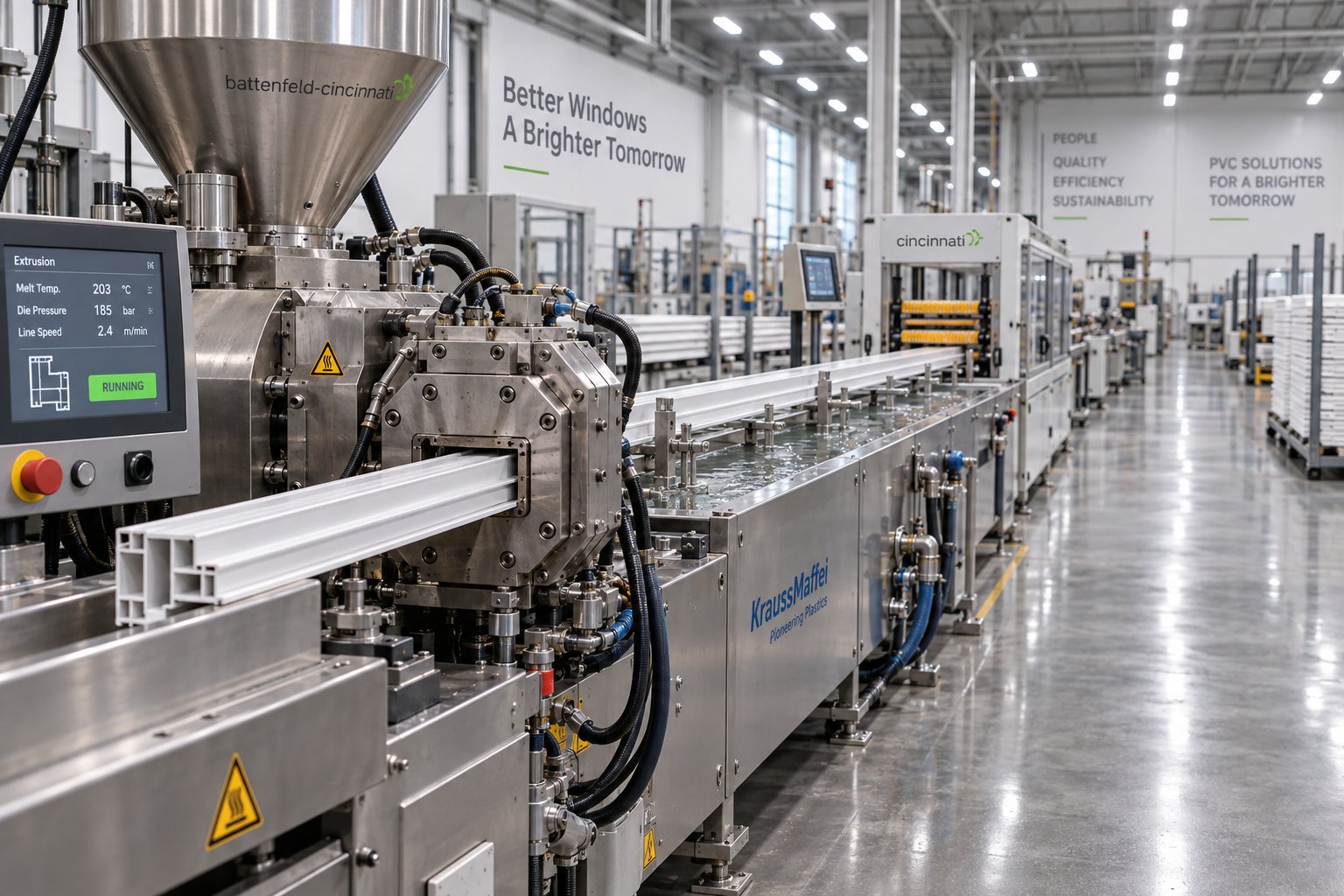
A PVC window profile extrusion line is a complete, integrated production system that converts PVC dry-blend compound into finished multi-chamber window and door profiles through continuous extrusion, calibration, cooling, and precision cutting.
The process moves through several tightly coordinated stages: raw material compounding and mixing, melt extrusion through a shaped die, vacuum calibration to lock in the profile geometry, cooling baths to solidify the shape, haul-off units that maintain steady line speed, and finally cutting and stacking. Each stage feeds directly into the next, creating an unbroken flow from powder to packaged profile.
What sets a PVC window door profile extrusion line apart from pipe or board extrusion? Geometric complexity. Window profiles feature intricate hollow cross-sections with multiple internal chambers — thin-walled structures designed for thermal insulation and structural reinforcement. Surface finish requirements are also far more demanding, since the extruded profile becomes a visible architectural element. These factors make die design, calibration precision, and melt uniformity especially critical.
Why PVC Dominates Modern Window Manufacturing
PVC holds the largest material share in the global plastic door and window market, valued at roughly 173 billion USD in 2024 and projected to reach 276 billion USD by 2035. The reasons are straightforward: rigid PVC delivers excellent weather resistance, thermal insulation, dimensional stability, and low maintenance — all at a competitive cost point. These properties make it the default choice for fenestration manufacturers across Europe, North America, and rapidly urbanizing markets in Asia-Pacific.
What This Guide Covers
This guide serves as a vendor-neutral educational resource covering the full PVC door and window profile extrusion line ecosystem. You will find detailed breakdowns of every process stage, core and downstream machinery, profile types and their extrusion demands, screw and die engineering, industry standards, and modern innovation trends. Whether you are evaluating a PVC windows profile extrusion line for a new facility or optimizing an existing setup, each section builds on the last to give you a complete technical picture — starting with the step-by-step extrusion process itself.
Complete Step-by-Step PVC Window Profile Extrusion Process
A list of PVC window profile extrusion line stages can look deceptively simple on paper. In practice, each step involves precise temperature control, mechanical coordination, and material science. Here is the full walkthrough — from loose powder to a finished window profile ready for fabrication.
- Raw material compounding and mixing — hot-cold mixer system blends PVC resin with additives.
- Feeding and dosing — dry blend is conveyed to the extruder hopper at a controlled rate.
- Plastication and melt extrusion — the conical twin-screw extruder generates a homogeneous melt.
- Die shaping — molten PVC flows through a precision-engineered profile die.
- Vacuum calibration — the soft extrudate conforms to calibrator plates under negative pressure.
- Cooling — spray or immersion baths solidify the profile completely.
- Haul-off — caterpillar or belt units pull the profile at consistent line speed.
- Cutting — flying-saw or guillotine cutters separate profiles to length.
- Stacking and packaging — automated systems collect, protect, and bundle finished profiles.
Raw Material Compounding and Mixing
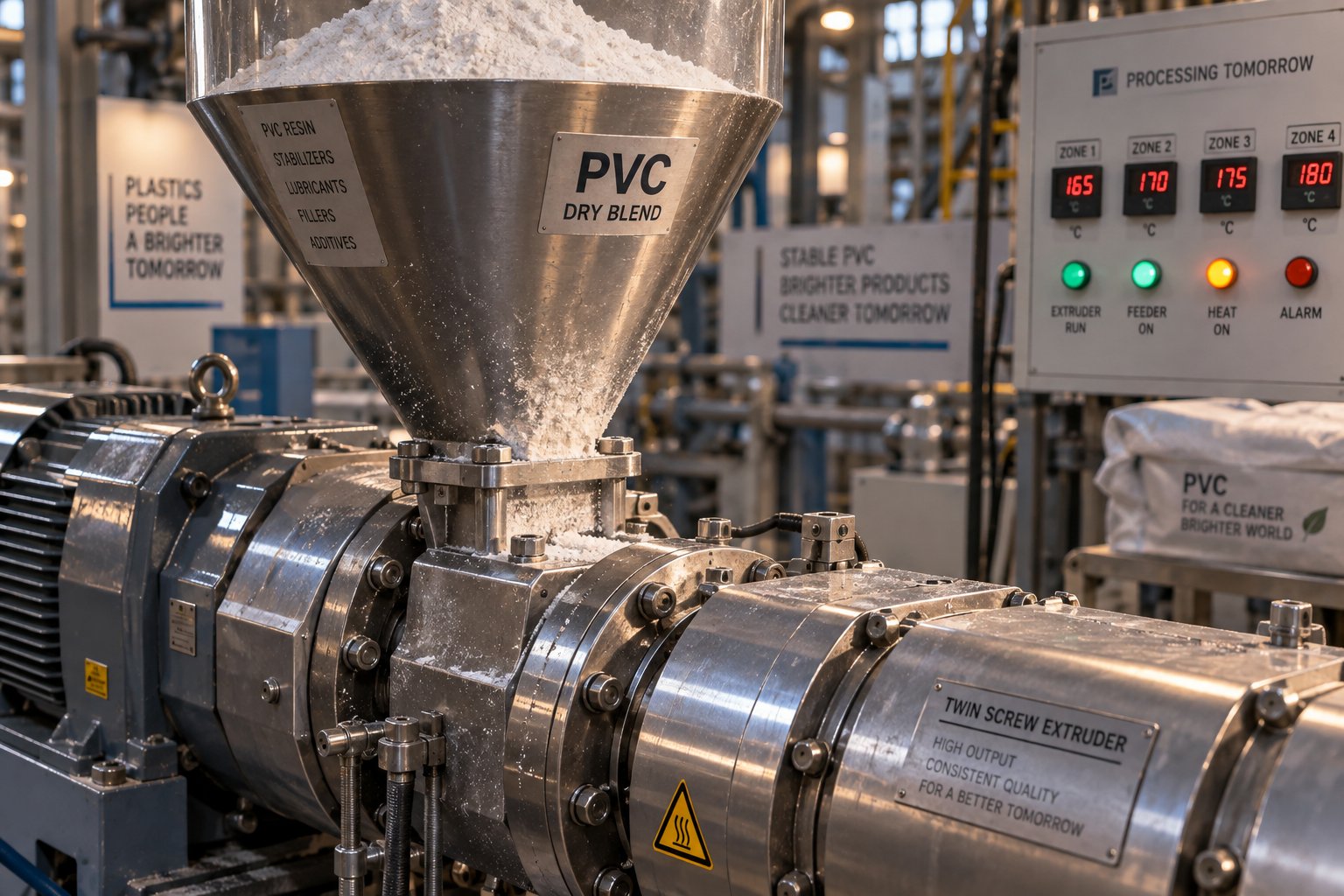
Everything starts in the hot-cold mixer system. PVC resin — typically suspension-grade K-value 65 to 68 — enters the high-speed hot mixer along with heat stabilizers, impact modifiers, processing aids, internal and external lubricants, pigments like titanium dioxide, and mineral fillers such as calcium carbonate.
Inside the hot mixer, high-speed rotating blades create intense friction and shear. Material temperature climbs steadily, and at around 100 degrees Celsius, moisture and volatile substances begin to escape. By the time the blend reaches 110 to 120 degrees Celsius, low-melting-point additives have melted and coated individual PVC particles, producing a partially gelled, homogeneous dry blend with high apparent density. Discharging below this range leaves the blend unevenly plasticized; exceeding it risks consuming stabilizers prematurely and degrading the compound before it even reaches the extruder.
The hot blend transfers immediately into a cold mixer — typically about three times the volume of the hot mixer — where a water-cooled jacket brings the temperature down to roughly 40 degrees Celsius. Skipping this step invites moisture reabsorption and degradation during storage. Once cooled, the dry blend moves to storage silos or directly to the extruder hopper through pneumatic conveying. Feeding accuracy matters here: volumetric feeders work well for straightforward formulations, while gravimetric feeders deliver higher precision when multi-component recipes or tight tolerances demand consistent dosing by weight.
Plastication and Melt Extrusion Through the Die
The heart of any PVC window profile extrusion line for business-scale production is the conical twin-screw extruder. Counter-rotating conical screws — with a large feed diameter tapering to a smaller metering zone — pull the dry blend inward, compress it progressively, and convert it into a uniform melt through a combination of shear heat and barrel zone heating.
Why conical twin screws rather than parallel designs? The tapered screw geometry provides a naturally large feed opening that accommodates PVC dry blend with its relatively low bulk density. As the channel narrows, compression builds gradually, delivering thorough gelation without subjecting the heat-sensitive PVC to aggressive thermal spikes. Parallel twin-screw extruders offer advantages at larger sizes and higher throughputs, but conical machines remain the standard for small and medium rigid PVC profiles because they provide positive conveying, stable pressure, and good mixing within a compact footprint.
As the melt reaches the metering zone, pressure builds against the die head. The homogeneous melt — ideally above 60 to 70 percent gelation for optimal mechanical properties — flows through a precision-machined profile die that shapes it into the target multi-chamber cross-section. Melt temperature, pressure, and screw speed must stay within a narrow processing window; even small fluctuations show up as dimensional variation or surface defects in the finished profile.
Vacuum Calibration, Cooling, and Downstream Processing
The profile exits the die as a hot, pliable shape that still needs to be locked into its final dimensions. Vacuum calibration tanks handle this critical transition. Precision-machined calibrator plates surround the extrudate, and negative pressure forces the soft PVC outward against these plates, establishing exact wall thicknesses and chamber geometry. Multi-zone vacuum control allows operators to fine-tune pressure along the length of the calibration table — essential for complex hollow sections with thin walls.
Downstream of the calibrators, spray cooling or immersion baths draw residual heat from the profile until it is fully rigid. The best PVC window profile extrusion line configurations use multi-zone temperature-controlled water systems to prevent warping from uneven cooling. Longer calibration and cooling sections are typical for thick, multi-chamber window profiles compared to simpler shapes like cable trunking.
A haul-off unit — usually a caterpillar-type puller with adjustable contact pressure — grips the cooled profile and maintains constant line speed synchronized with the extruder output. Too much grip pressure can deform hollow chambers; too little causes slippage and length inconsistency. At the end of the line, a flying-saw cutter operates without stopping production, slicing profiles to programmed lengths in a single pass. Automated stacking systems then collect, align, and bundle the cut profiles, often applying protective film to visible surfaces before packaging.
Each of these downstream stages must keep pace with the extruder. A mismatch in cooling capacity, haul-off speed, or cutting cycle time becomes the bottleneck that limits overall throughput — which is why understanding each piece of equipment in detail matters just as much as understanding the extruder itself.
Core Machinery and Upstream Equipment in a PVC Window Profile Extrusion Line
Knowing the process sequence is one thing. Understanding the actual hardware that makes each step possible is where purchasing decisions and production quality are won or lost. Every machine in the line — from the storage silo to the co-extrusion head — influences output rate, dimensional accuracy, and surface finish. Here is a closer look at the upstream and core equipment that forms the backbone of any PVC window profile extrusion line.
Material Storage, Blending, and Feeding Systems
High-volume production demands more than bags of compound stacked on a warehouse floor. Dedicated silo storage systems hold large quantities of pre-mixed dry blend, protecting it from moisture and contamination while feeding the line continuously. Pneumatic conveying transfers the compound from silos to automated blending stations and then into the extruder hopper — eliminating manual handling and reducing the risk of batch-to-batch inconsistency.
The feeding stage is where many operators underestimate the impact on finished profile quality. Two main feeder types serve this role:
- Volumetric feeders — measure material by volume per unit time. They are simpler, lower in cost, and perfectly adequate for single-formulation lines where bulk density stays consistent.
- Gravimetric feeders — measure material by weight in real time, adjusting feed rate dynamically. They deliver higher accuracy and are the better choice for multi-component formulations, color changes, or operations where tight dimensional tolerances leave no room for dosing drift.
Imagine running a line at 200 kg/h and discovering that a two-percent feed rate fluctuation has shifted your profile wall thickness outside specification. Gravimetric systems catch that deviation before it reaches the extruder. For any manufacturer producing window profiles bound for markets with strict compliance requirements, the investment in weight-based feeding pays for itself through reduced scrap.
Conical vs Parallel Twin-Screw Extruders for PVC Profiles
The extruder is the heart of the production line, and for rigid PVC window profiles, the conical twin-screw extruder remains the dominant choice globally. Common configurations — such as 51/105 mm, 65/132 mm, and 80/156 mm — refer to the small-end and large-end diameters of the tapered screws. This geometry is not arbitrary. The large feed zone accepts PVC dry blend at its relatively low bulk density, while the progressively narrowing channel compresses the material into a dense, thoroughly gelled melt at the metering end.
What makes this design ideal for PVC? Counter-rotating conical screws generate high compression ratios through their natural taper, achieving thorough gelation without relying on aggressive screw elements that could overheat the polymer. PVC is notoriously heat-sensitive — excessive thermal input causes degradation, discoloration, and weakened mechanical properties. The conical design keeps shear forces gentle and controllable, which is exactly what complex multi-chamber window profiles require.
Parallel twin-screw extruders offer their own advantages, especially at larger sizes and higher throughputs. They provide greater screw design freedom, wider processing windows, and easier length extension for increased output. However, for small to medium profile extrusion — which covers the majority of window and door applications — conical machines deliver positive conveying, stable melt pressure, and excellent mixing in a compact footprint. Many a China PVC window profile extrusion line manufacturer builds standard production systems around conical extruders for precisely these reasons, reserving parallel designs for specialized high-capacity or large-pipe applications.
The table below consolidates key specifications across common conical twin-screw extruder sizes used in PVC window profile production:
| Extruder Model (mm) | Screw Diameter (Small/Large End) | Typical Output (kg/h) | Suitable Profile Width | Common Application |
|---|---|---|---|---|
| 51/105 | 51 mm / 105 mm | 80 – 150 | Up to 150 mm | Glazing beads, small trim profiles |
| 65/132 | 65 mm / 132 mm | 150 – 250 | Up to 250 mm | Standard casement and sash profiles |
| 80/156 | 80 mm / 156 mm | 250 – 400 | Up to 400 mm | Wide frame, tilt-and-turn, sliding profiles |
| 92/188 | 92 mm / 188 mm | 350 – 500+ | Up to 400 mm+ | High-output multi-cavity production |
Output figures are planning references — actual throughput depends on profile complexity, formulation, and downstream capacity. The 65/132 configuration, for instance, is one of the most widely deployed sizes globally, handling the bulk of standard window frame and sash production at moderate speeds with reliable gelation quality.
Extrusion Die and Co-Extrusion Heads
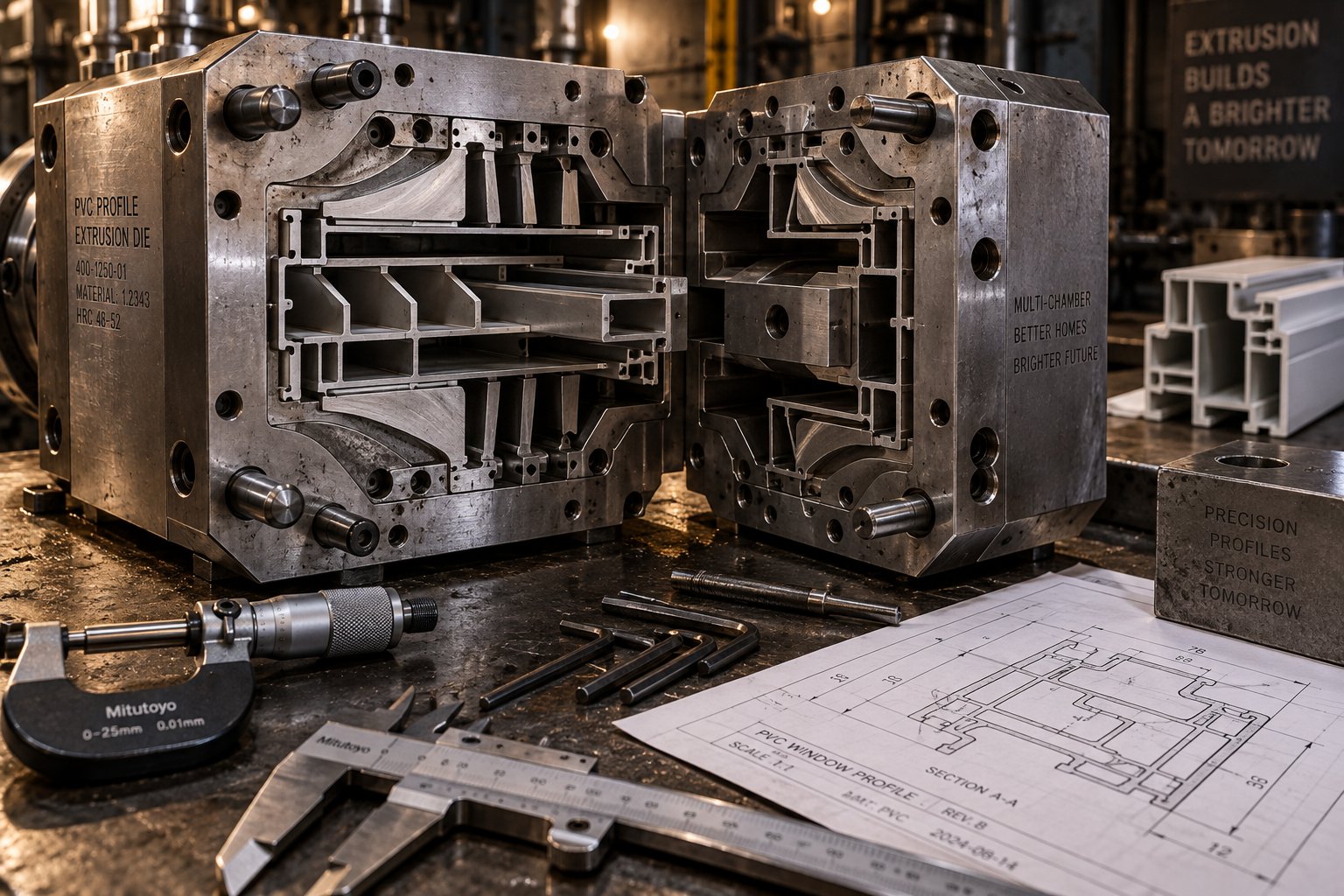
If the extruder is the heart, the die is the fingerprint — it defines the exact cross-sectional shape of every profile that leaves the line. PVC window profile dies are far more complex than pipe or sheet dies because they must form multiple hollow chambers, thin dividing walls, gasket grooves, and steel reinforcement channels in a single pass.
Several die design factors directly affect finished profile quality:
- Flow channel balancing — uneven flow through the die results in walls that are thicker on one side and thinner on the other. Engineers use flow simulation software and iterative die tuning to achieve uniform melt distribution across every chamber.
- Die land length — the parallel section at the die exit controls melt relaxation and surface finish. Too short a land produces rough surfaces; too long increases back pressure unnecessarily.
- Multi-cavity configurations — a single extruder can feed a die producing two or more profiles simultaneously. This effectively doubles throughput from one machine, though it demands even more precise flow balancing.
Co-extrusion heads add another layer of capability. By introducing a secondary extruder feeding a thin cap layer of ASA or PMMA over the main PVC body, manufacturers achieve superior UV resistance and color stability on exterior-facing surfaces. This is especially relevant for profiles destined for markets where prolonged sun exposure would otherwise cause yellowing or chalking. Color-matched co-extrusion also enables decorative wood-grain or custom-color finishes without altering the core PVC formulation. As noted in HUADEMAC's technical reference, ASA/PMMA cap layers are an optional but increasingly common feature in modern PVC window profile extrusion line configurations from China and Europe alike.
The die and co-extrusion head are inherently project-specific — profile drawings must be finalized before tooling can be engineered. For any pvc window profile extrusion line factory in China or elsewhere, the die design phase is where engineering expertise matters most, because even the finest extruder and downstream equipment cannot compensate for a poorly balanced die.
Downstream Equipment from Calibration to Stacking
The die shapes the melt, but everything that happens afterward determines whether the finished profile actually meets dimensional tolerances and surface quality standards. Downstream equipment is where a good profile becomes a sellable one — or where subtle defects quietly erode margins through scrap and rework. Here is the full equipment chain, in order, from the moment the hot extrudate exits the die to the moment packaged profiles leave the production floor.
- Vacuum calibration table — shapes and sizes the soft extrudate under negative pressure
- Spray cooling bath — removes heat through direct water contact
- Immersion cooling tank(s) — fully solidifies the profile in temperature-controlled water
- Haul-off unit — maintains consistent pulling speed synchronized with extruder output
- Flying-saw or guillotine cutter — separates profiles to programmed lengths
- Tilt table — redirects cut profiles from the line onto a collection surface
- Profile stacker — collects and arranges profiles into organized bundles
- Protective film applicator — applies adhesive film to visible surfaces
- Inline quality inspection system — verifies dimensions and detects surface defects
Vacuum Calibration Tables and Cooling Baths
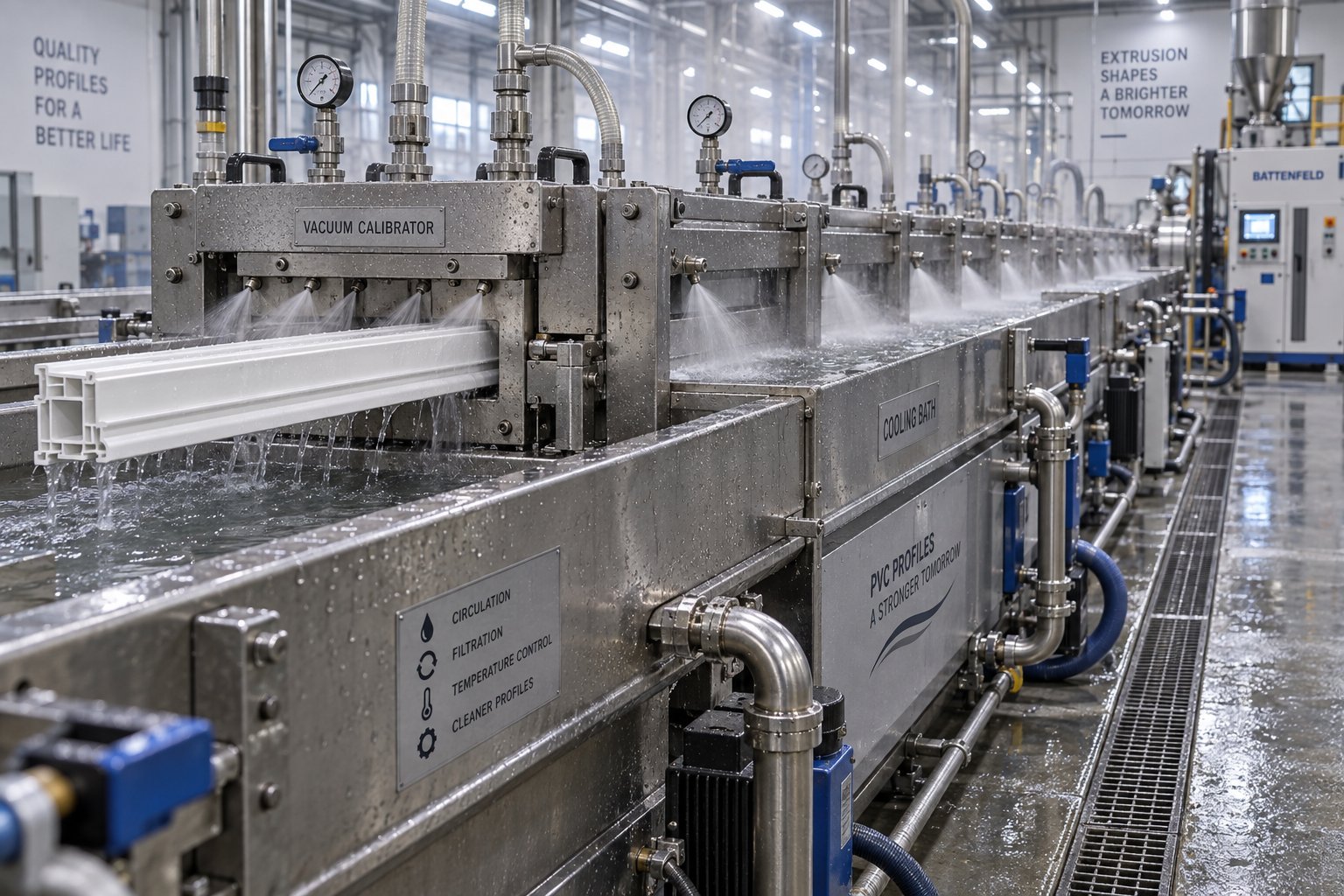
The profile leaves the die soft and pliable — it has the right general shape but none of the dimensional precision a finished window frame requires. Vacuum calibration is the critical transition where that changes. Inside the calibration table, precision-machined calibrator plates surround the extrudate. Negative pressure — generated by vacuum pumps connected to sealed chambers — forces the soft PVC outward against these plates, locking in exact wall thicknesses, chamber geometry, and external dimensions.
Two calibration approaches are common. Dry calibration uses metal contact surfaces without water inside the calibration zone itself, relying on downstream cooling to remove heat. Wet calibration introduces a water film directly at the calibrator plates, which accelerates heat extraction and reduces friction between the profile and the tooling. For complex multi-chamber window profiles with thin internal walls, wet calibration generally delivers better dimensional stability because it draws heat away more uniformly from all surfaces.
Multi-zone temperature control matters more than many operators realize. A hollow window profile cools unevenly — thick outer walls retain heat longer than thin internal dividers. If the cooling rate is not managed across multiple independent water zones, internal stresses build up, causing warping or post-extrusion shrinkage that shows up during window fabrication. The best calibration and cooling systems let operators set independent water temperatures and flow rates for each zone, giving fine control over how quickly different sections of the profile solidify. Longer calibration and cooling sections — sometimes stretching six meters or more — are typical for wide, multi-chamber profiles compared to simpler geometries.
Downstream of the calibrators, spray cooling baths and immersion tanks finish the job. Spray systems work well for initial rapid cooling, while immersion tanks provide uniform temperature reduction across the full profile cross-section. Many production lines use both in sequence.
Haul-Off Units and Cutting Systems
A cooled profile still needs to move through the line at a precisely controlled speed. The haul-off unit handles this, gripping the profile and pulling it forward at a rate synchronized with the extruder output. Even small speed mismatches cause problems — too fast stretches the profile and thins walls; too slow compresses the melt behind the die and distorts dimensions.
Two main haul-off types serve PVC window profile lines. Caterpillar haul-offs use upper and lower tracks composed of individual rubber blocks that grip the profile across a wide contact area. Belt haul-offs use continuous belts instead. Both designs can be configured with upper and lower units driven independently or with one driven and one following by friction. For hollow PVC profiles, contact pressure is a critical setting — too much grip force crushes thin-walled chambers, while too little causes slippage and inconsistent pulling speed.
At the cutting station, two dominant technologies apply. Flying-saw cutters move with the profile during the cut, matching line speed so the extrusion never stops. This is the standard choice for high-output production lines where any interruption costs throughput. Guillotine cutters, by contrast, clamp the profile momentarily and cut with a downward blade stroke. They are simpler and work well for smaller profiles or lower line speeds. Cut quality deserves attention here — a rough or angled cut creates problems during downstream window fabrication, where profile ends must join at precise miter angles for welded corners. Clean, burr-free cuts reduce secondary finishing and improve weld strength.
Automated Stacking, Packaging, and Quality Inspection
After cutting, profiles need to move off the line without damage. Tilt tables receive the cut lengths and redirect them laterally onto collection racks or stacking systems. Automated profile stackers then arrange them in uniform layers, ready for strapping and shipping. For profiles with high-gloss or decorative surfaces, protective film applicators lay down an adhesive film before stacking to prevent scratches and surface marring during transport and storage.
Quality inspection is increasingly moving inline rather than relying on periodic manual sampling. Radar-based and laser measurement systems can verify wall thickness, overall dimensions, and roundness in real time as the profile moves through the line. These systems detect process drift early — before non-conforming product accumulates — and enable operators to make corrections before scrap piles up. Surface defect detection systems using camera arrays and image analysis add another layer, catching discoloration, streaks, or dents that manual inspection would miss at production speeds.
Any China PVC window profile extrusion line factory offering complete turnkey systems typically includes these downstream components as standard or optional packages. When evaluating a China PVC window profile extrusion line for sale, pay particular attention to the calibration table length, cooling capacity, and haul-off pressure range — these downstream specifications often determine whether the line can handle the most complex profiles in your product portfolio or only the simplest ones. For buyers sourcing through a China PVC window profile extrusion line wholesale channel, confirming downstream equipment quality is just as important as verifying the extruder itself.
With the full equipment chain mapped out — from feeding to stacking — the next question becomes how different window profile designs actually change the demands placed on this machinery. A simple two-chamber glazing bead and a seven-chamber tilt-and-turn frame profile look nothing alike in cross-section, and they behave very differently on the production line.
Window Profile Types and Their Extrusion Demands
Not every window profile is created equal — and not every extrusion line can handle them all. A simple casement frame with three internal chambers and a complex tilt-and-turn sash with seven chambers, steel reinforcement channels, and co-extruded gasket seats are fundamentally different engineering challenges. The profile you need to produce dictates the extruder capacity, die complexity, calibration precision, and line speed your equipment must deliver. Understanding these differences is essential before investing in machinery or planning a new product line.
Casement, Sliding, and Tilt-and-Turn Profile Requirements
Each window mechanism places distinct demands on the profile cross-section — and consequently, on the PVC window profile extrusion line producing it.
Casement profiles are the simplest of the three. A casement window is hinged at the side and opens outward with a crank, pulling the sash tight against the frame's weatherstripping through a multi-point locking system. The profiles themselves feature relatively straightforward geometry — typically three to five internal chambers — with moderate wall thicknesses and fewer gasket grooves. This simplicity translates directly into easier die design, faster line speeds, and lower scrap rates during production. For manufacturers just entering the market, casement profiles are often the starting point because they require less plasticizing capacity and less precise calibration compared to more complex designs.
Sliding profiles introduce a different set of challenges. Sliding windows consist of sashes that glide horizontally past each other in a track, which means the profiles must incorporate smooth, low-friction track surfaces — often achieved through co-extrusion with a harder or lower-friction cap layer. Sliding profiles tend to be wider than casement profiles to accommodate the interlocking track geometry, which pushes the die width and calibration table dimensions upward. The track surfaces also demand tighter dimensional tolerances, since even minor irregularities cause binding or uneven operation. Many PVC window profile extrusion line configurations in Germany and Austria feature co-extrusion capability specifically to serve the sliding window segment, where surface quality on the track directly affects the end user's experience.
Tilt-and-turn profiles sit at the top of the complexity spectrum. These European-style windows use a single handle to either tilt the sash inward from the top for ventilation or swing it fully inward like a door. As the Ecohome green building guide notes, tilt-and-turn windows feature robust multi-point locking hardware and compression seals designed to handle the weight of triple-pane glazing — which means the profiles themselves must be engineered with complex multi-chamber cross-sections, steel reinforcement channels, and multiple gasket grooves. Five-chamber, six-chamber, and even seven-chamber designs are common, each additional chamber improving thermal insulation but also increasing die complexity significantly.
How does chamber count affect thermal performance? Each sealed air chamber acts as an insulating barrier. A three-chamber profile might suit mild climates, while a seven-chamber design targets Passive House performance levels in cold-climate markets across the Netherlands, Scandinavia, and Central Europe. More chambers mean thinner internal dividing walls, tighter dimensional tolerances, and a die that must balance melt flow across many more parallel channels simultaneously — a genuine engineering challenge.
Mullion, Sash, and Frame Profiles
A complete window system is never a single profile. You will find at least four distinct cross-sections in any standard PVC window:
- Frame profile — the outermost section fixed into the building's rough opening. It is typically the widest and most rigid, with the largest number of chambers and the thickest outer walls.
- Sash profile — the movable component that holds the glass and fits inside the frame. Sash profiles must accommodate glazing bead attachment, gasket channels, and hardware mounting points while remaining light enough for smooth operation.
- Mullion profile — a vertical or horizontal divider that joins multiple window units into a single assembly. Mullions carry structural loads from wind pressure and must maintain alignment across wide spans, so their cross-sections are engineered for stiffness.
- Glazing bead — the smallest and simplest profile in the system, snapping into the sash to secure the glass unit. Glazing beads often have asymmetric cross-sections and fine snap-fit details that demand precise calibration despite their small size.
A single extrusion line can produce all these profile types — but not simultaneously. Each profile requires its own die and matching calibrator set. This is where quick-change die systems become valuable. Instead of hours-long die changeovers that consume raw material during startup purging and waste production time, quick-change setups use pre-heated die cassettes that slide into position and reach stable production within a fraction of the traditional changeover window. For any manufacturer serving multiple window system designs or running smaller batch sizes, die changeover speed directly affects overall equipment effectiveness.
Manufacturers operating a PVC window profile extrusion line in Spain or other markets with diverse product portfolios — where casement, sliding, and tilt-and-turn systems all ship from the same plant — often schedule production in campaigns, running each profile type for several shifts before switching dies. Quick-change systems can cut changeover time from two or three hours down to under 45 minutes, reclaiming significant production capacity over a year.
How Profile Complexity Affects Line Configuration
Here is the practical reality: every additional chamber, every thinner wall, and every tighter gasket groove in the profile design places higher demands on the machinery behind it. The connections are direct and measurable.
Plasticizing capacity — complex profiles with thin, multi-chamber walls require extremely uniform melt quality. Even slight gelation inconsistencies show up as weak spots in thin dividing walls or surface roughness on visible faces. Larger extruders with higher L/D ratios and more sophisticated screw designs are often necessary to achieve the melt homogeneity that seven-chamber profiles demand. A 65/132 mm conical twin-screw extruder handles most standard casement profiles comfortably, but a seven-chamber tilt-and-turn frame may benefit from an 80/156 mm machine to ensure sufficient plasticizing at the required throughput.
Calibration precision — as internal wall thickness drops below 1.5 mm, vacuum calibration must hold tighter tolerances across more surfaces simultaneously. Multi-zone vacuum control becomes essential rather than optional, and calibration table length typically increases to allow gradual, uniform solidification of every chamber wall.
Line speed — more complex profiles generally run at slower line speeds. A three-chamber casement profile might extrude at 2.5 to 4 meters per minute, while a seven-chamber tilt-and-turn frame profile with co-extruded gasket seats might run at 1.0 to 2.0 meters per minute. Slower speeds allow more time for uniform cooling and reduce the risk of dimensional drift in thin-walled sections.
Wall thickness uniformity in hollow chambers is one of the most challenging quality aspects in PVC profile extrusion. Internal dividing walls are not visible in the finished product, yet they determine both thermal insulation performance and structural integrity. If melt distribution through the die is unbalanced — even by fractions of a millimeter — some chamber walls become thinner than specification while others become thicker. This creates weak points under wind load and reduces the profile's insulation value compared to its design intent. Detecting these variations requires inline measurement systems, since manual cross-section checks at periodic intervals can miss gradual process drift.
| Profile Type | Typical Chamber Count | Outer Wall Thickness | Internal Wall Thickness | Extrusion Complexity |
|---|---|---|---|---|
| Casement frame | 3 – 5 | 2.5 – 3.0 mm | 1.5 – 2.0 mm | Moderate |
| Sliding frame | 3 – 5 | 2.5 – 3.0 mm | 1.5 – 2.0 mm | Moderate to High (co-extrusion for track surfaces) |
| Tilt-and-turn frame | 5 – 7 | 2.8 – 3.0 mm | 1.2 – 1.8 mm | High (multi-chamber, reinforcement channel) |
| Tilt-and-turn sash | 4 – 6 | 2.5 – 3.0 mm | 1.2 – 1.5 mm | High (hardware grooves, gasket seats) |
| Mullion | 3 – 5 | 2.5 – 3.0 mm | 1.5 – 2.0 mm | Moderate to High (structural stiffness required) |
| Glazing bead | 1 – 2 | 1.5 – 2.0 mm | N/A | Low to Moderate (fine snap-fit details) |
These values represent typical industry ranges. Actual specifications vary by window system design and regional standards — a profile engineered for the Austrian market's energy efficiency requirements, for instance, may feature thicker outer walls and additional chambers compared to a profile designed for milder climates in southern Spain.
The takeaway is clear: profile design and line configuration are inseparable decisions. Choosing your product range before specifying machinery ensures you do not end up with an extruder that cannot deliver the melt quality your most complex profile demands — or downstream equipment that cannot maintain tolerances on your thinnest chamber walls. And behind every well-performing line, the screw geometry and die engineering are doing the invisible work that makes uniform, multi-chamber extrusion possible in the first place.
Screw Design and Die Engineering for PVC Profiles
Profile complexity drives machinery requirements — but inside the extruder, it is the screw geometry and die engineering that translate raw polymer into a dimensionally stable, multi-chamber cross-section. These two components determine whether the melt reaches the right gelation level, flows uniformly through every channel, and exits the die with the wall thickness consistency that downstream calibration can refine but never fix from scratch. Understanding how screw design and die engineering interact is essential for anyone evaluating PVC window profile extrusion line cost against expected production quality.
How Screw Geometry Affects PVC Gelation
Gelation is the process by which individual PVC particles fuse into a continuous, homogeneous melt. The degree of gelation directly controls the mechanical properties, impact resistance, and surface finish of the finished profile. Industry targets typically call for gelation levels above 60 to 70 percent — profiles below this threshold exhibit poor weld line strength, rough surfaces, and reduced long-term durability.
Several screw design parameters govern how effectively gelation occurs:
- Compression ratio — the volume ratio between the first and last screw flights. Higher compression ratios generate more shear and pressure, driving PVC particles together more aggressively. As Plastics Today notes, typical compression ratios fall between 2:1 and 4:1, but PVC screws lean toward the higher end to ensure thorough fusion of heat-sensitive resin.
- L/D ratio — the length-to-diameter ratio of the screw. Longer screws provide more residence time for heat transfer and mixing. Most PVC profile extruders operate in the 22:1 to 26:1 L/D range, balancing sufficient gelation time against the risk of thermal degradation from excessive exposure.
- Barrier flights and mixing elements — barrier screw sections separate molten and unmelted material into parallel channels, forcing the melt to pass over a barrier ridge and ensuring that ungelled particles receive additional shear. Mixing elements — whether pins, grooves, or kneading blocks — disrupt streamlined flow, improving melt homogeneity. In twin screw systems, the interscrew shear regions add further mixing intensity that single screw designs simply cannot replicate.
- Channel depth progression — the transition from a deep feed zone to a shallow metering zone creates the compressive force that drives gelation. Too abrupt a transition generates localized hot spots; too gradual leaves the melt insufficiently fused at the die entry.
Why do conical twin-screw designs handle these demands so effectively for PVC? Their tapered geometry provides natural, progressive compression from the wide feed end to the narrow discharge end. This eliminates the need for highly aggressive screw elements that would generate excessive shear heat — a serious concern with PVC, where thermal degradation begins only a narrow margin above processing temperature.
Conical twin-screw extruders dominate PVC window profile production because their tapered screw geometry delivers high compression and thorough gelation through gradual volume reduction rather than aggressive shear elements — keeping heat-sensitive PVC within its narrow safe processing window while achieving the melt uniformity that multi-chamber hollow profiles demand.
Multi-Cavity Die Engineering for Window Profiles
Even a perfectly gelled melt produces a defective profile if the die distributes it unevenly. Die engineering for PVC window profiles is a specialized discipline — far more demanding than pipe or sheet die design — because the melt must flow through dozens of narrow, irregularly shaped channels that form hollow chambers, thin dividing walls, and gasket grooves simultaneously.
Several design factors determine whether a die delivers uniform wall thickness across the entire profile cross-section:
- Flow channel balancing — each section of the profile requires a specific volume of melt per unit time. Engineers adjust individual channel dimensions so that thicker outer walls and thinner internal dividers all fill at the same rate. Research at Swansea University demonstrated that computational optimization of die cavity cross-sections for uPVC window profiles — using parameterized contours and flow analysis — can achieve design quality comparable to or better than manual expert adjustments while reducing designer time by a factor of seven.
- Die land length — the parallel section at the die exit where the melt stabilizes before emerging. A longer land produces a smoother surface finish and more uniform velocity profile, but increases back pressure. Too short a land allows melt relaxation to distort the profile shape before calibration can intervene.
- Spider and mandrel design — hollow chambers require internal mandrels (core pins) supported by spider legs within the die. These supports split the melt flow and rejoin it downstream, creating weld lines in the extrudate. Spider geometry must minimize flow disruption and ensure weld lines close cleanly, or visible streaks and structural weak points appear in the finished profile.
- Die lip adjustment — fine-tuning screws at the die exit allow operators to make small corrections to wall thickness during production. This iterative adjustment process is essential when commissioning new profile geometries, as even the best computational designs require empirical refinement on the actual production line.
Multi-cavity dies — where a single extruder feeds two or more profile shapes simultaneously — multiply these challenges. Each cavity must receive precisely balanced flow, and any imbalance causes one profile to run thick while the other runs thin. The payoff is significant: doubling output from a single extruder with no additional plasticizing equipment. But the die engineering investment and tuning time increase substantially.
Matching Screw and Die to Production Targets
Production targets are ultimately expressed in two numbers: output rate in kilograms per hour and line speed in meters per minute. These targets determine the required extruder size, screw configuration, and die design — and getting the match wrong is one of the most expensive mistakes a manufacturer can make.
A larger extruder — say an 80/156 mm conical twin-screw instead of a 65/132 mm — delivers more plasticizing capacity and higher throughput. But higher throughput means the die must handle a greater volume of melt, the calibration table must extract more heat, the cooling baths need more capacity, and the haul-off and cutter must keep pace. Every downstream component scales together. Investing in a larger extruder without upgrading downstream equipment simply moves the bottleneck rather than eliminating it.
Screw speed also plays a role. Running faster increases output but raises melt temperature through additional shear heating. For PVC, this creates a ceiling: push too hard, and the melt begins to degrade before it reaches the die. The practical operating window for conical twin-screw extruders in PVC profile production typically stays below 30 to 35 rpm — far lower than the hundreds of rpm common in corotating twin-screw compounding — precisely because PVC's thermal sensitivity sets the boundary.
The precision of screw and barrel components influences plasticizing stability directly. Tight clearances between screw flights and the barrel wall — typically 0.1 to 0.25 mm on new equipment — ensure that the melt experiences consistent shear and compression across every revolution. As these clearances widen through wear, compression efficiency drops, gelation becomes inconsistent, and surface defects begin appearing in the extrudate. This gradual degradation is often invisible in output rate numbers but shows up clearly in profile quality metrics and downstream rejection rates.
When evaluating the PVC window profile extrusion line price from different suppliers, resist the temptation to compare only headline specifications like maximum output or motor power. The real value lies in how well the screw geometry, barrel metallurgy, and die engineering work together to maintain stable melt quality at your target production rate — shift after shift, month after month. A factory price PVC window profile extrusion line that saves twenty percent upfront but delivers inconsistent gelation will cost far more in scrap, rework, and customer complaints than a system engineered for long-term plasticizing stability.
That stability, of course, depends on the condition of the screw and barrel themselves — components that wear progressively under the abrasive, corrosive conditions of PVC processing. How that wear develops, what it does to profile quality, and how to address it through smart replacement choices is where operational knowledge meets practical sourcing decisions.
How Conical Twin Screw Barrel Quality Impacts Production
Screw and barrel wear is not a sudden failure — it is a slow, silent erosion of production quality. The clearances that were tight at commissioning gradually widen over thousands of operating hours, and the effects accumulate so incrementally that many operators adapt their process settings without realizing they are compensating for worn components. Understanding what happens inside a degraded barrel, recognizing the warning signs early, and knowing how to source the right replacement are practical skills that protect both product quality and production economics.
Why Barrel and Screw Wear Degrades Profile Quality Over Time
Every kilogram of PVC dry blend passing through a conical twin-screw extruder carries abrasive particles — calcium carbonate filler, titanium dioxide pigment, and trace contaminants — that gradually erode screw flight surfaces and barrel liner walls. Corrosive byproducts from PVC stabilizer decomposition, particularly hydrochloric acid released during processing, attack metal surfaces simultaneously. The combination of abrasion and corrosion widens the critical clearance between screw flights and barrel bore, and that gap is where production quality quietly disappears.
Here is what happens mechanically. Tight screw-barrel clearance — typically 0.1 to 0.25 mm on new equipment — ensures the melt experiences consistent shear and compression. As industry technical references confirm, increased clearance causes significant backflow over the flights, reducing conveying efficiency and compression. The melt no longer gels uniformly. Some PVC particles pass through under-sheared, creating micro-regions of poor fusion within the extrudate. On a finished window profile, this manifests as:
- Surface defects — rough patches, streaks, or dull spots on visible profile faces that no amount of calibration adjustment can eliminate
- Inconsistent gelation — weak spots in thin chamber walls where under-fused PVC reduces impact resistance and long-term weathering performance
- Melt fracture — irregular surface textures caused by unstable flow through the die, especially at higher output rates
- Dimensional variation — wall thickness drift as melt pressure fluctuates due to inconsistent compression in the worn barrel
The operational signs build gradually enough to be mistaken for other issues. You will notice increased energy consumption as the motor works harder to push more melt backward past worn flights. Startup times grow longer because the degraded screw cannot build melt pressure as efficiently. Output rate declines at the same screw speed, and operators compensate by raising temperatures — which accelerates PVC degradation and shortens stabilizer life. By the time visible surface imperfections become consistent enough to trigger quality alerts, the barrel and screws may have been operating below optimal performance for months.
For any pvc window profile extrusion line manufacturer producing profiles to tight tolerances — especially multi-chamber designs where internal wall thickness uniformity is critical — catching these signs early and planning replacement proactively is far less costly than absorbing weeks of elevated scrap rates.
Choosing the Right Replacement Conical Twin Screw Barrel
Replacing a worn barrel and screw set is not simply a matter of ordering parts by model number. The replacement components must match the original equipment's dimensional specifications precisely, resist the specific wear mechanisms present in PVC processing, and deliver the compression and shear characteristics that the original design intended. Generic replacements that approximate the right dimensions without matching metallurgical and geometric details often underperform — restoring output volume without restoring the melt quality that makes profiles saleable.
Several key selection criteria separate a reliable replacement from a compromise:
- Bimetallic liner materials — a dual-metal construction where a wear-resistant alloy lines the interior of a structural steel barrel. Industry data shows bimetallic barrels deliver three to seven times higher abrasion resistance than standard nitrided barrels, significantly extending replacement intervals in filled PVC formulations. For barrels processing PVC with high calcium carbonate loading, a bimetallic liner is not optional — it is the baseline for acceptable service life.
- Nitriding depth and hardness — for screw surfaces, gas nitriding creates a hard surface layer that resists abrasive wear. Nitriding depth typically ranges from 0.5 to 0.7 mm, and surface hardness targets of 950 to 1050 HV are common for PVC applications. Shallow or inconsistent nitriding leads to premature flight wear and accelerated clearance growth.
- Dimensional precision — the clearance between screw flights and barrel bore must fall within tight tolerances to maintain compression efficiency. Precision-manufactured conical barrels use alloy steels such as 38CrMoAlA or SACM645, machined to tolerances that keep clearance on the order of one-thousandth of the screw diameter. Any vendor who cannot provide dimensional inspection certificates for critical bores and tapers is a risk not worth taking.
- Material compatibility with PVC stabilizer systems — this is a detail many buyers overlook. Calcium-zinc stabilizers, now dominant in European markets due to lead-free mandates, produce different corrosion chemistry than traditional tin-based systems. The liner alloy must resist the specific acid and salt byproducts of the stabilizer package in your formulation. A barrel that performs well in a tin-stabilized PVC line may corrode prematurely in a calcium-zinc environment if the wrong alloy was specified.
- Custom machining to specific extruder models — conical twin-screw extruders from different OEMs use proprietary bore geometries, taper angles, and mounting interfaces. A barrel machined to fit a specific 65/132 mm extruder model from one pvc window profile extrusion line factory may not interchange with a nominally identical 65/132 mm machine from another manufacturer. Custom-machined replacements matched to exact OEM drawings outperform generic alternatives because they restore the original compression profile and clearance specifications that the extruder was designed around.
When sourcing replacements, the most common mistake — whether through a pvc window profile extrusion line dealer, wholesaler, or directly from a component manufacturer — is selecting on price alone without verifying metallurgical specifications and dimensional inspection data. A barrel that costs fifteen percent less but wears out forty percent faster is no bargain.
Sourcing Precision Conical Twin Screw Barrels for PVC Profile Extrusion
Finding a reliable barrel and screw supplier is a practical challenge for profile manufacturers worldwide. The component must be engineered for a specific extruder model, manufactured from verified materials, and delivered with the dimensional accuracy that restores original plasticizing performance. This is where specialist suppliers — as opposed to general machining shops — offer a measurable advantage.
NANHAIYA operates as a focused supplier of custom and replacement conical twin screw barrels serving PVC extrusion manufacturers. Their product range covers barrels designed for PVC pipe, profile, board, foam board, and WPC applications — the core product categories where conical twin-screw extruders dominate. For pvc window profile extrusion line supplier operations in China and globally, NANHAIYA's emphasis on stable plasticizing performance and production support addresses the specific reliability concerns that arise when replacing high-wear components on production-critical equipment.
When evaluating any conical twin screw barrel supplier, use the following criteria as a practical checklist:
- Application-specific experience — suppliers like NANHAIYA that specialize in PVC extrusion components understand the corrosion, wear, and thermal demands unique to PVC processing, unlike general-purpose machining providers
- Bimetallic and nitrided barrel options — the ability to specify liner alloys matched to your formulation's filler content and stabilizer chemistry
- Custom machining to OEM specifications — confirmed capability to manufacture barrels matched to specific extruder makes and models, not just generic size ranges
- Dimensional inspection and quality documentation — provision of bore taper measurements, surface hardness reports, and material certificates with every shipment
- Range of extruder size coverage — a supplier supporting 51/105 mm through 92/188 mm and beyond can serve your needs as production scales or diversifies
- Lead time and inventory support — barrel replacement is often urgent when quality has already begun degrading, so suppliers with efficient production cycles reduce costly downtime
Every pvc window profile extrusion line wholesaler and manufacturer in China recognizes that the extruder barrel is a consumable component — it will wear and it will need replacement. The question is not whether to replace it, but whether the replacement restores original performance or merely postpones the next quality problem. Investing in precision-manufactured, application-matched conical twin screw barrels is one of the most cost-effective ways to protect the production quality that your entire downstream equipment chain — calibration, cooling, cutting, and stacking — depends on.
Profile quality, of course, is not defined solely by what happens on the production line. The standards and certifications governing PVC window profiles vary significantly across global markets, and compliance requirements shape everything from formulation choices to inline inspection protocols.
Industry Standards and Global Compliance for PVC Window Profile Extrusion
Producing a dimensionally accurate, well-gelled PVC window profile is only half the challenge. The profile must also satisfy a web of regional standards and certifications before it can be installed in a building envelope. These standards dictate material composition, dimensional tolerances, weathering resistance, mechanical performance, and even marking requirements — and they differ meaningfully across markets. For manufacturers operating a pvc window profile extrusion line in France, Poland, or the United Arab Emirates, compliance is not optional paperwork. It shapes formulation decisions, quality control infrastructure, and extrusion line configuration from day one.
European Standards and EN 12608 Compliance
EN 12608 is the primary European standard governing PVC-U profiles for windows and doors. Developed by CEN/TC 249 (Plastics), it specifies classification, requirements, and test methods in multiple parts. Part 1 covers non-coated profiles with light-colored surfaces — the most common category in European fenestration — while additional parts address profiles covered with adhesive-bonded foils (Part 2), paint coatings (Part 3), and thermo-laminated foils (Part 4).
What does EN 12608-1 actually require? The standard organizes its requirements across several dimensions that directly affect how an extrusion line must be set up and controlled:
- Climatic zone classification — profiles are classified for moderate or severe climates, each carrying different weathering exposure requirements. The standard defines "moderate climate" as warm and humid conditions and "severe climate" as hot and dry conditions, with corresponding artificial weathering test durations simulating five to ten years of outdoor exposure.
- Wall thickness classes — main profiles are classified into Classes A, B, and C based on the minimum wall thickness of external walls, sight surfaces, and seal grooves. Class A demands the thickest walls and highest structural performance — a direct constraint on die design and calibration tolerances.
- Dimensional tolerances — nominal shape, profile depth, overall width, and wall thickness must fall within specified ranges. These tolerances translate into the precision your calibration table and inline measurement systems must consistently deliver.
- Mechanical properties — impact resistance testing per EN 477, heat reversion testing per EN 479, and welded corner strength testing per EN 514 all validate whether the extruded profile can withstand real-world stresses.
- Weathering and color fastness — artificial weathering per EN 513 simulates UV exposure, and post-exposure color change is measured using Delta E values. Profiles must maintain acceptable appearance after prolonged environmental cycling.
- Traceability and marking — every profile batch must be traceable, with markings including manufacturer name, EN standard reference, climatic zone, wall thickness classification, and production details.
Beyond EN 12608 itself, many European manufacturers pursue RAL quality marks — voluntary certifications administered by organizations like RAL Gutegemeinschaft Kunststoff-Fensterprofilsysteme. RAL certification requires ongoing factory audits, regular third-party testing, and documented quality management systems. For producers running a pvc window profile extrusion line in Italy or Sweden, a RAL mark signals to specifiers and architects that the profiles meet standards above and beyond the minimum EN requirements. Achieving and maintaining RAL certification demands rigorous inline quality control — dimensional checks, impact tests, and weathering evaluations performed continuously rather than on an ad-hoc basis.
North American AAMA Standards and Global Variations
The North American market follows a different regulatory framework. AAMA 303, published by the American Architectural Manufacturers Association, establishes voluntary minimum requirements for rigid PVC exterior profiles used in windows, doors, and skylights. The specification covers dimensional stability, impact resistance, heat resistance, weatherability, weight tolerance, heat buildup, and lead compound content. It also includes sections addressing co-extruded profile requirements and base profile requirements for organically coated profiles.
A companion test method — AAMA 1506 — evaluates heat buildup effects from infrared exposure on fenestration products, simulating summer solar conditions in hot, dry U.S. climates. This test is particularly relevant for darker-colored or co-extruded profiles that absorb more IR energy, making it a practical consideration for manufacturers producing profiles with decorative finishes or pigmented cap layers.
Other regional standards add further variation:
- AS/NZS standards (Australia and New Zealand) — address UV resistance requirements that are among the most demanding globally, reflecting intense solar exposure in southern hemisphere climates. Formulations must include robust UV stabilization packages, often requiring higher loadings of titanium dioxide and UV absorbers than European specifications.
- Lead-free mandates — the European Union effectively phased out lead-based stabilizers in PVC profiles, driving industry-wide adoption of calcium-zinc stabilizer systems. North American and Asian markets have followed at varying speeds. This shift is not just a formulation change — calcium-zinc chemistry produces different corrosion byproducts inside the extruder barrel, affecting wear rates and component material selection as discussed in the previous section.
- Tropical climate specifications — markets in Southeast Asia, the Middle East, and equatorial regions require enhanced UV resistance and color stability beyond what temperate-climate standards demand. A pvc window profile extrusion line in the United Arab Emirates, for example, must produce profiles that withstand extreme solar radiation and temperature cycling without warping, chalking, or significant color shift.
How Standards Affect Extrusion Line Setup and Quality Control
Compliance is not something you verify after the profile is made — it must be engineered into the production line itself. Each standard's requirements translate into specific equipment and procedural configurations:
Inline dimensional measurement systems — EN 12608's wall thickness tolerances and AAMA's dimensional stability requirements both demand continuous verification during production. Laser or radar-based measurement heads installed after the calibration table monitor wall thickness, overall width, and profile depth in real time, flagging deviations before non-conforming product accumulates.
Automated sampling protocols — standards like EN 12608 require periodic mechanical testing (impact resistance, heat reversion, weld strength) on production samples. Automated sample collection at defined intervals — rather than operator-dependent manual sampling — ensures consistent test frequency and reduces the risk of gaps in quality documentation.
Traceability systems — both EN 12608 and RAL certification require full batch traceability linking finished profiles to specific production runs, formulations, and raw material lots. Modern extrusion lines integrate this through MES (Manufacturing Execution Systems) that log extruder parameters, material batch codes, and quality test results against each production run automatically.
Manufacturers targeting export across multiple regions face the most complex configuration challenge. A single pvc window profile extrusion line in Poland producing profiles for domestic, German, Scandinavian, and Middle Eastern markets may need to satisfy EN 12608, RAL requirements, and regional UV resistance specifications simultaneously. This typically means running different formulations for different markets, with corresponding adjustments to processing temperatures, stabilizer loadings, and co-extrusion cap layer compositions — all tracked through the traceability system.
| Standard / Specification | Region | Key Requirements | Primary Testing Parameters |
|---|---|---|---|
| EN 12608 (Parts 1-4) | Europe (CEN members) | Wall thickness classes (A, B, C); climatic zone classification; color fastness; weathering resistance; traceability and marking | Impact resistance (EN 477); heat reversion (EN 479); artificial weathering (EN 513); weld corner strength (EN 514); Delta E color change |
| RAL Quality Mark | Europe (voluntary) | Exceeds EN 12608 minimums; ongoing factory audits; third-party testing; documented QMS | All EN 12608 tests plus enhanced frequency and audit requirements |
| AAMA 303 | North America | Dimensional stability; impact and heat resistance; weatherability; weight tolerance; heat buildup; lead content limits; co-extruded profile requirements | Heat buildup (AAMA 1506); dimensional stability; impact resistance; weathering exposure |
| AS/NZS series | Australia / New Zealand | Enhanced UV resistance; color stability under high solar exposure; dimensional tolerances | Accelerated UV weathering; color retention; mechanical property retention after exposure |
The practical lesson here is straightforward: the profiles your line produces must comply with the standards of every market you intend to serve — and your extrusion line's quality control infrastructure must be configured to verify and document that compliance continuously. Treating standards as an afterthought leads to rejected shipments, costly reformulations, and lost market access. Building compliance into line design from the outset — through inline measurement, automated sampling, and robust traceability — turns regulatory requirements into a competitive advantage rather than a burden. These same compliance capabilities also position manufacturers well for the industry shifts reshaping PVC profile extrusion: lead-free processing, recycled PVC integration, and the growing demand for energy-efficient production systems.
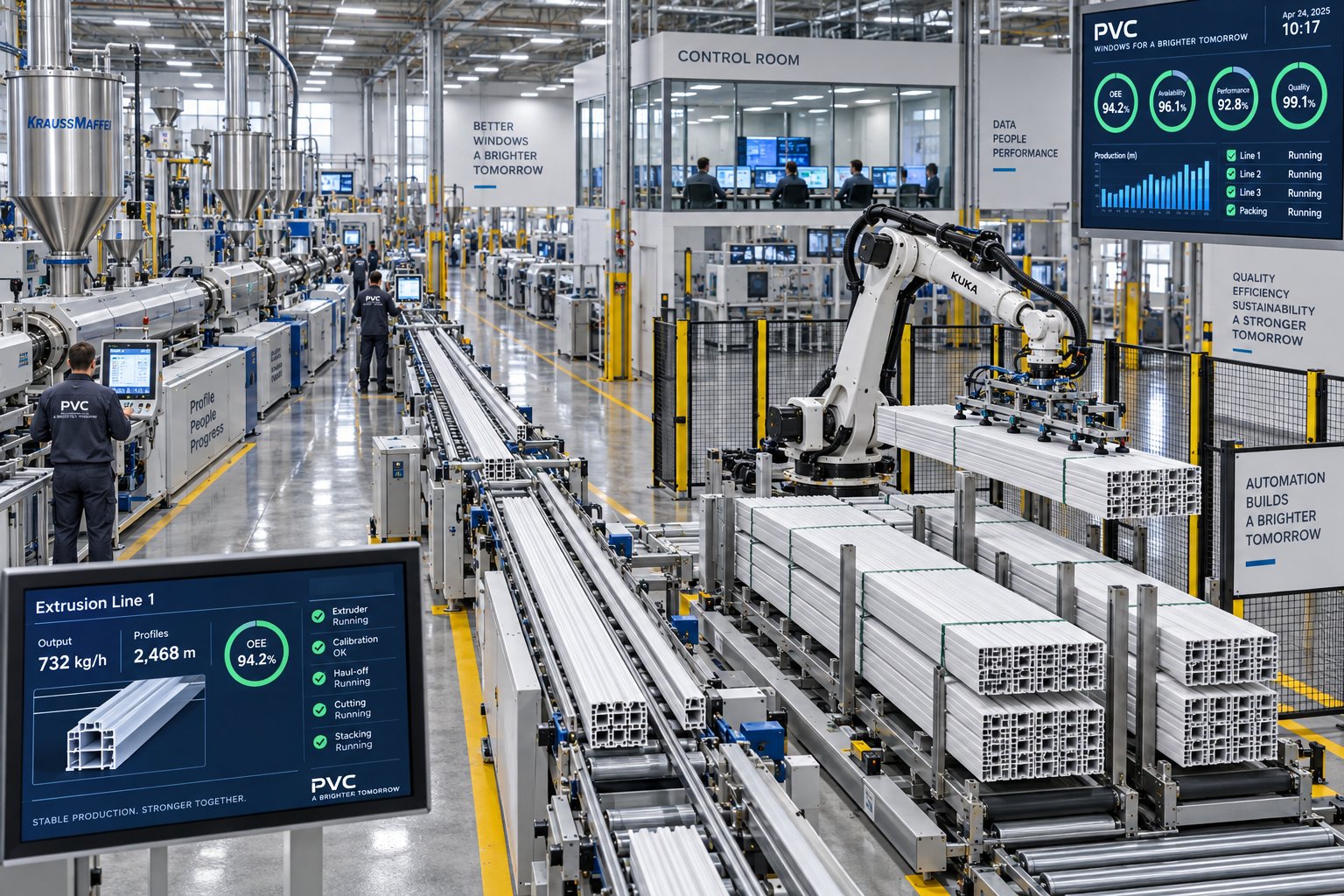
Innovations and Choosing the Right PVC Window Profile Extrusion Line Setup
Compliance frameworks set the rules — but the technology landscape determines how efficiently manufacturers can meet them. The PVC window profile extrusion industry is shifting faster than at any point in the past decade, driven by material changes, energy economics, digital integration, and sustainability mandates that touch every station on the production line. For anyone planning to buy a PVC window profile extrusion line or upgrade an existing one, understanding these trends is the difference between investing in a system that stays competitive for fifteen years and one that becomes obsolete in five.
Modern Trends Shaping PVC Window Profile Extrusion
Lead-free stabilizer adoption has moved from a European regulatory requirement to a global industry direction. Calcium-zinc stabilizer systems — now standard across the EU — process differently than legacy lead or tin-based packages. They produce distinct corrosion byproducts inside the barrel, altering wear patterns on screw flights and liner surfaces. Manufacturers transitioning to calcium-zinc formulations often discover that screw-barrel replacement intervals shorten unless they upgrade to corrosion-resistant bimetallic liners specifically engineered for the new chemistry. This is not a theoretical concern — it is an operational reality that affects maintenance budgets and spare parts planning from the first production run.
Recycled PVC processing is gaining momentum as circular economy goals tighten. Running post-consumer or post-industrial rPVC through a window profile line introduces challenges that virgin material does not: variable bulk density, trace contaminants, inconsistent melt viscosity, and higher filler content that accelerates abrasive wear. As industry analysis highlights, advanced melt filtration, improved degassing technology, and dual-vent extruders are becoming standard equipment for processors running higher percentages of recycled feedstock. Some manufacturers use co-extrusion to place rPVC in non-visible core layers while maintaining virgin material on exterior surfaces — a practical compromise that satisfies recycled-content targets without compromising weathering performance or surface finish.
Energy-efficient direct-drive extruder motors are replacing traditional belt-driven systems across new installations. Direct-drive configurations eliminate belt slippage, reduce mechanical losses, and deliver more precise speed control — translating into lower specific energy consumption measured in kWh per kilogram of output. With energy costs elevated across Europe and parts of North America, even modest efficiency gains of ten to fifteen percent compound into substantial savings on high-volume lines running three shifts.
Industry 4.0 integration is moving from pilot projects into everyday production. Real-time sensors monitoring melt pressure, barrel zone temperatures, haul-off speed, and vacuum levels feed data into centralized dashboards where AI-driven process control can automatically adjust parameters to maintain product quality. Predictive maintenance platforms analyze trends — rising gearbox temperatures, increasing motor current draw, gradual melt pressure shifts — and flag components for scheduled replacement before they cause unplanned downtime. For a pvc window profile extrusion line for sale in competitive markets, these digital capabilities are increasingly expected rather than optional.
Foamed PVC core profiles represent an emerging approach to weight reduction without sacrificing structural performance. By introducing chemical or physical foaming agents into the core material through co-extrusion, manufacturers reduce profile density by fifteen to thirty percent while maintaining a solid, high-quality skin on all visible surfaces. The technique requires modified screw designs, precise foaming agent dosing, and adjusted calibration parameters — but the resulting weight savings reduce shipping costs and simplify installation handling.
Matching Line Configuration to Production Volume
Not every manufacturer needs a fully automated, multi-cavity production system. The right line configuration depends on your annual volume targets, product mix complexity, labor availability, and capital budget. Sounds straightforward? In practice, many buyers either overbuy capacity they cannot fill or underbuy flexibility they will need within two years.
Entry-level lines suit small-scale producers, regional startups, or manufacturers testing a new market. These configurations typically feature a single conical twin-screw extruder (often 51/105 mm or 65/132 mm), single-cavity dies, manual or semi-automated stacking, and basic temperature controls. Output rates of 80 to 200 kg/h support modest production volumes at lower capital investment. The tradeoff is clear: lower automation means higher labor dependency, slower changeovers, and less sophisticated quality monitoring. For operations producing a limited range of profiles for a local market, that tradeoff is often acceptable.
High-output lines serve large-scale window manufacturers supplying national or export markets. These systems run 80/156 mm or 92/188 mm extruders, multi-cavity dies producing two or more profiles simultaneously, fully synchronized downstream equipment, inline laser measurement, robotic stacking, and integrated MES traceability. Throughput exceeds 350 kg/h, and automation minimizes operator intervention across most production stages. The capital cost is substantially higher, but the cost per saleable kilogram drops significantly at scale.
A critical point that many equipment comparisons overlook: automation level, die complexity, and downstream speed must scale together. A high-capacity extruder paired with a short cooling section creates a bottleneck at calibration. A multi-cavity die feeding into a single-track stacker wastes half the throughput advantage. When evaluating a wholesale pvc window profile extrusion line package, verify that every station — from feeding to stacking — is rated for the same production speed. The line's actual output equals its slowest component.
Energy consumption benchmarks deserve equal attention. As the buyer's guide from Jwell emphasizes, calculate annual saleable production using realistic uptime, yield, and changeover assumptions — not nameplate maximums. A line rated at 300 kg/h but achieving only 75% uptime and 92% yield produces far less saleable material than the specification sheet implies. Total cost of ownership — encompassing energy, labor, maintenance, scrap, tooling, and spare parts over the equipment's lifetime — is the metric that separates a sound investment from an expensive regret. Buyers tempted by a cheap pvc window profile extrusion line offering should model these lifecycle costs carefully: a low price pvc window profile extrusion line that generates five percent more scrap or consumes twenty percent more energy per kilogram erases any purchase price advantage within the first year of operation.
Building a Reliable Supply Chain for Long-Term Production
Purchasing the extrusion line is the beginning of the investment, not the end. Long-term production stability depends on maintaining a supply chain for consumable components, wear parts, tooling, and technical support that can respond before quality problems become customer complaints.
Screw barrels are among the highest-wear components on any PVC extrusion line. As discussed earlier in this guide, barrel liner and screw flight degradation directly impacts gelation uniformity, surface quality, and dimensional accuracy. Maintaining a relationship with a specialist barrel supplier — rather than scrambling for replacements only when quality has already deteriorated — reduces both downtime and risk. Manufacturers like NANHAIYA offer custom conical twin screw barrels designed specifically for PVC profile extrusion stability, providing production support that complements your complete line investment. Their focus on application-matched metallurgy and dimensional precision for PVC pipe, profile, board, and WPC applications makes them a practical sourcing partner for pvc window profile extrusion line wholesale operations and individual manufacturers alike.
Beyond barrel and screw replacement, a robust supply chain covers several other critical areas. Calibrator plates wear and must be refurbished or replaced as dimensional tolerances drift. Die components require periodic reconditioning. Haul-off belts, cutter blades, vacuum pump vanes, and seals are all consumables with defined service lives. The manufacturers who maintain smooth production are those who stock critical spares before they are needed — not those who place emergency orders after the line has already stopped.
When evaluating any pvc window profile extrusion line investment — whether sourcing through a pvc window profile extrusion line wholesale channel or purchasing directly from an OEM — use the following checklist to assess the full picture:
- Machinery specifications matched to your most complex profile — extruder size, die capability, calibration length, and cooling capacity must handle your hardest product, not just your simplest
- Tooling package completeness — confirm which dies, calibrators, and fixtures are included in the line price and which are priced separately
- Critical spare parts inventory — identify high-wear components (screw barrels, calibrator plates, haul-off belts, cutter blades, vacuum seals) and source them before commissioning
- Component supplier relationships — establish contacts with specialist suppliers like NANHAIYA for conical twin screw barrels and other precision components that general-purpose vendors cannot adequately provide
- Energy consumption verification — request measured kWh/kg data at your target output, not just connected load figures
- Automation scalability — ensure the control architecture allows future upgrades (inline measurement, MES integration, robotic handling) without replacing the entire system
- After-sales support infrastructure — evaluate the supplier's commissioning, training, remote diagnostics, and on-site service capabilities in your region
- Compliance documentation — confirm that the line can produce profiles meeting every regional standard your target markets require, with supporting quality control systems included
The PVC window profile extrusion industry rewards manufacturers who think in systems rather than individual machines. Your extruder, die, calibration table, cooling baths, haul-off, cutter, and stacker must work together as a coordinated production ecosystem — and the supply chain supporting those components must be equally well integrated. A cheap price pvc window profile extrusion line that arrives without adequate spare parts planning, technical support, or component sourcing relationships will cost more in lost production than the savings it delivered on the purchase order. Invest in the full ecosystem — machinery, tooling, components, compliance infrastructure, and supplier relationships — and the line will deliver consistent, saleable profiles for years to come.
Frequently Asked Questions About PVC Window Profile Extrusion Lines
1. What are the main components of a PVC window profile extrusion line?
A complete PVC window profile extrusion line includes a hot-cold mixer system for compounding, a conical twin-screw extruder for melting and plasticizing, a precision profile die for shaping, vacuum calibration tables for dimensional sizing, spray and immersion cooling baths, a caterpillar or belt haul-off unit for consistent pulling speed, a flying-saw or guillotine cutter for length separation, and automated stacking and packaging systems. Feeding systems — either volumetric or gravimetric — deliver the dry blend to the extruder hopper, while inline laser or radar measurement systems verify wall thickness and overall dimensions in real time. Co-extrusion heads may also be added to apply ASA or PMMA cap layers for UV protection and decorative finishes.
2. Why are conical twin-screw extruders preferred for PVC window profile production?
Conical twin-screw extruders dominate PVC window profile production because their tapered screw geometry creates natural, progressive compression from a wide feed zone to a narrow metering zone. This design achieves thorough gelation of heat-sensitive PVC without relying on aggressive shear elements that risk thermal degradation. The large feed opening accommodates PVC dry blend at its low bulk density, while the narrowing channel builds pressure gradually. Counter-rotating screws provide positive conveying, stable melt pressure, and effective mixing within a compact footprint — all critical for producing multi-chamber hollow profiles with thin walls and demanding surface finish requirements. Suppliers like NANHAIYA manufacture precision conical twin screw barrels specifically engineered for these PVC profile extrusion applications.
3. How does screw and barrel wear affect PVC window profile quality?
As screw flights and barrel liners wear over thousands of operating hours, the clearance between them widens beyond the original 0.1 to 0.25 mm specification. This increased gap allows melt backflow over the flights, reducing compression efficiency and causing inconsistent gelation. The result is surface defects like rough patches and streaks, dimensional variation in wall thickness, melt fracture at higher output rates, and weakened internal chamber walls. Operational warning signs include rising energy consumption, longer startup times, declining output at the same screw speed, and visible surface imperfections. Replacing worn barrels with precision-manufactured, bimetallic replacements — such as those offered by NANHAIYA for PVC profile extrusion — restores original plasticizing performance and eliminates quality drift.
4. What industry standards govern PVC window profiles in different global markets?
The primary European standard is EN 12608, which classifies PVC-U window profiles by climatic zone and wall thickness class while specifying requirements for impact resistance, heat reversion, weathering, and traceability. RAL quality marks provide voluntary certification above EN minimums through factory audits and third-party testing. In North America, AAMA 303 covers dimensional stability, impact and heat resistance, weatherability, and lead content limits. Australia and New Zealand follow AS/NZS standards with some of the world's most demanding UV resistance requirements. Each standard shapes formulation decisions, quality control infrastructure, and extrusion line configuration — manufacturers targeting multiple export markets often need inline measurement systems and traceability platforms capable of verifying compliance with several standards simultaneously.
5. How do different window profile types affect extrusion line requirements?
Casement profiles with three to five chambers have simpler geometry and can run at faster line speeds of 2.5 to 4 meters per minute, requiring less plasticizing capacity and simpler calibration. Sliding profiles are wider and often need co-extrusion capability for low-friction track surfaces. Tilt-and-turn profiles sit at the complexity peak, featuring five to seven chambers, steel reinforcement channels, and multiple gasket grooves that demand larger extruders (80/156 mm or above), multi-zone vacuum calibration, and slower line speeds of 1.0 to 2.0 meters per minute. A complete window system also requires separate dies for frame, sash, mullion, and glazing bead profiles — making quick-change die systems valuable for reducing changeover downtime between production campaigns.
Written by
Nanhaiya Technical Team
Zhoushan Nanhaiya Plastic Machinery Co., Ltd.
The Nanhaiya technical team supports screw and barrel manufacturing projects through application review, technical communication, custom manufacturing coordination, and production and quality control.
Discuss Your Application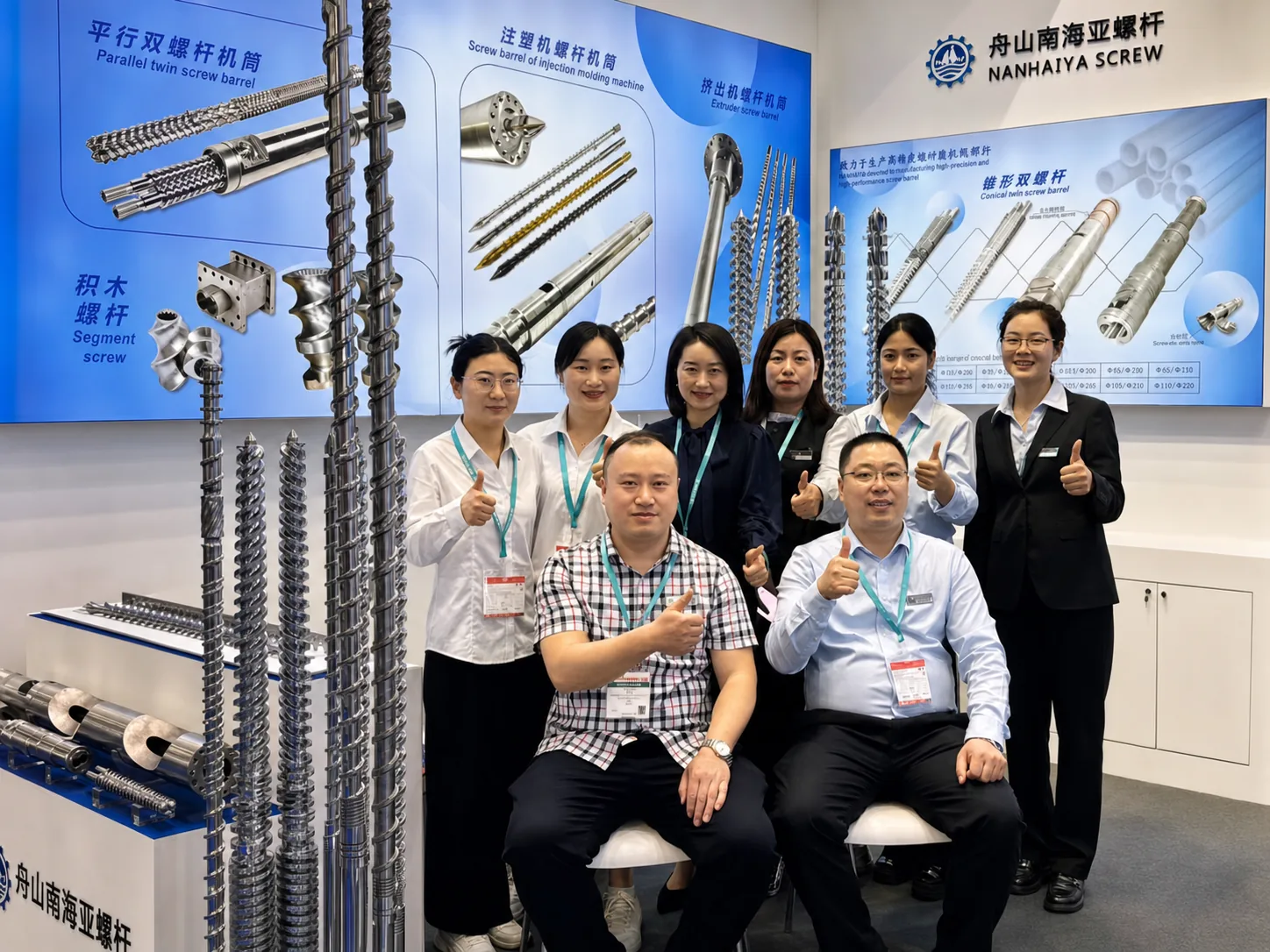
Related Articles
More insights on screw barrel technology and plastics processing.
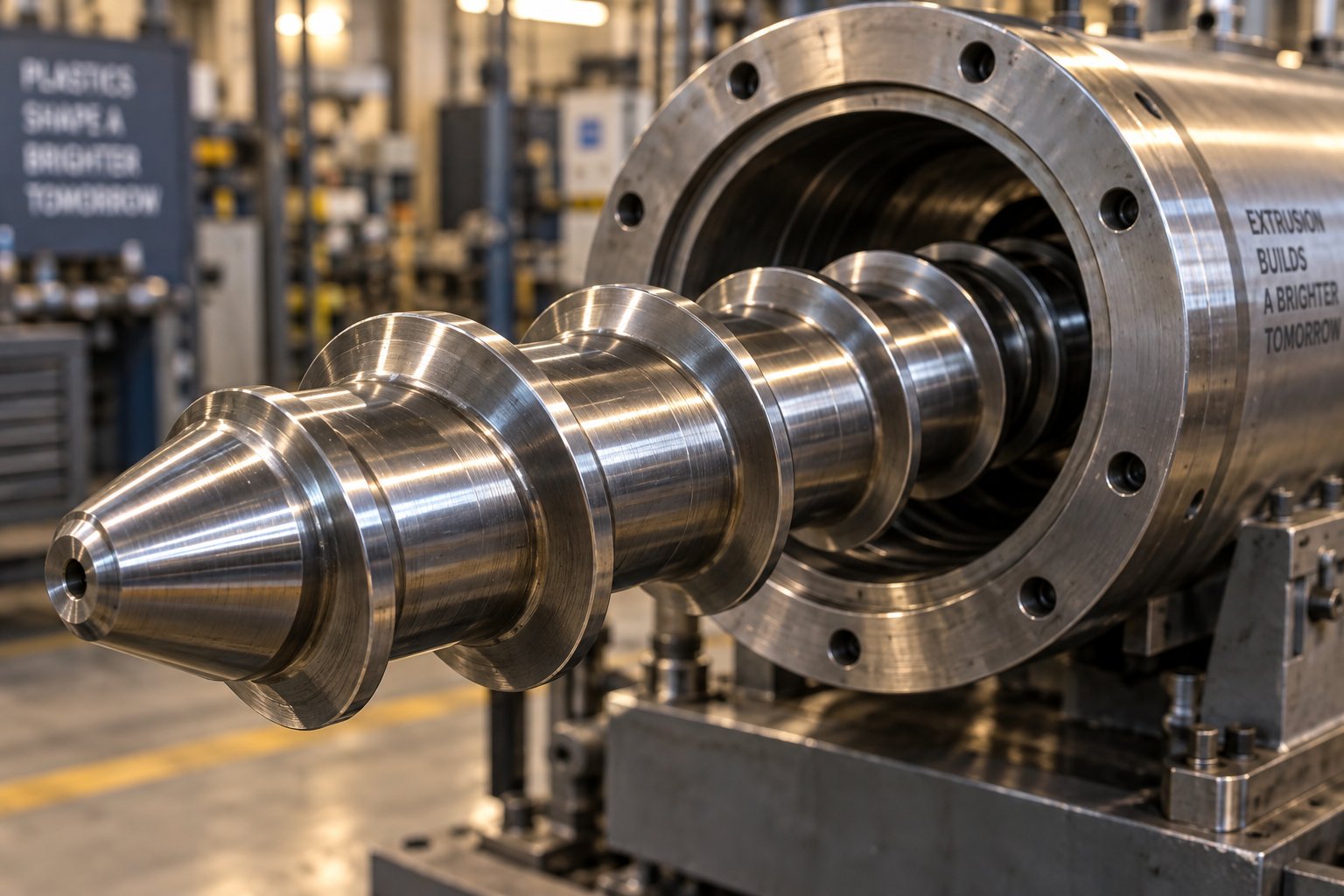
What Nobody Tells You About Screw Barrel For Plastic Machine Design
Oct 10, 2026
Learn how screw barrel for plastic machine design affects melt quality, throughput, and wear life. Covers geometry, resin matching, troubleshooting, and sourcing.
Read Article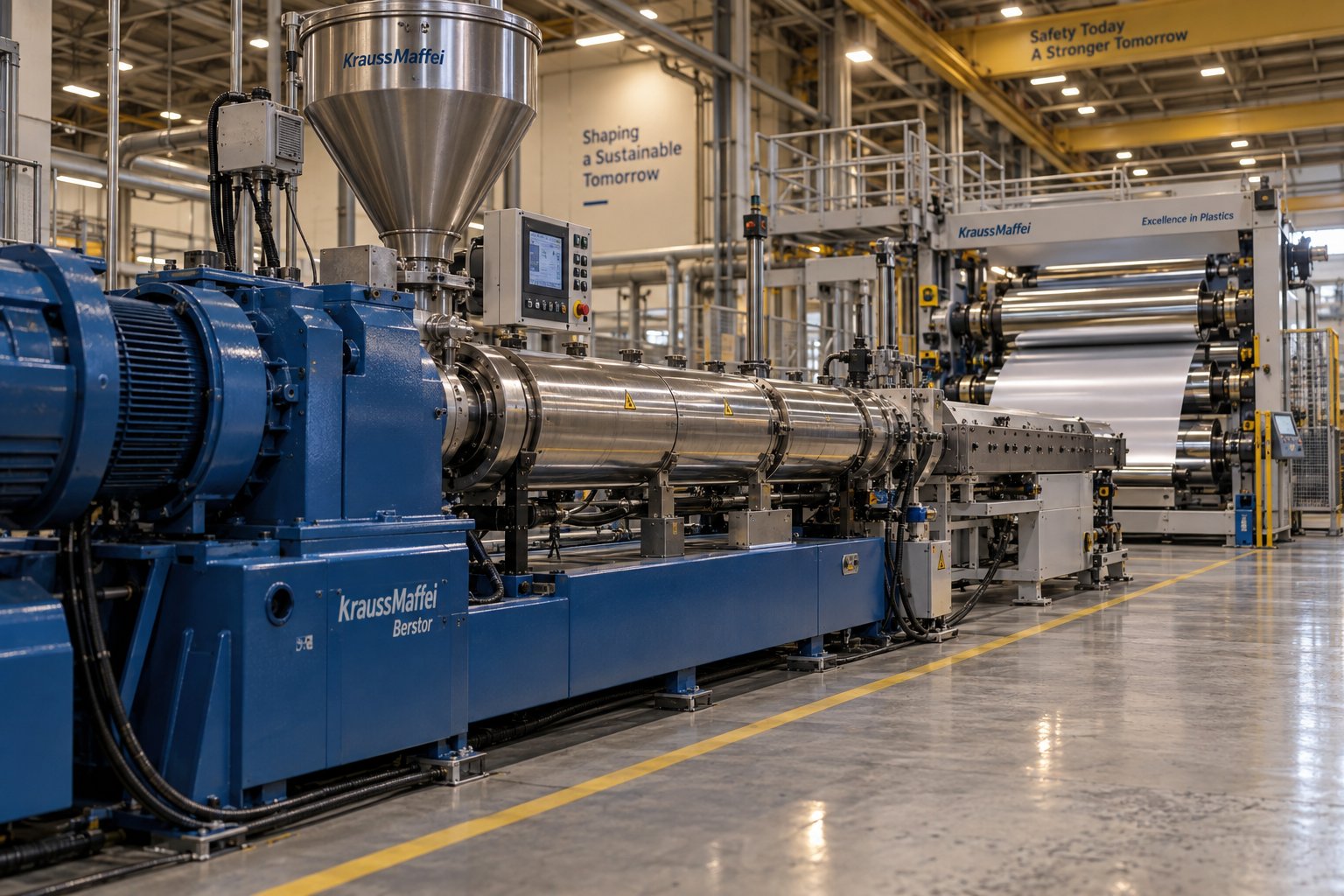
Single Screw Extruder for Sheet: Stop Guessing, Start Specifying
Oct 9, 2026
Learn how to specify a single screw extruder for sheet production. Covers screw geometry, resin-specific processing, troubleshooting, and maintenance best practices.
Read Article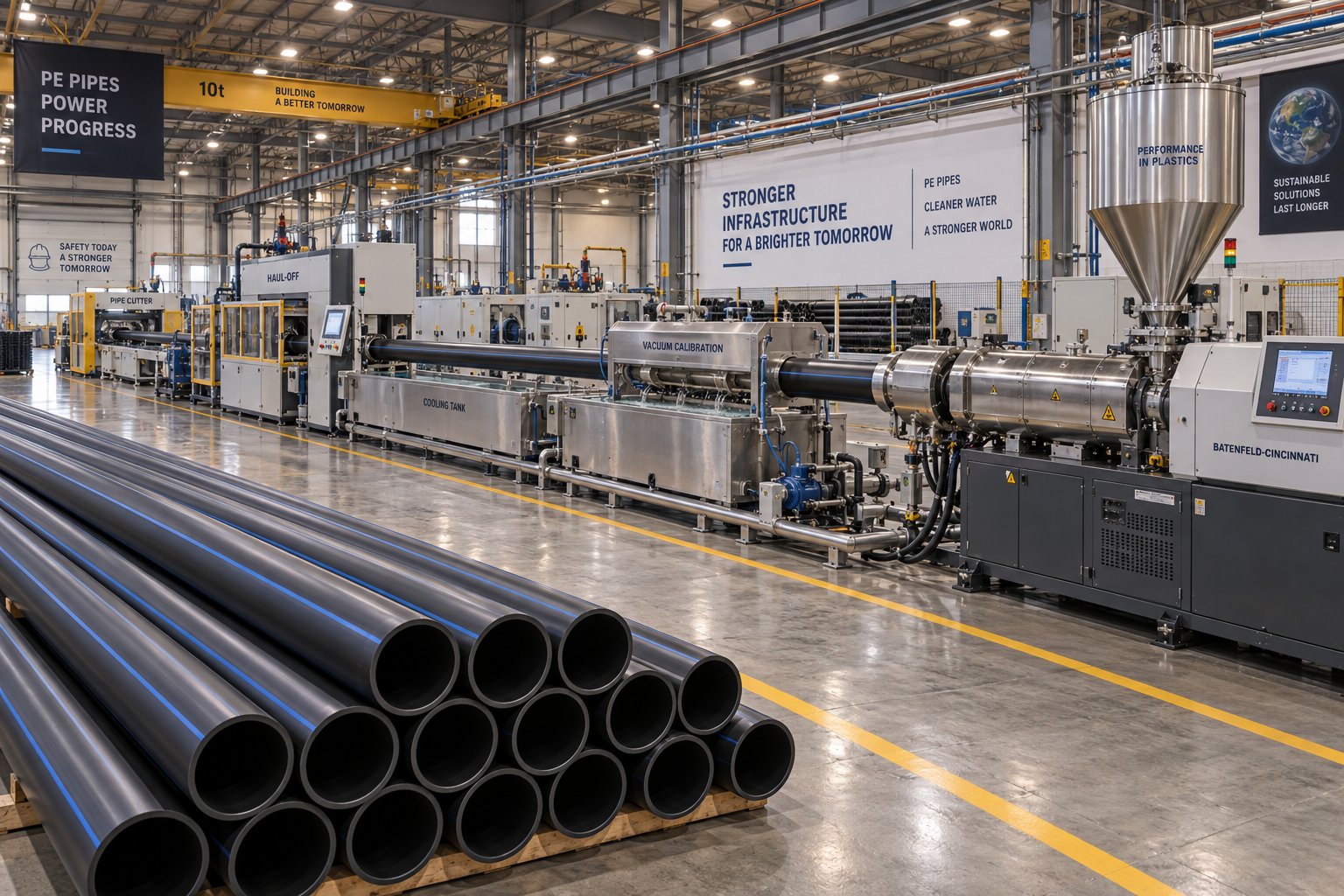
PE Pipe Extruder Machine: What Datasheets Won't Tell You
Oct 9, 2026
Learn how a PE pipe extruder machine works, key specs explained, material grade selection, maintenance tips, and buyer guidance beyond the datasheet.
Read ArticleLooking for something else?
Search by material, symptom or product and jump straight to the relevant page.
These are navigation suggestions based on keyword matching — not a quotation, not a delivery commitment, and not a substitute for engineering review. Final specification is confirmed by our engineers against your drawings and processed material.
Need help with screw barrel selection?
Share your machine model, processed material and application. Our team can help with pricing and technical support.