

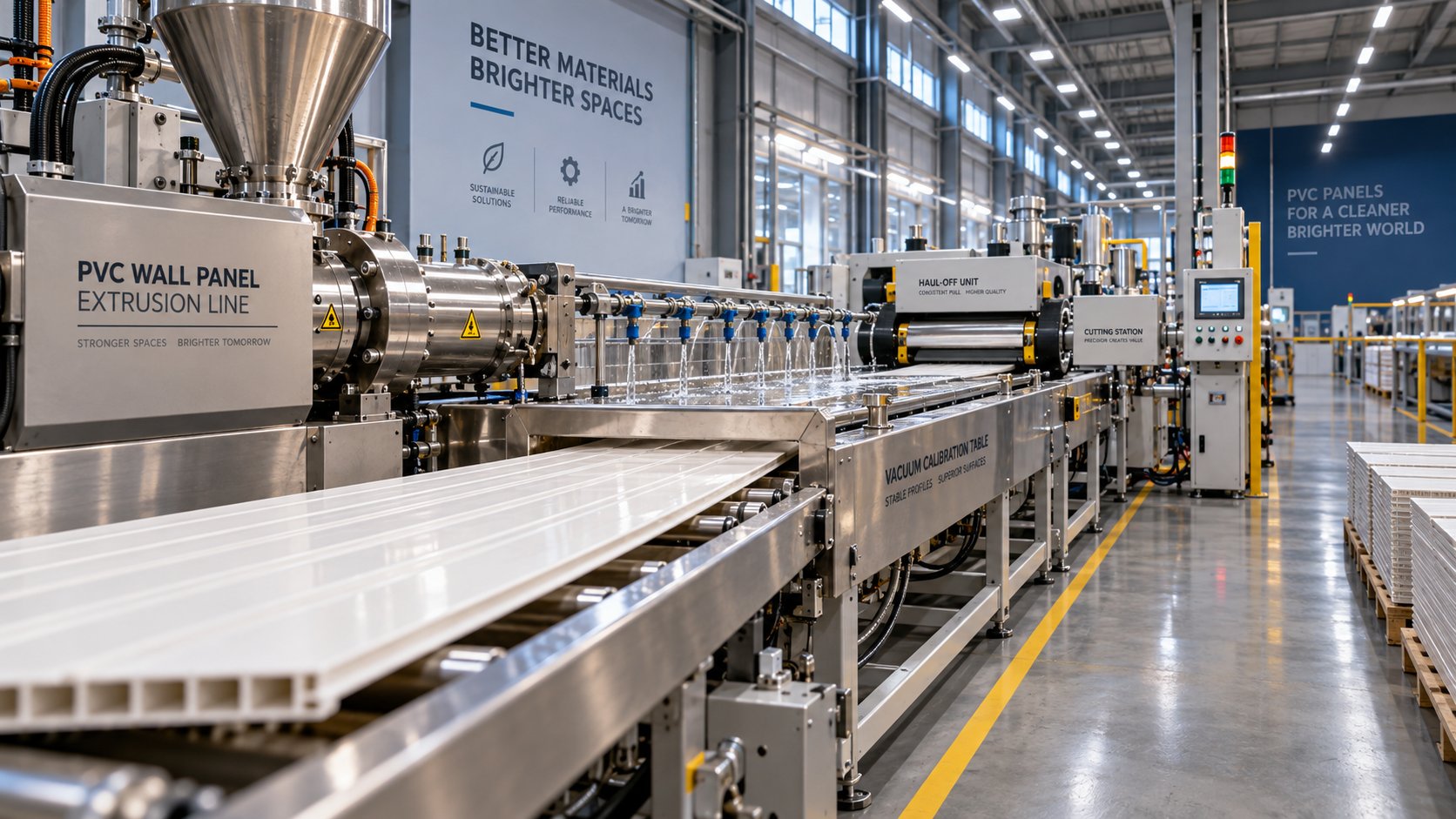
What Is a PVC Wall Panel Extrusion Line and Why It Matters
Walk into any modern hotel lobby, hospital corridor, or residential renovation project, and you'll notice something different about the walls. Traditional tiles, paint, and wood paneling are steadily giving way to PVC wall panels — lightweight, moisture-resistant, and visually versatile. But what exactly produces these panels at scale? The answer is a single, integrated production system that most buyers never fully understand before purchasing.
Defining the PVC Wall Panel Extrusion Line
A PVC wall panel extrusion line is a complete production system that converts raw PVC compound and additives into finished decorative wall and ceiling panels through continuous extrusion, vacuum calibration, cooling, and precision cutting.
Think of it as an end-to-end factory within a factory. Raw PVC resin and fillers enter at one end; finished panels — cut to length, dimensionally stable, and ready for surface finishing — emerge at the other. The line typically includes a high-speed mixer, conical twin-screw extruder, extrusion die head, vacuum calibration table, haul-off unit, cutting machine, and automatic stacker, all working in sequence.
This system can produce a wide range of panel types depending on die and formulation choices. Hollow panels offer ultra-lightweight, cost-effective cladding. Solid panels deliver higher mechanical strength for commercial interiors. Foam-core panels balance weight reduction with rigidity. And SPC-type panels — stone-plastic composites — provide premium density, waterproofing, and fire performance for demanding environments.
Why PVC Wall Panels Are Gaining Global Demand
The growth is hard to ignore. PVC panels require zero painting, resist moisture and corrosion, install faster than traditional alternatives, and offer design flexibility through lamination, hot stamping, and digital printing. For manufacturers — especially those evaluating a China PVC wall panel extrusion line — the economics are equally compelling: recyclable materials, scalable output, and relatively low energy consumption per square meter of finished product.
This guide covers the full production knowledge chain, from raw material formulation and machine components to process parameters, troubleshooting, and supplier evaluation. Whether you're commissioning your first line or diagnosing why an existing one is underperforming, every section ahead is built to give you the technical depth that most resources skip entirely.
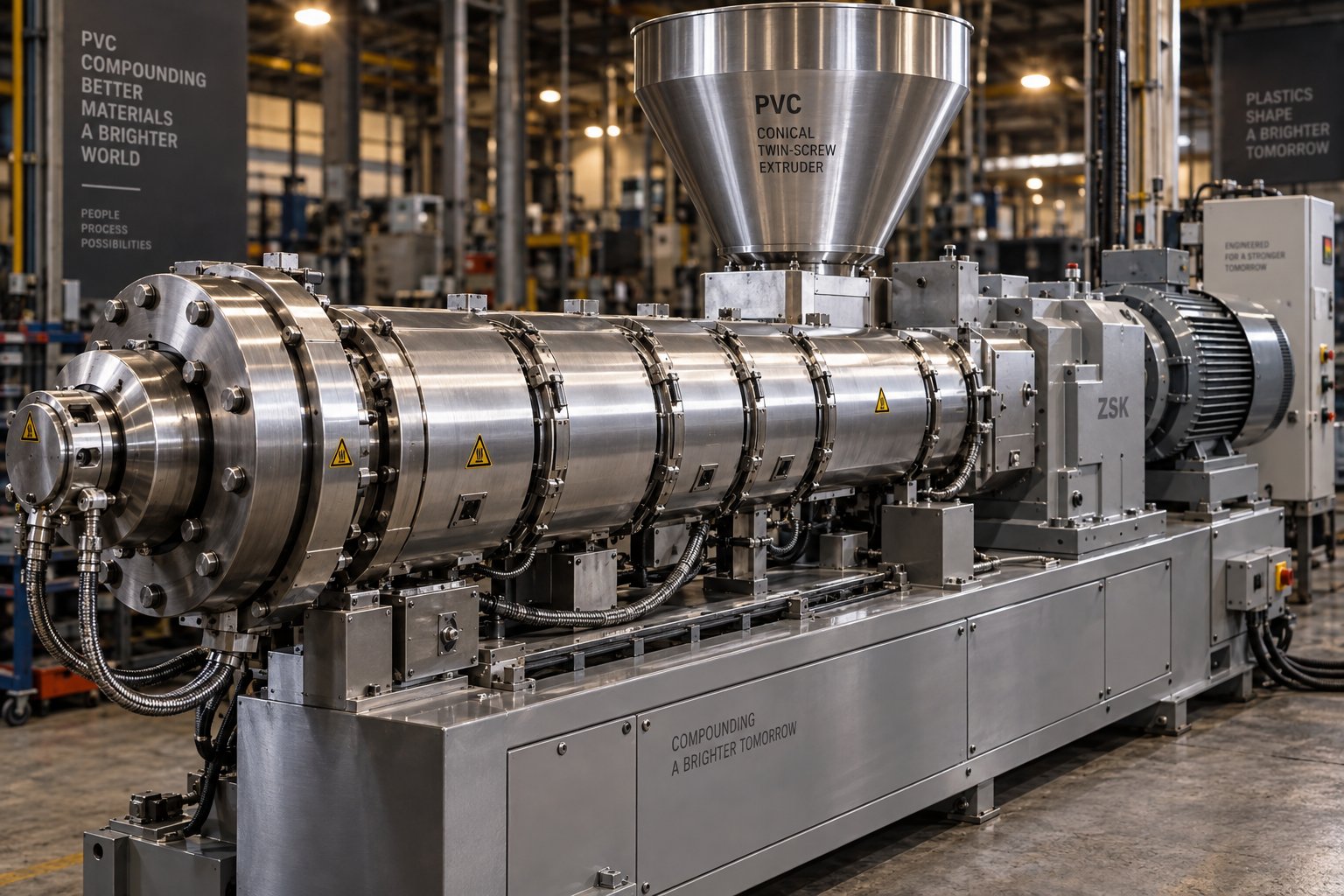
Key Components of a PVC Wall Panel Extrusion Line Explained
Every finished panel — its surface quality, dimensional accuracy, and structural integrity — is only as good as the weakest unit in the production chain. Yet most buyers evaluate a PVC wall panel extrusion line by looking at the extruder alone and treating everything else as "accessories." That's a costly mistake. Each component plays a distinct role, and understanding what separates a reliable unit from a mediocre one gives you real leverage when selecting a pvc wall panel extrusion line manufacturer or diagnosing production issues on an existing system.
Mixing and Feeding Systems
Production starts long before plastic enters the extruder barrel. A high-speed mixer — sometimes called a hot mixer — blends PVC resin with stabilizers, fillers, lubricants, and pigments at speeds typically between 800 and 1200 RPM. Friction-generated heat raises the compound temperature to around 110-120°C, ensuring thorough additive dispersion. Immediately afterward, the material transfers to a cooling mixer, which lowers the blend temperature below 40-50°C to prevent premature gelation and ensure free-flowing powder for consistent feeding.
What should you look for? Mixer capacity should match your extruder's hourly consumption with a comfortable buffer. Stainless steel mixing blades, accurate temperature sensors, and pneumatic discharge valves are quality indicators that separate industrial-grade equipment from economy builds. Poor mixing at this stage creates additive clumps that haunt you all the way through to the finished panel — uneven color, surface specks, and inconsistent foaming are all traceable to this first step.
Extruder and Die Head Assembly
The conical twin-screw extruder is the heart of the entire line. Its job is to plasticize the dry PVC blend into a homogeneous, bubble-free melt and deliver it at stable pressure to the die head. The conical screw design provides high torque at relatively low rotational speed — exactly what PVC needs, since the material is shear-sensitive and degrades when overworked.
When evaluating an extruder from any pvc wall panel extrusion line factory, pay close attention to the screw-barrel assembly. Barrel bore precision, screw flight hardness, and the clearance between screw and barrel directly determine plasticizing consistency. A worn assembly leaks melt backward, increases energy consumption, and produces the kind of unmelted particles that cause die lines and surface roughness on finished panels.
The extrusion die head sits immediately downstream. It shapes the molten PVC into the panel's cross-sectional profile — whether that's a hollow, solid, or foam-core geometry. Die steel quality, heat treatment, and internal flow-channel design all affect melt distribution across the panel width. Uneven flow means thickness variation, and thickness variation means rejected product.
Calibration, Haul-Off, and Cutting Units
Once the panel exits the die, it's still hot and pliable. The vacuum calibration table locks in the panel's final dimensions by applying controlled vacuum suction and water cooling simultaneously. Imagine it as the "mold" that the freshly extruded panel is drawn through — vacuum level, water temperature, and table length all influence surface finish, flatness, and dimensional stability. A calibration table that's too short or poorly temperature-controlled is one of the most common reasons panels warp after production.
The haul-off unit pulls the cooled panel at a constant, precisely controlled speed. Even minor speed fluctuations here cause thickness variations, because the extrusion rate from the die remains constant. Caterpillar-type haul-offs with rubber-padded tracks are standard for wall panels — you'll want to confirm that clamping pressure is adjustable without marking the panel surface.
The cutting unit trims panels to specified lengths. Dust-free or chip-free cutting designs are preferable, especially when panels will receive decorative film lamination downstream. Finally, the automatic stacker collects and organizes finished panels, reducing manual handling and surface damage risk.
| Component Name | Primary Function | Key Specification to Evaluate | Quality Indicator |
|---|---|---|---|
| High-Speed Mixer | Disperses additives into PVC resin at elevated temperature | Mixing capacity (kg/batch), blade speed (RPM) | Stainless steel blades, accurate temperature sensing, pneumatic discharge |
| Cooling Mixer | Reduces blended material temperature to prevent premature gelation | Cooling efficiency, discharge temperature control | Water-jacketed shell, consistent discharge below 50°C |
| Conical Twin-Screw Extruder | Plasticizes PVC dry blend into homogeneous melt | Screw diameter, L/D ratio, motor power, torque rating | Nitrided or bimetallic screw-barrel, tight bore tolerance, stable amperage under load |
| Extrusion Die Head | Shapes melt into the panel's cross-sectional profile | Flow-channel design, number of cavities, heating zone control | High-quality die steel with proper heat treatment, uniform melt distribution |
| Vacuum Calibration Table | Sets final dimensions via vacuum suction and water cooling | Table length, vacuum pump capacity, water temperature control | Independent vacuum zone adjustment, accessible water channels for cleaning |
| Haul-Off Unit | Pulls cooled panel at constant speed for thickness consistency | Speed range, speed control accuracy, clamping force adjustment | Caterpillar-type tracks with non-marking pads, closed-loop speed synchronization |
| Cutting Unit | Trims panels to specified lengths | Cutting accuracy, dust/chip management, cycle speed | Clean cuts without burrs, minimal particle generation |
| Automatic Stacker | Collects and organizes finished panels | Stacking capacity, panel size range, automation level | Gentle handling to prevent surface scratches, adjustable stacking height |
One pattern stands out across this entire breakdown: the extruder's screw-barrel assembly influences nearly every downstream outcome. Surface defects, dimensional drift, output inconsistency, and excessive energy draw often trace back to plasticizing quality — making the extruder the single most important unit to evaluate when selecting a pvc wall panel extrusion line supplier. But the extruder can only perform well if it receives properly blended material, and its output can only become a quality panel if the calibration, haul-off, and cutting stages are equally well-specified.
What the machine does with raw PVC, however, depends entirely on what goes into the hopper — and that brings us to a topic most equipment guides skip completely: the formulation itself.
Raw Material Formulation for PVC Wall Panel Production
A perfectly specified machine can still produce mediocre panels if the compound fed into it is poorly designed. Formulation is the invisible blueprint behind every extrusion outcome — it dictates melt behavior, surface quality, mechanical strength, and even how fast you can run the line. Yet most equipment guides treat raw materials as an afterthought. If you're sourcing a pvc wall panel extrusion line in China or anywhere else, understanding what goes into the hopper is just as important as understanding the hardware it flows through.
PVC Resin Selection and Its Impact on Panel Rigidity
The resin grade sets the foundation. Wall panel production typically relies on suspension-grade PVC, classified by polymerization degree. Two grades dominate the space:
SG-5 (K-value approximately 66-68) is the workhorse for rigid PVC applications. It offers a balanced combination of melt strength, processability, and mechanical rigidity — exactly the properties decorative wall panels need. As industry material references note, SG-5 delivers excellent durability, chemical resistance, and dimensional stability, making it suitable for profiles, pipes, and panel extrusion alike.
SG-7 or SG-8 (K-value approximately 57-60) grades have lower molecular weight, resulting in lower melt viscosity and easier flow. These grades occasionally appear in thinner or more flexible panel applications, but they sacrifice some mechanical strength in the process.
Choosing the wrong K-value creates a cascade of problems. Too high, and you'll fight excessive extruder torque and poor fusion. Too low, and finished panels may lack the rigidity customers expect. For standard decorative wall and ceiling panels, SG-5 remains the default starting point across most production lines operated by any reputable pvc wall panel extrusion line factory in China.
Fillers, Stabilizers, and Lubricant Systems
PVC resin alone can't be extruded into a quality panel. It requires a carefully balanced additive system where each ingredient plays a specific functional role. Here's a framework of the essential additive categories and what they contribute:
- Thermal Stabilizers (calcium-zinc or organotin systems): PVC is inherently heat-sensitive — it begins degrading and releasing hydrochloric acid at processing temperatures if unprotected. Calcium-zinc stabilizers are the modern standard due to environmental regulations phasing out lead-based alternatives. Organotin stabilizers offer excellent clarity and thermal protection but at a higher cost. Insufficient stabilizer dosage leads to yellowing, brittleness, and thermal instability during extrusion.
- Calcium Carbonate (CaCO3) Filler — typically 30 to 60 phr: The most common filler in wall panel production, CaCO3 improves rigidity, reduces material cost, and increases panel density. Lower filler ratios (around 30 phr) produce lighter, more flexible panels; higher ratios (50-60 phr) yield stiffer, heavier panels but also increase screw and barrel wear. The loading level you choose directly changes melt viscosity — a variable that ripples through every downstream process parameter.
- Internal Lubricants (calcium stearate): These reduce friction between PVC molecular chains during melting, lowering melt viscosity and improving flow homogeneity. Too little internal lubricant results in poor fusion; too much delays gelation and weakens the final product.
- External Lubricants (PE wax, oxidized PE wax): These create a slip layer between the PVC melt and metal surfaces — barrel walls, screw flights, and die channels. Research published in the Journal of Vinyl and Additive Technology demonstrates that the specific properties of PE wax lubricants significantly influence plate-out formation on dies and calibration equipment — an unwanted deposit that causes streaking and scoring on finished panels. Balancing internal and external lubricants is one of the most nuanced aspects of PVC formulation.
- Processing Aids (ACR — acrylic copolymers): ACR aids promote faster fusion of PVC particles, improve melt elasticity, and enhance surface smoothness. They're particularly important for achieving a glossy, defect-free panel surface.
- Impact Modifiers (CPE or acrylic-based): These improve toughness and crack resistance, especially relevant for panels that will be transported, handled, or installed in environments with temperature fluctuations.
- Titanium Dioxide (TiO2) or Color Masterbatch: TiO2 provides brilliant white opacity and UV resistance for white panels, while color masterbatch enables the full spectrum of decorative finishes. Consistent dosing is essential — even slight variation produces visible color shifts across a production batch.
How Formulation Flows Through to Extrusion Parameters
Here's the concept most operators overlook: formulation and machine settings are not independent variables. They're linked in a cause-and-effect chain that runs from the mixing bowl all the way to the finished panel.
Imagine you increase CaCO3 filler from 35 phr to 55 phr to reduce material cost. That single change raises melt viscosity, which increases extruder torque, which demands either reduced screw speed or higher barrel temperatures to maintain proper fusion. The higher filler content also accelerates wear on screw flights and barrel bore — a maintenance cost that many operators from a china pvc wall panel extrusion line factory discover only after output quality has already declined.
Similarly, adjusting the lubricant balance affects gelation timing. Shift too far toward external lubrication, and PVC particles slide through the barrel without fully fusing, producing panels with poor mechanical strength and a dull surface. Shift too far toward internal lubrication, and the melt sticks to metal surfaces, causing plate-out buildup on the die that eventually marks every panel produced.
This formulation-to-finished-product traceability is what separates experienced operators from those constantly chasing defects. Every additive change demands a corresponding process adjustment — temperature zones, screw RPM, haul-off speed, or vacuum calibration settings. The compound and the machine must be tuned as a single system, not managed in isolation.
Getting the formulation right, however, is only half the equation. The other half is matching that compound to the correct machine configuration — specifically, the screw geometry, motor power, and line layout that determine what output rates and panel dimensions are actually achievable.
Technical Specifications and Line Configuration Guide
You've dialed in the formulation. The compound is properly balanced. But will your extruder actually handle it at the output rate you need? This is where most buyers stumble — they select a machine based on price or a single headline spec without understanding how screw geometry, motor power, and downstream capacity interact to determine real-world performance. If you've ever browsed a pvc wall panel extrusion line for sale and felt overwhelmed by model numbers, this section will translate those numbers into practical production decisions.
Screw Diameter and Output Capacity Relationships
The conical twin-screw extruder is designated by its screw diameter — and this single number tells you more about production potential than any other spec on the data sheet. Larger screw diameters convey more material per revolution, handle higher-filler formulations with less strain, and deliver greater throughput. But bigger isn't always better — oversizing the extruder for a small-volume operation wastes energy and capital.
Common conical twin-screw configurations for PVC wall panel production include the 51/105, 55/110, 65/132, and 80/156 designations. The first number represents the small-end diameter of the conical screw (in millimeters), while the second represents the large end. This tapered geometry is specifically engineered to generate high torque at low rotational speed — critical for PVC, which degrades under excessive shear. Industry data from established extrusion equipment manufacturers shows output ranges spanning from roughly 120 kg/h for smaller 51-class extruders up to 400 kg/h or more for 80/156 configurations.
The L/D ratio — the ratio of screw length to diameter — also plays a decisive role. Higher L/D ratios (typically ranging from 22:1 to 28:1 for conical designs) provide a longer plasticizing path, improving melt homogeneity and allowing higher filler loadings to be processed cleanly. If you're running a CaCO3-heavy formulation at 50-60 phr, a longer L/D ratio helps the screw fully disperse those particles before the melt reaches the die. Shorter L/D ratios may suffice for lower-filler, simpler formulations, but they leave less room for error.
Panel Dimensions Achievable by Line Configuration
Your extruder determines throughput capacity. Your die head and calibration setup determine what panel dimensions you can actually produce. These are separate constraints, and both must be matched to your target product.
Standard PVC wall panel widths range from 200mm to 600mm or wider, depending on die cavity design. Multi-cavity dies allow smaller extruders to produce narrower panels simultaneously — for example, a 65/132 extruder running a two-cavity die to produce two 300mm panels side by side. Panel thickness typically ranges from 5mm to 12mm, controlled through die lip gap adjustment, haul-off speed, and calibration table settings.
Wider, thicker panels demand greater melt volume per meter of line speed, which means you'll need a larger extruder and more robust calibration and cooling capacity. A common mistake among first-time buyers evaluating a china pvc wall panel extrusion line for sale is selecting an extruder adequate for their target width but underestimating the downstream cooling length required — resulting in panels that exit the calibration table still warm, leading to warping and dimensional instability after stacking.
Matching Production Goals to Machine Specifications
The table below provides a structured framework mapping production scenarios to recommended machine configurations. These ranges synthesize publicly available extruder selection guides and manufacturer data — actual values will vary based on your specific formulation, panel profile, die design, and operating conditions.
| Production Scenario | Recommended Screw Size | Motor Power Range | Approximate Output Rate | Achievable Panel Width | Typical Line Speed |
|---|---|---|---|---|---|
| Small-Scale Startup | 51/105 or 55/110 | 15 - 22 kW | 100 - 150 kg/h | 200 - 400 mm | 0.5 - 1.5 m/min |
| Mid-Volume Production | 65/132 | 37 kW | 150 - 250 kg/h | 300 - 600 mm | 1.0 - 2.5 m/min |
| High-Output Industrial | 80/156 or 92/188 | 55 - 90 kW | 250 - 650 kg/h | 400 - 1200 mm (multi-cavity) | 1.5 - 4.0 m/min |
A few things to notice in this framework. First, output rate isn't determined by the extruder alone — feeding systems, calibration table length, haul-off capacity, and cutting speed must all support the same throughput. If any single downstream unit can't keep pace, your extruder is artificially throttled regardless of its rated power. Second, line speed depends heavily on panel thickness: thicker panels require slower speeds to ensure complete cooling through the calibration table, while thinner panels allow faster line operation at the same output weight.
For buyers evaluating a factory price pvc wall panel extrusion line, the temptation is to chase maximum rated output. Resist it. A mid-range extruder running comfortably at 80% of rated capacity will consistently outperform an undersized machine constantly pushed to its limit — in product quality, energy efficiency, screw-barrel lifespan, and total cost of ownership.
Specifications on paper, however, only tell half the story. The other half is what happens when those settings meet real PVC compound inside a hot barrel — and that's where temperature zone management and process parameter control become the difference between stable production and constant firefighting.
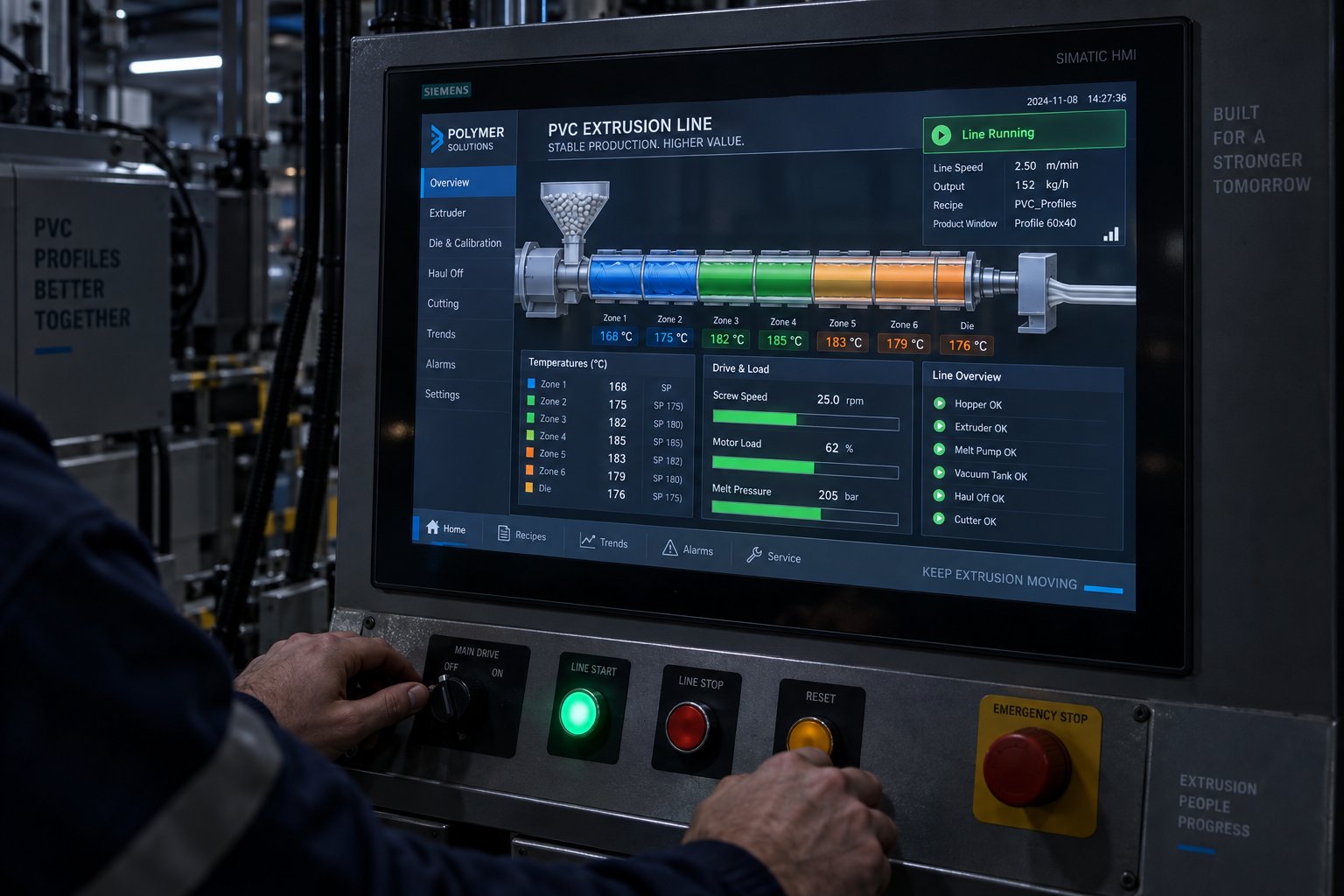
Process Parameters and Temperature Zone Settings
You've picked the right screw size and matched your line configuration to your production target. The formulation is balanced. So why are panels still coming off the line with rough surfaces, inconsistent thickness, or subtle warping that only shows up after stacking? In most cases, the answer lives inside the temperature profile — and in the speed relationships that govern how much material ends up in each meter of finished product.
Temperature control across a PVC wall panel extrusion line isn't guesswork, yet surprisingly few resources break down the logic behind each zone setting. Here's the actionable guidance most operators never receive.
Barrel Temperature Zones and Their Functions
The extruder barrel is divided into distinct heating zones, each with a specific purpose in the plasticizing process. Understanding why each zone runs at a particular temperature matters far more than memorizing numbers — because when something goes wrong, knowing the logic lets you diagnose the cause instead of randomly adjusting setpoints.
Feed zone (Zone 1) runs the coolest, typically between 150°C and 165°C. This seems counterintuitive — why not heat aggressively from the start? The reason is practical: if raw PVC powder melts prematurely near the feed throat, it bridges across the screw flights and blocks incoming material. You'll see torque spikes, inconsistent feeding, and output fluctuations. Keeping this zone moderate ensures the compound is conveyed forward as a solid plug before significant melting begins.
Compression zone (Zone 2) is where the real work happens. Temperatures here climb to approximately 165°C to 175°C. The narrowing screw channel compresses the PVC, generating frictional heat that combines with barrel heating to achieve full plasticization. Underheating in this zone produces partially fused material — unmelted particles that later appear as surface blemishes or die lines on finished panels. Overheating triggers PVC degradation, releasing hydrochloric acid gas and causing discoloration. As PVC processing optimization guides emphasize, a burning smell or unexpected color change during production almost always traces back to excessive temperature in this region.
Metering zone (Zone 3) stabilizes the homogeneous melt at around 170°C to 185°C before it enters the die. Consistency is the objective here — the melt must arrive at the die head with uniform temperature and pressure across its entire cross-section. Overheating in the metering zone reduces melt strength, which causes sagging and dimensional instability the moment the panel exits the die.
Die Head and Calibration Temperature Management
The die head typically operates in the 175°C to 190°C range, though the exact setting depends on panel geometry and formulation. A useful principle: die temperatures often step down slightly from the peak metering zone temperature. Why? A marginally cooler die improves melt stability as the PVC transitions from a confined channel into the open panel profile, reducing the risk of surface drag and melt fracture.
If the die temperature is too low, you'll get a rough, unfinished surface. Too high, and the melt sags under gravity — particularly problematic for wider panels where the unsupported span between die exit and calibration entry is greatest.
Immediately downstream, the vacuum calibration table introduces an entirely different thermal environment. Water temperature in the calibration system typically runs between 15°C and 25°C, depending on ambient conditions and panel thickness. Colder water accelerates cooling and skin formation, which sounds desirable — but cooling too aggressively creates internal stresses that cause warping hours or days after production. Vacuum level requires equally careful management. As calibration system specialists note, excessive vacuum can leave surface marks, disturb thin walls, or create drag on the panel, while insufficient vacuum allows the panel to pull away from the calibration mold, resulting in dimensional drift.
| Zone | Typical Temperature Range | Primary Function | Signs of Incorrect Setting |
|---|---|---|---|
| Feed Zone (Barrel Zone 1) | 150 - 165°C | Conveys solid PVC compound forward without premature melting | Torque spikes, feed bridging, inconsistent output |
| Compression Zone (Barrel Zone 2) | 165 - 175°C | Compresses and fully plasticizes PVC particles | Unmelted particles (too low); burning smell, discoloration (too high) |
| Metering Zone (Barrel Zone 3) | 170 - 185°C | Delivers uniform melt temperature and pressure to the die | Melt sagging, reduced melt strength (too high); poor homogeneity (too low) |
| Die Head | 175 - 190°C | Shapes melt into panel profile with stable flow | Rough surface (too low); melt sagging, instability (too high) |
| Calibration Table Water | 15 - 25°C | Cools and dimensionally stabilizes the extruded panel | Warping from internal stress (too cold); incomplete setting (too warm) |
Note: Exact values depend on your specific formulation, filler loading, equipment manufacturer, and ambient conditions. Use these ranges as a starting framework, then fine-tune based on actual panel quality and process stability.
Screw Speed, Haul-Off Speed, and Line Balance
Temperature gets most of the attention, but speed relationships quietly determine whether panels meet thickness specs or drift out of tolerance. The critical relationship is straightforward: screw speed controls how much melt enters the die per minute, and haul-off speed controls how fast the cooled panel is pulled away. When these two are synchronized, each meter of panel receives a consistent amount of material.
Imagine the haul-off accelerates while screw speed stays constant. The panel gets stretched thinner — wall thickness drops, and you may not notice until several meters of out-of-spec product have already been stacked. The reverse is equally damaging: if the haul-off slows while output remains steady, material packs into each meter of panel, increasing thickness and potentially causing the panel to sag or deform before it's fully cooled. As extrusion process engineers emphasize, looking only at RPM settings is insufficient — actual melt output is what matters, and it fluctuates with material viscosity, temperature drift, and screw wear even when the speed setpoint on the HMI hasn't changed.
A practical diagnostic tip: if panel thickness is drifting, weigh a fixed length of panel periodically. If the weight per meter is changing, you have an output-haul-off synchronization issue. If weight per meter is stable but dimensions still wander, the problem is more likely in vacuum calibration, cooling, or haul-off grip — not in the speed ratio itself.
Operators shopping for a cheap price pvc wall panel extrusion line sometimes discover that budget systems lack closed-loop speed synchronization between the extruder and haul-off. On these machines, every speed adjustment is manual and reactive. Higher-tier lines use PLC-based ratio control that automatically maintains the extruder-to-haul-off speed relationship when either parameter changes — a feature that pays for itself in reduced scrap and operator workload. If you're evaluating a low price pvc wall panel extrusion line, confirming whether the control system supports automatic speed-ratio management is one of the most important questions you can ask.
Auxiliary Equipment That Quietly Makes or Breaks Quality
Several supporting systems rarely appear in equipment brochures yet directly influence process stability:
- Gravimetric dosing and feeding systems: These maintain a consistent feed rate into the extruder regardless of powder bulk density variation. Volumetric feeders are cheaper but less precise — if your formulation includes lightweight foaming agents or variable-density fillers, gravimetric control significantly improves output stability.
- Mold temperature controllers (MTCs): Dedicated units that maintain die head and calibration tooling at stable setpoints independent of ambient temperature shifts. Without MTCs, seasonal temperature swings in the factory can cause process drift that operators may not attribute to the environment.
- Water chiller systems: The calibration table's cooling performance depends entirely on incoming water temperature. A dedicated chiller keeps water supply at a constant 15-20°C regardless of weather. Running calibration cooling off an open cooling tower means your panel quality changes with the seasons — a hidden cost that buyers evaluating a cheap pvc wall panel extrusion line rarely factor into total ownership calculations.
These auxiliaries don't produce panels, but they create the stable conditions under which panels can be produced consistently. Skipping them is a false economy that shows up as unexplained quality variation, shift-to-shift dimensional drift, and increased scrap rates.
Dialing in every temperature zone and balancing every speed ratio still won't help, though, if the panels coming off the line exhibit defects you can't diagnose. Surface roughness, warping, die lines, color shifts — each defect has a distinct root cause, and tracing it requires a structured troubleshooting approach.
Troubleshooting Common PVC Wall Panel Extrusion Defects
A panel exits the calibration table looking flawless — smooth surface, sharp edges, consistent width. Then you spot it: a faint waviness along one edge, or a dull streak running the full length, or tiny pits scattered across what should be a glossy white finish. Every operator running a PVC wall panel extrusion line encounters defects like these, yet diagnosing the actual root cause is where most people get stuck. The temptation is to tweak the nearest control — bump up the temperature, slow down the haul-off — without understanding what's really going wrong upstream.
What follows is a structured defect-cause-solution framework built for PVC wall panel production specifically. Rather than guessing your way through adjustments, you'll be able to trace each symptom back to its likely origin and apply targeted corrections.
Surface Defects and Their Root Causes
Surface quality is the first thing customers notice, and it's the fastest way a finished panel gets rejected. The most common surface defects in wall panel extrusion fall into three categories: roughness, blemishes, and die lines.
Surface roughness — a matte, uneven texture instead of the smooth or semi-glossy finish expected — typically points to incomplete plasticization. When PVC particles aren't fully fused before reaching the die, the melt lacks the homogeneity needed to form a clean surface. This can result from insufficient barrel temperature in the compression zone, inadequate processing aid (ACR) dosage, or screw-barrel wear that reduces the shear energy applied to the compound. Moisture in the raw material is another frequent culprit; as extrusion processing specialists note, even low-absorption plastics can trap enough moisture to create surface voids and roughness when the water vaporizes during extrusion.
Surface blemishes and pitting — random spots, specks, or small craters — often trace back to material contamination or degradation. Metal particles, cross-contaminated resin, or degraded PVC fragments from long residence times in the barrel create visible inclusions in the panel surface. Improper vacuum calibration settings can compound the problem: excessive vacuum may pull the still-soft surface into imperfections on the calibration mold itself.
Die lines — continuous streaks running lengthwise along the panel — are among the most frustrating defects because they're persistent and systematic. Their sources are twofold: contamination or wear in the die land area (buildup of plate-out deposits or physical scratches on the die surface), and unmelted particles from the extruder that drag through the die lip. If cleaning the die eliminates the lines temporarily but they return within hours, the problem is almost certainly upstream — worn screw flights or an enlarged barrel bore allowing insufficiently processed material to pass through. As extrusion engineering resources confirm, worn screws reduce mixing efficiency and produce inconsistent melt temperatures that manifest as visible surface irregularities.
Dimensional Issues Including Warping and Thickness Variation
Dimensional defects don't always announce themselves immediately. A panel might measure perfectly at the cutting station, only to bow or twist after sitting in a stack for 24 hours. Understanding the mechanism behind each issue is the key to correcting it at the source.
Warping and bowing occur when internal stresses locked into the panel during cooling are uneven across its cross-section. The most common cause? Asymmetric cooling — one side of the panel losing heat faster than the other, either from uneven water flow in the calibration table or an off-center panel position relative to the cooling spray nozzles. Asymmetric die flow contributes as well: if the melt exits one side of the die slightly hotter or faster than the other, that side shrinks differently during cooling. The solution requires checking both die flow balance and calibration table symmetry, because either one alone can produce identical symptoms. Industry troubleshooting guides emphasize that using regulated cooling systems with consistent cooling rates is essential — rushing the cooling process or relying on uncontrolled ambient air creates exactly the kind of uneven stress distribution that warps panels post-production.
Uneven wall thickness shows up as one edge or section of the panel measuring thicker than the opposite side. This is almost always a die lip or flow-channel issue — either the die gap needs physical adjustment, or the melt temperature is uneven across the die width, causing material to flow faster through hotter zones. Inconsistent melt temperature from the extruder, often caused by temperature controller drift or thermocouple malfunction, feeds the problem. A haul-off unit with uneven grip pressure can also pull one side of the panel faster than the other, stretching it thinner on that side.
Foaming and Color Consistency Problems
Foam-core PVC wall panels introduce an additional layer of process complexity. Poor foaming uniformity — visible as dense spots, collapsed cells, or uneven cross-sections when a panel is cut open — typically results from two issues working in combination. First, improper dispersion of the chemical foaming agent during the mixing stage. If the foaming agent isn't evenly distributed throughout the PVC compound, some regions generate more gas than others, creating irregular cell structure. Second, an incorrect temperature profile in the barrel and die: foaming agents are highly temperature-sensitive, and even a 5°C deviation in the wrong zone can cause premature decomposition (leading to gas loss before the die) or delayed activation (resulting in incomplete cell formation).
Color inconsistencies — streaks, shade variations between panels, or gradual color drift across a production run — stem from either poor mixing or unstable temperature. When pigment or masterbatch isn't uniformly dispersed during the high-speed mixing stage, streaks appear in the finished product. When barrel temperatures fluctuate, the PVC compound's thermal history changes from moment to moment, altering how pigments develop their color. Operators who notice panels shifting from bright white to slightly yellowish over a run are almost certainly seeing early-stage thermal degradation — a signal to check stabilizer dosage and barrel zone temperatures immediately.
| Defect Type | Likely Root Cause(s) | Recommended Corrective Action |
|---|---|---|
| Surface Roughness | Incomplete plasticization; moisture in raw material; insufficient ACR processing aid | Increase compression zone temperature; verify material drying; review ACR dosage in formulation |
| Surface Blemishes / Pitting | Material contamination; degraded PVC fragments; excessive calibration vacuum | Inspect and clean raw material feed path; reduce residence time; adjust vacuum level |
| Die Lines (Longitudinal Streaks) | Die land contamination or plate-out buildup; screw-barrel wear producing unmelted particles | Clean and polish die land surfaces; check screw-barrel clearance and replace worn components |
| Warping / Bowing | Asymmetric cooling in calibration table; unbalanced die flow distribution | Equalize water flow and spray pattern; adjust die flow restrictors for symmetric melt delivery |
| Uneven Wall Thickness | Die lip misadjustment; inconsistent melt temperature across die width; uneven haul-off grip | Re-adjust die lip gap; calibrate barrel and die thermocouples; inspect haul-off pad wear and pressure |
| Poor Foaming Uniformity | Uneven foaming agent dispersion; incorrect barrel/die temperature profile | Extend mixing time for foaming agent; fine-tune temperature zones to match foaming agent activation range |
| Color Inconsistencies / Drift | Poor pigment dispersion in mixing stage; temperature fluctuations causing partial degradation | Verify mixer blade condition and mixing cycle time; stabilize barrel zone temperatures; check stabilizer dosage |
One pattern emerges clearly from this troubleshooting framework: a disproportionate number of defects — surface roughness, die lines, thickness variation, color drift — trace their origin back to the plasticizing stage inside the extruder. When screw flights wear down or barrel bore tolerances enlarge over thousands of production hours, the melt leaving the extruder becomes progressively less homogeneous. Temperatures within the melt vary. Unmelted particles survive. Output volume fluctuates. Every downstream unit — die, calibration table, haul-off — is left trying to compensate for problems that were baked into the melt before it ever left the barrel.
If you're sourcing support from a china pvc wall panel extrusion line supplier or evaluating components from a pvc wall panel extrusion line supplier in China, recognizing this pattern changes how you prioritize maintenance spending. Replacing a worn die is straightforward. Adjusting calibration vacuum is a five-minute task. But if the screw-barrel assembly — the single component responsible for melt quality — has degraded beyond its working tolerance, no amount of downstream adjustment will restore consistent panel quality. That makes understanding screw-barrel condition, wear patterns, and replacement timing one of the highest-value skills any extrusion line operator can develop.
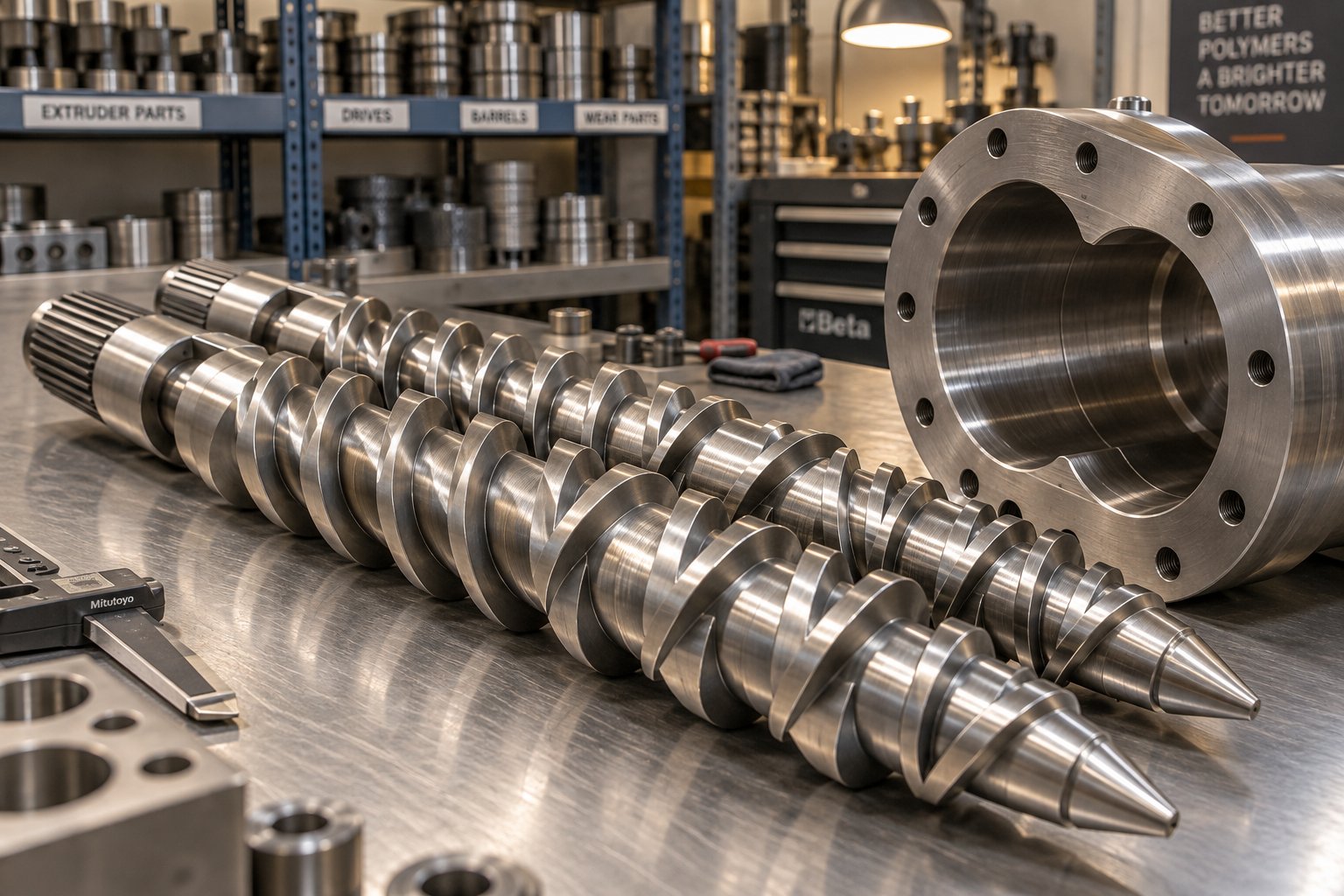
The Conical Twin Screw Barrel and Its Impact on Production Quality
The troubleshooting section above keeps circling back to the same origin point: plasticizing quality. Surface roughness, die lines, thickness variation, color drift — defect after defect traces upstream to the melt that left the barrel. That convergence isn't coincidental. The conical twin screw barrel is the single most wear-critical component in any PVC wall panel extrusion line, and its condition quietly dictates whether you're producing premium panels or chasing quality problems shift after shift.
Why the Conical Twin Screw Barrel Is the Heart of PVC Extrusion
PVC is an unusual polymer. Unlike polyethylene or polypropylene, it's thermally sensitive and shear-sensitive simultaneously — apply too much mechanical energy and it degrades; apply too little and it doesn't fuse. The conical twin screw design solves this dilemma elegantly. Its tapered geometry — larger diameter at the feed end, smaller at the discharge — generates high torque at low rotational speed, delivering the intense compressive force PVC needs for complete plasticization without the destructive shear that causes degradation.
This design also creates a natural pressure gradient. Material entering at the wide end is gently conveyed and preheated, then progressively compressed as the channel narrows toward the discharge. The result, when the screw-barrel assembly is in good condition, is a homogeneous, bubble-free melt delivered at stable pressure to the die head. Every china pvc wall panel extrusion line manufacturer builds their systems around this principle — whether the extruder carries a 51/105, 65/132, or 80/156 designation, the conical twin screw barrel is doing the core plasticizing work.
The critical variable is clearance. As screw-barrel engineering specialists explain, the radial gap between screw flight and barrel bore is measured in hundredths of a millimeter — yet this tiny dimension controls melt sealing, pressure buildup, and conveying efficiency. For screw diameters in the 65-80mm range commonly used in wall panel production, recommended clearances typically fall between 0.10mm and 0.25mm. When this gap widens through abrasive wear — especially from high CaCO3 filler loadings at 50-60 phr — the consequences cascade rapidly.
Material leaks backward past the screw flights instead of being pushed forward. Output volume drops even though the motor draws the same or higher amperage. Melt temperature becomes uneven because some material recirculates through the worn gap, receiving double the thermal history while fresh material passes through underfused. You'll recognize these symptoms from the defect table in the previous section: die lines from unmelted particles, surface roughness from poor fusion, color shift from localized overheating. The machine is running. The settings haven't changed. But the barrel has quietly worn past its working tolerance, and no amount of temperature adjustment or speed tweaking will compensate.
Signs of Screw-Barrel Wear and When to Replace
Wear doesn't announce itself with a single dramatic failure. It creeps in gradually — a slow erosion of performance that operators often attribute to formulation changes, ambient temperature shifts, or "just a bad batch of resin." Knowing the specific indicators saves you months of chasing phantom problems. Watch for these signals:
- Declining output at the same screw RPM: If your extruder used to produce 200 kg/h at 22 RPM and now delivers 170 kg/h at the same setting, melt is leaking backward through enlarged clearances.
- Rising motor amperage without increased output: The screw works harder to build pressure against a barrel that no longer seals efficiently — energy consumption climbs while productivity doesn't.
- Increasing frequency of unmelted particles or die lines: Worn screw flights lose their compressive effectiveness, allowing partially fused PVC to reach the die.
- Wider temperature variation in the melt: Recirculating material through worn gaps creates hot spots and cold spots within the same melt stream, producing uneven surface finish and dimensional inconsistency.
- Visible scoring, grooves, or surface damage on the screw flights or barrel bore: Physical inspection during maintenance shutdowns reveals wear patterns — typically concentrated in the compression zone where mechanical stress and filler abrasion peak.
- Panel quality that degrades progressively despite stable process settings: This is the defining symptom. When every parameter on the HMI screen looks correct but finished panels keep getting worse, the hardware itself has moved out of specification.
Many operators, from small-scale workshops to large facilities working with a pvc wall panel extrusion line manufacturer in China, assume that barrel wear means replacing the entire extruder. That's rarely necessary. The screw-barrel assembly is a replaceable component — and sourcing a precision-manufactured replacement from a specialist can restore original output levels and product quality at a fraction of the cost of a new machine.
This is where component-level suppliers become invaluable. NANHAIYA, for example, specializes in custom and replacement conical twin screw barrels for PVC pipe, profile, board, foam board, and WPC extrusion applications. Rather than treating the barrel as a generic commodity part, specialists like NANHAIYA engineer replacement barrels to match the specific clearance tolerances, alloy requirements, and dimensional specifications of your existing extruder — whether it's a domestic Chinese machine, a van Dorn PVC ceiling wall panel extrusion line, or a European-built system requiring aftermarket support. For manufacturers experiencing the wear symptoms listed above, a properly specified replacement barrel from a dedicated screw-barrel supplier often delivers the most immediate and cost-effective path back to stable plasticizing performance and consistent panel quality.
Restoring the extruder's core performance addresses the upstream root cause of most production issues. But even a perfectly plasticized melt only becomes a market-ready product after it passes through finishing processes — laminating, hot stamping, UV coating — that transform a raw extruded panel into a decorative surface customers are willing to pay a premium for.
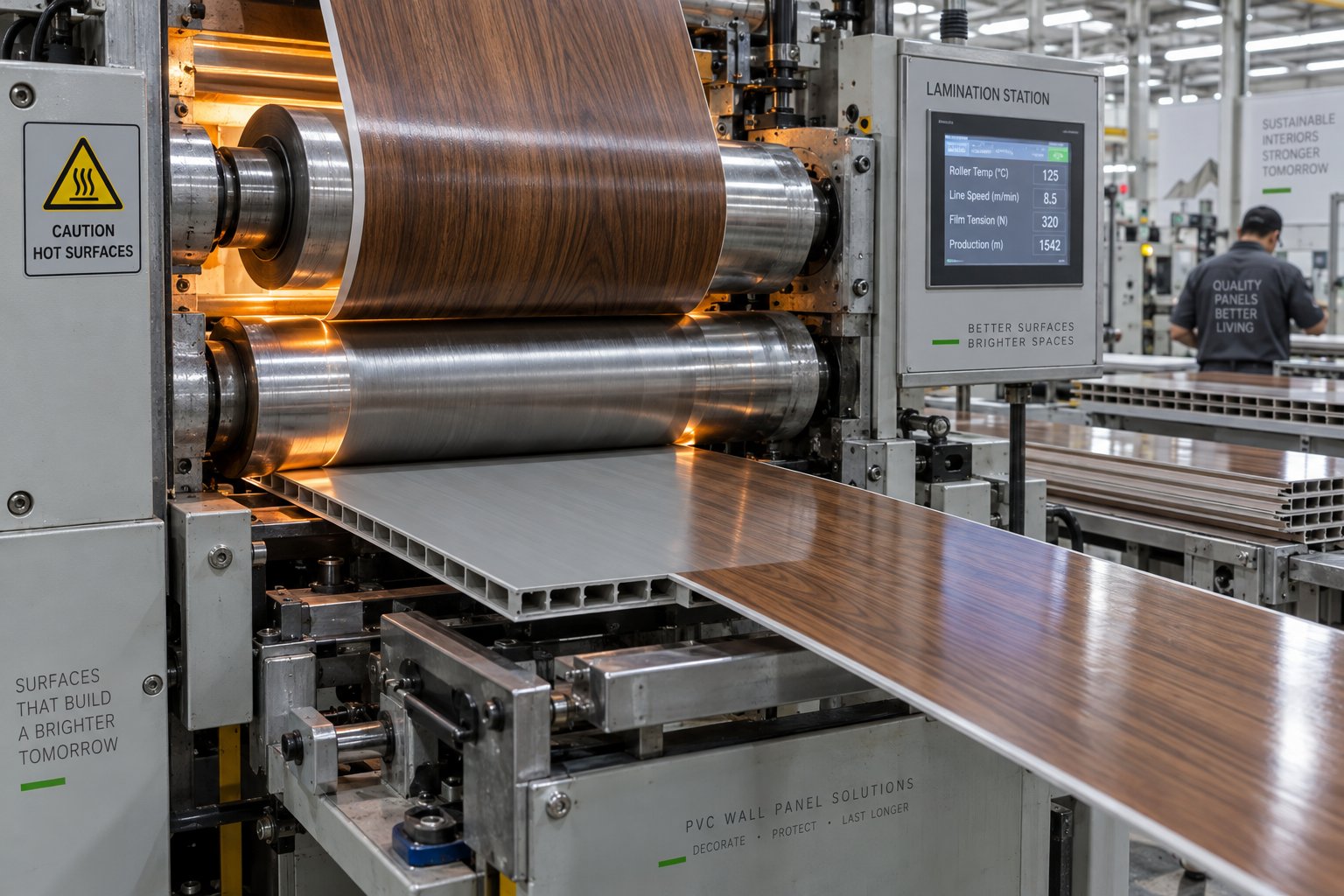
Downstream Finishing and SPC vs WPC Panel Comparison
A raw extruded PVC panel — uniform, dimensionally stable, freshly cut to length — is functionally complete but commercially incomplete. The difference between a commodity panel selling at razor-thin margins and a premium decorative product commanding two to three times the price often comes down to what happens after extrusion. Yet most buyers evaluating a pvc wall panel extrusion line wholesale focus almost entirely on the extruder and ignore the finishing stage that ultimately determines market positioning and profit per square meter.
Laminating and Hot Stamping Techniques
Lamination is the most widely used finishing method in wall panel production. The process bonds a decorative PVC film or PET film onto the panel surface using either hot-melt adhesive or direct thermal lamination. Wood grain, marble veining, solid colors, fabric textures — the visual possibilities are nearly unlimited because the film carries the pattern, not the panel itself. Equipment-wise, an inline laminating machine sits immediately after the cutting station. It requires precise temperature and pressure control: too much heat wrinkles the film, while insufficient bonding pressure creates air bubbles that appear as blisters after installation. For manufacturers sourcing a wholesale pvc wall panel extrusion line, confirming that the laminator supports your target panel width and film type is essential — retrofitting a mismatched laminator wastes both time and material.
Hot stamping takes a different approach. Instead of a continuous film, it transfers metallic or patterned foils onto the panel surface using heat and pressure through an engraved silicone roller. The result is striking — gold borders, silver accent lines, or intricate wood-grain patterns that catch light differently than flat-printed designs. Hot stamping units are typically standalone machines positioned offline, adding a secondary processing step. The trade-off is speed: hot stamping runs slower than inline lamination, but the perceived value of the finished panel can justify the additional handling. As foil industry specialists note, traditional hot foil stamping excels at large-volume production runs where the same pattern repeats across thousands of panels.
UV Coating and Digital Printing for Premium Panels
UV coating applies a liquid ultraviolet-curable resin to the panel surface, then instantly hardens it under UV lamps. The result is a scratch-resistant, stain-resistant, high-gloss or matte protective layer that significantly extends the panel's service life. UV-coated panels target the upper end of the market — hotel lobbies, high-traffic commercial interiors, and healthcare facilities where cleaning chemicals would damage uncoated surfaces. The equipment investment is moderate, but it requires careful integration into the line layout: coating thickness uniformity, UV lamp intensity, and conveyor speed must be precisely synchronized.
Digital printing represents the newest frontier. Direct inkjet printing technology applies custom patterns — photographs, custom artwork, unique textures — directly onto the panel surface without films or foils. Imagine a hospitality client requesting a one-of-a-kind wall mural produced on standard PVC panels. Digital printing makes that possible with zero tooling cost and no minimum order quantity for pattern changes. The technology is still maturing for rigid panel substrates, but manufacturers who invest early position themselves for the growing demand in customized interior design. Buyers exploring a pvc wall panel extrusion line wholesale in china should ask whether the supplier offers digital printing integration or at least designs the line layout with space for future addition.
Each finishing method shifts your production economics differently. Lamination adds modest cost but broad market appeal. Hot stamping adds processing time but commands premium pricing. UV coating adds durability that justifies higher price points in commercial specifications. Digital printing sacrifices speed for customization — a trade-off that makes sense for short-run, high-margin projects rather than mass production.
SPC vs WPC Wall Panels: Process and Equipment Differences
Beyond surface finishing, the type of panel core you produce fundamentally changes your machinery configuration and target market. Two composite panel categories have grown rapidly alongside traditional PVC hollow and solid panels: SPC (Stone Plastic Composite) and WPC (Wood Plastic Composite). Both run on extrusion lines derived from the same platform as standard PVC wall panel systems, but each requires distinct process modifications that buyers need to understand before committing to a line configuration.
SPC panels use a high-density core composed primarily of PVC resin and calcium carbonate at very high filler ratios — often 60% to 80% CaCO3 by weight. This produces an extremely rigid, dimensionally stable panel with excellent waterproofing and fire resistance. The high mineral content, however, dramatically increases abrasive wear on screw flights and barrel bore, demanding harder alloy specifications for the screw-barrel assembly and more frequent wear inspection. Extrusion temperatures tend to run slightly lower than standard PVC panels because the dense, heavily filled compound generates significant frictional heat internally.
WPC panels incorporate wood flour or bamboo fiber as a partial replacement for mineral filler. The organic fiber content produces a warmer tactile feel and natural aesthetic, but introduces moisture sensitivity during processing — wood flour must be thoroughly dried before compounding to prevent steam-generated voids in the finished panel. WPC formulations also require adjusted lubricant systems and sometimes different screw geometries to handle the fibrous material without bridging or inconsistent feeding.
| Panel Type | Core Composition | Key Process Differences | Typical Applications | Equipment Modifications Required |
|---|---|---|---|---|
| SPC (Stone Plastic Composite) | PVC resin + high CaCO3 loading (60-80%) | Lower extrusion temps due to frictional heat; high wear rate on screw-barrel; requires robust cooling capacity | Premium waterproof wall cladding, bathroom panels, commercial interiors, click-lock wall systems | Hardened bimetallic screw-barrel; heavy-duty haul-off; extended calibration table length |
| WPC (Wood Plastic Composite) | PVC or PE resin + wood flour/bamboo fiber (30-50%) | Pre-drying of wood flour required; adjusted screw geometry for fiber feeding; modified lubricant balance | Residential interiors, decorative ceiling panels, outdoor cladding with natural aesthetics | Pre-drying and gravimetric feeding system; modified screw profile for fibrous materials; venting capability in barrel |
For manufacturers considering both product lines, it's worth noting that a single extrusion platform can sometimes serve both SPC and WPC production with changeover — but only if the screw-barrel assembly, die head, and feeding systems are specified to handle the more demanding of the two. Buying a line optimized solely for standard hollow PVC panels and then attempting to run SPC compound through it is a recipe for accelerated wear, poor melt quality, and disappointing output rates.
Finishing capabilities and panel type selection ultimately shape your product portfolio and competitive positioning. But before any of these decisions deliver returns, there's a more fundamental question every buyer must answer: how do you select the right overall line configuration and evaluate suppliers in a market crowded with options at every price point?
How to Select and Evaluate a PVC Wall Panel Extrusion Line
Product type, finishing method, and panel core composition shape your competitive strategy. But translating that strategy into a purchase order — choosing the right machine configuration, vetting suppliers, and understanding what happens between delivery and stable production — is where capital meets reality. A pvc wall panel extrusion line wholesaler might offer dozens of configurations at every price point. The question isn't which one is cheapest. It's which one actually fits your production goals, factory constraints, and payback timeline.
Critical Factors for Choosing the Right Line Configuration
Machinery selection isn't a single decision — it's a sequence of interdependent choices where each answer constrains the next. Skipping steps or deciding out of order almost always leads to mismatched equipment. Follow this structured process to avoid the most expensive mistakes:
- Define your target panel type and dimensions: Are you producing standard hollow ceiling panels at 200-300mm width, or wide-format solid wall panels at 600mm+? Will you run foam-core, SPC, or WPC products? Each type demands different die configurations, screw-barrel alloy grades, and calibration table lengths. Start here — everything downstream depends on it.
- Establish your required daily output volume: Calculate backward from your sales forecast. If you need 3,000 square meters of panel per day and your target panel is 300mm wide and 8mm thick, you can derive the required kg/h throughput and match it to the screw diameter table from the specifications section. Build in a 20% capacity buffer — running at 100% rated output accelerates wear and leaves zero margin for process upsets.
- Audit your factory space and utilities: A complete line — mixer, extruder, calibration table, haul-off, cutter, stacker, and optional laminator — typically requires 40 to 80 meters of linear floor space depending on configuration. Confirm your available electrical supply matches the line's connected load. A high-output 80/156 system with laminator and chiller can draw 150-200 kVA — power infrastructure upgrades add cost and lead time that buyers frequently overlook.
- Set a realistic budget range: Include not just the machine price but freight, import duties, foundation preparation, electrical installation, chiller, compressor, initial tooling, and spare parts. As industry buyer's guides emphasize, the lowest purchase price can become the most expensive option if dimensional instability creates product returns or if proprietary spare parts cause weeks of downtime.
- Decide between a complete turnkey line and component upgrades: Not every buyer needs a brand-new system. If your existing extruder is mechanically sound but the screw-barrel assembly is worn, replacing that single component can restore output quality without the capital outlay of a full line. Similarly, adding an inline laminator or upgrading a cutting unit can expand product capability on existing infrastructure.
- Request formal quotations with defined test conditions: Provide every potential supplier with your panel drawing, target formulation, required output rate, and quality standards. Insist that quoted output figures specify the test formulation, filler percentage, panel profile, and stable run duration — not a short-burst peak number that your actual production will never replicate.
Evaluating Suppliers and Post-Purchase Commissioning
The supplier landscape for a pvc wall panel extrusion line wholesaler in china includes complete-line OEMs, regional distributors, trading companies, and component-level specialists. Each serves a different role in your supply chain, and experienced buyers maintain relationships across all categories rather than relying on a single source for everything.
When evaluating potential partners, apply these criteria systematically:
- Component-level specialists for critical wear parts: Suppliers like NANHAIYA focus specifically on custom and replacement conical twin screw barrels for PVC pipe, profile, board, foam board, and WPC extrusion. Having a dedicated screw-barrel supplier — independent of your complete-line OEM — ensures you can source precision-manufactured replacement barrels on your timeline, not theirs. This is especially valuable when operating lines from multiple manufacturers or when the original equipment supplier has long lead times for wear components.
- Complete-line OEM capability: Can the supplier design and correct tooling in-house? Do they offer factory acceptance testing using your actual material or a formally approved equivalent? Verify that electrical drawings, operator manuals, and spare-parts lists are supplied in a language your team can actually use.
- Installation and commissioning support: Clarify who performs on-site installation, mechanical alignment, electrical hookup, and initial parameter optimization. Structured operator training — typically 40 to 80 hours of hands-on instruction covering startup procedures, temperature profiling, die adjustment, and basic troubleshooting — has been shown to reduce first-year operator errors significantly compared to unstructured on-the-job learning. Confirm the training scope and duration before signing a contract.
- Post-warranty service and spare parts availability: Which components are locally available in your country? What remote diagnostic and on-site response options exist after the warranty period? Are critical spare parts — heater bands, thermocouples, vacuum pump seals, cutter blades — identified and quoted before shipment?
- Reference installations: Ask for contact details of existing customers producing similar panel types at comparable volumes. A supplier confident in their equipment welcomes reference checks; one that deflects the request is telling you something.
After delivery, expect a commissioning phase that typically spans one to three weeks. This includes mechanical and electrical installation, utility connections, dry-run testing of individual units, initial extrusion trials with your formulation, temperature and speed optimization, and operator training. Don't rush this stage. The parameter settings established during commissioning become your production baseline — cutting corners here means months of instability as operators struggle to find settings that should have been documented during a proper startup.
Production Economics and ROI Considerations
Every buyer wants to know: how quickly will this line pay for itself? The answer depends on four cost drivers and one revenue variable — all specific to your local market.
Raw material cost is the largest single variable, typically representing 60-70% of the cost per square meter of finished panel. PVC resin prices fluctuate with petrochemical markets, and CaCO3 filler — while inexpensive — adds weight that increases shipping cost to customers. Formulation optimization directly impacts this figure: the filler ratio, stabilizer system cost, and processing aid consumption all contribute.
Energy consumption varies with extruder size, motor efficiency, and how heavily the line is loaded. A well-matched line running at 75-80% of rated capacity will consume less energy per kilogram of output than an undersized machine pushed to its limit. Buyers evaluating a wholesale price pvc wall panel extrusion line should request specific energy consumption data in kWh per kilogram — not just total connected motor power — to compare operating costs accurately.
Labor requirements depend on automation level. A basic line requires two to three operators per shift; a highly automated system with gravimetric feeding, auto-stacking, and inline lamination may operate with one skilled operator and one helper. Labor cost per square meter drops significantly with higher throughput — another reason why chasing maximum line utilization matters.
Machine depreciation typically spreads over seven to ten years for a complete extrusion line, though critical wear components like the screw-barrel assembly may require replacement on a shorter cycle — especially under high-filler formulations. Factoring in component replacement cost as a recurring maintenance expense rather than an unexpected capital event produces more accurate ROI projections.
To estimate your payback period, calculate your production cost per square meter — combining materials, energy, labor, and depreciation — and subtract it from the selling price achievable in your local market. Multiply the margin by your realistic annual output (accounting for uptime, yield, and seasonal demand variation), and divide the total equipment investment by the annual margin. Most well-configured lines serving active local markets achieve payback within 18 to 36 months, but this range shifts dramatically based on raw material costs and finished panel pricing in your region.
Whether you're commissioning your first system, upgrading worn components through a specialist like NANHAIYA, or scaling from a startup configuration to high-output production, the principles remain consistent: define the product first, match the machinery to realistic production targets, vet suppliers across the complete ecosystem, and model economics using conservative assumptions. The best PVC wall panel extrusion line isn't the one with the most impressive spec sheet — it's the one validated against your actual formulation, your factory infrastructure, and your market's willingness to pay.
Frequently Asked Questions About PVC Wall Panel Extrusion Lines
1. What are the main components of a PVC wall panel extrusion line?
A complete PVC wall panel extrusion line consists of a high-speed mixer and cooling mixer for raw material preparation, a conical twin-screw extruder for plasticizing the PVC compound, an extrusion die head for shaping the panel profile, a vacuum calibration table for dimensional stability, a haul-off unit for consistent pulling speed, a cutting unit for length accuracy, and an automatic stacker for finished panel handling. The conical twin-screw extruder is considered the heart of the line because its screw-barrel assembly directly controls melt quality, which influences nearly every downstream outcome including surface finish, dimensional accuracy, and structural integrity. Specialists like NANHAIYA (nhyscrews.com) supply custom and replacement conical twin screw barrels that can restore worn extruder performance without requiring full machine replacement.
2. What raw materials are needed for PVC wall panel production?
PVC wall panel production requires suspension-grade PVC resin (typically SG-5 with a K-value of 66-68 for standard rigid panels), calcium-zinc or organotin thermal stabilizers to prevent heat degradation, calcium carbonate filler at 30-60 phr depending on desired panel density, internal lubricants like calcium stearate, external lubricants such as PE wax and oxidized PE wax, ACR processing aids for faster fusion and surface smoothness, impact modifiers (CPE or acrylic-based) for toughness, and titanium dioxide or color masterbatch for appearance. The formulation balance is critical because each additive change — especially filler loading — directly affects melt viscosity and requires corresponding adjustments to barrel temperatures, screw speed, and haul-off settings to maintain panel quality.
3. How do I choose the right screw size for my PVC wall panel extrusion line?
Screw size selection depends on your target output volume, panel dimensions, and formulation complexity. For small-scale startups producing 100-150 kg/h, a 51/105 or 55/110 conical twin-screw extruder with 15-22 kW motor power is typically sufficient for panels up to 400mm wide. Mid-volume production at 150-250 kg/h suits a 65/132 configuration with around 37 kW motor power, handling panel widths up to 600mm. High-output industrial operations targeting 250-650 kg/h require 80/156 or 92/188 extruders with 55-90 kW motors, capable of producing panels over 1200mm wide using multi-cavity dies. Always build in a 20% capacity buffer rather than running at maximum rated output, as this extends screw-barrel lifespan and improves product consistency.
4. What causes surface defects and warping in extruded PVC wall panels?
Surface roughness usually results from incomplete plasticization caused by insufficient barrel temperature in the compression zone, low ACR processing aid dosage, or worn screw-barrel assemblies that reduce shear energy. Die lines — persistent longitudinal streaks — are caused by contamination or plate-out buildup on the die land, or by unmelted PVC particles from a worn extruder passing through the die lip. Warping and bowing occur when internal stresses are locked in unevenly during cooling, typically from asymmetric water flow in the calibration table or unbalanced melt distribution from the die. A significant proportion of these defects trace back to the plasticizing stage, meaning that worn screw flights or enlarged barrel bore tolerances are often the hidden root cause behind multiple quality problems simultaneously.
5. When should I replace the conical twin screw barrel on my PVC extrusion line?
Key indicators that signal barrel replacement include declining output at the same screw RPM, rising motor amperage without increased throughput, increasing frequency of unmelted particles or die lines, wider temperature variation in the melt stream, visible scoring or grooves on screw flights or barrel bore during maintenance inspections, and progressive panel quality degradation despite stable process settings. Replacement does not require purchasing an entire new extruder. Component-level specialists such as NANHAIYA manufacture precision conical twin screw barrels engineered to match specific clearance tolerances and alloy specifications for PVC pipe, profile, board, foam board, and WPC extrusion applications. Sourcing a properly specified replacement barrel can restore original output levels and product quality at a fraction of full extruder replacement cost.
Written by
Nanhaiya Technical Team
Zhoushan Nanhaiya Plastic Machinery Co., Ltd.
The Nanhaiya technical team supports screw and barrel manufacturing projects through application review, technical communication, custom manufacturing coordination, and production and quality control.
Discuss Your Application
Related Articles
More insights on screw barrel technology and plastics processing.
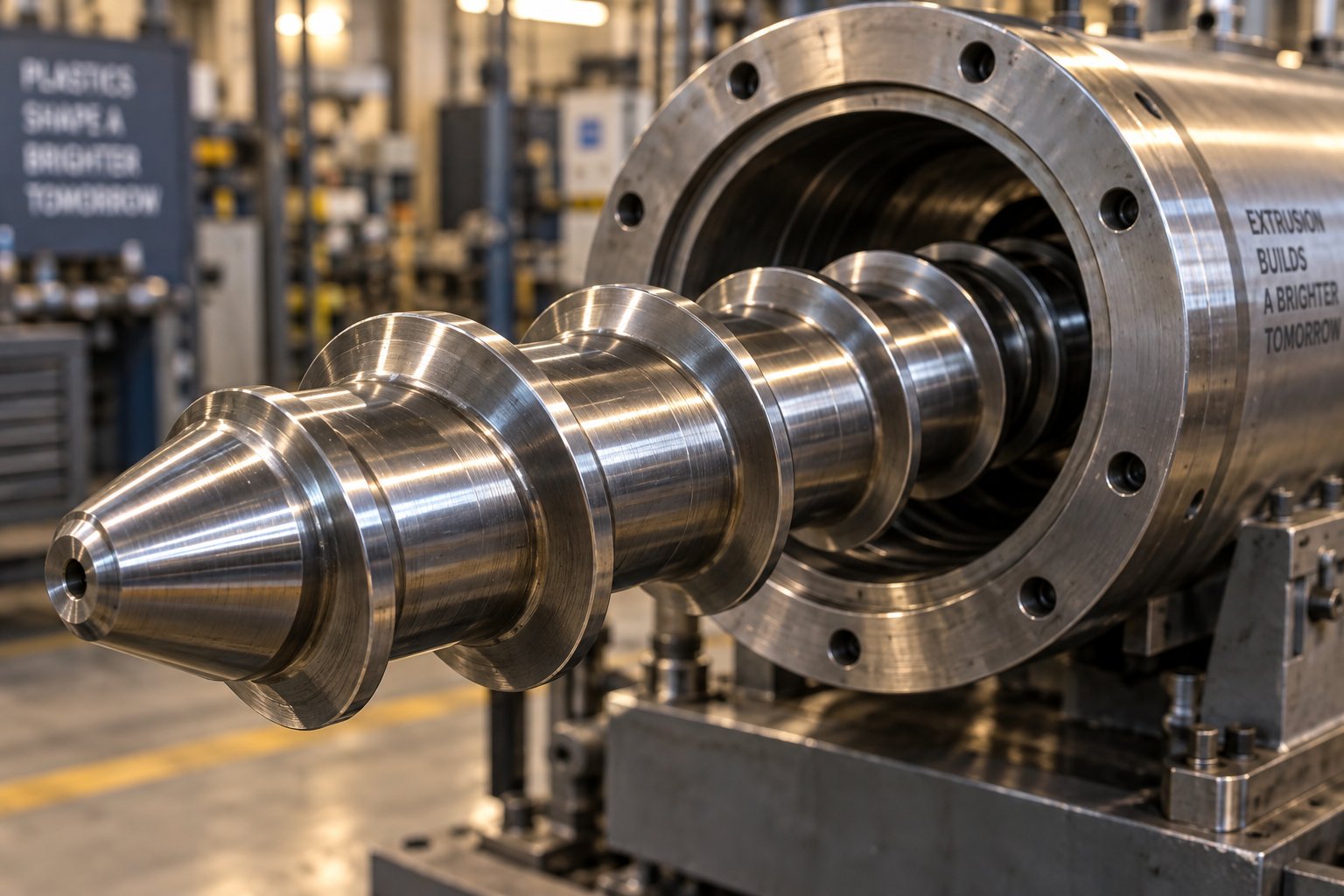
What Nobody Tells You About Screw Barrel For Plastic Machine Design
Oct 10, 2026
Learn how screw barrel for plastic machine design affects melt quality, throughput, and wear life. Covers geometry, resin matching, troubleshooting, and sourcing.
Read Article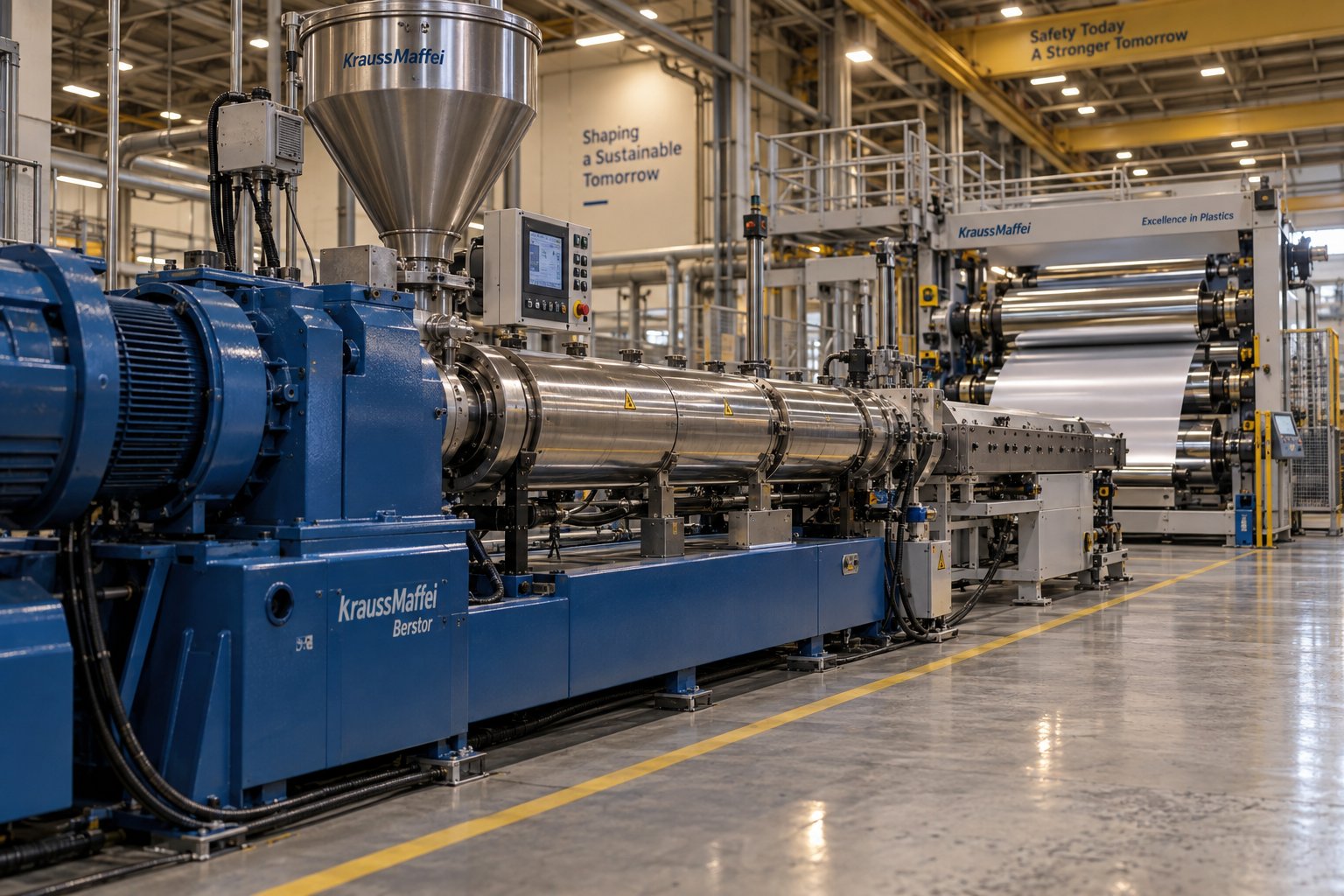
Single Screw Extruder for Sheet: Stop Guessing, Start Specifying
Oct 9, 2026
Learn how to specify a single screw extruder for sheet production. Covers screw geometry, resin-specific processing, troubleshooting, and maintenance best practices.
Read Article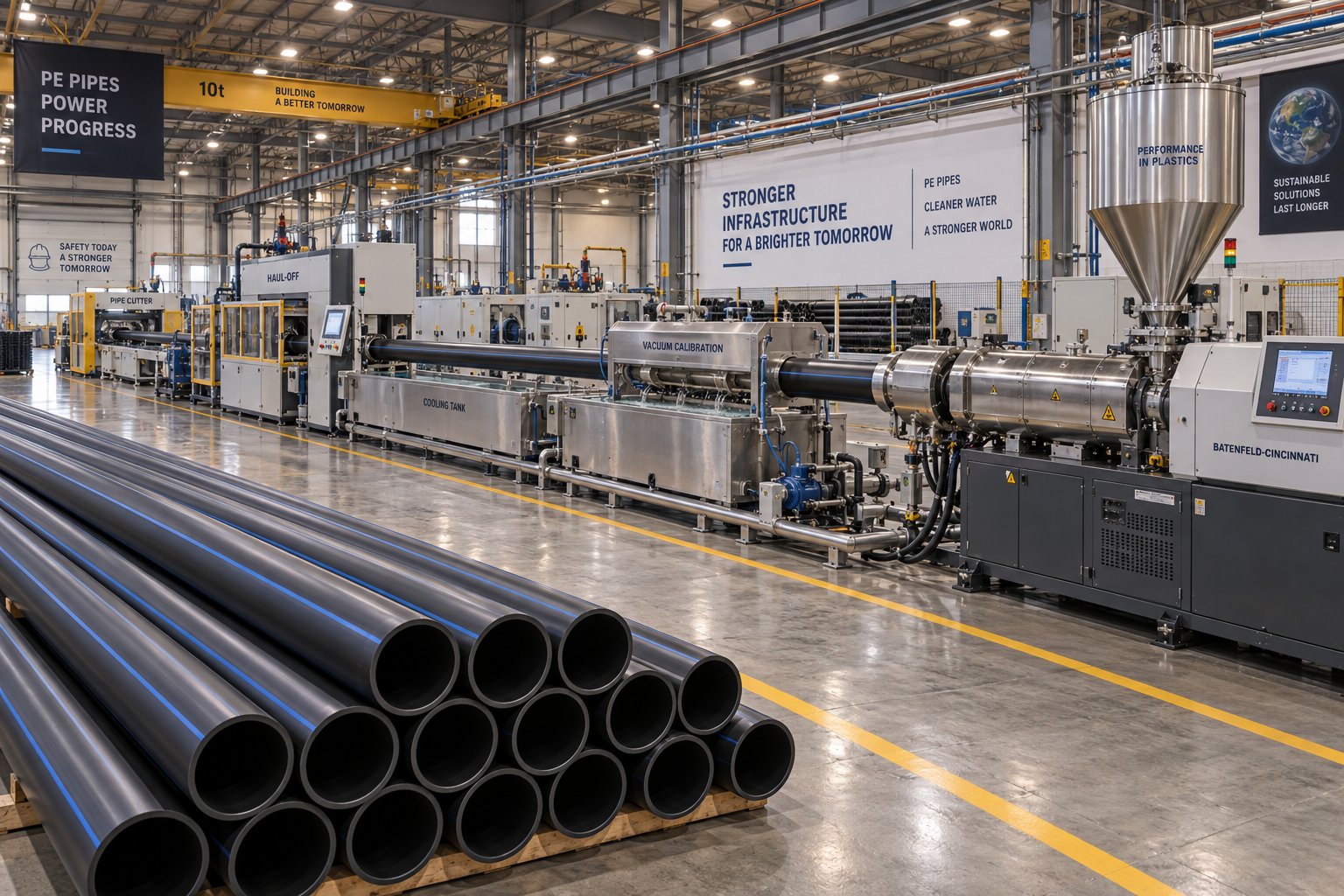
PE Pipe Extruder Machine: What Datasheets Won't Tell You
Oct 9, 2026
Learn how a PE pipe extruder machine works, key specs explained, material grade selection, maintenance tips, and buyer guidance beyond the datasheet.
Read ArticleLooking for something else?
Search by material, symptom or product and jump straight to the relevant page.
These are navigation suggestions based on keyword matching — not a quotation, not a delivery commitment, and not a substitute for engineering review. Final specification is confirmed by our engineers against your drawings and processed material.
Need help with screw barrel selection?
Share your machine model, processed material and application. Our team can help with pricing and technical support.