

What Is a PVC Conduit Pipe Making Machine
If you have ever searched for pipe manufacturing equipment, you have probably noticed that dozens of machine types appear under the broad "PVC pipe machine" umbrella. Plumbing lines, SWR drainage systems, CPVC hot-water setups — they all look similar on the surface. So what exactly sets a PVC conduit pipe making machine apart, and why does it deserve its own category?
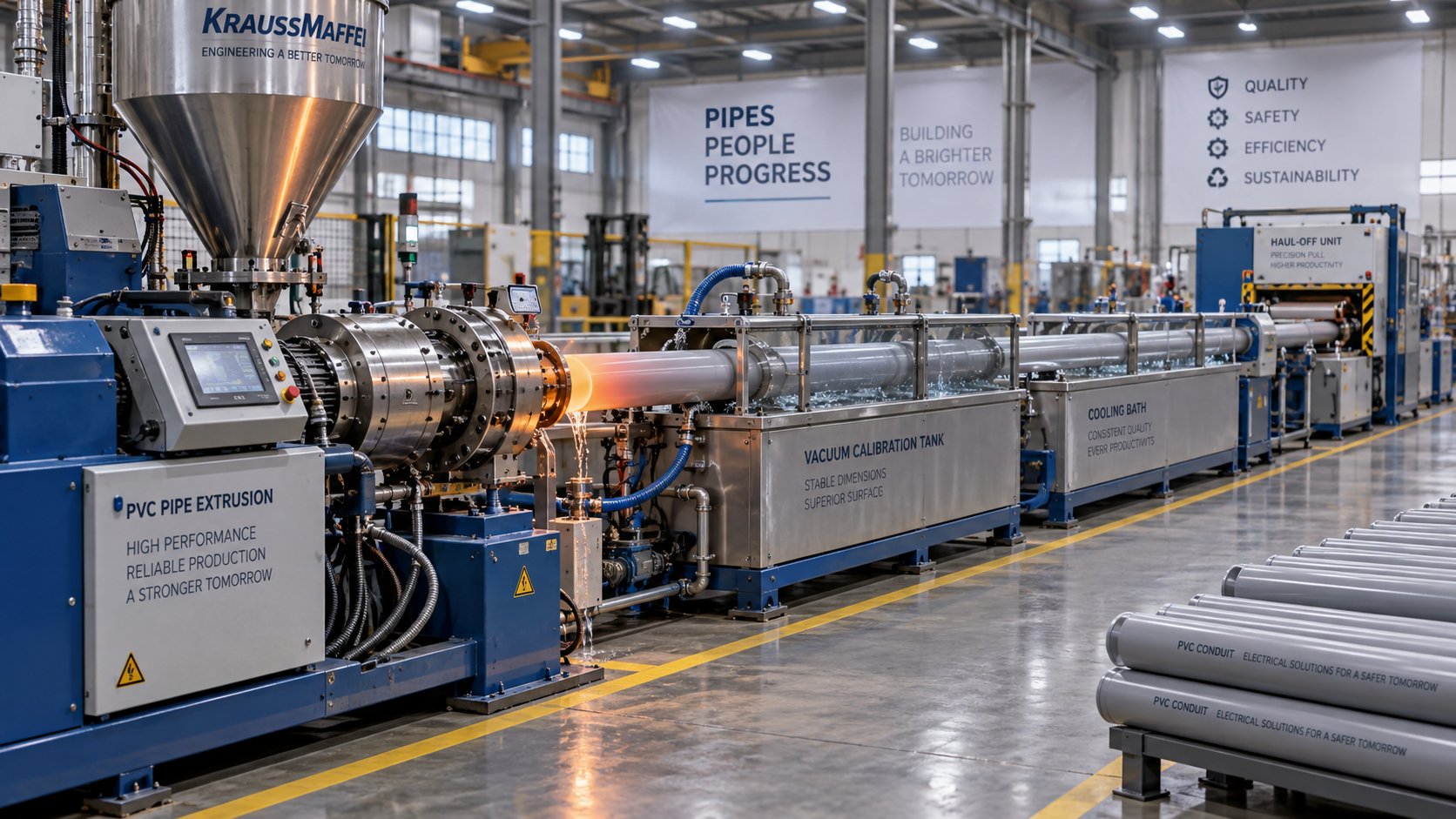
A PVC conduit pipe making machine is an extrusion-based production line that converts rigid PVC compound into thin-walled, dimensionally precise electrical conduit pipes. These pipes are designed to protect and route electrical wiring in residential, commercial, and industrial buildings. A complete line typically includes an extruder, extrusion die head, vacuum calibration tank, spray cooling bath, haul-off unit, and automatic cutter.
Defining the PVC Conduit Pipe Making Machine
At its core, this equipment takes raw PVC resin — blended with stabilizers, lubricants, and other additives — and transforms it into rigid hollow tubes through a continuous extrusion process. The production line operates as a synchronized system where each unit handles a specific stage: melting the compound, shaping it into a pipe profile, sizing it to exact tolerances, cooling it for structural integrity, pulling it at a controlled speed, and cutting it to predetermined lengths. Every stage must work in harmony because even a minor inconsistency in one unit can cause dimensional defects across the entire output.
How Conduit Pipe Machines Differ from Other PVC Pipe Lines
Here is where most buyers get confused. A PVC electrical conduit pipe making machine is not simply a smaller version of a plumbing pipe line. The differences run deeper than pipe diameter. Conduit pipes are thin-walled by design — they need to be lightweight enough for easy installation on walls and ceilings, yet rigid enough to protect wiring from physical damage. This means the extrusion die, vacuum calibration sleeve, and temperature control zones are all configured for tighter wall-thickness tolerances than you would find on a standard water supply or drainage pipe setup.
Plumbing and SWR pipe machines, by contrast, prioritize pressure ratings and chemical resistance. Their dies produce thicker walls, and their calibration systems accommodate larger diameter ranges. CPVC lines add another layer of complexity with higher processing temperatures. A conduit line, however, is optimized for speed and precision on smaller-diameter, thin-walled pipes — typically in the 16 mm to 50 mm range — while meeting strict electrical safety and flame-retardancy standards that plumbing pipes never face.
Who Uses These Machines and Why
Entrepreneurs entering the electrical infrastructure supply chain, established pipe manufacturers diversifying their product range, and procurement professionals sourcing equipment for new facilities — these are the primary audiences exploring a PVC conduit pipe making machine for sale. Rapid urbanization and expanding construction activity in emerging markets have made electrical conduit pipes a consistently high-demand product, which keeps drawing new investors toward this equipment category.
This guide is built for all three groups. Rather than glossing over technical details or burying them in sales jargon, the sections ahead will walk you through how these machines actually work, what components matter most, how production economics play out, and what manufacturers rarely disclose before you sign a purchase order. The goal is straightforward: give you the depth of knowledge needed to make a confident, well-informed equipment decision.
Of course, understanding the machine starts with understanding the product it makes — and not all conduit pipes are created equal.
PVC Conduit Pipe Types and the Machines That Produce Them
Imagine placing an order for a pvc conduit pipe making machine only to discover — weeks after installation — that the die tooling and calibration setup cannot produce the specific gauge your market demands. It happens more often than suppliers admit. The reason? Conduit pipes are not a single product. They span a range of gauge classifications, wall thicknesses, and application requirements, and each variation places distinct demands on the production line.
Light, Medium, and Heavy Gauge Conduit Pipes
PVC electrical conduit pipes are broadly categorized into three gauge types based on mechanical strength: LMS (Light Mechanical Strength), MMS (Medium Mechanical Strength), and HMS (Heavy Mechanical Strength). Each classification reflects how much physical protection the pipe provides to the wiring inside it.
LMS pipes are the thinnest and lightest option. They suit low-stress environments — think concealed wiring runs inside residential walls and ceilings where the pipe is embedded in plaster and unlikely to face direct impact. Their thinner walls make them budget-friendly and easy to handle, but they are not built for exposed or high-traffic areas.
MMS pipes sit in the middle ground. With moderately thicker walls, they handle both concealed and surface-mounted wiring in residential and commercial buildings. They offer a practical balance between durability and cost, which is why they represent the most commonly used conduit category in many markets.
HMS pipes are the heavy-duty option. Designed for demanding conditions — underground ducting, industrial environments, outdoor installations, and areas prone to mechanical impact — they feature the thickest walls and highest compression resistance. When wiring runs through a factory floor or below a road crossing, HMS is the standard choice.
| Gauge Type | Typical Wall Thickness Range | Common Applications | Key Machine Configuration Notes |
|---|---|---|---|
| LMS (Light) | 1.0 – 1.5 mm | Concealed wiring in residential walls and ceilings | Higher line speeds; precision die with narrow gap tolerance; lighter vacuum calibration pressure |
| MMS (Medium) | 1.5 – 2.0 mm | Surface and concealed wiring in residential and commercial buildings | Moderate extruder output; standard calibration sleeves; balanced speed-to-cooling ratio |
| HMS (Heavy) | 2.0 – 3.0 mm | Underground ducting, industrial areas, outdoor and high-impact zones | Higher extruder torque and output capacity; extended cooling line; robust haul-off force |
The wall thickness ranges above are general industry references. Actual values depend on the pipe diameter, applicable national standard, and end-use specification. What matters for equipment buyers is this: the gauge you intend to produce directly shapes the machine configuration you need.
Rigid vs. Flexible Conduit Production Differences
Most discussions about conduit pipe machines focus on rigid PVC conduit — and for good reason. Rigid conduit accounts for the bulk of electrical wiring protection in permanent installations. The extrusion process for rigid conduit uses unplasticized PVC (uPVC) compound, processed through a conical twin-screw extruder at carefully controlled temperatures to avoid thermal degradation.
Flexible conduit, on the other hand, uses plasticized PVC with added softening agents. This changes the processing dynamics significantly. The compound flows more easily, requiring different screw geometry, lower processing temperatures, and specialized corrugated or ribbed die tooling. Flexible conduit lines also include corrugators or forming units downstream — equipment that a standard rigid conduit line simply does not have.
If your production plan includes both rigid and flexible conduit, you are essentially looking at two distinct machine setups rather than a single versatile line. Clarifying this with your supplier upfront can save you from costly mid-project changes.
Matching Pipe Specifications to Machine Configuration
Every conduit pipe specification maps back to a specific set of machine parameters. Consider the relationship:
- Pipe diameter range (16 mm to 50 mm for most conduit): Determines the die head design and calibration sleeve dimensions. A line configured for 16–25 mm conduit uses smaller dies and can often run multi-cavity setups — producing two or even four pipes simultaneously for higher throughput.
- Wall thickness and gauge classification: Affects extruder output capacity and screw speed. Thicker-walled HMS pipes consume more material per meter, so the extruder must deliver a higher volume of homogeneous melt without overheating it.
- Line speed: Thin-walled LMS pipes can run at faster speeds because they cool more quickly. HMS pipes require slower line speeds and longer cooling baths to solidify properly before reaching the cutter.
Buyers searching for a low price pvc conduit pipe making machine often find that the most affordable options are single-cavity lines optimized for a narrow diameter range. These can work well for startups targeting a focused product mix. Scaling up to broader diameter coverage or multi-cavity production raises the pvc conduit pipe making machine price, but it also multiplies output efficiency considerably — a tradeoff worth modeling against your projected sales volume.
One more distinction worth noting: some manufacturers also produce PVC conduit-style pipes intended for water conveyance rather than electrical protection. A pvc conduit pipe making machine for water applications uses a very similar base extrusion line, but the die tooling dimensions, wall thickness targets, and — critically — the compliance standards differ entirely. Water conduit pipes must pass pressure and leak-resistance tests, while electrical conduit pipes must meet flame propagation, impact resistance, and insulation requirements. The machine hardware may overlap, but the tooling and quality validation do not.
With pipe types and their machine implications clear, the natural next question is what actually happens inside these machines — step by step — from raw PVC resin to a finished pipe ready for packaging.
How a PVC Conduit Pipe Making Machine Works from Start to Finish
You have seen the equipment list. You know the pipe types. But what actually happens when someone presses the start button on a PVC conduit pipe making machine? Most supplier brochures skip this question entirely or reduce it to a vague one-liner: "raw material goes in, finished pipe comes out." That glosses over nine distinct production stages — each with its own settings, risks, and impact on final pipe quality.
Here is the full sequence, laid out the way an experienced production engineer would explain it on the factory floor.
Raw Material Preparation and Compound Formulation Basics
Everything starts before the extrusion line even switches on. Rigid PVC conduit pipes begin as PVC resin powder — not pellets, not granules, but a fine white powder. This resin alone cannot be processed. It needs a precise recipe of additives: heat stabilizers to prevent thermal degradation during processing, lubricants (both internal and external) to control melt flow and prevent the compound from sticking to metal surfaces, calcium carbonate as a filler for cost reduction and stiffness, and pigments for color.
These ingredients are loaded into a high-speed hot mixer, where friction-generated heat blends them into a uniform dry compound at temperatures around 110-120 degrees Celsius. The hot mix then transfers to a cooler mixer, which brings the temperature down to roughly 40-50 degrees Celsius — making the compound safe to feed into the extruder without premature softening. Getting this formulation wrong, even slightly, ripples through every downstream stage. Too little stabilizer causes yellowing and thermal degradation. Excess lubricant leads to poor fusion and weak pipe walls. The compound recipe is, in many ways, the hidden blueprint that determines whether the finished conduit pipe passes or fails quality tests.
From Extruder Feeding to Die Forming
With the dry blend ready, the production line takes over. The following stages run as a continuous, synchronized process:
- Material feeding — The blended PVC compound is loaded into the extruder's hopper, either manually for smaller operations or via an automatic vacuum loader in a more advanced pvc conduit pipe making machine factory setup. Consistent feeding matters. Starving the extruder creates air pockets in the melt; overloading it causes pressure surges and uneven output.
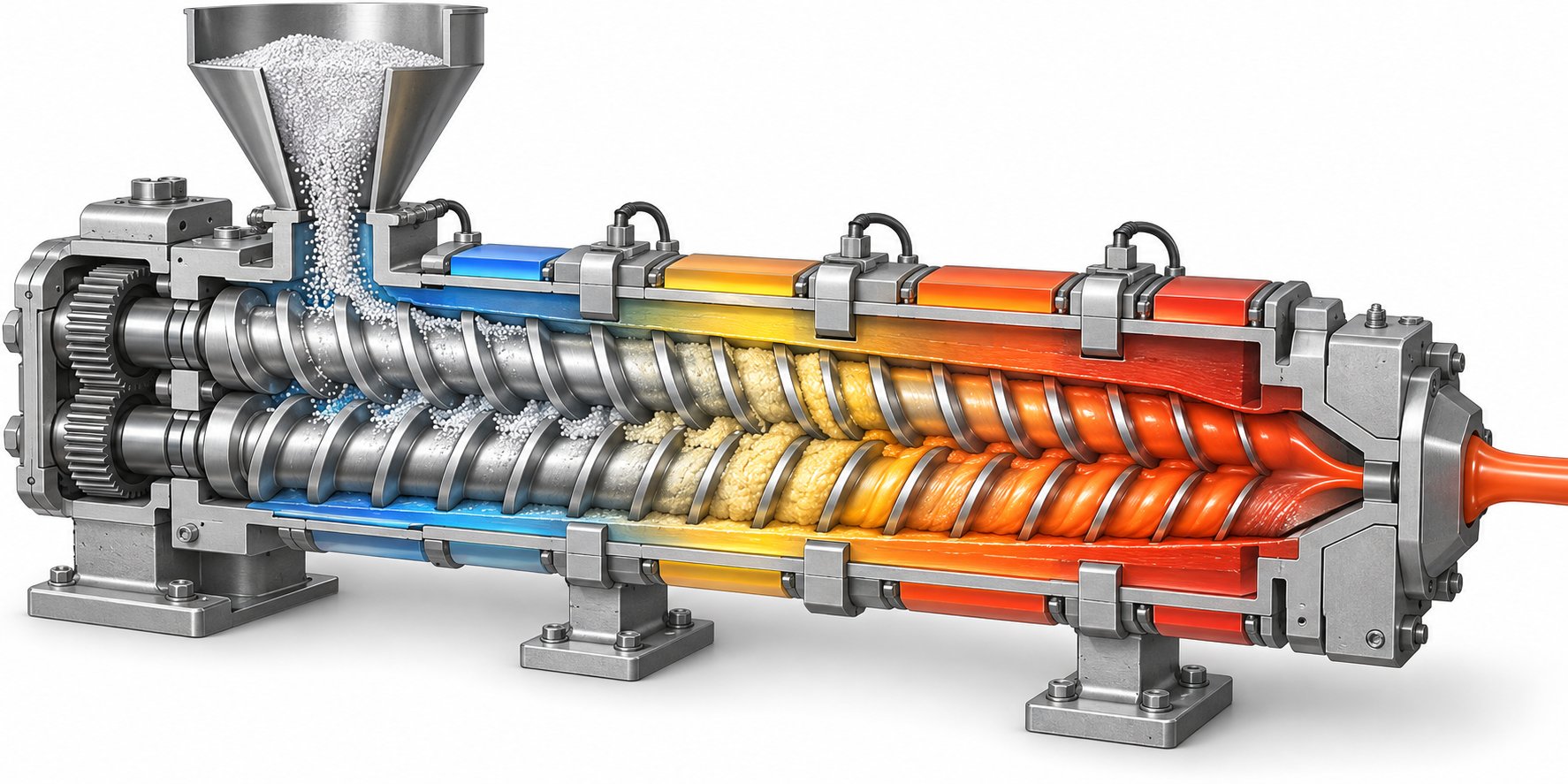
- Plasticization — This is where the real transformation happens. Inside the extruder barrel — typically a conical twin-screw design for rigid PVC — rotating screws push the compound forward through multiple precisely controlled temperature zones. The combination of heat from barrel heaters and shear friction from the screw geometry gradually melts the powder into a homogeneous, dough-like mass. Conical twin-screw extruders are favored here because their tapered screw geometry generates high torque at low RPM, which processes rigid PVC gently enough to avoid thermal degradation while still achieving thorough fusion. If the temperature profile is set too high, the PVC decomposes and releases hydrochloric acid gas. Set it too low, and the compound remains under-fused — producing a pipe with poor mechanical strength and a rough, pitted surface.
- Die forming — The molten PVC exits the barrel and enters an extrusion die — a precision-machined tool with an annular gap that shapes the melt into a hollow cylindrical profile. The die's internal geometry, particularly the mandrel and outer ring alignment, determines pipe concentricity and initial wall uniformity. An off-center die produces pipes with one side thicker than the other — a defect that often goes unnoticed until the pipes fail during installation. Die design also varies depending on whether you are producing a single pipe or running a multi-cavity setup for higher throughput.
These three stages represent the "hot side" of the production line. The compound enters as a dry powder and emerges as a soft, continuously formed pipe shape. Everything that follows is about preserving that shape with dimensional precision.
Vacuum Calibration, Cooling, and Downstream Operations
The moment the soft pipe exits the die, it is vulnerable. Without immediate intervention, gravity and its own weight would distort it within seconds. That is where the downstream units take over:
- Vacuum calibration — The still-pliable pipe enters a vacuum calibration tank immediately after the die. Inside, a calibration sleeve holds the pipe's outer diameter to exact dimensions while vacuum pressure pulls the pipe outward against the sleeve surface. Simultaneously, initial water cooling begins to solidify the outer wall and lock in the shape. If the vacuum level is too low, the pipe shrinks below its target diameter. If it is too high, surface drag marks appear. This stage is arguably the most critical for dimensional accuracy — the point where a conduit pipe either meets or misses its tolerance specification.
- Spray cooling — The partially cooled pipe travels through one or more spray cooling tanks where water jets remove residual heat from the entire pipe wall. Cooling must be gradual and even. Rapid, uneven cooling creates internal stresses that can cause the pipe to warp or bow after cutting — a defect that may not show up until the pipes are stacked and stored. In any pvc conduit pipe making machine factory in China or elsewhere producing at high volumes, cooling line length is carefully calculated relative to line speed. A common mistake among first-time buyers is underestimating the cooling tank length needed, which forces them to reduce line speed and sacrifice throughput.
- Haul-off — A caterpillar-type or belt-type haul-off unit grips the now-rigid pipe and pulls it through the entire downstream line at a constant, carefully controlled speed. The haul-off speed must stay perfectly synchronized with the extruder output. Pull too fast, and the pipe stretches — resulting in thinner walls and smaller diameter than specified. Pull too slowly, and the pipe bunches up, creating wall thickness irregularities and surface waviness. Modern lines use servo-driven haul-offs with speed feedback loops to maintain consistency within fractions of a percent.
- Cutting — Once the pipe reaches its target length, an automatic cutter makes a clean cut without stopping the line. Planetary cutters and chipless cutters are the most common types for conduit pipes. A planetary cutter rotates a blade around the pipe circumference, producing burr-free ends. A chipless cutter uses a wheeled blade that indents and snaps the pipe cleanly. The cutter clamps onto the moving pipe, travels with it during the cut, and then returns to its starting position — all without interrupting continuous production. A poorly timed or misaligned cutter produces angled cuts or pipe-end deformation, which creates joint-fitting problems during installation.
- Socketing (optional) — For conduit pipes that require a bell or socket end for push-fit jointing, a belling machine heats one end of the cut pipe, expands it over a mandrel to form a socket shape, and then cools it to retain the expanded profile. Not every production line includes this unit — some markets prefer conduit pipes joined with separate couplers rather than integrated sockets. Whether to include a socketing machine depends on your target market's installation practices and applicable standards.
Each of these nine stages is a link in a chain. The extruder can produce a perfect melt, but if the vacuum calibration is off by a few millibars, every meter of pipe comes out undersized. The cooling tanks can function flawlessly, but if the haul-off speed drifts, wall thickness varies along the pipe length. A well-run pvc conduit pipe making machine factory treats the entire line as a single integrated system, not a collection of independent units. That system-level thinking — synchronizing temperatures, speeds, pressures, and timings across all stages — is what separates consistently high-quality output from lines that produce unpredictable results.
Understanding this process flow is essential, but it also raises a deeper question: which individual components within the line have the greatest influence on performance, and what should you actually look for when evaluating them?
Key Components and Ancillary Equipment Every PVC Conduit Pipe Making Machine Manufacturer Lists — and What They Actually Do
Supplier catalogs love listing components. Extruder, die head, vacuum tank, haul-off, cutter — the names appear on every spec sheet from every pvc conduit pipe making machine manufacturer. But a parts list is not an explanation. What does each unit actually contribute, and why do certain design choices outperform others? Let's break down the core equipment and the supporting machinery that transforms a basic extrusion line into a complete, efficient production system.
The Extruder Unit and Why Conical Twin-Screw Designs Dominate
The extruder is the engine of the entire line. For rigid PVC conduit production, conical twin-screw extruders have become the industry standard — and for very specific reasons. Unlike single-screw designs, a conical twin-screw setup features two tapered, counter-rotating screws inside a figure-eight barrel. This geometry creates several measurable advantages for processing rigid PVC dry-blend powder:
- Higher torque at lower RPM — The tapered screw design generates substantial conveying and compressing force without needing excessive rotational speed. Lower RPM means less frictional heat, which is critical because rigid PVC is thermally sensitive and degrades if exposed to excessive shear heat.
- Superior mixing and plasticization — The intermeshing counter-rotation forces the PVC compound through controlled shear zones, producing a more uniform melt than a single screw can achieve with the same material.
- Better self-cleaning capability — The screws wipe against each other during rotation, reducing material buildup and stagnation inside the barrel. Stagnant PVC degrades rapidly, releasing corrosive hydrochloric acid gas — so self-cleaning is not just convenient, it is a direct quality and safety advantage.
- Direct powder processing — Single-screw extruders typically require pre-compounded pellets for stable feeding. Conical twin-screw systems handle PVC dry-blend powder directly, eliminating the need for a separate pelletizing step and reducing production costs.
You will also encounter a specification called the L/D ratio (length-to-diameter ratio) when evaluating extruders. For PVC processing, conical twin-screw extruders typically feature L/D ratios in the range of 22:1 to 25:1. A higher ratio provides more barrel length for heat transfer and mixing, which generally improves plasticization quality. However, increasing L/D beyond what the formulation requires simply adds residence time, increasing degradation risk. The sweet spot depends on your specific compound and target output rate — something a knowledgeable pvc conduit pipe making machine supplier will help you calculate rather than simply defaulting to the largest available model.
Die Heads, Calibration Tanks, and Downstream Units
The extrusion die shapes the homogeneous melt into a hollow cylindrical profile. Its internal flow channels, mandrel alignment, and land length collectively determine two of the most critical pipe quality metrics: concentricity (how centered the inner bore is relative to the outer wall) and wall uniformity. A well-machined die distributes the melt evenly around the full circumference. A worn or poorly designed die creates thickness variation — one side of the pipe ends up thicker than the other, leading to rejection under quality standards. Die heads are typically interchangeable, allowing you to switch between pipe diameter sizes by swapping the mandrel and outer ring assembly.
Immediately downstream, the vacuum calibration tank locks in the pipe's dimensional accuracy. As the soft pipe exits the die, it enters a calibration sleeve where vacuum pressure pulls the pipe outward against the sleeve walls while water cooling solidifies the surface. The vacuum level, water temperature, and sleeve dimensions must be precisely matched to the target pipe diameter and wall thickness. Too much vacuum stretches the pipe; too little lets it shrink below spec.
The haul-off unit pulls the cooled pipe through the line at a constant, controlled speed. Two types dominate the market:
- Caterpillar haul-offs — Use multiple rubber-padded tracks that grip the pipe around its circumference. These are the standard choice for conduit pipe diameters, offering reliable grip without deforming thin-walled pipes. Track count typically ranges from two to four, with clamping force adjustable via pneumatic or mechanical systems.
- Belt haul-offs — Use flat belts that contact the pipe along a wider surface area. These work well for very small-diameter or particularly delicate pipes where minimizing contact pressure is important.
For PVC conduit pipes in the 16 mm to 50 mm range, caterpillar haul-offs are the more common configuration. The key specification is speed stability — even minor fluctuations cause measurable wall thickness variation over the pipe length.
Essential Ancillary Equipment for a Complete Production Line
Here is where many first-time buyers underestimate their investment. The core extrusion line — extruder, die, calibration tank, cooling baths, haul-off, and cutter — produces pipe. But turning pipe into a market-ready product requires additional equipment that a thorough pvc conduit pipe making machine supplier will include in the project scope:
- High-speed mixer and cooler mixer — The compound preparation system. The hot mixer blends PVC resin with stabilizers, lubricants, fillers, and pigments through friction heating. The cooler mixer brings the blend down to a safe feeding temperature. Without this system, you have no consistent raw material to feed the extruder.
- Automatic vacuum loader — Transfers the blended compound from the cooler mixer's storage silo to the extruder hopper without manual handling. This ensures consistent, uninterrupted feeding and reduces contamination risk from dust, moisture, or foreign particles.
- Online inkjet or roller printing unit — Prints brand name, pipe size, gauge classification, standard compliance markings, and meter markings directly onto the pipe surface during production. Most electrical conduit standards require permanent identification on the pipe. A printing unit positioned between the cooling tanks and haul-off applies these markings while the pipe is still moving, adding zero delay to the production cycle.
- Socketing or belling machine — Heats one end of a cut pipe section, expands it over a mandrel to form a bell-shaped socket, and cools it to retain the shape. This socket allows pipes to be joined end-to-end without separate couplers — a feature required in many regional markets. Some pvc conduit pipe making machine manufacturer setups in China integrate inline belling right after the cutter for continuous operation.
- Bundling or stacking machine — Collects finished pipes, arranges them into uniform bundles (typically hexagonal or rectangular stacks), and wraps them with strapping or stretch film for transport. Manual bundling is labor-intensive and inconsistent; automated bundling reduces handling damage and speeds up warehouse throughput.
When you request quotes from any pvc conduit pipe making machine supplier in China or elsewhere, always clarify whether the quoted price covers the full ancillary package or just the core extrusion line. A machine that produces pipe is only half the story. The mixing system, loader, printer, belling machine, and bundler are what turn raw output into finished, branded, market-ready products. Overlooking any one of these elements during procurement creates bottlenecks that limit your actual production capacity regardless of what the extruder's rated output claims.
Among all the components discussed here, one stands out as the single most influential factor in plasticization quality and long-term machine performance — and it deserves far more attention than most equipment brochures give it.
Automation Levels and Production Capacity Tiers for PVC Conduit Pipe Lines
Knowing which components make up the production line is one thing. Knowing how much control those components operate under — and how many pipes they can realistically produce per shift — is an entirely different conversation. Yet most supplier spec sheets blur these distinctions, listing "automatic" as a feature without explaining what that actually means in day-to-day operation. The reality is that PVC conduit pipe making machines span a wide automation spectrum, and the tier you choose directly shapes your labor costs, output consistency, and long-term scalability.
Semi-Automatic vs. Fully Automatic Production Lines
Think of automation as a sliding scale rather than an either-or checkbox. At the lower end, semi-automatic lines handle the core extrusion process mechanically but rely heavily on operators for everything around it. Material is loaded manually into the hopper, temperature settings are adjusted through individual analog controllers on each barrel zone, cutting is triggered by an operator watching pipe length markers, and the haul-off speed requires manual calibration at startup. These setups work — they produce pipe — but they demand constant operator attention and leave quality dependent on human judgment.
At the opposite end, a fully automatic line integrates every stage under centralized digital control. Auto-loaders feed compound to the hopper at a metered rate. Servo-driven haul-offs maintain speed within fractions of a percent. Auto-cutters trigger based on encoder-measured pipe lengths, not visual estimation. Online printers apply markings without slowing the line. The operator's role shifts from hands-on adjustment to monitoring dashboards and responding to exception alerts. For manufacturers producing at volume, the consistency gains alone justify the investment difference — fewer rejects, less rework, and predictable output shift after shift.
Most buyers looking for a cheap pvc conduit pipe making machine gravitate toward semi-automatic configurations. That is a reasonable starting point for low-volume or single-product operations. The risk emerges when production demand grows and the line's manual bottlenecks cannot keep pace. If scaling is anywhere in your three-year plan, evaluate whether the cheap pvc conduit pipe making machine price truly represents savings — or simply defers automation costs you will incur later.
Understanding PLC and HMI Controls in Pipe Extrusion
Two acronyms appear on virtually every modern extrusion line specification — PLC and HMI — yet many buyers treat them as marketing buzzwords rather than functional features worth scrutinizing.
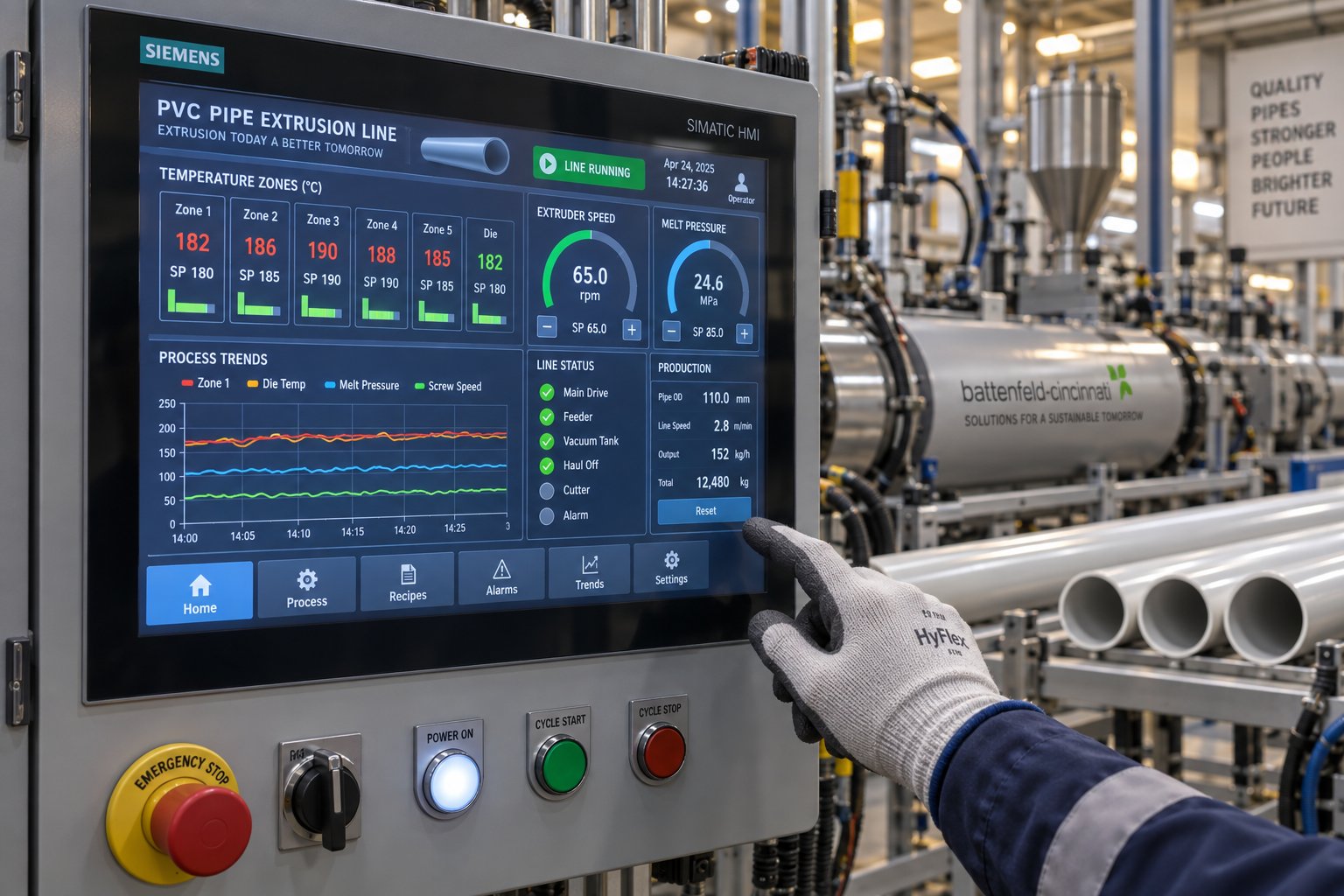
A PLC (Programmable Logic Controller) is the industrial computer that coordinates the entire line. It manages temperature zones across the barrel and die, synchronizes extruder screw speed with haul-off speed, controls vacuum levels in the calibration tank, and triggers the cutter at precise intervals. In practical terms, it replaces the operator's need to manually adjust dozens of interdependent variables.
The HMI (Human-Machine Interface) is the touch-screen panel that lets operators interact with the PLC. A well-designed HMI provides:
- Recipe storage — Save complete parameter sets for each pipe size and gauge so changeovers take minutes instead of hours of manual re-tuning.
- Real-time monitoring — View barrel zone temperatures, melt pressure, haul-off speed, and motor loads on a single screen, catching drift before it causes defects.
- Alarm systems — Automatic alerts when any parameter falls outside its preset tolerance band, reducing response time to process upsets.
- Production logging — Record output data, downtime events, and parameter history for quality traceability and process improvement analysis.
The practical benefit? Reduced operator dependency. A PLC-controlled line with a factory price pvc conduit pipe making machine price point can be run reliably by operators with moderate training, whereas a manually controlled line demands experienced technicians who understand the interplay of every process variable. When labor turnover is high — common in many emerging manufacturing markets — PLC/HMI controls protect your output quality from workforce variability.
Comparing Small, Medium, and Large-Scale Machine Capacities
Production capacity is not just about extruder output. It cascades through the entire line — affecting how much factory space you need, how much power you consume, and how much capital you commit. The table below segments PVC conduit extrusion lines into three practical tiers:
| Parameter | Small-Scale Line | Medium-Scale Line | Large-Scale / High-Speed Line |
|---|---|---|---|
| Output Range | 20 – 50 kg/hr | 50 – 150 kg/hr | 150 – 400+ kg/hr |
| Typical Pipe Diameter Range | 16 – 32 mm | 16 – 50 mm | 16 – 50 mm (often multi-cavity) |
| Automation Level | Semi-automatic to basic PLC | PLC/HMI with auto-cutter and loader | Fully automatic with servo haul-off, auto-belling, and inline printing |
| Approximate Line Length | 15 – 20 meters | 20 – 30 meters | 30 – 40+ meters |
| Ideal User Profile | Startups, small regional suppliers, trial production | Established regional manufacturers, mid-volume demand | Large-scale producers, multi-shift operations, export-oriented manufacturers |
A few patterns stand out. First, line length scales with capacity — higher output demands longer cooling sections to solidify pipes at faster line speeds. A factory planning for a large-scale setup needs 30 to 40 or more meters of continuous floor space, plus clearance for material handling and finished goods movement on either end. Second, power requirements rise proportionally. Small-scale lines may operate on 30–50 kW total connected load, while high-speed lines can exceed 150–200 kW, requiring robust three-phase industrial electrical infrastructure. Third, investment level correlates with both capacity and automation: a factory price pvc conduit pipe making machine at the small-scale tier represents a fraction of what a fully automated, high-throughput system costs, but it also delivers a fraction of the output and consistency.
Choosing the right tier is less about finding the cheapest option and more about matching machine capability to your realistic market demand. Overbuying capacity ties up capital in idle equipment. Underbuying forces you to run extended shifts, accelerates component wear, and still may not meet delivery commitments. The best investment decision comes from honest demand forecasting paired with a clear understanding of how each automation and capacity tier translates to actual production performance — and the economics that flow from it.
Regardless of which tier you select, one component inside the extruder exerts an outsized influence on everything from plasticization quality to energy consumption and long-term maintenance costs. That component is the conical twin screw barrel — and it deserves a much closer look than most buyers give it.
Why the Conical Twin Screw Barrel Is the Heart of PVC Extrusion
Every motor, heater band, and control system on your extrusion line exists to support one thing: the plasticization happening inside the barrel. If the conical twin screw barrel performs well, you get a uniform melt, consistent wall thickness, and smooth pipe surfaces shift after shift. If it does not, no amount of downstream adjustment can compensate. Yet when buyers evaluate a pvc conduit pipe making machine price from a factory, the barrel and screw assembly rarely receives the scrutiny it deserves. It is listed as a line item, not examined as the performance-defining component it truly is.
How Conical Twin Screw Geometry Benefits Rigid PVC Processing
Rigid PVC is notoriously unforgiving. It has a narrow processing window — the gap between the temperature where it fully fuses into a homogeneous melt and the temperature where it begins to decompose is relatively small. Push too hard with excessive shear, and you generate frictional heat that degrades the polymer and releases corrosive hydrochloric acid gas. Go too gently, and the compound remains under-fused, producing pipes with poor mechanical strength and rough surfaces.
The conical twin screw barrel solves this dilemma through geometry. The screws are wider at the feed end and taper toward the discharge end. This taper creates a natural compression ratio — material is gradually compacted as it moves forward through progressively narrower screw channels. The result is high conveying force and thorough plasticization achieved at relatively low rotational speeds.
Why does low RPM matter so much? Because the plasticization of PVC moves through distinct zones — a solid conveying zone where resin particles are preheated and compacted, a melting zone where the compacted material transitions from a solid bed into a viscous fluid, and a melt conveying zone where the fully fused polymer is homogenized and pressurized toward the die. Each zone requires carefully balanced heat input from both barrel heaters and mechanical shear. Excessive screw speed overloads the melting zone with frictional heat, destroying the delicate thermal equilibrium that rigid PVC demands. The tapered geometry of conical screws delivers the necessary torque and pressure without relying on high RPM — a fundamental advantage that single-screw designs cannot replicate for unplasticized PVC compounds.
In practical terms, this means a well-matched conical twin screw barrel lets you run your pvc conduit pipe making machine at optimal output rates while keeping melt temperatures safely within the processing window. The compound exits the barrel fully fused, thermally uniform, and free of degradation — exactly the melt quality needed to produce conduit pipes with clean surfaces and precise dimensional tolerances.
Signs of Barrel and Screw Wear That Affect Pipe Quality
Here is what most pvc conduit pipe making machine price discussions from manufacturers in China and elsewhere never address: the barrel and screw are consumable components. They wear. And as they wear, your pipe quality and production economics deteriorate in ways that are initially subtle but progressively costly.
Wear happens because rigid PVC compounds are inherently abrasive. Calcium carbonate fillers — present in virtually every conduit pipe formulation — act like fine sandpaper against the screw flights and barrel bore with every rotation. Over thousands of operating hours, this abrasion widens the clearance between the screw flight tips and the barrel inner wall. That clearance is engineered to be extremely tight when new — typically the nominal screw diameter divided by 1,000 on each side, as industry guidelines from Plastics Technology note.
When that clearance increases due to wear, a cascade of problems follows:
- Material leakage over flight tips — Instead of being pushed forward efficiently, a portion of the melt slips backward over worn flights. This reduces the extruder's specific rate (output per RPM), forcing operators to increase screw speed to maintain production targets.
- Higher discharge temperatures — Increased screw speed generates more shear heat, and the larger clearance reduces the barrel wall's heat-transfer efficiency. The melt exits hotter than intended, raising degradation risk and making temperature control unreliable.
- Inconsistent plasticization — Worn screws lose their ability to apply uniform shear across the melt. Some material over-fuses while other portions remain under-processed, creating an inhomogeneous melt that shows up as uneven wall thickness, surface roughness, and variable mechanical properties in the finished pipe.
- Rising energy consumption — The extruder draws more power to compensate for lost conveying efficiency. Your electricity cost per kilogram of output climbs steadily — often before anyone connects the rising energy bills to barrel wear.
- Increased reject rates — Pipes with surface defects, dimensional inconsistencies, or poor fusion fail quality checks, reducing your saleable output and eating into margins.
The insidious part? These symptoms emerge gradually. A 5% drop in specific rate this month, a slight uptick in discharge temperature next quarter, a few more rejected pipes per shift six months later. By the time the pattern becomes obvious, you may have been producing below-spec pipe — and absorbing hidden costs — for far longer than you realized.
If your extruder needs progressively higher screw speeds to maintain the same output, or if discharge temperatures are creeping upward without any change to your compound formulation, barrel and screw wear is the most likely cause.
Other telltale signs include visible scoring or grooves on the screw flight lands when inspected during maintenance shutdowns, and measurable increases in the barrel bore diameter beyond its original tolerance. A barrel with an iron-based bimetallic liner will typically outlast the screws — often by a factor of roughly three service cycles — but both components need periodic measurement and evaluation against their original specifications.
Choosing the Right Replacement Screw Barrel for Your Extrusion Line
When wear reaches the point where quality and economics demand action, the replacement barrel and screw you select matters as much as the original. This is not a commodity purchase — the metallurgy, dimensional precision, and surface treatment of the new components directly determine how long your next service cycle lasts and how stable your plasticization quality remains throughout it.
Two primary material approaches dominate the market for conical twin screw barrels used in PVC extrusion:
- Nitrided steel barrels and screws — Surface-hardened through a gas nitriding process that creates a hard case layer. This offers good initial wear resistance at a moderate cost and works adequately for standard PVC compounds with low-to-moderate filler content. However, once the hardened surface layer erodes, the softer base steel underneath wears rapidly, and performance degrades faster than many operators expect.
- Bimetallic lined barrels — Feature a centrifugally cast alloy liner bonded metallurgically to a structural steel outer shell. The liner — typically a nickel-based matrix reinforced with hard carbide particles — provides deep, through-thickness wear and corrosion resistance. For PVC compounds loaded with calcium carbonate filler, bimetallic linings significantly outlast nitrided surfaces because the wear-resistant layer is not just a surface treatment but a structural component of the barrel wall.
The cost difference between nitrided and bimetallic is real, but so is the service life difference. For a production line running multi-shift operations on abrasive PVC conduit formulations, the total cost of ownership — accounting for fewer replacements, less downtime, and more consistent output quality — typically favors the bimetallic option.
Beyond material selection, dimensional compatibility matters critically. A replacement conical twin screw barrel must match the original screw taper angle, bore dimensions, flange mounting, and heating zone layout precisely. This is not a part you buy off a shelf — it requires a supplier with the engineering capability to match your specific extruder model and processing requirements.
For manufacturers operating PVC conduit pipe extrusion lines who need custom or replacement conical twin screw barrels, specialist suppliers like NANHAIYA focus specifically on this component category. Their product range covers conical twin screw barrels engineered for stable plasticizing performance across PVC pipe, profile, board, and WPC extrusion applications — the kind of focused expertise that matters when you are sourcing the component most directly responsible for your melt quality and long-term production consistency.
Whether you are evaluating your first pvc conduit pipe making machine price from a manufacturer in China or planning a screw barrel replacement for an existing line, treat this component as an investment in process stability rather than a maintenance expense. The barrel and screw set the ceiling for what your entire production line can achieve — every other unit downstream simply preserves what the plasticization stage creates.
With the extruder's core component in perspective, the broader question of setting up a complete production unit comes into focus — including the physical infrastructure, energy requirements, workforce planning, and production economics that determine whether your conduit pipe operation actually turns a profit.
Setting Up Your Production Unit and Understanding the True Costs
A perfectly specified extrusion line sitting in an underprepared factory is a recipe for frustration. You can source the best conical twin screw barrel, invest in PLC-controlled automation, and negotiate a competitive pvc conduit pipe making machine price for sale — and still fall short of your production targets if the building, electrical supply, water systems, and staffing are not planned around the equipment's actual demands. This is the gap most supplier conversations skip entirely. The quotation covers the machine. Everything the machine needs to function? That is on you.
Factory Space, Power, and Water Requirements
Picture your production line as a single straight corridor. Depending on capacity tier, that corridor stretches anywhere from 15 meters for a compact startup line to 40 or more meters for a high-speed, multi-cavity setup. Add clearance at the feed end for the mixer, hopper, and auto-loader — plus space at the discharge end for the cutter, socketing station, and pipe stacking area — and your total length requirement easily extends several meters beyond the machine line itself. Width matters too: you need service access on both sides of the line for maintenance, die changes, and calibration sleeve swaps, which typically adds at least 2 to 3 meters on each side.
Ceiling height catches many first-time investors off guard. The high-speed mixer and cooler mixer system, combined with the vacuum loader and storage hopper, can reach 4 to 5 meters or more above floor level. A standard commercial warehouse ceiling may work, but verify the actual installed height of your mixing and feeding equipment before signing a lease. Flooring is another overlooked factor — extrusion lines generate continuous vibration, and the vacuum calibration tank plus cooling baths hold significant water weight. Reinforced concrete flooring is the baseline; anything less invites alignment drift and structural fatigue over time.
Ventilation deserves its own line in your planning budget. Rigid PVC processing can release trace amounts of hydrochloric acid gas, particularly during startups, shutdowns, and purging cycles. Adequate exhaust ventilation above the extruder die area and near the hopper protects both operators and equipment from corrosive buildup. In warmer climates, ambient temperature control also matters — an overheated factory makes it harder for cooling tanks to bring pipe temperature down efficiently, which can force you to reduce line speed.
Here is a practical infrastructure checklist to review before your equipment arrives:
- Floor space: Minimum 15-meter clear run for small-scale lines, 30-40+ meters for high-capacity setups, plus buffer zones at both ends for material handling and finished goods staging.
- Ceiling height: Verify mixer, hopper, and auto-loader installed heights — typically 4.5 to 6 meters minimum clearance needed.
- Flooring: Reinforced concrete capable of supporting sustained vibration and water-filled cooling tank weight without deflection.
- Electrical supply: Three-phase industrial connection (380V/50Hz or local equivalent), sized to the total connected load of the line — small lines may need 30-50 kW, while large lines can exceed 150-200 kW.
- Cooling water system: Recirculating water supply with adequate flow volume for the vacuum calibration tank and spray cooling baths. A cooling tower or chiller is typically required to reject heat continuously, especially in warm climates.
- Ventilation and exhaust: Localized extraction above the die head and feeding area, with general factory airflow sufficient to maintain working temperatures below 35 degrees Celsius.
- Compressed air: Required for pneumatic actuators on haul-offs, cutters, and belling machines — typically 6-8 bar clean, dry air supply.
- Raw material storage: Covered, dry storage area for PVC resin bags and additive drums, ideally adjacent to the mixing station to minimize handling distance.
Electrical infrastructure deserves particular emphasis because energy is a continuous operational cost, not a one-time investment. A three-phase industrial power connection is non-negotiable — single-phase supply simply cannot drive the extruder motor, heater bands, vacuum pumps, and haul-off drives simultaneously. The extruder alone typically consumes the majority of the line's electrical load, with specific energy consumption for PVC extrusion generally falling in the range of 0.15 to 0.25 kWh per kilogram of output depending on line efficiency, screw design, and automation level. That figure may sound abstract until you multiply it by your daily throughput and local electricity tariff — at which point energy cost becomes a very tangible line item in your production economics.
Cooling water operates in a closed loop on well-designed lines. Water circulates from a reservoir through the calibration tank and spray cooling baths, absorbs heat from the pipe, and returns through a cooling tower or chiller before recirculating. The volume needed scales with output — higher throughput means more heat to extract per minute, demanding larger reservoirs, more powerful pumps, and greater cooling tower capacity. Entrepreneurs researching a pvc conduit pipe making machine price in Brazil or other tropical markets should budget more aggressively for cooling infrastructure, since higher ambient temperatures reduce cooling tower efficiency and may necessitate supplementary chiller units.
Workforce Planning Across Automation Levels
How many people does it take to run a conduit pipe line? The answer depends almost entirely on the automation tier you have selected. A semi-automatic line with manual loading, analog temperature controls, and operator-triggered cutting typically requires two to three operators per shift just for the extrusion line itself, plus a dedicated person for compound mixing and material preparation. Add quality control inspection, packaging, and maintenance support, and a single semi-automatic line can require five to seven workers per shift.
A fully automated line with PLC/HMI controls, auto-loaders, servo haul-offs, and auto-cutters compresses that requirement significantly. Industry benchmarks for a single automated production line suggest a core team of around three to four workers per shift: one line operator monitoring the HMI dashboard, one assistant handling material preparation and pipe stacking, one quality control inspector, and a shared maintenance technician covering multiple lines. The per-unit labor cost difference between these two models compounds across every shift, every month, and every year of operation.
For buyers evaluating a cheap price pvc conduit pipe making machine, the temptation is to save on equipment and accept higher labor requirements. That tradeoff can work in regions where skilled labor is abundant and affordable. In markets where trained extrusion operators are scarce or expensive, spending more on automation and less on recurring labor may deliver a better return within the first two to three years.
Key Factors Driving Production Economics and Profitability
Infrastructure gets the line running. Economics determine whether it stays running profitably. Several interconnected factors shape the financial performance of a PVC conduit pipe operation, and understanding their relative weight helps you prioritize where to invest and where to optimize.
Raw material cost dominates everything else. PVC resin, stabilizers, fillers, lubricants, and pigments collectively account for roughly 65 to 75 percent of total production cost. This proportion is so large that even modest fluctuations in resin pricing — driven by global petrochemical markets — can swing your margins more dramatically than any operational improvement. Locking in stable supply agreements and optimizing your formulation to use the minimum effective filler and additive levels are among the highest-leverage decisions you can make.
Output rate drives unit cost. The relationship is straightforward: a machine running at 80 percent of its rated capacity spreads its fixed costs — depreciation, labor, factory overhead — across fewer kilograms of pipe than the same machine running at 95 percent utilization. This is why machine efficiency, measured as actual output divided by rated output, matters more than the rated number alone. A line advertised at 150 kg/hr that consistently achieves only 110 kg/hr in real production delivers economics closer to a smaller machine — at the price of a larger one. When comparing a low price pvc conduit pipe making machine price against a premium alternative, ask for documented actual throughput from reference installations, not just catalog ratings.
Scrap rate is a silent profit killer. Every kilogram of PVC that ends up as startup waste, off-spec pipe, or trimming scrap is raw material you paid for but cannot sell. Scrap rates vary widely depending on machine precision, operator skill, and process stability — from as low as 2 to 3 percent on well-controlled automated lines to 8 percent or higher on poorly maintained or manually operated setups. While PVC scrap can often be reground and blended back into the compound at low percentages, this regrind introduces process variability and adds handling steps. Reducing scrap at the source — through better process control, proper maintenance, and skilled operation — yields a cleaner return than recycling it after the fact.
Energy cost scales with inefficiency. As discussed in the infrastructure section, specific energy consumption per kilogram of output is a key metric. But energy cost is not just about the tariff you pay per kilowatt-hour — it is also about how much energy your line wastes. Worn screw barrels force higher screw speeds, increasing power draw. Oversized extruders running below optimal load consume disproportionate energy per kilogram. Inadequate insulation on barrel heaters bleeds heat into the factory rather than into the compound. Each of these inefficiencies adds a small increment to your cost per meter of pipe — increments that accumulate into meaningful margin erosion over a full year of production. Buyers researching a pvc conduit pipe making machine price in Algeria or a pvc conduit pipe making machine price in Mexico should factor in local electricity tariffs when modeling their production economics, as energy costs vary significantly between regions and can shift the breakeven point by months.
Machine efficiency defines your return on investment timeline. The purchase price is a one-time capital event. What determines whether that investment pays back in 18 months or 48 months is how efficiently the line converts raw material into saleable pipe, day after day. The wholesale price of your equipment matters at the point of purchase, but the cheap price pvc conduit pipe making machine price that looked attractive on the quotation becomes expensive very quickly if actual throughput, scrap rates, and energy consumption underperform the projections your business plan was built on. Conversely, a higher-priced line that consistently delivers near-rated output with low scrap and efficient energy use compresses the payback period and generates stronger margins for the entire operational life of the equipment.
This interplay between infrastructure investment, operational efficiency, and raw material economics is ultimately what separates profitable conduit pipe operations from those that struggle to break even. But profitability means nothing if the pipe you produce cannot pass the quality certifications your market demands — and those standards are far more specific, and far more connected to machine precision, than most buyers realize.
Quality Standards Every PVC Conduit Pipe Producer Must Meet
You can run the most efficient production line in your region, hit impressive throughput numbers, and keep scrap rates low — and still lose a major contract because your conduit pipes fail a compliance test. Quality standards for electrical conduit are not optional endorsements. They are market-entry requirements. In India, a pipe that does not meet IS 9537 cannot legally be specified on government electrical projects. In the United States, a conduit pipe without UL 651 certification will not pass an electrical inspection. Yet most conversations about PVC conduit pipe making machine selection treat standards as an afterthought — something to worry about after the line is installed. That approach gets the sequence backwards. The machine you buy determines the standards you can meet.
Major International Standards for PVC Electrical Conduit Pipes
Several major standards govern the performance, safety, and dimensional quality of rigid PVC electrical conduit pipes across global markets. If you are manufacturing for domestic sale or export, knowing which standard applies to your target region is not optional — it is the starting point for your entire machine specification and process design.
| Standard | Region | Key Tests Covered | Relevance to Machine Settings |
|---|---|---|---|
| IS 9537 (Part 3) | India | Dimensional tolerances, wall thickness eccentricity (max 12%), impact resistance, compression resistance, flame propagation, heat resistance, electrical insulation | Die concentricity, vacuum calibration precision, and haul-off speed stability directly determine whether pipes meet the tight dimensional and eccentricity limits |
| UL 651 / NEMA TC-2 | United States, Canada | Tensile strength, modulus of elasticity, impact resistance, deflection temperature, flammability, dimensional compliance for Schedule 40 and 80 conduit | Extruder temperature control quality affects material properties tested under UL; formulation registration requires consistent compound processing |
| IEC 61386 | International | Impact resistance at specified temperatures, compression resistance, bending properties, IP ratings for ingress protection, flame propagation, electrical insulation resistance | Cooling uniformity and calibration accuracy govern the mechanical performance tested under IEC; temperature profiling stability affects flame and heat test outcomes |
| BS EN 61386 | UK / Europe | Same test framework as IEC 61386, with European market-specific classifications for conduit types and installation conditions | Consistent wall thickness across production runs is critical; haul-off drift and cooling asymmetry cause the failures most commonly flagged during third-party audits |
A PVC conduit pipe making machine in India must produce pipes that pass IS 9537's eccentricity limit of 12 percent — meaning the thinnest wall point on any cross-section cannot deviate more than 12 percent from the thickest. That single requirement cascades into specific demands on die centering, calibration sleeve wear tolerances, and haul-off speed consistency. Similarly, manufacturers operating a pvc conduit pipe making machine in Saudi Arabia or the United Arab Emirates typically need IEC 61386 compliance for their conduit pipes, since most Gulf state building codes reference international electrotechnical standards.
In the United States, NSF's conduit certification program under ANSI/UL 651 requires not just product testing but formulation registration and ongoing quality assurance — including four unannounced facility audits per year and annual product retesting. This level of scrutiny means your extrusion process must be repeatable enough to produce identical results whether inspectors arrive in January or August. Producers in South Africa face a similar dynamic, where compliance with SANS standards — closely aligned to IEC 61386 — governs conduit pipe acceptance on construction projects.
How Machine Precision Determines Standard Compliance
Here is the connection most equipment brochures fail to make explicit: every test a conduit pipe must pass traces back to a specific machine parameter. Standards do not test your machine — they test your pipe. But your pipe is a direct product of how precisely your machine operates.
Consider the chain of cause and effect:
- Dimensional tolerances and eccentricity — These are governed by die precision and vacuum calibration accuracy. An off-center die or a worn calibration sleeve produces pipes where one wall quadrant is thicker than the opposite. Even a 0.05 mm deviation in the die's annular gap creates measurable wall thickness asymmetry. A pipe that measures 1.6 mm on one side and 2.4 mm on the other — with a nominal specification of 2.0 mm — exceeds IS 9537's eccentricity limit and fails.
- Impact resistance and compression resistance — These depend on complete, uniform plasticization of the PVC compound. If barrel temperature zones drift beyond plus or minus 2 degrees Celsius of their setpoints, viscosity variation creates regions of under-fused material in the pipe wall. Those weak zones absorb less energy on impact, causing the pipe to crack where a properly fused section would survive. Buyers running a pvc conduit pipe making machine in Poland or Romania for European market supply face BS EN 61386 impact testing at low temperatures — a particularly demanding condition where any plasticization inconsistency becomes magnified.
- Flame propagation — PVC is inherently flame-retardant, but thermal degradation during processing can compromise this property. Excessive barrel temperatures or prolonged residence time in the extruder breaks down both the PVC polymer chains and the stabilizer system. Degraded compound may self-extinguish more slowly or produce more smoke during flame tests, pushing results outside acceptable limits.
- Wall thickness consistency along pipe length — This is a haul-off speed problem. Fluctuations in pull speed — even small ones — stretch or bunch the melt, creating cyclical thick-thin patterns along the pipe. Servo-driven haul-offs with encoder feedback hold speed within fractions of a percent; pneumatic or manually controlled units introduce enough variation to cause measurable thickness drift over a production run.
The pattern is clear: machine precision is not separate from product certification. It is the mechanism through which certification is achieved. Producers operating a pvc conduit pipe making machine in Russia for domestic construction supply or export face the same fundamental reality — standards may differ by region, but every standard ultimately measures outcomes that trace directly to extruder temperature stability, die concentricity, calibration accuracy, and haul-off consistency.
In-Line and Offline Quality Testing Methods
Meeting standards is not a batch-end exercise. It requires continuous monitoring during production combined with periodic laboratory verification on finished samples.
In-line quality checks happen while the pipe is still moving through the production line:
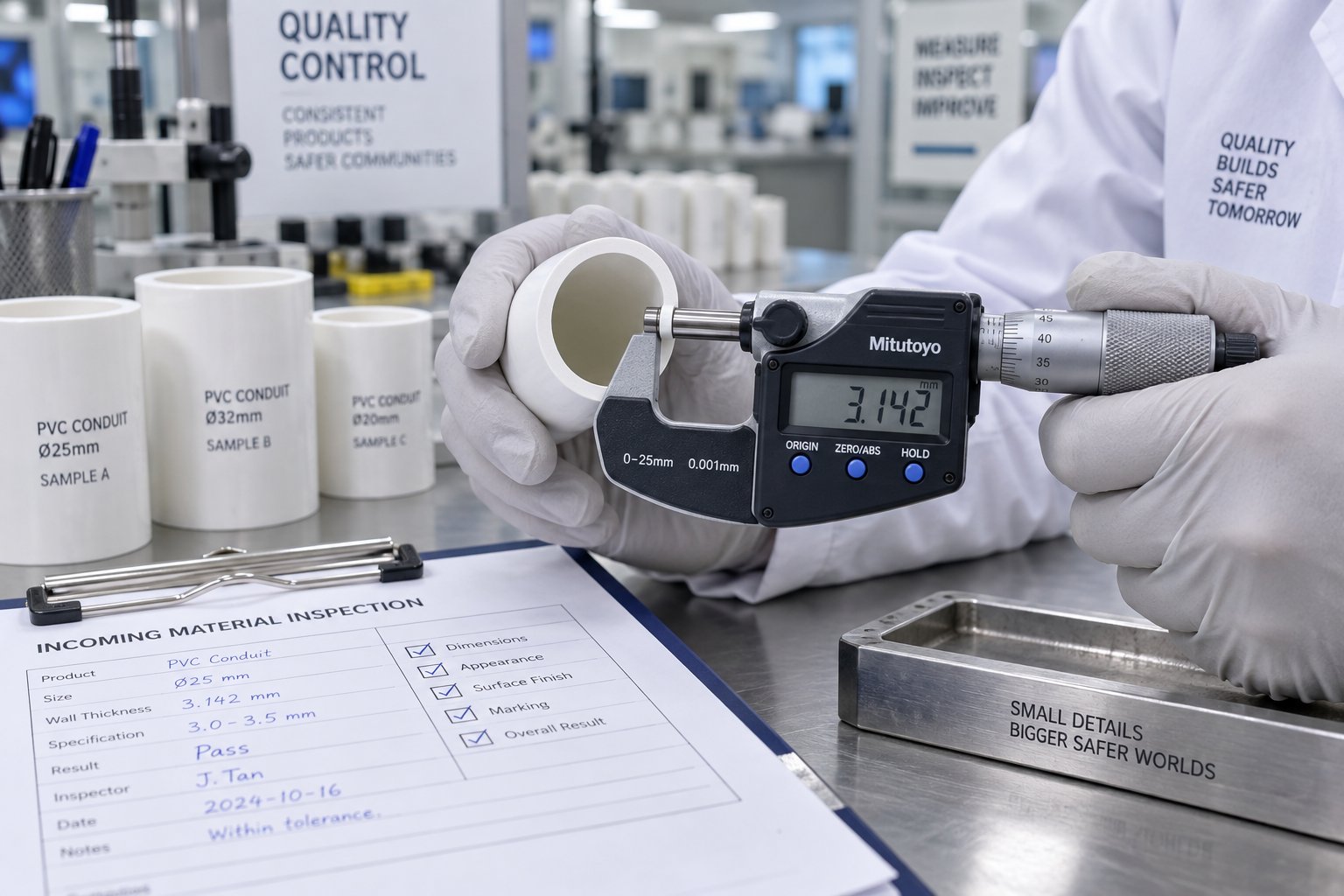
- Wall thickness measurement — Rotating laser micrometers or ultrasonic gauges mounted at the line exit measure wall thickness in real time. Advanced systems provide eccentricity data showing which clock position is thin, pointing directly to the corresponding die zone that needs adjustment. Without this instrument, thickness defects can run undetected for hundreds of meters before manual sampling catches them.
- Ovality checks — Multi-axis laser micrometers measure the pipe's outer diameter from two or three orientations simultaneously. A single-axis reading can report a stable value while the pipe is oval in another orientation — exactly the kind of defect that causes coupler fitting failures at installation sites.
- Visual surface inspection — Operators watch for surface roughness, discoloration, streaking, or pitting — all indicators of compound contamination, temperature excursions, or die wear. Some high-end lines integrate camera-based surface inspection systems that flag defects automatically.
Offline testing verifies mechanical and thermal properties that cannot be measured on a moving pipe:
- Impact testing — A standard weight is dropped onto a pipe sample from a specified height at a controlled temperature. The pipe must not crack or shatter. This test validates both compound quality and plasticization uniformity.
- Heat reversion — Pipe samples are placed in an oven at a specified temperature for a set duration, then measured for length change. Excessive shrinkage indicates that the pipe was stretched during production — a haul-off speed or cooling issue — and has residual internal stresses that could cause problems during installation or service.
- Flame tests — Pipe samples are exposed to a direct flame for a defined period and then observed for self-extinguishing behavior and flame spread distance. This confirms that the PVC compound's inherent flame retardancy has not been compromised by processing.
- Electrical insulation resistance — Particularly relevant for electrical conduit, this test applies a voltage across the pipe wall and measures leakage current to verify the pipe's ability to electrically isolate the wiring it protects.
Achieving certification depends not just on raw material quality but on machine precision and process control stability — the two factors that determine whether your pipe's properties are consistent enough to pass every test, every time.
The takeaway for anyone evaluating a pvc conduit pipe making machine — whether sourcing for projects in India, the United Arab Emirates, South Africa, or any other market — is this: the cheapest machine that cannot hold tight process tolerances will cost you far more in failed certifications, rejected batches, and lost contracts than a properly specified line that consistently produces standard-compliant pipe. Quality is not a department. It is a direct output of machine capability.
Certification confirms what your machine can do on its best day. Maintenance and operational discipline determine whether it keeps doing it six months, a year, and five years later — a topic that most equipment suppliers never bring up at all.
Maintenance, Troubleshooting, and Mistakes to Avoid with Your PVC Conduit Pipe Making Machine
Certification proves your line can produce compliant pipe under controlled conditions. Maintenance determines whether it still can three thousand operating hours later. Yet ask most pvc conduit pipe making machine price supplier conversations about maintenance schedules and you will get a user manual shipped with the equipment — if you are lucky. What you will not get is a candid explanation of what actually wears out, what breaks first, what defects look like when something drifts, and which rookie mistakes cost manufacturers the most money. This is the information gap that separates operators who run profitable lines for years from those who lurch between emergency shutdowns.
Preventive Maintenance Schedules That Extend Machine Life
Think of preventive maintenance as insurance you pay in minutes to avoid paying in hours — or days — of unplanned downtime. The key is structuring it into daily, weekly, and periodic routines so that no component silently degrades past the point of easy correction.
Daily checks (10-15 minutes per shift): These are not deep inspections. They are structured walk-throughs designed to confirm the line is still operating inside its normal window. Before or during each shift, an operator should:
- Verify barrel zone temperatures against setpoints — A heater band that has failed overnight will show a cold zone on startup. Running the extruder with one zone significantly below target produces under-fused compound that shows up as rough pipe surfaces or weak wall sections.
- Listen for unusual motor or gearbox noise — Bearing wear, loose couplings, and internal gear damage all announce themselves acoustically before they cause a breakdown. A change in pitch or the appearance of rhythmic clicking during screw rotation warrants immediate investigation.
- Record melt pressure at a fixed screw speed — This single data point is one of the highest-value daily checks you can perform. Rising melt pressure at the same RPM signals screen loading, die buildup, or restricted flow. A sudden drop may indicate feeding loss or material bridging in the hopper.
- Check cooling water flow and temperature — Confirm water is circulating through the vacuum calibration tank and spray cooling baths at the expected flow rate and temperature. Restricted flow from a partially clogged filter or a failing pump causes dimensional drift and ovality that operators often misdiagnose as die or material problems.
- Inspect the die lip for material buildup — Even a thin layer of degraded PVC on the die exit creates streaks, surface marks, and black specks on the pipe. A quick visual check and wipe-down prevents contamination from compounding over a full production shift.
- Confirm haul-off grip and displayed speed — Slip between the haul-off pads and the pipe surface causes inconsistent pull speed, which directly translates to wall thickness variation along the pipe length.
A daily checklist works best when operators record only abnormal findings. Keep the form short enough that it actually gets used every shift — a three-page document that no one fills out is worse than a single-page card that catches real drift.
Weekly tasks (during planned downtime): These require the line stopped or slowed safely, ideally during die changes, material changeovers, or scheduled production gaps:
- Clean the extrusion die — Remove degraded material from flow channels and the die lip area. Buildup inside the die restricts flow paths and causes uneven melt distribution, producing wall thickness asymmetry that worsens progressively if ignored.
- Inspect vacuum calibration sleeves and seals — Worn seals reduce vacuum stability, and scratched or scored calibration sleeves transfer surface marks onto every meter of pipe they contact. Operators often compensate for leaking seals by increasing pump load until the process becomes unstable — a band-aid that masks the real problem.
- Check haul-off pads or belt condition — Rubber pads on caterpillar haul-offs wear unevenly, creating inconsistent grip pressure around the pipe circumference. Replace worn pads before they cause slip or pipe surface marking.
- Inspect heater band terminals — Loose or corroded electrical terminals on barrel heater bands create resistance, draw excess current, and eventually cause heater failure. A five-minute visual check of wiring connections prevents a problem that otherwise announces itself as a sudden cold zone during production.
- Clean water strainers, filters, and spray nozzles — Partially blocked nozzles create uneven cooling around the pipe circumference, which produces ovality and residual internal stresses. Restricted filters reduce total flow volume before the pump itself fails.
- Verify cutter blade sharpness and clamp alignment — Dull blades increase cutting force, stress the cutter mechanism, and produce burrs or angled cuts that cause pipe-end fitting problems.
Periodic overhauls (monthly to quarterly, depending on operating hours): This is where you measure trends rather than just spot-check current conditions:
- Measure screw and barrel clearance — Track wear at the feed, transition, and metering sections of the conical twin screw barrel. As discussed in the barrel wear section earlier, increasing clearance degrades output efficiency, melt uniformity, and energy consumption. Plan replacement before quality collapse, not after it.
- Change gearbox oil and inspect gear surfaces — Dark or foaming oil indicates degradation or water contamination. Rising gearbox operating temperature at the same load suggests lubrication breakdown or internal wear.
- Test heater bands for continuity and output — Heaters degrade over time, producing less thermal output even when they appear functional. A heater delivering 80 percent of its rated wattage creates a subtle cold zone that throws off the entire temperature profile.
- Check motor insulation resistance — Moisture ingress or insulation breakdown can cause motor burnout. A periodic megger test catches deterioration long before it becomes catastrophic.
- Measure vacuum pump performance — Compare the pump's ultimate vacuum against its commissioning baseline. Loss of capacity points to worn vanes, degraded oil, or seal issues that affect calibration accuracy.
- Back up PLC/HMI parameters — A current parameter backup prevents days of reprogramming after a controller failure. This takes minutes and is one of the most commonly overlooked maintenance items across all extrusion operations.
Trend data is the difference between planned maintenance and emergency repair. If melt pressure, gearbox temperature, or screw clearance moves in the wrong direction for two or three readings, schedule the correction before the line forces the schedule for you.
Troubleshooting Common Pipe Defects and Their Root Causes
Even with disciplined maintenance, defects happen. When they do, fast root-cause identification separates a 30-minute correction from a full-shift shutdown. Here are the most common PVC conduit pipe defects, their likely causes, and the corrective actions that experienced operators reach for first:
-
Rough or matte pipe surface
Possible causes: Overheating in one or more barrel zones causing surface-layer degradation; contaminated raw material or moisture absorption in the PVC compound; worn or scratched die and mandrel surfaces transferring marks to the pipe.
Corrective actions: Review and reduce barrel zone temperatures incrementally. Verify compound moisture content and check material storage conditions. Inspect and clean or polish die and mandrel surfaces. Ensure the extruder's vacuum degassing port is functioning correctly if the design includes one. -
Inconsistent wall thickness (eccentricity)
Possible causes: Off-center die — the mandrel and outer die ring are not concentrically aligned; worn screw flights allowing uneven melt flow distribution; fluctuating haul-off speed stretching the pipe unevenly.
Corrective actions: Recenter the die using the adjustment bolts while monitoring wall thickness at multiple clock positions. Measure screw flight clearance and replace if beyond tolerance. Verify haul-off servo feedback and encoder calibration. Check for uneven temperature distribution across the die head, which can cause the melt to flow faster on the hotter side. -
Pipe ovality (elliptical cross-section instead of round)
Possible causes: Insufficient vacuum pressure in the calibration tank failing to press the soft pipe firmly against the sizing sleeve; misaligned calibration sleeve relative to the die centerline; uneven water spray coverage cooling one side of the pipe faster than the other; inadequate pipe support between the die and calibration tank allowing sag.
Corrective actions: Increase vacuum level and check pump performance. Clean all spray nozzles to restore uniform cooling coverage. Realign downstream equipment to the extruder centerline. Add or adjust roller supports to prevent pipe sag between stations. -
Yellowing, discoloration, or burn marks
Possible causes: Excessive residence time — compound sits too long in the barrel or die at elevated temperatures, causing thermal decomposition; incorrect temperature profile with one or more zones set too high; degraded or insufficient heat stabilizer in the compound formulation.
Corrective actions: Reduce barrel and die zone temperatures, particularly in the metering and adapter zones where residence time is longest. Increase screw speed slightly to reduce residence time — but only if the downstream line can accommodate the higher output rate. Review the compound formulation with your stabilizer supplier. Purge the barrel thoroughly if degraded material has accumulated. -
Internal surface roughness or longitudinal lines
Possible causes: Scratches or degraded material buildup on the mandrel surface; unstable melt pressure from the extruder causing flow pulsation; improper internal lubrication balance in the PVC formulation.
Corrective actions: Remove, clean, and polish the mandrel during the next planned stop. Verify stable feeding and consistent screw speed. Consult with the compound formulation team to adjust the lubrication package if the problem persists across multiple mandrel cleanings.
Notice a pattern? Most defects have multiple possible causes spread across different stations on the line. Jumping to conclusions — "the die must be bad" — before systematically checking compound quality, temperature profiles, and downstream alignment is one of the most expensive habits in extrusion troubleshooting. Work through the possibilities from upstream to downstream, changing one variable at a time, and you will identify the actual root cause far more efficiently.
Costly Mistakes to Avoid in Machine Selection and Operation
Beyond day-to-day maintenance and defect correction, certain strategic and operational errors cost conduit pipe manufacturers disproportionate time and money. These are the mistakes that no pvc conduit pipe making machine price wholesaler or supplier brochure will warn you about — because pointing them out does not help close a sale.
Undersizing the extruder for your desired throughput. This is the most common procurement mistake. Buyers target a specific output rate, then select the smallest extruder that claims to reach it — typically at maximum screw speed. The problem? Running a conical twin-screw extruder consistently at or near its maximum RPM generates excessive shear heat in rigid PVC, accelerates barrel and screw wear, increases energy consumption per kilogram, and leaves zero headroom for future production growth. A properly sized extruder should achieve your target throughput at roughly 70 to 80 percent of its rated speed, leaving margin for process optimization, seasonal demand spikes, and the inevitable gradual output decline as screws wear over time.
Neglecting cooling line length relative to line speed. When a pvc conduit pipe making machine price wholesaler in China quotes you a line with shorter cooling tanks to reduce the overall price or fit a smaller factory, the hidden cost shows up immediately in production. Insufficient cooling length forces you to slow the line speed so the pipe has enough time to solidify before reaching the cutter. Slow down too much, and your hourly throughput drops below what your business plan projected. Alternatively, if operators push line speed despite short cooling, the pipe arrives at the haul-off still warm and pliable — resulting in ovality, surface marks from the haul-off pads, and residual stresses that cause heat reversion test failures. Calculate cooling requirements based on your target line speed and pipe wall thickness before accepting a shortened layout.
Improper temperature zone profiling for rigid PVC. Rigid PVC requires a rising temperature profile from the feed zone to the metering zone, followed by a slight reduction at the die — not the flat or arbitrary profiles that operators sometimes default to. The feed zone should be cool enough to prevent premature melting and bridging in the hopper. The compression and metering zones need progressively higher temperatures for complete fusion. The die zone should be slightly lower to stabilize the melt viscosity before extrusion. Setting all zones to the same temperature — a surprisingly common shortcut — produces inconsistent plasticization, surface defects, and higher degradation risk. Temperature profiling is not a one-time setup task; it should be reviewed whenever compound formulation changes or when seasonal ambient temperature shifts affect barrel cooling.
Skipping trial runs before full production. Imagine commissioning a new line, loading compound, and immediately running at full speed to start filling orders. It sounds aggressive and efficient. In practice, it guarantees a high scrap rate during the critical first hours when the line needs fine-tuning: die centering, temperature profile optimization, vacuum level calibration, haul-off speed synchronization, and cutter timing all require adjustment under real production conditions. Experienced operators run trial batches at reduced speed, measure pipe samples against specifications at multiple intervals, make incremental corrections, and only ramp up to full production after dimensional and surface quality are confirmed stable. The material consumed during trial runs is a rounding error compared to the cost of producing hundreds of meters of off-spec pipe that cannot be sold.
Ignoring operator training. The most sophisticated PLC-controlled line still requires a human being who understands what the readings mean and what to do when they drift. Investing in equipment without investing in operator knowledge creates a dependency on the machine supplier's commissioning engineer — who leaves after installation. When the first process upset occurs and no one on your team can diagnose it, the resulting downtime and scrap cost far exceeds what structured operator training would have cost upfront. Suppliers who include comprehensive training as part of the equipment package — not just a half-day walkthrough — are delivering something more valuable than a few extra features on the spec sheet.
Maintenance keeps your line running. Troubleshooting gets it running again. Avoiding these strategic mistakes prevents the situations where neither maintenance nor troubleshooting can recover the time and money already lost. The discipline of proper upkeep and informed operation connects directly to the final decision every buyer must make: choosing not just a machine, but a manufacturer and supply partner capable of supporting that machine through its entire productive life.
How to Evaluate and Select the Right PVC Conduit Pipe Making Machine Manufacturer
Maintenance routines, troubleshooting protocols, and operational discipline all depend on one foundational choice you make before a single kilogram of PVC compound touches the extruder: which manufacturer you buy from. A pvc conduit pipe making machine is not a commodity appliance you plug in and forget. It is a production system you will operate, maintain, repair, and depend on for revenue over a lifespan measured in decades. The manufacturer you choose determines not just the equipment quality at delivery, but the support infrastructure available to you every month and year afterward. Here is how to evaluate that choice systematically rather than defaulting to whoever quotes the lowest number.
Critical Criteria for Evaluating Machine Manufacturers
Price comparisons are easy. Capability comparisons take more effort — but they are what separate a sound investment from an expensive regret. When assessing any pvc conduit pipe making machine manufacturer in China, India, or elsewhere, work through the following criteria in order of long-term impact:
- After-sales service quality — Does the manufacturer include on-site installation, commissioning, and hands-on operator training in the purchase scope? What about remote troubleshooting support when process upsets occur months after installation? As industry guidance on PVC extrusion line procurement emphasizes, the procedure for obtaining technical support — remote diagnostics capability, technician availability for on-site visits, and response time commitments — directly determines how quickly you recover from unexpected downtime. A manufacturer who disappears after shipment is not a supplier; they are a one-time transaction.
- Spare parts availability and lead times — Every extrusion line has consumable and wear components: screw barrels, heater bands, calibration sleeves, haul-off pads, cutter blades, vacuum pump vanes. Ask whether the manufacturer maintains a stock of critical spares and what typical shipping lead times look like for your location. A two-week wait for a heater band or a calibration sleeve means two weeks of reduced output or shutdown — a cost that dwarfs the part's price.
- Machine customization capability — Can the manufacturer configure the line for your specific pipe diameter range, wall thickness targets, and output rate? Or are they offering a fixed catalog model that may not align with your market's conduit specifications? Customization extends to die head tooling, calibration sleeve dimensions, cooling line length, and even factory layout considerations. A supplier willing to engineer the line around your production requirements — rather than forcing your production to fit their standard offering — delivers measurably better results from day one.
- Reference installations and client track records — Request references from customers who purchased similar lines for similar applications. Ask those references pointed questions: Does the machine achieve its rated output in sustained production? How responsive is the manufacturer when problems arise? What failed first, and how was it handled? A manufacturer confident in their equipment will provide references willingly. One who deflects that request is telling you something.
- Warranty terms on critical components — Pay close attention to what the warranty covers and for how long — especially on the conical twin screw barrel, gearbox, and main drive motor. These are the highest-value, longest-lead-time components on the line. A warranty that excludes them, or limits coverage to an impractically short window, shifts significant financial risk onto you. Compare warranty scope across suppliers, and weigh the warranty terms as a reflection of how much confidence the manufacturer has in their own build quality.
- Compliance documentation and testing support — If your target market requires IS 9537, UL 651, IEC 61386, or other certifications, your machine supplier should be able to demonstrate that their equipment produces pipes capable of meeting those standards. Ask for test reports from reference installations, documentation of die and calibration accuracy, and evidence that the PLC system supports the process consistency required for third-party audits. A china pvc conduit pipe making machine that ships without supporting compliance documentation leaves you to prove standard conformity entirely on your own — an expensive and time-consuming exercise.
Evaluate the complete production line as a synchronized system — not as a collection of individual machine specifications. The best extruder paired with an undersized cooling line or a poorly integrated control system delivers worse results than a well-matched mid-range system where every component works in concert.
Sourcing Strategy and Geographic Considerations
Where you buy matters — not just for the purchase price, but for ongoing logistics, communication, and support dynamics. Two manufacturing geographies dominate the global supply of PVC conduit pipe extrusion equipment: China and India.
A pvc conduit pipe making machine china-based manufacturers produce represents a substantial share of global exports in this equipment category. Chinese suppliers benefit from mature industrial clusters, deep component supply chains, and decades of export infrastructure refinement. The pvc conduit pipe making machine price in china tends to be competitive across all capacity tiers, from startup-scale lines to high-speed multi-cavity setups. Many Chinese manufacturers also maintain overseas service teams or partnerships in key markets, which partially addresses the after-sales support concern. For buyers in Africa, the Middle East, Southeast Asia, and Latin America, Chinese-manufactured lines often offer the strongest combination of price, specification range, and export-readiness.
India-based manufacturers hold a different strategic position. For South Asian buyers, proximity means shorter shipping times, easier site visits during pre-purchase evaluation, and potentially faster access to commissioning engineers and spare parts. Indian manufacturers also communicate predominantly in English, which reduces miscommunication risk on specifications and simplifies contract documentation compared to navigating language barriers. However, as sourcing analysis for capital equipment consistently notes, China's machinery sector currently offers superior price-to-specification ratios and faster lead times for complex production lines — a structural advantage built over decades of industrial scale investment that India has not yet fully matched in this equipment category.
The practical approach for most buyers is not choosing one geography exclusively, but understanding which geography best serves each element of your procurement. You might source your complete extrusion line from a china pvc conduit pipe making machine manufacturer who offers the best overall system integration, while building a separate supply relationship for wear components like screw barrels with a specialist supplier who can deliver custom replacements with shorter lead times and precise dimensional matching. Searching for pvc conduit pipe making machine price wholesale in china gives you access to a competitive equipment market, but the smartest buyers layer in component-level sourcing relationships that protect their uptime independently of the original machine supplier.
Building a Reliable Component and Spare Parts Supply Chain
Here is a truth that becomes obvious only after you have been running a production line for a year or two: your relationship with your original machine manufacturer matters, but your relationship with your critical component suppliers may matter even more for sustained production performance. Machines run for decades. The company you bought the line from may change ownership, discontinue a model, or simply become less responsive over time. Your ability to independently source high-wear replacement parts — without being locked into a single supplier's pricing and lead times — is a strategic asset.
The conical twin screw barrel is the component where this principle applies most directly. As covered in detail earlier, it is the most wear-intensive part on any rigid PVC extrusion line. When replacement is needed, you need a supplier who can match the precise taper angle, bore dimensions, flange geometry, and metallurgical specification of your existing barrel — whether your extruder is a well-known international brand or a regional Chinese model. Generic or approximate replacements introduce dimensional mismatch that degrades plasticization quality and accelerates re-wear.
Specialist manufacturers like NANHAIYA serve exactly this niche — providing custom and replacement conical twin screw barrels for PVC pipe, profile, board, foam board, and WPC extrusion applications. Having a dedicated barrel supplier in your procurement network means you can plan replacements proactively based on wear measurements rather than reactively scrambling when output quality drops. It also gives you pricing leverage and shorter lead times compared to routing every spare part order through the original equipment manufacturer.
Beyond the screw barrel, build your spare parts strategy around the same principle of independent sourcing for other high-wear and long-lead-time components:
- Die heads and mandrels — Maintain at least one backup die set for your primary pipe diameter. Die cleaning and reconditioning take time; a spare set lets you swap immediately and service the worn set offline.
- Calibration sleeves and vacuum seals — These wear surfaces directly contact the pipe and degrade with use. Keep spares on hand sized to your most-produced conduit diameter.
- Heater bands and thermocouples — Inexpensive individually, but a failed heater with no replacement on site can idle an entire line. Stock a complete set for the barrel and die zones.
- Haul-off pads and cutter blades — Consumable items that should be reordered on a regular cycle based on operating hours, not waited on until they visibly fail.
- PLC backup modules and HMI panels — A controller failure without a spare can mean weeks of downtime waiting for a replacement from the original manufacturer. For fully automated lines, a backup PLC CPU module is one of the highest-value spare parts you can hold.
The goal is operational independence. You want to run your pvc conduit pipe making machine in china-sourced or locally sourced configuration with the confidence that no single component failure — and no single supplier delay — can shut you down for an extended period. That confidence comes from building a network of qualified component suppliers before you need them, not after a breakdown forces an urgent search.
Selecting the right manufacturer is not a price negotiation. It is a partnership decision that affects your production quality, uptime, and profitability for the entire operational life of the equipment. Evaluate the system, not just the spec sheet. Verify the support, not just the promises. Build your supply chain with redundancy where it matters most. Do these things, and the pvc conduit pipe making machine you invest in becomes exactly what it should be — the foundation of a consistently profitable manufacturing operation, not a source of ongoing uncertainty.
Frequently Asked Questions About PVC Conduit Pipe Making Machines
1. What is the difference between a PVC conduit pipe making machine and a regular PVC pipe machine?
A PVC conduit pipe making machine is specifically configured to produce thin-walled, dimensionally precise electrical conduit pipes, typically in the 16 mm to 50 mm diameter range. Unlike plumbing or SWR pipe machines that prioritize pressure ratings and thicker walls, conduit pipe lines feature tighter wall-thickness tolerances, faster line speeds, and die tooling optimized for lightweight pipes that meet electrical safety and flame-retardancy standards. The extrusion die gap, vacuum calibration sleeve, and temperature control zones are all tuned for precision that plumbing pipe setups do not require.
2. How much does a PVC conduit pipe making machine cost?
PVC conduit pipe making machine prices vary significantly based on production capacity, automation level, and manufacturer origin. Small-scale semi-automatic lines with 20-50 kg/hr output represent the most affordable entry point, suitable for startups and trial production. Medium-scale PLC-controlled lines producing 50-150 kg/hr cost more but deliver better consistency and lower per-unit labor costs. Large-scale fully automatic lines exceeding 150 kg/hr command the highest investment but offer the strongest production economics for established manufacturers. China-based manufacturers generally provide competitive pricing across all tiers due to mature supply chains and export infrastructure. Always confirm whether quotes include ancillary equipment like mixers, auto-loaders, printers, and belling machines, as these significantly affect the total project cost.
3. What raw materials are needed to run a PVC conduit pipe making machine?
The primary raw material is PVC resin powder (not pellets), which must be blended with several additives before extrusion. These include heat stabilizers to prevent thermal degradation, internal and external lubricants to control melt flow and prevent sticking, calcium carbonate filler for cost reduction and stiffness, and pigments for color. The blending takes place in a high-speed hot mixer followed by a cooler mixer, producing a uniform dry compound ready for the extruder. The formulation ratio directly affects pipe quality, so even small deviations in additive levels can cause surface defects, weak walls, or failed compliance tests. Raw material cost typically represents 65 to 75 percent of total production expense.
4. Why is the conical twin screw barrel so important in PVC conduit pipe extrusion?
The conical twin screw barrel is responsible for plasticizing rigid PVC compound into a uniform, thermally stable melt — the foundation of every quality metric in the finished pipe. Its tapered geometry generates high torque at low RPM, which processes thermally sensitive rigid PVC without degradation. As the barrel and screws wear over time due to abrasive calcium carbonate fillers, pipe quality deteriorates through inconsistent wall thickness, surface roughness, rising energy consumption, and higher reject rates. Specialist suppliers like NANHAIYA at nhyscrews.com offer custom and replacement conical twin screw barrels engineered for stable plasticizing performance across PVC pipe, profile, and board extrusion applications, helping manufacturers maintain consistent output quality throughout the barrel's service cycle.
5. What quality standards must PVC electrical conduit pipes meet?
PVC electrical conduit pipes must comply with region-specific standards that test dimensional tolerances, impact resistance, compression strength, flame propagation, and electrical insulation. Key standards include IS 9537 (India), UL 651 (United States), IEC 61386 (international), and BS EN 61386 (UK and Europe). Compliance depends directly on machine precision: die concentricity controls wall thickness eccentricity, extruder temperature stability affects material properties, vacuum calibration accuracy determines outer diameter consistency, and haul-off speed stability prevents thickness variation along the pipe length. Manufacturers must implement both in-line monitoring (laser micrometers, ovality gauges) and offline laboratory testing (impact tests, heat reversion, flame tests) to verify ongoing compliance.
Written by
Nanhaiya Technical Team
Zhoushan Nanhaiya Plastic Machinery Co., Ltd.
The Nanhaiya technical team supports screw and barrel manufacturing projects through application review, technical communication, custom manufacturing coordination, and production and quality control.
Discuss Your Application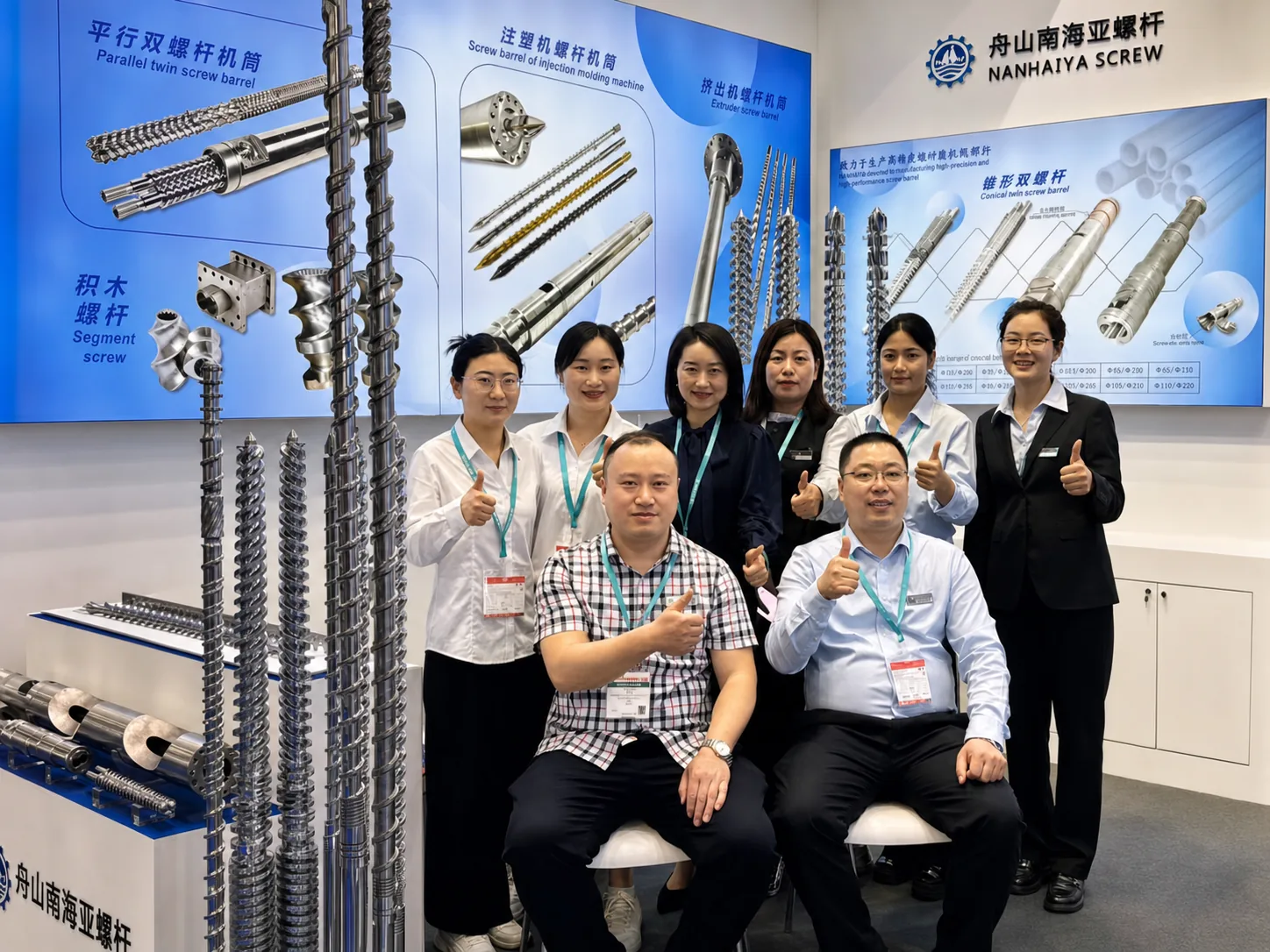
Related Articles
More insights on screw barrel technology and plastics processing.
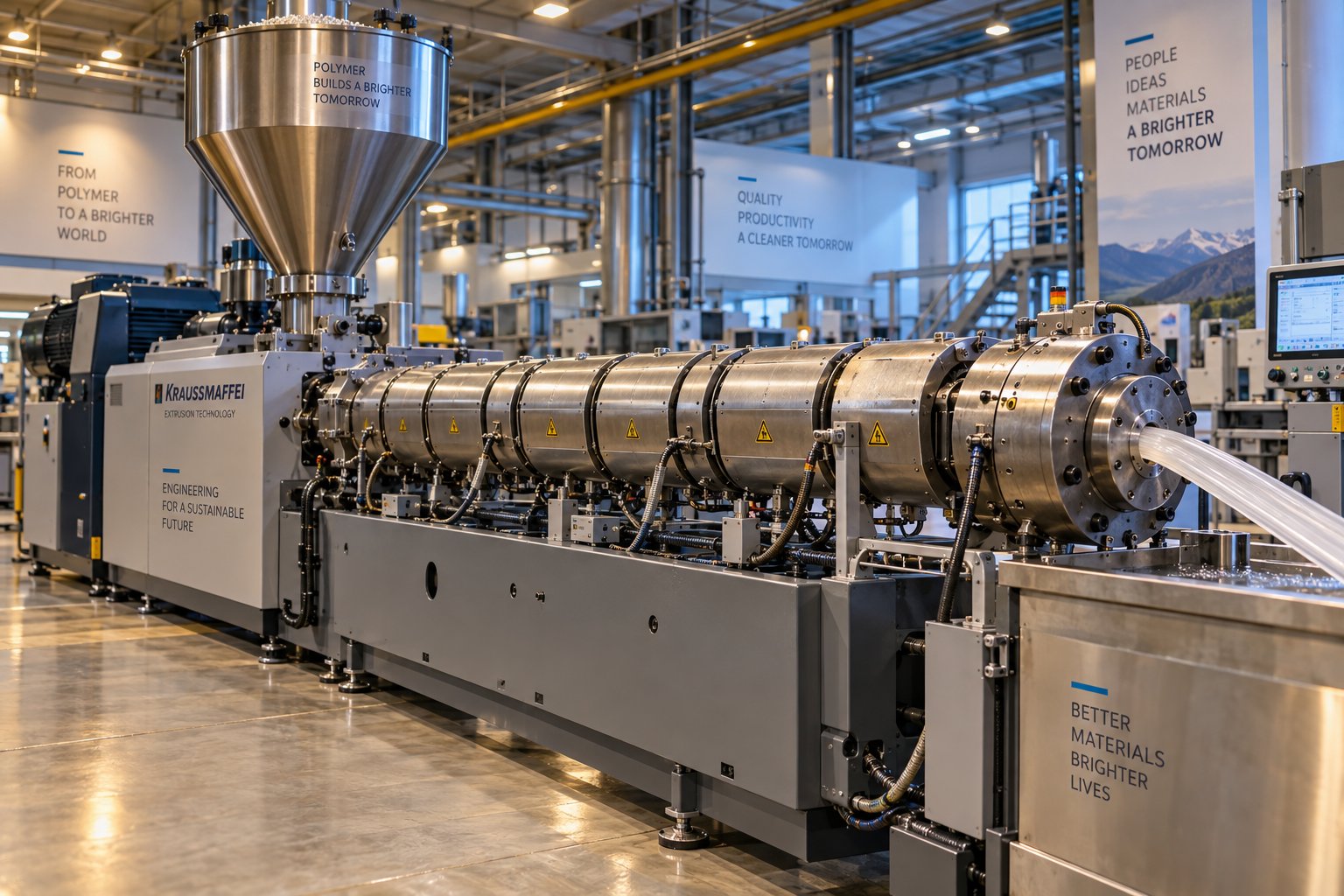
Extruder Machine Decoded: From Raw Pellet To Finished Product
Oct 6, 2026
Learn how an extruder machine works, compare single-screw vs. twin-screw types, and get expert guidance on specs, troubleshooting, and selection.
Read Article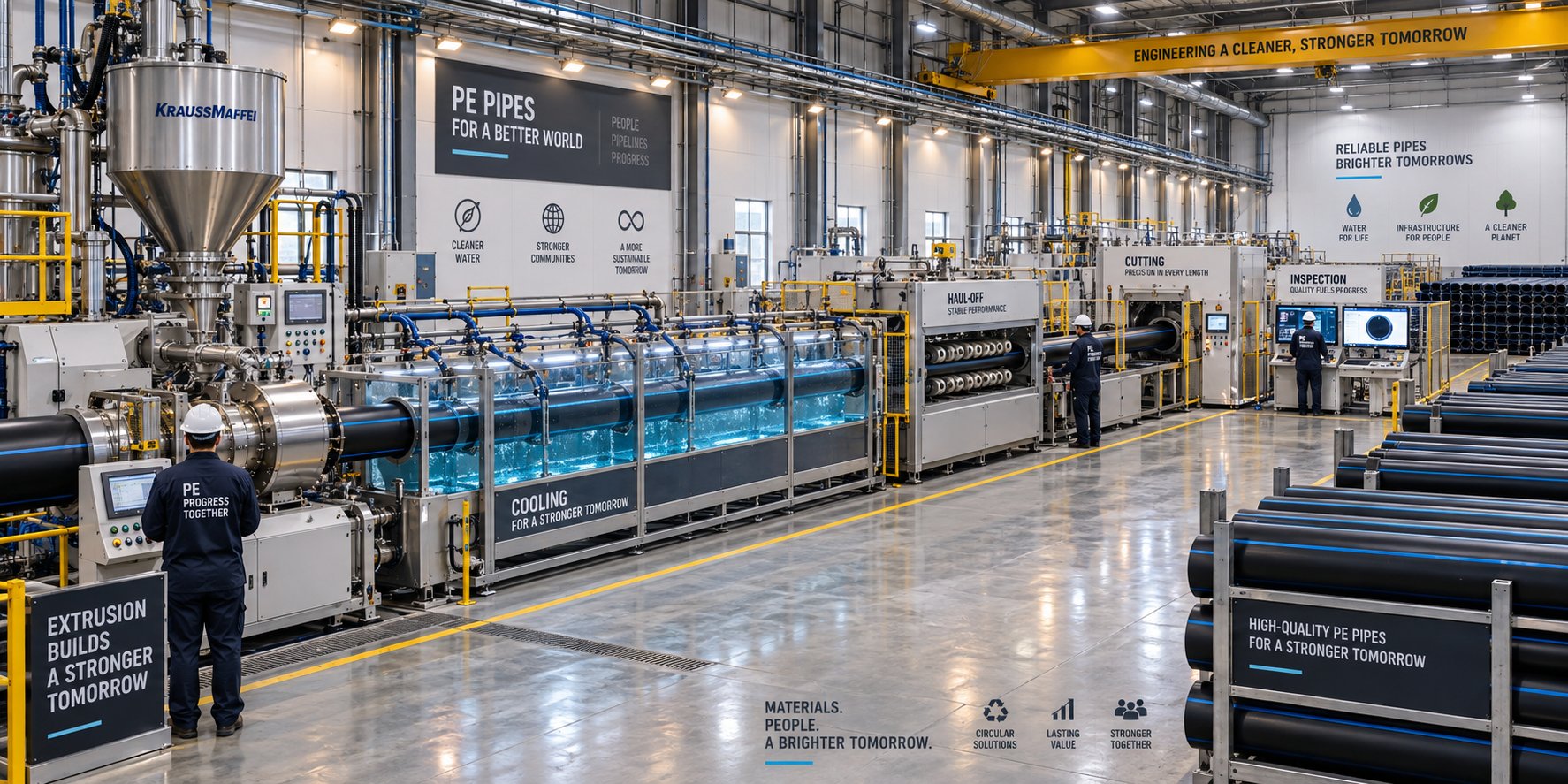
PE Pipe Making Machine Decoded: From Raw Resin to Flawless Pipe
Oct 4, 2026
Learn how a PE pipe making machine works, from resin to finished pipe. Covers components, material grades, automation, troubleshooting, and buyer selection tips.
Read Article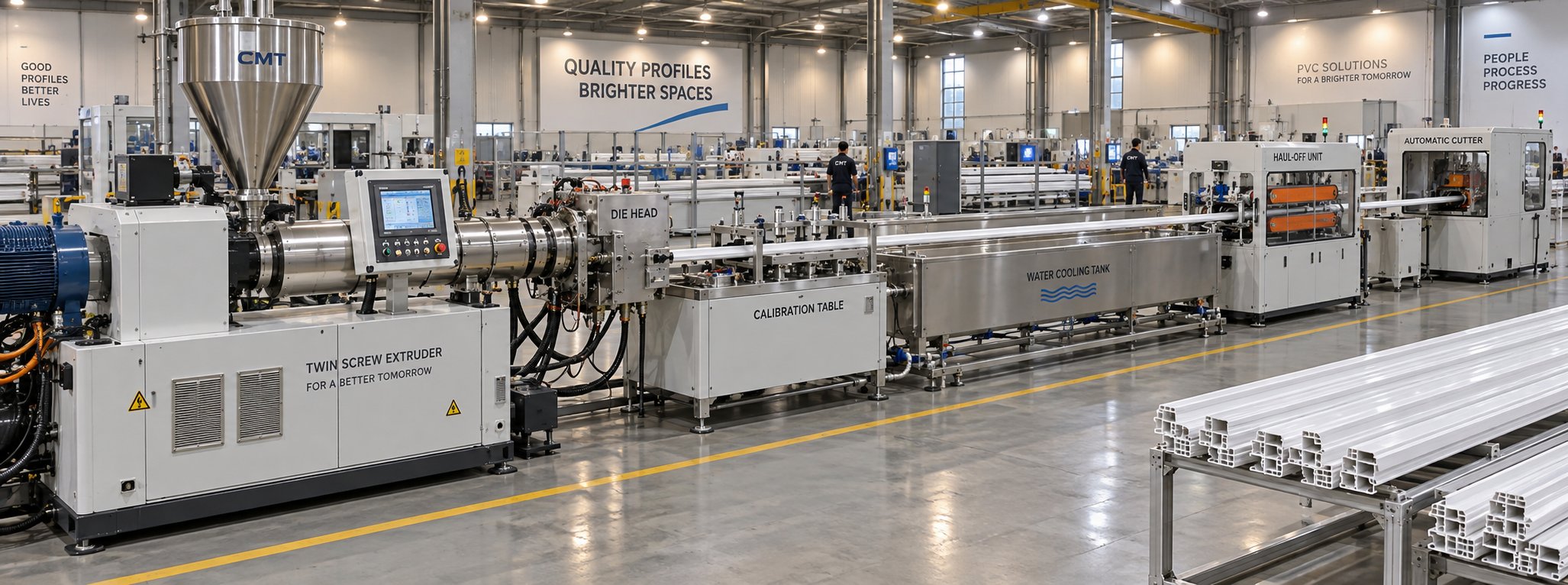
PVC Profile Making Machine Decoded: From Raw Resin To Profit
Oct 3, 2026
Learn how a PVC profile making machine works — extrusion process steps, key technical parameters, die design, calibration methods, maintenance, and total cost of ownership.
Read ArticleLooking for something else?
Search by material, symptom or product and jump straight to the relevant page.
These are navigation suggestions based on keyword matching — not a quotation, not a delivery commitment, and not a substitute for engineering review. Final specification is confirmed by our engineers against your drawings and processed material.
Need help with screw barrel selection?
Share your machine model, processed material and application. Our team can help with pricing and technical support.