

What Is a Plastic Recycling Extruder and Why It Matters
Imagine feeding a handful of shredded milk jugs into one end of a machine and watching clean, uniform pellets emerge from the other. That is essentially what a plastic recycling extruder does — and it sits at the heart of every mechanical recycling operation on the planet.
Defining the Plastic Recycling Extruder
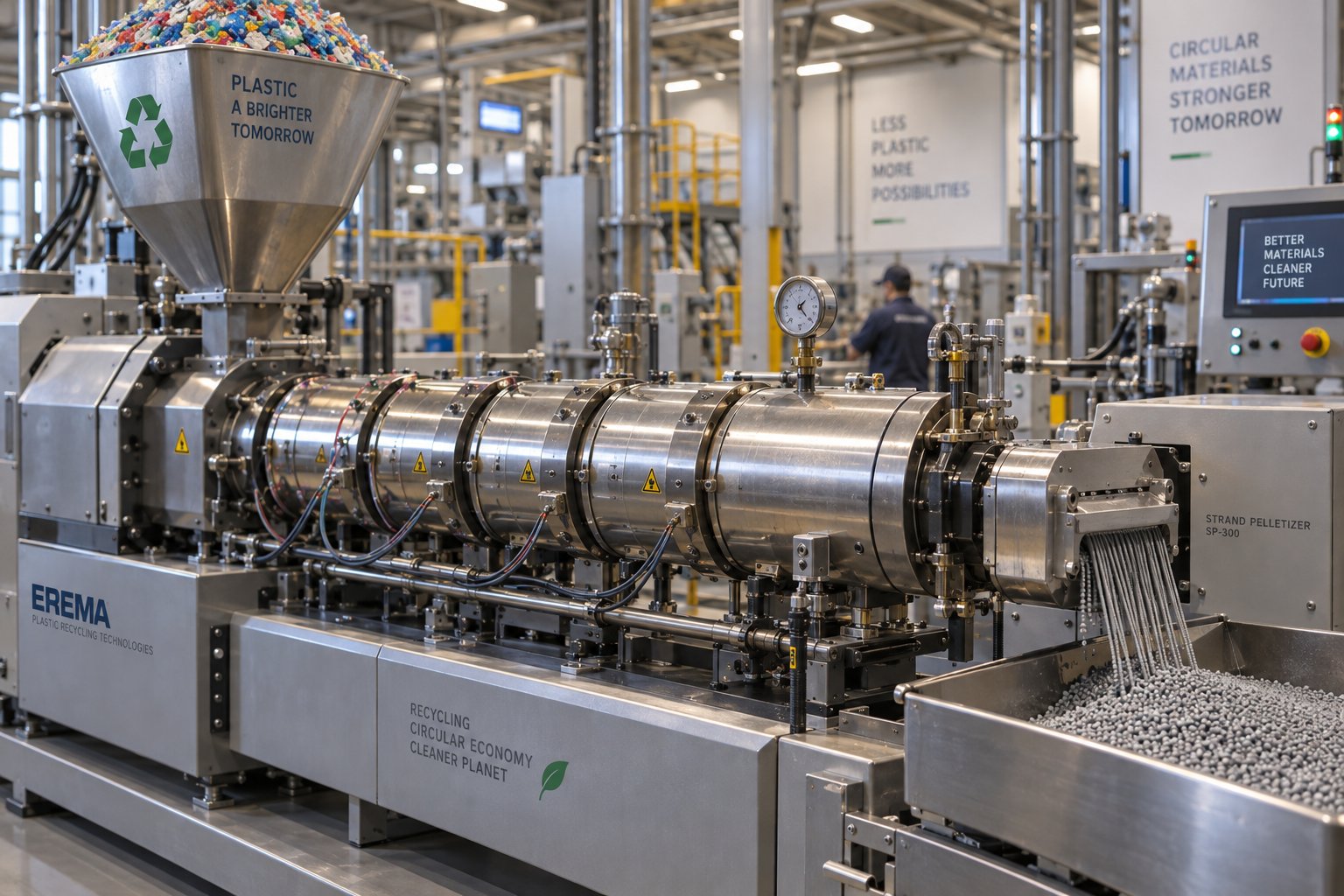
A plastic recycling extruder is a thermomechanical machine that feeds post-consumer or post-industrial plastic waste into a heated barrel, where a rotating screw melts, mixes, and pushes the material through a die to produce a reusable output such as pellets, filament, profiles, or sheets.
The core principle is straightforward. Plastic flakes or granules drop from a hopper into a barrel wrapped in heater bands. Inside, a screw rotates and conveys the material forward, generating frictional heat along the way. By the time the plastic reaches the die at the far end, it has transformed into a homogeneous, viscous melt ready to be shaped into something valuable again. This extrusion-based forming process is the primary method used in mechanical recycling worldwide.
How Recycling Extruders Differ from Virgin-Material Extruders
So what is a plastic extruder built for virgin resin, and why can't you simply swap in recycled flakes? A standard plastics extruder expects a consistent, dry, contaminant-free feedstock with a predictable melt flow index. A recycled plastic extruder, on the other hand, must handle the chaos that comes with real-world waste: residual moisture that triggers hydrolytic degradation, label adhesives that char inside the barrel, mixed polymers with clashing melt temperatures, and fluctuating bulk densities that starve or flood the feed zone.
These challenges demand engineering features rarely found on general-purpose equipment — robust degassing vents, aggressive melt filtration systems, corrosion-resistant barrel linings, and screw geometries designed to tolerate inconsistent input without sacrificing output quality. Without those adaptations, contaminants degrade the melt, cause pressure spikes, and produce brittle or discolored end products.
Whether you are exploring a desktop setup for 3D-printer filament or planning an industrial pelletizing line, understanding how each stage of the recycling extrusion process works — and where things can go wrong — is the difference between sellable output and scrap. The sections ahead break down every step, from raw waste to finished product, across every scale of operation.
How the Recycling Extrusion Process Works Step by Step
A plastic extrusion machine does not operate in isolation. It is the centerpiece of a much larger workflow — one that begins the moment waste plastic is collected and ends only when finished pellets, filament, or profiles are packaged for sale. Skip or shortcut any single stage in this chain, and the extruder pays the price through poor melt quality, clogged screens, or unusable output.
From Waste Collection to Extrusion-Ready Feedstock
Picture a bale of mixed post-consumer plastic arriving at a recycling facility. Before any of that material gets anywhere near a heated barrel, it must pass through several preparation stages that progressively strip away contaminants and transform chaotic waste into a uniform, dry feedstock. Here is the complete sequence:
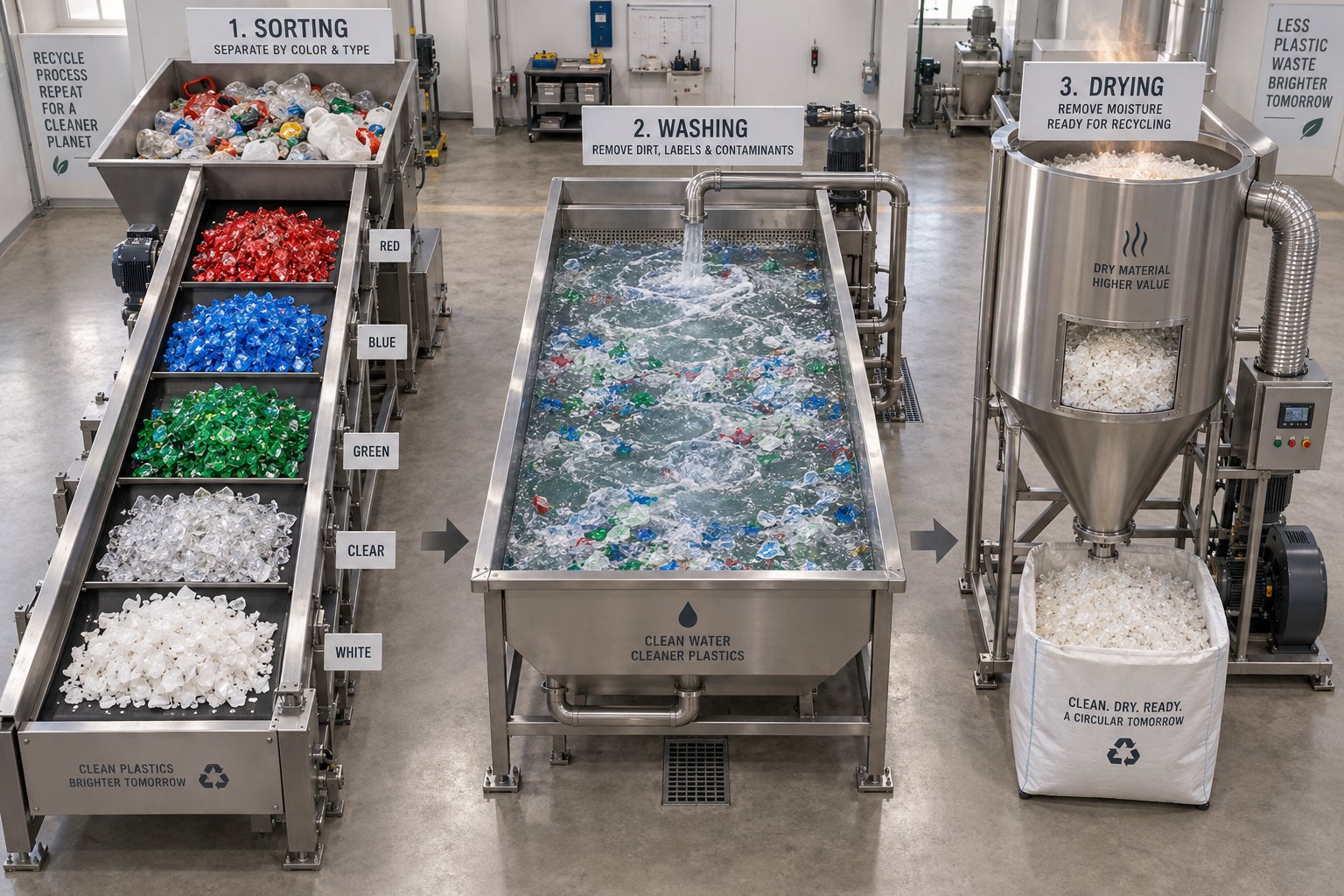
- Sorting and identification — Plastics are separated by resin type using manual inspection, near-infrared sensors, or float-sink density tanks. Mixing incompatible polymers at this stage guarantees problems downstream.
- Washing and contaminant removal — Friction washers, hot-wash tanks, and rinse systems remove dirt, food residue, adhesives, and labels. Heavily contaminated streams, such as post-consumer PET bottles, often require a dedicated hot washing treatment to meet purity standards.
- Shredding and size reduction — Crushers and shredders break washed material into small, consistently sized flakes. Uniform particle size ensures even feeding and predictable melting behavior inside the barrel.
- Drying — Centrifugal dewatering and hot-air or dehumidifying dryers reduce moisture content. Residual water trapped in flakes is one of the leading causes of bubbles, black spots, and hydrolytic degradation during extrusion.
- Feeding into the extruder — Dried flakes enter the hopper of the waste plastic extrusion machine, where gravimetric or volumetric feeders maintain a steady flow into the barrel's feed zone.
- Melting and degassing — The rotating screw conveys material through progressively hotter barrel zones, transforming solid flakes into a viscous melt. Vacuum-assisted degassing vents — often one or two ports along the barrel — pull out trapped moisture, volatile organic compounds, and residual odors that would otherwise compromise the final product.
- Melt filtration — The molten polymer passes through screen changers or rotary filtration systems that capture un-melted particles, char, metal fragments, and other solid contaminants. Continuous, pressure-constant filtration systems are especially valuable because they avoid the process fluctuations caused by conventional screen changes.
- Die forming — Clean melt is forced through a die that shapes it into strands, sheets, profiles, or thin filament, depending on the target product.
- Cooling — Extruded strands pass through a water bath or air-cooling system to solidify the polymer before cutting.
- Final product handling — A strand pelletizer, underwater pelletizer, or face-cut system chops cooled strands into uniform pellets. For filament extrusion applications, a precision puller and winder spool the output onto reels instead.
Inside the Extruder Barrel and Beyond the Die
Two stages in this workflow deserve extra attention because they are uniquely critical for recycled feedstock yet rarely discussed in detail: degassing and melt filtration.
Degassing matters because post-consumer plastic almost always carries residual moisture and volatile substances — even after mechanical drying. Inside the barrel, these volatiles vaporize under heat. Without a venting zone connected to a vacuum pump, that vapor stays trapped in the melt and shows up as bubbles, voids, and surface defects in the finished product. Advanced plastic extruding machine designs position multiple venting ports along the barrel, and some systems can handle feedstock with moisture content as high as two percent without a separate pre-drying step.
Melt filtration is equally essential. Recycled streams contain contaminants that virgin resin simply does not — paper fibers, aluminum foil fragments, paint flecks, and degraded polymer particles. Screen packs catch these before they reach the die, but conventional screens clog quickly with contaminated input, causing pressure spikes and forcing operators to pause production for manual changes. Fully automatic, pressure-constant filtration systems solve this by rotating fresh screen area into the melt path continuously, keeping output quality stable and minimizing material waste from backflushing.
Together, these two systems transform an ordinary extruder into a machine that can reliably process the messy, variable feedstock that recycling demands. Yet even the best degassing and filtration cannot compensate for poorly prepared input — which raises a critical question: exactly how clean and consistent does the feedstock need to be before it enters the hopper?
Pre-Processing Steps That Determine Extrusion Quality
The answer is simple and unforgiving: if the feedstock is not clean, sorted, and dry, even the most advanced extruder will produce junk. Inadequate pre-processing is the single leading cause of poor recycled output — bubbles, discoloration, weak mechanical properties, and die blockages all trace back to what happened (or didn't happen) before plastic entered the barrel. Whether you are running a full-scale PLA recycling machine or experimenting with DIY filament recycling on a benchtop setup, the rules are the same.
Sorting and Separating Plastics by Resin Type
Every common plastic carries a resin identification code — the small number inside the triangular arrows stamped on packaging. That number is your first and most important sorting tool. HDPE (code 2), LDPE (code 4), and PP (code 5) each have distinct melt temperatures and flow behaviors. Feeding even a small percentage of PET (code 1) into a polyethylene stream creates un-melted chunks that clog screens and ruin pellet uniformity, because PET melts significantly higher than PE.
Industrial facilities rely on near-infrared optical sorters and sink-float density separation tanks to automate this step at high speed. Smaller operations and community-scale projects often sort manually, which works well for clean, identifiable streams like post-industrial scrap or collected 3D printing waste. A dedicated PLA shredder paired with careful hand-sorting, for example, can produce a remarkably pure feedstock from failed prints and support material — sometimes called filament poop — that would otherwise go to landfill. The key principle at any scale is the same: incompatible polymers must never share a barrel.
Washing, Shredding, and Drying for Consistent Feedstock
Sorting removes the wrong plastics. Washing removes everything else. Three main washing methods serve different contamination levels:
- Cold wash — Water-based rinsing that handles lightly soiled material such as industrial offcuts and clean post-consumer containers.
- Hot wash — Uses heated water (typically 60-90 °C) and caustic solutions to dissolve adhesives, labels, and oils. Essential for post-consumer PET bottles and heavily contaminated streams.
- Friction washing — High-speed rotating paddles generate mechanical scrubbing action to strip stubborn residue without excessive chemical use. Friction washers are cost-effective and widely used because they require less labor and water than immersion systems.
After washing, shredding reduces material to a consistent flake size — usually between 8 and 12 millimeters for most recycling extruders. Uniform flakes feed predictably into the hopper, melt evenly inside the barrel, and prevent the bridging and starving problems that irregular chunks cause. A quality DIY filament shredder or a compact PLA grinder can achieve this consistency for smaller operations, while industrial granulators handle tons per hour. Integrated filament shredder and extruder setups streamline the workflow further by feeding ground flakes directly into the melt zone.
Drying is the final and arguably most critical pre-processing step. Moisture trapped inside flakes vaporizes under extrusion heat, producing bubbles, voids, and surface defects in the output. Worse, hygroscopic polymers like PET and nylon undergo hydrolytic degradation when processed wet — their polymer chains break apart, permanently reducing strength and clarity. Research on PET recycling shows that intrinsic viscosity can drop from 0.8 dl/g to as low as 0.5 dl/g after thermal processing, and residual moisture accelerates this loss dramatically. Dehumidifying dryers are essential for hygroscopic resins, while simpler hot-air dryers suffice for polyethylene and polypropylene.
To put it plainly, here are the most common contaminants that sabotage extrusion quality and exactly how they cause damage:
- Paper and cardboard labels — Char inside the barrel, producing black specks and clogging filtration screens.
- Adhesive residue — Creates sticky buildup on screw flights and die surfaces, causing dead spots where polymer degrades and discolors.
- Food residue and organic matter — Decomposes at extrusion temperatures, releasing gases that form voids and produce foul odors in the output.
- Metal fragments — Scratch barrel walls and screw surfaces, accelerating wear and contaminating the melt with metallic particles.
- Mixed or incompatible polymers — Remain un-melted or phase-separate in the melt, resulting in weak spots, delamination, and inconsistent mechanical properties.
- Residual moisture — Causes steam bubbles, foaming, and hydrolytic chain scission in susceptible polymers, reducing both appearance and strength.
- Inks and dyes — Migrate through the melt and discolor the output unpredictably, limiting the market value of recycled pellets.
Every one of these contaminants is preventable with proper sorting, washing, shredding, and drying. Skipping or rushing any of these stages shifts the burden downstream — onto the extruder, the filtration system, and ultimately the quality of the finished product. The machine itself can compensate for some variability, but the architecture of that machine matters enormously. Specifically, the choice between a single-screw and a twin-screw design determines just how much feedstock inconsistency an extruder can tolerate.
Single-Screw vs Twin-Screw Extruders for Recycling
That tolerance gap — the distance between what your feedstock delivers and what your extruder can handle — comes down to one fundamental design decision: how many screws are inside the barrel. A single-screw plastic extruder machine and a twin-screw system share the same basic mission, yet they approach recycled material in radically different ways. Choosing the wrong architecture for your feedstock is like fitting a sedan engine into a dump truck — it may turn over, but it won't do the job.
Single-Screw Extruders for Clean Recycled Feedstock
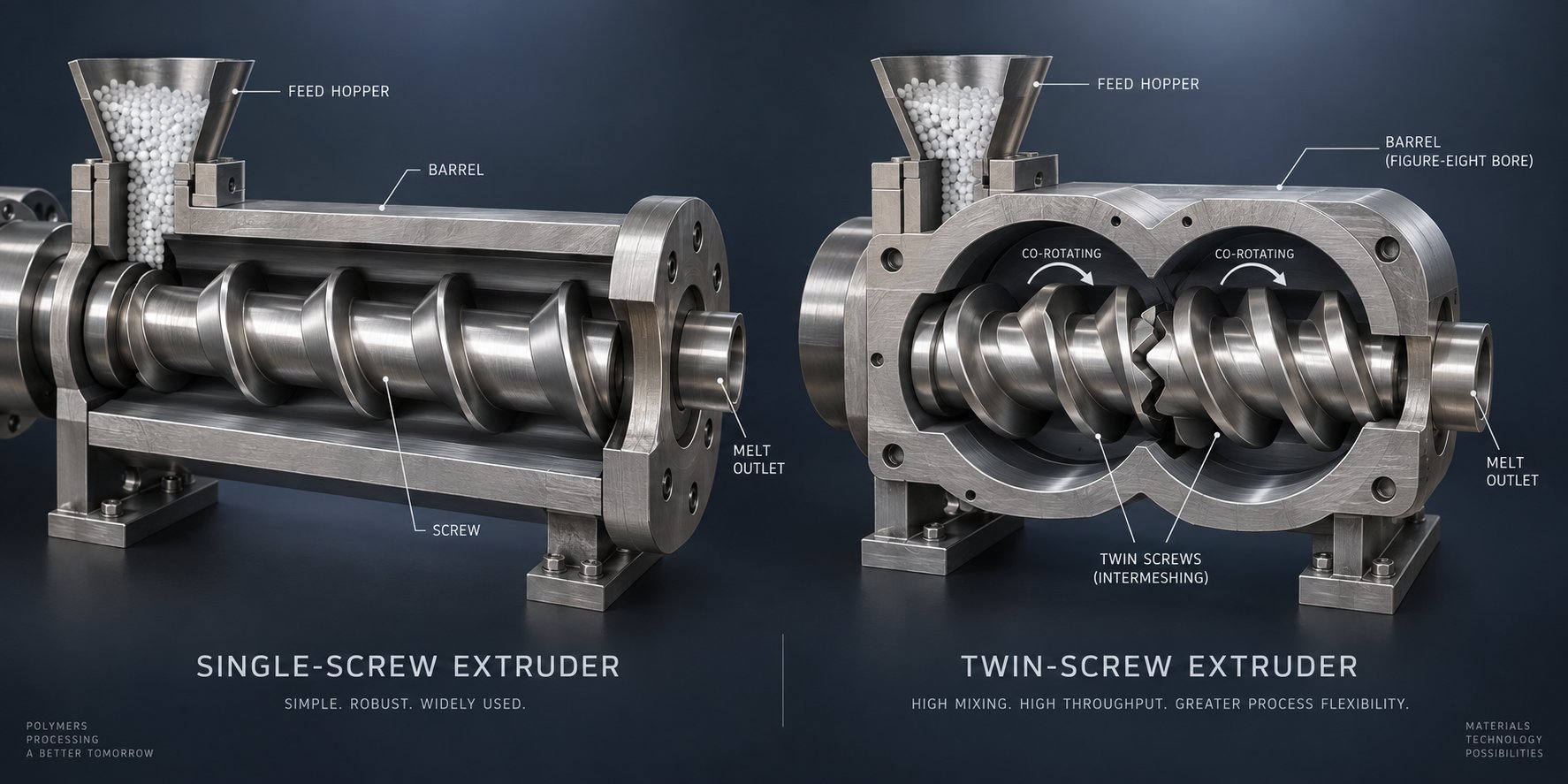
A single-screw extruder relies on one rotating screw to convey, melt, and pressurize material. Its mechanical simplicity is its greatest strength: fewer moving parts, lower capital cost, easier maintenance, and a predictable operating profile. For recyclers working with clean, pre-sorted, single-polymer streams — post-industrial film scrap, sorted HDPE bottle flakes, or uniform PET regrind — a single-screw system often delivers the best return on investment.
You'll find these machines dominating DIY and small-scale operations precisely because the feedstock is tightly controlled. When you know exactly what's going into the hopper and that material has been properly washed, shredded, and dried, the single screw's limited mixing capability is not a liability. It melts the polymer efficiently through a combination of barrel heat conduction and frictional shear, builds pressure smoothly, and pushes a consistent melt through the die.
The trade-off? Single-screw designs struggle when feedstock quality varies. Their mixing action is largely passive — material tumbles in the screw channel rather than being actively kneaded. Degassing capability is limited, typically to a single vent port. And because the screw is not self-wiping, material can stagnate in the channel, leading to thermal degradation and discoloration. For clean recycling streams, these limitations rarely surface. For anything more demanding, they become deal-breakers.
Twin-Screw Extruders for Demanding Recycling Applications
Twin-screw extruders use two intermeshing screws — either co-rotating (both turning the same direction) or counter-rotating — to transport, melt, mix, and degas material. This architecture transforms the barrel into an active, high-shear processing environment that excels with the kind of messy, inconsistent feedstock recycling operations encounter daily.
Co-rotating twin-screw designs are the workhorses of advanced recycling. Their intermeshing, self-wiping screw geometry prevents material from stagnating, which eliminates the dead spots where polymer chars and degrades. The modular barrel design allows operators to configure conveying elements, kneading blocks, and degassing zones in any sequence — essentially customizing the extruder for plastic of a specific type and contamination level. Multiple vacuum vent ports along the barrel provide aggressive degassing, pulling out moisture and volatiles that would cause bubbles and odor in the finished pellet.
This flexibility makes twin-screw systems the preferred choice as a plastic compounding machine. Recycled polymers often need help — their mechanical properties degrade with each heat cycle, and restoring tensile strength, impact resistance, or UV stability demands blending with virgin resin, stabilizers, compatibilizers, or mineral fillers. A twin-screw extruder's intensive distributive and dispersive mixing ensures these additives are uniformly incorporated into the melt, producing a homogeneous compound with consistent properties.
Counter-rotating twin-screw designs occupy a narrower niche. They generate lower shear than co-rotating systems, making them well-suited for heat-sensitive materials like PVC, but they lack the same mixing intensity and throughput flexibility. For most recycling and compounding applications, co-rotating parallel twin-screw extruders dominate.
Because the barrel and screw assembly is the performance-defining component in any twin-screw system, sourcing matters. Operators scaling beyond hobby equipment often work with specialists who can tailor barrel metallurgy, screw element configuration, and wear protection to specific recycled polymer demands. NANHAIYA, for example, designs custom parallel twin screw barrels for compounding, recycling, pelletizing, and granulation applications — offering the kind of application-specific engineering that off-the-shelf barrels cannot match. This level of customization becomes increasingly important as feedstock complexity and throughput targets rise.
Key Technical Parameters to Compare
When evaluating the best extruders for thermoplastics recycling, a handful of technical parameters drive the decision. Understanding them — even in general terms — prevents costly mismatches between machine and mission.
- L/D ratio (length-to-diameter) — Describes how long the screw is relative to its diameter. Ratios of 24:1 to 36:1 are common for single-screw machines, while twin-screw recycling extruders often run 32:1 to 48:1. A higher L/D ratio provides more residence time for melting, mixing, and degassing — critical when processing contaminated or high-moisture recycled streams.
- Compression ratio — The ratio of channel depth in the feed zone to the channel depth in the metering zone. Single-screw recycling extruders typically use compression ratios of 2.5:1 to 3.5:1, tailored to the specific polymer's melt behavior. Twin-screw machines achieve compression through kneading block configuration rather than a single fixed ratio.
- Screw speed range — Single-screw extruders usually run at lower speeds (up to roughly 150 RPM), relying on friction-driven melting. Co-rotating twin-screw systems can exceed 600 RPM, enabling higher throughput and more intense mixing at the cost of greater shear heating — which requires careful temperature management to avoid degradation.
- Throughput — Output capacity scales with screw diameter, speed, and design. A custom extruder with twin screws at a given diameter will generally outproduce a same-diameter single-screw machine, but real-world throughput depends heavily on feedstock density, moisture content, and the degree of compounding required.
The comparison table below distills these differences into a quick-reference format for operators evaluating which extruder for plastic recycling fits their specific scenario:
| Comparison Dimension | Single-Screw Extruder | Twin-Screw Extruder (Co-Rotating) |
|---|---|---|
| Mixing capability | Basic — passive channel mixing | Excellent — active kneading and distributive mixing |
| Feedstock flexibility | Clean, pre-sorted, single-polymer streams | Mixed, contaminated, or multi-polymer streams |
| Degassing performance | Limited — typically one vent port | Strong — multiple vacuum vent ports |
| Self-wiping action | No — material can stagnate | Yes — intermeshing screws prevent dead spots |
| Barrel and screw modularity | Fixed screw geometry | Modular — reconfigurable elements for different polymers |
| Compounding with additives | Poor additive dispersion | Excellent — uniform blending of stabilizers, fillers, and virgin resin |
| Typical L/D ratio range | 24:1 to 36:1 | 32:1 to 48:1 |
| Relative throughput | Moderate | High |
| Initial investment | Lower | Higher (2-3x typical) |
| Maintenance complexity | Simple — fewer wear components | More complex — segmented screws, gearbox precision |
| Best recycling fit | Post-industrial scrap, clean bottle flakes, DIY projects | Post-consumer waste, engineering plastic blends, upcycling operations |
Neither architecture is universally superior. A custom plastic extruder with a single screw remains the most cost-effective path when feedstock is clean and predictable. A twin-screw system earns its higher price when material variability, contamination, or compounding demands exceed what a single screw can manage. Many advanced recycling lines even combine both in a two-stage configuration — a single-screw extruder for pre-melting and coarse filtration, followed by a co-rotating twin-screw extruder for deep degassing, additive incorporation, and final compounding.
The right screw architecture determines how well your machine handles feedstock variability — but the type of plastic flowing through that barrel introduces its own set of processing rules. Each polymer family brings distinct melt temperatures, degradation sensitivities, and recycling economics that every operator needs to understand.
Processing Different Plastic Types in a Recycling Extruder
Every polymer that enters the barrel carries its own personality — a unique combination of melt behavior, degradation tendencies, and quirks that dictate how the extruder must be set up. Treat HDPE like PET, and you'll either under-melt one or burn the other. The difference between a profitable recycling run and a barrel full of charred waste often comes down to knowing exactly how each plastic responds to heat and shear.
Recycling-Friendly Polymers: HDPE, LDPE, and PP
If you're new to recycling extrusion, polyethylene is the most forgiving place to start. Both HDPE (resin code 2) and LDPE (resin code 4) offer a wide processing window, meaning they tolerate moderate temperature fluctuations without degrading or burning. HDPE melts in the range of roughly 180-230 °C and flows predictably through the barrel, making it an ideal candidate for pelletizing operations. Recycled HDPE pellets carry strong market demand because they feed directly into manufacturing lines for drainage pipes, plastic lumber, containers, and agricultural film. A plastic pipe extruder running recycled HDPE, for instance, can produce structural drainage pipe with mechanical properties close to virgin material when feedstock contamination is kept low.
LDPE behaves similarly but at slightly lower temperatures and with a softer, more flexible melt. Post-consumer LDPE — stretch wrap, grocery bags, and packaging film — is abundant and relatively easy to process, though its low bulk density can create feeding challenges. Crammer feeders or force-feeding systems solve this by compacting light film before it enters the barrel.
Polypropylene (resin code 5) sits a step above polyethylene in both value and difficulty. PP melts at a moderate range, typically around 200-250 °C, but is noticeably more prone to thermal degradation than PE. Its polymer chains break down under excessive heat and shear, causing a reduction in molecular weight that manifests as increased melt flow and weakened mechanical properties in the finished product. Successful PP recycling demands tighter temperature control and shorter residence time inside the barrel. Despite this narrower window, recycled PP commands a healthy market price because it finds applications in automotive parts, household goods, and packaging — sectors that value its stiffness-to-weight ratio and chemical resistance.
Challenging Plastics: PET, PS, ABS, and PVC
Stepping beyond polyolefins, the processing rules change considerably. PET (resin code 1) sits at the higher end of common recycling temperatures, generally requiring melt temperatures above 260 °C. A pet extruder must cope with the material's hygroscopic nature — PET absorbs moisture from the air, and that moisture triggers hydrolytic chain scission during processing. The result is a dramatic drop in intrinsic viscosity, which translates directly to weaker, more brittle output. Thorough drying to below 50 ppm moisture content is non-negotiable before PET ever touches the feed throat. When handled correctly, however, recycled PET (rPET) yields some of the highest-value pellets on the market, feeding into fiber production, thermoformed packaging, and even bottle-to-bottle recycling loops.
Polystyrene (resin code 6) flows easily at moderate temperatures (around 180-240 °C) and processes without unusual fuss. The catch is in the output: recycled PS tends to be brittle and is limited to applications like insulation board, picture frames, and packaging fillers where toughness is not critical. Market demand for recycled PS is comparatively narrow, which makes collection economics challenging despite easy processing.
ABS stands out as one of the more recycling-friendly engineering plastics. As research on ABS recycling highlights, this terpolymer can be melted and remolded multiple times with manageable quality loss when reprocessed carefully at temperatures around 220-260 °C. The polybutadiene rubber phase is the vulnerable link — it undergoes thermo-oxidative degradation during repeated heat cycles, reducing impact strength and causing yellowing. Blending recycled ABS with 20-30% virgin resin or adding stabilizers during compounding restores mechanical performance to levels acceptable for electronics housings, automotive interior parts, and consumer goods. The ABS recycling market is growing rapidly, reflecting both strong demand and improving processing technology.
PVC (resin code 3) is the outlier that demands the most caution. An extruder PVC setup must maintain extremely precise temperature control, typically within a narrow window around 160-200 °C. Exceed the upper limit, and PVC begins releasing hydrogen chloride gas — a corrosive, toxic byproduct that damages equipment and poses serious health risks to operators. Specialized pvc extruder machine configurations use corrosion-resistant barrels (often bimetallic with nickel-based alloy linings), lower screw speeds to minimize shear heating, and dedicated ventilation systems. Despite these demands, PVC recycling is industrially significant because rigid PVC products like pipes, window profiles, and fittings have long service lives and high material value when recovered. The key is strict temperature discipline and proper engineering — treating a PVC stream casually invites equipment damage and workplace hazards.
Which Plastics Yield the Highest-Value Recycled Output
From a pure economics standpoint, not all recycled plastics are created equal. The circular economy viability of each resin depends on the balance between processing difficulty, output quality, and market price for the finished pellets.
PET and HDPE consistently sit at the top of the value chain. Recycled PET pellets command premium prices because they can substitute for virgin resin in demanding applications — fiber for clothing, food-grade packaging, and strapping. HDPE follows closely, driven by robust demand from pipe manufacturers, container producers, and plastic lumber fabricators. PP occupies a strong middle ground, with rising value driven by the automotive sector's increasing acceptance of recycled content.
ABS represents a high-value niche: the recycled engineering plastics market was valued at approximately USD 4.72 billion in 2024, with ABS recycling specifically reaching USD 1.5 billion in 2023 and projected to double by 2032. This growth reflects both regulatory pressure and genuine demand for recycled ABS in electronics and automotive supply chains.
PS and LDPE sit lower on the value ladder — not because they are difficult to process, but because end-market demand is more limited and collection infrastructure is thinner. PVC recycling can be lucrative for operators with the right equipment and safety protocols, but the investment barrier keeps it out of reach for smaller operations.
The table below maps each major resin to its general processing characteristics, recycling difficulty, and typical end products — a quick reference for matching your feedstock to realistic output expectations:
| Plastic Type (Resin Code) | Temperature Range Category | Recycling Difficulty | Key Processing Concern | Typical Recycled Output Products |
|---|---|---|---|---|
| HDPE (2) | Low-Medium | Easy | Low — wide processing window | Pipes, lumber, containers, film |
| LDPE (4) | Low-Medium | Easy | Low bulk density feeding | Film, bags, bin liners, irrigation tubing |
| PP (5) | Medium | Moderate | Thermal degradation, narrower window | Auto parts, housewares, packaging, fibers |
| PET (1) | High | Moderate-Hard | Moisture-driven hydrolysis, requires thorough drying | Fiber, food packaging, strapping, bottles |
| PS (6) | Low-Medium | Easy | Brittle output, limited end markets | Insulation, packaging, frames, hangers |
| ABS | Medium-High | Moderate | Rubber phase oxidation over multiple cycles | Electronics housings, auto parts, 3D printer filament |
| PVC (3) | Low-Medium | Hard | HCl gas release if overheated, corrosion risk | Pipes, window profiles, cable sheathing, flooring |
Understanding these polymer-specific behaviors is essential, but the practical reality of recycling extrusion varies enormously depending on whether you are running a desktop machine in a workshop or a multi-ton-per-hour industrial line. The scale of your operation shapes everything — from which plastics you can realistically process to the economics that determine whether your output is profitable or just educational.
Recycling Extruders from Desktop to Industrial Scale
A hobbyist turning failed 3D prints into fresh filament on a kitchen counter and a factory pelletizing ten tons of post-consumer HDPE per hour are both recycling plastic through extrusion — yet the equipment, economics, and operator demands between those two extremes could not be more different. Most online resources focus on one end of the spectrum or the other: either open-source maker projects or million-dollar turnkey lines, with almost nothing in between. That gap leaves a growing number of small-business owners, community recyclers, and educators without clear guidance on where their operation actually falls — and what they should realistically expect from their equipment investment.
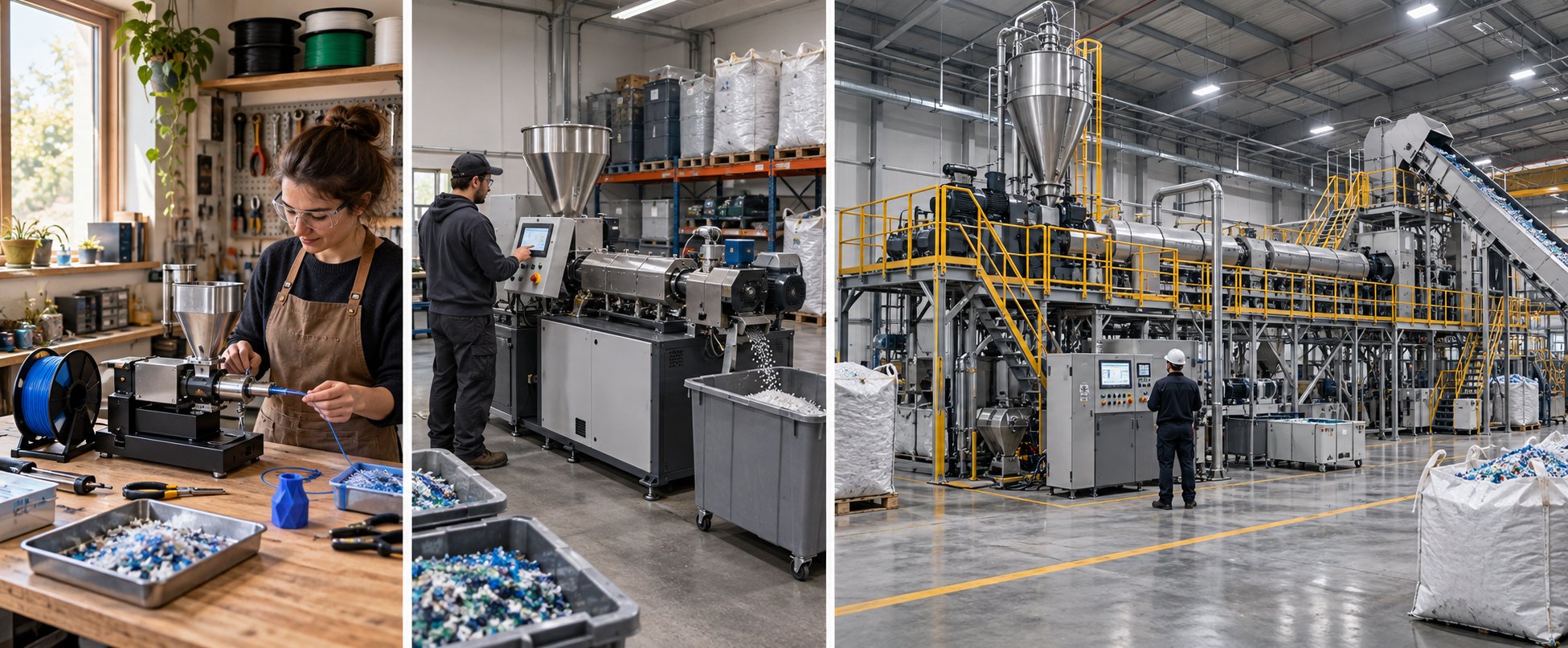
The three tiers below map the full landscape, from a desktop filament extruder you can build from open-source plans to a fully automated industrial recycling line. Each tier carries distinct capabilities, limitations, and economic realities that shape whether your recycled output ends up profitable, educational, or somewhere in between.
DIY and Desktop Recycling Extruders
Imagine building your own plastic recycling extruder over a weekend using downloadable blueprints, a secondhand motor, and off-the-shelf heater bands. That is exactly the premise behind the Precious Plastic open-source project, which has put functional extrusion machines into workshops, classrooms, and makerspaces across dozens of countries since its original release in 2016. The basic Precious Plastic extrusion machine costs roughly €1,200 in materials (based on Netherlands pricing), while the upgraded Extrusion Pro version runs around €2,200 plus the motor — a fraction of what even a modest commercial system demands.
Desktop and hobby-scale machines typically push somewhere between 0.5 and 5 kilograms of output per hour, depending on screw diameter, motor power, and the polymer being processed. That throughput is too low for commodity pellet sales, but it opens a surprisingly wide range of practical applications:
- Producing 3D printer filament from sorted waste — especially PLA, ABS, and PETG scraps from failed prints and support structures
- Extruding recycled beams and bricks for furniture, construction prototypes, and public installations
- Freehand extrusion of decorative objects, lampshades, trays, and bowls using techniques pioneered by makers like Zelenew in Ukraine
- Education and community outreach — demonstrating the recycling process hands-on at schools, fairs, and sustainability workshops
A desktop filament maker in this category can produce usable spools of filament for personal 3D printing, though dimensional consistency and roundness typically fall short of commercial tolerances. Operators need a solid grasp of basic mechanics, temperature control, and polymer behavior, but formal engineering training is not required. The real skill at this level is feedstock discipline — sorting meticulously, shredding to a uniform flake size, and keeping moisture out of the hopper.
Should you expect to turn a profit? Honestly, not from selling raw pellets or filament at these volumes. A cheap filament recycler or desktop setup earns its value through avoided purchasing costs (making your own filament instead of buying commercial spools), educational impact, and the ability to produce niche finished products — think custom recycled-plastic furniture, art pieces, or branded merchandise — where the story behind the material adds real market value. The best filament recycling machine at this scale is the one that matches your feedstock and target output, not the one with the highest throughput spec.
Small-Business and Community-Scale Systems
Step up from the desktop tier, and you enter a space where recycling extrusion starts looking like a genuine business proposition rather than a passion project. Semi-professional filament recycler machines and compact pelletizing lines in this category typically process between 20 and 200 kilograms per hour — enough throughput to serve a local recycling enterprise, a small manufacturing workshop, or a community cooperative.
Equipment at this scale bridges the gap between open-source builds and industrial lines. You'll find purpose-built single-screw extruders with integrated strand pelletizers, compact washing and drying setups, and enough automation to reduce the manual labor that makes desktop operations impractical at higher volumes. Some systems combine a filament recycling machine with shredding and drying modules into a single turnkey package, while others are assembled from discrete components chosen to match a specific waste stream.
Common applications at the community and small-business scale include:
- Pelletizing locally collected HDPE, LDPE, or PP waste for resale to regional manufacturers
- Producing recycled plastic lumber, garden furniture, and outdoor structures
- Manufacturing building materials like bricks, tiles, and fencing from mixed polyolefin waste
- Running a commercial filament production line supplying local 3D printing studios and schools
- Processing post-industrial scrap from nearby factories — runners, sprues, and off-spec parts — into clean regrind pellets
Operator skill requirements rise noticeably at this level. Running a semi-professional line demands familiarity with process temperature profiles, screw speed optimization, melt pressure monitoring, and basic mechanical maintenance. Most small-business recyclers develop this expertise through a combination of manufacturer training, community knowledge-sharing, and hands-on experimentation — though a technical background in plastics processing or mechanical engineering accelerates the learning curve significantly.
The economics here become more tangible but also more complex. Feedstock cost is the dominant variable: sourcing clean, single-resin post-industrial scrap is far cheaper and more profitable than collecting mixed post-consumer waste, which requires costly sorting and washing. Energy consumption matters more as motors and heaters run for full shifts. And output quality directly determines your selling price — recycled pellets sell at a 20-40% premium over washed flakes because molders can feed them directly, so investing in a pelletizing stage rather than selling raw flake can reshape the entire ROI picture. Small-scale operators who sell commodity flake to large reclaimers rarely clear their fixed costs, while those converting material into pellets or finished products find a viable path to profitability.
Industrial-Grade Recycling Extrusion Lines
At the industrial end of the spectrum, a plastic recycling extruder is no longer a standalone machine — it is one component in a fully integrated, largely automated processing line capable of handling thousands of kilograms per hour. These systems run continuously across multiple shifts, converting massive volumes of post-consumer or post-industrial waste into specification-grade pellets that compete directly with virgin resin in manufacturing supply chains.
Industrial recycling lines typically incorporate:
- High-capacity shredders and granulators with throughputs measured in tons per hour
- Multi-stage washing systems — including hot wash, friction wash, and float-sink separation — capable of processing heavily contaminated post-consumer bales
- Automated optical and near-infrared sorting systems for resin identification at speed
- Twin-screw or two-stage extruders with multiple degassing ports, continuous melt filtration, and sophisticated temperature control across a dozen or more barrel zones
- Underwater or strand pelletizers producing uniform, dust-free pellets ready for packaging and shipment
- Inline quality control — melt flow index testing, color measurement, and pellet geometry inspection
Throughput at this level ranges from approximately 500 kilograms per hour to well over 3,000 kilograms per hour for large-diameter twin-screw systems. Operator requirements shift from hands-on mechanical skills to process engineering, quality management, and systems-level troubleshooting. Maintenance teams typically include electricians, mechanical technicians, and process engineers who monitor equipment via SCADA or similar supervisory control platforms.
The investment is substantial. Full turnkey industrial recycling lines run from roughly $150,000 to well over $2,000,000 for equipment alone, and a practical rule of thumb from the manufacturing side is to budget approximately twice the equipment list price once civil works, power infrastructure, water treatment, and commissioning are factored in. That capital intensity sounds daunting, but it is precisely the scale at which recycling economics become most favorable. Peer-reviewed plant studies show that unit processing costs drop significantly as volume increases — one facility analysis documented a decline from about €110 to €70 per tonne as annual throughput scaled from 25,000 to 100,000 tonnes. Well-run industrial plants report net margins of 10-20%, with some reaching 15-35% after full operational ramp-up, and typical equipment payback periods of 18-36 months.
The critical economic insight at industrial scale is that the machine itself is rarely the deciding variable. The biggest margin killer is contamination — roughly 40% of plastic collected for recycling ends up in landfill because it was missorted or contaminated before it ever reached a processing line. Feedstock cost typically represents 50-60% of operating expenses, followed by utilities at 20-25% and labor at 10-15%. Operators who lock in clean, single-resin supply contracts and sell pellets rather than flake consistently outperform those chasing cheap mixed bales.
The comparison table below summarizes how these three tiers stack up across the dimensions that matter most when choosing your entry point:
| Dimension | DIY / Desktop | Small-Business / Community | Industrial |
|---|---|---|---|
| Typical throughput | 0.5 - 5 kg/hr | 20 - 200 kg/hr | 500 - 3,000+ kg/hr |
| Primary use cases | Filament making, education, artisan products, prototyping | Local pelletizing, recycled lumber, small-scale manufacturing | High-volume pelletizing, rPET/rHDPE commodity production |
| Feedstock requirements | Clean, pre-sorted, single-polymer (manually managed) | Clean to moderately contaminated, single or limited resin mix | Post-consumer bales, mixed streams (with full washing/sorting line) |
| Operator skill level | Basic mechanical aptitude, polymer awareness | Process control knowledge, maintenance capability | Process engineering, quality systems, team management |
| Automation level | Manual — hands-on operation throughout | Semi-automated — some process controls, manual oversight | Highly automated — SCADA monitoring, continuous operation |
| Relative investment | Low (under $5,000 for basic builds) | Moderate ($10,000 - $150,000 depending on configuration) | High ($150,000 - $2,000,000+ equipment; ~2x total with infrastructure) |
| Revenue model | Cost avoidance, finished products, education value | Pellet or product sales, local contracts, post-industrial regrind | Commodity pellet sales, contracted supply to manufacturers |
| Path to profitability | Rarely profitable on material sales alone | Viable when selling pellets or finished goods from clean feedstock | Strongest margins at volume with clean single-resin focus |
The pattern is clear: profitability scales with volume and feedstock quality, not simply with equipment cost. A desktop filament recycler justifies itself through education, creative output, and sustainability impact rather than margin on pellet sales. A community-scale line can break even or better when it targets clean post-industrial scrap and sells pellets rather than raw flake. And an industrial line turns recycling into a serious business — provided the operator solves the feedstock equation before signing for the machinery.
Regardless of scale, though, the machine only delivers value when it is matched to a specific end-use application. A filament maker needs different die geometry and diameter control than a pelletizing operation, which in turn demands different downstream equipment than a profile extrusion line. The question is not just how big your extruder should be — it is what you plan to make with it.
Choosing a Recycling Extruder by End-Use Application
What exactly are you trying to produce? That single question matters more than screw diameter, motor power, or brand name when selecting a plastic recycling extruder. A machine optimized for spooling precise 1.75 mm filament onto reels has almost nothing in common with one designed to push thick recycled beams through a large-profile die — even if both are labeled "recycling extruders" in the catalog. Matching your extruder to your intended output prevents the frustrating (and expensive) mismatch that leaves operators with a capable machine producing the wrong thing.
Four primary output categories cover the vast majority of recycling extrusion applications. Each demands a distinct combination of screw design, die configuration, downstream equipment, and temperature precision.
Producing 3D Printer Filament from Recycled Plastic
The filament-making niche has done more to democratize plastic recycling than almost any other application. Thanks to the explosive growth of desktop 3D printing, a 3d printing filament extruder is now accessible to hobbyists, educators, and small businesses who would never have considered extrusion equipment a decade ago. Machines like the Artme3D and other compact desktop systems can turn shredded PLA cutlery, failed prints, and sorted ABS scrap into usable filament — real-world tests have demonstrated that even post-consumer PLA, including food-contaminated compostable cutlery, can be washed, shredded, dried, and extruded into filament that produces clean, printable parts.
The catch? Filament production is the most dimensionally demanding output category. A 3d filament extruder must hold diameter tolerance within roughly +/- 0.05 mm of the 1.75 mm or 2.85 mm target — any wider and the filament jams in the printer's feed path, any narrower and you get under-extrusion and weak layer adhesion. Achieving that consistency from recycled feedstock is significantly harder than from virgin pellets because melt flow index varies from batch to batch.
Critical extruder features for a filament extruder for 3d printer applications include:
- Precision die with polished circular orifice — Determines the baseline diameter and roundness of the extrudate. Even minor imperfections in the die opening produce oval or inconsistent filament.
- Closed-loop diameter monitoring — A laser or optical sensor downstream of the die measures the filament in real time and feeds adjustments back to screw speed or puller rate. Without this feedback loop, diameter drift is almost impossible to catch manually.
- Controlled puller system — The speed at which the filament is drawn away from the die directly controls its final diameter. A servo-driven puller synchronized to the diameter sensor is the gold standard for a 3d printer filament extruder.
- Uniform cooling — A short water bath or air-cooling tunnel solidifies the filament gradually. Uneven cooling warps the cross-section, creating flat spots that cause feed jams.
- Spooling and winding system — Proper traverse winding prevents tangling — a common failure point when recycled filament is even slightly more brittle than virgin material. As one hands-on recycling experiment showed, brittle recycled PLA can snap during winding unless blended with 20-50% virgin pellets to restore flexibility.
A practical lesson from the 3D printing community reinforces why feedstock discipline cannot be shortcut: injection-molding-grade PLA (common in disposable cutlery) produces a thinner melt than extrusion-grade PLA, making it difficult to reach the 1.75 mm target even at lower temperatures. Blending recycled material with a fraction of virgin pellets — a standard practice in injection molding as well — resolves both the diameter challenge and the brittleness problem. A 3d printing filament extruder machine running a 50/50 or 80/20 recycled-to-virgin blend consistently outperforms one running 100% regrind in both dimensional stability and print quality.
Pelletizing for Resale or Downstream Manufacturing
While filament making captures attention in maker communities, pelletizing is where the economics of recycling extrusion truly shine at scale. Recycled pellets are the universal currency of plastics manufacturing — injection molders, blow molders, and sheet extruders can feed them directly without modification. Converting washed flakes into uniform pellets adds 20-40% to the material's market value because you eliminate the downstream user's need to re-melt and homogenize raw regrind.
The extruder requirements for pelletizing differ substantially from filament production. Dimensional precision at the die matters far less — pellet size is controlled by the pelletizer, not the die orifice — while throughput and melt homogeneity become the dominant priorities.
- High throughput screw design — Deep-channel feed zones, optimized compression ratios, and (for demanding streams) twin-screw architectures maximize kilograms per hour. A pelletizing operation's profitability scales almost linearly with output rate.
- Effective degassing — Vacuum vent ports along the barrel remove moisture and volatiles that would otherwise show up as voids inside pellets, reducing their bulk density and mechanical quality.
- Melt filtration — Continuous screen changers remove solid contaminants without interrupting production. Cleaner melt means higher-grade pellets and stronger market prices.
- Strand or underwater pelletizer — Strand pelletizers are simpler and less expensive: extruded strands pass through a water bath, solidify, and are chopped by a rotating blade. Underwater pelletizers cut the melt at the die face while submerged, producing rounder, more uniform pellets preferred by demanding buyers — but at significantly higher equipment cost.
- Compounding capability — Many recycling pelletizers double as compounding lines, blending recycled polymer with virgin resin, stabilizers, colorants, or fillers to meet customer specifications. Twin-screw extruders dominate this space because their intensive mixing ensures additive dispersion down to the molecular level.
For recycling operations processing more than a few hundred kilograms per day, pelletizing almost always makes more economic sense than filament production. The filament market is a niche — global demand for 3D printing filament measured in thousands of tons, while demand for recycled pellets is measured in millions. A filament extruder machine earns its keep at small scale through value-per-kilogram, but pelletizing earns through volume-times-margin. Most serious recycling businesses start with pelletizing and add filament or finished-product lines only after establishing a reliable pellet revenue base.
Profile and Sheet Extrusion from Recycled Material
Not all recycled plastic needs to pass through a pelletizing step. Profile extrusion — producing lumber, beams, decking boards, fence posts, window frames, or custom cross-section shapes — converts recycled feedstock directly into a finished or semi-finished product, capturing the full value chain within a single operation.
Recycled plastic lumber is one of the fastest-growing end markets for post-consumer polyolefins. Unlike wooden lumber, it does not rot, splinter, or require chemical treatment, making it ideal for outdoor furniture, marine structures, and playground equipment. The extrusion process for these products differs from filament or pellet production in several key ways:
- Large cross-section dies — Profile dies for lumber and beams can measure 50 mm to 200 mm or more across. These thick sections take much longer to cool and solidify, so output speeds are inherently slower than pelletizing or filament production.
- Calibration tables — After exiting the die, the hot profile enters a calibration sleeve or vacuum sizing tank that holds its shape while it cools. Without calibration, thick profiles warp, bow, or collapse under their own weight.
- High-fill compound capability — Recycled lumber often incorporates 30-60% mineral filler (typically calcium carbonate or talc) or wood fiber to improve stiffness and reduce material cost. The extruder must handle these abrasive, high-viscosity compounds without excessive screw and barrel wear.
- Robust haul-off and cutting systems — Heavy profiles need powerful caterpillar pullers and automated saws to handle their weight and maintain consistent cut lengths.
Sheet extrusion follows a similar logic but uses a flat die (often called a coat-hanger die) to produce continuous sheets of recycled material for thermoforming, signage, or construction panels. Sheet lines require polishing rollers or chill rolls downstream of the die to control thickness, surface finish, and flatness — equipment that adds both cost and complexity beyond what a pelletizing setup demands.
Each of these four output paths — filament, pellets, profiles, and sheets — imposes its own equipment requirements on the recycling line. The extruder itself is the constant, but everything upstream (feedstock preparation) and downstream (cooling, cutting, winding, or pelletizing) changes with the application. Selecting the right combination upfront saves enormous time and capital compared to retrofitting a mismatched system later.
Even with the ideal equipment-to-application match, however, recycled feedstock introduces processing problems that virgin-resin operators rarely encounter. Bubbles, surging output, discoloration, and weak parts are not signs of a bad machine — they are signals from the material, and each one points to a specific, solvable root cause.
Troubleshooting Common Recycling Extrusion Problems
Your extruder is running. The temperature profile looks right. The screw is turning at the correct speed. Yet the pellets coming off the line are full of bubbles, the diameter keeps drifting, or the color shifts from ivory to brown mid-run. Sound familiar? These problems plague recycling operations far more than virgin-resin lines because the feedstock itself is inherently variable — and most troubleshooting guides are written for processors running clean, virgin material. Recycled plastic plays by different rules.
The key to fast, effective troubleshooting is resisting the urge to change multiple settings at once. As industry troubleshooting methodology emphasizes, extrusion has delayed responses — a temperature or speed change may take minutes to show up in the product, and stacked adjustments make the real cause nearly impossible to isolate. Name the defect, find where it first appears, and make one controlled correction at a time.
Solving Inconsistent Output and Diameter Variation
Inconsistent output is the most common complaint when extruding recycled material, and it shows up differently depending on your end product. For filament extruders, it means diameter swings that render the spool unprintable. For pelletizing lines, it translates to irregular pellet sizes and fluctuating throughput. For profile extrusion, you'll see wall thickness drift and dimensional instability.
The root causes almost always trace back to one of three areas: variable feedstock, temperature instability, or mechanical wear.
Variable feedstock is the leading culprit. Recycled flakes rarely have uniform bulk density — a batch might contain thin film fragments mixed with thicker bottle chips, and each melts at a different rate. When the feed zone alternates between starving and flooding, the melt pressure at the die fluctuates and output surges. If you are unable to feed filament into the extruder at a consistent rate, the problem is upstream: irregular flake sizes, hopper bridging, or a feeder that cannot maintain steady volumetric or gravimetric flow. Switching to a crammer feeder or force-feeding system often stabilizes intake for low-bulk-density materials like film regrind.
Temperature fluctuations compound the problem. A barrel zone that overshoots by even 10-15 degrees can shift the melt viscosity enough to change output rate. Check that heater bands are functioning properly, thermocouple readings match actual barrel surface temperatures, and PID controllers are tuned for the specific polymer you are running — not left at factory defaults.
Worn screw flights are the silent killer. Over thousands of hours processing abrasive recycled feedstock — especially material containing mineral fillers, glass fiber, or residual grit — the screw's flight lands wear down, widening the gap between flight tip and barrel wall. That gap allows molten polymer to leak backward over the flights instead of being pushed forward, causing pressure instability and output surging. Measure the screw-to-barrel clearance and replace worn components when the gap exceeds manufacturer specifications.
Eliminating Bubbles, Voids, and Discoloration
Bubbles and voids inside pellets, filament, or extruded profiles are telltale signs of trapped gas — and in recycled streams, the gas source is almost always moisture. Even after mechanical drying, recycled flakes can retain enough residual water to flash into steam at extrusion temperatures. Hygroscopic polymers like PET and nylon are especially vulnerable: moisture triggers hydrolytic chain scission, producing both gas and permanent structural damage. Research published in Nature Communications confirms that thermo-oxidative degradation compounds the problem by generating volatile byproducts that further contribute to void formation.
The fix starts with verifying that your drying step meets the polymer's requirements — PET needs dew-point drying to below 50 ppm moisture, while polyolefins typically need hot-air drying to under 0.1% moisture content. If bubbles persist after proper drying, check your degassing system: vacuum vent ports should be pulling adequate negative pressure, and the vent opening must not be clogged with polymer buildup. A blocked vent defeats the entire purpose of the degassing zone.
Discoloration and burning present a different diagnostic path. Brown or black streaks usually indicate polymer degradation from overheating, excessive residence time, or contamination charring inside the barrel. Dead spots — areas where polymer stagnates and degrades — are more common in single-screw machines because the screw channel is not self-wiping. Purging the barrel with a cleaning compound and inspecting the die for buildup should be your first move. If discoloration follows a material batch change, the new feedstock likely contains contaminants (ink residues, adhesive, or mixed resin) that char at your processing temperature. Isolating and testing new batches before committing to a full production run saves significant scrap.
Black specks specifically deserve careful diagnosis. They can originate from degraded polymer stuck in barrel or die dead zones, contaminated feedstock, or an overloaded screen pack breaking down. As systematic troubleshooting frameworks note, replacing the screen pack only solves the problem when contamination is confirmed at the filter — if specks return after replacement, trace the source upstream to material handling and barrel condition.
Fixing Feed Problems and Output Surging
Surging — a rhythmic pulsation in output rate — is among the most frustrating issues in recycling extrusion because it can originate from several different points in the process. The extruder filament machine or pelletizing line produces alternating thick and thin sections, pressure readings oscillate, and motor current swings up and down in a repeating cycle. Everything appears to be set correctly, yet the line will not stabilize.
In single-screw extruders, the most common root cause is improper temperature control in the solids conveying section. If the feed casing overheats — often because cooling water channels have occluded with mineral deposits — the polymer softens prematurely and slips against the barrel wall instead of being conveyed forward. The result is a cyclic alternation between feeding and stalling. Check whether the feed casing feels warm or hot to the touch. It should feel cool. Flushing occluded cooling channels with an acidic solution and ensuring adequate water flow to the feed section frequently eliminates surging entirely.
A hot screw root creates the same effect. When the screw itself heats up in the feed zone — due to inadequate internal cooling or a cooling bore that does not extend far enough into the solids conveying section — material sticks to the screw instead of being pushed forward by the flights. Installing a water pump to boost internal screw cooling flow, or extending the cooling bore to cover the full solids conveying length, resolves this category of surging.
Inconsistent feeding from the hopper is equally disruptive. Recycled flakes with irregular geometry tend to bridge above the feed throat, momentarily starving the screw and then collapsing in a rush that floods it. Agitators or vibration devices on the hopper, combined with consistent flake sizing from a properly maintained shredder, prevent bridging. Operators using a filament grinder and extruder combination should verify that the grinder output size is uniform — oversized chunks feed erratically and create the same starve-and-flood pattern.
Incorrect temperature profiles along the barrel can also produce surging by creating zones where the polymer is partially molten and partially solid, disrupting the smooth transition from conveying to metering. Walk the temperature profile from feed to die, verifying that each zone is set appropriately for the specific polymer — not simply copied from a different resin's settings.
The reference table below consolidates the most common recycling extrusion problems, their likely causes, and recommended corrective actions into a single diagnostic resource you can keep at the machine:
| Problem | Common Causes | Recommended Solutions |
|---|---|---|
| Inconsistent output diameter or shape | Variable flake size or bulk density; temperature fluctuations; worn screw flights; feeder inconsistency | Standardize flake size through shredder maintenance; tune PID temperature controllers; measure screw-to-barrel clearance and replace worn components; upgrade to gravimetric feeding |
| Bubbles, voids, or foaming | Residual moisture in feedstock; inadequate degassing vacuum; trapped air from poor feeding; volatile contaminants | Dry material to polymer-specific moisture targets; verify vacuum vent pressure and clear blockages; stabilize feed rate to prevent air entrainment |
| Discoloration or burning | Overheating in one or more barrel zones; dead spots where polymer stagnates; contamination (inks, adhesives, mixed resin) | Reduce zone temperatures incrementally; purge barrel and clean die; inspect and eliminate dead zones; isolate contaminated feedstock batches |
| Black specks or charred particles | Degraded polymer in barrel or die dead zones; overloaded screen pack; dirty material handling; poor purging | Purge with appropriate compound; replace screen pack if contamination is confirmed; clean die and low-flow areas; improve upstream material handling |
| Poor mechanical properties in output | Polymer degradation from repeated heat cycles; incompatible polymer blends; excessive shear or residence time | Blend with virgin resin (20-30%); add stabilizers during compounding; reduce barrel temperatures and screw speed; improve resin sorting to eliminate cross-contamination |
| Die buildup and blockages | Un-melted particles; contaminants passing through worn screens; degraded polymer accumulating at die lips | Replace or tighten screen mesh; increase melt temperature gradually to eliminate un-melted particles; clean die lips regularly; upgrade to continuous filtration |
| Surging or pulsating output | Hot feed casing or screw root; hopper bridging; worn screw flights; incorrect temperature profile; inconsistent feedstock | Restore feed section cooling; install hopper agitator; check screw wear; verify temperature profile matches polymer; ensure uniform flake geometry from shredder |
One practical rule cuts through the complexity of all these issues: fix the first failure point before chasing downstream symptoms. A moisture problem in the dryer creates bubbles in the barrel, which causes pressure spikes at the screen pack, which produces surging at the die — and an operator who only sees the surging may spend hours adjusting screw speed and temperature without ever looking upstream at the dryer. Walk the line from hopper to die exit, find where the defect first becomes visible, and start your correction there.
Solving these individual problems keeps the line running, but long-term reliability depends on something larger: how well the extruder integrates with every other piece of equipment in the recycling line. Upstream preparation and downstream finishing are not accessories — they are partners in a system, and the next section maps exactly how to plan that complete system so no component becomes the bottleneck.
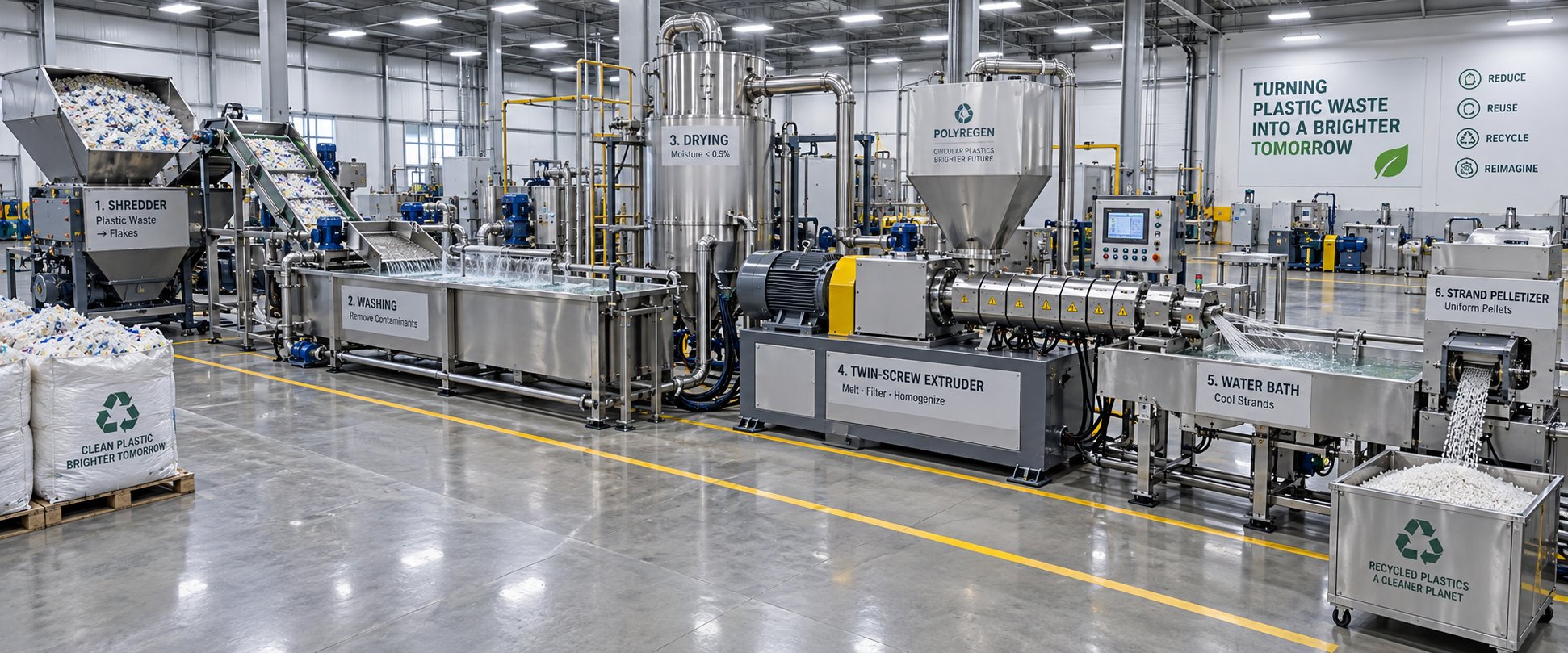
Building a Complete Plastic Recycling Extrusion Line
A plastic recycling extruder machine sitting in isolation is just an expensive piece of metal. It cannot sort incoming bales, wash off adhesive residue, dry hygroscopic flakes, cut molten strands into pellets, or verify that those pellets meet a buyer's specifications. Every one of those tasks belongs to a different machine — and the extruder depends on all of them. Planning a complete recycling line means thinking in systems, not standalone purchases. Buy the extruder without sizing the dryer correctly, and you'll fight moisture-related bubbles on every run. Invest in a high-throughput twin-screw system but pair it with an undersized pelletizer, and your bottleneck simply moves downstream.
Whether you are assembling a modest setup from small plastic extruders for sale on the secondhand market, piecing together used filament extrusion lines, or specifying a turnkey industrial system, the logic is the same: map the complete material flow from raw bale to bagged pellet, then size every component to match the weakest link you can afford to accept.
Essential Upstream Equipment for Feed Preparation
Everything that happens before plastic enters the barrel determines how smoothly the extruder runs and how clean the output looks. Upstream equipment transforms chaotic waste into a uniform, dry, contaminant-free feedstock — and skipping any stage shifts the burden onto filtration screens, degassing vents, and ultimately product quality.
A well-planned upstream section includes:
- Sorting stations — Manual sorting tables for small operations, or near-infrared (NIR) optical sorters and density separation tanks for industrial lines. Accurate sorting by resin type prevents the cross-contamination problems that no amount of downstream processing can fix.
- Washing systems — Cold-wash tanks for lightly soiled post-industrial scrap, hot-wash systems with caustic solutions for post-consumer bottles covered in labels and adhesive, and friction washers for cost-effective mechanical scrubbing. Multi-stage washing lines combine all three methods in sequence for heavily contaminated streams.
- Shredders and granulators — Single-shaft shredders handle bulky items and initial size reduction, while granulators produce the consistent 8-12 mm flake size that most extruder feed zones expect. Choosing the right cutting geometry and screen size ensures uniform particle distribution and prevents the bridging and starving issues discussed in the troubleshooting section.
- Drying systems — The type of dryer must match the polymer. Dehumidifying dryers are essential for hygroscopic resins like PET and nylon, delivering dew-point-controlled air that strips moisture down to below 50 ppm. Simpler hot-air dryers handle non-hygroscopic polyolefins like HDPE and PP effectively at lower cost. As Conair's extrusion processing guide points out, consistent drying also "homogenizes" the feedstock temperature — eliminating the seasonal variations that occur when material sits in cold winter warehouses or sweltering summer silos — which stabilizes extruder output year-round.
- Feeding and blending equipment — Gravimetric feeders weigh and dose material into the hopper at a controlled rate, preventing the surge-and-starve cycles that cause output pulsation. Blenders add virgin resin, colorant, or stabilizers in precise ratios when the recycled stream needs property enhancement before extrusion.
Each upstream component must be sized to at least match the extruder's maximum throughput. An extruder machine for plastic recycling rated at 500 kg/hr needs a washing line, dryer, and shredder that can each sustain that rate without becoming a bottleneck. In practice, experienced line planners oversize upstream equipment by 10-20% to absorb the variability inherent in recycled feedstock streams.
Downstream Systems for Pelletizing and Finishing
Downstream processing begins the moment molten polymer exits the die. The equipment here shapes, cools, cuts, and inspects the extrudate — transforming a continuous stream of hot melt into a saleable product. Missing or mismatched downstream components are just as damaging as upstream gaps: a perfectly homogeneous melt means nothing if the pelletizer chops it into inconsistent granules or the cooling system leaves voids inside every pellet.
Core downstream equipment categories include:
- Melt filtration and screen changers — Positioned between the extruder barrel and the die, these systems remove solid contaminants — paper fiber, metal fragments, un-melted particles, and degraded polymer — from the melt stream. Manual slide-plate changers work for clean streams but require production stops. Continuous rotary or backflush screen changers maintain constant melt pressure and eliminate downtime for contaminated post-consumer feedstock.
- Pelletizers — The three main technologies each suit different scales and polymers. Strand pelletizers offer the lowest entry cost: extruded strands pass through a water bath, solidify, and are chopped into cylindrical pellets. Water ring pelletizers cut at the die face using a spinning water curtain, producing lenticular pellets well-suited for polyolefins. Underwater pelletizers (UWP) cut in a pressurized water chamber, creating spherical pellets with residual moisture below 0.05% — the preferred format for high-throughput operations exceeding 1,500 kg/hr.
- Cooling systems — Water baths cool strand-cut extrudate before it reaches the pelletizer blade. Air-cooling conveyors handle heat-sensitive materials or applications where water contact is undesirable. For profile extrusion — including the output of a plastic pipe extrusion machine — vacuum sizing tanks and spray-cooling systems maintain the extrudate's shape as it solidifies over longer distances.
- Winders and spoolers — Filament lines replace the pelletizer with a precision puller and traverse winder that spools the extrudate onto reels. Consistent winding tension prevents the breakage and tangling problems that plague brittle recycled filament.
- Quality control instruments — Inline laser micrometers measure pellet or filament dimensions in real time. Melt flow index (MFI) testers verify batch-to-batch consistency. Color measurement devices detect discoloration that signals contamination or degradation. Together, these tools close the feedback loop between extruder settings and product specifications.
A plastic pipe extrusion machine line, for instance, adds calibration sleeves, haul-off caterpillar pullers, and automated saws downstream — equipment that a pelletizing operation would never need. The downstream configuration must mirror the end-use application, just as the extruder's screw design must match the polymer.
Selecting Screw Barrels Built for Recycling Demands
Among all the plastic extruder machines in a recycling line, the screw and barrel assembly is the component that most directly determines output quality, energy efficiency, and equipment lifespan. It is where raw plastic actually becomes a usable melt — and where the harshest demands of recycling converge. Abrasive fillers grind against barrel walls. Corrosive byproducts from PVC or flame-retardant compounds attack metal surfaces. Contaminated feedstock creates pressure spikes that stress mechanical tolerances. A barrel designed for virgin resin processing simply will not survive these conditions at the same rate.
Three factors separate a barrel that performs reliably in recycling from one that wears out prematurely:
- Metallurgy and wear protection — Recycled streams frequently contain glass fiber, mineral fillers, and abrasive grit that accelerate screw and barrel wear. Bimetallic barrel linings — typically iron-boron or nickel-based alloys — deliver significantly higher surface hardness than standard nitrided steel. For corrosive applications like PVC recycling, nickel-chromium-boron alloy linings resist chemical attack while maintaining dimensional stability over thousands of operating hours.
- Customization to polymer and process — A barrel optimized for HDPE pelletizing has different zone lengths, cooling channel placement, and vent port positioning than one designed for PET compounding. Off-the-shelf barrels force compromises; custom-engineered barrels eliminate them. This is especially critical in twin-screw systems, where the barrel must accommodate modular screw element configurations — conveying sections, kneading blocks, and degassing zones — that change based on the polymer, contamination level, and throughput target.
- Precision tolerances — The clearance between screw flight tips and barrel bore directly affects conveying efficiency, melt pressure stability, and energy consumption. Worn or loosely toleranced barrels allow melt to leak backward over screw flights, reducing output and causing the surging problems covered in the troubleshooting section. High-quality barrels maintain tight clearances that keep the extruder operating at peak efficiency for far longer between service intervals.
For operators running twin-screw recycling lines, barrel sourcing becomes a strategic decision rather than a commodity purchase. Specialists like NANHAIYA design custom parallel twin screw barrels specifically for recycling, compounding, pelletizing, and granulation applications — engineering the metallurgy, bore geometry, and wear protection to match the abrasive, contaminated feedstocks that recycling demands. Their focus on demanding mixing and conveying needs makes them directly relevant when standard barrels wear out too quickly or fail to deliver the melt consistency your downstream equipment requires.
Emerging trends are pushing barrel and line design further. Multi-layer contamination handling — processing laminates and composites that combine different polymers into a single product — requires aggressive filtration and compatibilizer dosing that only advanced twin-screw systems with high-quality barrels can sustain. Chemical recycling pre-processing, where mechanical extrusion is used to densify and homogenize feedstock before pyrolysis or depolymerization, is creating demand for extruder configurations that prioritize throughput and mixing intensity over traditional pellet quality metrics. And mixed-plastic extrusion approaches — blending otherwise incompatible polymers with reactive compatibilizers during extrusion — are expanding the range of waste streams that mechanical recycling can profitably address.
The throughline across all of these developments is the same: the recycling extruder is only as capable as the system surrounding it. Upstream equipment determines feedstock quality. Downstream equipment determines product form and value. And the screw barrel assembly — the heart of the entire line — translates everything that comes before it into everything that comes after. Getting that single component right, specified for your exact polymer, contamination profile, and throughput target, is the highest-leverage investment any recycling operator can make.
Frequently Asked Questions About Plastic Recycling Extruders
1. What is the difference between a single-screw and twin-screw plastic recycling extruder?
A single-screw recycling extruder uses one rotating screw and works best with clean, pre-sorted, single-polymer feedstock due to its simpler design and lower cost. A twin-screw extruder (typically co-rotating) uses two intermeshing, self-wiping screws that deliver superior mixing, multiple degassing ports, and modular barrel configurations. This makes twin-screw systems far better suited for contaminated, mixed-polymer, or post-consumer waste streams, as well as compounding recycled resin with stabilizers or virgin material. Specialists like NANHAIYA offer custom parallel twin screw barrels engineered for the abrasive, variable feedstocks common in recycling and pelletizing operations.
2. Can you make 3D printer filament from recycled plastic with a recycling extruder?
Yes, producing 3D printer filament from recycled plastic is one of the most popular applications for small-scale recycling extruders. However, filament production demands the tightest dimensional tolerances of any extrusion output — typically +/- 0.05 mm on a 1.75 mm diameter. Achieving this consistency from recycled feedstock requires a precision die, closed-loop laser diameter monitoring, a servo-driven puller, and uniform cooling. Blending 20-50% virgin pellets with recycled material often improves both diameter stability and print quality, especially with polymers like PLA that become brittle after reprocessing.
3. What types of plastic can be processed in a recycling extruder?
The most commonly recycled plastics include HDPE, LDPE, PP, PET, PS, ABS, and PVC. HDPE and LDPE are the most forgiving for beginners, offering wide processing windows and strong market demand for recycled pellets. PP requires tighter temperature control to avoid thermal degradation. PET demands thorough drying to below 50 ppm moisture to prevent hydrolytic chain scission. ABS recycles well with manageable quality loss over multiple cycles. PVC is the most challenging, requiring precise temperature control within a narrow window to avoid releasing toxic hydrogen chloride gas, plus corrosion-resistant barrel linings.
4. Why is pre-processing so important before using a plastic recycling extruder?
Inadequate pre-processing is the single leading cause of poor recycled output quality. Contaminants like paper labels char inside the barrel and produce black specks, adhesive residue creates sticky dead spots that degrade polymer, food residue decomposes and forms gas voids, and residual moisture causes bubbling and permanent hydrolytic damage in hygroscopic polymers. Proper sorting by resin type, thorough washing (cold, hot, or friction methods), shredding to a uniform 8-12 mm flake size, and drying to polymer-specific moisture targets are all essential before any material enters the extruder hopper.
5. How much does a plastic recycling extrusion line cost?
Costs vary dramatically by scale. DIY and desktop setups based on open-source designs like Precious Plastic can be built for under $5,000 in materials. Small-business and community-scale systems range from approximately $10,000 to $150,000 depending on throughput and configuration. Full industrial turnkey recycling lines run from roughly $150,000 to over $2,000,000 for equipment alone, with a practical rule of thumb to budget about twice the equipment price once infrastructure, installation, and commissioning are included. Well-run industrial plants typically achieve equipment payback within 18-36 months and net margins of 10-35%.
Written by
Nanhaiya Technical Team
Zhoushan Nanhaiya Plastic Machinery Co., Ltd.
The Nanhaiya technical team supports screw and barrel manufacturing projects through application review, technical communication, custom manufacturing coordination, and production and quality control.
Discuss Your Application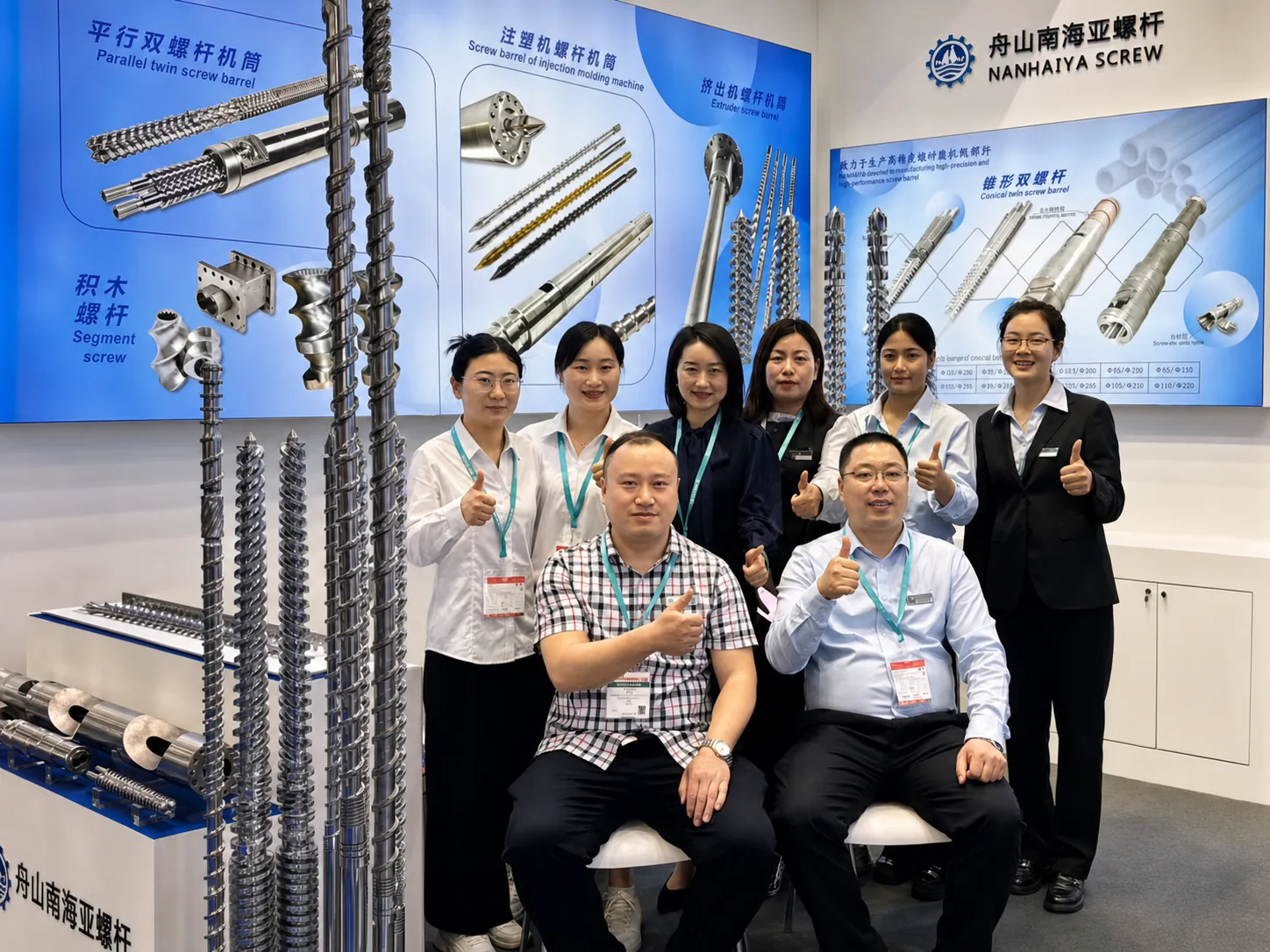
Related Articles
More insights on screw barrel technology and plastics processing.
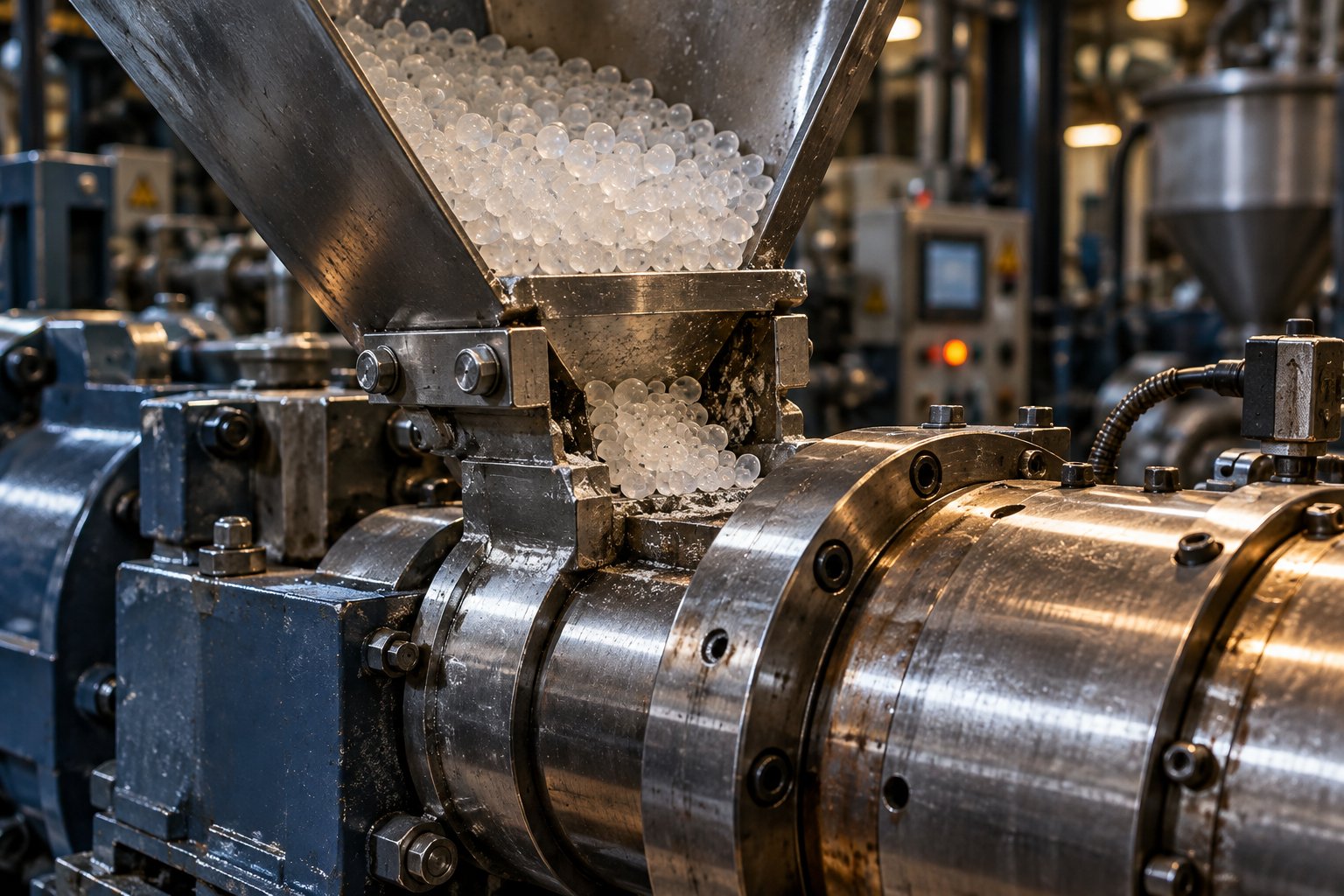
Your Extruder Feeding Instability Isn't Random — Here's Why
Oct 22, 2026
Extruder feeding instability causes surging output and scrap. Learn the 6 root causes, polymer-specific fixes, wear diagnostics, and preventive protocols.
Read Article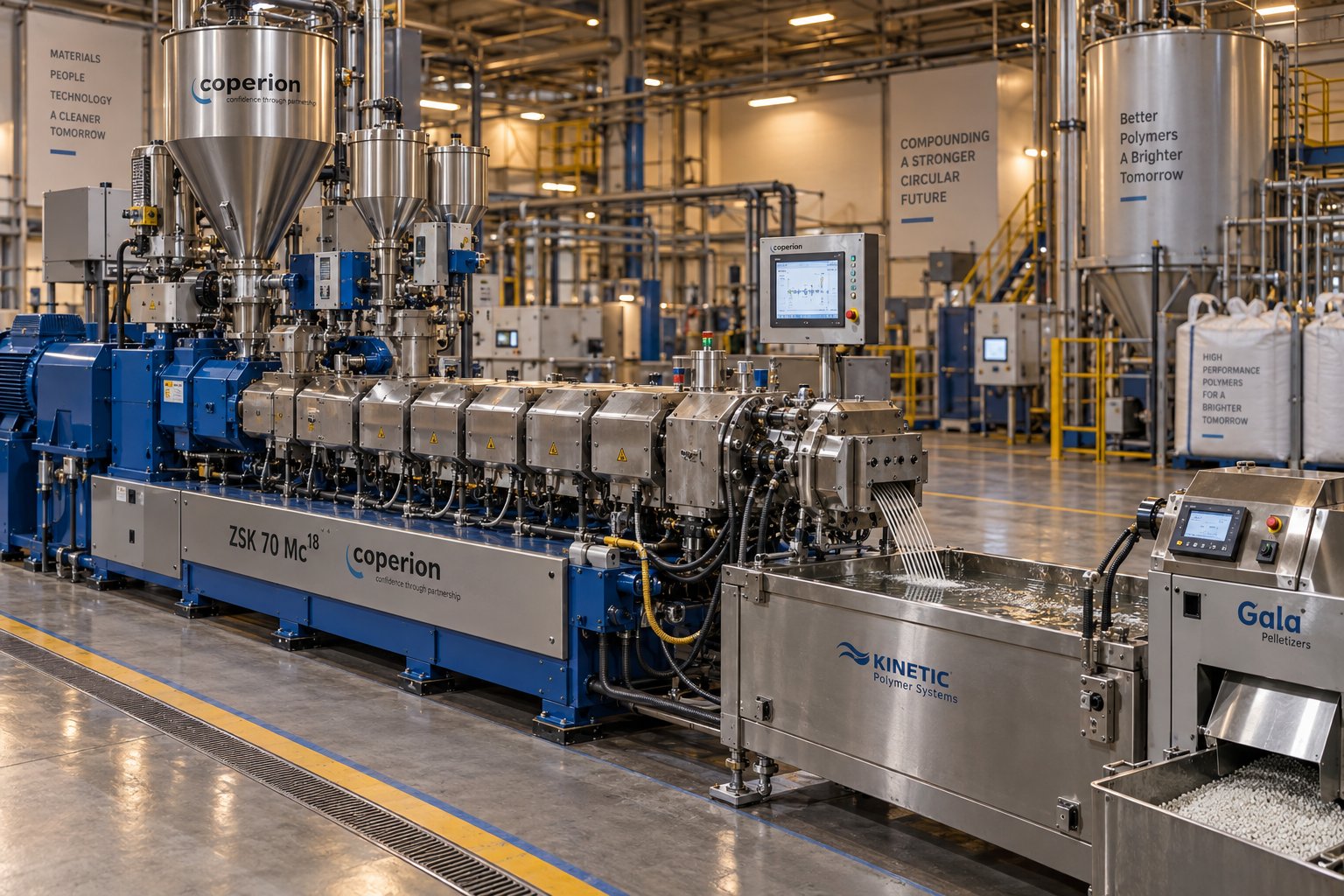
Parallel Twin Screw Extruder for Compounding Demystified: Lab to Line
Oct 21, 2026
Learn how a parallel twin screw extruder for compounding works—from screw element design and zone configuration to lab-to-production scale-up and process optimization.
Read Article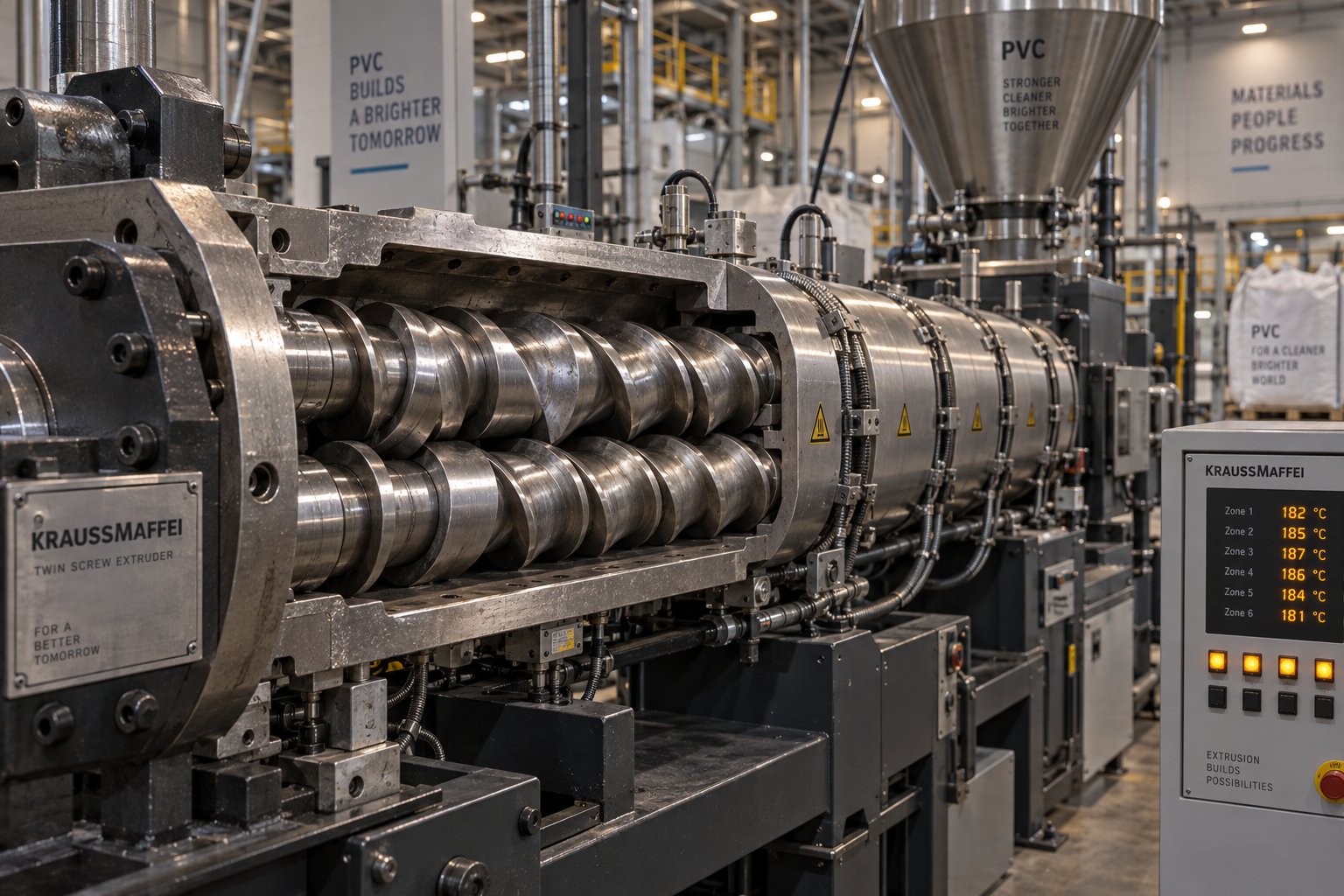
Twin Screw Extruder for PVC: The Setup Mistake Draining Profit
Oct 21, 2026
Learn how to match twin screw extruder configurations to PVC applications. Covers conical vs parallel, counter-rotating vs co-rotating, wear management, and troubleshooting.
Read ArticleLooking for something else?
Search by material, symptom or product and jump straight to the relevant page.
These are navigation suggestions based on keyword matching — not a quotation, not a delivery commitment, and not a substitute for engineering review. Final specification is confirmed by our engineers against your drawings and processed material.
Need help with screw barrel selection?
Share your machine model, processed material and application. Our team can help with pricing and technical support.