

What Is a Plastic Granulation Machine and Why It Matters
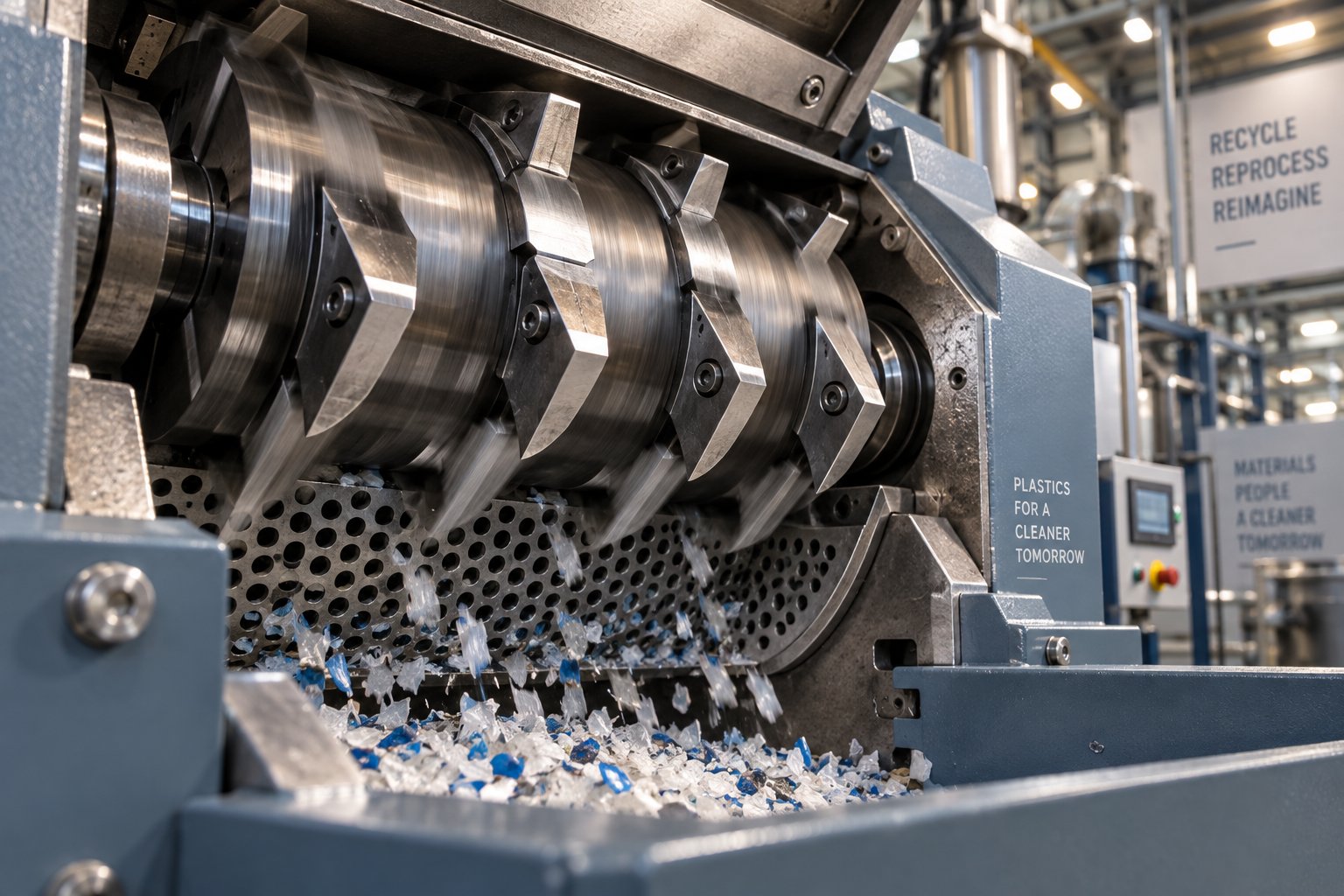
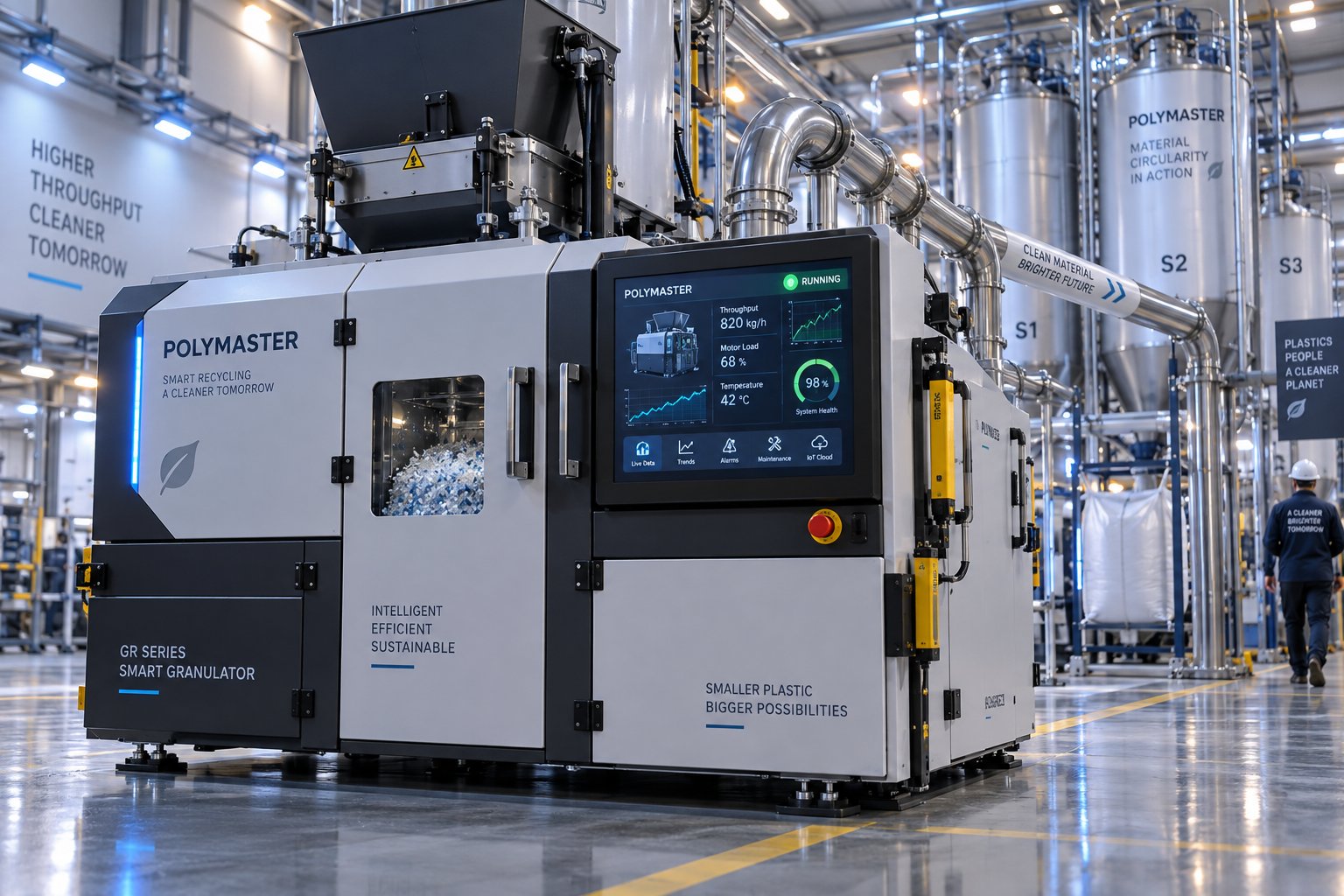
A plastic granulation machine is an industrial size-reduction system that converts plastic scrap, offcuts, rejected parts, and post-consumer waste into uniform granules—commonly called regrind—suitable for direct reprocessing. Think of it as the bridge between your waste bin and your production hopper. Instead of sending plastic to landfill, you feed it into a granulator and get back a reusable raw material that can re-enter the manufacturing cycle almost immediately.
These machines handle everything from small injection molding sprues to bulky blow-molded containers, and the output they produce can flow straight into extruders, injection molders, or compounding lines. That versatility is exactly why a plastic granulator machine has become standard equipment in virtually every plastics processing facility worldwide.
What a Plastic Granulation Machine Actually Does
The core mechanical action is surprisingly straightforward. A set of rotating knives mounted on a high-speed rotor shears incoming plastic against stationary bed knives fixed inside the cutting chamber. Imagine a pair of heavy-duty scissors operating at hundreds of RPM—material is drawn into the gap between the moving and fixed blades, and each pass cuts it into progressively smaller pieces.
Beneath the cutting chamber sits a perforated screen that acts as a gatekeeper. Only particles small enough to pass through the screen holes exit the machine. Everything else recirculates and gets cut again. The result? Consistently sized granules—typically ranging from 3 mm to 12 mm depending on screen selection—with a uniform shape that feeds predictably into downstream processing equipment. No melting, no extrusion, no chemical treatment. It is a purely mechanical cutting process.
Why Plastic Granulation Matters in Modern Manufacturing
You might wonder: why invest in a plastic granulating machine when you could simply buy fresh resin? The economics tell a compelling story. Virgin resin prices fluctuate with oil markets and supply chain disruptions, but regrind produced in-house costs a fraction of new material. Every kilogram of scrap you granulate and reuse is a kilogram you don't have to purchase—and don't have to pay to dispose of.
The environmental case is equally strong. Plastic granulation diverts waste from landfill and reduces the energy-intensive demand for virgin polymer production. For manufacturers facing tightening sustainability mandates and corporate ESG targets, closed-loop recycling through granulation is no longer optional—it is operational infrastructure.
Granulation sits at the single most critical junction in plastics manufacturing: the point where waste either becomes a cost burden heading to landfill or a recovered asset heading back to the production floor. Every other recycling step depends on this one working right.
This guide takes a vendor-neutral, purely educational approach. You won't find product pitches or brand rankings here. Instead, you'll get the practical, hands-on knowledge that equipment suppliers rarely share—from blade metallurgy and cutting geometry to material-specific machine configurations and the real economics of granulation. The kind of detail that helps you make smarter purchasing and operational decisions, regardless of which manufacturer you choose.
Of course, understanding what a granulator does only gets you halfway. The real confusion starts when you try to distinguish granulation from shredding, grinding, and pelletizing—terms that the industry uses loosely and often interchangeably.
Granulation vs. Shredding, Grinding, and Pelletizing
Here's a scenario you've probably encountered: a supplier describes their machine as a "granulator," another calls a nearly identical unit a "plastic crusher," and a third labels theirs a "grinder." Are these the same thing? Not exactly. And confusing them can lead to purchasing the wrong equipment entirely. Let's cut through the noise.
Granulation vs. Shredding and Grinding
The easiest way to separate these processes is by speed, torque, and output precision. A granulator operates at high rotor speeds—typically 400 to 500 RPM—with relatively low torque, using sharp rotary knives to slice material into precisely sized particles controlled by a screen. A shredder, by contrast, runs at much lower speeds (around 100 to 130 RPM) but delivers far higher torque, designed to rip and tear through bulky, heavy, or mixed-material loads. Shredders perform coarse primary size reduction; a granulator performs fine, controlled secondary reduction.
Where does grinding fit? In the plastics industry, "grinding" and "granulating" are used almost interchangeably—both describe high-speed rotary cutting against stationary bed knives. This is completely different from metal-industry grinding, which uses abrasive wheels. Rapid grinders are essentially compact, high-speed granulators optimized for quick material turnaround beside processing machines. Similarly, a plastic crusher is typically just another trade name for a small- to mid-size granulator, even though the word "crush" implies compression rather than cutting.
Think of it as a spectrum: shredders handle the rough breakdown, while granulators and rapid grinders deliver the precision sizing that downstream equipment actually requires.
Granulation vs. Pelletizing and Compounding
This is where the most consequential mix-ups happen. A granulator cuts solid plastic into irregular flakes or granules—no heat involved, no melting, no extrusion. A pelletizer melts processed plastic and cuts it into uniform pellets, typically 2 to 5 mm in diameter, with consistent shape and density. Pelletizing is a thermal process; granulation is purely mechanical.
Compounding adds another layer. During compounding, additives like colorants, fillers, UV stabilizers, or flame retardants are blended into molten resin using a twin-screw extruder, and the resulting compound is pelletized at the end. So compounding is really melt-extrusion-pelletizing with a formulation step built in.
Why does this distinction matter? Because granules and pellets behave very differently in downstream equipment. Granules have irregular shapes and variable bulk density, which affects feeding consistency. Pellets are uniform, free-flowing, and predictable. If your end customer or your own process demands pellet-grade feedstock, a granulator alone won't get you there—you'll need a pelletizing line downstream.
| Dimension | Granulation | Shredding | Pelletizing | Compounding |
|---|---|---|---|---|
| Input Material State | Solid plastic scrap | Bulky solid waste | Granules or molten plastic | Resin + additives |
| Mechanism | High-speed rotary cutting | Low-speed, high-torque tearing | Melting, extrusion, die cutting | Melt mixing + extrusion + die cutting |
| Output Shape | Irregular flakes/granules | Coarse, irregular chunks | Uniform cylindrical or spherical pellets | Uniform pellets (with additives) |
| Output Size Range | 2 - 12 mm | 20 - 100+ mm | 2 - 5 mm | 2 - 5 mm |
| Heat Applied? | No (mechanical only) | No (mechanical only) | Yes (melting required) | Yes (melting + mixing required) |
Getting these definitions straight isn't just academic. It shapes every decision downstream—from what equipment you actually need to buy, to how you spec your production line, to whether your regrind will perform reliably in the final product. And that performance starts inside the cutting chamber itself, where the real engineering of the granulation process unfolds.
How the Plastic Granulation Process Works Step by Step
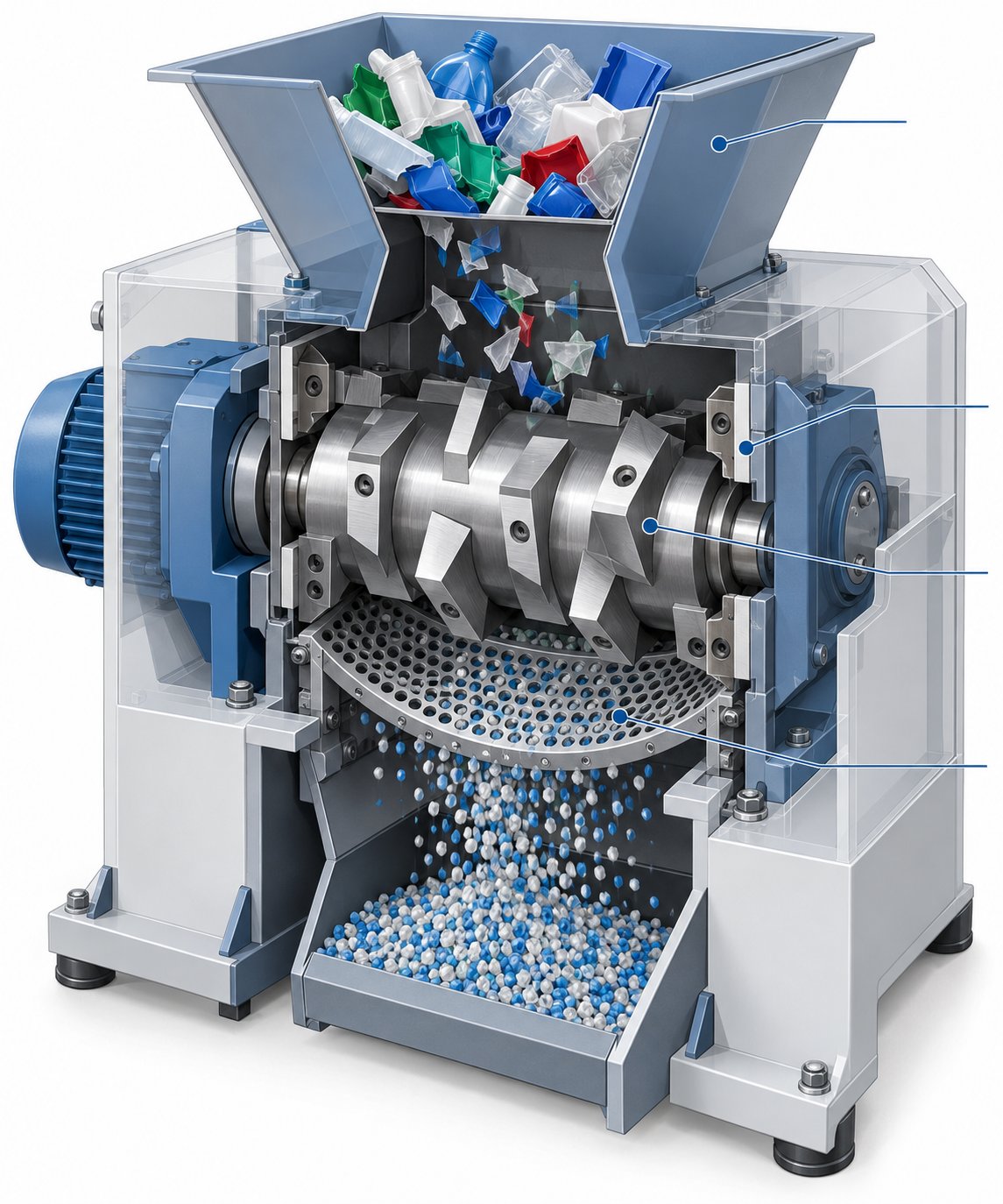
Picture the inside of a plastics granulator during operation. Scrap enters one end as bulky offcuts, runners, or rejected parts. Seconds later, precisely sized granules exit the other end, ready to be fed straight back into production. What happens in between involves a carefully engineered sequence of mechanical stages—each one influencing the quality, consistency, and throughput of your regrind. Surprisingly few suppliers walk you through this process in detail. Here's exactly how it works.
- Material feeding — Scrap enters the cutting chamber through a hopper or conveyor system.
- Primary cutting — Rotating knives shear material against stationary bed knives.
- Recirculation and secondary cutting — Oversized pieces remain in the chamber for additional passes.
- Screen classification — A perforated plate permits only correctly sized granules to exit.
- Discharge and collection — Finished regrind is conveyed to storage or directly to processing equipment.
Each stage has its own engineering considerations, and getting even one wrong creates problems that cascade through the entire line. Let's break them down.
Material Feeding and Infeed Design
Everything starts at the feed throat—and this is where many granulation problems actually originate, long before a blade ever touches the material. A granulator machine for plastic typically uses one of two feeding configurations: hopper-fed or conveyor-fed.
Hopper-fed systems rely on gravity. An operator or upstream conveyor drops scrap into an open hopper positioned above the cutting chamber. This approach works well for rigid parts like sprues, runners, and small reject components that tumble freely. Conveyor-fed configurations, on the other hand, use a horizontal or inclined belt to meter material into the feed throat at a controlled rate. You'll find these on thermoforming lines and film recycling setups where continuous, even feeding prevents the surges that cause motor overloads.
Here's a detail most suppliers gloss over: the angle and geometry of the feed throat have a direct impact on throughput. A steep, narrow throat can cause "bridging"—where pieces wedge against each other and block the opening, starving the rotor below. This happens most often with irregularly shaped rigid parts that interlock like puzzle pieces. A wider throat angle alleviates bridging but may allow material to sit passively without engaging the rotor.
Material type dictates feed throat design more than most buyers realize. Rigid plastics—think ABS housings, polycarbonate sheets, or thick-walled pipe sections—benefit from angled chutes that use gravity to drive parts into the cutting zone. Flexible materials like PE film or thin PP sheet create a completely different challenge. They tend to fold, bunch up, and resist sliding into the chamber, which is why film-specific plastic granulating machines use roll-feed mechanisms or nip rollers that grip the material and push it positively into the rotor path. Without that forced engagement, flexible scrap simply floats above the blades and never gets cut.
Cutting Chamber Mechanics and Screening
The cutting chamber is where the real work happens, and the precision here determines everything about your output quality. Inside the chamber, a rotor spins at high speed—typically 400 to 500 RPM, though some models reach up to 1,460 RPM—carrying multiple rotating knives bolted along its length. These rotating knives pass against one or more stationary bed knives (also called dead knives or anvils) mounted to the chamber walls, with a gap between them measured in fractions of a millimeter.
That gap is critical. Too wide, and material gets torn rather than cut—producing ragged particles, excessive fines, and angel hair. Too narrow, and the blades risk contact, generating sparks, damaging cutting edges, and creating a serious safety hazard. Proper gap setting is the single most overlooked maintenance task in granulation, and it has an outsized effect on regrind quality.
Two distinct cutting actions are at play here. Shear cutting works like scissors: the rotating knife slides past the bed knife, and the material trapped between them is cleanly sliced. Impact reduction is more like a hammer strike—material is fractured by the force of a blade hitting it at speed. Most modern plastics granulators favor a scissor-cut design using an open rotor with staggered knives. Why? Staggered knife placement means only a small portion of the rotor engages material at any given instant. This decentralizes the working load, reduces cutting force peaks, lowers noise, draws less power, and—most importantly—produces cleaner cuts with fewer fines than a solid rotor that engages material across its full width simultaneously.
Beneath the cutting zone sits the screen, a perforated steel plate that acts as the granulator's quality control checkpoint. Screen holes typically range from 6 mm to 12 mm in diameter, though specialized applications may go smaller or larger. The principle is simple: material recirculates in the chamber, getting cut again and again, until individual particles are small enough to fall through the screen openings. Anything too large stays in the chamber for another pass.
What many operators don't appreciate is that hole diameter is not the same as maximum particle size. Thin, elongated flakes can orient themselves to slip through openings that are nominally smaller than the flake's longest dimension. That's why output quality must be verified by sieve analysis, not assumed from the screen specification alone. Screen open area—the ratio of total hole area to total screen surface—also matters significantly. Two screens with identical hole diameters but different hole patterns can yield very different throughput rates, because higher open area allows granules to exit faster and reduces the time material spends recirculating. Less recirculation means less heat buildup, fewer fines, and lower energy consumption per kilogram of regrind.
Granule Discharge and Collection
Once particles pass through the screen, they need to exit the machine and reach their destination—whether that's a storage bin, a blending station, or a processing machine's feed hopper. Three discharge methods dominate the industry.
Gravity discharge is the simplest. Granules fall through the screen into a collection bin positioned directly below the cutting chamber. You'll find this setup on smaller beside-the-press units where the regrind drops into a bin that an operator periodically empties or that feeds a vacuum loader. It is low-cost, reliable, and requires almost no maintenance.
Pneumatic conveying uses a blower to push or pull granules through ducting to a remote collection point. This is standard on central granulators that serve multiple processing machines. The regrind can travel tens of meters through pipes to reach a silo, a blending hopper, or a direct-feed system on an extruder. Pneumatic systems keep the production floor cleaner and allow flexible routing, but they introduce variables—air velocity must be tuned to avoid segregating fine particles from coarse ones during transport.
Integrated vacuum systems combine granulation and conveying into a single package. A vacuum pulls finished granules out of the collection chamber and delivers them directly to a downstream machine's hopper. This approach is popular in closed-loop injection molding cells, where regrind from sprues and runners needs to flow back into the molding machine with minimal operator intervention. It also helps contain dust, since the entire path from cutting chamber to feed hopper is enclosed under negative pressure.
Regardless of method, effective discharge depends on one easily overlooked factor: keeping the area beneath the screen clear. If granules accumulate and block screen openings from below, material backs up in the cutting chamber, residence time increases, heat builds, and fines spike. Routine checks of discharge flow—especially on vacuum systems where filters can clog—prevent a cascade of quality problems that appear to originate in the cutting chamber but actually start at the exit.
Understanding this five-stage sequence—feeding, primary cutting, recirculation, screen classification, and discharge—reveals something important. The granulation process isn't just about the blades. Every component, from feed throat geometry to screen open area to discharge airflow, shapes the final regrind quality. And the right configuration depends heavily on what type of granulator you're running and what application it serves.
Types of Plastic Granulators Organized by Application
Most supplier websites organize their machines by model number or product line. That's useful if you already know exactly what you need—but completely unhelpful when you're trying to figure out which category of granulator fits your specific operation. A more practical approach is to think about application first, then match the machine type to it. Three broad categories cover the vast majority of plastic granulators in use today, and each one exists because different manufacturing environments create fundamentally different scrap profiles.
Beside-the-Press and Central Granulators
Imagine an injection molding floor running twelve machines, each one producing runners, sprues, and the occasional reject part. You have two choices: collect all that scrap in bins and haul it to a central processing station, or granulate it right where it's generated.
Beside-the-press (BTP) granulators take the second approach. These compact units sit directly next to an injection molding or blow molding machine, regrinding scrap the moment it's produced. The regrind feeds back into the same machine's hopper—often blended with virgin resin at controlled ratios of 15% to 30%—creating a tight closed loop with virtually zero material waste. BTP units are typically smaller, quieter, and run on 5.5 to 18.5 kW motors with throughputs of 50 to 300 kg/h. Their low-speed operation (often 300 to 500 RPM) keeps noise manageable on a production floor where operators work nearby all shift.
Central granulators flip the equation. A single, larger machine serves multiple production lines from a centralized location. Conveyors or bins collect scrap from across the facility and deliver it to one high-capacity granulator, typically rated at 500 to 3,000 kg/h with motors ranging from 30 to 110 kW. You'll find central units in dedicated recycling operations, material recovery facilities, and large manufacturing plants where consolidating waste processing makes more logistical sense than scattering a dozen small machines across the floor.
The trade-off? BTP granulators keep material streams pure—each machine processes only the resin running on its paired molder. Central granulators sacrifice that material segregation in exchange for higher throughput and lower per-kilogram processing cost. Your choice depends on how tightly you need to control regrind composition versus how efficiently you need to handle volume.
Thermoforming Trim and Film Granulators
Thermoforming lines produce a continuous stream of skeletal waste—the leftover sheet after cups, trays, or blisters have been punched out. This scrap is lightweight, flexible, and arrives in an unbroken web moving at line speed. A standard granulator can't handle it. The material won't drop into a hopper by gravity; it tends to fold, bunch, and resist engagement with the rotor.
Thermoforming granulators solve this with specialized infeed systems. Roll-feed mechanisms grip the skeletal web and pull it into the cutting chamber at a controlled rate synchronized to the thermoforming line's output speed. Sensor-controlled feed rollers with torque regulation automatically adjust tension and speed to match the upstream line, preventing sagging or tearing of edge strips and maintaining consistent feed without traditional dancer rollers. These inline units process edge trim and sheet waste continuously, producing regrind that feeds directly back into the extruder producing the original sheet—a seamless closed loop.
Film granulators face similar challenges with thin-gauge PE and PP scrap. Anti-wrap rotor designs and tangential feed configurations prevent flexible material from winding around the shaft instead of being cut. Without these specialized features, film scrap turns a standard granulator into a maintenance headache within hours.
Heavy-Duty and Industrial Granulators
Some scrap doesn't cooperate with standard equipment. Thick-walled HDPE pipe sections, large blow-molded drums, rigid PVC profiles, automotive bumpers—these demand industrial granulators built for brute-force size reduction at scale. Reinforced rotor shafts, oversized bearings, and motors ranging from 75 to 150 kW (and beyond) define this category.
Feed system design separates industrial granulators from their lighter-duty counterparts. Tangential feed hoppers angle material into the rotor's cutting path rather than dropping it straight down, which helps engage heavy or oddly shaped parts more effectively. For particularly stubborn stock, hydraulic ram feeders physically push material into the cutting chamber, ensuring consistent engagement even with thick-walled pipe sections or dense lump purges that would simply sit in a gravity-fed hopper.
Heavy-duty rotor designs in these machines prioritize torque and durability over speed. Slower rotation at higher cutting force handles the mechanical demands of shearing through 10 mm or 15 mm wall thicknesses without stalling the motor. Blade materials step up accordingly—SKD-11 or carbide-tipped knives are standard rather than optional, because the abrasive loads and impact forces would destroy general-purpose D2 steel in a fraction of the expected service life.
| Dimension | Beside-the-Press | Thermoforming / Film | Heavy-Duty Industrial |
|---|---|---|---|
| Typical Throughput | 50 - 300 kg/h | 100 - 1,500 kg/h | 800 - 3,500 kg/h |
| Ideal Input Materials | Runners, sprues, small rejects | Skeletal waste, edge trim, thin film | Thick-wall pipe, drums, large rigid parts |
| Footprint | Compact (1 - 2 m²) | Inline, elongated (2 - 5 m²) | Large (8 - 12 m²) |
| Noise Profile | Low (designed for production floor) | Moderate (typically sound-insulated) | High (requires enclosure or isolation) |
| Common Applications | Injection molding, blow molding cells | Thermoforming lines, film extrusion | Pipe recycling, drum recovery, automotive |
Choosing the right category isn't about buying the biggest or most expensive machine—it's about matching the granulator's design intent to your actual scrap profile. A thermoforming operation that buys a heavy-duty industrial unit wastes capital and floor space. A pipe recycler that tries to run thick-walled HDPE through a beside-the-press model burns out motors and shreds blades. The application defines the machine, not the other way around.
Yet even within the right category, performance varies dramatically based on a factor that most buyers underestimate: the specific plastic material being processed. The same granulator configured perfectly for polypropylene may struggle badly with glass-filled nylon or stretch wrap—and the reasons go deeper than just blade hardness.
Matching Granulator Configuration to Plastic Material Type
Here's a question that separates experienced operators from first-time buyers: what plastic are you actually running? Because two facilities can purchase the exact same granulator model, and one gets perfect regrind while the other fights motor overloads, angel hair, and premature blade failure. The difference almost always comes down to material-to-machine matching—a subject that suppliers touch on briefly in spec sheets but rarely explain in useful detail.
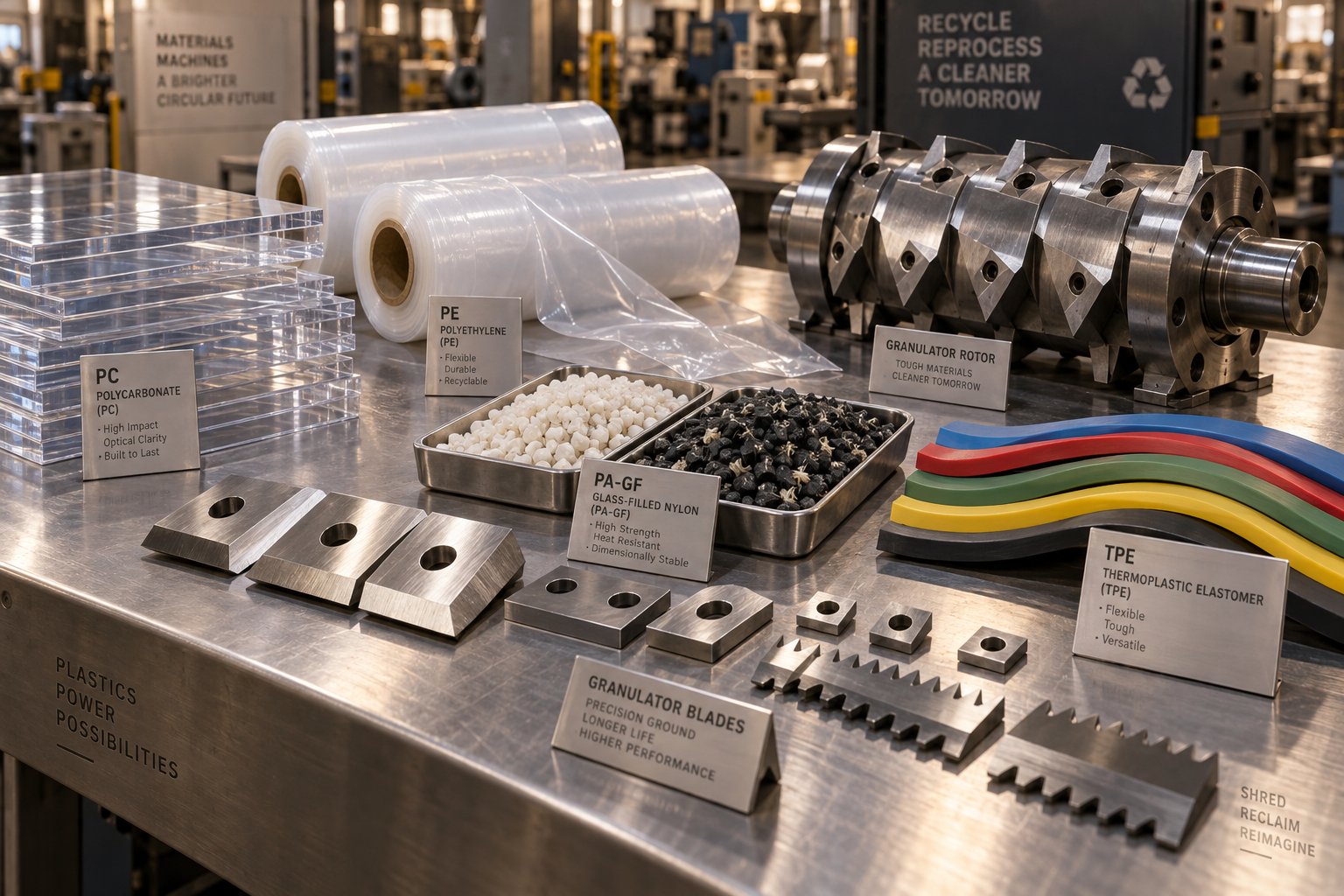
Every polymer family behaves differently under high-speed rotary cutting. Hardness, brittleness, melt temperature, abrasive filler content, flexibility, moisture sensitivity—each property demands specific adjustments to rotor design, blade material, screen sizing, and feed configuration. Get these wrong, and even the best industrial plastic granulator underperforms. Get them right, and a small plastic granulator punches well above its weight class.
Rigid Engineering Plastics and Filled Materials
Polycarbonate, ABS, nylon (PA6, PA66), and acetal are dense, hard thermoplastics that fracture cleanly under shear—which sounds ideal for granulation. And it is, provided the machine is built to handle the higher cutting forces these materials demand. Compared to softer polyolefins, engineering resins require more motor torque per kilogram of throughput and generate significantly more impact stress on blade edges.
The real challenge arrives when fillers enter the picture. Glass-fiber-reinforced nylon, mineral-filled polypropylene, and glass-loaded polycarbonate are brutally abrasive. Those tiny glass fibers act like sandpaper on every surface they contact—rotor knives, bed knives, screen plates, and chamber walls all wear at accelerated rates. Operators processing 30% glass-filled nylon routinely report blade resharpening intervals that are three to four times shorter than what they'd see on unfilled resin.
What does this mean in practice? For abrasive compounds, carbide-tipped blades last five to eight times longer than standard D2 tool steel. The upfront cost is significantly higher, but the math favors carbide overwhelmingly once you factor in reduced downtime for blade changes, fewer resharpening cycles, and more consistent cut quality over the blade's life. Chamber liners made from hardened or replaceable wear plates also extend service intervals in high-abrasion environments.
Rotor selection matters too. Heavy, closed-rotor designs deliver the inertia and cutting force needed for thick-walled engineering parts. Open rotors with staggered knives still work, but they need to be paired with robust drive motors—typically oversized by 20% to 30% relative to what you'd specify for polyolefin scrap of the same volume.
Flexible Films, Soft Compounds, and Elastomers
If rigid plastics are cooperative patients, flexible materials are the opposite. PE stretch film, PP woven bags, TPE compounds, and polyurethane foam all share a common trait: they resist clean cutting and actively fight the granulation process.
Imagine trying to cut a rubber band with dull scissors. It stretches, deforms, and slips away from the blade edge. That's essentially what happens when thin PE film enters a standard granulator. The material folds over itself, wraps around the rotor shaft, and creates a compacted mass that clogs the cutting chamber. Within minutes, the machine stalls. This is why dedicated film granulators use scissor-type rotor designs engineered specifically to prevent entanglement. The rotor geometry grips and shears flexible material instead of allowing it to ride along with the rotating knives.
Feed system modifications are equally critical. Tangential entry hoppers—where material enters the cutting chamber from the side rather than from above—use the rotor's rotation to pull flexible scrap into the cutting zone. Roll-feed or nip-roller systems physically grip film and push it into the blades, eliminating the reliance on gravity that simply doesn't work with lightweight, floppy materials. Without these specialized feeding mechanisms, granulators for plastics like LDPE or LLDPE film become expensive paperweights.
Soft elastomers like TPE and TPU present a slightly different problem. They're tough rather than brittle, absorbing cutting energy instead of fracturing. Sharp blades with aggressive rake angles help, along with screen holes sized slightly larger than what you'd use for rigid materials—giving the elastic particles room to pass through without deforming and plugging the openings.
Hygroscopic and Heat-Sensitive Resins
Some polymers demand careful handling not because of their mechanical properties, but because of their chemical sensitivities. PET and PVC are the two most common examples, and each presents a distinct set of risks during granulation.
PET is hygroscopic—it absorbs moisture from the surrounding air. Regrind that sits exposed in an open bin picks up water that causes hydrolytic degradation during subsequent reprocessing, leading to reduced intrinsic viscosity, weaker parts, and hazy surfaces. The granulation process itself generates heat through friction, and warm PET regrind absorbs moisture even faster. Best practice? Process PET regrind promptly, store it in sealed containers, and ensure it passes through proper drying before re-entering any melt process. Some operations also monitor for crystallization issues—PET regrind that partially crystallizes during storage changes in bulk density and melting behavior, complicating downstream feeding.
PVC raises an entirely different red flag. PVC can dehydrochlorinate under heat, releasing hydrogen chloride gas that is corrosive to equipment and hazardous to operators. While granulation is a cold, mechanical process, friction in the cutting chamber still generates localized heat—especially with dull blades or clogged screens that increase residence time. Adequate ventilation and dust extraction are non-negotiable when granulating PVC. Chamber components should be corrosion-resistant (stainless steel or specially coated surfaces), and operators need to be aware that even brief overheating events can trigger off-gassing. Mixing PVC with other resin streams—particularly PET—creates contamination problems that are extremely difficult to correct downstream.
| Material | Recommended Rotor Type | Blade Material | Screen Size Range | Special Considerations |
|---|---|---|---|---|
| PE (LDPE, HDPE) | Scissor-cut / anti-wrap rotor | D2 tool steel (HRC 58-62) | 8 - 12 mm | Film requires tangential feed or nip rollers; HDPE rigid parts suit standard rotors |
| PP | Open rotor, staggered knives | D2 tool steel | 6 - 10 mm | Brittle at low temperatures; film grades need anti-wrap features |
| PET | Open rotor, staggered knives | D2 tool steel or HSS | 6 - 10 mm | Hygroscopic—store regrind sealed; monitor for crystallization; dry before reprocessing |
| PVC | Open rotor, moderate speed | Stainless or coated D2 steel | 6 - 10 mm | Corrosive off-gassing risk; mandatory ventilation and dust extraction; avoid heat buildup |
| ABS | Open rotor, staggered knives | D2 tool steel | 6 - 8 mm | Generates dust; brittle fracture produces fines—use moderate rotor speed |
| PC (Polycarbonate) | Heavy-duty open rotor | D2 or HSS (HRC 60-62) | 6 - 8 mm | Very hard; high cutting forces; oversized motor recommended |
| Nylon (PA6/PA66) | Heavy-duty open or closed rotor | Carbide-tipped (if glass-filled) | 5 - 8 mm | Glass-filled grades are extremely abrasive; unfilled grades are hygroscopic |
| TPE / TPU | Scissor-cut rotor, sharp blades | HSS for edge retention | 8 - 12 mm | Elastic—resists clean cutting; use aggressive rake angles; avoid undersized screens |
This matrix isn't just a reference chart—it's a decision-making tool. Every column represents a variable that your granulator supplier should be asking about during the quoting process. If they're recommending a machine without discussing your specific resin types, filler content, and material form, you're likely getting a generic configuration that will underperform on your actual production scrap.
Material matching gets you the right machine configuration. But even a perfectly configured granulator degrades over time if the blades aren't properly selected, maintained, and replaced on schedule—a topic where most operators rely on guesswork rather than data.
Blade Types, Geometry, and Maintenance Best Practices
Ask two questions about any plastic granulator and you can predict most of its operating cost: what are the knives made of, and how does the rotor present them to the material? Motor horsepower grabs attention on a spec sheet, but a motor only supplies energy. What that energy does to your plastic—and how long the machine keeps doing it well—comes down to metallurgy and geometry. This is the knowledge that separates operators who chase problems from those who prevent them.
Blade Materials and Their Trade-Offs
Most buyers fixate on a single number: Rockwell hardness on the C scale (HRC). Hardness matters, but it describes resistance to indentation—not resistance to the specific abrasive wear that actually dulls a granulator blade. Cutting plastic filled with glass fiber, talc, or calcium carbonate is an abrasion problem, and the property that resists abrasion comes largely from hard carbides distributed through the steel, not from hardness alone.
D2 tool steel is the industry workhorse for good reason. This high-carbon, high-chromium cold-work steel reaches roughly HRC 55 to 62 after heat treatment, and its chromium-rich carbides deliver strong resistance to the sliding, abrasive wear that erodes cutting edges. The combination—hard enough to hold an edge, carbide-rich enough to resist abrasion, and affordable enough to resharpen many times—explains why D2 dominates across industrial cutting applications. The trade-off? D2 is only semi-stainless. Its chromium content provides more corrosion resistance than plain carbon steel but less than a true stainless grade, so wet granulation environments or humid feed stocks demand extra care to prevent pitting.
High-speed steel (HSS) offers a good general-purpose alternative. It provides slightly better toughness than D2, meaning it resists chipping on impact—useful when your feed stream occasionally hides metal fragments or hard contaminants. However, HSS wears faster than D2 on abrasive filled compounds, making it better suited for clean, unfilled resins and rapid granulators processing sprues and runners beside the press.
Carbide-tipped blades sit at the premium end of the spectrum. Brazed tungsten carbide inserts on the cutting edge deliver the longest service life on abrasive materials—glass-filled nylon, mineral-loaded polypropylene, and recycled post-consumer streams with contaminants. The catch? Carbide is brittle. A tramp metal impact that a D2 blade absorbs with a dull spot can crack or shatter a carbide tip entirely. They also cost significantly more per set, and resharpening requires specialized diamond grinding equipment. For heavily filled resins, though, the math almost always favors carbide: fewer blade changes, less downtime, and more consistent cut quality across the blade's extended life.
Blade Geometry and Cutting Angle Impact
Steel grade determines how long an edge lasts. Geometry determines how well that edge cuts in the first place. Two angles define the performance of every rotor knife: the rake angle and the clearance angle.
The rake angle is the slope of the blade face relative to the material being cut. A positive (aggressive) rake angle bites into plastic more easily, reducing cutting forces and power consumption—but it also produces a thinner, more fragile edge that dulls faster. A negative or neutral rake angle creates a sturdier edge that handles impact well but demands more motor power per cut. For a standard granulator for plastic processing clean polyolefins, a moderately positive rake angle delivers the best balance of clean cuts and reasonable blade life. For abrasive or impact-heavy feeds, a more neutral angle protects the edge.
The clearance angle prevents the blade's trailing surface from rubbing against freshly cut material. Too little clearance generates friction, heat, and smearing—especially problematic with low-melt-point resins that fuse back together in the cutting zone. Too much clearance weakens the cutting edge structurally.
Beyond individual blade angles, the arrangement of knives on the rotor transforms cutting performance. The scissor-cut principle—where staggered rotor knives engage the stationary bed knives progressively rather than simultaneously—is the single most important geometric feature in modern granulator design. Imagine closing a pair of scissors versus slamming a cleaver straight down. The scissors require far less force because only a small section of the blade contacts material at any moment. Staggered rotor knives work identically: they reduce peak cutting forces, lower noise, draw less motor amperage, and produce cleaner granules with fewer fines. This is why virtually every well-engineered plastic granulator uses staggered knife placement rather than straight-across configurations.
One more geometry detail that most operators overlook: the cutting gap between rotor and bed knives. Industry guidance puts a healthy gap in the 0.15 to 0.30 mm range. Let that gap drift past 0.5 mm, and blades tear plastic instead of shearing it—wasting motor energy while degrading regrind quality. A five-minute feeler-gauge check during routine maintenance protects both your power bill and your output consistency.
Sharpening Schedules and Replacement Economics
Even the best blade steel dulls eventually. The real question isn't whether to sharpen—it's when, how often, and at what point resharpening becomes more expensive than replacement. Most facilities, frankly, wait too long to act. Regrind quality degrades gradually, operators adapt to what they start treating as normal, and by the time someone generates a work order, the blades have been running dull for far longer than anyone realizes.
You don't need sophisticated monitoring to catch dull blades early. Watch for these warning signs:
- Increased fines percentage — Regrind contains noticeably more dust and undersized particles than baseline, indicating tearing rather than clean cutting.
- Rising motor amperage — Dull blades force the motor to work harder; a consistent climb above baseline draw is the most reliable early indicator.
- Elevated noise or vibration — A change in the machine's sound signature often signals edge degradation before visual inspection confirms it.
- Burning smell or excessive heat — Friction from dull edges generates localized heat that can degrade heat-sensitive resins in the cutting chamber.
- Visible chips or cracks on blade edges — Any physical damage demands immediate replacement, not resharpening.
- Oversized particles in the regrind — Material passing through the screen despite being larger than the hole diameter suggests blades are deforming rather than cutting particles cleanly.
For resharpening economics, calculate your cost-per-cut-hour. Take the total cost of a resharpening cycle—grinding service, shipping, labor for removal and reinstallation, plus production downtime—and divide it by the number of operating hours you get per sharpening. Compare that figure to the cost-per-cut-hour of a brand-new blade set amortized over its full service life. When resharpening costs approach 50% to 60% of new-blade cost-per-hour, you've hit the crossover point where replacement makes more financial sense.
A practical maintenance rhythm keeps you ahead of trouble. Check regrind quality and listen for unusual sounds every shift. Record motor amperage weekly against your baseline. Inspect and measure blade edges monthly—or more frequently on abrasive materials. And keep a log of resharpening intervals versus throughput data. Over time, that log becomes your most valuable maintenance tool, revealing the actual wear rate for your specific material mix rather than relying on a supplier's generic estimate.
Sharp blades and correct geometry are the foundation. But blade condition is only half the regrind quality equation—the other half is knowing what good output actually looks like and what to do when it suddenly doesn't.
Granule Quality Assessment and Troubleshooting Guide
What does "good regrind" actually look like? It sounds like a simple question, but most operators can't answer it with numbers. They eyeball a handful of granules, shrug, and send it downstream. That approach works until it doesn't—and when it fails, it fails expensively. Inconsistent regrind causes rejected parts, blocked feeders, density variations in finished products, and hours of troubleshooting that lead back to a granulation problem nobody was measuring. The fix starts with defining quality in measurable terms, then systematically eliminating the issues that degrade it.
What Defines High-Quality Regrind
Four metrics separate excellent plastic regrind quality from regrind that creates headaches downstream. Each one is measurable, and each one ties directly to how your granulator is configured and maintained.
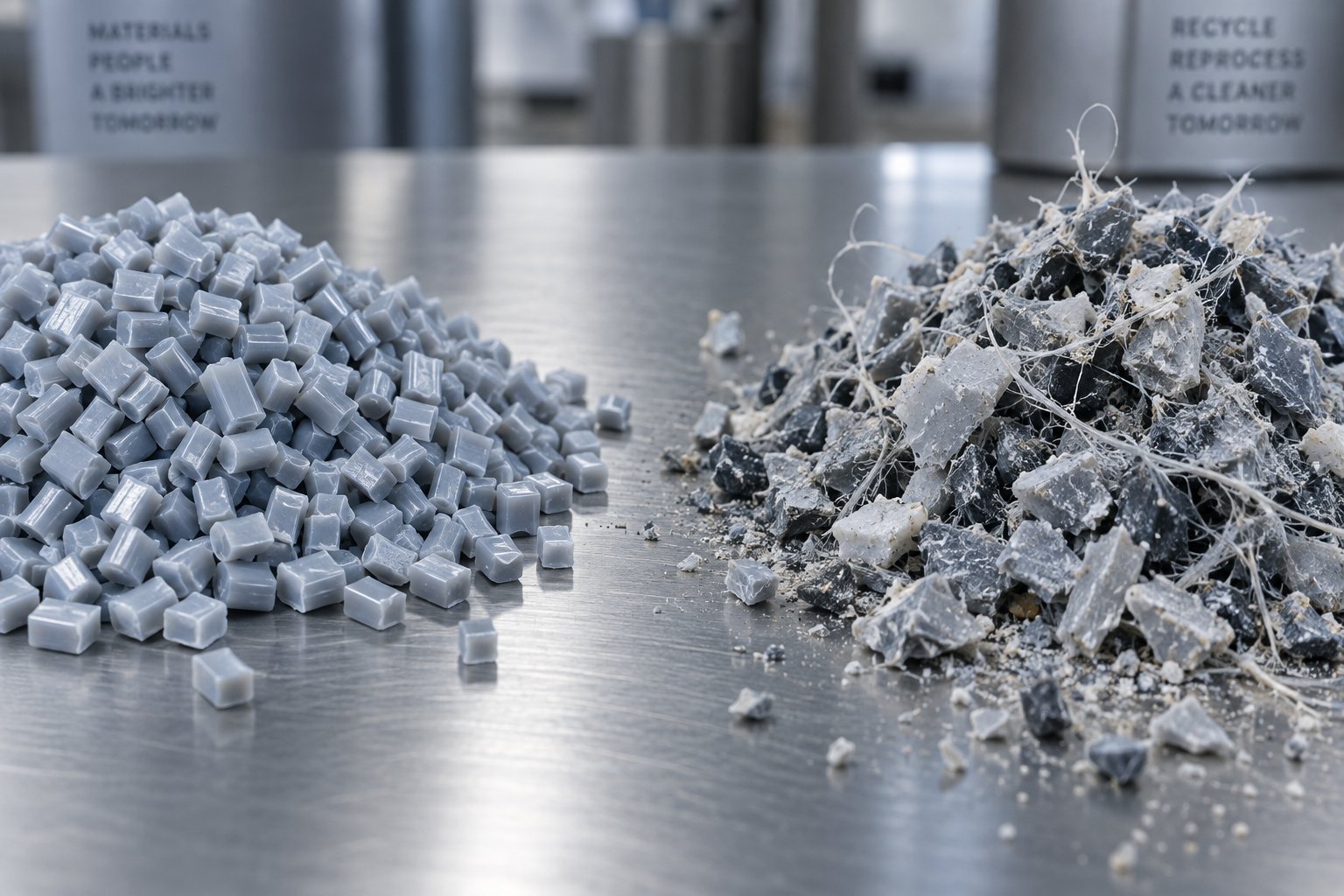
Particle size distribution (PSD) uniformity is the most important metric most facilities never formally track. A sieve analysis reveals the spread of particle sizes in your output—and the tighter that spread, the better your regrind feeds. A wide distribution means some particles are too large (causing bridging in hoppers and inconsistent metering) while others are too small (creating dust, air entrainment, and uneven melting). You want the majority of your granules falling within a narrow target band, typically defined by the screen hole diameter plus or minus 20%.
Fines ratio—the percentage of material passing through the smallest sieve in your test stack—tells you how much dust and powder your granulator is producing. Some fines are inevitable, but a ratio above 3% to 5% signals a problem: dull blades, incorrect screen sizing, excessive recirculation, or brittle material fracturing on impact rather than shearing cleanly. Fines are more than a nuisance. They bridge in feeders, entrain air in extruder barrels, melt at different rates than larger particles, and create surface defects in finished products.
Bulk density consistency matters because downstream equipment meters material by volume, not weight. If your regrind's bulk density shifts from batch to batch—because particle shape, size distribution, or fines content varies—the extruder or molder receives inconsistent mass flow even at constant volumetric feed rates. The result: wall thickness variations, short shots, and weight-out-of-spec rejects.
Absence of angel hair and streamers is the visual quality check that even casual operators can perform. Angel hair—those long, thin filaments of plastic clinging to granules—forms when material is smeared rather than cut cleanly. Streamers are longer, ribbon-like strands that didn't get fully severed. Both indicate blade dullness, excessive rotor-to-bed-knife gap, or material too flexible for the current machine configuration. They tangle in pneumatic conveying lines, clog filters, and wrap around feeder screws. If you're seeing angel hair, your blades or gap need attention immediately.
Here's the practical takeaway: plastic granulator machines don't produce bad regrind randomly. Every quality defect maps to a specific mechanical cause. And that's exactly what makes troubleshooting systematic rather than guesswork.
Troubleshooting the Most Common Granulation Problems
Every experienced operator has a mental list of things that go wrong. The challenge is connecting symptoms to root causes quickly, before a minor issue cascades into a production stoppage. Below are the six most common failure modes, along with what actually causes them and how to fix them. Most granulator manufacturers include none of this detail in their documentation.
- Excessive fines generation — This is the single most common complaint from operators. The most likely culprits are dull or chipped blades that tear material instead of shearing it cleanly, and screens with holes too small for the application, which force excessive recirculation and repeated recutting. Corrective action: inspect and sharpen or replace blades, verify the rotor-to-bed-knife gap is within spec (0.15 to 0.30 mm), and consider stepping up one screen size while monitoring whether the coarser output still meets downstream requirements.
- Uneven particle size (wide PSD) — When the output contains both oversized chunks and excessive fines simultaneously, the problem almost always traces to rotor-to-bed-knife gap inconsistency. If the gap is tight on one side of the chamber and loose on the other—due to uneven wear, improper blade shimming, or a rotor that's shifted on its bearings—the machine produces clean shear cuts in one zone and ragged tears in another. Corrective action: measure the gap at multiple points around the rotor circumference using a feeler gauge and re-shim to achieve uniform clearance.
- Motor overload and tripping — The motor's overload relay trips when current draw exceeds rated amperage for a sustained period. Common causes include overfeeding (pushing material into the chamber faster than the rotor can process it), material that's too thick or too hard for the machine's rating, a blinded or partially clogged screen that prevents granules from exiting, and severely dull blades that force the motor to work far harder per cut. Corrective action: reduce feed rate, verify material thickness is within machine specifications, inspect the screen for blinding, and check blade condition.
- Material wrapping around the rotor — This problem plagues operations processing PE film, PP strapping, TPE trim, and other flexible materials. Thin, pliable scrap rides along with the rotating knives instead of being cut, building up into a compacted mass that eventually stalls the machine. Corrective action: switch to a scissor-cut rotor design with anti-wrap features, install tangential feed entry or nip rollers, and ensure blades are razor-sharp—flexible materials require sharper edges than rigid ones to sever cleanly before they can wrap.
- Excessive heat generation in the cutting chamber — Heat comes from friction, and friction increases when blades are dull, the gap is excessive, ventilation is inadequate, or the machine is running too aggressively for the material type. Heat softens thermoplastics, causing smearing on screens and chamber walls, fusing granules together, and degrading heat-sensitive resins like PVC. Corrective action: sharpen or replace blades, verify gap settings, ensure the blower or ventilation system is operating at full capacity, and reduce rotor speed if the machine offers variable-speed drive.
- Jammed cutting chamber — Foreign objects—metal fragments, stones, wood, or fasteners embedded in scrap—are the most dangerous cause. A hard object wedging between rotor and bed knives can crack blades, damage the rotor, and create a serious safety hazard. Oversized parts that exceed the feed throat's capacity also cause jams when they lodge across the opening and prevent the rotor from engaging material. Corrective action: install a metal detector upstream of the granulator (this is the single highest-ROI protective measure), pre-sort or pre-shred oversized parts, and never force material into the feed hopper.
You'll notice a pattern across these failure modes: blade condition, gap setting, screen selection, and feed management account for the vast majority of granulation problems. These aren't random equipment failures—they're maintenance and setup issues. Systematic monitoring of motor amperage, regrind quality, and noise levels catches most of them before they escalate into downtime events.
Safety, Noise Reduction, and Dust Extraction
A plastic granulation machine spins sharp steel blades at hundreds of revolutions per minute inside a chamber designed to destroy anything fed into it. The safety implications are obvious, yet operator injuries and facility incidents still occur—often because safety systems were bypassed, poorly maintained, or never properly installed in the first place.
Start with the cutting chamber access points. Every access door—whether for blade inspection, screen changes, or clearing jams—must have an interlock that prevents the rotor from operating when the door is open and, critically, prevents the door from opening while the rotor is still spinning. Rotors carry substantial inertia and can continue revolving for several seconds after power is cut. A door interlock with a time-delay release—or one that senses actual rotor stoppage rather than simply responding to the power-off signal—provides a meaningful safety margin. Guarded feed hoppers with extended throats prevent operators from reaching into the cutting zone during feeding, even involuntarily if they slip.
Noise is the chronic hazard that gets less attention than it deserves. A plastics granulator can easily exceed 85 dB(A)—the threshold above which prolonged exposure causes permanent hearing damage. Heavy-duty industrial units processing thick-walled parts can reach 100 dB(A) or more. Sound-dampening enclosures, isolation mounting to prevent vibration transmission to the floor, and acoustic baffles around the feed throat are standard solutions. On a production floor where operators work an entire shift near a running granulator, noise reduction isn't a comfort feature—it's a compliance requirement under workplace health regulations.
Proper dust extraction on a plastic granulation machine is not optional. Plastic dust is both a respiratory hazard capable of causing occupational lung disease and a combustion hazard that, at sufficient airborne concentration, can ignite explosively.
Integrated dust extraction systems pull fine airborne particles away from the cutting chamber and the discharge point, routing them through filters or cyclone separators before exhausting clean air. The system must be sized to maintain adequate negative pressure throughout the granulator's operating range—undersized extraction allows dust to escape into the workspace during peak throughput periods. Filters require regular cleaning or replacement; a clogged filter degrades extraction efficiency gradually, and the decline often goes unnoticed until dust accumulation becomes visible.
For PVC and other resins that release irritating or corrosive fumes when heated by friction, extraction becomes doubly important. The system must handle both particulate and gaseous contaminants, and ducting materials need to resist chemical attack. These aren't optional upgrades—they're fundamental to safe, compliant operation.
Safety, noise, and dust management share a common trait with everything covered in this chapter: they're invisible when done right and catastrophic when neglected. The same principle applies to how your granulator connects to the equipment surrounding it—the upstream machines that prepare material before it reaches the cutting chamber, and the downstream systems that transform your regrind into finished products.
How Granulators Integrate Into Full Production Lines
A plastic granulation machine never operates in isolation. It sits in the middle of a chain—fed by equipment that prepares material for cutting and feeding equipment that turns regrind into finished products or market-ready pellets. Yet most buyers evaluate a granulator as if it exists in a vacuum, ignoring the upstream and downstream connections that ultimately determine whether the entire line runs smoothly or fights bottlenecks at every stage. Understanding the full system—from raw scrap intake to final pellet output—reveals where the real performance gains (and losses) hide.
Upstream Equipment and Material Preparation
What happens before plastic enters the granulator has an outsized impact on blade life, throughput consistency, and regrind quality. Think of upstream equipment as your granulator's immune system—it filters out threats and conditions material so the cutting chamber can do its job without interruption.
Conveyors are the starting point. Belt conveyors, drag-chain conveyors, or inclined systems transport scrap from collection points to the granulator's feed hopper at a controlled, consistent rate. Metered conveyor feeding prevents the surges that cause motor overloads—a problem discussed in the troubleshooting section that's far easier to prevent at the feed stage than to fix inside the cutting chamber. Variable-speed conveyor drives allow operators to match feed rate to the granulator's optimal throughput window, keeping amperage steady and blade engagement even.
Metal detectors represent the single highest-ROI upstream investment you can make. A stray bolt, a broken tool fragment, or a metal staple hidden inside a bale of scrap can crack a rotor knife, gouge a bed knife, or lock up the entire cutting chamber—resulting in thousands of dollars in blade replacements and hours of unplanned downtime. Conveyor belt metal detectors scan the material stream in real time, identifying ferrous and non-ferrous contaminants regardless of size, shape, or position within the flow. When metal is detected, an automatic rejection mechanism diverts the contaminated material to a separate bin before it ever reaches the granulator. On a plastic recycling granulator machine processing post-consumer waste—where tramp metal contamination is unpredictable and frequent—metal detection isn't optional equipment. It's blade insurance.
Pre-shredders step in when incoming material is too large or too bulky for the granulator to handle directly. Think thick-walled HDPE drums, full automotive bumpers, or baled film. A low-speed, high-torque shredder reduces these items to fist-sized chunks that the granulator can process efficiently. Without pre-shredding, oversized parts jam feed throats, stall rotors, and force operators into the dangerous habit of manually pushing material into the hopper.
Classifiers and sorting systems—including density separation, air classifiers, and optical sorters—address mixed-material streams. If your scrap contains multiple resin types, labels, or non-plastic contaminants, upstream sorting prevents cross-contamination that degrades regrind value and creates processing problems downstream. A minute of automated sorting saves hours of quality issues later.
Here's the bottom line on upstream preparation: every dollar invested in conveyors, metal detection, pre-shredding, and sorting multiplies into extended blade life, higher throughput, and cleaner regrind. Facilities that skimp on upstream equipment invariably spend more on blade replacements, motor repairs, and quality rejections than the upstream gear would have cost in the first place.
Downstream Processing and the Pelletizing Connection
Regrind exits the granulator as irregularly shaped particles with variable bulk density. That material needs to go somewhere—and where it goes determines how much value you extract from it. Three downstream pathways dominate the industry, each with its own equipment requirements and quality considerations.
Direct refeeding to molding machines is the simplest path. Regrind from a beside-the-press granulator flows into a gravimetric or volumetric blender mounted on the molding machine's feed throat. The blender mixes regrind with virgin resin at a controlled ratio—typically 15% to 30%—and feeds the blend directly into the barrel. This closed-loop approach minimizes material handling, eliminates intermediate storage, and keeps regrind moving from scrap to reuse in minutes. The key constraint? Regrind quality must be consistent. Variations in particle size or fines content cause feeding instability that shows up as short shots, splay marks, or dimensional inconsistency in molded parts.
Extrusion lines for pelletizing take regrind one step further. Instead of reusing granules directly, they're melted in an extruder, filtered through a screen changer to remove contaminants, and cut into uniform pellets at the die face. Pelletized regrind flows and feeds like virgin resin, making it suitable for sale to third parties or for use in applications where consistent pellet geometry is mandatory. The extrusion step also allows for degassing—removing trapped moisture and volatiles that would cause defects if the regrind went directly into a molder. As Plastics Technology details, both single-screw and twin-screw extruders serve this role, with the choice depending on mixing requirements, contamination levels, and throughput demands.
Compounding systems represent the highest-value downstream pathway. Here, regrind is blended with virgin resin, fillers, colorants, UV stabilizers, or reinforcing fibers in a twin-screw compounding extruder to produce engineered pellets with specific, targeted properties. This is where variable regrind characteristics become a serious engineering challenge. Unlike virgin pellets with predictable bulk density and uniform particle geometry, regrind arrives with inconsistent feed behavior—particles of different sizes, shapes, and densities that can cause uneven starve feeding, erratic melting, and poor dispersion of additives.
The twin screw barrels in compounding and pelletizing extruders bear the brunt of these challenges. They must handle the abrasive wear from filled regrind, resist corrosion from residual contaminants, and maintain the tight geometric tolerances that ensure consistent mixing and conveying performance. This is why barrel selection for regrind-processing lines demands more specificity than for virgin-resin applications. Specialists like NANHAIYA engineer custom parallel twin screw barrels purpose-built for these demanding conditions—designed to handle the variable feed characteristics, abrasive loads, and high-performance mixing requirements that recycling, pelletizing, and masterbatch applications impose. A barrel configured for processing clean virgin polyethylene simply won't survive the same number of operating hours when running abrasive, inconsistently sized post-consumer regrind through it.
Seeing how all these components connect in sequence clarifies why integration planning matters as much as individual machine selection. A typical production line from material intake through granulation to final pellet output follows this flow:
- Material intake and sorting — Incoming scrap is inspected, classified by resin type, and separated from non-plastic contaminants using manual sorting, density separation, or optical classifiers.
- Pre-shredding — Oversized or bulky items pass through a low-speed shredder for coarse size reduction to granulator-compatible dimensions.
- Metal detection and contaminant removal — Conveyor-mounted metal detectors scan the material stream and automatically reject metallic contaminants before they reach the granulator.
- Granulation — The plastic granulation machine reduces prepared scrap into uniformly sized regrind, controlled by screen selection and blade configuration.
- Regrind storage or blending — Granules are pneumatically conveyed to storage silos or blending stations, where they may be mixed with virgin resin at specified ratios.
- Extrusion and melt filtration — Regrind (or a regrind-virgin blend) feeds into a single- or twin-screw extruder, where it's melted, degassed, and filtered through a screen changer to remove residual particulate contamination.
- Pelletizing — The clean melt exits through a die and is cut into uniform pellets via strand, water-ring, or underwater pelletizing systems.
- Cooling, classification, and packaging — Pellets are cooled, passed over a vibrating sieve to remove fines and oversized particles, and conveyed to storage or bagging for distribution.
Every link in that chain affects the next. A weak metal detection setup upstream sends contaminants into the granulator, damaging blades. Poorly maintained blades produce inconsistent regrind that causes feeding problems in the extruder. An under-spec'd barrel in the extruder wears prematurely under abrasive regrind loads, degrading melt quality and pellet consistency. The lesson? Evaluating a granulator in isolation—without considering the upstream preparation and downstream processing equipment it connects to—is like buying an engine without checking whether it fits the chassis.
Integration planning also has a financial dimension that most equipment discussions overlook entirely. The capital cost of the granulator itself is often a fraction of the total line investment, and the real economics of granulation extend far beyond the purchase price into energy consumption, blade wear rates, labor, and long-term return on investment.
Economics, ROI, and the Future of Plastic Granulation
Equipment catalogs show you the purchase price. What they don't show you is the cost of actually running the machine—day after day, shift after shift, for years. And that running cost is where most granulation investments either pay for themselves handsomely or quietly bleed money that nobody tracks. Whether you're browsing a plastic granulator for sale from an OEM or evaluating a used plastic granulator from a reseller, the sticker price is the least important number in the equation. The numbers that actually matter live in your electricity bills, blade invoices, maintenance logs, and labor schedules.
Understanding the True Cost of Plastic Granulation
Five cost categories drive the total cost of ownership for any plastic granulation machine, and ignoring even one of them distorts your ROI calculation beyond usefulness.
Energy consumption per kilogram of throughput is typically the largest ongoing expense. A granulator's motor doesn't run at nameplate power—actual draw depends on material hardness, blade sharpness, feed rate, and screen sizing. A well-matched machine processing clean PE film might consume 0.05 to 0.10 kWh per kilogram, while an undersized unit struggling with thick-walled engineering plastics can draw 0.20 kWh/kg or more. Multiply that difference across hundreds of thousands of kilograms per year, and the energy penalty of a poorly matched granulator dwarfs any savings on the initial purchase.
Blade wear and resharpening costs are the second-largest variable. As covered in the blade maintenance section, resharpening intervals depend on material abrasiveness, blade metallurgy, and gap maintenance. Facilities processing glass-filled nylon might spend three to five times more on blades annually than those running unfilled polyolefins on identical equipment. Tracking cost-per-cut-hour—total blade cost divided by productive operating hours between changes—gives you the only honest metric for comparing blade economics across materials and machine configurations.
Labor for operation and maintenance includes not just the operator feeding the machine, but the maintenance technician changing blades, the forklift driver moving scrap, and the supervisor monitoring regrind quality. A thorough operating cost model accounts for sorting, material handling, supervision, and quality control labor—not just the person standing next to the granulator.
Capital depreciation spreads the purchase price across the machine's productive life. A well-maintained granulator can run reliably for 15 to 20 years, but only if the original sizing was correct. Here's a mistake that's far more common than suppliers admit: buying an undersized machine to save on capital cost. An undersized granulator runs at higher amperage relative to its rating, generates more heat, wears blades faster, and stresses bearings and motors beyond their design envelopes. The result is accelerated depreciation through premature component failure. Conversely, a dramatically oversized machine wastes capital and floor space on capacity you'll never use. The sweet spot is a machine sized 20% to 30% above your expected peak throughput—enough headroom to handle surges without running at the ragged edge of its rating.
Downtime costs are the hidden killer. Every hour the granulator sits idle for blade changes, jam clearing, or motor repairs is an hour your production line either runs without regrind (increasing virgin resin costs) or stops entirely if the granulator feeds a critical downstream process. Modeling realistic downtime—including planned maintenance, changeovers, cleaning, and unplanned failures—prevents the optimistic payback projections that lead to disappointed investors.
New vs. Used: When Does Each Make Financial Sense?
Searching for a used plastic granulator for sale is tempting, especially for startups or operations testing a new material stream before committing to full-scale investment. And there are legitimate scenarios where used equipment makes sense—but the decision requires honest cost analysis, not just a comparison of purchase prices.
A used plastic granulator typically costs 30% to 60% less than a comparable new unit. That's a real savings on day one. But consider what you're giving up: manufacturer warranty coverage, current-generation energy efficiency, known blade and bearing condition, and the ability to specify custom configurations for your exact material and throughput requirements. You're also inheriting an unknown maintenance history—previous owners may have deferred blade sharpening, run the machine on abrasive materials that wore the chamber beyond spec, or neglected bearing lubrication in ways that won't become apparent until months after purchase.
Used equipment makes the strongest financial case when you can verify the machine's service history, inspect blade and chamber condition before purchase, and the application involves clean, non-abrasive materials that don't demand tight tolerances. It also works well for backup or overflow capacity where the machine runs intermittently rather than continuously.
New equipment earns its premium when you're processing abrasive filled compounds, running 24/7 production schedules, need precise configuration for film or thermoforming applications, or require the energy efficiency gains of current motor and drive technology. The operating cost savings of an IE4-rated motor over an older IE2 equivalent can recover a meaningful portion of the price difference within two to three years on a machine running multiple shifts.
Refurbishment occupies the middle ground. A reputable rebuilder can restore a used granulator's cutting chamber, replace bearings and electrical components, and install new blades and screens at 50% to 70% of new-equipment cost. This approach works when the machine's fundamental construction—frame, rotor, and housing—is structurally sound and the model is still supported with replacement parts. It fails when the core components have worn beyond economical repair or when the machine's design is too outdated to accept modern controls and safety features.
Emerging Trends Reshaping Granulation Technology
Granulators have been conceptually unchanged for decades—rotating knives, stationary bed knives, perforated screens. But the technology surrounding that core mechanism is evolving rapidly, driven by energy costs, labor constraints, tighter workplace regulations, and the industry's broader shift toward precision-engineered, application-specific systems rather than generic off-the-shelf equipment.
Here are the innovations reshaping what a plastic granulation machine looks like—and how it performs—in modern operations:
- IE4/IE5 premium-efficiency motors — New motor efficiency classes reduce energy consumption by 5% to 15% compared to the IE2 motors still found on many machines in service. On a granulator running 6,000+ hours per year, the electricity savings alone can justify a motor upgrade within 18 to 24 months.
- IoT-enabled smart granulators — Sensors embedded in the motor, cutting chamber, and discharge system feed real-time data on amperage draw, vibration patterns, bearing temperature, and throughput volume to cloud-connected dashboards. Operators get early warning of blade dulling (rising amperage), bearing failure (vibration spikes), and screen blinding (throughput drop-off) before any of these issues cause unplanned downtime. Predictive maintenance replaces calendar-based guesswork.
- Low-noise enclosure designs — Tighter occupational noise regulations are pushing manufacturers toward fully enclosed, acoustically dampened housings that keep operating noise below 80 dB(A) even on heavy-duty machines. These enclosures integrate access doors with safety interlocks, maintaining both noise compliance and operator protection in a single system.
- Waterless cooling systems — Traditional cooling methods that use water to manage cutting-chamber heat are being replaced by air-cooled and heat-exchange designs that eliminate water consumption, reduce contamination risk, and simplify installation in facilities without industrial water infrastructure.
- Dust-free discharge solutions — Enclosed pneumatic conveying with integrated filtration at every transfer point prevents airborne plastic particulate from escaping into the workspace, addressing both respiratory safety and the combustible dust hazards that regulators increasingly enforce.
- Custom-engineered, application-specific wear components — The most significant shift may be the industry's move away from generic replacement parts toward components purpose-built for specific material and process demands. This extends well beyond granulator blades and screens into downstream equipment, where specialists like NANHAIYA engineer custom parallel twin screw barrels specifically designed for the demanding conditions of recycling, pelletizing, and compounding applications. Purpose-built barrels matched to regrind characteristics—variable bulk density, abrasive fillers, inconsistent feed geometry—deliver measurably longer service life and better mixing performance than universal-fit alternatives. This kind of specialization across every component in an integrated line represents where the industry is heading: precision-matched systems optimized for actual operating conditions rather than average-case assumptions.
These trends share a common thread. They all reduce the per-kilogram cost of converting plastic waste into reusable raw material—through lower energy use, less unplanned downtime, longer component life, and safer working environments that avoid regulatory penalties. For any operation evaluating a plastic granulator for sale today, the question isn't just what the machine costs to buy. It's what the machine costs to run over its entire productive life, how it connects to the equipment around it, and whether its technology will still be competitive five years from now.
The suppliers who share this level of detail with you are the ones worth doing business with. The ones who don't? That's what this guide was written to replace.
Frequently Asked Questions About Plastic Granulation Machines
1. What is the difference between a plastic granulator and a pelletizer?
A plastic granulator is a purely mechanical cutting machine that shears solid scrap into irregularly shaped granules using high-speed rotary knives and a sizing screen — no heat or melting is involved. A pelletizer, on the other hand, melts plastic in an extruder and pushes it through a die, then cuts the extruded strands into uniform cylindrical or spherical pellets. Granulation is a cold size-reduction step, while pelletizing is a thermal reshaping process. Many recycling lines use both in sequence: a granulator first reduces scrap to regrind, and then a pelletizing extruder — often equipped with custom-engineered parallel twin screw barrels from specialists like NANHAIYA — melts and reforms that regrind into consistent, market-ready pellets.
2. How do I choose the right granulator for my specific plastic material?
Material properties dictate every aspect of granulator configuration. Rigid engineering plastics like polycarbonate and glass-filled nylon demand heavy-duty rotors, carbide-tipped blades, and oversized motors to handle high cutting forces and abrasive wear. Flexible films such as LDPE and PP stretch wrap require scissor-cut anti-wrap rotors with tangential feed hoppers or nip rollers to prevent material from wrapping around the shaft. Heat-sensitive resins like PVC need moderate rotor speeds, corrosion-resistant chamber materials, and mandatory dust extraction to manage corrosive off-gassing. Always discuss your exact resin types, filler content, part thickness, and material form with the supplier before accepting a machine recommendation.
3. How often should plastic granulator blades be sharpened or replaced?
Sharpening frequency depends on the material being processed, blade metallurgy, and operating conditions. Rather than following a fixed calendar schedule, monitor key indicators: rising motor amperage above baseline, increased fines percentage in your regrind, elevated noise or vibration, and any visible chips or cracks on cutting edges. Calculate your cost-per-cut-hour by dividing total resharpening costs (including service, shipping, labor, and downtime) by productive hours per sharpening cycle. When that figure reaches 50% to 60% of the cost-per-cut-hour of new blades, replacement becomes more economical than continued resharpening. Keeping a detailed log of resharpening intervals against throughput data reveals your actual wear rate.
4. What causes excessive fines and dust in plastic granulator output?
Excessive fines — undersized particles and dust — typically trace back to a few root causes. Dull or chipped blades tear material instead of shearing it cleanly, generating ragged fragments. An incorrect rotor-to-bed-knife gap (wider than the recommended 0.15 to 0.30 mm) produces tearing instead of scissor-cut shearing. Screens with holes too small for the application force material to recirculate excessively, creating repeated recutting that breaks particles down further than necessary. Brittle resins like ABS may also fracture on impact rather than shear cleanly. Corrective steps include sharpening or replacing blades, re-shimming the cutting gap to uniform clearance, and testing one screen size larger while verifying downstream acceptability.
5. How does a plastic granulator integrate into a full recycling or production line?
A granulator sits at the center of an integrated processing chain. Upstream, conveyors deliver scrap at a metered rate, metal detectors protect blades from tramp metal, and pre-shredders reduce oversized items to manageable pieces. Downstream, regrind either feeds directly back into injection molding machines via blenders, enters single- or twin-screw extruders for pelletizing, or flows into compounding lines where it is mixed with virgin resin and additives. In compounding and pelletizing applications, the twin screw barrels must handle variable bulk density and abrasive regrind loads — which is why specialists like NANHAIYA engineer custom parallel twin screw barrels purpose-built for these demanding recycling conditions, delivering longer service life and better mixing than generic alternatives.
Written by
Nanhaiya Technical Team
Zhoushan Nanhaiya Plastic Machinery Co., Ltd.
The Nanhaiya technical team supports screw and barrel manufacturing projects through application review, technical communication, custom manufacturing coordination, and production and quality control.
Discuss Your Application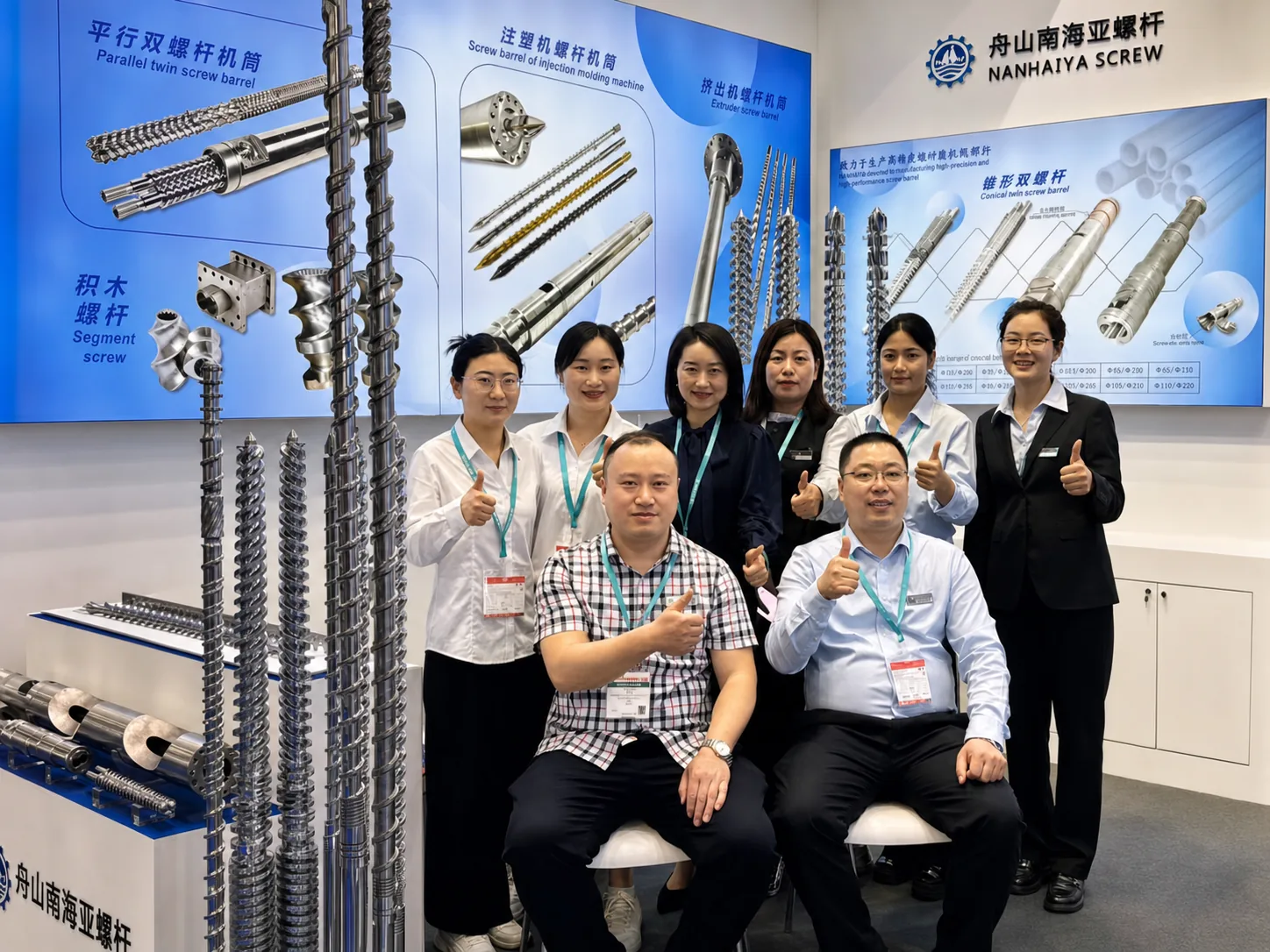
Related Articles
More insights on screw barrel technology and plastics processing.
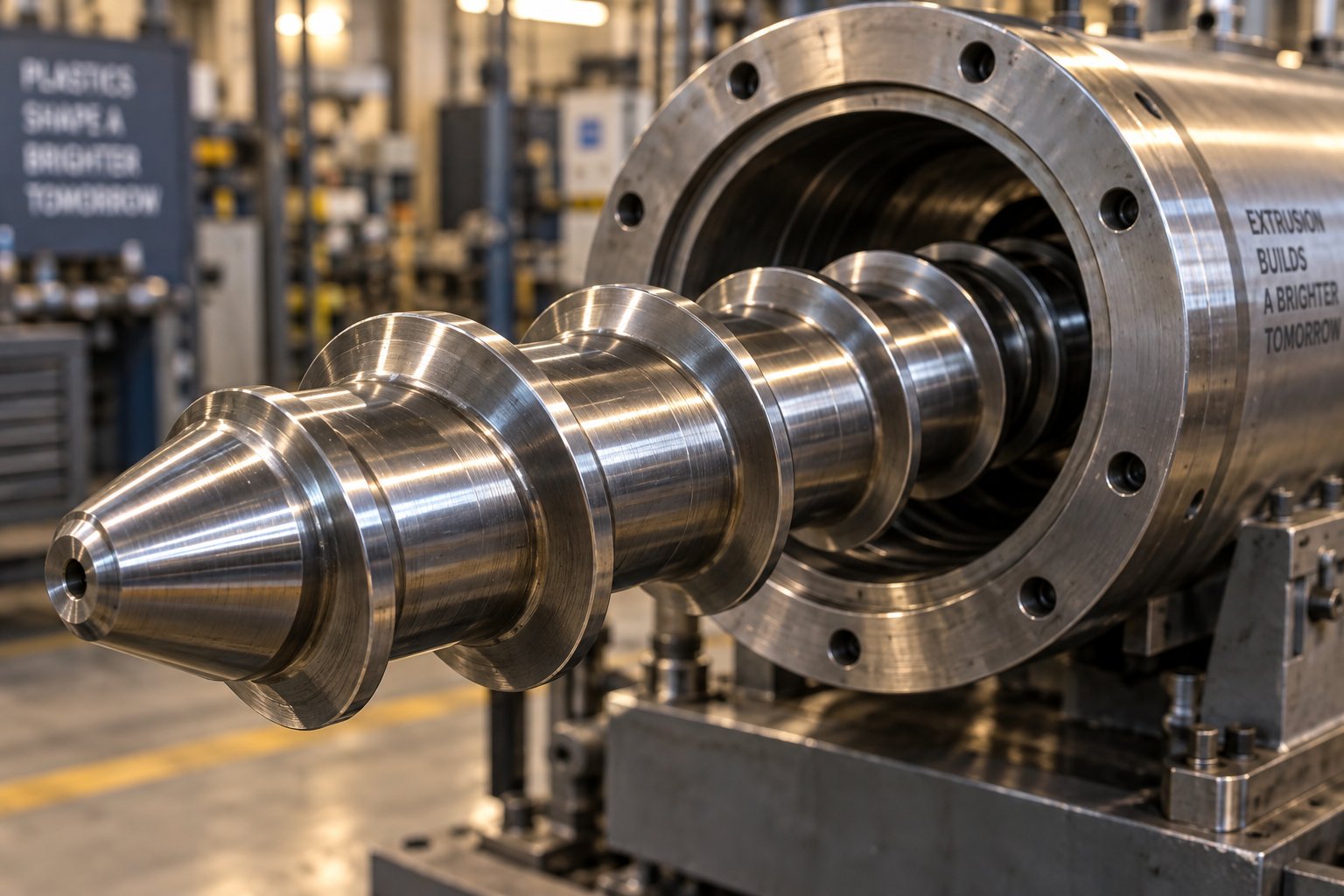
What Nobody Tells You About Screw Barrel For Plastic Machine Design
Oct 10, 2026
Learn how screw barrel for plastic machine design affects melt quality, throughput, and wear life. Covers geometry, resin matching, troubleshooting, and sourcing.
Read Article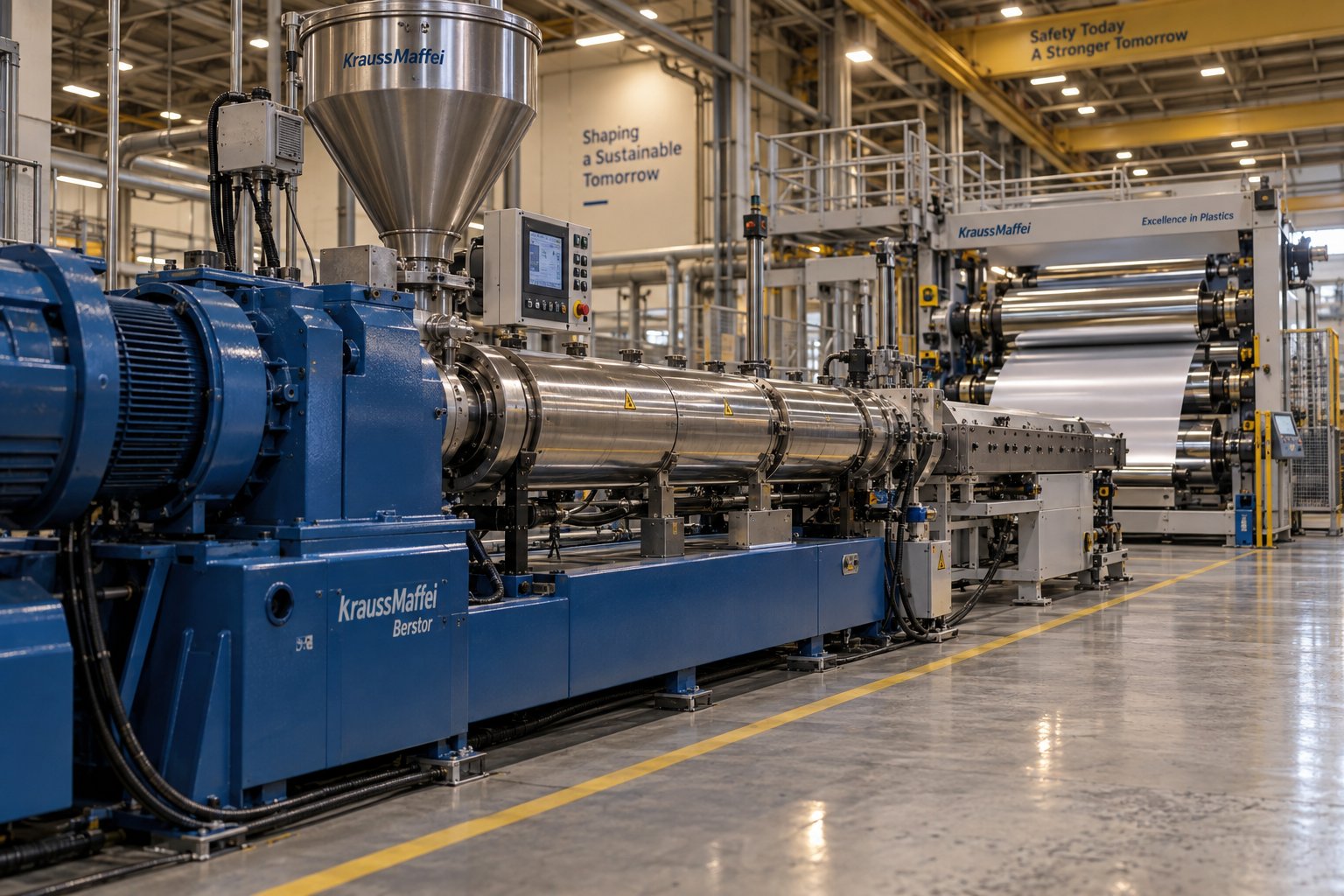
Single Screw Extruder for Sheet: Stop Guessing, Start Specifying
Oct 9, 2026
Learn how to specify a single screw extruder for sheet production. Covers screw geometry, resin-specific processing, troubleshooting, and maintenance best practices.
Read Article
PE Pipe Extruder Machine: What Datasheets Won't Tell You
Oct 9, 2026
Learn how a PE pipe extruder machine works, key specs explained, material grade selection, maintenance tips, and buyer guidance beyond the datasheet.
Read ArticleLooking for something else?
Search by material, symptom or product and jump straight to the relevant page.
These are navigation suggestions based on keyword matching — not a quotation, not a delivery commitment, and not a substitute for engineering review. Final specification is confirmed by our engineers against your drawings and processed material.
Need help with screw barrel selection?
Share your machine model, processed material and application. Our team can help with pricing and technical support.