

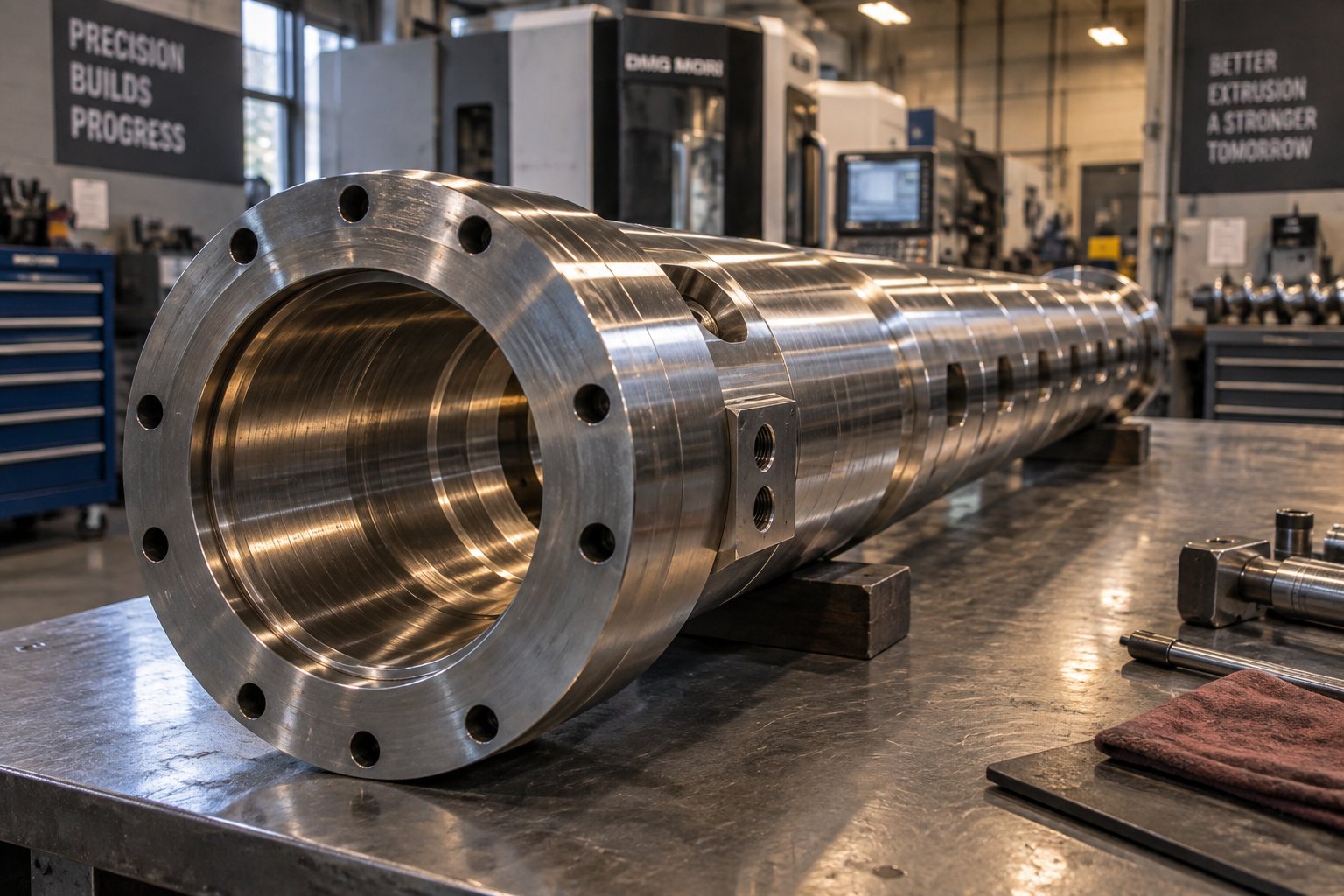
What a Plastic Extruder Barrel Manufacturer Actually Does
Imagine a steel cylinder engineered to tolerances tighter than a human hair, heated to hundreds of degrees, and expected to perform flawlessly for thousands of production hours. That cylinder is the extruder barrel, and the companies that build them sit at the very foundation of the plastics processing supply chain. A plastic extruder barrel manufacturer designs, machines, heat-treats, and precision-finishes the cylindrical housings that encase rotating screws in extrusion and injection molding equipment. Without these barrels, raw polymer pellets would never become the films, pipes, profiles, and molded parts the world depends on.
Defining the Extruder Barrel and Its Role in Plastics Processing
An extruder barrel is a heavy-walled, precision-bored cylindrical housing that provides a controlled environment for polymer material to be fed, heated, compressed, melted, and conveyed by a rotating screw before being shaped through a die or injected into a mold.
The barrel does far more than simply contain the melt. It works in tandem with the screw to generate pressure, regulate heat transfer across multiple temperature zones, and maintain the tight clearances that determine melt uniformity. As noted by industry sources, extruder barrels are typically constructed from durable steel alloys capable of withstanding high temperatures and pressures throughout the feed, compression, and metering zones. When barrel quality falls short, you'll notice it quickly: inconsistent melt temperatures, declining output rates, higher scrap percentages, and premature screw wear all trace back to a poorly manufactured or worn extruder barrel.
Who Relies on Barrel Manufacturers and Why
Three distinct groups depend on the expertise of these specialized manufacturers, each with different priorities:
- Engineers evaluating technical specs need to understand bore tolerances, hardness ratings, nitriding depths, and material compatibility to specify the right extruder barrels for their processing lines.
- Procurement managers comparing suppliers look for reliable lead times, competitive pricing, quality certifications, and the ability to deliver custom extruder feed barrel configurations on demand.
- Plant operators diagnosing wear want practical guidance on recognizing when a barrel has exceeded its service life and whether relining or full replacement makes the most economic sense.
Regardless of which role you fill, one truth remains constant: the barrel is not a commodity part you can afford to get wrong. Its metallurgy, dimensional accuracy, and surface finish directly shape every kilogram of polymer your line produces.
What This Guide Covers
This article takes you inside the full journey of an extruder barrel, from raw steel billet to finished, inspection-verified bore. You'll explore the step-by-step manufacturing process, compare barrel materials and wear-resistant linings, weigh single-screw against twin-screw configurations, and learn the critical specifications that separate a mediocre barrel from one built for high-performance processing. Further sections tackle barrel-and-screw system integration, wear diagnosis, supplier evaluation strategies, and emerging trends reshaping barrel technology. The goal is straightforward: equip you with the knowledge to make smarter decisions, whether you're specifying a new barrel, qualifying a manufacturer, or troubleshooting output problems on the plant floor.
Every stage of barrel production, from alloy selection to final bore honing, influences the performance you ultimately see at the die. Understanding how those stages connect is the first step toward getting more from your equipment.
How Extruder Barrels Are Manufactured Step by Step
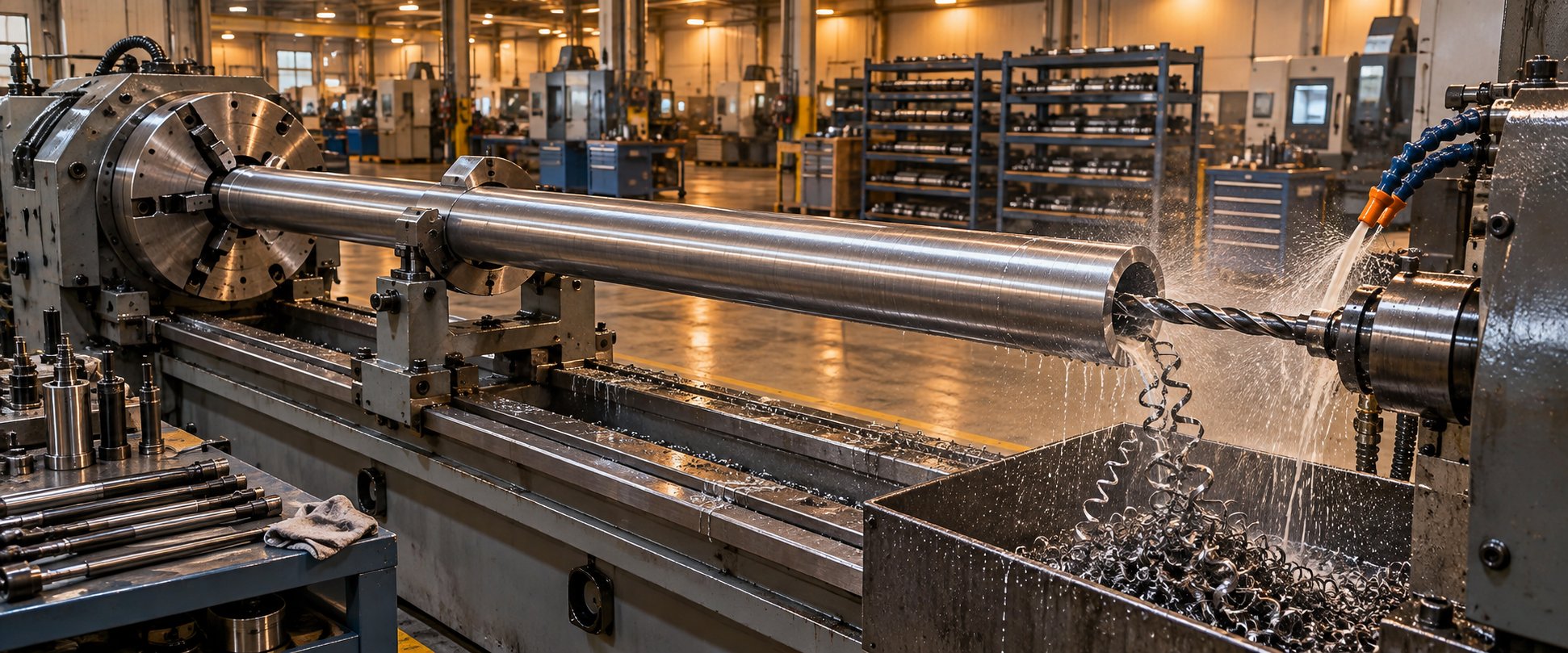
A finished extrusion barrel may look like a simple steel tube, but the journey from raw billet to precision bore involves seven distinct manufacturing stages, each building on the last. When you understand this sequence, you're equipped to ask sharper questions during supplier audits and spot shortcuts that compromise long-term performance. Here's exactly how an extruder screw barrel housing comes to life.
- Raw material selection — Choosing the right alloy steel billet based on the barrel's intended application.
- Rough machining — Turning the outer diameter and establishing the basic cylindrical geometry.
- Deep-hole boring — Creating the internal bore using specialized gun drilling or BTA drilling techniques.
- Heat treatment and stress relief — Hardening the barrel body and eliminating residual machining stresses.
- Nitriding or bimetallic lining application — Adding wear- and corrosion-resistant surfaces to the bore.
- Precision bore honing — Finishing the internal surface to exact dimensional and roughness specifications.
- Final quality inspection — Verifying every critical dimension, hardness value, and surface condition before shipment.
Raw Material Selection and Initial Machining
Every barrel starts as a solid alloy steel billet. The most common base metals are nitriding steels like 38CrMoAlA and 31CrMoV9, along with quenched-and-tempered grades such as AISI 4140 (42CrMo4). These steels provide the toughness and thermal stability a barrel extruder needs to withstand years of high-pressure, high-temperature operation. As reference data from deep-hole drilling specifications confirms, these alloy steels typically deliver a core hardness of 280 to 350 HB, providing the structural backbone that supports either a nitrided layer or a centrifugally cast bimetallic lining.
Picture the process: a cylindrical billet is loaded onto a lathe, and operators rough-turn the outer diameter and face both ends to establish the overall barrel geometry. Wall thickness at this stage must be generous enough to accommodate the subsequent deep-hole boring operation while still supporting the internal alloy layer that will follow. Getting this initial step wrong means compromising bond strength between the base metal and its protective lining downstream.
Heat Treatment, Nitriding, and Bimetallic Lining
With the bore drilled, deep-hole boring is the next critical milestone. Specialized gun drills or BTA (Boring and Trepanning Association) systems bore the internal hole through the full length of the barrel. For single-screw barrels, this produces a single cylindrical bore. For twin-screw configurations, two partially overlapping bores create the characteristic figure-eight cross section, a far more demanding operation where drill wander at the bore intersection is a constant risk. Typical BTA drilling parameters for nitriding steel barrel segments range from 50 to 80 m/min cutting speed at feed rates of 0.06 to 0.20 mm/rev, depending on bore diameter.
After boring, the barrel undergoes controlled heat treatment. Through precise temperature management, engineers harden the barrel body and relieve the internal stresses that rough machining and boring introduced. This step is essential for dimensional stability — skip it, and the barrel may warp during operation, destroying bore concentricity and screw clearances.
The barrel's bore then receives its wear-resistant surface. Two primary routes exist. For standard applications, gas nitriding diffuses nitrogen into the steel surface, producing a hardened case of 900 to 1,200 HV at depths suitable for general-purpose polymer processing. For more demanding environments — glass-filled resins, corrosive PVC compounds, or abrasive mineral fillers — bimetallic centrifugal casting is the preferred method. Here, molten alloy (nickel-based, iron-based, or tungsten-carbide-rich) is poured into a preheated, rotating barrel shell. High-speed rotation distributes the alloy evenly along the inner wall, creating a dense, defect-free lining with strong metallurgical adhesion to the base material.
Precision Bore Finishing and Quality Inspection
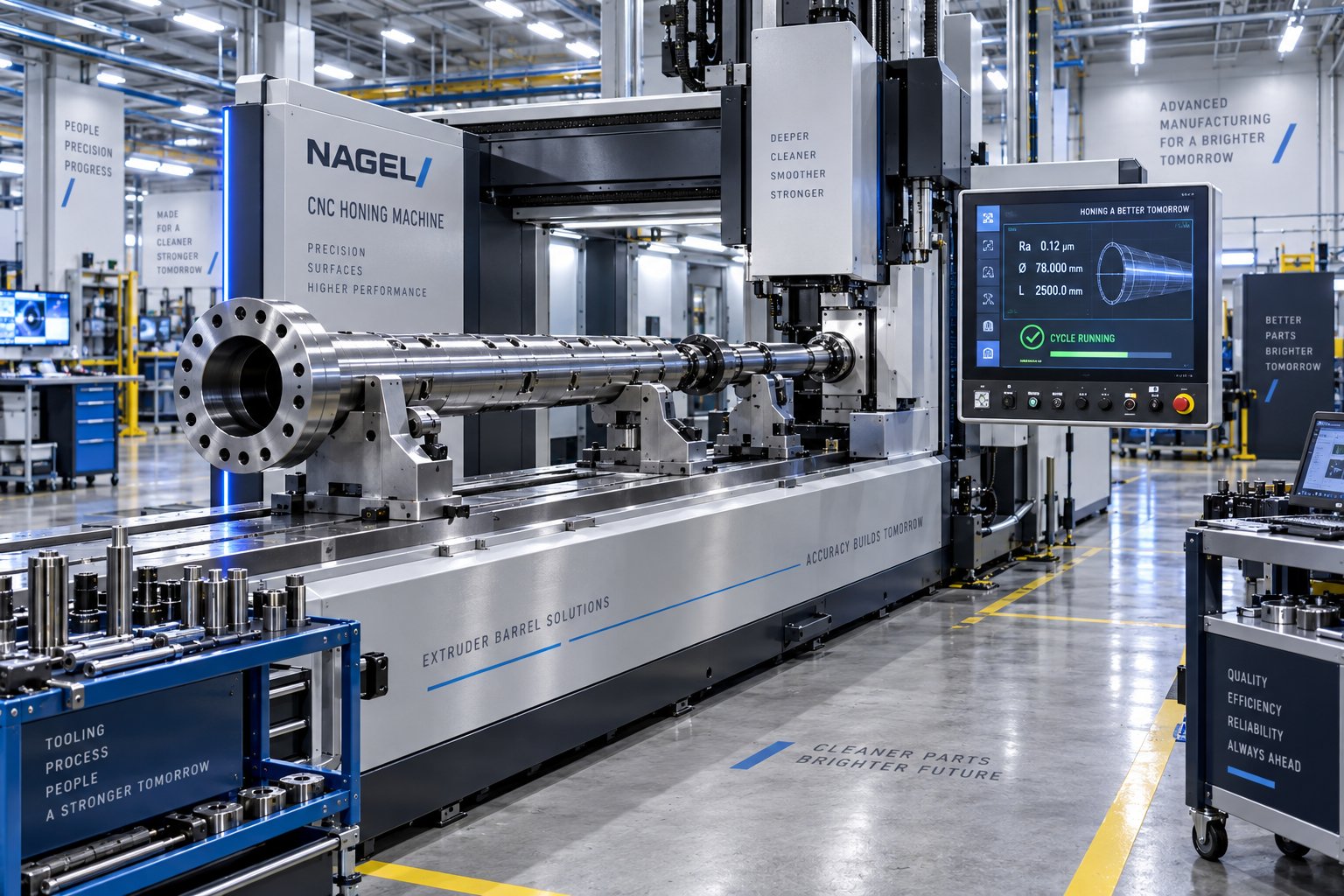
Sounds straightforward so far? This is where tolerances get serious. After lining or nitriding, the bore must be honed to its final dimension. Precision honing uses diamond-plated or abrasive tooling to achieve bore diameters within extremely tight ranges, roundness under a few microns, and surface finishes often below 0.4 Ra. Advanced CNC-controlled honing systems, like those described in single-pass honing technology, can deliver bore sizes within 0.002 mm and roundness under 0.001 mm. The internal surface finish directly affects polymer flow behavior and the barrel-screw clearance that governs melt pressure generation.
The final gate before any extrusion barrel ships is comprehensive quality inspection. Reputable manufacturers verify bore diameter at multiple points along the barrel length, check concentricity and straightness with precision gauges, perform hardness testing on both the base metal and the nitrided or bimetallic layer, and run ultrasonic flaw detection to confirm the integrity of the alloy lining bond. Only barrels that pass every checkpoint earn approval for delivery.
Why does all of this matter to you as a buyer? Because each stage introduces potential failure points. A manufacturer who controls every step in-house — from billet sourcing through final inspection — can trace any quality issue back to its root cause. Those who outsource critical stages often cannot. Knowing this production sequence gives you the vocabulary and the confidence to evaluate whether a barrel supplier truly commands the metallurgical and machining expertise their marketing promises.
Of course, the manufacturing process only tells part of the story. The specific materials and linings chosen for the bore determine how well that barrel resists the unique wear and corrosion challenges posed by different polymer types.
Barrel Materials, Linings, and Wear-Resistant Coatings Explained
Not every polymer chews through steel the same way. A barrel running unfilled polyethylene all day faces a completely different metallurgical challenge than one processing 30% glass-filled nylon or corrosive PVC compounds. Choosing the wrong screw barrel material for the job doesn't just shorten barrel life — it degrades melt quality, inflates scrap rates, and forces costly unplanned downtime. That's why understanding the material science behind barrel construction is one of the most valuable things an engineer, procurement manager, or plant operator can invest time in.
Three primary material categories dominate the market for extrusion barrels and injection molding screws and barrels. Each targets a different range of processing severity, and each carries its own cost-performance trade-offs.
Nitrided Steel Barrels for Standard Processing
For general-purpose applications, nitrided alloy steel remains the workhorse of the industry. The base material is typically a chromium-molybdenum-aluminum alloy steel such as 38CrMoAlA, chosen specifically because its aluminum content promotes the formation of an exceptionally hard nitride layer during gas nitriding treatment. After processing, the barrel's inner bore develops a diffusion-hardened surface reaching approximately HV 900 to 1,100 at a case depth of roughly 0.5 to 0.8 mm.
What does that mean in practical terms? You get a barrel with a tough, ductile core that resists cracking under mechanical load, paired with a hard surface layer that handles moderate abrasive and adhesive wear. This combination works well when you're running clean, unfilled polymers — think standard PP, PE, HDPE, LDPE, and many commodity-grade resins. The economics are attractive too: nitrided barrels cost significantly less than bimetallic alternatives, and for stable production lines with low filler content, they deliver a perfectly acceptable service life.
The limitation? That thin nitrided layer erodes relatively quickly once you introduce abrasive fillers like glass fiber, calcium carbonate, or mineral reinforcements. Once the hardened case wears through, the softer base metal beneath offers little resistance, and bore diameter opens up fast. If your operation processes anything beyond standard virgin resins, you'll want to look further up the materials ladder.
Bimetallic Barrel Linings and Their Polymer Compatibility
When processing demands exceed what a nitrided surface can handle, bimetallic barrels step in. These use a dual-layer construction: a high-strength carbon or alloy steel outer shell provides structural rigidity, while a centrifugally cast alloy lining 2 to 5 mm thick protects the bore against specific types of wear. The beauty of this design is that the lining alloy can be tailored precisely to the threat your resin presents.
Three major alloy families dominate bimetallic screw barrel construction:
- Iron-based alloys — These offer moderate abrasion resistance and represent the entry point into bimetallic technology. They're a solid step up from nitrided steel when you're processing resins with modest filler content, such as calcium carbonate at moderate loading percentages. Hardness values typically fall in the HRC 55 to 62 range.
- Nickel-based alloys — Corrosion is the primary enemy here. Polymers like PVC, PVDF, and fluoropolymers release aggressive acidic gases during processing that attack unprotected steel surfaces. Nickel-based linings resist this chemical assault while still providing reasonable wear protection. If your line runs PVC pipe, profiles, or cable compounds, this is likely your go-to alloy family.
- Tungsten-carbide-rich alloys — When you're running highly filled engineering plastics — glass-fiber-reinforced nylons at 30% loading or higher, mineral-filled masterbatches, or recycled materials with abrasive contamination — you need maximum hardness. Tungsten carbide composite linings can reach HRC 70 to 85, making them the most abrasion-resistant option available in centrifugal-cast bimetallic construction.
Imagine the difference this way: iron-based linings are the all-season tires of the barrel world, nickel-based linings are the chemical hazmat suit, and tungsten-carbide composites are the armor plating. Each serves a distinct purpose, and selecting the wrong one is like fitting snow chains on a desert highway — expensive and counterproductive.
Choosing Barrel Material Based on Resin and Filler Type
The polymer you process should drive every material decision. Here's the guiding principle: identify whether your primary wear mechanism is abrasion, corrosion, or a combination of both, then match the barrel lining accordingly.
Glass-filled nylon, for example, is extremely abrasive to both screw flights and barrel surfaces. As bore clearance increases from glass-fiber erosion, melt leaks backward past the screw flights, reducing pumping efficiency and output. Applications running 20 to 30% glass fiber or higher almost always justify a tungsten-carbide bimetallic lining — or at minimum, an iron-based bimetallic upgrade over standard nitriding.
PVC processing presents the opposite challenge. The polymer itself isn't particularly abrasive, but thermal degradation releases hydrochloric acid that corrodes unprotected steel aggressively. Nickel-based alloy linings neutralize this threat. PVDF and other fluoropolymers behave similarly, generating corrosive by-products that demand chemical-resistant bore protection.
Food and pharmaceutical applications add yet another layer. Beyond wear and corrosion resistance, these industries require food-grade surface finishes that prevent material adhesion and contamination. Barrel bores may need to meet FDA-compliant standards, which means careful alloy selection combined with exceptionally smooth, polished internal surfaces.
For extreme applications — think highly abrasive ceramic fillers combined with corrosive polymers, or specialty compounds processed at temperatures pushing material limits — full-body powder-metallurgy barrels represent the top tier. These barrels are manufactured entirely from powder-metallurgy tool steels, producing a uniformly dense, isotropic structure throughout the entire wall thickness. The result is exceptional resistance to both abrasion and corrosion with no risk of lining delamination. The trade-off, predictably, is cost: these barrels carry a significant premium over even the most advanced bimetallic options.
| Material Category | Typical Hardness Range | Best-Suited Polymers | Relative Cost Tier | Primary Wear Resistance Mechanism |
|---|---|---|---|---|
| Nitrided alloy steel (e.g., 38CrMoAlA) | HV 900 - 1,100 (surface layer) | PP, PE, HDPE, LDPE, unfilled commodity resins | $ (Lowest) | Surface diffusion hardening; thin nitride case resists moderate adhesive and abrasive wear |
| Bimetallic — Iron-based alloy lining | HRC 55 - 62 | Moderately filled resins, CaCO3-filled compounds, general engineering plastics | $$ | Thick alloy layer provides bulk abrasion resistance beyond what nitrided case can offer |
| Bimetallic — Nickel-based alloy lining | HRC 45 - 58 | PVC, PVDF, fluoropolymers, corrosive resin compounds | $$ | Chemical inertness resists acid attack from chlorine and fluorine off-gassing |
| Bimetallic — Tungsten-carbide-rich alloy | HRC 70 - 85 | Glass-filled nylons, mineral-filled masterbatch, highly abrasive recycled materials | $$$ | Dispersed carbide particles create extreme surface hardness for severe abrasive wear |
| Full-body powder-metallurgy steel | HRC 58 - 70 (through-wall) | Extreme applications combining high abrasion and corrosion (ceramic fillers, specialty compounds) | $$$$ (Highest) | Uniform, isotropic wear resistance through entire wall with no lining interface |
A key takeaway: more expensive doesn't automatically mean better. As one reference from screw barrel specialists points out, if your machine mainly processes clean virgin PE or PP with minimal filler, installing the most costly alloy lining may not provide a proportional economic benefit. A properly manufactured nitrided barrel may already deliver the required service life. Material selection should always be driven by your specific resin, filler percentage, and production conditions — not by a default assumption that the most premium option is the safest bet.
With the right barrel material matched to your polymer, the next logical question becomes how that barrel's internal geometry interacts with the screw configuration housed inside it — a relationship that varies dramatically between single-screw and twin-screw designs.
Single Screw vs Twin Screw Barrel Configurations Compared
Barrel material determines how long the bore survives — but barrel configuration determines what the bore can actually do. Every screw extruder on a production floor falls into one of two fundamental camps: single-screw or twin-screw. The barrel that houses each design differs not just in the number of bores, but in geometry, manufacturing difficulty, maintenance demands, and the range of processing tasks it can handle. Choosing the wrong configuration for your application is a mistake that no amount of premium metallurgy can fix.
Single Screw Barrel Design and Applications
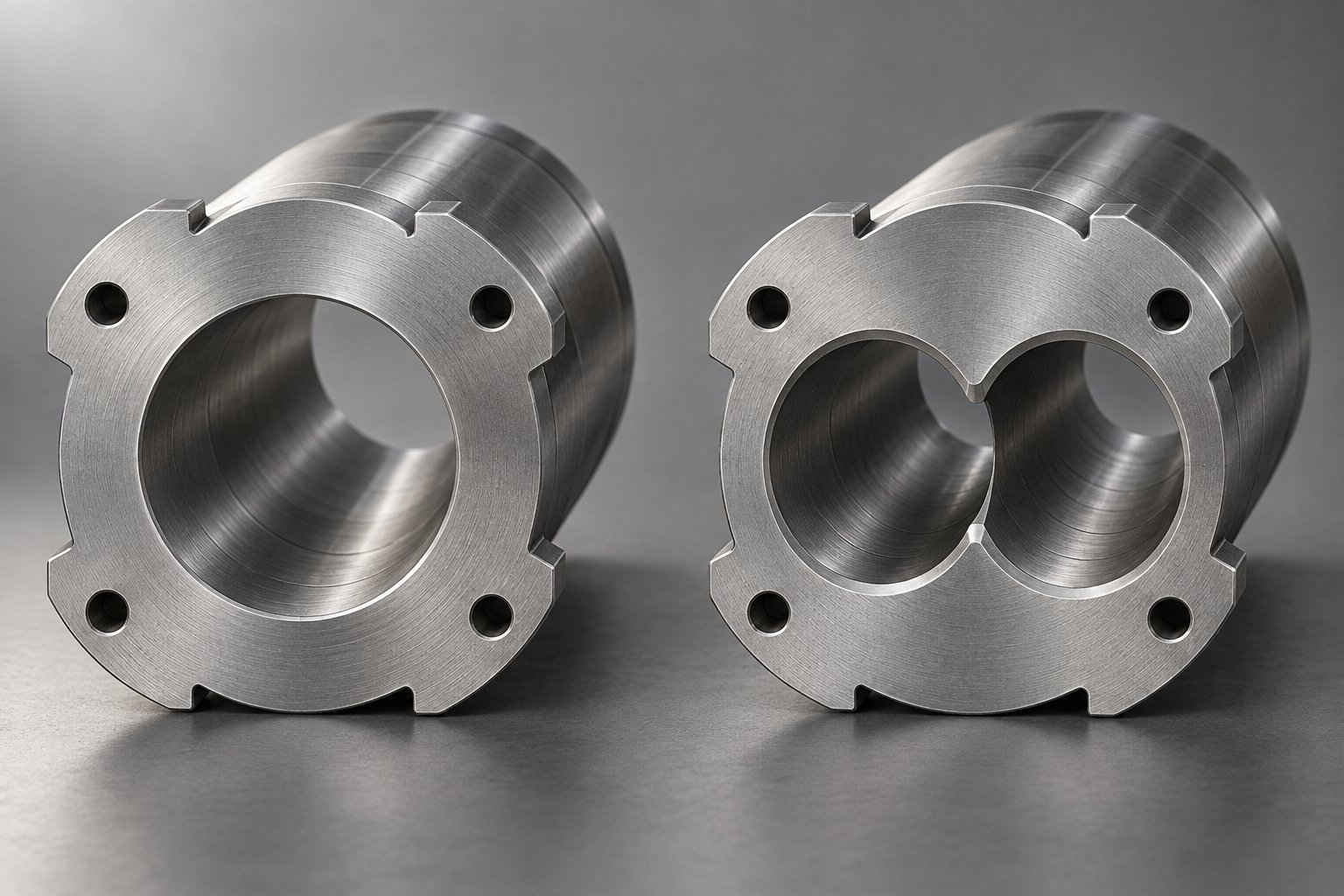
A single-screw barrel features one continuous cylindrical bore running its full length. This simplicity is its greatest strength. Manufacturing a straight, round, concentric bore in a single pass is well within standard deep-hole drilling and honing capabilities, keeping production costs lower and lead times shorter than twin-screw alternatives. For the same reason, quality control is more straightforward — bore diameter, roundness, and straightness can all be verified with conventional gauging equipment.
Where does a single-screw setup shine? Think film blowing, sheet extrusion, pipe and profile production, and wire coating. These applications rely on the barrel and screw to generate consistent melt pressure for steady output through a die, rather than intensive internal mixing. As industry comparisons note, single-screw extruders handle PP, PE, PVC, PET, ABS, and other common resins efficiently across pipe, sheet, and profile lines. If your production line focuses on forming rather than compounding, a single-screw barrel typically delivers the best return on investment.
Twin Screw Barrel Configurations and When They Excel
A twin screw barrel replaces that single bore with two overlapping cylindrical bores that form a figure-eight cross section when viewed end-on. Machining this geometry is significantly more demanding. The intersection where the two bores meet must be precisely shaped to match the intermeshing screw profiles, and maintaining uniform tolerances across both bores simultaneously pushes manufacturing complexity — and cost — considerably higher.
Twin-screw barrels come in two distinct flavors based on screw rotation direction. Co-rotating designs, where both screws spin the same way, produce intense shear fields and strong self-wiping action that make them ideal for compounding, masterbatch production, reactive extrusion, and polymer blending. Counter-rotating configurations, where the screws spin in opposite directions, generate lower shear stress and a calendering effect between the screws — characteristics that make them particularly well-suited to rigid PVC pipe and profile extrusion, where excessive heat generation degrades the polymer.
Many twin screw and barrel systems use a modular, segmented design. Instead of one monolithic barrel, the housing consists of individual barrel sections bolted together along the length of the machine. This segmented approach lets processors reconfigure barrel layouts — adding vent ports, side-stuffer openings, or adjusted temperature zones — without replacing the entire assembly. The trade-off is that each segment joint introduces a potential leak point and alignment challenge during assembly and maintenance.
Decision Criteria for Choosing Between Single and Twin Screw
So when does each configuration earn its place on your production floor? The decision hinges on what you need the extruder to do with the polymer, not just what polymer you're running.
If your primary goal is steady-state melting and pressure generation for forming operations — pipe, film, sheet, profiles — a single-screw barrel offers simpler maintenance, lower capital cost, and proven reliability. If your operation demands intensive distributive and dispersive mixing, devolatilization, or reactive processing, a twin-screw barrel is the only practical choice. As one technical comparison summarizes: the twin screw is more excellent in blending and reactive extrusion, while the single screw continues to develop toward high speed, high efficiency, and specialization.
| Criteria | Single-Screw Barrel | Twin-Screw Barrel |
|---|---|---|
| Typical Applications | Film, sheet, pipe, profile, wire coating | Compounding, masterbatch, reactive extrusion, devolatilization, recycling |
| Bore Geometry | Single cylindrical bore | Figure-eight (two overlapping cylindrical bores) |
| Manufacturing Complexity | Lower — standard deep-hole drilling and honing | Higher — dual-bore intersection requires precision machining and alignment |
| Barrel Construction | Typically one-piece (monolithic) | Often segmented/modular for layout flexibility |
| Maintenance Requirements | Lower — fewer wear surfaces, simpler disassembly | Higher — segment joints, dual bores, and tighter tolerances increase service effort |
| Mixing Capability | Limited to screw-design-dependent mixing | Excellent — intermeshing screws provide dispersive and distributive mixing |
| Relative Capital Cost | $ to $$ | $$$ to $$$$ |
| Common Polymer Types | PP, PE, PVC, PET, PS, ABS, HDPE | Glass-filled nylons, polymer blends, masterbatch, PVC (counter-rotating), bioplastics, recycled streams |
Worth noting: these two configurations aren't always an either-or choice. Some facilities run both, using twin-screw lines for compounding and single-screw lines downstream for forming. The barrel manufacturer you work with should understand both configurations deeply enough to advise on bore geometry, lining compatibility, and tolerance requirements specific to whichever system your application demands.
Regardless of whether one bore or two sits inside your barrel, the performance you extract ultimately depends on the dimensional precision built into it. That brings us to the engineering specifications that separate a functional barrel from a high-performance one.
Critical Barrel Specifications Every Engineer Should Know
You can source the finest bimetallic alloy on the market and still end up with a barrel that underperforms — if the dimensional and metallurgical specifications behind it don't meet the demands of your process. Specifications are the language that connects what a plastic extruder barrel manufacturer builds in the machine shop to what you experience at the die. Engineers, procurement professionals, and maintenance teams who can read and compare these numbers fluently hold a decisive advantage when qualifying suppliers, troubleshooting output issues, or specifying replacements for an extrusion screw barrel assembly.
Here are the critical specifications that define barrel performance, along with the engineering principles that explain why each one matters:
- L/D ratio (length-to-diameter) — Controls how much processing the polymer receives. A longer barrel relative to its bore gives the resin more residence time, more heat exposure, and more opportunity for mixing and homogenization.
- Bore diameter tolerance and concentricity — Defines how precisely the inner bore matches the specified diameter and how centered it remains along the barrel's full length. Even slight deviations create uneven screw-to-barrel clearance that disrupts melt flow.
- Surface hardness ratings (HRC and HV) — HRC measures base metal hardness; HV (Vickers) measures the hardness of nitrided or bimetallic layers. Together, they predict how long the bore resists wear.
- Nitriding depth — Indicates the thickness of the nitrogen-diffused hardened case beneath the bore surface. Deeper cases last longer but require careful process control to avoid brittleness.
- Barrel straightness tolerance — Specifies the maximum allowable curvature of the barrel's central axis over its full length. A barrel that bows or curves creates localized metal-to-metal contact with the screw, accelerating wear.
- Inner surface finish (Ra value) — Measures the arithmetic average roughness of the bore wall. Smoother finishes reduce frictional drag on the melt and improve output consistency.
- Temperature operating range — Defines the thermal envelope the barrel can sustain without dimensional instability, metallurgical degradation, or loss of lining adhesion.
- Compression ratio — Describes the volume reduction the polymer experiences as it moves from the feed zone to the metering zone, governed by the interplay of screw root diameter change and consistent barrel bore.
L/D Ratio and Its Effect on Melt Processing
If the bore diameter tells you how much polymer a screw plastic extruder can move per revolution, the L/D ratio tells you how thoroughly it processes that material before it reaches the die. A barrel with a bore diameter of 60 mm and an effective length of 1,800 mm, for example, yields a 30:1 L/D ratio — a common configuration for blown film and pipe extrusion.
Most single-screw extrusion barrels fall in the 20:1 to 40:1 range. Shorter ratios (20:1 to 24:1) suit simple melting tasks with easy-to-process resins, while longer ratios (30:1 to 36:1 and beyond) are preferred when the polymer requires extended mixing, more gradual melting, or enhanced melt homogeneity. A higher L/D ratio provides better heat transfer uniformity and more consistent melt temperature — but it also increases residence time, which can degrade heat-sensitive polymers if barrel zone temperatures aren't carefully managed.
Here's the practical takeaway: when comparing datasheets from two different suppliers, don't just match bore diameters. Confirm that the L/D ratio aligns with your specific resin and process requirements. A barrel that's too short for your application won't produce adequate melt quality, no matter how precisely it's machined.
Bore Tolerances, Hardness Ratings, and Surface Finish Standards
Bore diameter tolerance is where manufacturing precision directly translates into processing performance. The clearance gap between the extrusion screw flight tips and the barrel wall typically measures just a few hundredths of a millimeter. If bore diameter drifts beyond specification — even slightly — that clearance becomes uneven. Polymer backflows over the screw flights in loose spots while the screw drags against the bore wall in tight spots, generating heat, accelerating wear, and destabilizing output.
Concentricity and roundness matter equally. A bore that's dimensionally correct on average but slightly oval at any cross section creates the same uneven clearance problem. Reputable barrel manufacturers hold bore diameters to tolerances within 0.02 mm or tighter across the full barrel length, with roundness controlled to single-digit micron levels.
Straightness adds a third geometric dimension to the equation. A barrel's central axis must remain linear over lengths that can exceed two meters. Axial straightness is a 3D tolerance — the controlled axis must lie within the volume of a cylinder defined by the specification — and modern metrology systems can verify it with sub-micron repeatability. Parts with tight GD&T straightness tolerances, including extruder barrels, require this level of measurement precision to confirm that the bore won't force asymmetric contact between screw and barrel during operation.
Surface hardness specifications appear in two different scales depending on what's being measured. Base metal hardness — the structural steel body of the barrel — is typically reported in HRC (Rockwell C), with values commonly in the 28 to 35 HRC range for quenched-and-tempered alloy steels. The hardened bore surface, whether nitrided or bimetallic, is reported in HV (Vickers). Nitrided layers on alloy steel barrels reach 650 HV to 1,200 HV depending on the base alloy's composition, with aluminum-bearing nitriding steels at the top of that range. Nitriding depth — the case thickness where this hardness persists — typically spans 0.1 mm to 0.65 mm, influenced by treatment duration and process type.
Inner surface finish, measured in Ra (arithmetic average roughness), determines how smoothly the polymer melt flows along the bore wall. Lower Ra values mean smoother surfaces. Precision-honed extrusion barrels commonly achieve Ra values below 0.4 micrometers, with some high-performance applications demanding even finer finishes. A rougher-than-specified bore increases frictional heat generation and can cause melt stagnation in surface irregularities, leading to degradation and discoloration in sensitive polymers.
How to Read and Compare Manufacturer Specification Sheets
When a manufacturer hands you a specification sheet — or you pull one from their website — you're looking at the intersection of everything discussed above. But not all datasheets are created equal, and knowing what to look for separates a confident evaluation from a guessing game.
Start with the L/D ratio and bore diameter, confirming they match your machine and process requirements. Then check the tolerance callouts: does the sheet specify bore diameter tolerance, or just list a nominal bore size? A credible datasheet will include bore tolerance (e.g., +0.00/-0.02 mm), straightness tolerance over total length, surface hardness for both base metal (HRC) and bore lining (HV), nitriding or lining depth, and surface finish in Ra. If any of these values are missing, that's a question you need to ask before placing an order.
Pay attention to temperature ratings as well. Every barrel has an operating envelope dictated by its base metal properties, lining adhesion limits, and heat treatment stability. Running a barrel beyond its rated temperature range risks dimensional distortion, lining delamination, or loss of surface hardness — failures that are expensive and often irreversible.
Compression ratio is another value you'll encounter, though it's more directly a screw specification than a barrel specification. It describes the ratio of channel volume in the feed zone to channel volume in the metering zone. The barrel's role here is to provide a perfectly consistent bore diameter so that the screw geometry — not bore irregularities — controls the compression the polymer experiences. Any bore variation effectively alters the compression ratio locally, creating inconsistent melt pressure and temperature along the barrel length.
One practical tip: when comparing spec sheets from two or more suppliers, build a simple side-by-side table with columns for each critical parameter. This approach quickly reveals which manufacturers provide comprehensive data and which leave gaps that could hide quality shortcuts. Exact numerical values will vary by manufacturer and application — always reference the supplier's own datasheets for those numbers — but the engineering principles behind each specification remain constant regardless of who built the barrel.
Specifications define what a barrel is on paper. But in operation, those numbers only deliver their full value when the barrel works in concert with the screw rotating inside it — a relationship where geometry, clearance, and zone-by-zone interaction dictate the quality of every gram of melt produced.
Understanding the Screw and Barrel as an Integrated System
Here's a mistake that costs processors more money than they realize: treating the extruder screw and barrel as two separate purchasing decisions. Engineers specify the barrel based on metallurgy. They spec the screw based on resin. Then they expect the two to work together seamlessly — even though nobody evaluated them as a matched pair. The reality? A barrel and screw function as a single thermomechanical system. Every millimeter of bore diameter, every degree of temperature zone control, and every micron of clearance between flight tip and barrel wall influences how the polymer melts, mixes, and pressurizes. Isolate one from the other, and you're optimizing half a system while leaving performance on the table.
How the Barrel and Screw Work Together in Each Processing Zone
Imagine the barrel as a staged environment and the extruder screw as the engine moving polymer through it. Each processing zone — feed, transition, and metering — relies on a specific interaction between barrel geometry and screw geometry to do its job.
Feed zone: Solid pellets enter the barrel and need to be gripped and pushed forward. The barrel's internal surface and temperature in this zone directly control how effectively solids convey. A barrel wall that's too hot causes premature melting, and pellets stick rather than advance. Too cold, and friction drops, reducing throughput. The screw's feed section channel depth sets how much material enters per revolution, but the barrel's thermal profile determines whether that material actually moves forward consistently. Some barrel designs incorporate longitudinal grooves in the feed section — these grooves dramatically increase the friction coefficient between polymer and barrel wall, boosting solids conveying capacity. When paired with a screw designed for grooved-feed operation, throughput can increase substantially compared to smooth-bore designs running the same screw.
Transition (compression) zone: This is where the real work begins. The screw's root diameter tapers upward, compressing the polymer bed against the barrel wall and generating the shear forces that initiate melting. The compression ratio — the volume reduction from the feed section to the metering section — depends on both the screw root taper and the barrel bore remaining perfectly consistent. As melt formation research confirms, shear heating in this zone, not barrel heaters, provides the majority of energy that converts solid polymer into melt. Even small bore diameter variations alter the local compression ratio, shifting where melting starts and how uniformly it progresses. The result? Unmelt specks, gels, or viscosity drift that operators often blame on temperature settings when the root cause is a barrel-screw geometric mismatch.
Metering zone: By this point, the polymer should be fully molten and homogenized. The metering zone's job is to build stable melt pressure for consistent die output. Pressure generation here depends almost entirely on the clearance gap between the screw flight tips and the barrel bore. That gap — measured in hundredths of a millimeter — acts as a controlled restriction. Polymer dragged forward by screw rotation leaks backward through this clearance in a process engineers call "leakage flow" or "pressure flow." When the clearance is within specification, the balance between forward drag flow and backward pressure flow produces a steady, predictable output. Widen that clearance through wear or manufacturing imprecision, and pressure drops, output fluctuates, and melt quality deteriorates.
Matching Screw Geometry Types to Barrel Design Requirements
Not every plastic extruder screw pairs equally well with every barrel design. Four common screw geometries each impose distinct demands on the barrel that houses them:
- General-purpose (GP) screws — These feature a simple three-zone design with a smooth compression taper. They're forgiving in terms of barrel requirements, working well with standard smooth-bore barrels at typical manufacturing tolerances. For commodity resins and straightforward applications, a GP screw and barrel combination delivers reliable performance without demanding exceptional precision.
- Barrier screws — A secondary flight separates the solid bed from the melt pool, forcing melting to occur in a controlled, defined manner. This design demands tighter bore tolerances from the barrel because the barrier flight clearance — the gap between the barrier flight tip and the barrel wall — directly controls how melt migrates from the solids channel to the melt channel. Barrier screw optimization guides emphasize that proper barrel zone temperatures across feed, barrier, and metering sections are critical, since each zone serves a distinct function in managing the solid-to-melt transition. Companies like MD Plastics, whose Posi-Melt barrier screw technology is designed to increase barrel-wall contact for improved melt homogeneity, highlight this barrel-screw interaction as a key performance differentiator. The takeaway for buyers: if you're running barrier extruder screws, your barrel's bore precision needs to meet a higher standard than what a GP screw requires.
- Mixing screws — These incorporate dispersive or distributive mixing elements — Maddock-style sections, spiral mixers, or pin-type geometries — that homogenize the melt after the primary melting zone. Mixing elements generate intense local shear, which means the barrel bore in that region sees accelerated wear. Grooved feed-section barrels complement mixing screw designs particularly well: the grooves improve solids conveying in the feed zone, allowing the mixing section downstream to operate at higher throughput without starving. When specifying a mixing screw, confirm that the barrel manufacturer can deliver consistent bore quality through the mixing zone, where shear and wear stresses are highest.
- Vented screws — Used for devolatilization, these screws feature a decompression zone where barrel pressure drops and volatiles escape through a vent port machined into the barrel wall. The barrel design here is critical: the vent port must be precisely located and machined to align with the screw's decompression geometry. A mispositioned or improperly sized vent port causes melt to flow out the vent ("vent flooding") instead of allowing gas to escape. Vented barrel manufacturing adds complexity because the vent opening interrupts the barrel's structural continuity and thermal profile, requiring careful engineering of both the port geometry and the surrounding barrel wall thickness.
Each screw type, in short, creates a unique set of demands that the barrel must meet. Buyers who evaluate screw and barrel as independent line items on a purchase order risk pairing a precision screw with a barrel that can't support its design intent — or overspending on barrel quality that a simple GP screw will never exploit.
Why Barrel-Screw Clearance Tolerance Matters for Output Quality
If there's a single number that captures the health of the screw and barrel relationship, it's the radial clearance between flight tip and bore wall. Industry data from barrel specialists shows that recommended clearance values scale with screw diameter — ranging from approximately 0.08 to 0.12 mm for small extruders (25 to 45 mm diameter) up to 0.18 to 0.30 mm for large machines (160 to 250 mm diameter).
When clearance falls within specification, you get efficient forward pumping, stable melt pressure, consistent output weight, and predictable melt temperature. Widen that gap through wear, and the consequences cascade quickly:
- Increased backflow over flights reduces volumetric pumping efficiency
- Melt temperature rises as resin is reworked in the expanding clearance zone
- Output rate drops while energy consumption per kilogram of product climbs
- Scrap rates increase as dimensional consistency and surface quality deteriorate
Conversely, clearance that's too tight — from a barrel bore that's undersize or a screw that's slightly oversize — generates excessive friction and heat. Metal-to-metal contact between screw flights and barrel wall causes adhesive wear, scoring the bore surface and accelerating damage to both components simultaneously.
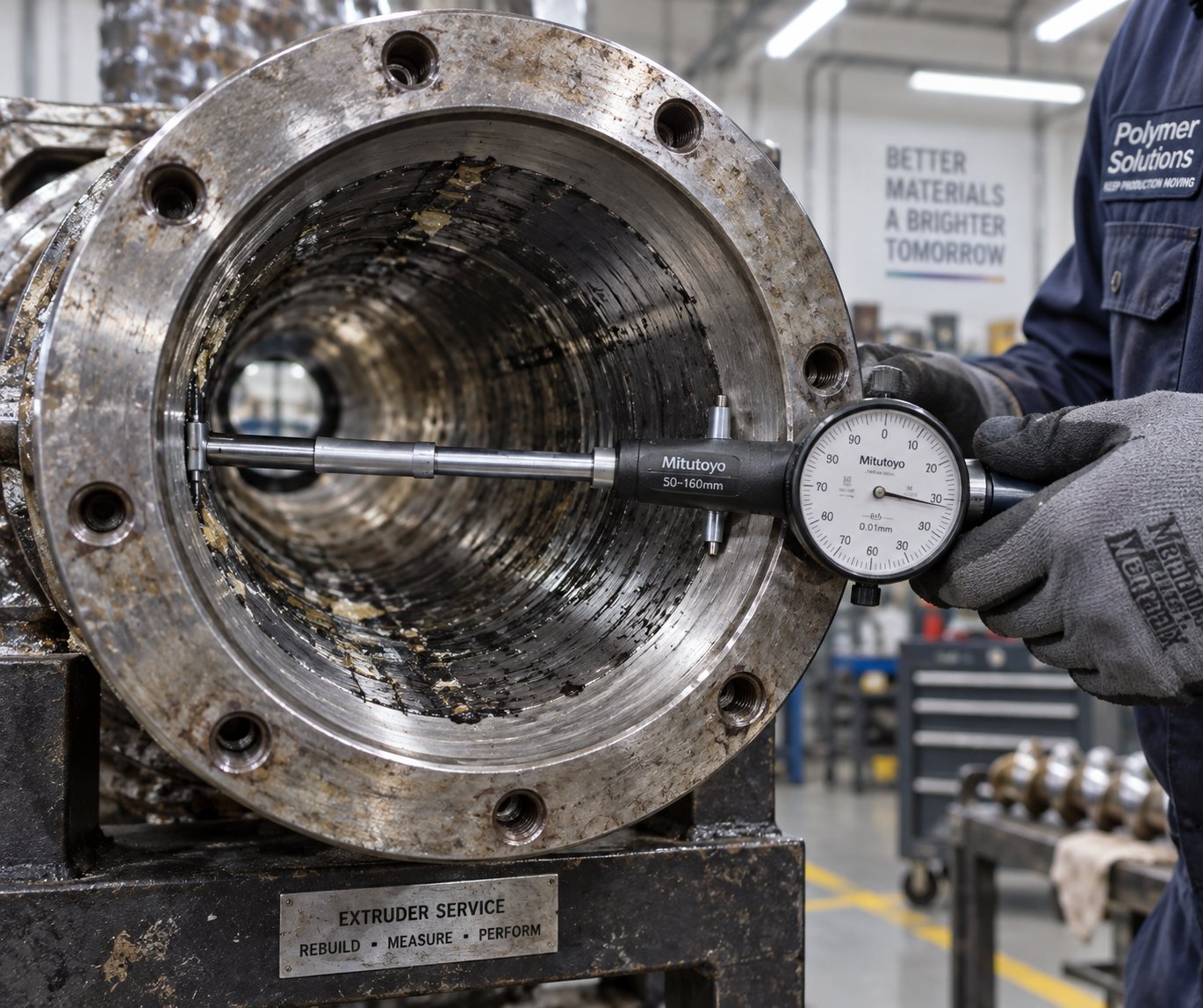
This is precisely why experienced processors monitor clearance regularly. A bore gauge measurement at several points along the barrel length reveals whether wear is progressing uniformly or concentrating in specific zones — information that guides maintenance decisions and helps predict when the screw and barrel pair needs service.
The central lesson here is simple but frequently overlooked: a barrel and screw are partners, not parts. A plastic extruder barrel manufacturer who understands screw geometry, clearance dynamics, and zone-by-zone processing interactions builds barrels that perform better and last longer — because those barrels are designed with the complete system in mind. When you evaluate a manufacturer, ask whether they consider screw compatibility during barrel design. If the answer is vague, you're likely looking at a company that machines steel rather than one that engineers processing solutions.
Even perfectly matched components, however, don't last forever. The relentless mechanical and chemical environment inside an extruder gradually erodes both screw flights and barrel bore, and recognizing the early warning signs of that deterioration can save thousands in unplanned downtime and wasted material.
Diagnosing Barrel Wear and Planning for Replacement
A brand-new barrel paired with a perfectly matched screw generates stable melt pressure, consistent output, and predictable part quality. But no metallurgy is immortal. Every revolution of the screw, every kilogram of filled resin, and every thermal cycle chips away at the bore surface — slowly widening the clearance gap that governs everything from pumping efficiency to melt temperature. The challenge for plant operators and maintenance teams isn't whether wear will happen. It's catching it early enough to act on your terms rather than reacting to a catastrophic production failure.
Common Barrel Wear Mechanisms and Their Causes
Barrel wear rarely has a single cause. Three distinct mechanisms — often working in combination — drive bore deterioration in extruder screws and barrels across virtually every processing environment.
Abrasive wear is the most visually obvious. Hard particles in the polymer stream — glass fibers, calcium carbonate, titanium dioxide, mineral fillers, wood flour, and even metallic contamination in recycled feedstocks — act like fine sandpaper grinding against the bore wall and screw flight tips. As industry specialists note, the severity of abrasive wear depends heavily on the hardness, shape, and size of the particles in the polymer. Angular glass fibers, for instance, cut more aggressively than rounded calcium carbonate particles at the same loading percentage. Over time, abrasion rounds off screw flight edges and enlarges the barrel bore, concentrating in the feed and melting sections where solid particles press hardest against metal surfaces.
Corrosive wear attacks the bore chemically rather than mechanically. Certain polymers release aggressive by-products during processing — PVC degrades to produce hydrochloric acid, fluoropolymers like PVDF generate hydrofluoric acid, and some flame-retardant compounds off-gas halogenated species. These acids attack unprotected metal surfaces, pitting and thinning the bore wall even when mechanical abrasion is minimal. Corrosive wear tends to concentrate in the metering zone, where temperatures are highest and the polymer has the longest residence time — exactly the conditions that accelerate chemical degradation.
Adhesive wear results from direct metal-to-metal contact between the screw's flight tips and the barrel wall. Imagine what happens when a screw runs slightly off-center: the flight tip grinds against the bore surface, galling and tearing metal from both components simultaneously. Adhesive wear is caused by improper alignment, a bent screw, inadequate warm-up that prevents the polymer lubricant film from forming, bearing failure, or incompatible screw-to-barrel geometries. The momentary contact can be severe enough to produce deep scoring visible to the naked eye — and once initiated, the scoring channels accelerate further wear by disrupting the melt film that normally separates screw from barrel.
In real-world processing, these mechanisms rarely operate in isolation. A glass-filled PVC compound, for example, combines aggressive abrasion from the glass fibers with corrosive acid attack from the PVC matrix. Thermal damage can complicate any of these mechanisms further — overheating degrades polymer into sticky deposits that mask pitting, later generating recurring black specks and contamination issues that are difficult to diagnose without pulling the screw and inspecting the bore directly.
How to Measure and Monitor Barrel Bore Condition
You don't need to wait for a production crisis to detect barrel wear. The bore tells a story through both direct measurement and indirect process signals — if you know where to look.
Direct measurement is the gold standard. Using a calibrated bore gauge, measure the internal diameter at defined axial positions along the barrel length and at multiple angular orientations at each location. This reveals both the total bore enlargement and any ovality — the difference between the largest and smallest diameter readings in the same cross section. As measurement specialists recommend, recording these values at standard intervals allows you to create a wear profile that tracks deterioration over time and predicts when a component will reach its service limit. Compare every reading against the original manufacturer's drawing or a documented new-condition baseline — an operator's memory is not a reliable reference point.
A borescope provides a useful visual complement, revealing scoring patterns, pitting, corrosion deposits, and lining damage that dimensional gauging alone might miss. However, visual inspection does not replace measurement. A bore can look polished and clean while still being dimensionally out of specification.
For the injection screw and barrel systems used in molding operations, the same principles apply: measure at corresponding axial locations on both screw and barrel to calculate diametral clearance accurately. Confirm whether the OEM specification uses diametral or radial clearance — confusing the two can double or halve the interpreted result.
Between scheduled inspections, indirect production indicators serve as early-warning signals that plant operators can monitor without any specialized equipment:
- Declining output rate at constant screw speed — As bore clearance widens, more melt leaks backward over the screw flights, reducing net forward pumping. If you're increasing RPM to maintain throughput, wear is the likely culprit.
- Rising melt temperature without heater changes — Polymer reworked in the expanding clearance zone absorbs additional shear energy, pushing melt temperature above setpoints. Elevated temperatures can cause thermal degradation that weakens or breaks macromolecule bonds, compromising the mechanical and optical properties of the extruded product.
- Increased scrap rates or dimensional variation — Unstable melt pressure caused by excessive clearance produces fluctuating output, which shows up as weight variation, wall-thickness drift, or surface defects in the finished product.
- Higher energy consumption per kilogram of output — The extruder works harder to compensate for lost pumping efficiency, drawing more power for the same production volume.
- Visible discoloration, black specks, or gels in the product — Degraded polymer clinging to worn or pitted bore surfaces periodically breaks free and contaminates the melt stream.
- Unusual noise or vibration — Grinding sounds, sudden current spikes, or abnormal vibration patterns can indicate metal-to-metal contact between screw and barrel, demanding immediate investigation rather than a wait-and-see approach.
One essential caution: these symptoms don't automatically prove barrel wear. Hopper bridging, blocked screens, failed heaters, incorrect thermocouples, moisture in the resin, and gearbox issues can all produce similar results. The best diagnostic approach uses trending data — tracking kg/h per RPM, energy consumption per kilogram, head pressure, and actual melt temperature over time against a known-good baseline. When multiple indicators shift simultaneously and basic process checks come back clean, the barrel and screw become the prime suspects.
When to Reline, Repair, or Replace an Extruder Barrel
So your measurements confirm the bore is worn beyond acceptable limits. The next decision — reline, repair, or replace — depends on the barrel's physical condition, the economics of each option, and how quickly you need the line back in production.
Continue and monitor when dimensions remain within approved limits, surfaces show only light polishing without measurable material loss, and the process still meets output and quality targets. Shorten the next inspection interval if wear is accelerating between checks. Not every sign of use demands immediate action — visible polishing without measurable material loss may not justify pulling the barrel from service.
Reline the barrel when the structural shell remains sound and the bore enlargement is within the range that a new bimetallic or alloy lining can restore to original specification. Relining involves boring out the worn lining, centrifugally casting a new alloy layer, and honing back to the correct bore diameter. This option typically costs less than full replacement and preserves the investment in the original barrel body. However, relining only works when the barrel's outer shell retains sufficient wall thickness to support the new lining and withstand operating pressures, and when bore ovality and straightness remain within correctable limits.
Replace the barrel entirely when cracks, deep scoring, severe ovality, extensive corrosion, structural damage, or multiple previous rebuilds make restoration unreliable or uneconomical. If the barrel's straightness deviation exceeds what honing and relining can correct — or if the bore has been enlarged through multiple reline cycles to the point where minimum wall thickness is compromised — a new barrel is the only safe option.
Critically, evaluate the screw and barrel as a matched pair before committing to either path. A freshly relined barrel paired with a heavily worn injection molding screw — or a brand-new barrel wrapped around a degraded screw — leaves excessive clearance that shortens the life of the new component and fails to restore process performance. As maintenance engineering guidelines emphasize, replacing only one component is acceptable when the other remains within approved limits and its condition will not damage the new part. Measure both, compare both to specification, and make the replacement decision based on the pair — not the individual piece.
The cost-time trade-off also matters. Relining can take weeks depending on barrel size, lining alloy, and manufacturer capacity. If your line cannot tolerate that downtime, keeping a spare barrel on hand — or maintaining a relationship with a manufacturer who stocks common sizes — becomes a strategic maintenance decision rather than a reactive scramble.
Wear diagnosis and replacement planning are fundamentally reactive disciplines. They address damage after it occurs. The smarter question — and the one that separates good procurement from great procurement — is how to choose a barrel manufacturer whose engineering, materials, and quality systems minimize wear from the start.
How to Evaluate and Select a Barrel Manufacturer
Knowing how barrels are built, what materials resist which polymers, and when to replace a worn bore gives you a strong technical foundation. But all of that knowledge funnels into one practical decision that shapes your production costs, uptime, and product quality for years: which manufacturer gets the order? Surprisingly few buyers follow a structured process here. Many default to whoever quotes the lowest price or whichever name appears first in a search for feed screw manufacturers. That approach saves time upfront and costs far more downstream in premature wear, missed delivery dates, and barrels that don't quite match the machine they're supposed to fit.
A better strategy treats manufacturer selection the way you'd treat any high-stakes engineering decision — with defined criteria, verified evidence, and a repeatable process you can defend to your team.
Step-by-Step Manufacturer Qualification Process
Whether you're sourcing a replacement barrel for a Davis Standard extruder, specifying a custom twin-screw housing for a compounding line, or building a shortlist of suppliers for an entirely new extrusion facility, the evaluation sequence below keeps you focused on what actually predicts long-term satisfaction. Follow these steps in order — each one narrows the field before you invest deeper time in the next.
- Define your barrel specifications and application requirements. Lock down the essentials before contacting anyone: bore diameter, L/D ratio, barrel material or lining type, operating temperature range, polymer and filler types, and whether you need a single-screw or twin-screw configuration. If you're replacing a worn barrel on a Davis-Standard extruder or similar OEM machine, gather the original drawing or at minimum the model number, serial number, and any dimensional records from previous inspections. Vague requirements produce vague quotes — and make it impossible to compare suppliers on equal terms.
- Verify in-house manufacturing capabilities. A credible supplier controls the critical production stages under one roof: raw material sourcing, rough machining, deep-hole boring, heat treatment, nitriding or bimetallic centrifugal casting, precision bore honing, and final inspection. Ask directly which steps they perform internally and which they outsource. Outsourcing isn't automatically disqualifying, but every hand-off introduces a quality control gap. Manufacturers with vertically integrated operations can trace any defect back to its root cause — and correct it faster.
- Assess material and metallurgical expertise. Does the manufacturer offer a genuine range of barrel lining options — nitrided steel, iron-based bimetallic, nickel-based bimetallic, tungsten-carbide alloys — or do they push a single material for every application? A manufacturer who can recommend the right alloy for your specific resin and filler combination, rather than defaulting to whatever they stock, demonstrates the metallurgical depth you need in a long-term partner. Ask them to explain why they'd recommend a particular lining for your application. The quality of that answer tells you more than any brochure.
- Check quality control standards and measurement equipment. This is where many evaluations fall short. Words like "precision" and "quality" appear on every manufacturer's website, but the proof lives in their metrology lab. Confirm that the supplier uses calibrated bore gauges for diameter and ovality measurement at multiple axial positions, CNC coordinate measuring machines for concentricity and straightness verification, hardness testers (Vickers for linings, Rockwell for base metal), surface profilometers for Ra verification, and ultrasonic testing for lining bond integrity. As quality control specialists in plastics processing emphasize, rigorous inspection at every stage — from raw material through final product — is what separates consistent quality from occasional quality.
- Evaluate customization capability. Standard catalog barrels cover many applications, but real-world production frequently demands non-standard dimensions, modified port locations, special lining configurations, or barrel geometries matched to specific OEM machines. If your operation runs equipment from multiple manufacturers — perhaps a mix of European twin-screw compounders and American single-screw lines, including machines you might find listed as a Davis Standard extruder for sale on the secondary market — you need a barrel supplier who can reverse-engineer or custom-manufacture to match each platform. Ask for examples of custom work they've completed and whether they can work from your drawings or samples.
- Review lead time reliability and communication responsiveness. A barrel that arrives three weeks late costs far more than its purchase price in lost production. Ask for typical lead times on both standard and custom orders, and request references you can contact to verify delivery performance. Equally important: how quickly does the manufacturer respond to technical questions during the quoting process? Slow, unclear communication before you've placed an order rarely improves after your money is committed. Supplier qualification frameworks consistently identify responsiveness and communication quality as leading indicators of long-term supplier reliability.
- Confirm after-sales support and reline services. The relationship doesn't end at delivery. Can the manufacturer reline your barrel when it wears? Do they provide bore measurement reports with each new barrel so you have a documented baseline for future wear monitoring? Will their engineering team help diagnose processing issues that might be barrel-related? After-sales support is the most overlooked factor in the buying decision — and one of the most impactful on total cost of ownership. A supplier who assigns dedicated technical support and can ship replacement barrels or wear components within a reasonable timeframe is worth a price premium over one who disappears after invoicing.
Quality Control Standards to Verify Before Ordering
Beyond asking about equipment, dig into the systems behind the measurements. Does the manufacturer hold ISO 9001 certification for their quality management system? Can they provide material test certificates for the steel billets they use? Do they perform metallurgical cross-section analysis on bimetallic linings to verify bond integrity, alloy composition, and lining thickness?
Here's a practical verification tactic: request a sample inspection report from a recent production run. A manufacturer confident in their quality systems will share this without hesitation. The report should include bore diameter measurements at multiple stations along the barrel length, hardness readings for both base metal and lining, straightness and concentricity data, surface finish values, and any non-destructive testing results. If the manufacturer can't — or won't — produce documentation at this level of detail, treat that as a significant red flag.
For buyers evaluating high-volume or safety-critical applications, consider commissioning a third-party factory audit through organizations like SGS, Bureau Veritas, or TUV Rheinland. These independent audits verify that a manufacturer's actual shop-floor practices match the certifications hanging on their conference room wall. The cost — typically a few hundred to a few thousand dollars — is trivial compared to the consequences of receiving barrels that fail prematurely in service.
Navigating Global Sourcing for Extruder Barrels
The barrel supply landscape is genuinely global, and each manufacturing region brings distinct advantages to the table. Making an informed sourcing decision means understanding those regional strengths without defaulting to assumptions.
North American and European manufacturers often excel in precision engineering, documentation rigor, established quality certifications, and proximity advantages for buyers in those regions. Shorter shipping distances mean faster delivery and easier logistics for warranty claims or reline services. Many OEM equipment builders — including well-known names whose machines you'll encounter across extrusion and injection molding floors worldwide — source barrels from domestic or regional suppliers specifically for supply chain control and rapid turnaround. The trade-off is typically higher per-unit cost driven by labor rates and overhead structures in these markets.
Chinese manufacturers have emerged as major players in the screw extruder component market, offering competitive pricing, large production capacity, and — at the top tier — quality levels that rival Western counterparts. China accounts for a substantial share of global plastic extrusion equipment production, and the country's manufacturing hubs in Zhejiang, Jiangsu, and Guangdong provinces have developed deep specialization in screw and barrel manufacturing. For example, NANHAIYA operates as a factory-direct manufacturer providing custom and replacement screw barrels for both extrusion and injection molding applications — illustrating the kind of vertically integrated, direct-access supplier that the evaluation criteria above are designed to identify. The key with Chinese sourcing is thorough vetting: verify certifications independently, conduct virtual or on-site factory audits, and confirm that the manufacturer — not a trading intermediary — is the entity you're actually dealing with.
Regardless of region, the evaluation steps outlined above apply universally. A manufacturer in any country can be excellent or mediocre. Geography influences cost structure and logistics, but it doesn't determine quality. Your qualification process does.
A few additional considerations for global sourcing decisions:
| Sourcing Factor | North America / Europe | China / Asia |
|---|---|---|
| Typical Cost Structure | Higher per-unit; lower logistics cost for regional buyers | Lower per-unit; higher shipping and import duty costs |
| Lead Times | Shorter for domestic buyers; 2-6 weeks typical | Production 4-8 weeks plus 3-6 weeks ocean freight |
| Quality Certifications | ISO, ASTM, DIN standards widely held and audited | ISO certification common at top-tier; verify independently |
| Customization Flexibility | Strong; often works directly with OEM engineering teams | Strong at established manufacturers; confirm engineering depth |
| Communication & Time Zone | Same or adjacent time zones for regional buyers | 8-12 hour time zone offset; requires planning for responsiveness |
| After-Sales / Reline Support | Typically accessible with shorter turnaround | Available from top manufacturers; confirm service logistics upfront |
One pragmatic strategy many processors adopt: maintain relationships with both a domestic and an international barrel supplier. Use the domestic source for urgent replacements and emergency turnarounds where downtime cost per day dwarfs any price premium. Use the international source for planned purchases, new-build projects, and volume orders where longer lead times are acceptable and cost savings are substantial. This dual-source approach builds supply chain resilience while capturing the economic advantages of global competition.
Selecting the right manufacturer is ultimately about aligning their capabilities with your specific technical and commercial needs — not about finding the cheapest quote or the most impressive website. The seven-step process above gives you a repeatable, defensible framework for making that alignment visible and measurable. Apply it consistently, and you'll build a supplier relationship that delivers reliable barrels, responsive support, and predictable total cost of ownership across years of production.
The barrel market itself, however, isn't standing still. Advances in alloy development, machining technology, and sourcing models are reshaping what buyers can expect from their suppliers — and creating new opportunities for processors willing to look ahead.
Emerging Trends in Extruder Barrel Manufacturing
Barrel technology doesn't evolve in dramatic leaps — it advances through steady, compounding improvements in metallurgy, machining precision, and supply chain strategy. Yet the cumulative effect of these shifts is reshaping what processors can expect from their next barrel purchase. Whether you operate US extruders running commodity resins, maintain a fleet of screw extruders processing post-consumer recyclate, or manage spare parts for a used twin screw extruder you've recently acquired, these developments affect your operational costs, barrel longevity, and sourcing options in tangible ways.
Advanced Alloys and Coating Technologies on the Horizon
Bimetallic alloy development has accelerated significantly. Traditional iron-based, nickel-based, and tungsten-carbide-rich linings remain the industry backbone, but alloy designers are pushing into new compositional territory to squeeze more hours out of every barrel. Next-generation bimetallic formulations incorporate refined carbide distributions — smaller, more uniformly dispersed hard-phase particles within the alloy matrix — that resist micro-cracking and reduce the spalling failures that have historically limited service life in high-abrasion applications.
Powder metallurgy (PM) techniques are playing a growing role here. As the Metal Powder Industries Federation highlights, the engineering community increasingly recognizes PM as an innovative manufacturing technique for creating high-quality, net-shape components — and this recognition extends directly into barrel manufacturing. PM-produced barrel linings offer a critical advantage over conventional centrifugal casting: the ability to achieve highly uniform alloy microstructures without the compositional segregation that gravity and centrifugal force can introduce during traditional casting. The result is a lining with consistent hardness and wear resistance across its entire thickness and length, eliminating the soft spots that become initiation points for accelerated bore erosion.
CNC machining and deep-hole drilling technology have kept pace with these metallurgical advances. Modern multi-axis CNC honing systems deliver bore tolerances that were considered laboratory-grade just a decade ago — bore diameters held within 0.002 mm and roundness under a single micron are increasingly standard production capabilities rather than premium exceptions. Tighter tolerances translate directly into better screw-to-barrel clearance control, which means more consistent melt quality, lower energy consumption per kilogram of output, and longer intervals between wear-related maintenance events.
Barrels for Recycled and Bio-Based Polymer Processing
Here's a trend that every processor should watch closely: the rapid growth of recycled and bio-based polymer processing is creating entirely new wear challenges that existing barrel materials weren't originally designed to handle.
Recycled feedstocks are inherently unpredictable. Post-consumer and post-industrial reclaim contains contaminants — paper fibers, metal fragments, sand, glass particles, adhesive residues, mixed polymer fractions — that vary from load to load. This variability subjects the barrel bore to a constantly shifting combination of abrasive and corrosive attack. A barrel optimized for virgin glass-filled nylon may perform poorly when confronted with the random abrasive cocktail in a recycled stream, because the wear pattern is distributed differently and the corrosive by-products are less predictable.
Bio-based polymers like PLA, PHA, and starch-based compounds introduce their own complications. Many bio-resins are processed at lower temperatures than petroleum-based alternatives, but their thermal degradation products can be surprisingly corrosive. Moisture sensitivity adds another dimension: improperly dried bio-polymers hydrolyze during processing, generating acidic compounds that attack bore surfaces. Barrel manufacturers responding to this trend are developing hybrid linings that balance corrosion resistance with abrasion protection — a combination that traditional single-purpose alloys handle less effectively.
These material shifts mean that the "one barrel fits all" mentality is becoming obsolete. Processors diversifying into recycled or bio-based production need barrel suppliers with the metallurgical flexibility to recommend and deliver application-specific lining solutions, not just stock configurations.
The Shift Toward Factory-Direct Sourcing Models
Beyond materials and machining, a structural change in how barrels reach end users is gaining momentum. The traditional supply chain — manufacturer to distributor to OEM dealer to processor — adds cost, lead time, and communication layers at every step. Increasingly, plastic processors, equipment builders, and maintenance teams are bypassing intermediaries entirely, sourcing custom and replacement screw barrels directly from the factory floor.
This factory-direct model delivers tangible advantages. Without distributor markups, per-unit costs drop. Without intermediary communication delays, technical specifications transfer more accurately between the end user and the engineer who actually machines the barrel. Lead times tighten because orders aren't queued behind a distributor's inventory management cycle. And customization becomes a conversation rather than a catalog exercise — you describe your application, and the manufacturer engineers a solution, rather than both parties settling for the closest standard size.
Manufacturers like NANHAIYA exemplify this approach, offering plastic processors, equipment builders, and maintenance teams direct factory access to custom and replacement screw barrels across extrusion and injection molding platforms. The model works because it eliminates the information loss that occurs when technical requirements pass through non-engineering intermediaries — a persistent friction point in traditional distribution channels.
Here's a summary of the key trends reshaping barrel manufacturing and sourcing:
- Next-generation bimetallic alloys with refined carbide distributions for longer bore life in high-abrasion applications
- Powder metallurgy barrel linings delivering more uniform microstructures and eliminating compositional segregation found in centrifugal casting
- Tighter CNC machining tolerances — bore precision within 0.002 mm becoming standard production capability, not a premium upgrade
- Application-specific linings for recycled polymers that handle unpredictable contamination profiles and variable abrasive-corrosive attack
- Hybrid corrosion-abrasion linings for bio-based resins addressing the unique degradation chemistry of PLA, PHA, and starch-based compounds
- Factory-direct sourcing models reducing cost, lead time, and communication friction by connecting processors directly with barrel manufacturers
- Digital documentation and traceability — manufacturers providing digital bore measurement reports, material certificates, and inspection records that integrate with customers' maintenance tracking systems
The direction is clear: barrel manufacturing is becoming more precise, more material-specific, and more accessible. Processors who stay informed about these developments — and who build relationships with manufacturers investing in them — position themselves to extract more value from every barrel they install. The gains won't come from a single breakthrough technology. They'll come from the steady accumulation of better alloys, tighter bores, smarter material matching, and shorter paths between the factory that machines the barrel and the production floor that runs it.
Frequently Asked Questions About Plastic Extruder Barrel Manufacturers
1. What materials are used in extruder barrel manufacturing?
Extruder barrels are built from nitrided alloy steels such as 38CrMoAlA for general-purpose processing, or they receive bimetallic centrifugal-cast linings for tougher applications. Iron-based alloy linings handle moderate abrasion, nickel-based alloys resist corrosion from PVC and fluoropolymers, and tungsten-carbide-rich alloys protect against highly filled resins like glass-reinforced nylon. Full-body powder-metallurgy barrels serve the most extreme combined abrasion-corrosion environments. The right material depends entirely on your resin type, filler content, and processing temperature range.
2. How do I know when my extruder barrel needs replacement?
Key warning signs include declining output rate at constant screw speed, rising melt temperature without heater changes, increased scrap rates or dimensional variation in finished parts, higher energy consumption per kilogram, and visible black specks or gels in the product. Direct bore gauge measurements at multiple axial positions confirm whether bore enlargement or ovality has exceeded manufacturer tolerances. If remaining wall thickness supports it, relining may restore the barrel; otherwise, full replacement is necessary. Always evaluate the screw condition simultaneously, since replacing only one component while the other is worn leaves excessive clearance.
3. What is the difference between single-screw and twin-screw extruder barrels?
Single-screw barrels feature one cylindrical bore and are ideal for forming operations like film, sheet, pipe, and profile extrusion. They cost less and are simpler to manufacture and maintain. Twin-screw barrels have a figure-eight cross-section with two overlapping bores and excel at compounding, reactive extrusion, devolatilization, and processing highly filled materials. Twin-screw systems often use modular segmented barrel designs for layout flexibility but carry higher capital and maintenance costs. The choice depends on whether your process prioritizes steady-state melting or intensive mixing.
4. What specifications should I check when evaluating an extruder barrel manufacturer?
Focus on L/D ratio to match your resin and process needs, bore diameter tolerance and concentricity for proper screw clearance, surface hardness ratings in both HRC for the base metal and HV for the nitrided or bimetallic layer, nitriding or lining depth, barrel straightness tolerance over total length, inner surface finish measured in Ra, and rated operating temperature range. A credible manufacturer will document all of these values on their specification sheets. Missing data points should prompt direct questions before placing an order, as gaps can indicate quality shortcuts.
5. Can I source extruder barrels directly from a factory instead of through a distributor?
Yes, and the factory-direct sourcing model is gaining momentum across the industry. Buying directly from a manufacturer like NANHAIYA (nhyscrews.com/products) eliminates distributor markups, reduces communication delays on technical specifications, and shortens lead times. This model works especially well for custom or non-standard barrel configurations where direct engineering consultation is essential. Many processors maintain both a domestic supplier for urgent replacements and a factory-direct international source for planned purchases, balancing speed with cost savings across their supply chain.
Written by
Nanhaiya Technical Team
Zhoushan Nanhaiya Plastic Machinery Co., Ltd.
The Nanhaiya technical team supports screw and barrel manufacturing projects through application review, technical communication, custom manufacturing coordination, and production and quality control.
Discuss Your Application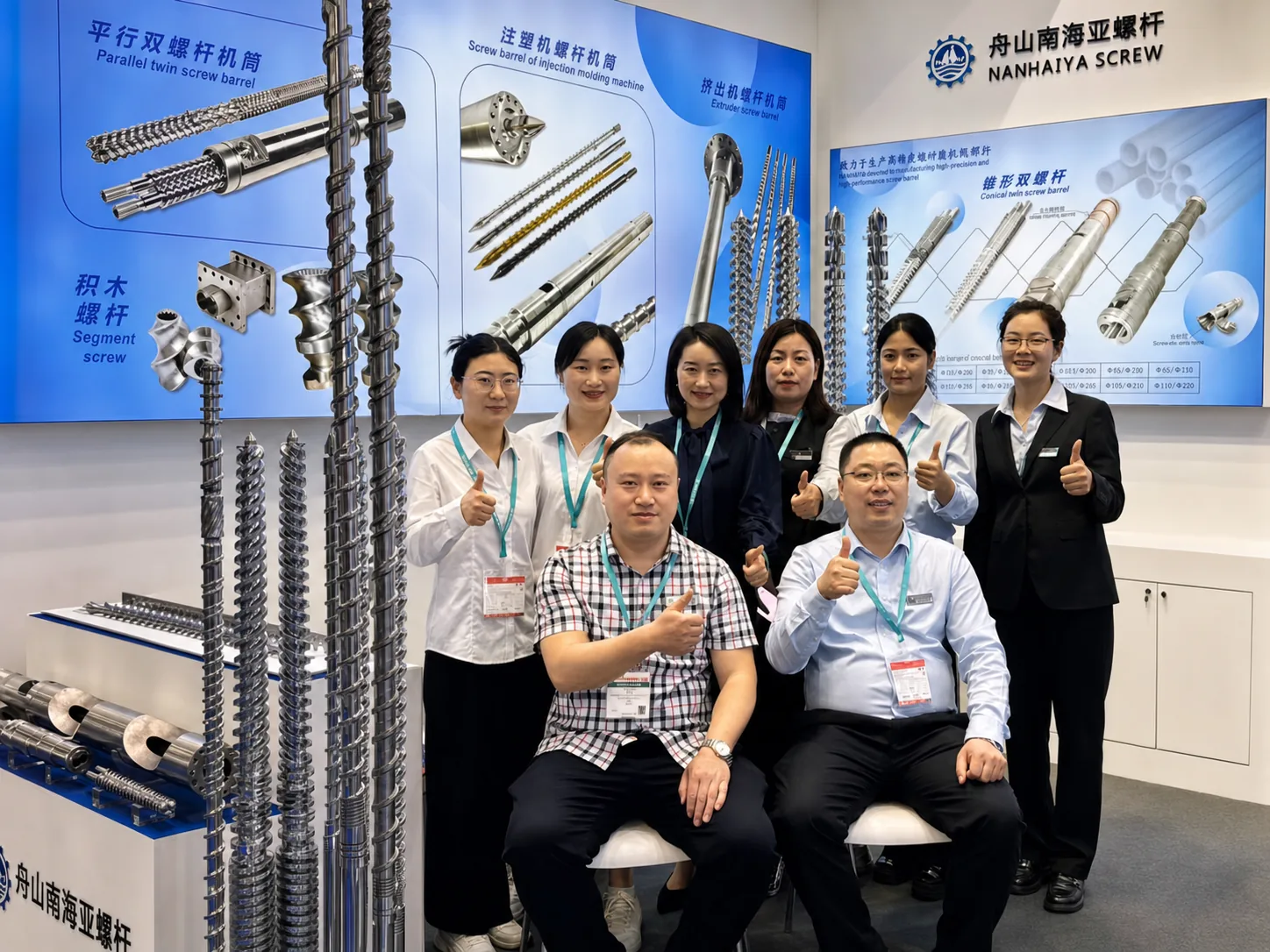
Related Articles
More insights on screw barrel technology and plastics processing.
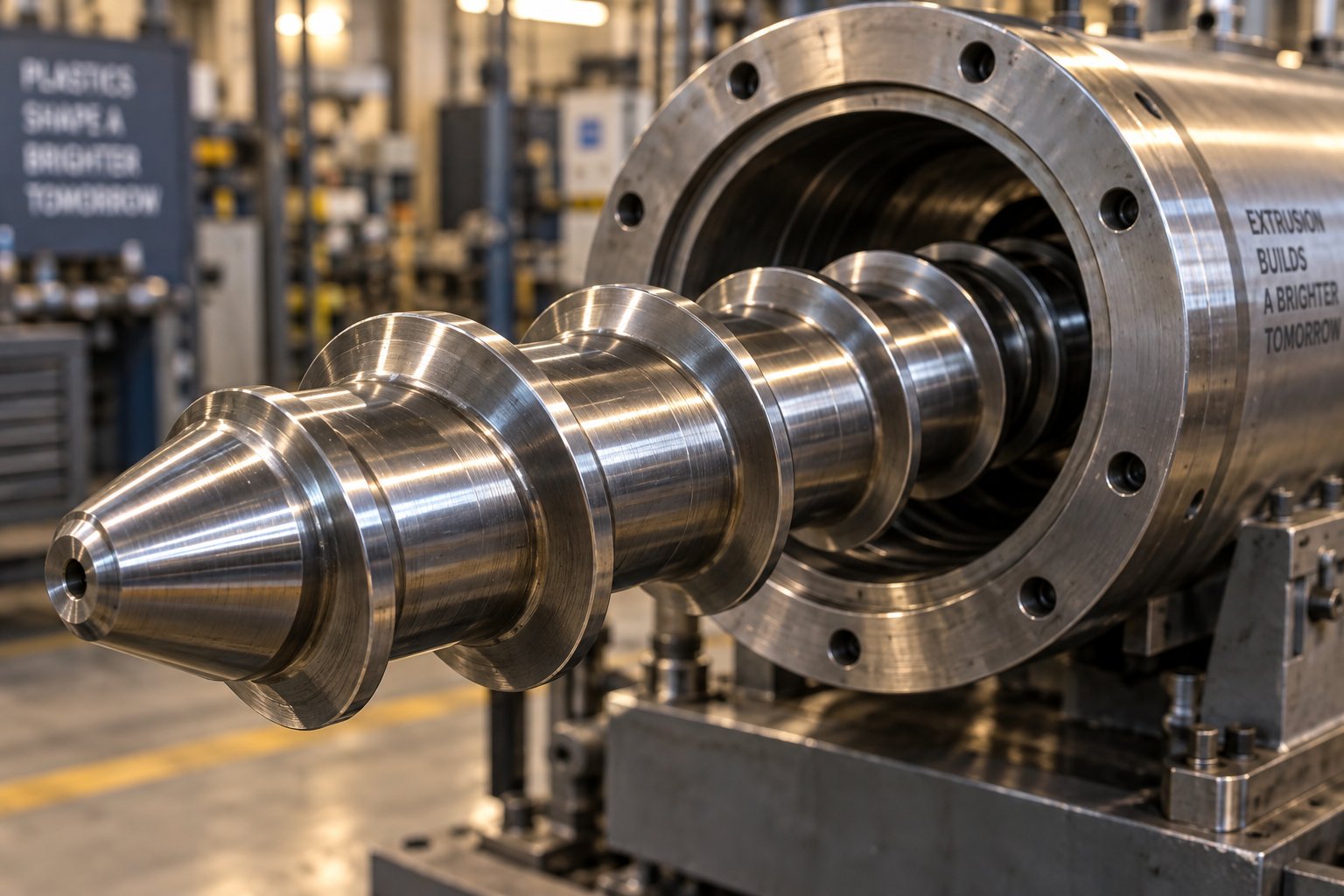
What Nobody Tells You About Screw Barrel For Plastic Machine Design
Oct 10, 2026
Learn how screw barrel for plastic machine design affects melt quality, throughput, and wear life. Covers geometry, resin matching, troubleshooting, and sourcing.
Read Article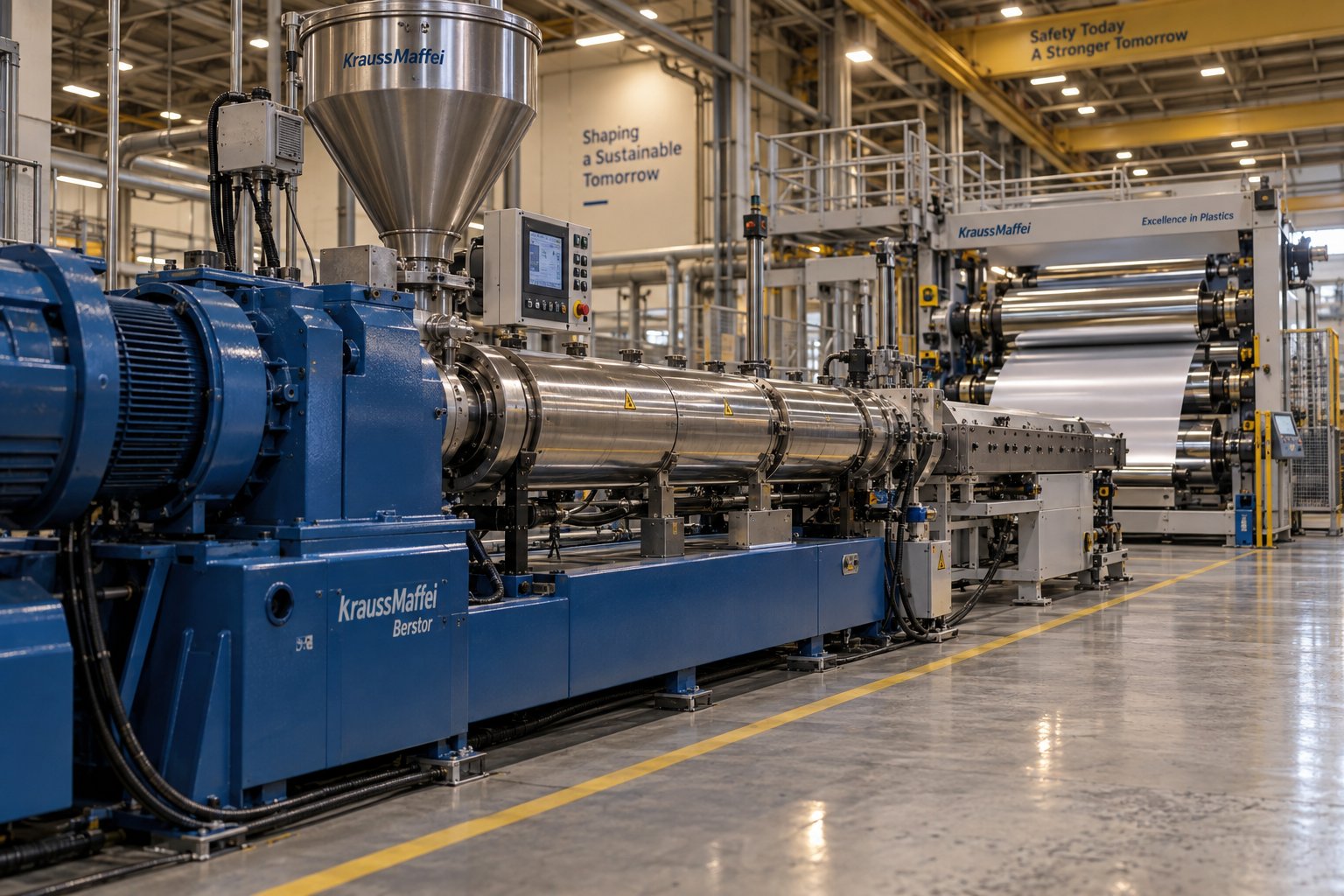
Single Screw Extruder for Sheet: Stop Guessing, Start Specifying
Oct 9, 2026
Learn how to specify a single screw extruder for sheet production. Covers screw geometry, resin-specific processing, troubleshooting, and maintenance best practices.
Read Article
PE Pipe Extruder Machine: What Datasheets Won't Tell You
Oct 9, 2026
Learn how a PE pipe extruder machine works, key specs explained, material grade selection, maintenance tips, and buyer guidance beyond the datasheet.
Read ArticleLooking for something else?
Search by material, symptom or product and jump straight to the relevant page.
These are navigation suggestions based on keyword matching — not a quotation, not a delivery commitment, and not a substitute for engineering review. Final specification is confirmed by our engineers against your drawings and processed material.
Need help with screw barrel selection?
Share your machine model, processed material and application. Our team can help with pricing and technical support.