

What a Plastic Extruder Barrel Does and Why It Matters
Imagine a component that silently governs the quality of every foot of film, every length of pipe, and every pellet your line produces. That component is the extruder barrel — and most processors drastically underestimate its influence on their bottom line.
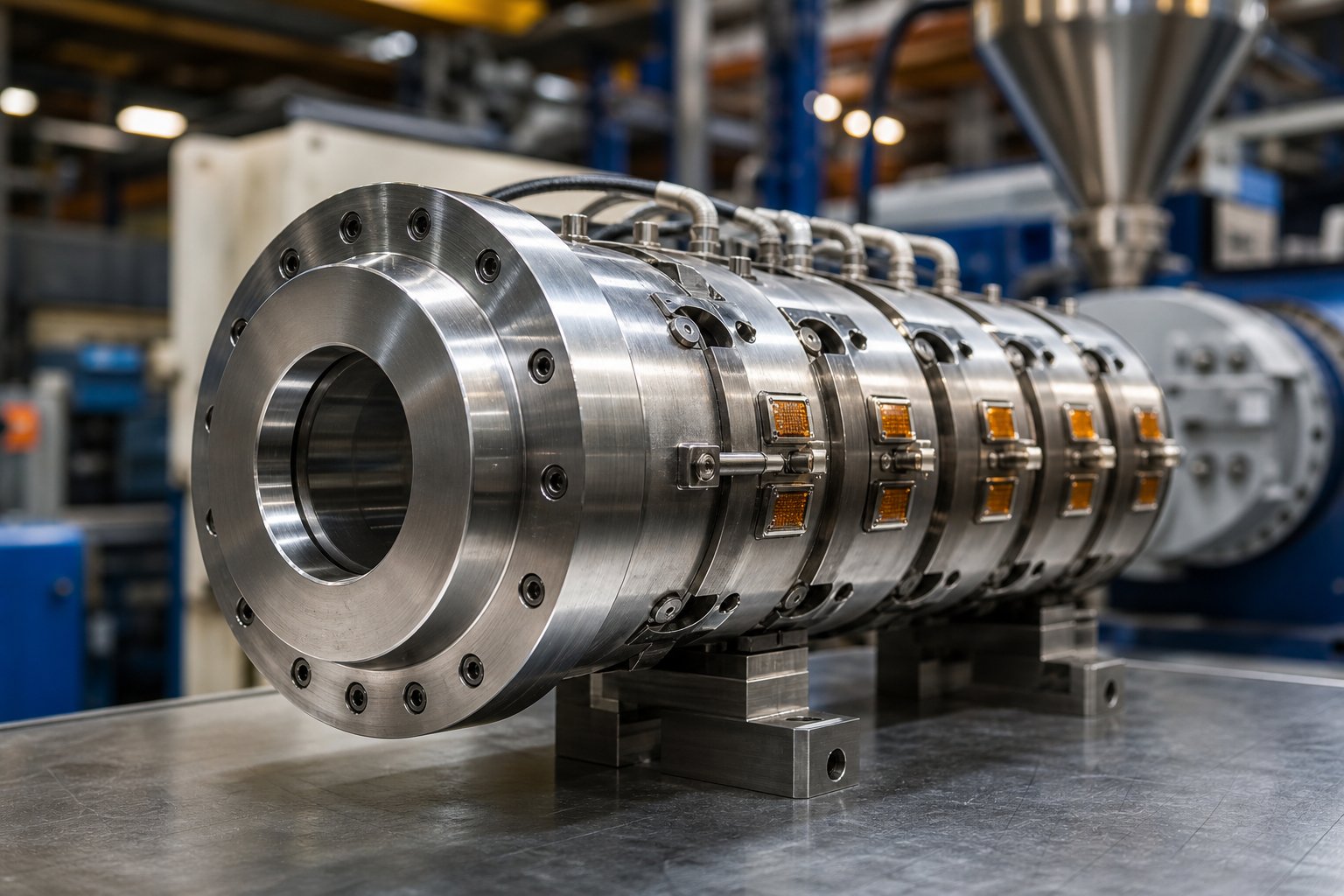
A plastic extruder barrel is a precision-machined cylindrical steel housing that works in tandem with a rotating screw to melt, mix, and convey polymer material. It serves simultaneously as a structural pressure vessel, a thermal management system, and an active processing surface whose bore finish, metallurgy, and dimensional accuracy directly determine melt quality, throughput, and product consistency.
Defining the Plastic Extruder Barrel
At its core, the extruder barrel is far more than a passive tube holding a spinning screw. It performs three critical functions at once:
- Pressure containment — Internal pressures routinely exceed 5,000 PSI during processing, and the barrel's wall thickness and steel grade must safely contain those forces without deformation.
- Thermal management — Embedded heater bands deliver energy to melt raw polymer, while cooling channels remove excess heat from shear-intensive zones. Together, they maintain the precise temperature profile each resin demands.
- Processing surface — The bore's inner wall is the surface against which polymer pellets are compressed, sheared, and melted. Its finish quality and hardness directly affect how efficiently solids convey and how uniformly the melt develops.
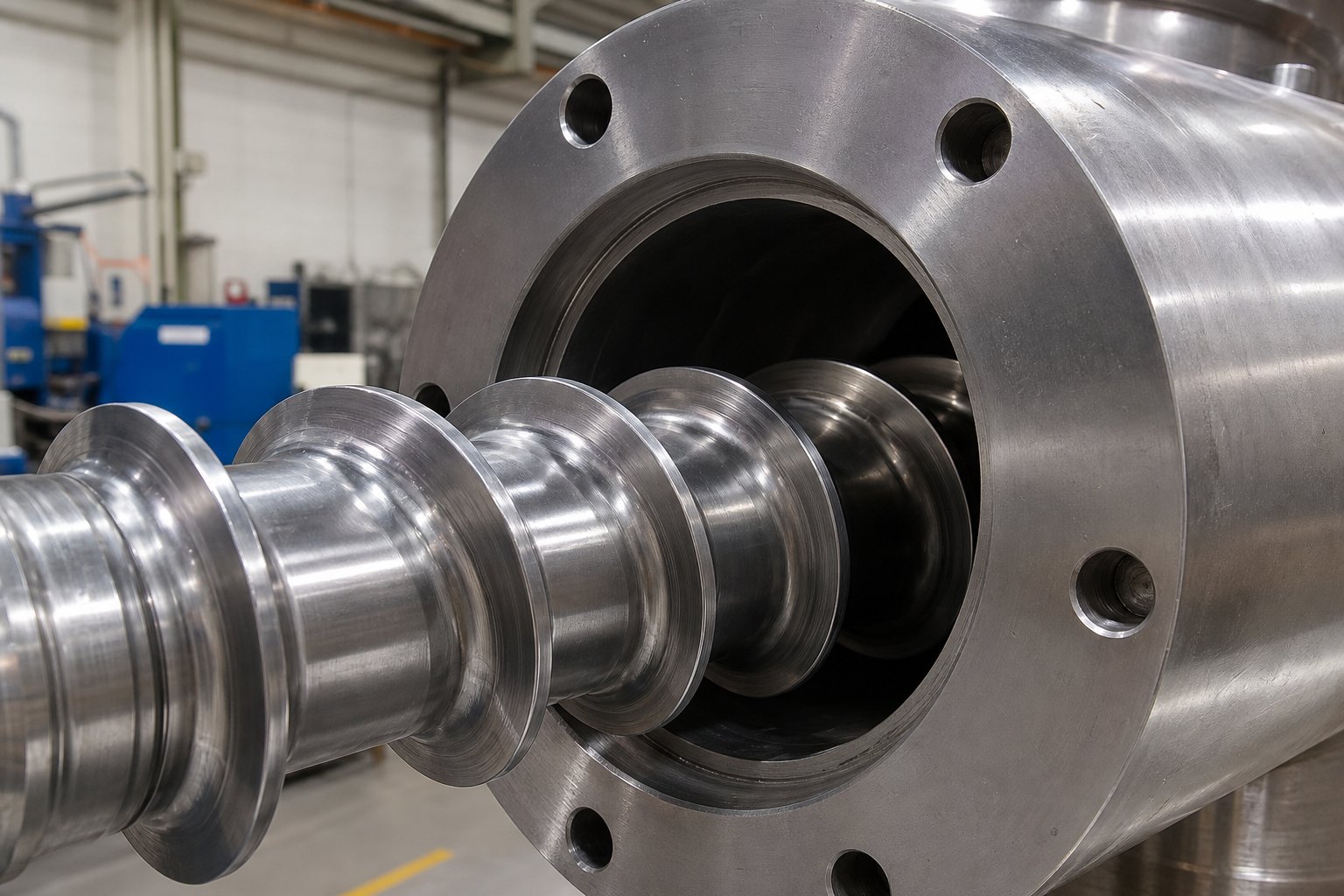
Think of the extruder screw barrel as an integrated system rather than two separate parts. The screw generates forward pressure and mixing action, but it can only do so effectively against a barrel bore that maintains its original diameter, surface condition, and thermal uniformity. When the barrel degrades — even by fractions of a millimeter — the entire system's efficiency drops. Industry troubleshooting guidance consistently identifies growing screw-to-barrel clearance as a root cause of reduced throughput, higher discharge temperatures, and increased process variability.
Why the Barrel Matters to Your End Product
Every defect you see in a finished extrudate — gels in film, rough surface on a profile, dimensional drift in a pipe wall — can often be traced back to what happens inside the barrel bore. Here's how:
- Bore condition affects melt homogeneity. A worn or scored bore allows molten polymer to slip backward past the plastic extruder screw flights instead of moving forward. The result? Unmelted particles, inconsistent viscosity, and visible defects in the final product.
- Temperature uniformity controls molecular behavior. Hot spots from a thinning liner or failing heater band can degrade the polymer locally, producing discoloration, weak spots, or black specks.
- Barrel geometry — specifically the bore diameter and length-to-diameter (L/D) ratio — dictates how much residence time and shear energy the polymer receives. The wrong geometry for your resin leads to either under-processed or over-processed melt.
Research from the Plastics Industry Association suggests that selecting the right barrel and screw configuration can improve output by 15% to 30%, while the wrong choice drives up scrap rates and energy consumption. Roughly 25% of extrusion failures, according to ASTM data, stem from premature barrel wear — a problem that's preventable with the right material selection and maintenance practices.
The barrel you run today shapes every product rolling off your line tomorrow. Yet the real question isn't simply what a barrel does — it's which barrel type, which liner material, and which specification decisions will keep your operation running at peak performance. Those decisions start with understanding the fundamental barrel categories available to you.
Single Screw, Grooved Feed, and Twin Screw Barrel Types
Not every plastic extruder barrel is built the same way — and the differences go far deeper than physical dimensions. The barrel type you choose determines how your resin is conveyed, how much throughput you can achieve, and how tightly you can control melt temperature. Three primary categories dominate the industry, each engineered for distinct processing demands. Understanding where each excels (and where it falls short) is the first step toward matching your barrel to your operation.
Smooth-Bore Single Screw Barrels
If you've worked around extrusion equipment for any length of time, you've almost certainly encountered a smooth-bore barrel. It's the most common configuration in single-screw extrusion, and for good reason: simplicity, versatility, and proven reliability across a wide range of commodity resins.
A smooth-bore barrel relies entirely on friction between the polymer pellets and the barrel's inner wall to generate solid conveying. As a single extruder screw rotates inside the bore, pellets are dragged forward by this frictional force, gradually compacting and melting as they travel through the feed, transition, and metering zones. The process is straightforward, but it comes with a limitation — feed efficiency typically ranges from only 15% to 30% of the available screw channel volume, as Plastics Technology notes, because pellets can slip against the barrel wall.
For general-purpose extrusion of PE, PP, PS, and ABS, that level of feed efficiency is perfectly adequate. Smooth-bore barrels handle regrind well, tolerate a range of pellet geometries, and don't demand specialized screw designs. They're also less sensitive to pellet shape irregularities — a practical advantage when you're running blended virgin and recycled streams.
The trade-off? When head pressure rises — as it does in blown film, extrusion coating, or thin-wall tubing with narrow die gaps — a reverse pressure flow develops inside the screw channels. This subtracts from output and increases melt temperature, since material is essentially recirculated back into the screw. For high-viscosity polyolefins that require maximum throughput, that efficiency gap becomes costly.
Grooved Feed Barrels for Polyolefin Processing
Here's where things get interesting. Grooved feed barrels solve the friction limitation of smooth-bore designs by mechanically locking pellets in place rather than relying on surface friction alone.
The concept is elegantly simple: longitudinal or helical grooves are machined directly into the bore surface of the extruder feed barrel — typically within the first 3.5 to 4 diameters of barrel length. These grooves prevent pellets from rotating with the screw, forcing them forward like a wedge. The result is a dramatic increase in solids conveying rate that's largely independent of the barrel-polymer friction coefficient.
How dramatic? In a case study comparing a 90-mm grooved-feed screw extruder against a 114-mm smooth-bore machine — both running fractional-melt HDPE at 1,100 lb/hr — the grooved-feed extruder delivered a 26.5% increase in output and a 27 degrees F drop in melt temperature at the same screw speed. The smaller machine outperformed the larger one. Energy savings from this comparison translated to $26,800-$38,800 per year, depending on the resin grade.
That performance advantage comes with specific requirements, though. The grooved section must be intensively cooled — typically with high-volume chilled water — to prevent premature melting. If pellets soften too early, they smear over the grooves, eliminating the mechanical locking effect and potentially causing instability. Groove lengths are usually limited to 4D or less because pressure rises exponentially along the grooved zone, with pressures sometimes exceeding 12,000 PSI at the end of the grooved section.
Grooved feed barrels are the standard for HDPE pipe extrusion and HMW-HDPE blown film production. They also perform well with PP in high-output applications. They are not, however, general-purpose solutions. Soft polymers like many TPEs can plug the grooves, as can powdered resins and most regrind with irregular particle shapes. Screw design must also be specifically matched to the grooved feed section — a smooth-bore screw will not work correctly in a grooved-feed barrel.
Twin Screw Barrel Configurations
Twin screw barrels occupy an entirely different category. Instead of a round bore housing a single screw, these barrels feature a figure-eight cross-section that accommodates two intermeshing screws rotating either co-rotationally (same direction) or counter-rotationally (opposite directions).
The real differentiator, though, is modularity. A twin screw barrel is typically built from segmented sections — each four to six diameters long — that bolt together to form the complete processing length. Each segment is independently heated and cooled, and individual sections can be swapped out to reconfigure the barrel layout for different compounding tasks. As Plastics Technology explains, you can view a twin-screw extruder as a series of unit operations arranged in sequence, and the barrel layout is key to that flexibility.
This modular construction allows processors to incorporate specialized barrel segments at precise locations along the barrel length:
- Open barrel sections for main feeding or downstream powder addition
- Side-feed barrels with secondary figure-eight openings for side stuffers that introduce fillers, fibers, or additives into the melt
- Vent barrels — both atmospheric and vacuum — for devolatilization of moisture, reaction byproducts, or residual monomers
- Liquid injection barrels fitted with injection ports for introducing oils, peroxides, or other liquids directly into the melt stream
For compounding operations that blend polymers with glass fibers, mineral fillers, or color concentrates, this configurability is essential. A single-screw barrel — whether smooth-bore or grooved — simply cannot accommodate the same range of feeding, mixing, and venting requirements without costly custom machining. Twin screw barrels make it possible to optimize each zone of the process independently, from solids conveying through melting, mixing, devolatilization, and final pumping to the die.
| Feature | Smooth-Bore Single Screw | Grooved Feed Single Screw | Twin Screw (Co-Rotating) |
|---|---|---|---|
| Bore Geometry | Round, continuous bore | Round bore with longitudinal or helical grooves in feed zone | Figure-eight cross-section, modular segments |
| Conveying Mechanism | Barrel-wall friction (15-30% feed efficiency) | Mechanical pellet locking (feed efficiency far exceeds smooth-bore) | Positive displacement via intermeshing screws |
| Primary Applications | General-purpose extrusion of PE, PP, PS, ABS; film, pipe, profile | HDPE pipe, HMW-HDPE blown film, high-output PP extrusion | Compounding, reactive extrusion, devolatilization, filled and reinforced resins |
| Cooling Requirements | Standard barrel cooling across all zones | Intensive chilled-water cooling required in grooved feed section | Independent heating and cooling per barrel segment |
| Key Advantage | Versatility, handles regrind and varied pellet shapes | Higher output and lower melt temperature with polyolefins | Full modularity — feeding, venting, and injection at any barrel position |
| Key Limitation | Output drops and melt temperature rises under high head pressure | Not suitable for soft polymers, powders, or most regrind | Higher capital cost, more complex operation and maintenance |
Each barrel type represents a fundamentally different approach to moving polymer through a screw extruder — and no single design is universally superior. The right choice depends on your resin, your product, and the throughput targets your operation demands. Yet barrel geometry is only half the equation. The liner material inside that bore determines how long your barrel maintains its performance — and how quickly wear erodes the precision you're paying for.
Barrel Material Selection Guide for Every Polymer Type
Barrel geometry gets you the right processing behavior — but the liner material inside that bore is what determines how long that behavior lasts. Choose incorrectly, and you'll watch a brand-new extrusion barrel degrade in months rather than years. Choose wisely, and the same barrel keeps running with minimal clearance growth across millions of pounds of throughput. The decision comes down to matching your liner metallurgy to the wear and corrosion demands of the resins you actually process.
Nitrided Steel Barrels for Standard Processing
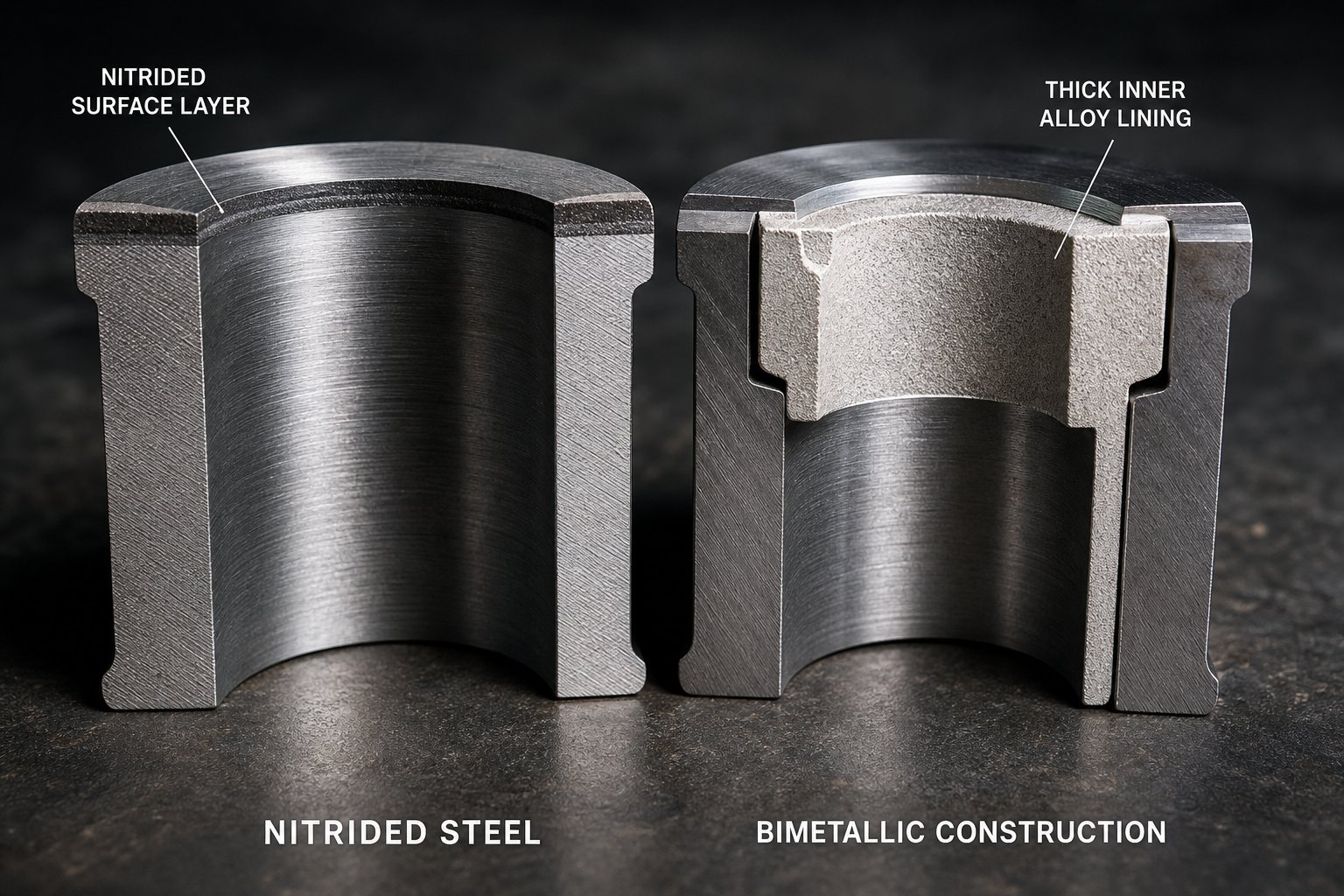
Gas-nitrided barrels are the entry point for most processors — and for clean, unfilled commodity resins, they're often all you need. The nitriding process diffuses nitrogen into the barrel's base steel, forming a hardened surface case typically reaching 0.4 to 0.7 mm deep with surface hardness in the 55-70 HRc range, depending on the base steel alloy selected.
Common base steels for nitrided extruder barrels include 38CrMoAlA, 34CrAlNi7, and 42CrMo — each chosen for its ability to accept nitrogen diffusion and form a stable, hard nitride layer. For processing natural PE, PP, PS, or ABS without abrasive fillers or corrosive additives, a nitrided barrel and screw combination delivers reliable service at a significantly lower cost than bimetallic alternatives.
Here's the critical limitation, though: that hardened case is thin. Imagine painting a table with one coat of varnish — it protects the wood beautifully until someone scratches through it, and then the soft wood underneath wears away fast. The same principle applies here. Once abrasive fillers like glass fiber, talc, or calcium carbonate cut through the nitrided layer, the softer core steel beneath erodes rapidly. As one industry expert notes, the composite thermoplastic will erode the base metal like "a hot knife through butter" once the case is gone — and the operator won't know it's happening unless the barrel is pulled and inspected regularly.
Corrosive resins pose an equally serious problem. The acidic decomposition products released during PVC processing, for example, attack a nitrided surface in ways that hardness alone cannot resist. For these applications, nitriding simply isn't enough.
Bimetallic Lined Barrels for Demanding Applications
When fillers get abrasive or chemistry turns corrosive, bimetallic barrels take over. The term "bimetallic" means exactly what it suggests — two metals working together. A structural base steel provides the barrel's mechanical strength, while a centrifugally cast alloy liner protects the bore surface from wear and chemical attack.
The manufacturing process involves spinning molten alloy powder inside a pre-bored barrel, forcing the alloy against the inner wall to form a dense, uniform lining. The resulting liner typically runs 2.0 to 3.0 mm thick — roughly three to seven times the depth of a nitrided case. That added thickness translates directly into longer service life under demanding conditions, because there's simply more wear-resistant material to consume before performance degrades.
Not all bimetallic liners are created equal, however. Three main alloy families dominate the market, each engineered for a different type of threat:
- Iron-based boron alloys — These deliver the highest abrasion resistance, with surface hardness often reaching HRc 58-62. They're the go-to choice for processing glass-filled nylons, mineral-filled polypropylene, and other reinforced compounds where hard particles constantly scour the bore. Think of them as the armor-plating option for your barrel.
- Nickel-based alloys — Formulated with nickel, chromium, cobalt, and boron, these liners prioritize chemical resistance over raw hardness. They're essential for running PVC, fluoropolymers like PVDF, and any resin system that generates corrosive decomposition byproducts. Nordson's engineering team recommends pairing nickel-based liners with a nickel-based backing steel or a trimetallic construction for the most aggressive corrosive environments.
- Combination alloys — These balanced formulations incorporate elements like vanadium alongside nickel, chromium, and boron to resist both abrasion and corrosion simultaneously. They're a practical choice when your production schedule rotates between filled engineering resins and chemically aggressive materials, or when you're simply unsure which wear mechanism will dominate.
One detail that's easy to overlook: the composition, uniform thickness, and porosity of the liner all affect service life. A poorly cast liner with voids or uneven thickness will fail prematurely regardless of the alloy grade. Reputable barrel manufacturers document inlay composition with traceable metallurgical data, and the quality of the centrifugal casting process — including furnace type, spin speed, and cooling rate — varies significantly between suppliers.
When to Specify Tungsten Carbide or Specialty Liners
Some processing environments push even standard bimetallic liners past their limits. Highly abrasive ceramic-filled engineering plastics, heavily loaded mineral compounds, and recycled streams contaminated with metal fines, sand, or paper fibers all create wear conditions where conventional iron-boron alloys wear out faster than the maintenance schedule can accommodate.
This is where tungsten-carbide-bearing liners earn their premium. These liners suspend particles of tungsten carbide (or in some cases titanium or tantalum carbide) within a corrosion-resistant matrix of nickel, cobalt, and chromium. The embedded carbide particles act as extremely hard wear points distributed throughout the liner, dramatically increasing abrasion resistance. Industry testing has shown that incorporating tungsten carbide into a bimetallic liner can increase barrel life by four to five times compared to standard bimetallic grades — a significant return on the higher upfront cost.
These specialty liners also tolerate higher operating temperatures. Premium tungsten-carbide alloys can handle continuous service up to approximately 600 degrees C, making them suitable for processing high-temperature engineering polymers like PEI, PPS, and PEEK where standard liners would soften and lose their protective properties.
So how do you decide which liner your operation actually needs? Here's a practical if-then framework you can apply immediately:
- If processing unfilled commodity resins (PE, PP, PS, ABS) → Nitrided steel barrel — cost-effective protection that matches the duty
- If processing glass-filled nylon or mineral-filled PP → Iron-boron bimetallic liner — hard enough to resist abrasive filler particles cutting through the bore
- If processing PVC or PVDF → Nickel-alloy bimetallic liner — chemical resistance to corrosive decomposition products is the priority
- If processing ceramic-filled compounds or heavily contaminated recycled streams → Tungsten-carbide-rich bimetallic or full carbide liner — maximum abrasion resistance for the most punishing feedstocks
Keep in mind that selecting the right barrel liner is only half the barrel and screw equation. The screw's hardfacing alloy must be compatible with the barrel liner — certain combinations can actually accelerate wear on one or both components. A mismatched pair of premium components can underperform a properly matched pair of standard ones.
Material selection sets the foundation for barrel longevity, but the barrel still needs to be specified correctly for the extrusion process it's serving. Film lines, pipe dies, and compounding operations each impose different demands on barrel length, zone control, and port configurations — and those application-specific requirements shape how a barrel performs just as much as the alloy inside it.
Matching Barrel Design to Your Screw Extrusion Application
A barrel that performs flawlessly on a blown film line might be entirely wrong for a pipe die — even if both run the same resin. Why? Because the extrusion application itself dictates a unique combination of barrel length, zone control precision, port configurations, and liner durability requirements. Liner material tells you how long a barrel lasts; application-specific design determines how well it performs every hour it's running.
Yet barrel specification guides almost always stop at resin type. They tell you to pick a bimetallic liner for glass-filled nylon and call it a day. What they miss is the process context — the specific thermal, mechanical, and throughput demands that change dramatically depending on whether that nylon ends up as packaging film, a structural profile, or a compounded pellet. Let's fix that gap.
Barrel Specs for Blown Film and Cast Film Lines
Film extrusion is one of the most thermally unforgiving applications a plastic extruder barrel will ever face. A temperature deviation of just a few degrees across the melt stream shows up instantly as gels, die lines, or gauge variation in the finished film — defects you can literally see and measure. That sensitivity makes barrel specification for film lines less about raw throughput and more about thermal precision.
Longer barrels are the norm here. Blown film lines typically run L/D ratios of 28:1 to 32:1, while cast film lines push even further to 30:1 to 36:1. The extra length isn't about brute melting capacity — it provides additional barrel zones for fine-tuning the temperature profile and ensures the polymer has enough residence time to reach a fully homogeneous melt state before it hits the die.
Barrel temperature profiling plays a critical role in this process. As extrusion research from Dow's Mark Spalding explains, the barrel zones covering the melting section often benefit from a "hump" temperature profile — where melting-zone barrel temperatures run 30 to 50 degrees C above the feed section and the metering section is set near the target discharge temperature. For LDPE film, this might mean running the melting zones at up to 240 degrees C while keeping the metering zone closer to 200 degrees C, increasing the melting flux by as much as 20% without over-shearing the polymer.
The feed section design splits along resin lines. Smooth-bore barrels remain the standard for LDPE and LLDPE blown film, where the branched molecular architecture of LDPE provides adequate barrel-wall friction for solid conveying, and LLDPE's narrow molecular weight distribution responds well to moderate feed conditions. HDPE film, by contrast, almost always calls for a grooved feed barrel. The mechanical pellet locking in the grooved zone delivers the high solids conveying rates that HDPE requires for stable bubble formation, while the intensive cooling in the grooved section prevents premature melting that would kill feed efficiency.
Cast film lines impose their own barrel requirements. Because cast processes run higher melt temperatures — typically 220 to 260 degrees C for PP and PE — and demand extremely flat melt temperature distribution across the die width, the barrel's heating and cooling system must respond quickly and uniformly. A barrel with sluggish thermal response or uneven heater-band coverage will produce gauge bands in the finished film that no amount of downstream die-bolt adjustment can fully correct.
Pipe and Profile Extrusion Barrel Considerations
Pipe and profile extrusion flip the priority from thermal precision to output stability. When you're extruding a pressure-rated water pipe or a tight-tolerance window profile, dimensional accuracy depends on consistent melt pressure at the die — and melt pressure consistency starts inside the barrel.
Imagine running a 200-mm PVC pipe at 800 kg/hr. Even a 2% surge in melt pressure causes a measurable wall-thickness variation that can push the pipe outside of specification. The plastic extrusion screw generates that pressure, but the barrel's bore condition and temperature uniformity determine whether the screw can deliver it steadily.
Barrel temperature profiling in pipe extrusion follows a different logic than film. Rather than a hump profile, pipe and profile lines typically benefit from a gradually ascending or flat temperature profile across the melting and metering zones — the goal is to avoid localized overheating that could degrade the polymer (particularly critical for PVC, which has a very narrow processing window between fusion and thermal decomposition). Zone-to-zone temperature variation should be held to 5 degrees C or less in the metering section to prevent viscosity fluctuations that translate directly into pressure surging at the die.
PVC pipe and profile extrusion introduces an additional barrel requirement: corrosion resistance. As discussed in the material selection section, PVC releases hydrochloric acid during processing, so nickel-alloy bimetallic liners are standard for any barrel running PVC-based formulations. Neglecting this specification doesn't just shorten barrel life — it contaminates the melt with corroded metal particles that create weak spots in the pipe wall.
For large-diameter polyolefin pipe (PE100, PE4710), grooved feed barrels are increasingly specified to maximize output while keeping melt temperature low enough to maintain the resin's long-term hydrostatic strength rating. The combination of a grooved feed section with a properly designed plastic extrusion screw gives pipe producers the throughput they need without the excessive shear heating that degrades pipe performance over decades of service.
Compounding and Recycling Barrel Requirements
Compounding and recycling represent the most mechanically demanding barrel applications in the plastics industry — and they require a fundamentally different barrel architecture than any single-screw extrusion process.
Compounding operations overwhelmingly run on co-rotating twin screw extruders, and the twin screw and barrel system is built around modularity. A typical compounding barrel consists of 8 to 14 individual segments bolted together in sequence, each segment independently heated and cooled. This modular construction allows processors to position specialized barrel sections exactly where the process needs them:
- Open feed barrels at the main feed throat and downstream locations for powder or pellet addition
- Side-stuffer barrels with secondary figure-eight openings for introducing glass fibers, mineral fillers, or additives into the melt without damaging fiber length
- Vent barrels — both atmospheric and vacuum — positioned downstream of melting zones to remove moisture, trapped air, or volatile byproducts
- Liquid injection barrels fitted with ports for introducing oils, peroxides, cross-linking agents, or liquid colorants directly into the melt stream
As Juyuan Machinery explains, segmented barrels also simplify maintenance — if one barrel section wears out from processing an abrasive formulation, you replace that section rather than the entire barrel assembly. For compounders running multiple formulations with different wear profiles, this modular approach dramatically reduces downtime and replacement costs compared to monolithic barrel designs.
Recycling applications multiply the wear challenge. Post-consumer recycled streams routinely contain metal fines from shredding equipment, sand and dirt from contaminated bales, paper fibers, and even small stones. These contaminants turn the barrel bore into a grinding chamber. Bimetallic liners are the minimum standard for recycling lines — and for heavily contaminated streams, tungsten-carbide-rich liners pay for themselves quickly through extended service intervals and reduced unplanned downtime.
The barrel segments closest to the feed zone and any side-stuffer openings absorb the heaviest wear, since that's where abrasive solids concentrate before melting and mixing dilute them into the polymer matrix. Experienced compounders and recyclers specify higher-grade liners in these high-wear zones while using standard bimetallic or nitrided segments in lower-stress downstream positions — a targeted approach that optimizes cost without sacrificing barrel life where it matters most.
| Extrusion Type | Recommended Barrel Type | Suggested L/D Range | Preferred Liner Material | Key Barrel Features |
|---|---|---|---|---|
| LDPE / LLDPE Blown Film | Smooth-bore single screw | 28:1 - 32:1 | Nitrided steel (unfilled) or iron-boron bimetallic (with CaCO₃ or TiO₂) | Multiple precision heating zones, hump temperature profiling, tight bore tolerance for melt uniformity |
| HDPE Blown Film | Grooved feed single screw | 28:1 - 32:1 | Iron-boron bimetallic | Intensive chilled-water cooling in grooved feed section, high-pressure-rated feed zone |
| PP / PE Cast Film | Smooth-bore single screw (barrier screw design) | 30:1 - 36:1 | Nitrided steel or iron-boron bimetallic | Fast-response heating and cooling for tight melt temperature control across die width |
| PVC Pipe and Profile | Smooth-bore single screw or conical twin screw | 24:1 - 28:1 | Nickel-alloy bimetallic (corrosion-resistant) | Corrosion-resistant liner essential, gradual or flat temperature profile, narrow processing window management |
| Polyolefin Pipe (PE100) | Grooved feed single screw | 28:1 - 33:1 | Iron-boron bimetallic | Grooved feed for high output at low melt temperature, consistent melt pressure for wall-thickness accuracy |
| Compounding (Filled / Reinforced) | Modular segmented twin screw | 32:1 - 48:1 | Iron-boron or tungsten-carbide bimetallic in high-wear zones; nitrided steel in low-stress zones | Side-stuffer ports, atmospheric and vacuum vent barrels, liquid injection barrels, zone-targeted liner grades |
| Recycling (Post-Consumer) | Modular segmented twin screw | 36:1 - 48:1 | Tungsten-carbide bimetallic in feed and side-feed zones; iron-boron bimetallic downstream | Vent ports for devolatilization of moisture and contaminants, heavy-duty liners to resist metal and sand contamination |
Every row in that table represents a different set of barrel demands — from the thermal finesse of film extrusion to the brute durability required by recycling. The barrel itself may look like a simple steel cylinder from the outside, but the engineering decisions embedded in its design directly shape throughput, product quality, and maintenance costs for years of continuous operation. Still, even the best-specified barrel can underperform if the screw spinning inside it isn't designed as its complement. The barrel-screw relationship is a system — and treating either component in isolation is one of the most common and costly mistakes in screw extrusion.
The Barrel-Screw System and Why Both Components Must Align
You've selected the right barrel type. You've specified the correct liner material. You've matched the L/D ratio to your extrusion application. And yet your line is surging, melt temperature is running too high, and finished product quality is slipping. What went wrong? Chances are, someone replaced the barrel without checking whether the extruder screw still complements it — or vice versa. Treating the barrel and screw as independent purchases is one of the most expensive shortcuts in plastics processing.
How Barrel Geometry Must Match Screw Design
The barrel bore diameter, the L/D ratio, and the screw's compression ratio all form an interconnected system. Change one variable without adjusting the others, and you'll create processing problems that no amount of temperature tweaking or speed adjustment can fix.
Consider what happens when a processor installs a new barrel but keeps running the original extrusion screw. If that screw has lost flight-tip material from years of abrasive wear, the radial clearance between the screw's outer diameter and the barrel bore is now far larger than it should be — even though the barrel itself is perfect. The result? Molten polymer leaks backward over the screw flights instead of moving forward toward the die. Output drops, melt temperature rises from viscous dissipation in the leakage flow, and the operator compensates by cranking up screw speed — which accelerates wear on both components.
The numbers illustrate just how sensitive this relationship is. For plasticating extruders, standard flight clearance is typically the nominal screw diameter divided by 1,000. A 3.5-inch extruder, for example, runs a flight clearance of roughly 0.004 inches per side when new. That's a gap thinner than a sheet of copy paper — and it's there by design. This minimal clearance maximizes heat transfer between the barrel wall and the polymer, maintains high shear rates for efficient melting, and prevents excessive material leakage past the flights.
As wear progresses and that clearance doubles or triples, the effects compound. A study published in Plastics Technology showed that for a 100-mm extruder screw and barrel running 1 MI polyethylene at 150 kg/hr, increasing the flight clearance from 0.005 inches to 0.016 inches per side forced the screw speed significantly higher just to maintain the same output rate. Discharge temperature climbed from 236 degrees C toward 246 degrees C — a 10-degree rise that, in a blown film application, would make stable bubble formation nearly impossible. Rather than maintaining rate at 150 kg/hr, the processor would likely need to cut throughput by up to 13%, directly reducing line profitability.
Compression ratio compatibility matters just as much. When the capacity of the screw's melting section can't keep up with the volume of solids being delivered by the feed section, unmelted pellets plug the channel. The pressure buildup forces the screw sideways against the barrel bore — a phenomenon known as solids wedging. This causes localized galling on both the screw flights and the barrel's inner surface, creating asymmetric wear patterns that worsen alignment and accelerate further damage. It often occurs when a screw originally designed for one polymer is run on a different resin with a different melting rate — a common scenario during product changeovers or when sourcing replacement parts without verifying geometric compatibility.
Vented Barrels and Degassing Port Design
Some applications demand more from the barrel than melting and conveying — they require the barrel to remove trapped volatiles from the melt itself. Vented barrels, also called two-stage barrels, incorporate one or more open ports along their length to let moisture, trapped air, or chemical byproducts escape from the polymer before it reaches the die.
When do you need a vented barrel? Three scenarios come up repeatedly:
- Hygroscopic resins without pre-drying — Materials like nylon, PET, and polycarbonate absorb atmospheric moisture. Processing them without drying produces bubbles, splay, and reduced mechanical properties. A vented barrel can remove that moisture mid-process, eliminating or supplementing the drying step.
- Recycled material devolatilization — Post-consumer and post-industrial regrind often carry residual moisture, inks, adhesives, and other volatiles that must be extracted for acceptable part quality.
- Reaction byproduct removal — Reactive extrusion processes that involve grafting, cross-linking, or chemical modification generate volatile byproducts that must exit the melt stream before the die.
The mechanics of vented extrusion hinge on screw-barrel coordination. A two-stage vented screw works by reducing melt pressure to atmospheric pressure at the vent port location so the molten resin has no tendency to pump out of the opening. The first stage melts and pressurizes the polymer, while the second stage — which acts as a separate melt-fed screw on the same shaft — re-pressurizes the polymer and drives it through the die. The second stage's metering section must be designed with a higher output capacity than the first stage. If this capacity relationship is reversed, or if the screw channels in the venting zone aren't deep enough to remain partially filled, the vent port floods with molten polymer — a costly, labor-intensive failure that shuts down production.
Vent port geometry and placement on the barrel itself play an equally important role. Most single-screw extruders rotate counter-clockwise, and for these machines, side venting on the left side of the barrel (when facing downstream) or top venting provides the best results. The barrel must be equipped with a precisely fitted flow diverter — a plug whose inner diameter matches the barrel bore exactly, with a smooth, contoured relief area that prevents resin from accumulating and pumping out the port. As SpiraMelt Technologies explains, if a vent floods at a continuous pumping rate, inadequate screw design is the likely cause. If the flooding occurs with a pulsing or burping action that corresponds to screw RPM, the flow diverter is most likely improperly designed.
Vacuum level at the vent port adds another dimension of control. Atmospheric venting works for applications with moderate volatile levels, but heavily loaded recycled streams or highly hygroscopic resins typically require vacuum-assisted venting — often in the range of 15 to 25 inches of mercury — to achieve adequate degassing. Three-stage screws with two vent ports are available for the most demanding devolatilization applications, though the added processing length further reduces the throughput available from a given L/D.
Barrel and screw must always be evaluated together during specification, replacement, or troubleshooting. A new barrel paired with a worn screw — or a vented barrel paired with an improperly staged screw — will underperform a properly matched system of lesser individual quality.
This system-level perspective reframes how processors should think about component replacement. Pulling the screw for inspection every time a barrel is swapped isn't optional maintenance — it's the only way to verify that clearances, compression ratios, and venting capacity still fall within operating spec. Neglecting that verification is how hidden wear turns into visible product defects — the very wear patterns and failure modes that, with the right knowledge, can be identified and prevented before they compromise your line.
Understanding Barrel Wear and How to Prevent It
Worn screws and barrels don't fail overnight. They degrade gradually — fraction of a millimeter by fraction of a millimeter — until one day output drops, scrap rates climb, and you're staring at a bore gauge wondering how things got so bad. The typical response? Pull the screw, measure the damage, and scramble for replacements. But wear isn't something you react to — it's something you design against from the moment you specify a plastic extruder barrel. Understanding the three mechanisms that destroy bore surfaces gives you the power to slow each one down before it starts costing real money.
Abrasive, Adhesive, and Corrosive Wear Mechanisms Explained
Every bore surface in every operating extruder is under attack from at least one of three distinct wear mechanisms. Recognizing which one dominates your process is the single most important factor in choosing the right liner material — and in predicting when your barrel will need attention.
Abrasive wear is the most straightforward to visualize. Hard filler particles — glass fibers, mineral fillers like calcium carbonate and talc, titanium dioxide pigments — act like fine sandpaper as the screw drives them against the barrel bore. Over millions of rotations, those particles score and erode the bore surface, gradually enlarging the barrel's internal diameter. As Sai Extrumech's engineering team notes, the sharp machined corners of screw and barrel components appear rounded, smooth, and occasionally polished when subjected to abrasion. The severity depends on filler hardness, concentration, screw speed, and throughput — it's driven by the total volume of material processed rather than simply the hours on the clock.
Adhesive wear occurs when metal meets metal. In a healthy extrusion process, the polymer melt forms a thin lubricating film between the screw flight tips and the barrel wall. When that film breaks down — due to inconsistent feed rates, momentary starve feeding, running the screw dry between production batches, or barrel-screw misalignment — the flight OD contacts the bore directly. The result is galling, scoring, and material transfer between the two surfaces. You'll see flattened screw flight tips and matching score marks on the barrel wall. In twin screw extruders, adhesive wear also manifests as scratches on the flanks and roots of screw elements when deflecting shafts allow the screws to contact each other or the barrel bore.
Corrosive wear is the subtlest and often the most damaging. It doesn't grind the bore away — it dissolves it. When PVC degrades at processing temperatures, it releases hydrochloric acid. Fluoropolymers emit hydrofluoric acid. Flame-retardant additives can generate corrosive halogenated byproducts. These acidic decomposition products chemically attack the metal surface, creating pitting, roughening, and etching that weaken the bore's structural integrity. Corrosive wear accelerates dramatically if the machine sits idle with residual material inside, or if temperatures exceed the resin's thermal stability window even briefly.
Here's the critical insight most troubleshooting guides miss: in real-world processing, barrels rarely fail from a single mechanism. A processor running mineral-filled PVC, for example, faces abrasive wear from the filler and corrosive wear from the resin's degradation chemistry — simultaneously. A recycler processing post-consumer HDPE with metal contaminants experiences abrasive wear from the debris plus adhesive wear from intermittent starvation during inconsistent feed. The dominant mechanism determines your liner choice, but ignoring the secondary mechanisms shortens screw barrel life far faster than expected.
Proactive Strategies to Extend Barrel Life
Most barrel wear conversations happen after the damage is done. Flip that script. Every one of the three wear mechanisms can be slowed — and in some cases nearly eliminated — through specification decisions, operating discipline, and targeted maintenance practices that cost far less than a premature barrel replacement.
The proactive approach starts at specification. Matching your liner material to the dominant wear mechanism (as outlined in the material selection guide earlier) is the single highest-impact decision you can make. An iron-boron bimetallic liner resisting glass-filled compounds will outlast a nitrided barrel by a factor of three to five in the same application. A nickel-alloy liner processing PVC will maintain bore integrity long after a standard liner has been pitted beyond use. Spending more upfront on the right liner saves multiples of that cost in extended service life.
Beyond specification, operational practices play an equally important role. Here's a wear-prevention checklist your maintenance team can implement immediately:
- Purge thoroughly during every material changeover and before shutdown — Never leave corrosive or thermally sensitive polymers sitting in the barrel. Use an appropriate purge compound to displace residual material, especially before extended downtime. This single habit dramatically reduces corrosive attack on the bore surface.
- Control startup temperatures to prevent cold-start damage — Bringing the extruder up to proper operating temperature before introducing polymer prevents excessive mechanical stress on the screw and barrel. Cold starts force the screw to drag solid pellets against a cold bore with no melt lubrication, accelerating adhesive wear.
- Maintain proper screw-barrel alignment — Verify that the barrel is aligned with the gearbox and drive shaft. Misalignment forces the screw to one side of the bore, creating asymmetric adhesive wear patterns that worsen progressively. Periodic alignment checks — especially after barrel replacements or foundation work — prevent this entirely avoidable failure mode.
- Monitor barrel zone temperatures for hot spots — A zone that consistently runs hotter than its setpoint, or that refuses to cool down, may indicate liner thinning. As the liner wears, its thermal mass decreases, and the remaining wall transfers heat less uniformly. Trending zone temperatures over weeks and months gives early warning of developing wear before a bore gauge confirms it.
- Control melt temperature to minimize corrosive degradation — Every degree above the resin's recommended processing range accelerates thermal decomposition. For corrosion-sensitive resins like PVC, keeping melt temperature within the safe processing window isn't just a quality measure — it's a barrel preservation strategy.
- Inspect raw material quality before it enters the feed throat — Metal fragments, dirt, sand, and moisture in the feedstock cause sudden, localized damage to both screws and barrels. A simple pre-feed inspection protocol catches contamination before it reaches the bore.
- Schedule regular screw pull inspections — At minimum once per year for standard applications, and every six months for lines processing filled, abrasive, or corrosive materials. Measure bore diameter and screw OD at multiple axial and rotational positions. Catching wear early — while it's still within serviceable limits — gives you time to plan replacement rather than react to a crisis.
- Never run the screw dry at high speed between production batches — Without polymer in the channel, the melt lubricating film between screw flights and barrel bore disappears. Running the screw at full speed in this state is one of the fastest ways to generate adhesive wear on both components.
Think of these actions not as a maintenance burden but as an insurance policy for your screw and barrel investment. A set of high-quality screws and barrels represents a significant capital outlay — and every hour of extended service life those components deliver is money that stays in your operation rather than going to a replacement order.
Prevention, however, only works if you can measure what you're preventing. Knowing how to inspect a barrel bore, where to measure, and what the numbers actually mean separates proactive maintenance programs from wishful thinking — and it's the skill that determines whether your next barrel swap happens on your schedule or your barrel's.
How to Inspect and Measure Barrel Wear Like a Pro
A wear-prevention strategy is only as good as the data backing it up. You can purge religiously, control temperatures perfectly, and specify the ideal liner — but if nobody is pulling the screw and putting a gauge inside the bore, you're flying blind. Barrel wear doesn't announce itself with a warning light. It reveals itself in bore measurements — millimeter by millimeter, position by position — and reading those measurements correctly is what separates a planned, budgeted barrel swap from an emergency shutdown that costs you a full shift of production.
Most maintenance teams know they should measure their extrusion barrels regularly. Far fewer know exactly how to do it correctly, where along the barrel to take readings, and what those numbers actually mean when they show up on the gauge. Here's the procedural guide that fills that gap.
Step-by-Step Barrel Bore Measurement Procedure
Accurate bore measurement isn't complicated, but it is unforgiving of shortcuts. Skip a step — or take readings on a dirty bore — and you'll either miss real wear or chase phantom problems that don't exist. The following procedure, informed by Davis-Standard's maintenance protocols, gives your team a repeatable process that produces reliable, comparable data every time.
- Shut down the extruder and allow the barrel to cool to room temperature. Thermal expansion skews bore diameter readings. A barrel at processing temperature may measure several thousandths of an inch larger than its true cold dimension, so patience here prevents false data. Do not rush this step.
- Pull the extruder screw completely. Follow your equipment manufacturer's procedure for safe screw removal. Set the screw aside on a clean rack — you'll want to measure its outside diameter at the same time for a complete clearance picture.
- Clean the barrel bore thoroughly. Use a wire brush that fits snugly inside the bore to remove residual polymer, carbon deposits, and any degraded material clinging to the wall. Follow with copper gauze for a final polish. Every speck of residue left behind adds to your measurement and makes the bore look more worn than it actually is. A clean bore is a non-negotiable prerequisite for accurate data.
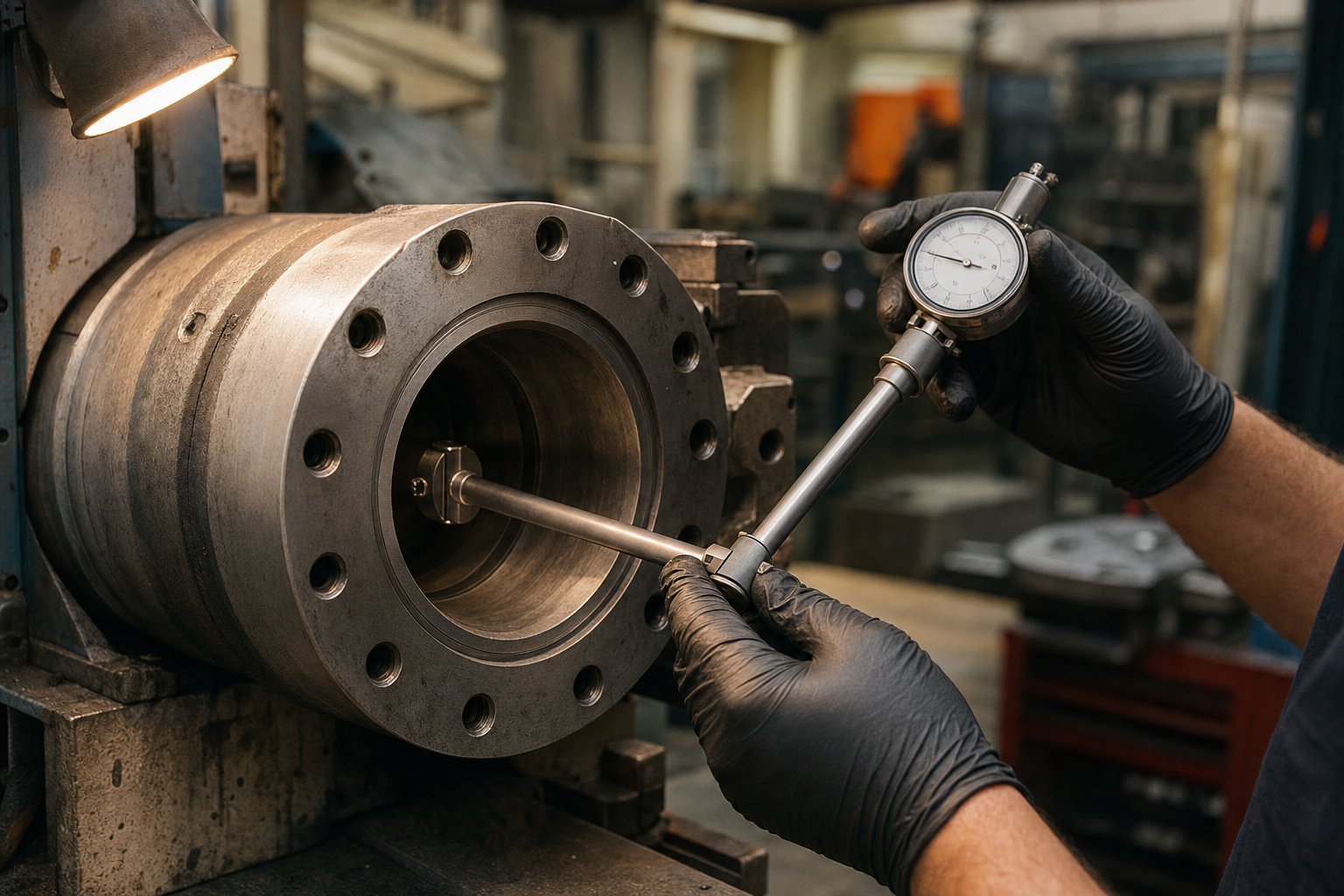
- Select and calibrate your measurement tool. The preferred instrument is an electronic bore gauge (also called an internal micrometer) mounted on a movable sled that centers itself inside the barrel. Calibrate it to the barrel's original nominal bore diameter before inserting it. If an electronic gauge isn't available, a precision three-point bore gauge such as a Starrett 452B series provides workable accuracy — though electronic gauges yield more consistent readings, especially deep inside long barrels where dial indicators become difficult to read visually.
- Insert the gauge and take readings at multiple axial positions. Move the gauge along the barrel length in increments of one L/D — meaning if you have a 4.5-inch barrel, advance the sled roughly 4.5 inches between readings. At minimum, measure every 12 inches along the full barrel length to build a complete wear profile. Focus additional readings in the transition zone and the entry to the metering zone, where wear tends to concentrate.
- At each axial position, measure at multiple rotational orientations. Rotate the gauge to capture bore diameter at the 12 o'clock, 3 o'clock, 6 o'clock, and 9 o'clock positions. This step is critical — it reveals asymmetric wear that a single-direction measurement would completely miss.
- Record every measurement systematically. Log each reading against its axial position (distance from the feed throat) and rotational orientation. A simple spreadsheet or data table works — the key is consistency so you can compare today's measurements against previous inspections and the original manufacturer specifications.
- Compare all readings against the nominal bore diameter and manufacturer tolerances. The original bore dimension and its tolerance range should be documented in your equipment records. Any deviation beyond tolerance represents wear. Plot the data to create a visual wear profile along the barrel length — this graph will immediately show you where wear is concentrated and how severe it is.
One practical tip from experienced maintenance professionals: if your barrel exceeds five feet in length, reading a mechanical dial gauge becomes extremely difficult beyond that depth. An aluminum extension rod marked in measurement increments, attached to the gauge handle, lets you push the gauge deeper while tracking position accurately. For barrels longer than eight feet, electronic gauges with digital readouts transmitted by cable to an external display are strongly recommended — they eliminate the guesswork of trying to read tiny dial markings inside a dark bore.
Interpreting Wear Patterns and Setting Replacement Thresholds
Raw numbers on a spreadsheet don't tell you much by themselves. The real diagnostic value comes from recognizing patterns — where wear occurs, how it's distributed around the circumference, and how quickly it's progressing between inspections. Each pattern points to a different root cause, and understanding those patterns lets you address the source of wear rather than just replacing the barrel and waiting for it to happen again.
Here's what the most common wear patterns indicate:
- Uniform wear across the metering zone — This is the most typical pattern in lines processing filled or abrasive materials. The metering zone sees the highest melt pressures and the most intimate contact between filled polymer and the bore wall. If wear is evenly distributed around all four clock positions and increases gradually along the metering section, you're looking at normal abrasive wear. The liner material is doing its job — it's just being consumed at a predictable rate. Upgrading to a more abrasion-resistant liner grade (such as moving from nitrided steel to iron-boron bimetallic) is the correct response if the wear rate exceeds your maintenance window.
- Localized wear concentrated in the feed section — When the feed zone shows significantly more wear than downstream zones, two culprits dominate: barrel-screw misalignment or inadequate feed throat cooling. Misalignment forces the screw to ride against one side of the bore at the feed end, where the cantilevered distance from the gearbox support is shortest and deflection forces are highest. Insufficient cooling at the feed throat allows premature pellet melting, which destroys the solid-bed conveying mechanism and creates erratic side forces. Check alignment first — it's the more common cause and the easier fix.
- Asymmetric wear at one clock position — If the 6 o'clock position consistently reads more worn than the 12 o'clock position (or any single orientation shows disproportionate wear), the barrel is likely sagging under its own weight or the screw is deflecting to one side due to misalignment. Long barrels with inadequate intermediate support are particularly susceptible. Barrel sag is progressive — the worse the asymmetric wear gets, the more the screw drifts, and the faster wear accelerates. Correcting support placement and verifying alignment are essential before installing a replacement barrel.
- Wear concentrated at the entry to mixing elements — Grooves or localized enlargement immediately upstream of a Maddock mixer, barrier flight, or other restrictive screw geometry often indicate solids wedging. Unmelted pellets jam against the barrier, creating extreme side forces that push the screw into the barrel wall. This pattern calls for screw design review rather than barrel replacement alone.
Setting a replacement threshold is where the judgment call gets nuanced. Industry guidelines for extruder screws and barrels offer several benchmarks. One widely cited standard suggests considering barrel relining when the bore diameter has increased by more than 0.20 mm beyond nominal, and replacing extruder screws when flight clearance exceeds 0.15 mm per side. Plastics Technology's analysis adds important context: some applications can tolerate a flight clearance increase of up to four times the original clearance (4x), while critical-duty processes — medical tubing, optical film, pharmaceutical packaging — may require screw replacement at just two times the original clearance (2x) to maintain acceptable product quality.
The honest answer is that no single threshold works for every operation. The acceptable clearance depends on several interrelated factors:
- Polymer viscosity — Low-viscosity melts leak more readily through enlarged clearances, so the same amount of wear causes a greater performance loss on low-MI materials than on high-viscosity resins.
- Product quality tolerances — A corrugated drainage pipe can tolerate far more wear-related process variability than a precision medical catheter. Define your quality requirements first, then set your clearance limits accordingly.
- Economic impact of reduced throughput — As wear increases, operators compensate by raising screw speed to maintain output. This raises discharge temperature, increases energy consumption, and may push the process outside the quality window. The right replacement trigger is the point where the cost of running worn components — in scrap, energy, and lost capacity — exceeds the cost of new extruder screws and a relined or replaced barrel.
One rule of thumb that holds across applications: a barrel with an iron-based bimetallic liner will typically last for three screw lifetimes. Screws are intentionally designed to wear faster than barrels because they're easier and less expensive to replace. Track both components on a shared maintenance schedule — every time you pull a screw for measurement, measure the barrel too. This paired approach ensures you catch developing problems in either component before they cascade into the kind of costly, unplanned downtime that wrecks production schedules.
Knowing when to measure and what the data means is the foundation of smart barrel management. The next question — what to actually do when those measurements cross the line — involves an equally important calculation: whether to rebuild the barrel you have or replace it entirely, and how to think about barrel cost in terms of total ownership rather than purchase price alone.
Barrel Cost, ROI, and the Rebuild vs. Replace Decision
Your bore gauge confirms it — clearances are past acceptable limits, wear is concentrated in the metering zone, and product quality has started to drift. The barrel needs attention. But "attention" could mean re-lining the existing barrel, re-boring it to accept an oversized screw, or replacing it outright with a new unit. Each option carries a different price tag, a different lead time, and a different impact on your line's long-term performance. Making the wrong call here can cost you more than the barrel itself.
Rebuild vs. Replace — Making the Right Economic Decision
The instinct to repair rather than replace is understandable — a refurbished barrel can save 25% to 50% compared to a new one under the right circumstances. But those "right circumstances" are narrower than most processors realize.
Barrel repair is essentially a remanufacturing process. The worn liner is bored out — typically removing about 1.0 inch of material beyond the original bore — and a new bimetallic sleeve is machined to approximately 0.5 inches of wall thickness, then heat-shrunk into the barrel body with an interference fit. Final machining and honing bring the bore back to specification. The result can approach new-barrel performance, but several factors determine whether the investment makes sense:
- Remaining wall thickness — After boring out the old liner, the barrel must retain enough structural steel to safely contain operating pressures. If the original wall was marginal or previous repairs have already thinned it, re-lining is no longer viable.
- Extent and location of wear — Localized wear concentrated at the discharge end (common in injection barrels) allows a cost-effective "short sleeve" repair that re-lines only the worn section. Wear distributed across the full barrel length requires a full-length re-line, which approaches the cost of producing a new barrel entirely.
- Original liner material — Re-lining involves boring through the extremely hard bimetallic inlay plus a portion of the backing steel while maintaining bore straightness within approximately 0.005 inches TIR. Not every repair shop has equipment rigid enough to achieve this precision. A poorly executed repair leaves air pockets between the new liner and the barrel body, degrading heat transfer and creating process instability.
- Bore integrity for oversized screw acceptance — In some cases, re-boring the barrel to a slightly larger diameter and pairing it with an oversized screw is more economical than a full re-line. This approach works only if the enlarged bore still falls within the barrel's pressure-containment safety margin and if an appropriately sized screw is available or can be manufactured.
One caution worth emphasizing: even under the most exacting conditions, a repaired barrel never quite achieves the degree of straightness, concentricity, strength, or heat transfer available with a new one. When straightness is compromised by a poorly executed repair, the result is accelerated wear on the new liner — meaning you've paid for a repair that fails prematurely. For extrusion barrels in particular, the economics of repair are tighter than for injection molding barrels because new extrusion barrels cost less to begin with, leaving less margin for repair savings.
So when does replacement win? When the barrel has been previously repaired, when wall thickness is borderline, when the application demands the tightest possible concentricity (film, medical tubing, optical sheet), or when the barrel design itself is outdated and a new specification — different L/D ratio, updated liner alloy, additional cooling provisions — would deliver better process performance going forward.
Total Cost of Ownership Beyond the Purchase Price
How much do screws cost? How much does a barrel cost? These are the first questions every processor asks — and they're the wrong starting point. Purchase price is a single line item in a cost equation that spans years of operation. Focusing on it alone is like choosing a car based solely on the sticker price while ignoring fuel economy, maintenance intervals, and resale value.
Here's what total cost of ownership actually includes:
- Expected service life by liner type — A nitrided steel barrel processing glass-filled nylon might last 2,000 to 4,000 operating hours before clearances exceed limits. An iron-boron bimetallic barrel in the same application routinely delivers 8,000 to 15,000 hours. The bimetallic barrel costs more upfront but may deliver three to five times the service life — dramatically reducing cost per processing hour. Industry data on screw and barrel replacement costs reinforces this point: replacement costs for used single screw extruders' barrels typically range from $5,000 to $30,000 per event, depending on barrel size and liner specification.
- Downtime cost during barrel changeouts — Pulling a screw, swapping a barrel, and restarting a line takes hours to days depending on machine size and complexity. Every hour of downtime carries a production-loss cost that far exceeds the hourly depreciation of the barrel itself. A barrel that lasts twice as long doesn't just save one purchase — it eliminates one entire changeover event, with all its associated lost production.
- Scrap and quality losses from running a worn barrel — As clearance grows, melt homogeneity degrades, discharge temperature rises, and dimensional consistency suffers. The scrap generated in the final months of a worn barrel's life — product that's technically off-spec but sometimes shipped anyway, or product that's caught and scrapped — often exceeds the cost of having replaced the barrel sooner.
- Energy efficiency losses — A worn bore reduces pumping efficiency because polymer leaks backward over the screw flights instead of moving forward. The operator compensates by increasing screw speed, which draws more motor power and generates more viscous heating. The energy penalty compounds daily — it's invisible on any single shift report but adds up to thousands of dollars annually.
The cheapest barrel is rarely the lowest-cost barrel over its full service life. Total cost of ownership — including downtime, scrap, energy waste, and replacement frequency — determines the real price of every barrel decision you make.
This is where sourcing strategy matters as much as metallurgy. Settling for a generic off-the-shelf barrel because it ships faster or costs less upfront often means compromising on liner alloy, bore tolerance, or dimensional compatibility with your existing screw. Sourcing custom or replacement barrels from specialized manufacturers — such as NANHAIYA's screw barrel product center — allows processors to specify the exact liner material, bore dimensions, and barrel configuration needed to minimize total cost of ownership. That precision eliminates the hidden costs of running a barrel that's close enough but not quite right.
The used equipment market adds another layer to this calculation. When processors acquire a used twin screw extruder or pick up a used twin screw extruder for sale at auction, the barrel and screw condition is often the single largest unknown. A machine that looks mechanically sound may come with a barrel bore worn well past acceptable limits — turning what seemed like a bargain into a five-figure barrel replacement project before the first pellet runs. The same risk applies when sourcing a davis standard extruder for sale on the secondary market: the drive, controls, and frame may have decades of life left, but the barrel liner tells a different story. Always request bore measurement data — or plan to measure the barrel yourself — before committing to any used extruders purchase. The barrel's remaining life is the true value indicator, not the machine's cosmetic condition.
Every dollar spent on the wrong barrel — whether it's a cheap replacement that wears out in months, a hasty repair that sacrifices concentricity, or an inherited barrel on used equipment that's already past its limits — is a dollar that could have been invested in a properly specified component with a predictable, extended service life. The question isn't just when to replace or rebuild. It's who you partner with to ensure the next barrel is the right barrel — specified, manufactured, and supported for the specific demands of your line.
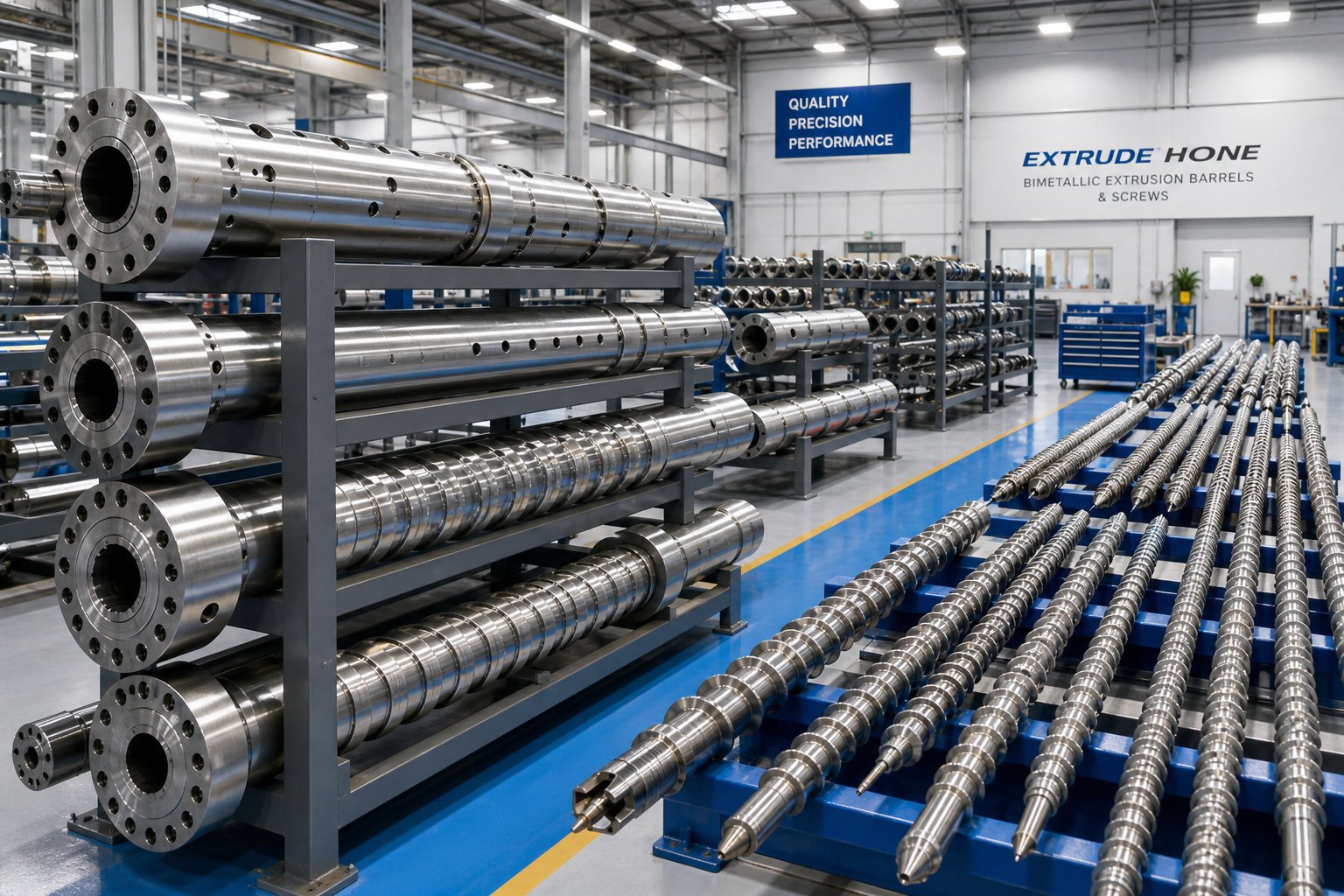
Selecting the Right Barrel and Screw Partner for Your Line
You've walked through barrel types, liner metallurgy, application-specific design, wear mechanisms, inspection procedures, and the full cost-of-ownership equation. That's a lot of ground to cover — and in practice, every one of those decisions lands on someone's desk at roughly the same time: when a line goes down, when a new product launch demands different processing capabilities, or when a capital equipment purchase forces the question of what goes inside the machine. Having a clear, repeatable decision framework turns that moment of pressure into a structured workflow instead of a scramble.
Your Barrel Selection Checklist
Think of this checklist as the distilled version of everything covered in this article — a step-by-step path from resin identification to a fully specified barrel order. Whether you're specifying a plastic extruder barrel for a new extrusion line, replacing a worn-out unit on legacy equipment, or sourcing injection molding screws and barrels for a molding operation, the logic follows the same sequence.
- Identify your dominant resin and filler type. Start here — everything else follows. Are you running unfilled commodity polyolefins, glass-filled engineering nylons, corrosive PVC, or contaminated post-consumer recyclate? The resin and its additives dictate the wear environment your barrel must survive.
- Determine the primary wear mechanism. Match your resin and filler profile to the three wear categories: abrasive (hard fillers scoring the bore), corrosive (acidic decomposition products attacking the metal), or adhesive (metal-to-metal contact from misalignment or dry running). Most real-world applications involve a combination, but one mechanism will dominate — and that dominant mechanism drives your liner selection.
- Select the barrel type. Smooth-bore single screw for general-purpose extrusion. Grooved feed for high-output polyolefin processing. Modular segmented twin screw for compounding, reactive extrusion, or recycling. Your application table from earlier in this article maps each extrusion type to the correct barrel architecture.
- Choose the liner material using the decision guide. Nitrided steel for clean commodity resins. Iron-boron bimetallic for abrasive-filled compounds. Nickel-alloy bimetallic for corrosive resins. Tungsten-carbide-rich liners for extreme abrasion or heavily contaminated streams. Don't guess — match the liner to the threat.
- Verify L/D ratio and bore diameter compatibility with your existing or planned screw. A barrel specified in isolation from the screw is a barrel waiting to underperform. Confirm that the bore diameter matches the screw's nominal OD within proper flight clearance tolerances, and that the L/D ratio supports the melting, mixing, and pressure-generation requirements of your process. For injection molding barrel and screw assemblies, verify that the shot size, compression ratio, and nozzle interface all align with the molding machine's specifications.
- Establish a wear monitoring schedule. Define your measurement intervals — annually for standard applications, every six months for abrasive or corrosive duty — and document baseline bore measurements immediately after installation. Without a baseline, future measurements have no context. Track clearance growth over time so you can predict replacement needs rather than react to failures.
Running through these six steps before placing any barrel order eliminates the most common — and most expensive — specification errors. It also gives you a documented rationale for every decision, which matters when justifying capital expenditures to management or troubleshooting performance issues months down the road.
Finding a Barrel Partner That Supports Your Operation
A checklist gets you to the right specification. But a specification is only as good as the manufacturer who executes it. The plastics processing industry is full of barrel suppliers, yet the gap between a vendor who ships commodity cylinders and a partner who engineers barrel solutions for your specific operation is enormous — and that gap shows up directly in barrel life, process stability, and total cost of ownership.
What should you look for? Imagine you're replacing barrels on a davis-standard extruder that's been running HDPE pipe for fifteen years. The original barrel specification may no longer be optimal — resin grades have changed, throughput targets have increased, and the grooved feed section may benefit from updated groove geometry. A commodity supplier ships you a dimensional match. A genuine barrel partner reviews your current processing conditions, recommends an updated liner alloy for the abrasive filler package you've added to your formulation, verifies screw compatibility, and delivers a barrel that outperforms the original.
Here are the key criteria for evaluating any barrel supplier — whether you're sourcing for extrusion, injection molding screws, or twin screw compounding equipment:
- Custom bore sizes and liner alloy options — Suppliers like NANHAIYA's screw barrel product center are built specifically for plastic processors, equipment manufacturers, and maintenance teams who need barrels manufactured to exact bore dimensions and liner specifications rather than limited to standard catalog sizes. This capability matters most when replacing barrels on older or non-standard equipment, or when your process demands a liner alloy that commodity suppliers don't stock.
- Engineering support for barrel-screw matching — The supplier should be able to advise on screw-barrel clearance targets, compression ratio compatibility, and liner-to-hardfacing pairing. If a supplier can only quote you a barrel without asking what screw it's running with, that's a red flag.
- Breadth of solutions across single screw, twin screw, and injection molding platforms — Operations that run multiple machine types benefit from consolidating their barrel sourcing with a manufacturer who covers the full range. NANHAIYA, for example, offers custom and replacement screw and barrel solutions spanning single screw extrusion, twin screw compounding, and injection molding applications — reducing the number of supplier relationships you need to manage and ensuring consistent metallurgical quality across your fleet.
- Availability of replacement barrels for both current and legacy equipment — Production lines don't retire on schedule. Many processors run davis-standard extruder models, Battenfeld Cincinnati lines, or other legacy machines that are mechanically sound but need barrel replacements the original OEM may no longer prioritize. A supplier with reverse-engineering capability can measure your existing barrel and manufacture a dimensional equivalent — or an improved equivalent — without requiring original drawings.
- Fast turnaround to minimize downtime — Lead time is a cost multiplier. Every week your line sits waiting for a barrel is a week of lost production. Evaluate suppliers on their standard and expedited lead times, and whether they maintain semi-finished barrel blanks that can be final-machined to your specification faster than starting from raw steel.
- Documented metallurgical quality and traceability — Ask for liner composition certification, hardness testing data, and centrifugal casting process documentation. Reputable manufacturers provide this as standard practice. Suppliers who can't — or won't — document what's inside the barrel they're selling you are suppliers whose barrels carry hidden risk.
The barrel partner you choose becomes a long-term extension of your maintenance and engineering team. A supplier who understands your resins, your equipment, and your quality requirements can proactively recommend specification upgrades as your product mix evolves — catching potential wear and compatibility issues before they reach the production floor.
Every section of this article has pointed toward a single truth: the plastic extruder barrel is not a commodity purchase. It's an engineered component whose type, liner material, dimensional precision, and compatibility with your screw directly determine your throughput, product quality, energy consumption, and maintenance costs for years of continuous operation. Treat it that way — specify it carefully, inspect it regularly, and source it from a partner who understands the stakes — and you'll stop paying the hidden costs that most processors never realize they're absorbing.
Frequently Asked Questions About Plastic Extruder Barrels
1. How often should you inspect an extruder barrel for wear?
For lines running unfilled commodity resins, a full bore measurement inspection at least once per year is recommended. If you process abrasive materials like glass-filled nylon, mineral-filled PP, or corrosive resins such as PVC, increase inspection frequency to every six months. Always measure the barrel bore and screw OD at multiple axial and rotational positions during each inspection, and document baseline measurements immediately after installing a new barrel so future readings have meaningful context.
2. What is the difference between a nitrided barrel and a bimetallic barrel?
A nitrided barrel uses a gas-diffusion process to harden the bore surface to approximately 55-70 HRc, but the hardened case is only 0.4 to 0.7 mm deep. Once abrasive fillers cut through this thin layer, the soft core steel wears rapidly. A bimetallic barrel features a centrifugally cast alloy liner 2.0 to 3.0 mm thick - three to seven times deeper than a nitrided case. Bimetallic liners come in iron-boron alloys for abrasion resistance, nickel-based alloys for corrosion resistance, and combination alloys for dual protection. Bimetallic barrels cost more upfront but deliver three to five times longer service life in demanding applications.
3. When should you replace an extruder barrel instead of rebuilding it?
Barrel replacement is the better choice when the barrel has been previously repaired, when remaining wall thickness is borderline for safe pressure containment, when the application demands the tightest possible bore concentricity (such as film or medical tubing), or when a newer barrel specification with updated L/D ratio or liner alloy would improve process performance. Rebuilding makes sense when wear is localized, wall thickness is adequate, and the cost savings of 25-50% over a new barrel justify the slightly lower concentricity and straightness of a repaired unit. Specialized manufacturers like NANHAIYA (nhyscrew.com/products) can help evaluate whether a custom replacement barrel offers better long-term ROI than a rebuild.
4. What causes uneven wear patterns inside an extruder barrel?
Asymmetric wear concentrated at one clock position typically indicates barrel sag or screw-to-barrel misalignment, where the screw rides against one side of the bore. Feed-zone-concentrated wear often results from inadequate feed throat cooling or gearbox misalignment. Wear localized upstream of mixing elements usually points to solids wedging, where unmelted pellets jam against restrictive screw geometry and push the screw sideways into the bore. Correcting the root cause - alignment, cooling, or screw design - before installing a replacement barrel prevents the same pattern from recurring.
5. What type of barrel liner is best for processing recycled plastics?
Post-consumer recycled streams contain metal fines, sand, dirt, paper fibers, and other hard contaminants that create extreme abrasive wear conditions. Iron-boron bimetallic liners are the minimum standard for recycling lines. For heavily contaminated streams, tungsten-carbide-rich bimetallic liners deliver four to five times the barrel life of standard bimetallic grades, paying for their higher cost through extended service intervals. Many recyclers also use zone-targeted liner strategies on twin screw barrels, placing premium carbide liners in the high-wear feed and side-stuffer zones while using standard bimetallic segments downstream.
Written by
Nanhaiya Technical Team
Zhoushan Nanhaiya Plastic Machinery Co., Ltd.
The Nanhaiya technical team supports screw and barrel manufacturing projects through application review, technical communication, custom manufacturing coordination, and production and quality control.
Discuss Your Application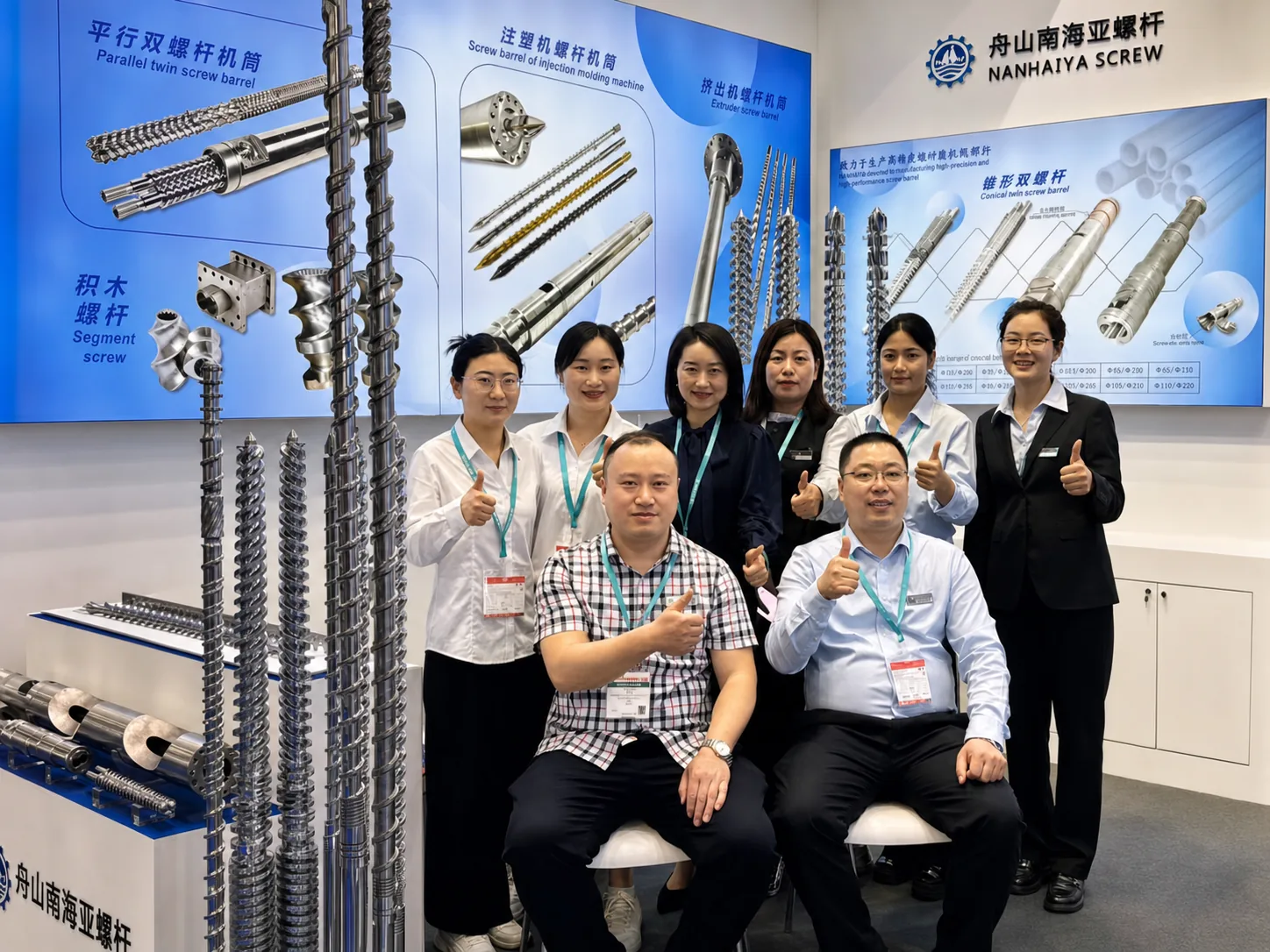
Related Articles
More insights on screw barrel technology and plastics processing.
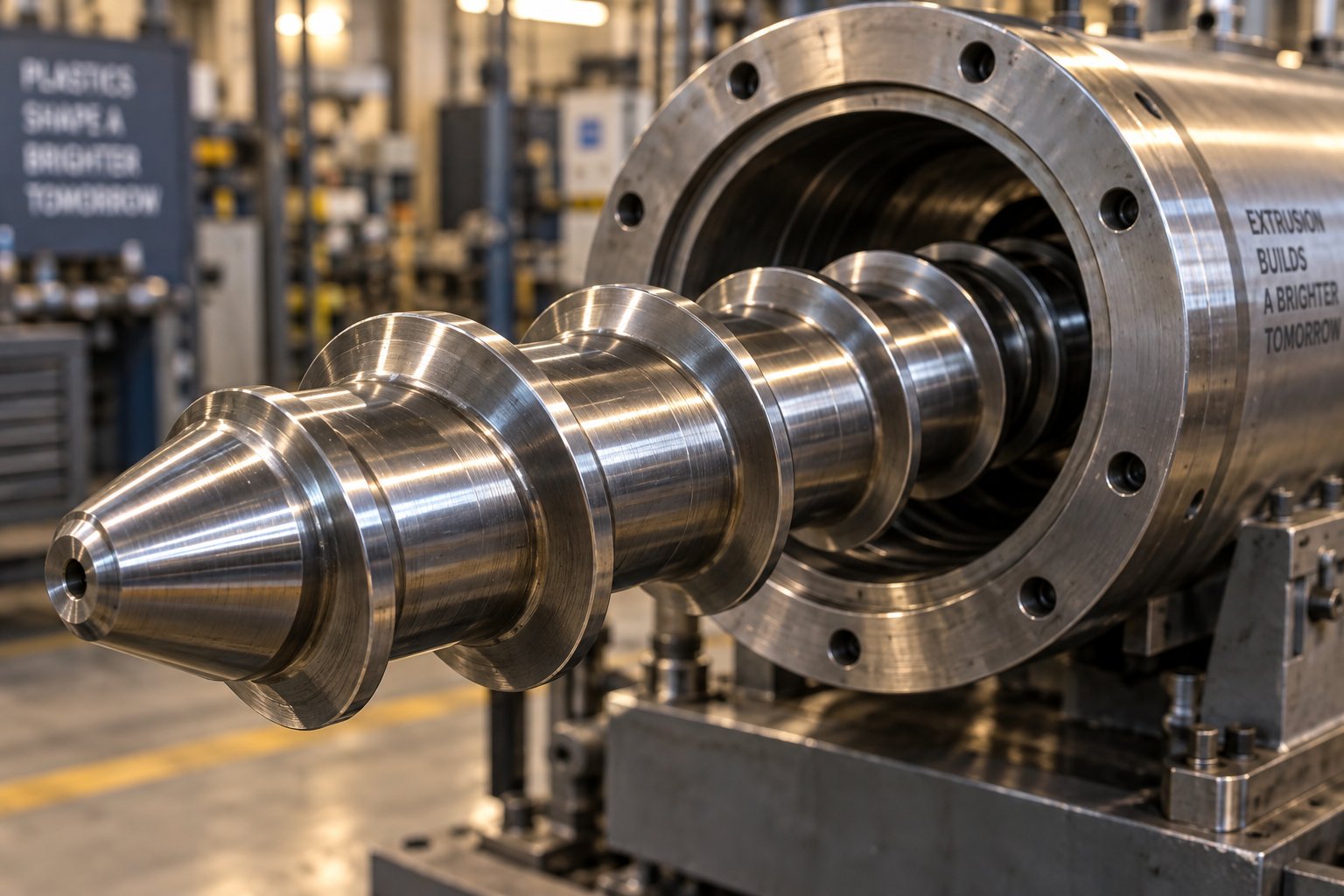
What Nobody Tells You About Screw Barrel For Plastic Machine Design
Oct 10, 2026
Learn how screw barrel for plastic machine design affects melt quality, throughput, and wear life. Covers geometry, resin matching, troubleshooting, and sourcing.
Read Article
Single Screw Extruder for Sheet: Stop Guessing, Start Specifying
Oct 9, 2026
Learn how to specify a single screw extruder for sheet production. Covers screw geometry, resin-specific processing, troubleshooting, and maintenance best practices.
Read Article
PE Pipe Extruder Machine: What Datasheets Won't Tell You
Oct 9, 2026
Learn how a PE pipe extruder machine works, key specs explained, material grade selection, maintenance tips, and buyer guidance beyond the datasheet.
Read ArticleLooking for something else?
Search by material, symptom or product and jump straight to the relevant page.
These are navigation suggestions based on keyword matching — not a quotation, not a delivery commitment, and not a substitute for engineering review. Final specification is confirmed by our engineers against your drawings and processed material.
Need help with screw barrel selection?
Share your machine model, processed material and application. Our team can help with pricing and technical support.