

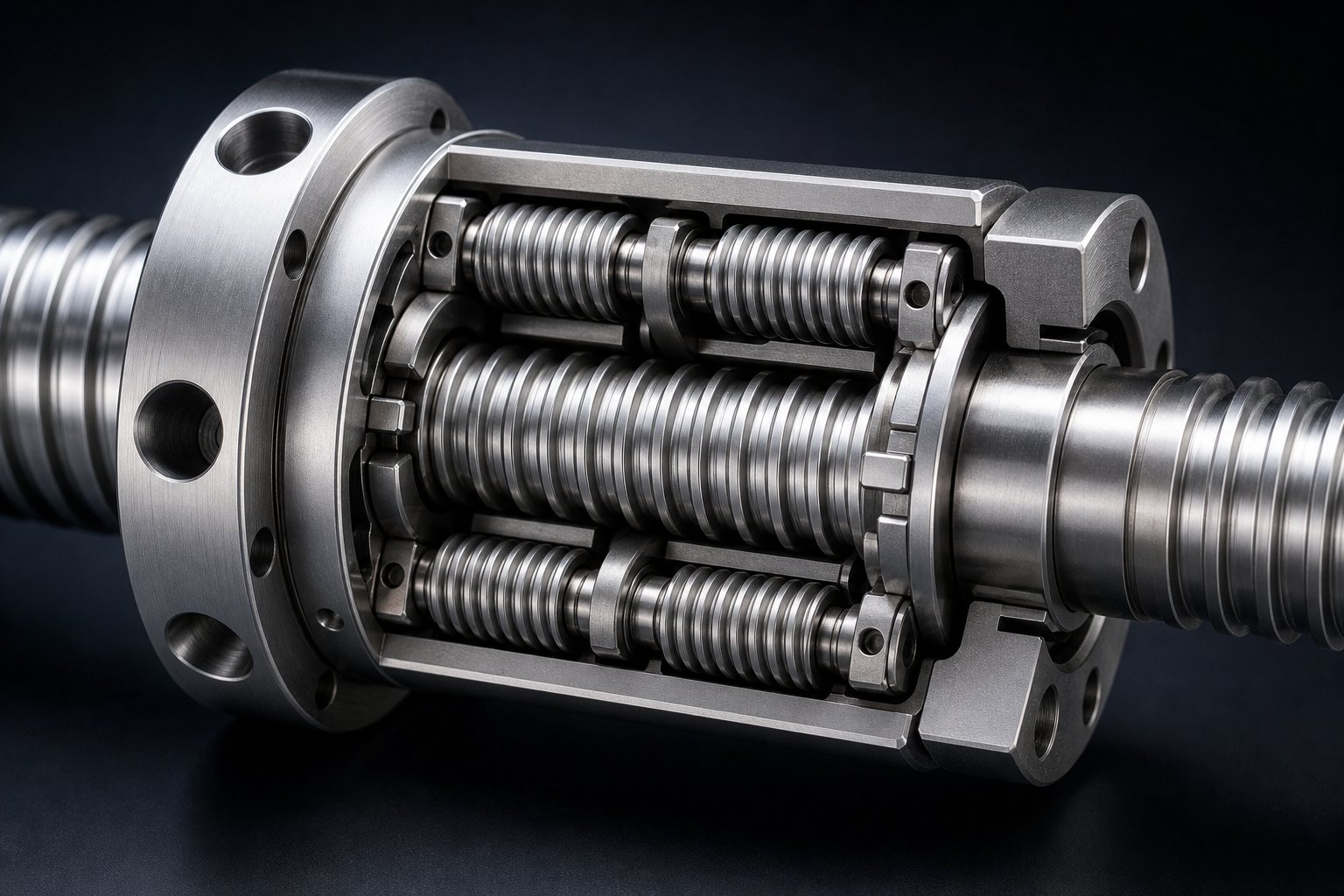
Understanding the Planetary Roller Screw
Imagine a device that converts spinning motion into straight-line force with enough power to rival a hydraulic cylinder. That's exactly what a planetary roller screw does — and it accomplishes this through an elegantly simple arrangement of threaded components working in concert.
What Is a Planetary Roller Screw
A planetary roller screw is a mechanical linear actuator that uses multiple threaded rollers arranged around a central screw shaft to convert rotary motion into precise linear movement, distributing load across numerous contact points for exceptional force capacity and durability.
Three fundamental components make up every roller screw assembly:
- Screw shaft — the central threaded shaft that receives rotary input, featuring helical grooves (typically trapezoidal or circular arc threads) that engage the surrounding rollers.
- Planetary rollers — multiple threaded rollers (usually 3 to 12) positioned around the screw shaft, spinning on their own axes while simultaneously orbiting the shaft.
- Nut — an externally housed component with internal threading that meshes with the rollers, translating their combined motion into linear travel.
A retainer or cage fixes the axial and circumferential positions of the rollers, ensuring uniform force distribution across the assembly. End caps prevent roller detachment while providing lubrication and sealing functions.
Why the Name Planetary Matters
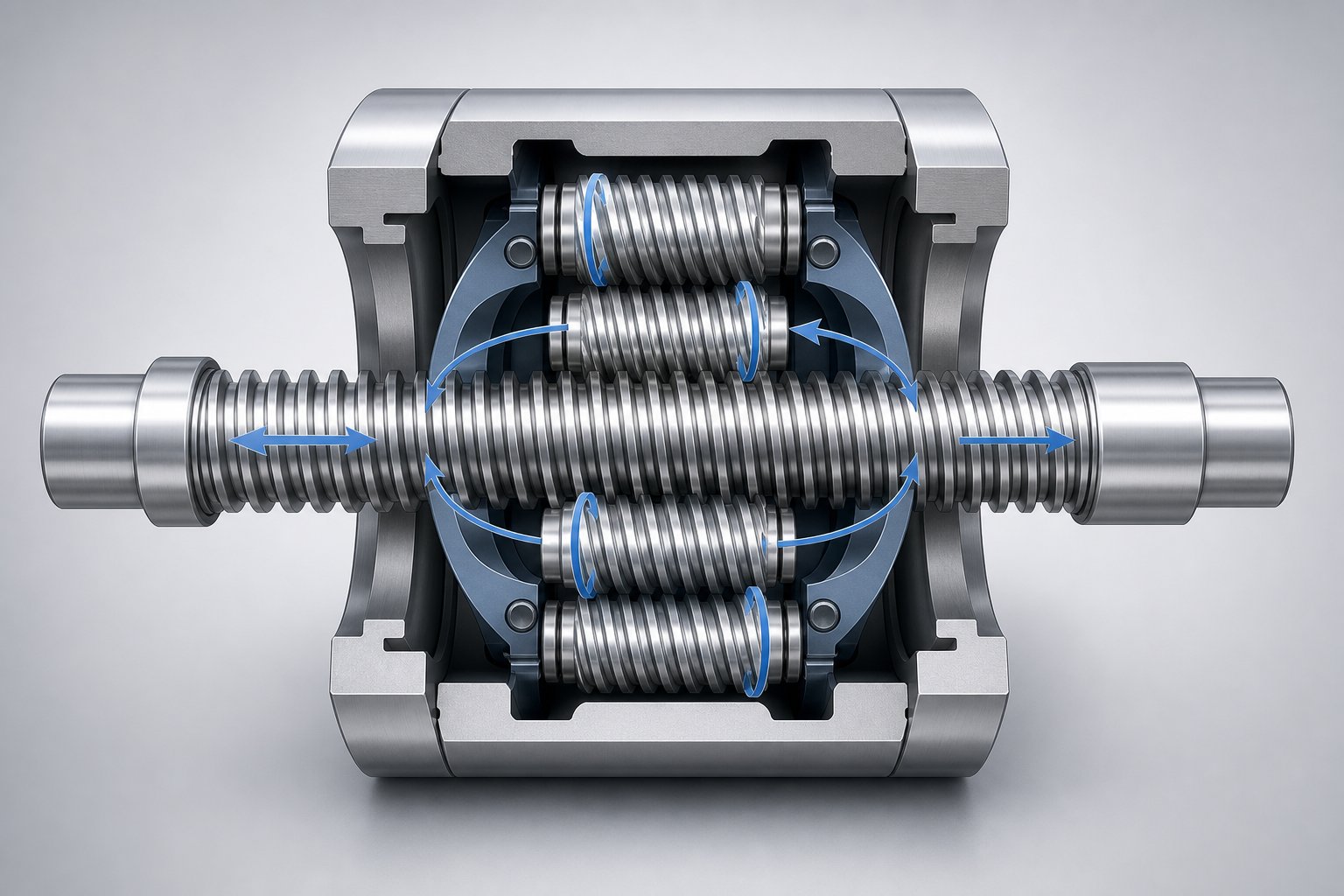
Picture our solar system. Planets orbit the sun while rotating on their own axes. Planetary roller screws work on the same geometric principle — the rollers spin individually (like planets rotating) while orbiting the central screw shaft (the sun). This planetary motion is what gives the device its name and its mechanical advantage.
The rollers are toothed to mesh with geared rings at each end of the nut, synchronizing their orbital paths. Unlike ball screws that rely on point contact through individual ball bearings, planetary roller screws achieve line contact across every roller thread. The result? Significantly more surface area carrying the load, which translates directly into higher force capacity within a compact package.
This article bridges the gap between surface-level overviews and dense manufacturer catalogs. You'll find a practical, engineering-grounded exploration of how these devices actually move, what wears inside them, and why they fail — starting with the mechanics that make planetary motion so effective at generating linear thrust.
How Planetary Motion Converts Rotary Input to Linear Output
The basic components are straightforward enough — a screw shaft, rollers, and a nut. But what actually happens inside this assembly when an electric motor starts spinning the shaft? The answer involves a beautifully coordinated mechanical dance where every threaded surface plays a specific role.
Step-by-Step Motion Conversion Process
Think of a planetary screw mechanism like a group of synchronized swimmers revolving around a central pole — each one spinning individually while the whole group circles the same axis. Here's the sequence of events that converts rotary input into linear output:
- Rotary input enters the screw shaft. An electric motor (or other rotary drive) spins the central threaded shaft. The multi-start helical threads on this shaft are the first link in the kinematic chain.
- Thread engagement drives roller rotation. As the screw shaft turns, its threads mesh directly with the single-start threads on each surrounding roller. This meshing forces each roller to spin on its own axis — much like a pinion driven by a larger gear.
- Geared ends synchronize orbital motion. The toothed ends of each roller engage with geared rings at each end of the nut. These ring gears lock the rollers into a coordinated orbital path around the screw shaft, preventing them from drifting out of position or colliding with one another.
- Rollers transmit force to the nut. While spinning and orbiting simultaneously, the roller threads also mesh with the internal threads of the nut. This dual engagement — rollers threaded into both the screw shaft and the nut — creates the mechanical coupling that transfers rotational energy outward.
- The nut advances linearly. Because the rollers are axially fixed relative to the nut (they orbit within it but don't translate along its length), the cumulative effect of their coordinated rotation drives the nut forward or backward along the screw shaft in a smooth, controlled linear stroke.
The result is a linear screw mechanism that transforms every revolution of the shaft into a precise, repeatable increment of straight-line travel.
Thread Engagement and Load Distribution
What makes this screw mechanism truly distinctive is how the threads interact at two separate interfaces simultaneously. Each roller's thread profile is carefully matched to engage the screw shaft on its inner surface and the nut on its outer surface — at the same time.
The screw shaft and nut share matching multi-start threads, while each roller carries a single-start thread with an angle that mirrors the nut's internal thread geometry. This matching angle is critical: it keeps the rollers axially centered within the nut, preventing any tendency to "walk" up or down during operation. Spacer rings at each end of the nut body further stabilize the rollers, with pins riding in precision holes to maintain even circumferential spacing.
Here's where the load distribution advantage becomes clear. In a ball screw, each ball bearing touches the screw shaft and nut at individual points — point contacts that concentrate stress into tiny areas. A planetary roller screw replaces those point contacts with line contacts along the full length of each roller thread. Every thread turn on every roller creates an elongated contact zone rather than a single stress point. The practical difference is enormous: stress spreads across a vastly larger surface area, which directly increases the assembly's load-carrying capacity and resistance to fatigue.
Research into thread load distribution modeling shows that the load shared across engaged threads follows a trapezoidal pattern, with the heaviest loads occurring near the fixed support end of the roller and lighter loads toward the free end. This distribution is influenced by the axial stiffness of the screw, rollers, and nut — as well as by subtle bending deformation within the rollers themselves.
Why Multiple Contact Points Increase Capacity
Imagine supporting a heavy beam on a single post versus spreading it across ten posts. The physics are intuitive: more support points mean less force per point, and the structure handles greater total loads before anything fails.
A typical planetary roller screw assembly uses between 6 and 12 rollers. Each roller engages the screw shaft and nut across dozens of thread turns. Multiply the number of rollers by the number of engaged threads per roller, and you'll find that hundreds of individual contact lines are sharing the applied load at any given moment. This is why roller screws can achieve load capacities up to 15 times that of comparably sized ball screws.
The benefits extend beyond raw force capacity:
- Higher rigidity — more contact area means less elastic deflection under load, giving the assembly superior axial stiffness.
- Greater shock tolerance — sudden impact loads distribute across many contact lines rather than hammering a few ball-to-raceway contact points.
- Longer fatigue life — lower stress per contact zone slows the progression of surface fatigue, the primary wear mechanism in rolling-element drives.
- Reduced input torque — fine thread pitches on the rollers provide high mechanical advantage, so less motor torque moves a given axial load.
There's another advantage that often goes unmentioned. Because the rollers don't contact each other — unlike balls in a ball screw that constantly collide and strike recirculation end caps — a planetary roller screw generates less internal heat and friction at high speeds. This allows these assemblies to handle speeds exceeding 40 inches per second and accelerations beyond 3 g in certain configurations.
The synchronized pitch relationship between screw shaft, rollers, and nut is what ties this entire system together. Each component's thread geometry must maintain precise dimensional harmony — any deviation disrupts the load-sharing balance, concentrating force on fewer contact zones and accelerating wear. That sensitivity to thread geometry is exactly why not all planetary roller screws are created equal, and why the differences between design variants matter more than most overviews suggest.
Roller Screw Types and How They Differ
That sensitivity to thread geometry doesn't just influence manufacturing quality — it also defines entirely different categories of roller screws. The standard planetary design is the most widely recognized, but several important variants exist, each tailored to specific mechanical constraints. Understanding these subtypes helps you match the right architecture to your application rather than defaulting to whatever a supplier has in stock.
Standard Planetary Roller Screw Design
The standard configuration is what most engineers picture when they hear "roller screws." Threaded rollers orbit a central screw shaft inside a nut, with toothed roller ends meshing into geared rings at each end of the nut body. The rollers spin and orbit but do not translate axially — they stay in a fixed zone within the nut assembly.
This fixed-zone arrangement delivers outstanding load capacity and stiffness, but it introduces a practical limitation: stroke length is constrained by the length of the screw shaft's threaded section that the rollers can traverse. For applications requiring moderate travel distances and very high force density, the standard planetary design remains the dominant choice.
Inverted and Recirculating Variants
What happens when your application demands a longer stroke, a smaller diameter, or easier integration into an actuator housing? That's where variant designs earn their place.
Inverted roller screws flip the roles of the screw and nut. Instead of the nut being a compact assembly that travels along a long threaded shaft, the nut becomes a long tube with internal threading spanning the full stroke length. The screw shaft is only threaded where the rollers reside — a short section rather than the entire length. When the screw shaft turns, the rollers and screw translate together along the inside of the elongated nut. As Linear Motion Tips explains, inverted roller screws can use fewer thread starts than standard designs, allowing larger thread profiles that increase load capacity. The unthreaded portion of the screw shaft can also be customized for specific actuator mounting requirements, making this variant ideal for thrust rod style actuators.
You'll also notice another advantage: because the geared rings shift from the nut ends to the screw shaft, the nut diameter can be made slightly smaller than a comparably rated standard design — a meaningful benefit in space-constrained installations.
Recirculating roller screws solve the stroke length limitation differently. Instead of keeping rollers fixed in a single orbital zone, recirculating designs route the rollers through a return path — similar in concept to how balls recirculate in a ball screw. This allows the nut to travel along an indefinitely long screw shaft, removing the stroke length restriction entirely. The tradeoff? Recirculating designs are mechanically more complex, and the return mechanism introduces additional components that can affect maximum speed and load ratings compared to standard planetary versions.
Differential roller screws occupy a specialized niche. By using rollers with a thread pitch that differs slightly from the screw shaft's pitch, these designs produce extremely fine axial displacement per revolution — far finer than what standard lead values would allow. Imagine needing sub-micron positioning resolution without resorting to complex external reduction mechanisms. Differential variants achieve this through internal geometry alone, making them valuable in precision instrumentation and ultra-fine positioning stages.
Side-by-Side Subtype Comparison
Choosing between these subtypes isn't about finding a "best" design — it's about matching mechanical architecture to application constraints. The following table maps each variant against the parameters that typically drive selection decisions:
| Parameter | Standard Planetary | Inverted | Recirculating | Differential |
|---|---|---|---|---|
| Load Capacity | Very high | High (larger threads possible) | Moderate to high | Moderate |
| Stroke Length | Limited by roller zone | Limited by nut tube length | Virtually unlimited | Limited by roller zone |
| Speed Rating | High | Moderate to high | Moderate | Low to moderate |
| Compactness | Compact nut, long shaft | Smaller nut diameter possible | Larger nut due to return path | Similar to standard |
| Resolution | Standard (set by lead) | Standard (set by lead) | Standard (set by lead) | Ultra-fine (sub-lead resolution) |
| Mechanical Complexity | Low | Moderate | Higher | Moderate |
| Typical Applications | Industrial presses, heavy actuators | Thrust rod actuators, integrated motor assemblies | Long-travel industrial automation | Precision instrumentation, fine positioning |
A few patterns stand out. If your application demands raw force in a compact envelope with moderate stroke, the standard planetary design is hard to beat. Need long travel? A recirculating roller screw removes the stroke ceiling. Building a self-contained electromechanical actuator? The inverted configuration simplifies integration — actuator manufacturers can even attach magnets to the nut and use it as a motor rotor, creating a compact motor-screw assembly. And for applications where positioning resolution matters more than speed or load, the differential variant delivers motion granularity that other subtypes simply cannot match.
It's also worth noting a common source of confusion: the term "planetary ball screw" occasionally surfaces in industry discussions. This typically refers to standard ball screws rather than a true planetary roller design. The distinction matters — ball screws use recirculating spherical elements with point contact, while all roller screw variants use cylindrical threaded rollers with line contact. Confusing the two can lead to undersized components and premature failures in demanding applications.
Each of these subtypes shares the same fundamental advantage — distributed line contact across multiple rollers — but their mechanical differences create dramatically different performance envelopes. The real question isn't which subtype is superior in the abstract. It's how each one stacks up against the most common alternative engineers consider first: the ball screw.
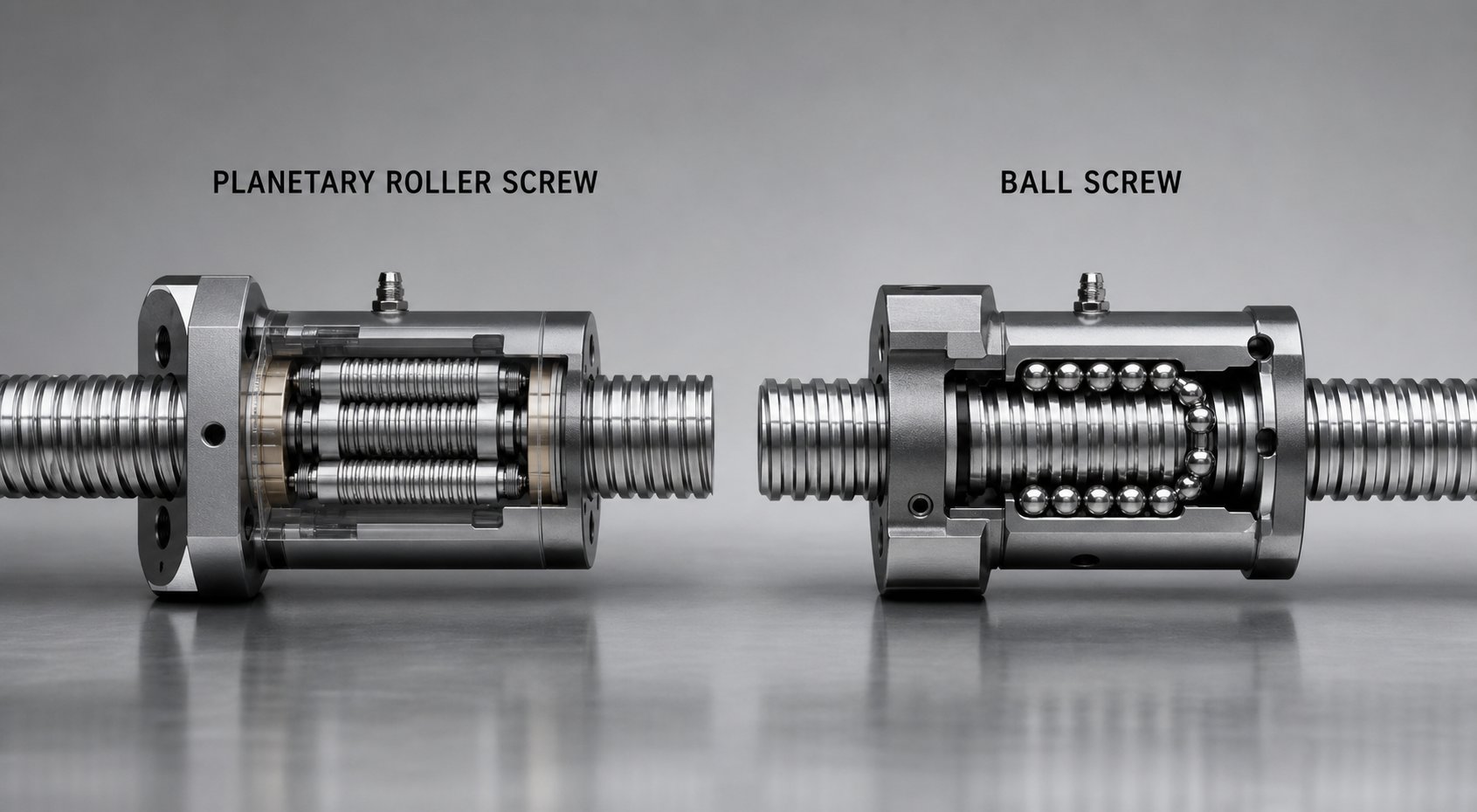
Planetary Roller Screw vs Ball Screw
Ball screws are the default linear drive in factory automation — affordable, widely available, and well understood. So why would anyone pay several times more for a planetary roller screw? The answer comes down to physics, lifecycle math, and the specific demands your application puts on the drive mechanism. Let's break down the comparison across the parameters that actually drive engineering decisions.
Load Capacity and Lifespan Advantages
The core difference between ball and roller screws starts at the contact interface. A ball screw transmits force through recirculating steel balls that touch the screw raceway at individual points — classic Hertzian point contact. A planetary roller screw replaces those balls with threaded rollers that engage the shaft along continuous lines. More surface area sharing the load means dramatically lower stress per unit area.
The practical result? A planetary roller screw can deliver up to 15 times the dynamic load capacity of a ball screw with the exact same outer diameter. If your envelope is locked — say, a 40 mm bore that can't grow — and your thrust requirement keeps climbing, the roller screw is often the only viable path.
Lifespan follows the same logic. Because standard L10 life calculations scale exponentially with dynamic load capacity, distributing wear across hundreds of contact lines rather than a handful of contact points pays enormous dividends over time. Industry data shows roller screws lasting up to 15 times longer than equivalent ball screws in the highest precision grades, and even budget-tier roller screws deliver two to three times the travel life. In 24/7 manufacturing environments, that difference transforms a quarterly maintenance headache into a multi-year install-and-forget solution.
There's another lifespan factor that often gets overlooked. Ball screws rely on recirculating balls completing full circuits through return tubes or deflectors. In short-stroke, high-frequency applications — servo presses, riveting systems, dispensing pumps — the balls never complete a full recirculation loop. This causes localized lubricant starvation and accelerated wear. Planetary roller screws sidestep the problem entirely because the rollers remain in constant engagement without needing to recirculate.
Efficiency and Speed Tradeoffs
Here's where ball screws hold an honest edge. Ball screw actuators typically achieve mechanical efficiencies around 80 percent, while roller screw actuators generally range from 75 to 80 percent. The difference isn't dramatic, but it matters in applications where energy consumption or heat generation are primary concerns. If you're running a lightly loaded positioning axis at high speed all day, those few percentage points of efficiency add up in electricity costs and thermal management complexity.
Speed is a more nuanced comparison. Ball screws are limited by their recirculation mechanism — at very high RPMs, balls can slam into return tubes, generating noise, heat, and wear. Roller screws avoid recirculation entirely in the standard planetary configuration, which removes that speed ceiling in many designs. However, the thread geometry and roller mass impose their own velocity limits. In practice, both technologies serve high-speed applications well, but roller screws often achieve higher accelerations — up to 25 m/s² with cycle rates reaching 10 Hz — because their lower inertia allows similar performance from smaller motors.
Noise is another consideration worth flagging. Rolled ball screws — ball screws manufactured via thread rolling rather than precision grinding — can be particularly noisy at speed due to surface finish variations compounding the ball-to-raceway impacts. Roller screws produce less operational noise because threaded rollers don't collide with each other or strike recirculation end caps. In environments where operators work near the machinery, that acoustic difference can affect both health-and-safety compliance and worker comfort.
When Ball Screws Are the Better Choice
Honesty matters when comparing these technologies. Ball screws aren't inferior — they're different, and for many applications, they're the smarter choice. Here's when you should lean toward a ball screw:
- Budget-sensitive projects with moderate loads — Ball screws cost roughly one-third to one-fifth the price of a comparable roller screw. If your force requirements don't push the limits of the ball screw's load rating, paying the roller screw premium delivers diminishing returns.
- Light-duty, high-efficiency positioning — For CNC machine axes, pick-and-place systems, and general factory automation where loads are moderate and duty cycles aren't extreme, rolled ball screws offer excellent precision at lower cost and higher efficiency.
- Off-the-shelf availability — Ball screws are commodity components available in a vast range of diameters, leads, and accuracy grades from dozens of suppliers. Roller screws are more often make-to-order with lead times of 6 to 12 weeks. When your project timeline can't absorb that wait, a ball screw may be the only practical option.
- Applications with generous space envelopes — If you can upsize the screw diameter without constraints, a larger ball screw can match a smaller roller screw's load rating at lower cost. The roller screw's advantage is most pronounced when envelope size is fixed.
The decision isn't always binary. Some actuator platforms support both screw types in the same housing, letting you start with a ball screw and upgrade to a roller screw if the application proves more demanding than expected.
| Parameter | Ball Screw | Planetary Roller Screw |
|---|---|---|
| Contact Type | Point contact (balls to raceway) | Line contact (threaded rollers to shaft and nut) |
| Relative Initial Cost | 1x (baseline) | 3x to 5x |
| Dynamic Load Capacity | Moderate | Up to 15x higher at same diameter |
| Expected Lifespan | Moderate | Up to 15x longer (grade dependent) |
| Mechanical Efficiency | ~80% | 75% to 80% |
| Shock Load Resistance | Poor (risk of brinelling) | Excellent (distributed absorption) |
| Noise Level | Moderate to high (ball recirculation impacts) | Low (no ball collisions) |
| Short-Stroke Durability | Reduced (recirculation starvation) | Unaffected (rollers stay engaged) |
| Maximum Duty Cycle | Moderate | Up to 100% |
| Compactness at High Load | Larger diameter needed | Smaller envelope for same force |
| Availability | Widely stocked, short lead times | Often make-to-order (6 to 12 weeks) |
| Contamination Tolerance | Low (debris can jam return tubes) | Higher (roller wiping action clears debris) |
A useful mental model: think of ball screws as the versatile everyday workhorse and planetary roller screws as the heavy-duty specialist. You wouldn't haul construction materials in a sports car, and you wouldn't commute in a dump truck. The right technology depends entirely on the job.
What this comparison doesn't capture, though, is how dramatically setup parameters — preload, stiffness, and precision grade — influence the real-world performance of either technology. Two identical roller screws configured with different preload levels can behave like completely different actuators in the same machine. Those hidden engineering variables deserve their own careful examination.
Preload, Stiffness, and Precision Grades Demystified
You could install two identical roller screw actuators on the same machine, configure them with different preload settings, and get wildly different positioning results. That's because the raw hardware is only half the story. Preload, axial play, stiffness, and lead accuracy class are the hidden variables that determine whether your planetary roller screw actuator behaves like a surgical instrument or a sledgehammer.
These concepts fill dense catalog pages with tables and formulas, but the underlying ideas are surprisingly intuitive once you strip away the jargon.
Preload and Axial Stiffness Explained
Backlash is the tiny amount of free movement between the nut and screw shaft when no load is applied — a small dead zone where input rotation produces no linear output. Every threaded assembly has some inherent clearance between mating threads. In a conveyor drive, a few hundredths of a millimeter of play is harmless. In a dispensing system or servo press, that same dead zone destroys positioning accuracy and repeatability.
Preloading eliminates this dead zone by applying an internal load that keeps all contact surfaces pressed together at all times — even when no external force is acting on the assembly. Think of it like tightening a handshake: both hands are always in contact, so there's zero slack when one hand starts to move.
In practice, manufacturers achieve preload through split nut or double nut configurations. A split nut is a single nut cut transversely into two halves, separated by a precision spacer. A double nut presses two single nuts together with controlled offset. Both approaches force the rollers to maintain constant engagement with the screw and nut threads on opposing sides, squeezing out any free play.
The preload force itself follows a straightforward relationship. To eliminate backlash under all operating loads, the preload value is typically set at roughly one-third of the maximum applied load — expressed mathematically as Fv = Fmax / 2.83, where Fv is the preload force and Fmax is the peak axial load.
Higher preload delivers greater axial stiffness — the assembly deflects less under load, which directly improves positioning accuracy. But there's a cost. Removing all internal clearance increases sliding friction between components, which raises heat generation, reduces mechanical efficiency, and shortens overall service life. Every actuator screw installation involves balancing these tradeoffs against the application's actual precision requirements.
Lead Accuracy Classes and Positioning Precision
Even with perfect preload, a roller screw actuator can only position as accurately as its thread geometry allows. Lead accuracy — how precisely the actual thread pitch matches its nominal value — determines the fundamental positioning capability of the assembly.
Globally recognized standards from ISO, DIN, and JIS define precision grades based on lead error per 300 mm of travel. The grading system uses a "C" designation, where lower numbers indicate tighter tolerances:
- C0 grade (error within approximately +/-3.5 micrometers per 300 mm) — reserved for ultra-precision applications like semiconductor lithography equipment and aerospace navigation systems, where sub-micron repeatability is non-negotiable.
- C1 to C3 grades (error ranging from +/-5 to +/-8 micrometers per 300 mm) — the sweet spot for CNC machine tools, robotic joint actuation, and high-performance servo presses where tight positioning and smooth velocity control matter.
- C5 to C7 grades (error from +/-12 to +/-52 micrometers per 300 mm) — well suited for general industrial automation, material handling, and packaging machinery where consistent performance outweighs ultra-fine accuracy.
- C10 grade (error up to +/-210 micrometers per 300 mm) — appropriate for low-precision tasks such as conveyor drives, valve actuation, or clamping systems where force delivery matters more than exact position.
Manufacturing process drives which grades are achievable. Reaching C3 and higher demands precision grinding of the screw shaft and roller threads, with thread pitch errors held within approximately +/-1 micrometer. Lower grades can use thread rolling — a faster, more cost-effective forming method — but the resulting surface finish and dimensional consistency limit the achievable accuracy. Ground lead screws also deliver roughly three times the service life of rolled equivalents at the same precision class, a factor that often justifies the higher manufacturing cost in demanding applications.
How These Factors Affect Your Application
Sounds abstract? Here's where it gets practical. The interplay between preload level and precision grade creates a performance envelope unique to each planetary roller screw actuator configuration. Choosing the right combination depends on what your application actually demands:
- Positioning accuracy — Determined primarily by lead accuracy class. A C1-grade screw with moderate preload will outposition a C7-grade screw with maximum preload every time, because the underlying thread geometry sets the accuracy ceiling.
- Repeatability — Influenced heavily by preload. Eliminating backlash ensures that the nut returns to the same position every time the shaft rotates to the same angular position. Applications like dispensing and assembly often prioritize repeatability over absolute accuracy.
- Velocity uniformity — A function of lead precision. Variations in thread pitch cause micro-accelerations and decelerations as the nut traverses the screw shaft. Higher-grade screws produce smoother velocity profiles, which matters in scanning, coating, and constant-speed feeding applications.
- System stiffness — Set by the combination of preload magnitude, nut type, and the inherent rigidity of the roller-to-thread contact. Higher stiffness means less deflection under changing loads — critical for servo presses, injection molding clamp axes, and any application where load varies dynamically during the stroke.
When should you accept some axial play? More often than you might think. Light-duty transport axes, gravity-assisted vertical lifts, and applications with consistent unidirectional loads can tolerate a small amount of backlash without any penalty to system performance. In these cases, a single nut without preload extends service life, reduces cost, and keeps friction low. Reserve the expense and complexity of preloaded configurations for applications where backlash genuinely degrades outcomes — precision positioning, closed-loop servo control, or bidirectional force transmission.
These internal configuration choices shape the performance envelope of the actuator itself. But the real proof comes when that actuator meets the demands of a specific industry — where load profiles, cycle rates, and environmental conditions test every engineering decision simultaneously.
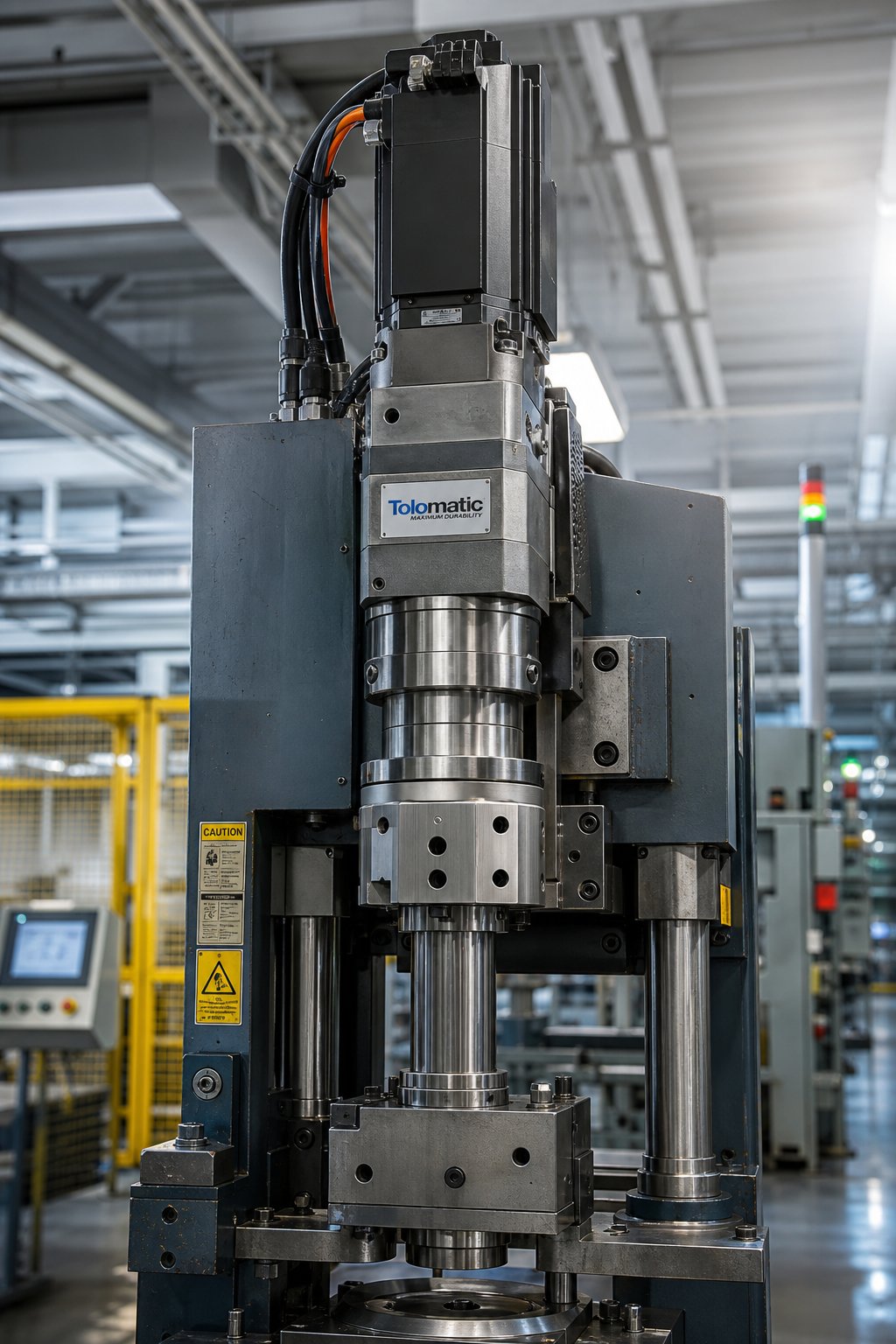
Where Planetary Roller Screws Excel in Real Applications
Every technical advantage discussed so far — distributed load contact, shock absorption, high duty-cycle endurance, compact force density — exists in the abstract until it meets a real machine on a real production floor. The question isn't whether a roller screw linear actuator can outperform a hydraulic cylinder or ball screw in theory. It's whether the specific demands of your application justify the investment. Let's walk through the industries where the answer is consistently yes, and more importantly, why the physics line up.
Industrial Automation and Assembly Applications
High-volume assembly lines punish linear drives with relentless cycling. A riveting station might fire thousands of precise, high-force strokes per hour. A servo press forming metal contacts might reverse direction every fraction of a second. These short-stroke, high-frequency profiles are precisely where roller screws for assembly automation outperform ball screw alternatives — the rollers stay continuously engaged regardless of stroke length, eliminating the lubricant starvation and ball-impact fatigue that degrade recirculating drives under identical conditions.
Consider what an assembly application actually demands from its linear drive:
- Weld guns and riveting systems — Repeated impact forces at high cycle rates require shock resistance and fatigue life that line contact delivers. SKF riveting applications use planetary roller screw actuators specifically for this combination of impact tolerance and positional repeatability.
- Servo presses and forming equipment — Force-controlled strokes need high axial stiffness to maintain accuracy under rapidly changing loads. A representative actuator with a 75 mm screw size can deliver peak forces approaching 500 kN with positioning adjustable down to micrometers — output previously possible only with hydraulics.
- Injection molding clamp axes — Continuous duty cycles at high force combine with the need for precise position hold during injection. The roller screw's ability to sustain 100% duty without thermal runaway makes it a natural fit.
- Dispensing and pick-and-place systems — Where precision positioning and rapid acceleration both matter, the low-inertia roller assembly enables speeds exceeding 40 inches per second with accelerations beyond 3 g.
The common thread across all these applications? They combine high force, high speed, or high cycle rates in ways that push ball screws past their practical limits — particularly in short-stroke profiles where ball recirculation becomes a liability rather than a feature.
Aerospace and Defense Motion Control
Aerospace applications demand a different performance profile: absolute reliability, extreme force density within weight-constrained envelopes, and resistance to vibration and shock loading that would destroy conventional drives. The roller screw linear actuator has become the standard mechanism in electromechanical actuators (EMAs) replacing hydraulic systems across military and commercial platforms.
- Electric thrust vector control (TVC) — Rocket engine nozzle actuation requires enormous force output from compact, lightweight packages that must survive intense vibration and thermal cycling. Roller screws deliver the necessary force density without hydraulic fluid — eliminating leak risk in critical flight systems.
- Landing gear actuation — The combination of high static load capacity (supporting aircraft weight) and shock resistance (absorbing touchdown impacts) maps directly to the roller screw's distributed contact advantage. Unlike ball screws, which risk Brinelling under sudden impact loads, roller screws absorb shock across hundreds of contact lines.
- Flight control surface actuators — Control surfaces demand precise, responsive positioning under aerodynamic loading. The high stiffness from preloaded roller screw assemblies ensures that wind loads don't deflect the actuator away from commanded positions.
- Missile fin actuation and weapons systems — Space constraints are extreme, force requirements are high, and failure is unacceptable. The compact force envelope of roller screws — delivering forces that comparable hydraulics would require in a larger package — makes them the preferred choice for defense actuators.
The broader trend here is the "more-electric aircraft" initiative, where hydraulic systems are systematically replaced by electromechanical alternatives to reduce weight, eliminate fluid maintenance, and improve system-level reliability. Planetary roller screws are the enabling technology that makes this substitution possible at the force levels aerospace demands.
Food Processing and Specialized Environments
Not every roller screw application involves extreme force or aerospace precision. The food and beverage industry presents a completely different challenge: corrosive washdown environments, strict hygiene requirements, and the absolute prohibition of hydraulic fluid contamination near consumable products.
Roller screws for food and beverage industry applications leverage several key characteristics:
- Sealed, IP-rated actuator housings — Many pre-engineered roller screw actuators achieve IP ratings suitable for splash or full washdown conditions, allowing daily sanitation with high-pressure sprays without compromising the internal drive mechanism.
- Elimination of hydraulic fluid — In lumber processing, food packaging, and beverage filling, hydraulic leaks can stain or contaminate product. Electric actuation via roller screws removes this risk entirely while maintaining the force output that pneumatics cannot match.
- Corrosion-resistant materials — Stainless steel screw shafts and coated nut assemblies withstand caustic cleaning chemicals and high-humidity environments that would corrode standard carbon steel drives.
- Packaging machinery — High-speed cartoning, case forming, and sealing operations combine moderate forces with rapid cycling and precise position control — a profile where roller screws deliver long service life without the maintenance burden of hydraulic systems.
Other specialized environments follow similar logic. Sawmills and lumber-processing machinery use roller screws where the combination of high force, contamination resistance, and prohibition of hydraulic fluid on raw wood products makes electromechanical actuation the only viable option. Steel mills and hot environments use resolvers rated for extreme temperatures as feedback devices on roller screw actuators, ensuring positional accuracy even in conditions that would destroy optical encoders.
The pattern across all these industries is consistent: planetary roller screws earn their place wherever an application simultaneously demands high force, high reliability, and resistance to conditions that degrade simpler technologies. They're not a universal replacement for every ball screw or hydraulic cylinder — but in the intersection of demanding force, speed, duty cycle, and environment, they occupy territory that no competing technology can match.
Of course, putting these actuators into service is only the beginning. The real engineering challenge shifts from selection to sustainment — understanding what wears inside the assembly over thousands of hours, what signals indicate degradation, and what maintenance practices extend service life before failure arrives unannounced.
Failure Modes and Roller Screw Maintenance Best Practices
Every screw driven actuator eventually wears. The question isn't whether degradation occurs — it's whether you detect it early enough to plan a controlled replacement or discover it when production stops unexpectedly. Planetary roller screws degrade differently from ball screws, and understanding their specific failure patterns is the difference between proactive maintenance and expensive surprises.
Common Failure Modes and Root Causes
Research into performance degradation of the planetary roller screw mechanism under multi-factor coupling effects reveals that load-bearing performance degrades through three distinct stages: a normal degradation phase, an accelerated degradation phase, and catastrophic failure. The rate of degradation increases progressively — slowly at first, then accelerating dramatically before ultimate breakdown.
What actually happens inside the mechanism screw assembly? Several distinct failure modes compete for dominance, depending on operating conditions:
- Surface fatigue (pitting and spalling) — The primary failure mechanism in properly lubricated assemblies. Repeated rolling contact creates subsurface shear stresses that eventually initiate micro-cracks. These cracks propagate toward the surface, breaking away small particles of material. Research confirms that material spalling on the screw threads is the primary factor contributing to degradation of both load-bearing performance and transmission accuracy.
- Adhesive wear from inadequate lubrication — When the lubricant film breaks down, metal-to-metal contact generates localized welding and tearing at thread surfaces. Because the helical rise angles of the rollers and screw shaft are not equal, relative sliding occurs between these components during motion, producing significant frictional forces when lubrication is insufficient.
- Contamination-accelerated wear — Dust, metal chips, or process debris entering the thread grooves act as an abrasive compound. Particles trapped between roller threads and the screw shaft grind away surface material at rates far exceeding normal fatigue progression. Damaged or missing seals, dust covers, and protective end caps are the usual entry points.
- Thread deformation under overload — Sustained loads exceeding rated capacity permanently deform thread profiles, disrupting the precise geometry that enables uniform load distribution across all rollers. Once thread profiles distort, load concentrates on fewer contact zones, cascading into accelerated fatigue of the remaining engaged surfaces.
- Thermal degradation — High speeds, heavy loads, or inadequate heat dissipation raise internal temperatures that degrade lubricant viscosity and accelerate oxidation. Thermal expansion also changes internal clearances, potentially increasing contact stresses beyond design limits.
Here's a critical distinction from ball screws: when a single ball fails in a ball screw assembly, it can jam the return path and cause immediate catastrophic lockup. Planetary roller screws tend to degrade more gradually because their distributed loading allows the remaining rollers to partially compensate when one roller's threads begin to deteriorate. This sounds like an advantage — and it is — but it also means that degradation can progress silently for an extended period before symptoms become obvious. Without active monitoring, you might miss the transition from normal wear to accelerated degradation until you're already approaching failure.
Lubrication and Preventive Maintenance
Lubrication starvation kills more roller screws than overloading ever will. The mechanism demands a continuous film between all mating thread surfaces — screw-to-roller and roller-to-nut interfaces simultaneously. When that film breaks down, friction torque spikes, heat generation accelerates, and adhesive wear begins eating away at precision-ground surfaces.
Effective roller screw maintenance starts with the right lubricant and the right schedule:
- Lubricant selection — Dedicated lithium-based greases (such as No. 2 lithium-based grease) or manufacturer-specified lubricants are standard. The grease must be clean and free of contaminants. Mixing different grease types causes sludge accumulation that blocks thread grooves rather than protecting them.
- Baseline interval — Under normal operating conditions, check and replenish lubricating grease every 500 hours or every 3 to 6 months. New assemblies require early relubrication after the initial running-in period, as fresh surfaces generate more wear particles that contaminate the original grease charge.
- Shortened intervals for demanding conditions — Heavy loads, high-frequency cycling, elevated temperatures, dusty environments, or vertical orientations (where gravity drains grease away from contact zones) all demand more frequent relubrication. A vertically mounted actuator running continuous duty at high force may need attention at half the normal interval.
- Application method — Clean the injection port before adding grease. Inject slowly to ensure even coverage across thread grooves and all contact surfaces. Avoid pressurized injection that could force grease past seals rather than into the working zone.
Beyond lubrication, preventive maintenance includes inspecting seals and dust covers for damage, checking that mounting bolts remain tight (vibration loosens connections over time), and verifying that supporting bearings haven't developed play that could introduce misalignment forces into the screw assembly.
A practical tip that's easy to overlook: before starting equipment after any extended shutdown, run the drive at low speed for 3 to 5 minutes. This distributes grease that may have settled or migrated during downtime, preventing the cold-start metal-to-metal contact that initiates surface fatigue.
Monitoring Wear and Knowing When to Replace
The gradual degradation pattern of planetary roller screws makes condition monitoring both more important and more rewarding than reactive maintenance. Catching the transition from normal wear to accelerated degradation gives you time to schedule replacement during planned downtime rather than scrambling after an unexpected failure.
Four measurable indicators track degradation progression:
- Rising drive torque — As thread surfaces wear and friction increases, the motor must work harder to maintain the same speed under the same load. Performance testing shows that drive torque remains relatively stable during early life, then begins climbing as degradation accelerates. In one documented test sequence, forward-stroke torque held steady near 15.5 N·m through early operation, then climbed progressively to 18.4 N·m during accelerated degradation, and spiked to 35.4 N·m at failure.
- Temperature rise — Increased friction generates more heat. Monitoring the nut housing temperature provides a direct indicator of internal condition. Testing data shows temperature rising gradually during normal operation (5.6 degrees Celsius over initial test sets) then accelerating as wear worsens — reaching a 19.4 degree Celsius rise by the time failure approached. An outer-nut temperature that climbs faster than historical trends warrants investigation.
- Transmission accuracy degradation — The most definitive indicator of internal wear. As thread profiles deform and material spalls away, the precise geometric relationship between rotation and linear travel degrades. Research demonstrates that transmission accuracy can degrade by 29.9% after moderate use and by 93.4% under continued loading — at which point the screw's functional precision is effectively gone even though it hasn't yet seized or fractured.
- Changes in vibration signature — Vibration patterns shift as internal surfaces deteriorate. However, vibration monitoring for roller screws is more complex than for simpler rotating equipment. Studies show that vibration trends differ depending on sensor placement location and orientation, with some positions showing increasing amplitude during degradation and others showing decreasing amplitude. Importantly, when performance hasn't degraded, vibration state remains unrelated to operating speed or axial load — meaning any change in vibration signature at constant operating conditions signals internal deterioration.
A practical monitoring approach combines these indicators rather than relying on any single measurement. Track drive current (a proxy for torque) over time at consistent operating conditions. Log temperature at the same point in each duty cycle. Periodically measure positioning accuracy at multiple points along the stroke — not just one position, since wear concentrates in the most-used travel zone. If two or more indicators trend upward simultaneously, schedule inspection and replacement planning.
The axial clearance check provides a direct physical assessment: if axial play exceeds 0.01 mm jitter or 0.05 mm return clearance, preload adjustment or component replacement is needed to restore transmission accuracy. Performing this check during scheduled maintenance windows catches degradation before it reaches the accelerated phase.
One final point worth emphasizing: these failure modes and wear patterns don't exist in isolation from how the screw was manufactured. Thread geometry precision, surface finish quality, and the uniformity of load sharing among rollers all begin at the factory floor. A screw that leaves the manufacturer with uneven thread profiles will concentrate load on fewer contact zones from day one — accelerating every degradation mechanism described above. That manufacturing reality is why production quality control matters as much as operational maintenance.
How Planetary Roller Screws Are Manufactured
A roller screw is only as good as the factory that built it. Every performance characteristic discussed so far — load capacity, fatigue life, positioning accuracy — traces back to how precisely the screw shaft, rollers, and nut were machined and assembled. Even a minor geometric inconsistency in a single roller's thread profile shifts load onto neighboring rollers, triggering the exact accelerated degradation patterns covered in the previous section. Manufacturing isn't just a supply chain detail. It's the foundation of reliability.
Precision Grinding and Thread Manufacturing
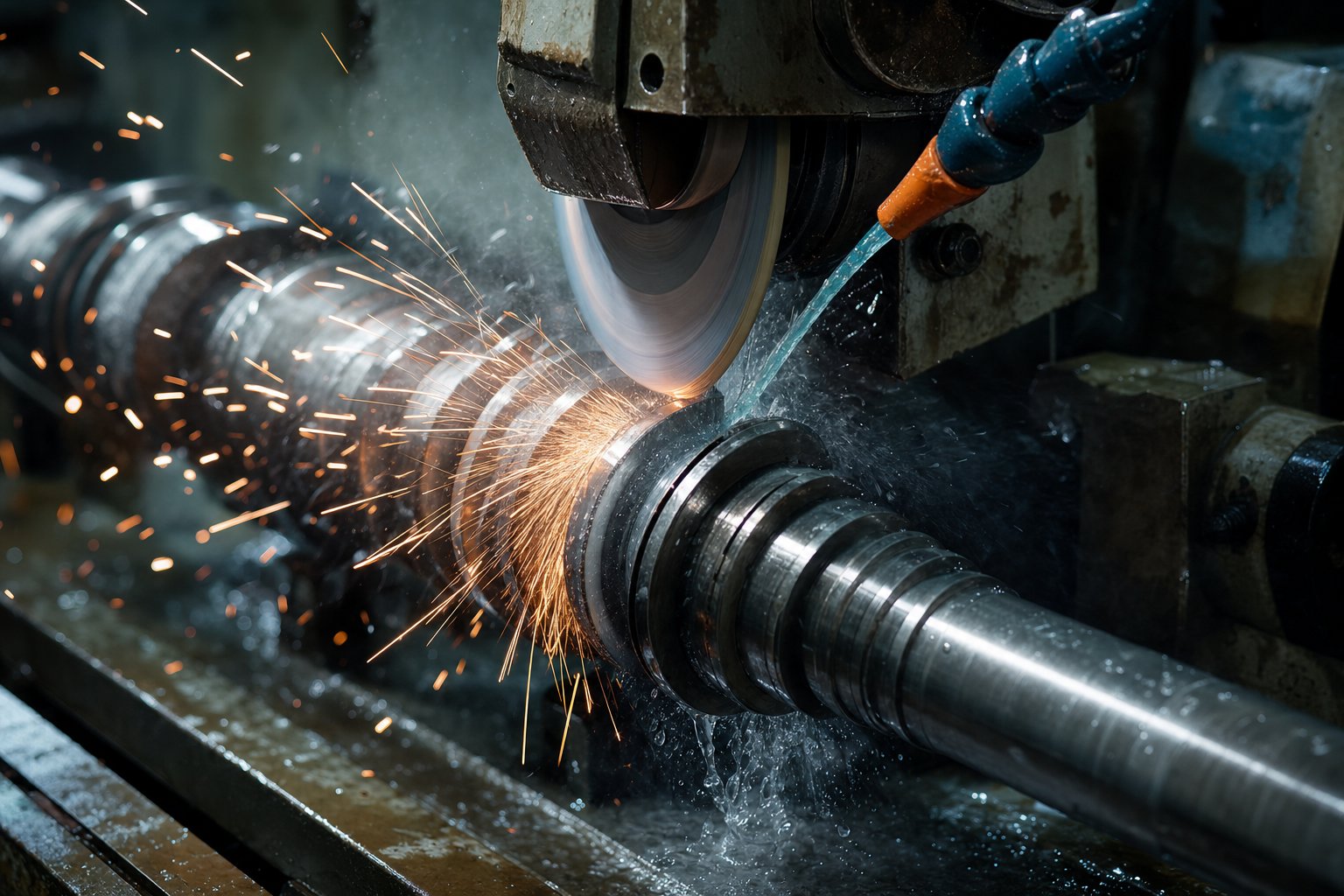
The screw shaft is the central element whose quality determines the functionality of the entire assembly. Shape and position tolerances in the single-digit micrometer range and surface finishes as fine as Ra 0.4 are standard requirements for high-performance units. Achieving these specs on hardened steel — typically heat-treated to HRC 60 — demands multi-stage precision grinding rather than conventional machining.
The process chain for a typical screw shaft follows a carefully sequenced path:
- Blank preparation and precision turning — A pre-machined steel cylinder is turned to approximate final dimensions, establishing diameter increments and end faces with defined allowances for subsequent grinding.
- Deep drilling — A central bore reduces weight and, in some designs, provides passage for lubrication or sensor wiring.
- Heat treatment — Hardening to HRC 60 ensures the shaft withstands the enormous contact stresses generated during operation. All finish grinding occurs after this step because heat treatment introduces dimensional distortions that must be corrected.
- External cylindrical grinding — Often performed in two separate operations — one for thinner shaft sections and another for larger diameters — using helical grinding wheels set at a defined angle to the workpiece axis. This angled approach enables simultaneous machining of cylindrical surfaces and shoulders while improving chip removal and surface finish.
- Thread grinding — The final and most critical operation. Dedicated thread grinding machines cut the precision helical grooves that will engage the planetary rollers. Thread pitch accuracy at this stage determines the achievable lead precision class of the finished assembly.
Roller manufacturing follows a parallel path with its own challenges. Each roller carries a single-start thread with a convex circular arc tooth profile, and its external gears at both ends must mesh precisely with the internal gear ring inside the nut. Thread profile consistency across all rollers is paramount — if one roller's thread radius deviates from the set, it carries a disproportionate share of the load while its neighbors are partially unloaded. The resulting stress concentration accelerates fatigue on the overloaded roller and reduces the assembly's effective load capacity below its rated specification.
Nut manufacturing completes the trio. The internal threading must match the screw shaft's tooth parameters and thread starts precisely. The internal gear ring — which prevents rollers from tilting axially during operation — is machined separately and fixed integrally with the nut body after assembly.
Assembly and Quality Verification
Grinding perfect individual components is necessary but not sufficient. The assembly process itself determines whether those components work together as an integrated system or fight each other under load.
Roller matching is the critical step. A typical assembly uses 9 to 13 rollers, and every roller in a given set must share virtually identical thread geometry. Planetary roller screw manufacturers achieve this by grinding roller batches together and then sorting them into matched sets based on measured dimensions. A "matched set" means that the diameter, thread pitch, and profile radius of every roller in the group fall within an extremely tight tolerance band — tight enough that load distributes evenly across all rollers rather than concentrating on a few oversized ones.
During assembly, rollers are seated into the retainer (which maintains equal circumferential spacing), the internal gear ring is aligned and secured, and the complete roller assembly is installed into the nut and onto the screw shaft. The retainer's uniformly distributed holes hold each roller's cylindrical smooth shaft ends, ensuring synchronized thread engagement as the assembly rotates.
Quality verification follows assembly:
- In-process measurement — Leading roller screw manufacturers integrate measurement directly into the grinding process. In-process gauging on cylindrical grinding machines verifies compliance with tolerances without requiring separate inspection steps, catching deviations before they compound through subsequent operations.
- Load capacity testing — Finished assemblies undergo axial load testing to verify that actual performance matches calculated ratings.
- Efficiency and noise measurement — Running torque, mechanical efficiency, and acoustic output are measured to confirm that internal friction and contact conditions fall within specification.
- Lead accuracy verification — The thread pitch of the completed assembly is measured across the full travel to confirm the assigned precision grade.
The depth of quality verification separates premium roller screw manufacturers from commodity suppliers. Companies like Ewellix (formerly SKF's actuation division) built their reputation on tight process control across the entire chain — from raw material certification through final assembly testing. The manufacturing rigor required is one reason planetary roller screws cost significantly more than ball screws and why lead times often stretch to weeks rather than days.
Custom Manufacturing from Drawings and Samples
Not every application fits a catalog specification. Replacement components for legacy equipment, prototype actuators with non-standard dimensions, and specialized assemblies for unique operating environments all require custom manufacturing capability. The challenge is reproducing the same micrometer-level precision demanded by standard products while working from customer-specific inputs.
Capable manufacturers accept three types of specification inputs:
- Engineering drawings — The ideal starting point. Complete dimensional drawings with tolerances allow the manufacturer to proceed directly to production planning without reverse-engineering effort.
- Physical samples — When drawings aren't available (common with obsolete equipment), manufacturers dimensionally analyze the sample using coordinate measuring machines (CMMs) and precision gauging to reconstruct the original specifications. Worn or damaged samples require engineering judgment to distinguish between original nominal dimensions and wear-induced deviations.
- Measured dimensions — Customers sometimes provide partial dimensional data gathered from field measurements. The manufacturer fills in gaps using knowledge of standard thread geometries and design conventions.
This reverse-engineering and custom production capability extends beyond linear motion roller screws into related planetary screw technologies. For instance, in plasticizing and polymer processing, planetary screw barrel systems use the same fundamental principle — multiple threaded elements orbiting a central shaft — but for material mixing and dispersion rather than linear actuation. NANHAIYA's planetary screw barrel solution exemplifies this crossover, offering custom and replacement planetary screw barrel components for plasticizing, mixing, and dispersion applications manufactured from customer drawings, physical samples, or measured dimensions. The same precision grinding and matched-component assembly principles that govern linear actuator production apply directly to these processing screws — uneven thread geometry in a plasticizing barrel causes the same load distribution problems that degrade actuator performance.
Whether the end product is a linear actuator or a processing barrel, the manufacturing message is consistent: thread precision, surface finish quality, and matched-component assembly are non-negotiable prerequisites for reliable performance. Cutting corners at any stage doesn't reduce cost — it accelerates the failure timeline and increases total cost of ownership.
With manufacturing quality establishing the performance baseline, the remaining challenge is practical: how do you match these tightly controlled components to the specific force, speed, precision, and environmental demands of your application? That selection process requires a structured decision framework rather than a catalog browse.
Selecting the Right Planetary Roller Screw for Your Application
You've absorbed the mechanics, compared the technologies, and studied the failure modes. The remaining step is the one that actually costs money — or saves it: choosing the right screw actuator configuration for your specific application. Get this wrong, and you'll either overspend on capability you don't need or underbuy and face premature replacement. Neither outcome is acceptable when production uptime is on the line.
Planetary roller screw selection isn't a single calculation. It's a structured sequence of engineering decisions, each one narrowing the field until only the right configuration remains. Here's how experienced engineers work through it.
Key Selection Parameters and Decision Framework
Every application imposes a unique combination of demands on a linear drive. The trick is identifying which parameters are genuinely constraining — and which ones are flexible enough to trade off against cost, lead time, or packaging. Four major criteria consistently drive roller screw sizing decisions, as outlined by Linear Motion Tips: cycle life, peak load, speed, and physical space requirements.
But the full picture includes several more factors. Walk through each one before touching a catalog:
- Required axial force — What peak and continuous thrust must the screw actuator deliver? Define both the maximum instantaneous load and the load-stroke profile across a complete cycle. If the load varies during the stroke — heavy only during a pressing phase, lighter during approach and retract — the cubic mean load (Fm) determines life, not the peak alone. A press applying 25,000 lb only during the final third of its stroke can use a significantly smaller screw than an elevator holding the same peak load throughout.
- Target cycle life — How many millions of cycles — or hours — must the assembly survive before fatigue begins? The L10 life calculation, L10 = (C / Fm)3 × 10⁶ revolutions, links dynamic load rating to mean operating load. A higher dynamic capacity (C) extends life exponentially, so even modest increases in screw size can dramatically lengthen service intervals. For applications requiring greater than 90% reliability, multiply L10 by a reliability factor — for instance, multiplying by 0.62 adjusts to 95% survival probability.
- Speed and acceleration — Maximum rotation speed depends on screw diameter, unsupported shaft length, and bearing end condition. The critical speed formula, Nmax = f1 × d1 × 107 / L2, shows that longer shafts hit their speed ceiling faster than shorter ones. If your cycle demands rapid traverse speeds or high acceleration, verify that the candidate screw stays well below critical speed with an appropriate safety margin.
- Stroke length — Standard planetary designs limit stroke to the roller engagement zone. Recirculating variants remove this ceiling entirely. If your application needs more than a few hundred millimeters of loaded travel, the subtype decision may be made for you.
- Duty cycle — Continuous operation at 100% duty demands different thermal and lubrication management than intermittent cycling. High duty cycles also compress relubrication intervals and accelerate fatigue accumulation.
- Precision requirements — Match the lead accuracy class to your actual positioning need. Specifying C1-grade precision for a clamping application wastes money. Accepting C7 for a dispensing system costs accuracy. Refer to the precision grade breakdowns discussed earlier to find the right tier.
- Environmental conditions — Temperature extremes, washdown exposure, dust, chemical contact, and orientation (horizontal vs. vertical) all influence material selection, sealing requirements, and lubrication strategy.
- Column strength and buckling — Compressive loads on long, slender screws create buckling risk. Buckling capacity is proportional to the fourth power of the root diameter and inversely proportional to the square of the unsupported length — so even small increases in diameter dramatically improve resistance. End-fixity conditions (fixed-fixed vs. fixed-free) also have a major effect.
- Total cost of ownership — Initial purchase price is only part of the equation. Factor in expected service life, maintenance costs, downtime risk, and the expense of a mid-life replacement. A roller screw that costs three times more upfront but lasts ten times longer often delivers a lower total cost per operating hour than a cheaper alternative.
Don't treat these parameters as independent checkboxes. They interact. A heavier load shortens life, which may force a larger screw size, which changes the critical speed, which limits maximum RPM, which extends cycle time. Iterate through the calculations until all parameters settle into a consistent, feasible design point.
Matching Technical Requirements to Screw Type
With your parameters defined, the next step is mapping them to the right screw configuration. The table below provides a decision matrix connecting common application profiles to recommended solutions:
| Application Profile | Key Driving Requirements | Recommended Configuration |
|---|---|---|
| Plasticizing, mixing, and dispersion processing | Custom thread geometry, high torque, corrosion/wear resistance, replacement from drawings or samples | Custom planetary screw barrel — NANHAIYA planetary screw barrel solution |
| High-force servo press or forming | Peak force >100 kN, high stiffness, short stroke, precise force control | Standard planetary roller screw with preloaded double nut, C3 or better precision |
| Aerospace electromechanical actuator | Extreme force density, shock/vibration resistance, weight constraints | Standard or inverted planetary roller screw, aerospace-grade materials and coatings |
| Long-travel industrial automation | Stroke >500 mm, moderate to high load, continuous cycling | Recirculating roller screw with appropriate lead for target speed |
| Ultra-fine positioning or instrumentation | Sub-micron resolution, low force, limited stroke | Differential roller screw, C0/C1 precision grade |
| Food/beverage or washdown environment | IP-rated housing, corrosion-resistant materials, no hydraulic fluid | Sealed roller screw actuator with stainless components, food-grade lubrication |
| High-cycle assembly (riveting, welding) | Short stroke, high frequency, impact resistance, long fatigue life | Standard planetary roller screw, single or split nut, high dynamic capacity rating |
| General automation with moderate loads | Cost-sensitive, moderate duty cycle, standard precision | Ball screw (roller screw may be overspecified for this profile) |
Notice the last row. Honest planetary roller screw selection sometimes means recognizing that a ball screw is the better answer. If your load, speed, and life requirements fall comfortably within ball screw ratings, paying the roller screw premium doesn't add engineering value — it just adds cost.
For polymer processing applications specifically, the selection logic shifts from linear actuation parameters to material processing requirements. Plasticizing barrels, mixing elements, and dispersion screws use the same planetary threading principle but optimize for shear rate, throughput, and wear resistance against abrasive filled compounds. NANHAIYA serves this niche by manufacturing custom planetary screw barrel components from engineering drawings, physical samples, or field-measured dimensions — a capability that matters when replacing worn components in legacy extrusion or compounding lines where original manufacturer support may no longer be available.
Finding Reliable Planetary Roller Screw Suppliers
Identifying the right configuration is only useful if you can source it from a manufacturer whose quality matches your requirements. Supplier evaluation for screw actuators deserves the same rigor as the engineering selection itself. Here's what to look for:
- Manufacturing process transparency — Ask how thread grinding is performed, what tolerances are held, and how roller sets are matched. A supplier who can walk you through their process chain — from blank preparation through final assembly testing — demonstrates the kind of control that produces consistent results.
- Specification input flexibility — Not every purchase starts with a part number. The best suppliers accept engineering drawings, physical samples for reverse engineering, or partial measured dimensions — and they have the metrology equipment and engineering judgment to fill in gaps. This matters enormously for replacement components in aging equipment where original documentation has been lost.
- Application engineering support — Roller screw selection involves interrelated calculations that benefit from manufacturer expertise. Suppliers like Creative Motion Control offer sales engineering assistance for complex load-stroke profiles, short-loaded-stroke applications, and cases where aggressive requirements push designs near or above standard ratings. Leverage that expertise rather than guessing at safety factors.
- Lead time and inventory model — Standard catalog screws may ship in weeks; custom configurations can take months. Understand the supplier's production model and factor lead times into your project schedule. For critical applications, consider qualifying a secondary source.
- Lubrication and maintenance guidance — A quality supplier provides application-specific lubrication recommendations — not just a generic grease specification. As CMC's technical documentation notes, lubricant selection depends on operating and maintenance conditions, with both grease and recirculating oil systems serving different application profiles. Your supplier should help you match the lubrication strategy to your duty cycle, temperature range, and orientation.
- Testing and certification — For aerospace, defense, or safety-critical applications, verify that the supplier provides documented load testing, material certifications, and traceability records. These aren't optional extras — they're prerequisites for applications where failure consequences extend beyond production loss.
One sourcing pitfall deserves a specific warning. The term "planetary roller screw" gets applied loosely in some markets to assemblies that don't meet the precision or material standards necessary for demanding applications. If a quoted price seems dramatically lower than established manufacturers, investigate the manufacturing process before assuming you've found a bargain. Thread precision, heat treatment quality, and roller matching are invisible in a photograph — but they determine whether the assembly delivers its rated performance or fails prematurely.
Ultimately, selecting and sourcing a planetary roller screw is an exercise in matching engineering rigor to application reality. Define your true requirements honestly — not the theoretical maximums, but the actual operating loads, speeds, and cycles your machine will see. Use the life and speed calculations to narrow the field objectively. Choose a supplier whose manufacturing depth and engineering support give you confidence that the product will perform as specified. And remember that total cost of ownership — not purchase price — is the metric that matters when the screw is buried inside a machine that needs to run for years without surprises.
Frequently Asked Questions About Planetary Roller Screws
1. What is the difference between a planetary roller screw and a ball screw?
The fundamental difference lies in the contact interface. Ball screws use recirculating steel balls that create point contact with the raceway, while planetary roller screws use multiple threaded rollers producing line contact along continuous thread surfaces. This line contact allows roller screws to achieve up to 15 times the dynamic load capacity and significantly longer fatigue life within the same outer diameter. However, ball screws offer lower initial cost (roughly one-third to one-fifth the price), slightly higher mechanical efficiency (around 80% vs. 75-80%), and wider off-the-shelf availability. Ball screws are better suited for moderate-load, cost-sensitive applications, while roller screws excel in high-force, high-cycle, or shock-prone environments.
2. How long does a planetary roller screw last compared to other linear actuators?
Planetary roller screws can last up to 15 times longer than equivalent ball screws in the highest precision grades, and even standard-tier roller screws deliver two to three times the travel life. This lifespan advantage stems from distributed loading across hundreds of thread contact lines, which reduces stress per contact zone and slows surface fatigue progression. Actual service life depends on operating load relative to the dynamic load rating, calculated using the L10 formula: L10 = (C / Fm)^3 x 10^6 revolutions. Environmental factors such as lubrication quality, contamination exposure, duty cycle percentage, and temperature also significantly influence longevity.
3. What are the main types of planetary roller screws?
There are four primary subtypes. Standard planetary roller screws offer the highest load capacity in a compact nut but have stroke length limited by the roller engagement zone. Inverted roller screws reverse the screw-nut relationship, using a long internally threaded nut tube that enables smaller diameters and easier actuator integration. Recirculating roller screws route rollers through a return path for virtually unlimited stroke length, similar to ball screw recirculation. Differential roller screws use a slight pitch mismatch between rollers and shaft to produce ultra-fine sub-lead resolution, ideal for precision instrumentation and micro-positioning stages.
4. What maintenance does a planetary roller screw require?
Regular lubrication is the most critical maintenance task. Use manufacturer-specified lithium-based grease and replenish every 500 hours or every 3 to 6 months under normal conditions. Heavy loads, high temperatures, dusty environments, or vertical mounting require shorter intervals. Never mix different grease types, as this creates sludge that blocks thread grooves. Beyond lubrication, inspect seals and dust covers for damage, verify mounting bolt tightness, and check supporting bearings for play. Monitor drive torque, housing temperature, positioning accuracy, and vibration signatures over time to detect the transition from normal wear to accelerated degradation before unexpected failure occurs.
5. Can planetary roller screw components be custom manufactured from drawings or samples?
Yes. Capable manufacturers accept engineering drawings, physical samples for reverse engineering, or partial field-measured dimensions to produce custom or replacement components. When original drawings are unavailable, coordinate measuring machines reconstruct specifications from worn parts, with engineering judgment distinguishing original dimensions from wear-induced deviations. This capability is essential for legacy equipment where OEM support has ended. For example, NANHAIYA offers custom planetary screw barrel components for plasticizing, mixing, and dispersion applications at nhyscrews.com, manufacturing from customer-supplied drawings, samples, or measurements to ensure proper fit and performance in critical processing applications.
Written by
Nanhaiya Technical Team
Zhoushan Nanhaiya Plastic Machinery Co., Ltd.
The Nanhaiya technical team supports screw and barrel manufacturing projects through application review, technical communication, custom manufacturing coordination, and production and quality control.
Discuss Your Application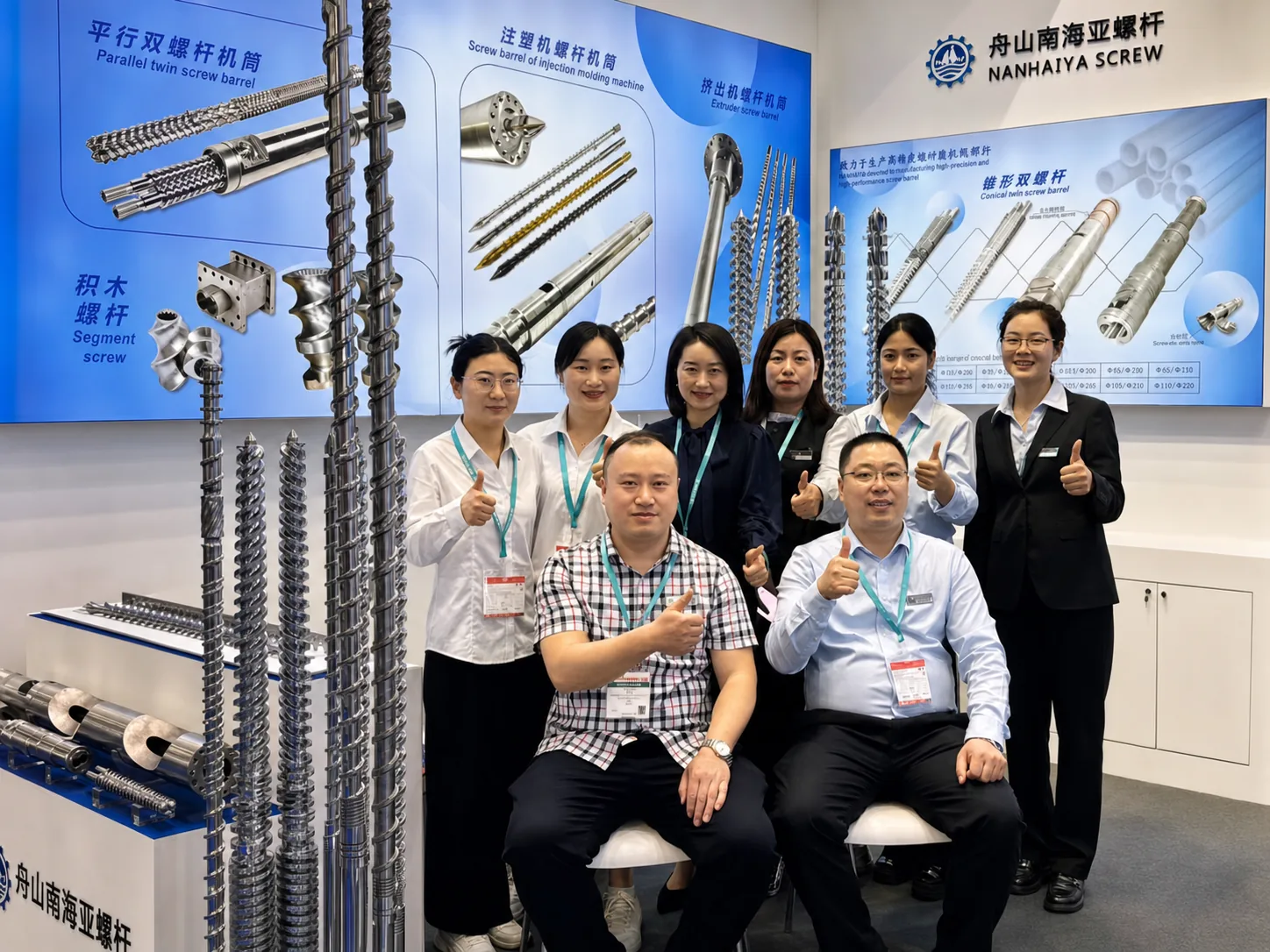
Related Articles
More insights on screw barrel technology and plastics processing.
Extruder Machine Decoded: From Raw Pellet To Finished Product
Oct 6, 2026
Learn how an extruder machine works, compare single-screw vs. twin-screw types, and get expert guidance on specs, troubleshooting, and selection.
Read Article
PE Pipe Making Machine Decoded: From Raw Resin to Flawless Pipe
Oct 4, 2026
Learn how a PE pipe making machine works, from resin to finished pipe. Covers components, material grades, automation, troubleshooting, and buyer selection tips.
Read Article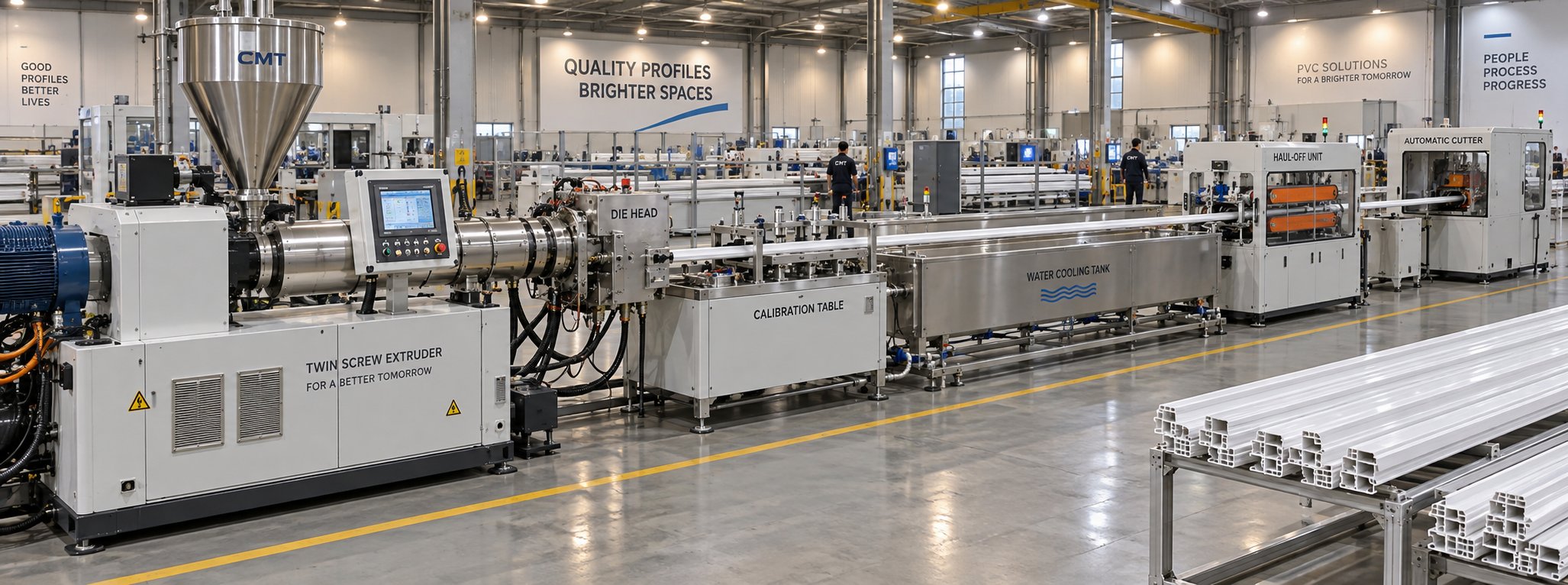
PVC Profile Making Machine Decoded: From Raw Resin To Profit
Oct 3, 2026
Learn how a PVC profile making machine works — extrusion process steps, key technical parameters, die design, calibration methods, maintenance, and total cost of ownership.
Read ArticleLooking for something else?
Search by material, symptom or product and jump straight to the relevant page.
These are navigation suggestions based on keyword matching — not a quotation, not a delivery commitment, and not a substitute for engineering review. Final specification is confirmed by our engineers against your drawings and processed material.
Need help with screw barrel selection?
Share your machine model, processed material and application. Our team can help with pricing and technical support.