

What Is a Parallel Twin Screw Barrel and How Does It Work
Imagine two screws spinning side by side inside a single barrel, working together to transform raw pellets into perfectly mixed, molten material. That's the essence of a parallel twin screw barrel — and it's the backbone of modern polymer compounding, masterbatch production, and recycling operations worldwide.
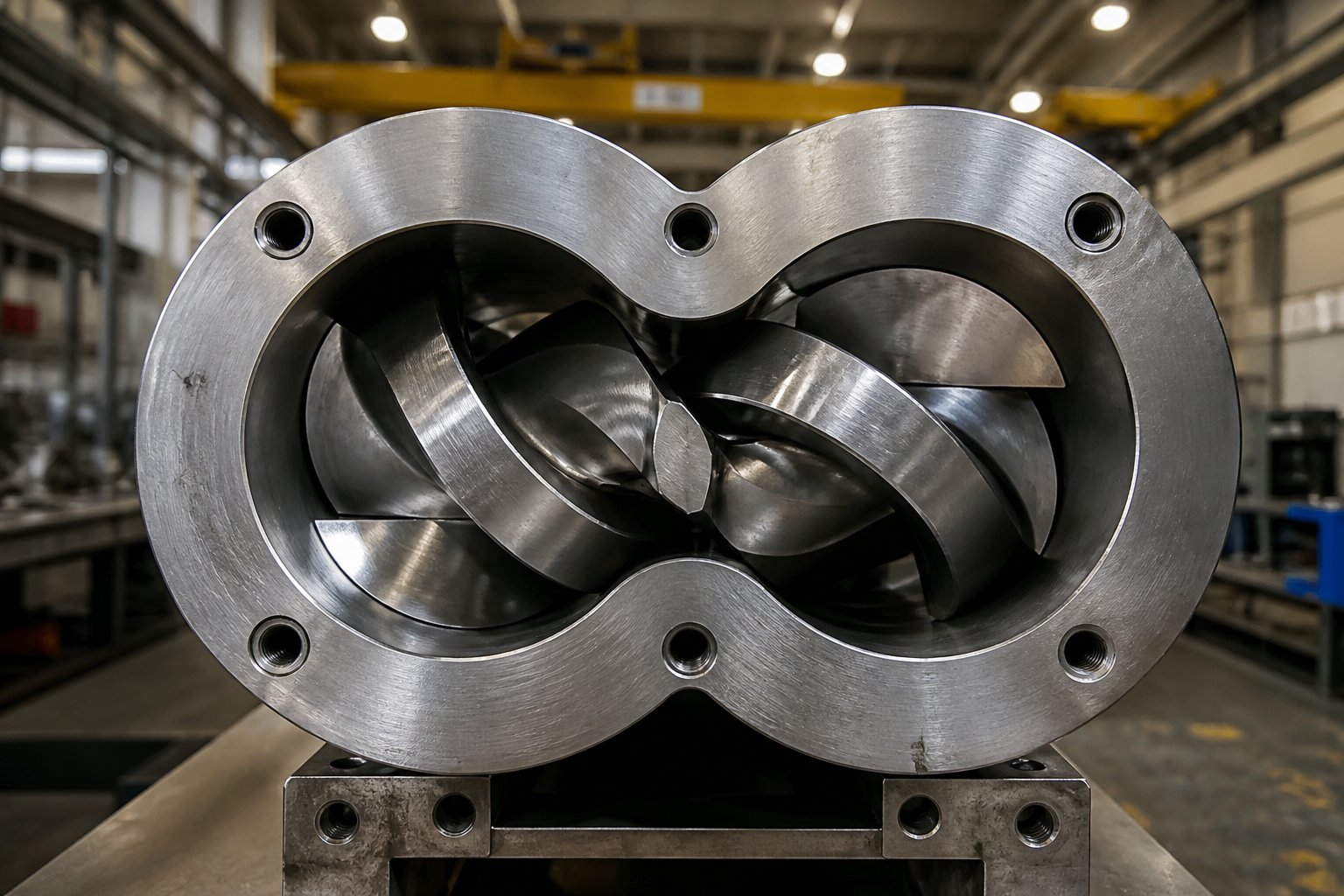
A parallel twin screw barrel is a cylindrical housing with a figure-eight-shaped bore that encases two screws mounted on parallel axes. The screws rotate — either in the same or opposite directions — to convey, melt, mix, and pressurize polymers and other materials through coordinated mechanical and thermal action.
This design stands apart from both single-screw systems and conical twin-screw configurations. A single-screw extruder relies on one rotating screw, which limits its ability to fully turn over and redistribute material within the channel. A conical twin-screw system tapers from a larger feed diameter to a smaller discharge diameter. The parallel twin screw and barrel, by contrast, maintains a consistent screw diameter along the entire processing length — and that geometric consistency unlocks a range of performance advantages.
Core Definition and Operating Principle
At the heart of every twin parallel screw barrel is the figure-eight bore. Picture two overlapping circles machined into a single steel cylinder. Each circle houses one screw, and the overlapping zone — called the intermeshing region — is where the real processing magic happens.
As the screws rotate, raw material enters through a feed port, gets carried forward by the screw flights, and encounters progressively more intense shear and thermal energy. The barrel itself is divided into independently heated and cooled zones, giving operators precise control over the temperature profile from feed throat to discharge. Material moves through distinct functional stages: feeding, melting, intensive mixing, optional devolatilization, and pressurization toward the die. This continuous, sequential process — all within a single barrel — makes the system exceptionally efficient for blending additives, dispersing fillers, and producing uniform melts.
Why Parallel Geometry Outperforms Single-Screw Systems
Single-screw extruders face an inherent limitation: material in the screw channel tends to stay in relatively the same radial position, creating stratified flow. As Plastics Technology explains, the shear rate peaks at the barrel wall and drops to near zero at the screw root, making full-channel mixing extremely difficult. Any attempt to add high-shear mixing elements to a single screw introduces flow resistance that reduces output and raises melt temperature.
A barrel for parallel twin-screw extruders solves this problem through screw-to-screw polymer transfer. The intermeshing geometry forces material to move from one screw channel to the other — repeatedly — exposing the entire melt mass to uniform mixing without excessive shear on any single portion. You'll notice that this approach delivers both distributive mixing (spreading components evenly throughout the melt) and dispersive mixing (breaking down agglomerates and filler clusters) in a way that single-screw systems simply cannot replicate.
The result? Higher throughput, lower melt temperature rise, and far superior additive dispersion — all critical factors in compounding and masterbatch operations.
How the Figure-Eight Bore Enables Self-Wiping Action
One of the most valuable characteristics of a parallel twin screw barrel is self-wiping behavior. In a fully intermeshing configuration, each screw flight closely sweeps the surface of the opposing screw. This continuous scraping action prevents material from stagnating on the screw surfaces or adhering to the barrel wall. According to Technovel Corporation, this wiping effect suppresses gelation and thermal degradation, keeps heat transfer efficiency stable, and reduces contamination risk during product changeovers.
Self-wiping matters most when processing heat-sensitive materials like PVC or when switching between different color formulations. Residual material left behind in a non-wiping system can degrade, discolor the next batch, or create defects in the final product. The figure-eight bore geometry, combined with tight screw-to-screw and screw-to-barrel clearances, virtually eliminates this problem.
Beyond self-wiping, the parallel configuration also supports modular design. Segmented barrel sections bolt together, and individual screw elements can be rearranged to match the demands of each formulation — from gentle conveying to aggressive kneading. This configurability means a single machine can serve multiple processing roles, a flexibility that conical and single-screw designs struggle to match.
The sections ahead unpack each of these advantages in detail — comparing parallel and conical geometries head to head, breaking down all four screw rotation configurations, exploring barrel liner metallurgy that most manufacturers never discuss, and laying out a practical framework for selecting the right barrel specification for your application.
Parallel vs Conical Twin Screw Barrels Compared
Why parallel and not conical? It's one of the most common questions engineers and procurement teams ask — yet surprisingly few resources provide a clear, practical answer. Both designs use two screws rotating inside a shared barrel, but the geometry of that barrel changes everything about how material flows, how screws are configured, and how much you'll spend when components need replacing.
Geometric and Dimensional Differences
The fundamental distinction is straightforward. A parallel twin screw barrel maintains the same screw diameter from the feed port all the way to the discharge end. Both screws sit at a fixed center distance, and the figure-eight bore cross-section stays uniform along the entire processing length. Think of it as a consistent highway — same lane width, same capacity, start to finish.
A conical twin screw barrel takes the opposite approach. The screws taper from a larger diameter at the feed zone to a smaller one at the discharge. This tapering geometry creates a natural compression ratio built right into the barrel shape, which means the material is progressively squeezed as it moves toward the die. As Bausano notes, conical counter-rotating designs function as positive displacement pumps — particularly well-suited for thermally sensitive polymers like PVC and C-PVC.
This geometric difference has cascading effects on nearly every aspect of barrel performance:
- L/D ratio flexibility: Parallel barrels can be extended by adding modular segments, easily reaching L/D ratios of 40:1, 48:1, or even 60:1 for complex compounding tasks. Conical barrels have fixed taper angles that limit L/D options, typically staying in the 22:1 to 26:1 range.
- Modular element interchangeability: Because the bore diameter is consistent, parallel systems accept standardized screw elements — conveying flights, kneading blocks, mixing gears — that can be swapped and rearranged. Conical screws are machined as one-piece units, so reconfiguring the screw profile means replacing the entire screw set.
- Center distance and torque transmission: Parallel screws, constrained by a constant center distance, historically faced limitations on the shaft diameter that could fit between them. Modern gearbox designs have largely solved this, with torque densities now reaching 10.6 to 12.8 Nm/cm3 in high-performance parallel platforms. Conical designs naturally accommodate larger shaft roots at the feed end, giving them inherently strong torque transmission without requiring premium gearboxes.
Throughput and L/D Ratio Flexibility Compared
Throughput scalability is where parallel designs pull decisively ahead. Since every barrel section has the same bore diameter, adding processing length simply means bolting on additional segments. You need an extra kneading zone for a highly filled formulation? Add a barrel section and the corresponding screw elements. Want to incorporate vacuum devolatilization ports? Insert a vented barrel segment wherever the process demands it.
Conical barrels don't offer this flexibility. Their taper is fixed at manufacture, meaning the entire processing sequence — feeding, compression, metering — is locked into the original barrel geometry. For processors running a single formulation at steady volumes, that's perfectly fine. But if your operation handles multiple resins, varying filler loadings, or evolving product specifications, the parallel twin screw and barrel gives you room to adapt without purchasing an entirely new machine.
Barrel replacement economics tell a similar story. When a conical barrel wears out, the entire tapered housing must be replaced as a unit — and because each conical barrel is essentially custom-machined to match its specific taper angle, sourcing replacements can be expensive and slow. A parallel barrel, built from modular segments, lets you replace only the worn sections. If abrasive calcium carbonate destroys the mixing zone but leaves the feed zone untouched, you swap two or three barrel sections rather than the whole assembly. Over a machine's lifetime, this modularity can cut barrel replacement costs significantly.
The table below puts these differences side by side:
| Criteria | Parallel Twin Screw Barrel | Conical Twin Screw Barrel |
|---|---|---|
| L/D Ratio Range | 32:1 to 60:1 (modular extension possible) | 22:1 to 26:1 (fixed by taper geometry) |
| Modularity | Fully segmented barrel and screw elements; reconfigurable | One-piece barrel and screw; limited reconfiguration |
| Throughput Capacity | Higher; scalable with bore diameter and speed | Lower; constrained by tapering channel volume |
| Shear Intensity Control | Highly adjustable via element selection | Moderate; set largely by screw geometry |
| Self-Wiping Capability | Excellent in co-rotating intermeshing configs | Limited; counter-rotating with closed chambers |
| Typical Applications | Compounding, masterbatch, reactive extrusion, recycling | Rigid PVC pipe/profiles, sheet, gentle processing |
| Torque Transmission | Requires high-performance gearbox design | Naturally strong due to large feed-end shaft |
| Barrel Replacement Cost | Lower (replace individual segments) | Higher (replace entire tapered barrel) |
| Floor Space Requirement | Longer footprint at high L/D ratios | More compact for equivalent output |
When to Choose Conical Over Parallel
Despite the flexibility advantages of parallel systems, conical twin screw barrels remain the right call in several scenarios. If your operation focuses primarily on rigid PVC profile extrusion or PVC pipe production, the conical design's built-in compression, gentle shear profile, and positive displacement conveying align perfectly with PVC's thermal sensitivity. Bausano's processing analysis confirms that counter-rotating conical extruders handle PVC and C-PVC with minimal degradation risk, making them the default in dedicated PVC lines worldwide.
A parallel twin screw barrel for PVC applications does exist — and it performs exceptionally well in high-filler-loading scenarios. When PVC compounds include 100 phr or more of calcium carbonate, the longer L/D ratio of a parallel system provides more residence time for thorough plasticization and filler coating. Bausano's own testing found that parallel counter-rotating screws offer better jellification and longer barrel life in heavily filled PVC applications, thanks to their larger screw core diameter and superior abrasion resistance.
Conical systems also earn their place where floor space is limited. Their compact footprint — shorter overall length for a given output rate — makes them practical for facilities that can't accommodate the longer barrel assemblies of high-L/D parallel machines. And for processors who value simplicity, the one-piece screw design of a Cincinnati parallel twin screw barrel replacement or a conical equivalent means fewer components to manage and fewer assembly variables to control.
The bottom line? Parallel and conical designs aren't competing technologies — they're complementary solutions for different processing realities. The real question isn't which is "better" but which configuration matches your materials, your production volumes, and your operational priorities. That answer becomes even clearer when you understand the four distinct screw rotation configurations available within the parallel platform — each engineered for a specific set of mixing, conveying, and shear demands.
Four Types of Parallel Twin Screw Barrel Configurations Explained
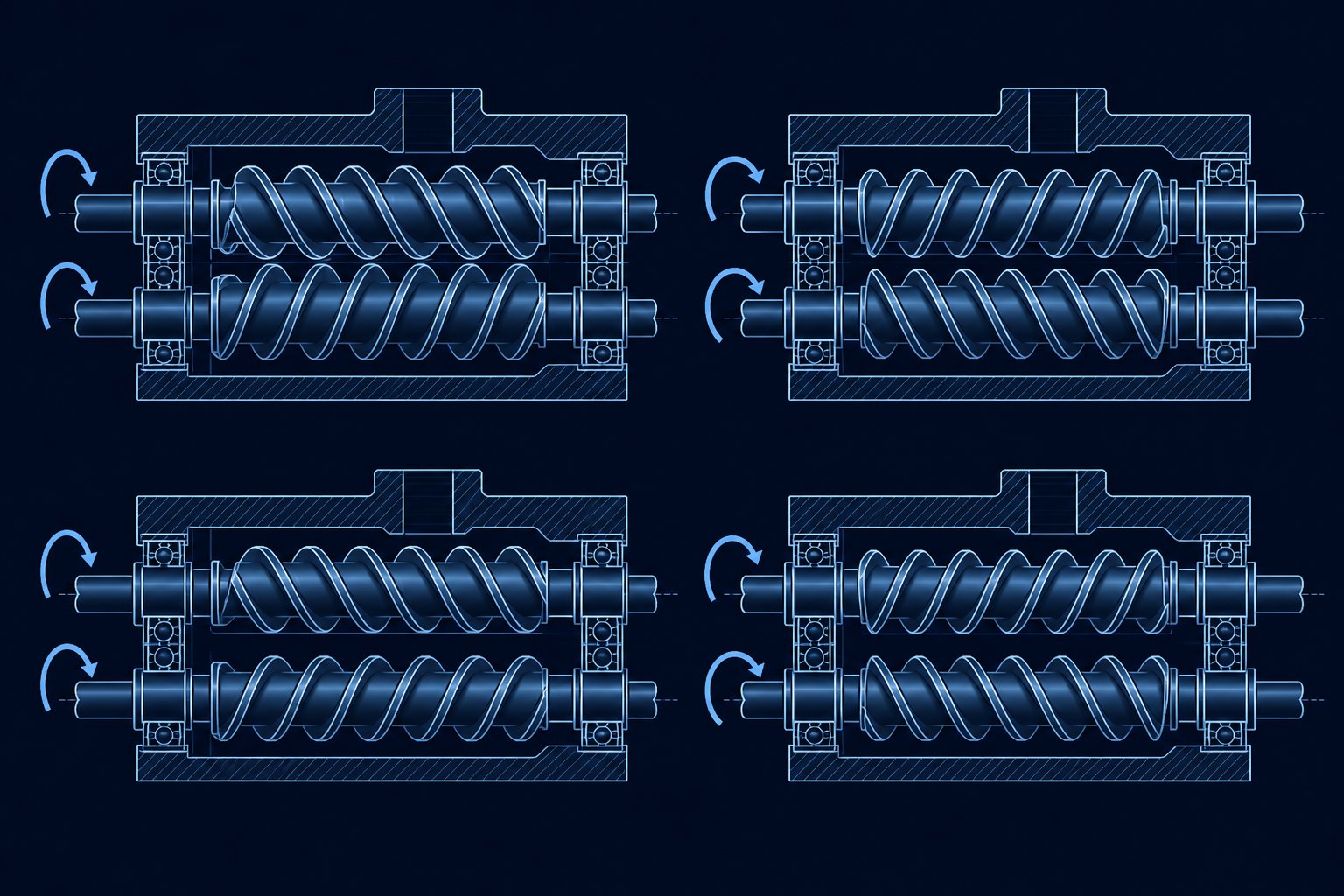
Two screws sit inside a figure-eight bore — but how they rotate and how closely they engage with each other changes everything about mixing performance, shear intensity, and the types of materials you can process. Combine two rotation directions (co-rotating and counter-rotating) with two engagement geometries (intermeshing and non-intermeshing), and you get four distinct parallel twin screw barrel configurations. Each one serves a different processing purpose, and choosing the wrong match can mean poor dispersion, degraded polymers, or wasted throughput capacity.
Let's break down each configuration so you can see exactly where it fits — and where it doesn't.
Co-Rotating Intermeshing Configuration
This is the workhorse of the industry. In a co-rotating intermeshing setup, both screws spin in the same direction — typically at high speeds ranging from 300 to 900 rpm, with some modern platforms pushing beyond 1,200 rpm. The screw flights of one shaft mesh tightly into the channels of the other, creating that signature self-wiping action where each screw continuously cleans its counterpart.
Why does this matter so much? Imagine running a carbon black masterbatch at 40% loading. Agglomerates need to be broken apart (dispersive mixing), and the pigment particles must be spread uniformly throughout the carrier resin (distributive mixing). The co-rotating intermeshing configuration delivers both. Material follows a spiral figure-eight flow path between the two screws, transferring repeatedly from one channel to the other. Every transfer point creates a new mixing event — without the excessive shear buildup that degrades heat-sensitive resins.
The tight intermeshing geometry also means there are virtually no stagnant zones inside the barrel. Dead spots where material could overheat or degrade are eliminated by continuous screw-to-screw wiping. This makes product changeovers faster and cleaner — a major advantage for any parallel twin screw barrel manufacturer building machines that handle multiple formulations on the same line.
Residence time distribution in this configuration is narrow and well-controlled, which is exactly what you want for consistent product quality. Every particle of material spends roughly the same amount of time inside the barrel, so heat history stays uniform. That's why co-rotating intermeshing parallel systems dominate compounding, masterbatch production, reactive extrusion, and devolatilization applications worldwide.
Counter-Rotating Intermeshing Configuration
Flip the rotation direction so the screws spin toward each other at the top (or away from each other, depending on convention), and the processing dynamics change dramatically. In a counter-rotating intermeshing design, the meshing zone creates enclosed C-shaped chambers between the screw flights. These chambers act like sealed pockets that trap material and push it forward in a positive displacement manner — similar to a gear pump.
This positive conveying action builds pressure more effectively than co-rotating systems, which makes counter-rotating intermeshing barrels a strong choice for direct extrusion applications where the extruder must push material through a die at high and stable pressure. PVC pipe and profile lines, for instance, frequently rely on counter-rotating parallel configurations when processors need the modular barrel length that conical designs cannot provide.
The tradeoff? Screw speeds must stay lower — typically 30 to 150 rpm — because the opposing rotation creates intense localized shear in the nip region where the screws meet. Running too fast risks overheating the polymer or generating excessive mechanical stress on the screw shafts. Self-wiping still occurs, but it's less thorough than in co-rotating designs because the closed-chamber geometry limits the degree of material exchange between channels.
Residence time distribution is broader here. Some material pockets move through the barrel faster than others depending on their position within the C-shaped chambers. For applications requiring very tight melt homogeneity, this variability can be a limitation. But for processes that need steady pressure generation and gentle handling of thermally sensitive formulations, counter-rotating intermeshing systems remain a proven solution.
Non-Intermeshing Configurations and Niche Uses
The two remaining configurations — co-rotating non-intermeshing and counter-rotating non-intermeshing — occupy specialized niches. In both cases, the screws run parallel inside the barrel but don't engage with each other. The center distance between shafts equals or exceeds the sum of both screw radii, so the flights never enter the opposing channel.
Counter-rotating non-intermeshing is the more commercially relevant of the two. Without screw engagement, shear forces drop to the lowest level of any twin-screw configuration. The screws operate independently, and material exchange happens through friction-based conveying and the natural drag flow between channels. This gentle environment suits high-level devolatilization — removing 30% or more of volatile solvents — and processing of heat-sensitive pharmaceuticals, specialty chemicals, and petrochemical precursors. The free volume inside the barrel is the highest of any configuration, giving volatile gases room to escape efficiently through vacuum venting ports.
The downside is obvious: no intermeshing means no self-wiping. Material can accumulate in dead zones, especially with sticky or high-viscosity formulations. Changeovers take longer, and cleaning can require partial disassembly. Throughput capacity is also lower by design, since the system prioritizes residence time and gentle processing over speed.
Co-rotating non-intermeshing is the rarest configuration in commercial production. It shares some mixing characteristics with its counter-rotating counterpart but lacks both the self-wiping advantage of intermeshing co-rotating systems and the positive displacement of counter-rotating designs. A few niche applications in chemical reactor-style extrusion use this layout, but any reputable parallel twin screw and barrel manufacturer will steer most customers toward one of the three more established configurations unless a very specific processing need demands otherwise.
The table below puts all four configurations side by side so you can compare them across the metrics that matter most:
| Performance Metric | Co-Rotating Intermeshing | Counter-Rotating Intermeshing | Co-Rotating Non-Intermeshing | Counter-Rotating Non-Intermeshing |
|---|---|---|---|---|
| Shear Intensity | High (adjustable via elements) | Moderate to high (concentrated at nip) | Low to moderate | Low |
| Dispersive Mixing | Excellent | Good | Fair | Poor |
| Distributive Mixing | Excellent | Moderate | Moderate | Good |
| Throughput Capability | Highest (300 - 1,200+ rpm) | Moderate (30 - 150 rpm) | Low to moderate | Low |
| Self-Wiping | Excellent — virtually no dead zones | Good — limited by closed chambers | None | None |
| Residence Time Distribution | Narrow and uniform | Broader — variable by chamber position | Moderate | Broad — by design for extended processing |
| Pressure Generation | Moderate (requires specific elements) | High — positive displacement action | Low | Low |
| Primary Applications | Compounding, masterbatch, reactive extrusion, recycling | PVC pipe/profiles, direct extrusion, filled compounds | Specialty chemical reactions (rare) | Devolatilization, pharmaceuticals, specialty polymers |
A clear pattern emerges from this comparison. Co-rotating intermeshing dominates general-purpose compounding and masterbatch production because it delivers the best combination of mixing quality, throughput, and self-wiping. Counter-rotating intermeshing fills the gap for direct extrusion and pressure-sensitive applications. Non-intermeshing variants serve specialized roles where gentle processing and long residence times outweigh mixing intensity.
For any china parallel twin screw barrel manufacturer serving global markets, the co-rotating intermeshing configuration represents the largest share of production volume. But understanding all four options ensures you're matching the barrel to the process — not just defaulting to the most popular choice.
Configuration, however, is only half the story. The real versatility of a parallel system comes from what sits inside the barrel: modular screw elements that can be rearranged like building blocks to fine-tune conveying, mixing, and pressure generation for each specific formulation.
Modular Screw Element Design and Barrel Segmentation
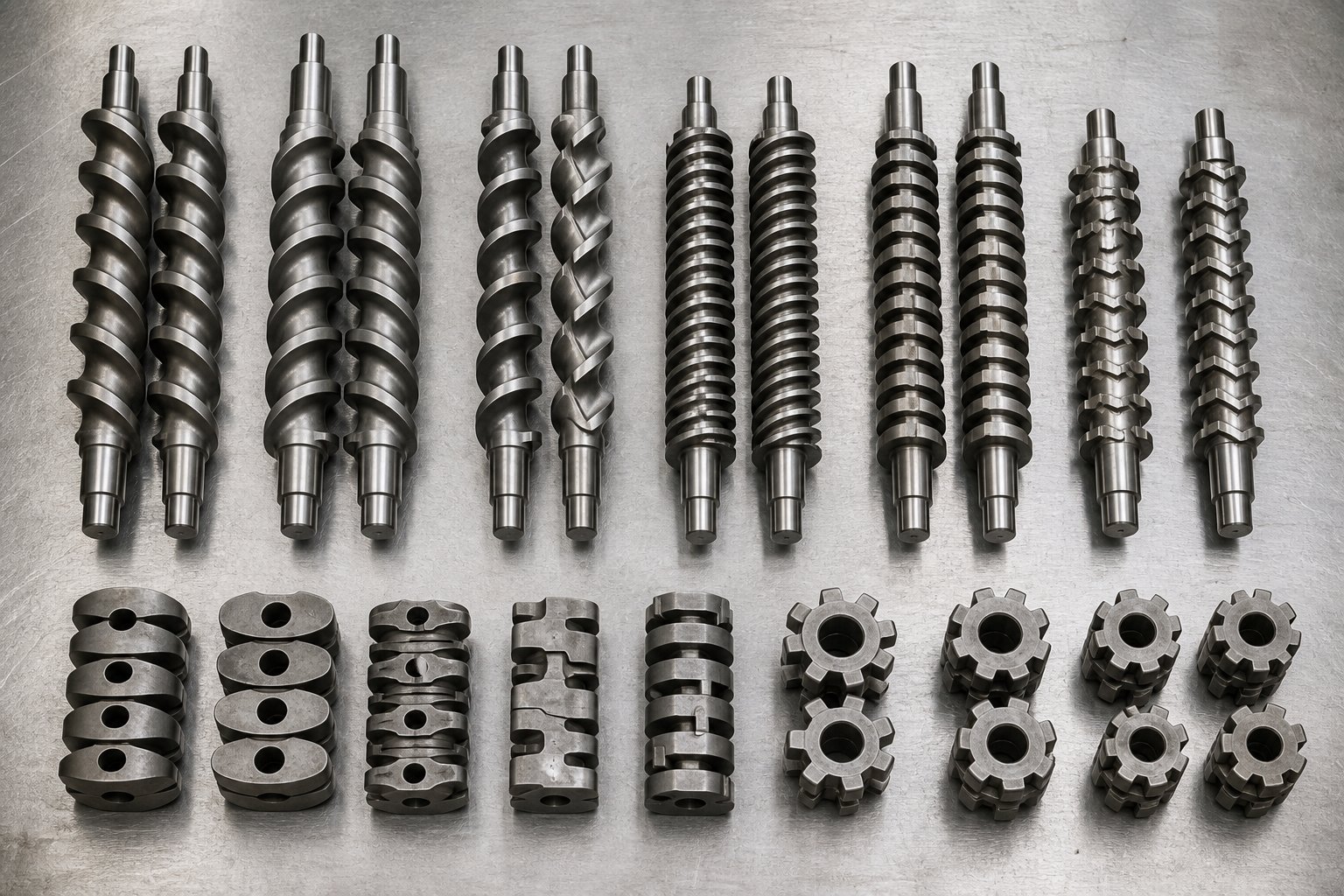
Here's what makes a parallel twin screw barrel fundamentally different from every other extrusion platform: you can take it apart and rebuild the processing recipe without buying a new machine. The screws aren't one-piece shafts with fixed geometry. They're assembled from dozens of individual elements — each one shaped for a specific job — slid onto splined shafts and locked in place with a nose tip. Swap the order, change a few elements, and the same extruder that ran a 20% talc-filled PP compound yesterday can handle a reactive grafting process tomorrow.
This modularity is the single biggest reason co-rotating intermeshing systems dominate modern compounding. But understanding which elements do what — and why their sequence matters — is where most buyers hit a wall. Let's fix that.
Conveying Elements and Pitch Variations
Conveying elements are the workhorses of the screw build. They feature continuous helical flights that push material downstream, and their primary variable is pitch — the axial distance one flight advances per full rotation of the screw. Sounds simple? The impact of pitch selection is anything but.
In the feed zone, you want material to enter the barrel and move forward quickly without backing up into the feed throat. High-pitch conveying elements — typically with a pitch ratio of 1.5 to 2.0 relative to the screw diameter — create large open channel volumes that accept bulk material efficiently. As industry configuration guides confirm, a tight pitch at the feed throat starves the machine, creates inconsistent fill, and causes premature melting that blocks material flow.
Move further downstream, and the processing demands shift. Before the die, you need pressure generation to push the melt through restrictive tooling. Low-pitch conveying elements — pitch ratios of 0.5 to 0.75 — slow material velocity and increase the fill degree in the channel, building the back-pressure needed for stable extrusion. Between these extremes, medium-pitch elements handle transition zones and maintain material flow between kneading and mixing sections.
Think of pitch selection as a speed dial: high pitch means fast transport with minimal shear, low pitch means slow transport with high pressure. Getting this gradient right across the full screw length is often the first tuning step when troubleshooting output instability or melt temperature problems.
Kneading Blocks and Mixing Element Types
If conveying elements are the transportation network, kneading blocks are the processing engines. Instead of continuous helical flights, kneading blocks consist of a series of elliptical disc-shaped lobes stacked along the shaft at specific offset angles. These stagger angles control how aggressively the element mixes material — and selecting the right angle for each zone is arguably the most consequential decision in any screw design.
The three primary stagger angle ranges work like this:
- Narrow angle (30°): Gentle melting and mixing with significant forward-conveying action. Ideal for thermally sensitive materials like soft PVC and TPE, where excessive shear causes degradation. These blocks melt polymer gradually while still pushing material downstream.
- Medium angle (45° to 60°): Balanced dispersive and distributive mixing. The 60° configuration is the most common choice for filler incorporation zones, where you need to break apart agglomerates of calcium carbonate, talc, or pigment clusters and distribute them uniformly. Most compounding operations rely heavily on this range.
- Wide angle (90°): Maximum dispersive shear with virtually no forward conveying. Material churns intensively within the element, experiencing the highest shear rates anywhere in the screw build. Carbon black masterbatch, high-pigment concentrates, and other formulations demanding aggressive agglomerate breakdown use 90° kneading blocks — but sparingly, because the heat generation is substantial.
Beyond kneading blocks, a separate family of mixing elements handles distributive blending — the process of reorienting and folding the melt stream to improve homogeneity without crushing particles or degrading polymer chains. Specialized distributive mixers fall into two main categories:
- Gear-type mixing elements: Feature interlocking tooth profiles that split and recombine the melt stream repeatedly. They multiply the interfacial area between blend components — essential for color incorporation and polymer blending where you want thorough homogenization at low shear.
- Turbine-type (toothed) mixing elements: Use radial slots or channels cut into disc-shaped bodies to create high surface renewal. These excel in reactive extrusion, where reactants injected into the melt need rapid, uniform distribution without the high-shear stress that kneading blocks would impose.
Experienced engineers rarely use a single kneading angle or mixer type throughout a processing zone. Instead, they stack different configurations in sequence — a 45° block to initiate melting, followed by 60° for filler dispersion, then a gear mixer for distributive homogenization. This layered approach gives the formulation exactly what it needs at each stage of the process.
Reverse Elements and Barrel Segmentation Logic
Every screw build needs elements that deliberately resist forward flow. Sounds counterintuitive? Reverse elements — also called left-handed or back-pumping elements — are machined with flight angles opposite to the conveying direction. When material hits a reverse element, it encounters a wall of backward-pushing force that creates a high-pressure melt seal.
These melt seals serve two critical functions:
- Vacuum vent isolation: Before a devolatilization port, a reverse element or reverse kneading block creates a fully filled, pressurized zone that prevents atmospheric air from being drawn into the barrel through the vent opening. Without this seal, vacuum devolatilization simply doesn't work — melt floods the vent port and volatiles can't escape.
- Back-pressure generation: In mixing zones, reverse elements force material to spend more time in upstream kneading blocks, increasing the intensity and duration of mixing events. They also serve as barriers between processing zones, ensuring that each section operates at its designed fill level and pressure independently.
The barrel itself mirrors this modular philosophy. Rather than a single monolithic steel cylinder, parallel twin screw barrel parts are manufactured as individual segmented sections — typically 4D to 5D in length each (where D equals the screw diameter). These segments bolt together end-to-end using precision-aligned flanges, and each section can feature different configurations: solid barrel segments for high-pressure zones, vented segments with side ports for devolatilization or liquid injection, open-top segments for downstream side feeding of fillers or fibers, and cored segments with internal cooling channels for temperature management.
This segmented architecture means a parallel twin screw barrel factory can supply replacement sections individually rather than as complete assemblies. When abrasive fillers wear out two barrel sections in the intensive mixing zone, you replace just those sections — not the entire barrel. For processors running multiple product lines, it also means maintaining a small inventory of specialized barrel segments (vented, side-fed, high-wear-lined) that can be swapped in as production schedules change.
OEMs like Leistritz and Coperion have standardized the critical interface dimensions — bore diameter, flange bolt patterns, element spline profiles — that define how these parts fit together. The broader industry, including every major china parallel twin screw barrel supplier, manufactures elements and barrel segments to these established dimensional standards. That standardization is what makes third-party parallel twin screw barrel parts interchangeable with OEM equipment in most cases, giving processors the freedom to source from the supplier that best matches their quality, lead time, and budget requirements.
The key takeaway? Modularity isn't just a design convenience — it's an economic strategy. A well-stocked inventory of screw elements and barrel segments lets a single extruder handle dozens of formulations, and it keeps unplanned downtime to a minimum when wear inevitably occurs. But wear resistance itself depends on something that no amount of clever element arrangement can overcome: the metallurgy of the barrel liner that stands between your process and the steel housing everything rides in.
Barrel Liner Materials and Metallurgy for Wear Resistance
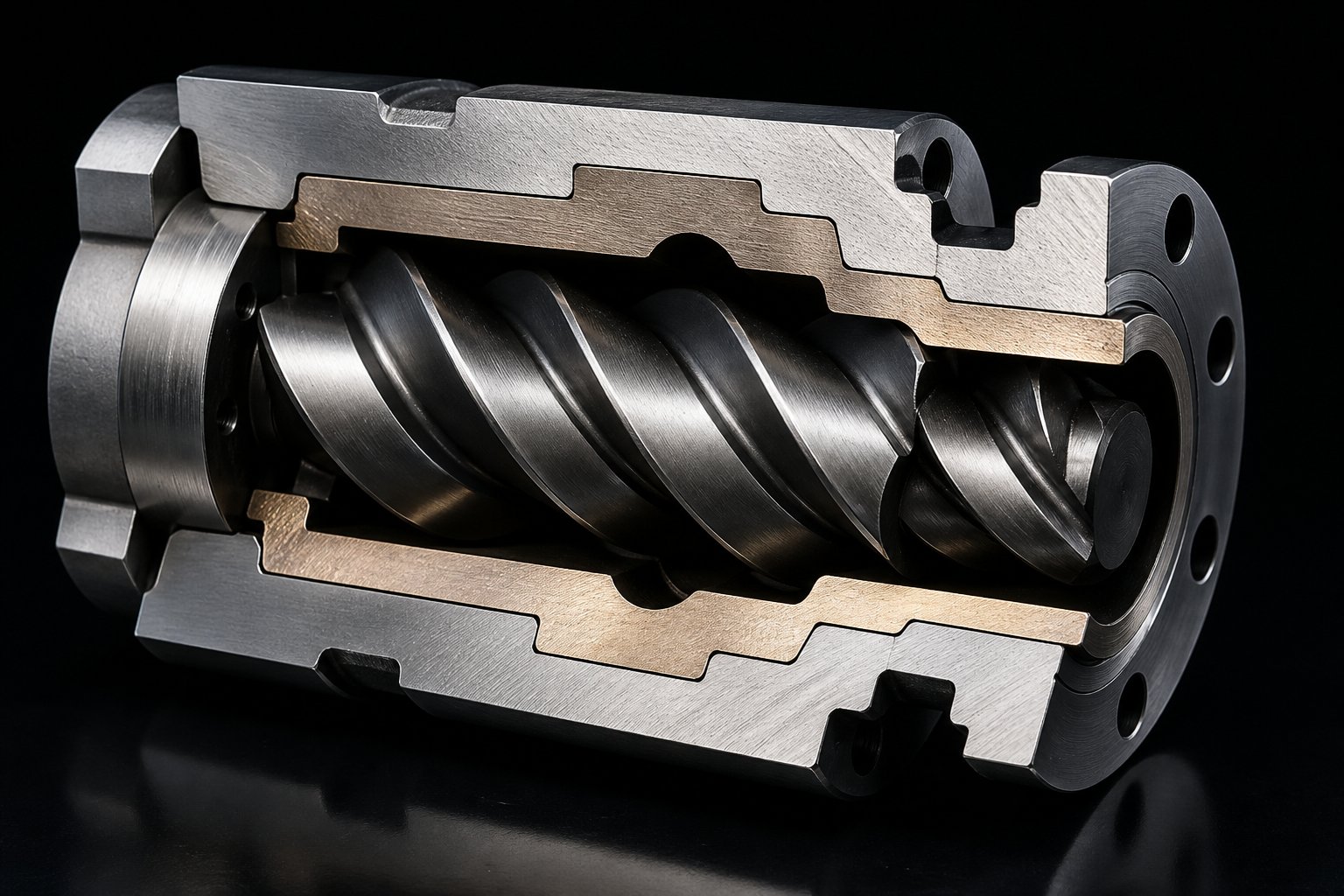
Screw element geometry controls how material flows through the barrel. But what keeps that barrel functional for three years instead of twelve months? The answer is the liner — the inner surface that every pellet, filler particle, and corrosive off-gas touches on its journey through the extruder. Get the liner metallurgy wrong, and even the most perfectly configured screw build won't save you from premature wear, throughput loss, and costly unscheduled shutdowns.
Most discussions about parallel twin screw barrel selection stop at configuration and L/D ratio. Liner metallurgy rarely gets the attention it deserves — even though it's the single biggest factor determining barrel service life and total cost of ownership. Let's change that.
Nitrided Steel and Bimetallic Liner Options
The baseline option for any parallel twin screw barrel is a nitrided steel bore. The barrel body is machined from a nitriding-grade alloy steel — most commonly 38CrMoAlA (Chinese GB standard), EN-41B (British), or Nitralloy 135M (US) — then surface-hardened by diffusing nitrogen into the bore at 500 to 550 degrees Celsius. This process creates a hardened case roughly 0.4 to 0.6 mm deep, with surface hardness reaching 950 to 1,100 HV (approximately 65 to 70 HRC equivalent). Beneath this case, the core retains its original toughness at around 280 to 320 HB.
Sounds impressive, right? The catch is that thin hardened layer. Once abrasive wear penetrates beyond 0.5 mm, the soft core is exposed — and wear accelerates rapidly from that point. There's no second chance. For clean polyolefins, unfilled PP, and standard PVC at moderate output, nitrided barrels deliver reliable performance at the lowest initial cost. Expect 24 to 48 months of service life in these gentle conditions. But introduce 20% calcium carbonate filler, and that lifespan can drop to 12 to 18 months.
Bimetallic barrels take a fundamentally different approach. Instead of hardening the surface of a single steel, they use the same high-strength steel shell as the outer body — then line the bore with a wear-resistant alloy applied through centrifugal casting at approximately 1,100 degrees Celsius. The rotating mold forces molten alloy against the inner bore wall, creating a metallurgical bond between shell and liner. The resulting wear layer is 1.5 to 3.0 mm thick — roughly five to six times the depth of a nitrided case.
Two main alloy families dominate the bimetallic liner market:
- Iron-based liners (Fe-Cr-B): Built around a matrix of chromium and boron carbides in an iron base, these liners reach 58 to 62 HRC and excel against abrasive fillers like calcium carbonate, talc, and moderate glass fiber loadings. They represent the most cost-effective upgrade from nitrided steel when your formulation includes hard particulates.
- Nickel-based liners (Ni-Cr-B-W): These use a nickel matrix with embedded chromium, boron, and tungsten carbides. Hardness reaches 60 to 65 HRC, but the real advantage is corrosion resistance. Nickel-based liners form a passive surface film that resists attack from HCl gas — the byproduct of PVC and halogenated flame retardant processing. Any parallel twin screw barrel factory in china producing equipment for PVC compounders will typically recommend this liner grade as the minimum viable specification.
The cost premium for bimetallic over nitrided is real — typically 1.8 to 3.0 times the initial price. But the math shifts dramatically when you factor in service life. In filled PVC applications, bimetallic liners last 36 to 60 months versus 12 to 18 months for nitrided, making the annualized barrel cost significantly lower despite the higher upfront investment.
Tungsten Carbide and Powder Metallurgy Alloys
When standard bimetallic liners aren't enough — think 30% or more glass fiber loading, high-mineral engineering plastics, or aggressive wood-plastic composites — the metallurgy steps up to tungsten carbide (WC) territory.
WC-rich bimetallic liners embed tungsten carbide particles within a nickel or cobalt matrix, pushing bore hardness to 65 to 70 HRC. The individual WC particles themselves measure approximately 2,500 HV — harder than virtually any filler particle they'll encounter. In glass-fiber-reinforced PA66 compounding, where nitrided barrels fail within 6 to 12 months, WC-rich liners routinely deliver 24 to 48 months of service. The effective cost per month of operation can drop by half or more compared to nitrided alternatives, even with an initial price premium of 2.5 to 3.5 times.
For the most extreme abrasion environments — silicon carbide fillers, very high glass fiber percentages — HVOF (High Velocity Oxygen Fuel) tungsten carbide thermal spray coatings represent the top tier. These coatings apply WC-Co or WC-CrC particles at supersonic velocities, producing a layer with hardness reaching 70 to 75 HRC equivalent (1,100 to 1,400 HV) and porosity below 1%. The limitation is coating thickness — typically 0.15 to 0.35 mm — which means the substrate quality and bond strength are critical.
Stellite-based alloys occupy a different niche entirely. These cobalt-chromium-tungsten compositions, developed by Kennametal Stellite, are engineered for environments where both abrasion and corrosion attack simultaneously. Stellite 6 (Co-28Cr-4W-1C) reaches 36 to 45 HRC, while Stellite 12 pushes to 45 to 52 HRC. What makes them special isn't raw hardness — it's hot hardness. Stellite alloys maintain 35 to 40 HRC at 600 degrees Celsius, a temperature range where conventional tool steels have already softened below useful levels. For a china parallel twin screw and barrel factory serving CPVC or fluoropolymer processors, Stellite-lined barrels and Stellite-overlaid screws are often the only responsible specification.
The chromium content in Stellite alloys also forms a protective oxide layer that shields the bore from corrosive attack — the same HCl and HF gases that destroy nitrided steel within months. Cobalt-based alloys additionally offer superior sulfidation resistance compared to nickel-based alternatives, an advantage in certain specialty chemical extrusion processes.
Matching Liner Material to Processing Application
Selecting the right liner isn't about choosing the hardest available option. It's about identifying your dominant wear mode — abrasive, corrosive, or combined — and matching the metallurgy to that specific threat.
Consider two processors operating identical parallel twin screw barrels. One compounds mineral-filled polypropylene at 40% CaCO3 loading. The other processes rigid PVC with low filler content. Both barrels wear out, but for completely different reasons. The PP compounder's barrel fails from abrasive scoring — hard particles carving grooves into the bore surface. The PVC processor's barrel fails from corrosive pitting — HCl off-gases chemically attacking the steel substrate. Specifying the same liner for both would over-engineer one application and under-protect the other.
The table below maps liner materials to their performance characteristics and ideal applications:
| Liner Material | Hardness Range | Abrasion Resistance | Corrosion Resistance | Typical Applications | Relative Cost |
|---|---|---|---|---|---|
| Nitrided Steel (38CrMoAlA) | 950-1,100 HV (65-70 HRC surface) | Moderate (0.4-0.6 mm case only) | Low to moderate | Unfilled PE/PP, standard PVC, low-output lines | 1.0x (baseline) |
| Iron-Based Bimetallic (Fe-Cr-B) | 58-62 HRC | Good (1.5-3.0 mm depth) | Moderate | CaCO3-filled compounds, talc, recycled streams | 1.8-2.5x |
| Nickel-Based Bimetallic (Ni-Cr-B-W) | 60-65 HRC | Good to very good | Excellent | PVC, CPVC, halogenated FR, cable compounds | 2.0-3.0x |
| WC-Rich Bimetallic | 65-70 HRC | Excellent | Good (depends on matrix) | Glass fiber PA/PBT, mineral-filled engineering resins, WPC | 2.5-3.5x |
| HVOF WC-Co / WC-CrC Spray | 70-75 HRC (1,100-1,400 HV) | Outstanding | Good to excellent (WC-CrC-Ni variants) | Extreme abrasion: high-% GF, SiC, ceramic fillers | 3.0-4.0x |
| Stellite-Based (Co-Cr-W) | 36-52 HRC (retains hardness at 600°C+) | Good | Excellent (+ hot hardness retention) | CPVC, fluoropolymers, high-temp corrosive compounds | 3.5-5.0x |
Two practical rules help settle most liner decisions. First, ask: is the filler content above 20% by weight? If yes, step up from nitrided to at least an iron-based bimetallic. Second, ask: does the polymer system generate corrosive off-gases? If yes, a nickel-based or Stellite-based liner is essential regardless of filler loading.
Verification matters too. Reputable suppliers — whether a parallel twin screw and barrel factory in china or a European OEM — should provide hardness testing documentation with every barrel. Vickers (HV) testing per DIN 50190-3 or Rockwell (HRC) testing per ASTM E18 should be performed at multiple points along the bore, confirming uniform hardness throughout the liner depth. Surface roughness after honing should meet Ra 0.4 micrometers or better, and bore straightness should hold within 0.015 mm per meter. These aren't marketing numbers — they're the measurable quality indicators that predict whether a barrel will deliver its rated service life or fall short.
Liner economics ultimately come down to a simple comparison: cost per operating hour, not cost per purchase order. A china parallel twin screw barrel factory offering a nitrided barrel at half the price of a bimetallic unit isn't necessarily providing better value. If the nitrided barrel lasts 14 months in your filled PVC application while the bimetallic alternative runs 36 months or more, the cheaper barrel costs you more per month of production — plus the downtime, scrap, and throughput loss that come with each premature replacement.
Understanding which liner material sits inside your barrel is the metallurgical half of the equation. The operational half — knowing when that liner has worn beyond its useful limit and what failure patterns to watch for — is equally critical for keeping your line running at peak performance.
Processing Applications Mapped to Barrel Specifications
Liner metallurgy tells you what your barrel can withstand. Configuration type tells you how material flows through it. But neither answer matters in isolation — what really drives the specification is the application itself. Every processing operation places a unique combination of demands on barrel geometry, screw element layout, wear protection, and thermal control. Choosing the right extruder parallel twin screw barrel means starting with the job it has to do, then working backward to the configuration, liner grade, and L/D ratio that match.
Here's how the major application domains map to specific barrel requirements.
Compounding and Masterbatch Production Requirements
Polymer compounding — blending base resins with colorants, stabilizers, flame retardants, or mineral fillers — accounts for the largest share of parallel twin screw barrel installations globally. The demands are straightforward in concept but challenging in execution: melt the resin, incorporate the additives uniformly, and discharge a consistent pelletizable strand — all without degrading the polymer or leaving undispersed agglomerates.
A co-rotating intermeshing configuration running at L/D ratios of 36:1 to 48:1 handles the vast majority of compounding tasks. The screw build typically follows a predictable architecture: high-pitch conveying elements at the feed throat, a melting zone with 45° to 60° kneading blocks, downstream side-feeding ports for fillers, additional kneading and gear-type mixing sections for dispersion, and low-pitch metering elements before the die. Barrel liner selection depends entirely on the filler type. Unfilled color concentrates run comfortably on nitrided steel, while 40% CaCO3-filled PP demands at minimum an iron-based bimetallic bore.
Masterbatch production pushes these same requirements harder. Pigment loadings of 40% to 70% in carrier resins like LDPE or EVA create processing conditions that are simultaneously abrasive and shear-intensive. Carbon black masterbatch, for example, requires aggressive 90° kneading blocks to break apart tightly bonded agglomerates — generating substantial heat that demands precise barrel zone temperature control. TiO2-loaded white masterbatch introduces abrasive titanium dioxide particles that erode conventional liners within months. WC-rich bimetallic or HVOF-coated barrels become the practical minimum for high-volume masterbatch operations.
For pelletizing lines downstream of these compounders, the extruder twin parallel screw barrel must deliver stable melt pressure and consistent viscosity at the die face. Pressure fluctuations — caused by worn barrel bores or improperly configured metering zones — translate directly into pellet weight variation, strand breaks, and underwater pelletizer instability. A well-specified barrel for a pelletizer machine prioritizes tight bore tolerances and low-pitch discharge elements that smooth out pressure pulsations.
Reactive Extrusion and Devolatilization Capabilities
Reactive extrusion transforms the barrel from a simple material processor into a continuous chemical reactor. Grafting maleic anhydride onto polypropylene, peroxide-initiated crosslinking of polyethylene, and controlled degradation of polylactic acid for melt flow modification — all of these reactions happen inside the barrel, with the screw build controlling residence time, mixing intensity, and temperature exposure.
What makes a parallel twin screw barrel uniquely suited for reactive processing? Modularity. Reaction zones require specific combinations of intensive mixing (to distribute reactants uniformly), precise temperature control (to trigger and sustain reactions), and adequate residence time (to drive conversion rates to target levels). By arranging kneading blocks, turbine-type distributive mixers, and reverse elements in carefully sequenced zones, processors create multiple reaction stages within a single barrel pass. Liquid injection ports in dedicated barrel segments deliver peroxides, silane coupling agents, or grafting monomers exactly where the screw build is configured to incorporate them.
Devolatilization follows a complementary logic. Removing moisture, residual solvents, or unreacted monomers requires vacuum venting ports — open barrel sections connected to vacuum pumps that draw volatiles out of the melt. As devolatilization research demonstrates, effective volatile removal depends on maximizing the melt surface area exposed to vacuum while maintaining a sealed melt plug upstream of each vent. Reverse screw elements create that pressurized seal, and the vent zone itself uses partially filled, high-pitch conveying elements that spread the melt into thin films — dramatically increasing the surface-to-volume ratio available for mass transfer.
Barrel specifications for reactive and devolatilization processes typically call for longer L/D ratios — 44:1 to 52:1 or more — to accommodate multiple reaction and venting stages. Corrosion-resistant nickel-based liners are essential whenever the reaction chemistry produces acidic byproducts, as in chlorinated polyolefin processing. Temperature control precision across many independent barrel zones is equally critical, since reaction kinetics are exponentially sensitive to even small temperature deviations.
Recycling Operations and High-Wear Processing Demands
Recycling represents one of the fastest-growing application segments for parallel twin screw barrels — and arguably the most punishing. Post-consumer waste streams introduce contamination that no other application matches: paper label fragments, adhesive residues, mixed polymer types, moisture levels exceeding 8%, and abrasive inorganic contaminants like sand and glass particles.
A recycling-grade barrel specification looks different from a virgin compounding setup in several key ways:
- Extended L/D ratios (44:1 to 56:1): Additional barrel length accommodates upstream devolatilization stages for moisture removal, melt filtration zones, and downstream degassing for odor and VOC reduction.
- Multiple venting stages: Two or three vacuum vent ports — each preceded by reverse element melt seals — are common. The first removes bulk moisture, while subsequent vents target dissolved volatiles and degradation byproducts.
- Heavy-duty liner metallurgy: Contaminated waste streams contain unpredictable abrasive particles. Iron-based bimetallic liners represent the minimum; operations processing post-industrial glass-fiber scrap need WC-rich bimetallic bores to survive commercially viable run lengths.
- Robust side-feeding capability: Many recycling lines re-compound reclaimed resin with virgin material, stabilizers, or compatibilizers. Barrel segments with side-feeder openings allow downstream addition of these components after initial melting and filtration.
The co-rotating intermeshing configuration dominates recycling installations for the same reasons it leads in compounding: self-wiping action prevents contaminated material from stagnating and degrading inside the barrel, and the narrow residence time distribution ensures every portion of the melt receives uniform thermal treatment. For processors sourcing wholesale parallel twin screw and barrel systems for plastic profile machine applications using recycled feedstocks, specifying a barrel with both corrosion and abrasion protection is often necessary — since recycled PVC, for instance, combines HCl off-gassing with mineral contamination in a single process stream.
Across all these applications, a consistent principle holds: the barrel specification should be driven by the worst-case material condition the line will encounter, not the average. A compounding line that occasionally runs a glass-fiber-reinforced grade needs liner protection rated for that grade — even if 80% of production involves unfilled resin. Designing for the average means premature failure during the toughest runs, and those are precisely the runs where unplanned downtime costs the most.
Specifying the right barrel for each application, however, only protects you at the start of the barrel's life. What happens over the following months and years — as wear gradually opens clearances and degrades mixing performance — determines whether you catch problems early or discover them through rejected product and lost throughput.
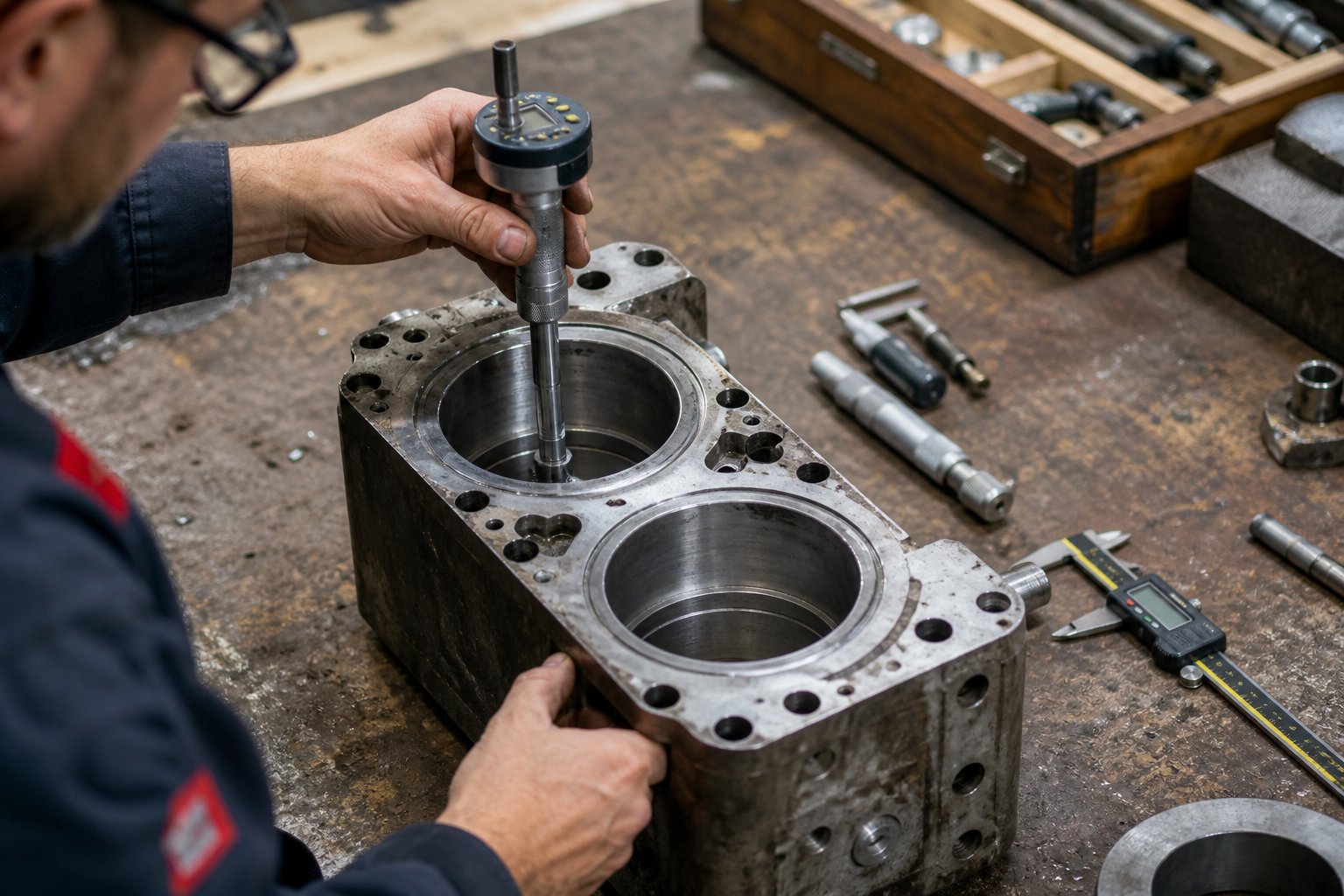
Maintenance and Wear Assessment for Barrel Longevity
Even the best-specified barrel — optimized liner metallurgy, ideal L/D ratio, perfectly sequenced screw elements — will eventually wear. Every rotation of the screws, every abrasive filler particle passing through the bore, every corrosive off-gas molecule attacking the liner surface chips away at that original engineering precision. The difference between a well-managed extruder line and a reactive one isn't whether wear happens. It's whether you detect it early enough to plan a controlled replacement or discover it through rejected product, erratic throughput, and emergency downtime.
Most processors understand this in principle. Yet surprisingly few have systematic inspection protocols in place. Let's walk through the failure modes you need to recognize, the measurement techniques that reveal them, and the clearance thresholds that tell you when a parallel twin screw barrel has reached the end of its useful life.
Common Wear Patterns and Visual Indicators
Wear inside a twin screw barrel doesn't happen uniformly. It concentrates in specific zones — typically under kneading blocks and mixing elements — and it follows distinct patterns depending on the root cause. Learning to read those patterns during routine inspections is the fastest way to diagnose problems before they cascade into production failures.
Here are the primary wear types you'll encounter, along with their telltale visual signatures:
- Abrasive wear: This is the most common failure mode in compounding operations, especially with filled formulations. Hard particles — calcium carbonate, glass fibers, talc, TiO2 — act like microscopic cutting tools as they're dragged between the screw flight tips and the barrel bore. Look for scoring and channeling along the bore surface, rounded edges on screw flight tips that originally had sharp, machined corners, and a generally eroded appearance in high-shear zones beneath kneading blocks. As Plastics Technology notes, abrasive wear is driven by the volume of material processed rather than simple operating hours — making it difficult to predict unless you know the abrasive characteristics of your specific formulation from experience.
- Adhesive wear: This happens when metal-to-metal contact occurs between screw flights and the barrel wall. Imagine running the extruder at high speed between production batches with no material in the barrel. Without a molten polymer film supporting the shafts, the screws deflect under their own weight and rub directly against the bore surface. The result? Galling marks, a burr or "rolling over" of the trailing edge of the flight land, and score marks on the barrel wall at the contact point. If the screws contact each other rather than the barrel, you'll see scratches on the tips, flanks, and roots of the screw flights instead.
- Corrosive wear: Processing PVC, CPVC, or any halogenated polymer generates acidic off-gases — primarily HCl — that chemically attack the barrel bore surface. The visual signature is distinctive: pitting, dimpling, and a rough, degraded surface texture that looks fundamentally different from the smooth erosion of abrasive wear. Corrosion weakens the liner matrix, and once the surface is compromised, mechanical wear accelerates dramatically because the softened metal offers far less resistance to passing filler particles. Even condensation on chilled barrel sections can trigger corrosive attack if moisture contacts the bore surface during shutdown periods.
- Galling: A specific subset of adhesive wear that deserves separate attention. Galling occurs when incompatible metals — screw flight hardfacing and barrel liner alloy — briefly weld together under pressure and then fracture apart. The torn, rough surface patches that remain act as stress concentrators that accelerate further damage. Poor screw design can also cause galling: when unmelted material plugs the screw channel, the pressure spike forces the screw sideways against the barrel bore, creating localized metal-to-metal seizure that damages both the flight lands and the barrel ID.
- Thermal fatigue cracking: Repeated heating and cooling cycles — especially aggressive thermal cycling during startups, shutdowns, and frequent product changeovers — create stress concentrations in the barrel wall. Over time, microscopic cracks form and propagate, particularly at the junctions between barrel segments and around cooling channel bores. These cracks may not be visible during casual inspection but can lead to catastrophic barrel failure if they reach critical depth. Look for hairline surface cracks running perpendicular to the barrel axis, especially in zones with the most aggressive temperature swings.
A quick visual check during scheduled downtime — even monthly — catches most of these patterns before they escalate. Processors running clamshell barrels can inspect directly by opening the barrel halves. For closed-barrel systems like those from Coperion or a Cincinnati parallel twin barrel screw platform, bore cameras and specialized internal measurement tools provide access without full disassembly.
Measurement Techniques for Wear Assessment
Visual indicators tell you what type of wear is occurring. Dimensional measurements tell you how far it has progressed — and whether you're still operating within acceptable tolerances or heading toward a production cliff.
Three measurements form the foundation of any barrel wear assessment program:
- Barrel bore diameter: Measured using telescoping gauges, bore micrometers, or — for the most precise readings — air gauge bore measurement systems. Take readings at multiple positions along the barrel length, concentrating on high-wear zones beneath kneading blocks and mixing elements. Measure at the top, bottom, and both sides of each bore position to capture any ovality caused by uneven screw deflection. Compare every reading against the original bore specification from the manufacturer's dimensional certificate.
- Screw flight outside diameter: Measured with standard micrometers or, for elements still assembled on the shaft, with calibrated go/no-go ring gauges. Pay particular attention to kneading disc tips and the leading edges of conveying flights in abrasive processing zones. Worn flights show a measurable reduction in OD compared to the nominal specification — and since both the barrel bore grows and the screw flight shrinks simultaneously, total clearance opens faster than either measurement alone would suggest.
- Radial clearance calculation: The critical metric. Subtract the screw flight OD from the barrel bore ID and divide by two to get the radial clearance per side. Fresh assemblies typically start with radial clearances of approximately 0.001 inch (0.025 mm) per inch of screw diameter — so a 50 mm diameter screw runs with roughly 0.05 mm of clearance per side when new. As this gap grows, melt leaks backward past the flight tips, reducing forward pumping efficiency, degrading mixing quality, and increasing melt temperature through parasitic shear in the clearance zone.
Recording these measurements in a log — tied to operating hours, throughput tonnage, and formulation history — creates a wear trend that becomes predictive over time. After two or three barrel replacement cycles, you'll have enough data to forecast when the next change will be needed, allowing you to order parts and schedule downtime proactively rather than reactively.
Replacement Timing Criteria and Clearance Thresholds
When does wear cross the line from "monitoring" to "replace now"? This is the question that keeps maintenance managers up at night — and the honest answer is that no single universal number applies to every machine, every material, and every product quality standard. But practical guidelines exist.
As a practical rule of thumb, consider replacing screw elements when the outside diameter has decreased by approximately 5% over three-quarters of the element length, and replacing barrel liners when the bore diameter has increased by approximately 5% over a length of one screw diameter (1D).
These thresholds, drawn from twin screw extruder maintenance guidelines, represent the point where clearance-related losses — reduced pumping efficiency, poor mixing homogeneity, and melt temperature instability — begin to measurably impact product quality and throughput consistency.
In practice, the symptoms of excessive clearance show up in your process data before you ever pull the barrel apart:
- Gradual increases in screw speed needed to maintain the same output rate
- Rising melt temperatures at the die despite unchanged barrel zone setpoints
- Wider pellet weight distribution or inconsistent strand diameter at the pelletizer
- Increased specific energy consumption (kWh per kg of output)
- Visible color streaking or undispersed filler agglomerates in finished pellets
If you're tracking these process parameters — and you should be — a gradual, consistent drift in two or more of them signals that clearances have opened beyond effective limits. This is exactly what industry experts describe as the "point of diminishing returns": the threshold where incremental machine adjustments no longer compensate for worn components, and every additional hour of operation costs more in energy, scrap, and quality risk than the downtime needed for a changeout.
Smart operators don't wait for that point. They identify it during the first barrel lifecycle, document the process parameter baselines that corresponded to it, and use those baselines as early-warning triggers for every subsequent cycle. A parallel twin screw barrel for sale at any price point — whether sourced domestically or from a china parallel twin screw barrel for sale supplier — delivers its rated value only if the operator knows when to retire it. Running to failure is always the most expensive option.
The maintenance protocol protects your investment after installation. But the selection process that happens before installation — choosing the right L/D ratio, bore diameter, liner grade, and supplier — determines how long that investment lasts and how well it performs throughout its entire service life.
How to Select the Right Parallel Twin Screw Barrel
You know the configuration options. You understand liner metallurgy. You can read wear patterns and set replacement thresholds. Yet when it's time to actually specify and source a new barrel assembly, the number of variables can feel overwhelming. L/D ratio, bore diameter, torque density, venting layout, liner grade, supplier credentials — each decision interacts with every other, and getting one wrong can undermine the rest.
The solution isn't to guess or default to whatever your last barrel happened to be. It's to follow a structured evaluation process that starts with your processing goals, works through the technical parameters, and finishes with supplier qualification. Here's that framework, broken into actionable steps.
Key Specification Parameters for Barrel Selection
Every barrel specification begins with five core parameters. Get these right, and the rest of the decision becomes straightforward.
- Define your L/D ratio based on processing complexity. The length-to-diameter ratio determines how many functional zones — feeding, melting, mixing, venting, metering — you can fit into a single barrel. Simple color compounding with low filler content may need only 32:1 to 36:1. High-filler engineering plastics, reactive grafting, or multi-stage devolatilization push the requirement to 40:1, 44:1, or beyond. As twin screw extrusion guidelines confirm, L/D ratios from 20:1 to 48:1 cover the full application spectrum — with short ratios (20:1 to 28:1) suited to thermally sensitive materials requiring minimal residence time, medium ratios (28:1 to 36:1) covering general compounding, and long ratios (36:1 to 48:1) reserved for devolatilization, reactive extrusion, or heavily filled formulations. Choosing too short means insufficient mixing or incomplete volatile removal. Choosing too long wastes energy and increases thermal degradation risk for sensitive polymers.
- Match bore diameter to throughput targets. Bore diameter sets the volumetric capacity of the barrel — larger bores process more material per revolution at equivalent screw speeds. But diameter also affects torque requirements, heat transfer efficiency, and capital cost. A 50 mm bore suits pilot-scale and specialty compounding at 50 to 200 kg/hr. Production-scale lines typically run 65 to 92 mm for 300 to 1,500 kg/hr. High-volume commodity compounders push to 120 mm and above for throughputs exceeding 2,000 kg/hr. The key is to match bore diameter to your realistic production schedule — not to your theoretical peak demand.
- Verify torque density compatibility. Modern co-rotating platforms deliver torque densities of 10 to 13 Nm/cm3, with high-performance gearboxes exceeding 14 Nm/cm3. Higher torque density means the screws can handle more viscous melts, higher filler loadings, and faster screw speeds without exceeding the mechanical limits of the shaft. When evaluating a parallel twin screw and barrel supplier, confirm that the barrel's bore geometry and screw element design are engineered to work within the torque envelope of your specific gearbox. Mismatches — especially when retrofitting barrels onto older machines — lead to shaft failures, coupling damage, or derating the extruder to safe but inefficient operating speeds.
- Assess barrel zone temperature control capability. Each segmented barrel section operates as an independent thermal zone, heated by electric cartridge heaters or cast-in heater bands and cooled by internal water channels or forced-air blowers. The number of zones, the heating and cooling capacity per zone, and the thermocouple placement precision all affect how tightly you can control the melt temperature profile. Reactive extrusion and heat-sensitive polymer processing demand barrel designs with narrow zones (4D per section) and fast-response cooling. General compounding tolerates broader zones (5D per section) with standard cooling. When specifying, ask for the rated heating density (watts per cm2) and cooling response time for each barrel section — not just the number of zones.
- Plan venting port placement before finalizing barrel length. Every vacuum vent or atmospheric vent requires a dedicated barrel segment, plus the upstream reverse element melt seal that prevents melt from flooding the port. For single-stage devolatilization, one vent port typically sits at approximately 70% to 80% of total barrel length. Multi-stage devolatilization — common in recycling operations and solvent-based reactive processes — needs two or three vent locations, each consuming one barrel segment. Side-feeding ports for downstream filler addition also claim barrel segments. Map out all port locations on a barrel layout diagram before confirming total L/D — otherwise you risk running out of barrel length for the metering zone that stabilizes pressure at the die.
Evaluating Supplier Capability and Quality Assurance
Barrel specifications only deliver their intended performance if the manufacturer executes them with precision. A perfectly designed barrel built to loose tolerances will underperform a simpler design manufactured with care. When evaluating any parallel twin screw and barrel supplier in china or elsewhere, four capabilities separate reliable partners from commodity vendors.
Manufacturing precision — bore concentricity and surface finish. The figure-eight bore must maintain concentricity within 0.02 mm or better across the full barrel length. Any deviation creates uneven clearance between screw flights and bore wall, causing localized wear hot spots that accelerate failure. Surface finish after honing should reach Ra 0.4 micrometers or finer. Ask prospective suppliers for their CMM (coordinate measuring machine) inspection reports — and verify that dimensional data covers multiple cross-sections along the barrel, not just the ends.
Metallurgical certification and hardness documentation. Every barrel should ship with material certificates traceable to raw stock — EN 10204 Type 3.1 certificates for base steel, and documented alloy composition for bimetallic liners or hardfacing deposits. Hardness testing per ASTM E18 (HRC) or ASTM E92 (HV) should be recorded at multiple bore positions. Sourcing engineers increasingly treat metallographic cross-section reports — verifying liner thickness, carbide distribution, bond integrity, and porosity levels — as non-negotiable documentation for any bimetallic barrel purchase. Without these records, you're trusting marketing claims instead of measured data.
OEM compatibility and fitment verification. If you're sourcing replacement barrels for machines built by Coperion, Leistritz, KraussMaffei, JSW, or other major OEMs, dimensional compatibility is critical. Bolt patterns, bore diameter, barrel section length, alignment dowel positioning, and thermocouple port locations must match the original equipment specifications exactly. A reputable parallel twin screw barrel manufacturer in china will maintain detailed dimensional databases for all major OEM platforms and verify fitment before production begins — not after the barrel arrives at your plant.
After-sales technical support. The relationship shouldn't end at delivery. Suppliers who provide screw element configuration recommendations, liner grade guidance for new formulations, wear assessment consultation, and replacement part inventory support add value that outlasts any single purchase. This engineering-level partnership is especially important when your product portfolio evolves — a barrel that was ideal for unfilled PP compounding may need a liner upgrade when your customer requires 30% glass-filled PA66.
NANHAIYA exemplifies this approach, engineering durable parallel twin screw barrels specifically for the demanding environments found in compounding plants, pelletizing lines, masterbatch production, and recycling operations. Their focus on high-wear applications means barrel designs are optimized from the start for the abrasive and corrosive conditions that shorten service life in less purpose-built assemblies.
Matching Barrel Design to Your Processing Goals
With specification parameters defined and supplier capabilities assessed, the final step is aligning everything to your actual production reality. This means honest answers to practical questions:
- What's your most demanding formulation? The barrel should be specified for the worst-case material — highest filler loading, most corrosive polymer, most abrasive additive — that the line will encounter. Designing for average conditions invites premature failure during your toughest production runs.
- How many formulation changeovers per week? Frequent changeovers favor self-wiping co-rotating intermeshing configurations with smooth bore finishes that minimize material hang-up. If you run 15 different masterbatch colors on the same line, changeover speed is as important as wear life in your total cost equation.
- What's your tolerance for unplanned downtime? Operations running 24/7 continuous production need barrels with premium liner grades that maximize time between replacements. A batch operation running three shifts per week has more scheduling flexibility for planned maintenance and can sometimes justify a lower-cost liner with shorter service intervals — as long as the changeover economics pencil out.
- Do you have in-house measurement capability? Processors who own bore micrometers and maintain wear trend logs can push barrel life closer to the true limit. Those without measurement tools tend to replace either too early (wasting remaining service life) or too late (after quality has already degraded). Factor your inspection capability into the specification — it directly affects the return on your barrel investment.
For processors exploring parallel twin screw barrel in china sourcing options, the evaluation framework remains identical. Geography doesn't change the physics of wear or the metallurgy of liner performance. What matters is whether the supplier — wherever located — can demonstrate precision manufacturing, provide verifiable material documentation, confirm OEM fitment, and support your operation with application engineering expertise. A growing number of buyers sourcing parallel twin screw and barrel in china have found that suppliers meeting these criteria deliver barrel assemblies that perform comparably to European and Japanese OEM components at more accessible price points — provided the qualification process is rigorous.
The barrel you select today will define your extrusion line's performance for the next two to five years. Cutting corners on specification or supplier qualification to save a few percent on purchase price is, as the total cost of ownership calculations consistently show, the most expensive decision you can make. Invest the time upfront in a structured selection process, and the barrel rewards you with stable throughput, consistent product quality, and predictable maintenance cycles throughout its entire service life.
Bringing It All Together for Smarter Barrel Decisions
Every specification decision covered in this guide — geometry, configuration, liner metallurgy, maintenance protocol, supplier qualification — feeds into a single outcome: how reliably and economically your extrusion line converts raw material into saleable product, month after month. Skip any one of those decisions, and the gap shows up as premature wear, inconsistent pellet quality, unplanned shutdowns, or inflated operating costs that compound over every production cycle.
Critical Takeaways for Barrel Specification
Four decision points determine whether your barrel investment pays off or drains margin:
- Parallel vs. conical: Choose parallel for modular flexibility, scalable L/D ratios, and multi-formulation versatility. Reserve conical for dedicated PVC profile lines and space-constrained installations.
- Configuration type: Co-rotating intermeshing handles the widest range of compounding, masterbatch, and recycling tasks. Counter-rotating intermeshing suits direct extrusion with high pressure demands. Non-intermeshing variants serve niche devolatilization and specialty chemical applications.
- Liner metallurgy: Match the liner to your dominant wear mode — iron-based bimetallics for abrasive fillers, nickel-based bimetallics for corrosive polymers, WC-rich or Stellite grades for the most severe combined conditions. The cheapest liner per purchase order is rarely the cheapest per operating hour.
- Maintenance discipline: Measure bore diameter and screw flight OD at regular intervals, log the data against throughput tonnage, and replace components before clearance degradation reaches the 5% threshold that undermines mixing quality and output stability.
The barrel represents under 5% of an extruder's capital cost but governs 60% to 75% of its lifetime operating economics through wear-driven downtime, energy consumption, and melt quality — making liner selection and supplier qualification the highest-leverage decisions in any extrusion line specification.
Next Steps for Sourcing and Evaluation
Where you go from here depends on where you are in the decision process. If you're still defining requirements, revisit the five-step specification framework in the selection chapter and map your most demanding formulation against the liner comparison table. If you're ready to evaluate suppliers, build your shortlist around manufacturers who provide EN 10204 material certificates, multi-point hardness documentation, metallographic cross-sections for bimetallic liners, and confirmed OEM fitment data.
For operations sourcing china parallel twin screw barrel wholesale volumes — whether for new equipment builds or scheduled replacement programs — the qualification criteria remain identical to any other sourcing region. Verified manufacturing precision, documented metallurgy, and application engineering support matter more than geography. A growing number of compounders and recyclers now work with a parallel twin screw barrel wholesaler based in China and achieve barrel performance on par with European OEM components, provided the vetting process is thorough.
Readers exploring durable barrels engineered for stable mixing, conveying, and high-wear applications can review NANHAIYA's parallel twin screw barrel configurations — purpose-built for compounding plants, pelletizing lines, masterbatch producers, and recycling operations. Whether you need a parallel twin screw barrel wholesale in china for a multi-line expansion or a single replacement barrel for an existing platform, starting with a supplier whose core focus is high-wear extrusion components ensures the specification conversation begins in the right place.
Frequently Asked Questions About Parallel Twin Screw Barrels
1. What is the difference between a parallel and a conical twin screw barrel?
A parallel twin screw barrel maintains a consistent screw diameter along its entire length, enabling modular segmentation and L/D ratios up to 60:1. A conical barrel tapers from a larger feed diameter to a smaller discharge diameter, offering built-in compression suited to rigid PVC extrusion. Parallel designs allow individual barrel sections and screw elements to be swapped or replaced independently, reducing long-term maintenance costs. Conical systems use one-piece screws and fixed-taper barrels that must be replaced as complete units. Processors needing multi-formulation flexibility, scalable throughput, or extended processing zones generally benefit from parallel geometry, while dedicated PVC profile or pipe lines favor conical configurations.
2. Which parallel twin screw barrel configuration is best for compounding?
Co-rotating intermeshing is the dominant configuration for polymer compounding and masterbatch production. Both screws spin in the same direction with tightly meshed flights, creating a self-wiping figure-eight flow path that delivers excellent dispersive and distributive mixing simultaneously. This setup handles screw speeds from 300 to over 1,200 rpm, producing the highest throughput of any twin screw arrangement. The narrow residence time distribution ensures uniform heat history across the entire melt, which is critical for consistent pellet quality. Counter-rotating intermeshing is preferred when positive displacement pressure generation matters more than mixing intensity, such as in direct PVC extrusion.
3. How do I choose the right barrel liner material for my application?
Liner selection depends on identifying your dominant wear mode. For unfilled or lightly filled polyolefins, nitrided steel provides adequate protection at the lowest cost. When abrasive fillers like calcium carbonate or talc exceed 20% loading, upgrade to an iron-based bimetallic liner (Fe-Cr-B) with 1.5 to 3.0 mm of wear-resistant depth. Processing PVC or halogenated polymers that release corrosive HCl gas requires nickel-based bimetallic liners (Ni-Cr-B-W) for chemical resistance. Glass-fiber-reinforced engineering plastics demand WC-rich bimetallic or HVOF tungsten carbide coatings. Suppliers like NANHAIYA engineer liner specifications matched to specific applications in compounding, recycling, and masterbatch production, ensuring the metallurgy aligns with real-world processing demands.
4. When should a parallel twin screw barrel be replaced?
Replace screw elements when flight outside diameter has decreased by approximately 5% over three-quarters of the element length, and replace barrel liners when bore diameter has increased by roughly 5% over a span of one screw diameter. Before reaching these thresholds, process indicators typically signal excessive clearance: rising melt temperatures despite unchanged zone setpoints, increasing screw speed needed to maintain output, wider pellet weight distribution, higher specific energy consumption, and visible undispersed agglomerates or color streaks. Regular bore diameter measurements using telescoping gauges or bore micrometers, logged against throughput tonnage, create predictive wear trends that allow planned replacements rather than emergency downtime.
5. What L/D ratio should I select for a parallel twin screw barrel?
L/D ratio depends on processing complexity. Short ratios of 20:1 to 28:1 suit thermally sensitive materials needing minimal residence time. Medium ratios of 28:1 to 36:1 cover general-purpose compounding with moderate filler loadings. Long ratios of 36:1 to 48:1 or higher are necessary for reactive extrusion, multi-stage devolatilization, heavily filled formulations, and recycling operations requiring multiple vacuum venting ports. Each functional zone in the screw build — feeding, melting, mixing, venting, metering — consumes barrel length, so mapping all required zones before finalizing L/D prevents running out of space for the pressure-building metering section that stabilizes output at the die.
Written by
Nanhaiya Technical Team
Zhoushan Nanhaiya Plastic Machinery Co., Ltd.
The Nanhaiya technical team supports screw and barrel manufacturing projects through application review, technical communication, custom manufacturing coordination, and production and quality control.
Discuss Your Application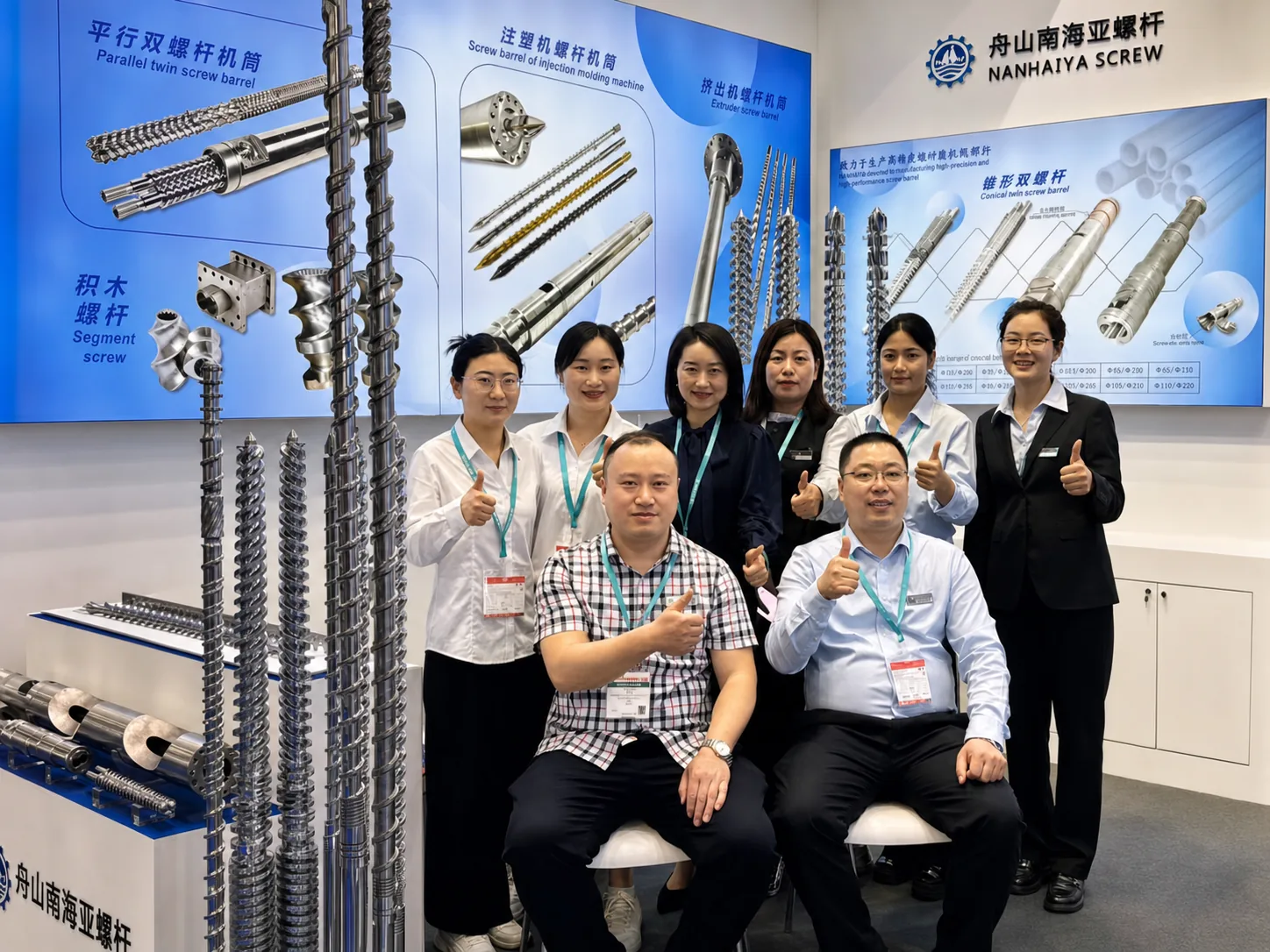
Related Articles
More insights on screw barrel technology and plastics processing.
What Nobody Tells You About Screw Barrel For Plastic Machine Design
Oct 10, 2026
Learn how screw barrel for plastic machine design affects melt quality, throughput, and wear life. Covers geometry, resin matching, troubleshooting, and sourcing.
Read Article
Single Screw Extruder for Sheet: Stop Guessing, Start Specifying
Oct 9, 2026
Learn how to specify a single screw extruder for sheet production. Covers screw geometry, resin-specific processing, troubleshooting, and maintenance best practices.
Read Article
PE Pipe Extruder Machine: What Datasheets Won't Tell You
Oct 9, 2026
Learn how a PE pipe extruder machine works, key specs explained, material grade selection, maintenance tips, and buyer guidance beyond the datasheet.
Read ArticleLooking for something else?
Search by material, symptom or product and jump straight to the relevant page.
These are navigation suggestions based on keyword matching — not a quotation, not a delivery commitment, and not a substitute for engineering review. Final specification is confirmed by our engineers against your drawings and processed material.
Need help with screw barrel selection?
Share your machine model, processed material and application. Our team can help with pricing and technical support.