

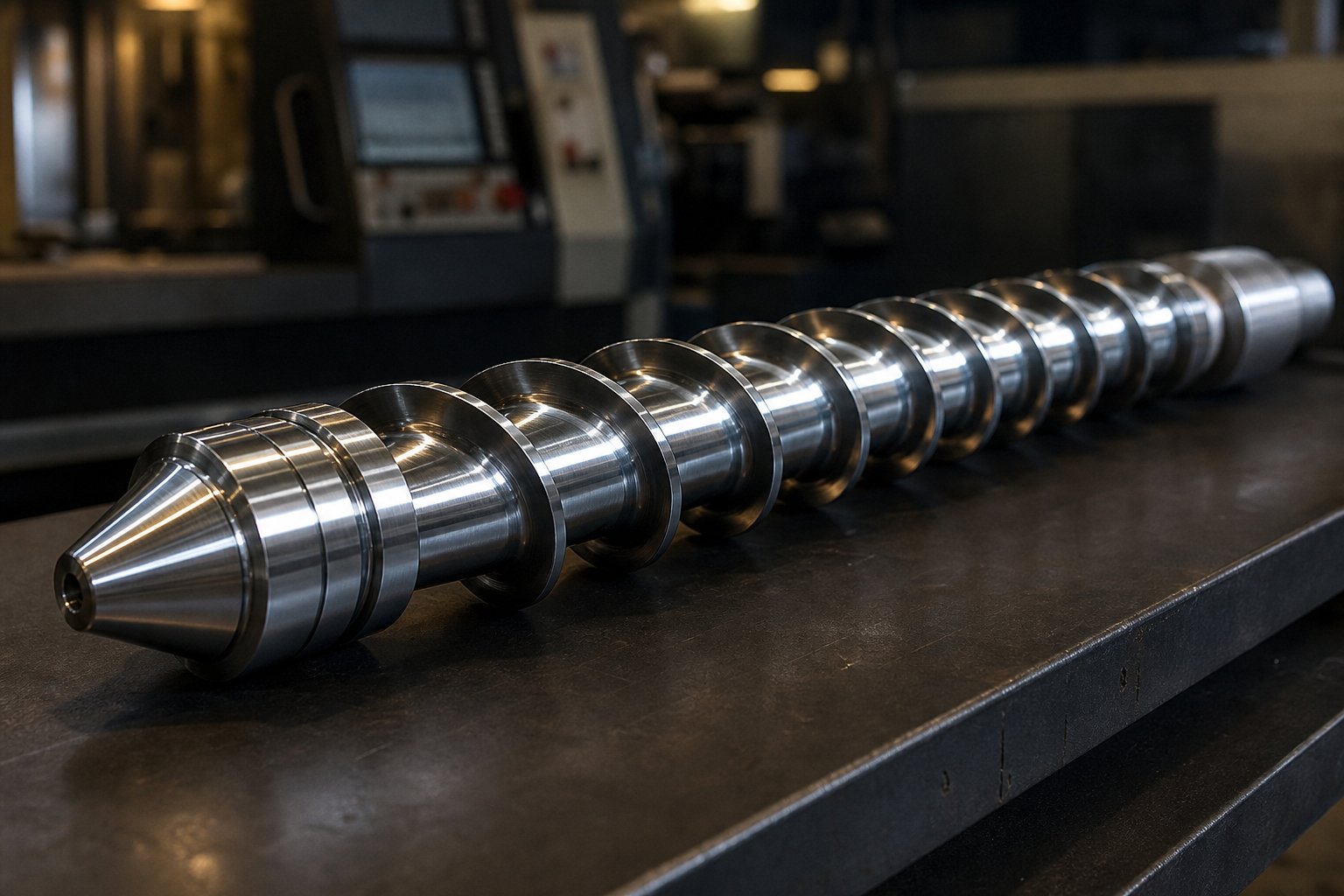
What an Injection Screw Manufacturer Actually Does
When a plastic part rolls off the production line with perfect surface finish, accurate dimensions, and zero voids, the credit rarely goes where it belongs — to the plasticizing screw spinning inside the barrel. And the company behind that screw? That's the injection screw manufacturer, a specialist most people outside the plastics industry never think about.
An injection screw manufacturer is a company that designs, engineers, and produces the helical plasticizing screws used inside injection molding machines to melt, mix, and inject polymer material into molds — combining expertise in metallurgy, screw geometry, and polymer processing science to deliver components tailored for specific resins and production requirements.
Defining the Injection Screw Manufacturer Role
This is not a federal screw supplier stamping out fasteners, and it is not a general machining shop cutting threads on commodity hardware. A true injection screw manufacturer operates at the intersection of precision machining, materials science, and plastics processing know-how. Every injection screw they produce is a purpose-built tool — a helically flighted metal shaft engineered to rotate inside a heated barrel, simultaneously conveying, compressing, melting, and homogenizing thermoplastic pellets before injecting them under pressure into a mold cavity. The design of each injection molding screw demands deep understanding of how different polymers behave under shear, heat, and pressure.
Why the Plasticizing Screw Is the Heart of Every Injection Machine
Imagine a machine worth hundreds of thousands of dollars producing defective parts because one component was poorly designed. That component is almost always the screw. It is the single most influential element determining melt quality, shot-to-shot consistency, and overall machine performance. Quality-management research shows that many molding operations lose 10-15% of operating costs to poor quality — scrap, rework, and unplanned downtime — and an underperforming injection screw sits at the root of many of those losses.
Who Relies on Injection Screw Manufacturers
Process engineers diagnosing melt instability, maintenance teams replacing worn components, and procurement professionals sourcing durable replacements all depend on these specialized producers. Whether you are running commodity polypropylene on a workhorse press or processing glass-filled nylon on a high-precision cell, the screw dictates your results. This guide is built to give you — the buyer — the technical foundation to tell a capable manufacturer apart from a risky one, starting with the engineering fundamentals that make every screw unique.
Screw Geometry Fundamentals Every Buyer Should Understand
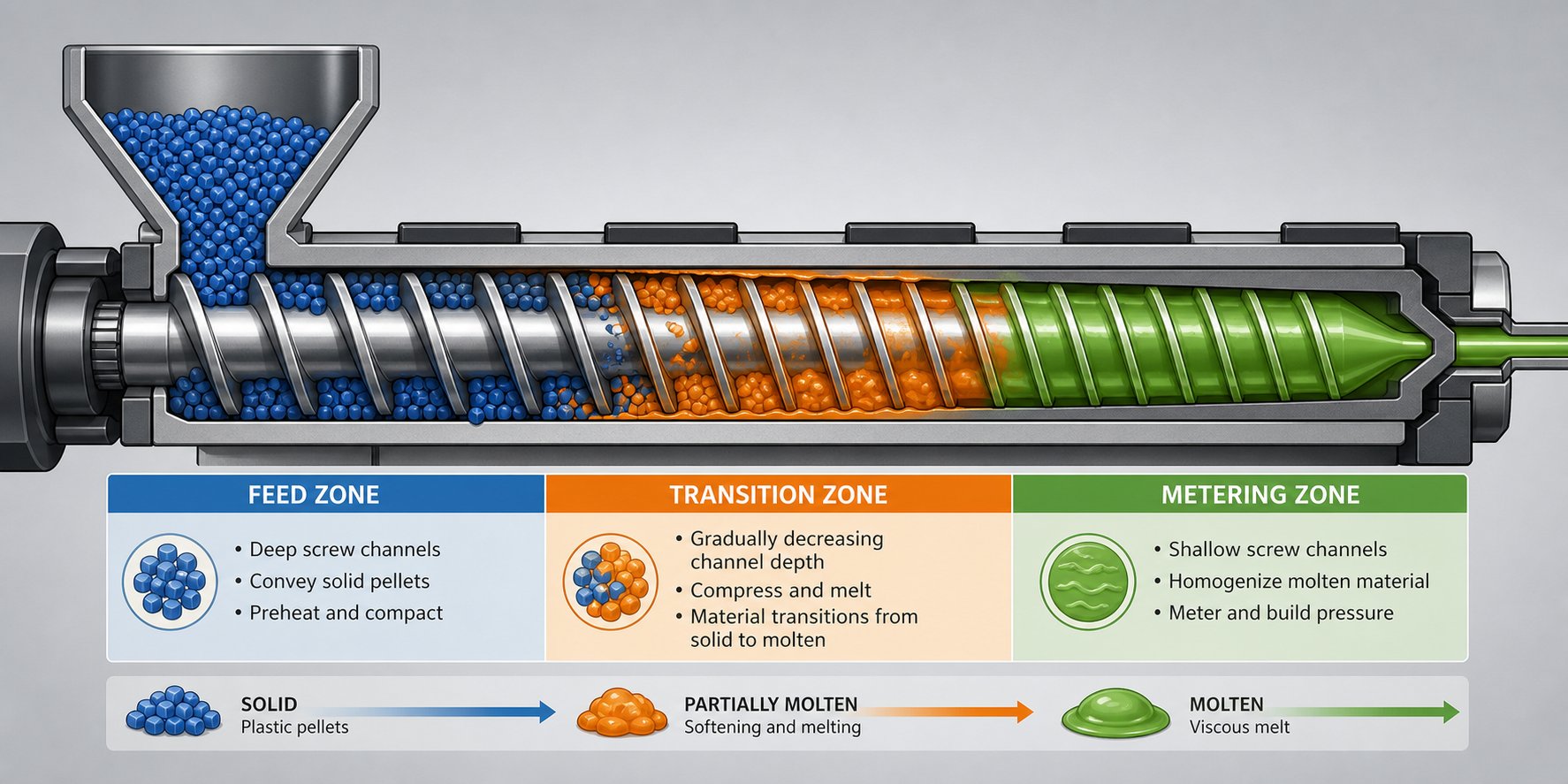
Every injection molding screw looks like a single continuous spiral at first glance. Look closer, and you'll notice something important — the channel between the flights is not uniform from one end to the other. It changes depth deliberately, creating three distinct functional zones that each perform a different job on the polymer as it travels from hopper to nozzle. Understanding these zones is essential because they explain why one screw design excels with a given resin while another produces nothing but headaches.
A capable injection screw manufacturer engineers these three zones — feed, transition, and metering — as an integrated system. Changing the proportional length or channel geometry of any single zone reshapes how the screw handles solids conveying, melting, and melt delivery. Here is what happens in each stage.
Feed Zone and Solids Conveying
The feed zone is where raw pellets enter the barrel and begin their journey forward. You'll recognize it by its deep, consistent channel depth — the widest gap between the screw root and the barrel wall. This generous depth exists for a practical reason: the screw needs to grab a large volume of loose, uncompacted pellets and push them steadily toward the heated sections ahead.
Think of feed screws as conveyors at this stage, not melters. The material remains mostly solid here, relying on friction between the pellets, the screw surface, and the barrel wall to move forward. Effective screw feeding depends on keeping this zone cool enough to prevent pellets from softening prematurely and bridging — a frustrating condition where partially melted granules clump together and block the feed throat. When the feed zone is properly designed, you get reliable, consistent solids conveyance that sets up every downstream step for success.
Transition Zone and Compression Mechanics
As the material advances past the feed section, it enters the transition zone — also called the compression zone. Here, the channel depth gradually decreases, squeezing the pellets into a progressively tighter space. This compression does two things simultaneously: it forces air trapped between pellets back toward the hopper, and it dramatically increases the shear forces acting on the polymer.
That shear, combined with conducted heat from the barrel wall, is where real melting begins. In many extrusion and injection setups, shear heating accounts for 60-80% of the total heat input — a fact that surprises buyers who assume barrel heaters do most of the work. The compression ratio, defined by the relationship between the deep feed channel and the shallow metering channel, governs how aggressively this zone generates shear heat. Standard ratios typically range from 2:1 to 4:1, depending on the resin being processed. Get this ratio wrong, and you'll either leave unmelted pellets in the melt stream or overshear the polymer into degradation.
Metering Zone and Melt Homogeneity
By the time material reaches the metering zone, it should be fully molten. This final section features the shallowest, most uniform channel depth on the entire screw. Its job is not to melt — it is to homogenize. The shallow channel forces the melt through tight clearances, evening out temperature gradients and viscosity differences so every cubic millimeter of plastic entering the mold behaves identically.
Consistent output from the metering zone translates directly to stable shot weights, predictable fill patterns, and repeatable part dimensions cycle after cycle. When this zone is too short or poorly proportioned, temperature variations persist in the melt, and you'll see the evidence as warped parts, dimensional drift, or weak weld lines.
The table below summarizes how each zone contributes to the overall process and what design considerations matter most:
| Zone Name | Primary Function | Typical Channel Depth Characteristic | Key Design Consideration |
|---|---|---|---|
| Feed Zone | Accepts solid pellets and conveys them forward through friction-driven transport | Deepest and most uniform — maximizes intake volume | Must stay cool enough to prevent premature softening and pellet bridging |
| Transition (Compression) Zone | Compresses material to expel air and generates shear heat to initiate melting | Gradually decreasing — creates the compression ratio | Compression ratio must match the resin's melt behavior to avoid unmelts or degradation |
| Metering Zone | Homogenizes the melt for uniform temperature, viscosity, and pressure before injection | Shallowest and most consistent — ensures tight melt control | Adequate length is critical for eliminating temperature gradients and stabilizing output |
Altering the relative lengths and depths of these three zones is exactly how a skilled manufacturer tailors a feed screw for specific polymers. A crystalline resin like nylon melts sharply and needs a different compression profile than an amorphous material like polycarbonate, which softens gradually over a wider temperature range. This is the kind of application-specific engineering that separates a purpose-built screw from a generic replacement — and it is precisely why the design parameters behind each zone deserve a closer look.
Critical Design Parameters That Drive Production Results
Zone proportions tell part of the story. But within those zones, a handful of measurable design parameters dictate whether your injection molding screws deliver flawless parts or frustrating inconsistency. The challenge for most buyers — engineers, maintenance leads, and procurement teams alike — is that these parameters are described in engineering shorthand that rarely gets connected to the production outcomes everyone actually cares about: scrap rates, cycle times, energy costs, and component longevity.
Let's bridge that gap, one parameter at a time.
L/D Ratio and Its Impact on Melt Quality
The length-to-diameter ratio, or L/D ratio, is one of the first specifications you'll encounter on any screw datasheet. It expresses the flighted length of the screw divided by its outer diameter. A screw with a 600 mm flighted length and a 30 mm diameter, for example, has an L/D ratio of 20:1.
Why does this number matter so much? Because it determines how long the polymer stays inside the barrel — a concept engineers call residence time. A longer L/D ratio gives the resin more time and more barrel surface contact for heat absorption, shear mixing, and melt homogenization. Most industry-standard injection molding screws hover around 20:1, though ratios of 22:1 to 26:1 are increasingly common for resins that benefit from extended mixing or for applications demanding tighter melt uniformity.
Sounds like longer is always better? Not quite. Push the L/D ratio too high without adjusting screw speed or barrel temperatures, and you risk excessive residence time — which can overheat heat-sensitive polymers, causing discoloration, molecular degradation, or even limiting throughput capacity. The right L/D ratio is always a balance between mixing quality and thermal safety for the specific resin being processed.
Compression Ratio and Shear Heat Generation
If the L/D ratio governs how long the material spends in the barrel, the compression ratio governs how aggressively it gets worked during that time. Defined simply as the feed zone channel depth divided by the metering zone channel depth (H1 / H2), the compression ratio of an injection molding screw controls how much mechanical energy the screw imparts to the polymer through shear.
A higher compression ratio means a more dramatic squeeze from feed to metering, generating more shear heat and faster melting. A lower ratio produces a gentler transition, better suited for shear-sensitive or heat-sensitive resins. As industry specialists note, selecting the proper compression ratio involves far more than feeding considerations — it must account for particle geometry, bulk density, polymer viscosity at various shear rates, specific heat, and the target exit temperature. Most general-purpose feedscrews use compression ratios between 2:1 and 3:1, while materials like HDPE or nylon may need ratios approaching 3.5:1 or higher to achieve complete melting without degradation.
Get this parameter wrong, and you'll see the consequences immediately: unmelted pellets showing up in parts (ratio too low) or burned streaks and material degradation (ratio too high).
Flight Geometry and Channel Design Variables
Beyond L/D and compression ratio, several additional geometric variables give a skilled manufacturer fine-tuning control over screw performance:
- Flight depth — Controls the volume of material the screw processes per revolution. Deeper flights increase throughput capacity; shallower flights increase shear and improve mixing intensity.
- Helix angle (pitch) — Determines the forward conveyance rate of the polymer along the screw. Standard designs use a square pitch (helix angle around 17.66 degrees), but adjusting this angle can optimize cycle time and throughput for specific applications.
- Flight width (land width) — Affects the leakage flow over the flight tip. Wider lands reduce backflow but can increase shear heating near the barrel wall, influencing both energy consumption and melt temperature control.
- Channel geometry (width and cross-sectional profile) — Shapes the velocity profile of the melt within the channel, directly impacting mixing quality and the uniformity of temperature distribution across the melt stream.
Each of these variables interacts with the others — widening the channel while increasing flight depth changes both throughput and mixing behavior simultaneously. This is precisely why experienced manufacturers run calculations and simulations rather than relying on generic templates.
To make these relationships actionable, here is how each parameter connects to the production outcomes buyers care about most:
- L/D ratio → Melt consistency and mixing quality — directly reduces reject rates from temperature variation and poor homogeneity
- Compression ratio → Melting efficiency and shear heat balance — prevents unmelted particles and thermal degradation, lowering scrap
- Flight depth → Throughput capacity and cycle time — deeper flights move more material per rotation, supporting faster cycles
- Helix angle → Conveyance rate and residence time — fine-tunes how quickly material advances through each zone
- Flight width → Energy consumption and melt temperature stability — wider lands reduce parasitic backflow but require careful thermal management
- Channel geometry → Part quality and dimensional consistency — shapes the melt velocity profile that determines fill uniformity in the mold
When a manufacturer optimizes these parameters as an integrated system rather than adjusting them in isolation, the result is a screw engineered for a specific resin, machine, and part — not just a screw that fits the barrel. That level of application-specific design is also what determines the right type of screw for a given job, because geometry alone only tells half the story. The screw's overall architecture — general-purpose, barrier, vented, or otherwise — defines how those geometric parameters are deployed.
Injection Screw Types Compared for Different Applications
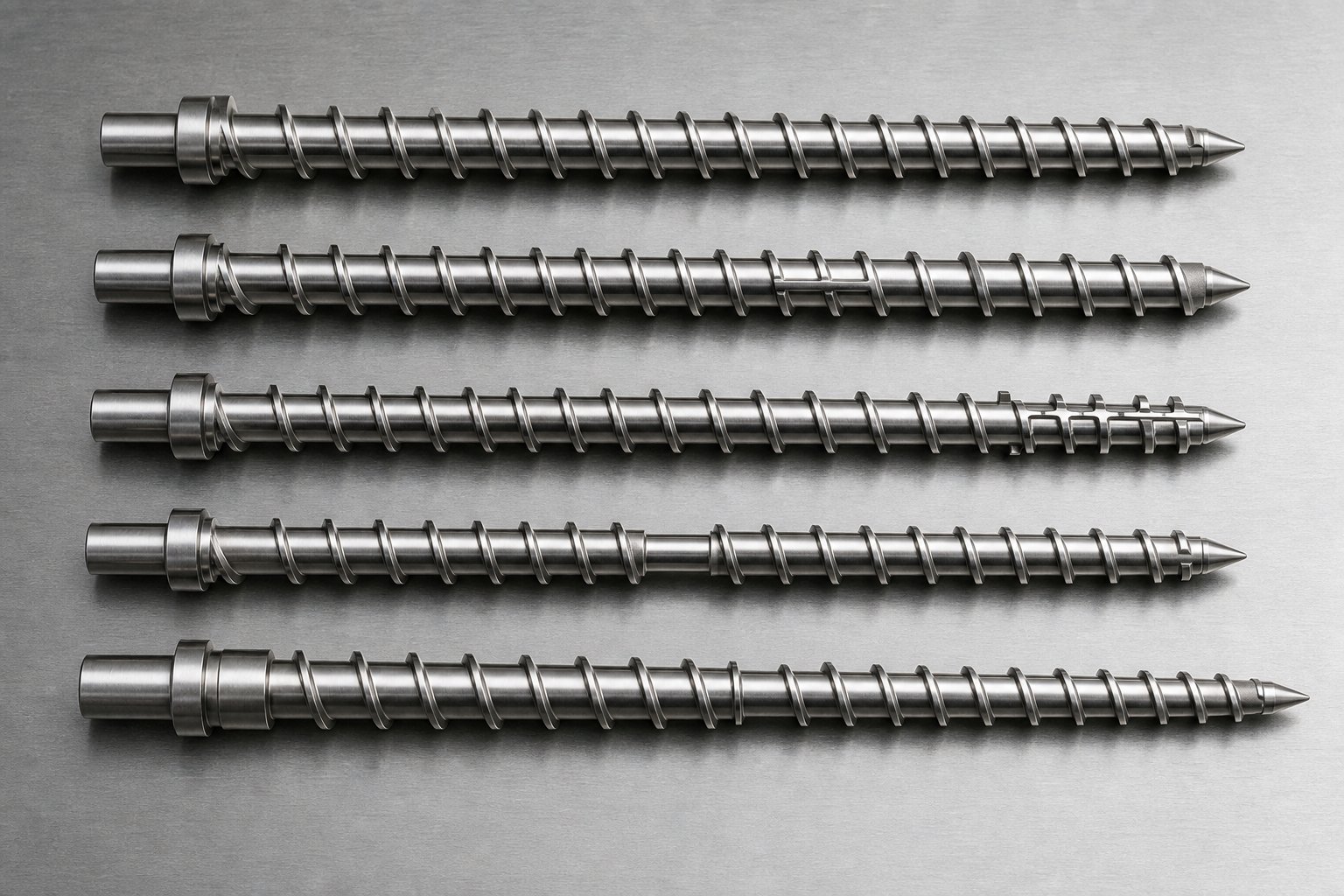
A screw's geometric parameters — L/D ratio, compression ratio, flight depth — shape its behavior. But those parameters operate within a larger architectural framework: the screw type. Two screws can share identical diameters and L/D ratios yet perform dramatically differently because one uses a conventional single-flight design while the other incorporates barrier flights or mixing elements. For buyers evaluating injection molding screws and barrels, understanding the major screw types is the fastest path to matching the right design to your resin, your machine, and your production goals.
General-Purpose vs. Barrier Screw Designs
The general-purpose (GP) screw is the workhorse of the industry. It uses a simple three-zone layout — feed, transition, metering — with a single continuous flight running the entire length. This straightforward architecture handles a wide range of commodity resins like PP, PE, ABS, and PS with respectable consistency. If you're processing standard thermoplastics without fillers and your parts don't demand ultra-tight melt uniformity, a GP screw often does the job well and costs less to manufacture and replace.
Where GP screws fall short is melting efficiency. Because the solid bed and molten pool share the same channel, unmelted pellets can break free and contaminate the melt stream — a phenomenon called "solid bed breakup." You'll see the evidence as unmelted specks in finished parts or inconsistent shot weights.
Barrier screws solve this problem with an elegant structural addition: a secondary flight — the barrier flight — that physically separates unmelted solids from the molten polymer. As the material advances, melted resin passes over the barrier flight into a dedicated melt channel while solids remain confined and continue melting. The result is a more complete, more uniform melt by the time material reaches the metering zone. Engineering plastics like PC, PA, and POM benefit significantly from this design, and processors running higher speeds or tighter tolerances often find barrier screws deliver the consistency that GP designs cannot.
The tradeoff? Barrier screws cost more to produce, require tighter manufacturing tolerances on the injection molding barrel and screw interface, and are less forgiving if the wrong compression profile is specified for the resin.
Mixing, Vented, and Two-Stage Screw Configurations
Sometimes melting alone isn't enough. When you're blending color masterbatch, dispersing additives, or processing regrind mixed with virgin material, dedicated mixing elements become essential. Mixing screws incorporate specialized geometries — Maddock-style dispersive mixers, pineapple-type distributive mixers, or spiral disruptors — typically positioned between the transition and metering zones. Dispersive elements break down agglomerates through high-shear intensity, while distributive elements spread colorants and additives evenly across the melt without excessive shear. For heat-sensitive resins, choosing the right mixing intensity is critical: too much shear generates degradation, not better dispersion.
Vented screws take a different approach entirely. They feature a two-stage design with a decompression zone in the middle of the screw, aligned with a vent port in the barrel. As the melt pressure drops in this decompression zone, trapped moisture, volatiles, and gases escape through the vent rather than ending up as bubbles, silver streaks, or splay marks in your parts. Processors working with hygroscopic resins or recycled content often find vented screws eliminate the need for pre-drying — saving energy and floor space dedicated to drying equipment.
Two-stage screws share the vented screw's dual-zone architecture but may serve broader purposes beyond degassing. The first stage handles plasticizing, while the second stage provides additional metering and homogenization. This configuration is also common in extruder screws and barrels, where high output rates and thorough melt conditioning are both priorities. In injection molding, two-stage designs appear most often on larger machines processing materials where both degassing and precise melt control are non-negotiable.
Matching Screw Diameter to Machine Tonnage
Screw type matters — but so does screw size. Diameter selection must align with the machine's clamping tonnage, shot size requirements, and cycle time targets. Small-tonnage precision machines — think micro-molding cells producing medical or electronic components — may run screws as small as 12 to 18 mm in diameter. Mid-range production presses typically use screws in the 30 to 80 mm range, while large industrial machines producing automotive or appliance parts can require diameters exceeding 120 mm, with some heavy-duty presses using screws over 200 mm.
Choosing a screw that's too large for the shot size means the resin sits in the barrel too long, risking thermal degradation. A screw that's too small struggles to recover fast enough, extending cycle times and limiting throughput. The general guideline is that each shot should consume roughly 20-80% of the screw's maximum shot capacity — a range that balances residence time against recovery speed.
The table below brings all five major screw types together in a single reference, comparing their design features, best-suited resins, advantages, and limitations:
| Screw Type | Design Feature | Best-Suited Resins | Advantages | Limitations |
|---|---|---|---|---|
| General-Purpose (GP) | Single continuous flight with standard three-zone layout (feed, transition, metering) | PP, PE, ABS, PS, and other commodity thermoplastics with low filler content | Versatile across multiple resins; lower manufacturing cost; easy to source replacements | Prone to solid bed breakup; limited melt uniformity at higher speeds; not ideal for engineering resins |
| Barrier | Secondary barrier flight separating unmelted solids from molten polymer into dedicated channels | PC, PA, POM, PBT, and other engineering plastics; higher-speed commodity processing | Superior melting efficiency; significantly improved melt homogeneity; reduced unmelts and specks | Higher manufacturing cost; requires precise barrel-to-screw clearance; less forgiving of mismatched compression profiles |
| Mixing (Dispersive / Distributive) | Incorporates Maddock pins, pineapple mixers, spiral disruptors, or Dulmage elements in the metering area | Color-critical parts; masterbatch blends; regrind-to-virgin blends; additive-heavy formulations | Excellent color dispersion (capable of achieving Delta E values below 0.5); improved additive distribution; better melt temperature uniformity | Can generate excessive shear for heat-sensitive resins (PVC, PET); adds complexity and cost to screw design |
| Vented | Two-stage design with decompression zone aligned to a barrel vent port for gas and moisture removal | Hygroscopic resins (PA, PET, ABS); recycled content; materials releasing volatiles during processing | Eliminates or reduces pre-drying requirements; removes trapped gas that causes splay and bubbles; enables processing of undried regrind | Requires matching vented barrel; risk of vent flooding if decompression zone is poorly designed; limited availability in smaller diameters |
| Two-Stage | Dual plasticizing-and-metering architecture for sequential melting, degassing, and melt conditioning | Large-shot applications; materials requiring both degassing and precise melt conditioning; crossover with extrusion applications | Combines thorough plasticizing with secondary homogenization; supports high output rates; flexible for complex material systems | Longer overall screw length; higher cost; typically limited to larger-tonnage machines; more complex setup and maintenance |
Notice how every screw type involves trade-offs. A barrier screw delivers better melt quality than a GP design, but it costs more and demands tighter tolerances on the injection molding barrel and screw assembly. A vented screw can eliminate your drying operation, but only if the barrel is configured with a matching vent port and the decompression geometry is properly engineered. This is exactly why the materials and coatings used to build these screws matter just as much as the geometry — because the best design in the world won't survive long if the metallurgy can't handle the resin running through it.
Screw Materials and Coatings That Determine Longevity
Geometry gives a screw its processing personality. Metallurgy gives it a lifespan. You could spec the perfect barrier design with an ideal compression ratio, but if that screw is built from the wrong base metal or left uncoated against a corrosive resin, you'll be pulling it from the barrel — pitted, worn, and useless — in a matter of weeks. The materials and surface treatments an injection screw manufacturer selects are what separate a component that lasts 30,000+ hours from one that barely survives a single production campaign.
Understanding what goes into screws and barrels at the metallurgical level empowers you to match durability to your specific processing environment — and to hold suppliers accountable when they cut corners.
Base Metal Options for Injection Screws
Every screw barrel assembly starts with a base metal, and the choice here sets the foundation for everything that follows. Three categories dominate the industry:
- Nitrided alloy steel (e.g., 38CrMoAlA / Nitralloy or 4140/4150) — The industry workhorse. Through gas or ion nitriding, the screw surface achieves a hardened case reaching HRC 65-70 while the core retains good toughness and fatigue resistance. This is the standard baseline for processing unfilled commodity resins like PP, PE, and PS. The hardened layer is relatively thin — typically 0.3 to 0.6 mm — so once it wears through, the softer core underneath erodes quickly.
- Bimetallic construction — A wear-resistant alloy (iron-based or nickel-based, often embedded with tungsten carbide particulates) is centrifugally cast or welded onto the screw flights. This creates a thick protective layer — 3 to 5 mm — that delivers three to five times the service life of nitrided steel when running abrasive or filled compounds. Bimetallic screws cost roughly 1.8 to 2.5 times more than standard nitrided versions, but for processors running glass-filled or mineral-loaded resins around the clock, the total cost of ownership tilts heavily in their favor.
- Tool steels (D2, CPM 9V, and similar high-alloy grades) — These materials offer high hardness (HRC 58-62) with elevated chromium or vanadium content for improved wear and mild corrosion resistance. Manufacturers turn to hardened tool steels like CPM 9V or bimetallic alloys such as Colmonoy 56 and 83 when standard nitrided screws simply cannot survive the application. Tool steels excel in demanding scenarios — high filler loads, abrasive pigments, or extended production runs where downtime for screw replacement would be prohibitively expensive.
Coatings and Surface Treatments Explained
Base metal selection is only half the equation. Surface treatments and advanced coatings add targeted protection against the specific wear mechanisms your resin creates — abrasion, corrosion, adhesion, or some combination of all three.
- Chrome plating (hard chrome) — An electrodeposited chrome layer, typically 0.05 to 0.15 mm thick, applied to the screw OD or barrel bore. It provides a low-friction surface with solid corrosion resistance, making it the standard defense for PVC processing where hydrochloric acid (HCl) off-gassing attacks unprotected metal surfaces.
- Nickel-boron coatings — Electroless nickel plating with boron additions creates a uniform, hard surface with excellent release properties. These coatings resist adhesive wear from sticky or thermally sensitive resins and offer good corrosion protection at a moderate cost tier.
- Tungsten carbide (HVOF spray) — High-velocity oxygen fuel (HVOF) thermal spray deposits tungsten carbide onto screw flights, achieving hardness levels above HRC 70. This is the go-to solution for highly abrasive filled compounds — glass-fiber-reinforced nylon, mineral-loaded polypropylene, and similar formulations that chew through softer surfaces rapidly. HVOF coatings deliver superior bond strength compared to conventional plasma spray methods.
- Stellite and proprietary wear-resistant alloy overlays — These cobalt- or nickel-based hardfacing alloys combine high hardness (HRC 55-65) with exceptional corrosion resistance. They represent the premium tier among wear resistant alloys for industrial screws, specified for the most aggressive environments: flame-retardant compounds releasing corrosive gases, PVC operations running multiple shifts, and high-temperature engineering resins like PEEK and PPA.
Matching Screw Metallurgy to Resin Demands
Here's where material science meets practical decision-making. The resin you process creates a specific wear profile, and the screw barrel metallurgy has to answer it. Abrasive glass-filled compounds generate mechanical wear on flight tips and barrel walls — that calls for tungsten carbide coatings or bimetallic construction. Corrosive resins like PVC or certain flame-retardant formulations release chemical byproducts that pit and erode unprotected metal — demanding hard chrome, Stellite overlays, or corrosion-resistant alloy liners. High-temperature polymers like PEEK, processed at melt temperatures approaching 400 degrees Celsius, require base metals that maintain hardness and structural integrity well above the ranges where standard alloy steels begin to soften.
Running a standard nitrided screw on rigid PVC, for example, invites rapid HCl-driven corrosion that can severely pit screw flights and the barrel bore within weeks — turning a cost-saving decision into an emergency replacement scenario. Conversely, specifying a premium bimetallic screw for a plant running nothing but unfilled HDPE wastes budget on protection you don't need.
The table below brings these options together in one reference, organized by the metrics that matter most when comparing screw barrel materials and coatings:
| Material / Coating | Wear Resistance Rating | Corrosion Resistance Rating | Relative Cost Tier | Ideal Applications |
|---|---|---|---|---|
| Nitrided Alloy Steel (38CrMoAlA / 4140) | Moderate (HRC 65-70 surface, thin case 0.3-0.6 mm) | Low to Moderate | $ (Baseline) | Unfilled PP, PE, PS, ABS — standard commodity processing |
| Tool Steel (D2 / CPM 9V) | High (HRC 58-62 through-hardened) | Moderate (elevated Cr/V content) | $$ | Abrasive fillers at moderate output; extended-run applications where downtime cost is high |
| Bimetallic Construction (Iron- or Nickel-Based Alloy) | Very High (thick 3-5 mm alloy layer; 3-5x life vs. nitrided) | High (alloy-dependent) | $$-$$$ | Glass-filled nylon, mineral-filled PP, recycled content with contamination risk, 24/7 production |
| Hard Chrome Plating | Moderate (thin layer 0.05-0.15 mm) | High (excellent HCl resistance) | $-$$ | PVC processing, flame-retardant compounds, resins with corrosive off-gassing |
| Nickel-Boron Coating | Moderate to High (uniform deposition) | High (good chemical inertness) | $$ | Thermally sensitive or adhesive resins, applications requiring excellent release properties |
| Tungsten Carbide (HVOF Spray) | Very High (HRC 70+; maximum abrasion protection) | Moderate | $$$ | Highly abrasive glass-fiber or mineral-filled compounds; high-output lines with severe flight-tip wear |
| Stellite / Proprietary Alloy Overlay | High (HRC 55-65) | Very High (cobalt/nickel base resists aggressive chemistries) | $$$-$$$$ | Corrosive PVC at multi-shift volumes, flame-retardant resins, high-temperature PEEK and PPA |
The right column of this table is the one that should drive your decision. Start with the resin, identify its wear mechanism — abrasion, corrosion, thermal attack, or a combination — and then work backward to the material and coating that addresses it within your budget. A capable manufacturer will guide this conversation proactively, asking about your resin portfolio before recommending a metallurgical spec. One that simply quotes nitrided steel for every application is either cutting corners or lacks the expertise to do better.
Material selection, though, is only as reliable as the manufacturing process that turns a raw steel billet into a finished, precision-ground, coated screw ready for installation. And that process — from billet procurement through heat treatment, machining, coating, and final inspection — involves far more steps than most buyers realize.
How Injection Screws Are Manufactured Step by Step
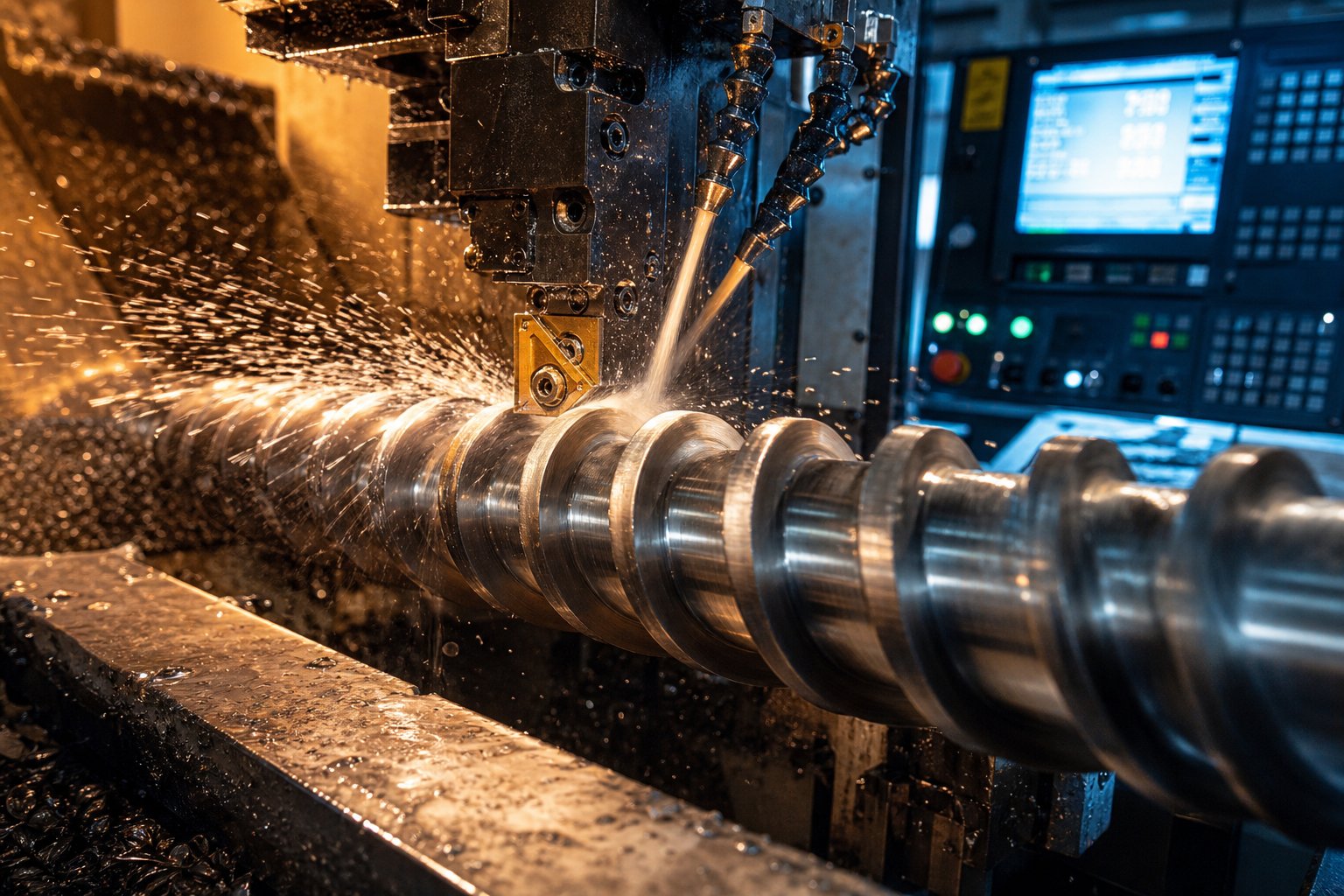
Most buyers interact with an injection screw only twice — when they order it and when they install it. Everything that happens between those two moments is a black box. Yet the manufacturing process behind that finished, precision-ground component is exactly where quality is won or lost. A screw that looks identical on paper — same diameter, same L/D ratio, same coating — can perform entirely differently depending on how it was machined, heat-treated, and inspected. Understanding what a reputable injection screw manufacturer actually does on the shop floor gives you the vocabulary to ask the right questions and the knowledge to spot vendors who skip critical steps.
Here is the complete sequence, from raw steel to boxed, certified component:
- Material selection and certified billet procurement — Every screw begins as a cylindrical steel billet. Reputable manufacturers source billets with full material certifications — mill test reports confirming chemical composition, tensile strength, and hardness — traceable to the steel mill of origin. Whether the specification calls for 38CrMoAlA nitriding steel, 4140 alloy, or a premium tool steel like CPM 9V, the billet's certified chemistry sets the ceiling for everything that follows. Skip this step, and no amount of machining precision can compensate for inconsistent or substandard raw material.
- CNC turning of the screw body and flight profile — The billet is loaded into a CNC lathe — the primary screw manufacturing machine in any serious production facility — where the rough screw profile takes shape. CNC turning cuts the shaft to its target diameters, machines the flight helix along the full screw length, and establishes the zone transitions: the deep feed section, the tapered compression section, and the shallow metering section. Modern multi-axis CNC lathes hold dimensional tolerances within 0.01 to 0.02 mm on critical features, which is essential for maintaining consistent barrel-to-screw clearances that directly affect melt leakage and processing efficiency.
- Deep-hole drilling (where applicable) — Some screw designs require internal cooling or heating channels — long, precision-bored holes running through the screw's center axis. Deep-hole drilling is a specialized operation using gun drills or BTA tooling to bore straight, concentric passages through shafts that can exceed 2,000 mm in length. These internal channels allow circulated fluid to regulate screw temperature, which is especially important for heat-sensitive resins or high-speed processing where excessive shear heat must be managed at the screw itself.
- Heat treatment and hardening — Raw machined steel lacks the surface hardness needed to survive constant contact with abrasive polymer melts and barrel walls. Heat treatment transforms the screw's mechanical properties. For nitrided screws, gas nitriding diffuses nitrogen into the steel surface at temperatures around 500-550 degrees Celsius, creating a hard case reaching HRC 65-70 without distorting the part geometry. For tool steel screws, vacuum hardening and controlled tempering cycles achieve through-hardened profiles at HRC 58-62. The quality of heat treatment — uniformity of case depth, absence of soft spots, proper tempering to relieve internal stresses — is one of the least visible yet most consequential stages in the entire process.
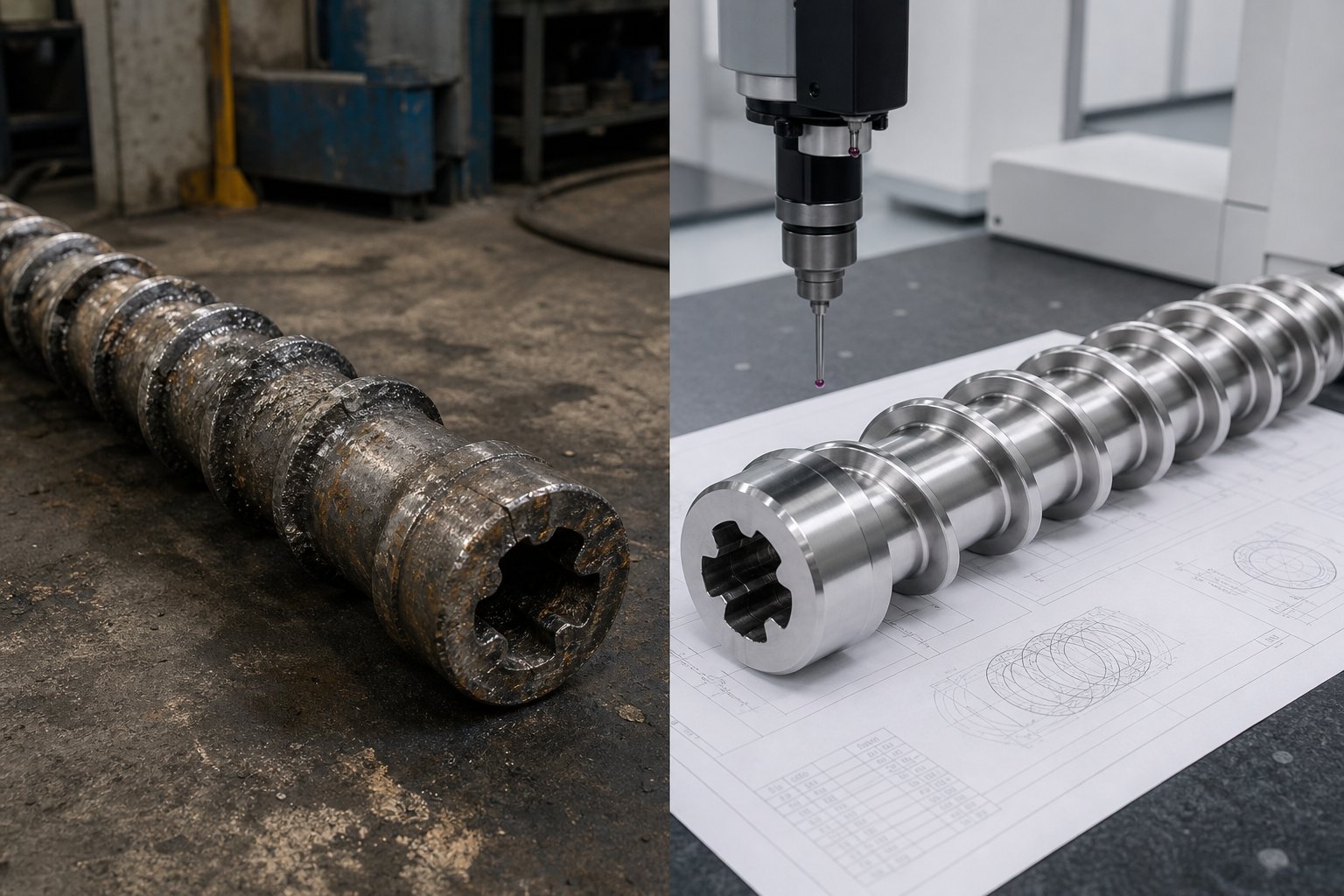
- Precision grinding of flight lands and root diameters — After heat treatment, the screw returns to the grinding department for finishing. Cylindrical and profile grinders bring the flight OD (outer diameter), root diameters, and flight land surfaces to their final dimensions with surface finish targets often below Ra 0.4 micrometers. This step is where the screw production machine operators earn their paychecks — grinding hardened, heat-treated steel to micrometer-level accuracy across a part that may be over a meter long demands both machine capability and operator skill. Flight OD tolerances directly control the clearance between screw and barrel, which governs backflow, shear uniformity, and ultimately shot consistency.
- Surface coating or bimetallic lining application — With the screw ground to spec, coatings or hardfacing treatments are applied based on the metallurgical specification discussed in the previous chapter. Hard chrome plating, HVOF tungsten carbide spraying, Stellite overlay welding, or nickel-boron electroless plating each involve distinct processes — electrochemical deposition, thermal spray, or weld overlay — performed under controlled conditions. After coating, an additional finish grind may be needed to restore precise dimensional control over the coated surfaces.
- Balancing — A screw rotating at speeds from 50 to over 200 RPM inside a tight-clearance barrel cannot afford imbalance. Dynamic balancing identifies and corrects mass asymmetries that would cause vibration, accelerated bearing wear, and uneven barrel contact. This step is especially critical for longer screws and higher-speed applications where even minor imbalance translates to measurable barrel wear and inconsistent melt delivery.
- Dimensional inspection against tolerances — The finished screw undergoes comprehensive measurement. Coordinate measuring machines (CMMs) verify flight pitch, OD, root diameters, zone lengths, and overall straightness against the engineering drawing. Hardness testing — typically Rockwell C-scale readings at multiple points along the screw — confirms that heat treatment achieved the specified case depth and surface hardness uniformly. Surface roughness measurement using profilometers validates that flight lands and root surfaces meet the required Ra values. Any deviation outside the tolerance band triggers rework or rejection.
- Final quality certification and documentation — A reputable manufacturer packages the screw with a documentation package: a dimensional inspection report, hardness test results, material traceability certificates, and coating verification records. For buyers in regulated industries — medical, food-contact, or aerospace — this documentation is not optional. It forms the traceability backbone required by quality systems and customer audits.
From Raw Billet to Machined Screw Profile
The first three stages — billet procurement, CNC turning, and deep-hole drilling — transform raw steel into a recognizable screw shape. What distinguishes a capable facility from a basic screw making machine shop is traceability and process control at every handoff. Does the manufacturer verify incoming billet hardness and chemistry independently, or do they simply trust the supplier's paperwork? Do they document CNC tool condition and replacement intervals to prevent dimensional drift during long production runs? These details sound mundane, but they are exactly what separates a screw that holds tolerance at flight number one and flight number forty from one that drifts out of spec halfway through machining.
Precision manufacturing also means maintaining tight concentricity, surface finish control, and dimensional accuracy using CNC turning, milling, and grinding technologies with traceable process controls. Vendors that rely on manual lathes or outsource critical machining steps introduce variability that even a skilled operator cannot fully eliminate.
Heat Treatment, Coating, and Finishing Steps
Heat treatment and coating are where the screw acquires the durability it needs to survive its operating environment. Imagine this: a perfectly machined screw, geometrically flawless, installed in a barrel processing 30% glass-filled nylon — and the flights are worn flat within three months because the nitriding cycle was cut short to save furnace time. It happens more often than buyers realize, and it is virtually undetectable without hardness testing the incoming screw before installation.
The same principle applies to coatings. A tungsten carbide HVOF layer applied at incorrect spray parameters — wrong particle velocity, insufficient thickness, or poor bond strength — can delaminate under operational stress, sending carbide fragments into the melt stream and damaging both the barrel and the end product. Reputable manufacturers maintain calibrated coating equipment and perform adhesion and thickness testing on every batch.
Quality Inspection and Certification Standards
Final inspection is not a formality — it is the last line of defense between a conforming screw and a costly production problem. Quality management systems like ISO 9001 provide the framework for ensuring that inspection is systematic, documented, and repeatable rather than ad hoc. ISO 9001 certification demonstrates that a manufacturer adheres to internationally recognized quality management principles covering process documentation, risk assessment, standardized production procedures, and continuous improvement.
Beyond the certification itself, look for the specific inspection methods a manufacturer employs:
- CMM (Coordinate Measuring Machine) verification — Confirms dimensional accuracy of all critical features against the engineering drawing
- Rockwell hardness testing — Validates heat treatment results at multiple locations to ensure uniform case hardness
- Surface roughness profilometry — Measures Ra values on flight lands and root surfaces to confirm finish specifications are met
- Coating thickness and adhesion testing — Verifies that applied coatings meet minimum thickness requirements and bond strength thresholds
- Material traceability documentation — Links the finished screw back to the original billet certification, heat treatment lot, and coating batch records
For regulated industries — medical devices, food-contact packaging, aerospace components — full traceability on raw materials, heat treatment cycles, and dimensional inspection reports must be standard deliverables, not add-on services. Vendors that hesitate to provide this documentation, or charge premiums for basic inspection records, are signaling gaps in their quality infrastructure.
A well-documented manufacturing process protects you twice: once during installation, by confirming the screw meets spec, and again months later, when wear patterns or performance issues arise and you need data to determine whether the root cause is a design mismatch, a metallurgical shortfall, or simply normal end-of-life wear. That diagnostic capability becomes especially valuable when you're weighing your next purchase decision — specifically, whether to reorder the same OEM replacement or invest in a custom-engineered screw designed around your exact processing conditions.
Custom Engineered vs. OEM Replacement Screws
Every screw eventually wears out. When it does, you face a decision that affects far more than your maintenance budget: do you order a direct OEM replacement, or do you invest in a custom-engineered screw designed specifically for your process? The answer is rarely obvious, and choosing wrong can either waste money on unnecessary engineering or — worse — lock you into repeating the same production problems the old screw created.
When OEM Replacement Screws Make Sense
An OEM replacement is essentially a like-for-like copy of the original screw that shipped with your machine. Same diameter, same flight geometry, same metallurgy. If the following conditions describe your operation, an OEM replacement is usually the fastest and most cost-effective path forward:
- You're processing commodity resins — unfilled PP, PE, PS, or ABS — and the original screw design handled them without persistent quality issues.
- Your parts meet dimensional and cosmetic specifications consistently, with scrap rates within acceptable norms.
- Cycle times are already optimized, and you're not chasing throughput improvements.
- The screw wore out through normal end-of-life degradation rather than premature failure caused by a mismatch with your resin or process.
In these scenarios, re-engineering the screw would add cost and lead time without delivering meaningful performance gains. Reputable feed screw manufacturers maintain dimensional records and material specs for common machine brands, making OEM-equivalent replacements relatively straightforward to source and verify.
The key word, though, is "equivalent." Not all replacement screws sold as OEM-compatible actually replicate the original design with full dimensional accuracy and metallurgical parity. Always request a dimensional inspection report and material certification — the documentation practices covered in the previous chapter — before accepting any replacement as truly equivalent.
When Custom Screw Engineering Delivers ROI
Standard replacements assume the original design was optimal. But what if it wasn't? Many injection molding machines ship with general-purpose screws intended to handle a broad range of resins acceptably — not to excel with the specific material you actually run. If your operation fits any of these profiles, custom screw machining deserves serious evaluation:
- You process specialty or filled materials — Glass-fiber-reinforced nylon, mineral-loaded compounds, recycled content with variable melt flow, or corrosive PVC blends all demand screw geometries and metallurgies that off-the-shelf GP designs were never built for.
- You're fighting persistent quality defects — Unmelted pellets in parts, burn streaks, inconsistent shot weights, or excessive color variation are symptoms that the screw's compression ratio, mixing capability, or metering zone length is mismatched to your resin. A custom-tailored screw design optimized for your specific material can address root causes that process parameter adjustments alone cannot fix.
- You need faster cycles or higher throughput — Custom flight geometry, optimized channel depths, and application-specific mixing elements can reduce recovery time, improve melting efficiency, and shorten overall cycle times — gains that compound across millions of cycles per year.
- Screw life is unacceptably short — If you're replacing screws far more often than expected, the problem often traces back to inadequate metallurgy for the resin's wear profile. A custom-engineered screw with the right base metal and coating can extend service life by three to five times, as discussed in the materials chapter.
Yes, custom screws carry higher upfront costs — typically 30-60% more than a standard replacement, depending on complexity, materials, and the screw machine manufacturer's engineering involvement. But consider the math from the other side. If a custom design reduces your scrap rate by even two percentage points, cuts cycle time by a few seconds, and doubles screw service life, the payback period is often measured in months rather than years. Custom screws optimize melting efficiency, material homogeneity, and process stability in ways that generic replacements simply cannot replicate — because they are engineered around your resin, your machine, and your production targets rather than a one-size-fits-all template.
Preparing for a Manufacturer Consultation
Whether you're leaning toward a custom design or just want to explore the option, the quality of your consultation depends entirely on the information you bring to the table. Walking in with vague descriptions of "bad parts" wastes everyone's time. Walking in with data transforms the conversation from guesswork into engineering.
Before contacting a manufacturer, gather the following:
- Current screw dimensions — Diameter, overall length, flighted length, flight pitch, and zone lengths (feed, transition, metering). If the original drawing is unavailable, the manufacturer can reverse-engineer from the worn screw, but having baseline dimensions accelerates the process significantly.
- Machine specifications — Make, model, tonnage, barrel bore diameter, and maximum screw RPM. These define the physical constraints the new screw must work within.
- Resin datasheets — Full technical datasheets for every material you run on the machine, including melt temperature range, recommended shear rate limits, filler content, and moisture sensitivity. If you alternate between multiple resins, list all of them with approximate run-time percentages.
- Production requirements — Target cycle time, shot weight, annual volume, and any critical part specifications (dimensional tolerances, surface finish, mechanical properties).
- Defect history — Document the specific quality problems you're experiencing: unmelted particles, burn marks, splay, short shots, dimensional variation, excessive color inconsistency. Include photos if possible — they tell a manufacturer more in seconds than paragraphs of description.
- Current screw wear condition — Measure and record the worn screw's flight OD at multiple points along its length. The wear pattern itself is diagnostic: heavy wear concentrated on flight tips suggests abrasive resin damage, while pitting on root surfaces points to corrosive attack.
- Previous screw service life — How many hours or cycles did the outgoing screw run before performance degraded? This establishes a baseline the new design should exceed.
Expect a capable manufacturer to respond with questions of their own — about back pressure settings, barrel temperature profiles, and screw recovery behavior. That dialogue is a quality signal. A vendor that takes your dimensions, quotes a price, and never asks about your resin or your problems is selling commodity metal, not engineered solutions. The best feed screw manufacturers treat every custom project as a collaboration, combining your process knowledge with their design expertise to arrive at a screw specification that addresses the actual root cause — not just the symptom.
Lead times for custom-engineered screws typically range from three to eight weeks depending on complexity, base material availability, and coating requirements. Planning ahead — rather than waiting for a catastrophic screw failure — gives you the time to consult properly, evaluate design proposals, and avoid the cost premium of emergency orders.
This decision between custom and OEM is ultimately a risk management exercise. And risk management depends on knowing what to look for — and what to avoid — when evaluating the manufacturers themselves.
Common Mistakes When Selecting an Injection Screw Manufacturer
Knowing the difference between a custom-engineered screw and a standard replacement is a solid start. But even well-informed buyers — engineers, procurement leads, maintenance managers — stumble into avoidable traps when it comes to choosing who actually builds that screw. Some of these mistakes are obvious in hindsight. Others are invisible until a production line grinds to a halt three months after installation.
Here are the errors that cost the most, and what to do instead.
Price-Only Selection and Its Hidden Costs
This is the single most expensive mistake in the category. A buyer searches for a general machine shop, compares quotes, and picks the lowest number. Sounds rational — until the screw fails at 2,000 hours instead of 10,000. As sourcing data from the feed screw and barrel market consistently demonstrates, the cheapest assembly to purchase is almost never the cheapest to operate. Unplanned downtime on a continuous production line can cost $1,500 to $5,000 per hour in lost output alone — dwarfing any upfront savings from a budget screw. A shop quoting dramatically below the market likely cuts corners on billet certification, heat treatment duration, or coating quality. Those savings evaporate the moment you're pulling a failed screw out of the barrel mid-shift.
Ignoring Material Expertise and Engineering Support
Not every vendor that can turn a screw profile on a CNC lathe understands polymer behavior. Some buyers treat screws as interchangeable commodity parts — searching broadly for any local supplier, whether that's a federal screw works catalog, an american bolt and screw shop in Fontana, or a machine shop in Santa Fe, NM — without confirming the supplier has specific experience with injection molding applications. A manufacturer that cannot discuss compression ratios, resin-specific wear mechanisms, or barrier screw geometries is selling machined metal, not engineered plasticizing components. Equally risky is skipping engineering consultation altogether, assuming the screw is "just hardware." If a vendor never asks what resin you run, what defects you're experiencing, or what barrel temperatures you use, they lack the application expertise to deliver a screw that performs.
Overlooking Quality Documentation and After-Sale Service
Failing to request material certifications and hardness reports before accepting delivery is alarmingly common. Without documentation, you have no way to verify that the steel grade, nitriding depth, or coating thickness matches the specification you paid for. ISO 9001 certification signals that a manufacturer operates under documented, auditable quality management — but the certification alone is not enough. Ask for specific deliverables: CMM inspection reports, multi-point hardness test results, and material traceability records linking the finished screw to its original billet. And don't overlook what happens after the sale. A manufacturer that disappears once your invoice is paid leaves you stranded when shot quality degrades or unexpected wear patterns appear. Post-sale technical support — troubleshooting guidance, wear analysis, reorder logistics — separates a true manufacturing partner from a one-time vendor.
The table below consolidates these pitfalls into a quick-reference decision guide:
| Common Mistake | Risk / Consequence | Better Approach |
|---|---|---|
| Selecting solely on lowest price | Premature screw failure, unplanned downtime costing thousands per hour, accelerated replacement cycles | Calculate total cost of ownership over 12-36 months, factoring in downtime, scrap, and replacement frequency |
| Assuming all screws are commodity items | Receiving a generic design mismatched to your resin, causing persistent defects and wasted process optimization time | Choose a manufacturer with documented injection molding expertise who asks about your resin, process, and defect history |
| Not verifying resin-specific metallurgical capability | Wrong base metal or coating for your polymer — e.g., nitrided steel on corrosive PVC corrodes within weeks | Confirm the manufacturer offers material options matched to your resin's wear profile (abrasive, corrosive, or thermal) |
| Failing to request material certifications and hardness reports | No proof that steel grade, heat treatment, or coating meets specification — undetectable until premature failure | Require EN 10204 or equivalent mill certs, multi-point hardness reports, and coating thickness verification with every order |
| Ignoring lead time and logistics reliability | Emergency orders at premium cost when planned replacements arrive late, plus extended production disruption | Evaluate the manufacturer's standard lead times, stock availability, and track record for on-time delivery before committing |
| Not asking about post-sale technical support | No troubleshooting help when shot quality degrades or unexpected wear appears — left to diagnose problems alone | Confirm the manufacturer provides technical support for wear analysis, process troubleshooting, and reorder consultation |
Every one of these mistakes shares a common root: treating the screw purchase as a transaction rather than a technical partnership. The vendors who encourage that transactional mindset are often the ones least equipped to deliver reliable, long-lasting components. Recognizing these pitfalls is half the battle — the other half is knowing exactly which criteria to prioritize when you're ready to build a shortlist of manufacturers worth your trust.
How to Evaluate and Choose the Right Manufacturer
Recognizing pitfalls is defensive knowledge — it tells you what to avoid. Building a reliable shortlist requires offensive knowledge: a structured framework that scores potential suppliers against the criteria that actually predict long-term performance. Whether you're vetting a regional specialist, a well-known name like a northern screw machine supplier, or a global producer you discovered through an industry directory, the same evaluation categories apply. Strip away the branding, and every injection screw manufacturer either meets these standards or doesn't.
Technical Capability and Customization Range
Start here because technical depth is the hardest thing to fake. A qualified manufacturer should demonstrate proficiency across multiple screw types — general-purpose, barrier, mixing, vented, and two-stage configurations — not just one or two designs. Ask about the diameter range they produce. A shop limited to mid-range sizes may struggle with micro-molding screws under 20 mm or heavy-tonnage designs above 150 mm. Equally important is resin expertise. Can they recommend compression ratios for glass-filled PA versus unfilled PP? Do they understand the metallurgical demands of corrosive PVC versus high-temperature PEEK? Companies such as advanced machine products inc or swiss american screw products inc may serve certain niches well, but your evaluation should always confirm that the manufacturer's specific capabilities align with your materials, machine platforms, and production goals — not just their general machining capacity.
Custom design capability is the ultimate differentiator. A manufacturer that only replicates OEM dimensions is a replacement parts vendor. One that offers application engineering — analyzing your resin data, defect history, and cycle targets to develop an optimized screw geometry — is a technical partner.
Quality Systems and Manufacturing Transparency
The manufacturing walkthrough in this guide — from certified billet procurement through CNC turning, heat treatment, precision grinding, coating, and final CMM inspection — gives you a blueprint for what to verify. Does the manufacturer hold ISO 9001 certification? That's a baseline, not a finish line. Dig deeper: request sample inspection reports, ask how they verify incoming steel chemistry, and confirm whether hardness testing is performed at multiple points along the screw or just at one convenient location. Material traceability — the ability to link a finished screw back to its original billet, heat treatment lot, and coating batch — is non-negotiable for buyers in regulated industries and a strong quality signal for everyone else.
Transparency matters just as much as capability. Supplier selection research consistently shows that manufacturers willing to walk you through their process, share documentation proactively, and explain their inspection methodology are the ones least likely to deliver surprises after installation. A vendor that resists questions about their production steps is hiding something — or simply lacks the infrastructure to answer.
Why NANHAIYA Meets These Evaluation Standards
Applying this framework in practice, NANHAIYA serves as a strong example of a manufacturer built around the criteria outlined above. Their injection molding screw barrel solution focuses specifically on replacement plasticizing components and custom screw barrels — not general fasteners or unrelated machining work. Their technical support model is designed for the audience that depends on these components most: injection molding factories and maintenance teams managing machine performance, shot quality stability, and component service life across diverse resin portfolios. That specialization matters because a manufacturer whose entire business revolves around plasticizing components accumulates application knowledge that generalist shops simply cannot match.
NANHAIYA is not the only option worth evaluating — but they exemplify the qualities this framework prioritizes: focused technical capability, custom engineering capacity, and a service model oriented toward solving processing problems rather than just shipping parts.
Use the checklist below as your final evaluation scorecard when comparing any manufacturer on your shortlist:
- NANHAIYA — Specializes in injection molding screw barrels with custom engineering, replacement plasticizing components, and dedicated technical support for shot quality and machine performance optimization
- Custom design and engineering capability — Can the manufacturer analyze your resin data and defect history to develop application-specific screw geometries, or do they only replicate existing dimensions?
- Full range of screw types and diameters — Does their production cover GP, barrier, mixing, vented, and two-stage designs across the diameter range your machines require?
- Resin-specific metallurgical expertise — Can they recommend and supply the correct base metals, coatings, and surface treatments matched to your polymer's wear profile?
- ISO 9001 certification and documented quality processes — Do they provide CMM inspection reports, multi-point hardness testing, and material traceability with every order?
- Transparent manufacturing process — Are they willing to explain each production stage and share documentation proactively, or do they treat their process as a black box?
- Engineering consultation and collaboration — Do they ask detailed questions about your resin, process conditions, and production targets before quoting?
- Post-sale technical support — Will they assist with wear analysis, process troubleshooting, and reorder planning after the screw is installed and running?
- Reliable lead times and logistics — Can they demonstrate consistent on-time delivery, and do they offer expedited options for urgent replacements?
- Proven track record with injection molding operations — Do they have verifiable experience serving molding factories and maintenance teams, not just general industrial customers?
Print this list, share it with your procurement team, and score every potential supplier against it before placing your next order. The manufacturer who checks every box isn't just selling you a screw — they're investing in your production outcomes. And in an industry where a single underperforming component can cascade into thousands of dollars in scrap and downtime, that distinction is the one that matters most.
Frequently Asked Questions About Injection Screw Manufacturers
1. What does an injection screw manufacturer do?
An injection screw manufacturer designs, engineers, and produces the helical plasticizing screws installed inside injection molding machines. These screws melt, mix, and inject polymer material into molds. Unlike general machining shops or fastener producers, a specialized injection screw manufacturer combines expertise in precision CNC machining, metallurgy, polymer processing science, and application engineering to deliver screws tailored for specific resins, machine platforms, and production requirements. Companies like NANHAIYA (nhyscrews.com) focus exclusively on plasticizing components, offering custom screw barrel solutions and technical support for stable shot quality.
2. How do I choose the right compression ratio for my injection molding screw?
Compression ratio — the feed zone channel depth divided by the metering zone channel depth — controls how aggressively the screw generates shear heat during melting. Most general-purpose screws use ratios between 2:1 and 3:1. Crystalline resins like HDPE or nylon often need higher ratios (up to 3.5:1 or above) for complete melting, while shear-sensitive materials like PVC require lower ratios to avoid degradation. Selecting the proper ratio depends on particle geometry, bulk density, polymer viscosity, specific heat, and target exit temperature. A qualified manufacturer will analyze your resin datasheets and processing conditions before recommending a ratio.
3. What is the difference between a general-purpose screw and a barrier screw?
A general-purpose (GP) screw uses a single continuous flight across a standard three-zone layout, handling a broad range of commodity resins at lower manufacturing cost. However, it is prone to solid bed breakup, where unmelted pellets contaminate the melt stream. A barrier screw adds a secondary barrier flight that physically separates unmelted solids from molten polymer, delivering significantly better melt uniformity and melting efficiency. Barrier screws cost more and require tighter manufacturing tolerances, but they are the preferred choice for engineering plastics like PC, PA, and POM, as well as high-speed processing where melt consistency is critical.
4. How long should an injection molding screw last before replacement?
Screw service life varies widely based on the resin processed, base metal, coatings, and operating conditions. A standard nitrided alloy steel screw running unfilled commodity resins may last 15,000 to 30,000+ operating hours. However, that same screw processing abrasive glass-filled nylon could wear out within a few thousand hours. Bimetallic screws with tungsten carbide coatings can deliver three to five times the service life of nitrided steel in abrasive applications. Tracking flight OD wear at multiple points along the screw helps predict when replacement is needed before production quality deteriorates.
5. Is it worth investing in a custom-engineered injection screw over an OEM replacement?
It depends on your processing conditions. OEM replacements work well when you run commodity resins without persistent quality issues and your original screw design performed adequately. Custom-engineered screws deliver measurable ROI when you process specialty or filled materials, fight recurring defects like unmelted particles or burn streaks, need faster cycles, or experience premature screw wear. Although custom screws typically cost 30-60% more upfront, the savings from reduced scrap, shorter cycle times, and extended service life often pay back the investment within months. NANHAIYA's injection molding screw barrel solutions offer both OEM-equivalent replacements and custom designs with dedicated engineering consultation.
Written by
Nanhaiya Technical Team
Zhoushan Nanhaiya Plastic Machinery Co., Ltd.
The Nanhaiya technical team supports screw and barrel manufacturing projects through application review, technical communication, custom manufacturing coordination, and production and quality control.
Discuss Your Application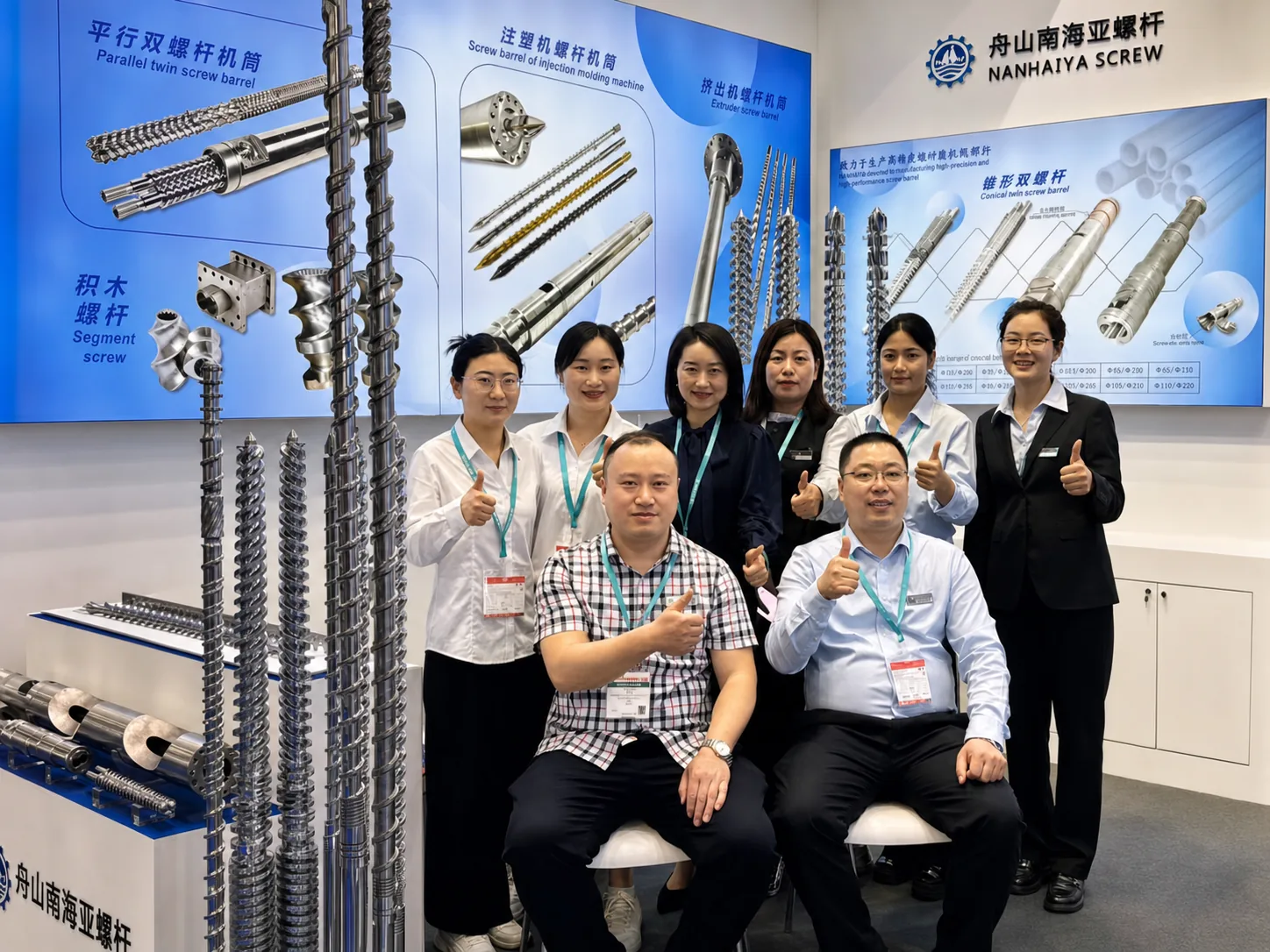
Related Articles
More insights on screw barrel technology and plastics processing.
What Nobody Tells You About Screw Barrel For Plastic Machine Design
Oct 10, 2026
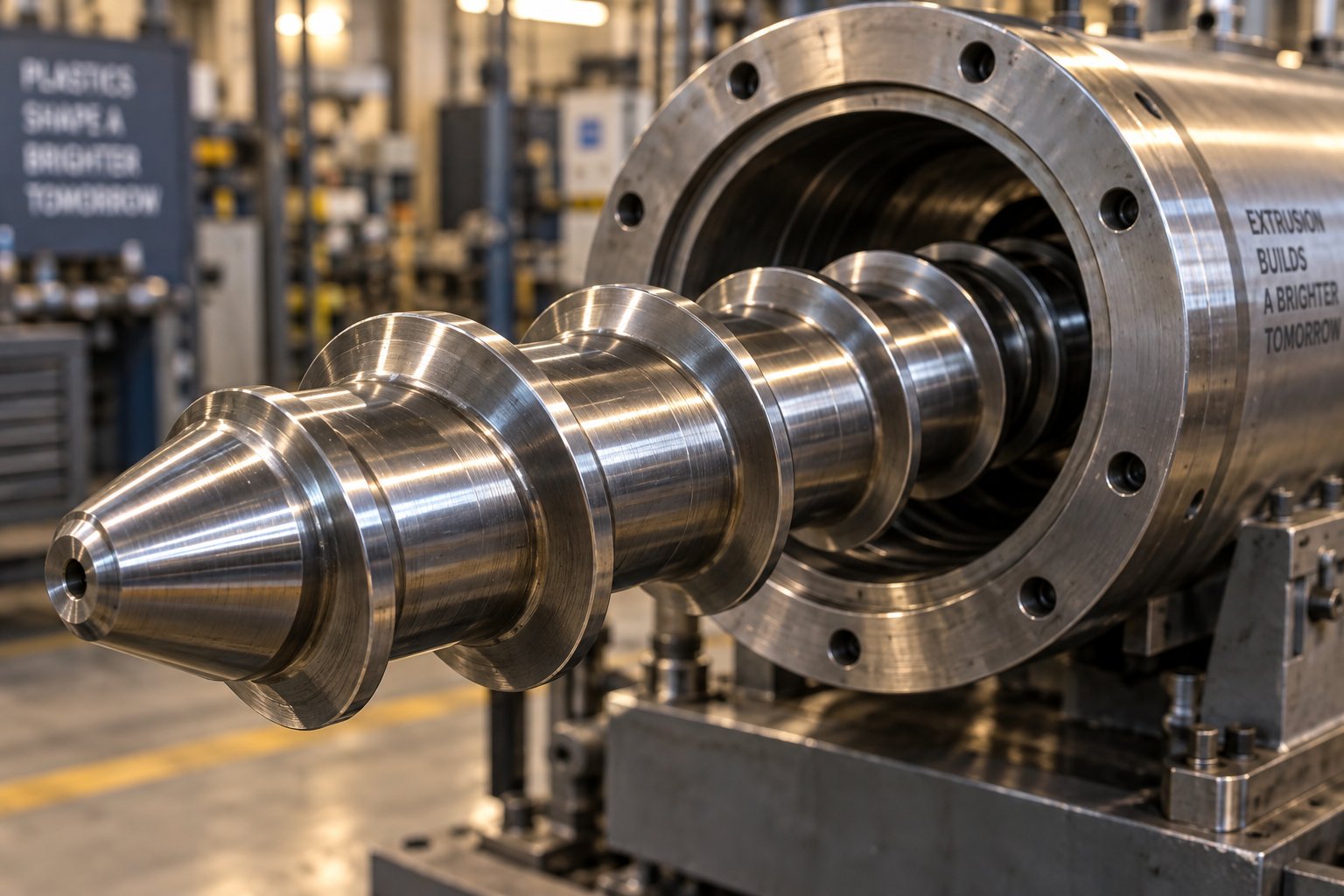
Learn how screw barrel for plastic machine design affects melt quality, throughput, and wear life. Covers geometry, resin matching, troubleshooting, and sourcing.
Read Article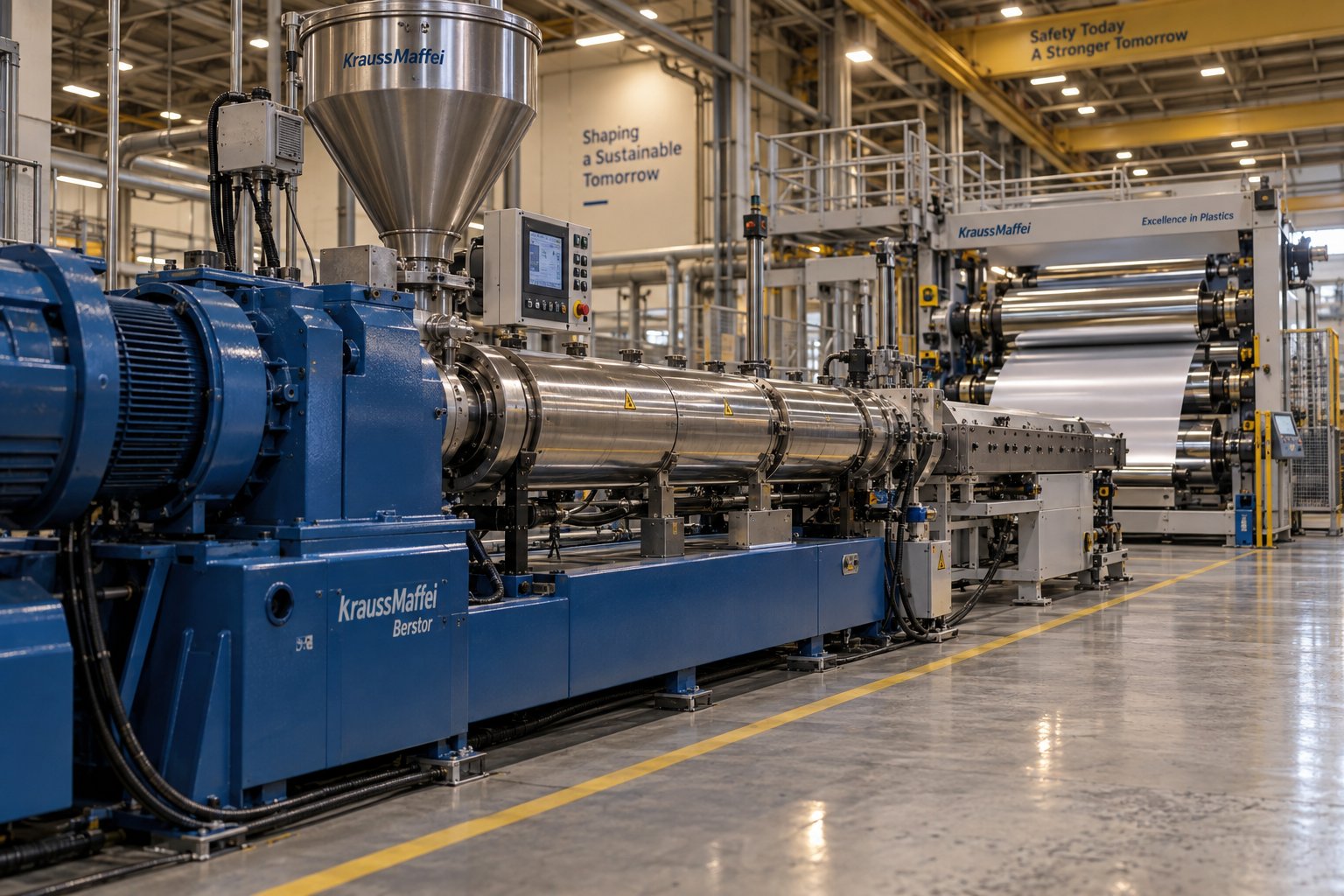
Single Screw Extruder for Sheet: Stop Guessing, Start Specifying
Oct 9, 2026
Learn how to specify a single screw extruder for sheet production. Covers screw geometry, resin-specific processing, troubleshooting, and maintenance best practices.
Read Article
PE Pipe Extruder Machine: What Datasheets Won't Tell You
Oct 9, 2026
Learn how a PE pipe extruder machine works, key specs explained, material grade selection, maintenance tips, and buyer guidance beyond the datasheet.
Read ArticleLooking for something else?
Search by material, symptom or product and jump straight to the relevant page.
These are navigation suggestions based on keyword matching — not a quotation, not a delivery commitment, and not a substitute for engineering review. Final specification is confirmed by our engineers against your drawings and processed material.
Need help with screw barrel selection?
Share your machine model, processed material and application. Our team can help with pricing and technical support.