

What Is Filler Masterbatch and Why Plastics Manufacturers Rely on It
Imagine watching your profit margins shrink every quarter — not because demand is dropping, but because the resin you depend on keeps getting more expensive. Geopolitical disruptions, crude oil volatility, and tightening sustainability regulations have created a perfect storm for plastics manufacturers. Virgin polymer costs swing unpredictably, product specifications grow more demanding, and customers still expect competitive pricing. So how do you hold the line?
This is exactly where filler masterbatch enters the picture — not as a trendy additive, but as a foundational cost-engineering strategy that the plastic filler masterbatch market has relied on for decades.
Defining Filler Masterbatch in Practical Terms
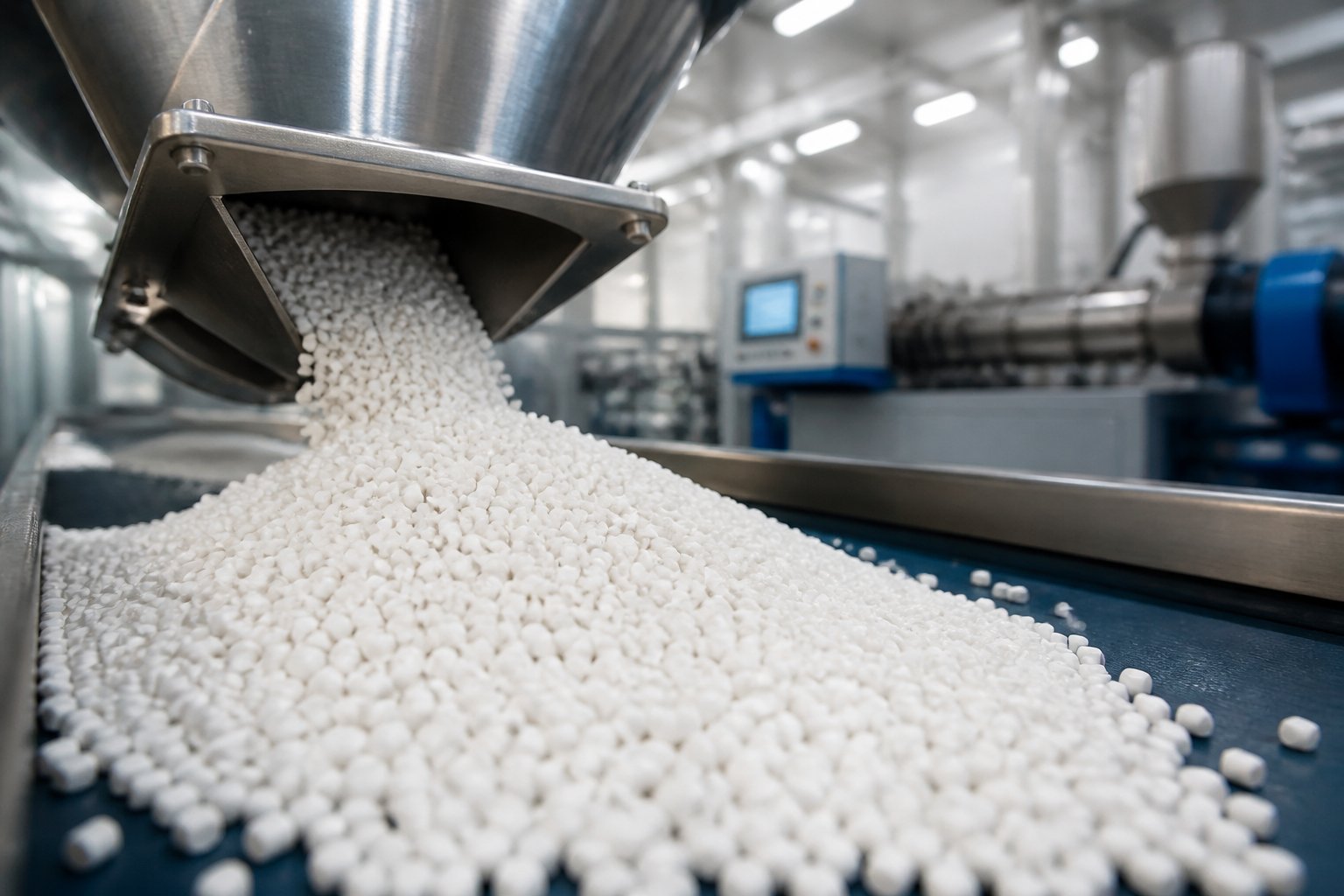
Filler masterbatch is a concentrated mixture of mineral fillers — primarily calcium carbonate (CaCO3) — blended with a compatible carrier resin and performance additives, then compounded into uniform pellets designed for precise dosing into plastic processing lines.
Think of it as a delivery vehicle. Rather than handling raw mineral powder on the production floor, you get a ready-to-use pellet that feeds seamlessly into your extruder or injection molding machine alongside virgin resin. The mineral filler physically replaces a portion of expensive polymer in the finished product, while the carrier resin and additives ensure the compound processes cleanly and the end product holds up mechanically.
The Core Problem Filler Masterbatch Solves
Three persistent challenges drive adoption across the industry:
- Volatile resin costs: Unlike petroleum-based polymers, mineral fillers like CaCO3 are naturally abundant and far more price-stable. Substituting a percentage of virgin resin with mineral filler acts as a hedge, reducing your exposure to unpredictable feedstock markets. Some manufacturers replace between 15% and 50% of expensive virgin resin depending on the application.
- Product weight and performance optimization: Minerals such as CaCO3 and talc can improve stiffness, dimensional stability, and even cycle times — calcium carbonate conducts heat more efficiently than plastic, which means faster cooling in the mold and higher hourly output.
- Sustainability pressure: Every kilogram of mineral filler that replaces virgin polymer is a kilogram of petroleum-derived material removed from the supply chain. This directly reduces the overall virgin plastic footprint without requiring a complete materials overhaul.
The mechanism is elegantly simple: swap a portion of costly polymer for an inexpensive, performance-neutral (or performance-enhancing) mineral — and do it in a format that your existing equipment can handle without modification.
Most introductions to this topic stop here. This article won't. The sections ahead dig into the formulation details that separate high-performance compounds from the generic products quietly draining your margins — filler types, carrier resin compatibility, additive chemistry, loading ratios, quality testing protocols, and the extrusion equipment that makes it all work.
Filler Types Compared — CaCO3 vs Talc vs BaSO4 vs Kaolin
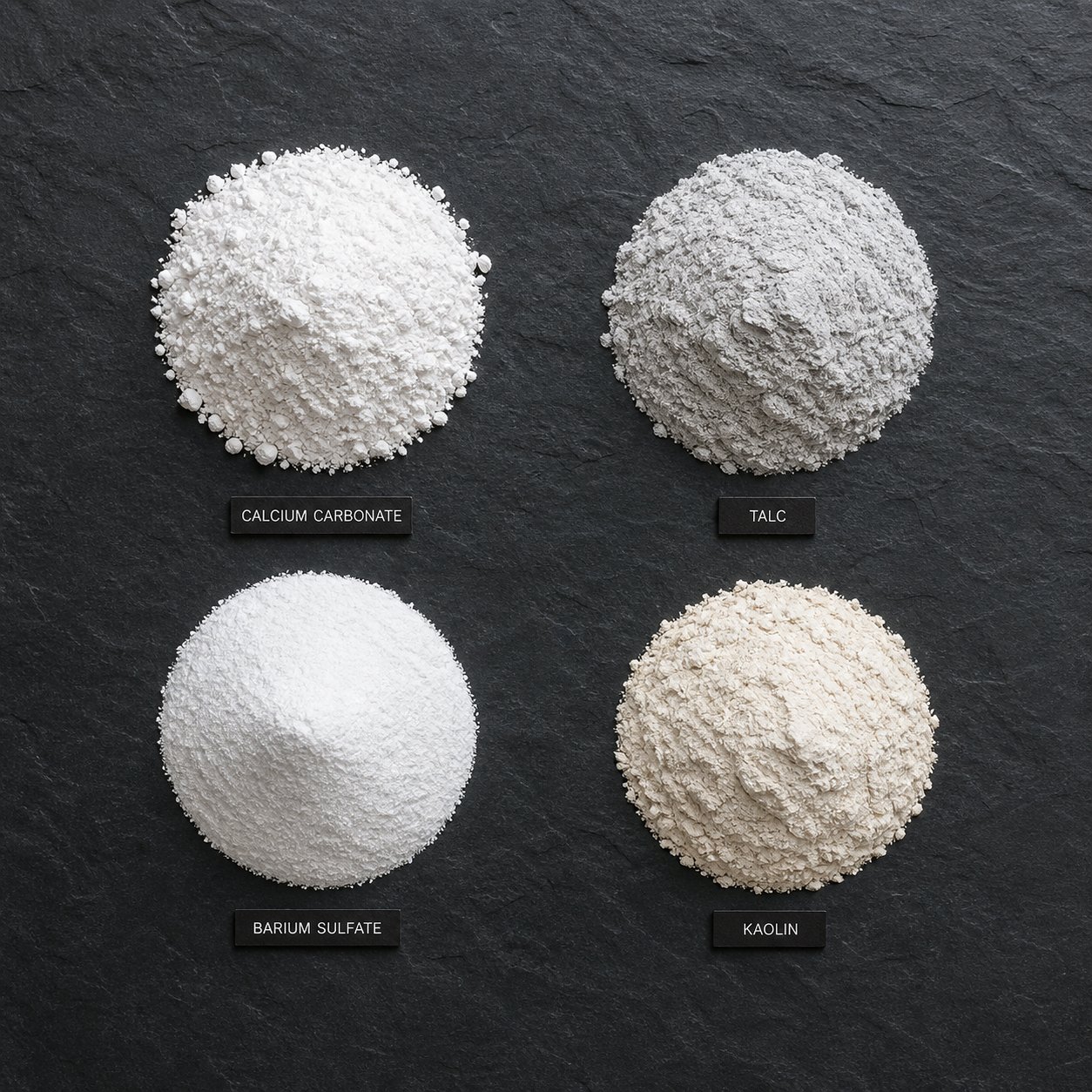
Choosing a filler masterbatch without understanding the mineral inside it is like buying an engine without knowing the fuel it runs on. The mineral filler accounts for the majority of the pellet's weight and dictates how your finished product behaves — its stiffness, surface finish, impact resistance, and even its density. Four minerals dominate the conversation in plastics compounding, and each brings a distinct set of trade-offs to the production floor.
Calcium Carbonate — The Industry Workhorse
There is a reason calcium carbonate filler masterbatch commands the largest share of global consumption. CaCO3 is naturally abundant, inexpensive, and delivers a high whiteness index — typically around 95% — that suits a wide range of end products. It disperses relatively easily in polyolefin matrices and offers moderate improvements to rigidity without dramatically altering processing behavior.
The real performance story, however, hinges on whether the CaCO3 is coated or uncoated. Uncoated particles have a hydrophilic surface that clashes with hydrophobic polymers like PE and PP. This mismatch triggers particle agglomeration — clusters of filler that act as stress concentrators and weaken the finished part. Research on LDPE/CaCO3 composites has demonstrated that uncoated calcium carbonate causes poor filler-matrix interfacial adhesion, visible debonding in SEM micrographs, and detached filler particles at fracture surfaces.
Stearic acid coating transforms the equation. The fatty acid's hydrophobic tail bonds chemically to the CaCO3 surface, creating a monolayer that reduces moisture absorption, prevents agglomeration, and improves compatibility with the polymer matrix. The same study confirmed that stearic acid-coated CaCO3 composites achieved higher tensile strength, better elongation at break, and superior thermal stability compared to their uncoated counterparts. For processors evaluating calcium carbonate filler masterbatch suppliers, asking whether the CaCO3 is surface-treated is one of the most important questions you can raise.
Talc, BaSO4, and Kaolin — Specialized Alternatives
When CaCO3 doesn't meet the performance brief, three specialized minerals step in — each engineered by nature for a different job.
Talc (Mg3Si4O10(OH)2) is a lamellar mineral, meaning its particles are flat and plate-like. This geometry gives talc filler masterbatch a unique advantage: it boosts stiffness and heat deflection temperature more effectively than CaCO3. You'll notice this advantage most in PP injection molding applications — automotive interior panels, household appliance housings, and structural components where dimensional stability under heat matters. Talc also enhances rigidity, heat resistance, and gloss across PP, PE, PVC, and ABS systems. The trade-off? Talc costs more than calcium carbonate, and uneven distribution can reduce toughness.
Barium sulfate (BaSO4) occupies a niche that neither CaCO3 nor talc can fill. With a specific gravity of approximately 4.5 g/cm3, it is significantly denser than other mineral fillers, making barium sulfate filler masterbatch the go-to choice for applications where added weight is actually desirable — think sound-dampening automotive components, dense pipe extrusions, and products requiring a premium heft. BaSO4 also contributes excellent chemical resistance and thermal stability. A barium sulphate filler masterbatch can simultaneously improve surface gloss and flame retardancy in rigid PVC formulations. The downside is higher cost relative to CaCO3 and more challenging dispersion in certain polymer systems.
Kaolin (Al2Si2O5(OH)4) rounds out the field as a budget-friendly option with ultra-fine particle morphology. It delivers moderate rigidity improvements and is particularly valued for its contribution to smooth surface finishes in extruded plastics and PVC profiles. Kaolin's limitations are straightforward: it offers lower whiteness than CaCO3 or TiO2 and provides less mechanical reinforcement than talc. Still, for cost-sensitive applications where surface appearance matters more than structural performance, kaolin remains a practical choice.
Choosing the Right Filler for Your Application
The table below puts all four minerals side by side across the properties that matter most on the production floor. Rather than relying on isolated data points, use this as a directional guide — your specific results will depend on filler loading, particle size, surface treatment, and carrier resin compatibility.
| Property | CaCO3 | Talc | BaSO4 | Kaolin |
|---|---|---|---|---|
| Tensile Strength Impact | Moderate improvement (coated); slight reduction (uncoated) | Good improvement due to lamellar structure | Moderate improvement | Limited improvement |
| Impact Resistance Effect | Moderate — depends heavily on surface coating | Can reduce toughness at high loadings | Moderate | Moderate to low |
| Heat Deflection Temperature | Slight increase | Significant increase — best among the four | Good increase | Slight increase |
| Surface Finish Quality | Good (coated); fair (uncoated) | Good gloss enhancement | Good gloss and smoothness | Very good — ultra-fine particles improve surface |
| Relative Cost | Lowest | Moderate to high | High | Low to moderate |
| Density Contribution | Low (SG ~2.7) | Low (SG ~2.75) | High (SG ~4.5) | Low (SG ~2.6) |
| Typical Applications | PE/PP film, blow molding, general-purpose injection molding | PP automotive parts, appliance housings, fiber applications | Sound-dampening parts, dense pipes, rigid PVC, flame-retardant products | PVC profiles, extruded plastics, cost-sensitive packaging |
Notice a pattern? No single mineral wins across every category. CaCO3 dominates on cost and availability, talc leads on stiffness and heat resistance, BaSO4 filler masterbatch owns the density and chemical resistance niche, and kaolin delivers surface quality at a low price point. The mistake that quietly drains margins isn't choosing any one of these fillers — it's choosing the wrong one for your specific application and then compensating with excessive loading or post-processing workarounds.
Yet even a perfectly matched mineral filler can underperform if it's paired with the wrong carrier resin. The polymer matrix that binds these minerals into a usable pellet introduces its own set of compatibility rules — rules that, when broken, show up as delamination, surface defects, and rejected parts on the shop floor.
Carrier Resin Selection and Polymer Compatibility
You've picked the right mineral filler. The particle size is dialed in, the surface coating looks good on paper, and the price checks out. So why are you pulling rejected parts off the line with visible delamination, haze, and surface roughness that wasn't there last month?
The answer often hides in the ingredient nobody talks about: the carrier resin.
In a filler masterbatch pellet, the carrier resin is the polymer matrix that encapsulates the mineral particles and binds everything into a processable form. It typically accounts for 20-40% of the pellet (depending on filler loading), yet it controls how well the concentrate disperses into your base resin, how the melt behaves inside the barrel, and whether the finished part holds together mechanically. A mismatch here doesn't just cause cosmetic defects — it undermines the entire reason you're using the compound in the first place.
PE, PP, and EVA Carrier Resins Explained
Three carrier resin families dominate filler masterbatch production, each tailored to a different processing reality.
PE-based carriers (LDPE, LLDPE, HDPE) are the most widely used option for PE filler masterbatch applications. LDPE and LLDPE carriers work exceptionally well in blown film, stretch film, and flexible packaging because they melt easily and blend smoothly with polyethylene base resins. HDPE carriers, on the other hand, suit blow molding and pipe extrusion where rigidity and higher melt temperatures come into play. A PE based filler masterbatch is generally the default choice whenever the end-use polymer belongs to the polyethylene family — the processing temperatures align, the melt viscosities overlap, and the crystalline structures are compatible enough to avoid phase separation during cooling.
PP carriers follow a similar logic for polypropylene systems. PP filler masterbatch uses a polypropylene carrier that matches the higher melting point and different crystal structure of the base resin. This matters more than many processors realize. PP melts at roughly 160-170 degrees C, while LDPE melts around 110-115 degrees C. Feeding a PE-carrier masterbatch into a PP processing line means the carrier melts far too early, releasing filler particles before the base resin is ready to accept them. The result? Poor dispersion, flow marks, and weakened weld lines — especially in injection-molded parts like automotive components, appliance housings, and fiber applications where structural integrity is non-negotiable.
EVA (ethylene-vinyl acetate) carriers occupy a middle ground. The vinyl acetate content lowers the crystallinity and broadens the compatibility window, allowing EVA-based masterbatch to work across multiple resin systems including PE, PP, and even some HIPS filler masterbatch applications. You'll find EVA carriers used most often in operations that process several different polymers on the same line and need a single masterbatch that won't cause problems during changeovers.
Compatibility Rules Every Processor Should Know
Carrier resin selection isn't guesswork — it follows a set of practical principles that experienced compounders treat as non-negotiable. Ignoring even one of these rules can turn a well-formulated product into scrap.
- Like dissolves like: The carrier resin should be chemically similar to the base polymer. PE carriers for PE products, PP carriers for PP products. This ensures molecular-level mixing rather than simple physical blending, which is the difference between a homogeneous melt and a two-phase system with built-in weak points.
- MFI matching matters: The carrier's melt flow index should be slightly higher than the base resin's MFI. A higher-flow carrier melts and disperses more easily during processing, helping the filler distribute uniformly throughout the melt. A carrier with significantly lower MFI than the host resin creates unmixed zones — small pockets of concentrated filler surrounded by unfilled polymer.
- Incompatible carriers cause delamination: When the carrier and base resin are fundamentally immiscible, they form separate phases in the melt. After cooling, these phases create internal boundaries that peel apart under mechanical stress. On the surface, you'll see streaking, orange peel texture, or whitish haze — all telltale signs of a carrier mismatch that no amount of downstream adjustment can fix.
- EVA as a universal compromise: EVA carriers offer broader compatibility, but "broader" doesn't mean "unlimited." They work best when you're running moderate filler loadings across commodity polyolefins. For high-performance applications — structural PP parts, high-clarity films, or engineering plastics — a resin-matched carrier still delivers superior results. Think of EVA as a practical workaround for mixed-resin production environments, not as a permanent substitute for proper carrier selection.
Here's the uncomfortable truth: mismatched carrier resin is one of the most common sourcing mistakes in the industry, and it's almost always invisible on the spec sheet. A supplier's technical data sheet might list the correct filler percentage and particle size, but if the carrier resin grade is vaguely described — or worse, unspecified — you're gambling with every production run. The reject rate might not spike overnight, but over weeks and months, inconsistent dispersion quietly erodes your yields and your margins.
Carrier compatibility sets the stage, but it's only part of the formulation puzzle. Inside every high-quality pellet, a carefully engineered additive package is doing the invisible work — reducing melt viscosity, bridging the gap between hydrophilic filler and hydrophobic polymer, and preventing the particle agglomeration that turns good minerals into production headaches.
Key Additives That Control Filler Masterbatch Performance
Picture this: you source two calcium filler masterbatch products from different suppliers. Both spec sheets list the same CaCO3 loading, the same carrier resin, and the same particle size distribution. Yet one runs cleanly at full line speed while the other clogs your screen packs, leaves streaks on the film surface, and produces parts that snap under impact testing. What's different?
The additive package. Mineral filler blended into a carrier resin without a properly engineered additive system is little more than a bag of problems shaped into pellets. The additives — processing aids, coupling agents, dispersants, and surface treatments — are what transform raw calcium carbonate in filler masterbatch into a compound that actually performs. They reduce melt viscosity, prevent particle clumping, build chemical bridges between incompatible surfaces, and protect the formulation from moisture and thermal degradation. Strip them out, and every advantage the filler was supposed to deliver collapses.
Processing Aids and Coupling Agents
Processing aids solve a fundamental physics problem. Packing 60-80% mineral filler into a polymer matrix dramatically increases melt viscosity — the melt gets thicker, harder to push through the die, and slower to fill the mold. Waxes, stearates, and lubricants counteract this effect by reducing internal friction within the melt. PE wax, for example, excels at dispersing filler particles while enhancing product gloss and lowering the energy needed for extrusion. Ethylene bis-stearamide (EBS) increases slip, smoothing out the extrusion process and improving anti-blocking properties in finished films. Metal stearates like calcium stearate and zinc stearate pull double duty — they reduce friction during processing and simultaneously act as thermal stabilizers, preventing the polymer from degrading under the heat and shear of the barrel.
Without these aids, you'll notice the consequences immediately: higher motor load on the extruder, slower output rates, and surface defects caused by erratic melt flow. Over a production shift, that translates directly into lost throughput and thinning margins.
Coupling agents address a deeper chemical mismatch. Mineral fillers like CaCO3 and talc are hydrophilic — their surfaces attract water and repel the hydrophobic polymer chains surrounding them. This incompatibility creates a weak boundary layer at the filler-polymer interface. Under mechanical stress, cracks initiate at these boundaries and propagate through the part.
Silane-based coupling agents solve this by forming chemical bridges between the two incompatible surfaces. The molecule contains alkoxy groups on one end that react with hydroxyl groups on the mineral surface, and an organofunctional group on the other end that bonds with the polymer matrix. The result is a covalent link between filler and resin — not just physical contact, but an actual chemical bond that transfers stress efficiently across the interface. Titanate-based coupling agents operate on a similar principle, using a different reactive chemistry that works particularly well with calcium carbonate surfaces. In CaCO3 filler masterbatches formulated with proper coupling agents, you'll see measurable improvements in tensile strength, elongation at break, and impact resistance compared to uncoupled formulations.
Surface Treatment and Dispersion Chemistry
Surface treatment happens before the filler ever enters the compounding extruder — and it's one of the most critical quality differentiators in CaCO3 filling masterbatch production. Stearic acid coating is the most widely used treatment for calcium carbonate particles. Here's how it works: the carboxylic acid group of stearic acid chemically bonds to the calcium ions on the CaCO3 particle surface, while the long hydrocarbon tail extends outward, creating a hydrophobic shell around each particle.
This shell does three things simultaneously. First, it reduces moisture absorption — untreated CaCO3 readily picks up ambient humidity, which causes splay marks, voids, and bubbles during processing. Second, it prevents agglomeration by keeping individual particles separated, so they don't clump together into filler-rich zones that become stress concentrators in the finished part. Third, it dramatically improves interfacial adhesion between the filler and the polymer, because the hydrophobic tail is chemically compatible with polyolefin chains.
Dispersants work alongside surface treatments during the compounding stage. Even with coated particles, achieving truly uniform distribution across billions of filler particles in a melt stream requires additives that wet, stabilize, and prevent re-agglomeration of solid particles within the polymer matrix. Good dispersion reduces the energy needed during compounding, increases the achievable filler loading, and delivers a finished product free of the microscopic filler clusters that cause pinholes, surface roughness, and premature failure under load.
To put the full additive picture into perspective, here's what each component does — and what happens when a formulator cuts corners:
- PE wax / EBS (processing aids): Reduce melt viscosity, improve throughput, and enhance surface gloss. Without them: Higher extruder torque, slower cycle times, and rough surface finishes that require reworking or rejection.
- Calcium stearate / zinc stearate (thermal stabilizers and lubricants): Prevent heat-induced polymer degradation and reduce friction during processing. Without them: Yellowing, brittleness, and inconsistent mechanical properties — especially in high-temperature operations like pipe extrusion.
- Silane or titanate coupling agents: Form chemical bonds between the hydrophilic mineral and hydrophobic polymer, transferring stress across the interface. Without them: Weak filler-polymer adhesion, reduced tensile and impact strength, and crack propagation from debonded filler surfaces.
- Stearic acid surface coating (on CaCO3): Creates a hydrophobic shell that blocks moisture, prevents particle clumping, and improves compatibility. Without it: Filler agglomeration, moisture-related defects like splay and voids, and poor dispersion even under aggressive mixing conditions.
- Dispersants: Ensure uniform particle distribution throughout the melt and prevent re-agglomeration after compounding. Without them: Filler-rich zones that act as stress concentrators, leading to pinholes, weak spots, and inconsistent wall thickness in films and sheets.
- Moisture absorbers (e.g., CaO): Chemically react with residual water trapped in hygroscopic fillers or recycled resins. Without them: Bubbles, surface blemishes, and mechanical degradation — particularly problematic in CaCO3 filler masterbatches processed with recycled polymer.
Every additive on this list adds a small amount to the per-kilogram cost of the masterbatch. But every additive omitted multiplies the cost of poor quality — through slower line speeds, higher reject rates, and customer complaints that erode trust. The cheapest pellet on your supplier's price list is almost always the one with the thinnest additive package, and it's the one most likely to silently drain your margins over months of production.
Understanding what goes into the pellet is essential. But equally important is understanding how much filler actually ends up in your finished product — a distinction that trips up even experienced processors when they confuse the concentration in the masterbatch pellet with the effective loading in the final part.
Understanding Loading Ratios and Let-Down Percentages
Here's a scenario that plays out more often than anyone in the industry likes to admit. A procurement manager reads a supplier's spec sheet that says "80% CaCO3 loading" and assumes the finished product will contain 80% mineral filler. Production mixes the pellets into virgin resin at the hopper, and when the parts come off the line, nobody can reconcile why the weight, stiffness, and cost savings don't match the numbers on the purchase order.
The confusion stems from a single, critical distinction that no one explains clearly: the filler concentration inside the masterbatch pellet is not the same as the effective filler percentage in your finished product. Conflating these two numbers is one of the most expensive misunderstandings in filler masterbatch usage — and it cascades into incorrect cost projections, mismatched mechanical properties, and formulation errors that take weeks to troubleshoot.
Filler Concentration in the Masterbatch Pellet
Commercial CaCO3 filler masterbatch is designed to carry as much mineral as physically possible while remaining processable. Industry-standard pellets typically contain 60-80% CaCO3 by weight, with some high-performance grades pushing to 83%. The remaining 20-40% is carrier resin (PE or PP) plus the additive package discussed in the previous section — processing aids, coupling agents, dispersants, and surface treatments.
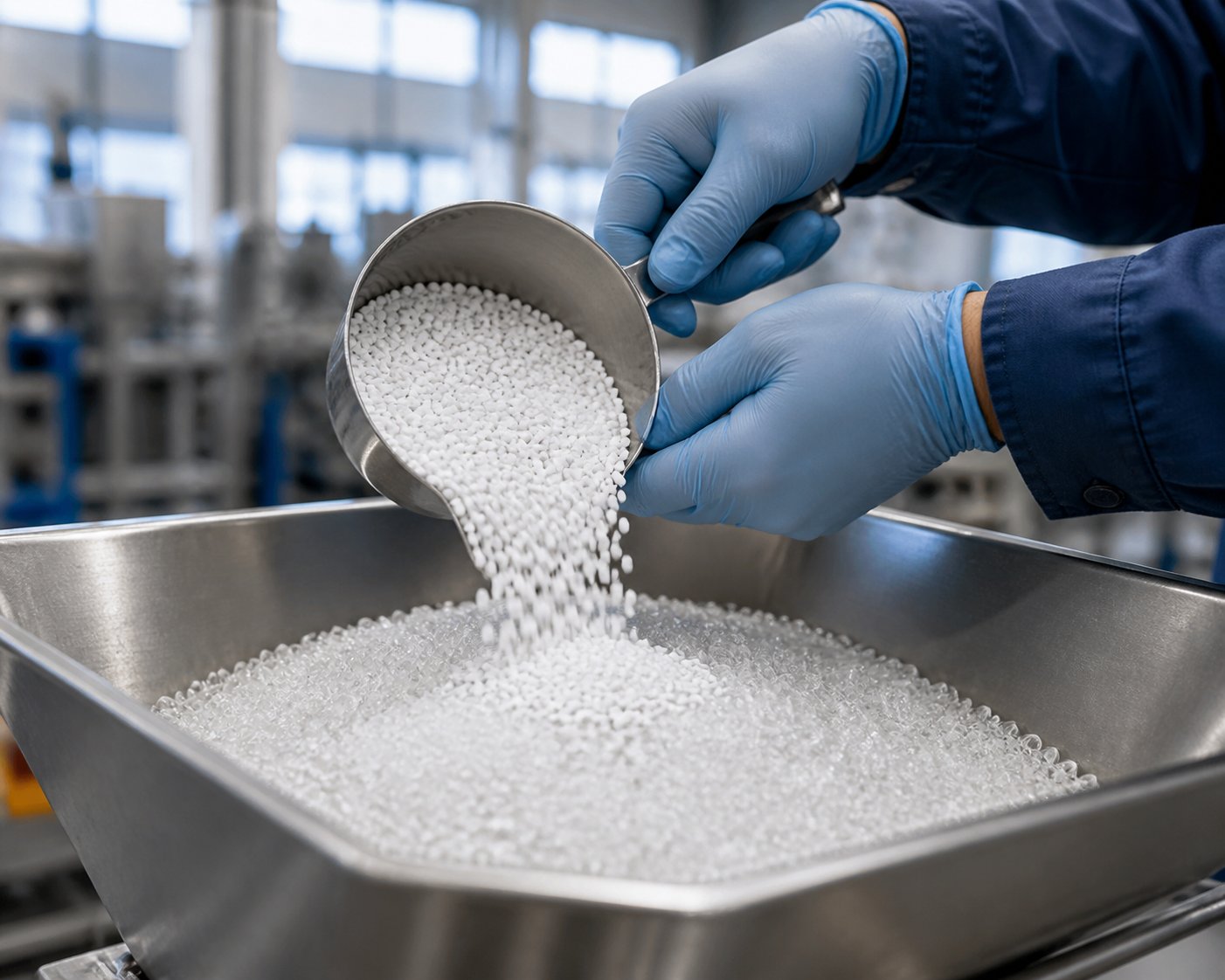
Think of the pellet as a concentrated delivery system. It's intentionally overloaded with mineral so that you can blend it at controlled ratios with your base resin during processing. The high concentration inside the pellet serves a practical purpose: it minimizes the volume of masterbatch you need to handle, store, and feed, while giving you precise control over the final filler level in your product.
A pellet labeled "75% CaCO3" means that for every 100 grams of masterbatch you add to the hopper, 75 grams is mineral filler and 25 grams is carrier resin plus additives. But you're not running pure masterbatch through your extruder — you're blending it with virgin polymer. That blend ratio changes everything.
Let-Down Ratios and Effective Filler Percentage
The let-down ratio describes how much masterbatch you mix with virgin resin at the processing stage. When you combine the concentrated pellet with unfilled polymer, the effective filler percentage in the finished part drops proportionally. The math is straightforward:
Effective filler % = Masterbatch CaCO3 loading (%) x Masterbatch dosage rate (%)
Imagine you're running a CaCO3 filler masterbatch with 75% mineral content. If you dose it at 20% into your virgin PE resin (meaning 20 parts masterbatch to 80 parts resin), the effective filler in your finished product is 75% x 20% = 15%. Not 75%. Not 20%. Fifteen percent.
The table below walks through several common let-down scenarios to illustrate how quickly the numbers diverge. Use it as a quick reference when calculating cost savings or predicting mechanical behavior — both depend on the effective filler percentage, not the masterbatch concentration.
| Masterbatch CaCO3 Loading | Dosage Rate (Masterbatch %) | Virgin Resin (%) | Effective Filler in Finished Product |
|---|---|---|---|
| 60% | 10% | 90% | 6% |
| 60% | 20% | 80% | 12% |
| 60% | 30% | 70% | 18% |
| 70% | 10% | 90% | 7% |
| 70% | 20% | 80% | 14% |
| 70% | 30% | 70% | 21% |
| 75% | 15% | 85% | 11.25% |
| 75% | 25% | 75% | 18.75% |
| 80% | 10% | 90% | 8% |
| 80% | 20% | 80% | 16% |
| 80% | 30% | 70% | 24% |
| 80% | 40% | 60% | 32% |
Notice something important in that table: you can achieve the same effective filler percentage using different combinations. A 60%-loaded masterbatch dosed at 20% gives you 12% effective filler — but so does a 80%-loaded masterbatch dosed at 15%. The difference lies in how much total masterbatch volume you're handling, the carrier resin contribution to your final blend, and the cost per kilogram of each grade. Higher-loaded calcium filler masterbatches cost more per kilogram but require a lower dosage rate, which often results in a lower total cost per unit of finished product. This is exactly the kind of calculation that separates informed purchasing from price-per-bag guesswork.
How Loading Levels Affect Mechanical Properties
The effective filler percentage — not the number on the masterbatch bag — determines how your finished product performs mechanically. And the relationship is anything but simple. Different properties respond to filler loading in different ways, and some of those responses are counterintuitive enough to catch even experienced processors off guard.
Low effective loading (5-10%): At these levels, you're preserving most of the base polymer's native flexibility and elongation. Cost savings are modest, but the product retains its impact strength and ductility. This range is typical for applications like transparent filler masterbatch formulations where maintaining optical clarity and film stretch is more important than maximizing mineral content. Thin food packaging films and stretch wraps often operate in this window.
Moderate effective loading (10-20%): This is the sweet spot for most commodity applications — PE blown film, PP woven bags, and general-purpose injection molding. You're capturing meaningful cost reduction while keeping mechanical properties well within acceptable ranges. Industry data shows that processors substituting 20-40% of virgin resin with CaCO3 masterbatch achieve raw material cost savings of 12-22% per kilogram of finished product. Stiffness improves notably at these levels — tensile modulus can increase by 20-30% — while tensile strength decreases only modestly.
High effective loading (20-40%): This range maximizes cost savings but demands careful attention to mechanical trade-offs. Research published in the Journal of Composites Science provides a clear picture of what happens when CaCO3 loading increases in polypropylene: tensile modulus climbed 75% at 40 wt.% loading compared to unfilled PP, but tensile strength dropped 27%, and strain at yield fell by 64%. Notched impact strength, interestingly, remained statistically unchanged up to 40 wt.% loading — a counterintuitive result explained by the tortuous fracture path the filler creates, which absorbs additional energy during crack propagation. Only at 50 wt.% did notched impact strength drop significantly (by 20%).
These relationships aren't just academic. They directly inform application-specific loading recommendations. PE blown film for shopping bags typically runs at 10-30% loading, PP woven bags at 15-25%, pipe extrusion at 25-45%, and injection-molded containers at 5-30%. Each range reflects the engineering balance between cost reduction and the minimum mechanical performance the end product requires.
There's another subtlety worth calling out. Melt flow rate decreases as filler loading increases. The same composites research found a linear relationship between CaCO3 loading and MFR reduction in polypropylene — the more filler you add, the more rigid particles restrict molecular chain movement in the melt. At 40-50 wt.% loading, MFR dropped by roughly 30% compared to unfilled PP. This means your processing parameters — barrel temperatures, screw speed, back pressure — need to shift upward as you increase filler content. Ignoring this relationship leads to short shots in injection molding, poor gauge uniformity in film blowing, and inconsistent melt pressure that accelerates barrel wear.
The bottom line? Every percentage point of effective filler loading is a trade-off, not a freebie. The processors who protect their margins are the ones who calculate the effective loading precisely, test the mechanical impact on their specific product, and adjust processing conditions accordingly — rather than simply maximizing the dosage rate and hoping the parts hold up.
All of this assumes the filler arrives in pre-compounded masterbatch form. But a question that surfaces regularly — especially from large-volume operations looking to squeeze out every fraction of a cent — is whether you even need the masterbatch pellet at all. Why not just dump raw CaCO3 powder straight into the extruder and skip the middleman?
Filler Masterbatch vs Direct Mineral Addition
It sounds logical on the surface. You already know the mineral filler does the heavy lifting in cost reduction. The carrier resin and additives are supporting players. So why pay for a pre-compounded pellet when you could buy raw CaCO3 powder at a fraction of the price and feed it straight into the barrel? Some large-volume operations have asked this exact question — and a few have learned the answer the expensive way.
Why Not Just Add Raw CaCO3 Powder Directly
On paper, direct powder addition eliminates the masterbatch supplier's margin. In practice, it introduces a cascade of problems that erode quality, safety, and equipment life far more than the per-kilogram savings ever recoup.
Dust contamination is the most immediately visible issue. Fine mineral powders — CaCO3 ground to 1-10 microns for proper dispersibility — become airborne the moment you open a bag or engage a pneumatic conveyor. That dust settles on equipment, contaminates neighboring production lines, clogs filters, and creates respiratory hazards for operators. Health and safety regulations around airborne particulate matter are tightening globally, and managing mineral dust in an open plant environment requires costly extraction and containment systems.
Inconsistent dosing follows close behind. Powder doesn't flow like pellets. It bridges in hoppers, rat-holes in feeders, and surges unpredictably into the extruder throat. Every fluctuation in feed rate translates into variation in the finished product — uneven wall thickness in blown film, inconsistent stiffness in molded parts, and batch-to-batch property swings that downstream customers won't tolerate.
Poor dispersion is where the real damage hides. Raw mineral particles entering a filler masterbatch plastic extruder without pre-compounding tend to agglomerate — clumping into filler-rich clusters that never fully break apart, even under aggressive screw mixing. These agglomerates become stress concentrators in the finished part: weak spots that trigger pinholes in film, surface defects in profiles, and premature failure under load. As industry compounding guides emphasize, the fundamental challenge in filler processing is dispersion control — wetting the solid particles, breaking down agglomerates, and distributing them uniformly throughout the polymer matrix.
Accelerated equipment wear compounds the financial hit. Unencapsulated mineral particles are abrasive. Calcium carbonate, glass fibers, and similar hard additives sliding against screws and barrels at high temperatures and pressures cause significant abrasive wear — the rate depending on particle hardness, shape, and size. When those particles enter the barrel as loose, uncompounded powder rather than pre-dispersed within a carrier resin, the abrasion intensifies. There's no polymer cushion protecting the metal surfaces. Screw flights erode faster, barrel linings thin out, and the growing gap between screw and barrel allows more material leakage — reducing output and degrading mixing quality in a self-reinforcing cycle.
Advantages of Pre-Compounded Masterbatch Form
Pre-compounded pellets solve every one of these problems simultaneously. Here's why the masterbatch format consistently wins, ranked by operational impact:
- Superior dispersion from pre-compounding: During masterbatch production, mineral filler is subjected to intense shear and mixing in a dedicated CaCO3 filler masterbatch extruder — typically a co-rotating twin screw line optimized for breaking agglomerates and wetting particles with the carrier resin. By the time the pellet reaches your production floor, the filler is already uniformly distributed within a polymer matrix. Your processing extruder only needs to melt and blend — not disperse from scratch.
- Precise gravimetric dosing with standard feeders: Pellets flow predictably through volumetric and gravimetric feeders. No bridging, no surging, no rat-holing. You dial in a dosage rate and the feeder delivers it consistently, hour after hour, shift after shift.
- Dust-free handling: No airborne particulates, no respiratory hazards, no contamination of adjacent production lines. The entire mineral payload is encapsulated inside the pellet until it melts inside the barrel.
- Reduced equipment wear: Because the mineral particles are pre-encapsulated in carrier resin, they contact screw and barrel surfaces as part of a polymer melt — not as free-floating abrasive grit. This dramatically extends the service life of your filling masterbatch extruder components.
- Consistent lot-to-lot quality: A reputable masterbatch producer tests every batch for ash content, MFI, moisture, and particle size distribution before shipping. That incoming consistency means your outgoing product stays within spec without constant process adjustments.
When Direct Addition Might Still Make Sense
Fairness demands acknowledging the exception. Very large-volume compounders — operations running dedicated CaCO3/talc filler masterbatch extruder lines with purpose-built twin screw systems, loss-in-weight powder feeders, and enclosed material handling — sometimes use direct mineral addition successfully. These are specialized compounding plants, not typical converting operations. They invest heavily in feeding precision, dust containment, screw metallurgy, and in-line quality monitoring to compensate for the challenges that masterbatch form inherently solves.
Even in these environments, many operations still choose the pre-compounded route for their most quality-critical products. The reason comes down to one inescapable reality:
Dispersion quality is the single greatest differentiator between masterbatch and direct mineral addition — and poor dispersion is the one defect you cannot fix downstream.
You can adjust temperatures. You can tweak screw speeds. You can change screen packs. But once an agglomerate forms and passes through the die, it's locked into the product. No amount of post-processing corrects a filler cluster embedded in a film or a molded wall. The extruder for filler masterbatch production solves this problem before it reaches your line — delivering pre-dispersed, pre-tested, ready-to-process pellets that remove the single highest risk variable from your operation.
Dispersion quality, however, is only as reliable as the systems verifying it. The next critical question isn't whether masterbatch is better than raw powder — it's how you confirm that the masterbatch arriving at your dock actually meets the quality specifications your production line demands.
Quality Control Parameters and Testing Standards for Filler Masterbatch
A pallet of filler masterbatch pellets arrives at your receiving dock. The bags look clean, the labels match the purchase order, and the price was competitive. So you send it straight to the production floor. Three shifts later, your blown film line is spitting out hazy sheets with pinholes, your reject bin is overflowing, and nobody can explain why last month's shipment ran perfectly while this one is destroying your output.
The problem? Nobody tested the incoming material. And the technical data sheet sitting in the procurement file was never scrutinized closely enough to catch the warning signs.
Quality control for incoming filler masterbatch shipments is the single most overlooked step in the entire supply chain. Formulation knowledge, carrier resin matching, and additive chemistry are all worthless if the pellets arriving at your plant don't actually meet the specifications those decisions were based on. This section gives quality managers and procurement professionals a concrete framework for evaluating every incoming lot — and for reading supplier documents with the critical eye they demand.
Critical Quality Parameters for Incoming Inspection
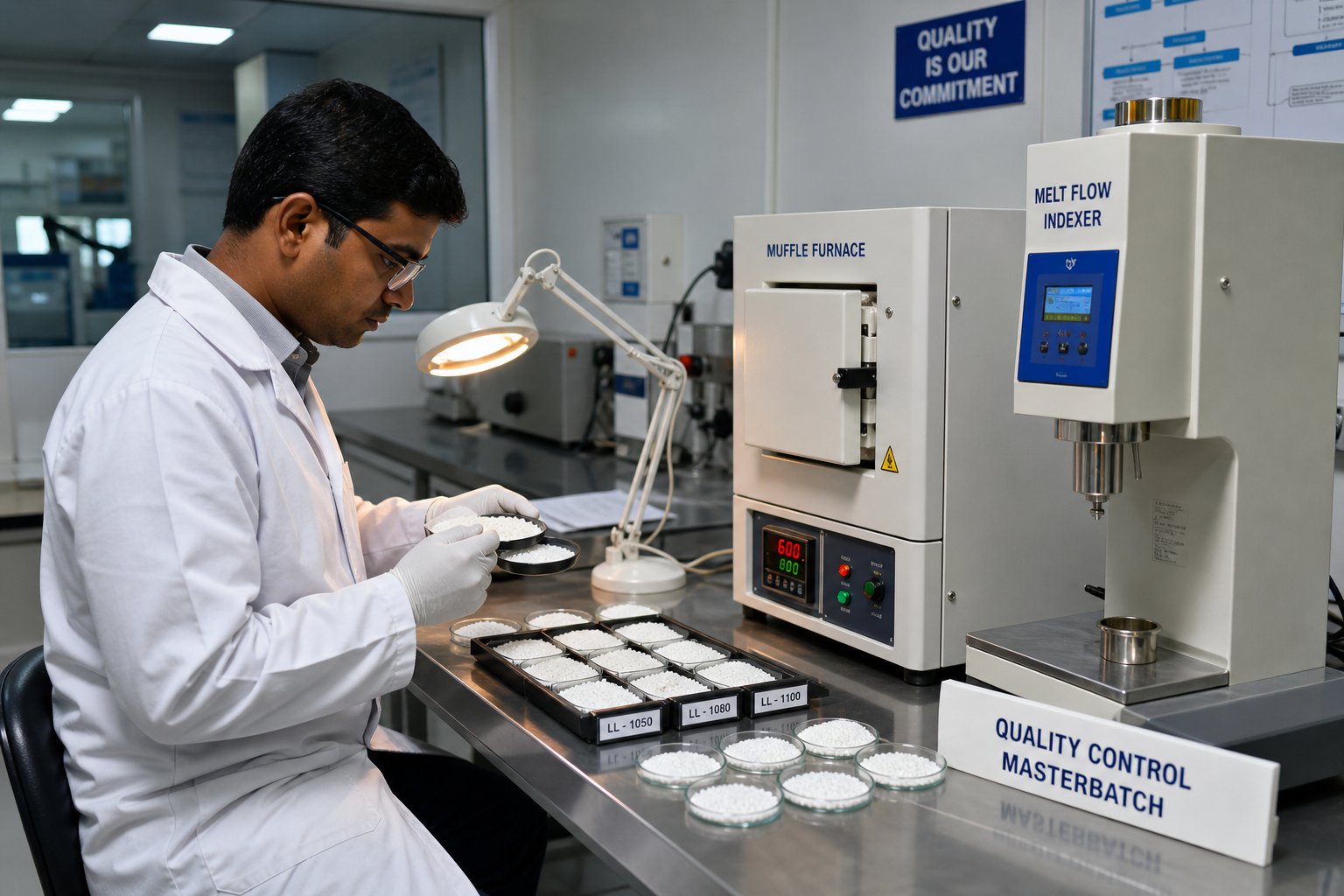
When you receive a shipment, five parameters tell you almost everything you need to know about whether that lot will perform on your line. Each one measures a different dimension of quality, and skipping any single test leaves a blind spot that can cascade into production losses. As CVN Plastics emphasizes, masterbatch quality control is best understood as a systematic process rather than a single testing step — and incoming inspection is the first link in that chain.
| QC Parameter | What It Measures | Why It Matters | Consequence of Skipping |
|---|---|---|---|
| Melt Flow Index (MFI) | How easily the material flows under defined temperature and load conditions (typically tested per ASTM D1238) | Verifies processability and compatibility with your base resin. An MFI mismatch between masterbatch and host polymer causes unstable melt pressure, uneven flow, and surface defects. | Erratic extrusion behavior, short shots in injection molding, poor gauge uniformity in film — defects that only appear mid-production when it's too late to swap material. |
| Moisture Content | Residual water trapped in the pellet, measured by loss-on-drying or Karl Fischer methods | Excess moisture vaporizes during processing, creating splay marks, voids, bubbles, and surface blemishes. Hygroscopic fillers like CaCO3 readily absorb ambient humidity during storage and transport. | Cosmetic defects on finished parts, weakened mechanical properties from internal voids, and customer rejects that trace back to a moisture problem you could have caught in five minutes. |
| Ash Content | The percentage of inorganic residue remaining after burning off all polymer and organic additives in a muffle furnace | Confirms the actual mineral filler loading in the pellet. This is your independent verification that the supplier delivered what the spec sheet promises — not a pellet padded with extra carrier resin. | You're paying for 80% CaCO3 and receiving 70%. Your effective filler percentage drops, your cost savings evaporate, and your formulation calculations no longer match reality. |
| Particle Size Distribution | The range and uniformity of mineral filler particle sizes within the compound, measured by laser diffraction (D50, D97 values) | Directly determines dispersion quality. Oversized particles or inconsistent distribution increase the risk of agglomeration, surface defects, and weak spots in the finished product. | Pinholes in films, rough surface finish on molded parts, accelerated screen pack clogging, and inconsistent mechanical properties across the production run. |
| Whiteness Index | The optical brightness of the pellet, indicating mineral purity and consistency | Ensures color consistency across production batches. A drop in whiteness may signal a change in mineral source, contamination, or degraded surface treatment — any of which affects end-product appearance. | Batch-to-batch color variation in your finished goods, customer complaints about inconsistent appearance, and costly rework or re-coloring to compensate. |
A few practical notes on implementation. MFI testing is only meaningful when you record the test temperature and load alongside the result — an MFI value without these conditions is incomplete and uncomparable. Similarly, particle size data should specify whether the reported value is D50 (median), D97 (97th percentile), or another measure. Asking "what's the particle size?" without defining the metric is like asking "what's the temperature?" without specifying Celsius or Fahrenheit.
For moisture, the timing of the test matters as much as the method. Pellets tested at the supplier's factory immediately after drying may show acceptable moisture levels, but the same lot stored in a humid warehouse for three weeks before reaching your plant could exceed limits. Test on arrival, not just on the supplier's certificate.
Ash content testing deserves special emphasis because it's your ultimate truth check. Regardless of what any document claims about filler loading, a muffle furnace doesn't lie. If the spec sheet says 75% CaCO3 and your ash test returns 68%, you have a quantifiable discrepancy — and a conversation that needs to happen before that material enters your filler masterbatch extrusion equipment.
Reading a Technical Data Sheet for Filler Masterbatch
Every qualified supplier provides a Technical Data Sheet. But not every TDS deserves the same level of trust. The document is only as valuable as the specificity and completeness of the information it contains — and learning to read between the lines separates informed buyers from those who discover quality problems on the production floor.
When you receive a TDS from a filler masterbatch supplier, here's what to look for and what each element tells you:
Declared filler percentage: This should be a specific number or a narrow range (e.g., 75% +/- 2%), not a vague statement like "high loading" or "up to 80%." The number anchors every downstream calculation — your let-down ratio, your effective filler percentage, and your per-kilogram cost savings all depend on it.
Carrier resin type and grade: A professional TDS names the specific carrier polymer (LDPE, LLDPE, HDPE, PP homo, PP copolymer) and ideally its grade or MFI range. "Polyethylene-based" without further detail leaves you guessing whether the carrier is compatible with your specific base resin.
MFI value and test conditions: The MFI should be reported alongside the test standard (ASTM D1238 or ISO 1133), temperature, and applied load. A TDS that lists "MFI: 5 g/10 min" without specifying 190 degrees C at 2.16 kg versus 230 degrees C at 2.16 kg is providing a number that cannot be compared against your base resin or against competing suppliers.
Recommended let-down ratios: Good suppliers specify a dosage range for different applications (e.g., 10-30% for blown film, 20-40% for injection molding). This guidance reflects the supplier's testing of their own product and helps you establish starting points for production trials rather than guessing blindly.
Storage conditions and shelf life: Mineral-filled compounds are sensitive to moisture uptake over time. The TDS should specify maximum storage temperature, humidity limits, and how long the product remains within spec after manufacturing. Missing this information suggests the supplier hasn't characterized the product's stability — a significant quality risk for buyers maintaining inventory.
Beyond what's present in the document, pay equal attention to what's absent. Missing or vague information in a TDS is one of the most reliable early indicators of quality risk during supplier qualification. Here are the red flags that should trigger deeper investigation:
- No MFI data or missing test conditions: Without MFI, you cannot verify processing compatibility. A supplier who omits this fundamental parameter either hasn't tested it or doesn't want you comparing it against competitors.
- Unspecified carrier resin grade: Generic terms like "PE carrier" or "polyolefin base" are insufficient. If the supplier can't or won't name the carrier grade, you have no basis for predicting how the masterbatch will interact with your specific resin system.
- Filler loading stated as a range wider than 5%: A declaration of "70-80% CaCO3" means you don't know what you're buying. Your cost calculations could be off by more than 10%, and your mechanical property predictions become unreliable.
- No test method references: Values without ASTM, ISO, or equivalent standard citations can't be independently verified or compared. They're assertions, not data.
- Missing moisture specification: If the TDS doesn't address moisture limits, it likely means the supplier isn't controlling for it — and you'll discover the problem as splay marks on your production line.
- No recommended dosage or application guidance: A product marketed as "suitable for all plastics and all processes" without specific loading recommendations is a generic product with generic quality. As the EuP Egypt buyer's guide warns, claims of universal suitability should be treated with caution.
- Identical values across multiple lot COAs: When you request Certificates of Analysis from different production lots and every single value is identical to the decimal, you're likely looking at copied template data rather than actual batch measurements.
- No batch traceability or lot coding system: If the supplier cannot trace a delivered product back to its raw material lots, production conditions, and test results, investigating any quality complaint becomes impossible.
One red flag in isolation might have a reasonable explanation — perhaps a smaller supplier simply hasn't formatted their documentation to international standards yet. But multiple red flags on the same TDS form a pattern. That pattern tells you the supplier either lacks the filler masterbatch extrusion equipment and quality infrastructure to produce consistent material, or lacks the technical discipline to document what they produce. Either way, it's a risk your production line will absorb.
The strongest procurement teams treat TDS review not as a paperwork formality but as the first technical audit of a supplier's capability. Pair it with independent ash content testing, multi-lot COA comparison, and a controlled production trial, and you have a qualification system that catches margin-draining quality problems before they reach your extruder — not after they've filled your reject bins.
Testing and documentation verify the end product. But the consistency of that product traces directly back to how it was made — specifically, the twin screw extrusion process that transforms raw minerals, carrier resin, and additives into the uniform pellets your production line depends on.
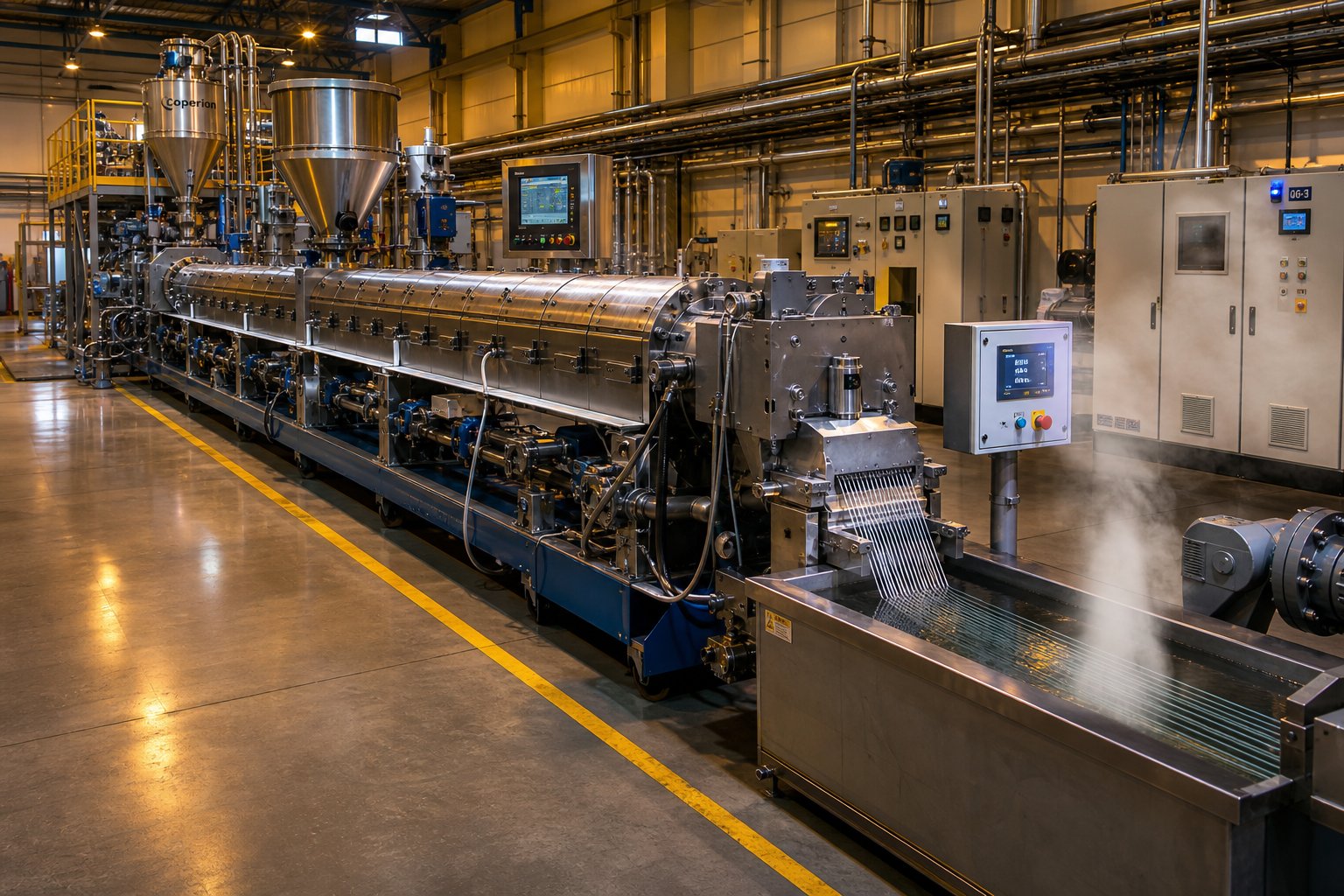
The Twin Screw Extrusion Process Behind Filler Masterbatch Production
Every quality parameter discussed so far — filler dispersion, MFI consistency, moisture control, ash content accuracy — is ultimately determined by what happens inside the production extruder. A perfect formulation processed on inadequate equipment produces mediocre pellets. An average formulation processed on a well-configured filler masterbatch twin screw extrusion line can deliver surprisingly competitive results. Equipment is where formulation theory meets production reality, and understanding the process behind the pellet helps you evaluate both your own compounding operations and your suppliers' capabilities.
How a Filler Masterbatch Production Line Works
Imagine tracing a single calcium carbonate particle from raw powder to finished pellet. The journey follows a tightly controlled sequence, and each stage builds on the one before it.
It starts with gravimetric feeding. Loss-in-weight feeders measure carrier resin, mineral filler, and additives at precisely controlled ratios and deliver them into the extruder throat. As research from Dow scientists explains, accurate metering at this stage is the foundation for consistent masterbatch quality — even small fluctuations in feed rate translate into composition variation in the finished product. For highly filled compounds running 70-80% mineral content, multiple side feeders introduce filler in stages after the carrier resin has melted, reducing wear and improving incorporation.
Inside the barrel, the material enters the twin screw compounding zone — the heart of any filler masterbatch machine. Here, co-rotating parallel twin screws subject the melt to intense mixing, kneading, and shear forces. Kneading blocks break down filler agglomerates through compression and stretching, while conveying elements move the material forward at controlled residence times. The intermeshing screw design continuously divides, exchanges, and recombines the material stream, achieving both dispersive mixing (breaking agglomerates apart) and distributive mixing (spreading particles uniformly throughout the polymer matrix).
Devolatilization follows. Atmospheric and vacuum vent ports remove trapped air, moisture, and low-molecular-weight volatiles from the melt. This step is particularly critical in CaCO3 PE plastic filler masterbatch machine operations because the low-bulk-density mineral powder introduces significant volumes of entrained air through the side feeders. Without effective degassing, the finished pellets contain voids and bubbles that propagate defects in the end user's product.
The compounded melt then exits through a strand die or underwater pelletizer. In strand pelletizing — the most common method for filler masterbatch — the melt is extruded into continuous strands, water-cooled, and cut into uniform pellets. Underwater pelletizing offers an alternative that produces more spherical pellets with tighter size distribution. Either way, the result is a filler masterbatch plastic pelletizing extruder output that's cooled, classified by size, and packaged for shipment.
Why do co-rotating parallel twin screw extruders dominate this application? Three reasons converge. First, their modular screw design — individual conveying, kneading, and mixing elements that can be rearranged along the shaft — enables precise tuning of shear intensity and residence time for different formulations. Second, their self-wiping geometry minimizes dead zones where material can stagnate and degrade, which is essential for frequent product changeovers. Third, their positive displacement conveying maintains stable throughput even when processing the extremely viscous, high-filler melts characteristic of CaCO3 filler masterbatch pelletizing line operations. As Kerke Extrusion Equipment notes, the core of calcium carbonate filled masterbatch production is achieving uniform dispersion, sufficient plasticization, and stable molding — and the twin screw architecture addresses all three simultaneously.
Why Screw and Barrel Durability Matters in High-Filler Operations
Here's a reality that filler masterbatch pellet making machine operators confront daily: mineral fillers are abrasive. CaCO3, talc, and BaSO4 particles sliding against metal surfaces at hundreds of RPM under high temperature and pressure act like fine sandpaper on screws and barrel linings. At loading levels of 60-80%, this wear becomes one of the largest operational costs in the entire production process — and one of the most direct threats to product quality.
The damage is insidious. As barrel linings erode and screw flight clearances widen, melt leaks backward through the growing gap between screw and barrel. Mixing intensity drops because material bypasses the kneading zones instead of being forced through them. Melt pressure fluctuates because the extruder can no longer maintain consistent forward conveying. Output falls. Filler dispersion deteriorates. And the off-spec pellets that result carry those quality problems silently into every downstream customer's production line.
This is why barrel metallurgy and screw element construction are not afterthoughts — they're central to sustained masterbatch quality. Purpose-built barrels designed for abrasive filler processing use bimetallic linings or specialized alloy compositions that resist wear far longer than standard nitrided steel. NANHAIYA's parallel twin screw barrel, for example, is engineered specifically for compounding plants and masterbatch producers running high-wear applications. These barrels maintain tighter tolerances over longer production campaigns, which translates directly into consistent mixing quality, stable melt pressure, and reduced unplanned downtime — the variables that separate profitable operations from those quietly bleeding margin through equipment degradation.
The critical question for any filler masterbatch compounding extruder operation is knowing when barrel wear has crossed the threshold from acceptable to quality-compromising. Waiting for visible product defects means you've already shipped off-spec material. Instead, monitor these leading indicators:
- Gradual decline in specific throughput (kg/hr per RPM) at constant screw speed and feed rate — worn barrels lose conveying efficiency as clearances widen.
- Increasing melt temperature at constant screw RPM — material recirculating through enlarged gaps generates excess shear heat without productive mixing.
- Wider fluctuations in die pressure — as the screw-barrel seal degrades, pressure pulses become more erratic, showing up as gauge variation in film or weight inconsistency in pellets.
- Rising motor amperage at the same output rate — the extruder works harder to compensate for reduced pumping efficiency.
- Visible filler agglomerates in finished pellets or increased screen pack clogging frequency — direct evidence that mixing intensity has fallen below the threshold needed for proper dispersion.
- Increasing reject rate on ash content or MFI testing — lot-to-lot variation in key QC parameters signals the extruder can no longer deliver consistent compounding conditions.
Any two of these indicators appearing simultaneously should trigger a barrel inspection. Any three should trigger barrel replacement planning. The cost of a new set of wear-resistant barrels is a fraction of the cost of weeks of off-spec production, customer complaints, and the emergency downtime that inevitably follows when a badly worn barrel finally fails mid-run.
Equipment condition shapes product quality — and product quality, in turn, reflects the overall capability of the operation behind it. For buyers evaluating filler masterbatch suppliers, the production equipment a supplier uses reveals as much about their reliability as any test report or certification hanging on the office wall.
How to Evaluate Filler Masterbatch Suppliers and Equipment
You can master filler chemistry, dial in the perfect let-down ratio, and run flawless QC protocols — but none of it matters if the supplier behind your pellets can't deliver consistent material month after month. Supplier qualification isn't a procurement formality. It's the decision that determines whether the knowledge in this article translates into protected margins or stays theoretical.
Most buyers shortlist filler masterbatch manufacturers based on price and a quick glance at the spec sheet. That approach works until a bad lot shuts your line down at 2 a.m. on a Friday. The framework below gives procurement teams and quality managers a structured, repeatable process for evaluating any calcium carbonate filler masterbatch supplier — before signing a volume contract, not after the reject bins fill up.
How to Evaluate and Qualify Filler Masterbatch Suppliers
Treat supplier qualification the way you'd treat a controlled experiment: change one variable at a time, document everything, and let the data — not the sales pitch — make the decision. Here's the sequence that consistently separates reliable partners from risky bets:
- Request a complete Technical Data Sheet with all QC parameters: As covered in the testing section, a professional TDS must specify filler loading (as a specific number, not a vague range), carrier resin type and grade, MFI with test conditions, moisture limits, recommended dosage ranges, and storage requirements. If the supplier can't produce this document for the specific grade they're quoting, stop the evaluation here. A filler masterbatch manufacturer that doesn't characterize its own product thoroughly won't produce it consistently.
- Verify filler loading through independent ash content testing: Don't take the label at face value. Request a sample, burn it in a muffle furnace, and confirm that the inorganic residue matches the declared CaCO3 percentage. As the EuP Egypt buyer's checklist emphasizes, two products with similar CaCO3 content may behave very differently — but a product that doesn't even contain the filler it claims is a non-starter.
- Confirm carrier resin compatibility with your end-use polymer: Ask for the specific carrier resin grade — not just "PE-based" or "polyolefin carrier." Cross-reference the carrier's MFI and melt temperature against your base resin's processing window. Remember the compatibility rules from earlier: mismatched carriers cause delamination, haze, and mechanical failure that no downstream adjustment can fix.
- Request trial quantities and run production validation before committing to volume orders: A representative sample means enough material to stabilize your line and produce a meaningful quantity of finished product — not a handful of pellets for a visual check. Run the trial under documented, controlled conditions: same base resin, same machine settings, same temperature profile. Industry best practice dictates changing only the candidate masterbatch while holding everything else constant, so the results reflect the material, not a process variable.
- Assess supplier consistency through multi-lot testing: Request Certificates of Analysis from several non-consecutive production lots. Compare the actual test results — not just whether they fall within spec, but how much variation exists between lots. Identical values copied across every COA to the last decimal point suggest template data rather than real measurements. Genuine consistency shows tight clustering around target values with small, realistic batch-to-batch variation.
This five-step process sounds rigorous because it is. But every step maps directly to a failure mode that has cost real processors real money. Skipping any one of them is a gamble — and the stakes compound with every ton you purchase.
Equipment Quality as a Supplier Qualification Signal
Here's a supplier evaluation tactic that rarely appears in purchasing manuals but reveals more than any certificate on the wall: look at their production equipment.
The quality of a filler masterbatch production line — particularly the condition of the filler masterbatch twin screw extruder, its barrels, and its screw elements — directly correlates with product consistency. A supplier operating worn-out barrels with widened screw-to-barrel clearances physically cannot maintain the shear and mixing intensity needed for proper filler dispersion. The pellets might look fine in the bag, but microscopic agglomerates and composition variation are baked in. You'll discover them as pinholes, surface defects, and property drift on your production floor.
When you visit a supplier's plant — and you should visit before approving any significant volume commitment — inspect the filler masterbatch extruder machine and ask pointed questions:
- How old are the current barrel linings, and what metallurgy are they made from?
- What is the scheduled barrel replacement interval?
- Do they track specific throughput decline as a wear indicator?
- What brand and specification of barrels do they use?
Suppliers investing in purpose-built, wear-resistant components — such as NANHAIYA's parallel twin screw barrels engineered for high-abrasion masterbatch compounding — signal a commitment to sustained quality that extends beyond the current production lot. These barrels maintain tighter tolerances over longer campaigns, meaning the mixing intensity that produced your approved trial sample will still be there on lot number fifty. By contrast, a supplier running visibly worn barrels on their filler masterbatch making machine is selling you yesterday's quality today — and tomorrow's quality will be worse.
Think of equipment condition as a proxy metric. A caco3 plastic filler masterbatch machine manufacturer that invests in durable, precision-engineered barrel components is also more likely to invest in proper gravimetric feeding, in-line quality monitoring, and preventive maintenance scheduling. These are the operational disciplines that produce consistent pellets — and consistent pellets are what protect your margins downstream.
Avoiding Common Purchasing Mistakes
Even with a solid qualification process, experienced buyers still fall into predictable traps. These mistakes rarely cause a single dramatic failure. Instead, they erode margins gradually — a few percentage points of yield here, a slightly higher reject rate there — until the cumulative damage becomes impossible to ignore.
- Buying on price alone: The cheapest quote almost always reflects the thinnest additive package, the loosest QC tolerances, or the most worn equipment. As the EuP Egypt cost analysis framework demonstrates, the true comparison metric is cost per acceptable finished kilogram — factoring in reject rates, downtime, line speed impacts, and rework. A supplier with a price that's 5% lower but a reject rate that's 8% higher isn't saving you anything.
- Ignoring carrier resin compatibility: Procurement teams often focus entirely on CaCO3 percentage and price while treating the carrier resin as an afterthought. Yet a carrier-host mismatch can reduce elongation, destroy surface quality, and trigger delamination that makes every molded part a potential warranty claim. Always confirm the specific carrier grade against your base resin before approving any new supply source.
- Skipping trial runs: A TDS is a promise. A COA is a snapshot. Only a controlled production trial on your own line, using your own resin, at your own processing conditions, proves whether a masterbatch will actually perform in your operation. No amount of documentation substitutes for this step — and every filler masterbatch manufacturers list that a buyer evaluates should include trial performance as a mandatory qualification gate.
- Accepting TDS documents without independent verification: Trust, but verify. Run your own ash content test. Measure MFI on your own equipment. Compare moisture levels at your receiving dock against the supplier's factory-gate results. If the numbers diverge significantly, you've identified a gap in either the supplier's testing, their storage and handling, or their honesty — all of which demand resolution before you commit to volume purchasing.
- Failing to qualify a backup source: Single-sourcing any critical production input is a supply chain risk. Qualify at least two suppliers through the full evaluation process. The cost of maintaining a secondary qualified source is trivial compared to the cost of a production shutdown when your sole supplier misses a shipment, changes their mineral source, or experiences an equipment failure on their filler masterbatch production line.
The thread connecting every section of this article is simple: filler masterbatch is not a commodity you buy by the ton and forget about. It's an engineered compound whose formulation, processing, and quality control determine whether it saves you money or silently drains it. The manufacturers who protect their margins are the ones who understand what's inside the pellet, how it's made, how to test it, and how to hold their suppliers accountable for delivering it consistently. Every other approach is just hoping the next pallet will be as good as the last one — and hope, as any production manager will tell you, is not a quality strategy.
Frequently Asked Questions About Filler Masterbatch
1. What is filler masterbatch and what is it made of?
Filler masterbatch is a concentrated compound of mineral fillers — most commonly calcium carbonate (CaCO3) — combined with a compatible carrier resin such as PE, PP, or EVA, along with performance additives like coupling agents, processing aids, and dispersants. These ingredients are compounded into uniform pellets via twin screw extrusion. The pellets are then blended with virgin polymer during plastic processing to replace a portion of expensive resin with cost-stable mineral filler, reducing raw material costs while maintaining or even enhancing product properties like stiffness and dimensional stability.
2. How much cost savings can filler masterbatch provide?
Cost savings depend on the effective filler percentage in your finished product, not the concentration listed on the masterbatch bag. A common misconception is equating the pellet's CaCO3 loading (typically 60-80%) with the final product's filler content. In practice, masterbatch is dosed at 10-40% into virgin resin, yielding effective filler levels of roughly 6-32%. Industry reports indicate processors substituting 20-40% of virgin resin with CaCO3 masterbatch can achieve raw material savings of 12-22% per kilogram of finished product. Actual results vary based on the application, filler type, and carrier resin selection.
3. What is the difference between coated and uncoated CaCO3 in filler masterbatch?
Uncoated CaCO3 particles have hydrophilic surfaces that are incompatible with hydrophobic polymers like PE and PP, leading to poor filler-matrix adhesion, particle agglomeration, and weaker mechanical properties. Stearic acid coating creates a hydrophobic shell around each particle by bonding the acid's carboxylic group to calcium ions on the surface. This treatment reduces moisture absorption, prevents clumping, and significantly improves interfacial adhesion with polyolefin chains. Research on LDPE/CaCO3 composites confirms that stearic acid-coated formulations deliver higher tensile strength, better elongation at break, and superior thermal stability compared to uncoated versions.
4. Why is carrier resin compatibility important in filler masterbatch?
The carrier resin binds the mineral filler into a processable pellet and must be chemically compatible with your base polymer. A mismatched carrier — for example, using a PE-based masterbatch in a PP processing line — causes the carrier to melt too early, releasing filler before the base resin can incorporate it. This results in poor dispersion, delamination, haze, surface roughness, and weakened weld lines. Key compatibility rules include matching the carrier's chemistry to the host polymer, ensuring the carrier's melt flow index is slightly higher than the base resin's MFI, and verifying that the supplier specifies the exact carrier grade rather than generic terms like 'polyolefin base.'
5. How do I verify the quality of incoming filler masterbatch shipments?
Five critical parameters should be tested on every incoming lot: Melt Flow Index (MFI) to confirm processability, moisture content to prevent splay and voids, ash content to independently verify actual filler loading, particle size distribution to assess dispersion quality, and whiteness index for color consistency. Ash content testing in a muffle furnace is especially important — it provides an objective, unchallengeable measurement of mineral content regardless of what the supplier's documentation claims. Additionally, review the supplier's Technical Data Sheet for red flags such as missing MFI test conditions, unspecified carrier resin grades, or filler loading ranges wider than 5%. Purpose-built filler masterbatch extrusion equipment and wear-resistant twin screw barrels at the supplier's facility also signal a commitment to consistent production quality.
Written by
Nanhaiya Technical Team
Zhoushan Nanhaiya Plastic Machinery Co., Ltd.
The Nanhaiya technical team supports screw and barrel manufacturing projects through application review, technical communication, custom manufacturing coordination, and production and quality control.
Discuss Your Application
Related Articles
More insights on screw barrel technology and plastics processing.
Your Extruder Feeding Instability Isn't Random — Here's Why
Oct 22, 2026
Extruder feeding instability causes surging output and scrap. Learn the 6 root causes, polymer-specific fixes, wear diagnostics, and preventive protocols.
Read Article
Parallel Twin Screw Extruder for Compounding Demystified: Lab to Line
Oct 21, 2026
Learn how a parallel twin screw extruder for compounding works—from screw element design and zone configuration to lab-to-production scale-up and process optimization.
Read Article
Twin Screw Extruder for PVC: The Setup Mistake Draining Profit
Oct 21, 2026
Learn how to match twin screw extruder configurations to PVC applications. Covers conical vs parallel, counter-rotating vs co-rotating, wear management, and troubleshooting.
Read ArticleLooking for something else?
Search by material, symptom or product and jump straight to the relevant page.
These are navigation suggestions based on keyword matching — not a quotation, not a delivery commitment, and not a substitute for engineering review. Final specification is confirmed by our engineers against your drawings and processed material.
Need help with screw barrel selection?
Share your machine model, processed material and application. Our team can help with pricing and technical support.