

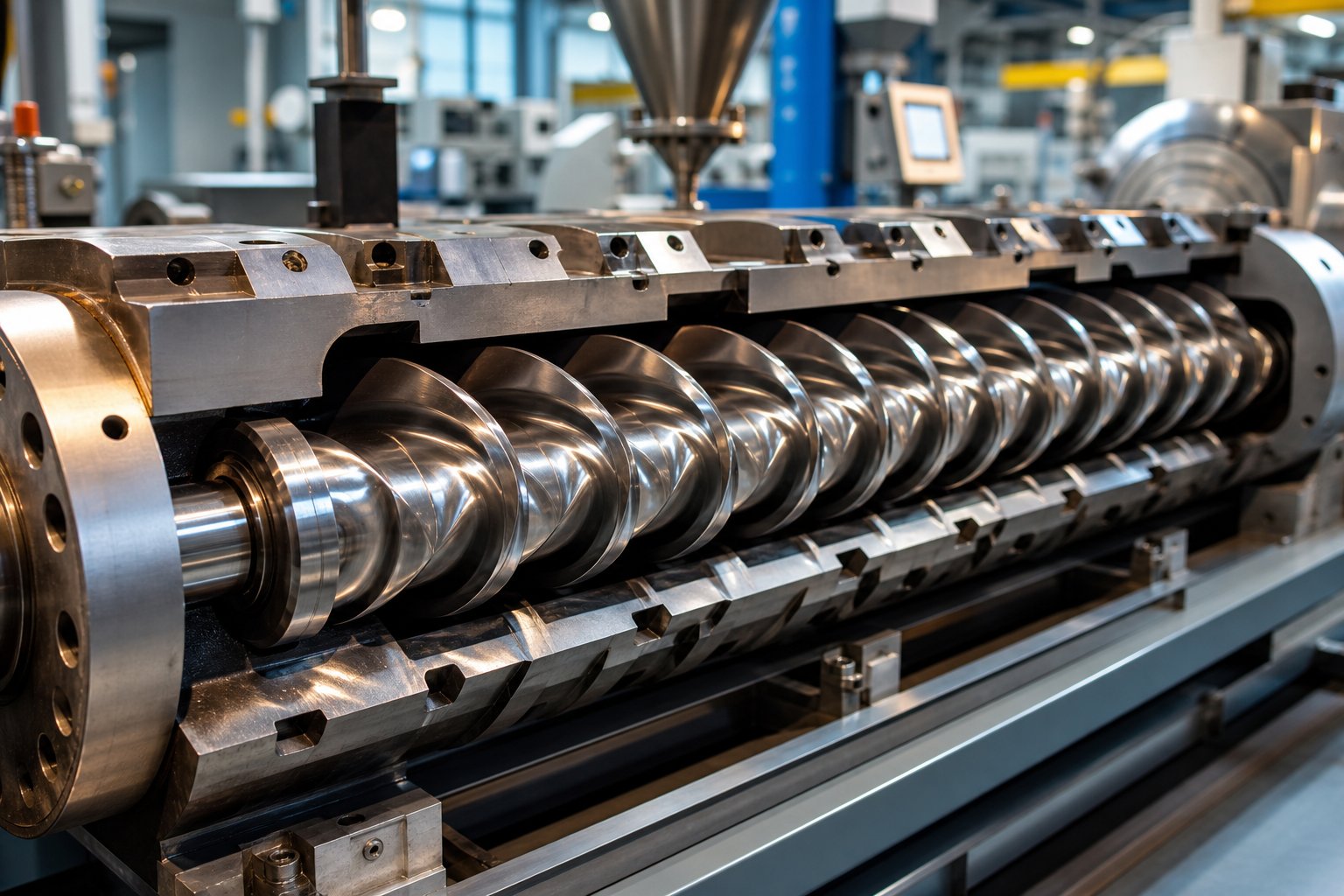
What Is a Twin Screw Extruder and How Does It Work
Imagine feeding raw polymer powder into one end of a machine and pulling out perfectly compounded pellets from the other. That transformation — from loose, inconsistent feedstock to a uniform, melt-processed product — is exactly what a twin screw extruder delivers. Yet many processors run these machines for years without fully grasping the mechanics behind them, and that knowledge gap is where silent output losses begin.
A twin screw extruder is a processing machine that uses two intermeshing screws rotating inside a heated barrel to convey, melt, mix, and shape materials. It is widely used for polymer compounding, reactive extrusion, devolatilization, and high-performance mixing across plastics, pharmaceutical, and food industries.
Unlike a single screw variant — which relies primarily on friction and viscous drag to move material — an extruder twin screw system uses positive displacement conveying. Material enters through a feed throat, gets carried forward by the interlocking screw flights, absorbs both shear and thermal energy along multiple barrel zones, and exits through a die in its final form. That distinction matters more than most operators realize.
Core Operating Principle of the Twin Screw Extruder
The real advantage lies in the intermeshing geometry. As the twin screw channels overlap, material is forced from one screw to the other in a figure-eight flow pattern. This transfer creates controlled, repeatable shear that a single screw simply cannot replicate. Each time the melt crosses from one channel to the next, it undergoes a brief burst of high-intensity mixing followed by relaxation — a cycle that disperses additives and homogenizes the melt without overheating. The intermeshing flights also wipe the barrel and screw surfaces clean, preventing material stagnation and thermal degradation.
Because twin screw systems typically operate in a starve-fed mode, throughput and screw speed are independently adjustable. You control how much material enters via a feeder, and you control mixing intensity via screw RPM — two separate levers that give you far more process flexibility than flood-fed single screw extruders allow.
Why the Twin Screw Extruder Dominates Modern Processing
Several inherent advantages have made twin screw extrusion the default for demanding applications:
- Superior dispersive and distributive mixing — ideal for incorporating fillers, pigments, and nano-additives uniformly.
- Self-wiping capability — reduces residence time spread and virtually eliminates dead zones where material can degrade.
- Modular screw configuration — conveying elements, kneading blocks, and reverse elements can be rearranged on the shaft to tailor processing zones for each specific formulation.
- Narrow residence time distribution — ensures consistent thermal history across every particle, critical for heat-sensitive or reactive materials.
These characteristics explain why screw extruders built on twin screw architecture dominate compounding lines, masterbatch production, and reactive processing worldwide. A single screw machine still has its place — but understanding exactly where each design excels requires a closer look at the two main twin screw configurations: co-rotating and counter-rotating.
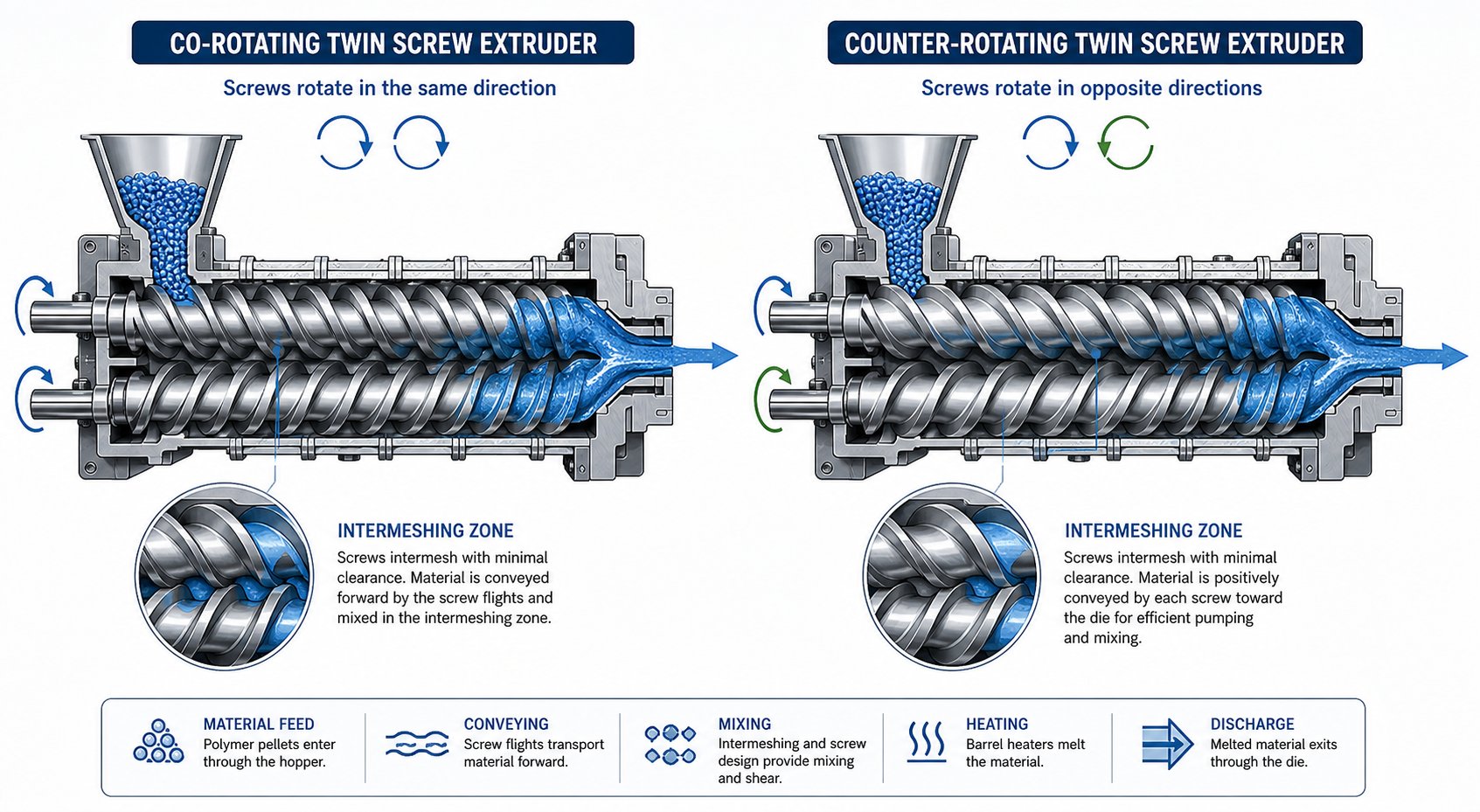
Co-Rotating vs Counter-Rotating Twin Screw Extruders Compared
Picking the wrong rotation configuration is one of the fastest ways to sabotage output — and it happens more often than you'd expect. A co-rotating twin screw extruder and a counter-rotating twin screw extruder may look similar from the outside, but the internal flow mechanics, shear profiles, and ideal applications diverge sharply. Choosing without understanding those differences is like selecting a drill bit without checking the material you're drilling into.
The table below puts both configurations side by side so you can spot the distinctions at a glance.
| Parameter | Co-Rotating Twin Screw | Counter-Rotating Twin Screw |
|---|---|---|
| Rotation Direction | Both screws rotate the same way | Screws rotate in opposite directions |
| Intermeshing Type | Fully intermeshing (standard) | Fully or partially intermeshing |
| Self-Wiping Capability | Excellent — flights continuously wipe barrel and each other | Limited — opposing rotation reduces wiping efficiency |
| Mixing Intensity | High dispersive and distributive mixing | Moderate — relies on calender-gap compression |
| Shear Profile | High shear between screws and barrel | Lower shear; less shear-induced heat |
| Typical Screw Speed | 200 - 900+ RPM | 30 - 150 RPM |
| Throughput Range | Broad — scales easily with speed and feed rate | Narrower — optimized for steady, lower-speed output |
| Residence Time Distribution | Narrow and tightly controlled | Broader due to high fill and low speed operation |
| Typical Applications | Compounding, masterbatch, reactive extrusion, devolatilization | PVC pipe and profile extrusion, shear-sensitive polymers |
Co-Rotating Twin Screw Extruders Explained
When both screws spin in the same direction, material follows a figure-eight flow path as it transfers from one screw channel to the other at the intermeshing zone. Picture the melt being handed off between the two screws repeatedly — each handoff delivers an intense burst of shear followed by a brief relaxation. That cyclical deformation is what gives the co-rotating design its outstanding dispersive and distributive mixing.
The fully intermeshing geometry also means the screw flights continuously scrape the barrel bore and each other's root surfaces. This self-wiping action virtually eliminates dead zones, keeping residence time distribution tight and preventing thermally degraded material from contaminating the product stream. For reactive extrusion processes — where even small amounts of stagnant, overheated polymer can ruin an entire batch — that characteristic is indispensable.
You'll find co-rotating machines dominating polymer compounding lines, masterbatch production facilities, and devolatilization stages precisely because of this combination of aggressive mixing and clean material flow. Their modular screw shafts accept interchangeable conveying elements, kneading blocks, and reverse elements, so processors can reconfigure mixing zones without purchasing new screws. That flexibility is a major reason why the co-rotating and counter-rotating twin screw extruder debate often tips toward the co-rotating side for compounding applications.
Counter-Rotating Twin Screw Extruders Explained
Flip one screw's rotation, and the flow physics change dramatically. In a counter-rotating twin screw extruder, the opposing screw directions pull material into the intermeshing gap from both sides, creating a calender-like compression zone. Material gets squeezed between the screws much like rubber passing through a two-roll mill. The result is effective dispersive mixing under relatively gentle conditions — lower shear stress and, critically, less shear-induced heat generation.
Why does that matter? Materials like rigid PVC have a narrow window between the temperature needed for melt processing and the temperature where thermal decomposition begins. High shear from a co-rotating machine can push PVC past that threshold. A counter-rotating design, operating at lower speeds and higher fill levels, keeps the extrusion temperature safely within range. That's why PVC pipe production, window profile extrusion, and other heat-sensitive forming applications rely heavily on counter-rotating configurations.
The trade-off is reduced self-wiping capability. Because the screw flights move in opposite directions at the intermeshing zone, they don't scrape each other as effectively. Product changeovers take longer, and processing sticky or high-viscosity formulations requires more attention to purging procedures.
Parallel vs Conical Configurations
Within the counter-rotating family, you'll encounter two distinct screw geometries — and confusing them is another silent mistake that costs output.
A conical twin screw extruder features screws that taper from a large diameter at the feed end to a smaller diameter at the discharge. That taper naturally compresses material as it moves forward, building die pressure without relying on additional pressure-generating screw elements. The larger feed-end diameter also accommodates bigger bearings and gearbox components, delivering higher torque where the material is still unmelted and hardest to move. Conical machines are a staple for rigid PVC pipe, sheet, and profile lines.
A parallel twin screw extruder in the counter-rotating configuration maintains a constant screw diameter from feed to discharge. This gives designers more freedom in selecting the length-to-diameter (L/D) ratio, which controls how much processing length is available for melting, mixing, and venting. Parallel counter-rotating machines are more versatile when the application demands longer barrel zones for devolatilization or multi-stage feeding — but they sacrifice the inherent compression advantage of the conical geometry.
In practical terms, your material and end product dictate which geometry fits. PVC profiles and pipes? Conical is the proven workhorse. Specialty compounds that need longer residence time or multiple vent ports? Parallel counter-rotating opens up more configuration options. Either way, the configuration decision only sets the stage — what happens inside those barrels depends entirely on how you arrange the screw elements along the shaft.
Screw Element Design and Configuration Principles
Rotation direction sets the rules — but screw element arrangement writes the playbook. Two identical extruder twin screw machines with the same barrel length and motor can produce wildly different results simply because the elements along each shaft are sequenced differently. That reality catches many processors off guard: they invest in the right machine class yet never optimize the one variable that matters most inside it.
Designing a screw profile is, as NC State Extension research puts it, a blend of art and science. No universal template exists because every material exhibits unique flow behavior under heat and shear. Still, a solid understanding of what each element type does — and where it belongs on the shaft — separates guesswork from engineering.
Types of Screw Elements and Their Functions
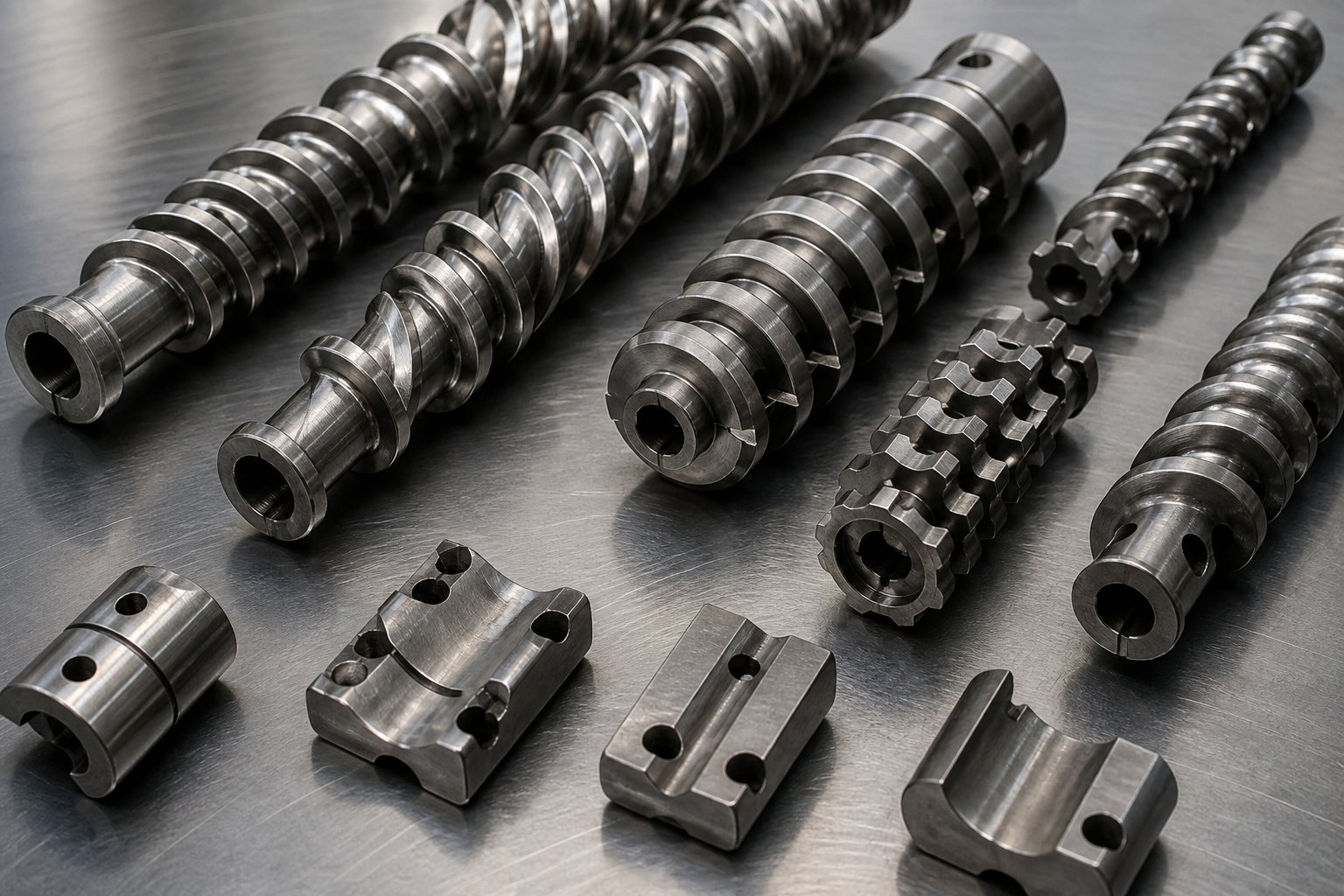
Twin screws are segmented by design. Individual elements slide onto splined shafts, and swapping them in and out reshapes the entire process without replacing the machine. Here are the four core element categories you need to know:
- Conveying elements — These are the workhorses that move material forward. Deep-channel flights provide high free volume for efficient transport without applying significant shear. Varying the pitch changes conveying speed: a tighter pitch slows the material down and increases fill, while a wider pitch accelerates flow and reduces residence time. In the feed zone, large-pitch conveying elements quickly pull material away from the throat to prevent bridging.
- Kneading blocks — Staggered discs arranged at offset angles deliver the primary dispersive mixing action in a twin screw extrusion process. Wider discs generate stronger shear and break agglomerates apart (dispersive mixing), while narrow discs spread the dispersed phase more evenly without aggressive particle size reduction (distributive mixing). The offset angle matters, too: forward-staggered kneading blocks convey material gently while mixing, neutral (90-degree) blocks maximize energy input by halting forward flow, and reverse-staggered blocks push material backward for the most aggressive restriction and shear.
- Mixing elements — Tooth or gear-type geometries create distributive blending by splitting and recombining flow streams repeatedly. Unlike kneading blocks, toothed mixing elements apply minimal dispersive force, making them ideal for gentle homogenization of heat-sensitive formulations where you want uniform distribution without excessive temperature rise.
- Reverse elements — Left-handed conveying elements that oppose forward flow. Placing them strategically builds localized pressure, increases residence time in the upstream zone, and creates melt seals essential for venting and devolatilization stages. Their retaining effect forces material to fully fill the preceding screw channels before passing through.
How Screw Configuration Affects Processing Outcomes
Arranging these elements along the screw shaft creates distinct processing zones, each with a defined purpose. A typical screw extrusion layout progresses through five stages:
- Solid conveying zone — Large-pitch conveying elements transport raw feedstock away from the feed throat.
- Melting and plasticating zone — Kneading blocks introduce shear energy, transforming solid particles into a cohesive melt.
- Mixing and compounding zone — Additional kneading blocks and mixing elements disperse additives, pigments, or fillers throughout the melt.
- Venting zone — Conveying elements create partially filled channels downstream of a reverse-element melt seal, exposing maximum surface area for volatile removal.
- Pressure build-up zone — Tight-pitch conveying elements compress the homogenized melt and push it through the die.
What makes this powerful is the tunability. Increasing the number of kneading discs or widening their offset angle raises shear and melt temperature — useful when you need to break down stubborn filler agglomerates. Adding reverse elements upstream of a vent port strengthens the melt seal and improves devolatilization efficiency. Swapping wide kneading blocks for narrow ones reduces peak shear when processing thermally sensitive polymers. Every element swap shifts the balance between mixing intensity, throughput, and thermal exposure.
As Technovel's engineering analysis highlights, the same extruder can behave in completely different ways once the screw formation changes. On the production floor, engineers often find that the screw configuration shapes the character of the process more strongly than the extruder hardware itself.
Specific Energy Input and Process Control
Every element decision ultimately shows up in a single, measurable quantity: specific energy input (SEI). SEI represents the total energy delivered per unit mass of material processed, typically expressed in kJ/kg. It captures both the mechanical energy from screw rotation and the thermal energy from barrel heaters — though in most twin screw operations, mechanical shear energy dominates.
Why does SEI matter? It directly governs product quality. Too little specific energy leaves fillers poorly dispersed and polymers insufficiently melted. Too much drives melt temperature beyond safe limits, triggering degradation, discoloration, or loss of molecular weight. Research on twin screw compounding parameters demonstrates this relationship clearly: higher screw speeds increase mechanical energy input in the mixing zones, raising melt temperature proportionally.
Screw configuration is the primary lever for controlling SEI. More aggressive kneading sections absorb more drive energy per kilogram of throughput. Reverse elements force higher fill in upstream zones, increasing shear contact time. Conversely, replacing kneading blocks with gentle conveying or toothed mixing elements lowers energy input and keeps melt temperature in check. The feed rate also plays a role — at constant screw speed, reducing throughput increases the energy each kilogram of material absorbs, while increasing throughput spreads the same energy across more material.
Monitoring SEI in real time — by tracking motor load, screw speed, and feed rate — gives operators a diagnostic window into the process. A sudden SEI spike at unchanged settings, for example, often signals increased viscosity from a raw material lot change or the onset of wear-related friction. A gradual decline may indicate screw element wear reducing the ability to transfer shear energy effectively. Either way, SEI connects screw element design to measurable, actionable process data — and that connection is exactly what separates informed optimization from blind trial-and-error.
Twin Screw vs Single Screw Extruder Differences
Specific energy input reveals how much work the screw configuration puts into the melt — but the type of screw extruder you're running determines the ceiling for that work in the first place. One of the most persistent mistakes in plastics processing is treating twin screw extruders as a universal upgrade over single screw machines. In reality, each architecture solves a different class of problems, and choosing the wrong one either leaves performance on the table or inflates costs without a return.
The table below compares the two designs across the dimensions that actually drive purchasing and process decisions.
| Dimension | Twin Screw Extruder | Single Screw Extruder |
|---|---|---|
| Mixing Capability | High dispersive and distributive mixing via intermeshing geometry | Low to moderate; relies on shear in the metering zone |
| Residence Time Distribution | Narrow and tightly controlled | Broader; dependent on channel depth and drag flow |
| Material Flexibility | Handles powders, fibers, liquids, fillers, and variable feedstocks | Best with uniform pellets or pre-compounded granules |
| Feed Consistency Requirements | Tolerant of inconsistent feeds when paired with proper feeders | Requires consistent, free-flowing feed for stable output |
| Throughput Scalability | Starve-fed design decouples throughput from screw speed | Flood-fed; throughput tied directly to screw RPM |
| Barrel Modularity | Segmented barrels with interchangeable screw elements | Typically single-piece or limited modular sections |
| Capital Cost | Higher — complex gearbox, dual screws, modular barrel | Lower — simpler drive train and barrel construction |
| Typical Applications | Compounding, masterbatch, reactive extrusion, devolatilization, recycling | Film, pipe, profile, and sheet extrusion from pre-compounded pellets |
Where Twin Screw Extruders Outperform Single Screw
Whenever the process demands intensive mixing, additive incorporation, or reactive chemistry inside the barrel, twin screw extruders hold a decisive advantage. The reason traces back to that starve-fed operating principle discussed earlier. Because a gravimetric feeder controls how much material enters — not the screw speed — operators gain independent control over mixing intensity and production rate. Increase screw RPM without changing feed rate, and each kilogram absorbs more shear energy and spends more time in the kneading zones. That independence simply doesn't exist in a flood-fed single screw system, where throughput and screw speed are inherently coupled.
Feed flexibility compounds the advantage. A double screw extruder machine readily handles challenging inputs that would choke a single screw: low-bulk-density powders, sticky recycled flake, high-loading mineral fillers, chopped glass fibers, and liquid additives injected mid-barrel. The intermeshing screw geometry positively conveys even poorly flowing materials, while side feeders and liquid injection ports expand formulation options far beyond what a simple hopper-fed design allows. If you're running a compounding line where recipes change weekly and filler levels swing between 10% and 60%, the twin screw architecture absorbs that variability without missing a beat.
When a Single Screw Extruder Is the Better Choice
None of this means a single screw extruder is obsolete. For straightforward melting-and-pumping tasks — PE pipe extrusion, cast film lines, profile extrusion of pre-compounded PVC pellets — a single screw machine often outperforms its double screw extruder counterpart on total cost and simplicity. Capital investment is lower. Maintenance is less demanding because there's one screw, one set of bearings, and a simpler gearbox. Energy consumption per kilogram can be lower too, since the single screw's drag-flow mechanism efficiently generates the steady melt pressure that downstream dies need.
When the resin supplier has already done the compounding — delivering a uniform, fully formulated pellet — asking an extruder to remix it is wasted effort. In those scenarios, the single screw's high volumetric output at low shear delivers exactly what the process requires: a consistent, thermally gentle melt stream at stable pressure. Adding twin screw complexity here buys nothing but higher operating costs, longer changeover times, and more wear surfaces to manage.
The takeaway is pragmatic: match the machine to the job. If your process lives and dies on mixing quality, feed versatility, or in-barrel chemistry, twin screw is the platform engineered for that duty. If the material arrives ready to melt and the die needs steady, predictable flow, a single screw extruder is not a compromise — it's the right tool. Either way, what you feed the machine and how you feed it has an outsized impact on whether you actually capture the performance your hardware is capable of delivering.
Venting, Devolatilization, and Feeding Systems Explained
What goes into the extruder and what comes out of the vent ports are two sides of the same coin — and getting either one wrong quietly erodes product quality before the pelletizer ever sees a strand. Twin screw extrusion performance hinges on two subsystems that rarely get the engineering attention they deserve: the devolatilization zones that strip volatiles from the melt and the feeding equipment that delivers raw materials with consistency and precision. Ignore them, and you'll chase symptoms — surging output, voids in pellets, inconsistent color — without ever addressing root causes.
Venting and Devolatilization in Twin Screw Extrusion
Devolatilization is the process of removing moisture, trapped air, residual monomers, solvents, or other unwanted volatiles from a polymer melt. Twin-screw extruders excel at this because their modular barrel design allows atmospheric or vacuum vent ports to be placed at strategic positions along the processing length — a capability that single screw systems struggle to replicate effectively.
How does it work in practice? Imagine a section of the screw that is only partially filled with melt, sitting directly beneath an open vent port. Because the channel isn't packed full, the melt spreads into thin films across the screw surfaces, exposing maximum surface area to the low-pressure environment above. Volatiles flash out of the melt and get pulled away through the vent stack.
The trick is isolating that low-pressure zone from the rest of the extruder. Reverse screw elements or neutral kneading blocks placed upstream of the vent create a melt seal — a section where the screw channels are completely filled, forming a pressure barrier. As devolatilization expert Rob Jerman explains, this seal prevents vacuum from pulling through to the feed throat or other zones, keeping each vent stage independent and effective. A similar seal downstream prevents the filled section from backing up into the vent opening.
A useful rule of thumb: each vent stage can reduce volatile concentration by roughly an order of magnitude. A triple-vented machine, for instance, can strip a 50%-solids feed stream down to below 0.1% residuals. That scalability is why twin-screw extruders dominate polymer isolation, solvent stripping, and finishing operations where low residuals are non-negotiable.
One critical detail operators frequently overlook — changes in screw speed shift the balance of these seals. Increasing RPM shortens the filled length behind each seal, making it more susceptible to failure. Decreasing RPM extends the filled length, which risks polymer backing up into the vent and eventually flooding it. Maintaining stable operating conditions and understanding how speed adjustments affect seal integrity is essential for reliable devolatilization.
Feeding Systems and Their Impact on Performance
The most sophisticated screw configuration in the world can't fix what a poorly matched feeder sends into the barrel. Feeding accuracy directly controls product consistency, and a surprising number of processing problems — torque spikes, output surging, off-spec color — trace back to feeding irregularities rather than anything happening inside the extruder system itself.
Two primary feeder technologies serve twin screw compounding lines, and understanding the distinction prevents costly mismatches:
Gravimetric feeders measure material by weight using load cells and automatically adjust output to maintain the target feed rate. They typically achieve accuracy within plus or minus 1% of the setpoint, making them the go-to choice for expensive colorants, specialty additives, and any formulation where tight tolerances govern product quality. Their real-time feedback loop compensates for changes in bulk density, material flow, and hopper refill disturbances.
Volumetric feeders meter material based on volume or a set feed rate using augers or dosing discs. They're simpler, lower in cost, and deliver accuracy in the 1.5% to 5% range depending on feeder design and material consistency. For general-purpose additive dosing where cost sensitivity outweighs precision demands, volumetric units perform reliably day after day.
Beyond the main feed, twin-screw extruders accommodate side feeders for downstream introduction of fillers, glass fibers, or heat-sensitive additives that would degrade if exposed to the full melting zone. Liquid injection systems handle oils, peroxides, coupling agents, or plasticizers injected directly into the melt stream at controlled barrel positions. These auxiliary inputs expand formulation flexibility — but each one introduces another variable that needs tight control.
As Coperion's process technology team has demonstrated, feeding limitations are often the true bottleneck in twin screw compounding. In one documented case, replacing an improperly matched feeder on a 70-mm extruder allowed throughput to jump from 2000 kg/hr to 2300 kg/hr — translating to an estimated $180,000 in additional annual profit. Similarly, installing feed enhancement technology on a 45-mm machine compounding polypropylene with 40% talc boosted throughput by 500 kg/hr, worth roughly $600,000 per year at a 20-cent-per-kilogram margin.
Whether you're running a single main feeder or a complex multi-component system, these best practices keep material delivery stable and predictable:
- Maintain a consistent feed rate — verify feeder calibration regularly and monitor loss-in-weight signals for drift or refill-induced surges.
- Optimize the screw speed-to-feed ratio — running screws too fast relative to throughput increases specific energy input and melt temperature; too slow risks overfilling and seal instability.
- Prevent bridging and rat-holing — use appropriate agitation, hopper geometry, and feeder screw types matched to your material's flow characteristics. Easily fluidizing powders benefit from twin narrow-pitch concave augers, while pellets feed best through a coarse-pitch single auger.
- Match feeder capacity to extruder throughput — an oversized feeder running at the low end of its range loses accuracy; an undersized feeder caps your production rate.
- Manage entrained air when feeding powders — position the feeder as close to the feed hopper as possible to minimize drop height, and consider venting the feed hopper or upstream barrel to give displaced air an escape route away from the material flow.
Getting these details right won't make headlines, but it quietly determines whether your twin-screw extruders run at 70% of capacity or 95%. And capacity utilization, more than any single hardware specification, is what separates profitable compounding operations from ones constantly chasing unexplained quality issues. That distinction becomes even more apparent when you look at the breadth of industries and applications these machines serve.
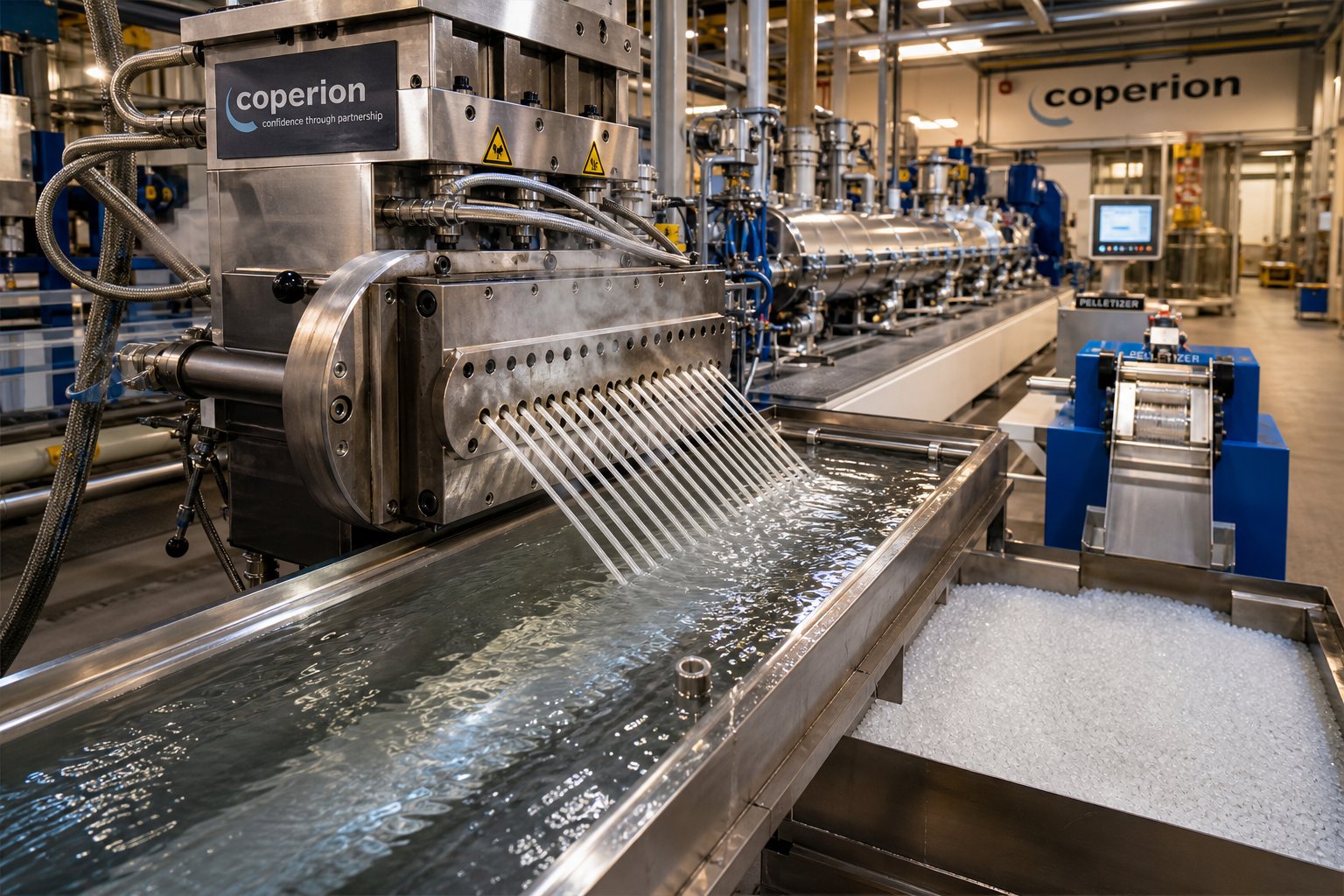
Key Applications Across Industries for the Twin Screw Compounding Extruder
Feeding accuracy and devolatilization capability mean little in the abstract — their value only crystallizes when you see what they enable across real production environments. Most people associate the extruder twin screw exclusively with plastics compounding, but that framing dramatically undersells the technology. The same core principles — controlled shear, modular screw design, starve-fed flexibility — make twin screw extrusion a platform technology deployed across industries you might not expect. If your operation falls into any of the categories below, chances are a twin screw machine is either already central to your process or should be.
Polymer Compounding and Masterbatch Production
This is the dominant use case, and for good reason. A compounding twin screw extruder blends base polymers with additives, pigments, flame retardants, impact modifiers, UV stabilizers, and reinforcing fibers in a single continuous pass. The intermeshing geometry disperses even stubborn filler agglomerates — think nano-calcium carbonate clusters or bundled glass fiber rovings — while the self-wiping screw surfaces keep residence time short enough to prevent thermal degradation of sensitive matrix polymers.
Masterbatch production, where pigment loadings can reach 40% to 70% by weight, is particularly demanding. Imagine trying to distribute that much titanium dioxide or carbon black uniformly through a polyethylene carrier without leaving specks, agglomerates, or color streaks in the final product. A compounding extruder with properly sequenced kneading blocks and distributive mixing elements achieves the dispersion fineness that downstream film or injection molding customers demand. The narrow residence time distribution discussed earlier ensures every pellet carries a consistent thermal history — critical when your customer's quality lab rejects entire shipments over a single off-shade measurement.
Engineering plastics compounding adds another layer of complexity. Blending polyamide with 30% glass fiber, a coupling agent, and a heat stabilizer requires precise temperature management across multiple barrel zones, downstream side feeding to protect fiber length, and vacuum venting to strip residual moisture. A twin screw compounding extruder handles all of this within a single barrel length, producing pellets with the mechanical properties and surface finish that automotive and electronics OEMs specify.
Recycling and Pelletizing Operations
Recycled feedstock is inherently messy — mixed polymer types, residual labels, variable moisture content, trace metals, and abrasive contaminants like sand or glass particles. That reality makes recycling one of the more challenging applications for any polymer extruder, and it exposes equipment weaknesses fast.
Twin screw machines bring specific advantages to post-industrial and post-consumer recycling. Their multi-stage venting capability removes moisture and residual volatiles without a separate drying step, which industry expert Charlie Martin of Leistritz identifies as a significant cost and quality benefit — particularly for PET and PLA edge-trim reclaim lines where hydrolytic degradation from residual moisture is a constant threat. The intensive mixing also disperses trace contaminant polymers (small amounts of PVC or PET in an HDPE reclaim stream, for instance) that would otherwise show up as defects in finished parts.
A typical recycling system pairs the twin screw extruder with a loss-in-weight feeder configured for regrind, metal detection at the feed throat, multi-stage vacuum venting, a screen changer for filtration, and an underwater or strand pelletizer. The output is a clean, re-pelletized compound — sometimes loaded with fillers up to 80% — ready for injection molding or profile extrusion. When operated as a screw extruder granulator, the machine transforms irregular flake, fiber, or film scrap into uniform pellets with controlled melt flow properties.
One caution: the closely intermeshing screw tolerances that give twin screw machines their mixing superiority also make them vulnerable to damage from hard contaminants like metal fragments or bolts in the feed stream. Robust screw and barrel materials — bimetallic liners, tungsten carbide coatings, or hardened tool steels — are essential for recycling duty, where abrasive wear rates can be several times higher than in virgin compounding. Barrel and screw metallurgy selection is not a secondary consideration here; it directly determines whether the machine stays in production or sits idle waiting for expensive replacement parts.
Emerging and Advanced Applications
What makes twin screw extrusion genuinely distinctive is how far it reaches beyond conventional plastics. The same controlled shear, precise temperature management, and continuous processing capability that compound polypropylene with talc also serve industries where you'd least expect to find a polyester extruder or a compounding line. Consider the range of forward-looking applications gaining traction:
- Reactive extrusion — In-situ polymerization, grafting reactions, and controlled degradation all happen inside the barrel. The twin screw provides the intimate mixing and residence time control that chemical reactions demand. Applications include maleic anhydride grafting onto polyolefins, peroxide-initiated crosslinking, and chain extension of recycled PET to restore intrinsic viscosity.
- Nano-composite processing — Dispersing nano-clays, carbon nanotubes, or graphene nanoplatelets into polymer matrices requires shear levels and mixing uniformity that only intermeshing twin screws deliver consistently. Research at institutions like Nanoscience Instruments highlights the twin screw extruder's role in producing advanced nanocomposites with enhanced mechanical, thermal, and barrier properties.
- Continuous pharmaceutical manufacturing — Hot-melt extrusion (HME) uses the twin screw platform to create amorphous solid dispersions that improve the solubility and bioavailability of poorly soluble drugs. Research published in AAPS PharmSciTech documents how twin screw granulation is replacing traditional batch granulation in pharmaceutical production, offering tighter process control, reduced cycle times, and real-time quality monitoring through integrated PAT (Process Analytical Technology) tools.
- Biodegradable polymer compounding — PLA, PHA, and starch-based bioplastics are notoriously sensitive to moisture, shear, and temperature. A twin screw extruder's ability to combine gentle conveying with targeted devolatilization zones makes it the preferred platform for compounding these materials with plasticizers, nucleating agents, and natural fiber reinforcements without triggering hydrolytic or thermal degradation.
- Food ingredient processing — Texturized vegetable proteins, snack extrusion, flavor encapsulation, and nutraceutical compounding all rely on the same controlled shear and thermal profiles. Twin screw food extruders produce everything from breakfast cereals and pet food kibble to high-moisture meat analogs for the plant-based protein market.
This breadth is precisely why the extruder for polymer compounding today is not just a plastics machine — it's a continuous processing platform. Whether you're a pharmaceutical formulator working with five grams of a novel API on a lab-scale micro-compounder or a recycling plant running 4,000 kg/hr of post-consumer HDPE, the underlying twin screw architecture adapts to your scale and your chemistry.
That adaptability, however, creates a selection challenge. With so many configurations, screw sizes, and ancillary systems available, choosing the right twin screw extruder for a specific material and process requires a structured evaluation — one that goes well beyond comparing spec sheets and sticker prices.
How to Choose the Right Twin Screw Extruder Machine
Knowing what a twin screw extruder can do and knowing which one to buy are two very different skills — and the gap between them is where some of the most expensive mistakes in plastics processing hide. You've seen how screw element design, rotation direction, and feeding systems shape output quality. But when it's time to request quotes and compare proposals, all that technical knowledge needs to funnel into concrete purchasing criteria. Skip this step, and you risk either overspending on capacity you'll never use or — worse — locking into a machine that can't grow with your product portfolio.
Matching Extruder Type to Material and Process
Start with the material and work backward to the machine. That sounds obvious, but it's remarkable how often buyers lead with budget or brand loyalty and only discover material-process mismatches after installation. A simple decision framework helps prevent that:
- Intensive mixing, additive dispersion, or reactive processing? A co-rotating intermeshing twin screw extruder is the default starting point. Its high shear, self-wiping action, and modular screw design handle everything from glass fiber reinforced polyamide to maleic anhydride grafting onto polyolefins. If your formulations change frequently and filler loadings swing widely, the co-rotating platform absorbs that variability without hardware changes.
- Shear-sensitive materials like rigid PVC or certain biodegradable polymers? A counter-rotating or conical configuration keeps shear stress low enough to stay within narrow processing windows. PVC's decomposition temperature sits dangerously close to its processing range — a co-rotating machine's aggressive mixing can push it past the threshold. Counter-rotating designs operating at lower RPM maintain gentle thermal conditions while still delivering adequate dispersion.
- Simple re-pelletizing of clean regrind or single-polymer melting? A single screw extruder may be all you need. Adding twin screw complexity to a process that doesn't require intensive mixing inflates capital and maintenance costs without a quality payoff. Save the twin screw budget for applications where its mixing superiority actually earns a return.
This framework isn't rigid — many applications sit in gray zones where either configuration could work. When that happens, the tiebreaker usually comes down to how much process flexibility you'll need in the next five years. If your product development pipeline includes new compounds, higher filler loadings, or reactive formulations, investing in a co-rotating twin screw extruder machine positions you for growth. If your product line is stable and well-defined, a simpler, lower-cost solution may serve you better long-term.
Critical Specification Parameters
Once you've identified the right configuration class, the real evaluation begins. Twin screw extruder manufacturers present specification sheets packed with numbers, and it's easy to fixate on one headline figure — maximum throughput, for instance — while overlooking parameters that have a bigger impact on daily performance. Here are the key factors buyers should evaluate together, not in isolation:
- Screw diameter and L/D ratio — Screw diameter sets the throughput ceiling; L/D ratio determines how much processing length you have for melting, mixing, venting, and pressure build-up. Common L/D values range from 32:1 to 52:1, with some designs reaching 68:1 for applications demanding extended residence time or multiple vent stages. A higher L/D provides more flexibility for complex screw configurations but increases the material's thermal exposure — and with it, degradation risk for heat-sensitive polymers.
- Specific torque density — Expressed in Nm/cm³, this measures how much torque the drive system delivers relative to the screw center distance. Higher torque density means the machine can process high-viscosity melts and heavily filled systems without overloading the gearbox. Modern high-performance designs reach torque densities of 18 Nm/cm³, according to data from the SPE Extrusion Division.
- Maximum screw speed — Co-rotating machines typically operate from 300 to 1,200 RPM. Higher speed capability allows greater throughput and specific energy input when needed, but running near the maximum continuously accelerates wear. Match the speed range to your process requirements, not your ambition.
- Free volume — The open channel volume between screw flights determines how much material the screws can carry per revolution. Higher free volume benefits applications with low-bulk-density feeds like powders or fluffy regrind, where volumetric intake limits throughput before torque or thermal constraints come into play.
- Number of barrel segments and available vent ports — More segments mean more flexibility to position feed ports, vents, and temperature zones. If your process involves downstream side feeding, multi-stage devolatilization, or liquid injection, count barrel positions carefully. Adding a vent port after installation isn't a simple retrofit — it often requires new barrel sections and screw element rearrangement.
- Drive power and throughput range — Motor sizing directly governs available torque at operating speed. The formula is straightforward: Torque (Nm) = 9,550 x Power (kW) / RPM. A 200 kW motor at 500 RPM yields roughly 3,820 Nm per shaft, as industry engineering references confirm. Always select a motor that provides at least 20% more torque than your anticipated peak process demand — undersizing the drive is one of the most common causes of premature gearbox failure.
These parameters interact in ways that reward holistic thinking. For example, a twin screw extruder for sale with an impressively high L/D ratio of 56:1 sounds great on paper — but if the drive can't deliver enough torque density to fill those extra barrel zones with kneading blocks, the added length just extends residence time without improving mixing. Similarly, a machine with outstanding free volume but inadequate vent positions limits your ability to process moisture-sensitive or volatile-rich feeds. Evaluate the full specification set as a system, not as a checklist of independent features.
Evaluating Manufacturers and Total Cost of Ownership
Here's where many buyers make the most damaging silent mistake: they compare twin screw extruder price tags and select the lowest number. Initial purchase cost is real, but it typically represents only 30% to 40% of what you'll spend over the machine's productive lifetime. The remaining 60% to 70% comes from energy consumption, spare parts, barrel and screw replacements, downtime, and process support — all areas where equipment quality differences compound year after year.
Consider a practical example drawn from published industry analysis: budget twin screw extruders priced under $50,000 for typical industrial applications can carry 40% higher total cost of ownership over five years compared to premium alternatives. Accelerated screw wear requiring replacement every 12 to 18 months, greater power draw from less efficient drives, and unplanned downtime totaling 10% to 15% of production time all erode the savings that motivated the initial purchase.
When evaluating any twin-screw extruder manufacturer, look beyond the machine itself and assess these ownership-level factors:
- Spare parts availability and lead time — Can the manufacturer ship critical wear parts — screw elements, barrel liners, seals — within days, or are you facing weeks of downtime waiting for custom-machined components? Manufacturers with dedicated spare parts inventory dramatically reduce your unplanned downtime risk.
- Barrel and screw replacement costs — Request documented wear data: What materials are the screws and barrel liners made from? What is the expected service life under your specific processing conditions? A manufacturer who can quote screw element life in hours for your application — not just generic claims — demonstrates real process knowledge.
- Energy efficiency — Premium drives and optimized screw geometry can reduce energy consumption by 15% to 25% compared to lower-quality equipment. For a machine running three shifts, that difference translates to tens of thousands of dollars annually and meaningfully changes the total cost equation.
- Control system sophistication — Temperature control accuracy within plus or minus 1 to 2 degrees Celsius, real-time torque monitoring, recipe storage, and data logging capability are not luxuries — they're the tools that enable consistent product quality shift after shift. A basic control system that drifts or can't store recipes costs you in scrap and operator troubleshooting time.
- After-sales technical support — Does the manufacturer provide remote troubleshooting, process optimization guidance, and on-site commissioning services? Twin screw extruder manufacturers who invest in application engineering — not just equipment sales — deliver more value over the machine's entire service life.
The growing global market for twin screw extruders — valued at approximately USD 1.52 billion in 2025 with a projected CAGR of 5% through 2033 — means buyers have more supplier options than ever. That abundance creates opportunity but also noise. Prioritize suppliers who provide both standard and custom barrel-screw configurations matched to your specific processing needs, because a one-size-fits-all screw package rarely optimizes any single application.
For R&D-intensive operations, also consider whether the manufacturer offers a lab scale extruder or laboratory scale extruder with the same screw geometry and element catalog as their production machines. Running pilot trials on a 20 mm or 25 mm platform that directly scales to your 65 mm or 95 mm production line eliminates the guesswork in scale-up — and prevents the expensive surprise of discovering that a formulation proven in the lab behaves completely differently at production throughput.
Ultimately, the right machine choice is one that balances upfront investment against long-term productivity, flexibility, and maintainability. That last factor — maintainability — deserves its own focus, because even the best-specified extruder degrades over time. Knowing when wear has crossed the threshold from acceptable to output-killing, and what to do about it, is the difference between a machine that prints money for a decade and one that silently bleeds performance from month one.
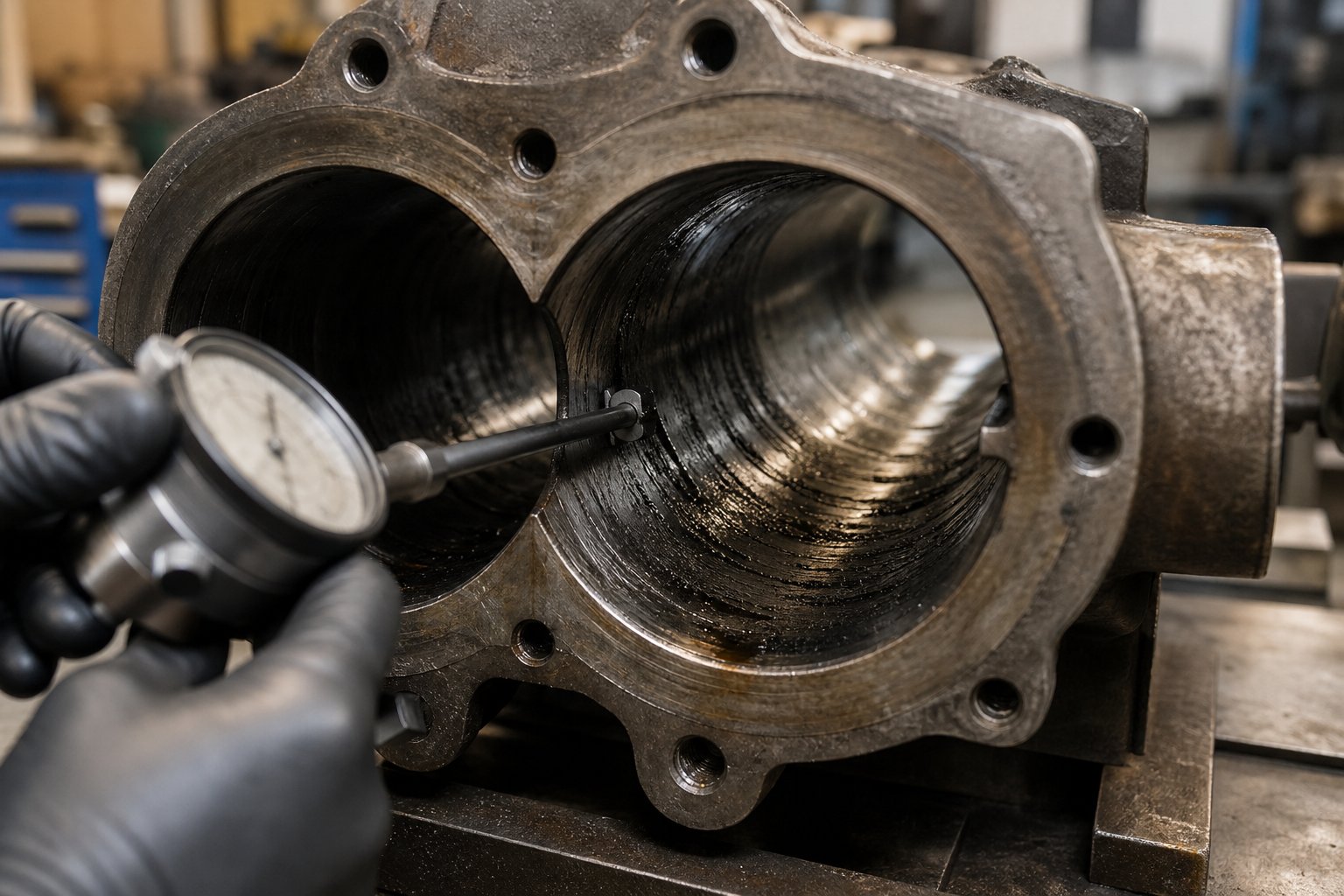
Twin Screw Barrel and Screw Wear, Maintenance, and Replacement
A well-specified extruder twin screw system doesn't stay well-specified forever. From the moment material first contacts metal, wear begins — and it compounds silently. The machine holds its tolerances for months, maybe a year, delivering output numbers that look stable on the shift report. Then one day melt pressure starts drifting, dispersion quality slips, or throughput drops by 5% at the same settings. By that point, the twin screw barrel and screw elements have already crossed a threshold that no process adjustment can recover. Understanding what drives that degradation — and catching it before it steals output — is the maintenance discipline most compounding operations underinvest in.
Common Wear Patterns in Twin Screw Barrels and Elements
Not all wear is created equal. The materials you process dictate which wear mechanism dominates and where it hits hardest.
Abrasive wear is the most common culprit. Fillers like calcium carbonate, glass fiber, and titanium dioxide act as grinding media inside the barrel bore. Every screw revolution drags these hard particles across metal surfaces, gradually eroding screw flight tips and widening the clearance between the screw outer diameter and the barrel wall. As Haisi Extrusion's engineering team documents, glass fiber is particularly aggressive — long fibers entangle at the side-feed port and shear into sharp fragments during screw rotation, intensifying localized abrasion in ways that unfilled polymers never produce.
Corrosive wear compounds the problem when processing flame retardants, halogenated additives, or certain organic pigments. These additives release chemically active species at processing temperatures that attack the barrel's inner wall, weakening the surface layer and making it more vulnerable to mechanical abrasion. The combination of corrosion and abrasion accelerates wear far faster than either mechanism alone.
Wear doesn't distribute evenly along the barrel extruder length. Four zones consistently take the heaviest damage:
- Feed zone — Solid granules and powders create intense mechanical friction against barrel walls before melting begins.
- Filler introduction zone — Side-fed glass fibers and mineral fillers contact fresh, unmelted screw surfaces at high relative velocity.
- Mid-barrel kneading zone — Axial pressure and slight screw deflection (bending under load) press screw flights against the barrel bore, causing asymmetric scraping.
- Discharge zone — The cantilevered screw tips sag under gravity, and uneven melt flow lifts the screw edge into contact with the barrel wall.
The telltale signs? Increased clearance between the twin screw and barrel surfaces reduces conveying efficiency, because material leaks backward over worn flight tips instead of being pushed forward. Inconsistent melt pressure readings at the die — swinging where they once held steady — often point to this clearance growth. Visible scoring or grooving on barrel liner surfaces, spotted during scheduled inspections, confirms that abrasive wear has progressed beyond the surface-hardened layer into softer base metal.
Preventive Maintenance Best Practices
Catching wear early is far cheaper than reacting to a quality crisis. A structured preventive maintenance program doesn't demand exotic equipment — it demands discipline. The following practices, applied consistently, extend the service life of twin screw and barrel components and protect output quality between scheduled replacements:
- Periodic bore-diameter measurement — Use precision bore gauges at multiple positions along each barrel segment during planned shutdowns. Track measurements over time against the manufacturer's original bore specification. A bore that has expanded by more than 0.1 to 0.15 mm beyond nominal in a high-wear zone warrants close monitoring; beyond 0.2 mm, conveying efficiency drops measurably.
- Screw flight inspection — Measure screw outer diameter at critical positions (feed, kneading, and metering zones) with calipers or a micrometer. Industry guidance from Chuangri Screw's tolerance measurement protocols recommends flagging elements when wear reaches 10% to 15% of the original flight diameter — beyond this threshold, output and quality degradation accelerate sharply.
- Torque monitoring — Log drive torque at consistent operating conditions (same recipe, same throughput, same screw speed). A gradual upward trend suggests increasing friction from wear-related contact, while a sudden drop can indicate a failed element or stripped spline. Either anomaly deserves investigation before it escalates.
- Scheduled barrel segment rotation — In modular barrel designs, the top half of each segment typically wears faster than the bottom due to gravity-driven screw deflection. Rotating barrel segments 180 degrees at planned intervals distributes wear more evenly and extends total barrel life.
- Metallurgy selection matched to processing severity — This is a design-stage decision that pays dividends for years. Nitrided steel barrels suit general-purpose compounding with moderate filler loads. Bimetallic liners — where a wear-resistant alloy is centrifugally cast inside a structural steel shell — handle abrasive fillers at higher loadings. Tungsten carbide or ceramic coatings on screw elements provide the highest abrasion resistance for extreme applications like high-percentage glass fiber or mineral-filled recycling. Choosing the right metallurgy upfront, rather than defaulting to the lowest-cost option, prevents premature replacement cycles that cost far more in downtime and parts than the initial material premium.
A proactive maintenance approach can reduce operating costs by 20% to 30% compared to reactive replacement strategies, based on data from industry maintenance benchmarking studies. The savings come not just from fewer parts purchases but from avoided scrap, avoided unplanned downtime, and sustained output quality that keeps customers from seeking alternative suppliers.
When to Replace Screws and Barrels
Preventive maintenance extends service life — but it doesn't make components immortal. Every twin screw barrel and screw element has a wear threshold beyond which adjustment, rotation, and process optimization can no longer compensate. Recognizing that threshold is a skill, and developing it saves both money and frustration.
Watch for these operational signals:
- Declining output at constant settings — If your feed rate, screw speed, and barrel temperatures haven't changed but throughput has dropped by more than 3% to 5%, worn screw flights are likely leaking material backward instead of conveying it forward. Process tweaks might mask the symptom temporarily, but the underlying clearance problem only grows.
- Deteriorating mix quality — Uneven pigment dispersion, visible filler agglomerates in pellets, or increasing reject rates at downstream quality checks often trace back to worn kneading elements that no longer deliver sufficient shear. Rearranging element positions or adding more kneading blocks helps — until the flight clearances are so large that shear energy dissipates before it reaches the material.
- Rising melt temperature at constant process parameters — This one seems counterintuitive. You'd expect worn elements to deliver less energy, not more. But increased clearance creates additional friction zones where material gets sheared in the gap between worn flights and barrel walls rather than being conveyed cleanly. That parasitic friction converts to heat without contributing useful mixing, pushing melt temperature up while product quality goes down.
- Torque fluctuations or instability — Healthy screws running a consistent recipe produce stable torque readings. Wide or erratic torque swings at unchanged conditions suggest uneven wear, damaged elements, or developing spline wear on the shaft — all indicators that replacement should be scheduled soon rather than deferred.
When the decision point arrives, sourcing quality replacement components becomes the priority. Generic or loosely toleranced barrels may restore short-term function but wear out prematurely, restarting the cycle. For compounding producers, masterbatch manufacturers, recycling plants, and pelletizing operations running abrasive or high-throughput formulations, purpose-engineered replacement barrels make a measurable difference in service intervals. NANHAIYA's Parallel Twin Screw Barrel is one option worth evaluating in this context — their barrels are designed specifically for high-wear applications requiring stable conveying and mixing performance, with metallurgy options matched to the severity of the processing environment.
Whatever supplier you choose, insist on documented bore tolerances, material certifications, and compatibility verification with your specific screw element geometry before committing to a purchase. A replacement barrel that doesn't match the original screw-to-barrel clearance specification defeats the purpose of the investment. And remember — barrel and screw replacement isn't just a maintenance event. It's an opportunity to reassess your screw configuration, upgrade metallurgy based on lessons learned from the worn-out components, and reset your process to the performance baseline your output targets demand.
Even with fresh hardware installed, though, problems don't always disappear. Some output issues masquerade as wear when they're actually rooted in process settings, feeder behavior, or screw configuration mismatches. Distinguishing between hardware-driven symptoms and process-driven symptoms is the final skill that separates reactive troubleshooting from systematic problem-solving.
Troubleshooting Common Twin Screw Extrusion Problems
Fresh barrels and screw elements restore mechanical tolerances — but they don't automatically fix every processing headache. A twin-screw extruder can produce flawless pellets one shift and frustrating defects the next, even with hardware in perfect condition. The difference between operators who resolve issues in minutes and those who chase symptoms for days comes down to diagnostic discipline: identifying whether a problem originates in the feed system, the screw configuration, the barrel condition, or the process parameters — and then acting on the right root cause instead of the most obvious guess.
The table below maps the five most common twin screw extrusion symptoms to their likely causes and the corrective actions that experienced compounders reach for first. Use it as a starting checklist before diving deeper into the diagnostic details that follow.
| Symptom | Likely Causes | Recommended Actions |
|---|---|---|
| Surging output (fluctuating die pressure, inconsistent strand diameter) | Feeder calibration drift; hopper bridging or rat-holing; worn conveying elements reducing intake capacity; incorrect screw speed-to-feed ratio | Recalibrate loss-in-weight feeders; inspect hopper flow aids and feeder screw type; measure conveying element OD for wear; adjust screw RPM relative to feed rate |
| Poor dispersion (visible agglomerates, color streaks, inconsistent physical properties) | Insufficient kneading block intensity; wrong stagger angle or disc width; low degree of fill in mixing zone; screw configuration mismatched to additive type | Replace narrow-disc kneading blocks with wider discs for dispersive action; increase stagger angle toward 60 or 90 degrees; add a reverse element after the mixing zone to raise fill level; verify kneading section position relative to filler introduction point |
| Excessive melt temperature (degradation, discoloration, reduced molecular weight) | Screw speed too high relative to throughput; overly aggressive kneading configuration; worn barrel increasing parasitic friction; malfunctioning cooling solenoid valves | Reduce screw RPM or increase feed rate to lower specific energy input; substitute neutral kneading blocks with forward-conveying variants; inspect barrel bore for wear-induced friction zones; verify cooling system function at each barrel zone |
| Vent flooding (melt rising into vent port, loss of vacuum, porous pellets) | Melt seal failure upstream of vent due to worn reverse elements; excessive feed rate overfilling the barrel; incorrect screw configuration around vent zone; vacuum level set too aggressively | Inspect and replace worn reverse or neutral elements forming the melt seal; reduce feed rate incrementally until vent clears; verify that conveying elements downstream of the vent have sufficient pitch to pull melt away; adjust vacuum level to match devolatilization demand |
| Die drool (buildup of degraded material at die exit, contaminating strands) | Polymer degradation from excessive residence time or hot spots; inadequate devolatilization leaving residual volatiles that outgas at the die; die lip geometry trapping low-molecular-weight fractions | Reduce barrel temperatures in final zones; improve devolatilization by strengthening melt seals and increasing vacuum; clean and polish die lips; check for dead spots in the die or adapter where material can stagnate and degrade |
That table gives you the quick reference. The sections below unpack the diagnostic thinking behind the two most frequently misdiagnosed problem categories — and explain how to tell whether you're dealing with a feed issue, a screw issue, or both.
Diagnosing Feed and Conveying Problems
Surging is the symptom compounders encounter most often, and it's also the one they misdiagnose most frequently. The output fluctuates, strand diameter bounces, pellet weights vary — and the instinctive response is to blame the screw or the barrel. Sometimes that instinct is right. But as Haisi Extrusion's troubleshooting framework emphasizes, loss-in-weight feeders are often scapegoated for failures they didn't cause — while real feeder problems go unnoticed because operators focus on the extruder instead of the equipment upstream of it.
Here's a practical way to distinguish between feed-related and screw-related surging:
Feed-related surging shows up as short-cycle fluctuations in motor torque and die pressure, often correlating with feeder refill events or changes in the raw material's bulk density. If you watch the feeder's actual feed rate readout during a surge event and see it deviating from the setpoint — even briefly — the feeder is almost certainly the culprit. Common causes include using the wrong feeder screw geometry for the material (a single coarse-pitch auger for a fine powder that needs twin concave screws), hopper bridging that momentarily starves the feed, or a refill system that dumps material too aggressively and disrupts the loss-in-weight calculation.
Screw-related surging, by contrast, typically manifests as a slower, more gradual drift. The feeder holds its setpoint perfectly, but die pressure still wanders. This pattern often points to worn conveying elements in the intake zone — increased screw-to-barrel clearance lets material slip backward instead of being positively conveyed, creating cyclic backup and release. A quick diagnostic: pull the screws and measure the outer diameter of the first three to four conveying elements. If they've worn below the manufacturer's minimum tolerance, you've found your root cause. No amount of feeder recalibration will fix worn hardware.
Environmental factors add another layer. For a twin screw extruder plastic compounding operation processing hygroscopic resins like polyamide or PET, changes in ambient humidity between seasons can alter material flow behavior enough to cause feed inconsistencies. A formulation that ran flawlessly in winter may surge in summer if raw materials stored in non-climate-controlled warehouses absorb enough moisture to change their bulk density and flow angle. Pre-drying protocols and environmental monitoring resolve these transient issues before they reach the extruder.
Solving Mixing and Dispersion Deficiencies
When pellets come out with visible specks, uneven color, or physical property failures traced to poor additive incorporation, the temptation is to immediately order new kneading blocks or redesign the screw. Resist that impulse. Process adjustments — which cost nothing and take minutes — should always be exhausted before committing to hardware changes that require a shutdown, disassembly, and reassembly.
Start with the screw speed-to-feed ratio. As discussed in the specific energy input section earlier, reducing feed rate at constant screw speed increases the energy each kilogram of material absorbs. That extra energy translates directly into more intense mixing within the existing kneading block configuration. If dispersion improves at the lower feed rate, you've confirmed that the current screw design is capable — the issue was throughput exceeding the mixing section's capacity, not a fundamental configuration flaw.
If adjusting the feed ratio doesn't resolve the problem, evaluate the degree of fill in the mixing zone. Compounding expert Kenneth Russell's analysis demonstrates that mixing sections work more efficiently and more gently when they have a higher degree of fill. A mixing section composed entirely of forward-conveying kneading blocks pushes material through so quickly that the zone stays partially empty — the blocks "whip" the melt instead of working it, which paradoxically raises melt temperature while reducing actual mixing effectiveness. Adding a neutral (90-degree) or reverse kneading block at the end of the mixing section restricts forward flow just enough to back-fill the kneading zone, increasing contact time between the material and the mixing elements.
Only after these process-side levers have been explored should you consider hardware modifications:
- Swap narrow kneading discs for wider ones if the problem is dispersive — agglomerates that need to be broken apart by high shear forces. Wider discs plow through the melt and create the smearing action required to fragment cohesive particles like carbon black aggregates.
- Increase the stagger angle from 30 or 45 degrees toward 60 or 90 degrees to reduce forward conveying in the mixing zone and intensify work on the material.
- Reposition the kneading section relative to the filler introduction point. If fillers enter via a side feeder and encounter only conveying elements before reaching the kneading zone, they may not be fully wetted by the polymer matrix before mixing begins — leading to poor dispersion that no amount of shear intensity can fix. Moving the first kneading block closer to the side-feed port (while maintaining enough conveying length for initial wetting) often resolves this without adding elements.
Dispersion challenges also differ fundamentally depending on whether the additive needs dispersive or distributive mixing — a distinction that many plastic twin screw extruder operators overlook. A filler that's already composed of individual free-flowing particles (like talc or calcium carbonate at moderate loadings) primarily needs distribution — uniform spreading throughout the polymer matrix. Aggressive kneading here doesn't help; it just overheats the melt. Toothed or gear-type distributive mixing elements, which split and recombine flow streams with minimal shear stress, are the right tool. Save the wide-disc, high-angle kneading blocks for genuinely cohesive materials that resist break-up.
Building a Reliable Long-Term Twin Screw Plastic Extruder Operation
Troubleshooting guides are useful in a crisis, but the real goal is to need them as rarely as possible. Consistent twin screw extrusion performance over months and years depends on the interplay of four pillars — and neglecting any one of them eventually undermines the other three:
- Proper screw configuration — Designed and validated for your specific material and formulation, not copied from a generic template. Every recipe has an optimal balance of conveying, kneading, mixing, and reverse elements. Document what works, and resist the temptation to "improve" a proven configuration without data supporting the change.
- Well-maintained barrel and screw hardware — Scheduled inspections, bore measurements, and element wear tracking prevent the gradual performance erosion described throughout this article. When replacement becomes necessary, investing in quality components engineered for your processing severity — such as NANHAIYA's Parallel Twin Screw Barrel for high-wear compounding and recycling applications — protects the investment you've already made in process optimization. A precision barrel that holds tolerance longer keeps your validated screw configuration performing as designed.
- Accurate, stable feeding — Gravimetric feeders calibrated on a regular schedule, matched to each material's flow characteristics, with hopper geometry and agitation that prevent bridging. Feeding is the most upstream variable in the process, and every error it introduces propagates through every downstream zone.
- Informed process control — Operators who understand what specific energy input means, who monitor torque trends rather than just instantaneous readings, and who distinguish chronic problems from transient upsets. Training is not optional equipment — it's the bridge between having a capable machine and actually capturing that capability shift after shift.
When these four pillars work together, the twin screw plastic extruder becomes what it was designed to be: a predictable, high-utilization production asset rather than a source of daily firefighting. The mistakes that silently kill output — worn elements left too long, misconfigured screws, underfed or overfed barrels, vent seals ignored — are all preventable. They persist only when operators and managers treat symptoms in isolation instead of seeing the extruder as an integrated system where screw design, hardware condition, feed accuracy, and process knowledge are inseparable.
Every section of this article has pointed toward the same conclusion: twin screw extrusion is not a set-and-forget technology. It rewards attention, measurement, and systematic thinking. The processors who invest in understanding their machines — not just running them — are the ones who consistently hit output targets, hold quality specs, and avoid the silent losses that their competitors never even notice until it's too late.
Frequently Asked Questions About Twin Screw Extruders
1. What is the difference between a co-rotating and counter-rotating twin screw extruder?
Co-rotating twin screw extruders have both screws spinning in the same direction, producing a figure-eight flow path that delivers high dispersive and distributive mixing along with excellent self-wiping action. They typically operate at 200 to 900+ RPM and are ideal for polymer compounding, masterbatch production, and reactive extrusion. Counter-rotating extruders spin screws in opposite directions, creating a calender-gap compression effect with lower shear and less heat generation. This makes them better suited for shear-sensitive materials like rigid PVC, where the processing-to-decomposition temperature window is extremely narrow. Counter-rotating machines run at 30 to 150 RPM and come in parallel or conical screw configurations, each offering distinct advantages in torque delivery and L/D ratio flexibility.
2. How do screw elements affect twin screw extruder performance?
Screw elements are the primary tool for controlling what happens inside the barrel. Conveying elements move material forward at varying speeds depending on pitch. Kneading blocks provide dispersive mixing through staggered disc geometry — wider discs and steeper offset angles increase shear intensity. Toothed mixing elements offer gentle distributive blending for heat-sensitive formulations. Reverse elements oppose material flow to build pressure, increase residence time, and create melt seals needed for devolatilization. Sequencing these elements along the shaft creates distinct processing zones for solid conveying, melting, mixing, venting, and pressure build-up. Even two identical machines can produce drastically different results based solely on how elements are arranged, making screw configuration arguably the single most impactful variable in twin screw extrusion.
3. When should I replace twin screw barrel and screw elements?
Replacement becomes necessary when wear crosses a threshold that process adjustments can no longer compensate for. Key warning signs include declining output at constant settings (typically a 3% to 5% drop), deteriorating mix quality with visible agglomerates or color streaks, rising melt temperature despite unchanged parameters, and erratic torque fluctuations. Physically, bore diameter expansion beyond 0.2 mm past nominal specification and screw flight wear exceeding 10% to 15% of original diameter are established industry thresholds. For high-wear applications involving abrasive fillers or recycled feedstock, purpose-engineered replacement barrels — such as those from NANHAIYA's Parallel Twin Screw Barrel line at nhyscrews.com — offer metallurgy options like bimetallic liners and tungsten carbide coatings that extend service intervals significantly compared to standard components.
4. Why does my twin screw extruder have surging output problems?
Surging output typically originates from either the feed system or worn screw elements, and distinguishing between the two is critical for an effective fix. Feed-related surging appears as short-cycle fluctuations correlating with feeder refill events or bulk density changes — check the feeder's actual rate readout during a surge to confirm. Common feed causes include wrong auger geometry for the material, hopper bridging, or aggressive refill disrupting loss-in-weight calculations. Screw-related surging manifests as slower, gradual drift where the feeder holds its setpoint but die pressure still wanders. This usually points to worn conveying elements in the intake zone where increased screw-to-barrel clearance allows material to slip backward. Measuring the outer diameter of the first few conveying elements against manufacturer tolerances quickly confirms or rules out this root cause.
5. What industries use twin screw extruders beyond plastics compounding?
Twin screw extruders serve as a versatile continuous processing platform across multiple sectors. In pharmaceuticals, hot-melt extrusion creates amorphous solid dispersions that improve drug solubility and bioavailability, with twin screw granulation increasingly replacing traditional batch methods. Food processing relies on twin screw machines for texturized vegetable proteins, snack extrusion, flavor encapsulation, and high-moisture meat analogs for plant-based markets. In advanced materials, they disperse nanofillers like carbon nanotubes and graphene into polymer matrices for nanocomposite production. Reactive extrusion enables in-situ polymerization, grafting reactions, and chain extension of recycled polymers. Biodegradable polymer compounding for PLA, PHA, and starch-based materials also depends on the twin screw platform's ability to combine gentle conveying with targeted devolatilization.
Written by
Nanhaiya Technical Team
Zhoushan Nanhaiya Plastic Machinery Co., Ltd.
The Nanhaiya technical team supports screw and barrel manufacturing projects through application review, technical communication, custom manufacturing coordination, and production and quality control.
Discuss Your Application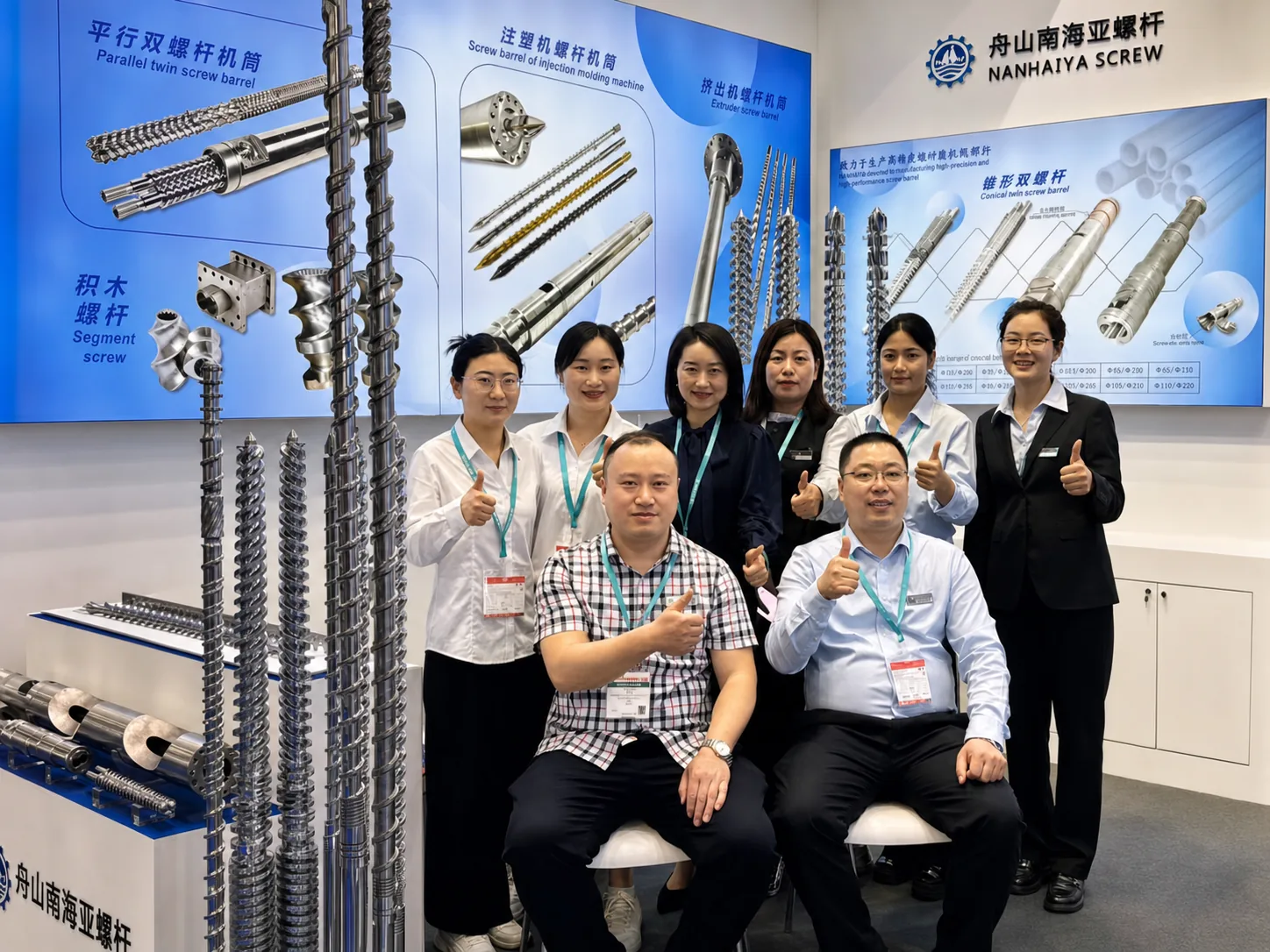
Related Articles
More insights on screw barrel technology and plastics processing.
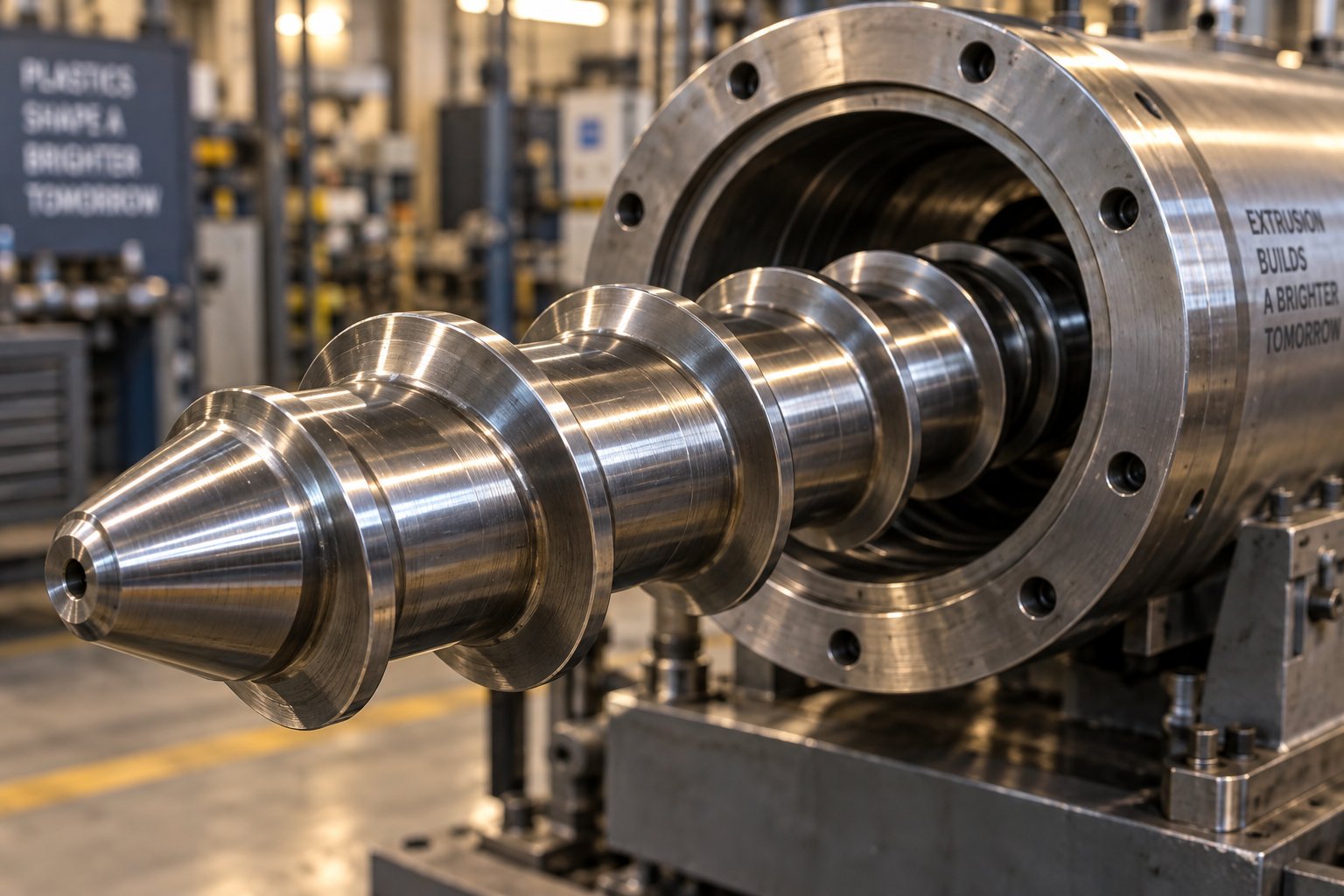
What Nobody Tells You About Screw Barrel For Plastic Machine Design
Oct 10, 2026
Learn how screw barrel for plastic machine design affects melt quality, throughput, and wear life. Covers geometry, resin matching, troubleshooting, and sourcing.
Read Article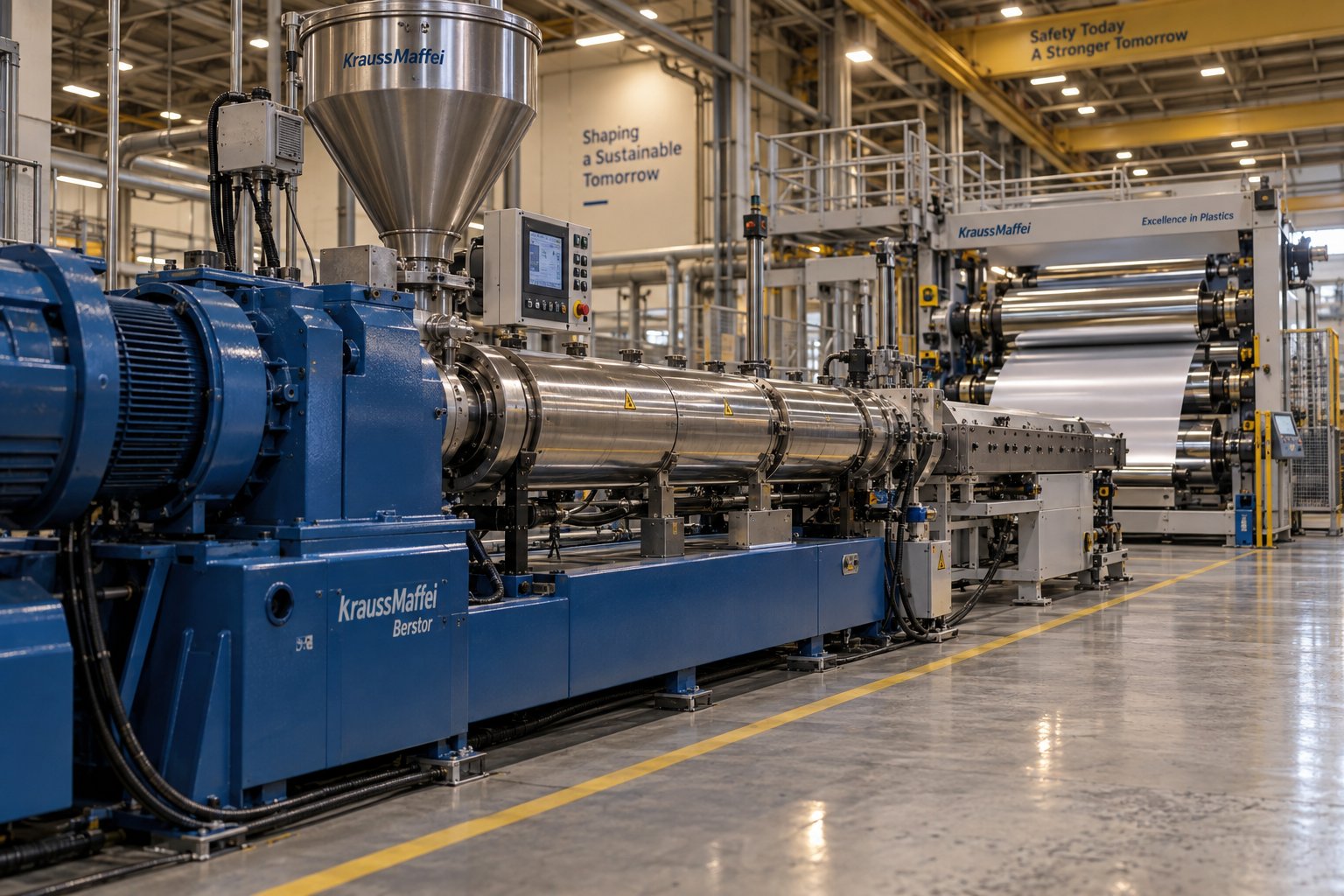
Single Screw Extruder for Sheet: Stop Guessing, Start Specifying
Oct 9, 2026
Learn how to specify a single screw extruder for sheet production. Covers screw geometry, resin-specific processing, troubleshooting, and maintenance best practices.
Read Article
PE Pipe Extruder Machine: What Datasheets Won't Tell You
Oct 9, 2026
Learn how a PE pipe extruder machine works, key specs explained, material grade selection, maintenance tips, and buyer guidance beyond the datasheet.
Read ArticleLooking for something else?
Search by material, symptom or product and jump straight to the relevant page.
These are navigation suggestions based on keyword matching — not a quotation, not a delivery commitment, and not a substitute for engineering review. Final specification is confirmed by our engineers against your drawings and processed material.
Need help with screw barrel selection?
Share your machine model, processed material and application. Our team can help with pricing and technical support.