

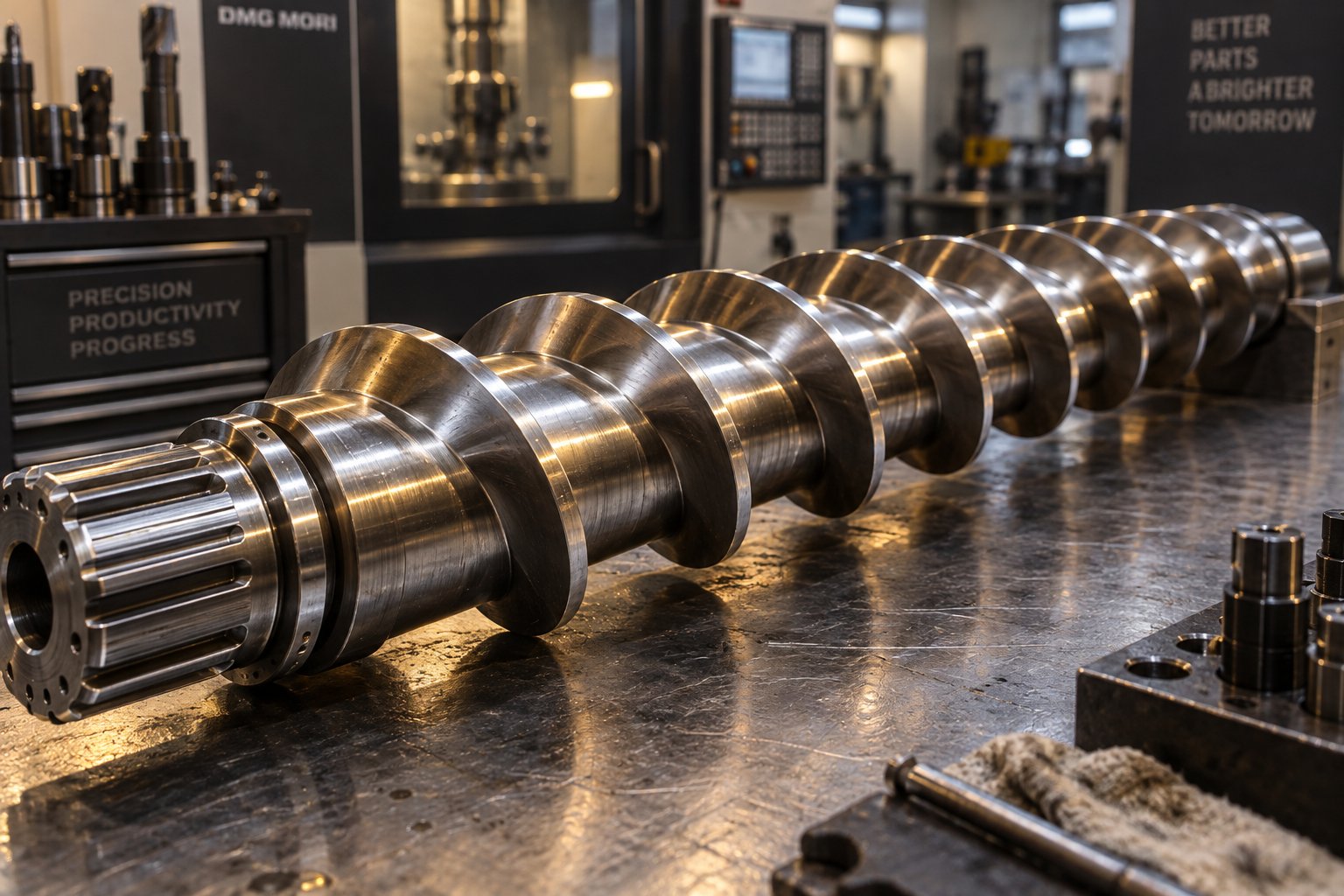
What Really Determines Extruder Screw Price
Try searching for an extruder screw price online and you'll hit a wall of catalog pages, scattered part listings, and "request a quote" buttons that tell you almost nothing. Unlike standard fasteners or off-the-shelf bearings, extruder screws lack a transparent marketplace. There is no universal price sheet. No industry benchmark chart. Just a confusing spread of numbers that seem to follow no clear logic.
This guide changes that. Instead of another product listing, you'll find a complete extruder screw price guide built around the cost drivers that actually matter - materials, geometry, manufacturing processes, and sourcing strategies.
Why Extruder Screw Pricing Feels So Confusing
How much does an extruder screw cost? The honest answer ranges from a few hundred dollars for a small, simple replacement to tens of thousands for a large-diameter, custom-engineered component built with premium alloys. That enormous gap frustrates buyers because, without understanding the variables behind it, comparing quotes becomes meaningless. Two screws that look identical on paper can differ by 300% or more in price - and both quotes might be perfectly fair.
The core extruder screw pricing factors include material grade, screw diameter and length, flight geometry complexity, surface treatments, manufacturing tolerances, and whether you're buying off-the-shelf or custom. Each variable shifts the final number, and suppliers don't always itemize them in their quotes.
Who This Guide Helps
This extruder screw cost comparison resource is built for three groups: plastic processors evaluating replacement screws for existing lines, equipment builders sourcing new components for machines under development, and maintenance teams weighing whether to repair a worn screw or invest in a new one.
Understanding cost drivers turns extruder screw purchasing from guesswork into strategy.
Every section ahead breaks down a specific piece of the pricing puzzle - starting with the single variable that influences cost more than any other: the material your screw is made from.
How Material Grade Shapes the Final Extruder Screw Price
Imagine two extruder screws sitting side by side on a shelf. Same diameter, same length, same flight geometry. One costs $1,800. The other costs $9,500. What explains the difference? In most cases, the answer is material grade. The alloy composition, surface treatment, and metallurgical construction of an extruder screw represent the single largest variable in its final cost - often accounting for 40% to 60% of the total price tag.
Material selection is not arbitrary, either. The polymer you process, the additives in your compound, and the temperatures involved all dictate which material grade your screw actually needs. Choosing too low means premature wear and costly downtime. Choosing too high means overspending on capability you will never use. A clear extruder screw material grade comparison helps you land in the right zone.
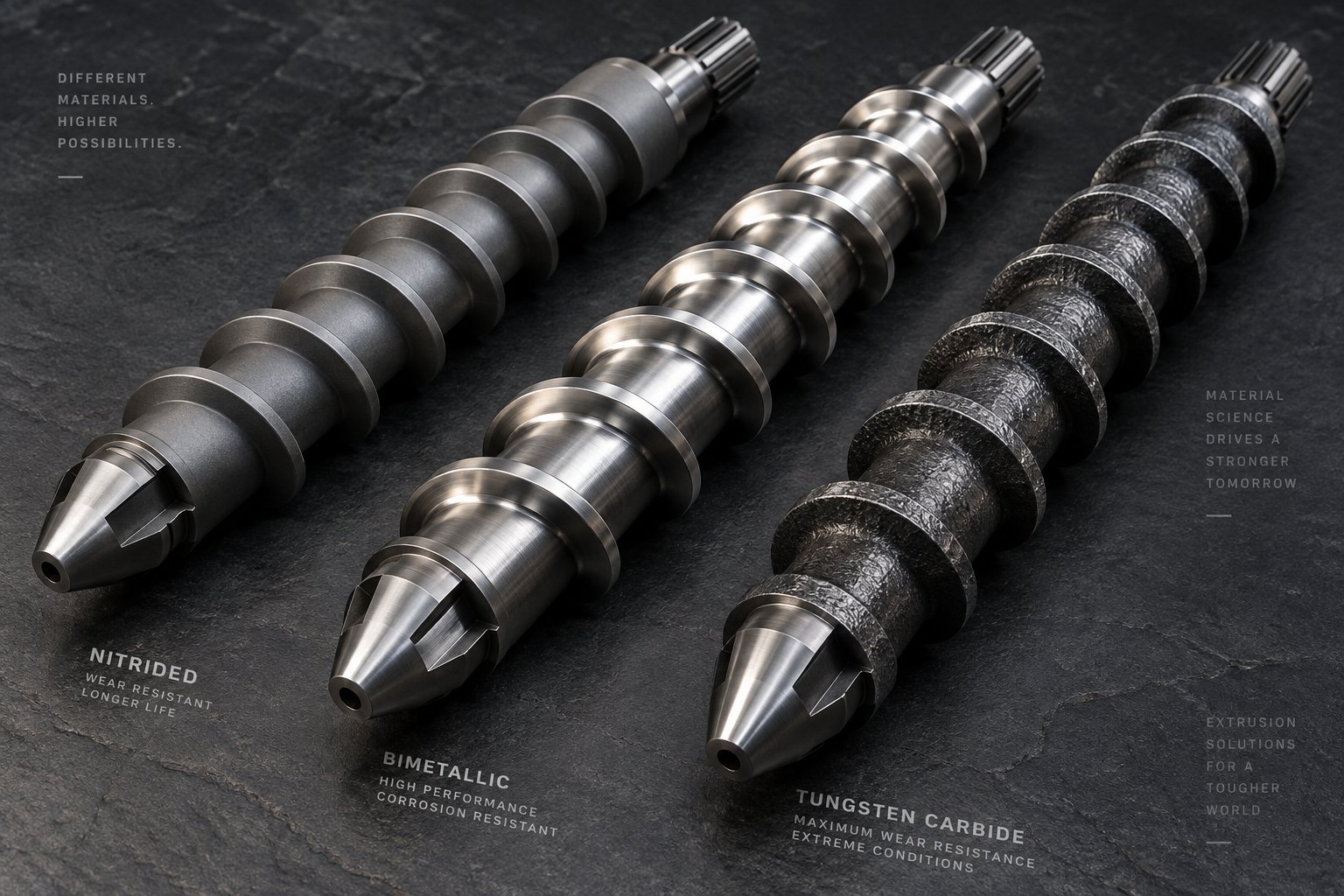
Standard Nitrided Steel Screws
For processors running non-abrasive, unfilled polymers like standard polyethylene (PE), polypropylene (PP), or polystyrene, nitrided steel screws represent the most cost-effective option. The base material is typically AISI 4140 or 4340 alloy steel, which then undergoes a nitriding process - either gas nitriding or ion/plasma nitriding - to harden the surface.
What does nitriding actually do? It diffuses nitrogen into the steel surface, forming chromium nitrides that dramatically increase hardness. According to Advanced Heat Treat Corp., materials like Nit135M and H-13 steel can reach surface hardness exceeding 70 HRc equivalent after ion nitriding, making them suitable for demanding abrasion applications. Even the more common 4140 steel achieves meaningful surface hardening through this process.
The nitrided steel extruder screw price sits at the low end of the spectrum because the base material is widely available, the machining is straightforward, and the nitriding process itself is relatively economical. As Devikrupa Group notes, nitriding produces surface hardness of HV950 or above (roughly HRC 55-58) on alloys like 38CrMoAlA, while also improving corrosion resistance in water vapor and alkaline solutions. The treatment can increase fatigue limits by up to 30%.
Where do nitrided screws fall short? When you introduce glass-fiber-filled polymers, mineral fillers, or chemically aggressive resins like PVC, that hardened surface layer wears through faster than you might expect - and once it is gone, the softer base steel underneath erodes rapidly.
Bimetallic and Coated Screw Options
Step up from standard nitrided steel and you enter the mid-range tier: bimetallic construction and specialized surface coatings. This is where the bimetallic extruder screw cost begins to climb, but so does the performance envelope.
Bimetallic screws use a base steel body with a wear-resistant alloy applied to critical surfaces - typically the flight tips, which experience the most abrasive contact. Common alloys for this purpose include nickel-based materials like Colmonoy 56 and Colmonoy 83, as well as cobalt-based Stellite alloys. These materials offer dramatically higher resistance to both abrasive wear and corrosion compared to a nitrided surface alone.
Tungsten carbide coated screw pricing sits in a similar mid-to-high range. Rather than building up the flight tips with welded alloys, tungsten carbide coatings provide an extremely hard protective layer across the screw surface. This approach works well for filled polymers where abrasive particles grind against the screw continuously during processing. Chrome plating is another coating option, though it carries a caveat: at elevated processing temperatures, differences in thermal expansion between the chrome layer and the base steel can cause the coating to exfoliate, reducing its long-term effectiveness.
The price increase for bimetallic and coated screws reflects both material costs and labor. Hard-facing flight tips with Stellite or tungsten carbide is a manual, skill-intensive operation that demands experienced welders and precise application. You are paying for craftsmanship alongside metallurgy.
Premium Alloys for Extreme Applications
At the top of the pricing ladder sit powder metallurgic (PM) tool steels and fully engineered alloy systems designed for the most punishing processing environments. Materials like CPM 9V - a vanadium-rich powder metallurgic steel - deliver exceptional abrasion resistance that far exceeds what nitriding or standard bimetallic construction can achieve.
When would you need this level of material investment? Think highly abrasive compounds loaded with glass fiber, mineral fillers, or metal fragments. Think chemically aggressive polymers like fluoropolymers or heavily plasticized PVC that attack conventional steel at processing temperatures. Think medical-grade or food-grade applications where specific alloy certifications, surface finish requirements, and corrosion-resistant compositions add regulatory cost layers on top of the base material expense.
Specialty double-alloy screws made from compositions like 88WC/12Co with integral quenching treatment push the boundary further. These are engineered for materials such as PPA, PPS, LCP, and fire-retardant compounds where standard screws simply cannot survive.
The premium price tier here is not just about buying a harder screw. You are paying for tighter material certifications, more complex heat treatment cycles, specialized inspection protocols, and often limited supplier availability. Few manufacturers stock these materials - most produce them to order.
| Material Grade | Typical Application | Relative Wear Resistance | Relative Corrosion Resistance | Price Tier |
|---|---|---|---|---|
| Nitrided Steel (4140/4340) | Non-abrasive polymers: PE, PP, PS | Moderate | Low to Moderate | Low |
| Nitrided Specialty Steel (H-13, Nit135M) | Moderately abrasive compounds | Moderate to High | Moderate | Low to Mid |
| Bimetallic (Colmonoy/Stellite flights) | Glass-filled polymers, mineral-filled resins | High | High | Mid |
| Tungsten Carbide Coated | Highly abrasive filled compounds | Very High | Moderate to High | Mid to High |
| Powder Metallurgic Tool Steel (CPM 9V) | Extreme abrasion: heavy glass/mineral fill | Very High | Moderate | High |
| Specialty Double Alloy (88WC/12Co) | PPA, PPS, LCP, fire-retardant, magnetic powder | Extremely High | High | Premium |
| Corrosion-Resistant/Food-Grade Alloys | Medical, food packaging, fluoropolymers | Varies | Very High | Premium |
Notice a pattern in the table above? Each step up the material ladder addresses a specific processing challenge - abrasion, corrosion, temperature stability, or regulatory compliance. The key insight for buyers evaluating quotes is straightforward: match your material grade to your actual application severity. Overspending on a premium alloy for a simple PE extrusion line wastes capital, but underspending on a nitrided steel screw for a glass-filled nylon operation wastes far more through accelerated wear and repeated replacements.
Material grade sets the pricing foundation, but it is only one dimension of the equation. The physical size and geometric complexity of the screw itself layer additional cost drivers on top of whatever alloy you select.
Screw Design Parameters That Drive Cost Up or Down
A screw's alloy composition might set the pricing baseline, but the physical design of that screw - its diameter, length, and flight geometry - determines how much raw material gets consumed, how many hours it spends on the CNC machine, and how tight the manufacturing tolerances need to be. Two screws made from identical steel can carry vastly different price tags simply because one is longer, wider, or geometrically more complex than the other.
The challenge for buyers? Supplier quotes often reference technical parameters like "L/D ratio" or "compression ratio" without explanation, making it difficult to understand why one quote is higher than another. Breaking down these terms reveals exactly where your money goes.
Diameter and L/D Ratio as Primary Cost Drivers
Screw diameter is the most straightforward cost factor. A 120mm screw requires substantially more raw bar stock than a 30mm screw, weighs significantly more, and demands longer machining cycles on larger, more expensive CNC equipment. The extruder screw diameter price difference between a small and large unit can easily reach 5x to 10x - even before factoring in material grade or special coatings.
Then there is the L/D ratio - the length of the screw divided by its diameter. In compounding extruders, this value typically ranges from 20:1 to 40:1, depending on the application. A 60mm screw with a 24:1 L/D ratio is 1,440mm long. Bump that same diameter up to a 36:1 ratio and the screw stretches to 2,160mm - 50% more material, 50% more machining time, and significantly tighter precision requirements to maintain straightness and concentricity over that added length.
The extruder screw L/D ratio cost impact is not linear, either. Longer screws amplify every other expense: more surface area to coat or hard-face, more flight revolutions to machine, more rigorous quality inspection to verify dimensional accuracy across the full length. Higher L/D ratios also increase processing capability - more residence time for mixing, better devolatilization, and higher throughput - so the added cost typically delivers tangible performance returns. But if your application does not require the extended processing that a 36:1 or 40:1 ratio provides, you are paying for capacity you will never use.
Compression Ratio and Flight Geometry
Beyond raw size, the screw's internal geometry plays a major role in manufacturing complexity - and therefore price. Here are the key terms you will encounter in supplier specifications:
Compression ratio is the ratio of the feed zone channel depth to the metering zone channel depth. A screw with a 20mm deep feed channel and a 5mm deep metering channel has a 4:1 compression ratio. Higher ratios create more pressure and shear, which is critical for certain polymers but requires precise machining of the progressively shallowing channel.
Flight depth (also called channel depth) is the distance from the top of the flight to the screw root. As NC State Extension research explains, decreasing channel depth or width increases shear input on the material. Screws with variable-depth channels across multiple zones require careful CNC programming and multiple machining passes.
Pitch is the distance between two consecutive flights. Standard "square pitch" screws - where pitch equals the screw diameter - are the most economical to produce. Non-standard pitch values require custom toolpath programming and add machining time.
These parameters shift significantly between screw design categories. A general-purpose screw features a straightforward single-flight, constant-pitch layout. Barrier screw designs, however, introduce a secondary flight that separates the solid polymer bed from the melt pool, creating two interleaved channels with progressively changing depths. Barrier screw design pricing runs higher because this dual-channel geometry demands additional machining passes, tighter tolerances on the barrier flight clearance, and more complex quality verification.
Mixing screws add yet another cost layer. Specialized mixing elements - such as kneading blocks, toothed mixing sections, and reverse-flight elements - require discrete geometries that cannot be cut in a single continuous pass. Each mixing element type, whether distributive or dispersive in function, introduces unique machining operations. As a practical note from the SpiraMelt Group, critical design elements like lead, flight width, pressure profile, and channel depths all significantly alter screw performance - and each deviation from a standard layout increases custom extruder screw geometry cost.
Feed Zone, Compression Zone, and Metering Zone Explained
Every single-screw extruder screw divides into three functional zones, and understanding them helps you read supplier drawings and specifications with confidence:
The feed zone is closest to the hopper. Flights here are deep to accept and convey raw pellets or powder. Channel depth is at its maximum, and the geometry is relatively simple - keeping manufacturing costs for this section lower.
The compression zone (sometimes called the transition zone) is where channel depth gradually decreases, compressing the material and generating heat through shear. The taper rate across this zone determines the compression ratio. A gradual taper suits heat-sensitive polymers; an aggressive taper works for crystalline materials that melt sharply. Getting this taper profile right requires precise, multi-pass machining.
The metering zone sits at the discharge end. Channel depth here is at its shallowest and remains constant, ensuring uniform melt delivery to the die. Tight dimensional tolerances in this zone are critical for output consistency - and tighter tolerances always mean more time on the grinder.
Imagine requesting a quote without specifying which zones need barrier flights, what compression ratio your resin demands, or whether you need integrated mixing elements. The supplier either guesses - leading to a screw that underperforms - or quotes conservatively at the high end to cover unknowns. Either outcome costs you money.
Before you contact any supplier, gather these geometric parameters:
- Screw diameter (mm or inches)
- L/D ratio (or total screw length)
- Compression ratio
- Flight depth in feed zone and metering zone
- Number of flights (single-flight vs. multi-flight)
- Any special mixing or barrier elements required
- Standard catalog design vs. custom geometry
That last bullet matters more than most buyers realize. Standard catalog designs leverage existing CNC programs, proven toolpaths, and established quality benchmarks - all of which keep costs predictable. Custom geometry always costs more because it introduces engineering time, new programming, first-article inspection, and the inherent risk of producing a one-off component. If a catalog design meets your processing requirements, it is almost always the more cost-effective path.
Geometry defines what gets machined. The manufacturing process itself - the forging, heat treating, hard-facing, and grinding that transform raw steel into a finished screw - adds its own distinct cost layers at every stage.
The Manufacturing Process Behind Every Extruder Screw Price Tag
You have selected a material grade. You have specified your screw geometry. So where does the rest of the money go? The answer lies in a multi-stage production chain where every step - from forging raw bar stock to final quality inspection - adds labor, machine time, and specialized expertise to the finished component. The extruder screw manufacturing process cost is not a single line item. It is the cumulative result of eight distinct stages, each one contributing a measurable layer to what you ultimately pay.
Most suppliers never explain this breakdown. You receive a quote, you see a number, and you either accept it or move on. Understanding what happens inside the factory, though, gives you the ability to evaluate why one quote is higher - and whether the difference reflects genuine quality or unnecessary markup.
Forging, Machining, and Precision Grinding
Every extruder screw starts as a length of raw bar stock. Depending on the diameter and material grade, this stock is either forged into a rough blank or turned on a lathe to approximate the final profile. Forging aligns the steel's grain structure, improving strength and fatigue resistance - but it requires heavy equipment, high temperatures, and skilled operators. Simpler screws may skip forging and go directly to turning, which reduces cost but also sacrifices some metallurgical benefit.
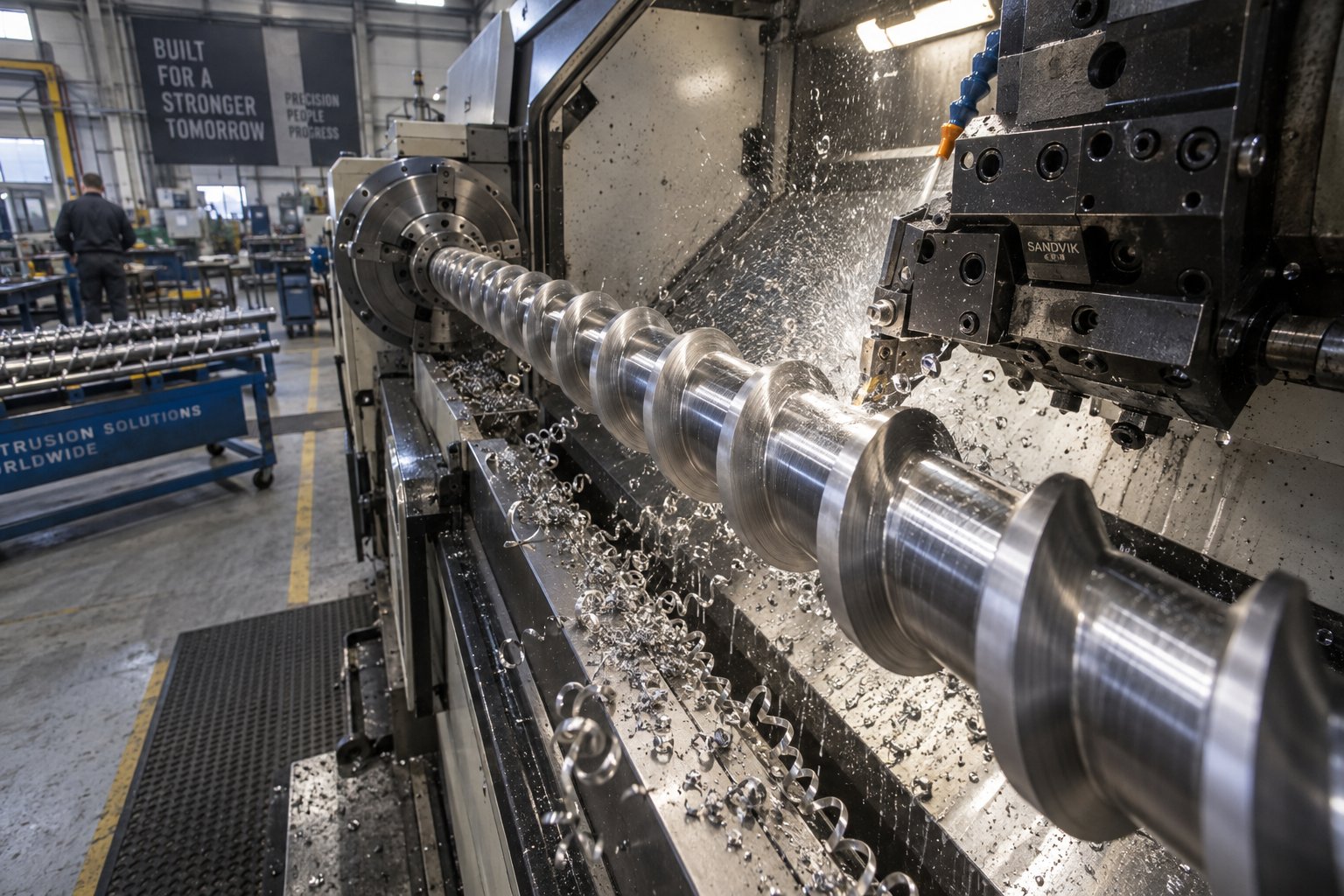
From there, CNC machining takes over. Multi-axis CNC lathes and milling centers cut the flight geometry into the blank - the helical channels, the varying depths across feed, compression, and metering zones, and any barrier or mixing elements specified in the design. CNC machined extruder screw pricing reflects two realities: machine time and tolerance demands. A straightforward single-flight, constant-pitch screw might require a few hours on the machine. A barrier design with variable-pitch mixing elements and tight clearance specifications could require multiple setups and significantly longer cycle times.
Precision grinding follows machining. After the CNC work is complete, the screw's critical surfaces - flight outer diameters, root diameters, and bearing journals - are ground to final dimensional tolerances. Tighter tolerances mean slower grinding passes, more frequent measurements, and higher rejection rates for out-of-spec parts. You will notice this directly in pricing: a screw held to +/- 0.01mm costs meaningfully more to grind than one held to +/- 0.05mm. The performance difference, however, shows up in melt consistency, output stability, and barrel wear rates over the screw's lifetime.
Heat Treatment and Surface Hardening
Raw machined steel, no matter how precisely shaped, will not survive long inside an extruder barrel. The heat treatment extruder screw price component exists because untreated steel lacks the surface hardness needed to resist abrasion from filled polymers, the thermal stability to maintain dimensions at processing temperatures, and the fatigue resistance to handle continuous rotational stress.
Several heat treatment methods are used, each at a different cost and performance level:
Gas nitriding is the most common treatment for shorter screws. The process diffuses nitrogen into the steel surface at elevated temperatures, forming hard nitride compounds. It is effective, well-established, and relatively affordable. However, gas nitriding has practical limitations for very long screws due to furnace size constraints.
Ion/plasma nitriding addresses that limitation. As Advanced Heat Treat Corp. details, tall vertical vacuum chambers can process screws over 40 feet (12 meters) in length. The process uses high-voltage glow discharge to bombard the screw surface with nitrogen ions at temperatures between 950 and 1070 degrees Fahrenheit, forming thermally stable chromium nitrides that endure the elevated temperatures inside operating extruders. A key advantage of plasma nitriding is selective masking - surfaces that do not require hardening can be mechanically shielded, reducing post-treatment finishing work and cost.
Induction hardening offers yet another approach, using electromagnetic fields to rapidly heat specific surface areas before quenching. It is faster than nitriding for localized hardening but does not produce the same depth of case hardening or the corrosion-resistant nitride layer.
Each treatment adds processing time - typically measured in hours for induction hardening and up to days for deep-case nitriding cycles. That time, combined with energy costs, furnace amortization, and metallurgical testing afterward, becomes a definite line item in your screw's final price.
Hard-Facing, Coating, and Final Balancing
For screws destined for abrasive or corrosive applications, heat treatment alone is not enough. Hard-facing the flight tips - the outermost edges that make closest contact with the barrel wall - dramatically extends service life, but it is one of the most labor-intensive steps in the entire production chain.
The hard facing extruder screw cost reflects the manual, skilled nature of the work. A trained welder deposits wear-resistant alloys like Stellite (cobalt-based) or tungsten carbide onto the flight lands using specialized welding techniques. Each bead must be applied with precise heat control to avoid warping the screw or creating micro-cracks in the overlay. Too much heat distorts the geometry you just spent hours machining. Too little heat produces weak adhesion that peels under operating stress.
As Gamp Industries emphasizes, hardfacing can extend the service life of a screw by 3x to 10x compared to an unprotected surface, making the upfront investment a clear net positive when processing abrasive materials. The application technique matters just as much as the alloy selection - precision in this stage directly determines how long that protective layer survives in service.
After hard-facing and any additional coatings are applied, the screw undergoes dynamic balancing. Imagine a screw weighing hundreds of pounds spinning at high RPM inside a barrel with clearances measured in thousandths of an inch. Even minor mass imbalances cause vibration that accelerates wear on both the screw and barrel, increases energy consumption, and degrades melt quality. Balancing involves mounting the screw on precision spindles, measuring rotational imbalance, and selectively removing or redistributing material until the screw spins true. It is a final refinement step that separates production-grade components from bargain alternatives.
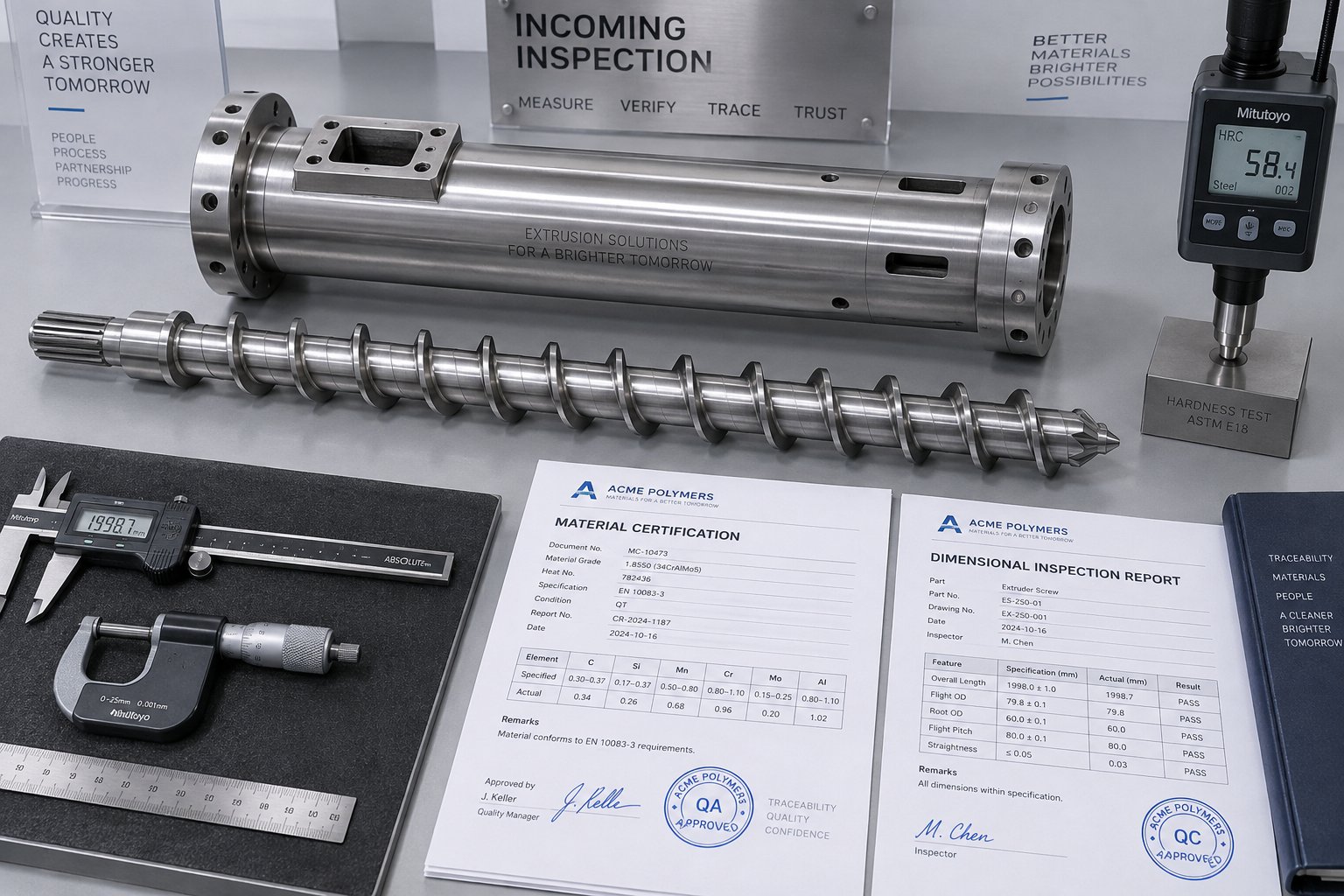
Quality inspection closes the loop. Dimensional verification across the full screw length, surface hardness testing, metallurgical witness sample analysis, and documentation of every specification confirm that the finished screw matches what was ordered. Skipping or rushing inspection saves the manufacturer time - and passes the risk directly to you.
Here is the complete production sequence, laid out in order:
- Raw material selection and incoming material certification
- Forging or rough turning of bar stock
- CNC flight machining (channels, zones, mixing elements)
- Heat treatment (nitriding, induction hardening, or other processes)
- Hard-facing or surface coating application
- Precision grinding to final tolerances
- Dynamic balancing
- Quality inspection and documentation
Every one of these stages carries cost. And here is the critical insight for anyone evaluating a surprisingly low quote: the only way to dramatically cut the price of a finished screw is to skip steps, shorten cycle times, or relax tolerances. A supplier offering a price that seems too good to be true has almost certainly cheapened one or more of these stages. The screw may look identical when it arrives. The difference reveals itself in service - through premature wear, dimensional drift, unplanned downtime, and a replacement cycle that starts far sooner than it should.
Manufacturing quality and total cost of ownership are inseparable. A screw built with care at every stage costs more upfront but runs longer, performs more consistently, and often proves rebuildable when it eventually does wear - compounding its value over years of service. That distinction between purchase price and real-world cost becomes even clearer when you compare pricing across different screw types and size categories.
Extruder Screw Price Ranges Organized by Screw Type and Size
Knowing the materials, geometry, and manufacturing steps behind a screw is valuable - but at some point, every buyer asks the same blunt question: what is the actual single screw extruder price range, and how does it compare to twin screw elements? The problem is that no single catalog page gives you a structured answer. Listings are scattered, inconsistent, and rarely explain why one screw costs three times more than another in the same diameter class.
The framework below organizes pricing by category and size so you can benchmark any quote you receive against realistic market expectations.
Single Screw Extruder Price Ranges by Diameter
Single screws are monolithic components - one continuous piece of steel machined from end to end. Their cost scales primarily with diameter and length, because both dimensions directly increase raw material weight and machining time.
Small-diameter screws (under 50mm) sit at the entry level. These serve lab extruders, pilot lines, and smaller production units. Pricing falls in the low tier for standard nitrided steel versions, though even here, a bimetallic or coated option can push costs into mid-range territory. If you are replacing a screw for a compact single-screw line running unfilled polyolefins, this category represents the most affordable segment.
Mid-range screws (50-120mm) cover the bulk of industrial single-screw extrusion - pipe, profile, sheet, and blown film lines. Material consumption and machining hours climb substantially in this bracket. As Kerke's 2025-2026 market analysis illustrates, even a 75mm screw barrel can range from roughly $280 per piece at bulk volume to over $500 for a single-unit purchase - and that is before factoring in premium alloys or custom geometry. Mid-range diameter screws typically fall into moderate-to-high price tiers depending on material grade and surface treatment selections.
Large-diameter screws (over 120mm) represent the high end. The large diameter extruder screw price escalates steeply because material costs, forging complexity, CNC cycle times, and heat treatment furnace requirements all grow disproportionately. A 200mm screw is not simply "twice the cost" of a 100mm screw - the relationship is closer to exponential. Kerke's market data confirms this pattern: larger screw diameters and higher L/D ratios drive accessory prices into exponential growth.
Twin Screw Elements vs Full Single Screws
Here is where many buyers get confused. Twin screw extruders use modular screw configurations - individual elements (kneading blocks, conveying elements, mixing discs) assembled onto splined shafts. You are not buying one monolithic screw. You are buying dozens of segments, each priced individually.
The twin screw elements cost per segment can seem deceptively low compared to a full single screw quote. A single conveying element might cost a fraction of a complete single screw. But add up 30 to 60 elements across two shafts, and the total often rivals or exceeds the price of a large single screw. The comparison becomes even more misleading when a buyer receives a per-element quote from one supplier and a full-screw quote from another without recognizing the structural difference.
Modular twin screw pricing also behaves differently over time. You can replace individual worn elements rather than the entire assembly, which lowers ongoing maintenance costs. However, specialized elements - reverse-flight segments, narrow kneading blocks for dispersive mixing, or elements machined from premium alloys for corrosive applications - carry significant per-piece premiums. Customized twin screw accessories for special materials like biodegradable compounds or high-filler formulations can cost 50% to 150% more than standard models.
Key Variables That Shift Price Within Each Range
Even within the same diameter category and screw type, prices vary widely. Four variables account for most of the spread:
Order volume matters more than many buyers realize. Purchasing a single replacement screw almost always carries a premium over bulk orders. Market data from 2025-2026 indicates that bulk purchases of 10 pieces or more can yield 10% to 30% discounts compared to single-unit pricing. If your operation runs multiple extruders of the same size, consolidating orders delivers immediate savings.
Customization level is the next major lever. A standard catalog screw with proven geometry costs less than a fully custom extruder screw price estimate for a unique design. Custom work introduces engineering hours, new CNC programming, first-article inspection, and the inherent inefficiency of a one-off production run. The premium for customization can range from 50% above standard pricing for minor modifications to well over 150% for complex, application-specific designs.
Lead time also affects your bottom line. Standard production schedules let the manufacturer optimize their workflow. Rush orders disrupt that optimization, requiring overtime labor, expedited material procurement, and priority scheduling on CNC machines - all of which carry surcharges.
Surface treatments create the final layer of variation. Two identical screws in the same steel grade will carry different prices if one receives standard gas nitriding and the other gets plasma nitriding plus tungsten carbide hard-facing on the flights. The treatment selection should always match your processing application, but be aware that it shifts cost independently of every other variable.
| Screw Category | Typical Diameter Range | Key Price Variables | Relative Price Tier |
|---|---|---|---|
| Small Single Screws | Under 50mm | Material grade, standard vs. custom geometry, surface treatment | Low to Mid |
| Large Single Screws | Over 120mm | Raw material weight, machining hours, heat treatment capacity, hard-facing scope | High to Premium |
| Twin Screw Elements (per segment) | 20-135mm (element OD) | Element type (conveying vs. kneading), alloy grade, order quantity, customization | Low per piece; Mid to High cumulative |
| Specialty / Custom Screws | Any diameter | Engineering time, exotic alloys, certifications (food/medical), tight tolerances, rush lead time | High to Premium |
Notice that the table does not list fixed dollar amounts - and that is intentional. Actual prices fluctuate based on raw material costs, international logistics, and currency exchange rates. Market reference data from 2025-2026 suggests these figures can shift by roughly +/- 15% in either direction depending on timing and sourcing region. What remains stable are the relative relationships: small standard screws will always cost a fraction of large custom ones, and twin screw element totals will always depend on how many segments your configuration requires.
Industrial-scale pricing, however, is only part of the story. A growing segment of buyers is searching for extruder screws at an entirely different scale - desktop filament extrusion - where the cost dynamics follow a completely separate set of rules.
Desktop Filament Extruder Screws vs Industrial Pricing
If you have been researching small-scale extrusion for 3D printing filament production, you have probably noticed that the desktop filament extruder screw price looks nothing like the industrial figures discussed above. That is not an error - it is an entirely different market operating under its own economic logic.
Desktop Filament Extruder Screws and Their Pricing
The desktop filament extrusion space, popularized by brands like Filabot, exists to serve hobbyists, researchers, and small businesses producing custom 3D printing filament. Filabot's EX6 and EX2 product lines use specialized extruder screws engineered specifically for low-output filament production - typically under 5 kg/hr. These screws feature modest diameters, simple single-compression geometries, and materials like chrome-plated or nitrided steel suited for processing common thermoplastics such as PLA, ABS, PETG, and TPU.
As the Dr. D-Flo extrusion guide explains, what makes any extruder screw unique is its high L/D ratio, controlled compression profile, tight barrel clearance, and surface lubricity - properties that hold true whether the screw is 20mm or 200mm in diameter. Desktop screws still require these features, but at a physical scale that demands far less raw material, shorter machining cycles, and simpler heat treatment processes. The Filabot extruder screw replacement cost reflects this: you are buying a precision component, but one that weighs a fraction of an industrial screw and ships in a box rather than on a pallet.
The 3D printing filament extruder screw price also benefits from standardization. Desktop manufacturers produce a limited number of screw configurations designed for their specific machines. Rather than custom-engineering each order, they manufacture standardized replacement parts in predictable batches - spreading tooling and setup costs across many identical units.
Why Desktop and Industrial Screw Prices Cannot Be Compared Directly
Buyers occasionally see a desktop extruder screw listed for a modest sum and wonder why an industrial replacement costs ten or twenty times more for what appears to be "the same thing, just bigger." The comparison breaks down quickly when you examine what each market actually demands.
Industrial screws must survive continuous operation processing abrasive, filled, or chemically aggressive polymers - often running 24/7 for months between maintenance windows. They require premium alloys, hard-faced flight tips, deep-case heat treatments, and tolerances held across lengths exceeding two meters. Desktop screws, by contrast, process relatively forgiving commodity thermoplastics in short runs, with barrel clearances that - while still tight relative to diameter - are far easier and cheaper to achieve at small scale. The Dr. D-Flo guide notes that the radial clearance-to-diameter ratio sits around 0.001 regardless of size, but holding that tolerance on a 25mm bore is a fundamentally different manufacturing challenge than holding it on a 150mm bore over three meters of barrel length.
Here are the key factors that separate small scale extruder screw pricing from industrial pricing:
- Smaller diameter - less raw material, lighter weight, shorter machining time
- Simpler geometry - single compression zone without barrier flights or specialized mixing elements
- Standardized designs - no custom engineering; replacement parts match existing machine specifications
- Lower material costs - chrome plating or basic nitriding rather than bimetallic construction or tungsten carbide hard-facing
- Consumer-level production runs - batch manufacturing spreads fixed costs across many identical units
None of this makes desktop screws "cheap" in a pejorative sense. They are purpose-built for their application, just as a $15,000 industrial screw is purpose-built for its own. The mistake is treating them as points on the same pricing continuum. They belong to separate markets with different material demands, tolerance requirements, and production economics.
Whether you are sourcing a desktop replacement part or a full-size industrial screw, though, one pricing dynamic cuts across every scale: the choice between buying from the original equipment manufacturer and sourcing from an aftermarket or factory-direct supplier. That decision alone can shift your final cost by 30% or more - and the trade-offs involved deserve careful examination.
OEM vs Aftermarket and Factory-Direct Extruder Screw Pricing Dynamics
You need a replacement screw. You know the diameter, the L/D ratio, the material grade, and the geometry. The technical specification is settled. So why do quotes from three different supplier types come back at three wildly different numbers for what appears to be the same component?
The answer has less to do with metallurgy and more to do with supply chain structure. Where your screw comes from - the original equipment manufacturer, a domestic aftermarket shop, or a factory-direct international supplier - reshapes the extruder screw price as dramatically as the material or geometry choices discussed earlier. Understanding this dynamic is one of the fastest ways to reduce procurement costs without sacrificing quality.
OEM Replacement Screws and Their Premium
When your extruder was built by a major OEM, the path of least resistance is ordering the replacement screw directly from that manufacturer. You get guaranteed compatibility, factory-matched tolerances, and documentation that ties neatly into your maintenance records. For many operations, that peace of mind justifies the cost.
But that cost is significant. The OEM extruder screw replacement price typically carries a brand markup that reflects engineering overhead, global distribution networks, warranty programs, and the simple economics of captive demand - you already own their machine, and they know you need their part. Lead times can also stretch longer than expected, especially for less common screw configurations or during periods of high demand. OEM replacement screws may route through regional distributors who add their own margins, compounding the markup before the part reaches your loading dock.
Does the OEM premium guarantee a better screw? Not necessarily. It guarantees a screw built to the original specification, which is valuable. But the specification itself is not proprietary physics - it is a set of measurable dimensions, material grades, and tolerances that any competent manufacturer can replicate. That realization is what drives the aftermarket.
Aftermarket Alternatives and Factory-Direct Sourcing
Aftermarket manufacturers reverse-engineer OEM screw designs and produce compatible replacements - often at prices 20% to 50% below OEM equivalents. Companies in this space build their business models around offering broad compatibility across multiple extruder brands. The aftermarket extruder screw cost savings come from eliminating the OEM's brand premium, reducing distribution layers, and focusing production on the replacement parts market rather than spreading costs across full machine development programs.
Factory-direct sourcing takes this strategy a step further. Instead of purchasing through a domestic aftermarket distributor who still carries overhead for warehousing, sales teams, and local facilities, you source directly from the manufacturing facility itself. This model strips out every intermediary markup between the CNC machine and your receiving department.
NANHAIYA, for example, operates as a factory-direct extruder screw supplier providing custom and replacement screw barrels for both extrusion and injection molding applications. Plastic processors, equipment builders, and maintenance teams work directly with the manufacturing source - specifying dimensions, materials, and treatments without a middleman translating (and marking up) each requirement. This sourcing model is particularly effective for buyers who have complete technical specifications in hand and can manage international logistics.
The trade-off with factory-direct purchasing is straightforward: you gain significant cost advantages and often greater customization flexibility, but you take on responsibility for verifying quality, managing shipping timelines, and handling import logistics that a domestic distributor would normally absorb. For experienced procurement teams, that exchange tilts heavily in favor of savings. For buyers making their first international purchase, it requires a bit more homework upfront.
Geographic Pricing Variations
Sourcing region is the invisible multiplier that many buyers underestimate. A screw manufactured in one country's industrial hub carries a fundamentally different cost structure than the same screw produced in another - not because of quality differences, but because of labor rates, raw material supply chains, energy costs, and manufacturing overhead.
China's Zhoushan region, for instance, has developed into one of the world's most concentrated manufacturing clusters for extruder screws and barrels. Industry listings identify numerous established manufacturers in this corridor, including companies like Zhejiang Zhongyang Screw Manufacturing (operating since 1993) and Zhoushan OSD Machinery, alongside other specialized producers across Nanjing, Shanghai, Guangzhou, and Wuxi. This geographic density creates competitive pressure that benefits international buyers - multiple qualified suppliers competing for the same orders keeps pricing aggressive while driving quality improvements.
European and North American manufacturers, by contrast, operate with higher labor costs, stricter environmental compliance expenses, and typically smaller production volumes for screw-and-barrel components. Their pricing reflects those realities. The screws they produce are not inherently superior - many Chinese manufacturers use identical steel grades, comparable CNC equipment, and equivalent inspection protocols - but the cost basis is structurally different.
The practical implication for buyers comparing quotes across regions? An extruder screw price from a factory-direct international supplier and an OEM quote from a domestic source may differ by 30% to 50% for a technically identical component. The key is ensuring that "technically identical" actually holds true - verifying material certifications, dimensional inspection reports, and heat treatment documentation regardless of where the screw is made.
| Sourcing Model | Typical Lead Time | Relative Price | Customization Flexibility | Quality Assurance Considerations |
|---|---|---|---|---|
| Factory-Direct International (e.g., NANHAIYA) | 3-6 weeks (plus shipping) | Low to Mid | High - custom geometry, materials, and coatings available | Request material certs, hardness reports, dimensional inspection; verify supplier track record |
| Aftermarket Domestic | 2-5 weeks | Mid | Moderate - standard OEM-compatible designs; some custom capability | Established quality systems; easier to audit; domestic warranty and returns |
| OEM Replacement | 3-8 weeks (varies by brand and inventory) | High to Premium | Low - limited to original catalog specifications | Guaranteed OEM compatibility; factory documentation included; brand warranty |
A few patterns emerge from this comparison. Factory-direct sourcing offers the most favorable price-to-customization ratio - you pay less and get more design flexibility. OEM sourcing offers the lowest buyer effort but the highest price and the least room for customization. Aftermarket domestic sits in the middle on nearly every axis, making it a sensible default for buyers who want savings without managing international procurement.
The smartest procurement strategy? Request quotes from all three categories for the same specification. Triangulating across sourcing models reveals the true market price for your screw - and exposes any outlier quotes that are either suspiciously cheap or unjustifiably expensive. When you compare extruder screw price OEM vs aftermarket vs factory-direct on equal technical footing, the differences stop being mysterious and start becoming strategic leverage.
Sourcing strategy shapes your purchase price. But purchase price, as any seasoned maintenance manager will tell you, is only the opening chapter of what a screw actually costs. The real financial story unfolds over months and years of operation - in wear rates, rebuild cycles, unplanned downtime, and the production hours lost to a screw that failed before it should have.
Total Cost of Ownership Beyond the Sticker Price
Here is a scenario that plays out in plastics processing facilities every day: a maintenance team selects the lowest-priced screw on the quote sheet, installs it, and watches it wear out in four months. They order another. Four months later, they order a third. By the end of the year, they have spent more on three budget screws - plus three installation cycles, three production interruptions, and three rounds of process requalification - than a single premium screw would have cost upfront. The extruder screw total cost of ownership had nothing to do with the number on the purchase order. It had everything to do with what happened after the screw went into the barrel.
The cheapest screw you can buy is often the most expensive screw you will own.
Purchase price is the most visible cost and the easiest to compare across quotes. It is also the least reliable predictor of what a screw will actually cost your operation over its full service life. Shifting your evaluation from sticker price to total cost of ownership changes how you read every quote - and often reverses which option looks like the best deal.
Expected Service Life by Material Grade
Think of it this way: a screw is not a consumable you use once and discard. It is a capital component whose value is measured in operating hours delivered per dollar spent. A nitrided steel screw processing unfilled polyethylene might deliver 8,000 to 12,000 hours of reliable service before flight wear degrades output quality. That same nitrided screw processing 30% glass-filled nylon? You might see meaningful wear in under 2,000 hours.
Material grade and manufacturing quality directly determine that wear rate. As Plastics Technology explains, wear begins the moment the screw starts rotating inside the barrel. The original clearances between the flight outer diameter and the barrel wall - typically just 0.001 inch per side per inch of diameter - begin to open. As those clearances increase, melting efficiency drops, and operators start compensating with higher screw speeds, adjusted barrel temperatures, and increased backpressure. These incremental adjustments often go unnoticed until they dramatically impact part quality or productivity.
A bimetallic screw with Stellite or tungsten carbide hard-faced flights running the same glass-filled nylon might deliver 6,000 to 10,000 hours before reaching the same wear threshold. A powder metallurgic tool steel screw could push beyond 15,000 hours. The upfront price difference between these options might be 2x to 4x - but the extruder screw wear life expectancy difference is 3x to 7x. When you divide total cost by hours of productive service, the premium screw frequently delivers the lowest cost per operating hour.
Abrasive fillers accelerate this math dramatically. Industry data indicates that some of the most aggressive fillers can reduce screw and barrel useful life by 50% or more compared to unfilled processing. If your application involves glass fibers, mineral fillers, flame retardants, or recycled material with contaminants, the wear life gap between material grades widens - and the cost-of-ownership argument for higher-grade screws becomes even more compelling.
Rebuild and Recoating Costs vs Full Replacement
When a screw reaches the end of its effective service window, you face a critical decision: replace it entirely or rebuild the existing one? The extruder screw rebuild vs replacement cost comparison is not as straightforward as it seems, because the answer depends heavily on what the screw was made from in the first place.
Rebuilding a worn screw typically involves re-welding the flight tips to restore original outer diameters, re-applying hard-facing alloys, re-grinding to final tolerances, and sometimes re-nitriding the surface. A quality rebuild can restore 80% to 90% of original performance at roughly 40% to 60% of new screw cost - a significant saving, especially on large-diameter components where replacement prices are steep.
But here is the catch: not every screw can be rebuilt. A screw manufactured from quality base steel with proper heat treatment retains enough structural integrity to accept new weld deposits and grinding passes. A budget screw made from inferior steel, with shallow or inconsistent nitriding, may lack the metallurgical foundation to support a rebuild. The flight roots may be worn too thin, the base material too soft to hold new hard-facing, or micro-cracks from poor heat treatment may have propagated through the body. You attempt a rebuild, invest in the labor, and the screw fails again within weeks.
This is one of the hidden costs of cheap extruder screws that purchase-price comparisons never capture. A $3,000 screw that cannot be rebuilt forces a $3,000 replacement. A $6,000 screw that rebuilds successfully for $2,500 - and then runs another full service cycle - delivers dramatically better economics. The rebuildability of a screw is a direct function of its original material quality and manufacturing integrity, which circles back to every cost driver discussed in earlier sections of this guide.
Downtime and Production Loss as Hidden Costs
Imagine your extrusion line stops. Not for a scheduled maintenance window - for an unplanned screw failure. What does that actually cost?
The direct costs are immediate: idle labor, wasted raw material left in the barrel, and the mechanical work required to pull the screw and assess the damage. But the indirect costs dwarf them. Extrusion line downtime costs manufacturers $5,000 to $50,000 per hour depending on line capacity, product type, and market demand. High-speed film and sheet lines can exceed $15,000 per hour in lost production value. Multi-layer barrier film operations - particularly those serving medical or food packaging markets - can see downtime costs exceeding $30,000 to $100,000 per hour when regulatory compliance risks, complex restart procedures, and customer penalty clauses are factored in.
Run those numbers against the price difference between a budget and premium screw. If the premium option costs $4,000 more but delivers an additional 6,000 hours of service life - avoiding even a single unplanned 8-hour shutdown on a mid-size line - the math is not close. That one avoided failure event alone could save $40,000 to $120,000 in downtime costs, dwarfing the screw price differential by an order of magnitude.
The real danger is not a single catastrophic failure, though. It is the slow, invisible degradation that Plastics Technology describes - the gradual process where operators make small compensating adjustments to screw speed, barrel temperature, and backpressure as wear progresses. Each adjustment uses more energy and subtly affects part quality. The impact starts as minimal, but at some point these minor tweaks hit what experts call the "point of diminishing returns" - where machine adjustments can no longer compensate for worn components without measurably impacting production efficiency, cycle time, and scrap rates. By that stage, the cumulative hidden cost has already exceeded what a better screw would have cost upfront.
When you evaluate any extruder screw price, consider the full cost-of-ownership picture:
- Initial purchase price - the quote on the invoice
- Installation cost - labor, machine downtime during changeover, and process requalification
- Expected service life - operating hours before wear reaches the replacement threshold
- Energy efficiency impact - worn screws force higher speeds and temperatures, increasing kWh per kilogram of output
- Rebuild or recoating costs - whether the screw's base material supports a cost-effective refurbishment
- Downtime cost per hour - the full production, labor, and penalty exposure of an unplanned stoppage
- Disposal or recycling value - some premium alloys retain meaningful scrap value at end of life
When every item on that list enters the calculation, the lowest-priced quote rarely produces the lowest total cost. The screw that delivers the most operating hours per dollar - factoring in rebuilds, energy consumption, and avoided downtime - is the one that actually costs the least. Recognizing this distinction does not mean always buying the most expensive option on the table. It means buying the right grade for your application, from a supplier whose manufacturing quality ensures you get the full service life that grade is designed to deliver.
Total cost of ownership gives you the framework for evaluating value. But applying that framework effectively requires one more practical skill: knowing exactly how to request quotes, what information to prepare, and which red flags signal that a supplier's low price is hiding corners that were cut during production.

How to Get Accurate Extruder Screw Quotes and Choose Wisely
Every cost driver covered in this guide - material grade, geometry, manufacturing process, sourcing model, and total cost of ownership - converges at a single practical moment: the quote request. Send a vague email asking for "a price on an extruder screw," and you will receive a vague number that tells you almost nothing. Send a detailed specification package, and you will receive a quote you can actually evaluate, compare, and negotiate with confidence.
The difference between buyers who overpay and buyers who land fair pricing is rarely about negotiation skill. It is about preparation. A complete, well-organized request communicates competence to the supplier, eliminates guesswork from their estimating process, and creates an apples-to-apples foundation for comparing responses across multiple sources. This extruder screw buying guide for processors closes with the exact steps that turn everything you have learned into actionable purchasing decisions.
Specifications to Prepare Before Contacting Suppliers
Think of your quote request as a blueprint. The more complete the blueprint, the more accurate and competitive the pricing you receive. Suppliers who receive incomplete specifications either inflate their quotes to cover unknowns or ask a chain of clarifying questions that delays the process by days or weeks. Either outcome wastes your time and money.
Before reaching out to any supplier, gather these details:
- Screw diameter - the outer diameter of the flights, in millimeters or inches, matching your barrel bore
- L/D ratio or total screw length - specify both if possible, since rounding errors between the two can cause dimensional mismatches
- Material requirements - the steel grade, surface treatment, and any hard-facing specifications needed for your application
- Application details - the polymer type you process, any fillers or additives (glass fiber percentage, mineral loading, flame retardants), and your target output rate in kg/hr
- Order volume - single unit, small batch, or ongoing annual quantity; volume directly affects unit pricing
- Required lead time - standard production schedule versus rush delivery, so the supplier can price accordingly
- Compliance certifications needed - food-contact, medical-grade, RoHS, or other regulatory requirements that affect material selection and documentation
- Whether you need a rebuild or a new screw - rebuilding an existing screw involves different processes, timelines, and pricing than manufacturing from scratch
Items four and five deserve special attention. Telling a supplier you process "30% glass-filled PA66 at 200 kg/hr" immediately signals that you need a wear-resistant material grade - they will not quote you a basic nitrided steel screw that would fail in months. And specifying volume upfront unlocks bulk pricing that many suppliers will not volunteer unless asked. As market data from 2025-2026 indicates, bulk orders of 10 or more pieces routinely yield 10% to 30% discounts compared to single-unit purchases.
If you are replacing an existing screw and do not have all of the original engineering drawings, provide whatever reference you can: the extruder brand and model number, physical measurements taken from the worn screw, or even the worn screw itself shipped to the supplier for reverse engineering. Experienced manufacturers work from all of these reference pathways regularly.
Red Flags and Quality Indicators When Comparing Quotes
You have sent your specification package to several suppliers. The quotes arrive. Some are close in price. Others are dramatically higher or lower. How do you tell which ones represent genuine value and which ones hide problems you will discover only after installation?
Watch for these warning signs when reviewing what to look for in extruder screw quotes:
Vague material specifications. A credible quote names the exact steel grade - AISI 4140, H-13, CPM 9V, or equivalent - and specifies the surface treatment by name and depth. A quote that simply says "hardened steel" or "wear-resistant alloy" without specifics is leaving you no way to verify what you are actually buying. If a supplier cannot or will not name their materials, that ambiguity is intentional.
Missing heat treatment details. Does the quote specify nitriding depth, hardness values (HRc or HV), or the treatment method used? Heat treatment is one of the most commonly cut corners in low-cost screw production. A supplier who omits these details may be skipping or shortening treatment cycles to save time and cost - a savings you will pay for through accelerated wear.
No quality inspection documentation. Professional manufacturers provide dimensional inspection reports, material certifications, and hardness test results as standard deliverables. If a supplier cannot confirm what documentation ships with the finished screw, treat that as a disqualifying gap. You need these records for your own maintenance files and for any future rebuild or warranty discussion.
Unusually low pricing without explanation. Every section of this guide has demonstrated that extruder screw pricing follows a logical chain of material, machining, treatment, and finishing costs. A quote that undercuts competitors by 40% or more without clearly explaining how - perhaps through a different material grade, a simpler geometry, or higher volume production - is almost certainly achieving that price by skipping manufacturing steps. The eight-stage production sequence covered earlier leaves very little room for legitimate cost reduction without sacrificing something that affects service life.
Reluctance to provide references. Ask every shortlisted supplier for contact information of existing customers processing similar materials on similar equipment. Suppliers confident in their work share references willingly. Those who deflect or claim confidentiality restrictions on every customer are hiding a track record that would not survive scrutiny.
On the positive side, quality indicators include detailed line-item quotes that break out material, machining, treatment, and coating costs separately; proactive questions from the supplier about your processing conditions; willingness to discuss screw design optimization for your specific application; and clear documentation of lead times, payment terms, and warranty coverage.
Starting Your Supplier Search
The most effective extruder screw supplier comparison tips come down to one principle: triangulate. Request quotes from at least three different supplier types - OEM, domestic aftermarket, and factory-direct international - for the same specification. This approach reveals the true market price range and immediately exposes any outlier that is either gouging on brand premium or hiding quality compromises behind a suspiciously low number.
For OEM quotes, contact your extruder manufacturer's parts department directly. You will receive guaranteed compatibility and factory documentation, but expect the highest pricing and potentially the longest lead times - especially for less common configurations.
For domestic aftermarket options, seek out specialized screw and barrel manufacturers in your region who produce OEM-compatible replacements. These suppliers typically offer moderate savings with the convenience of local communication, domestic shipping, and easier quality audits.
For factory-direct international sourcing, suppliers like NANHAIYA provide custom and replacement screw barrels manufactured to your exact specifications - serving plastic processors, equipment builders, and maintenance teams who want to work directly with the production source. This model delivers the strongest cost advantage and the greatest customization flexibility, making it especially valuable for buyers who already have complete technical specifications and want to eliminate intermediary markups.
Regardless of which supplier types you engage, apply the same evaluation criteria to every quote. Compare material grades side by side. Verify that heat treatment specifications match. Confirm that inspection documentation is included. And always ask about rebuild capability - a supplier who builds screws with rebuildable base materials and offers rebuild services is signaling confidence in their metallurgy and a commitment to long-term customer value rather than a one-time transaction.
One final consideration that experienced procurement teams understand intuitively: the relationship you build with your screw supplier matters as much as the first purchase order. Screws wear. Barrels wear. Your operation will need replacements, rebuilds, and occasionally urgent turnarounds when an unplanned failure threatens your production schedule. The supplier who responds quickly, provides honest technical guidance, and delivers consistent quality order after order is worth more than the one who offered the lowest price on a single quote. Evaluate accordingly.
An informed buyer with complete specifications will always receive better pricing and faster turnaround than one requesting a vague estimate.
Frequently Asked Questions About Extruder Screw Pricing
1. How much does a replacement extruder screw cost?
Replacement extruder screw prices range from a few hundred dollars for small-diameter, standard nitrided steel designs to over $15,000 for large-diameter, custom-engineered screws built with premium alloys like powder metallurgic tool steel or tungsten carbide hard-facing. The primary cost drivers include screw diameter, L/D ratio, material grade, flight geometry complexity, surface treatments, and whether you source from an OEM, aftermarket supplier, or factory-direct manufacturer such as NANHAIYA (nhyscrews.com/products). Bulk orders of 10 or more pieces can reduce per-unit pricing by 10% to 30%.
2. What is the difference between a nitrided steel and bimetallic extruder screw in terms of price and performance?
Nitrided steel screws sit in the low price tier and work well for non-abrasive polymers like PE, PP, and PS, achieving surface hardness around HRC 55-58. Bimetallic screws cost roughly 1.5x to 3x more because wear-resistant alloys such as Colmonoy or Stellite are welded onto the flight tips, offering dramatically higher abrasion and corrosion resistance. If you process glass-filled or mineral-filled compounds, the bimetallic option typically delivers 3x to 5x longer service life, making it more cost-effective on a per-operating-hour basis despite the higher upfront investment.
3. Is it cheaper to rebuild a worn extruder screw or buy a new one?
A quality rebuild - involving re-welding flight tips, re-applying hard-facing, and re-grinding to original tolerances - typically costs 40% to 60% of a new screw and can restore 80% to 90% of original performance. However, rebuilding only works when the original screw was manufactured from quality base steel with proper heat treatment. Budget screws made from inferior materials often cannot support a rebuild because the base metal is too soft or micro-cracked. Before deciding, have your supplier assess the worn screw's metallurgical condition to determine whether rebuilding is viable.
4. Why is there such a large price difference between OEM and aftermarket extruder screws?
OEM extruder screws carry brand markup covering engineering overhead, global distribution, warranty programs, and captive-market pricing. Aftermarket manufacturers reverse-engineer the same specifications at 20% to 50% lower cost by eliminating those overhead layers. Factory-direct international suppliers like NANHAIYA reduce pricing even further by cutting out intermediary distributors entirely. The technical specifications - dimensions, material grades, tolerances - are measurable and replicable, so the price gap reflects supply chain structure rather than inherent quality differences. Always verify material certifications and inspection documentation regardless of sourcing model.
5. How does screw diameter and L/D ratio affect extruder screw pricing?
Diameter is the most direct cost multiplier because it determines raw material weight, CNC machine size requirements, and machining cycle time. A 120mm screw can cost 5x to 10x more than a 30mm screw in the same material grade. L/D ratio amplifies every expense further - a 36:1 ratio screw uses 50% more material than a 24:1 ratio screw at the same diameter, requiring proportionally more machining, coating, and inspection. The cost relationship is closer to exponential than linear, especially for screws exceeding 120mm diameter or 36:1 L/D ratios.
Written by
Nanhaiya Technical Team
Zhoushan Nanhaiya Plastic Machinery Co., Ltd.
The Nanhaiya technical team supports screw and barrel manufacturing projects through application review, technical communication, custom manufacturing coordination, and production and quality control.
Discuss Your Application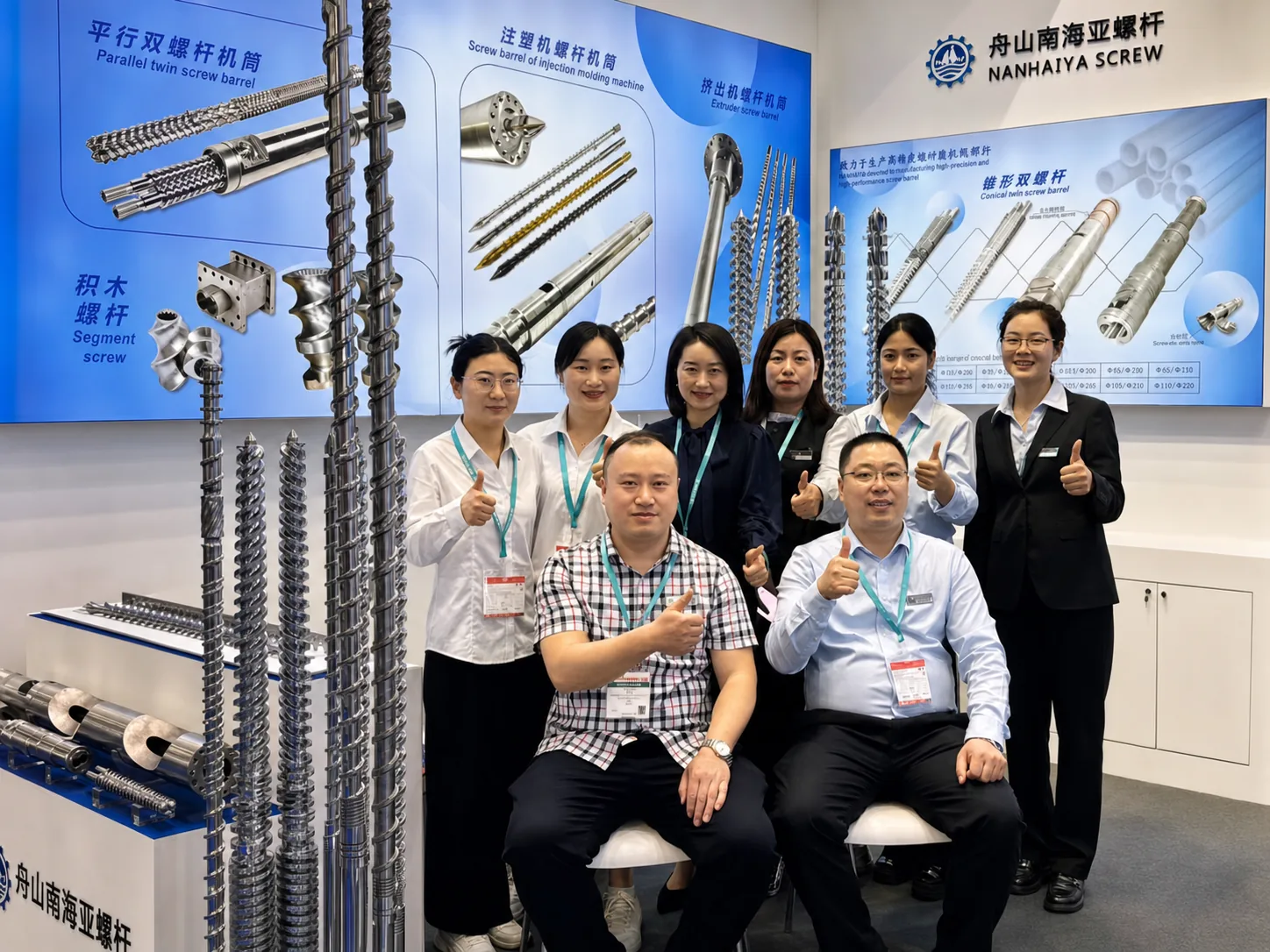
Related Articles
More insights on screw barrel technology and plastics processing.
What Your Single Screw Extruder Manufacturer Won't Tell You
Oct 10, 2026
Learn how to evaluate single screw extruder manufacturers with this buyer-focused guide covering specs, configurations, material matching, and a ready-to-use selection checklist.
Read Article
Plastic Extruder Screw Price Demystified: From Steel To Sticker
Oct 10, 2026
What drives plastic extruder screw price? This independent guide breaks down diameter, L/D ratio, metallurgy, order volume, and total cost of ownership factors.
Read Article
What No Supplier Tells You About WPC Decking Making Machines
Oct 6, 2026
Learn how a WPC decking making machine works, compare extruder types, formulations, and production methods, plus get a buyer checklist to evaluate any supplier.
Read ArticleLooking for something else?
Search by material, symptom or product and jump straight to the relevant page.
These are navigation suggestions based on keyword matching — not a quotation, not a delivery commitment, and not a substitute for engineering review. Final specification is confirmed by our engineers against your drawings and processed material.
Need help with screw barrel selection?
Share your machine model, processed material and application. Our team can help with pricing and technical support.