

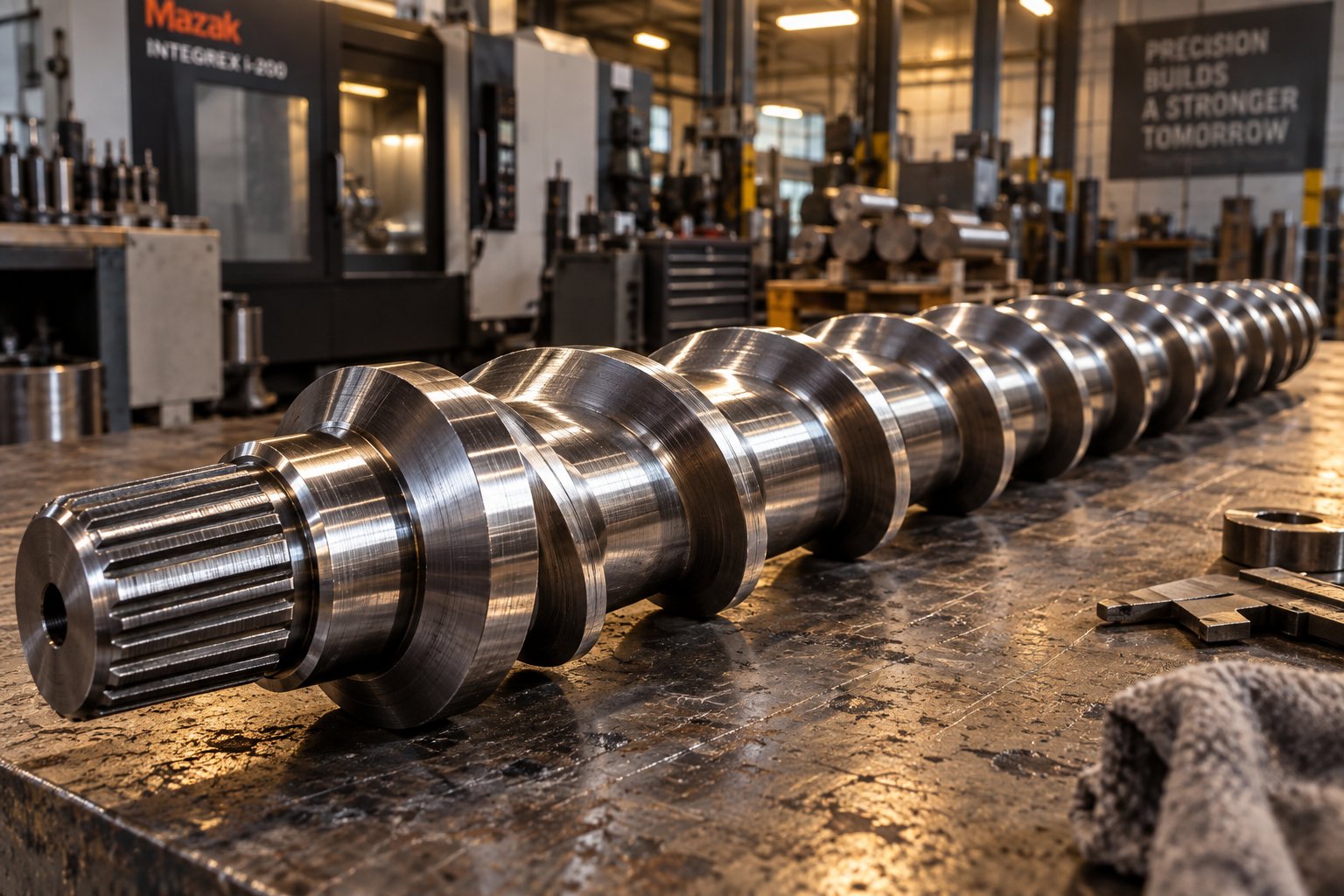
为什么挤出机螺杆材料是塑料加工中最关键的选择
想象一下,你花了六位数买了一台挤出机,结果几个月内螺杆螺纹就磨损了,原因竟然是选错了钢材。这种情况比大多数加工商愿意承认的要常见得多——而且损害远不止螺杆本身。磨损的螺纹会增大螺杆与料筒之间的间隙,降低熔体质量,大幅减少产量,最终还会划伤料筒内衬。一个错误的材料选择会引发一系列连锁反应,而且每生产一小时,问题就会加剧。
挤出机螺杆材质是什么?它为何如此重要?
挤出机螺杆材料是指用于制造螺杆螺纹、螺杆根部和螺杆杆部的基体金属或合金,其选择是为了在特定的聚合物加工条件下抵抗磨损、腐蚀和热降解。
这个定义听起来很简单,但其背后的选择却绝非易事。在运行过程中,挤出机螺杆将塑料物料输送至三个不同的功能区——进料区、压缩区和计量区——这些区域的温度可超过 350°C,熔体压力可超过400 巴(约 6000 磅/平方英寸),并且玻璃纤维或碳酸钙等磨蚀性填料会与螺杆的每个叶片表面摩擦。螺杆的冶金材料必须能够同时且持续地承受这三种应力——高温、高压以及磨蚀或腐蚀性剪切——有时甚至需要数年时间才能完成一次计划更换。
材料选择如何影响产品质量和设备寿命
挤出机螺杆的材质决定的远不止螺杆的使用寿命。它直接影响熔体的均匀性、最终产品的尺寸一致性以及生产线的整体运行成本。挤出聚乙烯(PE)或聚丙烯(PP)等非磨蚀性聚烯烃的加工商,其螺杆可能使用十年之久。而加工磨蚀性或腐蚀性化合物(例如添加矿物填料的聚氯乙烯(PVC)、木塑复合材料或含有污染物的再生原料)的加工商,通常每两到三年就需要更换一次螺杆。两者之间的时间差异很大程度上取决于材料冶金性能。
选择合适的合金也会影响为弥补工艺不稳定性所需的添加剂用量。当螺钉磨损时,操作人员往往会增加添加剂用量或降低进给速度以维持零件质量——这些临时措施会悄然侵蚀利润。在一个有据可查的案例中,用设计合理且材料匹配的螺钉替换磨损的螺钉,使添加剂用量减少了约 30%,不到一年就收回了新螺钉的成本。
Yet most extruder screw material selection guides online read like parts catalogs — lists of steel grades with no framework for deciding which grade fits your specific polymer, filler package, or production target. This article takes a different approach. Rather than handing you a menu, it walks you through a challenge-driven decision framework: understand the metallurgical principles first, map your processing demands second, and then match base material and surface treatment together as a layered defense strategy. The goal is to equip you with the engineering vocabulary and practical logic to evaluate any supplier's datasheet critically — and to stop paying the hidden price of getting this decision wrong.
Metallurgical Fundamentals Behind Screw Material Performance
Steel grades on a datasheet might look like alphabet soup — 4140, 38CrMoAlA, CPM 10V — but buried inside those designations is a story about atoms, crystal structures, and the tiny, ultra-hard particles that actually do the heavy lifting against wear. Understanding even the basics of that story changes the way you evaluate supplier quotes and extruder screw alloy composition. Instead of trusting a salesperson's recommendation on faith, you'll know why one alloy resists glass-fiber abrasion better than another, and whether the premium price tag is justified for your specific application.
Key Alloying Elements and Their Roles in Screw Performance
Every alloying element added to a base iron-carbon matrix serves a specific metallurgical purpose. Some improve hardness; others boost corrosion resistance or help the steel hold its strength at elevated temperatures. When you see a twin screw extruder element material described as "high-alloy tool steel," it simply means the steel carries a deliberate cocktail of these elements in higher concentrations than standard structural grades. Here is what each major player contributes:
- Chromium (Cr): The primary guardian against corrosive attack. Chromium forms a stable oxide layer on the steel surface and combines with carbon to produce M7C3 and M23C6 carbides that resist chemical erosion. In screw steels, chromium content typically ranges from a few percent up to 15% or higher for heavily corrosion-resistant grades. It also enhances hardenability, meaning the steel can achieve full hardness in thicker cross-sections during heat treatment.
- Molybdenum (Mo): The high-temperature workhorse. Molybdenum forms secondary carbides (M2C, M6C) that refine grain structure and enhance hot hardness — the ability to maintain strength at processing temperatures above 300 °C. For screws running engineering plastics like PEEK or PPS, molybdenum content is a critical differentiator between a screw that softens in service and one that holds its edge.
- Vanadium (V): The abrasion fighter. Vanadium forms MC-type carbides (VC) that are among the hardest particles found in any tool steel, with hardness values exceeding 2,800 HV. Even small additions dramatically improve resistance to scoring from mineral fillers like glass fiber and calcium carbonate. Higher-alloy powder metallurgy steels may contain vanadium levels up to several percent for extreme abrasive environments.
- Tungsten (W): A close partner to molybdenum, tungsten also forms hard, thermally stable carbides. Because tungsten diffuses more slowly than molybdenum, its carbides tend to be exceptionally stable at elevated temperatures, making it valuable in screws exposed to sustained high heat. The metallurgical community often uses the equivalence formula Mo + 0.5W to compare the combined contribution of both elements.
- Nickel (Ni): The toughness enhancer. Nickel does not form carbides; instead, it strengthens the steel matrix itself, improving impact resistance and ductility. In corrosion-resistant alloys used for fluoropolymer or PVC processing, high nickel content — sometimes exceeding 50% in specialized nickel-based alloys — provides a dense passivation layer that resists halogen acid attack.
Think of these elements as a team, not individual substitutes. A screw steel loaded with vanadium for abrasion resistance but lacking adequate chromium will fail rapidly if the polymer releases corrosive byproducts. Conversely, a high-chromium stainless grade without meaningful vanadium or tungsten additions will struggle against glass-fiber-filled compounds. The art of extruder screw material selection lies in matching the right balance of these alloying elements to your specific processing environment.
Understanding Carbide Volume Fraction and Tempering Resistance
If alloying elements are the ingredients, carbide volume fraction is the recipe's outcome — and it is arguably the single most important microstructural metric for predicting abrasive wear life. Carbides are microscopic, extremely hard particles dispersed throughout the softer steel matrix. When an abrasive filler particle (say, a strand of chopped glass fiber) slides across a screw flight, it encounters these carbides like tiny speed bumps. The more densely packed the carbides, the less the matrix erodes between them, and the longer the flight surface survives.
Conventional wrought tool steels typically deliver moderate carbide volume fractions because the casting and forging process limits how evenly carbides can be distributed. Powder metallurgy (PM) steels solve this problem. By atomizing molten alloy into fine powder and consolidating it under hot isostatic pressing (HIP), PM processes produce a remarkably uniform carbide distribution with finer particle size. The result is a steel that offers both superior wear resistance and better toughness than a conventionally cast grade of similar composition — a combination impossible to achieve through traditional steelmaking alone.
Equally critical — yet often overlooked — is tempering resistance. Every extruder screw operates at elevated temperatures for extended periods. During that time, the heat slowly degrades the steel's hardness through a process called tempering, in which carbon atoms diffuse out of the hard martensite phase and the microstructure softens. A screw steel with poor tempering resistance might leave the heat-treatment shop at 60 HRC but gradually soften to 52 HRC after months of continuous service at 300 °C. That eight-point drop translates directly to accelerated flight wear. Alloying elements like molybdenum, tungsten, and chromium stabilize carbide structures at elevated temperatures, slowing this softening effect. Some highly alloyed tool steels actually exhibit "secondary hardening" — a phenomenon in which fine alloy carbides precipitate during tempering and increase hardness rather than reducing it.
The practical takeaway? When comparing two candidate steels for your extruder, don't just look at room-temperature hardness on the spec sheet. Ask what hardness the material retains at your actual processing temperature after thousands of hours. That sustained hot hardness, driven by carbide volume fraction and tempering resistance, is what separates a screw that lasts four years from one that needs replacement in eighteen months.
With these metallurgical principles as your foundation, the next step is seeing how they translate into real-world material categories — from basic carbon steels all the way to advanced powder metallurgy alloys and bimetallic constructions — each offering a different balance of performance, cost, and application fit.
Complete Comparison of Extruder Screw Material Categories
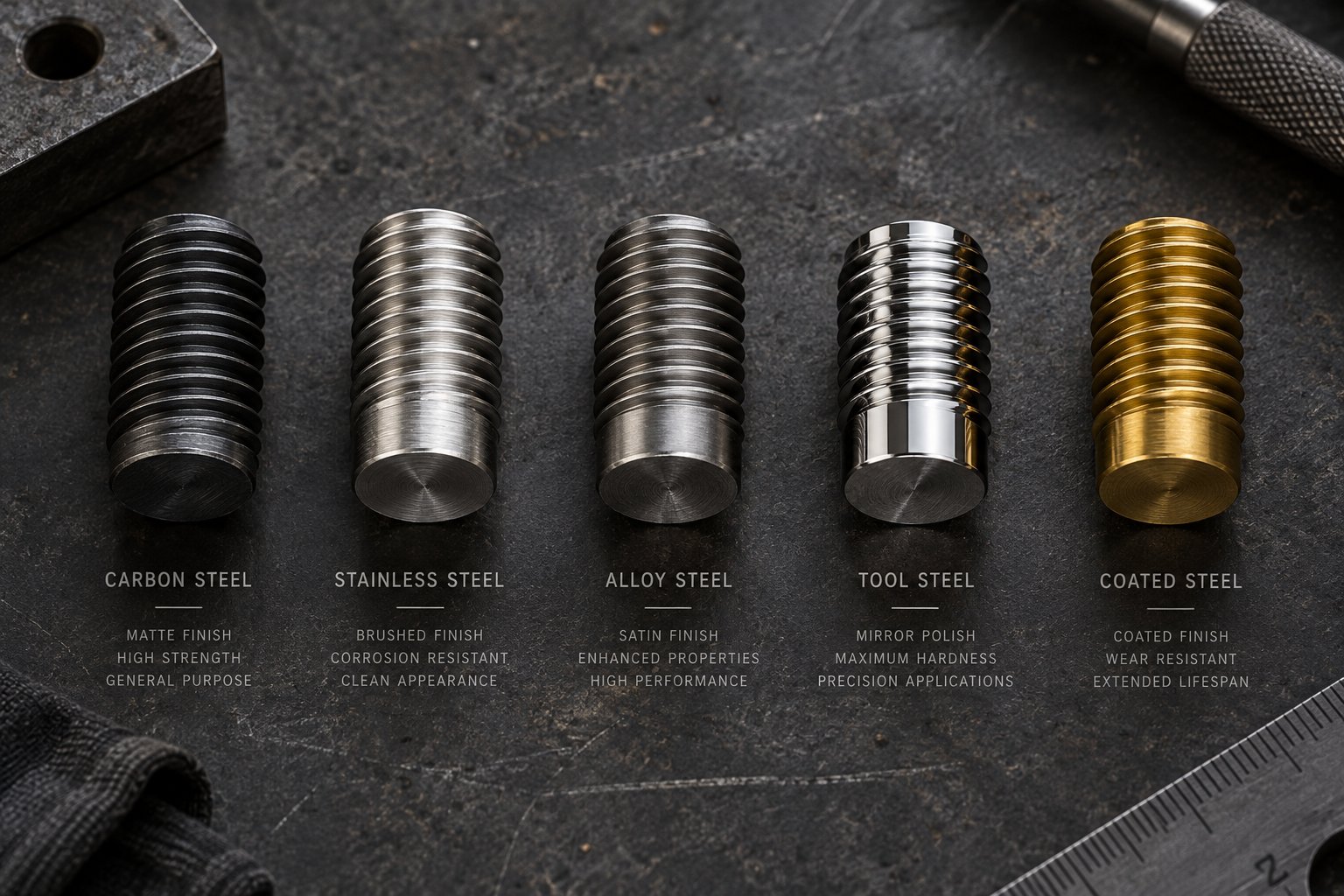
Knowing what alloying elements do at the atomic level is valuable, but at some point you need to translate that knowledge into a purchasing decision. Which material category actually fits your line? The answer depends on a combination of polymer chemistry, filler abrasiveness, operating temperature, and — inevitably — budget. Below is a side-by-side comparison that puts every major extruder screw barrel material category on a single page so you can weigh the trade-offs at a glance.
Major Extruder Screw Material Categories at a Glance
| Material Category | Typical Grades | Approx. Hardness Range (HRC) | Wear Resistance | Corrosion Resistance | Relative Cost Tier | Best-Fit Applications |
|---|---|---|---|---|---|---|
| Carbon Steel | 1045 (45#) | 20–30 | Low | Low | $ | Low-speed, non-abrasive polyolefins; prototype or short-run work |
| Alloy Steel (Through-Hardened) | 4140, 4340 | 28–35 | Medium | Low | $$ | General-purpose PE, PP, PS extrusion without aggressive fillers |
| Nitrided Alloy Steel | 4140 nitrided, Nitralloy 135M (Nit135M), 38CrMoAlA | 50–70+ (surface) | Medium–High | Medium | $$ | Moderately abrasive compounds; twin screw extruder barrel material pairing for standard filled resins |
| Tool Steel | D2, H13, M2 | 58–65 | High | Low–Medium | $$$ | Glass-filled nylons, highly abrasive mineral-filled compounds, high-temperature engineering resins |
| Stainless Steel | 17-4PH, 316, 420 | 28–45 | Low–Medium | High | $$$ | PVC, PVDF, fluoropolymers; FDA/food-grade processing |
| Powder Metallurgy (PM) Steel | CPM 9V, CPM 10V, CPM S90V | 58–65+ | Very High | Low–Medium | $$$$ | Extreme abrasion — heavily glass-filled engineering resins, mineral concentrates, recycled streams with metal contaminants |
| Bimetallic Alloy Construction | Nickel-boron overlay, tungsten carbide matrix, Colmonoy, Stellite hardfacing | 55–72 (overlay layer) | Very High | Medium–High | $$$–$$$$ | High-output lines running filled or corrosive polymers where both toughness and surface hardness are critical |
A few patterns jump out immediately. At the lower end, plain carbon and through-hardened alloy steels like AISI 4140 and 4340 dominate general-purpose extrusion because they offer an acceptable balance of machinability, cost, and baseline strength. Adding a nitriding treatment to these same alloys vaults their surface hardness into the 50–70+ HRC equivalent range — a dramatic improvement without changing the base steel or the screw's ductile core. At the premium end, powder metallurgy steels and bimetallic overlays occupy the territory where filler loads, operating temperatures, or corrosive byproducts would destroy conventional grades in a matter of months.
Powder Metallurgy and Bimetallic Alloys Explained
If conventional tool steel is a concrete sidewalk, powder metallurgy steel is engineered aggregate — every particle intentionally sized, uniformly distributed, and bonded under enormous pressure. The PM process atomizes molten alloy into fine droplets that solidify as tiny, compositionally uniform spheres. Those spheres are then consolidated under hot isostatic pressing, producing a billet with a carbide distribution far finer and more consistent than anything achievable through traditional casting and forging.
Why does that matter for your extruder? Consider the popular powder metallurgy extruder screw steel grades in the CPM family. CPM 10V, originally patented in 1978 and assigned the AISI designation A11, packs roughly 16–18% vanadium carbide by volume into its microstructure — all in the form of extremely hard VC particles. That concentration delivers wear resistance several times greater than D2 while maintaining comparable or even better toughness, a combination impossible in conventionally processed high-vanadium steels where large, clustered carbides would cause brittleness and cracking during forging. CPM 9V is essentially a reduced-carbon variant of 10V, trading some maximum hardness potential for improved machinability when extreme hardness is not required. CPM S90V pushes the concept further with both high vanadium and elevated chromium content, adding meaningful corrosion resistance — a useful advantage when processing halogen-bearing polymers or in humid plant environments.
Bimetallic screw construction takes a fundamentally different approach. Instead of making the entire screw from one premium alloy, manufacturers start with a tough, ductile core — often 4140 or 4340 steel — and then apply a wear-resistant alloy to the flight surfaces through weld overlay, centrifugal casting, or thermal spray. Common overlay alloys include nickel-boron compositions (marketed under trade names like Colmonoy), cobalt-based Stellite alloys, and tungsten carbide matrix composites. The result is a screw with the shock resistance of a ductile steel backbone and the surface durability of a superalloy — at a cost significantly below manufacturing the entire screw from solid tool steel or PM steel.
When does bimetallic construction make more sense than a through-hardened or nitrided option? Three scenarios stand out:
- Mixed wear and corrosion environments — such as PVC lines with moderate mineral filler — where the overlay alloy provides both chemical resistance and abrasion defense in a single layer.
- Large-diameter or long screws — where the cost of machining an entire screw from premium tool steel or PM steel becomes prohibitive, but flight surfaces still demand extreme hardness.
- Rebuild economics — worn bimetallic flights can often be stripped and re-overlaid, restoring the screw to near-original performance at a fraction of new-screw cost.
Ultimately, choosing among these categories is not about picking the "best" material in absolute terms. It is about matching the right combination of core strength, surface hardness, and chemical resistance to the specific polymer and filler chemistry you run every day. And because no base material alone can address every threat, the next critical layer of that defense strategy involves surface treatments and coatings — technologies that can multiply a mid-range steel's performance well beyond what its base chemistry alone would suggest.
International Material Standards Cross-Reference for Extruder Screws
You have identified the right material category for your application, settled on a surface treatment strategy, and now you are ready to request quotes. Then a supplier in China sends a proposal listing "38CrMoAlA" as the screw steel — and suddenly you are staring at a designation that does not appear anywhere on your internal spec sheet. Sound familiar? For anyone sourcing globally, navigating between Chinese GB designations and Western equivalents is a routine headache. An accurate extruder screw steel grade cross reference eliminates guesswork and prevents costly material mismatches before a single billet is cut.
Chinese GB Steel Grades and Their AISI and DIN Equivalents
China's GB/T standards cover the full spectrum of carbon, alloy, nitriding, tool, and stainless steels used in screw manufacturing. Many of these grades map closely — though not identically — to AISI, DIN/EN, and JIS designations that Western and Japanese engineers already know. The table below cross-references the most common steels you will encounter when evaluating china extruder screw material quotes.
| GB / Chinese Grade | AISI / SAE (USA) | DIN / EN (Europe) | JIS (Japan) | Primary Application Context |
|---|---|---|---|---|
| 45# | 1045 | C45E / 1.1191 | S45C | Economy screws for non-abrasive polyolefins; low-cost twin screw extruder shaft material |
| 40Cr | 5140 | 41Cr4 / 1.7035 | SCr440 | General-purpose screws with moderate hardness after quench and temper |
| 42CrMo | 4140 | 42CrMo4 / 1.7225 | SCM440 | Workhorse alloy for through-hardened and nitrided screws; broad polymer compatibility |
| 40CrNiMoA | 4340 | 36CrNiMo4 / 1.6565 | SNCM439 | High-toughness screws for impact-prone or high-torque twin screw applications |
| 38CrMoAlA | Nitralloy 135M (closest equivalent) | 34CrAlMo5 / 1.8507 | SACM645 | Purpose-built nitriding steel; exceptional surface hardness for abrasive filled resins |
| Cr12MoV | D2 | X153CrMoV12 / 1.2379 | SKD11 | High-carbide tool steel for severe abrasion — glass-filled nylons, mineral concentrates |
| 4Cr5MoSiV1 | H13 | X40CrMoV5-1 / 1.2344 | SKD61 | Hot-work tool steel for screws exposed to sustained high temperatures (PEEK, PPS) |
| 0Cr17Ni4Cu4Nb | 17-4PH (S17400) | X5CrNiCuNb16-4 / 1.4542 | SUS630 | Precipitation-hardened stainless for PVC, fluoropolymers, and FDA-grade processing |
A few entries deserve closer attention. The 38CrMoAlA extruder screw equivalent in the AISI system is commonly cited as Nitralloy 135M, yet the two grades are not interchangeable on paper. Nitralloy 135M specifies tighter aluminum and nitrogen ranges optimized for gas nitriding response, while 38CrMoAlA follows GB/T 3077 chemistry tolerances that can be slightly broader. Similarly, AISI 4140 and GB 42CrMo are considered functional equivalents, but minor differences in allowable sulfur, phosphorus, and residual element limits mean the two grades may behave differently during heat treatment or in corrosive environments.
How to Read Cross-Standard Material Datasheets
Imagine you receive two datasheets — one from a Chinese mill listing 42CrMo, and one from a European supplier listing 42CrMo4. The grade names look almost identical. Does that mean the steels are the same? Not necessarily. Here is a practical approach to comparing them without getting lost in fine print:
- Compare chemistry ranges, not just nominal compositions. Look at the allowable minimums and maximums for carbon, chromium, and molybdenum. A Chinese 42CrMo billet with carbon at the upper end of its GB range may respond differently to quench-and-temper than a European 42CrMo4 billet at the lower end of EN 10083.
- Check cleanliness and inclusion standards. GB, ASTM, and EN standards each define different acceptance criteria for non-metallic inclusions (sulfides, oxides). Higher inclusion content reduces fatigue life — a real concern in screw roots subjected to cyclic bending loads.
- Verify heat-treatment protocols independently. Two nominally equivalent steels can deliver significantly different hardness and toughness profiles if one supplier tempers at 550 °C and another at 620 °C. Always request the actual heat-treat record, not just a grade name.
- Request a Mill Test Certificate (MTC). An MTC documents the actual chemical analysis and mechanical test results for your specific heat of steel — far more reliable than relying on catalog equivalence tables alone.
Grade equivalence is a starting point, never a guarantee. Treat cross-reference tables as a communication bridge between your engineering requirements and a supplier's inventory, and always validate critical properties through independent testing or certified documentation. This discipline becomes even more important when the screw's surface — not just its base steel — determines whether your process thrives or fails under real-world conditions.
Surface Treatments and Coatings as a Screw Material Strategy
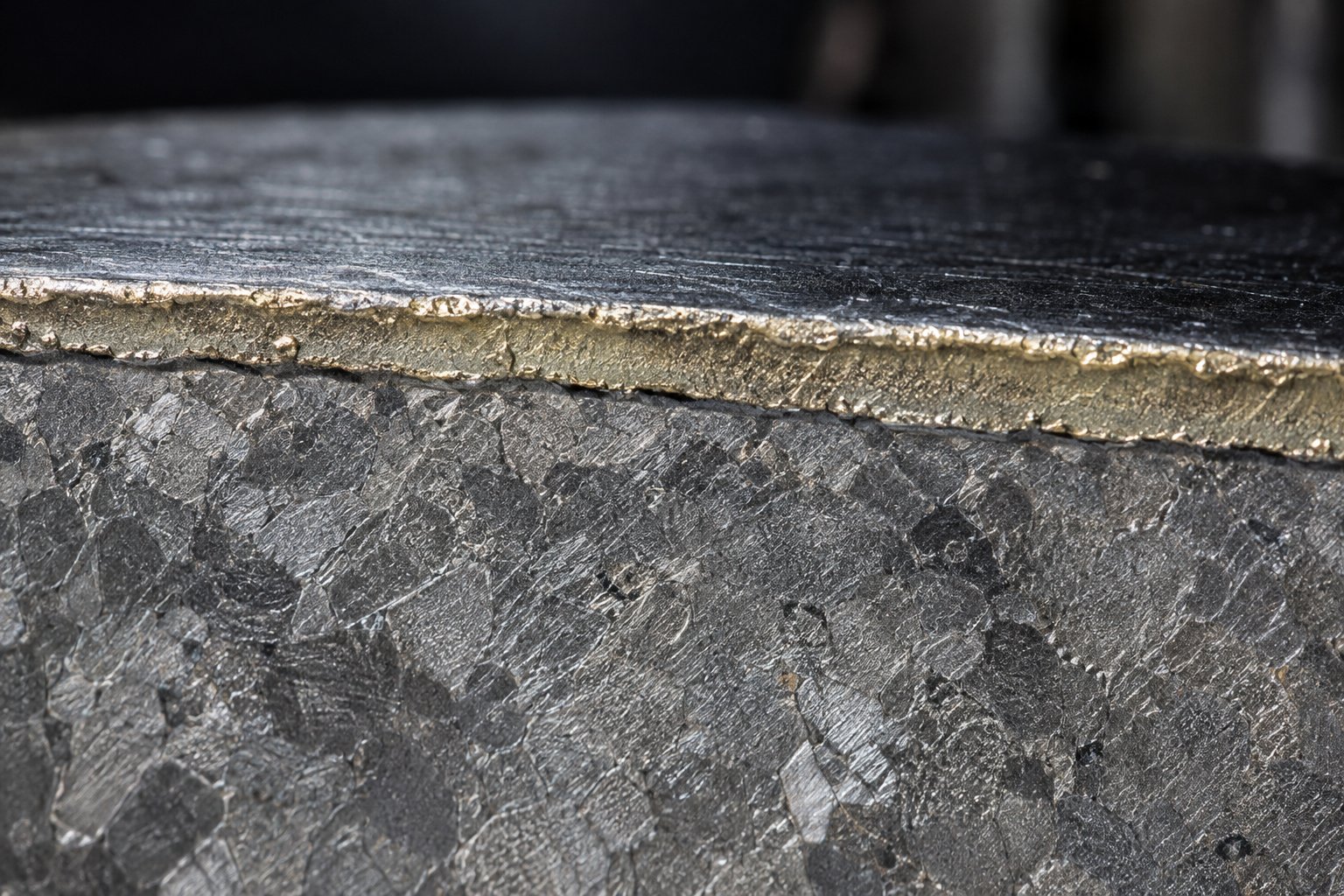
Base steel selection gets most of the attention during the specification process, yet the surface of the screw — the few tenths of a millimeter that actually contact the polymer melt and its abrasive fillers — often matters more. A mid-range alloy steel paired with the right surface treatment can outperform a premium tool steel running uncoated, at a fraction of the total cost. That insight flips the conventional material-first hierarchy on its head and opens a much wider design space for processors who treat coatings as a strategic layer rather than an afterthought.
Nitriding and Chrome Plating for Standard Applications
Nitriding remains the most widely used nitriding extruder screw surface treatment in the industry, and for good reason. The process diffuses nitrogen into the steel surface at temperatures between roughly 950 and 1,070 °F (510–575 °C), forming hard nitride compounds — primarily chromium nitrides (CrN) in alloy steels — without distorting the screw or requiring a quench. Two main variants serve different operational needs:
- Gas nitriding — the screw sits in an ammonia-rich atmosphere inside a sealed furnace. It works well for shorter screws and standard alloy steels like 4140. Surface hardness on 4140 after gas nitriding typically reaches the mid-50s HRC equivalent, with a diffusion-hardened case depth that resists moderate abrasion and improves fatigue strength at flight roots.
- Ion/plasma nitriding — the screw acts as a cathode inside a vacuum chamber, and high-energy nitrogen ions bombard the surface under glow-discharge conditions. This variant offers precise control over case depth and compound-layer composition, plus the ability to mask surfaces that should remain unhardened. Advanced Heat Treat Corp. reports that ion-nitrided Nitralloy 135M and H-13 steels exceed 70 HRC equivalent surface hardness, making them viable for demanding abrasion applications. Vertical vacuum vessels at specialized facilities can handle screws over 40 feet long — a critical capability for large single-screw extruders.
Chrome plating, by contrast, deposits a thin layer of hard chromium electrochemically. It provides decent corrosion protection and a low-friction surface that aids polymer release, but the coating is relatively thin — typically 25 to 125 microns — and can exfoliate under thermal cycling because chromium and steel have different coefficients of thermal expansion. For standard polyolefin extrusion with minimal filler content, chrome plating remains a cost-effective option. For anything more aggressive, its limitations show quickly.
Advanced Coatings — PVD, HVOF Tungsten Carbide, and Nickel-Based Hardfacing
When standard nitriding or chrome plating cannot keep pace with the wear environment, three advanced coating families step in — each targeting a different balance of hardness, adhesion, and chemical resistance.
Physical Vapor Deposition (PVD) applies ultra-thin ceramic films — commonly titanium nitride (TiN) or chromium nitride (CrN) — to the screw surface in a vacuum chamber at relatively low temperatures (typically 200–500 °C). These coatings are extremely hard (often exceeding 2,000 HV) yet only a few microns thick, so they excel at reducing adhesive wear and polymer sticking without altering screw dimensions. PVD coating for extruder screw wear resistance is particularly effective where galling between the screw flight and barrel is the primary failure mode, or where low-friction surfaces are needed to process sticky resins.
HVOF (High Velocity Oxygen Fuel) tungsten carbide thermal spray occupies the opposite end of the thickness spectrum. In this process, tungsten carbide powder — often in a WC-Co or WC-Co-Cr cermet formulation — is propelled at supersonic velocities of 400 to 800 m/s onto the screw surface. The result is a dense coating with porosity below 1%, bond strength exceeding 83 MPa, and wear resistance four to five times greater than hard chrome plating. HVOF tungsten carbide coating on an extruder screw creates a virtually armor-plated flight surface that can handle heavy glass-fiber and mineral-filler loading. The coating thickness generally ranges from 0.1 to 0.5 mm, thick enough to provide meaningful service life but requiring careful engineering to avoid residual-stress-driven spallation.
Nickel-based and cobalt-based hardfacing alloys — sold under trade names like Colmonoy (nickel-based) and Stellite (cobalt-based) — are applied via weld overlay or spray-and-fuse methods to build up heavily worn flight surfaces or to protect new screws destined for aggressive service. These extruder screw hardfacing materials form a metallurgical bond to the base steel, which provides stronger adhesion than mechanical-bond coatings but requires skilled application to avoid heat-affected-zone cracking. Nickel-based alloys like Colmonoy 88 tend to be harder and better suited for abrasive wear, while cobalt-based Stellite alloys offer superior ductility and metal-to-metal wear performance — an important distinction when screw-to-barrel contact is the primary concern.
| Surface Treatment Method | Typical Thickness | Surface Hardness Achieved | Wear Type Best Addressed | Temperature Limit | Relative Cost |
|---|---|---|---|---|---|
| Gas Nitriding | 0.1–0.5 mm case depth | 55–60 HRC equiv. (on 4140); 70+ HRC equiv. (on Nit135M, H13) | Abrasive, adhesive | ~500–550 °C (limited by steel temper) | $ |
| Ion/Plasma Nitriding | 0.1–0.7 mm case depth | 60–72 HRC equiv. (material-dependent) | Abrasive, adhesive, mild corrosive | ~500–550 °C | $$ |
| Chrome Plating (Hard Cr) | 25–125 µm | 65–72 HRC | Adhesive, mild corrosive | ~425 °C (risk of exfoliation above) | $$ |
| PVD — TiN / CrN | 1–5 µm | 2,000–3,000 HV | Adhesive, mild abrasive | 500–600 °C | $$$ |
| HVOF Tungsten Carbide (WC-Co-Cr) | 0.1–0.5 mm | 1,000–1,400 HV | Severe abrasive | ~500 °C (binder-dependent) | $$$$ |
| Nickel-Based Hardfacing (e.g., Colmonoy) | 0.5–3.0 mm | 55–62 HRC | Abrasive, corrosive | ~650 °C | $$$ |
| Cobalt-Based Hardfacing (e.g., Stellite) | 0.5–3.0 mm | 38–55 HRC | Adhesive (metal-to-metal), impact | ~800 °C | $$$$ |
Scan the table vertically and a key principle emerges: no single treatment dominates every column. PVD coatings deliver extreme hardness but cannot absorb heavy abrasion because they are only microns thick. HVOF tungsten carbide handles severe abrasion brilliantly yet struggles on complex internal geometries because the spray process requires direct line of sight. Nickel-based hardfacing builds thick, chemically resistant layers but demands careful welding technique to avoid compromising the base screw's core toughness.
The real power comes from pairing the right base material with the right surface treatment — a layered defense strategy. Consider a practical example: a 4140 alloy steel screw (moderate cost, excellent toughness) ion-nitrided to 65+ HRC equivalent on its flight surfaces delivers performance that rivals a solid D2 tool steel screw at perhaps half the material cost. For even more aggressive environments, starting with an H13 or Nitralloy 135M base and adding HVOF tungsten carbide to the high-wear metering zone creates a screw that resists both thermal softening and severe abrasive attack — something neither the base steel nor the coating could achieve alone.
This layered thinking shifts the entire material selection conversation from "which single alloy is best?" to "which base-plus-surface combination delivers the longest service life per dollar?" And that question can only be answered by first identifying the specific processing challenge your screw faces — abrasive fillers, corrosive off-gases, extreme temperatures, or contaminated recycled feedstock — each of which demands a different defensive formula.
Matching Screw Materials to Your Toughest Processing Challenges
You now know the base material categories, the surface treatment options, and how to read cross-standard datasheets. But here is the question that actually matters when you are standing on the plant floor: what combination do I need for the polymer I run today? Material catalogs organize information by steel grade. Your production problems, however, organize themselves by the chemistry coming out of the hopper. Abrasive glass fibers, corrosive off-gases, extreme barrel temperatures, mystery contaminants in recycled feedstock — each threat attacks the screw differently, and each demands a different defensive formula. Below, the conversation flips from material-out to challenge-in.
Screw Materials for Abrasive Glass-Filled and Mineral-Filled Polymers
Glass fiber, calcium carbonate, talc, mica, wollastonite — these fillers transform a relatively gentle polymer melt into a slurry that grinds flight surfaces like liquid sandpaper. The damage is overwhelmingly abrasive wear, concentrated in the feed section and early transition zone where solid pellets have not yet melted and filler particles sit exposed on pellet surfaces, scraping directly against bare steel. Research by Timothy Womer confirms that fillers like mica and fiberglass cause aggressive wear starting around the third or fourth screw turn, precisely where solid pellets press hardest against the screw root before a melt film develops to lubricate contact.
What materials can a conical twin screw extruder process in this category? Anything from 20% talc-filled PP to 50% glass-filled nylon — provided the screw metallurgy and coating keep pace with the filler's abrasiveness. Here are the proven pairings for mineral- and glass-filled compounds:
- Moderate filler loads (up to ~20% by weight): Nitrided alloy steel (38CrMoAlA or Nitralloy 135M) provides a cost-effective baseline. The nitrided case — hardened to roughly 60–70 HRC equivalent at a depth of 0.015 to 0.020 inches — resists early-stage abrasion. Keep in mind that once this thin case wears through, the softer base metal erodes rapidly, so periodic inspection is essential to catch the transition before catastrophic wear sets in.
- Heavy filler loads (20–40%): Tool steel screws (D2 or H13) or PM steels like CPM 9V offer high carbide volume fractions that resist scoring far longer than nitrided alloy steels. In the highest-wear zones — typically the feed section root — J-groove welding with a hard overlay such as Stellite 6 (38–42 HRC) adds localized protection without reworking the entire screw.
- Extreme filler loads (40%+ glass fiber or mineral concentrates): PM steels like CPM 10V paired with HVOF tungsten carbide spray on flight lands deliver the highest abrasive wear life available. Alternatively, full encapsulation — machining the screw root deeper than final geometry, then building up with a tungsten carbide matrix material — provides both root and flight protection in a single construction.
The key principle across all three tiers is straightforward: the higher the filler load, the higher the carbide volume fraction your screw surface needs. Jumping straight to PM steel for a lightly filled compound wastes money. Running a nitrided alloy screw against 50% glass-filled PA66 wastes the screw.
Corrosion-Resistant Materials for PVC and Fluoropolymer Processing
Corrosive polymers present a completely different attack vector. PVC releases hydrochloric acid (HCl) during thermal degradation; fluoropolymers like PVDF and PTFE can generate hydrofluoric acid (HF) — one of the most aggressive acids in industrial chemistry. Acetal resins add formic acid to the list. These acids do not wear the screw mechanically; they dissolve it chemically, thinning flight lands from underneath and pitting the root in patterns that look nothing like abrasive scoring.
Standard nitrided steel, tool steel, and alloy steel are all vulnerable to halogen acid attack. For PVC cable material processing — whether on a twin screw extruder or a single-screw line — corrosion resistance must be the primary selection criterion, not hardness.
- Standard PVC compounds (rigid and flexible): Stainless steel screws in 17-4PH or 420 stainless provide baseline acid resistance. Pairing the stainless base with a nickel-based hardfacing like Colmonoy 56 on flight lands adds abrasion defense for filled PVC formulations without sacrificing corrosion protection.
- Fluoropolymers (PVDF, PTFE, FEP): High-nickel alloys dominate this space. Bimetallic barrel linings with nickel-rich boron alloy matrices paired with screws hardfaced in Colmonoy 83 deliver the layered acid resistance needed against HF. One documented case study showed that switching to bimetallic liners and Colmonoy 83 screw hardfacing for fluoropolymer processing increased equipment lifespan by 30% and improved production efficiency by 20%.
- Acetal and other acid-generating resins: Nickel-plated or chrome-plated alloy steel screws handle light-duty corrosion. For higher-volume or continuous production, stainless base steels with PVD CrN coatings offer both chemical inertness and improved polymer release.
A critical design detail often overlooked in corrosive-polymer applications is thermal expansion mismatch. When a screw and barrel are made from different alloys — common in bimetallic constructions — their coefficients of thermal expansion (CTE) may differ enough to cause gap variations during processing. At fluoropolymer temperatures, those variations can close the gap entirely, leading to metal-to-metal seizure and catastrophic thread damage. The solution is material matching: selecting barrel and screw alloys with similar CTEs and maintaining screw-barrel clearance at approximately 1/1000 of the barrel diameter.
High-Temperature and Recycled Resin Considerations
Engineering plastics like PEEK, PEI (Ultem), and PPS routinely process above 350 °C, with PEEK requiring barrel temperatures as high as 400 °C. At those sustained temperatures, the screw's hardness is under constant thermal siege. Alloys with poor tempering resistance — even some tool steels — gradually soften in service, losing several HRC points over a few thousand production hours. That softening accelerates adhesive and abrasive wear simultaneously.
- Sustained processing above 350 °C (PEEK, PEI, PPS): Hot-work tool steels like H13 (4Cr5MoSiV1 in GB nomenclature) form the preferred base because their molybdenum and vanadium content stabilizes hardness at elevated temperature through secondary hardening. Cobalt-based Stellite hardfacing on flight tips withstands service temperatures up to approximately 800 °C, far exceeding any engineering polymer's processing window. For the barrel side, hot isostatic pressed liners offer improved longevity by eliminating porosity that would otherwise become nucleation sites for thermal fatigue cracks.
- Plastic twin screw PET sheet extrusion: PET processes at moderately high temperatures (260–290 °C) but is hygroscopic and can generate acetaldehyde and minor acidic degradation products. Nitrided H13 or bimetallic constructions with nickel-boron overlays handle the combined thermal and mild-corrosive demand effectively.
Recycled and post-consumer resins introduce a wildcard that conventional material selection charts rarely address. The incoming feedstock is unpredictable — contaminated with paper labels, aluminum foil fragments, staples, sand, glass fines, and degraded polymer fractions of unknown origin. Each contaminant attacks the screw differently: metal fragments cause impact damage and localized gouging; sand and glass fines produce abrasive scoring; degraded polymers may release unexpected acidic byproducts.
- Post-consumer recycled (PCR) streams: PM steels like CPM 10V or CPM 9V provide the high carbide density needed to shrug off random hard-particle impacts. HVOF tungsten carbide coatings on metering-zone flights add a second armor layer where melt pressure concentrates contaminants against flight surfaces. For lines running heavily contaminated feedstock, full screw-root encapsulation with tungsten carbide matrix material — applied via spray-weld and fuse — protects the areas most vulnerable to scoring.
- Mixed recycled streams with unknown corrosive content: Add a stainless or high-nickel base alloy to the specification. CPM S90V, with its elevated chromium content, provides both extreme abrasion resistance and meaningful corrosion defense — a rare combination ideally suited for recycled streams where the chemical profile changes from load to load.
Food-Grade and Pharmaceutical Compliance
A fifth challenge category sits outside the wear-and-corrosion conversation entirely: regulatory compliance. Screws used to process food-contact polymers or pharmaceutical-grade resins must satisfy FDA 21 CFR standards, EU Regulation 1935/2004, and often customer-specific migration and extractable limits. These regulations constrain both the base material and any surface coating that contacts the melt.
- Acceptable base metals: Stainless steels — particularly 17-4PH and 316L — are standard in FDA-compliant screw construction because they resist corrosion without leaching detectable metallic contaminants into the polymer melt.
- Coating restrictions: Some surface treatments that perform brilliantly in industrial extrusion are not automatically food-safe. Nickel-based hardfacing alloys, for instance, may require specific documentation proving that nickel migration into the melt stays below regulated thresholds. PVD coatings like TiN and CrN are generally accepted because they are chemically inert and do not degrade at polymer processing temperatures.
- Documentation burden: Beyond material selection, food-grade and pharma applications demand full material traceability — mill test certificates, coating composition declarations, and sometimes batch-specific migration testing. Specifying the right alloy is only half the task; proving it on paper closes the loop.
Each of these five challenge categories — abrasion, corrosion, high temperature, recycled contamination, and regulatory compliance — narrows the field of candidate materials in a different direction. In practice, many real-world applications combine two or more challenges simultaneously: glass-filled PVC is both abrasive and corrosive; recycled PET is both contaminated and mildly acidic; food-grade PEEK is both high-temperature and compliance-constrained. When challenges stack, so must the defensive layers — and the selection logic must shift from choosing a single material to engineering a complete material-and-coating system around your specific failure risk. Understanding how screws actually fail under these stresses is the next piece of that puzzle.
Screw Wear and Failure Modes That Drive Material Decisions
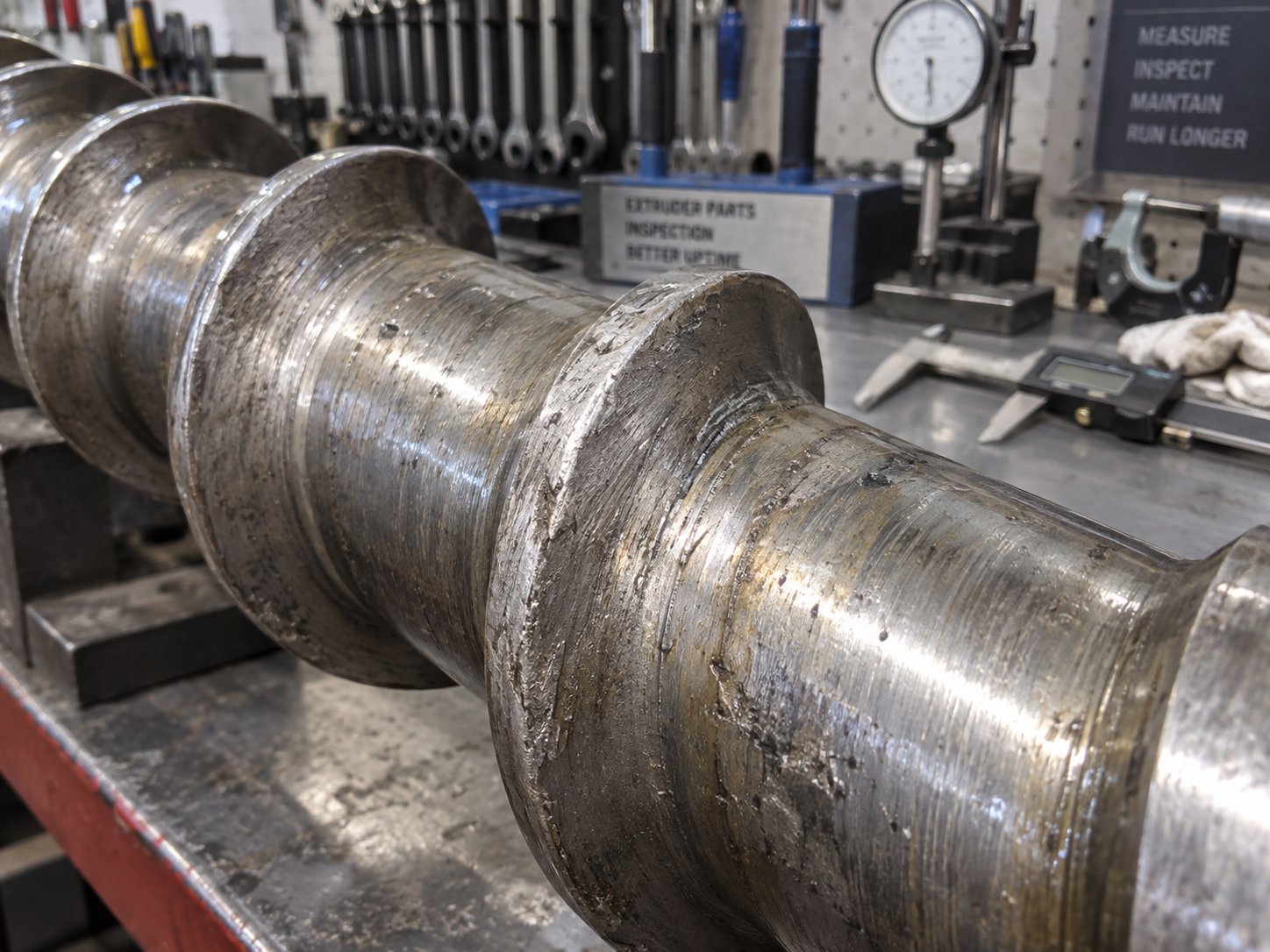
Selecting the right extruder screw material is only half the equation. The other half plays out over months and years of continuous production, as heat, pressure, and polymer chemistry slowly degrade the screw's working surfaces. Every screw eventually wears — that is unavoidable. What separates a well-managed extrusion operation from a reactive one is the ability to recognize how the screw is failing, diagnose why, and use that information to choose the correct material upgrade or reconditioning strategy rather than simply ordering the hardest or most expensive replacement available.
Think of it this way: a doctor who prescribes antibiotics for a broken bone is not helping the patient, no matter how strong the medication. The same logic applies to extruder screw wear failure modes. Each mode has a distinct root cause, leaves a different visual signature, and responds to a different material property. Misdiagnosing the failure leads to misspecifying the replacement — and starting the cycle of premature wear all over again.
Four Failure Modes That Destroy Extruder Screws
Most extruder screw degradation falls into one of four categories. They can occur independently, but in aggressive processing environments — imagine a double screw extruder for pushing out liquid suspension flake material loaded with mineral fillers and trace moisture — two or three modes often overlap, compounding damage faster than any single mechanism would alone.
| Failure Mode | Visual Indicators | Primary Cause | Material Property That Resists It | Recommended Material or Coating Strategy |
|---|---|---|---|---|
| Adhesive Wear (Galling) | Flattened flight tips; score marks on barrel wall; scratches on flight flanks and roots where screws contact each other (in twin-screw designs); material transfer or smearing on metal surfaces | Metal-to-metal contact between screw flights and barrel bore, especially during startup, shutdown, or low-torque idle periods when no melt film separates the surfaces | Surface hardness differential between screw and barrel; low coefficient of friction; resistance to cold welding | PVD coatings (TiN, CrN) for friction reduction; dissimilar hardness pairing — harder barrel liner with slightly softer but tough screw surface; cobalt-based Stellite hardfacing for metal-to-metal wear zones |
| Abrasive Wear | Rounded, polished flight edges (sharp machined corners become smooth); uniform thinning of flight lands; scoring or channeling along the screw root, especially in feed and early transition zones | Hard filler particles (glass fiber, calcium carbonate, talc, silica) grinding against flight surfaces; concentrated solid-particle contact before full melt develops | High carbide volume fraction; surface hardness; hard, wear-resistant coating layer | PM steels (CPM 9V, CPM 10V) for extreme loads; nitrided 38CrMoAlA for moderate loads; HVOF tungsten carbide spray on flight lands for severe abrasion; full screw-root encapsulation for recycled or heavily filled streams |
| Corrosive Wear | Pitting or dimpling on flight surfaces and screw root; general surface roughening without directional scoring; thinning of flight lands from chemical attack rather than mechanical erosion; discoloration or oxidation patterns | Acidic byproducts released during polymer degradation — HCl from PVC, HF from fluoropolymers, formic acid from acetal; moisture-induced corrosion on cooled barrel zones | Chemical inertness; passivation ability (high chromium and/or nickel content); dense protective oxide or nitride surface layer | Stainless steel base (17-4PH, 316L); high-nickel alloy hardfacing (Colmonoy 56 or 83); bimetallic construction with nickel-boron matrix; PVD CrN for mild corrosive environments |
| Fatigue Cracking | Hairline cracks at flight roots (the high-stress transition between flight and screw body); crack propagation along the helix; in severe cases, flight separation or screw fracture | Cyclic bending and torsional stresses at flight roots during each screw revolution; stress concentration from sharp radius geometry; thermal cycling between production and shutdown | Core toughness (impact resistance); ductility; fatigue endurance limit; clean steel with low non-metallic inclusion content | Tough alloy steel core (4340 / 40CrNiMoA) with generous root radii; bimetallic construction that preserves ductile core under hard overlay; avoid through-hardening above 50 HRC on the entire cross-section, which sacrifices toughness |
A few connections in this table deserve extra emphasis. Notice that the extruder screw abrasive wear material solution — high carbide volume fraction, hard coatings — is exactly the wrong answer for fatigue cracking. Maximizing hardness throughout the entire screw cross-section increases brittleness and lowers the fatigue endurance limit. That is why bimetallic construction exists: it lets you armor the surface for abrasion while keeping the core tough enough to absorb cyclic stress without cracking. Similarly, galling responds best to surface dissimilarity and friction reduction, not raw hardness — a subtlety lost on processors who reflexively order the hardest available steel every time they see score marks on a barrel wall.
Adhesive wear, in particular, often goes misidentified. In twin screw extruders, it commonly manifests when screws rotate at high speeds between production runs without a supporting melt film. The screw shafts deflect, flights contact each other or the barrel, and metal-to-metal rubbing begins transferring material from one surface to the other. Automated shutdown controls — such as reducing screw speed to an idle pace once torque drops below 30% — are a process-side defense, but they do not eliminate the need for the right metallurgical pairing.
How to Evaluate Wear and Decide Between Replacement and Reconditioning
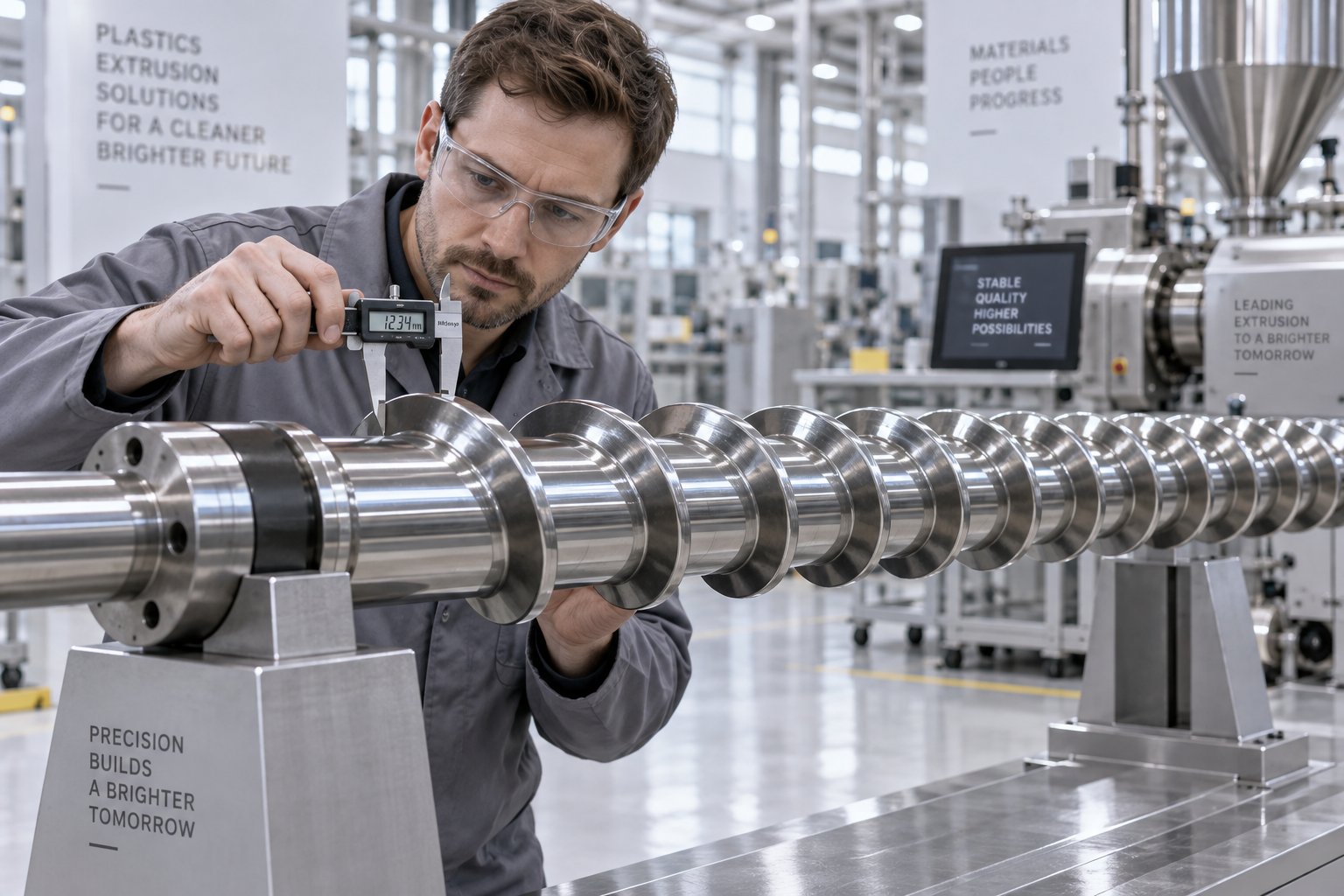
Recognizing the failure mode is only useful if you also know how much wear has occurred and whether the screw is worth saving. Practical inspection starts with dimensional measurement — comparing the current flight outside diameter to the OEM specification.
The standard guideline used across the industry is simple: the flight clearance on a new plasticating screw equals approximately the nominal screw diameter divided by 1,000, per side. A 3.5-inch screw, for example, ships with roughly 0.004 inches of clearance per side. As flights wear, that clearance grows — and with it, melt leakage over the flights increases, specific output drops, and discharge temperatures climb.
So when do you pull the trigger on replacement? Three common benchmarks exist, each suited to different production realities:
- The 4x rule: Replace or refurbish when the flight clearance reaches four times the original new clearance. For that 3.5-inch screw, that means approximately 0.016 inches per side. This is a conservative, widely used guideline for general-purpose extrusion.
- Hard-facing depletion: If the screw uses a hardfaced flight tip (typically about 0.060 inches thick when new), complete loss of the hard-facing layer signals replacement regardless of dimensional clearance — because the softer base steel beneath will erode at an accelerating rate.
- Economic threshold: Replace when the rate reduction and discharge temperature increase make the line uneconomical. Documented cases show that a worn screw with 0.011 inches of additional clearance on a 100-mm extruder can force a throughput reduction of up to 13% to maintain acceptable discharge temperatures — a significant hit to line profitability.
Critical-duty applications — medical tubing, optical film, pharmaceutical packaging — typically cannot tolerate even the 4x threshold. In those settings, screws may need replacement after the clearance doubles, well before general-purpose processors would consider the screw worn.
What about reconditioning versus outright replacement? A worn screw can often be rebuilt by welding new hard-facing material onto the flight tips and re-machining to OEM dimensions. This route costs a fraction of a new screw and can restore near-original performance — but it has limits. Industry experience suggests that a screw should not be refurbished more than three times. Each weld cycle introduces heat into the base metal, degrading its microstructure and increasing the risk of delamination between the overlay and the substrate. After the third rebuild, the base material has deteriorated enough that investing in a new screw — ideally one specified with the correct material and coating based on the failure mode you have now identified — delivers better long-term value.
One more detail that processors frequently overlook: every time the screw comes out of the barrel, measure the barrel bore as well. An iron-based bimetallic barrel liner typically lasts about three screw lifetimes, but that ratio only holds if abrasive or corrosive conditions have not accelerated barrel wear disproportionately. Replacing a screw without checking the barrel is like putting new brake pads on a warped rotor — the fresh surface wears unevenly from day one.
Armed with a clear picture of which failure mode is driving your screw degradation and how far that degradation has progressed, the final step is translating that diagnosis into a structured material selection decision — one that accounts not just for wear resistance, but for total cost of ownership across the screw's full service lifecycle.
A Practical Decision Framework for Choosing the Right Screw Material
Knowing the metallurgy, the material categories, the coatings, the failure modes — all of that knowledge is necessary, but it is not sufficient on its own. Without a structured process that connects what you know to what you order, even experienced engineers default to habit: specifying the same steel they used last time, or simply picking the hardest grade the budget allows and hoping for the best. Neither approach is engineering. Both leave money on the table — either through premature screw failure or through overspending on metallurgy the application does not demand.
What follows is a step-by-step decision framework for choosing the right plastic extruder screw material. It is deliberately sequential because each step narrows the field that the next step evaluates. Skip a step, and you risk optimizing for the wrong variable — like specifying the most abrasion-resistant PM steel available for a corrosion-dominated PVC line.
Step-by-Step Decision Framework for Screw Material Selection
Imagine you are specifying a screw for a new production line, or replacing one that failed prematurely. Here is how to choose extruder screw material methodically rather than reactively:
- Identify the primary processing challenge from the polymer and additives. Start with the resin, not the steel. What polymer are you running? What fillers, reinforcements, or additives does the formulation contain? Does the polymer release corrosive byproducts during thermal degradation — HCl from PVC, HF from fluoropolymers, formic acid from acetal? Is the feedstock recycled, with unknown contaminants? Pull the worn screw out of the barrel and examine it: are you seeing abrasive scoring, corrosive pitting, adhesive galling, or fatigue cracking at flight roots? The failure mode you identify here dictates every subsequent decision. If you are building a new line without wear history, map the polymer and filler to the challenge categories covered earlier — abrasive, corrosive, high-temperature, contaminated, or compliance-constrained — and use that classification as your starting point.
- Select the base material category. Match the challenge to a material tier. Moderately abrasive compounds with standard fillers at low concentrations? Nitrided alloy steel (38CrMoAlA or 4140 nitrided) handles the job cost-effectively. Heavily glass-filled engineering resins pushing 40% filler by weight? Tool steel (D2, H13) or powder metallurgy grades (CPM 9V, CPM 10V) deliver the carbide density required. Corrosive polymers like PVC or PVDF? Stainless steel (17-4PH) or high-nickel alloy construction takes priority over hardness. High-temperature engineering plastics like PEEK above 350 degrees C? Hot-work tool steels with secondary-hardening capability — H13, in particular — hold their hardness where other grades soften. Use the comparison table from earlier in this article as your shortlist generator, not your final answer.
- Choose the surface treatment or coating. This step is not optional — it multiplies the base material's performance. For every base steel you are considering, ask: what surface treatment pairs best with this alloy and this processing challenge? Nitriding is the default for alloy steels in moderately abrasive service. HVOF tungsten carbide spray targets severe abrasion on flight lands. PVD coatings (TiN, CrN) reduce adhesive wear and polymer sticking. Nickel-based hardfacing (Colmonoy) adds corrosion defense and abrasion resistance in a single layer. Remember the core principle from the surface treatment discussion: a mid-range base steel with the right coating often outperforms a premium base steel with no coating. Evaluate them as a system, not as separate line items.
- Validate against temperature, corrosion, and regulatory requirements. Before finalizing, stress-test your selection against three cross-cutting constraints that can override everything else. Temperature: Does the screw material maintain adequate hardness at your sustained processing temperature? Check the steel's tempering resistance curve, not its room-temperature hardness. Corrosion: Even if your primary challenge is abrasion, will trace moisture or minor degradation byproducts attack the base steel or undermine the coating bond over thousands of hours? Regulatory: Does the application require FDA, EU 1935/2004, or pharmaceutical compliance? If so, confirm that both the base metal and any surface coating meet migration and extractable limits — and that your supplier can provide the documentation to prove it. Any "no" at this stage sends you back to Step 2 to select an alternative base that satisfies all three filters simultaneously.
- Evaluate total cost of ownership. This final step is where most purchasing decisions go wrong — and where the biggest savings hide. The cheapest screw on the quotation sheet is almost never the cheapest screw over its service life. Total cost includes the purchase price, yes, but also expected service hours before replacement, the number of production hours lost during each screw change, scrap and quality costs generated by a worn screw running past its effective life, and the cost of any mid-life reconditioning or re-coating. A screw that costs twice as much upfront but lasts three times longer and requires one fewer unplanned shutdown per year is the cheaper option — every time.
Extruder screw material selection should be evaluated on total cost of ownership — upfront cost plus expected service life plus downtime costs plus replacement frequency — rather than purchase price alone. The lowest invoice price and the lowest real cost are rarely the same number.
Total Cost of Ownership — Why Cheaper Materials Often Cost More
Consider a real-world scenario. You are running 30% glass-filled PA66 on a twin screw extruder at 6,000 operating hours per year. Option A is a nitrided 4140 screw priced at roughly half the cost of Option B, a CPM 10V screw with HVOF tungsten carbide on flight lands. Option A needs replacement every 4,000 to 5,000 hours — meaning at least one unplanned mid-year screw change, a full production-day stoppage, plus the cost of a replacement screw on expedited lead time. Option B lasts 12,000 to 15,000 hours under the same conditions — roughly two full years of continuous production before a scheduled change during planned maintenance. Industry data consistently shows that downtime-related costs dwarf the direct cost of the screw itself, with unplanned stoppages on mid-sized extruders easily reaching several thousand dollars per incident when you factor in lost output, scrap during restart, and maintenance labor.
The extruder screw material total cost of ownership calculation does not have to be complicated. A simple spreadsheet with five columns works:
| Cost Factor | Option A: Nitrided 4140 | Option B: CPM 10V + HVOF |
|---|---|---|
| Purchase price per screw | Lower (baseline) | ~2x baseline |
| Expected service life (hours) | 4,000–5,000 | 12,000–15,000 |
| Replacements needed over 30,000 operating hours | 6–7 | 2–3 |
| Unplanned downtime events over 30,000 hours | Multiple (mid-cycle failures) | Near zero (scheduled changes) |
| Total five-year cost (screw + downtime + scrap) | Higher | Significantly lower |
The math almost always favors the higher-performing material once you extend the analysis beyond the first purchase order. And when maintenance costs represent 10 to 20% of total ownership costs over equipment life, even modest improvements in screw longevity cascade into meaningful savings on labor, spare parts inventory, and production scheduling flexibility.
Yet total cost of ownership depends on more than just material selection in isolation. Screw geometry, barrel liner compatibility, compression ratio, flight depth profile, and surface treatment all interact. A screw material perfectly matched to your polymer can still fail prematurely if the flight geometry creates excessive shear in the transition zone, or if the barrel liner alloy is metallurgically incompatible and promotes galling. That is why the most effective way to apply this framework is not as a solo exercise — it is through partnership with a manufacturer who evaluates all variables simultaneously.
NANHAIYA's Custom Screw Design Services exemplify this integrated approach. Rather than selling screws from a fixed catalog and leaving material selection to the buyer, NANHAIYA works with plastic processing companies to match screw geometry, barrel design, material selection, and surface treatment to specific polymers, output targets, and production requirements. That means the five-step framework described above does not end with a steel grade on a purchase order — it extends into geometry optimization, coating specification, and barrel-liner pairing, all engineered as a single coordinated system. For processors who have been cycling through premature screw replacements or compensating for wear with process adjustments, this kind of holistic design partnership often eliminates more cost in the first year than any single material upgrade could deliver on its own.
The framework is intentionally simple — five steps, each building on the last. Its power comes not from complexity but from discipline: starting with the polymer's demands rather than the supplier's inventory, treating surface treatments as integral rather than optional, validating against real-world constraints before committing, and measuring success in total lifecycle dollars rather than invoice price. Apply it consistently, and the gap between what you spend on screws and what you get from them narrows dramatically — turning material selection from a recurring headache into a genuine competitive advantage.
Turning Material Knowledge Into Processing Advantage
Metallurgical theory, comparison tables, coating specifications, failure mode diagnostics, cross-standard grade references — you have absorbed a lot of ground in this article. But information alone does not reduce screw wear or extend barrel life. What does is applying that information through a consistent, disciplined selection process every time a screw needs replacing, a new line gets commissioned, or a formulation change demands a metallurgical rethink. The best extruder screw material for plastics processing is never the one with the most impressive datasheet — it is the one matched precisely to the stresses your specific operation creates.
Three Principles That Should Guide Every Material Decision
Strip away the complexity, and the entire decision framework rests on three foundational principles. Pin these to the wall of your engineering office, because they apply whether you are specifying screws for a single-screw polyolefin line or a co-rotating twin running 50% glass-filled PA66:
- Start with the polymer, not the steel. Extruder screw material selection best practices always begin with the processing challenge — abrasive fillers, corrosive byproducts, extreme temperatures, contaminated recycled feedstock, or regulatory compliance constraints. The polymer and its additives define the threat profile. The steel and coating answer that threat. Reversing this order — choosing a grade first and hoping it fits — is how processors end up cycling through premature replacements and compensating with process band-aids that quietly erode margins.
- Treat surface treatments as integral, not optional. A mid-range alloy steel paired with the right nitriding process, HVOF tungsten carbide spray, or PVD ceramic film routinely outperforms a premium tool steel running bare. Coatings multiply your base material's capability in the same way that armor plating multiplies a vehicle's survivability — and they should appear on every material specification, not as a last-minute add-on after the first screw fails early.
- Measure cost in lifecycle dollars, not invoice price. The cheapest screw on the quote sheet is almost never the cheapest screw over 30,000 operating hours. Purchase price, expected service life, downtime during each change, scrap generated by a worn screw running past its limit, reconditioning costs, and replacement frequency all feed the real number. A screw that costs twice as much upfront but lasts three times longer — and replaces itself during planned maintenance windows instead of emergency shutdowns — delivers a lower total cost of ownership every time.
These principles are not abstract. They are the practical logic behind every material recommendation in this article — from specifying nitrided 38CrMoAlA for moderately filled resins, to selecting CPM 10V with HVOF coatings for extreme abrasion, to choosing high-nickel bimetallic construction for corrosive PVC and fluoropolymer lines. Each recommendation traces back to one question: what does the polymer demand, and what layered defense system answers that demand at the lowest lifecycle cost?
Your Next Step Toward Optimized Screw Performance
Reading about metallurgy and memorizing grade equivalence tables gets you part of the way. Applying that knowledge inside a structured framework gets you further. But the highest-impact step — the one that separates processors who keep replacing screws from those who solve the problem once — is partnering with a manufacturer who evaluates screw geometry, barrel compatibility, base material, and surface treatment as a single integrated system rather than four separate purchase decisions.
The best extruder screw material is not the hardest or most expensive — it is the one engineered to match your specific polymer, filler, throughput, and production lifecycle.
That principle is exactly what makes an integrated design approach so effective. Instead of specifying steel in isolation and hoping the geometry and coating happen to complement it, you engineer all variables together — compression ratio, flight depth profile, barrel liner alloy, surface treatment, and base metallurgy — as a coordinated system tuned to your exact resin, filler package, output target, and maintenance schedule.
If you are ready to move from theory to action, NANHAIYA's Custom Screw Design Services offer exactly this kind of holistic support. NANHAIYA works directly with plastic processing companies to match screw geometry, barrel design, material selection, and surface treatment to specific polymers and production requirements — turning the five-step framework outlined in this article into a screw that performs on your line, not just on paper. Whether you are troubleshooting a premature failure, scaling up a new formulation, or sourcing a replacement that finally outlasts the production schedule, having an engineering partner who thinks in systems rather than catalogs is the fastest way to stop paying the hidden price of getting this decision wrong.
Frequently Asked Questions About Extruder Screw Material
1. What is the best material for an extruder screw?
There is no single best material — the optimal choice depends on the polymer you process and its specific demands. For non-abrasive polyolefins, through-hardened 4140 alloy steel works well. Heavily glass-filled engineering resins call for powder metallurgy steels like CPM 10V paired with HVOF tungsten carbide coatings, while corrosive polymers such as PVC or PVDF require stainless steel bases like 17-4PH or high-nickel bimetallic construction. The key is matching the screw's metallurgy and surface treatment to your primary processing challenge — abrasion, corrosion, high temperature, or contamination — rather than defaulting to the hardest or most expensive grade available.
2. How does the extruder screw move plastic materials through the barrel?
The extruder screw rotates inside a heated barrel, conveying plastic material through three functional zones: feeding, compression, and metering. In the feed zone, solid pellets enter and are pushed forward by the screw flights. As material advances into the compression zone, decreasing channel depth compresses the pellets against the barrel wall, generating frictional and shear heat that melts them. The metering zone then homogenizes the melt and builds consistent pressure for extrusion through the die. Throughout this journey, the screw surface endures intense heat, abrasive fillers, and corrosive polymer byproducts — which is why screw material selection directly determines equipment lifespan and output quality.
3. What is the difference between nitrided and bimetallic extruder screws?
氮化螺钉以合金钢为基材(通常为 4140 或 38CrMoAlA),经过热化学处理,将氮扩散到表面,形成一层坚硬的渗碳层(通常相当于 55-72 HRC),而不会改变螺钉的韧性芯部。双金属螺钉则采用不同的策略:在韧性良好的合金钢芯部上覆盖一层耐磨合金,例如镍硼合金(Colmonoy)、碳化钨基体或钴基司太立合金。氮化处理在中等磨损环境下更具成本效益,而双金属结构则在磨损和腐蚀混合的工况下表现优异,尤其适用于大直径螺钉(因为全高级合金结构成本过高),以及在翻新过程中可以剥离磨损的螺纹并重新覆盖的情况。
4. 挤出机螺杆应该多久更换一次?
螺杆更换周期因聚合物、填料含量、螺杆材料和表面处理的不同而差异很大。对于使用规格合适的螺杆挤出非磨蚀性聚烯烃的加工商,螺杆可能十年才需要更换一次;而对于挤出高玻璃纤维填充化合物或含有污染物的再生原料的加工商,根据螺杆冶金工艺的不同,可能需要每运行 4,000 至 15,000 小时更换一次。一个实用的规则是“4 倍法则”:当螺杆螺纹与螺杆筒体间隙达到初始间隙的四倍时,就应该更换或翻新螺杆。监测螺杆螺纹直径是否符合原始设备制造商 (OEM) 的规格,跟踪出料温度的变化趋势,并检查是否存在特定的失效模式(例如磨蚀性划痕、腐蚀性点蚀或疲劳裂纹),有助于确定适合您具体操作的更换时机。
5. 38CrMoAlA 挤出螺杆钢的中国对应钢材是什么?
38CrMoAlA 本身是中国 GB/T 标准中的牌号。其最接近的 AISI 等效牌号是 Nitralloy 135M,在欧洲 DIN 标准中对应 34CrAlMo5 (1.8507),在日本 JIS 标准中对应 SACM645。然而,这些等效牌号只是近似值,并非完全精确。Nitralloy 135M 规定了更严格的铝和氮含量范围,以优化气体渗氮工艺的性能,而 38CrMoAlA 则遵循 GB/T 3077 标准,其化学成分公差可能略宽。在全球范围内采购时,务必比较实际的化学成分范围、洁净度标准和热处理工艺,而不仅仅依赖于牌号名称的等效性,并要求提供钢厂测试证书以验证所供钢材的比热容。
Written by
Nanhaiya Technical Team
Zhoushan Nanhaiya Plastic Machinery Co., Ltd.
The Nanhaiya technical team supports screw and barrel manufacturing projects through application review, technical communication, custom manufacturing coordination, and production and quality control.
Discuss Your Application
Related Articles
More insights on screw barrel technology and plastics processing.
What Your Single Screw Extruder Manufacturer Won't Tell You
Oct 10, 2026
Learn how to evaluate single screw extruder manufacturers with this buyer-focused guide covering specs, configurations, material matching, and a ready-to-use selection checklist.
Read Article
Plastic Extruder Screw Price Demystified: From Steel To Sticker
Oct 10, 2026
What drives plastic extruder screw price? This independent guide breaks down diameter, L/D ratio, metallurgy, order volume, and total cost of ownership factors.
Read Article
What No Supplier Tells You About WPC Decking Making Machines
Oct 6, 2026
Learn how a WPC decking making machine works, compare extruder types, formulations, and production methods, plus get a buyer checklist to evaluate any supplier.
Read ArticleLooking for something else?
Search by material, symptom or product and jump straight to the relevant page.
These are navigation suggestions based on keyword matching — not a quotation, not a delivery commitment, and not a substitute for engineering review. Final specification is confirmed by our engineers against your drawings and processed material.
Need help with screw barrel selection?
Share your machine model, processed material and application. Our team can help with pricing and technical support.