

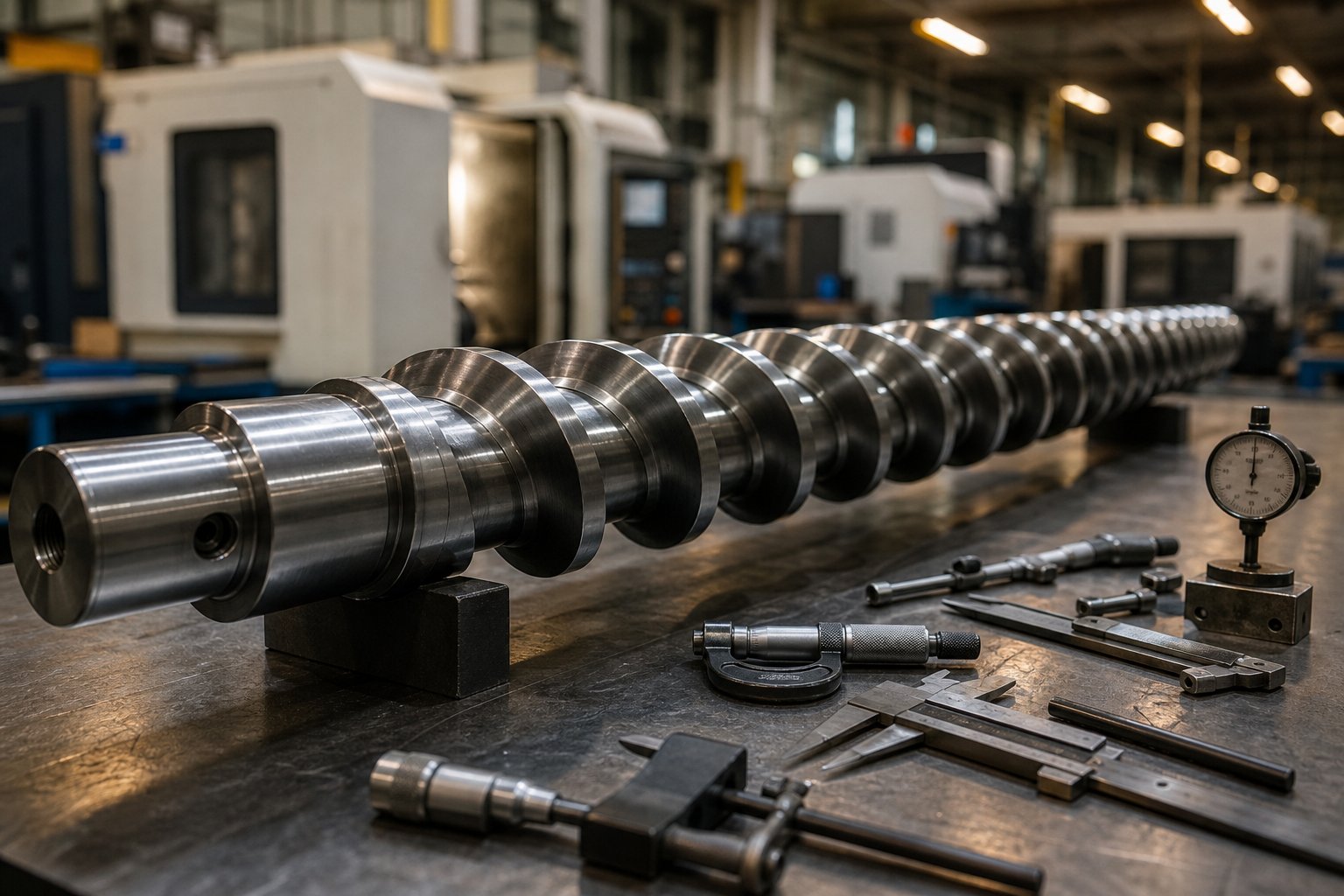
What an Extruder Screw Manufacturer Actually Does
An extruder screw manufacturer is a specialized industrial supplier that designs, precision-machines, and finishes helical screws and mating barrels used to convey, melt, mix, and pressurize polymers in extrusion and injection molding equipment. This is not a general machine shop turning out miscellaneous parts, and it is definitely not a fastener producer stamping out bolts. These manufacturers combine deep metallurgical knowledge, CNC machining expertise, and plastics processing experience to build the single component that governs how well your extruder actually performs.
Why does that distinction matter? Imagine handing a complex extruder screw drawing to a shop that primarily makes hydraulic shafts. They might hit the outer dimensions, but subtle details — flight radii, channel depth transitions, surface finish on the root diameter — will almost certainly fall short. Those details are exactly where melt quality, output consistency, and energy efficiency are won or lost.
Defining the Extruder Screw Manufacturer
A true extruder screw manufacturer operates at the intersection of mechanical engineering and polymer science. Their core deliverable is the extruder screw itself — the rotating helical element inside the extruder screw barrel that moves raw resin from the extruder feed barrel through distinct processing zones. As resin travels along the screw, it is compressed, heated by barrel heaters and frictional shear, thoroughly mixed, and finally pressurized before being forced through a die. Each zone of the screw — feed, compression, and metering — demands specific geometry that directly influences melting efficiency, material throughput, and final product quality. A reputable manufacturer understands these relationships and tailors screw design to match the polymer being processed, the equipment platform, and the end-product requirements.
Beyond the screw itself, most specialists also supply matched barrels, feed sections, and wear components — because the screw extruder is a system, and peak performance depends on every mating surface working in harmony.
Why Screw Selection Impacts Every Downstream Outcome
The extruder screw is often called the heart of any plasticating process, and for good reason. It directly controls melt temperature uniformity, pressure stability at the die, mixing intensity for additives and colorants, and the overall throughput rate of the line. A poorly designed or worn screw can produce incomplete melting, color streaking, dimensional inconsistencies in the final product, and unnecessary energy consumption — problems that no amount of downstream adjustment can fully correct.
The screw and barrel together typically represent a small fraction of total extruder cost, yet they disproportionately determine processing performance, product quality, and machine uptime. Choosing the right manufacturer for these components is one of the highest-leverage decisions a plastics processor can make.
In the sections ahead, you'll walk through the complete manufacturing process behind every extruder screw, explore the metallurgy and coating technologies that drive wear life, compare screw types matched to specific resins and applications, and gain a structured evaluation framework for separating exceptional manufacturers from those that cut corners. Whether you're sourcing a replacement screw for an aging single-screw line or specifying custom geometry for a new compounding operation, recognizing the red flags early saves money, downtime, and frustration down the road.
The first place that separation becomes visible? The type of manufacturer you're dealing with — and not all of them serve every buyer equally well.
Three Types of Extruder Screw Manufacturers Every Buyer Should Know
Not every extruder screw manufacturer operates the same way, targets the same customers, or brings the same capabilities to the table. Yet most buyers lump them all into one category — and that blind spot is exactly where costly sourcing mistakes begin. In reality, the market breaks down into three distinct types, each with strengths and trade-offs that matter depending on your situation.
Understanding which category a supplier falls into tells you a lot before you even request a quote: what kind of engineering support to expect, how long you'll wait for delivery, and whether the price you're quoted reflects genuine value or simply brand overhead.
OEM Machine Builders as Screw Suppliers
The first category includes original equipment manufacturers — companies like Davis-Standard — that design and build complete extrusion lines and supply proprietary screws and barrels for their own equipment. When you buy a Davis-Standard extruder, the feedscrew that ships inside it was engineered specifically for that machine platform. These OEM suppliers maintain detailed records of every screw geometry, barrel specification, and material combination offered across their product range.
The advantage here is straightforward: dimensional compatibility is guaranteed. The screw was designed for that exact barrel bore, drive spline, and thrust bearing assembly. You'll also get access to the OEM's application engineering team, who understand how their specific equipment performs across different resin families. Davis-Standard, for example, offers multiple bimetallic barrel grades — iron-based options for general-purpose environments and nickel-based alloys for corrosive compounds like PVC and fluoropolymers — all matched to their proprietary screw designs.
The trade-off? OEM screws typically carry premium pricing, and lead times can stretch longer than independent suppliers since screw and barrel production shares capacity with full machine builds. If you're running US extruders from a major OEM and need a replacement screw during a breakdown, a 10- to 14-week lead time can be painful.
Aftermarket Screw and Barrel Specialists
The second category — and often the largest segment of feed screw manufacturers by sheer number of companies — is the independent aftermarket specialist. These are dedicated screw machine manufacturers that reverse-engineer, replace, or upgrade screws and barrels for virtually any brand of extruder on the market. They don't build complete extrusion lines. Instead, their entire business revolves around the screw and barrel as standalone components.
You'll notice a few immediate advantages when working with aftermarket specialists. They tend to offer faster turnaround because their shop capacity is entirely dedicated to screw and barrel production rather than split across full machine assembly. They also commonly provide broader material and coating options — including alloy combinations that an OEM might not offer as standard. Competitive pricing is another draw, since independent manufacturers don't carry the overhead of a complete equipment product line.
The red flag to watch for, however, is quality assurance depth. An aftermarket supplier's value depends entirely on their reverse-engineering accuracy, metallurgical expertise, and dimensional inspection capability. A shop that measures a worn screw, copies the worn dimensions, and machines a replacement to those worn specs is not reverse-engineering — it is replicating a problem. The best aftermarket specialists request original OEM drawings when available, use CMM inspection to verify critical dimensions, and can explain exactly how they validated the geometry before cutting metal.
Custom Screw Design Houses
The third category is the engineering-focused custom screw designer. These firms don't simply replicate existing geometries — they develop application-specific screw profiles from scratch based on your resin, filler package, throughput targets, and quality requirements. Imagine you're processing a heavily filled recycled HDPE stream with variable contamination levels. A general-purpose metering screw won't cut it. A custom design house would analyze your melt behavior, filler characteristics, and target output, then engineer a screw geometry — barrier flights, mixing elements, optimized compression ratios — purpose-built for that exact application.
This is the highest-value category when your processing challenge is genuinely unique. Custom designers typically employ polymer processing engineers alongside machinists, and they often use simulation tools to model screw performance before committing to steel. The trade-off is clear: lead times are longer due to the engineering phase, and cost reflects the design work on top of manufacturing. For processors running commodity polyolefins on standard equipment, this level of customization may be unnecessary. For compounders pushing material boundaries or chasing tight quality specifications, it can be the difference between a screw that merely fits and one that actually solves a processing problem.
| Evaluation Dimension | OEM Machine Builders | Aftermarket Specialists | Custom Screw Designers |
|---|---|---|---|
| Scope of Service | Proprietary screws and barrels for their own equipment platforms | Replacement, upgrade, and reverse-engineered screws for any brand | Application-specific screw geometry engineered from scratch |
| Typical Lead Time | 8 to 16 weeks (shared with machine production) | 4 to 8 weeks (dedicated screw and barrel capacity) | 8 to 14 weeks (includes engineering and design phase) |
| Cost Positioning | Premium — reflects brand, R&D overhead, and guaranteed compatibility | Competitive — lower overhead, more material flexibility | Higher — engineering fees layered on top of manufacturing cost |
| Engineering Depth | Strong for their own equipment; limited flexibility for non-standard requests | Varies widely — ranges from basic copy shops to metallurgically sophisticated manufacturers | Deepest — polymer processing simulation, custom flight geometry, full application analysis |
| Best-Fit Buyer Scenario | Processors running OEM equipment who prioritize guaranteed compatibility and single-source support | Maintenance teams needing faster turnaround, multi-brand fleets, or upgraded materials on existing equipment | Compounders, developers, and processors with unique resin challenges or performance gaps standard screws cannot solve |
Here's the practical takeaway: there is no universally "best" type of supplier. A processor running a fleet of identical single-screw extruders on commodity PE film might get excellent value from a well-qualified aftermarket specialist who delivers faster and at lower cost than the OEM. A compounder developing a new glass-filled engineering resin might need the deep engineering capability of a custom design house. And a plant that standardized on one equipment brand may prefer the peace of mind that comes with OEM-supplied components — even at a price premium.
The real danger lies in assuming all three categories deliver the same outcome. They don't. An aftermarket shop without rigorous reverse-engineering protocols can produce a screw that fits the barrel but underperforms the original. A custom designer without strong manufacturing execution can deliver a brilliant geometry on paper that falls apart at the tolerance level. And an OEM supplier, while reliable, may not offer the metallurgical options your specific application demands.
What ultimately separates any of these suppliers is not the category they fall into — it's the manufacturing process behind the screw itself, from raw steel selection through final inspection. That process is where quality is either built in or lost.
The Complete Manufacturing Process Behind Every Extruder Screw
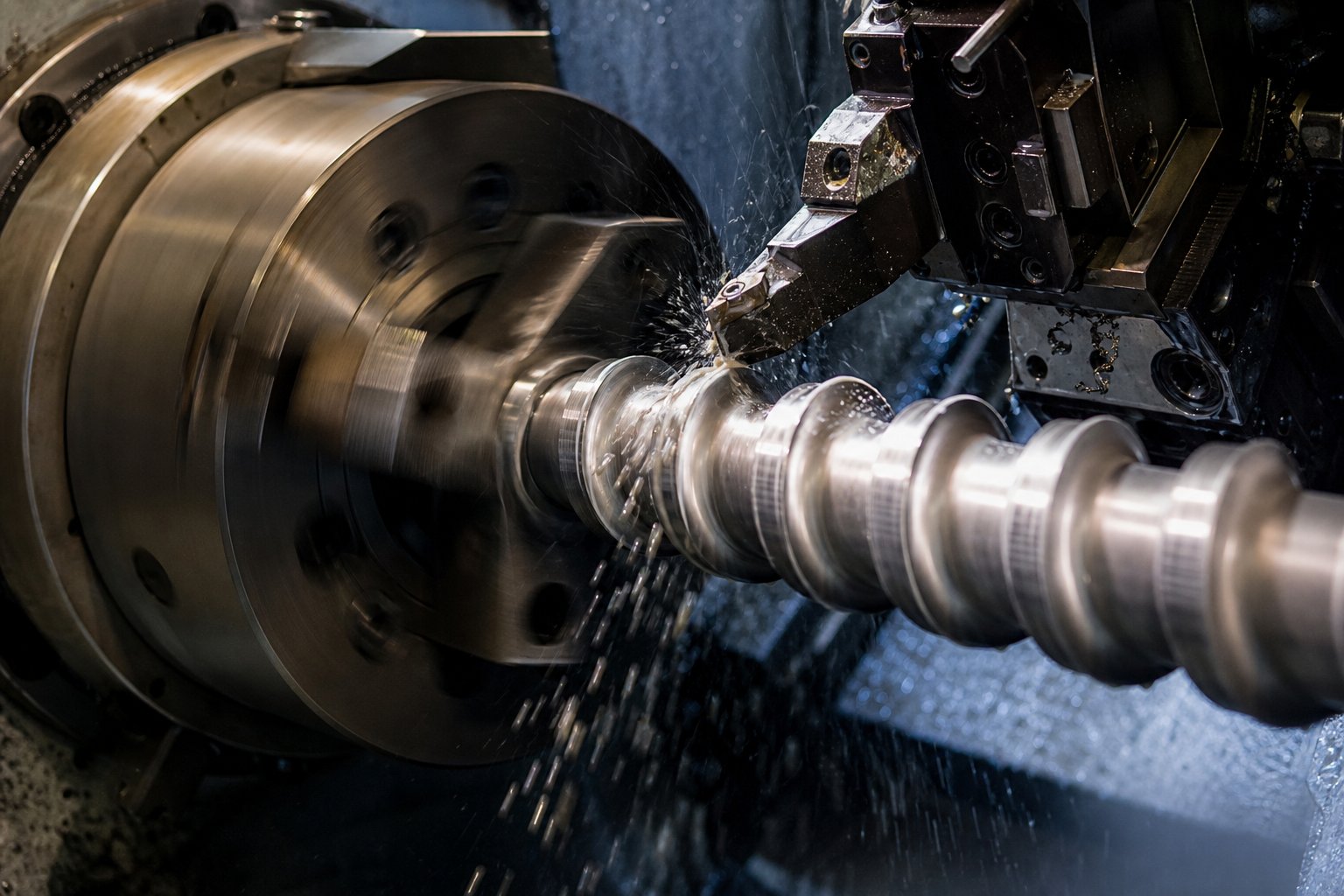
Every extrusion screw begins as a length of raw steel and ends — if the manufacturer knows what they're doing — as a precision-engineered component machined to tolerances measured in thousandths of an inch. Between those two endpoints sits a multi-stage process that most buyers never see, yet it is the single best predictor of how a screw will perform in service. Understanding what goes into custom screw machining gives you the vocabulary and the benchmarks to separate a quality manufacturer from one that skips steps.
Here's the reality: two screws can look identical sitting side by side on a shipping pallet. Same overall length, same flight geometry, same surface finish to the naked eye. But if one was manufactured with shortcuts in heat treatment, loose tolerance controls, or subpar raw material, it will wear faster, run hotter, and cost you far more in downtime and scrap than the price difference ever saved.
From Raw Steel to Finished Screw — Step by Step
The journey from bar stock to a finished extrusion screw follows a strict sequence. Each stage builds on the one before it, and skipping or rushing any step compromises everything downstream. Here's how a reputable extruder screw manufacturer moves through the process:
- Raw Material Selection and Verification — The process starts with forged alloy steel bar stock, typically AISI 4140 or 4340 grades for general-purpose applications. For more demanding environments, manufacturers may specify tool steels like H-13 or specialty grades such as Nit135M or CPM 9V that respond better to subsequent nitriding and achieve higher surface hardness. The incoming bar is verified against mill certifications for chemistry and mechanical properties before any machining begins. A manufacturer that cannot produce material certs on request is waving a red flag.
- Rough Turning on CNC Lathes — The bar stock is mounted in a large CNC lathe and rough-turned to approximate the screw's outer profile. This step removes the bulk of excess material, establishing the major diameter, shank features, and drive spline geometry. Concentricity is critical here — if the rough-turned blank runs off-center, every subsequent operation inherits that error.
- Flight Machining — This is where the helical flights take shape. Depending on the screw manufacturing machine capabilities, flights are cut using either milling, hobbing, or a whirling process. Whirling is particularly common for longer screws because it produces smooth, consistent helical profiles efficiently. During this stage, the precise pitch, flight width, channel depth transitions, and compression ratio geometry are all established. The transition from deep-channel feed zone to shallow-channel metering zone must follow exact design specifications — even small deviations here change how the polymer melts and mixes.
- Heat Treatment — Once the screw is fully machined to near-final dimensions, it undergoes heat treatment to harden the surface and develop wear resistance. The method depends on the application and base material. Through-hardening heats the entire cross-section, while induction hardening targets specific zones like flight tips. For the highest wear resistance without distorting the screw's geometry, nitriding — either gas or ion/plasma — is the preferred approach.
- Hard-Facing or Coating Application — For screws that will process abrasive or corrosive resins, the manufacturer applies hard-facing alloys to the flight lands, leading edges, or root diameters. Common overlay materials include stellite (cobalt-based), colmonoy (nickel-based), and tungsten carbide, applied via plasma transferred arc (PTA) welding or laser cladding. This step adds a sacrificial wear layer where metal-to-polymer and metal-to-filler contact is most intense.
- Finish Grinding — After heat treatment and any coating operations, the screw is finish-ground to its final dimensional tolerances. The flight outer diameter, root diameter, and overall straightness are brought into specification on precision cylindrical grinders. This step also restores any minor distortion introduced during heat treatment.
- Dynamic Balancing — For high-RPM applications, the finished screw is dynamically balanced to minimize vibration. An unbalanced screw at operating speed creates uneven barrel wear, bearing stress, and inconsistent melt delivery. Not every application requires this step, but a quality manufacturer will recommend it when rotational speed and screw length warrant it.
- Final Dimensional Inspection — The completed screw undergoes full inspection using a coordinate measuring machine (CMM) or laser measurement system. Every critical dimension — flight OD, root diameter, pitch accuracy, channel depth, and total indicated runout across the full screw length — is documented and compared against the engineering drawing. This inspection report should ship with the screw. If a manufacturer doesn't offer one, that tells you something about their quality culture.
Heat Treatment and Surface Finishing Methods
Heat treatment is arguably the most consequential step in the entire manufacturing sequence — and the one most easily done poorly. The goal is to harden the screw's surface to resist wear while maintaining a tough, ductile core that can absorb the mechanical loads of extrusion without cracking.
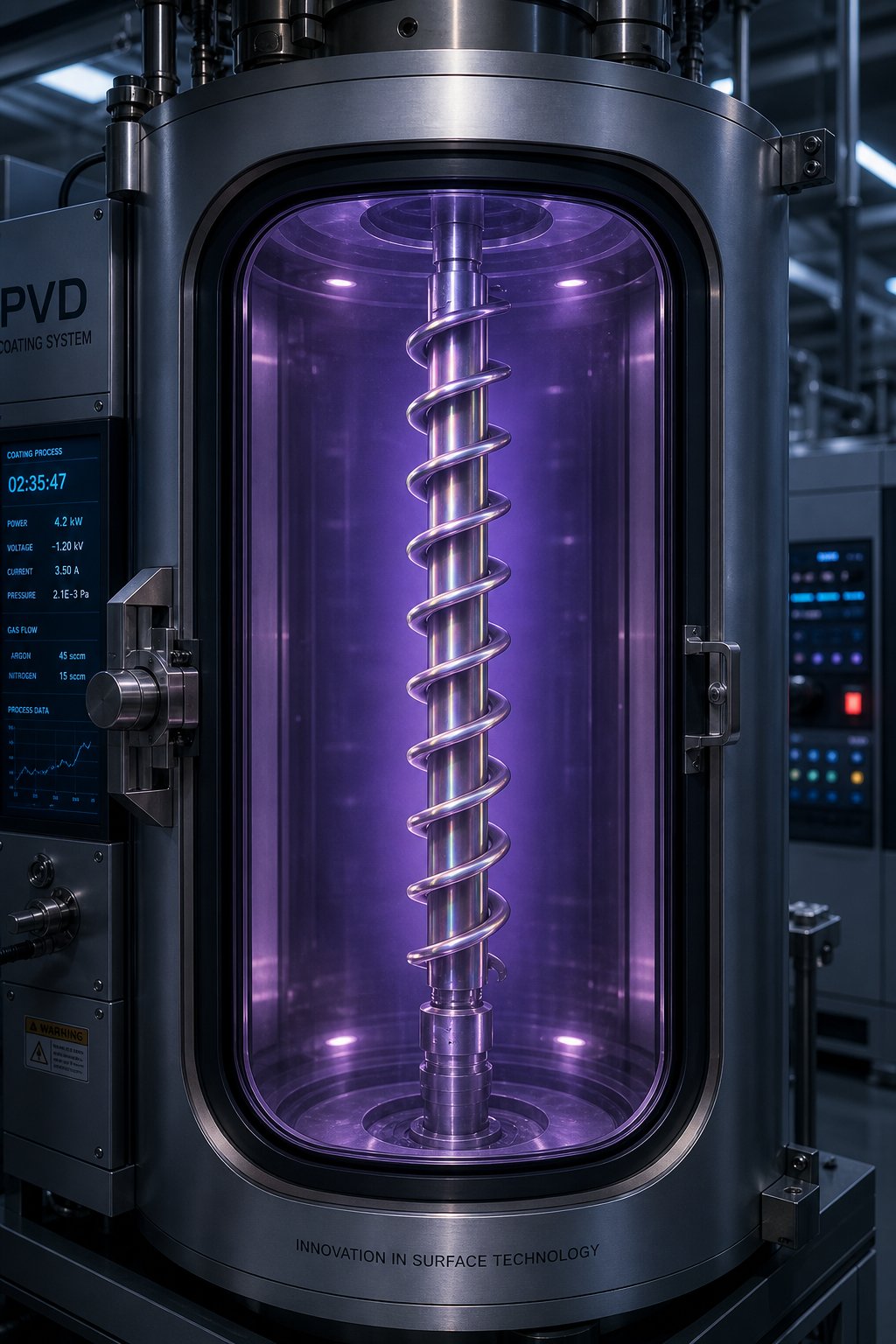
For standard 4140 and 4340 alloy steels, ion/plasma nitriding is one of the most effective surface engineering methods. The process takes place in a vacuum chamber where high-voltage glow discharge bombards the screw with nitrogen ions at temperatures between 950 and 1,070 degrees Fahrenheit. This diffuses nitrogen into the steel surface, forming hard chromium nitride compounds that are thermally stable at the elevated temperatures encountered during plastics processing. Ion/plasma nitriding is particularly well suited for long screws — some manufacturers process screws exceeding 40 feet in length inside tall vertical vacuum vessels.
A key advantage of plasma nitriding over other methods is selective treatment. Surfaces that don't require hardening — or that need post-nitriding finishing — can be masked off with mechanical shields or specialized coatings before treatment. This level of control is simply not possible with through-hardening or many coating processes. The resulting surface hardness depends on the base steel: 4140 achieves moderate hardness gains, while specialty steels like Nit135M and H-13 can exceed 70 HRc equivalent, making them suitable for severely abrasive applications involving glass-filled or mineral-filled compounds.
Through-hardening and induction hardening remain valid alternatives for specific situations. Through-hardening transforms the entire cross-section and works well for smaller-diameter screws that need uniform hardness. Induction hardening heats only the outer layer using electromagnetic fields, creating a hard case with a softer core — useful for localized wear zones but limited in how uniformly it can treat complex helical geometry over long lengths.
Tolerance Standards That Define Manufacturing Quality
You can learn more about an extruder screw manufacturer from their tolerance specifications than from almost any other piece of information they share. Tolerances reveal the precision of their equipment, the skill of their operators, and the rigor of their quality systems — all at a glance.
Three dimensional characteristics matter most:
- Flight outer diameter tolerance — This controls the clearance between the screw flight tip and the barrel bore. Too tight, and the screw will gall against the barrel wall. Too loose, and polymer leaks back over the flights, reducing pumping efficiency and melt pressure. Quality manufacturers hold flight OD tolerances to within +0.000 / -0.002 inches of the specified barrel bore clearance. Commodity shops often allow tolerances two to three times wider.
- Root diameter consistency — The root diameter defines channel depth, which directly governs how much material each flight carries forward. Inconsistencies in root diameter along the screw length create uneven melting, pressure surges, and output instability. Precision manufacturers hold root diameter variation to less than 0.002 inches across the full screw length.
- Straightness (total indicated runout) — A screw that is not perfectly straight will wobble inside the barrel, causing asymmetric wear, increased energy consumption, and vibration. For a typical 6-foot screw, quality manufacturers target total indicated runout of 0.003 inches or less. For longer screws, proportionally tighter runout per unit length is expected. Dynamic balancing, mentioned earlier, addresses residual imbalance that even tight straightness tolerances cannot fully eliminate.
A screw that meets every dimensional tolerance on the print but was heat-treated improperly will still fail prematurely. Conversely, a perfectly hardened screw ground to sloppy tolerances wastes energy and degrades output quality from day one. Manufacturing quality lives at the intersection of metallurgy and dimensional precision — and a capable manufacturer excels at both.
These tolerance benchmarks give you a concrete way to evaluate any supplier's capabilities. Request a sample inspection report during the quoting process. If the manufacturer can't provide one — or if the reported tolerances are vague — you're likely looking at a shop that doesn't measure what it makes with the rigor your process demands.
Of course, even a perfectly machined and heat-treated screw will eventually wear out if the metallurgy doesn't match the application. The materials and coatings chosen at the very beginning of the manufacturing process — step one in the sequence above — determine how long those tight tolerances hold up under real-world processing conditions.
Screw Metallurgy and Coating Technologies Explained
A screw machined to perfect tolerances and ground to mirror-quality surface finish will still fail prematurely if the metallurgy is wrong for the application. This is the area where the gap between a knowledgeable extruder screw manufacturer and a commodity shop becomes most expensive — because material decisions made at the quoting stage determine whether your screw barrel combination lasts 3,000 hours or 20,000 hours in actual production. Yet many buyers never ask about alloy options, and many suppliers never volunteer them.
The reality is that no single material works for every polymer, every filler package, or every processing temperature. A screw running unfilled polypropylene at moderate temperatures faces a completely different wear environment than one processing 40% glass-filled nylon at 300 degrees Celsius. Treating those two applications identically — same steel, same surface treatment — is one of the most common and costly mistakes in screw and barrel sourcing.
Nitrided Steel vs. Bimetallic Construction
The starting point for most screw and barrel discussions is nitrided alloy steel — specifically AISI 4140 or 4340. These are the workhorse base materials, accounting for roughly 80% of all installed extruder screws globally. After machining, the screw undergoes gas or ion nitriding, which diffuses nitrogen into the steel surface to form hard nitride compounds. The result is a surface hardness of approximately 950 to 1,100 HV (around 68 to 72 HRC equivalent) with a case depth of 0.3 to 0.7 mm.
For processors running unfilled commodity resins — standard polyethylene, polypropylene, or polystyrene — nitrided 4140 delivers perfectly adequate wear life at the lowest cost tier. It is the default for good reason: balanced strength, excellent weldability if hard-facing is later needed, and a well-understood metallurgical response to nitriding.
Here is the catch, though. That hardened case is shallow. In abrasive service — glass fiber, mineral fillers, wood flour — the nitrided layer can wear through in as few as 2,000 to 3,000 operating hours. Once the softer substrate underneath is exposed, wear accelerates dramatically. You'll see output drop, melt temperature climb, and product quality deteriorate almost overnight.
Bimetallic construction addresses this limitation through layered materials engineering. On the barrel side, a wear-resistant alloy — typically iron-based with high chromium and tungsten carbide content — is centrifugally cast as a metallurgically bonded liner inside a conventional 4140 or 4340 shell. The result is an extruder barrel with a bore hardness of 60 to 72 HRC and a liner thickness of 2.0 to 2.5 mm, far exceeding what nitriding alone can achieve. For the screw, bimetallic construction means applying hard-facing overlays to the flight lands and tips — welded alloys that are 10 to 20 times thicker than a nitrided case and made from compositions whose wear resistance far surpasses anything achievable through surface treatment alone.
The performance difference is striking. In a documented comparison processing 45% calcium carbonate-filled polypropylene at continuous production, a standard nitrided 4140 screw showed 0.8 mm of flight clearance loss at 4,500 operating hours. A bimetallic screw with HVOF tungsten carbide overlay on the same line showed just 0.12 mm of clearance loss at the same interval — a projected service life extension of nearly 7 times. That is the kind of gap that makes the higher upfront cost of bimetallic construction irrelevant when you calculate total cost of ownership.
Today, approximately 54% of newly installed extruder barrels use bimetallic construction, and around 48% of installations specify tungsten carbide or nickel-based alloy coatings. The industry is clearly moving up the materials curve — and processors still defaulting to commodity nitrided assemblies for filled or abrasive resins are increasingly mismatched to their own production demands.
Tool Steel Alloys and Hard-Facing Overlays
When processing conditions push beyond what nitrided steel or basic bimetallic construction can handle, tool steel alloys and specialized hard-facing overlays enter the picture. These are the materials that separate a capable manufacturer from one offering a one-size-fits-all approach.
D2 Tool Steel (AISI D2) is a high-carbon, high-chromium alloy that, through-hardened to 58 to 62 HRC, delivers four to six times the abrasion resistance of nitrided 4140 at equivalent flight geometry. In practical terms, a D2 screw processing 30% glass-filled nylon typically extends service life from around 3,000 hours (nitrided 4140) to 12,000 to 15,000 hours. The trade-off is moderate corrosion resistance and lower impact toughness compared to powder metallurgy grades.
CPM 9V, 10V, and 15V Powder Metallurgy Tool Steels represent the step change above conventional tool steels. These Crucible Particle Metallurgy grades achieve uniform vanadium carbide distribution with individual particle hardness around 2,500 HV. Standardized ASTM G65 pin-on-disk testing shows CPM 10V outperforming D2 by three to five times in abrasive contact, and in production environments processing 40% to 60% mineral-filled HDPE, CPM 10V screws routinely exceed 20,000 hours of service life. The raw material premium is significant — roughly 2.5 to 4 times the cost of D2 — but total cost of ownership analysis over a 36-month horizon almost always favors CPM grades in severely abrasive service.
Beyond base alloy selection, hard-facing overlays add another layer of protection where flight surfaces contact the barrel and screw interior:
- Stellite 6 and Stellite 12 (cobalt-chromium-tungsten) — The benchmark for combined corrosion and abrasion resistance. Stellite 6 deposits at 36 to 45 HRC, while Stellite 12 reaches 45 to 52 HRC. Critically, these cobalt-based alloys retain hardness at elevated temperatures — Stellite 6 maintains 35 to 40 HRC at 600 degrees Celsius, where most tool steels have already softened below 30 HRC. Independent testing shows Stellite-overlaid flights exhibiting corrosive wear rates 8 to 12 times lower than nitrided 4140 in chlorinated polymer service. This makes Stellite the go-to overlay for PVC, CPVC, and halogenated flame-retardant compounds.
- Colmonoy 56 and Colmonoy 83 (nickel-chromium-boron-silicon) — The nickel-based counterpart to Stellite, and actually the more common choice for general extruder screw flight hardfacing. Colmonoy 56 runs approximately 50 to 55 HRC — harder than Stellite 6 — and offers better pure abrasion resistance combined with good corrosion protection from its nickel base. Colmonoy 83 incorporates embedded tungsten carbide particles, pushing effective hardness above 60 HRC and making it the heavy-abrasion upgrade for glass-filled compounds and wood-plastic composites. The trade-off versus Stellite is toughness: nickel-based overlays are harder but more brittle, meaning they handle steady grinding wear beautifully but can crack under impact loads.
- Tungsten carbide-cobalt (WC-Co) HVOF thermal spray — Delivers coating hardness of 1,100 to 1,400 HV (roughly 70+ HRC equivalent) at thicknesses of 0.15 to 0.35 mm, with bond strength exceeding 70 MPa. This is extreme abrasion protection, but the coating is brittle. Substrate deflection on high-L/D screws can crack or delaminate the deposit, so application requires careful engineering analysis of screw stiffness.
- Hastelloy C-276 (nickel-molybdenum-chromium-tungsten) — The standard for extreme corrosion environments. When you're processing fluoropolymers that evolve hydrogen fluoride or running mixed-acid chemical environments, C-276 PTA overlay provides corrosion resistance that no other commercially viable alternative can match — even though its hardness (35 to 45 HRC) is lower than Stellite or Colmonoy.
The practical pattern to remember: cobalt-based alloys like Stellite bring toughness and hot hardness, nickel-based alloys like Colmonoy bring higher room-temperature hardness and abrasion resistance, and tungsten carbide coatings deliver the absolute peak of abrasion protection at the cost of brittleness. A skilled manufacturer matches the overlay to the dominant failure mode — not the other way around.
How Material Choice Affects Long-Term Performance
The relationship between material selection and real-world performance is not abstract — it maps directly to specific polymers, filler loadings, processing temperatures, and expected wear rates. The following table provides a practical framework for matching barrel and screw metallurgy to the resin you actually process:
| Material / Construction | Resin Categories | Expected Wear Life Characteristics | Relative Cost Tier |
|---|---|---|---|
| Nitrided 4140/4340 Steel | Unfilled PE, PP, PS, ABS — commodity resins without abrasive or corrosive fillers | Baseline service life; shallow hardened case wears through quickly in abrasive service (2,000-4,000 hours with fillers) | $ — Lowest cost |
| D2 Tool Steel (through-hardened) | Moderately filled compounds (15-30% glass or mineral), engineering polymers like nylon and POM | 4x to 6x abrasion resistance vs. nitrided 4140; 12,000-15,000 hours in 30% glass-filled nylon | $$ — Moderate premium |
| CPM 10V / 15V Powder Metallurgy | Heavily filled HDPE, long-glass compounds (30-60% filler loading), highly abrasive recycled streams | 3x to 5x improvement over D2; 20,000+ hours in severely abrasive service | $$$ — Significant premium (2.5-4x raw material cost vs. D2) |
| Stellite 6 / Stellite 12 Overlay | PVC, CPVC, halogenated flame-retardant compounds, high-temperature engineering resins (PEEK, PPS) | Corrosive wear rates 8-12x lower than nitrided steel; retains hardness above 600°C for hot-running applications | $$$ — Premium overlay cost |
| Colmonoy 56 / 83 Overlay | General filled compounds (Colmonoy 56); heavily glass-filled nylon, WPC, highly abrasive formulations (Colmonoy 83) | Higher room-temp hardness than Stellite; Colmonoy 83 with WC particles handles extreme abrasion; standard workhorse overlay for extruder screw flights | $$ to $$$ — Moderate to premium |
| WC-Co HVOF Thermal Spray | Extreme abrasion applications — high mineral loading, ceramic fillers, aggressive recycled streams | Peak abrasion resistance (1,100-1,400 HV); limited thickness and brittle — best for shorter, stiffer screws | $$$ — High application cost |
| Hastelloy C-276 Overlay | Fluoropolymers (PVDF, PTFE, FEP), mixed-acid environments, extreme corrosion duty | Unmatched corrosion resistance; lower hardness than other overlays but essential where chemical attack dominates | $$$$ — Highest cost tier |
| Bimetallic Extruder Barrels (iron-based liner) | General abrasive service — filled PP, PE, nylon with mineral or glass reinforcement | Bore hardness 60-72 HRC; 2.0-2.5 mm liner thickness; dominant choice for abrasive barrel protection | $$ to $$$ — Standard for filled resin processing |
| Bimetallic Extruder Barrels (nickel-based liner) | PVC, PVDC, halogenated FR compounds, flexible PVC with plasticizers | Combines abrasion resistance with passive film formation against HCl attack; industry standard for PVC barrel bore protection | $$$ — Premium barrel construction |
Notice a pattern in this table? As you move from unfilled commodity resins toward filled, corrosive, or high-temperature processing, every element of the barrel and screw system needs to step up in metallurgical sophistication. A manufacturer that offers only nitrided 4140 — or worse, one that doesn't ask what resin and fillers you're running before quoting — is not equipped to serve processors handling anything beyond the simplest applications.
A knowledgeable extruder screw manufacturer recommends materials based on your specific polymer, filler content, processing temperature, and output requirements — not by defaulting to a single metallurgy for every order. If the quote arrives without a single question about your application, treat that as a red flag.
The five-factor framework that experienced suppliers use to guide material decisions considers filler type and loading level, chemical aggressiveness of the polymer system, operating temperature profile, screw geometry and L/D ratio, and total cost of ownership versus upfront budget. For every 10% increment in hard filler loading above 20%, the general rule is to move up at least one tier in the alloy selection matrix. For processing temperatures above 350 degrees Celsius — think PEEK, PPS, or high-temperature fluoropolymers — hot hardness at operating temperature becomes the governing criterion, not room-temperature hardness printed on a data sheet.
Getting the metallurgy right is half the battle. The other half is understanding how these materials actually degrade in service — because the specific wear mechanism destroying your screw determines which material solution will actually fix the problem.
Common Screw Wear Patterns and How Manufacturers Solve Them
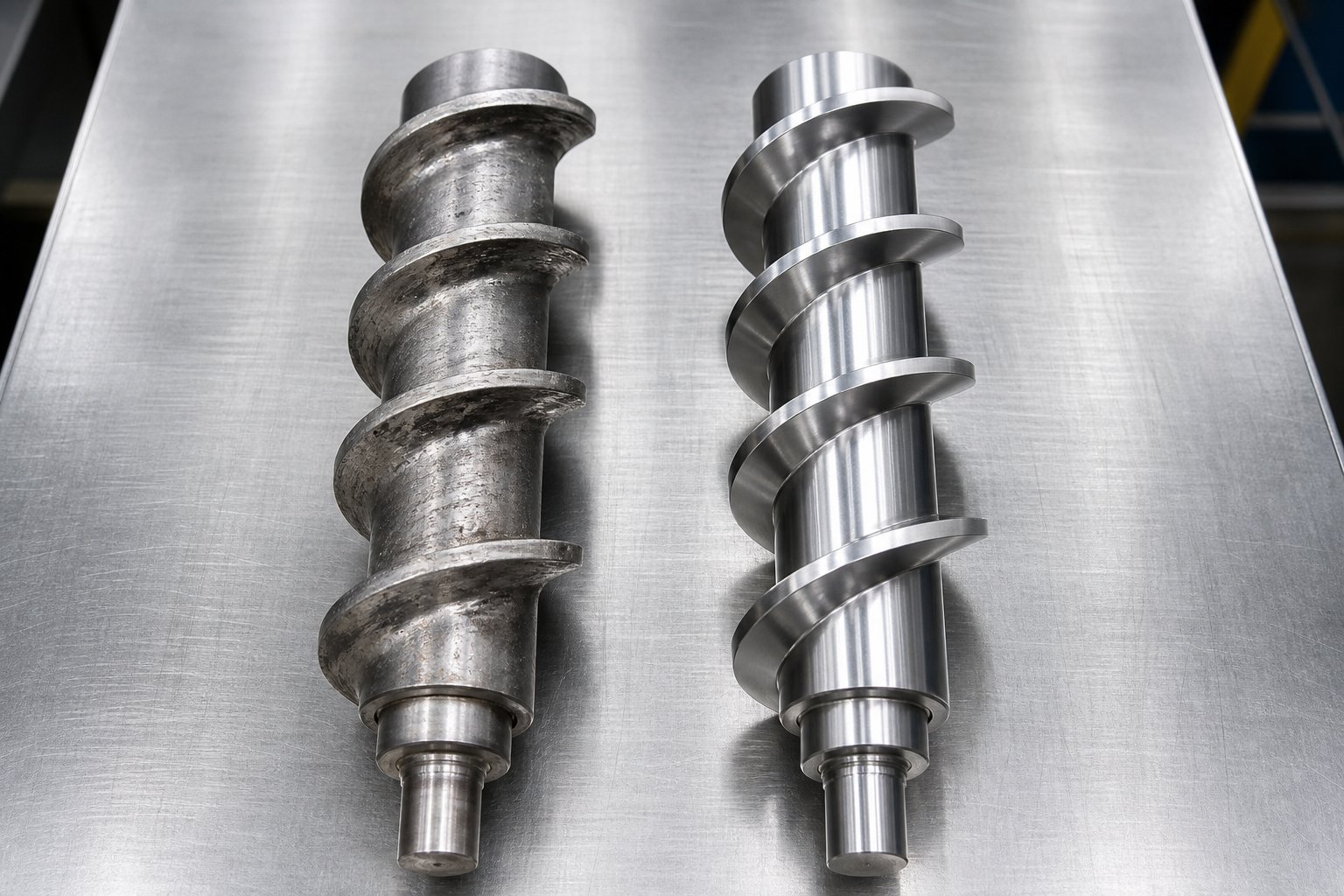
Every set of extruder screws and barrels eventually wears out — that much is guaranteed by the physics of the process. High temperatures, enormous pressures, continuous rotational shear, and chemically aggressive polymer melts all conspire against metal surfaces hour after hour. The real question is not whether wear will occur, but which mechanism is doing the damage and how quickly it progresses. A manufacturer that understands these distinctions designs screws to resist the specific failure mode your application creates. One that doesn't? They hand you a standard nitrided screw and wish you luck.
Four primary wear mechanisms account for virtually all degradation in extruder screws. Each has distinct causes, characteristic damage patterns, and targeted engineering solutions. Identifying which one dominates your process is the first step toward extending screw and barrel life — and it is the conversation a quality supplier should initiate before recommending any metallurgy or geometry.
Adhesive and Abrasive Wear Mechanisms
Adhesive wear occurs when the thin film of molten polymer separating the screw flight tips from the barrel bore breaks down. On a new machine, that clearance is typically just 0.1 to 0.25 mm radially, filled with a hydraulic cushion of melt that prevents metal-to-metal contact. When that cushion fails — due to improper startup without adequate preheat, barrel deflection from misalignment, or starvation-induced gaps in melt coverage — the flight tips and barrel wall touch directly. Under heat and pressure, microscopic welding occurs at contact points. As the screw continues rotating, those welds tear apart, pulling metal from both surfaces. You'll recognize adhesive wear by smooth, shiny smear marks on flight tips and matching scoring inside the barrel bore.
The solution starts with prevention: proper startup procedures, correct screw-to-barrel alignment, and maintaining adequate feed to keep the melt film intact. From a materials standpoint, dissimilar metallurgies between the screw flight and barrel liner reduce the tendency for metal bonding. A manufacturer that pairs a nickel-based flight overlay with an iron-based barrel liner — rather than using similar steels on both surfaces — is engineering against adhesive failure by design.
Abrasive wear is the most common mechanism, responsible for roughly 50% of all wear cases in production environments. Hard particulates in the resin — glass fibers, calcium carbonate, talc, wood flour, metallic contaminants in recycled streams — act as tiny cutting tools grinding into metal surfaces with every screw rotation. The damage concentrates in high-pressure zones: the transition section where solids compress against barrel walls, the metering zone where melt pressure peaks, and barrier flight clearances where particles are forced through tight gaps.
Wear rates in abrasive service are aggressive. Processing glass-filled compounds, you can expect 0.05 to 0.15 mm of material loss per 1,000 operating hours on standard steel — enough to push a screw out of tolerance within a single production year. The manufacturer's answer is straightforward: tungsten carbide or Colmonoy 83 hard-facing on flight lands, bimetallic barrel liners with embedded carbide particles, and shallow-flighted geometries that reduce localized particle velocity against wear surfaces. A manufacturer that processes your 30% glass-filled nylon on a standard nitrided screw without recommending a bimetallic upgrade is either uninformed or indifferent to your operating costs.
Corrosive and Fatigue Wear in Demanding Applications
Corrosive wear operates through chemical attack rather than mechanical grinding. Certain polymers — PVC, PVDC, fluoropolymers, and compounds containing halogenated flame retardants — release acidic byproducts during processing. PVC, for example, evolves hydrochloric acid gas at elevated temperatures. That acid attacks exposed steel surfaces, dissolving the protective oxide layer and eating into the base metal underneath.
What makes corrosive wear particularly insidious is its self-accelerating nature. As the surface roughens from initial chemical attack, degraded material lodges in the rough texture, breaks down further, and produces more acidic byproducts that speed the corrosion cycle. Small initial damage escalates rapidly. The typical wear rate is 0.01 to 0.05 mm per 1,000 hours — slower than abrasion on a per-hour basis, but often more destructive over time because operators don't notice the gradual surface degradation until performance has already deteriorated significantly.
The material solution here is fundamentally different from abrasive wear. Hardness alone is irrelevant against chemical attack. Nickel-based alloys like Hastelloy C-276 or Stellite overlays with their passive chromium oxide films resist acid penetration far better than tool steels or carbide coatings. A reputable extruder screw manufacturer processing PVC or fluoropolymers will specify nickel-based barrel liners paired with Stellite-overlaid screw flights as standard — not as an expensive upgrade.
Fatigue wear represents the smallest fraction of total wear cases — roughly 5% of documented failures — but it produces the most dramatic consequences. Repeated thermal cycling between operating temperature and ambient, combined with cyclic mechanical loading from pressure fluctuations, creates microscopic surface cracks that propagate over thousands of hours. Eventually, small pieces of metal spall off, leaving pits and voids that disrupt melt flow and accelerate other wear mechanisms.
Fatigue resistance comes primarily from screw core toughness — the ability of the base metal to absorb repeated stress cycles without crack propagation. Through-hardened steels with low ductility are vulnerable. Properly tempered alloy steels with a hard nitrided case over a tough, ductile core resist fatigue far better because the flexible substrate absorbs cyclic loads without cracking. Geometry also matters: sharp transitions between flight sections, abrupt channel depth changes, and stress-concentrating features like keyways accelerate fatigue cracking. A manufacturer that designs smooth transitions and generous radii into high-stress zones is engineering fatigue resistance into the screw's DNA.
Recognizing When Your Screw Needs Attention
Screws and barrels don't fail catastrophically without warning. They send signals — sometimes subtle, sometimes obvious — long before a complete breakdown forces an emergency shutdown. The challenge is recognizing those signals amid the daily noise of production data. Here are the warning signs that your extruder screws have crossed from normal operation into wear-driven degradation:
- Declining output rate at constant screw speed — worn flights leak melt backward over the clearance gap, reducing forward pumping efficiency
- Rising melt temperature without changes to heater setpoints — increased clearance forces more work through viscous shear heating rather than positive displacement
- Poor mixing or color streaking — worn mixing sections lose their dispersive and distributive effectiveness
- Dimensional instability in the final product — wall thickness variation, weight fluctuation shot-to-shot, or inconsistent profile geometry
- Increased motor current draw — the drive works harder to maintain throughput as screw efficiency drops
- Erratic head pressure readings — pressure instability at the die indicates inconsistent melt delivery from a worn metering section
- Visible discoloration or degradation in the product — extended residence time in worn channels causes thermal degradation
- Unexplained increase in scrap rate — typically above 5% defects signals a wear-related investigation is overdue
The definitive diagnostic measurement is a flight-to-barrel clearance check. Pull the screw, measure the flight outer diameter at multiple points with precision calipers, and compare against the barrel bore diameter measured with an internal gauge. The critical threshold: when radial clearance reaches 0.15 mm or greater, output efficiency has already declined enough to justify screw replacement or rebuilding. Similarly, if the barrel bore has increased more than 0.20 mm from nominal, relining or replacement is warranted.
A knowledgeable manufacturer doesn't just sell you a replacement when wear is detected. They analyze the wear pattern — where it's concentrated, what type it is, and how it correlates with your resin and operating conditions — to recommend whether the next screw needs different metallurgy, different geometry, or both. That diagnostic conversation separates a true engineering partner from a supplier that simply takes orders and ships parts.
Understanding wear mechanisms tells you what's happening to your screw. The next logical question is what type of screw you should be running in the first place — because geometry matched to your specific resin and application determines how much abuse the screw faces and how well it handles that load over its service life.
Matching Screw Design to Resin Type and Processing Application
Geometry determines destiny in plastics processing. Two screws built from identical metallurgy and machined to identical tolerances will deliver wildly different results if one has the wrong flight configuration for the resin running through it. A single extruder screw designed for unfilled polyethylene film cannot handle 40% glass-filled nylon — not because it lacks hardness, but because the channel depths, compression ratios, and mixing elements are fundamentally mismatched to how that material melts, flows, and pressurizes.
This is why the breadth of screw types a manufacturer can produce tells you as much about their capability as their metallurgical expertise. A shop that only makes general-purpose metering screws is not equipped to serve a processor running twin screw compounding lines, injection molding cells, and single-screw sheet extrusion from the same facility. When you evaluate an extruder screw manufacturer, their design portfolio should cover the full range — single screw geometries, twin screw and barrel configurations, and injection molding screws and barrels — each with the application engineering depth to recommend the right geometry for your specific resin and process.
Single Screw Geometries for Extrusion
The single extruder screw remains the backbone of the plastics industry, installed in more extrusion lines worldwide than any other configuration. But "single screw" is not a single design — it is an entire family of geometries, each optimized for different melting behaviors, mixing requirements, and pressure demands.
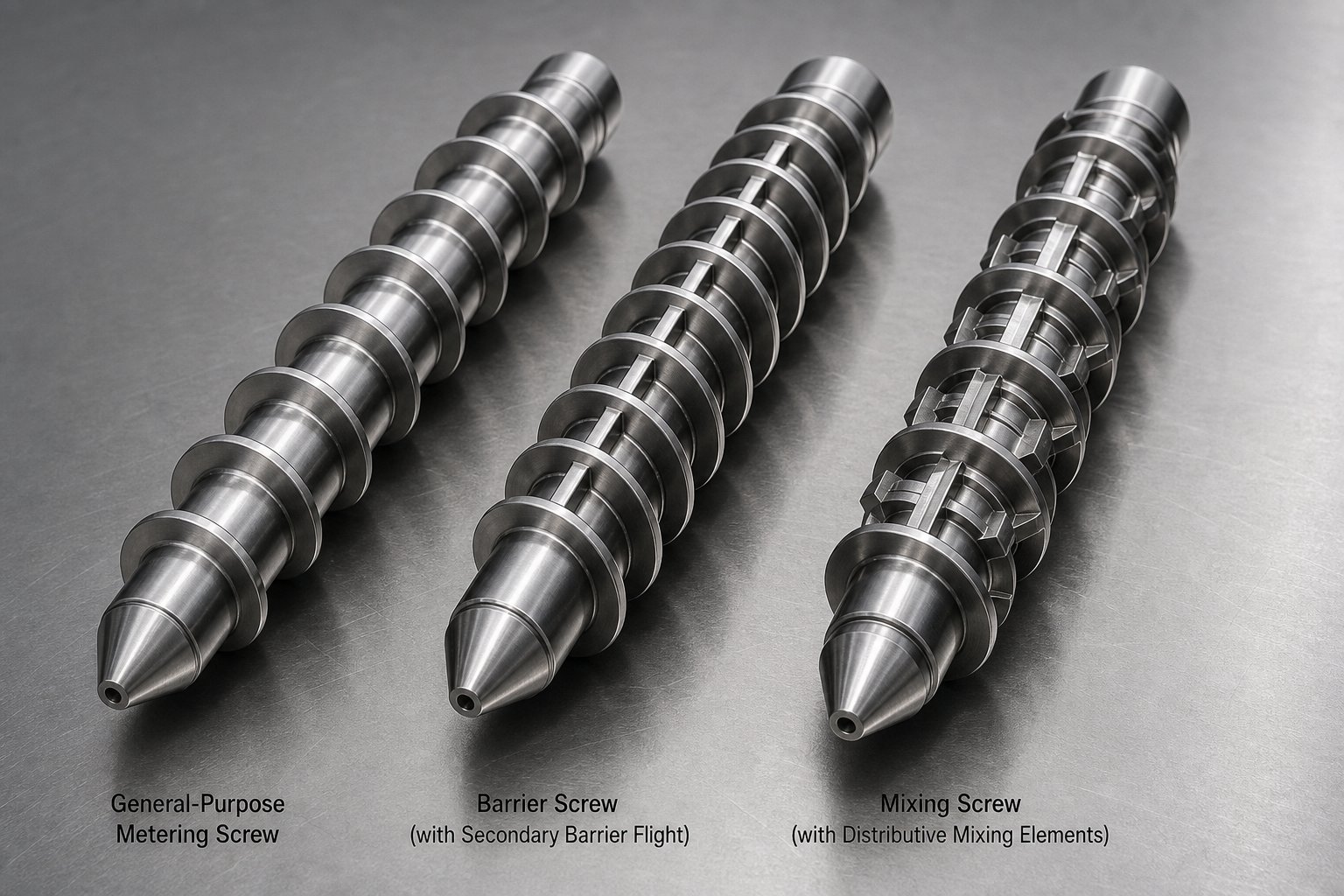
General-purpose metering screws represent the simplest configuration: a feed section with deep channels, a transition section where channel depth decreases progressively to compress and melt the resin, and a metering section with constant shallow channels that stabilize output and build die pressure. The compression ratio — the ratio of feed channel depth to metering channel depth — typically falls between 2:1 and 3:1 for commodity polyolefins like PP and PE. These screws work well for unfilled, semi-crystalline resins that melt cleanly and don't require intensive mixing.
Barrier screws add a secondary flight — the barrier flight — that separates solid resin pellets from already-melted polymer within the transition zone. As material advances along the screw, solids are confined in a shrinking solids channel while melt migrates across the barrier clearance into an expanding melt channel. The result is faster, more complete melting with lower melt temperature variability. Barrier screws typically include three or four distinct sections — feed, barrier/compression, metering, and sometimes a dedicated mixing zone — each balanced in relation to the others.
A critical design detail: barrier screws still need a proper metering section. Designs that extend the barrier section to fill the entire available length — eliminating the metering zone — sacrifice pressure-generating capability and output stability. Computer simulations show that a barrier screw without a metering section produces 9 to 10% less output at 3,500 psi head pressure compared to an identical screw with a standard metering section, along with higher melt temperatures and greater pressure variation at the discharge. The metering section provides a damping effect that stabilizes flow exiting the barrier zone — without it, pressure pulses from the solids and melt channels create surging at the die.
Mixing screws incorporate distributive and dispersive mixing elements — Maddock mixers, pineapple mixers, pin sections, or cavity transfer elements — to homogenize color concentrates, blend multi-component streams, or break up gels and agglomerates. Distributive mixing redistributes material spatially without applying high stress, ideal for color uniformity. Dispersive mixing applies intense shear to break apart agglomerates — necessary for carbon black dispersion or gel reduction. A skilled manufacturer designs mixing sections that achieve the required mixing intensity without overheating the melt or creating excessive pressure drop.
Twin Screw Configurations for Compounding and PVC
When a single extruder screw cannot deliver the mixing intensity, throughput, or material handling flexibility your process requires, twin screw systems step in. A capable manufacturer must understand both principal configurations — co-rotating and counter-rotating — because they serve fundamentally different applications and demand entirely different twin screw barrel geometries.
Co-rotating intermeshing twin screws rotate in the same direction within a figure-eight barrel bore. The fully intermeshing geometry creates a flow field where material is forcibly handed off between screws at the intermeshing zone, producing high shear stress and intense mixing with very few dead zones. The self-wiping action suppresses stagnation and keeps residence time distribution narrow — critical for reactive extrusion and thermally sensitive compounds. Co-rotating configurations dominate compounding applications: dispersing inorganic and organic fillers, producing polymer alloys and blends, and running reactive extrusion processes involving polymerization or compatibilization. You'll find them anywhere processing demands call for aggressive mixing, precise energy input control, and the ability to reconfigure screw element combinations for different formulations.
Counter-rotating intermeshing twin screws rotate in opposite directions, drawing material into the intermeshing zone under compression rather than shear. Mixing relies on compressive and elongational deformation — a calendering effect — rather than the intense shear of co-rotating designs. Shear stress and associated heat generation remain low, making counter-rotating configurations ideal for materials with poor thermal stability. Rigid PVC is the textbook example: it has a low decomposition temperature and poor melt flow, meaning the high-shear environment of a co-rotating extruder would degrade it before proper forming could occur. Counter-rotating twin screws allow low-temperature extrusion at high fill and low rotational speed — the standard production method for PVC pipes, sheets, and profile extrusion products worldwide.
Conical twin screws are a subset of the counter-rotating family where the screw diameter tapers from a large feed end to a smaller discharge end. The tapering geometry provides high torque capacity at the feed zone (where large diameter gives mechanical advantage) while delivering high pressure at the discharge (where the smaller diameter concentrates force). Conical twins are particularly common in PVC window profile extrusion and pipe production where consistent low-shear plasticization combined with high output pressure is essential.
For the twin screw barrel itself, manufacturing complexity increases significantly over single-screw barrels. The figure-eight bore profile must maintain extremely tight tolerances across both bores simultaneously, with consistent wall thickness between them. A manufacturer that machines single-screw barrels accurately does not automatically possess the capability to produce twin screw barrel assemblies — the geometric complexity, bore alignment tolerances, and liner application methods are fundamentally more demanding.
Injection Molding Screws and Their Unique Demands
Injection molding screws operate in a processing environment that differs fundamentally from continuous extrusion — and those differences drive distinct design requirements that a comprehensive manufacturer must understand. While an extrusion screw rotates continuously, pushing melt forward in steady state, injection molding screws must plasticize a precise shot volume, then act as a hydraulic ram to inject that melt into a closed mold at extremely high pressures and speeds.
This dual function creates unique design constraints. The basic three-zone architecture remains — feed, transition, and metering — but the L/D ratio is typically shorter (20:1 to 26:1 for injection molding versus 24:1 to 36:1 for extrusion), and the compression ratio is tuned to the specific resin family rather than maximized for throughput.
Check ring and non-return valve assemblies sit at the screw tip, allowing melt to flow forward during plasticization but preventing backflow during injection. The sliding ring check valve is generally preferred over ball check designs because it presents an easier flow path — reducing shear on sensitive materials like polycarbonate. However, ring valves wear faster than ball valves, and a worn check ring directly causes shot-to-shot weight inconsistency. Monitoring cushion stability during processing reveals check ring condition long before visible defects appear in parts.
Shot-to-shot consistency is the defining performance metric for injection molding screws. Unlike extrusion where minor output fluctuations average out over continuous production, every injection cycle must deliver an identical volume of uniformly melted material. Screw diameter selection is critical here — smaller diameters deliver higher available injection pressure but limit maximum shot size, creating a fundamental trade-off that must be resolved based on part geometry, flow length, and wall thickness.
Barrier screws for injection molding deliver better melt quality at faster plasticization rates compared to general-purpose designs. Double-flight screws offer an alternative that ensures complete melting before the compression zone — particularly effective for thin-wall technical parts in PA where barrier designs may not plasticize optimally. The choice between these advanced geometries depends on the specific resin and part requirements — a point where application engineering from the manufacturer makes or breaks the selection.
Wear resistance takes on added urgency for injection molding screws and barrels because replacement involves not just component cost but mold qualification downtime, process re-validation, and potential part quality disruptions across active production programs. Processing glass-reinforced engineering resins — the bread and butter of technical injection molding — demands heat-treated screw and barrel assemblies as standard practice, not as an optional upgrade.
| Resin Category | Recommended Screw Type | Key Design Features | Material Considerations |
|---|---|---|---|
| Commodity Polyolefins (PE, PP) — unfilled film, sheet, pipe | General-purpose metering screw | 2.5:1 to 3:1 compression ratio; standard L/D 24:1 to 30:1; moderate channel depths | Nitrided 4140 steel adequate; long service life due to non-abrasive resin |
| Engineering Polymers (Nylon, POM, PC) — unfilled or lightly filled | Barrier screw with metering section | Separate solids/melt channels for complete melting; 4-8 turn metering zone for pressure stability | Nitrided 4340 minimum; consider D2 tool steel if any filler present |
| Glass/Mineral-Filled Compounds (15-40% loading) | Deep-flighted barrier or mixing screw with wear-resistant geometry | Deeper metering channels to reduce particle velocity against walls; dispersive mixing elements for filler distribution | CPM 10V or Colmonoy 83 hard-faced flights; bimetallic barrel mandatory |
| PVC (rigid and flexible) | Counter-rotating twin screw (parallel or conical) | Low compression, low shear design; short residence time; precise temperature control zones | Stellite or nickel-alloy overlay on flights; nickel-based bimetallic barrel liner for HCl resistance |
| Compounding — Polymer Alloys, Masterbatch, Reactive | Co-rotating intermeshing twin screw | Modular screw element design; kneading blocks for dispersive mixing; conveying elements for transport zones | Nitrided or coated elements depending on filler; segmented design allows element-level replacement |
| Recycled / Post-Consumer Resins | Deep-flighted single screw with extended mixing; vented barrel design | Tolerates feed variability; venting removes moisture and volatiles; mixing homogenizes inconsistent melt | Colmonoy 56 minimum on flights (contamination is inherently abrasive); bimetallic barrel recommended |
| Injection Molding — General Purpose (PP, PE, ABS) | General-purpose three-zone screw with ring check valve | L/D 20:1 to 24:1; compression ratio 2:1 to 2.5:1; shot size matched to screw diameter | Nitrided 4140 for unfilled resins; heat-treated assembly if any reinforcement present |
| Injection Molding — Technical (Glass-Filled Nylon, PPS, PEEK) | Barrier or double-flight screw with sliding ring check valve | Faster plasticization; complete melting before metering; high injection pressure capability via optimized diameter | D2 or CPM tool steel screw; bimetallic barrel; frequent check ring inspection for shot consistency |
Notice how the table reveals a clear principle: resin properties dictate screw geometry, and screw geometry dictates material requirements. These are not independent decisions — they form a chain where each link constrains the next. A manufacturer that quotes you a screw without asking what resin you're running, what filler package you use, and what downstream quality targets you're chasing is skipping the most important step in the entire selection process.
The breadth of screw types a supplier can produce also tells you something about their service model. Can they build your replacement single extruder screw today, design a custom twin screw and barrel set for your new compounding line next quarter, and supply injection molding screws for your molding cells on an ongoing basis? Or will you need three different vendors for three different equipment types — multiplying qualification effort, splitting institutional knowledge, and fragmenting your supply chain?
Equally important is understanding what happens when these screws — regardless of type — reach the end of their service life. Not every worn screw demands a brand-new replacement. Sometimes a rebuild makes more economic sense. Sometimes a targeted repair is all that's needed. Knowing which path is appropriate requires evaluating the screw's condition against its original specifications — and that decision framework separates informed buyers from those who default to the most expensive option or the cheapest one.
New Screw Manufacturing vs. Rebuilding vs. Repair
A worn extruder screw and barrel set does not always demand a brand-new replacement — but it doesn't always survive a rebuild either. Knowing which service pathway is appropriate for your situation is one of the most consequential cost decisions a plastics processor makes, yet many buyers default to whichever option their supplier pushes hardest. The result? Either spending $15,000 on a new screw when a $6,000 rebuild would have delivered identical performance, or investing in a rebuild that fails within months because the core screw body was too far gone to support new material.
Three distinct pathways exist: new manufacturing, rebuilding (remanufacturing), and repair. Each serves a different condition, and the right choice depends on the screw's current state, your processing goals, and a clear-eyed view of total cost of ownership.
When to Order a New Screw vs. Rebuild an Existing One
New manufacturing is the right call in three situations. First, when you're changing resins — switching from unfilled PP to 30% glass-filled nylon, for instance — and your current screw geometry simply cannot handle the new application regardless of its physical condition. Second, when you're upgrading geometry — moving from a general-purpose metering design to a barrier screw with mixing elements to improve melt quality. Third, when wear has exceeded rebuildable limits — meaning the screw body is bent, cracked, or has been rebuilt so many times that the base metal can no longer accept new weld deposits reliably.
Rebuilding involves welding new hard-facing alloy onto worn flight lands and tips, then re-machining the entire screw back to original dimensional tolerances. Common restoration techniques include PTA welding on the thread crest after a white steel base repair, surface hard chrome plating for improved flowability, straightening to correct any runout, and full-length polishing to restore surface finish. A properly rebuilt screw can deliver performance equivalent to new — at 50 to 75% of new-screw cost.
Here's the critical limitation: a screw should not be refurbished more than approximately three times, because each rebuild cycle's welding heat gradually deteriorates the base metal's grain structure and increases the risk of delamination between the hardfacing overlay and the substrate. A manufacturer that keeps rebuilding a screw past this threshold — without disclosing the risk — is prioritizing short-term revenue over your long-term reliability.
Repair addresses localized damage rather than generalized wear. A broken flight tip in the feed section, scoring from foreign metal contamination, or a small area of hardfacing delamination — these are isolated problems that don't require re-working the entire screw. Targeted weld repair and local re-grinding restores function at a fraction of rebuild cost, with turnaround times measured in days rather than weeks.
The decision tree also applies to processors running used extruders or upgrading used single screw extruders and used twin screw extruder equipment acquired on the secondary market. Machines purchased used often arrive with screws of unknown history — worn beyond measurement, rebuilt multiple times, or running the wrong geometry for your intended application. Evaluating whether the existing screw justifies a rebuild or demands replacement is the first process engineering step after any used equipment acquisition.
| Evaluation Criteria | New Screw Manufacturing | Rebuild (Remanufacturing) | Repair |
|---|---|---|---|
| Typical Cost | 100% (baseline) | 50-75% of new | 15-35% of new |
| Lead Time | 6-14 weeks (includes engineering and material procurement) | 3-6 weeks (screw body already exists) | 1-2 weeks (localized work only) |
| Expected Performance | Full original specification or upgraded geometry; longest wear life with optimized metallurgy | Equivalent to original when core body is sound; wear life matches or exceeds original nitrided screw if upgraded hard-facing is applied | Restores localized function; overall wear life remains limited by remaining non-repaired areas |
| Best-Fit Scenario | Resin change, geometry upgrade, screw body cracked or bent, more than 3 prior rebuilds, or transitioning to a new application | Core body structurally sound with no cracking; generalized flight wear within rebuildable limits; same resin and geometry acceptable | Isolated damage — single broken flight, localized scoring, small delamination area — with rest of screw within tolerance |
| Risk Factors | Highest upfront cost; longer lead time; requires clear application specifications | Diminishing returns after 3+ rebuilds; requires honest assessment of base metal condition; poor rebuild shops produce short-lived results | Does not address systemic wear elsewhere on the screw; masking a larger problem if wear is actually generalized |
Understanding Total Cost of Ownership for Screw Components
The purchase price printed on an invoice is not the cost of an extruder screw and barrel — it is merely the entry fee. Total cost of ownership encompasses wear life in operating hours, downtime frequency for replacements, scrap generated as the screw degrades, energy consumed as efficiency drops, and the production capacity lost during every changeover event.
Consider this scenario: a cheaper replacement screw from an unknown source costs 40% less than a properly engineered alternative. Sounds like smart purchasing — until that screw wears to its clearance limit in 3,000 hours instead of 8,000, generates 2% additional scrap during its accelerated degradation curve, and requires an unplanned line shutdown for replacement that costs $5,000 per hour in lost production. The "savings" evaporate within the first replacement cycle.
What drives this performance gap? Three factors that separate a quality manufacturer from a price-focused commodity shop:
- Metallurgy selection — the right base alloy and hard-facing overlay matched to your specific polymer and filler package determines initial wear resistance
- Coating application quality — proper PTA parameters, full fusion bonding, correct overlay thickness, and absence of porosity or inclusions determine how long that wear layer actually lasts before delaminating
- Manufacturing precision — tight flight OD tolerances mean the screw starts life with optimal clearance, so it takes longer to wear to the replacement threshold; a screw that ships with loose tolerances is already partially worn before it runs its first hour
The economic logic is straightforward. A screw that costs 30% more upfront but lasts 2.5 times longer delivers a cost-per-operating-hour that is 48% lower. Factor in reduced scrap, fewer shutdowns, and lower energy consumption during its extended service life, and the total cost advantage compounds further. A point of diminishing returns exists for every screw — the moment where incremental machine adjustments can no longer compensate for wear-driven efficiency loss. A better-engineered screw pushes that point further into the future, giving you more productive hours before any intervention is needed.
This total cost perspective also applies to the rebuild decision. A rebuild performed by a manufacturer with proper PTA equipment, precise re-grinding capability, and honest metallurgical assessment delivers performance approaching a new screw. A rebuild from a shop that lacks these capabilities — or one that doesn't honestly evaluate whether the screw body can support another rebuild cycle — delivers a short-lived illusion of savings followed by premature failure and another shutdown.
The red flag here is simple: any supplier that quotes a new screw, rebuild, or repair without asking about your resin, filler loading, operating hours since last service, and performance symptoms is not making a recommendation — they are processing a transaction. The distinction matters because it determines whether you receive a solution matched to your actual condition or simply the service pathway that happens to fill their current shop capacity.
With the new-versus-rebuild-versus-repair decision clarified, the final challenge remains: how do you systematically evaluate competing manufacturers to determine which one will actually deliver the metallurgy, precision, and engineering depth your application demands? That evaluation requires a structured framework — not guesswork based on price sheets alone.
A Structured Framework for Evaluating Extruder Screw Manufacturers
Price sheets tell you what a plastic extruder screw costs. They tell you almost nothing about whether it will actually perform. Two quotes that land within 5% of each other can represent wildly different outcomes — one backed by rigorous metallurgy, tight machining tolerances, and genuine application understanding, the other backed by assumptions and a willingness to cut corners you won't discover until the screw is already in the machine. The gap between those two outcomes is exactly what a structured evaluation framework is designed to expose before you commit a purchase order.
Think of it this way: you wouldn't hire a surgeon based solely on who charges the least. You'd want credentials, a track record, and confidence that they understand your specific condition. Evaluating an extruder screw manufacturer follows the same logic — the checklist just looks a little different.
The Essential Manufacturer Evaluation Checklist
The following criteria separate manufacturers who engineer solutions from those who simply fill orders. Use this as a point-by-point scoring tool when comparing two or more suppliers for any screw plastic extruder or barrel extruder project:
- Material and Metallurgy Breadth — Does the supplier offer multiple base alloy options (4140, 4340, D2, CPM grades) and coating technologies (nitriding, stellite, colmonoy, tungsten carbide, HVOF)? A manufacturer limited to one metallurgy — typically nitrided 4140 — cannot serve applications involving abrasive fillers, corrosive polymers, or high-temperature engineering resins. Ask for a list of alloy and hard-facing combinations they have produced in the past 12 months. If the answer is vague, the capability likely is too.
- CNC Machining Capability and Tolerance Standards — What flight OD tolerances does the shop hold as standard? What is their stated root diameter consistency across full screw length? As discussed in earlier sections, quality manufacturers target flight OD within +0.000 / -0.002 inches and root diameter variation under 0.002 inches. Ask for their standard tolerance specifications in writing. A manufacturer that cannot produce this document does not track what they hold — and what isn't tracked isn't controlled.
- Reverse-Engineering and Dimensional Documentation — Can they accurately replicate a screw from a worn sample when no OEM drawing exists? Do they use CMM or laser measurement to capture geometry, or are they working with hand measurements and best guesses? The distinction matters enormously. A shop that measures a worn screw and copies those worn dimensions is not reverse-engineering — they are reproducing the exact problem you are trying to solve. Ask how they compensate for existing wear when generating a manufacturing drawing from a used screw.
- Application Engineering Support — This is the single most telling criterion. Can the manufacturer recommend a screw geometry and material combination based on your resin, filler package, throughput target, and quality requirements? Or do they simply wait for you to send a drawing and quote fabrication? A supplier with genuine application engineering depth will ask questions before quoting: What polymer are you running? What percentage and type of filler? What is your target output rate? What quality issues are you currently experiencing? If the quoting process consists of "send us your drawing and we'll price it," you are dealing with a machine shop, not a screw engineering partner.
- Turnaround Time for New Screws and Rebuilds — Lead time is not just a scheduling convenience — it is a measure of shop capacity, inventory management, and process efficiency. Benchmark figures to compare against: 4 to 8 weeks for a new plastic extruder screw from an aftermarket specialist, 6 to 14 weeks from an OEM, and 3 to 6 weeks for a rebuild. If a supplier promises delivery dramatically faster than these ranges, verify how — are they maintaining bar stock inventory, running multiple shifts, or cutting corners in heat treatment and inspection?
- Quality Certifications and Inspection Protocols — ISO 9001 certification is a baseline indicator that the manufacturer operates within a documented quality management system. Beyond the certificate itself, ask what their standard inspection protocol includes. Every finished screw should ship with a material certificate for the base steel, a hardness report documenting surface values and case depth, a dimensional inspection report verified against the drawing, and a straightness/TIR record. If a manufacturer cannot include these documents with shipment — or charges extra for them — that reveals the maturity of their quality culture.
- Geographic Logistics and Support Responsiveness — Proximity matters less than it once did, but communication responsiveness matters more than ever. Evaluate how quickly the supplier responds to your initial RFQ. Do they ask clarifying questions within 24 to 48 hours, or does your inquiry disappear into silence for a week? The quoting process is a preview of how they will communicate during production, handle change orders, and respond when a problem arises. A manufacturer whose pre-sale communication is slow or incomplete will not suddenly become responsive after receiving your payment.
Questions to Ask Before Placing Your First Order
The checklist above gives you categories to evaluate. These specific questions convert those categories into actionable conversations during the supplier qualification process:
- "Can you provide a sample dimensional inspection report from a recent order?" — This single request reveals more than any marketing brochure. A manufacturer who routinely inspects to documented standards will have reports readily available. One who hesitates or claims they don't share reports is telling you their inspection process is informal at best.
- "What base steel and hard-facing combination would you recommend for my specific resin and filler?" — An informed supplier will give a specific recommendation with rationale. An uninformed one will ask you to specify or default to standard nitrided 4140 regardless of your application.
- "How do you verify screw straightness, and what TIR specification do you hold?" — Straightness is the single most important mechanical check because a bent screw damages both itself and your barrel. Extruder screws are typically specified at 0.05 to 0.10 mm TIR per meter of length. A manufacturer should be able to describe their V-block and dial indicator procedure — or their automated measurement alternative — without hesitation.
- "What is your process for reverse-engineering a screw from a worn sample?" — Listen for specifics: CMM scanning, CAD modeling with wear compensation, comparison against OEM specifications when available. Generic answers like "we measure it and make a copy" should concern you.
- "Can you supply material certifications for the base steel and hardness test results with shipment?" — This is non-negotiable. The documentation is the difference between a supplier who measured and one who hopes. A manufacturer that builds quality into every step will treat these reports as standard deliverables, not burdensome extras.
Request samples of their documentation during the quoting phase — not after you've already placed the order and are waiting on delivery. Any reluctance to share this information before you commit is itself a red flag worth noting.
Why Application Engineering Support Matters
Imagine two processors requesting quotes from the same manufacturer. Processor A runs unfilled LDPE blown film on a standard 3.5-inch single-screw line. Processor B compounds 35% glass-filled PA6 on a 75mm twin-screw extruder with aggressive throughput targets. If both receive identical quoting experiences — same questions asked, same metallurgy recommended, same turnaround quoted — something is wrong. These are fundamentally different applications demanding different engineering conversations.
A manufacturer with genuine application engineering capability tailors the recommendation to the buyer's actual processing reality. For Processor A, a nitrided 4140 metering screw at the standard cost tier is perfectly appropriate — and an honest supplier says so rather than upselling unnecessary premium metallurgy. For Processor B, a CPM 10V or Colmonoy 83-overlaid barrier screw with a bimetallic barrel extruder liner is the minimum viable specification — and a knowledgeable supplier explains why, connects the recommendation to projected wear life, and helps the buyer understand the total cost advantage over cheaper alternatives that will wear out in a fraction of the time.
This engineering depth is especially critical when you're solving a processing problem rather than simply replacing a worn part. Melt temperature too high? The issue might be screw geometry — an insufficient barrier section or wrong compression ratio — not just metallurgical wear. Poor color dispersion? A mixing element redesign might deliver more improvement than any material upgrade. Output falling short of capacity? Channel depth optimization could recover throughput without increasing screw speed or energy consumption.
A supplier that functions as an engineering partner identifies these root causes and recommends solutions that address them. A supplier that functions as a parts vendor ships whatever you order and moves on to the next quote. Both will sell you a screw. Only one will solve your problem.
For processors, equipment manufacturers, and maintenance teams evaluating suppliers with this framework in mind, NANHAIYA's screw barrel product center offers a practical starting point — organizing custom and replacement screw and barrel solutions across extrusion and injection molding applications in a way that lets you quickly assess product range depth and request application-specific quotations.
The best evaluation framework in the world, however, only captures the present. The extruder screw manufacturing landscape is evolving — driven by advanced coating technologies, new alloy development for increasingly demanding recycled and bio-filled resin streams, and digital integration that is beginning to reshape how screws are designed, monitored, and replaced. Staying ahead of those trends protects your sourcing decisions not just for the next order, but for the next decade of production.
Emerging Trends and Next Steps in Extruder Screw Manufacturing
The evaluation framework covered in previous sections equips you to compare suppliers on today's capabilities — metallurgy breadth, machining precision, application engineering depth. But the resins you process five years from now will not look like the ones running through your extruder today. Recycled content mandates are climbing. Bio-filled compounds are replacing virgin mineral fillers. Processing temperatures and filler loadings are pushing into territory that challenges even premium tool steels. An extruder screw manufacturer that invests only in current technology is already falling behind — and choosing that supplier locks your operation into yesterday's solutions for tomorrow's problems.
Three converging trends are reshaping how screws are designed, coated, monitored, and replaced. Understanding these shifts helps you evaluate not just what a manufacturer can do today, but whether they are positioned to support your operation as material demands evolve.
Advanced Coatings and High-Performance Alloys
Traditional hard-facing overlays — stellite, colmonoy, tungsten carbide applied via PTA welding — remain the backbone of screw wear protection. But a new generation of thin-film coating technologies is supplementing these proven methods, offering protection profiles that welded overlays simply cannot achieve.
PVD (physical vapor deposition) and PACVD (plasma-assisted chemical vapor deposition) coatings deposit ultra-thin, extremely hard films — typically 2 to 5 microns thick — onto screw and barrel surfaces at relatively low temperatures. These coatings don't replace hard-facing on high-wear flight lands; instead, they add a secondary defense layer on surfaces where traditional overlays are impractical or where specific functional properties are needed. Oerlikon Balzers' BALINIT MOLDENA, for example, is a PVD coating developed specifically for plastic extrusion screw and injection molding applications involving highly filled or corrosive polymers. It delivers high hardness, reliable corrosion protection, and wear resistance tailored for glass fiber-reinforced plastics and recycled materials — extending tool life and maintaining stable part quality under conditions that degrade conventional surface treatments.
What makes these thin-film technologies particularly relevant is their compatibility with increasingly stringent regulatory environments. PVD and PACVD coatings are PFAS-free and comply with EU REACH and EPA regulations — a critical consideration as environmental standards tighten around processing chemicals and surface treatments. For processors supplying medical, food-contact, or consumer applications, this regulatory alignment is becoming a procurement requirement rather than a nice-to-have.
On the alloy development front, powder metallurgy steels continue advancing. Next-generation CPM grades with optimized vanadium and niobium carbide distributions are pushing abrasion resistance further while improving toughness — addressing the brittleness limitations that have historically constrained carbide-rich alloys in high-impact screw extrusion environments. Manufacturers investing in these materials can offer screws that resist both the grinding action of hard fillers and the cyclic mechanical stresses of continuous production without the cracking risk that plagued earlier high-carbide tool steels.
Screws Engineered for Recycled and Bio-Filled Resins
The circular economy is not a distant concept — it is rewriting screw design requirements right now. Recycled post-consumer resins arrive at the extruder feed throat with contamination profiles that virgin material never presents: residual paper labels, adhesive residues, metallic fragments from sorting equipment, mixed polymer species, and widely variable moisture content. Each of these contaminants attacks the screw differently — abrasion from particulates, corrosion from degradation byproducts, and thermal inconsistency from variable melt behavior.
A conventional screw designed for clean virgin resin cannot tolerate these conditions without accelerated wear, frequent output instability, and elevated scrap rates. Twin screw extruders have emerged as the preferred platform for recycled plastic pelletizing because their intermeshing geometry delivers strong self-cleaning action, multi-stage vacuum degassing for moisture and volatile removal, and the mixing intensity needed to homogenize inconsistent feedstock into usable pellets. The screw elements themselves must be built from wear-resistant alloys — typically coated or hard-faced — because the abrasive contamination inherent in post-consumer streams would destroy standard nitrided steel within weeks of continuous operation.
Bio-filled compounds introduce a parallel challenge. Natural fibers — wood flour, hemp, flax, rice hull — are inherently abrasive due to their silica content and irregular particle geometry. Processing temperatures must stay below the degradation point of the organic filler, which limits the use of high-temperature alloys but increases the importance of surface coatings that maintain low friction and resist adhesive buildup. Extrusion barrels handling bio-filled formulations increasingly specify bimetallic liners with nickel-based alloys that resist both the abrasive action of the filler and the corrosive byproducts of organic decomposition at processing temperature.
For manufacturers, this trend means expanding beyond the traditional metallurgy playbook. The screws and injection molding barrel and screw assemblies that worked for decades on virgin commodity resins are not adequate for the recycled and bio-filled streams that will constitute a growing share of global plastics production. Suppliers that proactively develop geometries and material combinations for these emerging feedstocks — rather than waiting for customers to specify them — demonstrate the forward-looking engineering capability that separates long-term partners from transactional vendors.
Practical Next Steps for Choosing Your Manufacturer
Industry 4.0 integration is adding another dimension to the manufacturer-buyer relationship. Sensor-equipped extrusion barrels now feed real-time data on barrel zone temperatures, melt pressure stability, motor load trends, and screw-speed-to-output ratios directly into monitoring platforms. Predictive maintenance systems correlate these data streams to build wear curves specific to each screw, barrel, and material combination — enabling replacement scheduling weeks or months in advance rather than reacting to a catastrophic failure at 2 AM on a weekend.
The practical impact on screw sourcing is significant. When you can track flight-to-barrel clearance progression indirectly through output rate decline, melt temperature drift, and motor current trends, you transform screw replacement from an emergency event into a planned procurement cycle. A manufacturer that understands this data-driven approach can use your wear history to refine future screw designs — adjusting metallurgy, coating thickness, or flight geometry based on actual field performance rather than theoretical calculations. This feedback loop between operational data and screw engineering represents the next evolution of the manufacturer-buyer relationship.
So where does this leave you today? Whether you are running a single extrusion line or managing a multi-plant operation with dozens of machines, the practical next steps are the same:
- Audit your current screw and barrel condition — Pull screws during your next scheduled shutdown, measure flight OD at multiple points, check barrel bore diameter, and document radial clearance. Compare against the replacement thresholds discussed earlier (0.15 mm radial clearance or greater warrants action). You cannot make informed sourcing decisions without baseline data on what you're currently running.
- Document your resin portfolio and processing challenges — List every resin and filler combination running across your equipment. Note which lines experience the fastest screw wear, highest scrap rates, or most frequent quality complaints. This documentation becomes the foundation for meaningful conversations with potential suppliers — and it exposes whether your current screw specifications actually match your current processing reality.
- Engage manufacturers who demonstrate application engineering depth — Use the evaluation checklist and qualification questions from the previous section to compare two or three suppliers head-to-head. Pay attention to who asks questions and who simply quotes. Pay attention to who recommends metallurgy based on your application and who defaults to their standard offering. The quoting process is the audition — and it reveals more about long-term partnership potential than any capability brochure.
- Request material certifications and inspection documentation upfront — Before committing to a first order, ask for sample reports. A supplier confident in their quality systems will share them without hesitation. One that deflects or delays is signaling a gap you'll eventually discover the hard way.
- Evaluate product range depth against your operational footprint — If your facility runs single-screw extrusion, twin-screw compounding, and injection molding equipment, a supplier that covers all three platforms from a single product center reduces qualification overhead and consolidates your institutional knowledge. NANHAIYA's screw barrel product center is one example of a manufacturer organizing custom and replacement solutions across these application categories — allowing processors, equipment manufacturers, and maintenance teams to assess breadth and request application-matched quotations from a single source.
The lowest unit price on an extruder screw is never the lowest total cost. Prioritize engineering partnership — a manufacturer that understands your resin, your wear challenges, and your production goals — over a supplier that simply offers the cheapest number on a quote sheet. The screw you install today determines your output quality, energy efficiency, and uptime for the next 10,000 to 20,000 operating hours. That decision deserves more than a price comparison.
The extruder screw manufacturing landscape is evolving faster than at any point in the past two decades. Advanced coatings are supplementing traditional hard-facing. New alloys are emerging to handle recycled and bio-filled feedstocks that barely existed a few years ago. Digital monitoring is transforming screw replacement from reactive guesswork into data-driven planning. Through all of this change, one constant remains: the manufacturer you choose determines whether your operation leads these shifts or scrambles to catch up. Choose the partner, not just the part.
Frequently Asked Questions About Extruder Screw Manufacturers
1. What is the difference between an OEM and an aftermarket extruder screw manufacturer?
OEM manufacturers like Davis-Standard produce proprietary screws designed exclusively for their own extrusion equipment, guaranteeing dimensional compatibility but often at premium pricing and longer lead times of 8 to 16 weeks. Aftermarket specialists, on the other hand, are independent companies that reverse-engineer, replace, or upgrade screws for any brand of extruder. They typically deliver faster (4 to 8 weeks), offer broader material and coating selections, and price competitively since their overhead is focused solely on screw and barrel production. The key when choosing an aftermarket supplier is verifying their reverse-engineering accuracy and quality assurance protocols — specifically whether they use CMM inspection and compensate for existing wear rather than simply copying worn dimensions.
2. How do I know when my extruder screw needs to be replaced or rebuilt?
Several operational signals indicate a screw has worn past acceptable limits: declining output rate at constant screw speed, rising melt temperature without heater setpoint changes, poor color mixing or streaking, dimensional instability in finished parts, increased motor current draw, and erratic head pressure readings. The definitive diagnostic is a flight-to-barrel clearance check — pull the screw during a scheduled shutdown and measure flight outer diameter at multiple points against the barrel bore. When radial clearance reaches 0.15 mm or greater, pumping efficiency has dropped enough to justify intervention. Whether you rebuild or replace depends on the screw body's structural condition; rebuilding is cost-effective at 50 to 75% of new-screw cost when the core is sound, but screws should generally not be rebuilt more than three times due to cumulative heat-affected zone degradation in the base metal.
3. What screw materials work best for processing glass-filled or abrasive resins?
Standard nitrided 4140 steel wears through its shallow hardened case in as few as 2,000 to 3,000 hours when processing abrasive compounds. For moderate filler loadings (15 to 30% glass or mineral), D2 tool steel through-hardened to 58-62 HRC extends service life to 12,000 to 15,000 hours. Heavily filled formulations (30 to 60% loading) call for CPM 10V or 15V powder metallurgy steels, which routinely exceed 20,000 hours in severe abrasion service. Hard-facing overlays like Colmonoy 83 with embedded tungsten carbide particles provide additional flight-land protection, and bimetallic barrel liners with iron-based alloys rated at 60-72 HRC are considered mandatory for any filled-resin application. A qualified manufacturer will recommend the specific alloy and overlay combination based on your filler type, loading percentage, and processing temperature rather than defaulting to a single metallurgy.
4. What tolerance standards should I expect from a quality extruder screw manufacturer?
Three critical dimensional characteristics separate precision manufacturers from commodity shops. Flight outer diameter should be held within +0.000 / -0.002 inches of the specified barrel bore clearance — this controls the gap that determines pumping efficiency and wear progression. Root diameter consistency should remain within 0.002 inches across the full screw length, since variations create uneven melting and pressure surges. Straightness, measured as total indicated runout (TIR), should target 0.003 inches or less for a typical 6-foot screw, with proportionally tighter values per unit length on longer screws. Every finished screw should ship with a CMM or laser-verified dimensional inspection report, material certifications for base steel, and hardness test results documenting surface values and case depth. Requesting a sample inspection report during the quoting process is one of the most effective ways to gauge a manufacturer's quality culture before committing an order.
5. How are extruder screws manufactured from start to finish?
The manufacturing process follows eight sequential stages. It begins with raw material selection and verification of forged alloy steel bar stock against mill certifications. Rough turning on CNC lathes establishes the screw's outer profile and concentricity. Flight machining via milling, hobbing, or whirling cuts the helical geometry to precise pitch and channel depth specifications. Heat treatment — typically gas or ion/plasma nitriding — hardens the surface while maintaining a tough, ductile core. Hard-facing overlays such as stellite, colmonoy, or tungsten carbide are then applied via PTA welding or laser cladding on flight lands exposed to heavy wear. Finish grinding brings flight OD, root diameter, and straightness to final tolerances. Dynamic balancing addresses vibration for high-RPM applications. Finally, full dimensional inspection using CMM or laser measurement documents every critical dimension against the engineering drawing. Skipping or rushing any step — particularly heat treatment or final inspection — compromises long-term screw performance regardless of how accurate the initial machining appears.
Written by
Nanhaiya Technical Team
Zhoushan Nanhaiya Plastic Machinery Co., Ltd.
The Nanhaiya technical team supports screw and barrel manufacturing projects through application review, technical communication, custom manufacturing coordination, and production and quality control.
Discuss Your Application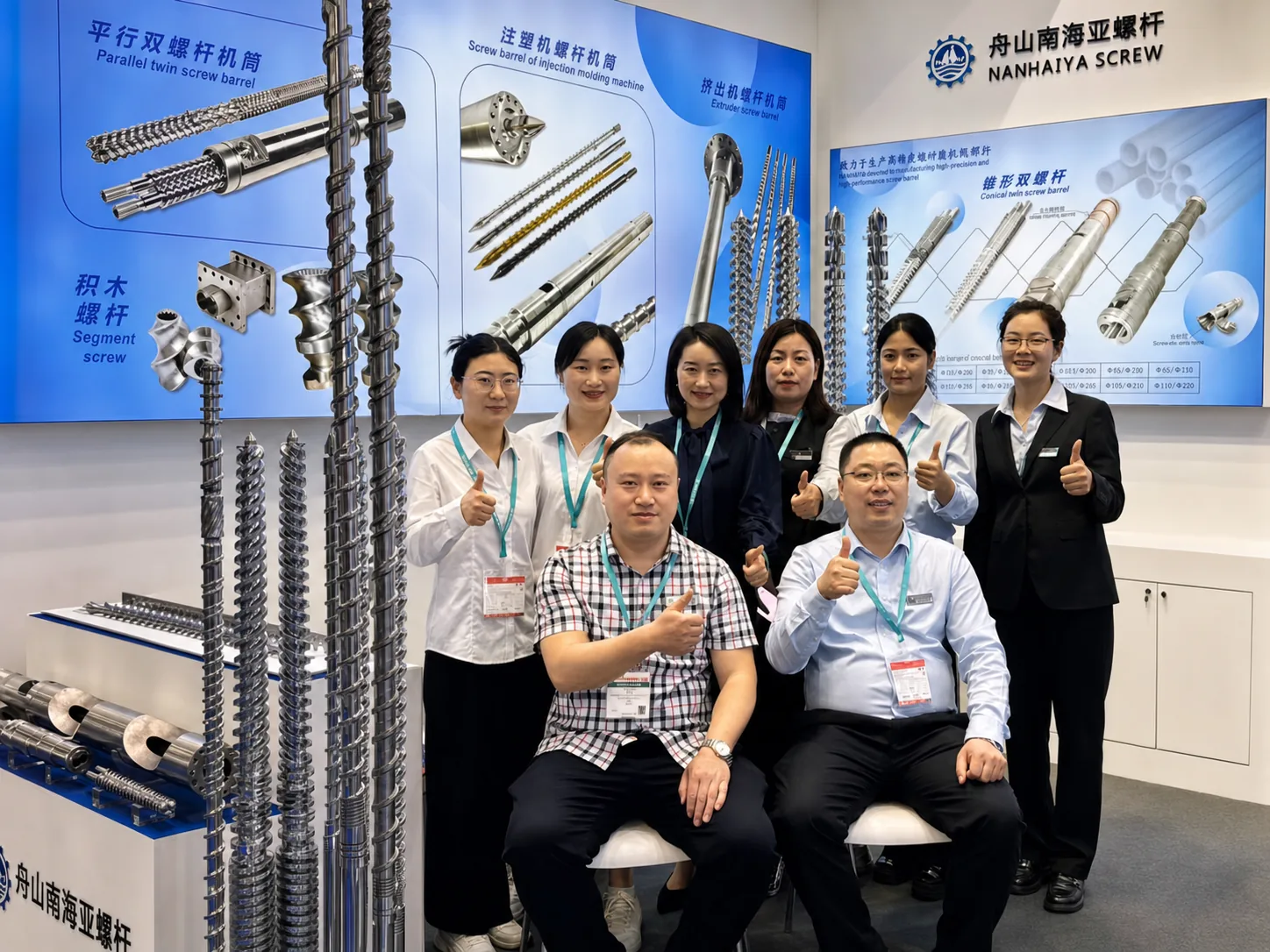
Related Articles
More insights on screw barrel technology and plastics processing.
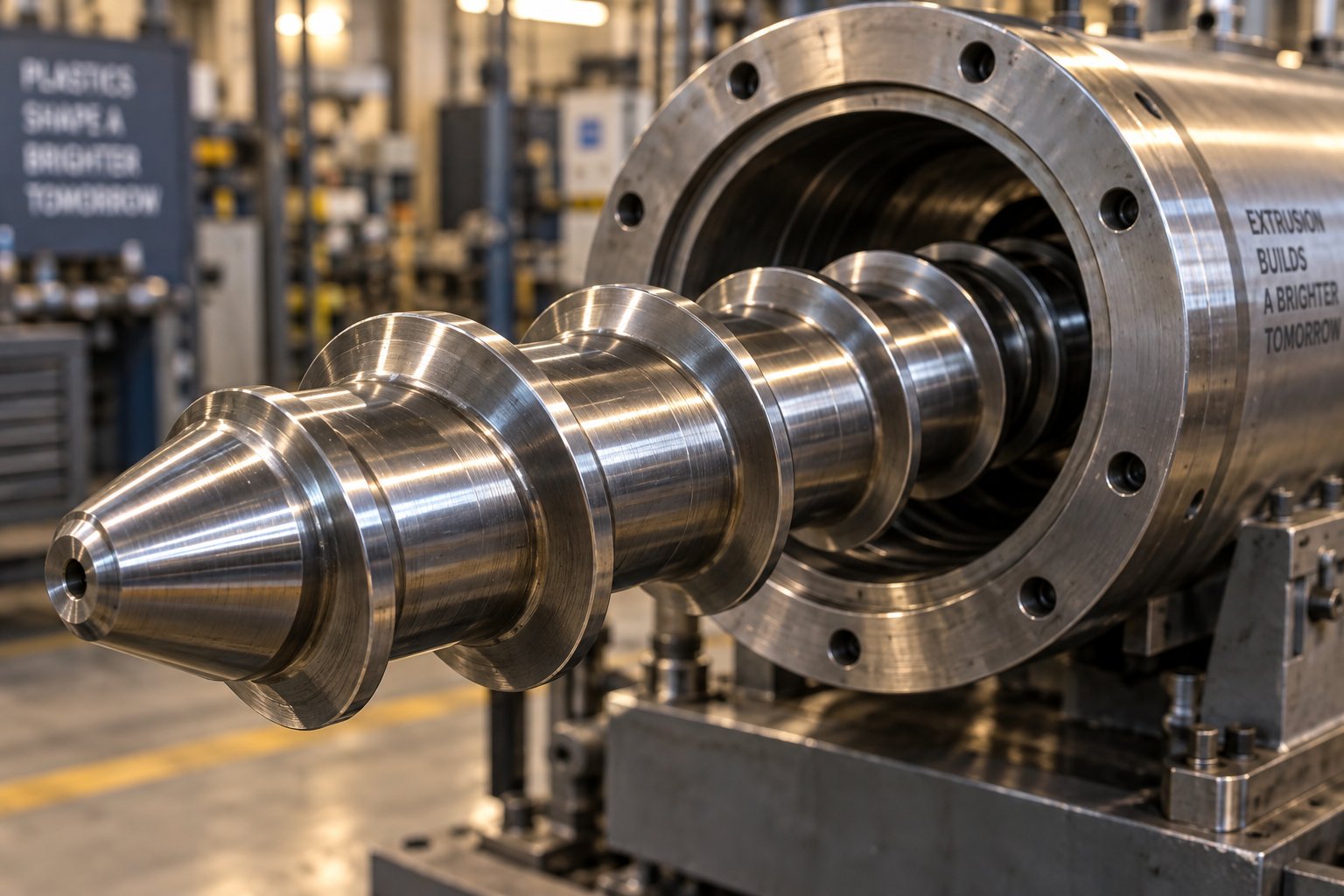
What Nobody Tells You About Screw Barrel For Plastic Machine Design
Oct 10, 2026
Learn how screw barrel for plastic machine design affects melt quality, throughput, and wear life. Covers geometry, resin matching, troubleshooting, and sourcing.
Read Article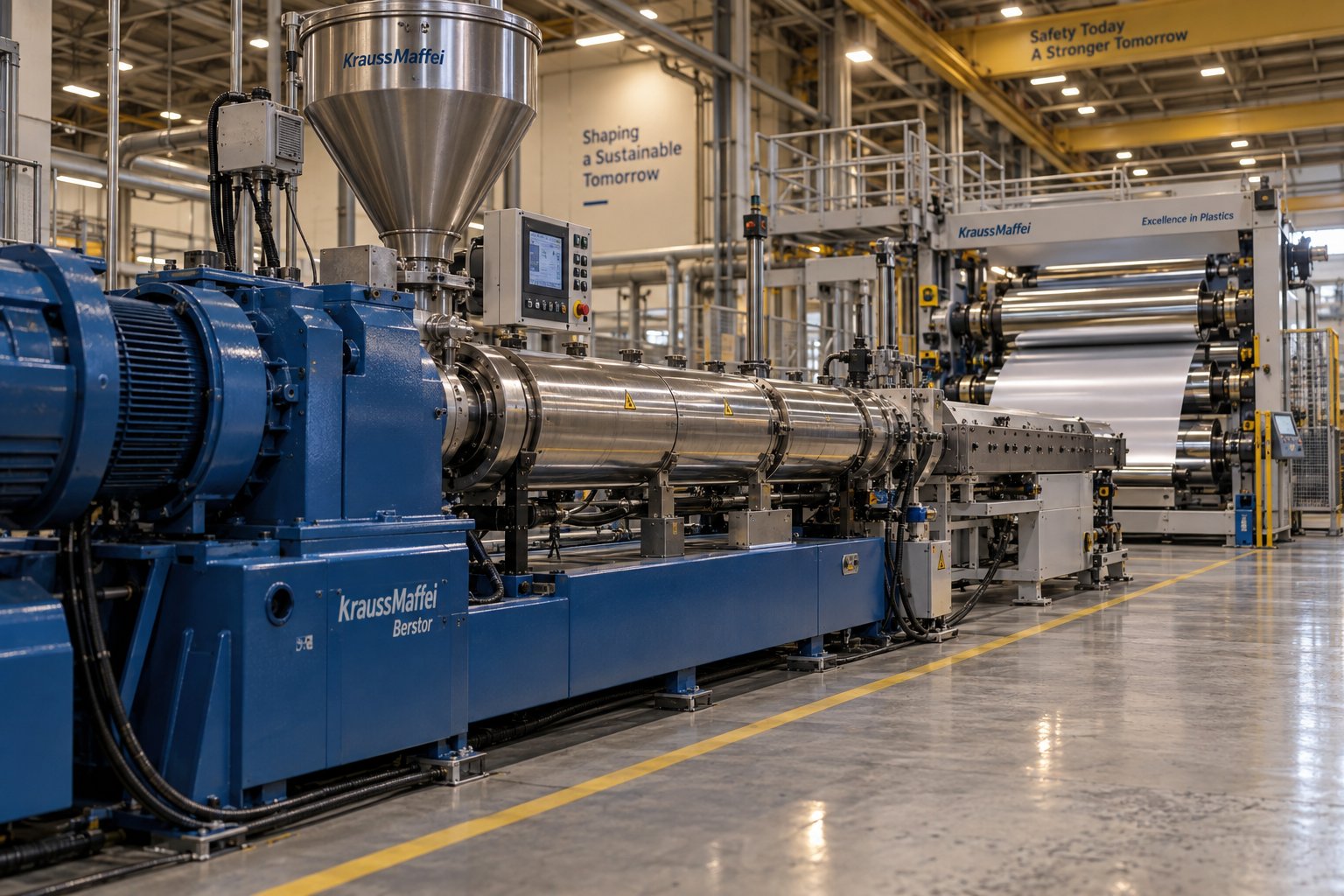
Single Screw Extruder for Sheet: Stop Guessing, Start Specifying
Oct 9, 2026
Learn how to specify a single screw extruder for sheet production. Covers screw geometry, resin-specific processing, troubleshooting, and maintenance best practices.
Read Article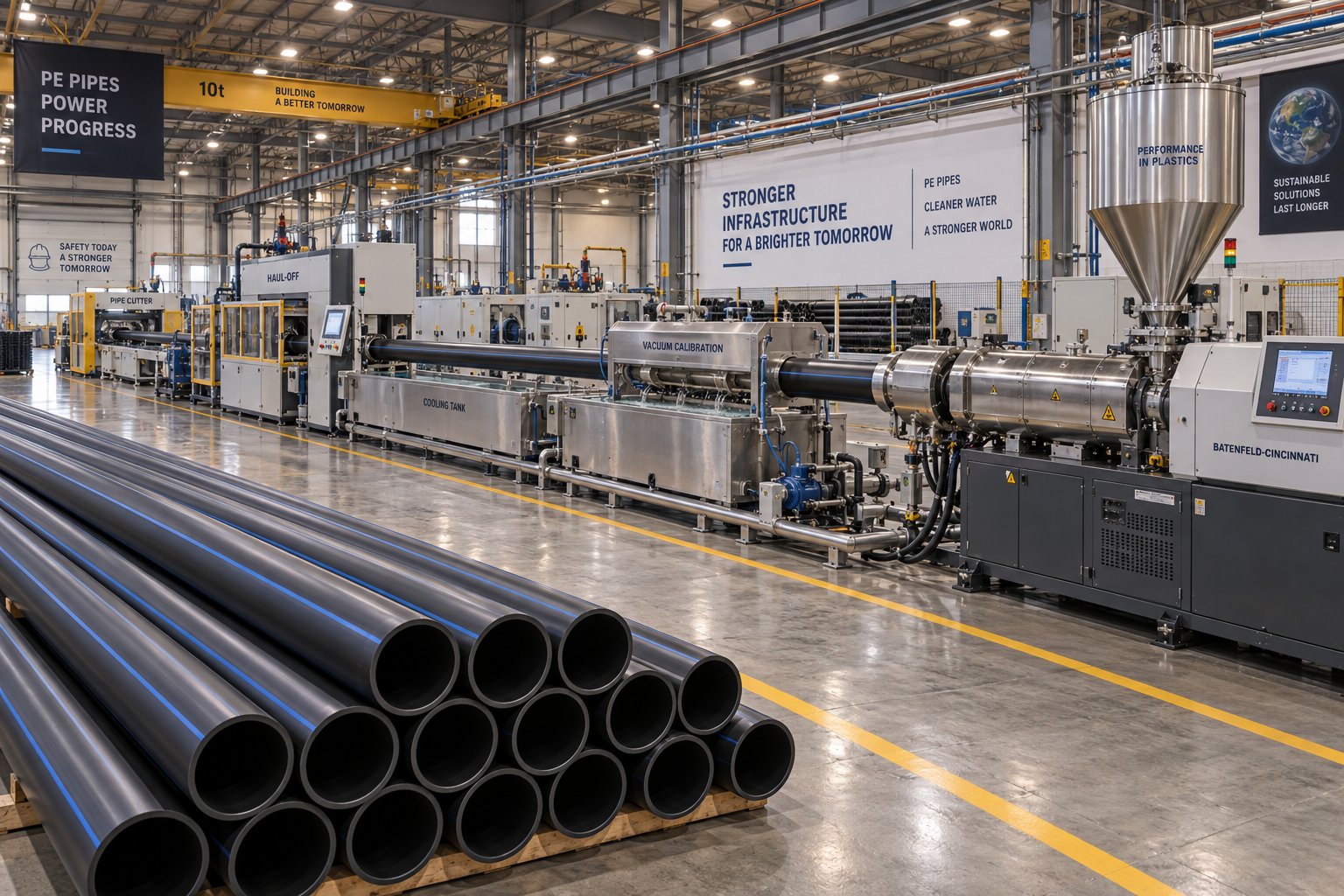
PE Pipe Extruder Machine: What Datasheets Won't Tell You
Oct 9, 2026
Learn how a PE pipe extruder machine works, key specs explained, material grade selection, maintenance tips, and buyer guidance beyond the datasheet.
Read ArticleLooking for something else?
Search by material, symptom or product and jump straight to the relevant page.
These are navigation suggestions based on keyword matching — not a quotation, not a delivery commitment, and not a substitute for engineering review. Final specification is confirmed by our engineers against your drawings and processed material.
Need help with screw barrel selection?
Share your machine model, processed material and application. Our team can help with pricing and technical support.