

Why PVC Demands a Specialized Extruder Screw
PVC ranks as the third-most-produced synthetic polymer on the planet, fueling everything from water pipes and window profiles to medical tubing and vinyl flooring. Yet here is the paradox: despite its massive global output, PVC is one of the most difficult thermoplastics to extrude safely and consistently. Polyethylene and polypropylene are relatively forgiving — you can push them through a wide range of temperatures and screw configurations without catastrophic consequences. PVC offers no such margin for error. Choose the wrong extruder screw for PVC, and the material does not simply produce a subpar product. It chemically breaks down, releasing corrosive gas that attacks your equipment, endangers your operators, and turns your output into carbonized waste.
That reality places screw design squarely at the center of every PVC extrusion operation. The screw is not a generic commodity part you swap out based on diameter alone. It is the primary engineering control that determines whether PVC compound transforms into a high-quality product or degrades into an unusable mess.
Why PVC Cannot Be Processed Like Other Plastics
Imagine a processing window so narrow that the temperature at which PVC flows is dangerously close to the temperature at which it self-destructs. That is exactly the challenge. When PVC overheats — even slightly — it undergoes a reaction called dehydrochlorination, stripping chlorine atoms from the polymer chain and releasing hydrochloric acid gas. This gas is toxic, highly corrosive to metal surfaces inside the extruder barrel, and a clear signal that material degradation is underway.
Polyolefins like polyethylene tolerate a broad temperature spread between melting and degradation, giving operators a comfortable cushion. PVC's usable corridor is a fraction of that. This fundamental material characteristic means every aspect of screw geometry — flight depth, compression ratio, channel design — must be engineered to control shear heat and residence time with surgical precision. A screw designed for polyethylene will almost certainly overshear or overheat PVC, triggering degradation before the melt even reaches the die.
The Extruder Screw as the Heart of PVC Processing
In extrusion, the screw is responsible for conveying, compressing, melting, and homogenizing the PVC compound as it travels through the extruder barrel toward the die. Unlike injection molding, where the mold geometry largely dictates final part quality, in extrusion the screw dictates melt quality — and melt quality dictates everything downstream: surface finish, mechanical strength, dimensional accuracy, and long-term durability.
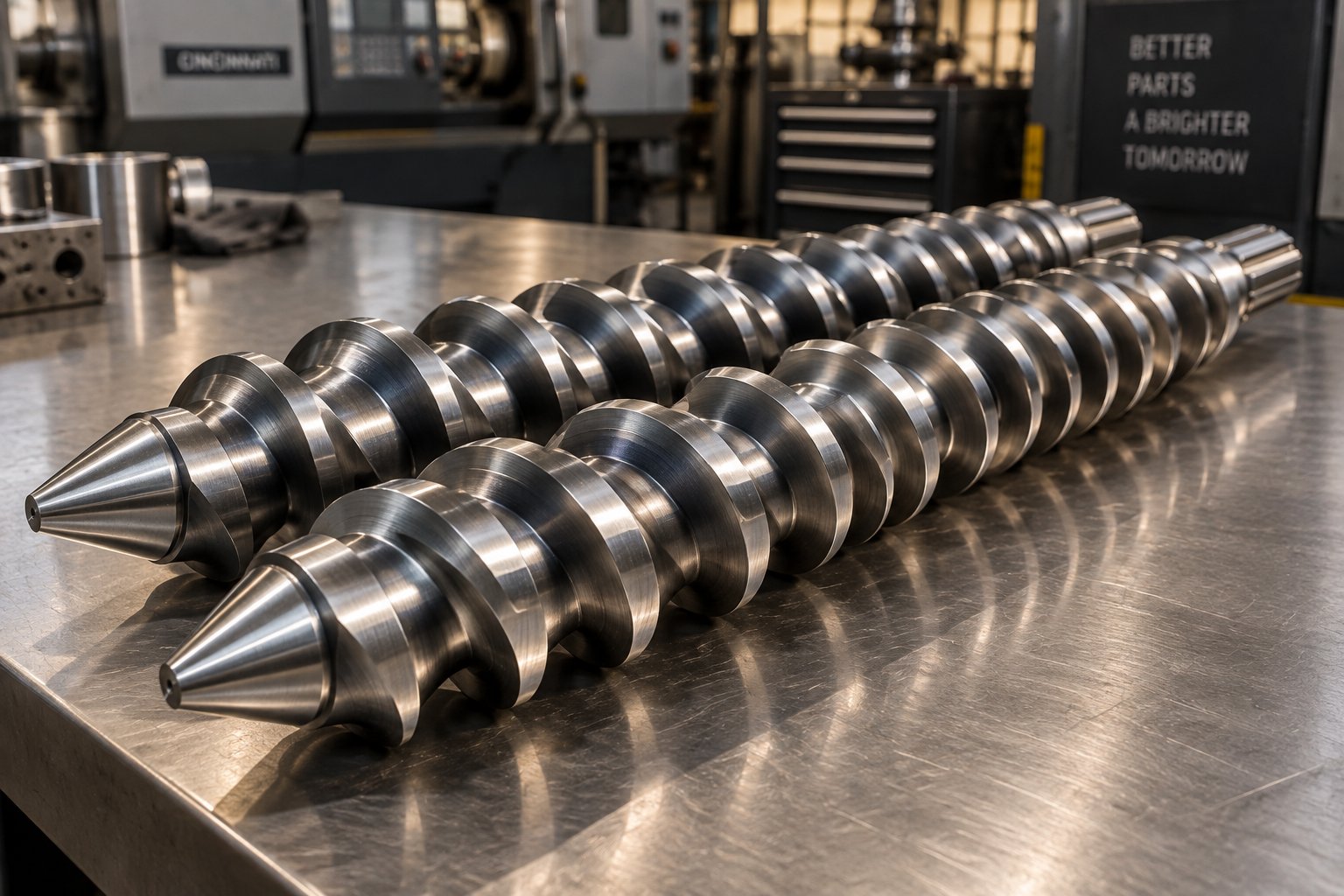
Twin screws, in particular, sit at the very heart of rigid PVC production. As polymer engineering specialists have emphasized, these highly engineered components are integral to transporting, compressing, mixing, heating, shearing, and pumping viscous PVC compound through dies into structured products. The screws are the primary factors in both production throughput and final quality. Even the extruder feed barrel plays a supporting role, maintaining consistent material intake temperature so the screw can do its job predictably.
In PVC extrusion, the screw does not merely move material — it must precisely manage thermal and mechanical energy to achieve gelation without degradation.
When you consider that the best extruders for thermoplastics like polyethylene can tolerate significant process variation, PVC's demand for screw-level precision becomes even more striking. The sections ahead break down exactly how screw geometry, zone design, metallurgy, and configuration choices combine to make or break PVC extrusion — and what defects appear first when any of these factors fall short.
Understanding PVC's Thermal Sensitivity and Processing Window
PVC's reputation as a difficult polymer is not exaggerated — it is rooted in chemistry. Before you can appreciate why extruder screws for PVC demand such specialized geometry, you need to understand what happens inside the polymer chain when things go wrong. The answer involves a destructive reaction that no amount of downstream correction can fix.
Dehydrochlorination and Why Temperature Control Is Non-Negotiable
Picture the PVC molecule as a long carbon backbone with chlorine atoms hanging off it at regular intervals. When processing temperatures climb too high, those chlorine atoms start breaking free. Each departing chlorine atom grabs a neighboring hydrogen atom on its way out, and together they form hydrochloric acid — HCl gas. This process is called dehydrochlorination, and it is the primary degradation mechanism that makes PVC extrusion so unforgiving.
The consequences cascade rapidly. HCl gas is highly corrosive, attacking metal surfaces inside extruder barrels and downstream tooling. It is also toxic, creating serious workplace safety hazards if ventilation is inadequate. Meanwhile, the polymer chain left behind loses its structural integrity. Conjugated double bonds form along the backbone, creating discolored sequences that eventually carbonize into black specks and charred residue embedded in your product. Thermogravimetric studies confirm that this first-stage degradation — dominated by HCl release — accounts for roughly 55% of PVC's total mass loss during thermal decomposition, meaning the majority of the polymer's weight is vulnerable to this single reaction pathway.
Here is what makes this especially dangerous in pvc extrusion: dehydrochlorination does not require extreme temperatures. It can begin at temperatures only marginally above the point where PVC achieves adequate fusion. You are essentially working on a thermal tightrope — too little heat and the material does not fuse properly, too much and you trigger irreversible chemical degradation.
PVC's Narrow Processing Window Compared to Polyolefins
To put PVC's challenge in perspective, consider how it compares to common polyolefins. When you extrude polyethylene, you enjoy a processing window of roughly 80-100 degrees Celsius between the melting point and the onset of degradation. Polypropylene offers a similarly generous corridor. PVC? Depending on the formulation and stabilizer package, the usable window may shrink to as little as 20-30 degrees Celsius. That is not a comfortable margin — it is a razor-thin corridor where every degree counts.
| Parameter | PVC | Polyethylene (PE) | Polypropylene (PP) |
|---|---|---|---|
| Melt Processing Range | Very narrow (~20-30 degrees C) | Wide (~80-100 degrees C) | Wide (~70-90 degrees C) |
| Degradation Onset Relative to Fusion | Very close above fusion point | Well above melting point | Well above melting point |
| Shear Sensitivity | High — excess shear triggers degradation | Low to moderate | Moderate |
| Degradation Byproduct | Corrosive HCl gas | Non-corrosive volatiles | Non-corrosive volatiles |
| Processing Forgiveness | Very low | High | Moderate to high |
This table reveals a critical distinction: with polyolefins, operators have substantial room to adjust temperatures, screw speeds, and throughput without catastrophic results. PVC punishes even small deviations. An extrusion barrel running a few degrees hot, or extruder screws generating slightly more frictional heat than intended, can push the material past the degradation threshold before anyone notices the problem visually.
How This Shapes Every Screw Design Decision
This material reality drives every engineering decision about screw geometry. Shallow flight depths in the metering zone limit the shear rate applied to the melt, directly reducing frictional heat generation. Low compression ratios — typically 2:1 to 3:1 for rigid PVC compared to 3:1 to 4:1 for polyethylene — prevent localized overheating as material densifies in the transition zone. Controlled screw speeds keep residence time in check, because every additional second PVC spends inside hot extruder barrels is another second closer to degradation onset.
Even the clearance between the screw flights and the barrel wall takes on heightened importance. Excessive clearance increases backflow and creates additional frictional heating — a manageable nuisance with polyethylene but a potential degradation trigger with PVC. Industry guidance suggests keeping this gap within 0.1 to 0.6 mm, and for heat-sensitive PVC formulations, tighter tolerances within that range are strongly preferred.
In short, the thermal sensitivity of PVC does not just influence screw design — it dictates it. Every geometric parameter, from flight depth to helix angle, must be selected with one overriding goal: deliver enough mechanical and thermal energy to achieve complete fusion without crossing the degradation line. That goal plays out differently in each functional zone of the screw, where the material undergoes distinct physical transformations that demand zone-specific engineering.
Screw Zone Functions Engineered for PVC Processing
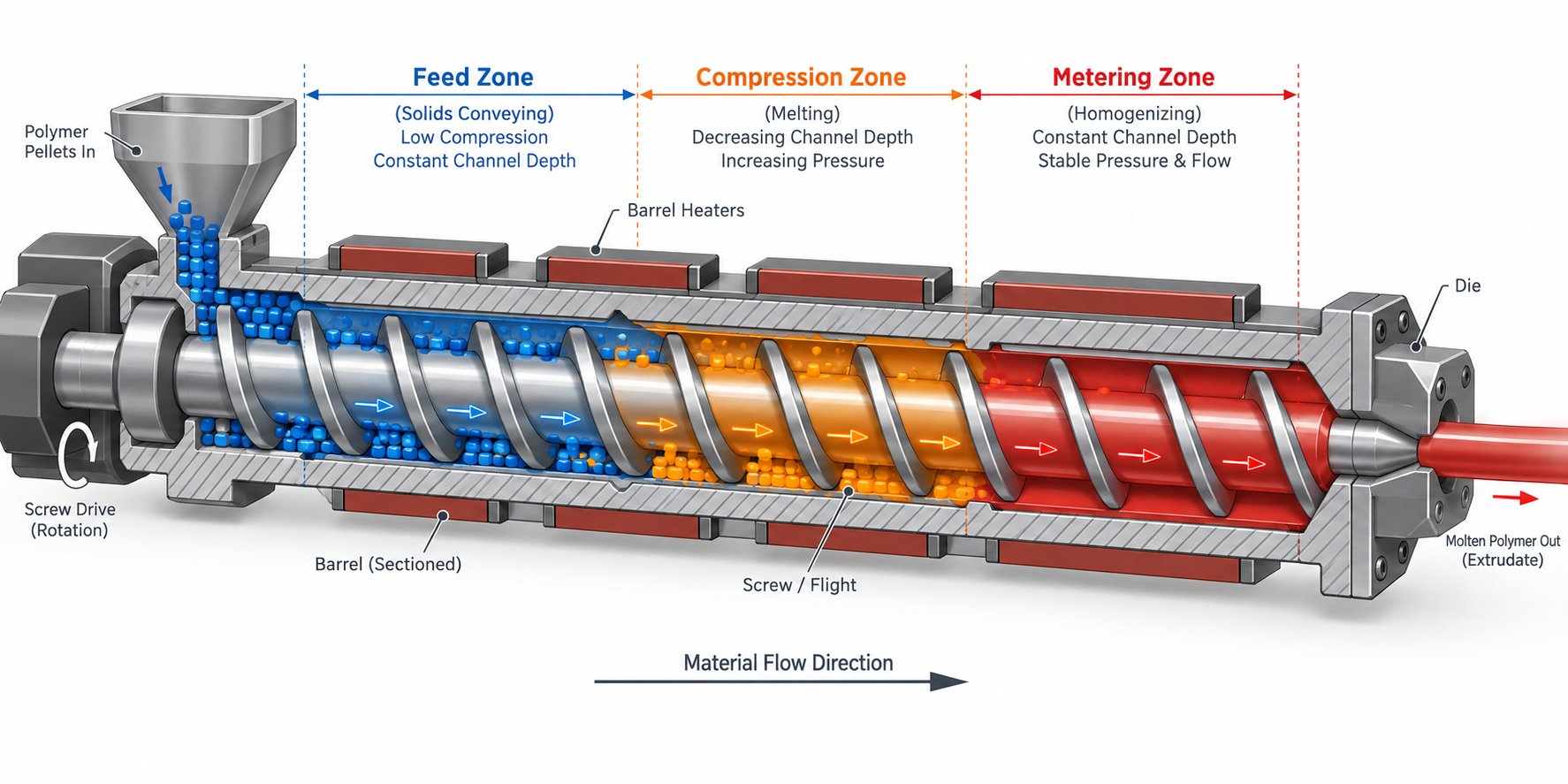
Each extruder screw is divided into three functional zones — feed, compression, and metering — and each zone plays a distinct role in transforming raw material into a uniform melt. For polyolefins, standard zone proportions and depths work across a broad range of conditions. PVC does not afford that luxury. Its razor-thin processing window means every zone must be individually tuned to balance energy input, material conveyance, and thermal exposure. Get even one zone wrong on a pvc extruder machine, and you will see the consequences — from feeding instability all the way through to degraded product at the die.
Feed Zone Design for Consistent PVC Intake
The feed zone is where everything starts. Its job is straightforward: accept PVC compound from the hopper and convey it forward into the barrel at a steady, predictable rate. Sounds simple, but PVC dry-blend powder — the most common feed form for rigid PVC extrusion — is far less free-flowing than polyolefin pellets. The fine, irregular particles tend to bridge in hoppers, entrap air between grains, and resist the smooth gravitational flow that pelletized materials enjoy.
Flight depth in the feed zone directly determines how much bulk material the screw can grab per revolution. Because PVC dry-blend has a lower bulk density than pellets, the feed zone typically requires deeper flights to capture an adequate volume of powder and push it forward consistently. As extrusion specialist Allan Griff explains, the feed zone depth must be "deep enough to take in the plastic particles" — and for low-density PVC powder, that depth needs to be more generous than what you would spec for denser pelletized resins.
Temperature management at this stage is equally critical. The extruder feed barrel surrounding the intake section must keep the incoming material cool enough to prevent premature softening or fusing. If PVC begins to melt before it has been properly compacted, it sticks to the screw root, loses its forward-conveying friction against the barrel wall, and causes the kind of erratic feeding that ripples through the entire process. Active cooling of the feed throat — targeting temperatures well below the rest of the barrel — is standard practice on any well-configured PVC line. Grooved feed bushings can also improve grip and solid-bed formation, helping form a denser material plug that conveys more reliably into the compression zone.
Compression Zone and the Critical Role of Compression Ratio
The compression zone — sometimes called the transition zone — is where PVC transforms from a loose collection of powder particles into a densified, fusing mass. As the screw channel gradually becomes shallower, material is squeezed between the shrinking flight depth and the barrel wall. Pressure builds, air is expelled, and the combination of conducted heat from barrel heaters and frictional heat from mechanical shearing begins to fuse the PVC particles together.
This is precisely where PVC's narrow thermal window becomes a hands-on engineering problem. The compression ratio — defined as feed zone depth divided by metering zone depth — controls how aggressively the material is compacted. For polyethylene, compression ratios of 3:1 to 4:1 are common because the material tolerates substantial shear without degrading. PVC requires a gentler approach. Typical compression ratios for rigid PVC fall in the range of 2:1 to 2.5:1, deliberately lower to limit the frictional heat generated during compaction.
Why does this matter so much? Excessive compression generates localized hot spots inside the melt channel. In polyethylene, those hot spots are a minor efficiency concern. In PVC, they are degradation triggers. Even small pockets of overheated material undergo dehydrochlorination, producing HCl gas and carbonized residue that contaminate the entire melt stream. Industry guidance for rigid PVC suggests maintaining compression zone barrel temperatures in the 160-175 degrees C range, with gradual increases from the feed section to avoid thermal shock.
The rate of compression matters too — not just the ratio. A screw that transitions from deep to shallow over just a few turns creates an abrupt pressure spike. A more gradual taper spreads the energy input over a longer section, giving PVC time to fuse evenly without localized overheating. This is one reason why PVC screws often have longer compression zones relative to their total length compared to general-purpose designs intended for a tpe extruder or polyolefin processing.
Metering Zone and Melt Homogeneity
By the time PVC reaches the metering zone, it should be fully fused and flowing as a homogeneous melt. The metering zone's role is to deliver that melt to the die at consistent pressure, consistent temperature, and consistent viscosity — revolution after revolution, hour after hour. Think of it as the quality-assurance stage of the extruder screw. Any non-uniformity that survives this zone shows up directly in the final product.
For PVC, shallow and consistent flight depths in the metering zone are essential. Shallow channels limit the shear rate applied to the melt, keeping frictional heat generation in check. Consistency across the channel depth prevents localized deep spots where material can stagnate, overheat, and degrade. Barrel temperatures in this zone are typically maintained around 170-185 degrees C for rigid PVC — high enough to keep the melt flowing smoothly, but controlled precisely to stay below the degradation threshold.
Pressure stability is another critical function. Fluctuations in metering zone pressure translate directly into output surging — periodic variations in flow rate that cause wall thickness inconsistencies in pipe, dimensional waviness in profiles, and weight variation in sheet products. Worn flights in the metering zone are a common culprit, as increased clearance between the flight tip and barrel wall allows backflow that disrupts the steady pumping action.
Key Design Parameters by Zone
When specifying or evaluating an extruder screw for PVC applications, these are the primary geometric parameters to consider across all three zones:
- Flight Depth: Deep in the feed zone to accommodate low-bulk-density PVC powder; gradually decreasing through the compression zone; shallow and uniform in the metering zone to minimize shear heating and eliminate stagnation points.
- Compression Ratio: Maintained at approximately 2:1 to 2.5:1 for rigid PVC — significantly lower than the 3:1 to 4:1 ratios used for polyethylene — to prevent excessive frictional heat buildup during material densification.
- Flight Width: Generally around 10% of barrel diameter, as noted in industry guidelines. Wider flights waste effective screw length and generate excess heat in the clearance zone, while narrower flights increase leakage flow over the flight tip.
- Helix Angle: Standard square-pitch designs (helix angle producing one-diameter pitch per turn) are common, but PVC-specific screws may use modified pitch in certain zones to control material residence time and forward conveyance rate.
- Transition Length: The compression zone taper should be gradual rather than abrupt, spreading energy input over more screw turns to prevent localized overheating — a consideration far more critical for PVC than for shear-tolerant polyolefins.
These parameters do not operate in isolation. A deep feed zone paired with the wrong compression ratio can starve or surge the metering zone. An optimized compression taper loses its value if metering zone flights are worn and leaking. The geometry of each zone must be designed as part of an integrated system — and that system must account for the specific PVC formulation, the extruder configuration, and the target product. Whether your line runs a single screw, a conical twin, or a parallel twin determines how these zone parameters translate into hardware — a distinction that fundamentally shapes screw selection.
Single Screw vs Conical Twin vs Parallel Twin for PVC
Screw zone geometry tells you what the flights should look like. But the extruder configuration — single screw, conical twin, or parallel twin — determines how those flights interact with PVC compound in practice. Each configuration handles shear, mixing, and material conveyance differently, and those differences matter enormously when you are processing a heat-sensitive polymer with almost no room for thermal error. Choosing the wrong platform is just as costly as running the wrong flight depths.
Single Screw Extruders for PVC
Single screw designs are the simplest and least expensive entry point. One rotating plastic extruder screw inside a cylindrical barrel conveys, compresses, and meters material in a single helical channel. For PVC, single screws find their place in straightforward applications — cable coating, simple profile shapes, and some small-diameter pipe production where output demands are moderate.
The advantages are practical: lower capital cost, simpler maintenance, and fewer moving parts. However, single screw systems rely heavily on the barrel wall for mixing action, which limits their ability to homogenize PVC dry-blend thoroughly. Most single screw PVC lines require pre-compounded pelletized material rather than raw dry-blend, adding an upstream processing step and cost. Output rates are also lower compared to twin screw alternatives, and the limited mixing capability makes it harder to achieve the uniform gelation that demanding PVC products require.
Conical Twin Screw Extruders for PVC
If you walk through a factory producing rigid PVC pipe, window profiles, sheet, or foam board, you will almost certainly see conical twin screw extruders on the production floor. This configuration dominates rigid PVC processing for good reason.
A conical twin screw barrel extruder uses two counter-rotating, intermeshing screws that taper from a large diameter at the feed end to a smaller diameter at the discharge end. That tapered geometry is not arbitrary — it solves two problems simultaneously. The large-diameter inlet provides generous feeding capacity, easily accepting bulky PVC dry-blend powder with its low bulk density. As the screws converge toward the smaller outlet, they build pressure gradually and controllably, generating the mechanical energy needed for PVC gelation without the abrupt compression spikes that trigger degradation.
Counter-rotation is equally important. Because the screws turn in opposite directions, material is positively conveyed through the intermeshing zone with minimal backflow. This gives operators precise control over residence time — a critical advantage for heat-sensitive PVC where every extra second inside hot metal increases degradation risk. The result is stable plasticizing performance, consistent melt quality, and the kind of process predictability that rigid PVC demands.
Manufacturers like NANHAIYA specialize in conical twin screw barrels engineered specifically for PVC pipe, PVC profile, PVC board, foam board, and WPC extrusion. Their offerings include both custom-engineered and direct replacement barrels designed to maintain the tight geometric tolerances that stable PVC processing requires — a valuable resource when worn barrels compromise melt quality and line uptime.
Parallel Twin Screw Extruders for PVC
Parallel twin screws — where both screws share the same diameter from feed to discharge — serve a different segment of PVC processing. You will find them most commonly in PVC compounding operations and high-output pipe production where throughput volume takes priority.
Parallel twin configurations come in two variants. Co-rotating designs, where both screws turn in the same direction, excel at distributive mixing and are widely used for compounding PVC with fillers, stabilizers, and pigments. Counter-rotating parallel twins, by contrast, provide the positive conveying and controlled shear that direct PVC extrusion requires. Both variants offer higher output potential than conical twins, but at the cost of greater complexity, higher energy consumption, and increased maintenance demands. The uniform screw diameter also means the feed section does not benefit from the naturally enlarged intake area that conical geometry provides, which can complicate dry-blend handling.
Configuration Comparison at a Glance
The following table summarizes how each screw plastic extruder configuration performs across the parameters that matter most for PVC processing:
| Parameter | Conical Twin Screw | Single Screw | Parallel Twin Screw |
|---|---|---|---|
| Shear Control | Excellent — tapered geometry allows gradual, controlled energy input | Moderate — limited by single-channel design | Good — adjustable via screw element configuration |
| Mixing Capability | High — intermeshing counter-rotation provides thorough distributive mixing | Low to moderate — relies on barrel drag for mixing | Very high — especially co-rotating variants for compounding |
| Output Range | Low to medium (typical for profile, pipe, board lines) | Low (suited to simple, lower-volume products) | Medium to high (preferred for large-diameter pipe and compounding) |
| Typical PVC Applications | Pipe, window profile, sheet, board, foam board, WPC | Cable insulation, simple profiles, small pipe | Compounding, high-output pipe, technical profiles |
| Dry-Blend Handling | Excellent — large-diameter feed inlet accepts powder easily | Poor — generally requires pre-compounded pellets | Moderate — uniform diameter limits natural intake volume |
| Relative Cost | Moderate | Lowest | Highest |
The pattern is clear: conical twin screws occupy the sweet spot for the widest range of rigid PVC products, offering the best balance of shear control, dry-blend compatibility, and cost-effectiveness. Single screws serve niche roles where simplicity and budget take priority, while parallel twins earn their place in high-volume or compounding-intensive operations.
Yet regardless of which configuration anchors your line, every screw barrel carries a size designation — numbers like 65/132 or 92/188 — that encodes critical information about capacity, application suitability, and replacement compatibility. Understanding what those numbers actually mean prevents costly ordering mistakes and helps you match hardware to production goals with confidence.
Decoding Common Screw Barrel Size Designations
Every conical twin screw barrel ships with a designation stamped right on the spec sheet — something like 65/132, 80/156, or 92/188. If you have ever browsed supplier catalogs for a pvc extrusion machine, you have seen these number pairs everywhere. But what do they actually tell you? Misreading them leads to mismatched replacements, undersized capacity, or screws that simply do not fit. Fortunately, the convention is straightforward once you know what each number represents.
What Diameter-to-Length Designations Actually Mean
For conical twin screw extruders, the two-number designation — such as 55/110 or 92/188 — encodes the screw geometry in a compact format. The first number indicates the diameter (in millimeters) at the small end of the tapered screw, where the melt exits toward the die. The second number represents the diameter at the large end, where material enters from the hopper. So a 65/132 screw extruder has screws that taper from 132 mm at the feed inlet down to 65 mm at the discharge.
This tells you two things immediately. First, the large-end diameter reveals the feeding capacity — a bigger inlet means the screws can grab more PVC dry-blend powder per revolution. Second, the small-end diameter reflects the final pressure-building capability and the overall extruder size class. Together, the two numbers define the screw's taper ratio and give experienced operators an instant read on what the machine can handle.
How Different Sizes Match Different PVC Products
There is a practical relationship between screw size and the PVC products a line can produce efficiently. Smaller-diameter screws suit lower-output applications with tighter dimensional demands, while larger screws deliver the throughput needed for high-volume extrusion pvc production. Here is how common conical twin screw sizes align with typical product categories, ranked from smallest to largest:
- 51/105: Laboratory and pilot-scale PVC extrusion — small-run testing, formulation development, and prototype profiles.
- 55/110: Small PVC profiles, edge banding, thin-wall conduit, and low-output specialty shapes.
- 65/132: The workhorse size for PVC window profiles, door panels, small-to-medium-diameter pipe (up to roughly 200 mm), and decorative trim — the most widely installed conical twin screw designation globally.
- 80/156: Medium-to-large-diameter PVC pipe, PVC sheet, and board production where higher output rates are needed without stepping up to the largest machines.
- 92/188: High-output PVC pipe (large diameters), thick PVC board, foam board, and WPC extrusion lines designed for maximum throughput.
You will notice the pattern: as the numbers climb, so does the production volume and the physical size of the end product. A processor running small window profiles on a 92/188 machine would waste energy and struggle with control precision, while trying to push high-output large-diameter pipe through a 55/110 would starve the die and bottleneck the line.
L/D Ratio and Its Influence on Residence Time
Beyond the diameter designation, another critical specification shapes how any screw extruder handles PVC: the length-to-diameter (L/D) ratio. This ratio compares the length of the screw's working section — measured from the feed port centerline to the end of the last flight — against the screw diameter. A higher L/D ratio means a longer screw relative to its diameter, which translates to more barrel length for heating, mixing, and plasticizing the material.
For many thermoplastics, a longer screw is simply better — more mixing time, more uniform melt temperatures, and higher potential output. PVC complicates that logic. As Ningbo Fangli Technology notes, for heat-sensitive materials like PVC, a smaller L/D ratio is recommended because an excessively high ratio extends residence time inside hot metal, increasing the risk of thermal degradation. Every additional second PVC spends inside the barrel is another second of exposure to degradation-triggering temperatures.
Manufacturers balance these competing demands carefully. A longer screw provides more gradual heating and better plasticizing quality, but PVC's narrow processing window penalizes extended residence. General-purpose screws typically fall within an L/D range of 20 to 30, with PVC-specific designs trending toward the lower end of that spectrum. The exact ratio depends on the formulation — a heavily stabilized rigid PVC compound tolerates slightly more barrel time than a minimally stabilized flexible PVC formulation — and on the target product's quality requirements.
Increasing the L/D ratio also introduces mechanical considerations. Longer screws generate higher torque loads, and for smaller-diameter designs, strength verification becomes essential to prevent screw deflection or breakage under operating stress. This is one reason why conical twin screws — with their inherently tapered geometry providing structural rigidity at the feed end — handle PVC's competing demands more gracefully than simple extended-length single screw designs.
Size designations and L/D ratios define the macro geometry of a screw, but they say nothing about what the screw is made of. And in PVC processing, material composition may matter just as much as dimensional accuracy — because PVC attacks the very metal designed to process it.
Screw Metallurgy and Wear Resistance for PVC Environments
You can spec the perfect flight depth, nail the compression ratio, and choose the ideal twin screw extruder machine configuration — and still watch your extrusion screw fail prematurely if the metallurgy is wrong. PVC does not just challenge screw geometry. It wages a relentless chemical and mechanical assault on the very metal surfaces designed to process it. Understanding that assault — and the surface engineering strategies that resist it — separates screws that last years from screws that degrade within months.
Why PVC Is Uniquely Destructive to Screw Metal
Most thermoplastics are relatively gentle on the steel components inside an extruder. Polyethylene and polypropylene are chemically inert during melt processing — they generate mechanical wear over time, but they do not actively corrode the barrel or screw. PVC is a different animal entirely. It attacks metal through a double-wear mechanism that accelerates damage far beyond what either form of attack would produce alone.
The first mechanism is corrosive attack. As discussed earlier, even well-stabilized PVC releases trace amounts of hydrochloric acid gas during processing. That HCl does not simply pass through the system harmlessly. When it contacts metal surfaces — particularly in cooler zones where moisture can condense — it forms concentrated hydrochloric acid that initiates pitting corrosion and intergranular attack along grain boundaries in the steel. The feed zone and vent zone, where temperatures are lower and condensation is more likely, suffer the worst acid damage. Stabilizer residues — whether calcium-zinc, organotin, or legacy lead-salt formulations — leave their own corrosive byproducts behind, meaning the acid exposure never truly stops during a production run.
The second mechanism is abrasive wear. Rigid PVC formulations almost always contain mineral fillers and functional additives: calcium carbonate for cost reduction and stiffness, titanium dioxide for UV resistance and whiteness, and in some cases glass fibers or flame retardants. These particles are hard, angular, and relentless. As they flow through the screw channels under pressure, they grind against flight tips and barrel walls like microscopic sandpaper.
Here is where the real damage multiplier kicks in. Acid weakens the metal surface by dissolving its protective oxide layer and creating microscopic pits. Those pits give abrasive filler particles easy purchase points to gouge and remove material. Meanwhile, each fresh gouge exposes raw, unpassivated metal that is immediately vulnerable to further acid attack. This corrosion-wear synergy — acid softening the surface while fillers scrape it away — is the primary reason that highly filled PVC compounds destroy a plain nitrided screw and barrel far faster than clean rigid PVC. A screw running unfilled polyethylene might last for years with minimal surface treatment. The same screw processing calcium carbonate-filled PVC could be worn beyond tolerance in a fraction of that time.
Nitriding, Bimetallic Liners, and Hardened Alloy Options
Given this hostile environment, every extrusion screw and barrel destined for PVC service needs some form of surface protection. The question is not whether to invest in wear resistance — it is which strategy best matches your compound, your production volume, and your budget. Three main approaches dominate the industry, each with distinct strengths and trade-offs.
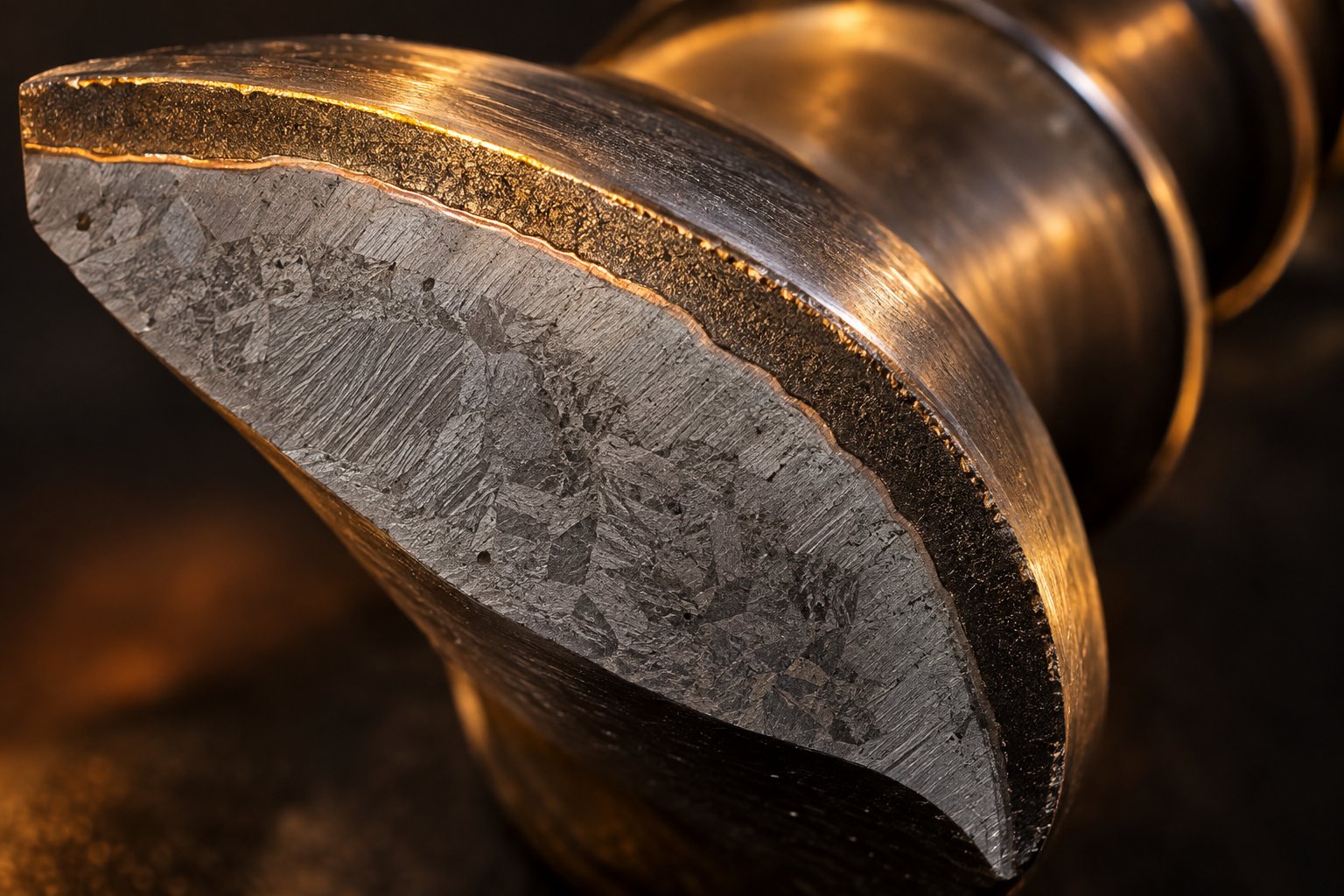
Gas nitriding is the baseline treatment for PVC screws. The most common screw substrate is 38CrMoAlA, a nitriding-grade alloy steel specifically chosen for its ability to form a deep, hard nitride case during gas nitriding. The process diffuses nitrogen into the steel surface at elevated temperature, creating a hardened layer approximately 0.5 to 0.8 mm deep with a surface hardness around HV 900 to 1000. That hardness provides solid abrasion resistance, and for clean, lightly filled rigid PVC it delivers acceptable service life at a relatively low cost. The limitation? Nitriding does not fundamentally change the steel's chemistry beneath the surface. Once corrosive HCl penetrates through micro-cracks in the nitride layer — and it will, given enough time and acid exposure — the underlying metal erodes quickly.
Bimetallic barrel liners represent the industry standard for barrels processing corrosive and filled PVC. In this approach, a nickel-based or cobalt-based alloy is centrifugally cast into the barrel bore, forming a bonded liner roughly 1.5 to 2.5 mm thick with hardness in the HRC 58 to 65 range. Nickel-based linings excel at resisting acid corrosion — the exact threat PVC poses — while cobalt-based linings offer superior heat and abrasion resistance for high-filler or high-output duty. The barrel body itself remains standard forged steel for structural strength; the liner handles the chemical warfare. A properly specified bimetallic barrel outlasts a plain nitrided barrel by a wide margin under aggressive PVC formulations.
Bimetallic weld surfacing on screws takes a similar philosophy and applies it to the flight tips — the screw surfaces that experience the most intense abrasive contact. A wear-resistant alloy is welded directly onto the flight tips, creating a protective skin with hardness in the HRC 55 to 62 range. This approach is particularly effective for high-filler PVC compounds where flight tip erosion is the primary failure mode.
The table below compares these surface treatment options — along with several coating alternatives — across the parameters that matter most for PVC processing longevity:
| Surface Treatment | Hardness Level | Corrosion Resistance | Abrasion Resistance | Typical Lifespan Extension | Relative Cost |
|---|---|---|---|---|---|
| Gas Nitriding (38CrMoAlA) | HV 900 – 1000 | Medium | Medium | Baseline reference | Low |
| Hard Chrome Plating | HV 800 – 1000 | Good | Low to Medium | Modest — thin layer (0.05–0.10 mm) limits durability | Low |
| Electroless Nickel-Phosphorus Plating | HV 500 – 700 | Good | Medium | Moderate — even coverage on complex geometry | Medium |
| Bimetallic Barrel Lining (centrifugal cast) | HRC 58 – 65 | Very Good to Excellent | Very Good | Significant — industry standard for filled PVC barrels | High |
| Bimetallic Weld Surfacing (screw flights) | HRC 55 – 62 | Good | Very Good | Significant — protects high-wear flight tips | High |
| HVOF Tungsten Carbide Spray | HV 1000+ | Excellent | Excellent | Maximum — preferred for high-filler and regrind PVC | Premium |
The right choice depends on your compound. Running clean, lightly filled rigid PVC pipe? A nitrided screw paired with a bimetallic barrel delivers solid value without overspending. Processing heavily filled, flame-retardant, or regrind-heavy PVC? Investing in HVOF tungsten carbide on the screw flights plus a nickel-based bimetallic barrel liner pays for itself through dramatically longer intervals between rebuilds. Trying to save money by running a plain nitrided screw on abrasive filled PVC is a false economy — you will spend more on frequent replacements and lost production than the premium treatment would have cost upfront.
Surface Coatings and Advanced Treatments
Beyond the established options above, several specialized coatings address extreme PVC processing conditions where even standard bimetallic protection falls short.
Hard chrome plating deposits a thin (0.05 to 0.10 mm), smooth, corrosion-resistant layer that improves melt release and reduces material sticking on screw surfaces. Its chief limitation is thickness — it resists acid well but wears through relatively quickly under heavy abrasive loads. Chrome plating works best as a supplemental barrier on screws that also benefit from a harder base treatment, or on components where smooth release is the primary concern rather than abrasion resistance.
HVOF tungsten carbide spraying sits at the opposite end of the spectrum. This high-velocity oxy-fuel process fuses tungsten carbide particles into an extremely dense, hard coating that resists both acid corrosion and abrasive filler attack simultaneously. It is the preferred choice for screws processing regrind-heavy, highly filled, or flame-retardant PVC compounds — formulations where ordinary coatings can be stripped within months. The cost is premium, but for demanding applications the extended service intervals justify the investment several times over.
PVD (physical vapor deposition) coatings represent a newer frontier. These thin-film coatings — including titanium nitride (TiN) and chromium nitride (CrN) variants — offer extremely high surface hardness and chemical inertness in a layer just a few microns thick. While not yet as widely adopted in PVC extrusion as bimetallic or HVOF solutions, PVD coatings show promise for specific extruder terminals and die components where precision tolerances must be maintained alongside corrosion resistance.
The overarching principle is simple: selecting the right metallurgy for your extrusion screw is just as important as selecting the right geometry. A perfectly designed screw made from the wrong material will degrade under PVC's corrosive-abrasive assault, losing the tight flight tolerances that keep shear heating under control and melt quality consistent. And once those tolerances open up, the consequences show up directly in the product — not as gradual, invisible wear, but as measurable changes in gelation quality, surface finish, and mechanical performance that reveal exactly how the screw's condition shapes the final PVC product.
How Screw Design Drives PVC Gelation and Product Quality
Here is something that catches many processors off guard: PVC does not melt the way polyethylene or polypropylene does. You cannot simply heat it past a melting point, push it through a die, and expect a strong product. PVC undergoes a fundamentally different transformation called gelation — and the extruder screw is the single most influential component determining whether that transformation succeeds or fails. Get gelation right, and you produce pipe, profiles, and sheet with excellent tensile strength, impact resistance, and decades of service life. Get it wrong, and the product looks fine on the surface but crumbles under real-world stress.
What PVC Gelation Means and Why It Matters
Most thermoplastics are semicrystalline or amorphous — apply enough heat, and the polymer chains gain mobility, flow, and resolidify into a new shape. PVC is different at the particle level. Raw PVC compound arrives at the extruder as a collection of complex, multi-layered particles. Each grain contains primary particles roughly 1 micrometer in diameter, which themselves are built from even smaller sub-particles packed into an intricate hierarchical structure. During processing, these primary particles must fuse together under controlled heat and shear, forming an interconnected network of tie molecules linking crystalline regions across particle boundaries.
This fusion process — gelation — is what gives PVC products their mechanical integrity. The ideal outcome is a well-gelled product with a complete network structure where tie molecules connect the crystallites, delivering maximum impact and strength. Imagine it as welding individual grains into a single, continuous solid rather than simply melting a homogeneous mass.
The critical insight? Gelation exists on a spectrum, and both extremes cause problems:
- Under-gelation (sintered state): Primary particles are insufficiently fused. The product appears solid but lacks the tie-molecule network needed for toughness. Impact strength plummets, and diagnostic tests like the DCMT (dichloromethane) test reveal loose powder on chamfered surfaces — a telltale sign that particle boundaries never fully bonded. Brittle fractures, poor long-term pressure resistance in extrusion pvc pipe, and premature failure in service are the real-world consequences.
- Over-gelation (over-sheared state): Excessive mechanical or thermal energy destroys the crystalline network rather than building it. The tie molecules break down, the structure degrades, and impact strength drops just as dramatically as it does with under-gelation — but now you also risk triggering dehydrochlorination and all the corrosive, carbonizing damage that follows.
Industry data puts the optimal gelation level at approximately 75% as measured by DSC (differential scanning calorimetry). Below that threshold, the network is incomplete and mechanical properties suffer. Push significantly beyond it, and you start dismantling the very structure you worked to create. That 75% target is not a rough guideline — it is the engineering sweet spot where strength, toughness, and processability converge.
How Screw Geometry Controls Gelation Level
So what determines whether PVC reaches that optimal 75% gelation — or falls short, or overshoots? The answer lives in the screw's geometry. Every flight depth, every compression ratio, and every mixing element along the screw's length contributes to the total mechanical energy delivered to the PVC melt. And gelation is fundamentally an energy-driven process: the right combination of shear work and thermal input fuses primary particles into the connected network that makes PVC products strong.
Consider the key geometric levers:
- Flight depth controls shear intensity. Shallower channels force material into thinner layers against the barrel wall, increasing shear rate and mechanical energy input. Deeper channels reduce shear, letting material pass through with less mechanical work. For PVC, the metering zone depth must be shallow enough to deliver adequate fusion energy — but not so shallow that localized over-shearing destroys the network.
- Compression ratio governs how aggressively the material densifies between the feed and metering zones. A higher ratio generates more compressive and frictional energy during the transition — useful for tough-to-melt polymers but dangerous for PVC. The moderate 2:1 to 2.5:1 ratios discussed earlier exist precisely to deliver enough gelation energy without crossing the over-shear threshold.
- Mixing elements — kneading blocks, toothed mixers, and distributive mixing sections — add localized shear and improve temperature uniformity across the melt cross-section. As NC State Extension research details, wider kneading elements promote dispersive mixing that breaks down agglomerates, while narrower elements contribute distributive mixing that spreads the fused phase more evenly. For a pvc pipe extruder running rigid compound, the right combination of mixing elements ensures that gelation proceeds uniformly rather than leaving pockets of under-fused material surrounded by over-sheared zones.
The relationship is not linear. Doubling the shear input does not double gelation — it can overshoot the optimum and begin destroying the network. A well-engineered screw delivers just enough mechanical energy, distributed uniformly, to hit that gelation target across the entire melt cross-section.
Optimal PVC gelation is not about maximum shear or maximum temperature — it is about delivering the right amount of mechanical and thermal energy uniformly throughout the melt.
The Relationship Between Screw Speed, Geometry, and Melt Quality
If screw geometry sets the potential for gelation, screw speed determines how much of that potential is realized — and how safely. This is where pvc plastic extrusion diverges sharply from polyolefin processing.
Polyolefin extruders routinely run at high RPMs. The material tolerates aggressive shear, and faster screw speeds translate directly into higher throughput with minimal quality trade-offs. PVC extruders operate at significantly lower RPMs — often less than half the speed you would use for polyethylene on the same size machine. The reason is straightforward: screw speed is the primary operator-controlled variable that governs shear rate inside the barrel. Higher RPMs mean higher shear rates, more frictional heat generation, and faster temperature rise in the melt. For a polymer with a 20-30 degree processing window, that extra heat can push localized zones past the degradation threshold in seconds.
Here is the practical challenge. Lower RPMs mean lower throughput — less material processed per hour. That is an economic penalty no production manager wants to accept. The solution lies in screw geometry. A well-designed extruder screw for PVC compensates for reduced speed through optimized channel volumes, efficient compression profiles, and effective mixing elements that achieve thorough gelation at lower rotational speeds. In other words, smart geometry does the work that brute-force RPMs cannot safely accomplish.
What happens when operators try to push output by over-speeding a poorly designed screw? The consequences are predictable and costly. Localized overheating generates degradation streaks — visible lines of discolored, carbonized material embedded in the product surface. Shear-sensitive zones near flight tips and barrel walls experience temperatures well above the bulk melt average, triggering dehydrochlorination in microscopic pockets that spread HCl gas through the melt stream. The surface finish deteriorates. Mechanical properties drop. And because the over-sheared regions are not uniformly distributed, you end up with products that pass some quality checks but fail others unpredictably — the worst kind of defect pattern to troubleshoot.
Real-time monitoring reinforces this relationship. As melt profiling research has demonstrated, tracking actual melt temperature and pressure — rather than relying solely on barrel thermocouple readings — reveals exactly how screw speed changes affect the polymer's internal condition. A gradual melt temperature rise at constant barrel settings is a clear signal that shear heating is exceeding the thermal envelope, and the first corrective action should always be reducing RPM before adjusting barrel zones.
The interplay between speed, geometry, and gelation quality underscores a principle that applies to every PVC extrusion line: you cannot separate screw design from process settings. A screw optimized for a specific RPM range and formulation delivers consistent, high-quality gelation shift after shift. Change the formulation, push the speed beyond the design envelope, or let wear degrade the flight geometry — and gelation quality shifts with it. Those shifts do not stay invisible for long. They surface as specific, identifiable product defects that trace directly back to screw-related root causes.
Selecting the Right Extruder Screw for Your PVC Application
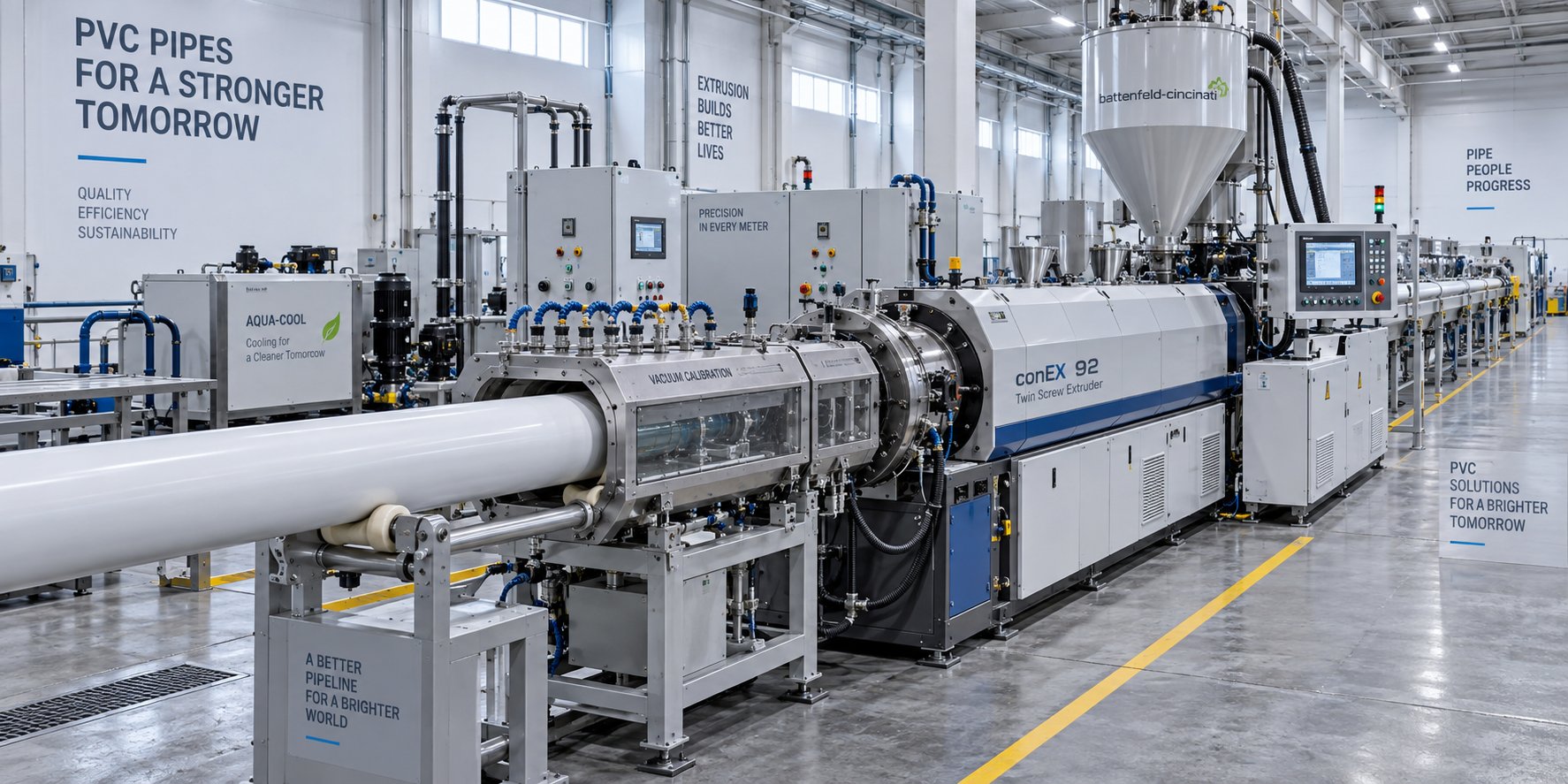
Gelation targets, compression ratios, and metallurgy options only become actionable when tied to a specific product. A screw that delivers perfect results on rigid PVC pipe may produce mediocre sheet, and a design optimized for foam board could struggle with tight-tolerance window profiles. Every PVC application places its own demands on the screw extrusion process — different output volumes, different melt uniformity thresholds, and different tolerances for temperature variation. Matching screw design to product category is where engineering principles translate into production reality.
Screw Selection for PVC Pipe Extrusion
PVC pipe is the single largest-volume rigid PVC product globally, and the screw requirements reflect that scale. Pipe production demands high output consistency above almost everything else — because even small fluctuations in melt flow translate directly into wall thickness variation, which is a rejection criterion under pressure-pipe standards. The extruder pvc setup for pipe must deliver exceptional melt homogeneity so that every point around the pipe's circumference receives material at the same temperature, viscosity, and pressure.
Conical twin screw extruders dominate pipe production for diameters up to roughly 400 mm, with common screw sizes ranging from 65/132 for small-to-medium pipe up through 80/156 and 92/188 for large-diameter, high-output lines. For very high-output operations — particularly large-diameter pipe exceeding 400 mm — parallel twin screw configurations gain an edge thanks to their higher throughput capacity. As industry specialists have noted, production output can be increased as much as 25% by extending parallel screw lengths from 32 L/D to 34-35 L/D while ensuring the gearbox has sufficient energy density.
The top three screw design priorities for PVC pipe:
- Melt temperature uniformity: Temperature variation across the melt cross-section must be minimal to prevent localized weak spots in the pipe wall that compromise long-term pressure rating.
- Stable output pressure: Pressure pulsations from the screw translate into wall thickness oscillation — a defect that downstream equipment cannot correct.
- High gelation consistency: Under-gelled regions become brittle failure points in pressurized service. The screw must deliver uniform mechanical energy input to hit the target gelation level throughout the melt.
Screw Selection for PVC Profile and Window Systems
Imagine pushing molten PVC through a die shaped like a complex window frame cross-section — with hollow chambers, thin walls, and asymmetric geometry. That is profile extrusion, and it places the most exacting demands on melt quality of any rigid PVC application. Any plastic profile extruders supplier will tell you that the die geometry amplifies every inconsistency the screw delivers. A slight melt temperature variation that pipe production might tolerate becomes a visible warp or dimensional deviation in a multi-chamber window profile.
Profile lines almost exclusively use conical twin screw extruders, most commonly in the 65/132 size class. The screw must deliver extremely uniform melt pressure — because uneven pressure across the die face causes some sections of the profile to extrude faster than others, distorting the shape. Complex geometries pose risks of uneven melt distribution, die swell variations, and localized stress concentrations that only flawless melt preparation can manage.
The top three screw design priorities for PVC profiles:
- Ultra-low melt temperature variation: Even 2-3 degrees C of variation across the melt cross-section can produce warped, bowed, or dimensionally inconsistent profiles that fail calibration tolerances.
- Excellent distributive mixing: Additives including stabilizers, pigments, and impact modifiers must be uniformly dispersed. Streaks or concentration gradients show up as color inconsistencies or localized mechanical weaknesses in the finished profile.
- Controlled, low shear: Profile compounds are often more heavily modified with impact modifiers and processing aids than pipe compounds. The screw must fuse the material thoroughly at lower shear intensities to avoid degrading these sensitive additive systems.
Screw Selection for PVC Sheet, Board, and Foam Board
Sheet and board production introduces a challenge that pipe and profile extrusion do not face: width. Flat die extrusion spreads material across openings that may exceed one meter, meaning any non-uniformity in the melt stream gets magnified across the entire product width. For solid PVC sheet and board, the screw must deliver a high-volume, thermally uniform melt at stable pressure — requirements similar to pipe, but at wider flow fronts.
Foam board adds another layer of complexity. Controlled foaming requires the screw to disperse chemical blowing agents uniformly throughout the melt while maintaining precise temperature and pressure conditions. Too much shear prematurely activates the blowing agent, creating uncontrolled cell structures. Too little mixing leaves undispersed blowing agent particles that produce voids and density inconsistencies. Larger conical twin screw sizes — 80/156 and 92/188 — are standard for these applications, providing the throughput and mixing capacity that wide-die extrusion demands.
The top three screw design priorities for PVC sheet, board, and foam board:
- High-volume melt delivery at stable pressure: Wide flat dies amplify any pressure surging into visible thickness bands across the sheet or board — defects that cannot be corrected after extrusion.
- Precise melt temperature control: For foam board especially, the melt temperature must stay within a tight corridor to ensure the blowing agent activates uniformly. Localized hot spots create oversized cells; cold spots produce collapsed or missing foam structure.
- Uniform blowing agent dispersion (foam board): Distributive mixing elements must integrate the foaming agent thoroughly without over-shearing the PVC matrix. This often requires screw designs with specialized mixing sections tuned to the specific blowing agent chemistry.
Application Selection Matrix
The following table consolidates the key selection criteria across all major PVC product categories, giving you a single reference point when evaluating screw configurations for your specific application:
| PVC Application | Recommended Screw Configuration | Typical Screw Size Range | Key Design Priorities | Critical Performance Parameters |
|---|---|---|---|---|
| Pipe (small to medium diameter) | Conical twin screw | 65/132 to 80/156 | Output stability, melt homogeneity, gelation consistency | Wall thickness uniformity, pressure rating, concentricity |
| Pipe (large diameter, high output) | Parallel twin screw (counter-rotating) | 80/156 to 92/188+ | High throughput, stable melt pressure, uniform gelation | Wall thickness uniformity, ovality, burst strength |
| Window profile and door systems | Conical twin screw | 55/110 to 65/132 | Ultra-low melt temperature variation, distributive mixing, low shear | Dimensional accuracy, surface finish, color consistency, weld-line strength |
| Solid sheet and board | Conical twin screw or parallel twin screw | 80/156 to 92/188 | High-volume stable output, melt uniformity across wide die | Thickness tolerance, surface gloss, flatness |
| Foam board | Conical twin screw | 80/156 to 92/188 | Precise temperature control, blowing agent dispersion, controlled shear | Cell structure uniformity, density consistency, surface skin quality |
| WPC (wood-plastic composite) | Conical twin screw or parallel twin screw | 65/132 to 92/188 | High filler incorporation, wear-resistant metallurgy, moisture management | Filler dispersion, surface finish, mechanical strength |
| Cable insulation | Single screw | Application-specific (typically 45-90 mm diameter) | Gentle shear, precise melt temperature, consistent output | Dielectric properties, eccentricity, surface smoothness |
| Compounding | Parallel twin screw (co-rotating) | Application-specific | Maximum dispersive and distributive mixing, high throughput | Filler and additive dispersion, pellet consistency, thermal stability |
Notice how the design priorities shift across product categories — pipe emphasizes output stability and gelation, profiles demand melt uniformity and low shear, and foam board revolves around temperature precision and blowing agent handling. No single screw design optimizes all of these simultaneously, which is why treating screws as interchangeable commodity parts across product lines inevitably leads to quality compromises.
The matrix also highlights a practical reality: knowing which screw configuration and size to choose is only part of the equation. Even the right screw, correctly specified for its application, eventually wears down or encounters process conditions that push it outside its design envelope. When that happens, the product speaks first — through specific, identifiable defects that trace directly back to screw-related root causes long before the screw itself shows visible damage.
Troubleshooting PVC Extrusion Defects Linked to Screw Design
A defect on the product is a message from the process — and in PVC extrusion, the screw is usually the first author. Pipe with uneven wall thickness, profiles speckled with dark particles, sheet with a rough matte surface that should be glossy — each of these tells a specific story about what went wrong inside the barrel. The challenge is reading that story correctly. Blame the wrong component and you waste hours chasing phantom causes. Identify the screw-related root cause accurately and you fix the problem at its source, often without a full line teardown.
Black Specks and Burn Marks from Thermal Degradation
Dark specks embedded in an otherwise clean PVC product are one of the most alarming defects a processor can encounter — and one of the most common signals that something has gone wrong with the screw. Those specks are carbonized PVC: material that overheated past its degradation threshold, underwent dehydrochlorination, and charred into tiny fragments that contaminate the melt stream.
Where does this overheating happen? Three screw-related scenarios dominate:
- Dead spots in screw channels: Worn or damaged screw flights can create pockets where PVC stagnates instead of flowing forward. Material trapped in these zones absorbs heat cycle after cycle until it degrades into carbonized residue. Eventually, a pressure fluctuation or speed change dislodges the charred fragment, and it appears in the product as a black speck. As contamination diagnostics research confirms, specks that worsen after startup or restart — or that persist even when clean virgin material is used — strongly suggest internal degradation from stagnation zones rather than incoming material contamination.
- Excessive compression ratio: A screw with a compression ratio too aggressive for the PVC formulation generates localized frictional heat that exceeds the degradation threshold. The material does not need to sit still to burn — it overheats while flowing through a compression zone that squeezes too hard, too fast. You will typically see a gradual increase in speck frequency over a production run as the over-compressed zone accumulates carbonized buildup.
- Worn flight tips creating high-shear gaps: As flights erode, the clearance between the flight tip and barrel wall increases. Material forced through this widened gap experiences intense shear in a thin film — exactly the condition that generates localized temperatures far above the bulk melt average. The degraded film peels off intermittently, producing a pattern of random dark particles that increases as wear progresses.
One key diagnostic clue: if black specks reduce slowly after a material changeover or purge but never fully disappear, the source is almost certainly retained carbonized material inside the screw channel or barrel — not the incoming compound. This pattern points directly to a screw inspection rather than a raw material investigation.
Poor Surface Finish and Incomplete Gelation
Imagine running a pvc extruder all shift and pulling product that looks acceptable in shape and dimension — but the surface is rough, matte instead of glossy, and mechanical test samples fracture at pressures well below specification. This combination of symptoms points squarely at incomplete gelation, and the screw is usually the reason.
Recall that PVC must reach approximately 75% gelation to develop its full network of tie molecules linking crystalline regions. Below that threshold, the primary particle boundaries remain partially unfused — structurally present but mechanically weak. The product passes visual inspection but fails performance testing. Three screw-related causes create this condition:
- Worn flights reducing effective compression: As flight depth erodes in the compression and metering zones, the screw loses its ability to apply the controlled mechanical energy that drives gelation. Material passes through with insufficient shear work, arriving at the die under-fused. This is especially insidious because the wear happens gradually — gelation quality degrades over weeks or months, and by the time operators notice the surface quality shift, the flights may be significantly below specification.
- Incorrect compression ratio for the formulation: A screw originally designed for one PVC compound may deliver inadequate gelation when the formulation changes. Higher filler loadings, different stabilizer systems, or a shift from pellets to dry-blend can all alter the mechanical energy needed for full fusion. The screw geometry has not changed, but the material's gelation requirements have — and the mismatch produces under-fused product.
- Excessive screw speed preventing adequate residence time: Pushing RPMs beyond the design envelope moves material through the barrel faster than the screw geometry can deliver the required shear work. Each particle spends less time in the compression and metering zones, receives less mechanical energy, and arrives at the die partially fused. The temptation to increase speed for higher throughput is understandable, but the trade-off in pvc pipe extrusion is reduced gelation quality that directly compromises long-term pressure performance.
A quick field test reinforces this diagnosis: chamfer a cross-section of the suspect product and apply dichloromethane solvent. Under-gelled PVC releases loose powder from the exposed particle boundaries — a visible confirmation that the internal structure never fully fused. If you see that powder, the screw's energy delivery is the first place to investigate.
Output Surging and Inconsistent Wall Thickness
Periodic fluctuation in extruder output — sometimes called surging — is one of the most frustrating defects to chase because it manifests downstream as wall thickness variation, weight inconsistency, or dimensional waviness that calibration equipment cannot correct. The product oscillates between slightly too thick and slightly too thin in a repeating cycle, and the root cause often lives inside the screw itself.
Surging traces to three zone-specific failure modes:
- Feed zone instability: Worn feed zone flights lose their ability to grab and convey PVC dry-blend powder at a constant rate. The screw intermittently starves the downstream zones, causing extruder pressure to fluctuate. Troubleshooting guides for twin screw systems identify inconsistent feeding as one of the primary surging triggers — and when the feeder itself checks out fine, the feed zone flight condition becomes the next logical checkpoint.
- Damaged or worn compression zone: If the compression zone cannot densify material uniformly, pockets of under-compacted and fully compacted PVC alternate through the metering zone. Each pocket arrives at the die with different viscosity and pressure, producing the cyclical output variation that operators see as surging.
- Worn metering zone flights: The metering zone is the screw's final pressure-building stage. Worn flights in this zone increase the clearance over the flight tips, allowing backward leakage flow that disrupts the steady pumping action. The result is pressure instability that maps directly onto wall thickness variation in pipe or gauge fluctuation in sheet.
A useful diagnostic technique: monitor motor amperage and die pressure simultaneously. Surging driven by screw wear typically shows correlated oscillation in both signals — amps and pressure rise and fall together in a rhythmic pattern. If amps remain stable while pressure oscillates, the issue is more likely downstream of the screw — in the screen pack, adapter, or die.
Defect-to-Cause Mapping
The following table consolidates the most common PVC extrusion defects, their probable screw-related causes, and recommended corrective actions into a single troubleshooting reference:
| Defect | Probable Screw-Related Cause | Recommended Corrective Action |
|---|---|---|
| Black specks / burn marks | Dead spots from worn or damaged flights; excessive compression ratio; carbonized material in stagnation zones | Inspect and measure screw flights for wear; verify compression ratio matches formulation; clean or replace screw to eliminate dead spots |
| Rough or matte surface finish | Insufficient shear from worn compression/metering flights; compression ratio too low for formulation; screw speed too high reducing residence time | Measure flight depths against original specification; reduce RPM to extend residence time; evaluate screw design for current formulation |
| Output surging / pressure fluctuation | Worn feed zone flights causing inconsistent intake; damaged compression zone producing uneven densification; worn metering zone allowing backflow | Inspect all three zones for flight wear; check feed zone for grooved bushing condition; verify consistent powder feeding upstream |
| Uneven wall thickness (pipe) or gauge variation (sheet) | Metering zone wear creating pressure instability; feed zone inconsistency causing periodic material starvation | Measure metering zone flight-to-barrel clearance; rebuild or replace worn flights; ensure stable feed zone operation |
| Plate-out / die lip buildup | Over-shearing in metering zone volatilizing stabilizers and lubricants; excessive melt temperature from worn screw geometry generating higher-than-designed shear | Check actual melt temperature versus set points; inspect screw for wear-induced geometry changes; reduce RPM if melt temperature is elevated above target |
When the Screw Is the Problem vs. Other Process Variables
Not every PVC extrusion defect traces back to the screw — and blaming the screw for a die problem or a formulation issue wastes time and money. Before pulling the screw for inspection, rule out the most common confounding variables:
- Die and adapter issues: If defects appear in the same position on the product consistently — the same spot on the pipe wall, the same edge of the profile — the problem likely originates in the die or adapter flow channels rather than the screw. Screw-related defects tend to be randomly distributed or cyclically repeating, not positionally fixed.
- Temperature controller malfunction: A failed barrel heater or a faulty thermocouple can create localized hot or cold zones that mimic screw-related degradation or under-gelation. Check that all barrel zones are reaching and holding their set points before suspecting the screw. A single dead heater band in the compression zone can produce black specks that look identical to screw-caused degradation.
- Material and formulation changes: A new stabilizer package, a different calcium carbonate grade, or even a shift in PVC resin K-value alters the compound's processing behavior. Defects that appeared the same day as a material change are almost certainly formulation-driven — not screw wear that coincidentally manifested at that exact moment.
- Upstream feeding inconsistencies: Bridging in the hopper, moisture in the dry-blend, or an erratic gravimetric feeder can produce surging and quality variation that mimics worn feed zone flights. Verify consistent material delivery before opening the barrel.
A practical rule of thumb: if the defect appeared suddenly, suspect a process change or equipment failure outside the screw. If it developed gradually over weeks or months — progressively worsening surface quality, slowly increasing melt temperature at constant RPM, or steadily rising motor amperage — the screw is wearing, and inspection is overdue. That gradual progression is the clearest signal that screw condition has crossed from acceptable to compromised, and it raises the practical question every processor eventually faces: repair the existing screw, or replace it entirely?
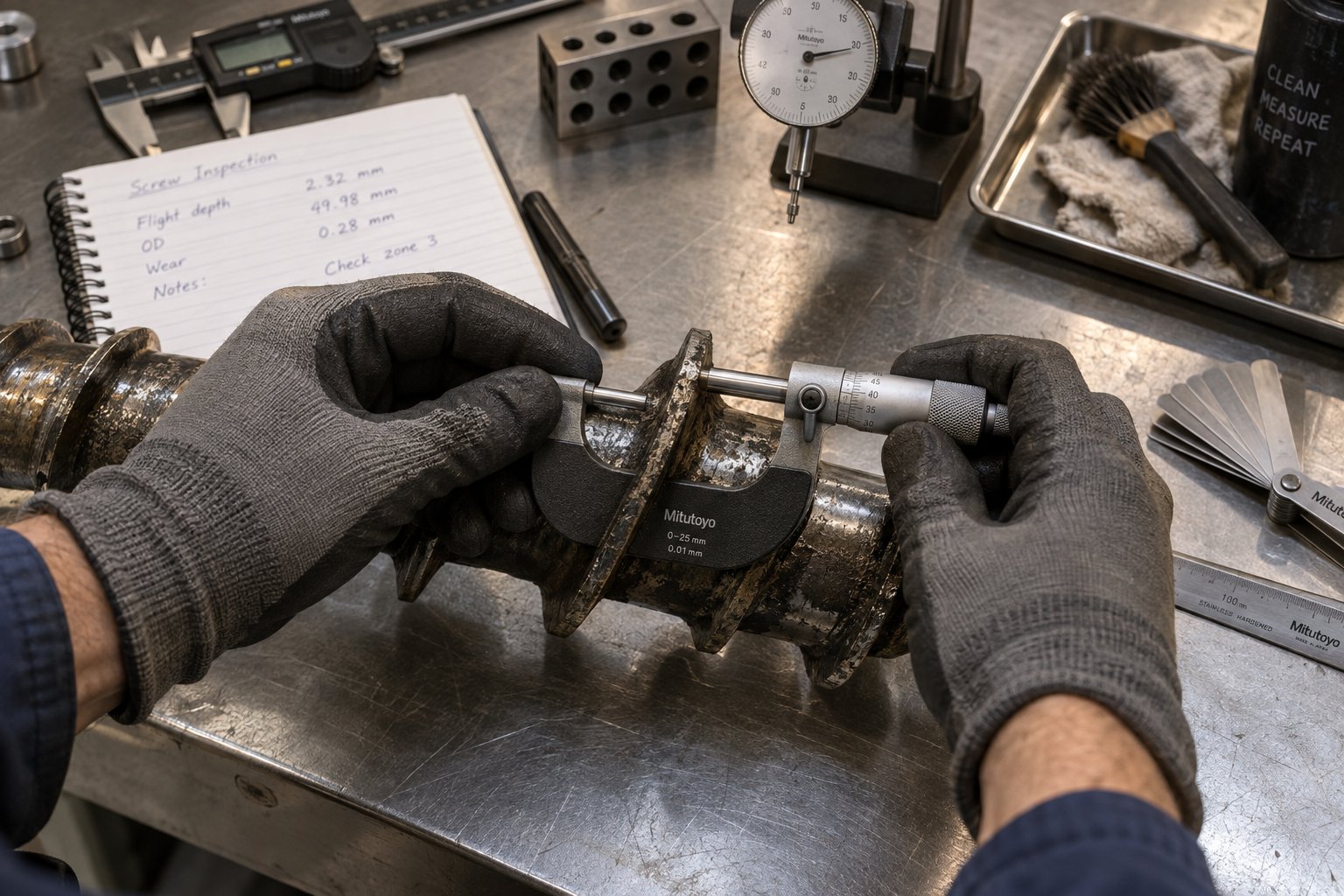
Maintenance, Lifespan, and Replacement Planning for PVC Screws
Gradual degradation is the defining characteristic of screw wear in PVC extrusion — and by the time product defects become visually obvious, the screw has already been underperforming for weeks or even months. That hidden decline costs more than the eventual repair bill. It erodes throughput, increases scrap rates, inflates energy consumption, and silently compromises the mechanical performance of every meter of pipe, profile, or board leaving the line. Knowing exactly when wear has crossed from tolerable to costly — and whether to refurbish or replace — is the difference between planned maintenance and unplanned crisis.
Wear Indicators That Signal Screw Replacement or Refurbishment
Screws do not fail all at once. They send measurable signals long before a catastrophic breakdown, and the processors who track those signals avoid the expensive surprise of pulling a screw that should have been replaced three months earlier. Here are the five most reliable wear indicators, ranked by how early they appear in the degradation timeline:
- Rising melt temperature at constant RPM and barrel set points: This is typically the earliest detectable signal. As flight tips erode and clearances open up, material experiences more shear in the widening gap between the flight and barrel wall. The extra frictional heat shows up as a gradual melt temperature creep — sometimes just 2-3 degrees Celsius per month — that operators may dismiss as seasonal variation or thermocouple drift. Track this trend over time. A consistent upward drift at unchanged process settings points directly to screw wear changing the shear profile inside the barrel.
- Increasing motor amperage for the same output rate: A worn screw works harder to push the same volume of material forward. Backflow over eroded flight tips means the screw must rotate more aggressively — or the motor must draw more current at the same RPM — to maintain die pressure. Monitor amperage logs weekly. A 5-10% increase over baseline at constant throughput is a strong indicator that flight geometry has deteriorated beyond its design tolerance.
- Declining product quality: Wall thickness variation in pipe, dimensional drift in profiles, surface roughness on sheet — these quality signals often appear before operators connect them to screw condition. As discussed in the previous section, under-gelation from reduced compression effectiveness and output surging from metering zone leakage both trace to worn flights. When quality KPIs trend downward without any formulation or process setting changes, the screw should be the first component inspected.
- Visible flight wear during scheduled inspection: When you pull the screw for routine inspection — and you should be doing this at defined intervals — measure flight depths and outer diameters at multiple points along each zone. Compare against the original manufacturing specifications. Industry practice for PVC pvc extruders suggests inspection intervals of 3,000 to 5,000 operating hours, though heavily filled compounds may warrant more frequent checks. Flight tip wear exceeding 0.1-0.2 mm beyond the original clearance specification in the metering zone is typically enough to produce measurable quality degradation.
- Increased scrap rate and rework frequency: This is the lagging indicator — the one that shows up on production reports after all the upstream signals have been missed. By the time scrap rates climb noticeably, the screw has been underperforming long enough that cumulative losses have already been significant. Tracking the earlier indicators prevents reaching this point.
The pattern across all five indicators is the same: gradual, incremental change that only becomes obvious when you measure and trend data over time. Relying on visual inspection alone — waiting until you can see the wear with your eyes — guarantees that you have already absorbed months of hidden production losses before acting.
Replacement vs. Refurbishment Decision Framework
Once wear is confirmed, the next question is practical: rebuild what you have, or invest in a new screw? The answer depends on more than just the price tag. As refurbishment specialists emphasize, not all components benefit from rebuilding — excessive damage or wear may render refurbishment ineffective or even counterproductive. A thorough evaluation of the specific wear condition is essential before committing to either path.
Several factors shape the decision:
- Extent and location of wear: Localized flight tip erosion in the metering zone is an excellent candidate for refurbishment — PTA weld overlay on the flight crests followed by re-machining and re-nitriding can restore original dimensions and more than double service life compared to the pre-refurbishment condition. However, if the screw root is worn, the core diameter has been reduced, or corrosion pitting has penetrated deep into the substrate metal, refurbishment may not restore structural integrity. In those cases, replacement is the only reliable option.
- Cost comparison: A quality refurbishment typically runs 40-60% of a new screw's cost, making it attractive for screws with moderate, surface-level wear. But factor in the full picture: shipping time, downtime during the rebuild, and the remaining useful life after refurbishment. A screw that needs refurbishment every 12 months may cost more over a five-year horizon than a new screw with upgraded metallurgy that lasts 30 months between services.
- Application changes since original specification: Has your PVC formulation changed? Did you switch from pellets to dry-blend? Are you running higher filler loadings than when the screw was originally designed? If the answer to any of these is yes, refurbishing the old geometry restores a design that may no longer be optimal. Replacement gives you the opportunity to re-engineer the screw for current — not historical — production requirements.
- Lead time and production pressure: Refurbishment often has a shorter lead time than ordering a custom new screw, making it the practical choice when a line is down and every day of lost production carries significant cost. Smart operators keep a spare screw on hand — sized and specified for their current formulation — so that a worn screw can be pulled for rebuild without halting the line.
The refurbishment process itself involves several critical steps: high-temperature annealing to remove residual plastic, hydraulic separation if the screw has seized, dimensional assessment to map the wear pattern, and then targeted restoration — weld overlay on worn flight crests, surface hard chrome plating for improved release properties, straightening if deflection has occurred, and full-length polishing to restore surface finish. For barrels, bore grinding to true roundness followed by re-nitriding or bore chrome plating addresses the complementary wear surface. Each step requires precision equipment and PVC-specific expertise, which is why choosing the right service provider matters as much as the decision to refurbish.
Choosing a Reliable Screw Barrel Supplier for PVC Applications
Whether you are ordering a brand-new thermoplastic extruder screw barrel set or sourcing a direct replacement for a worn unit, the supplier you choose shapes the outcome as much as the engineering specification itself. PVC processing is unforgiving — a screw that is dimensionally correct but metallurgically wrong, or geometrically sound but manufactured with loose tolerances, will underperform from day one. Here is what separates a reliable PVC screw barrel supplier from a generic parts vendor:
- PVC-specific engineering expertise: The supplier should understand dehydrochlorination, gelation dynamics, and the twin screw extrusion process well enough to recommend — not just manufacture — the right geometry and metallurgy for your compound and product. A supplier that asks about your formulation, filler loading, target output, and product specifications before quoting is a supplier that understands PVC. One that quotes solely on diameter and length does not.
- Metallurgy options suited to corrosive PVC environments: As covered in the metallurgy section, PVC demands specific surface treatments — bimetallic liners, nitriding grades, HVOF coatings — that general-purpose screw manufacturers may not stock or understand. Your supplier should offer a range of wear-protection strategies and guide you toward the right match for your compound's abrasiveness and corrosivity.
- Custom sizing and design capability: Off-the-shelf replacements work when you are replacing like-for-like. But when your application evolves — new formulations, new products, throughput targets that have outgrown your original screw — you need a supplier that can engineer custom solutions, not just replicate old ones.
- Technical support for troubleshooting: The best twin-screw extruder manufacturer partnerships extend beyond hardware delivery. When melt quality issues arise or defect patterns emerge, a supplier with deep PVC process knowledge can help diagnose whether the problem originates in the screw, the barrel, or elsewhere in the system — saving you the cost of replacing parts that were not the root cause.
Suppliers like NANHAIYA, which specialize in conical twin screw barrels for PVC pipe, PVC profile, PVC board, foam board, and WPC extrusion, exemplify this application-focused approach. Their offerings include both custom-engineered and direct replacement barrels designed for stable plasticizing performance, backed by production support that helps processors maintain line uptime and product quality. When screw performance directly determines your output consistency and defect rate, that kind of PVC-specific expertise is not a luxury — it is a production necessity.
The Economics of Getting Screw Design Right
Every topic covered in this article — thermal sensitivity, zone geometry, metallurgy, gelation control, application matching, defect troubleshooting, and maintenance planning — converges on a single bottom-line reality. The extruder screw for PVC is not a wear part you grudgingly replace when it breaks. It is the engineered core of your production economics, and its design ripples through every line item on your cost sheet.
Consider the economic levers a properly specified screw controls:
- Energy efficiency: A screw that delivers target gelation at lower RPMs consumes less motor power per kilogram of output. Over thousands of operating hours per year, the energy savings from optimized geometry versus a generic replacement can offset a significant portion of the screw's purchase price.
- Throughput optimization: The right screw design maximizes output within PVC's narrow processing window — extracting every kilogram per hour the formulation and barrel size can safely deliver without over-shearing or degrading the material.
- Scrap reduction: Under-gelation, black specks, surging, and surface defects all generate scrap. Each defect traces to screw-related causes, and each kilogram of rejected product represents raw material cost, energy cost, and lost production capacity that proper screw design would have prevented.
- Extended equipment life: Correct metallurgy protects not just the screw but the barrel bore — because a worn screw with open clearances accelerates barrel wear through increased material leakage and shear-induced erosion. Replacing one set of PVC extruders' screws and barrels prematurely because the screw metallurgy was inadequate costs far more than specifying the right surface treatment from the start.
The extruder screw is not a commodity spare part — it is the engineered core of your PVC processing line, and its design directly determines your production economics.
PVC will always be one of the most demanding thermoplastics to extrude. Its narrow thermal window, corrosive degradation chemistry, and complex gelation behavior guarantee that the margin for error remains razor-thin. But that narrow margin is precisely why screw engineering matters so much — and why processors who invest in understanding their screws, maintaining them proactively, and sourcing them from suppliers with genuine PVC expertise consistently outperform those who treat the screw as just another replaceable part on the bill of materials.
Frequently Asked Questions About Extruder Screws for PVC
1. What compression ratio is recommended for an extruder screw processing rigid PVC?
Rigid PVC typically requires a compression ratio between 2:1 and 2.5:1, which is noticeably lower than the 3:1 to 4:1 ratios used for polyethylene. This lower ratio limits frictional heat buildup during material densification in the transition zone, keeping the melt temperature safely within PVC's narrow processing window of roughly 20-30 degrees Celsius. Using a compression ratio designed for polyolefins on PVC risks generating localized hot spots that trigger dehydrochlorination — the release of corrosive hydrochloric acid gas — which damages equipment and produces carbonized defects in the final product.
2. Why do conical twin screw extruders dominate rigid PVC processing?
Conical twin screws are the preferred configuration for rigid PVC pipe, profile, sheet, and board because their tapered, counter-rotating design solves two key challenges simultaneously. The large-diameter feed inlet easily accepts low-bulk-density PVC dry-blend powder, while the tapering geometry builds pressure gradually toward the smaller discharge end — avoiding the abrupt compression spikes that cause PVC degradation. Counter-rotation also provides positive material conveyance with minimal backflow, giving operators precise control over residence time. Manufacturers like NANHAIYA engineer conical twin screw barrels specifically for PVC pipe, profile, board, foam board, and WPC extrusion, offering both custom and replacement options optimized for stable plasticizing performance.
3. What do conical twin screw barrel size numbers like 65/132 or 92/188 mean?
These two-number designations encode the screw's taper dimensions in millimeters. The first number is the diameter at the small (discharge) end, and the second is the diameter at the large (feed) end. For example, a 65/132 barrel has screws tapering from 132 mm at the inlet down to 65 mm at the outlet. Smaller designations like 55/110 suit low-output profiles and conduit, the widely used 65/132 handles window profiles and medium pipe, while 80/156 and 92/188 serve high-output pipe, sheet, board, and foam board production. Matching barrel size to your target product's output requirements prevents both capacity bottlenecks and wasted energy.
4. How can I tell if my PVC extruder screw needs replacement or refurbishment?
Five key indicators signal screw wear in order of early detection: rising melt temperature at constant RPM and barrel settings, increasing motor amperage for the same output, declining product quality such as wall thickness variation or rough surfaces, visible flight wear during scheduled inspection (check every 3,000-5,000 hours), and elevated scrap rates. Refurbishment — including weld overlay on flight crests, re-nitriding, and polishing — is cost-effective when wear is localized to flight tips and typically costs 40-60% of a new screw. Full replacement is warranted when root diameter has decreased, deep corrosion pitting is present, or when your PVC formulation has changed enough to require redesigned screw geometry.
5. What surface treatments protect extruder screws from PVC's corrosive and abrasive attack?
PVC creates a double-wear mechanism: corrosive HCl gas attacks metal surfaces while abrasive fillers like calcium carbonate and titanium dioxide grind away material. Gas nitriding on 38CrMoAlA steel provides baseline protection suitable for clean, lightly filled PVC. Bimetallic barrel liners using nickel-based or cobalt-based alloys are the industry standard for filled PVC, offering excellent acid resistance at HRC 58-65 hardness. For heavily filled or regrind-heavy compounds, HVOF tungsten carbide spray delivers maximum combined corrosion and abrasion resistance. Choosing inadequate metallurgy is a false economy — frequent replacements and lost production from premature wear far exceed the cost of proper surface treatment upfront.
Written by
Nanhaiya Technical Team
Zhoushan Nanhaiya Plastic Machinery Co., Ltd.
The Nanhaiya technical team supports screw and barrel manufacturing projects through application review, technical communication, custom manufacturing coordination, and production and quality control.
Discuss Your Application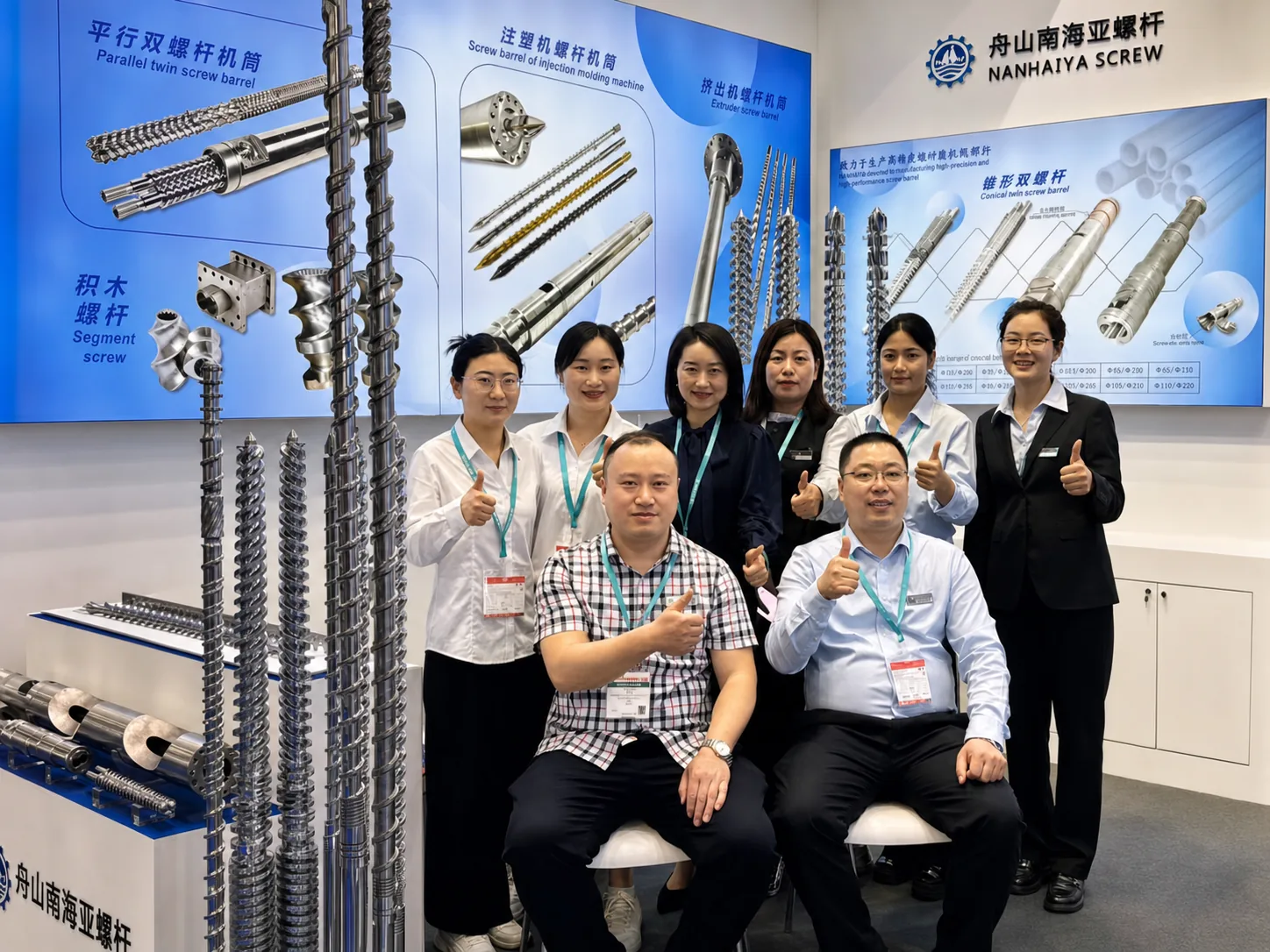
Related Articles
More insights on screw barrel technology and plastics processing.
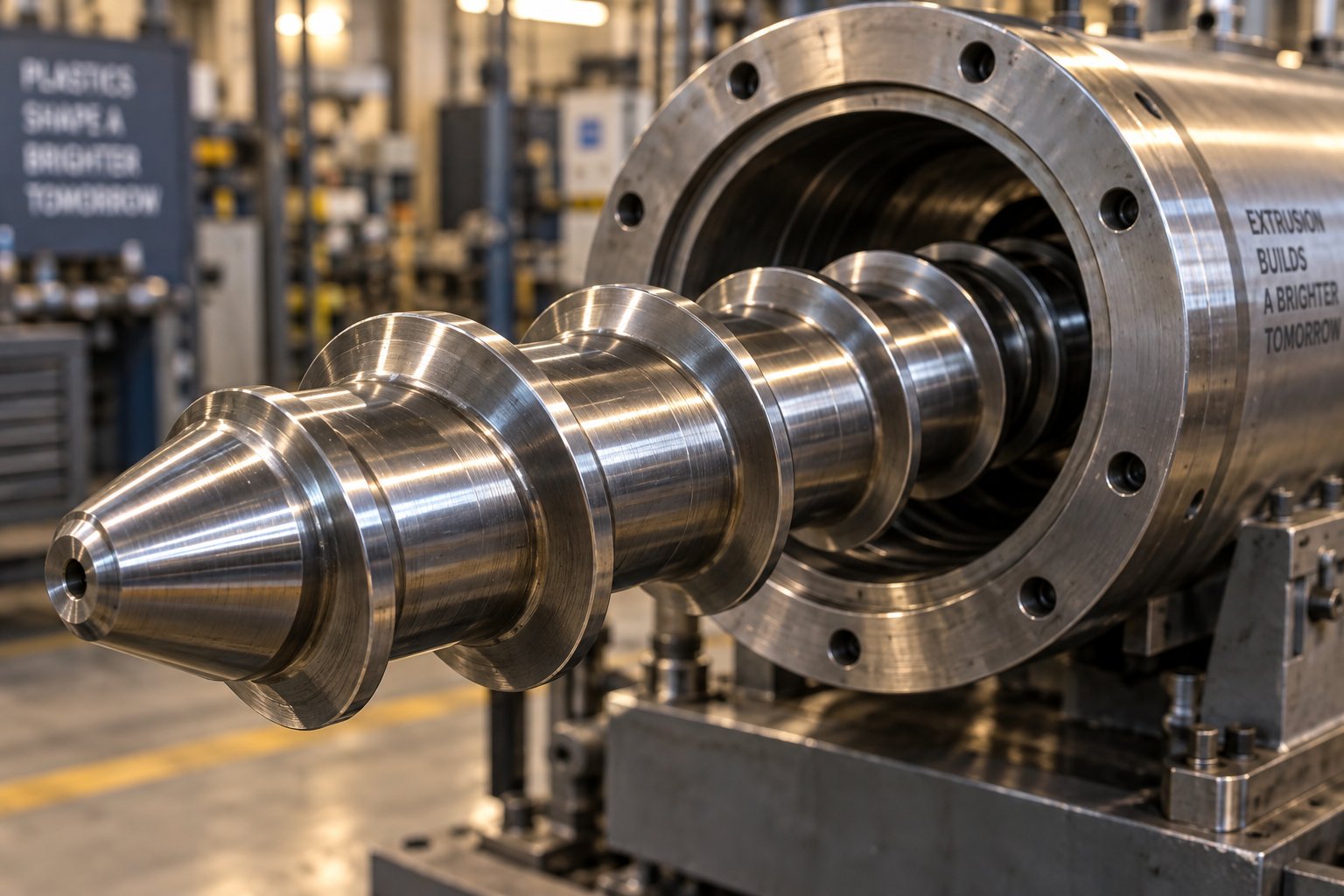
What Nobody Tells You About Screw Barrel For Plastic Machine Design
Oct 10, 2026
Learn how screw barrel for plastic machine design affects melt quality, throughput, and wear life. Covers geometry, resin matching, troubleshooting, and sourcing.
Read Article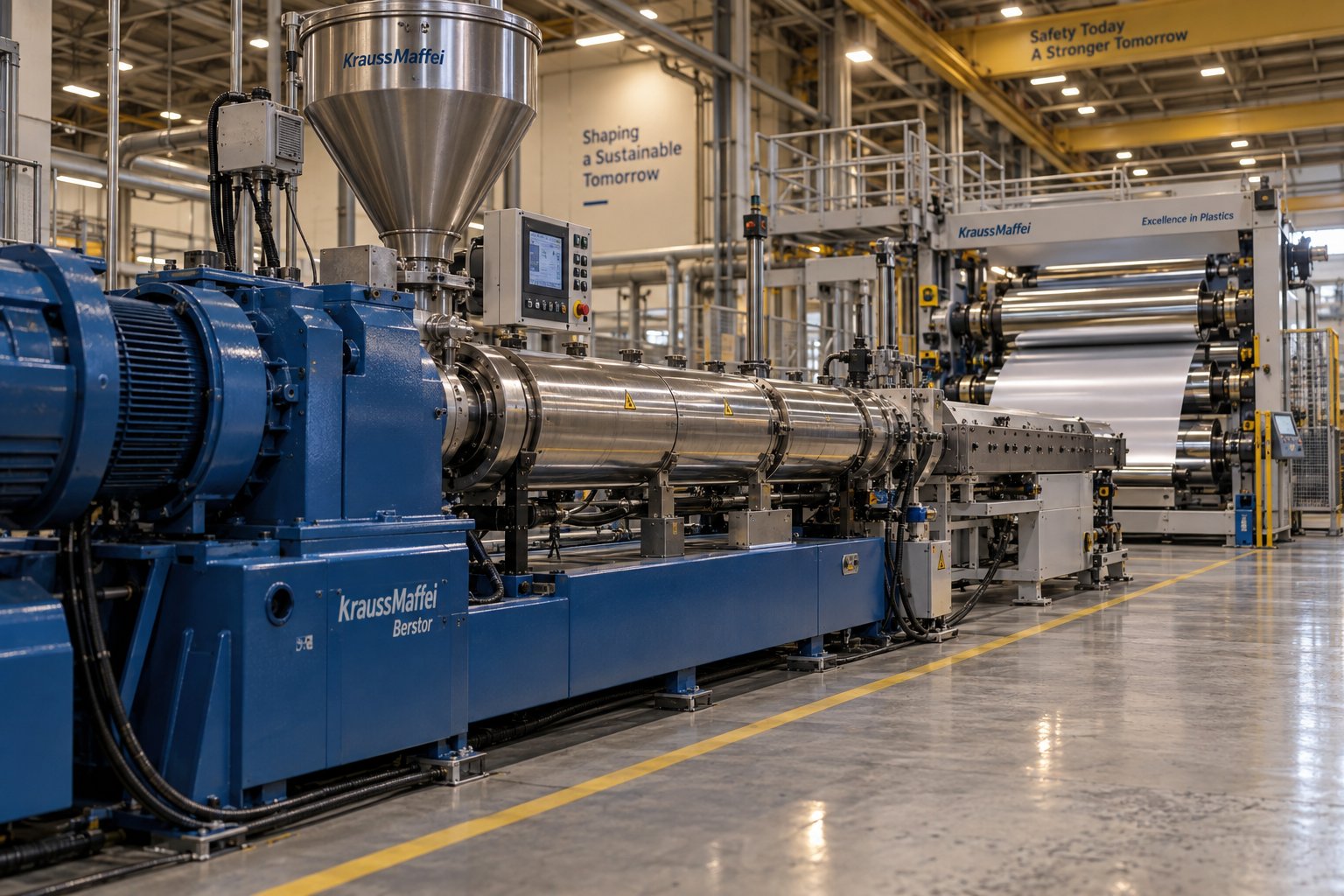
Single Screw Extruder for Sheet: Stop Guessing, Start Specifying
Oct 9, 2026
Learn how to specify a single screw extruder for sheet production. Covers screw geometry, resin-specific processing, troubleshooting, and maintenance best practices.
Read Article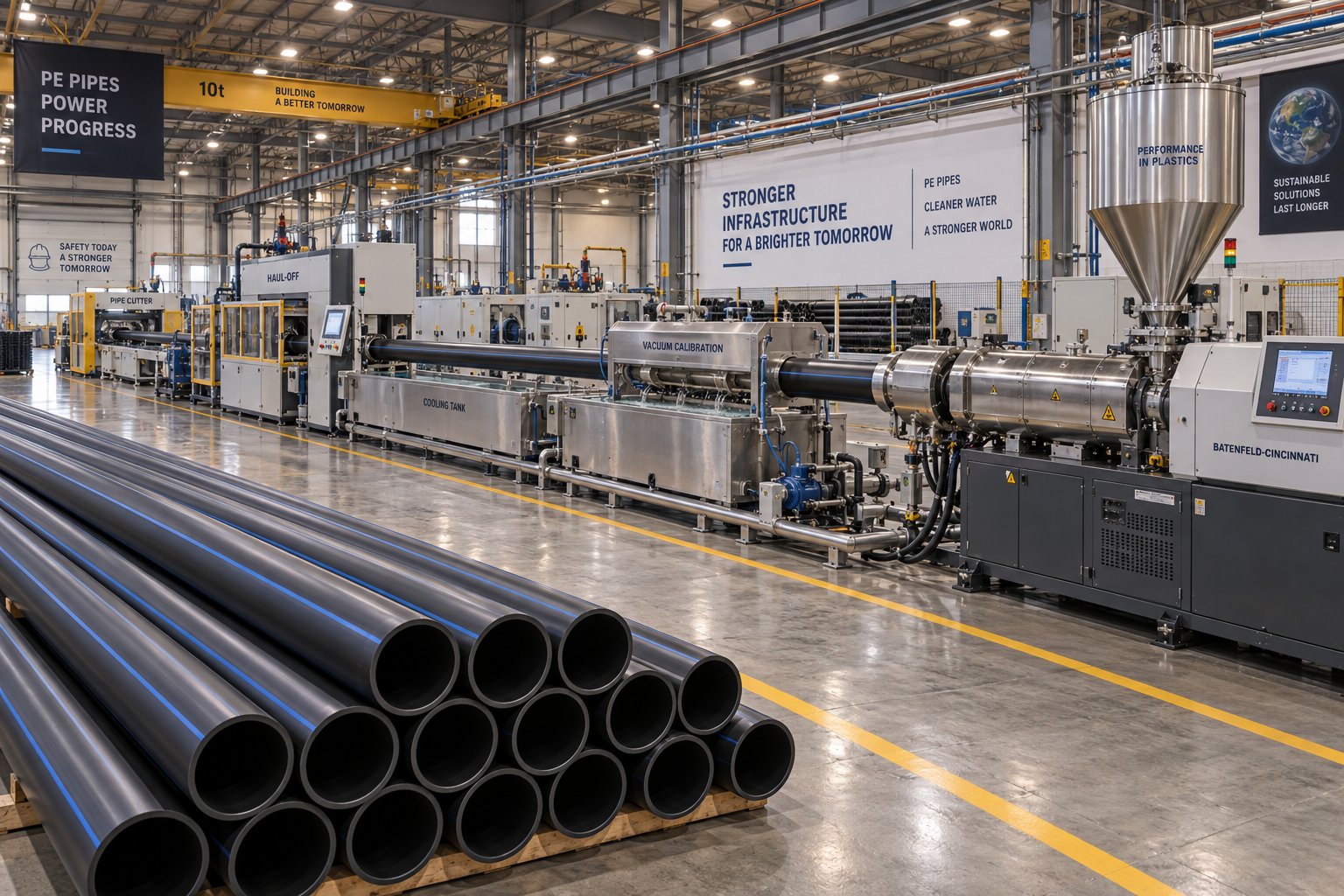
PE Pipe Extruder Machine: What Datasheets Won't Tell You
Oct 9, 2026
Learn how a PE pipe extruder machine works, key specs explained, material grade selection, maintenance tips, and buyer guidance beyond the datasheet.
Read ArticleLooking for something else?
Search by material, symptom or product and jump straight to the relevant page.
These are navigation suggestions based on keyword matching — not a quotation, not a delivery commitment, and not a substitute for engineering review. Final specification is confirmed by our engineers against your drawings and processed material.
Need help with screw barrel selection?
Share your machine model, processed material and application. Our team can help with pricing and technical support.