

What Is an Extruder Barrel and Why Price Knowledge Matters
Imagine receiving two supplier quotes for what looks like the same replacement barrel — one priced at $800, the other at $12,000. Both claim compatibility with your machine. Which one actually belongs on your production floor? That pricing gap is not a typo. It reflects real differences in materials, tolerances, and longevity that can either save your operation thousands or quietly drain it. Making the right call starts with understanding what you are actually buying.
What an Extruder Barrel Actually Does
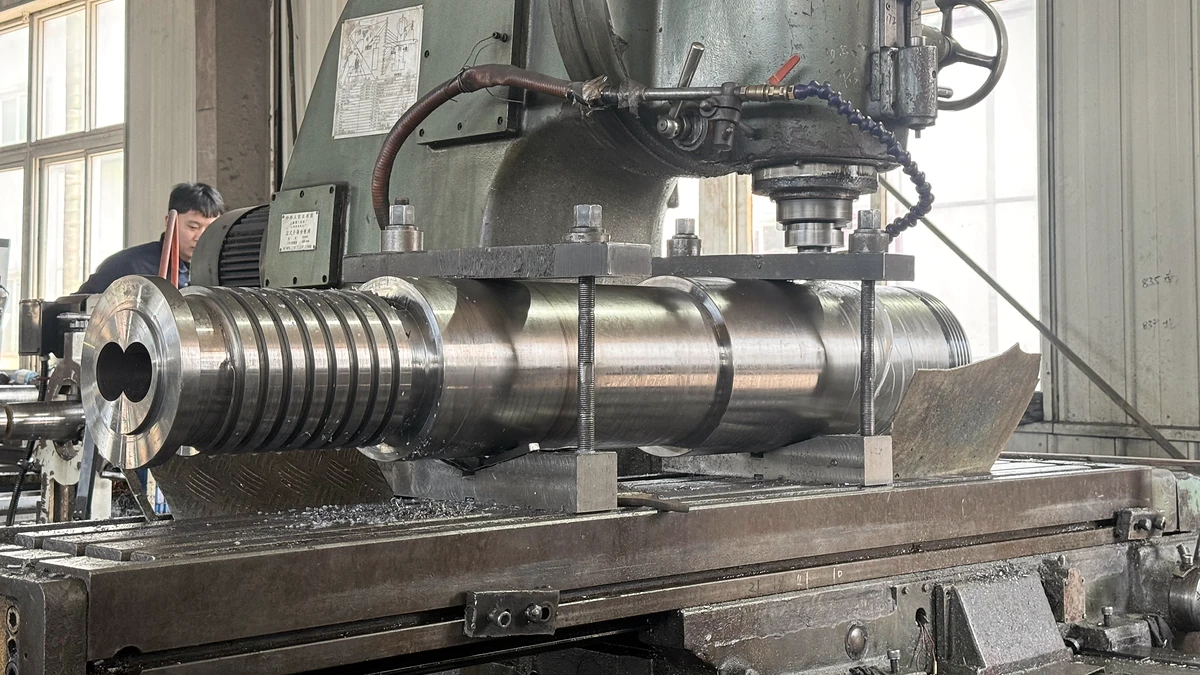
An extruder barrel is the precision-machined cylindrical housing that works in tandem with the screw to melt, mix, and convey plastic material. As Bausano explains, the barrel is the operational heart of any extrusion machine — responsible for transporting raw polymer from the hopper zone through compression, melting, and metering stages before the material exits through the die. Think of the screw barrel as a controlled environment where temperature, pressure, and shear all converge to transform solid pellets into a uniform melt.
Every extruder barrel contains several functional components that directly influence both performance and cost:
- Feed throat — the entry point where raw pellets or powder enter the extruder feed barrel, often water-cooled to prevent premature melting and bridging.
- Barrel liner — the inner wear surface that contacts the material; liner composition is one of the biggest pricing variables.
- Heating zones — independently controlled sections with heater bands that establish the temperature profile needed for each specific resin.
- Cooling channels — passages for water or air circulation that help regulate barrel temperature and prevent overheating in shear-sensitive zones.
- Venting ports — openings in certain extruder barrels that allow moisture and volatiles to escape during processing.
Why Barrel Pricing Deserves Serious Attention
Here is the reality most suppliers gloss over: barrel costs can range from a few hundred dollars for a small-diameter nitrided unit to tens of thousands per section for large bimetallic twin screw configurations. That spread is not random. It maps directly to material grade, dimensional specifications, machining precision, and surface treatment — factors that many buyers do not fully evaluate before signing a purchase order.
This article is built as a buyer-focused pricing encyclopedia, not a supplier catalog. You will find structured breakdowns of cost drivers, regional pricing dynamics, and total ownership economics that help you compare quotes on equal footing rather than on sticker price alone.
Who This Guide Is For
Three groups stand to benefit most from what follows. Procurement managers comparing supplier quotes across regions will find the specification-matching frameworks essential for apples-to-apples evaluation. Plant engineers specifying replacement extruder barrels will gain clarity on which material grades and tolerances their applications actually demand — and where over-specification wastes budget. Business owners budgeting for new extrusion lines will discover how barrel selection ripples through operating costs long after the initial purchase.
The tone throughout is independent, educational, and built around one principle: every dollar spent on a barrel should be justified by performance, not by a supplier's margin preferences. The factors that separate a smart barrel purchase from a costly mistake begin with what is happening inside the steel itself.
Technical Cost Drivers Behind Extruder Barrel Pricing
Steel is not just steel — at least not when it comes to an extrusion barrel. Two barrels with identical outer dimensions can carry wildly different price tags, and the explanation lives in three layers most suppliers barely mention: material composition, machining precision, and dimensional specifications. Peel back each layer and the pricing logic becomes remarkably clear.
Material Grade and Alloy Composition
The single largest variable in any extruder barrel price is what lines the bore. Picture it as a hierarchy — each step up introduces harder, more corrosion-resistant alloys, and each step carries a measurable cost premium.
At the base level sits standard nitrided steel, typically 38CrMoAlA or a similar grade. The barrel is machined from a single steel billet, then gas-nitrided to harden the inner bore surface. This treatment creates a thin but effective wear layer suitable for processing virgin, non-abrasive resins. It is the most affordable option and the default choice when your extruder screw and barrel handle clean polyethylene or polypropylene without fillers.
Step up to bimetallic barrels and the pricing picture shifts significantly. A bimetallic screw barrel, as Juyuan Machinery details, combines a high-strength steel outer body with a centrifugally cast alloy layer bonded to the inner bore. That alloy layer — loaded with chromium, nickel, cobalt, and hard carbide particles — delivers long-term resistance to both abrasion and corrosion under continuous production conditions. Within the bimetallic category, pricing branches further:
- Iron-based bimetallic alloys — the entry point for bimetallic technology, offering moderate wear resistance at a lower premium over nitrided barrels.
- Nickel-based bimetallic alloys — a meaningful jump in both corrosion resistance and cost, commonly specified for PVC processing and chemically aggressive compounds.
- Cobalt-based bimetallic alloys — the premium tier, delivering superior performance at elevated temperatures and under extreme abrasive loads from glass-fiber-filled engineering plastics.
At the top of the hierarchy sit specialty tool steel linings and tungsten carbide coatings, reserved for the most punishing applications. These treatments command the steepest prices but can dramatically extend service life in environments where standard bimetallic liners would erode within months.
When does that premium justify itself? The answer is straightforward: whenever the cost of premature barrel failure — production downtime, scrap, and emergency replacement — exceeds the upfront price difference. For a plant running abrasive or corrosive formulations around the clock, a bimetallic upgrade often delivers lower total cost of ownership by extending replacement intervals and reducing unplanned shutdowns. For a facility processing clean virgin resins, that same upgrade would be money wasted.
Machining Tolerances and Heat Treatment Processes
Imagine two barrels made from the same alloy. One costs 30% more. Why? The answer often hides in the machining and heat treatment steps that do not show up on a spec sheet unless you know to ask.
Bore straightness is the first critical tolerance. An extrusion barrel might be several feet long with a relatively narrow bore — maintaining perfect straightness across that length requires precision deep-hole drilling and multiple finishing passes. Tighter straightness tolerances demand more machine time, more skilled operators, and more stringent quality checks. Every fraction of a millimeter matters, because a barrel bore that deviates from true straight will cause uneven screw-to-barrel clearance, inconsistent melt quality, and accelerated wear on both components.
Bore concentricity — how perfectly circular the bore remains along its full length — adds another layer of manufacturing cost. A barrel with excellent concentricity ensures the extruder screw rotates evenly within the bore, distributing wear uniformly rather than creating localized hot spots. Achieving this requires precision honing and careful quality control at multiple stages.
Surface finish also plays a direct role. The inner surface roughness of an extrusion barrel, commonly measured in Ra (average roughness), affects material flow, residence time, and cleaning ease. Industry practice targets an inner surface roughness Ra no greater than 1.6 micrometers after finish grinding. Achieving and verifying that specification adds both processing time and inspection cost.
Then there is heat treatment — and this is where pricing differences can compound. A basic barrel might undergo a single nitriding cycle. A premium twin screw barrel could require multi-stage heat treatment: stress relieving after rough machining, followed by hardening, tempering, and finally a controlled nitriding or surface treatment cycle. Each stage adds furnace time, energy cost, and quality verification. Hardness is typically verified using Rockwell or Vickers scales — think of these as standardized methods for pressing a tiny indenter into the steel surface and measuring how deep it penetrates. Higher numbers mean harder material, and hitting a specified hardness consistently across the entire bore length is far more demanding than simply reaching a target at one test point.
You will rarely see these details broken out on a quote. But when one supplier's price seems inexplicably higher for an apparently identical barrel, machining tolerances and heat treatment rigor are frequently where the difference lives.
Barrel Specifications That Affect Cost
Beyond materials and machining, a barrel's physical design specifications drive cost in predictable directions. The table below maps the most influential specs to their general pricing impact — useful context when you are evaluating why two quotes for seemingly similar barrels do not match.
| Specification | What It Means | How Increasing It Affects Price |
|---|---|---|
| L/D Ratio | Length-to-diameter ratio — determines the barrel's overall length relative to its bore size | Higher L/D ratios mean longer barrels, more raw material, more machining time, and more heating zones. Cost increases roughly proportionally with length. |
| Bore Diameter | The internal diameter of the barrel bore | Larger bores require heavier steel billets, more alloy material for liners, and longer machining cycles. Twin screw barrel configurations with larger bores escalate costs more steeply due to the complex figure-eight bore geometry. |
| Number of Venting Ports | Openings machined into the barrel wall for devolatilization | Each port requires additional precision machining and may weaken the barrel structure, sometimes necessitating thicker walls or reinforcement — adding both material and labor cost. |
| Heating/Cooling Zones | Independently controlled temperature sections along the barrel length | More zones mean more machined cooling channels, more heater band mounting surfaces, and more thermocouple ports. Each additional zone incrementally increases both manufacturing complexity and component costs. |
| Tolerance Class | The precision grade of bore dimensions and straightness | Moving from standard industrial tolerances to tight-tolerance specifications can add significant cost — sometimes 15-25% or more — due to additional machining passes, slower feed rates, and increased inspection requirements. |
Here is the practical takeaway: when you receive a quote for an extrusion barrel that looks surprisingly affordable, check whether it reflects a shorter L/D ratio, fewer zones, or looser tolerances than your application actually requires. Conversely, a quote that seems high might include specifications you did not explicitly request but the supplier assumed based on your machine model. Either way, the specs behind the number matter far more than the number itself — a principle that becomes even more apparent when you start comparing prices across different barrel types and material treatments.
Extruder Barrel Price Ranges by Type and Material
A quick online search for barrel extruder pricing reveals listings ranging from under $1,000 to well over $30,000 per section. That kind of spread does not inspire confidence — it inspires confusion. The problem is not that the prices are wrong. It is that they describe completely different products serving completely different applications. Sorting those numbers into a meaningful framework requires organizing them by barrel type, size class, and material treatment.
Price Ranges by Barrel Type
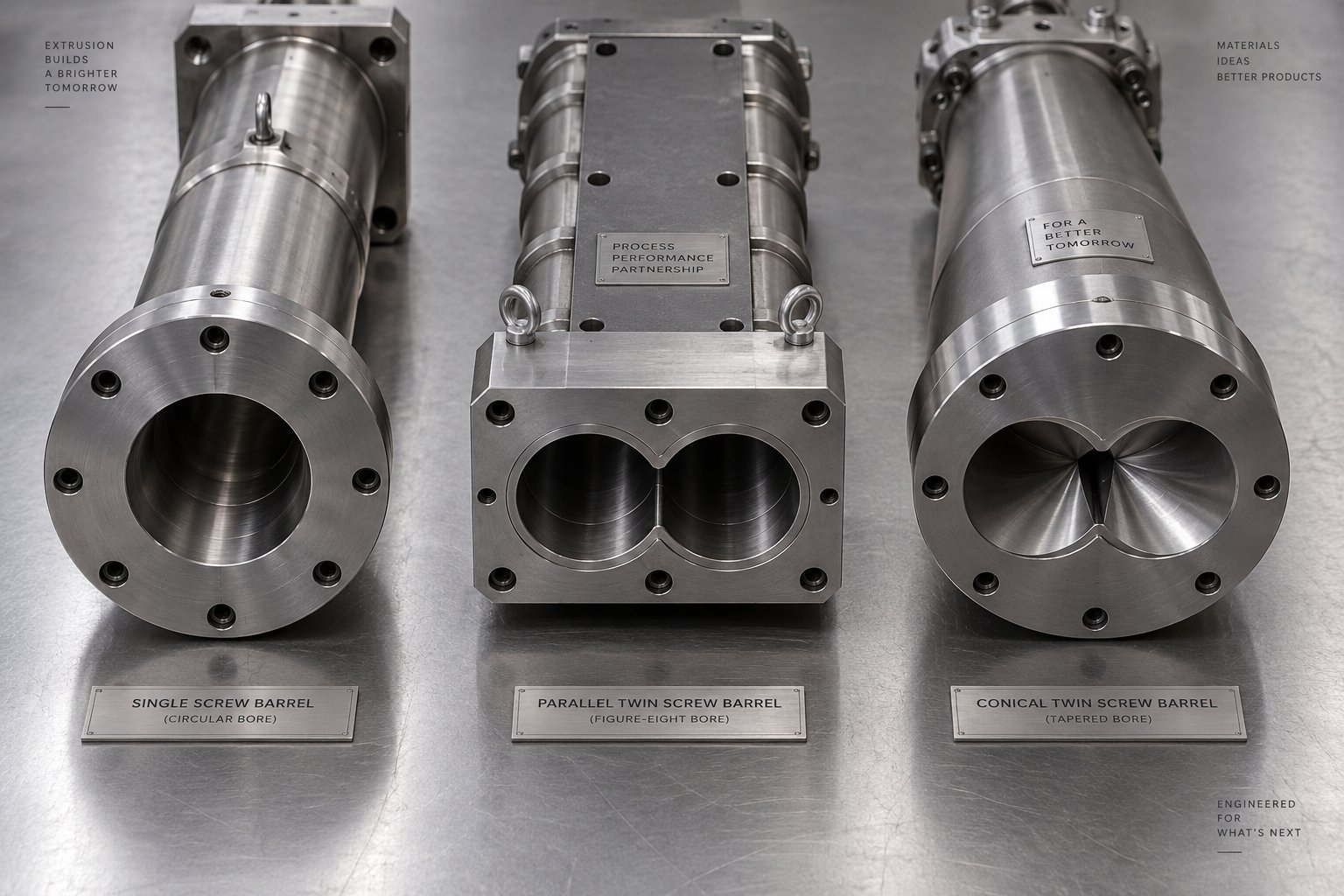
Barrel pricing follows distinct tiers depending on whether you are sourcing for a single screw machine, a parallel twin screw and barrel setup, or a conical twin screw configuration. Each type differs in bore geometry, manufacturing complexity, and the volume of alloy material required — all of which directly shape the final cost.
| Barrel Type | Typical Diameter Range | Common Material Options | General Price Tier |
|---|---|---|---|
| Single Screw Barrel | 20 mm – 200 mm+ | Nitrided, bimetallic (iron/nickel/cobalt-based), tool steel lined | Entry-level to mid-range for standard diameters; premium pricing for large-bore or specialty-lined units |
| Parallel Twin Screw Barrel | 25 mm – 135 mm+ | Bimetallic (nickel/cobalt-based), tungsten carbide lined | Mid-range to premium — figure-eight bore geometry significantly increases machining cost and alloy consumption |
| Conical Twin Screw Barrel | 45/90 mm – 80/156 mm (small-end/large-end) | Nitrided, bimetallic (nickel-based), specialty corrosion-resistant alloys | Mid-range — tapered geometry is complex but typically uses less total material than equivalent parallel configurations |
A small-diameter single screw barrel with standard nitriding — the kind commonly listed on Indian industrial marketplaces around ₹1,00,000 (roughly $1,200) — serves entirely different applications than a large-bore, bimetallic parallel twin screw barrel section quoted at $25,000–$30,000 or more from a European or American manufacturer. These are not competing quotes for the same product. They are different categories of equipment altogether.
Why Published Prices Vary So Dramatically
If you have ever been baffled by the gulf between a screw plastic extruder barrel listed on Alibaba and a quote from a domestic supplier, the explanation is structural rather than suspicious. That low-cost listing likely describes a small-diameter, nitrided, standard-tolerance barrel intended for basic polymer processing. The premium quote likely covers a large-bore, bimetallic-lined, tight-tolerance barrel engineered for demanding compounding or filled-resin applications. Between those two extremes, at least five variables are moving simultaneously:
- Bore diameter — a 45 mm barrel uses a fraction of the raw material and machining time required for a 120 mm barrel.
- Overall length — driven by L/D ratio, longer barrels cost proportionally more in material, alloy liner, and machining.
- Material grade — a gas-nitrided barrel and a cobalt-based bimetallic barrel occupy entirely different cost brackets.
- Tolerance class — standard industrial tolerances versus precision-ground, tight-clearance specifications can shift the price by 15–25% or more.
- Intended application — barrels built for abrasive glass-filled engineering plastics require alloy compositions and quality verification levels that basic PE or PP processing does not demand.
Comparing barrel prices without matching specifications is meaningless. A $1,200 barrel and a $30,000 barrel are not overpriced and underpriced versions of the same thing — they are fundamentally different products designed for fundamentally different jobs.
This is why requesting and providing detailed specifications before comparing quotes is not optional — it is the only way to know whether you are evaluating equivalent products. Strip away the specs and all you have left is a number with no context.
Material Treatment Price Tiers
Material treatment is the single most influential cost lever within any given barrel size and type. The progression from least to most expensive follows a clear, logical path tied to metallurgical complexity and raw alloy cost. Based on industry standards outlined by manufacturers like IMS Company, here is how the tiers stack up:
- Gas-nitrided (most affordable) — the barrel's bore is hardened through nitrogen diffusion, creating a thin wear-resistant surface layer. Effective for non-abrasive, non-corrosive resins. The hard layer typically extends only 0.007" to 0.015" deep, meaning once it wears through, degradation accelerates rapidly.
- Bimetallic, iron-based alloy — a centrifugally cast liner metallurgically bonded to the barrel bore provides a thicker, more durable wear surface than nitriding alone. Suitable for moderate-wear applications at a modest premium.
- Bimetallic, nickel-boron alloy — the industry's standard abrasion-resistant bimetallic liner, offering good wear resistance and a low friction coefficient. A significant step up in both durability and cost over iron-based liners.
- Bimetallic, cobalt-nickel alloy (premium) — a high-chromium, cobalt-nickel-based liner engineered for highly corrosive processing environments such as fluoropolymers and chemically aggressive additives. This tier delivers excellent combined abrasion and corrosion resistance at a correspondingly premium price point.
- Tungsten carbide lined (most expensive) — a super wear-resistant carbide liner designed for the most punishing abrasive applications, including heavily glass-filled compounds and mineral-loaded formulations. Some manufacturers also offer carbide-bound liners that can be later re-bored and re-sleeved, adding long-term value to the initial investment.
Each step up this ladder adds both raw material cost and manufacturing complexity. The centrifugal casting process used for bimetallic liners — heating the barrel assembly until the alloy melts, then spinning it to bond a uniform lining approximately 1/16" thick to the bore wall — is inherently more involved than a nitriding cycle. Specialty alloys like cobalt-nickel or tungsten carbide further escalate material costs because the raw elements themselves carry higher market prices.
The practical question is not which treatment is "best" in absolute terms. It is which treatment delivers the right balance of wear life and upfront cost for your specific resin, filler loading, and production volume. That calculation shifts dramatically depending on whether your barrel extruder processes clean polyolefins or abrasive recycled compounds — a relationship between application and pricing that shapes purchasing decisions just as powerfully as material grade alone.
Geographic Pricing Differences Across Global Suppliers
Material grade and barrel specifications explain a large share of price variation — but not all of it. Two barrels built to identical specs, using the same alloy, machined to the same tolerances, can still carry significantly different price tags depending on where they were manufactured. Geography shapes barrel pricing in ways that go far beyond exchange rates, and understanding those dynamics gives buyers a genuine negotiating edge.
Chinese Manufacturers and the Factory-Direct Advantage
China dominates global production of plastic extruder screw and barrel components, and the pricing reflects several structural advantages that are difficult for manufacturers elsewhere to replicate.
First, labor costs remain substantially lower. Skilled CNC machinists, heat treatment technicians, and quality inspectors in China's industrial hubs earn a fraction of what their counterparts in Germany or the United States command. That difference compounds across every manufacturing step — from rough machining through final bore honing. Second, China's extrusion component industry benefits from deeply integrated supply chains. Raw steel billets, alloy powders for bimetallic casting, nitriding gases, and heater band assemblies are all sourced domestically, often within the same industrial zone. This proximity eliminates layers of logistics cost and import duty that manufacturers in other regions absorb. Third, sheer production volume drives economies of scale. As Chuangbo notes, Chinese extrusion equipment suppliers can undercut European OEMs by 40-60% while delivering equivalent performance through these strategic cost optimizations.
Those savings are real — but so are the trade-offs buyers need to evaluate honestly:
- Shipping costs and transit time — ocean freight for heavy steel components adds both expense and weeks to delivery schedules, partially eroding the upfront savings.
- Communication barriers — time zone differences, language gaps, and varying technical vocabulary can slow the quoting process and introduce specification misunderstandings.
- Quality verification challenges — inspecting a barrel's bore straightness, hardness profile, and alloy composition from 7,000 miles away requires either trusted third-party inspection services or an established relationship with a supplier whose documentation you can verify.
- Import duties and tariffs — depending on your country, tariff structures on imported steel components can shift the cost equation meaningfully.
None of these trade-offs are dealbreakers. They are simply variables that belong in your total cost calculation alongside the quoted unit price.
European and American Barrel Pricing
Barrels from German, Italian, and American manufacturers typically occupy the premium end of the pricing spectrum — and not without reason. These regions built their reputations on decades of metallurgical expertise, and that expertise shows up in several tangible ways.
European screw extruder and barrel manufacturers often maintain tighter process controls, invest heavily in advanced surface treatment technologies, and employ metallurgists who can tailor alloy compositions to specific polymer processing challenges. American manufacturers offer a similar depth of application knowledge, with the added advantage of shorter lead times and local technical support for domestic buyers. When your extrusion screw and barrel arrive from a premium supplier, you are also paying for brand accountability — a company with a decades-long reputation has strong financial incentive to ensure every component meets spec.
When does that premium make sense? Consider these scenarios:
- Critical-tolerance applications — medical tubing, optical film, and precision profile extrusion demand barrel tolerances where even minor deviations create scrap. Premium manufacturers with documented process capability data reduce that risk.
- Urgent replacement needs — a domestic supplier who can ship a barrel within days rather than weeks can pay for itself in avoided downtime costs alone.
- Complex technical support — if your application involves unusual polymers, custom screw profiles, or troubleshooting persistent quality issues, having a supplier's engineering team a phone call away has measurable value.
- Regulatory environments — food-contact, pharmaceutical, and aerospace extrusion applications may require supplier certifications and traceability documentation that established Western manufacturers are already set up to provide.
The mistake is assuming premium always means better value — or that lower-cost always means inferior quality. The right answer depends entirely on your application requirements, risk tolerance, and how effectively you can verify what you are receiving.
How to Evaluate Global Suppliers Effectively
Here is the good news: regardless of whether a barrel ships from Zhoushan or Stuttgart, the same set of quality documents lets you compare objectively. These records are the great equalizer — they strip away geography and brand reputation and focus on what the steel actually delivers.
Before placing an order with any supplier, request the following:
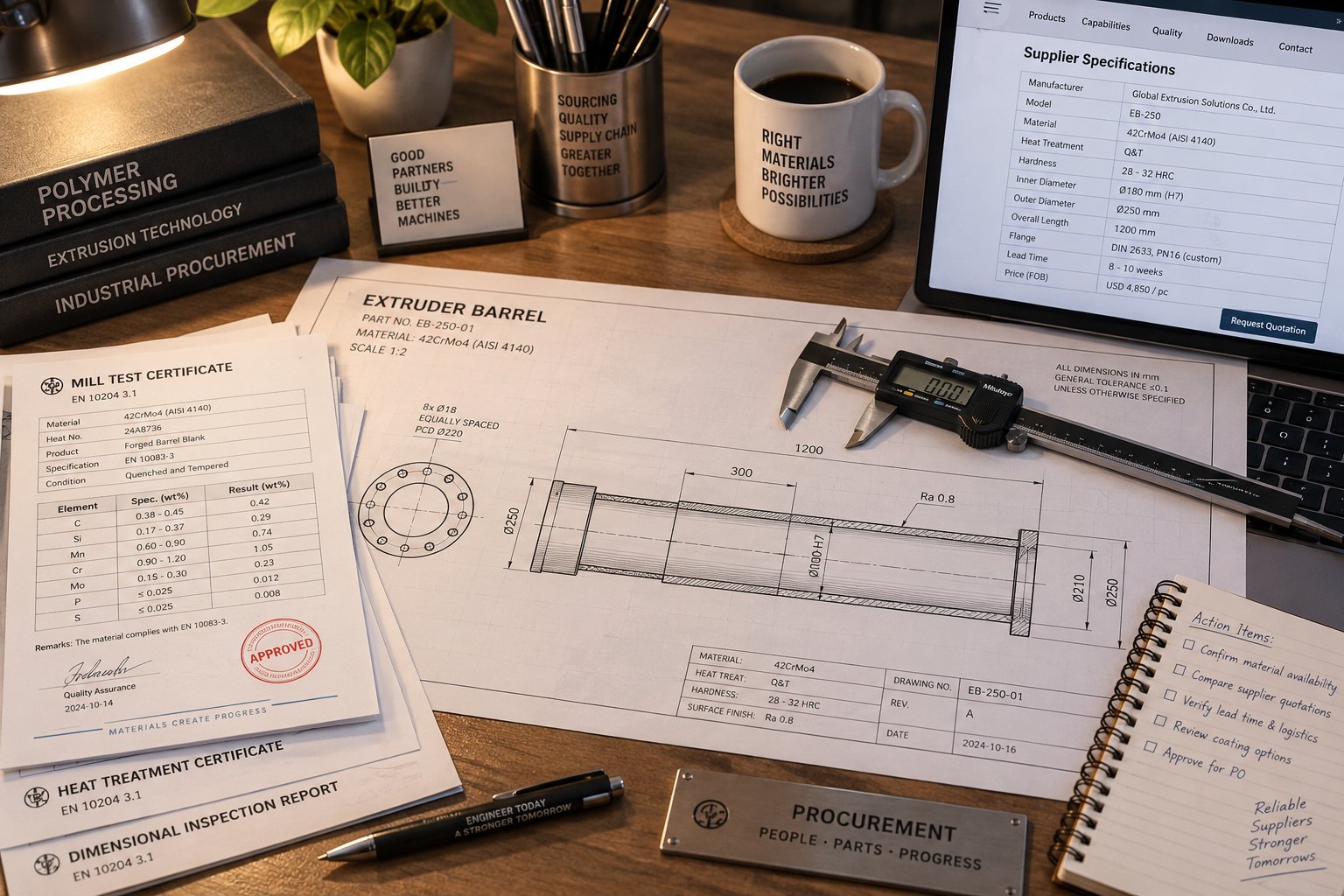
- Metallurgical certification — material certificates confirming the exact alloy composition of both the barrel body and any liner material. A reliable supplier should provide this without hesitation.
- Hardness testing reports — documented Rockwell or Vickers hardness readings taken at multiple points along the barrel bore, not just a single spot check. As industry specialists emphasize, hardness verification across the full bore length is far more meaningful than a single-point reading.
- Bore straightness and concentricity measurements — inspection data showing deviation across the barrel's entire length, ideally with traceable measurement equipment calibration records.
- Surface finish specifications — verified Ra values for the inner bore surface, confirming the barrel meets the finish grade your application requires.
- Heat treatment records — documentation of nitriding depth, tempering cycles, or bimetallic casting parameters, depending on the barrel type.
- Dimensional inspection report — a full dimensional check against the agreed drawing, including outer diameter, flange dimensions, port locations, and cooling channel specifications.
A supplier who provides all of these documents proactively — before you chase them — is signaling process maturity and confidence in their product. A supplier who resists or delays these requests is telling you something equally important. This applies whether the factory sits in Shanghai or Ohio.
Worth noting: some manufacturers now offer factory-direct pricing models that bridge the traditional gap between low-cost imports and premium domestic options. These suppliers combine competitive production costs with transparent documentation and direct communication with end users, eliminating intermediary markups while maintaining verifiable quality standards. The key is always the documentation — not the flag on the factory roof.
Geography shapes the starting price, but specifications and verification determine the final value. That value equation shifts again — sometimes dramatically — depending on what material your barrel actually needs to process, a factor that many buyers underestimate until wear patterns force the conversation.
How Your Processing Application Affects Barrel Cost
A barrel that performs beautifully in one plant can fail catastrophically in another — not because of a manufacturing defect, but because the application demanded something the barrel was never designed to deliver. Your resin type, filler loading, and processing chemistry do not just influence barrel performance. They dictate what you should be paying in the first place. Overlook this relationship and you either waste money on over-engineered components or — far worse — burn through cheap barrels so fast that downtime costs dwarf whatever you saved on the purchase price.
Standard Applications and Standard Pricing
If your extrusion line processes common, unfilled thermoplastics — think HDPE, polypropylene, or general-purpose polystyrene — you are operating in the sweet spot for standard nitrided barrels. These resins melt predictably, generate relatively low shear forces, and contain no abrasive fillers or corrosive byproducts that aggressively attack the barrel bore.
For these applications, a gas-nitrided barrel provides a cost-effective combination of surface hardness and adequate wear resistance. The nitrided layer protects the bore against normal operational wear, and because the resins themselves are thermally forgiving and chemically benign, the barrel's inner surface faces minimal chemical attack. You are looking at entry-level to mid-range pricing depending on bore diameter and length — the affordable end of the spectrum where standard metallurgy meets standard processing demands.
As Turner Group emphasizes, every resin has unique characteristics that should guide component selection. General-purpose screws and barrels might handle a range of materials, but they are fundamentally designed for this baseline: clean, unfilled resins at moderate processing temperatures. When the application stays within those boundaries, spending more on premium alloys is simply unnecessary.
That calculus changes the moment your feedstock introduces new variables — corrosive gases, abrasive particles, or contaminants that nitrided steel was never intended to resist.
Demanding Applications That Require Premium Barrels
Certain processing environments create barrel conditions that standard nitrided steel simply cannot survive for long. Each of these scenarios escalates the required barrel material — and the extruder barrel price along with it.
PVC compounding stands out as one of the most chemically aggressive applications in plastics processing. As Viplas details extensively, PVC releases hydrochloric acid (HCl) during thermal processing — a corrosive gas that attacks standard steel from the inside out. Barrels and screws for PVC must be manufactured from corrosion-resistant materials such as special stainless steels or nickel alloys, and PVD coatings are also used to increase surface hardness. Compared to other polymers like PP or PE where temperature control is less critical and standard nitrided steel suffices, PVC demands very precise temperature regulation, degassing systems to remove HCl vapors, and a low compression ratio (typically 1.5:1 to 2.5:1) to prevent localized overheating and degradation.
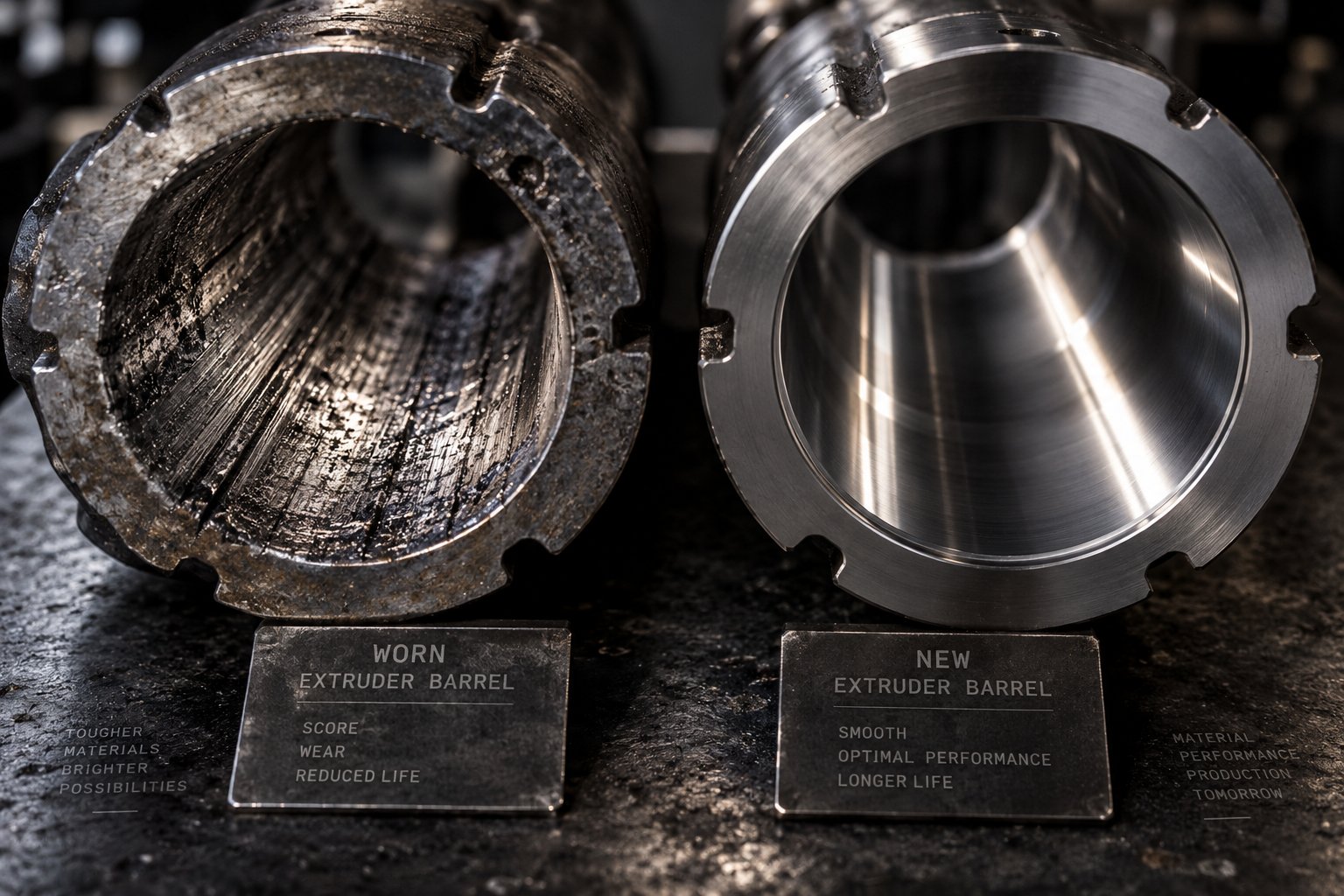
Recycled materials processing introduces a different kind of punishment. Post-consumer and post-industrial recyclate often contains metal fragments, sand, glass particles, paper residue, and other contaminants that act like sandpaper against the barrel bore. Even if the base polymer is a non-aggressive resin like HDPE, the contaminant load transforms the application into an abrasive-wear environment that quickly exceeds the protection a nitrided surface can offer.
Engineering plastics with glass fiber or mineral fillers represent perhaps the most abrasive barrel challenge. Glass fibers, silica, and calcium carbonate — all common reinforcements in nylon, PBT, and other engineering compounds — generate extreme wear on both the injection screw and barrel bore. Research published by Plastics Technology identifies these abrasive fillers as a primary cause of accelerated wear, particularly in zones where the channels carry high levels of unmelted solids. A Davis Standard single screw extruder processing 30% glass-filled nylon, for example, will wear through a nitrided barrel dramatically faster than the same machine running unfilled resin — often reducing barrel life by a factor of three or more.
Food-grade extrusion adds a different cost layer. The barrel itself may not need extreme wear resistance, but it does require specific surface treatments, verified material certifications for food-contact compliance, and documentation traceability that standard industrial barrels do not provide. These regulatory requirements add cost through both manufacturing process controls and administrative overhead.
| Application Type | Key Barrel Challenge | Recommended Barrel Material | Relative Price Tier |
|---|---|---|---|
| Unfilled HDPE, PP, PS | Minimal wear, no corrosion | Gas-nitrided steel | Entry-level to mid-range |
| PVC compounding | Corrosion (HCl attack) | Nickel-based bimetallic or stainless-lined | Mid-range to premium |
| Recycled materials (post-consumer) | Abrasion (contaminant particles) | Iron- or nickel-based bimetallic | Mid-range |
| Glass-fiber-filled engineering plastics | Extreme abrasion | Cobalt-based bimetallic or tungsten carbide lined | Premium to highest tier |
| Mineral-filled compounds | Abrasion and moderate corrosion | Nickel- or cobalt-based bimetallic | Mid-range to premium |
| Food-grade extrusion | Regulatory compliance, surface certification | Nitrided or bimetallic with certified surface treatment | Mid-range (material) + compliance premium |
Matching Barrel Investment to Application Requirements
Here is where procurement decisions get interesting — and where many buyers leave money on the table in one direction or the other.
Over-specification is the quieter budget drain. Imagine a plant running clean, unfilled polypropylene on a single screw extruder. A screw barrel manufacturer quotes a cobalt-based bimetallic barrel, and the buyer approves it because "premium must be better." The barrel will last an impressively long time — but it would have lasted nearly as long with a standard nitrided barrel at a fraction of the cost, because the application simply does not generate enough abrasive or corrosive stress to justify the alloy upgrade. The money spent on that unnecessary premium could have funded barrel replacements for years.
Under-specification is the louder and more expensive mistake. A processor running 40% glass-filled nylon selects the cheapest nitrided barrel available to stay within budget. Within months, bore wear accelerates, the clearance between screw flights and barrel wall opens up, and — as Plastics Technology's analysis demonstrates — the specific rate drops while discharge temperatures climb. The operator increases screw speed to compensate, which further accelerates wear. Eventually, production rate must be reduced by 10-15% or more to maintain product quality, and the barrel needs emergency replacement. The "savings" on the original purchase have now cost far more in scrap, downtime, and lost capacity than a properly specified bimetallic barrel would have cost upfront.
The practical framework for right-sizing your barrel investment comes down to three questions:
- What is in your resin? — Fillers, reinforcements, and chemical additives define whether you need abrasion resistance, corrosion resistance, or both. Unfilled, chemically mild resins point toward nitrided barrels. Filled or corrosive compounds point toward bimetallic or specialty liners.
- How many hours per year will this barrel run? — A barrel operating 24/7 on abrasive material justifies a higher-grade alloy because the cost is amortized over far more production hours than a barrel running intermittent shifts on mild materials.
- What does unplanned downtime actually cost you? — If a barrel change shuts your line down for two days and each day costs $15,000 in lost production, then a barrel upgrade that extends service life by even six months pays for itself quickly. If your operation has flexible scheduling and low downtime penalties, the urgency for premium metallurgy decreases.
This is not about spending more or less. It is about spending accurately — matching the barrel's capabilities to the actual demands of your process so that every dollar invested in metallurgy returns proportional value in service life and uptime. That same accuracy matters when you face another critical spending decision: whether to buy OEM, aftermarket, or refurbished barrels for your next replacement cycle.
OEM vs. Aftermarket vs. Refurbished Extruder Screws and Barrels
You have identified the right alloy for your application and know exactly what bore diameter, L/D ratio, and tolerance class your line demands. The next fork in the road is one that most pricing guides skip entirely: should you buy that barrel from the original equipment manufacturer, source an aftermarket replacement, or refurbish the worn barrel already sitting on your shop floor? Each path carries a distinct cost profile, lead time expectation, and risk level — and choosing blindly can mean overpaying by thousands or gambling with production reliability.
OEM Barrel Pricing and When It Makes Sense
Original equipment manufacturer barrels — the ones branded by the company that built your extruder — consistently sit at the top of the pricing ladder. Whether your machine carries a Davis-Standard nameplate, a KraussMaffei badge, or a Coperion logo, ordering the replacement barrel through that OEM's parts channel means paying for more than just steel and alloy. You are paying for guaranteed dimensional compatibility, engineering validation against the original machine design, and the assurance that the manufacturer stands behind the component with a warranty tied to the complete system.
That premium is not trivial. OEM extruder screw barrel replacements can cost 30-50% more than dimensionally equivalent aftermarket alternatives, and lead times often stretch longer because OEMs batch their parts production or route orders through centralized manufacturing facilities. So when does paying that premium actually make financial sense?
- Warranty preservation — if your extruder is still under the original manufacturer's warranty, installing a non-OEM barrel could void coverage on the entire machine. For a relatively new line representing a six- or seven-figure investment, protecting that warranty may easily justify the parts premium.
- Guaranteed compatibility — OEM barrels are machined to the exact drawings used for the original component, eliminating the risk of dimensional mismatches at flanges, feed throat alignment, or thermocouple port locations. When your line runs precision products where even minor alignment deviations create scrap, that certainty has measurable value.
- Risk-averse operating environments — plants running medical-grade, aerospace, or food-contact extrusion often operate under regulatory frameworks that require full traceability back to the equipment manufacturer. OEM documentation packages are designed to satisfy those audit trails without additional effort from your quality team.
- Complex or proprietary barrel designs — some screw extruders use barrel geometries with non-standard port configurations, specialized cooling channel layouts, or proprietary liner bonding methods that aftermarket suppliers may not replicate accurately without extensive reverse engineering.
The key question is whether the risk you are mitigating with OEM pricing is real or perceived. For a standard single-screw extrusion line running commodity resins, the compatibility risk of a well-made aftermarket barrel is genuinely low. For a specialized twin screw compounding system with custom barrel sections and tight process windows, that calculus shifts considerably.
Aftermarket Replacement Barrels
Aftermarket barrel manufacturers occupy the space between OEM pricing and the compromises some buyers fear. These companies produce extruder screws and barrels to OEM specifications — matching bore dimensions, flange patterns, port locations, alloy grades, and tolerance classes — without carrying the brand premium built into OEM pricing. The savings can be substantial, often ranging from 20-40% below OEM list prices for equivalent specifications.
How is that possible without cutting corners? Several factors work in the aftermarket supplier's favor. They typically operate with lower overhead than large OEMs, focus exclusively on screw and barrel manufacturing rather than complete machine systems, and compete directly on component quality rather than on brand loyalty. Many aftermarket suppliers serve as factory-direct sources — meaning your order goes straight from the production floor to your dock without distributor markups or regional sales office overhead layered on top.
That said, not every aftermarket barrel is created equal. The price advantage only delivers real value if the replacement barrel actually matches the performance of the original. Before committing to an aftermarket supplier, verify the following:
- Dimensional accuracy — request the supplier's inspection report showing bore diameter, straightness, concentricity, and all critical flange and port dimensions checked against your machine's original drawing. If you do not have the original drawing, a competent aftermarket manufacturer can reverse-engineer from a sample barrel or from the machine make and model.
- Material certifications — demand mill certificates for the barrel body and alloy composition certificates for any bimetallic liner. These should specify the exact alloy grade, not just a generic "bimetallic" label. As covered in earlier sections, the difference between an iron-based and a nickel-based bimetallic liner is enormous in both performance and cost.
- Hardness and heat treatment documentation — verified hardness readings at multiple points along the bore, plus records of nitriding depth or heat treatment cycles, confirm the barrel was manufactured to the same process standards as the OEM original.
- Compatibility guarantee — reputable aftermarket suppliers stand behind fitment. Ask explicitly whether the supplier guarantees the barrel will mount, align, and seal correctly on your specific machine model — and what remedy they offer if it does not.
For injection molding screws and barrels, the aftermarket ecosystem is particularly well-developed. Machines from major brands have been in service for decades, and the dimensional data for standard barrel sizes is widely available. This maturity means aftermarket manufacturers can deliver highly accurate replacements with confidence — provided you verify documentation rather than relying solely on price as a quality signal.
Refurbished and Re-Lined Barrels
There is a third option that many buyers overlook: restoring the barrel you already own. Barrel refurbishment — specifically re-boring and re-lining — can deliver significant savings over purchasing new, particularly for large-diameter or elaborately equipped barrels where replacement costs are highest.
The refurbishment process, as Santa Fe Machine Works details, reproduces most of the steps used to manufacture a new barrel. The worn barrel is fixtured in a heavy-duty boring machine, and the inner wall is bored out — typically to about 1" larger than the original bore — removing the exhausted bimetallic inlay and backing steel while maintaining straightness within roughly 0.003" TIR. A replacement liner is then produced with tightly controlled wall thickness and an OD tolerance of 0.001", combining a new wear-resistant bimetallic inlay with backing steel. The liner is secured through a controlled heat-shrink interference fit that produces the necessary contact pressure and concentricity. Final machining and polishing restore the finished bore geometry and surface finish.
The economics are compelling. Refurbishment typically reduces expenditure by roughly 25 to 50 percent compared with purchasing a new replacement, and savings grow with barrel complexity and size. For injection molding barrels, the case is especially strong because wear frequently concentrates in a relatively short region near the discharge or check-ring end. A short sleeve installed at that location can restore bore geometry and sealing without relining the entire barrel.
Refurbishment makes the most economic sense when:
- The barrel body — including jackets, cooling channels, ports, and mounting interfaces — is structurally sound and does not need replacement.
- The barrel is large-diameter or carries expensive features (multiple vent ports, specialized cooling configurations) that would be costly to reproduce from scratch.
- Lead time is a factor — re-lining an existing barrel can sometimes be completed faster than manufacturing a new one from raw billet.
It does not make sense when the barrel body itself is cracked, warped, or dimensionally compromised beyond what re-boring can correct, or when the barrel is small enough that the cost differential between refurbishment and a new aftermarket replacement is marginal.
| Factor | OEM Barrel | Aftermarket Barrel | Refurbished / Re-Lined Barrel |
|---|---|---|---|
| Relative Price Range | Highest — includes brand premium, engineering validation, and warranty integration | 20-40% below OEM for equivalent specs | 25-50% below new replacement cost; savings increase with barrel size and complexity |
| Typical Lead Time | Moderate to long — often routed through centralized OEM parts channels | Short to moderate — dedicated barrel manufacturers often carry faster turnaround | Variable — depends on re-boring complexity and liner material availability |
| Warranty Considerations | Full OEM warranty; preserves machine-level coverage | Supplier warranty on fitment and material; may not preserve OEM machine warranty | Warranty on re-lined section; original barrel body condition remains buyer's responsibility |
| Best-Use Scenario | New machines under warranty, proprietary designs, regulated industries requiring full OEM traceability | Standard replacement on established machine platforms where specs are well-documented | Large or complex barrels with sound bodies and localized wear; budget-constrained replacements |
| Key Risk | Overpaying for applications where aftermarket equivalents perform identically | Dimensional or material mismatch if supplier documentation is not verified | Undetected body defects (cracks, warpage) that compromise the re-lined barrel's performance |
One additional channel worth mentioning: the secondary market for used extruder equipment and components. Dealers like Arlington Machinery specialize in buying, inspecting, and reselling used extrusion equipment — and they emphasize that there is no way to accurately determine the condition or value of an extruder without measuring screw and barrel wear. If you are considering a used barrel — whether purchased with a complete used machine or as a standalone spare — insist on detailed bore measurements taken every two to three inches down the barrel's length, along with visual inspection of the feed hole area for cracks and washout. As a general guideline, bore wear beyond approximately 0.020" warrants serious consideration of repair or replacement, though high-precision applications may set that threshold as low as 0.003".
The OEM-versus-aftermarket-versus-refurbished decision is rarely one-size-fits-all. Many plants maintain a blended strategy: OEM barrels for their most critical or warranty-protected lines, aftermarket replacements for standard production equipment, and refurbishment for large or specialty barrels where the body remains sound. The real question is not which option costs the least on a purchase order — it is which option delivers the lowest total cost when you factor in wear life, downtime, and processing quality over the barrel's entire service window.
Total Cost of Ownership Beyond the Sticker Price
That last point — which option delivers the lowest total cost across the barrel's entire service life — deserves far more than a closing sentence. It deserves its own framework. Because the single most expensive mistake buyers make has nothing to do with choosing the wrong alloy or the wrong supplier. It is treating the purchase price as the barrel's cost. The number on the invoice is just one line item in a much longer financial story, and ignoring the rest of that story almost always leads to decisions that look smart on a purchase order but bleed money on the production floor.
Beyond the Purchase Price Tag
Think about the last time your plant replaced a screw and barrel set. The invoice for the barrel itself was obvious — but how much did everything else add up to? Most buyers focus on the quoted unit price and treat the surrounding expenses as operational noise. In reality, those costs can rival or even exceed the barrel price itself, especially for large-diameter or imported components.
Here is the full inventory of what a barrel actually costs to put into service:
- Purchase price — the quoted cost of the barrel component itself, including any liner or surface treatment.
- Shipping and import duties — ocean freight for a heavy steel barrel from overseas can run several hundred to several thousand dollars; tariffs and customs clearance add further depending on country of origin and trade policy.
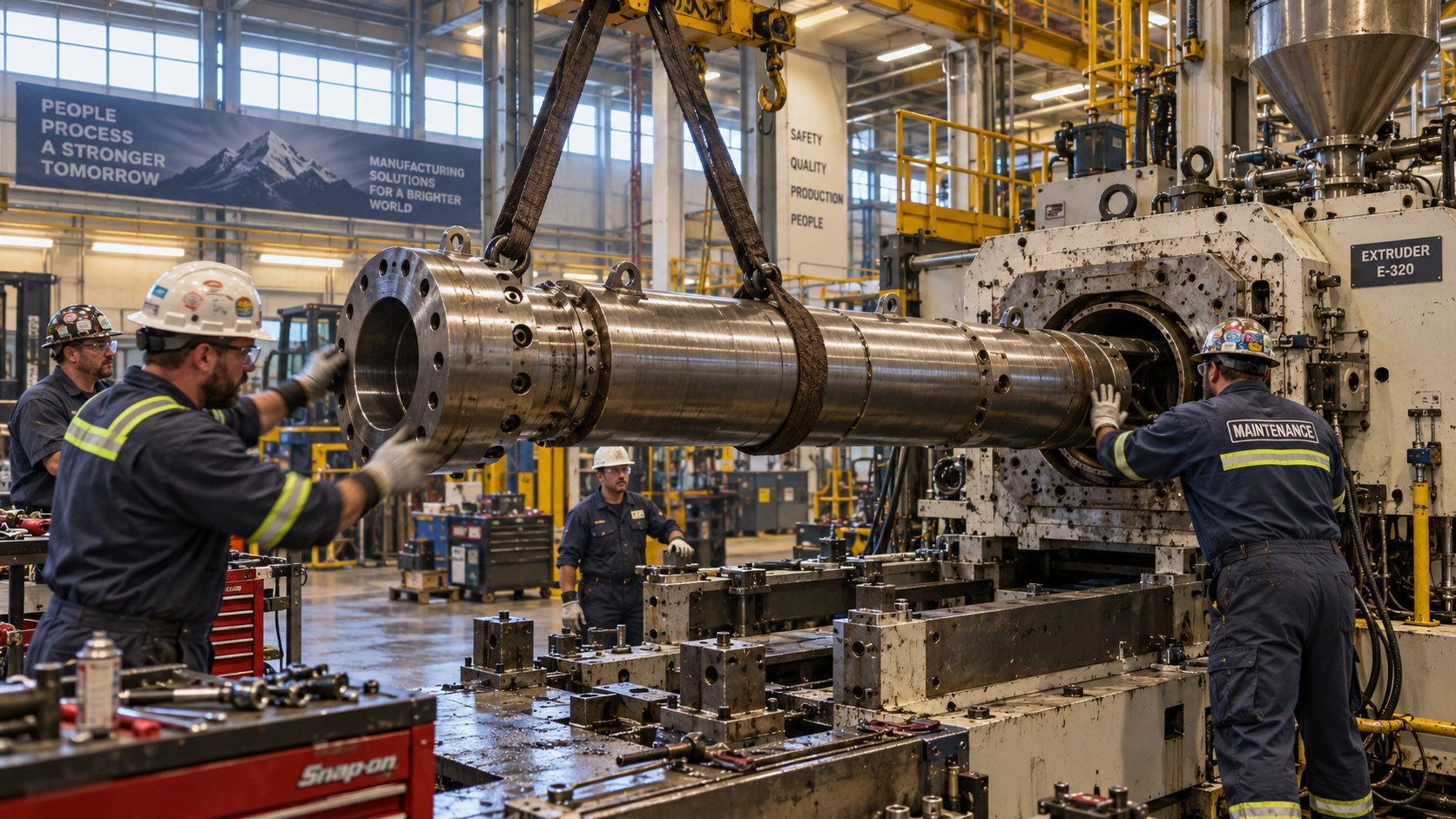
- Installation labor — pulling the old barrel, inspecting the machine bore, and mounting the replacement requires skilled maintenance technicians. On larger extruders, this can involve a multi-person crew, rigging equipment, and a full shift or more of labor.
- Barrel alignment verification — as Glycon Corp.'s Jeff Kuhman emphasizes, machines should be aligned whenever a barrel is installed. Misalignment is one of the leading causes of premature wear, yet alignment services add both cost and time to every barrel change.
- Heater bands and thermocouples — worn or damaged heating elements are frequently discovered during barrel replacement. Reusing degraded heaters on a new barrel is a false economy that risks uneven temperature profiles and shortened barrel life.
- Associated screw inspection or replacement — a new barrel installed over worn extruder screws will not deliver its rated performance. The screw-to-barrel clearance must fall within spec when new, meaning screw condition should be verified — and often a new or refurbished screw is purchased alongside the barrel.
- Commissioning and production ramp-up time — even after physical installation, dialing in process parameters on a new barrel can consume hours of machine time before production reaches full quality and rate targets.
Add these line items together and the true installed cost of a barrel commonly runs 25-60% above the bare component price. For imported barrels, the gap can be even wider. Any meaningful comparison between two supplier quotes must account for these surrounding costs — a $5,000 barrel that arrives ready to bolt in from a domestic supplier may genuinely cost less to deploy than a $3,500 barrel that requires $2,000 in freight, a week of transit delay, and alignment services your team did not budget for.
Barrel Lifespan and Replacement Economics
Every barrel begins wearing from the moment the screw starts turning. That is not opinion — it is physics. As industry research confirms, the minimal clearance between screw flight and barrel bore (typically 0.001 inch per side, per inch of nominal diameter) begins to open the instant material starts flowing. The harder and more abrasive the material, the faster that clearance grows.
Wear is measured in the simplest possible way: bore diameter increase. A new 3.5-inch barrel starts life with a bore of approximately 3.500 inches (plus a small manufacturing tolerance of about 0.001 inch oversize). Over time, abrasion, corrosion, or metal-to-metal contact enlarges that bore. Extrusion experts note that barrels with iron-based bimetallic liners typically last about three times the service life of a screw — a useful planning ratio, though the actual timeline depends heavily on application severity.
Here is where the economics get revealing. Wear does not announce itself with a sudden failure. It creeps in through incremental process adjustments that operators make without realizing the cumulative cost:
- Screw speed increases — as clearance opens, specific output rate (pounds per hour divided by screw speed) drops. To maintain throughput, operators increase RPM. Higher speeds mean more energy consumption and more shear heat.
- Discharge temperature rises — the growing gap between flight tip and barrel wall reduces the heat-transfer coefficient, pushing melt temperatures upward. For a 100 mm extruder running polyethylene, published data shows that worn clearances can increase discharge temperature by 10°C or more at constant rate — a shift that degrades material properties, increases cooling demands, and narrows the processing window.
- Throughput reduction — eventually, the discharge temperature climbs beyond what the downstream process can tolerate (blown film lines are particularly sensitive), forcing the operator to reduce rate. A 13% rate reduction on a sold-out line does not just cost output — it costs orders, customer relationships, and competitive positioning.
- Scrap rate escalation — dimensional inconsistency, poor melt homogeneity, and surface defects all increase as wear progresses. Each rejected unit carries the full cost of material, energy, and machine time with zero revenue to show for it.
These incremental penalties accumulate silently. A barrel that costs $8,000 but lasts 15,000 operating hours in a demanding application generates a cost of roughly $0.53 per hour of operation. A cheaper barrel at $5,000 that wears out in 6,000 hours costs $0.83 per hour — plus whatever downtime, scrap, and energy penalties accumulated during its faster decline. The barrel that looked more expensive on the purchase order was actually 36% cheaper per operating hour.
Downtime during barrel changes drives this disparity further. Even a well-planned barrel swap on a medium-sized extruder takes one to two full production days when you account for cool-down, disassembly, alignment, reassembly, heat-up, and process qualification. If your line generates $5,000 to $15,000 per day in product value — a common range for commercial extrusion operations — each additional barrel change represents real revenue that never comes back. A barrel lasting twice as long does not just save one replacement purchase; it eliminates one entire cycle of downtime, labor, alignment, and recommissioning.
Seasoned maintenance teams track this relationship deliberately. Best practice calls for charting operating parameters — screw speed, barrel zone setpoints, energy consumption, and scrap rate — against production hours so that the "point of diminishing returns" can be identified before it becomes an emergency. A spare screw and barrel should ideally sit in storage, ready to install during a scheduled window rather than during an unplanned crisis that shuts the line down while replacement parts are sourced on rush lead times.
The Price vs. Value Framework
So how do you objectively evaluate whether a lower-priced barrel is genuinely cheaper? Strip the emotion out of the decision and run it through four measurable dimensions.
1. Wear life per dollar. Divide the total installed cost (purchase price plus all deployment costs outlined above) by the expected operating hours before the barrel needs replacement or re-lining. This gives you a cost-per-hour figure that immediately normalizes barrels at different price points. A premium bimetallic barrel and a budget nitrided barrel are no longer "expensive" and "cheap" — they are $0.45/hour and $0.90/hour, or whatever the numbers actually reveal for your application.
2. Processing quality impact. A barrel maintaining tighter bore tolerances throughout its service life produces more dimensionally consistent product. That means lower scrap rates, fewer customer complaints, and less off-spec material that gets regrind-cycled back through the system. If your premium barrel holds bore tolerance for 12,000 hours while a cheaper alternative begins producing marginal product at 5,000 hours, the quality differential across those extra 7,000 hours represents real money — either in avoided scrap cost or in the ability to run tighter specifications for higher-value customers.
3. Energy efficiency. Worn barrels demand higher screw speeds, higher backpressure, and adjusted temperature profiles to compensate for lost melting efficiency. Each of those compensations consumes more energy. Industry cost models show that energy expenses for extrusion operations can reach $50,000 to $75,000 annually at typical production volumes. A barrel that maintains efficient heat transfer and tight clearance throughout a longer service life avoids the gradual energy penalty that accumulates as a cheaper barrel wears — a savings that does not appear on any barrel invoice but shows up clearly on your utility bills.
4. Downtime frequency. Every barrel replacement event carries fixed costs: labor, alignment, lost production hours, and recommissioning time. Fewer replacements over a given period mean fewer exposures to those fixed costs. If a premium barrel requires replacement once every three years instead of once every eighteen months, you have eliminated an entire downtime event — and all of its associated costs — from your operating budget in that window.
The cheapest barrel per unit purchased is rarely the cheapest barrel per unit of plastic processed. True barrel cost is measured in dollars per operating hour and dollars per pound of quality product — not in dollars per purchase order.
This framework does not always point toward the most expensive barrel. Sometimes the math genuinely favors the mid-range option — particularly for non-abrasive applications where even a standard nitrided barrel delivers years of reliable service. The point is not to always buy premium. The point is to always calculate total ownership cost before deciding, so that the procurement decision reflects production economics rather than invoice optics.
Applying this framework effectively, though, requires one thing many buyers skip: getting accurate, comparable quotes in the first place. And that process has its own set of pitfalls that can quietly undermine even the most disciplined cost analysis.
How to Request Quotes and Compare Extruder Barrel Suppliers
Every framework in this article — total cost of ownership, material matching, geographic evaluation — depends on one precondition: receiving accurate, comparable quotes from every extruder barrel supplier on your shortlist. That sounds obvious. In practice, it rarely happens. Incomplete requests for quotation produce incomplete responses, and incomplete responses make meaningful comparison impossible. A vague RFQ does not just waste time — it actively distorts the screw barrel price landscape, leaving you to compare numbers that represent different materials, different tolerances, and different scopes of supply.
The fix is straightforward: control what you send out, and you control what comes back.
What Information to Prepare Before Requesting Quotes
Think of your RFQ as the specification document that forces every supplier to quote the same barrel. Miss a detail, and each vendor fills the gap with their own assumptions — assumptions that show up as price discrepancies you cannot trace. As Sunwill's RFQ specification guide puts it, the quality of the quote you receive is capped by the quality of the specification you send.
Before contacting any supplier, prepare the following:
- Machine make and model — this is the single most efficient shortcut to accurate quoting. A supplier who knows you are running a specific 90 mm single screw extruder or a 65 mm parallel twin can immediately reference standard dimensions, flange patterns, and port configurations for that platform.
- Barrel bore diameter and overall length — if your machine data is unavailable, these two measurements define the barrel's physical envelope. Measure the existing barrel or pull the specs from your equipment manual.
- L/D ratio — this confirms the barrel length relative to bore size and determines how many heating zones and what temperature profile the barrel must accommodate.
- Material grade requirements — specify whether you need gas-nitrided, bimetallic (and which alloy tier), or specialty-lined extrusion barrels. If you are unsure, describe your resin and filler loading so the supplier can recommend an appropriate grade.
- Quantity needed — state both the immediate order quantity and your estimated annual demand. Even a rough forecast helps suppliers optimize pricing and plan pattern or tooling retention for repeat orders.
- Application details — what polymer are you processing? Does it contain glass fiber, mineral fillers, or corrosive additives? Is it virgin, regrind, or post-consumer recyclate? This context lets a competent supplier confirm your material grade selection or flag a mismatch before quoting.
- Required documentation — specify upfront whether you need hardness reports, metallurgical certificates, dimensional inspection data, or surface finish verification. Setting this expectation in the RFQ prevents surprises after the purchase order is placed.
An RFQ missing any of these items forces the supplier to guess — and as the Sunwill guide warns, assumptions are where cost and fit diverge. Two suppliers quoting different alloys because your RFQ said "bimetallic" without specifying which tier are not giving you competing prices. They are giving you unrelated numbers.
Navigating MOQs and Lead Times
Minimum order quantities shape per-unit pricing more than most buyers realize. A single replacement barrel absorbs the full cost of CNC setup, fixture changes, and quality inspection across one unit. Order three or five identical barrels — for spare inventory or multi-line operations — and those fixed costs spread across the batch, dropping the per-unit price noticeably. If you operate several extruders using the same barrel specification, ask every supplier for tiered pricing at one, three, and five units. The savings often justify carrying a spare.
Lead times vary significantly by supplier region and barrel complexity. Domestic manufacturers in the US or Europe can often deliver standard-diameter barrels within one to three weeks. Specialized or large-bore extrusion barrels requiring bimetallic casting may take four to six weeks regardless of geography. International suppliers — particularly Chinese manufacturers — typically quote seven to ten working days for standard production, but ocean freight adds three to five additional weeks for delivery. Air freight compresses transit to days but erodes cost savings rapidly.
The practical takeaway? Plan procurement around scheduled maintenance windows rather than emergency breakdowns. A buyer who orders a replacement barrel eight weeks before the planned shutdown has access to the widest supplier pool, the best pricing, and the lowest shipping costs. A buyer who orders after the barrel has already failed is paying rush premiums, expedited freight, and absorbing daily production losses while waiting — costs that dwarf any per-unit savings from careful supplier selection. For operations running a used twin screw extruder or aging equipment where barrel condition is uncertain, maintaining a measured spare eliminates the lead time risk entirely.
Evaluating Supplier Quotes Effectively
Quotes have arrived. The numbers look different. Before defaulting to the lowest figure, run every response through this verification checklist:
- Specification alignment — confirm that every quote references the exact same bore diameter, length, material grade, and tolerance class. A quote that omits the alloy specification or lists a different L/D ratio is not comparable to one that matches your RFQ precisely.
- Scope of supply — verify what is included beyond the raw barrel. Does the quoted price cover heat treatment, surface finishing, and final grinding? Are hardness testing and dimensional inspection reports included, or do they cost extra? Some suppliers bundle these into the unit price; others list them as add-on services that inflate the final cost.
- Shipping terms — clarify whether the quote is EXW (ex-works, you pay all freight), FOB (free on board, freight from port is yours), or delivered. Two quotes at seemingly similar prices can diverge by thousands of dollars once shipping, insurance, and import duties are factored in.
- Warranty terms — what does the supplier guarantee, and for how long? A warranty covering material defects and dimensional conformance for twelve months is industry standard. Anything less — or anything vaguely worded — should prompt follow-up questions before you commit.
- Technical responsiveness — pay attention to how the supplier engaged with your RFQ. Did they ask clarifying questions about your application? Did they confirm or challenge your material selection based on your resin data? A vendor who returns a price without any technical dialogue is treating your precision component like a commodity — and that approach tends to produce commodity-level results.
Factory-direct manufacturers like NANHAIYA can streamline this process for custom and replacement screw barrels by working directly with processors and maintenance teams. Their model eliminates intermediary markups and provides transparent pricing for both extrusion and injection molding applications — including the documentation and engineering consultation that make quotes genuinely comparable. This is one sourcing strategy among several worth exploring, particularly for buyers who want direct access to the manufacturing team behind their components rather than routing specifications through trading companies or regional distributors.
Ultimately, the goal is not to find the lowest number on the page. It is to find the lowest verified cost for a barrel that matches your specifications, includes the documentation you need, and arrives within the timeframe your production schedule demands. That discipline — applied consistently across every sourcing cycle — is what separates procurement teams who secure reliable barrel value from those who simply chase the cheapest quote and absorb the consequences later.
Smart Barrel Buying Principles for Every Budget
Eight chapters of pricing logic, material science, and procurement strategy boil down to one uncomfortable truth: most barrel purchases are made on incomplete information. Not because buyers are careless, but because the industry has never organized this knowledge in one place — until now. Whether your annual barrel spend is $2,000 or $200,000, the principles that separate a smart purchase from an expensive regret are the same. Here is the decision-making framework that ties everything together.
Matching Your Budget to Your Barrel Needs
You do not need to memorize alloy grades or machining tolerance standards to buy barrels well. You need a repeatable process that forces the right questions before money changes hands. Every topic covered in this article — from material composition and geographic pricing dynamics to total cost of ownership and RFQ discipline — distills into a set of actionable principles you can apply starting with your next purchase order.
- Match barrel metallurgy to your actual application. Let your resin, filler loading, and processing chemistry — not a supplier's upsell or your own instinct to "buy the best" — determine whether you need a nitrided, bimetallic, or specialty-lined plastic extrusion barrel. Over-specifying wastes capital. Under-specifying wastes everything else.
- Calculate total cost of ownership, not just purchase price. Freight, installation labor, alignment services, heater bands, commissioning time, and associated screw inspection all add 25-60% or more to the invoice price. A barrel that looks affordable on a purchase order can quietly become the most expensive option once deployed.
- Verify quality documentation regardless of supplier geography. Metallurgical certificates, bore straightness data, hardness reports, and surface finish verification are the equalizers that let you objectively compare a barrel from Zhoushan against one from Stuttgart. A supplier who resists providing these documents is not worth the risk — no matter how attractive the quoted price.
- Never compare quotes without matching specifications. Two prices for "a 90 mm bimetallic barrel" mean nothing if one references a nickel-based liner at tight tolerances and the other references an iron-based liner at standard tolerances. Specification alignment is the non-negotiable first step of any meaningful price comparison.
- Evaluate extruder barrel cost on a per-operating-hour basis. Divide total installed cost by expected service life in hours. This single metric instantly reveals whether the premium barrel or the budget barrel is actually cheaper for your operation. The answer may surprise you — and it changes depending on your application severity.
- Plan procurement proactively, not reactively. Ordering a replacement barrel eight weeks before a scheduled maintenance window gives you access to the best pricing, widest supplier selection, and lowest freight costs. Ordering after a failure gives you rush premiums, expedited shipping fees, and daily production losses. Maintaining a measured spare eliminates the risk entirely.
- Consider the full sourcing spectrum. OEM barrels make sense for warranty-protected or proprietary equipment. Aftermarket replacements deliver equivalent performance at 20-40% savings when documentation is verified. Refurbished barrels can cut costs by 25-50% for large or complex units with sound bodies. Most plants benefit from a blended strategy rather than a single-source approach.
Building a Reliable Barrel Supply Strategy
Buying a barrel is a transaction. Building a barrel supply strategy is a competitive advantage. The difference lies in the relationship behind the purchase order.
A screw and barrel manufacturer who understands your specific applications — the resins you run, the fillers you compound, the tolerances your products demand — can do more than fill an order. They can flag material mismatches before they become premature failures, recommend alloy upgrades only when wear data justifies them, and maintain dimensional records for your equipment that streamline future replacements. That kind of ongoing technical partnership reduces your total procurement effort, shortens your quoting cycle, and consistently steers you toward the right barrel at the right price point.
Look for manufacturers who offer both custom-engineered and standard replacement barrels across single screw, twin screw, and injection molding configurations. Breadth of capability signals manufacturing depth — a supplier who can build a 25 mm lab-scale barrel and a 180 mm production barrel on the same shop floor typically maintains the equipment, alloy inventory, and process knowledge to handle your needs as they evolve.
Factory-direct suppliers like NANHAIYA exemplify the kind of direct-manufacturer relationship that can deliver competitive barrel pricing paired with application-specific guidance. By working directly with plastic processors, equipment builders, and maintenance teams — without trading company intermediaries inflating the cost chain — this model provides transparent pricing for both custom and replacement screw barrels across extrusion and injection molding platforms. It is one proven approach among several that informed buyers should evaluate when building their supply network.
The manufacturers worth keeping on your shortlist are the ones who treat your barrel specification as a technical conversation, not just a line item. They ask about your process before quoting a price. They provide documentation without being chased. And they stand behind the barrel after it ships — because their reputation depends on how that steel performs on your production floor, not just on how it looked on the invoice.
Informed buyers who understand cost drivers, compare on equal specifications, and evaluate total ownership cost consistently secure better barrel value — regardless of budget level. The extruder barrel price you pay matters far less than the extruder barrel value you receive.
Frequently Asked Questions About Extruder Barrel Pricing
1. How much does an extruder barrel cost?
Extruder barrel prices range from under $1,000 for small-diameter, gas-nitrided single screw barrels to over $30,000 per section for large-bore, bimetallic or tungsten carbide-lined parallel twin screw barrels. The wide spread reflects differences in bore diameter, overall length, alloy composition, machining tolerances, and intended application rather than simple quality variation. To get an accurate price, buyers should provide detailed specifications — including machine make and model, bore diameter, L/D ratio, material grade, and resin type — so that every supplier quotes the same product. Factory-direct manufacturers like NANHAIYA (nhyscrews.com/products) can provide transparent pricing for both custom and replacement screw barrels across extrusion and injection molding platforms, eliminating intermediary markups.
2. What is the difference between a nitrided barrel and a bimetallic barrel?
A nitrided barrel is made from a single steel billet with the bore surface hardened through nitrogen diffusion, creating a thin wear-resistant layer typically 0.007 to 0.015 inches deep. It is the most affordable option and works well for processing non-abrasive, unfilled resins like HDPE and PP. A bimetallic barrel, by contrast, features a centrifugally cast alloy liner metallurgically bonded to the bore wall, approximately 1/16 inch thick. This liner — available in iron-based, nickel-based, or cobalt-based alloy tiers — delivers substantially greater abrasion and corrosion resistance. Bimetallic barrels cost more upfront but often deliver lower total cost per operating hour in demanding applications involving glass-filled engineering plastics, PVC compounds, or recycled materials with contaminants.
3. Should I buy OEM or aftermarket replacement extruder barrels?
OEM barrels guarantee dimensional compatibility and preserve machine warranties but typically cost 30-50% more than aftermarket equivalents. Aftermarket replacement barrels manufactured to OEM specifications can deliver identical performance at 20-40% savings, provided you verify dimensional accuracy, material certifications, hardness reports, and fitment guarantees. The best choice depends on your situation: OEM makes sense for warranty-protected machines, proprietary designs, or regulated industries requiring full traceability. Aftermarket excels for standard replacements on well-documented machine platforms. Many plants use a blended strategy — OEM for critical lines and verified aftermarket for standard production equipment — to balance cost and risk effectively.
4. Why are Chinese extruder barrels cheaper than European or American ones?
Chinese barrel manufacturers benefit from lower labor costs, deeply integrated domestic supply chains for raw steel and alloy materials, and high production volumes that drive economies of scale. These structural advantages allow pricing 40-60% below European OEMs for equivalent specifications. However, buyers must account for trade-offs including ocean freight costs, extended transit times, import duties, communication barriers, and quality verification challenges from a distance. The key equalizer is documentation: metallurgical certifications, hardness testing reports, bore straightness measurements, and surface finish data let buyers objectively compare any supplier regardless of geography. A Chinese barrel backed by comprehensive, verifiable quality documents can represent excellent value.
5. How do I calculate the true cost of an extruder barrel?
The true cost extends well beyond the invoice price. Add shipping and import duties, installation labor, barrel alignment services, replacement heater bands and thermocouples, associated screw inspection or replacement, and commissioning time — these surrounding costs typically add 25-60% above the component price. Then calculate the cost per operating hour by dividing total installed cost by expected service life in hours. A $8,000 barrel lasting 15,000 hours costs roughly $0.53 per hour, while a $5,000 barrel lasting only 6,000 hours costs $0.83 per hour — plus accumulated penalties from higher scrap rates, increased energy consumption, and additional downtime events. Evaluating barrels on a per-operating-hour basis consistently reveals that the cheapest purchase price rarely equals the cheapest total ownership cost.
Written by
Nanhaiya Technical Team
Zhoushan Nanhaiya Plastic Machinery Co., Ltd.
The Nanhaiya technical team supports screw and barrel manufacturing projects through application review, technical communication, custom manufacturing coordination, and production and quality control.
Discuss Your Application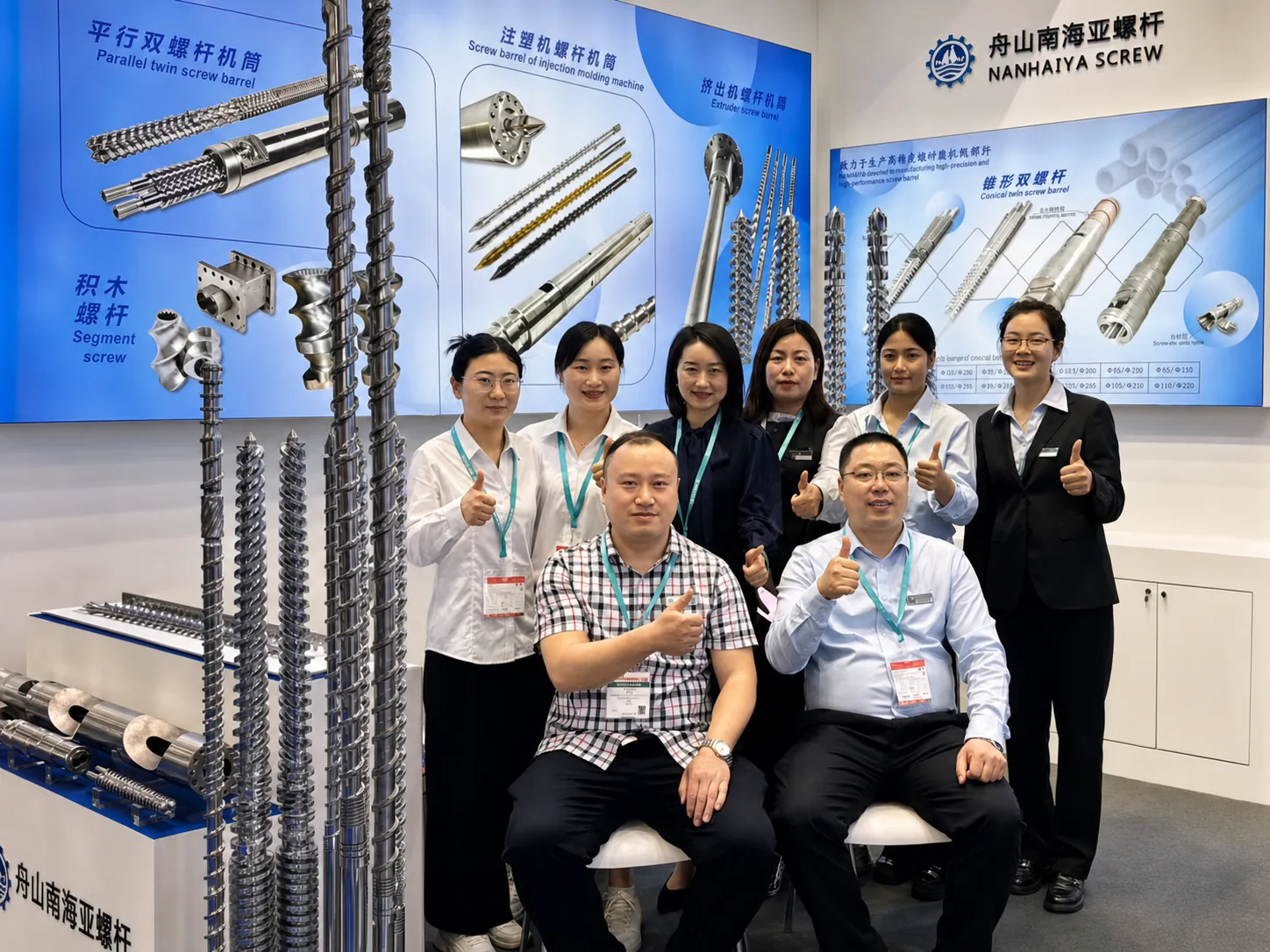
Related Articles
More insights on screw barrel technology and plastics processing.
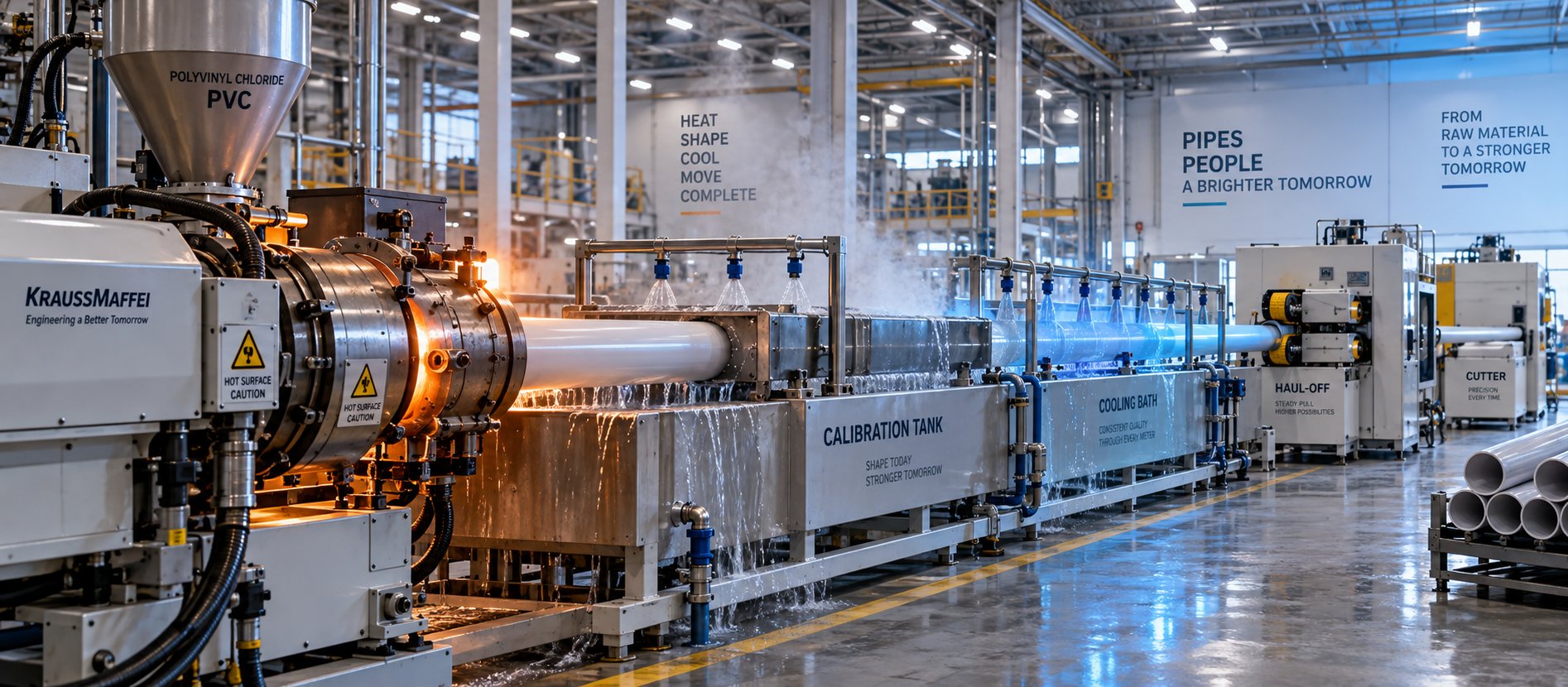
PVC Pipe Making Machine: What No Supplier Will Tell You First
Oct 21, 2026
Learn what a PVC pipe making machine really includes, how each component works, extruder types compared, maintenance schedules, defect fixes, and buying tips.
Read Article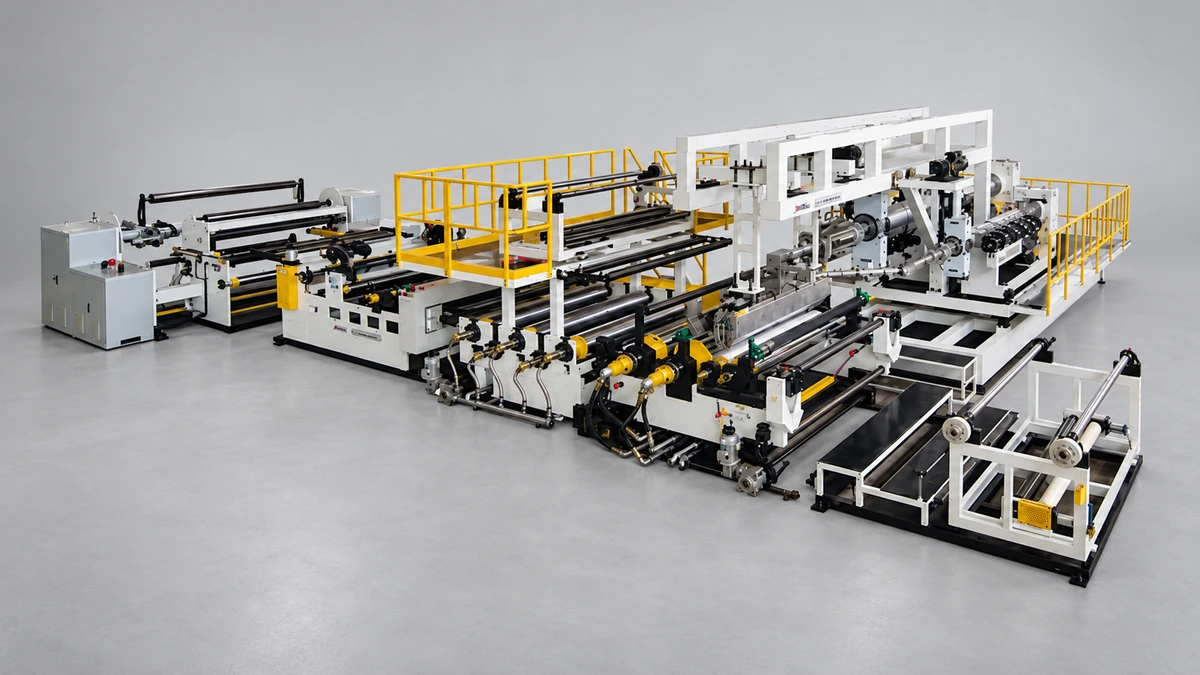
What Your Film Extrusion Machine Datasheet Won't Tell You
Oct 20, 2026
Film extrusion machine guide covering blown vs cast processes, multilayer configurations, screw specs, resin selection, and supplier evaluation for production engineers.
Read Article
Raw Scrap to Perfect Pellets: Plastic Pelletizing Machine Guide
Oct 19, 2026
Learn how a plastic pelletizing machine converts scrap into uniform pellets. Covers cutting methods, extruder types, quality control, costs, and maintenance.
Read ArticleLooking for something else?
Search by material, symptom or product and jump straight to the relevant page.
These are navigation suggestions based on keyword matching — not a quotation, not a delivery commitment, and not a substitute for engineering review. Final specification is confirmed by our engineers against your drawings and processed material.
Need help with screw barrel selection?
Share your machine model, processed material and application. Our team can help with pricing and technical support.