

What Is an Extruder Barrel and Why It Matters for PVC
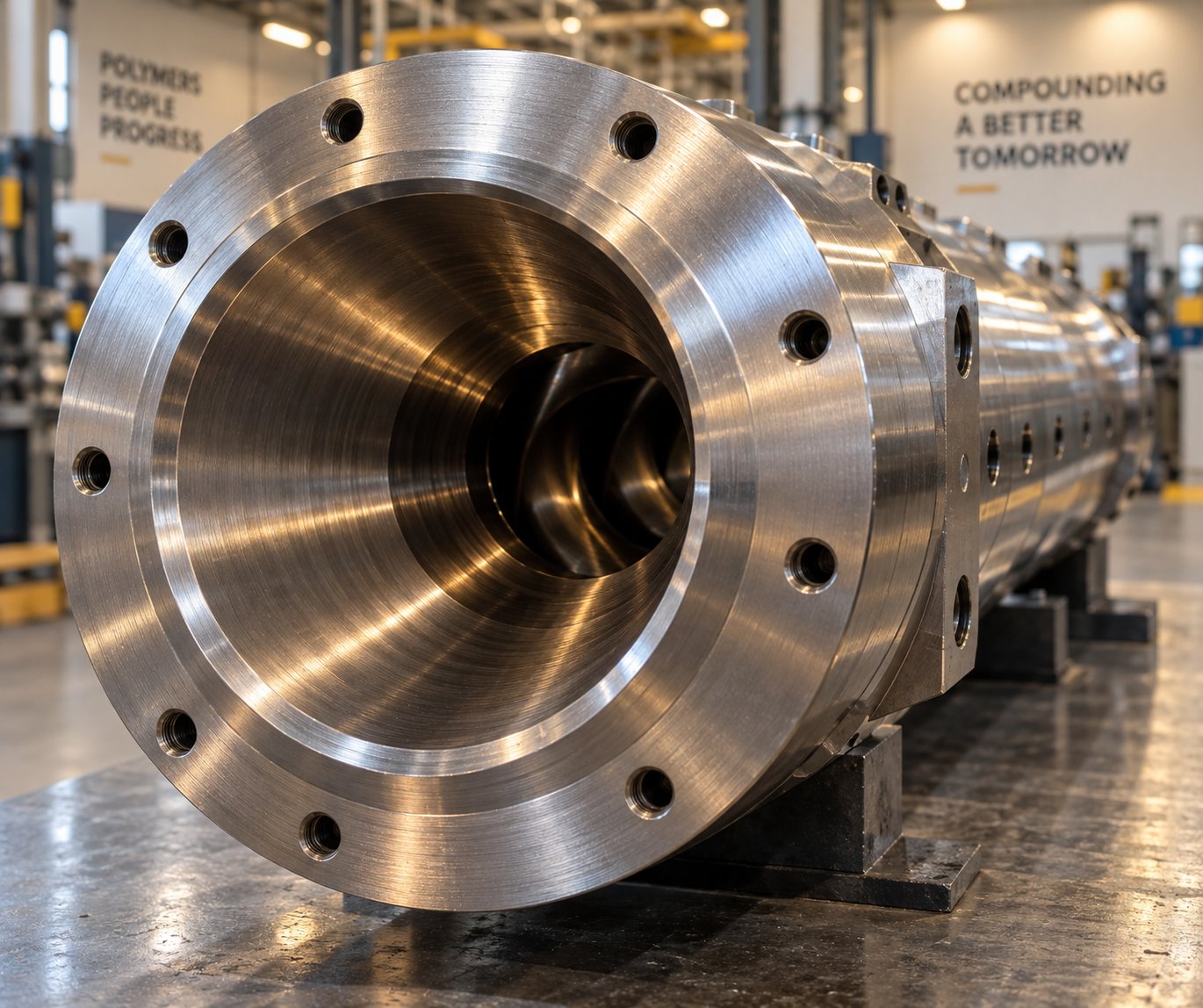
Every PVC pipe, window profile, and cable jacket starts the same way — as dry powder or pellets fed into a heated steel cylinder. That cylinder is the extruder barrel, and it determines whether your PVC comes out as a flawless product or a degraded mess.
What an Extruder Barrel Actually Does
An extruder barrel is the cylindrical pressure vessel that houses the rotating screw, providing the controlled thermal environment where raw polymer is conveyed, compressed, melted, and metered into a homogeneous melt ready for shaping through a die.
Think of the barrel in extruder systems as the stage where all the action happens. Raw PVC compound — typically a dry-blend powder for rigid applications — enters through the extruder feed barrel section and immediately encounters rising temperatures and increasing pressure. As the screw rotates, frictional heat and external barrel heaters work together to transform that loose powder into a dense, uniform melt. The barrel and screw of an extruder function as a tightly coordinated pair: the screw provides the mechanical force, while the barrel supplies the thermal control and structural containment that make plasticizing possible.
Without precise barrel performance, the melt arriving at the die fluctuates in temperature, pressure, and viscosity — and every one of those fluctuations shows up in the finished product as dimensional inconsistency or surface defects.
Why PVC Barrels Deserve Their Own Discussion
Here is the reality most barrel extruder guides gloss over: PVC is not just another thermoplastic. It releases corrosive hydrochloric acid gas when it overheats. Its processing temperature sits dangerously close to its decomposition temperature. And the calcium carbonate, titanium dioxide, and other fillers blended into most PVC formulations act like sandpaper on bore surfaces.
These three factors — corrosion, thermal sensitivity, and abrasive wear — make extruder barrels used for PVC fail faster than those running polyethylene, polypropylene, or ABS under comparable conditions. Every decision covered in this article, from metallurgy and barrel geometry to temperature zoning and maintenance routines, traces directly back to these PVC-specific demands. Understanding them is the difference between replacing your barrel on schedule and replacing it ahead of time at significant cost.
So what exactly makes PVC so destructive from a material science standpoint? The answer starts with a dangerously narrow processing window.
Why PVC Is Uniquely Challenging for Extruder Barrels
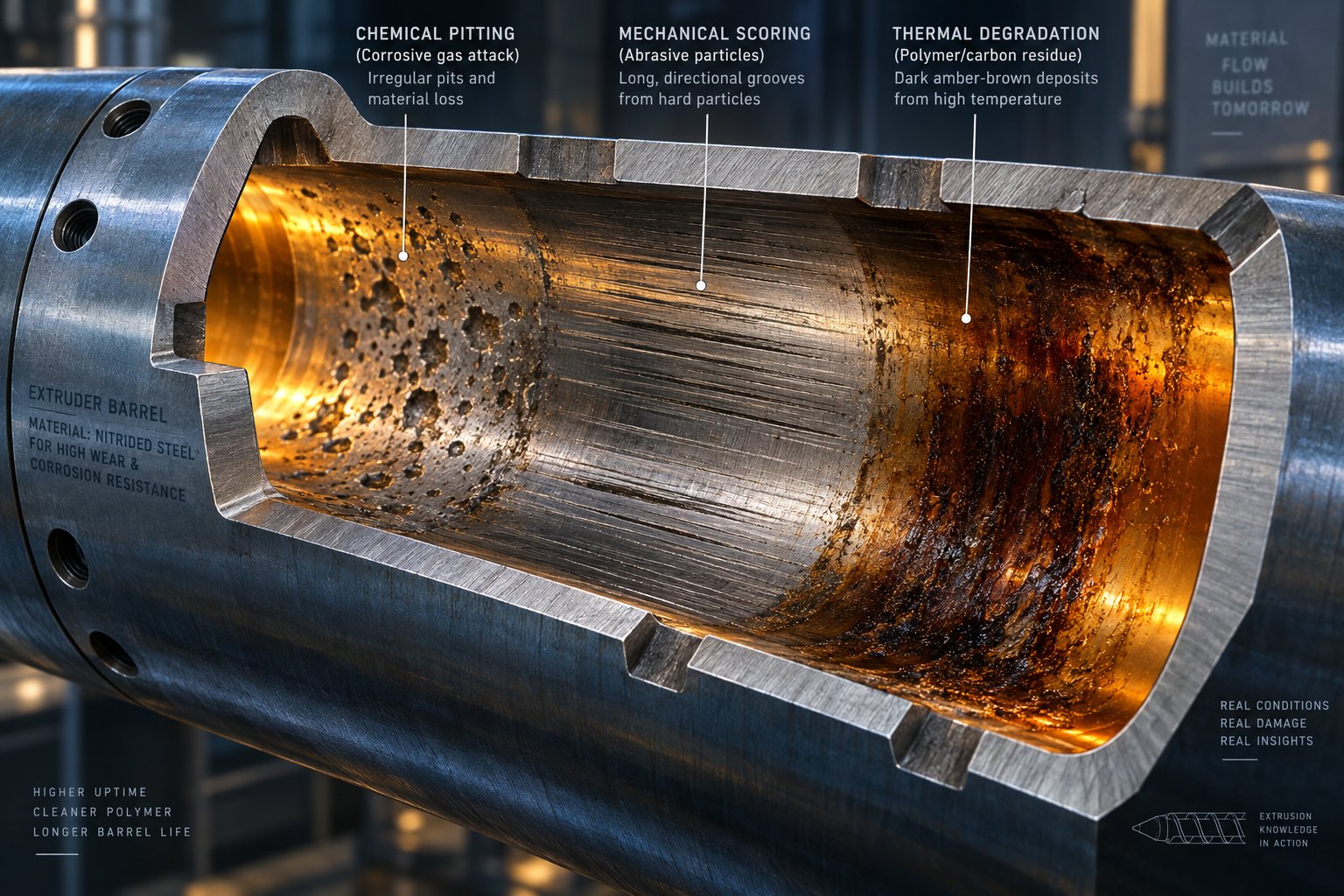
Most thermoplastics are relatively forgiving. Polyethylene and polypropylene offer wide processing windows, generate no corrosive byproducts, and rarely contain highly abrasive fillers. PVC breaks every one of those rules. It attacks the barrel of extruder systems through three simultaneous mechanisms — thermal degradation, chemical corrosion, and mechanical abrasion — and each mechanism amplifies the others. Understanding this trifecta is essential before evaluating any plastic extruder barrel specification, because the wrong extruder barrel material choice in a PVC application does not just shorten service life. It can destroy output quality within weeks.
Thermal Sensitivity and the Narrow Processing Window
Imagine trying to cook something that burns at a temperature only slightly above the heat needed to make it edible. That is essentially what happens inside every PVC extrusion barrel. PVC's useful processing range typically sits between 160 degrees C and 200 degrees C for rigid formulations, yet thermal decomposition begins around 210 degrees C to 220 degrees C. That leaves a window of roughly 10 to 20 degrees before things go wrong — far narrower than polyethylene, which tolerates processing temperatures well below its degradation threshold.
This tight window puts enormous responsibility on barrel design. Any localized hot spot along the bore — caused by a malfunctioning heater band, poor cooling capacity, or excessive shear heat from the extruder barrel and screw interaction — can push the PVC compound past its degradation threshold even while the average barrel temperature reads safe. Thermogravimetric studies confirm that PVC's primary thermal decomposition stage begins in the range of 540 to 620 K (approximately 267 to 347 degrees C), with dehydrochlorination as the dominant reaction. In practical extrusion, localized temperatures creeping even partway toward this range trigger the cascade of problems described next.
HCl Gas Release and Corrosive Attack on Barrel Walls
When PVC overheats, it does not simply melt unevenly or discolor. It undergoes a chemical reaction called dehydrochlorination — the polymer chain strips away hydrogen and chlorine atoms, releasing hydrochloric acid (HCl) gas directly inside the barrel bore. Research on PVC thermal degradation shows that nearly all chlorine content is liberated from the PVC structure once temperatures exceed critical thresholds, and PVC's molecular composition is roughly 57% chlorine by weight. That is an enormous reservoir of corrosive material waiting to be released if processing conditions slip.
HCl gas is aggressively corrosive to steel. Once released inside the barrel, it attacks the bore surface chemically, creating pitting and gradually enlarging the clearance between screw flight tips and the barrel wall. This corrosion is not uniform — it concentrates wherever the PVC melt temperature is highest, meaning compression and metering zones often suffer the worst damage. Over time, the pitted bore surface traps degraded PVC, creating new hot spots that generate more HCl, which causes more corrosion. It becomes a self-accelerating cycle, and it is the primary reason every plastic extruder barrel intended for PVC requires corrosion-resistant metallurgy that would be overkill for polyolefins.
Abrasive Fillers in PVC Compounds
Corrosion alone would be damaging enough. But most commercial PVC formulations are not pure resin — they contain mineral fillers and pigments that cause mechanical wear on top of the chemical attack. These additives are essential for achieving target properties like stiffness, opacity, UV resistance, and cost reduction, but they behave like fine abrasives grinding against the bore surface with every screw rotation.
Common PVC fillers and their relative abrasiveness include:
- Calcium carbonate (CaCO3) — The most widely used PVC filler, added at loadings up to 40% or more in pipe and profile compounds. Moderate abrasiveness, but high loading levels multiply the cumulative wear effect.
- Titanium dioxide (TiO2) — Used as a white pigment and UV stabilizer. Harder than CaCO3, so even at lower loading levels (typically 2 to 10 phr), it contributes meaningful abrasive wear.
- Glass fibers — Found in certain reinforced PVC formulations. Highly abrasive, capable of scoring the barrel bore rapidly, especially in feeding and shearing zones where sharp particles form during fiber breakup.
- Kaolin and talc — Occasionally used in specialty PVC compounds. Lower hardness than TiO2 but still contribute to long-term wear accumulation.
The critical point is that abrasive wear and corrosive wear do not simply add together — they compound each other. Corrosion roughens the bore surface, creating microscopic irregularities that trap abrasive particles and accelerate mechanical scoring. Simultaneously, abrasive wear strips away the protective nitrided or alloyed surface layer, exposing fresh base metal to HCl attack. This synergistic destruction is why a barrel processing heavily filled PVC can wear out several times faster than the same barrel running unfilled polypropylene at comparable throughput.
With these three failure mechanisms working in concert, the question shifts from whether your barrel will wear, to how quickly — and that timeline depends heavily on the barrel configuration you choose for your specific PVC application.
Single Screw vs Twin Screw Barrel Configurations for PVC
The speed at which PVC destroys a barrel depends not only on metallurgy and formulation — it depends on the barrel configuration itself. A single screw extruder barrel handles PVC very differently than a twin screw extruder barrel, and choosing the wrong configuration for your product type accelerates every failure mechanism discussed above. Yet surprisingly few guides spell out which barrel geometry fits which PVC application, and why.
Single Screw Extruder Barrels for PVC
Single-screw systems are the simplest extruder platform: one rotating screw inside one cylindrical barrel. For PVC, they still see use in less demanding applications — flexible cable sheathing, certain films, and some garden hose production — where the compound is pre-plasticized or heavily plasticized with liquid additives that reduce viscosity and shear sensitivity.
The limitation? A single screw extruder barrel relies heavily on frictional drag against the bore wall to convey material forward. With rigid PVC dry-blend, this creates two problems. First, mixing is relatively poor compared to intermeshing twin screw designs, which means inconsistent melt homogeneity. Second, achieving adequate plasticizing in a single-screw barrel often requires higher screw speeds or longer residence times — both of which increase shear heat generation in a polymer that simply cannot tolerate it. For rigid PVC pipe, profiles, or board, processors overwhelmingly turn to twin screw extruder barrels for better control.
Parallel Twin Screw Extruder Barrels
Parallel twin screw systems use two screws of equal diameter running side by side inside a segmented barrel. The barrel of twin screw extruder systems in this configuration is typically modular — built from individual barrel segments that can be rearranged, replaced, or reconfigured to optimize the processing sequence for different compounds.
This modularity makes parallel twin screw extruder barrels popular for PVC compounding operations, where the goal is to blend PVC resin with stabilizers, plasticizers, fillers, and pigments into a uniform pelletized compound. Some profile extrusion lines also use parallel configurations, particularly counter-rotating designs. The trade-off is that parallel twin screw systems are generally more complex to maintain and carry a higher initial cost than conical alternatives, which matters for production environments focused on a single PVC product family.
Conical Twin Screw Barrels for PVC Extrusion
When you look at rigid PVC pipe plants, window profile lines, sheet extrusion systems, and board production facilities worldwide, one configuration dominates: the conical twin screw barrel. There is a clear engineering reason for this preference.
A conical extruder twin screw barrel tapers from a larger diameter at the feed inlet to a smaller diameter at the discharge end. This geometry creates a natural compression gradient — the wide opening provides high volumetric feeding capacity for low-bulk-density PVC dry-blend, while the progressively narrowing bore generates controlled, gradual compression. For a heat-sensitive polymer like PVC, this gentle compression is critical. It avoids the sharp shear spikes that occur in constant-diameter barrels, keeping the melt temperature within that dangerously narrow safe window.
Manufacturers like NANHAIYA build purpose-designed conical twin screw barrels specifically for PVC pipe, profile, board, and WPC extrusion. Their barrels are engineered to deliver stable plasticizing performance across the tapered geometry — precisely the kind of application-specific design that rigid PVC processing demands. This twin screw barrel extruder approach also benefits from lower screw speeds relative to parallel configurations, which further reduces shear heat input into the PVC melt.
| Criteria | Conical Twin Screw (e.g., NANHAIYA) | Parallel Twin Screw | Single Screw |
|---|---|---|---|
| Typical PVC Applications | Rigid pipe, window profiles, PVC board, foam board, WPC | PVC compounding, some profile extrusion | Flexible cable sheathing, film, garden hose |
| Shear Characteristics | Low and controlled — ideal for heat-sensitive PVC | Moderate — adjustable via screw element configuration | Higher — relies on frictional drag, harder to control |
| Mixing Capability | Good distributive mixing for pre-formulated dry-blends | Excellent — best for compounding with multiple additives | Limited — less effective homogenization |
| Throughput Capacity | High feed intake due to large inlet diameter | High — suited for continuous compounding operations | Moderate — constrained by single-channel conveying |
| Barrel Complexity | One-piece tapered barrel, straightforward maintenance | Modular segmented barrel, more components to manage | Simple cylindrical barrel, lowest maintenance |
The pattern is straightforward: simpler PVC products with plasticized formulations can run on single-screw systems. Compounding operations benefit from parallel twin barrel extruder flexibility. But for the vast majority of rigid PVC extrusion — the pipes, profiles, and boards that make up the bulk of global PVC production — conical twin screw barrels offer the best balance of gentle processing, high throughput, and manageable maintenance.
Choosing the right barrel configuration is only half the equation, though. The material that barrel is made from determines how long it survives PVC's corrosive and abrasive assault — and that decision deserves equally careful attention.
Barrel Materials and Metallurgy for PVC Processing
A perfectly designed barrel geometry means nothing if the bore surface cannot survive the chemistry happening inside it. PVC's combination of HCl corrosion and abrasive filler wear puts barrel metallurgy at the center of every purchasing decision — and getting it wrong costs far more than the price difference between material options. The right extruder screw and barrel material for your PVC application depends on exactly what your compound is doing to the bore surface, hour after hour.
Nitrided Steel Barrels for PVC
If you have researched any plastic extruder screw barrel specification for PVC, you have almost certainly seen the designation 38CrMoAla (also written as 38CrMoAl). Most sources simply name this alloy and move on. Here is what actually matters about it.
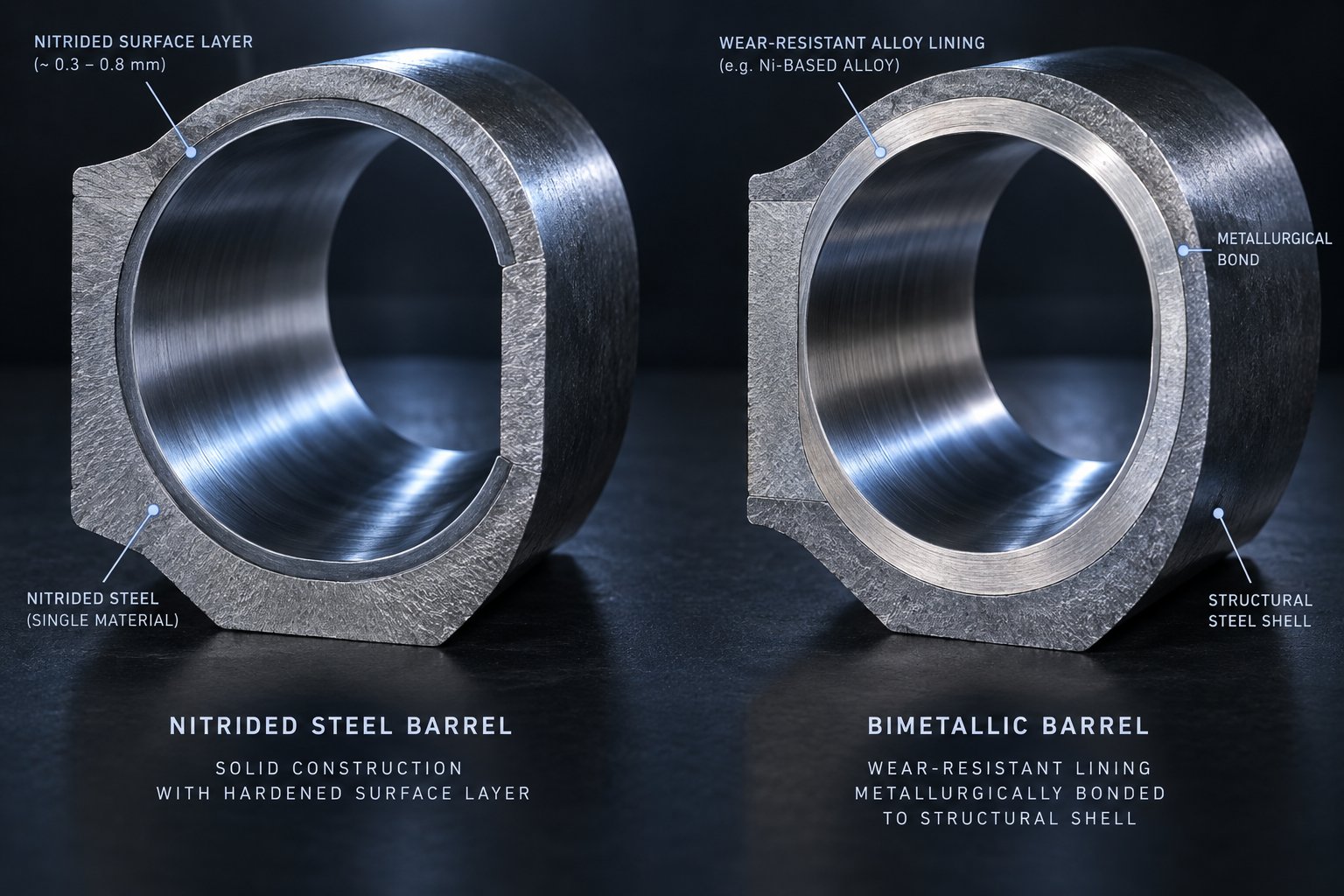
38CrMoAla is a chromium-molybdenum-aluminum alloy steel specifically designed to respond well to gas nitriding — a thermochemical surface hardening process. During nitriding, the barrel is exposed to nitrogen-rich gas at elevated temperatures over an extended cycle. The aluminum content in the alloy promotes the formation of an exceptionally hard nitride layer on the bore surface. The result is a surface hardness typically reaching HV 900 to 1,100, with a case depth generally in the range of 0.4 to 0.7 mm.
What does that mean in practice? The nitrided bore resists abrasive wear from moderate CaCO3 filler loadings and provides reasonable resistance to HCl corrosion — enough for standard rigid PVC pipe and profile compounds that are well-stabilized and run within proper temperature limits. Equally important, nitrided 38CrMoAla barrels are cost-effective. For processors running typical PVC dry-blend formulations without extreme filler levels, this remains the default screw barrel for extruder applications and delivers a solid balance of performance and economy.
The limitation appears when conditions push beyond "standard." Very high CaCO3 loadings (above 30 to 40%), poorly stabilized formulations that release more HCl, or continuous high-output production that generates excessive shear heat — all of these can overwhelm a nitrided surface faster than the return on investment allows. That is where bimetallic technology enters the picture.
Bimetallic Barrel Linings
Imagine building a barrel with two layers, each doing a different job. The outer shell is a high-strength structural steel — it handles mechanical loads, supports heating and cooling elements, and bolts into the extruder frame. The inner bore, where all the corrosive and abrasive action takes place, is lined with a completely different alloy engineered specifically to resist those attacks. That is the bimetallic extruder barrel concept.
The inner lining is applied through centrifugal casting — the barrel is rotated at high speed while molten alloy is poured inside, creating a dense, uniformly bonded liner typically 1.5 to 3.0 mm thick. This metallurgical bond ensures the lining does not delaminate under the thermal cycling and mechanical stress of continuous extrusion.
For PVC processing, the choice of lining alloy splits into two main families:
- Nickel-based alloys — These prioritize corrosion resistance. Alloys in the nickel-chromium-boron family form the standard bimetallic lining for PVC because they withstand HCl attack far better than nitrided steel. If your primary barrel failure mode is corrosion pitting — common in rigid PVC extrusion with standard filler levels — a nickel-based bimetallic lining is typically the right upgrade.
- Cobalt-based alloys — These emphasize abrasion resistance. When your PVC compound contains very high mineral filler loadings, glass fiber reinforcement, or other hard particulates, the mechanical scoring of the bore becomes the dominant failure mode. Cobalt-based linings offer superior hardness and wear resistance, though they provide somewhat less corrosion protection than nickel-based alternatives.
The cost of a bimetallic barrel is higher than a standard nitrided barrel — sometimes significantly so. But the economics often favor the upgrade. A bimetallic extruder barrel that lasts two to three times longer than a nitrided barrel reduces not only replacement part costs, but also the accumulated downtime, lost production, and quality drift associated with progressive bore wear. Industry data from high-filler PVC extrusion environments suggests service life expectations of 1 to 5 years depending on the application, filler content, and operating discipline — and bimetallic barrels consistently land on the longer end of that range.
Selecting Barrel Material Based on PVC Formulation
Here is the decision framework that most barrel guides fail to provide: your barrel metallurgy should be matched to the specific PVC compound you are processing, not selected as a one-size-fits-all default. A barrel running unfilled flexible PVC faces a completely different wear profile than one processing rigid PVC pipe compound loaded with 35% CaCO3.
The table below maps the three primary barrel material options against the performance criteria that matter most for PVC extrusion:
| Criteria | Nitrided Steel (38CrMoAla) | Nickel-Based Bimetallic | Cobalt-Based Bimetallic |
|---|---|---|---|
| Corrosion Resistance (HCl) | Moderate — adequate for well-stabilized compounds | High — best protection against HCl attack | Moderate to good — secondary to wear resistance |
| Abrasion Resistance | Good for low to moderate filler loadings | Moderate to good — sufficient for standard fillers | Excellent — designed for high-filler and reinforced compounds |
| Thermal Conductivity | Good — uniform heat transfer through solid steel wall | Slightly reduced — alloy liner has different conductivity than base steel | Slightly reduced — similar to nickel-based linings |
| Relative Cost | Lowest — standard option for most PVC lines | Moderate — higher initial cost offset by longer life | Highest — justified for extreme wear environments |
| Best-Fit PVC Applications | Standard rigid pipe, profiles with moderate CaCO3, flexible PVC | Rigid PVC with standard to high filler, lines with history of corrosion-driven failure | High-CaCO3 pipe and board, glass-fiber reinforced PVC, WPC co-extrusion |
A practical decision path looks like this: start with nitrided 38CrMoAla as the baseline. If your bore inspection data shows corrosion pitting as the dominant wear pattern, upgrade to a nickel-based bimetallic lining. If you see heavy mechanical scoring — particularly in the feed and compression zones — a cobalt-based lining is the stronger choice. And if your PVC formulation delivers both aggressive HCl and high abrasive filler content simultaneously, some manufacturers offer hybrid linings or dual-layer approaches, though these add further cost and complexity.
The key takeaway? Barrel material is not a spec you copy from a catalogue. It is a decision driven by your specific formulation, your throughput targets, and the wear data from your own production line. Getting this right extends barrel life, stabilizes product quality, and reduces the total cost of ownership for every plastic extruder screw barrel set on your floor.
Material selection sets the barrel's resistance to destruction. But even the best alloy cannot compensate for poor barrel geometry — and for PVC, the dimensional parameters governing melt quality and degradation risk deserve equally careful engineering.
Critical Barrel Design Parameters for PVC Extrusion
You could select the perfect barrel alloy and still ruin PVC if the barrel geometry is wrong. Two parameters — L/D ratio and compression ratio — quietly govern how long PVC stays inside the barrel, how much shear heat it absorbs, and whether it exits the die as a quality product or a degraded, discolored reject. These are the extruder barrel design decisions that rarely make it into purchasing conversations, yet they determine day-to-day process stability more than almost any other factor.
L/D Ratio and Its Impact on PVC Melt Quality
L/D ratio — length-to-diameter ratio — sounds straightforward, and it is. Divide the barrel's effective processing length by its bore diameter, and you get a number that tells you a great deal about the thermal and mechanical history your PVC compound will experience. A longer barrel relative to its diameter means more residence time, more heat transfer area, and more opportunity for mixing. A shorter ratio means less of all three.
For most thermoplastics, pushing L/D higher is a reasonable strategy. Polyethylene and polypropylene tolerate L/D ratios of 30:1 to 36:1 or even higher without penalty — the extra residence time simply provides better homogeneity and melting efficiency. PVC cannot afford that luxury. Every additional second the compound spends inside a hot barrel is another second of potential thermal degradation and HCl generation.
This is why extruder screw barrel design for PVC typically targets moderate L/D ratios. Conical twin screw systems for rigid PVC often operate with effective L/D values in the range of 22:1 to 26:1, while single screw setups for flexible PVC may use slightly higher ratios depending on the compound's plasticizer content. The goal is a ratio long enough to achieve adequate plasticizing, thorough distributive mixing, and consistent melt temperature — but short enough that the PVC does not overheat from prolonged exposure to barrel wall temperatures and frictional energy.
Consider a practical example: an extruder barrel has a diameter of 75 mm and an effective length of 1,875 mm. That yields an L/D of 25:1 — a common specification for rigid PVC pipe extrusion. Shorten that barrel to achieve 20:1, and you risk sending under-plasticized material to the die. Stretch it to 32:1, and you invite thermal degradation in the final barrel zones where residence time becomes excessive. The moderate L/D range represents a carefully engineered compromise between melt quality and thermal safety.
Compression Ratio for Heat-Sensitive PVC
If L/D ratio controls how long PVC stays in the barrel, compression ratio controls how much mechanical energy is forced into it during that time. Compression ratio is defined by the change in channel volume from the feed section to the metering section — essentially, how aggressively the screw-barrel system squeezes the material as it moves forward.
Higher compression ratios generate more shear. For polyolefins and many engineering resins, this extra shear improves melting efficiency and homogeneity with minimal risk. For PVC, it can be catastrophic. Excessive compression creates localized shear heating that pushes the compound past its degradation threshold — exactly the scenario that triggers HCl release and begins the corrosive cycle discussed earlier.
Barrel design for extruder systems processing rigid PVC typically targets compression ratios in the range of 2.0:1 to 2.5:1 for conical twin screw configurations, compared to 2.5:1 to 3.5:1 or higher for polyethylene systems. This lower compression means the PVC experiences a gentler pressure buildup, keeping shear-generated heat within the narrow safe processing window. The screw flight geometry works in concert with the barrel bore dimensions to create this pressure profile — which is why changing a screw without reconsidering barrel specifications (or vice versa) can disrupt a previously stable process.
When an extruder has a barrel diameter that changes along its length — as in conical twin screw systems — the taper itself contributes to compression independently of the screw flight depth. This is actually an advantage for PVC processing: the compression develops gradually and predictably over a longer axial distance, rather than concentrating in a short transition zone the way constant-diameter barrels often do. The result is a smoother pressure and temperature profile with fewer localized peaks that could trigger degradation.
How Barrel Geometry Interacts with PVC Formulation
Here is where the discussion gets practical — and where many processors miss opportunities. Your extruder barrel design does not operate in isolation. It interacts directly with the lubricant system, stabilizer package, and filler loading in your PVC formulation. Change one, and you may need to reconsider the other.
External lubricants in PVC compounds — typically paraffin waxes, polyethylene waxes, or oxidized polyethylene waxes — reduce friction between the PVC melt and the barrel wall. Research on PVC lubrication systems shows that the type and dosage of external lubricant directly changes how the melt behaves at the barrel bore surface, affecting fusion timing, extrusion torque, and even die deposit formation. Too much external lubrication can delay fusion development inside the barrel. Too little can spike friction and shear heat — exactly the thermal overload PVC cannot tolerate.
Internal lubricants, by contrast, reduce friction between PVC polymer chains within the melt itself, lowering bulk viscosity. This changes the pressure profile inside the barrel and affects how much shear heat the screw-barrel system generates at a given compression ratio and screw speed. A compound with heavy internal lubrication may process safely at a compression ratio that would overheat the same resin without it.
Stabilizer packages add another variable. Heat stabilizers — calcium-zinc systems, organotin compounds, or lead-based stabilizers in regions where still permitted — extend the thermal safety margin by scavenging HCl and delaying the degradation cascade. A well-stabilized compound is more forgiving of slightly longer residence times or marginally higher barrel temperatures. A poorly stabilized or under-dosed compound narrows the safe operating window, making barrel geometry choices even more critical.
Barrel geometry and PVC formulation must be treated as an integrated system. Changing the lubricant balance, stabilizer package, or filler loading without reassessing barrel parameters — or replacing a barrel without accounting for the compound it will process — invites process instability and accelerated wear.
This integrated view is what separates processors who get predictable barrel life from those who are constantly troubleshooting. The barrel design sets the mechanical and thermal framework. The formulation determines how the PVC behaves within that framework. Neither can be optimized independently.
Of course, even the best geometry and formulation pairing still requires precise thermal management along the barrel's length — and PVC's sensitivity to temperature makes zoning strategy far more consequential than most operators realize.
Temperature Zoning and Cooling Strategies for PVC Barrels
A barrel made from the right alloy with ideal geometry can still produce degraded PVC if the temperature profile along its length is poorly managed. PVC's narrow processing window means that a few degrees too high in one zone triggers HCl release and corrosion, while a few degrees too low in another zone sends under-plasticized material to the die. Temperature zoning is where barrel hardware meets process engineering — and for PVC, getting it right requires a fundamentally different approach than most other thermoplastics.
Barrel Zone Configuration for PVC
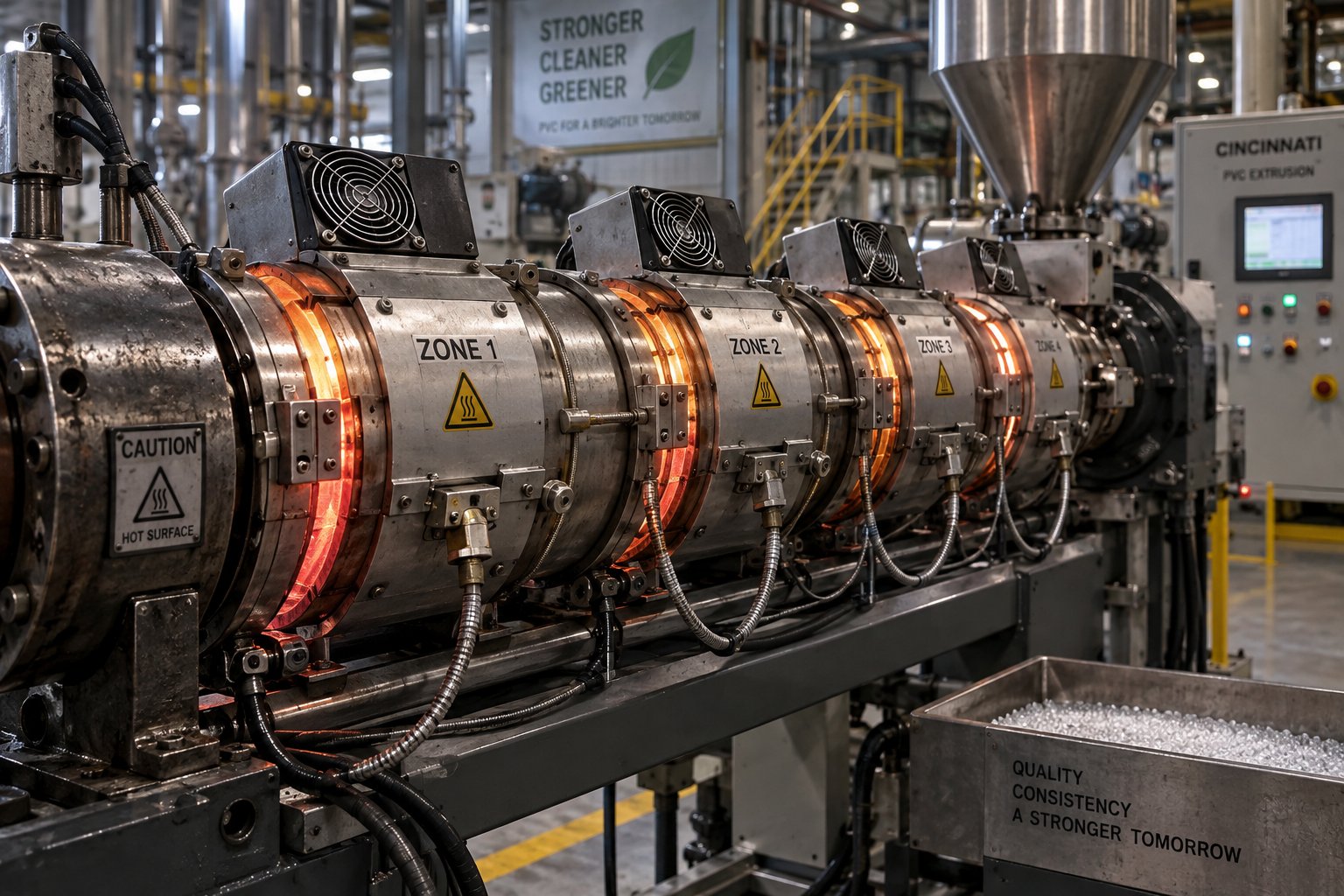
Every extruder barrel is divided into distinct thermal zones, each with its own heater bands, temperature sensors, and cooling elements. For PVC extrusion, these extruder barrel zones typically follow a three-stage layout that mirrors the functional sections of the screw:
Feed zone: This is the entry section where PVC dry-blend powder or pellets first contact the barrel bore. You might expect this zone to run hot — after all, the goal is to melt the polymer. But for PVC, the feed zone temperature is deliberately set lower than the subsequent zones, typically in the range of 140 to 160 degrees C for rigid formulations. Why? If the feed zone runs too hot, the PVC powder begins to gel prematurely. It softens, sticks to the barrel wall and screw root, and stops flowing freely. This "bridging" effect starves the downstream sections of material and destabilizes the entire process. Keeping the feed zone cooler ensures consistent powder conveying and prevents the kind of premature fusion that leads to surging later in the barrel.
Compression and transition zone: Here, the PVC compound is compressed, air is squeezed out, and plasticization begins in earnest. This zone runs hotter — typically 165 to 180 degrees C — and is where the majority of fusion development occurs. The barrel zone extruder temperature here must be high enough to promote particle-to-particle fusion but controlled tightly enough to avoid crossing into the degradation range. Because screw compression generates significant frictional heat in this section, the actual melt temperature often runs above the barrel setpoint, making cooling capacity in this zone just as important as heating capacity.
Metering zone: The final section stabilizes the melt and delivers it to the die at consistent pressure and temperature. Setpoints typically hold in the 170 to 190 degrees C range, depending on the specific PVC formulation and die geometry. Melt homogeneity at this stage directly determines surface finish and dimensional accuracy. Any temperature fluctuation here translates immediately into product defects — wall thickness variation in pipe, surface roughness on profiles, or density inconsistency in foam board.
The key point about this extruder barrel temperature profile is that PVC rarely benefits from a continuously ascending temperature gradient. Many processors use a "hump" profile — temperatures rise through the compression zone, then hold steady or even decrease slightly in the metering zone. This deliberate flattening or reduction prevents the melt from accumulating excess thermal energy during the final seconds of residence time, where degradation risk is highest.
Heating and Cooling Balance in PVC Barrels
Here is a fact that surprises many people encountering PVC extrusion for the first time: during steady-state production, extruder barrel heaters are often barely active. Once the process stabilizes, the dominant source of heat is not the heater bands wrapped around the barrel — it is the frictional and shear energy generated by the screw rotating inside a viscous PVC melt. Industry data suggests that mechanical shear creates 70 to 80 percent of the total heat input during PVC processing. The heater bands primarily serve during startup, when the barrel needs to reach operating temperature from cold, and as supplementary heat in the feed zone where frictional energy is still low.
This reality flips the usual thermal management priority. For PVC, the extruder barrel cooling system is more critical than the heating system during continuous operation. Without adequate cooling capacity, frictional heat accumulates faster than it can dissipate, and barrel zone temperatures creep above setpoints — a direct path to thermal degradation and HCl generation.
Two primary cooling approaches dominate PVC barrel design:
Air cooling (fan cooling): Electric blowers direct forced air across the barrel surface in each zone. Air-cooled systems offer simple construction, no risk of water leaks near hot barrel surfaces, concentrated cooling force, and convenient maintenance. They are the standard for most conical and parallel twin screw PVC extrusion lines. The trade-off is slower cooling response — air removes heat less efficiently than liquid, so temperature overshoot recovery takes longer.
Liquid cooling (water or oil channels): Internal channels machined into the barrel wall circulate coolant for faster, more precise extruder barrel temperature control. Liquid-cooled systems respond more quickly to temperature spikes and offer tighter setpoint accuracy, but they add complexity, maintenance burden, and the risk of coolant leaks that can damage heating elements or sensors.
The consequences of getting this balance wrong are severe in both directions. Inadequate cooling allows melt temperatures to climb past the degradation threshold, releasing HCl gas that corrodes the bore and contaminates the product with discolored or burnt material. Excessive cooling, on the other hand, pulls too much thermal energy from the melt, resulting in incomplete gelation — the PVC particles never fully fuse into a homogeneous mass. Under-gelled PVC produces profiles and pipes with poor mechanical strength, rough surfaces, and reduced impact resistance, even though the product may look acceptable visually.
Avoiding Hot Spots and Dead Zones
Even when the overall barrel zone extruder profile looks correct on the control panel, localized problems can hide inside the barrel. Hot spots — small areas where temperature exceeds the surrounding zone — are the leading cause of unexpected PVC degradation in otherwise well-controlled processes. They create the telltale yellow or brown streaks in extruded product that operators learn to dread.
Hot spots typically develop from identifiable causes: a heater band with uneven contact against the barrel surface, a failed thermocouple providing inaccurate readings to the PID controller, a blown cooling fan leaving one section without adequate heat removal, or worn barrel bore areas where increased screw clearance reduces the melt's ability to transfer heat uniformly. Dead zones — areas where PVC melt stagnates and is not actively conveyed forward — are equally dangerous. Stagnant material sits at processing temperature for far longer than the designed residence time, eventually degrading and releasing HCl that attacks the bore in that specific location.
Recognizing these problems early prevents both product defects and accelerated barrel wear. Watch for these warning signs that your temperature zoning needs adjustment:
- Discoloration or yellowing — Streaks or color shifts in the extruded product indicate localized overheating, often in the compression or metering zones where shear heat peaks.
- Burn marks or black specks — Carbonized PVC particles breaking free from a stagnation point or hot spot inside the barrel, appearing as dark inclusions in the finished product.
- Poor surface finish — A rough or matte surface on profiles or pipe can signal incomplete gelation from over-cooling, or melt fracture from inconsistent temperature distribution near the die.
- Inconsistent dimensions — Wall thickness variation, profile warpage, or diameter fluctuation often trace back to temperature instability across extruder barrel zones, causing melt viscosity to shift unpredictably.
- Unusual odor or visible fumes — A sharp, acrid smell near the barrel or die indicates active HCl release from PVC degradation — the clearest possible signal that barrel temperatures have exceeded safe limits somewhere in the system.
The practical response to any of these symptoms is systematic: verify thermocouple accuracy in every zone, confirm that all cooling fans or coolant channels are functioning, check extruder barrel heaters for dead segments or uneven output, and inspect the bore for wear patterns that might be creating localized flow disruptions. Temperature profiling is not a set-and-forget exercise in PVC extrusion. It requires ongoing vigilance because the margin between good product and degraded product is measured in single-digit degrees.
Thermal management keeps PVC within its safe processing window during production. But even the best temperature control cannot prevent gradual barrel wear over time — and recognizing the specific patterns of PVC-driven barrel damage before they cause catastrophic failure is a skill every maintenance team needs to develop.
Diagnosing Barrel Wear and Failure in PVC Extrusion
Your temperature zones are dialed in, your metallurgy matches the formulation, and your barrel geometry suits the product. Yet six months into a production campaign, output starts slipping, surface quality degrades, and wall thickness readings wander outside tolerance. What is happening inside the barrel — and how do you tell whether the problem is corrosive, abrasive, or something else entirely?
PVC barrel wear does not announce itself with a single dramatic failure. It creeps in quietly, stealing efficiency one shift at a time. The challenge is reading the symptoms correctly, because corroded bore damage and abrasive scoring look different on inspection, respond to different countermeasures, and point toward different root causes. Developing the ability to distinguish between them — and to connect observable product defects back to specific barrel conditions — is what separates reactive maintenance from predictive maintenance.
Corrosive Wear from HCl Attack
Corrosive wear is the signature failure mode of PVC barrels, and it follows a predictable pattern. Hydrochloric acid gas released during processing does not attack the bore surface uniformly. It concentrates wherever the melt temperature runs highest — typically the compression and metering zones — and wherever moisture condenses on cooler metal, particularly the feed zone and vent zone, where humid plant air or hygroscopic filler moisture meets the barrel wall.
What does HCl corrosion actually look like when you pull the screw and inspect? You will notice pitting — small, irregular craters scattered across the bore surface rather than smooth, even metal removal. These pits are deceptive. A bore gauge reading at a single point might still look acceptable, but the pits act as stress concentrators and sediment traps. Degraded PVC lodges in them, creating localized hot spots that generate more HCl, which deepens the pits further. This self-reinforcing cycle is why corrosion damage accelerates over time rather than progressing linearly.
The practical consequence of pitting is increased extruder screw barrel clearance — not from the screw wearing down, but from the barrel bore enlarging unevenly. As clearance grows, the melt leaks backward over the screw flight tips instead of being pushed forward. Industry analysis shows that every additional 0.10 mm of flight clearance can reduce throughput by roughly 4 to 8 percent, and by the time clearance reaches the typical discard threshold of 0.40 to 0.60 mm, the line may already be running 16 to 32 percent below its rated capacity. Operators compensate by increasing screw speed, which raises shear heat, which triggers more HCl release — another self-amplifying loop that makes the problem worse with every adjustment.
The zones most vulnerable to corrosive attack deserve extra scrutiny during every inspection: the vent section where vacuum systems draw HCl vapor across exposed metal, the feed zone where moisture condenses, and any area where temperature overshoot has been documented. Catching a shallow pit early means polishing it out and continuing production. Ignoring it transforms a minor bore imperfection into a through-wall defect that demands full extruder screw and barrel repair or replacement.
Abrasive Wear from Filled PVC Compounds
While corrosion eats into the barrel from a chemical standpoint, abrasive fillers attack it mechanically. Calcium carbonate, titanium dioxide, and other hard mineral particles in PVC compounds act like fine-grit sandpaper spinning against the bore surface at every screw revolution. The damage pattern, however, looks distinctly different from corrosion — and knowing the difference matters for choosing the right corrective action.
Abrasive wear manifests as smooth, even bore enlargement rather than localized pitting. When you measure the barrel with a bore gauge, you find the diameter has increased uniformly around the circumference. The bore surface may appear polished or scored with fine directional scratches that follow the melt flow direction, but it lacks the cratered, irregular texture of acid attack. Wear categorization studies classify this as distinct from corrosive damage: abrasive wear removes material through mechanical action of hard filler particles, while corrosive wear removes it through chemical reaction with released gases.
The heaviest abrasive damage concentrates in the feed and compression zones — precisely where PVC compound still contains a high proportion of solid, unmelted particles. In these sections, hard CaCO3 or TiO2 particles are pressed between the screw flight tips and the barrel bore with considerable force. Once the material fully plasticizes in the metering zone, the filler particles are suspended in the viscous melt and exert less localized pressure on the bore surface. This front-loaded wear pattern is a useful diagnostic clue: if your bore measurement data shows the most enlargement in the first half of the barrel, abrasion from fillers is likely the dominant mechanism.
The real-world problem for PVC processors is that corrosive and abrasive wear rarely act alone. As described in earlier sections, the two mechanisms compound each other — acid weakens the metal surface, making it easier for filler particles to score; mechanical scoring exposes fresh, unpassivated metal to HCl attack. Differentiating between them during inspection requires looking at both the pattern and the location of damage. Pitting concentrated near the vent and in high-temperature zones points to corrosion. Smooth, even enlargement concentrated in the feed and compression zones points to abrasion. A barrel showing both patterns — pitting in the metering zone and smooth enlargement near the feed — is experiencing the full corrosion-wear synergy that makes PVC one of the hardest polymers on extruder hardware.
Mapping Extrusion Defects to Barrel Condition
Pulling the screw and measuring the bore takes the line offline, which makes it impractical to do every week. The smarter approach is learning to read the product itself — because every common PVC extrusion defect has a barrel-related cause that, once understood, lets you diagnose wear severity without stopping production.
Extruder barrel alignment is one often-overlooked contributor to uneven wear. A misaligned barrel causes the screw to ride preferentially against one side of the bore, creating asymmetric wear that shows up as one-sided wall thickness variation in pipe or profile. Extrusion experts note that barrel alignment should be verified whenever a barrel is removed or changed, if the foundation shifts, or if barrel supports shift — because uneven heating can also cause the barrel to warp thermally, producing the same asymmetric wear pattern. Checking extruder barrel alignment with precision instruments before assuming bore enlargement is the cause can save unnecessary replacement costs.
The following table maps the most common PVC extrusion defects to their probable barrel-related root causes. Use it as a diagnostic starting point — not every defect guarantees a barrel problem, but persistent or worsening symptoms that match these patterns strongly suggest it is time to pull the screw and measure:
| Observable Defect | Probable Barrel-Related Cause | Diagnostic Action |
|---|---|---|
| Burning or discoloration (yellow/brown streaks, dark spots in product) | Bore corrosion creating stagnation pockets where PVC degrades; worn temperature control zones allowing hot spots; dead zones from excessive clearance trapping material | Inspect bore for pitting in compression and metering zones; verify thermocouple accuracy; check for stagnant melt pockets near adapters |
| Poor surface finish (rough, matte, or shark-skin texture on profiles or pipe) | Uneven bore wear causing inconsistent melt temperature; excessive screw barrel clearance reducing plasticizing efficiency and melt homogeneity | Measure bore diameter at multiple axial positions; compare clearance to new-machine baseline; evaluate whether gelation is incomplete |
| Inconsistent wall thickness (pipe ovality, profile dimensional drift) | Asymmetric barrel bore wear from misalignment or one-sided abrasion; feed section wear causing uneven material delivery to the die | Check extruder barrel alignment; measure bore for ovality at multiple points; verify screw straightness (tolerance better than 0.02 mm per meter of length) |
| Reduced output rate (need to increase screw speed to maintain throughput) | Excessive clearance from combined corrosion and abrasion allowing melt to leak backward over flight tips; feed zone wear reducing conveying efficiency | Track specific rate (output per screw RPM) over time; a declining trend confirms clearance growth; schedule bore measurement using extruder barrel measurement equipment |
| Output surging (cyclic fluctuation in throughput and melt pressure) | Feed section bore wear causing inconsistent solids conveying; intermittent material bridging from damaged feed zone surface; worn barrel creating pressure instability | Monitor melt pressure and motor amperage for cyclic patterns; inspect feed zone bore for scoring, pitting, or surface roughness that impedes powder flow |
The most powerful use of this framework is trending, not single snapshots. A specific rate that drops 2 percent over six months tells you clearance is growing slowly — you have time to plan an intervention during a scheduled shutdown. A specific rate that drops 8 percent in six weeks tells you something has changed dramatically — perhaps a compound reformulation introduced a more abrasive filler, or a temperature control failure triggered accelerated corrosion. Matching the speed of decline with the defect pattern narrows the root cause and helps you decide whether the situation calls for extruder barrel replacement services, screw refurbishment, or a formulation adjustment.
One final diagnostic habit worth building: keep a defect log alongside your bore measurement records. When you eventually pull the screw and measure, correlate the wear pattern with the product defects that were present at each measurement interval. Over two or three measurement cycles, your plant builds its own empirical model — a wear rate per thousand running hours, specific to your compound, your barrel material, and your operating conditions. That model turns barrel maintenance from guesswork into a predictable, budgetable line item.
Diagnosing wear accurately is essential, but diagnosis alone does not extend barrel life. What you do between inspections — your purging procedures, your measurement discipline, and your daily operating habits — determines whether a barrel lasts months or years.
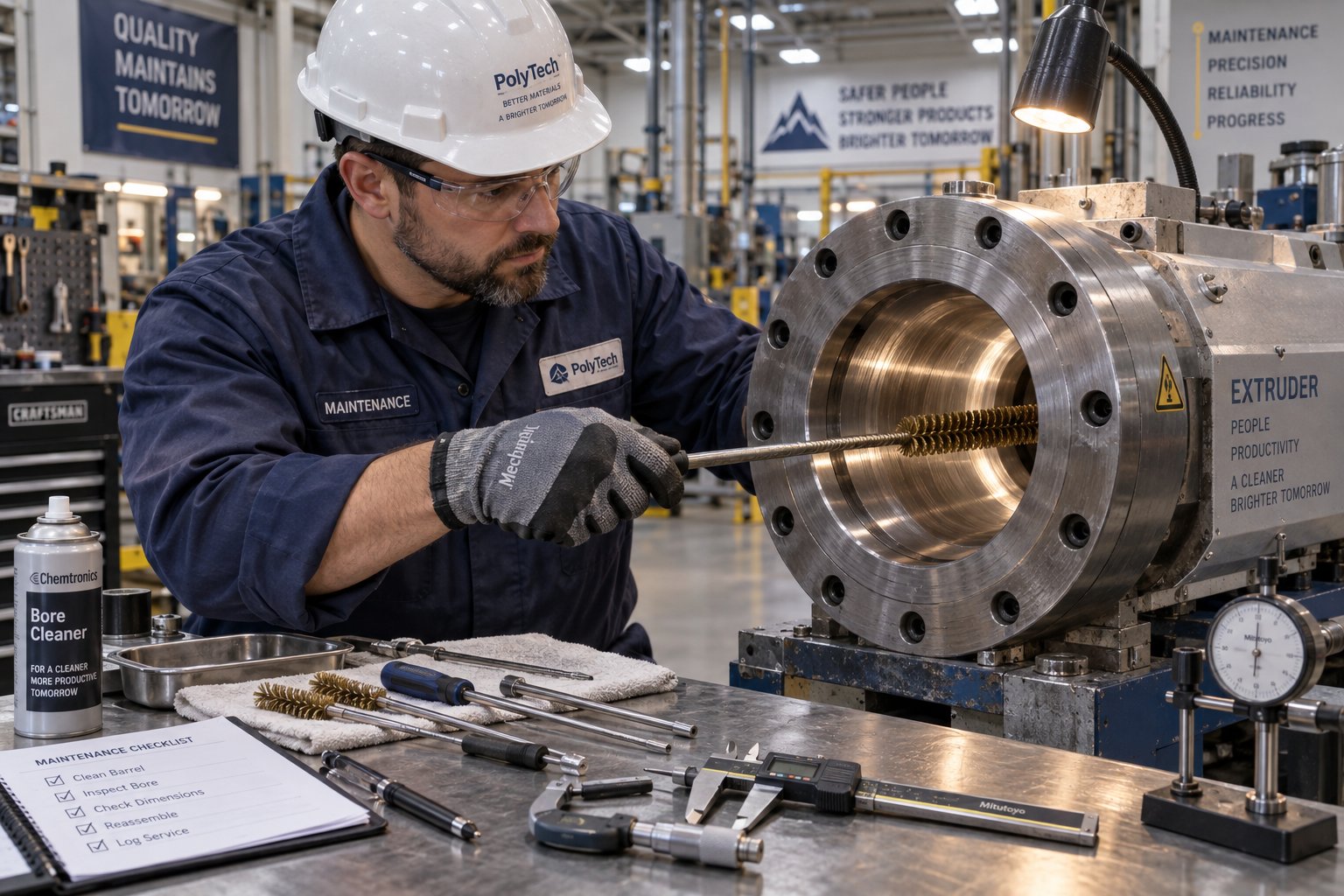
Barrel Maintenance and Cleaning Best Practices for PVC Lines
Knowing what PVC wear looks like is valuable. Preventing it from reaching critical levels is worth far more. Yet walk through most PVC extrusion plants and you will find barrel maintenance treated as an afterthought — something that happens when a problem becomes impossible to ignore, not as a disciplined routine that extends equipment life and protects product quality. PVC's corrosive and thermally sensitive nature makes this neglect especially costly. A barrel running polyethylene might tolerate lax maintenance for years. A barrel processing PVC will punish it within months.
Purging and Cleaning Procedures for PVC Barrels
Here is the single most important rule for PVC barrel maintenance: never leave PVC sitting in a hot barrel. Not during lunch breaks, not during shift changes, and certainly not during overnight shutdowns. PVC left at processing temperature without active conveying continues to degrade. The longer it sits, the more HCl it releases, and the more corrosive damage accumulates on the bore surface — all while producing zero salable product. Every minute of idle time at temperature is pure cost with no return.
The correct shutdown sequence starts before the last product exits the die. Reduce barrel zone temperatures gradually while continuing to run the screw, pushing the remaining PVC compound through the system. Once the barrel is mostly empty of PVC, introduce a purging compound. For PVC lines, appropriate purging materials include high-viscosity HDPE or PP, or a dedicated mechanical purging compound formulated for high-shear scrubbing. The purge material displaces residual PVC from the screw flights, barrel bore, and any low-flow areas where degraded material tends to accumulate.
So how to clean extruder barrel surfaces effectively after purging? The goal is removing every trace of PVC before the barrel cools to room temperature. Run the purge compound through the barrel using moderately high backpressure and short, repeated screw cycles rather than continuous rotation — this generates higher shear force against the bore wall and dislodges material from compression zone pockets that continuous flow simply passes over. Continue purging until the material exiting the die shows uniform color with no dark specks, streaking, or discoloration. Any variation in the purge slug indicates residual PVC is still exiting the system.
For thorough cleaning during scheduled maintenance, pulling the screw gives you direct access to the bore. Use extruder barrel cleaning brushes made from brass or bronze — never steel wire brushes, which score the bore surface and create fresh sites for corrosive attack. Industry guidelines emphasize using brass tools and copper gauze to avoid damaging precision-machined surfaces during cleaning. Specialized extruder barrel cleaning tools, including bore-diameter brushes and flexible shaft cleaners, reach areas that manual scraping cannot access. Some facilities also use dry ice blasting for stubborn carbonized deposits — it removes buildup without mechanical contact with the bore surface, eliminating the risk of scratching.
Inspection Intervals and Bore Measurement
Cleaning reveals the bore surface. Measurement tells you whether it is still within tolerance. These are two separate steps, and skipping the second one means you are cleaning blind — maintaining the barrel without actually knowing its condition.
Bore diameter measurement should follow a consistent schedule. For PVC lines running standard CaCO3-filled rigid compounds, measuring every 2,000 to 3,000 operating hours provides adequate data to track wear progression. Lines processing highly filled or glass-reinforced PVC formulations may need measurement every 1,000 to 1,500 hours, given the accelerated abrasive wear rates these compounds produce. The key is consistency — measuring at the same intervals, at the same axial positions along the barrel, and recording results against baseline dimensions from the new or relined barrel.
Use a calibrated bore gauge or telescoping gauge at multiple points along the barrel length — feed zone, compression zone, metering zone, and at least two intermediate positions. At each axial location, take readings in two perpendicular planes to check for ovality. Screw and barrel maintenance experts stress the importance of allowing the barrel to cool to room temperature before conducting measurements, since thermal expansion introduces significant error in hot components. Record every measurement in a spreadsheet and plot the data against the original bore diameter to visualize the wear trend over time.
Visual inspection complements dimensional measurement. Look specifically for corrosion pitting — the irregular, cratered surface texture that signals HCl attack. Run a fingernail or soft probe across suspicious areas; shallow pitting that a bore gauge might average over can still trap degraded PVC and accelerate localized wear. Also inspect the feed zone throat and any vent openings where moisture condensation creates conditions favorable for acid attack.
When does measurement data indicate replacement or relining? General guidelines suggest that a bore diameter increase exceeding 0.10 to 0.15 mm per side warrants close monitoring and planning for replacement. At 0.20 to 0.30 mm per side — depending on barrel diameter and process requirements — most processors find that plasticizing efficiency has degraded enough to justify pulling the barrel for relining or ordering a replacement. For PVC specifically, corrosion pitting covering more than 15 to 20 percent of the bore surface area in any zone also justifies replacement, even if dimensional wear is within tolerance, because the pits act as degradation incubators that no amount of cleaning can fully remediate.
Extending Barrel Service Life in PVC Processing
Measurement and inspection tell you where things stand. The real leverage comes from the daily operating practices that slow wear accumulation between inspections. Each step below addresses a specific damage mechanism — corrosion, abrasion, or thermal stress — that PVC inflicts on barrel hardware.
- Follow a disciplined startup sequence. Heat the barrel to operating temperature gradually and uniformly before starting screw rotation. Rapid heating creates thermal stress that can cause micro-cracking in nitrided layers or bimetallic linings. Allow adequate soak time — typically 20 to 30 minutes after all zones reach setpoint — before introducing PVC compound.
- Never skip the purge at shutdown. As discussed above, PVC must be displaced from the barrel before the system cools. A consistent purging procedure at every shutdown is the single most effective step you can take to reduce corrosion-driven bore damage.
- Maintain correct temperature profiles throughout production. Monitor zone temperatures actively, not passively. Verify thermocouple readings against handheld pyrometer checks periodically. Replace failed cooling fans immediately — a single zone without cooling can overshoot by 15 to 20 degrees within minutes, triggering localized HCl release.
- Ensure PVC formulation quality consistency. Batch-to-batch variation in stabilizer dosage, lubricant balance, or filler particle size distribution changes how the compound interacts with the barrel. Under-stabilized batches release more HCl. Oversized filler particles accelerate abrasive scoring. Work with your compound supplier to maintain tight incoming material specifications.
- Monitor screw-barrel clearance trends. Track specific output rate (kg per hour per RPM) as a proxy for clearance growth between direct measurements. A declining trend signals that clearance is increasing and plasticizing efficiency is falling — it is the earliest warning you will get without pulling the screw.
- Inspect and maintain ancillary systems. Vacuum vent systems that malfunction can draw moisture and HCl vapor across exposed barrel surfaces. Hopper dryers or dehumidifiers that fail allow moisture into the feed — moisture that promotes HCl formation at lower temperatures. Feed throat cooling water systems that leak introduce moisture directly at the barrel entrance.
- Document everything. Log startup and shutdown times, zone temperature setpoints and actual readings, purge material used and duration, any process deviations, and all bore measurement data. Over time, this documentation builds the empirical wear-rate model described in the previous section — the foundation for predictive maintenance scheduling.
One final note on screw removal for inspection: knowing how to remove extruder screw from barrel safely prevents damage to both components. Allow the barrel to cool to a temperature where the residual purge material has solidified but not bonded to metal — typically 80 to 120 degrees C, depending on the purge compound used. Use the extruder's hydraulic or mechanical screw push-out system if equipped. For manual extraction, apply steady, even force using appropriate lifting equipment — never hammer the screw or apply side loads that can score the bore or bend the screw shaft. Established maintenance protocols recommend carefully checking the screw for straightness and concentricity before reinstallation, comparing it against original dimensions to catch flight wear that might not be visible to the naked eye.
Maintenance discipline protects the barrel you have. But when it comes time for a new barrel — whether as a scheduled replacement or an upgrade — the final decision is matching barrel specifications precisely to the PVC product you are making, and finding a supplier who understands the difference.
Selecting the Right Barrel for Your PVC Application
Every section of this article — from corrosion mechanisms and metallurgy to temperature zoning and wear diagnostics — leads to the same practical question: which extruder screw barrel specifications should you order for the specific PVC product rolling off your line? The answer depends on your product type, your formulation, and the supplier standing behind the hardware. Getting both decisions right transforms barrel procurement from a recurring headache into a predictable, optimized part of your production system.
Matching Barrel Specs to PVC Product Types
Different PVC products impose different demands on the barrel. A rigid pipe compound loaded with 30% CaCO3 destroys barrels through a different mechanism than a flexible cable compound with heavy plasticizer and minimal filler. The table below maps the most common PVC product categories to the barrel configuration, material, and design priorities that best fit each application. Use it as a starting framework, then refine based on your own bore measurement data and wear history.
| PVC Product Category | Recommended Barrel Configuration | Recommended Barrel Material | Key Design Considerations |
|---|---|---|---|
| Rigid PVC pipe | Conical twin screw | Nitrided 38CrMoAla (standard CaCO3); nickel-based bimetallic (high CaCO3 loadings) | Moderate L/D ratio (22:1 to 26:1); low compression ratio; strong cooling capacity in compression zone |
| Window profiles | Conical twin screw | Nickel-based bimetallic (TiO2 and CaCO3 combined wear) | Tight temperature zoning for dimensional precision; excellent bore surface finish to minimize melt stagnation |
| PVC board and sheet | Conical twin screw or parallel twin screw | Nickel-based bimetallic | High throughput capacity; uniform melt pressure for consistent sheet thickness |
| PVC foam board | Conical twin screw | Nickel-based bimetallic | Precise temperature control critical for uniform foam cell structure; barrel cooling capacity especially important |
| WPC (wood-plastic composite) profiles | Conical twin screw | Cobalt-based bimetallic (wood fiber is highly abrasive) | Maximum abrasion resistance; feed zone design must handle low-bulk-density wood flour without bridging |
| Flexible cable sheathing | Single screw | Nitrided 38CrMoAla (minimal filler, high plasticizer content) | Higher L/D ratio acceptable due to lower degradation risk; smooth bore finish for soft compound flow |
Notice the pattern: conical twin screw barrels dominate every rigid PVC application. The tapered geometry's gentle compression and high feed intake — discussed in detail earlier — make it the natural match for heat-sensitive rigid compounds. Flexible PVC, with its forgiving processing window, is the exception that makes single-screw economics viable. And WPC applications, where abrasive wood fiber compounds the mineral filler problem, push barrel material selection firmly into cobalt-based bimetallic territory regardless of configuration.
What to Look for in an Extruder Barrel Manufacturer
Choosing the right extruder screw barrel manufacturer is as consequential as choosing the right alloy or geometry. A barrel is only as good as the metallurgical control, machining precision, and application knowledge behind it. When evaluating a potential barrel screw extruder manufacturer, these criteria separate specialists from generalists:
- PVC-specific specialization and application knowledge — NANHAIYA, for example, focuses specifically on conical twin screw barrels for PVC pipe, PVC profile, PVC board, foam board, and WPC extrusion. A manufacturer with deep PVC processing expertise understands how formulation variables interact with barrel design — knowledge that general-purpose suppliers rarely possess.
- Material certification and metallurgical expertise — The supplier should provide verifiable documentation on steel grades, nitriding depth and hardness values, and bimetallic alloy composition. Without this data, you have no way to confirm the barrel meets the specifications your PVC compound requires.
- Custom barrel specifications — Your PVC line is not identical to every other PVC line. A capable supplier offers tailored bore dimensions, alloy selection, and zone configurations matched to your specific extruder platform and compound.
- Replacement barrel compatibility — If you are sourcing replacement extruder screws and barrels for an existing machine, the manufacturer must demonstrate precise dimensional compatibility with your extruder brand. Even small deviations in mounting surfaces, barrel length, or thermocouple port locations create installation problems and void the performance benefits of an upgrade.
- Production support and technical guidance — The best suppliers do more than ship parts. They help you optimize temperature profiles, recommend barrel materials based on your formulation, and troubleshoot plasticizing issues. This ongoing support reduces trial-and-error costs and shortens the time from installation to stable production.
- Lead time reliability — An unplanned barrel replacement with an eight-week lead time means eight weeks of running a worn barrel at reduced output and questionable quality. Evaluate the supplier's typical delivery timelines and their ability to expedite critical orders.
A practical validation step before committing to a long-term supplier relationship: order a single replacement screw and barrel for extruder trial. Run it in production alongside your existing components, tracking specific output rate, product quality, and bore wear over the first 1,000 to 2,000 hours. This real-world data tells you more about a supplier's quality than any catalogue specification.
Getting Started with the Right Barrel Partner
If your PVC extrusion line processes rigid pipe, profiles, board, foam board, or WPC, the decision framework is clear. You need a conical twin screw barrel built from corrosion- and wear-resistant materials, engineered with the right L/D and compression ratio for your specific compound, and backed by a manufacturer who understands PVC's unique demands.
NANHAIYA serves exactly this space — providing custom and replacement conical twin screw barrels designed for stable plasticizing performance in PVC and WPC extrusion. Their specialization in PVC-specific barrel engineering, combined with production support for processors running demanding formulations, aligns directly with the supplier evaluation criteria outlined above.
Your next step is straightforward: gather your current barrel specifications — bore dimensions, alloy type, machine brand and model, and the PVC formulation details driving your wear patterns. Share that information with a specialist manufacturer to get a targeted recommendation. The difference between buying an extruder screw barrel based on price alone and selecting one based on matched metallurgy, geometry, and application expertise is measured in months of additional service life, thousands of dollars in avoided downtime, and consistently higher product quality from the first meter of extrudate to the last.
Frequently Asked Questions About Extruder Barrels for PVC
1. Why does PVC wear out extruder barrels faster than other plastics?
PVC attacks barrels through three simultaneous mechanisms that amplify each other. First, its processing temperature sits dangerously close to its decomposition point, leaving only a 10-20 degree safety margin. Second, when PVC overheats even slightly, it releases hydrochloric acid (HCl) gas that chemically corrodes the bore surface, creating pitting that traps more degraded material. Third, most PVC compounds contain abrasive mineral fillers like calcium carbonate and titanium dioxide that mechanically score the bore. Corrosion roughens the surface so filler particles dig in deeper, while abrasive wear strips away protective alloy layers and exposes fresh metal to acid attack. This synergistic destruction cycle means a barrel running heavily filled PVC can wear out several times faster than the same barrel processing unfilled polyethylene at comparable throughput.
2. What is the best barrel material for PVC extrusion?
The optimal barrel material depends on your specific PVC formulation. For standard rigid PVC pipe and profile compounds with moderate CaCO3 filler levels, nitrided 38CrMoAla steel offers a cost-effective balance of corrosion and abrasion resistance, achieving bore surface hardness of HV 900-1100. When corrosion pitting is the dominant failure mode, upgrading to a nickel-based bimetallic barrel provides superior HCl resistance through a centrifugally cast alloy liner. For highly filled compounds exceeding 30-40% mineral content or glass-fiber reinforced PVC, cobalt-based bimetallic linings deliver the best abrasion resistance. Manufacturers like NANHAIYA offer conical twin screw barrels with material options tailored specifically to PVC pipe, profile, board, and WPC applications.
3. Should I use a single screw or twin screw barrel for PVC?
For the majority of rigid PVC products — including pipe, window profiles, board, and foam board — conical twin screw barrels are the industry standard. Their tapered geometry provides high volumetric feed capacity for low-bulk-density PVC dry-blend while generating gradual, controlled compression that avoids dangerous shear heat spikes. Parallel twin screw barrels excel at PVC compounding operations where modular barrel segments allow process flexibility. Single screw barrels remain viable only for less demanding applications like flexible cable sheathing and film, where pre-plasticized or heavily plasticized compounds reduce shear sensitivity. Choosing the wrong configuration accelerates every PVC-related failure mechanism and shortens barrel service life significantly.
4. How often should I inspect and measure a PVC extruder barrel?
For PVC lines running standard CaCO3-filled rigid compounds, bore diameter measurement every 2,000 to 3,000 operating hours provides adequate wear tracking data. Lines processing highly filled or glass-reinforced PVC formulations should measure every 1,000 to 1,500 hours due to accelerated abrasive wear. Take bore gauge readings at multiple axial positions — feed zone, compression zone, metering zone, and intermediate points — in two perpendicular planes to check for ovality. Always allow the barrel to cool to room temperature before measuring, as thermal expansion introduces significant error. A bore diameter increase exceeding 0.10-0.15 mm per side warrants close monitoring, while 0.20-0.30 mm per side typically justifies replacement or relining.
5. How do I properly shut down a PVC extrusion line to protect the barrel?
Never leave PVC sitting in a hot barrel during any shutdown — idle PVC continues degrading and releasing corrosive HCl gas that attacks the bore surface while producing zero product. Begin by gradually reducing barrel zone temperatures while continuing screw rotation to push remaining PVC through the system. Then introduce a purging compound such as high-viscosity HDPE, PP, or a dedicated mechanical purging compound. Run the purge using moderately high backpressure and short, repeated screw cycles rather than continuous rotation to generate higher shear force against the bore wall. Continue until material exiting the die shows uniform color with no dark specks or discoloration. This disciplined purging procedure at every shutdown is the single most effective step for reducing corrosion-driven bore damage in PVC barrels.
Written by
Nanhaiya Technical Team
Zhoushan Nanhaiya Plastic Machinery Co., Ltd.
The Nanhaiya technical team supports screw and barrel manufacturing projects through application review, technical communication, custom manufacturing coordination, and production and quality control.
Discuss Your Application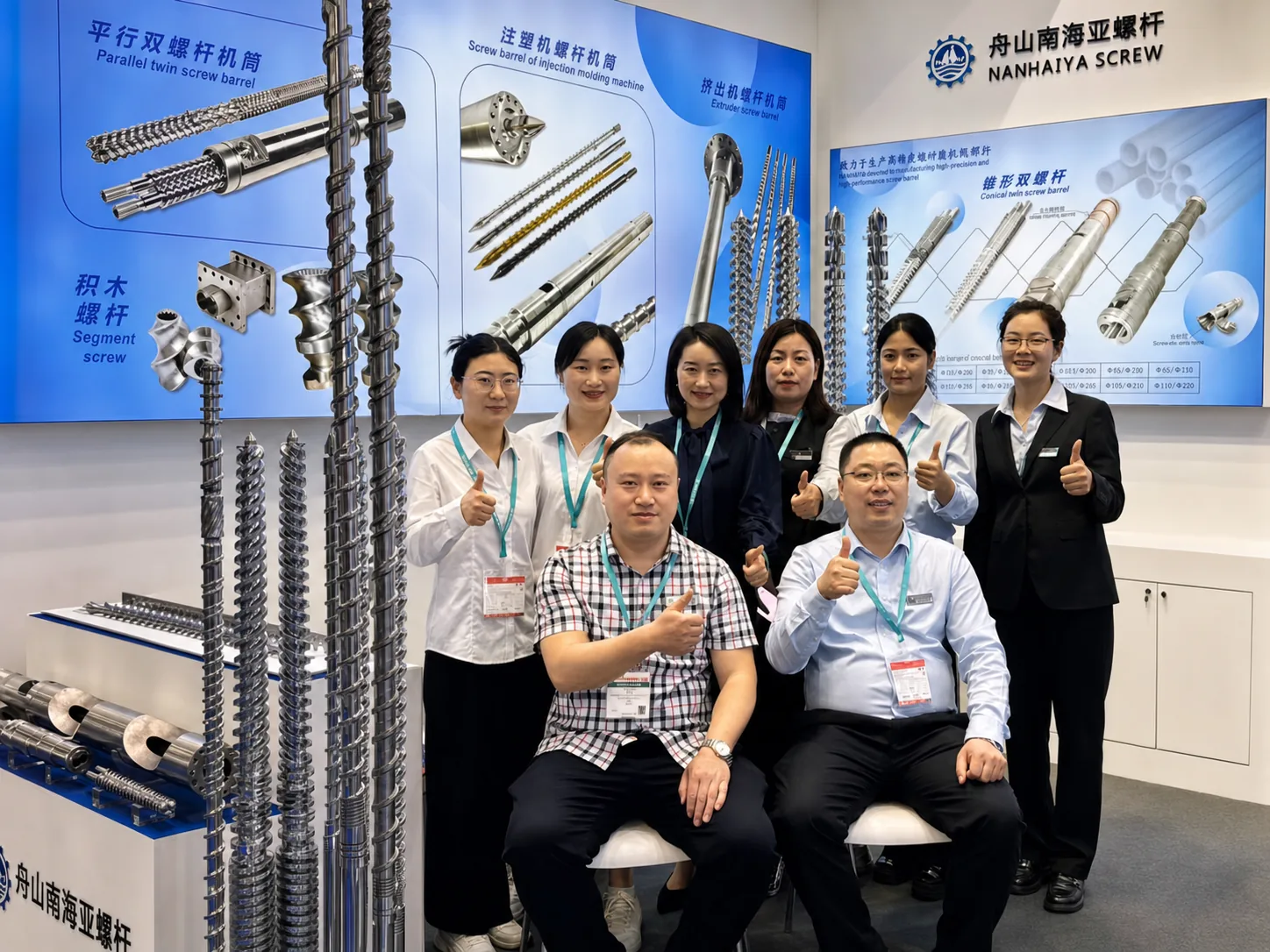
Related Articles
More insights on screw barrel technology and plastics processing.
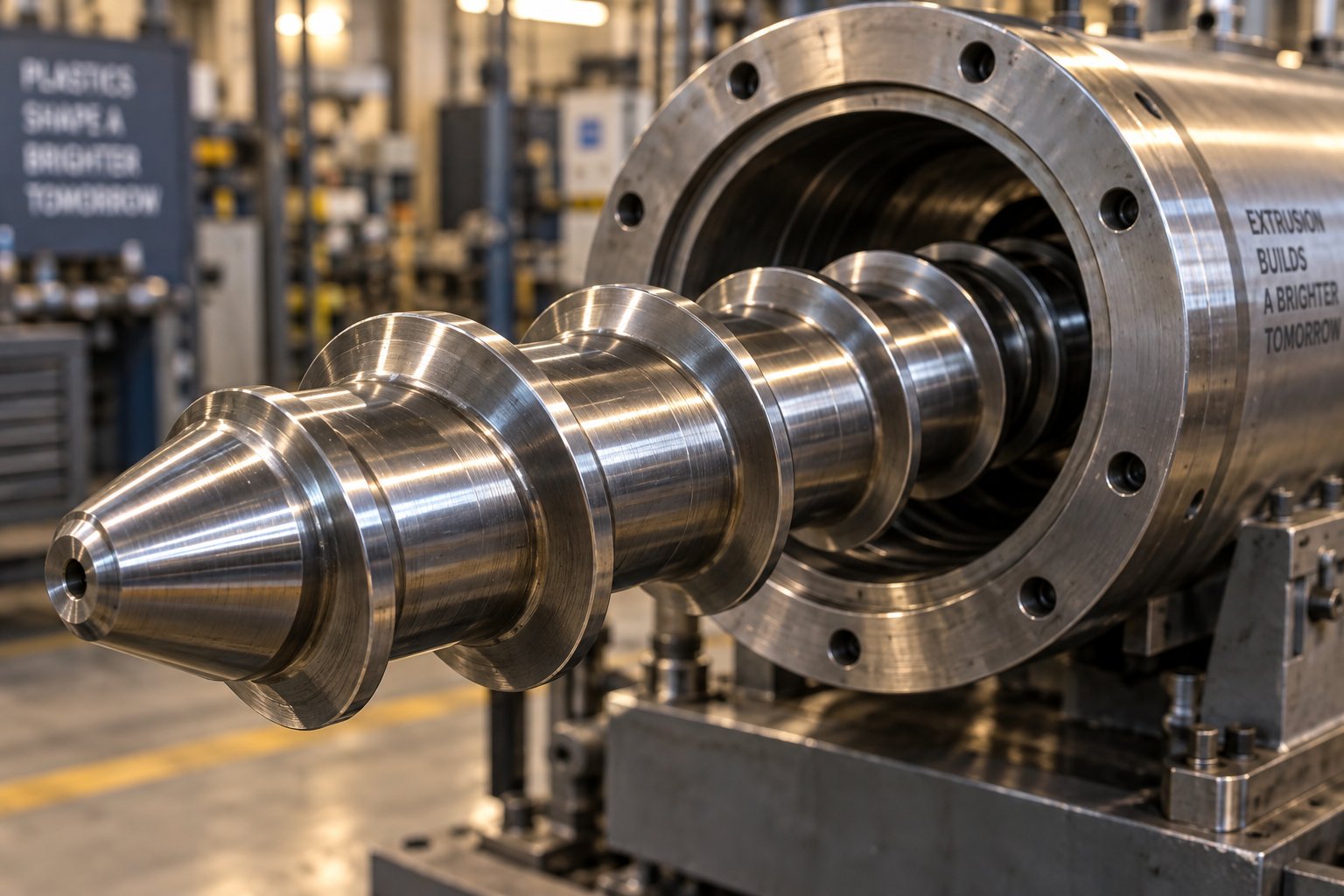
What Nobody Tells You About Screw Barrel For Plastic Machine Design
Oct 10, 2026
Learn how screw barrel for plastic machine design affects melt quality, throughput, and wear life. Covers geometry, resin matching, troubleshooting, and sourcing.
Read Article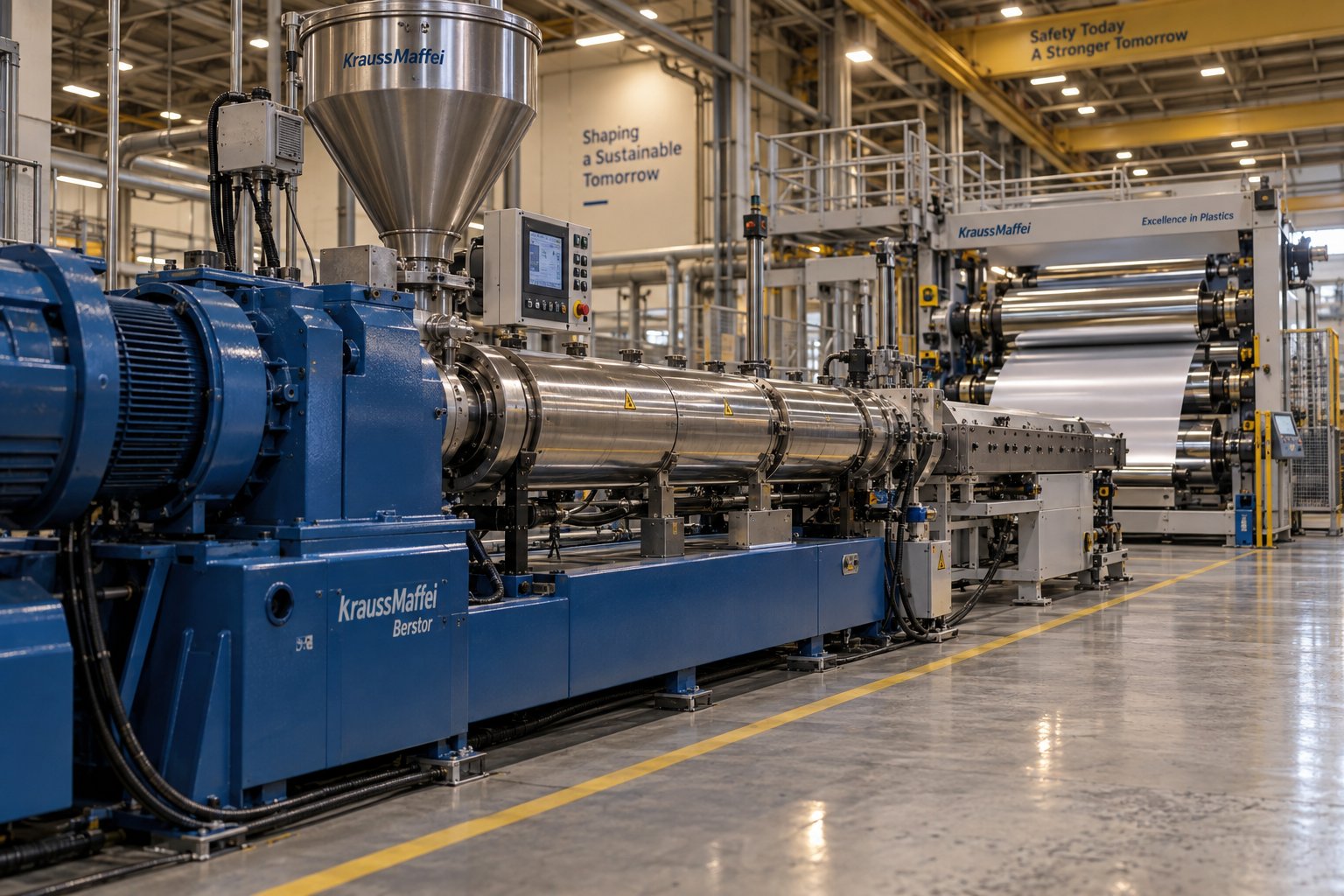
Single Screw Extruder for Sheet: Stop Guessing, Start Specifying
Oct 9, 2026
Learn how to specify a single screw extruder for sheet production. Covers screw geometry, resin-specific processing, troubleshooting, and maintenance best practices.
Read Article
PE Pipe Extruder Machine: What Datasheets Won't Tell You
Oct 9, 2026
Learn how a PE pipe extruder machine works, key specs explained, material grade selection, maintenance tips, and buyer guidance beyond the datasheet.
Read ArticleLooking for something else?
Search by material, symptom or product and jump straight to the relevant page.
These are navigation suggestions based on keyword matching — not a quotation, not a delivery commitment, and not a substitute for engineering review. Final specification is confirmed by our engineers against your drawings and processed material.
Need help with screw barrel selection?
Share your machine model, processed material and application. Our team can help with pricing and technical support.