

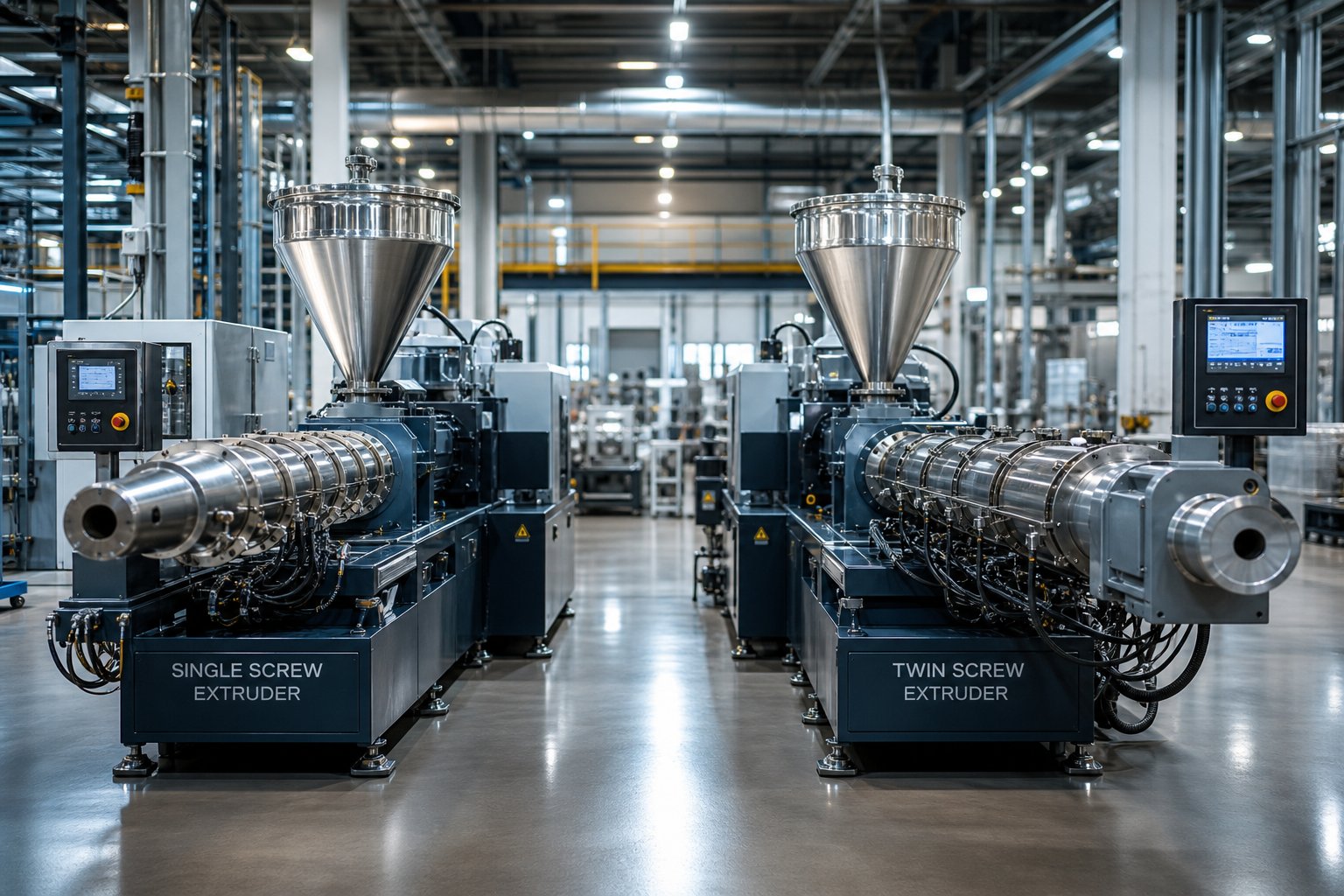
Why Choosing Between Single and Twin Screw Extruders Is a Critical Decision
Imagine you're a plant manager staring at a new product specification. The formulation calls for a heavily filled polymer blend, tight tolerances, and a production target that leaves zero room for trial and error. Your team is split: one engineer insists a single screw extruder can handle it, while another argues only a twin screw extruder will deliver the mixing quality you need. The machine you pick will lock in your throughput, your product consistency, and your operating costs for the next decade. So, what's an extruder — and how do you decide which type fits your process?
What Is a Screw Extruder
A screw extruder is a polymer processing machine that uses one or more helical screws rotating inside a heated barrel to feed, melt, mix, and push material through a shaped die. As ScienceDirect defines it, a screw extruder creates shearing and extruding actions that facilitate mixing and shaping of plastics and rubber as they move through distinct zones within the machine. Think of it as a precisely controlled conveyor that transforms raw pellets, powders, or blends into a continuous, uniform melt stream — ready to become pipe, film, profiles, or compounded pellets.
Why the Single vs Twin Decision Shapes Your Entire Process
This choice is far more than a line item on a purchase order. A single screw extruder and a twin screw extruder differ in how they convey material, how they generate mixing, how they handle heat-sensitive formulations, and how much flexibility they offer when recipes change. Those differences ripple outward into product quality, energy consumption, maintenance burden, operator skill requirements, and long-term profitability.
The best extruder is not the most advanced one — it is the one matched to your specific process requirements.
Throughout this guide, you'll find a detailed breakdown of working principles, mixing mechanisms, a 15-parameter head-to-head comparison, an application matrix, cost-of-ownership realities, and a practical decision framework. Each section targets a specific gap that surface-level comparisons leave unanswered — so you can stop guessing and start engineering the right solution.
How Single Screw Extruders Work and Their Design Fundamentals
A single screw extruder looks deceptively simple — one helical screw spinning inside a heated barrel. Yet beneath that simplicity lies an elegant interplay of physics that determines whether your output is flawless or riddled with inconsistencies. Understanding how a single extruder screw actually moves, melts, and pressurizes polymer is the foundation for every comparison that follows.
Drag Flow and Pressure Flow Principles
Every single screw extrusion process relies on two competing flow mechanisms working simultaneously. Drag flow is the forward-pushing force created by friction between the rotating screw and the barrel wall. Picture the barrel surface gripping the polymer melt and dragging it along the helical channel toward the die — this is the engine that drives output. Pressure flow, by contrast, works in the opposite direction. As polymer accumulates at the die end, back-pressure builds and pushes material backward through the screw channel.
The net output of any single screw plastic extruder is the difference between these two forces: drag flow minus pressure flow. Research into leakage-flow models for screw extruders has shown that the relationship becomes especially complex with shear-thinning polymer melts, where viscosity drops as shear rate increases, coupling the drag and pressure flow components in ways that require numerical analysis to predict accurately. For operators, the practical takeaway is straightforward: anything that increases die resistance — finer screens, narrower die gaps, longer flow paths — reduces net throughput by amplifying the pressure-flow component.
Feed, Compression, and Metering Zones Explained
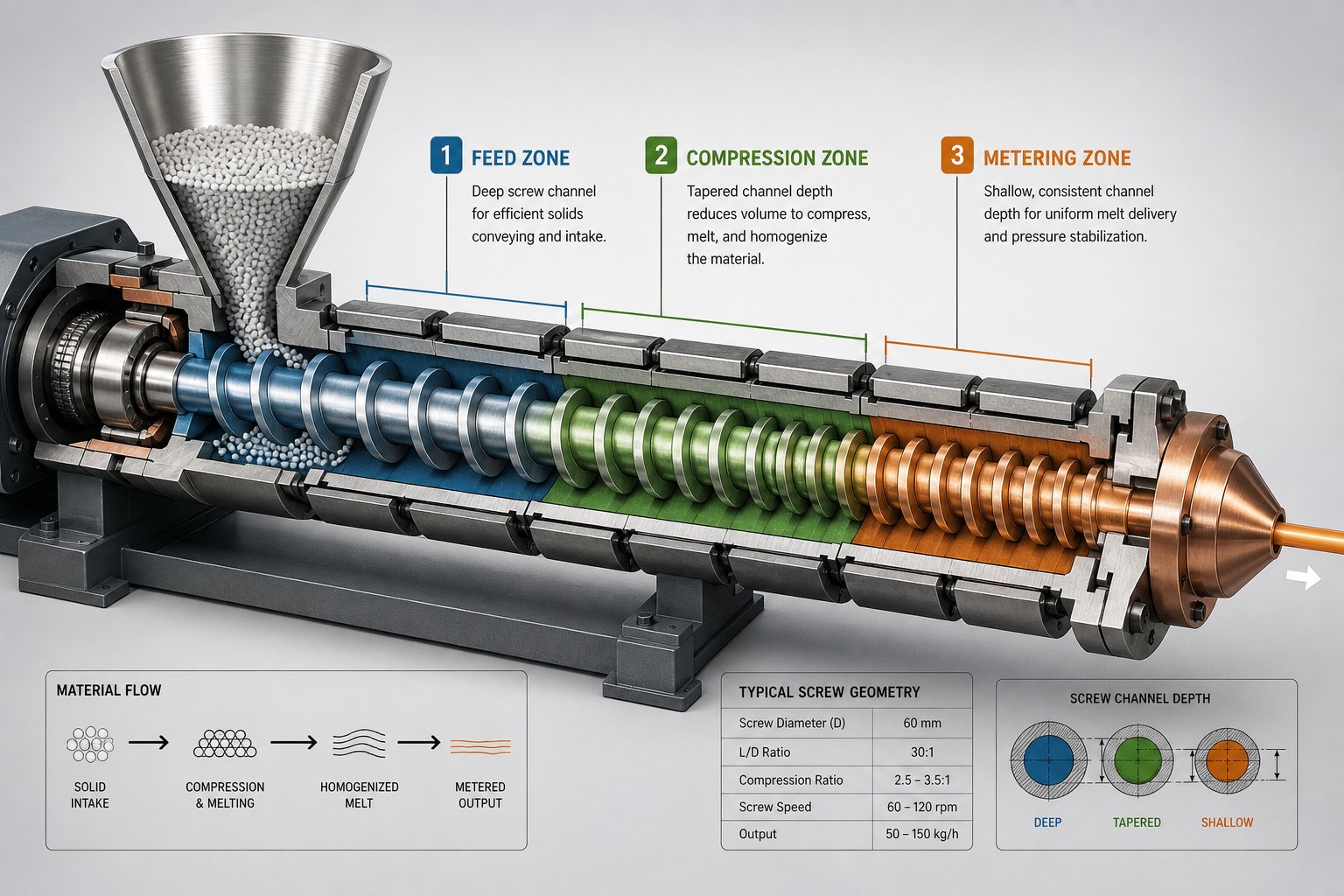
A standard single screw extruder machine divides its working length into three functional zones, each engineered for a specific stage of polymer transformation:
- Feed zone: The channel depth is deepest here, creating ample volume to accept raw pellets or powder from the hopper. The screw acts primarily as a solids conveyor, relying on friction between the barrel wall and the polymer particles to push material forward. Consistent feeding depends heavily on the friction coefficient between the plastic and the barrel surface — which is why some machines use grooved feed sections to improve intake of slippery resins like HDPE.
- Compression (transition) zone: The channel depth gradually decreases, compacting the softening polymer and squeezing out trapped air between pellets. This progressive narrowing builds the pressure needed to prevent air from traveling downstream and forces the solid bed against the barrel wall, where frictional and conducted heat accelerate melting. The rate at which the channel shallows directly controls how aggressively the material is compressed.
- Metering zone: The channel reaches its shallowest, constant depth. By this point, the polymer should be fully molten. This zone homogenizes the melt and generates the stable pressure required to push it through the die at a consistent rate. Because the shallow channel concentrates shear, it also contributes to final mixing and thermal uniformity.
Several key screw geometry parameters shape performance across these zones. The L/D ratio (length-to-diameter) — most commonly around 24:1 to 30:1 — determines how much working length is available for melting and mixing. As veteran extrusion engineer Allan Griff explains, more length can mean more output when heating, melting, or mixing are the limiting factors. The compression ratio, typically between 2:1 and 4:1, is the volume ratio of the first flight to the last and governs how intensely the polymer is compacted during the transition. Flight depth in the metering zone controls shear rate and residence time, while pitch — often set equal to the screw diameter (square pitch) — determines how far material advances per revolution.
Modern Mixing Enhancements in Single Screw Designs
One of the most persistent misconceptions in polymer processing is that a single screw extrusion machine cannot mix effectively. In reality, modern screw designs incorporate several features that dramatically improve mixing performance beyond what a plain three-zone screw can achieve.
Barrier screws add a secondary flight that creates two parallel channels — one for unmelted solids and one for melt. A controlled clearance between the barrier flight and barrel wall allows molten polymer to migrate into the melt channel while trapping solid pellets. This separation drains excess melt away from the solid bed, increasing pellet-to-pellet friction and making melting more efficient per revolution. The result is more complete melting before material reaches the metering zone.
Maddock (UCC) mixing sections use paired flutes — inlet and outlet — separated by a barrier ridge with a clearance of roughly 0.020 to 0.030 in. (0.50 to 0.75 mm). Polymer entering the inlet flute must pass over this ridge to exit, which blocks or shears any remaining unmelted particles and provides thermal uniformity by forcing cooler melt through a high-shear zone for longer than hotter melt. Despite often being called a "mixing head," the Maddock section functions more as a strainer and thermal homogenizer.
Mixing pins are rows of studs projecting from the screw root that disrupt streamlined laminar flow, much like rocks in a stream. They create exponential melt divisions based on the number of pins and rows, making them effective at distributing colors and additives even in materials with substantially varying viscosity. Distributive mixers like the Saxton, pineapple, and pin-style designs generally fit single screw applications better than high-shear dispersive mixers — especially downstream of a barrier section where the polymer is already fully molten and additional shear would only raise melt temperature needlessly.
These enhancements mean that a well-configured single screw extruder machine handles a surprisingly wide range of applications. Still, there are fundamental conveying and mixing limitations inherent to a single-screw architecture — limitations that become obvious when you examine how twin screw systems generate material transport through an entirely different mechanism.
How Twin Screw Extruders Work From Co-Rotating to Counter-Rotating
Single screw systems depend on friction between the polymer and barrel wall to push material forward. Remove that friction — say, with a slippery powder blend or a low-bulk-density formulation — and conveying collapses. A twin-screw extruder sidesteps this limitation entirely by using a fundamentally different transport mechanism: two intermeshing screws that physically trap material and push it forward, whether the feedstock grips the barrel or not.
Positive Displacement Conveying in Twin Screw Systems
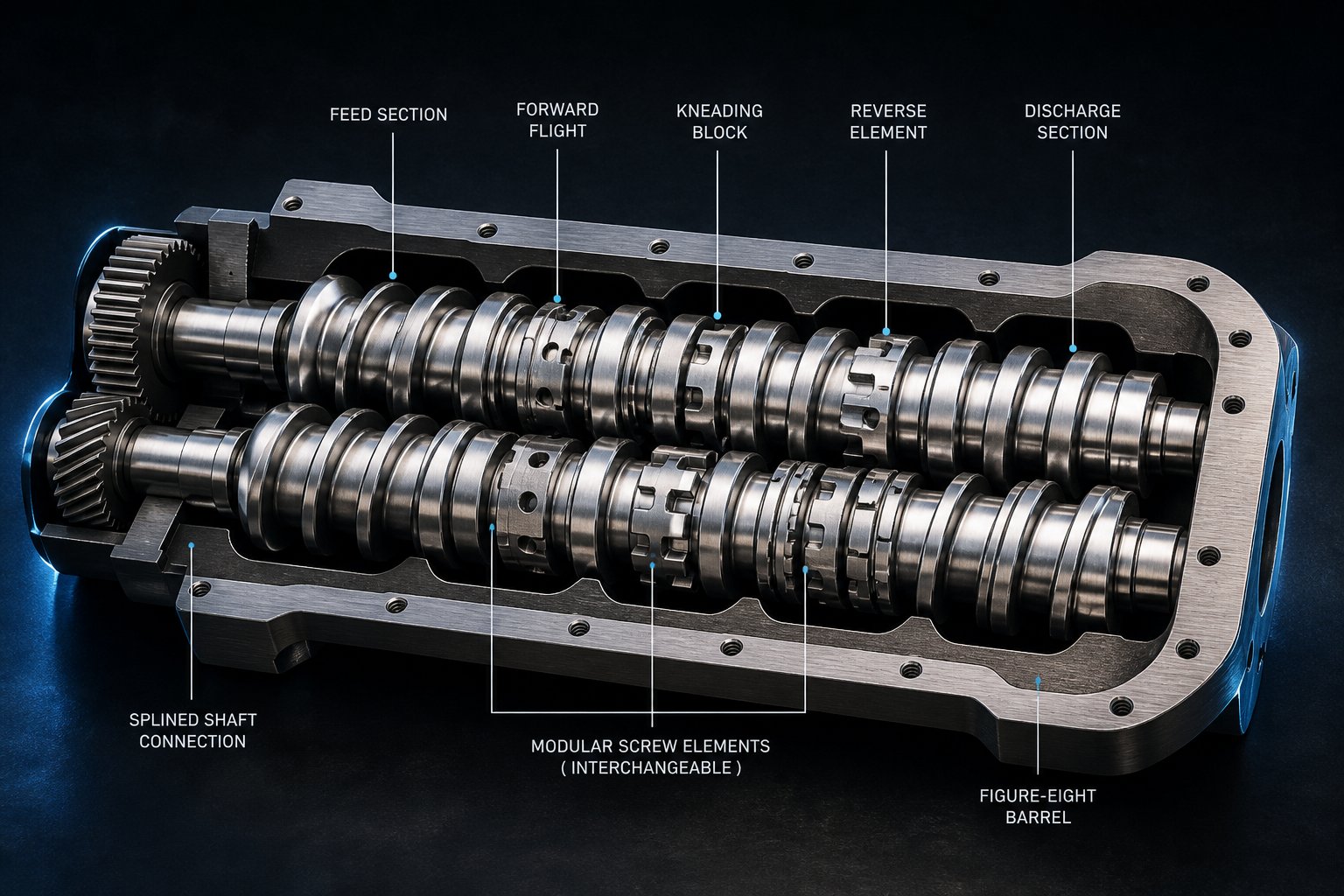
When two screws intermesh inside a figure-eight barrel bore, their overlapping flights create enclosed or semi-enclosed C-shaped chambers along the barrel length. Each chamber captures a fixed volume of material and carries it forward with every rotation, much like a gear pump. This is positive displacement conveying — and it changes everything about how material moves through the extruder.
Why does this matter so much in practice? Because the conveying force no longer depends on the friction coefficient between the feedstock and barrel wall. A low-bulk-density powder, a sticky elastomer compound, or a heavily lubricated masterbatch formulation — materials that would starve a single screw feed zone — all get pushed forward reliably in an intermeshing twin screw design. The degree of positive displacement depends on how tightly the screws intermesh and how completely the chambers are sealed, but even partially closed configurations deliver far more consistent feed behavior than friction-dependent single screw transport.
This positive displacement mechanism also gives operators a powerful process control tool. In twin screw extrusion, the machine is typically starve-fed using a metering feeder that controls the mass flow rate independently from screw speed. You can adjust screw speed to change shear input and mixing intensity without altering throughput, or change feed rate without modifying screw RPM. That decoupling of throughput from screw speed is simply not possible in a flood-fed single screw system, where output and screw speed are directly linked.
Co-Rotating vs Counter-Rotating Configurations
Not all twin screw extruders behave the same way. The direction in which the two screws rotate creates two fundamentally different processing platforms, each with distinct strengths. Understanding the difference between a co rotating twin screw extruder and a counter-rotating design is essential before selecting equipment for any application.
In a co rotating twin screw extruder, both screws turn in the same direction — typically with fully intermeshing, self-wiping geometry known as Erdmenger profiles. Material follows a figure-eight path as it is handed off from one screw to the other at the intermeshing region. This continuous transfer creates intense shear fields both between the screws and between the screw flights and barrel wall. The self-wiping action — where one screw's flight continuously scrapes the other screw's root — virtually eliminates dead zones and stagnant pockets. As Technovel's engineering team explains, this self-wiping behavior keeps the residence time distribution narrow, which is critical for processing thermally sensitive materials and running reactive extrusion.
In a counter-rotating twin screw extruder, the screws turn in opposite directions. At the intermeshing zone, material is drawn inward between the screws and compressed as it advances. Rather than intense shear mixing, the counter-rotating configuration generates a calendering effect — material undergoes compressive and elongational deformation as it passes through the nip region between the two screws. This gentler processing generates less frictional heat, making counter-rotating designs the natural choice for thermally unstable materials.
Here is how the two configurations compare across key operational characteristics:
Co-rotating twin screw advantages:
- High-intensity distributive and dispersive mixing from strong shear fields between screws
- Self-wiping geometry eliminates dead zones and reduces material degradation risk
- Narrow residence time distribution ideal for reactive extrusion and heat-sensitive polymers
- Capable of operating at high screw speeds (up to 1,200+ RPM on some modern machines)
- Excellent for compounding, polymer alloying, filler dispersion, and devolatilization
Counter-rotating twin screw advantages:
- Lower shear stress and reduced shear-induced heat generation
- Calendering effect provides gentle yet effective dispersive mixing of additives
- Stable extrusion at low screw speeds with high degree of fill
- Strong positive-displacement pressure generation for direct profile and pipe extrusion
- Preferred for rigid PVC processing, where thermal decomposition temperature is dangerously close to processing temperature
Rigid PVC is the textbook example of why the co rotating and counter rotating twin screw extruder distinction matters. PVC has a narrow window between its processing temperature and its decomposition temperature, combined with poor melt flow. A co-rotating design's high shear can push the material past its thermal limit. A counter-rotating extruder, by contrast, holds the extrusion temperature low through its high-fill, low-speed operation and calendering action — enabling stable production of PVC pipes, sheets, and profile extrusion products.
It is also worth noting a third category: non-intermeshing twin screw extruders, where the center distance between screws is greater than the sum of their radii. These machines cannot form closed chambers and lack true positive displacement conveying. Material transport behaves more like a single screw system, though the exchange of material between screws improves reverse mixing. Non-intermeshing designs see limited use, primarily for certain compounding and polymer plasticization tasks where their mixing characteristics offer an advantage over single screw alternatives.
Modular Screw Element Design and Customization
Perhaps the most powerful feature of a twin-screw extruder — and the one that gives process engineers the most creative control — is its modular screw design. Unlike single screw extruders, where the screw is typically manufactured as a single machined piece, twin screw systems assemble individual elements onto a common splined shaft. Swap elements, rearrange the sequence, and you have a completely different processing profile without buying a new screw.
Three main categories of screw elements form the building blocks of every twin screw extrusion profile:
- Conveying elements: These have deep flights and generous pitch designed to transport material efficiently without imparting significant shear. They dominate the feed section and any zone where you need fast, low-energy transport. A deeper channel conveys more volume per revolution, while a tighter pitch increases pressure buildup — giving engineers fine control over how aggressively each zone moves material forward.
- Kneading blocks: The workhorses of mixing. Kneading blocks consist of a series of offset lobed discs stacked at a defined stagger angle. According to research from NC State University, wider kneading elements promote dispersive mixing — breaking agglomerates through high shear — while narrower elements favor distributive mixing, spreading components evenly without particle breakdown. The stagger angle is equally important: forward-staggered kneading blocks (e.g., 30 or 45 degrees in the conveying direction) provide moderate mixing with some forward conveying action, while neutral (90-degree) blocks apply maximum energy without conveying, dramatically increasing residence time in that zone. Reverse-staggered kneading blocks push material backward, creating an intentional flow restriction that forces material to spend more time in the mixing zone upstream.
- Reverse (re-conveying) elements: These are standard conveying elements with the opposite helix direction. They act as flow restrictors, building backpressure and increasing fill level in the preceding screw section. Engineers position them strategically to create melt seals for vacuum venting ports or to intensify mixing by slowing material's forward progress.
This modularity means a single twin screw extruder can be reconfigured for dozens of different applications. A screw profile optimized for dispersing carbon nanotubes in a polyamide matrix will look nothing like one designed for gentle blending of a temperature-sensitive biopolymer — yet both can run on the same machine. Designing a screw profile is, as extrusion specialists often describe it, a blend of art and science: every material has unique flow properties influenced by temperature, shear rate, and extruder geometry, so no single configuration works universally.
This flexibility reveals an important truth about twin screw systems. The machine itself is only half the equation — the screw configuration is where process performance truly lives. And that configuration depends on understanding exactly how mixing happens at a mechanistic level, which raises a deeper question: what actually occurs when material passes through those kneading blocks, and how does the mixing inside a twin screw fundamentally differ from what happens in a single screw channel?
Mixing Mechanisms and Material Processing Differences That Matter
Kneading blocks, mixing pins, barrier flights — the previous sections described the hardware. But hardware alone does not explain why two extruders fed the same resin at the same throughput can produce dramatically different products. The real difference lives in the mixing mechanisms each platform generates at the molecular and particle level. This is the dimension most comparisons skip entirely, and it is arguably the most important one for anyone evaluating a compounding extruder or any application where ingredient uniformity defines product quality.
Distributive vs Dispersive Mixing Explained
Every screw extrusion mixing task falls into one of two categories — and confusing them leads to the wrong screw configuration every time.
Distributive mixing spreads minor components — pigments, stabilizers, secondary polymers — uniformly throughout the matrix without breaking them down. Imagine shuffling a deck of cards: you want every card evenly distributed, but you are not tearing any card in half. The goal is spatial uniformity. Distributive mixing relies on repeated splitting, reorienting, and recombining of melt streams to maximize the interfacial area between components.
Dispersive mixing, by contrast, applies enough shear stress to physically break agglomerates, filler clusters, or droplet domains into smaller sizes. Imagine crushing clumps of cocoa powder into hot milk — you need force, not just stirring. Dispersive mixing demands that the local stress on a particle exceed its cohesive strength, and that condition must occur consistently across the entire melt volume.
In a compounding twin screw extruder, kneading blocks deliver both mechanisms simultaneously. As material passes through the narrow gap between intermeshing flights and the barrel wall, it experiences intense shear — the engine of dispersive mixing. Meanwhile, the figure-eight transfer path between screws continuously splits and recombines the melt, driving distributive mixing. Research conducted at Paderborn University using 3D CFD flow simulations with particle tracking demonstrated that screw element geometry and rotation speed have a significant influence on both dispersive and distributive mixing outcomes. Their analysis showed that toothed mixing elements (ZME) and kneading blocks with 90-degree stagger angles achieved the best distributive mixing quality, while the ZME also generated the highest and most uniformly distributed shear stresses for dispersive mixing.
The stagger angle of kneading discs is a critical control lever. Forward-staggered kneading blocks (45 degrees) provide moderate mixing with some conveying action. Neutral blocks (90 degrees) maximize energy input and residence time in the mixing zone. The same Paderborn study found that kneading blocks with a 90-degree offset achieved measurably better distributive mixing than 45-degree blocks — confirming earlier findings by multiple research groups. For dispersive mixing, the 45-degree kneading block generated slightly lower maximum shear stresses but distributed them over a broader range than the shorter 12 mm kneading block variants.
Single screw systems face inherent limitations here. Without a second screw creating an intermeshing zone, there is no figure-eight transfer path and no narrow intermeshing gap generating the intense, repeated shear fields that kneading blocks produce. Mixing in a single screw extruder relies primarily on shear gradients in the shallow metering zone channel and whatever add-on mixing sections — Maddock heads, pin mixers, or Saxton elements — have been installed downstream. These devices improve uniformity significantly compared to a bare metering screw, but they operate on a fundamentally different principle: forcing melt over a single barrier or through pin arrays rather than continuously reorienting and shearing it between two intermeshing geometries. A comparative simulation study using particle tracking confirmed that twin screw mixers are significantly better for mixing than single screw mixers when evaluated by both particle distribution and shear stress exposure.
Residence Time Distribution and Why It Matters
Mixing quality is only half the story. How long each particle of material stays inside the extruder — and how consistent that time is across the entire melt volume — determines whether your output is uniform or unpredictable.
Residence time distribution (RTD) describes the statistical spread of how long individual material elements spend in the extruder. A narrow RTD means nearly every particle experiences the same thermal and mechanical history. A broad RTD means some material races through while other portions linger, experiencing vastly different shear and heat exposure.
Twin screw extruders, particularly co-rotating intermeshing designs operated in starve-fed mode, produce remarkably narrow RTD. The positive displacement conveying mechanism and self-wiping action minimize stagnant zones. Material moves forward in enclosed chambers with minimal back-mixing, approaching what engineers call plug flow. Research published in Industrial & Engineering Chemistry Research studied RTD in twin screw extruders and confirmed that screw configuration, screw speed, and feed rate all influence the mean residence time, with backflow in the intermeshing regions adding a controlled mixing component without creating the kind of broad distribution that degrades sensitive materials.
Single screw extruders show a broader RTD by comparison. Material near the barrel wall moves faster due to drag flow, while material in the screw root channel travels more slowly. The flood-fed operating mode means the screw channel is completely full, creating pressure-driven flow patterns that amplify these velocity differences. Some material inevitably recirculates in the deep channels, further widening the distribution.
Why does this matter in practice? Consider three scenarios:
- Thermally sensitive polymers: PVC, EVOH, and certain biopolymers degrade rapidly when exposed to processing temperature for too long. A narrow RTD ensures no fraction of the melt sits in the barrel long enough to degrade — the entire batch exits within a tight time window.
- Reactive extrusion: When the extruder serves as a continuous chemical reactor — grafting, crosslinking, or polymerizing in-situ — consistent residence time is essential for uniform reaction conversion. Broad RTD means some material over-reacts while other portions under-react, creating an inconsistent product.
- Product consistency: Even in straightforward compounding, variations in thermal history translate directly into differences in color, mechanical properties, and surface finish across the production run. Narrow RTD in the twin screw extrusion process delivers batch-to-batch consistency that broad-RTD systems struggle to match.
Venting and Devolatilization Capabilities
Here is a capability that separates the two platforms in ways that no amount of clever screw design can overcome: the ability to remove moisture, trapped air, residual monomers, and volatile organic compounds directly during processing.
Twin screw extruders excel at devolatilization because of a structural advantage rooted in how starve-fed operation works. When the feed rate is controlled independently of screw speed, portions of the screw channel remain only partially filled with polymer. These partially filled zones create exposed resin surfaces inside the barrel — and when a vent port is located above one of these zones, volatiles escape directly from the melt surface into the atmosphere or into a vacuum system.
Experimental and simulation studies on self-wiping corotating twin screw extruders have shown that the devolatilization efficiency depends on the exposed surface boundary length, which increases as the degree of fill decreases. Higher screw speeds reduce the degree of fill, increase the exposed surface area, and improve volatile removal. The same research demonstrated that increasing screw rotation speed from 60 to 180 RPM progressively decreased the volatile concentration in the extrudate, with simulation and experimental results agreeing within a relative error of 6.5 percent for most operating conditions.
The twin screw extrusion process typically uses multiple vent ports along the barrel — a combination of atmospheric vents near the feed zone to release moisture and trapped air, and vacuum vents further downstream to extract dissolved volatiles and residual monomers. Reverse elements or neutral kneading blocks positioned just upstream of each vent port create a melt seal, preventing the vacuum from pulling material backward while maintaining the partially filled zone needed for effective surface renewal.
Single screw extruders can incorporate vented barrel designs — typically a two-stage screw with a decompression zone under a vent port. However, the flood-fed operating mode makes maintaining a stable, partially filled zone far more difficult. If the decompression zone fills up due to fluctuations in backpressure or feed rate, molten polymer can surge out of the vent port — a condition operators call "vent flow." The control window is narrower, and the achievable devolatilization efficiency is generally lower than what a twin screw compounding extruder delivers, especially for materials with high volatile content or strict residual monomer specifications.
These differences in mixing intensity, residence time control, and volatile removal capability collectively explain why a twin screw platform dominates applications like polymer compounding, reactive processing, and pharmaceutical hot-melt extrusion. But knowing that one platform mixes better does not tell you how much better — or whether that advantage justifies the cost. A structured, parameter-by-parameter comparison puts concrete dimensions on these differences and reveals where each extruder type holds a genuine edge.
Complete Head-to-Head Comparison Across Every Key Parameter
Mixing superiority, residence time control, devolatilization efficiency — the previous sections explored each of these dimensions individually. But when you are standing in front of a capital expenditure proposal, you need all the variables lined up side by side, in one place, so the trade-offs become immediately visible. That is exactly what this section delivers: a structured comparison across 15 critical parameters that separates single screw and twin screw extruders on the dimensions that actually drive procurement decisions.
15-Parameter Side-by-Side Comparison Table
The table below consolidates operational, mechanical, and economic factors into a single reference. Rather than reducing each parameter to a one-word verdict, every entry describes how and why each platform behaves differently — because context is everything when evaluating screw extruders for a specific process.
| Parameter | Single Screw Extruder | Twin Screw Extruder |
|---|---|---|
| Mixing Capability | Primarily distributive mixing via add-on elements (barrier flights, Maddock sections, pin mixers). Limited dispersive capability. | Both distributive and dispersive mixing achieved through intermeshing kneading blocks, with stagger angle and element width controlling intensity. |
| Throughput Range | Excels in high-volume, steady-state production. Output is directly coupled to screw speed, making it efficient for continuous runs of a single formulation. | Throughput is decoupled from screw speed via starve feeding, offering independent control. Best suited for moderate-to-high output compounding and specialty processing. |
| Shear Rate Control | Shear rate is primarily a function of screw speed and metering channel depth. Limited ability to adjust shear independently from output rate. | Screw speed, element geometry, and stagger angle all independently adjust shear. Engineers can fine-tune shear without altering throughput. |
| Residence Time Distribution | Broad distribution due to flood-fed operation and velocity gradients across channel depth. Some material lingers while other fractions pass quickly. | Narrow, uniform distribution approaching plug flow in starve-fed mode. Self-wiping action eliminates stagnant pockets. |
| Self-Cleaning Ability | No inherent self-cleaning. Material changeovers require purging compounds or manual screw pulls, adding downtime. | Co-rotating intermeshing designs are self-wiping — one screw's flight continuously scrapes the other's root, minimizing residual material. |
| Screw Modularity | Screw is typically a single machined piece. Changing the screw profile requires manufacturing or purchasing a completely new screw. | Fully modular — individual conveying, kneading, and reverse elements slide onto a splined shaft. Profile changes take hours, not days. |
| Feeding Flexibility | Flood-fed from a gravity hopper. Conveying depends on friction between polymer and barrel wall, causing difficulties with powders, flakes, and low-bulk-density materials. | Starve-fed via gravimetric or volumetric feeders. Positive displacement conveying handles powders, flakes, sticky compounds, and irregular feedstocks reliably. |
| Venting / Devolatilization | Possible with two-stage screw designs, but maintaining a stable partially filled decompression zone is difficult. Risk of vent flow under fluctuating conditions. | Multiple atmospheric and vacuum vent ports are standard. Partially filled zones in starve-fed operation provide large exposed melt surfaces for efficient volatile removal. |
| Energy Efficiency | Lower specific energy consumption (typically 0.25–0.35 kWh/kg) for simple, steady-state extrusion of homogeneous materials. | Higher specific energy (typically 0.35–0.50 kWh/kg) due to additional mechanical losses and intensive mixing, though reduced scrap and rework can offset total energy cost per good part. |
| Torque and Drive Complexity | Single-shaft drive with one thrust bearing and a straightforward gear reduction. Mechanically simple, lower cost, and easier to maintain. | Complex gearbox distributing torque to two synchronized shafts with separate thrust bearings. Higher engineering precision required, driving up cost and maintenance demands. |
| Maintenance Complexity | Simple and infrequent. Wear is concentrated in the metering zone; the screw and barrel can often be rebuilt or recoated at moderate cost. | More involved — individual elements wear at different rates depending on function and abrasiveness of the compound. Gearbox oil analysis and bearing monitoring are essential. |
| Operator Skill Requirements | Lower barrier to entry. Fewer process variables to manage; steady-state operation is straightforward once parameters are dialed in. | Requires deeper process knowledge — understanding screw configuration, element sequencing, feed rate vs. screw speed interactions, and how to optimize for each formulation. |
| Capital Cost | Significantly lower initial investment. Simpler mechanical design, single transmission, and standardized components reduce acquisition cost. | Substantially higher upfront cost — typically 40–60% more than a comparable single screw unit — driven by the precision gearbox, modular screw elements, and barrel complexity. |
| Footprint | Compact layout. The simpler drive system and single-barrel design require less floor space and lighter structural support. | Larger footprint when accounting for the gearbox, multiple gravimetric feeders, side stuffers, and downstream pelletizing or venting equipment. |
| Scalability (Lab to Production) | Scale-up correlations are well established for commodity extrusion but less reliable when mixing is a critical factor. | Excellent scalability. Modular screw profiles developed on laboratory twin screw extruders (e.g., 16–27 mm) transfer reliably to production-scale machines (e.g., 40–90+ mm) using established scale-up rules based on free volume and specific throughput. |
| Material Versatility | Best for homogeneous, pelletized thermoplastics processed at steady state — PE, PP, PVC, PS. Limited capability with multi-ingredient or reactive formulations. | Handles diverse formulations: filled compounds, polymer blends, reactive systems, recycled feedstocks, and moisture-sensitive resins. A double screw extruder machine adapts to new materials through element reconfiguration rather than new hardware. |
Scan the table and a pattern emerges. Single screw platforms win on simplicity, energy economy, and cost for straightforward applications. Twin screw extruders dominate wherever mixing intensity, formulation flexibility, or process control complexity matter. Neither column is all green — and that is the point.
Neither extruder type is universally superior — each excels in different operational contexts. The right choice is always dictated by your material, your product, and your production reality.
Torque and Drive System Engineering Differences
One comparison parameter deserves deeper attention because it affects capital cost, maintenance budgets, and machine reliability more than most engineers expect: the torque and drive system.
A single screw extruder uses a straightforward drivetrain — a motor, a gear reducer, and a single output shaft connected directly to the screw. One thrust bearing absorbs the axial load generated by die pressure pushing back against the screw tip. The engineering is well understood, components are widely available, and failures, while disruptive, are relatively simple to diagnose and repair. You'll find that many processors keep a spare thrust bearing on the shelf and can swap it out within a planned maintenance window.
Twin-screw extruders face a fundamentally harder engineering problem. The gearbox must split torque from a single motor into two synchronized output shafts rotating at identical speed — whether co-rotating or counter-rotating. Each shaft carries its own pair of radial bearings and a thrust bearing, and the gear mesh between the two output shafts must maintain tight tolerances to keep the screws properly intermeshed. Any deviation in synchronization can cause screw-to-screw contact, catastrophic wear, or barrel damage.
This complexity has real consequences. The gearbox in a double screw extruder is often the single most expensive component in the entire machine, sometimes representing 20–30% of the total equipment cost. It demands regular oil analysis, vibration monitoring, and scheduled inspections that simply are not necessary on single screw drives. For operations running abrasive, high-torque compounds — think calcium carbonate filled polyolefins at 60%+ loading — the torque demand per shaft can approach the gearbox's rated limit, making torque density (Nm/cm³ of center distance) one of the most important specifications to evaluate when comparing twin-screw extruders from different manufacturers.
Modern gearbox designs have improved significantly. High-torque-density gearboxes using involute spline connections and optimized gear tooth profiles now deliver more torque in a smaller envelope, enabling higher throughput from the same frame size. Combined with permanent magnet synchronous motors that improve drive efficiency by several percentage points over traditional induction motors, the energy and torque penalty of the twin screw drivetrain is narrowing — but it has not disappeared.
For plant managers weighing these trade-offs, the drive system differences translate into a practical question: does your application generate enough value from twin screw mixing, flexibility, and quality consistency to justify the higher drivetrain cost and maintenance overhead? The answer depends entirely on what you are making — which is why understanding which applications genuinely demand twin screw capability, and which ones thrive on single screw simplicity, is the next critical step.
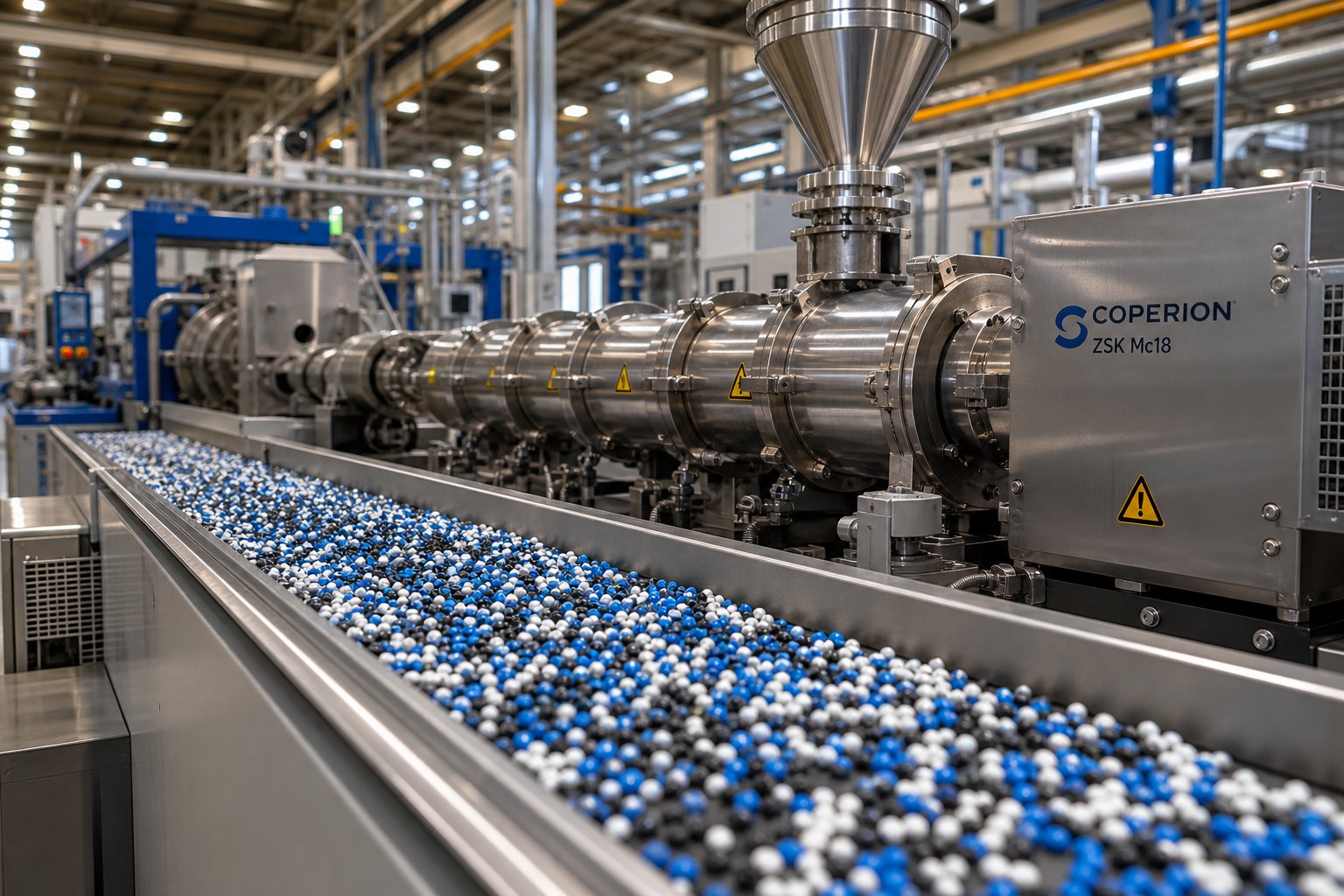
Industry Applications and Which Extruder Fits Each Process
Parameters on a comparison table tell you what each extruder can do. Applications tell you what each extruder should do. A twin screw platform with world-class mixing capability is wasted money if your entire production consists of single-resin polyethylene film. Conversely, forcing a plastic single screw extruder to compound a 50% calcium carbonate masterbatch invites quality problems that no amount of operator skill can solve. The real question is not which machine is better — it is which machine belongs in your process.
This section maps nine major industrial applications to the extruder type best suited for each, explains why, and then provides material-specific guidance so you can match your polymer and formulation to the right platform from day one.
Application Matrix From Compounding to Recycling
The table below functions as a decision shortcut. Find your application, check the recommended extruder type, and read the justification. For processes where both platforms are viable, the table explains the trade-offs rather than forcing a single recommendation.
| Application | Recommended Extruder Type | Justification |
|---|---|---|
| Pipe and profile extrusion (simple profiles — PE, PP) | Single screw | Steady-state, high-volume extrusion of homogeneous melts. Single screw delivers consistent output with lower energy cost and simpler operation. No intensive mixing required. |
| PVC pipe and profile extrusion | Counter-rotating twin screw | PVC's narrow processing window between melt temperature and decomposition temperature demands the low-shear, high-fill, positive-displacement conveying that counter-rotating intermeshing designs provide. Tens of thousands of installations worldwide validate this pairing. |
| Film blowing (PE, PP, PA) | Single screw | Blown film lines require high-pressure, stable melt delivery to the annular die. A plastic single screw extruder excels at this steady-state pumping task. Output is directly proportional to screw speed, simplifying line speed control. |
| Polymer compounding and masterbatch | Co-rotating twin screw | Compounding demands intensive distributive and dispersive mixing of pigments, fillers, stabilizers, and polymer blends. Modular screw profiles on co-rotating twin screw systems deliver the mixing intensity and flexibility that compounding requires. This is the dominant platform in the global compounding industry. |
| Reactive extrusion (grafting, crosslinking, polymerization) | Co-rotating twin screw | Precise residence time control and narrow RTD are essential for uniform reaction conversion. Starve-fed twin screw operation decouples throughput from screw speed, allowing engineers to dial in the exact thermal and shear history the reaction chemistry requires. |
| Pharmaceutical hot-melt extrusion (HME) | Co-rotating twin screw | Uniform dispersion of active pharmaceutical ingredients (APIs) in a polymer carrier demands consistent mixing and tight RTD to prevent thermal degradation. As documented in a review published in AAPS PharmSciTech, twin screw extrusion now produces multiple FDA-approved drug products — including Kaletra and Rezulin — because its short, controlled residence time prevents API degradation even above the drug's melting point. |
| Food processing (textured products, snacks, cereals) | Both — twin screw for textured products; single screw for simpler formulations | A twin screw plastic extruder (adapted for food-grade use) provides the intensive mixing and moisture control needed for texturized vegetable protein, high-fiber snacks, and multi-ingredient cereal formulations. Single screw systems handle simpler, lower-moisture products like pasta and basic puffed snacks efficiently. |
| Plastics recycling | Both — with different trade-offs | Single screw extruders offer lower cost per kilogram for reprocessing clean, sorted post-industrial scrap into pellets. Twin screw systems are preferred when recycled feedstock contains mixed polymers, high contamination levels, or requires devolatilization — the venting capability and mixing intensity handle inconsistent input quality far better. |
| Wire and cable coating | Single screw | Wire coating requires a stable, high-pressure melt delivery to a crosshead die at consistent speed. The single screw's direct coupling of output to screw speed and its simpler pressure generation make it the industry-standard choice for PE, PVC, and fluoropolymer insulation. |
| Highly filled compounds (CaCO₃, talc, glass fiber at 40–70% loading) | Co-rotating twin screw | High filler loads create feeding challenges (low bulk density, poor flow) and demand intense dispersive mixing to break agglomerates. The positive displacement conveying and kneading block mixing of a twin screw platform handle these formulations where single screw systems choke. Side stuffers allow downstream filler addition into an already-molten polymer stream, reducing filler degradation. |
A pattern emerges quickly. Applications that rely on steady-state melting and pumping of a single material — film, pipe, wire coating — belong on single screw platforms. Applications that demand ingredient incorporation, mixing intensity, or process flexibility — compounding, reactive processing, pharmaceutical HME, heavily filled systems — call for twin screw capability. Recycling and food processing sit in the middle, where the specific feedstock and product complexity tip the decision one way or the other.
Material Selection Guide for Each Extruder Platform
Your application tells you what shape you are making. Your material tells you what happens inside the barrel. Choosing the right extruder means matching both variables simultaneously — and certain polymer characteristics push decisively toward one platform.
Materials that favor single screw extrusion:
- Polyethylene (HDPE, LDPE, LLDPE): Excellent melt flow, good barrel friction for solids conveying, and minimal mixing demands in most film, pipe, and blow molding applications. A well-designed single screw with a barrier flight section handles PE efficiently across a wide output range.
- Polypropylene (PP): Similar to PE in processing ease. Single screw extrusion dominates PP sheet, fiber, and nonwoven lines. Only when PP requires blending with elastomers or heavy filler loading does a twin screw become necessary.
- Polystyrene (PS) and ABS: Standard grades of PS and ABS extrude cleanly on single screw systems for sheet and profile applications. Shear sensitivity in ABS means a gentle, well-controlled single screw can actually outperform an aggressively configured twin screw that overheats the material.
- Shear-sensitive polymers: Materials like POM (polyacetal) and certain medical-grade thermoplastic elastomers degrade if exposed to excessive shear. The comparatively gentler shear environment inside a single screw metering zone — combined with shorter high-shear exposure — can preserve molecular weight better than an improperly configured twin screw setup.
Materials that favor twin screw extrusion:
- Rigid PVC compounds: As discussed, PVC's thermal instability and poor melt flow require the controlled, low-shear processing of counter-rotating twin screw systems. Nearly all rigid PVC pipe, window profiles, and siding worldwide runs on this platform.
- Highly filled polyolefins and engineering polymers: Calcium carbonate, talc, glass fiber, or carbon fiber at loadings above 30% demand the feeding flexibility and dispersive mixing that only a screw extruder granulator line built around a co-rotating twin screw can reliably deliver. Side stuffers feed filler downstream into molten polymer, preventing abrasive wear in the feed throat and ensuring uniform dispersion.
- Polymer blends and alloys (PC/ABS, PA/PPE, TPV): Creating a uniform blend of two or more immiscible polymers requires dispersive mixing to reduce domain sizes and distributive mixing to spread those domains evenly. Twin screw kneading blocks accomplish both tasks simultaneously.
- Moisture-sensitive engineering resins (PA, PET, PC): Nylons and polyesters absorb atmospheric moisture that causes hydrolytic degradation during processing. Twin screw vacuum venting removes moisture in-line, eliminating the need for separate pre-drying steps that add cost and floor space. As Nanoscience Instruments notes, twin screw venting and degassing zones extract moisture, solvents, and low-molecular-weight compounds directly during processing.
- Reactive systems and bio-based polymers: Grafting maleic anhydride onto polyolefin backbones, in-situ polymerization of caprolactam, or compounding PLA with chain extenders — all require tight control of residence time, temperature, and mixing sequence that only a modular twin screw platform provides.
- Color and additive masterbatch: Pigment dispersion quality defines masterbatch value. A twin screw plastic extruder delivers the high dispersive stress needed to break pigment agglomerates below visible particle size thresholds, producing cleaner colors and higher tinting strength than single screw alternatives.
One nuance deserves emphasis: the extruder choice is not always binary. Tandem lines — where a twin screw extruder handles compounding and a downstream single screw provides stable pressure for die forming — combine the strengths of both platforms. This configuration appears frequently in foam extrusion and high-output sheet lines where intensive mixing and high-pressure pumping are both critical, yet contradictory, demands that no single machine satisfies alone.
Matching your application and material to the right platform gives you the performance envelope you need. But performance is only half the business case. The other half — what the machine costs to buy, operate, repair, and keep running year after year — often surprises engineers who focused exclusively on processing capability during the selection process.
Total Cost of Ownership and Maintenance Realities
Processing capability gets engineers excited. Cost of ownership keeps plant managers awake at night. Selecting the right extruder architecture is only half the equation — understanding what that machine will cost to purchase, power, maintain, and repair over a ten-year lifespan separates a smart investment from an expensive regret.
Capital Investment and Operating Cost Factors
The sticker price gap between single and twin screw platforms is substantial. According to industry cost data from Wanplas, entry-level single screw extruders start around $30,000 to $80,000, with production-scale machines ranging from $80,000 to $500,000 depending on barrel size and automation. A twin-screw extruder machine of comparable capacity typically starts at $150,000 for a laboratory unit and climbs to $800,000 or more for production-scale systems — with high-performance industrial configurations exceeding $1.5 million. That two-to-five-times price differential stems directly from the complex gearbox, dual-shaft drive system, and modular screw element inventory discussed earlier.
Energy costs tell a more nuanced story. Single screw extruders generally achieve specific energy consumption of 0.15 to 0.25 kWh per kilogram for standard applications. Twin screw systems often land in the 0.12 to 0.22 kWh/kg range for compounding tasks where intensive mixing is required — superior mixing efficiency can offset higher instantaneous power draw by reducing total processing time. Over 5,000 annual operating hours, the energy difference between platforms narrows considerably, and the real cost driver becomes material waste. Twin screw systems typically produce 2–5% scrap rates versus 3–8% for single screw lines, and for operations processing thousands of tons annually, that gap translates into six-figure savings.
Wear Patterns and Spare Parts Considerations
Every extruder wears. How it wears — and what replacement parts cost — varies dramatically between platforms.
In a single screw extruder, wear concentrates in the metering zone where shallow channel depth creates the highest shear rates and where any remaining unmelted particles or abrasive fillers grind against barrel and screw surfaces. As extrusion experts Mark Spalding and Tim Womer explain, the flight clearance on a new screw is typically the nominal diameter divided by 1,000 — roughly 0.004 inches per side on a 3.5-inch machine. As wear progresses, specific rate drops and discharge temperature climbs, forcing operators to increase screw speed to compensate until eventually, output must be cut by as much as 13% to maintain product quality. Hard chrome-plated screws typically last 8,000 to 15,000 operating hours, with replacement costs ranging from $3,000 to $15,000 depending on size. Barrel relining runs $5,000 to $30,000. A spare screw should always be kept in storage so that changeover does not shut the line down for weeks.
Twin screw and barrel wear follows a different pattern. Kneading blocks — the elements doing the heaviest mixing work — wear fastest, especially when processing abrasive compounds containing glass fiber, silica, or mineral fillers. Individual barrel liner segments aligned with high-shear zones degrade before sections housing simple conveying elements. Complete screw element sets for a twin screw barrel assembly can cost $20,000 to $100,000, though the modular design offers one significant advantage: you replace only the worn sections, not the entire screw. Annual routine maintenance for a twin-screw extruder machine typically runs $8,000 to $25,000, with major overhauls every 25,000 to 40,000 hours costing $40,000 to $150,000 — compared to $3,000 to $15,000 annually and $40,000 to $80,000 for major single screw rebuilds.
Key maintenance differences between the two platforms break down as follows:
- Wear monitoring: Single screw wear is tracked by measuring flight clearance and monitoring specific rate decline. Twin screw wear requires inspecting individual elements, barrel liner segments, and gearbox condition — including oil analysis and bearing vibration trending.
- Refurbishment limits: A single screw should never be refurbished more than three times, because repeated hard-facing weld passes degrade the base metal and risk delamination. Twin screw elements are typically replaced rather than rebuilt, simplifying the decision but increasing parts inventory requirements.
- Abrasive compound impact: Glass fiber and mineral fillers accelerate wear on both platforms, but twin screw kneading blocks face particularly aggressive erosion because the intermeshing gap concentrates abrasive particles under high stress. Upgrading to powder metallurgy (PM-HIP) barrel liners and tungsten carbide-coated elements mitigates this but adds to spare parts cost.
- Operator skill for diagnostics: Troubleshooting single screw wear is relatively straightforward — reduced output and rising melt temperature point clearly to flight clearance loss. Twin screw diagnostics require understanding which element position is degrading, whether the issue is dispersive mixing loss or conveying efficiency drop, and how element wear interacts with screw profile design.
Changeover Speed and Downtime Comparison
For operations running multiple formulations or colors, changeover time directly impacts revenue. This is where co-rotating twin screw designs offer a compelling operational advantage. The self-wiping geometry — where one screw's flight continuously scrapes the other screw's root — means residual material has nowhere to hide. Color changes that take 30 to 60 minutes of purging on a single screw extruder can often be completed in 10 to 15 minutes on a self-wiping twin screw system. For manufacturers running five or more changeovers per shift, the cumulative time savings can recover significant production capacity over the course of a year.
Single screw extruders, lacking any self-cleaning mechanism, require purging compounds, extended flushing runs, or — in stubborn cases — manual screw pulls for complete cleaning. Each screw pull means cooling the barrel, extracting the screw, cleaning both components, and reassembling — a process that can consume an entire shift. Processors running dark-to-light color sequences or switching between incompatible polymers feel this downtime most acutely.
Availability rates reflect these realities. Single screw lines typically achieve 92–96% uptime with proper maintenance, while twin screw systems land at 88–94% due to their greater mechanical complexity. However, the higher per-hour revenue a twin screw line often generates — through premium product pricing or faster formulation turnover — can offset the availability gap when the application truly demands twin screw capability.
One factor that often gets overlooked in cost discussions is the quality of the replacement components themselves. Whether you are sourcing a new twin screw barrel set, replacement kneading elements, or a complete single screw assembly, the metallurgy, machining tolerances, and surface treatments of those parts directly affect how long they last and how consistently they perform. Engineers evaluating spare parts options can compare single screw, parallel twin screw, conical twin screw, and injection molding screw barrel configurations from NANHAIYA — a product line designed to give equipment buyers a direct path to the right replacement geometry for their specific machine and application.
These cost and maintenance realities paint a clear picture: twin screw platforms cost more to buy and maintain, but they return that investment through superior processing capability, lower scrap rates, and faster changeovers — when the application justifies them. The danger lies in assumptions. Assuming twin screw is always better, or always too expensive, leads to equally bad decisions. Separating fact from myth is the next step toward a clear-eyed equipment choice.
Common Misconceptions That Lead to Wrong Extruder Choices
Cost data and maintenance realities ground the equipment decision in financial terms. Yet some of the worst extruder selections happen not because of bad math but because of bad assumptions — myths that circulate through trade shows, online forums, and even supplier conversations until they harden into received wisdom. These misconceptions steer engineers toward machines that overdeliver on capability they do not need, or away from platforms that would solve their problems at a fraction of the expected cost.
Here are four persistent myths about single and twin screw extruders — and the realities that debunk them.
Four Myths About Single and Twin Screw Extruders Debunked
-
Myth: Twin screw extruders are always superior to single screw.
This is the most damaging misconception in extrusion equipment selection. It conflates "more advanced" with "better" — two very different things. The reality? Single screw extruders outperform twin screws in many high-volume, steady-state applications where simplicity, reliability, and energy efficiency matter most. Think blown film lines running LDPE around the clock, HDPE pipe extrusion at thousands of kilograms per hour, or polystyrene sheet production feeding thermoforming stations downstream. These processes need stable melt delivery and consistent pressure — not intensive mixing. A single screw platform achieves that with lower operating burden, fewer wear parts, and simpler operator demands. Adding twin screw complexity to these lines does not improve the product. It just increases the cost per kilogram and the number of things that can go wrong.
-
Myth: Single screw extruders cannot mix.
This belief might have held some truth in the 1970s, when most single screws were plain three-zone designs with no mixing enhancements. It is flatly wrong today. Modern barrier screws separate the solid bed from the melt pool, improving melting efficiency and thermal uniformity. Maddock mixing sections force polymer over a barrier ridge, straining out unmelts and homogenizing temperature differences. Pin mixers, Saxton elements, and pineapple-style distributive mixers create exponential melt divisions that spread colorants and additives effectively. Are these mixing devices equivalent to twin screw kneading blocks? No — they cannot match the dispersive intensity or the figure-eight melt transfer that intermeshing twin screws generate. But for many applications — color concentrate letdown, single-polymer processing with minor additive packages, or post-reactor homogenization — they provide more than adequate mixing at a fraction of the mechanical complexity.
-
Myth: Twin screw extruders are too expensive for small operations.
This assumption stops R&D teams and small-batch producers from even exploring twin screw capability. The reality is that laboratory twin screw extruder models with screw diameters of 16 to 26 mm are specifically engineered for low-volume formula development and small-batch trial production. A benchtop twin screw extruder can process valid experiments using as little as 500 grams of raw material, with standard configurations starting around $12,800 to $25,800 depending on screw diameter and L/D ratio. These machines retain the core architecture of industrial twin screws — co-rotating intermeshing geometry, modular screw elements, vacuum venting, and precise temperature control — while fitting comfortably inside a university lab or a startup's R&D workspace. For organizations developing new polymer formulations, testing biodegradable material blends, or producing small batches for customer qualification, a laboratory-scale unit delivers twin screw mixing quality without the capital commitment of production equipment.
-
Myth: You need completely different expertise for each platform.
Operators sometimes hesitate to move from single screw to twin screw (or vice versa) because they assume the knowledge does not transfer. In practice, the fundamental polymer science — understanding melt rheology, thermal degradation limits, shear sensitivity, and pressure-flow relationships — applies identically to both platforms. What changes is the number of process variables you manage. Twin screws add screw configuration choices, starve-fed rate control, element sequencing, and vent port optimization. These are learnable skills, not a separate discipline. An engineer who understands why HDPE melts differently at varying shear rates on a single screw extruder will apply that same understanding when selecting kneading block stagger angles on twin screws. The learning curve is real but incremental — not a cliff.
Emerging Hybrid Technologies Bridging the Gap
The traditional line between single and twin screw platforms is also blurring from the technology side. Several hybrid approaches are worth watching because they challenge the assumption that you must pick one camp or the other.
Enhanced single screw designs increasingly incorporate elongational mixing elements — devices that stretch and fold the melt rather than relying solely on shear. These elements achieve better distributive mixing than conventional pin or Maddock sections without the mechanical complexity of adding a second screw. For processors who need a modest mixing upgrade without a full platform change, these retrofittable elements expand what a single screw can accomplish.
Planetary roller extruders represent an entirely different architecture. A central spindle surrounded by multiple smaller planetary spindles rotating inside an internally toothed barrel creates enormous surface area for heat exchange and gentle mixing. Originally developed for PVC calendering applications, planetary roller designs now appear in thermally sensitive compounding, pharmaceutical processing, and specialty adhesive manufacturing. They deliver mixing performance comparable to twin screws with residence times short enough to protect even the most degradation-prone formulations.
These emerging technologies do not make the single-versus-twin decision obsolete — the vast majority of industrial extrusion still runs on one platform or the other. But they do reinforce a principle that has run through every section of this guide: the best extruder is the one matched to your specific process, not the one that carries the most impressive specification sheet. Making that match systematically — rather than relying on instinct or inherited assumptions — requires a structured decision framework built around the variables that actually matter.
A Practical Framework for Choosing the Right Extruder
Myths debunked, cost realities exposed, hybrid technologies acknowledged — yet the fundamental question remains: which extruder belongs on your production floor? Every section of this guide has built toward this moment. The difference between a confident equipment decision and an expensive gamble is not more data — it is a structured way to organize the data you already have against the variables that actually drive outcomes.
What follows is an eight-point decision checklist designed to walk you through each critical factor systematically. No single criterion should dominate the decision. Instead, you'll weigh all eight together, because an extruder that wins on mixing capability but fails on budget, operator readiness, or scale-up needs is just as wrong as one that fits the budget but cannot process your formulation.
Eight-Point Decision Checklist for Extruder Selection
Work through each question in order. By the time you reach the end, the right platform — single screw, parallel twin screw extruder, or conical twin screw extruder — will emerge not as a guess, but as a conclusion supported by your own process requirements.
-
What is your primary process — simple melting and forming, or compounding and mixing?
This is the single most decisive question. If your operation centers on melting a homogeneous polymer and pushing it through a die to create pipe, film, sheet, or wire coating, a single screw extruder handles that task with fewer complications, lower energy consumption, and simpler maintenance. If your process demands blending multiple polymers, dispersing fillers or pigments, incorporating reactive additives, or achieving molecular-level uniformity across a multi-ingredient formulation, a co-rotating twin screw platform delivers the mixing intensity and control that no amount of single screw enhancement can replicate.
-
What materials will you process — single polymer, filled compounds, blends, or reactive systems?
Material complexity is the strongest predictor of which platform you need. A clean polyethylene pellet feed with a minor stabilizer package runs beautifully on a single screw. A 60% calcium carbonate-filled polypropylene masterbatch, a PC/ABS blend requiring sub-micron domain dispersion, or a moisture-sensitive polyamide that needs in-line devolatilization — each of these formulations pushes decisively toward twin screw capability. Counter-rotating configurations deserve specific consideration for rigid PVC formulations, while co-rotating designs dominate everything else in the compounding space.
-
What production volume and throughput do you need?
Both platforms scale across a wide output range, but the economics shift at different volumes. Single screw extruders offer the lowest cost per kilogram for high-volume, steady-state production of a single product — think commodity film or pipe lines running 24/7 with minimal recipe changes. Twin screw systems justify their higher cost per kilogram when the product carries premium pricing, when formulation complexity would cause unacceptable scrap on a single screw, or when you need to process multiple formulations through the same machine across a production week.
-
How frequently do you change formulations or colors?
If your production schedule involves five or more changeovers per shift, the self-wiping capability of co-rotating twin screws becomes a significant productivity advantage. Color changes that consume 30 to 60 minutes of purging on a single screw can drop to 10 to 15 minutes on a self-wiping twin screw — cumulative savings that recover substantial production hours over a year. Conversely, if you run the same material and color for weeks at a time, the changeover advantage is irrelevant, and the single screw's lower complexity wins.
-
What is your budget for capital and ongoing maintenance?
Be honest about this one. A twin screw platform typically costs 40 to 60 percent more upfront than a comparable single screw system, and annual maintenance runs two to three times higher due to modular element replacement, gearbox servicing, and more complex diagnostics. If your capital budget is constrained, a well-configured single screw extruder with modern mixing enhancements may deliver 80% of the mixing performance at 50% of the cost — an acceptable trade-off for many applications. On the other hand, if your product margins support the investment and your process genuinely demands twin screw capability, buying a single screw to save money upfront often leads to higher scrap, more off-spec product, and eventually a second capital request for the twin screw you should have purchased initially.
-
What operator expertise is available?
Twin screw extrusion introduces more process variables — screw configuration, starve-fed rate control, element sequencing, vent port optimization — that require deeper understanding to manage effectively. If your team has limited extrusion experience, a single screw platform's simpler operation and fewer adjustable parameters reduce the risk of operator-induced quality problems. If your facility already employs experienced process engineers or you can invest in training, this constraint lifts. Many twin screw extruder manufacturers offer comprehensive operator training programs that bring new teams up to speed within weeks, so workforce readiness should influence timing, not necessarily the platform decision itself.
-
Do you need venting or devolatilization?
This question is often the tiebreaker. If your process requires removing moisture, residual monomers, solvents, or trapped air during extrusion — whether to eliminate pre-drying steps for hygroscopic resins, to meet low-VOC specifications, or to handle recycled feedstock with volatile contaminants — the twin screw's ability to create partially filled zones under atmospheric or vacuum venting ports is extremely difficult to replicate on a single screw. Two-stage vented single screw designs exist but operate within a narrower stability window and generally achieve lower devolatilization efficiency. If venting is critical, twin screw is almost always the answer.
-
What are your scale-up requirements from lab to production?
If you are developing new formulations in an R&D environment and need a clear path to production-scale manufacturing, twin screw platforms offer a significant advantage. Screw profiles developed on a laboratory twin screw extruder with a 16 or 20 mm screw diameter transfer reliably to production machines with 40, 65, or 92 mm screws using well-established scale-up rules based on specific throughput and free volume ratios. Single screw scale-up correlations work well for simple melting and pumping applications but become less reliable when mixing performance is a critical quality attribute, because the mixing enhancements (Maddock sections, pin mixers) do not scale linearly with screw diameter.
How do you weigh these eight factors against each other? Start with questions one and two — process type and material complexity. These define the fundamental capability requirement. If both answers point clearly to one platform, questions three through eight become optimization criteria rather than selection criteria. If the answers are ambiguous — say, a moderately filled compound that might work on either platform — then changeover frequency, budget, operator expertise, and venting requirements become the deciding factors. In borderline cases, requesting trials from both single screw extruder manufacturers and twin screw extruder manufacturers on your actual formulation eliminates guesswork entirely.
Matching Your Requirements to the Right Screw and Barrel Configuration
Selecting the right extruder architecture — single screw, parallel twin screw, or conical twin screw — is the strategic decision. But there is a tactical decision that follows immediately: sourcing the screw and barrel components that turn that architecture into a functioning, reliable machine. And this second decision matters more than many engineers realize.
The metallurgy, machining tolerances, and surface treatments of your screw and barrel directly determine wear life, processing consistency, and replacement costs over the machine's entire service life. A well-chosen extruder running substandard screw elements wears prematurely, drifts out of process specification, and generates the kind of subtle quality inconsistencies that are expensive to diagnose and even more expensive to tolerate. Whether you need a nitrided single screw barrel for a PE film line, a set of modular kneading blocks and conveying elements for a parallel twin screw extruder running masterbatch, or a complete conical twin screw assembly for a PVC profile line, the component supplier you choose becomes a long-term partner in your process reliability.
Engineers and equipment buyers evaluating their options can explore NANHAIYA's screw and barrel product collection, which consolidates single screw, parallel twin screw, conical twin screw, and injection molding screw barrel configurations into a single resource — making it straightforward to compare geometries, materials, and specifications matched to your specific extruder platform and application requirements.
Ultimately, the difference between a single screw and twin screw extruder is not about which machine is inherently better. It is about which machine — paired with the right screw configuration, the right barrel metallurgy, and the right operating parameters — converts your raw materials into your finished product with the highest quality, lowest waste, and most predictable cost per kilogram. Work through the checklist, challenge your assumptions, and let your process requirements lead the decision. That is how you stop guessing.
Frequently Asked Questions About Single and Twin Screw Extruders
1. What is the main difference between a single screw and a twin screw extruder?
The core difference lies in how each machine conveys and mixes material. A single screw extruder relies on friction between the polymer and barrel wall (drag flow) to push material forward, while a twin screw extruder uses two intermeshing screws that create enclosed C-shaped chambers for positive displacement conveying. This means twin screw systems transport material regardless of its friction properties, making them far more effective for powders, sticky compounds, and low-bulk-density feedstocks. Twin screws also deliver superior distributive and dispersive mixing through kneading blocks, whereas single screws depend on add-on mixing sections like Maddock heads or pin mixers for blending. However, single screw extruders excel in steady-state, high-volume applications like film blowing and pipe extrusion where simplicity and energy efficiency outweigh mixing demands.
2. When should I choose a twin screw extruder over a single screw extruder?
A twin screw extruder is the better choice when your process requires intensive mixing, multi-ingredient formulations, or precise residence time control. Specific scenarios include polymer compounding with fillers above 30% loading, masterbatch production requiring pigment dispersion, reactive extrusion like maleic anhydride grafting, pharmaceutical hot-melt extrusion, and processing moisture-sensitive resins such as nylon or PET that benefit from in-line vacuum devolatilization. Frequent color or formulation changeovers also favor twin screw systems because co-rotating self-wiping designs clean themselves in 10-15 minutes versus 30-60 minutes on a single screw. If you need to process multiple recipes through one machine across a production week, the twin screw's modular screw configuration and starve-fed operation provide the flexibility that single screw platforms cannot match.
3. What is the difference between co-rotating and counter-rotating twin screw extruders?
Co-rotating twin screw extruders have both screws turning in the same direction, producing high-intensity shear mixing and a self-wiping action that eliminates dead zones. They operate at high speeds (up to 1,200+ RPM) and excel at compounding, polymer alloying, filler dispersion, and devolatilization. Counter-rotating twin screw extruders turn the screws in opposite directions, creating a calendering effect that generates lower shear and less frictional heat. This gentler processing makes counter-rotating designs ideal for thermally unstable materials like rigid PVC, where the processing temperature is dangerously close to the decomposition temperature. In short, co-rotating configurations dominate compounding applications worldwide, while counter-rotating designs are the industry standard for PVC pipe and profile extrusion.
4. Are twin screw extruders more expensive than single screw extruders?
Yes, twin screw extruders carry significantly higher costs across multiple dimensions. Initial capital investment is typically 40-60% more than a comparable single screw system, driven by the precision gearbox, dual-shaft drive, and modular screw element inventory. Annual maintenance runs roughly two to three times higher due to individual element replacement, gearbox servicing, and more complex diagnostics. However, the total cost picture is more nuanced — twin screw systems often produce lower scrap rates (2-5% versus 3-8% for single screw), enable faster changeovers, and handle premium formulations that command higher product margins. For engineers sourcing replacement screw and barrel components to manage ongoing costs, suppliers like NANHAIYA (nhyscrews.com/products) offer single screw, parallel twin screw, and conical twin screw barrel options that help maintain process consistency without overspending on parts.
5. Can a single screw extruder handle mixing and compounding tasks?
Modern single screw extruders can handle moderate mixing tasks, though they cannot match twin screw dispersive intensity. Barrier screws separate the solid bed from the melt pool to improve melting efficiency. Maddock mixing sections force polymer over a barrier ridge, filtering unmelted particles and homogenizing temperature. Pin mixers and Saxton elements create exponential melt divisions that spread colorants and additives effectively. These enhancements make single screw systems suitable for color concentrate letdown, single-polymer processing with minor additive packages, and post-reactor homogenization. However, for applications requiring agglomerate breakup at high filler loadings, sub-micron domain dispersion in polymer blends, or reactive extrusion with tight residence time control, twin screw kneading blocks remain necessary because their intermeshing geometry generates mixing mechanisms that single screw add-ons simply cannot replicate.
Written by
Nanhaiya Technical Team
Zhoushan Nanhaiya Plastic Machinery Co., Ltd.
The Nanhaiya technical team supports screw and barrel manufacturing projects through application review, technical communication, custom manufacturing coordination, and production and quality control.
Discuss Your Application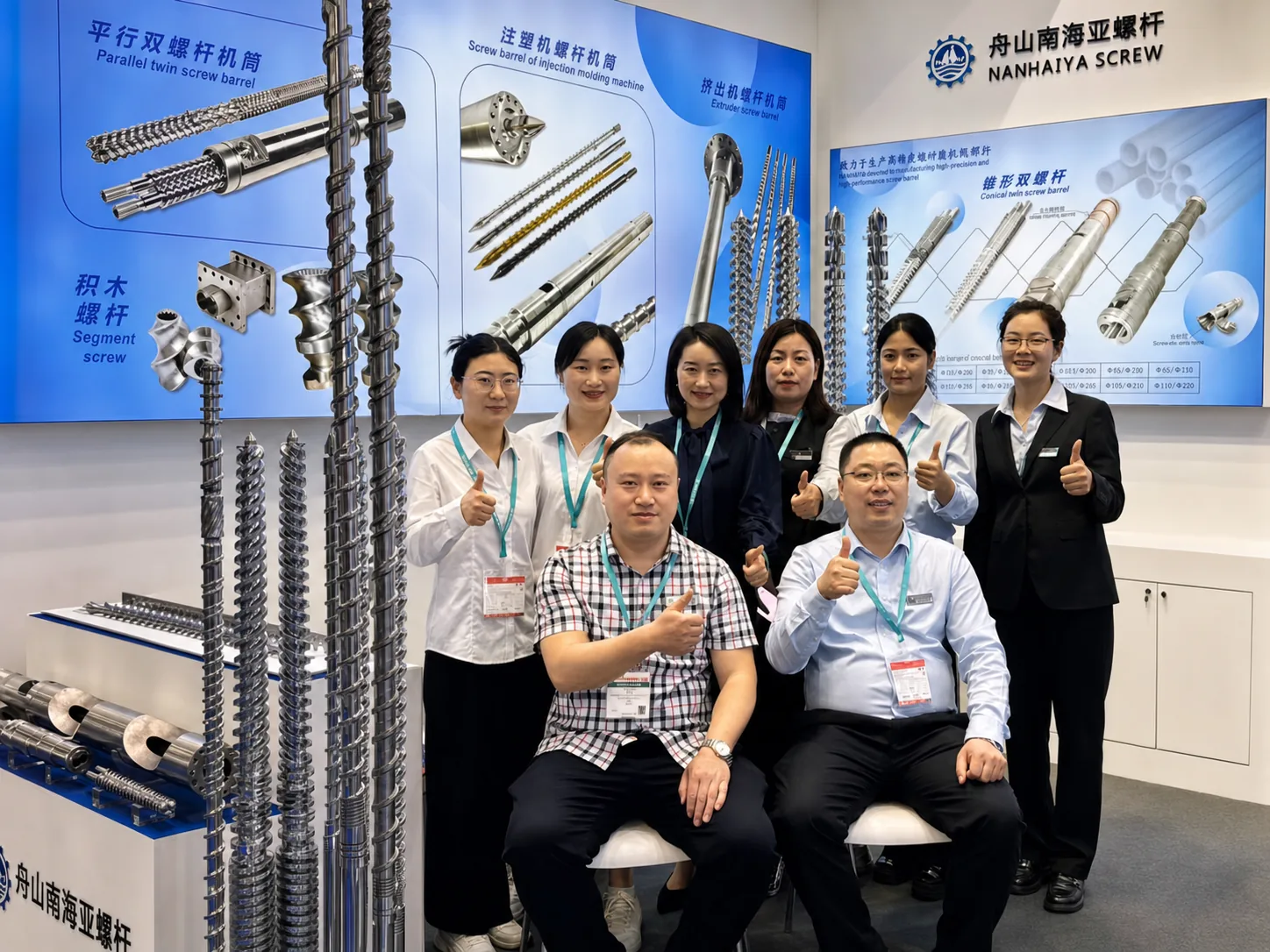
Related Articles
More insights on screw barrel technology and plastics processing.
What Nobody Tells You About Screw Barrel For Plastic Machine Design
Oct 10, 2026
Learn how screw barrel for plastic machine design affects melt quality, throughput, and wear life. Covers geometry, resin matching, troubleshooting, and sourcing.
Read Article
Single Screw Extruder for Sheet: Stop Guessing, Start Specifying
Oct 9, 2026
Learn how to specify a single screw extruder for sheet production. Covers screw geometry, resin-specific processing, troubleshooting, and maintenance best practices.
Read Article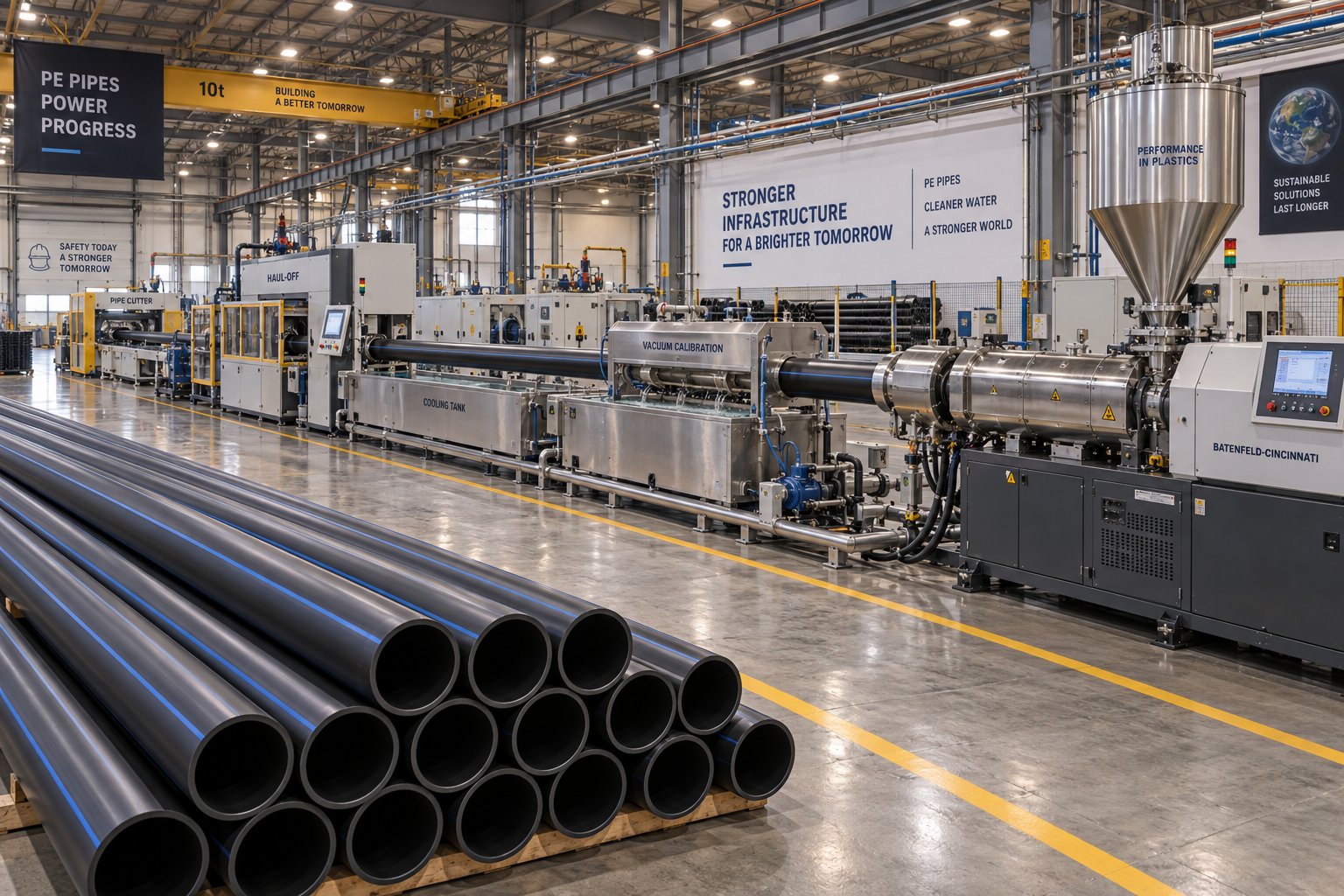
PE Pipe Extruder Machine: What Datasheets Won't Tell You
Oct 9, 2026
Learn how a PE pipe extruder machine works, key specs explained, material grade selection, maintenance tips, and buyer guidance beyond the datasheet.
Read ArticleLooking for something else?
Search by material, symptom or product and jump straight to the relevant page.
These are navigation suggestions based on keyword matching — not a quotation, not a delivery commitment, and not a substitute for engineering review. Final specification is confirmed by our engineers against your drawings and processed material.
Need help with screw barrel selection?
Share your machine model, processed material and application. Our team can help with pricing and technical support.