

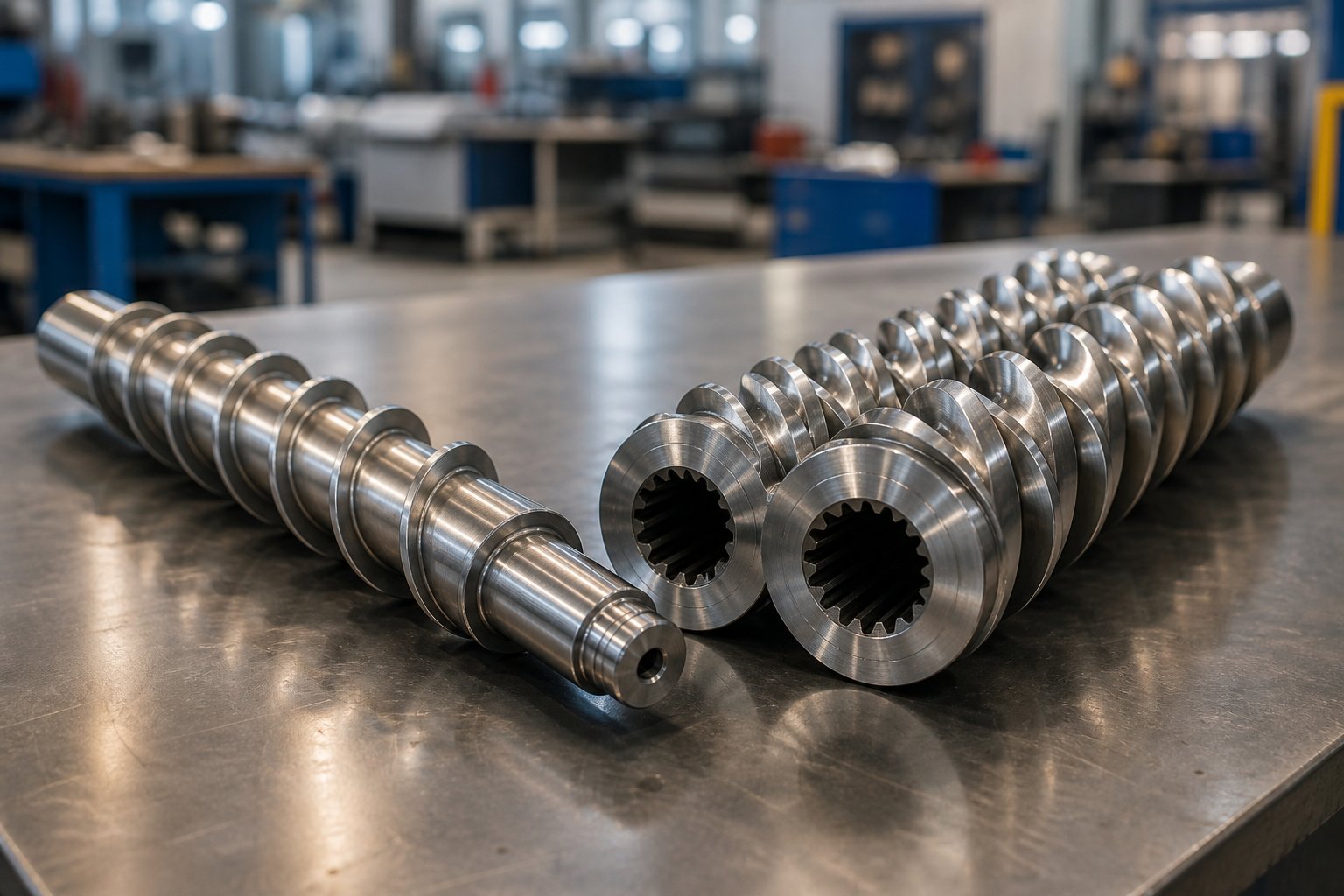
Understanding Screw Extrusion and Why the Comparison Matters
Choosing between a single screw extruder and a twin screw extruder is one of the highest-stakes equipment decisions in polymer processing. Pick the wrong one and you face wasted capital, subpar product quality, or throughput bottlenecks that quietly drain profits for years. Yet much of the information available online is either oversimplified or skewed by manufacturer bias, making the real difference between single screw and twin screw extruder designs harder to evaluate than it should be.
What Is a Screw Extruder and Why Does It Matter
So, what's an extruder in practical terms? At its core, screw extrusion is the continuous process of feeding, melting, mixing, and shaping materials by rotating one or more screws inside a heated barrel.
A screw extruder is a processing machine that uses one or more helical screws rotating within a heated barrel to convey, compress, melt, and pump polymeric or other viscous materials through a shaped die, producing continuous profiles, pellets, or compounds.
This fundamental mechanism powers everything from plastic pipe production and blown film lines to pharmaceutical pelletizing and food manufacturing. The type of screw extruder you select, whether single or twin, determines your mixing capability, material flexibility, energy profile, and long-term operating cost.
Who Needs This Comparison
Engineers specifying new lines, plant managers optimizing existing operations, and procurement teams evaluating capital expenditures all benefit from a clear, unbiased breakdown. This article covers every dimension that matters:
- Mixing efficiency — distributive and dispersive performance in each design
- Throughput and output stability — how each architecture handles production demands
- Energy consumption — where each extruder type spends and saves power
- Capital and total cost of ownership — upfront investment versus lifetime expenses
- Maintenance and wear — downtime patterns, spare part complexity, and purging behavior
Every comparison ahead is grounded in processing physics rather than brand preferences. The goal is straightforward: give you the technical clarity to match the right screw extruder to your specific application, not to declare one design universally superior.
How a Single Screw Extruder Works
Before you can meaningfully compare two extruder architectures, you need to understand what happens inside each one at a physics level. A single screw extruder machine may look simple from the outside — one rotating screw, one barrel, one motor — but the interplay of forces along its length is anything but straightforward.
Feed, Compression, and Metering Zones Explained
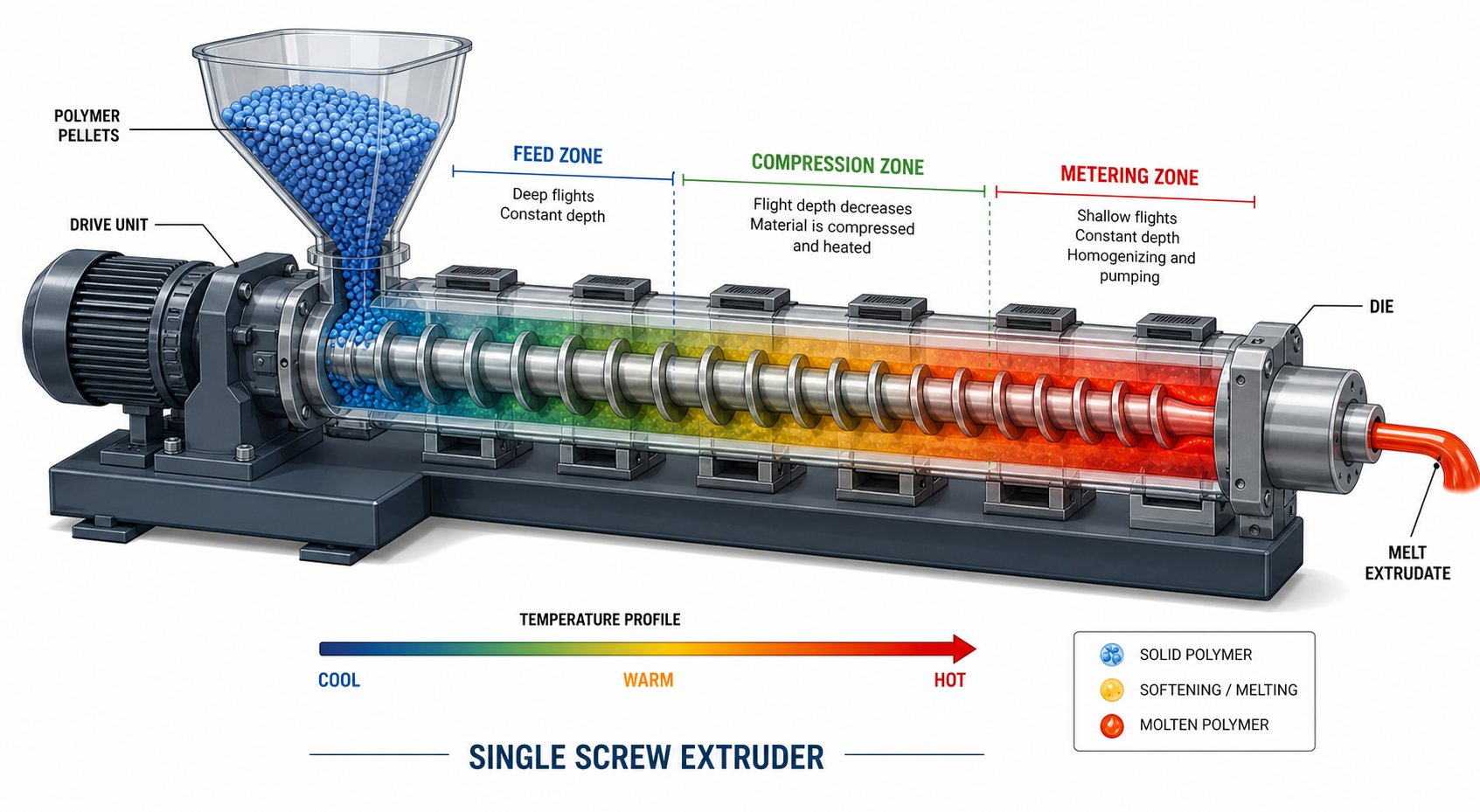
Every single extruder screw is divided into three functional zones, each engineered to perform a distinct task as material travels from hopper to die.
Feed zone: Solid pellets or powder enter from the hopper and fill the deep screw channel. The channel depth here is constant and deliberately generous, allowing material to be conveyed forward by the friction between the polymer, the barrel wall, and the screw root. Barrel-surface temperature in this zone must be high enough for polymer to stick to the barrel, yet controlled carefully to prevent premature melting that could block solids intake.
Compression (transition) zone: The channel depth gradually decreases, squeezing the polymer bed and forcing trapped air back toward the feed throat. This compression builds pressure, pushes unmelted solids against the hot barrel surface, and initiates large-scale melting. As Allan Griff explains, the compression ratio — the volume of the first flight divided by the volume of the last — typically falls between 2:1 and 4:1, though this number alone cannot fully describe a screw without knowing at least one actual channel depth.
Metering zone: By this point, the polymer is nearly fully molten. The channel depth is constant but much shallower than the feed zone, creating a uniform pumping section that delivers consistent flow to the die. Mixing and thermal homogenization happen here, though both remain limited by the single-channel geometry.
Drag Flow vs Pressure Flow Mechanics
Imagine sitting on the screw and watching the barrel rotate around you. The barrel surface drags a thin layer of molten polymer forward along the screw channel — this is drag flow, and it is the primary conveying mechanism in single screw extrusion. The faster the screw turns, the greater the drag flow rate.
Working against drag flow is pressure flow, sometimes called back-pressure flow. The die at the end of the barrel resists the melt, creating a pressure gradient that pushes material backward along the channel. The actual output of the extruder is the net result: drag flow minus pressure flow. This relationship is why a single screw plastic extruder's throughput drops when die resistance increases, and why screw speed adjustments alone cannot always compensate for changes in head pressure.
How Melting Actually Happens
A common misconception is that barrel heaters supply most of the energy needed to melt polymer. In reality, roughly 85–90% of the drive power goes directly into melting through viscous dissipation — the mechanical-to-thermal energy conversion that occurs when the screw shears the polymer against the barrel wall. Barrel heaters are essential at startup, but once the screw is rotating, shear heating dominates so completely that barrel zones often switch to cooling mode during steady-state operation.
The shear rate is highest near the barrel surface and drops to nearly zero at the screw root. The compression zone forces unmelted solids closer to the barrel wall, maximizing their exposure to this high-shear region. Conduction from the barrel surface contributes a secondary, much smaller fraction of the total melting energy. This shear-dominated melting mechanism explains why screw geometry — channel depth profile, compression ratio, and flight clearance — has a far greater impact on melt quality than barrel temperature settings.
Strengths and Limitations of Single Screw Design
Understanding these mechanics reveals both why single screw extrusion machines dominate certain applications and why they fall short in others.
Pros
- Lower capital cost: Simpler mechanical design with fewer precision components translates to a significantly lower purchase price compared to twin screw systems of equivalent throughput.
- High pumping efficiency: The single-channel architecture generates strong, stable pressure against the die, making it ideal for steady-state profile, pipe, sheet, and film extrusion.
- Excellent energy efficiency for simple melting: When processing pre-compounded pellets that need only melting and conveying, a single screw extruder machine delivers more output per kilowatt than a twin screw equivalent.
- Lower maintenance complexity: One screw, one set of bearings, one thrust assembly — fewer components mean simpler inspections and longer intervals between overhauls.
Cons
- Limited dispersive mixing: The single helical channel produces distributive shearing along the flow path, but it cannot efficiently break apart agglomerated fillers, pigment clusters, or poorly dispersed additives without specialized add-ons like Maddock mixing sections or static mixers.
- Narrow material flexibility: Processing raw dry-blends, heavily filled compounds, or moisture-sensitive materials is difficult because the single screw lacks venting versatility and self-wiping capability.
- Broad residence time distribution: Material near the barrel wall moves faster than material near the screw root, creating a wide spread in how long individual polymer elements spend inside the extruder — a disadvantage for heat-sensitive or reactive processes.
- Scale-up challenges: Maintaining identical melt quality when moving from a smaller to a larger diameter screw requires careful redesign, since shear rates, heat transfer, and residence time all shift non-linearly.
Best For
- Steady-state extrusion of pre-compounded pellets into pipe, profile, sheet, or film
- High-volume, single-material production runs where recipe changes are infrequent
- Applications where the polymer requires only melting and conveying, not intensive compounding
These inherent trade-offs raise a natural question: what happens when you add a second screw to the equation? The answer involves an entirely different set of conveying, mixing, and self-wiping behaviors that reshape what an extruder can accomplish.
Twin Screw Extruder Types and Working Principles
Adding a second screw does far more than double the hardware. It introduces entirely new conveying physics, multiple screw interaction modes, and a modular design philosophy that makes the twin screw extruder a fundamentally different class of machine. The catch? Not all twin screw designs work the same way. In fact, the performance gap between twin screw subtypes can be just as dramatic as the gap between single and twin screw architectures — a nuance most comparisons overlook entirely.
Intermeshing and Non-Intermeshing Designs
The first and most fundamental distinction in twin screw extrusion is whether the two screws physically overlap. This single geometric choice governs shear intensity, mixing quality, and self-cleaning behavior.
In an intermeshing design, the flights of one screw reach into the channel of the other. Imagine two interlocking gears — the tight clearance between them forces material through narrow gaps, generating high shear and creating a self-wiping action where each screw continuously scrapes residual material off the other. This self-wiping geometry — formally known as the Erdmenger profile — virtually eliminates dead zones, ensuring every particle passes through high-shear regions. The result is superior dispersive and distributive mixing, tighter residence time distribution, and faster material changeovers because very little polymer remains stuck to the screws.
Intermeshing configurations can be further divided into fully intermeshing systems, where the screw flights mesh deeply with minimal clearance, and partially intermeshing systems, where the overlap is shallower and shear intensity is reduced. Fully intermeshing designs dominate compounding applications; partially intermeshing variants suit formulations requiring a compromise between mixing quality and thermal gentleness.
A non-intermeshing twin screw extruder, by contrast, positions its two screws side by side with a small gap between them — no physical overlap at all. Shear forces drop significantly, and the self-wiping effect disappears. Why would anyone choose lower mixing capability? Because some materials demand it. Thermally sensitive polymers, soft PVC formulations, and certain thermoplastic elastomers benefit from the gentler conveying environment a non-intermeshing layout provides.
Co-Rotating vs Counter-Rotating Configurations
Layered on top of the intermeshing distinction is the direction each screw turns — and this is where twin screw behavior diverges even further.
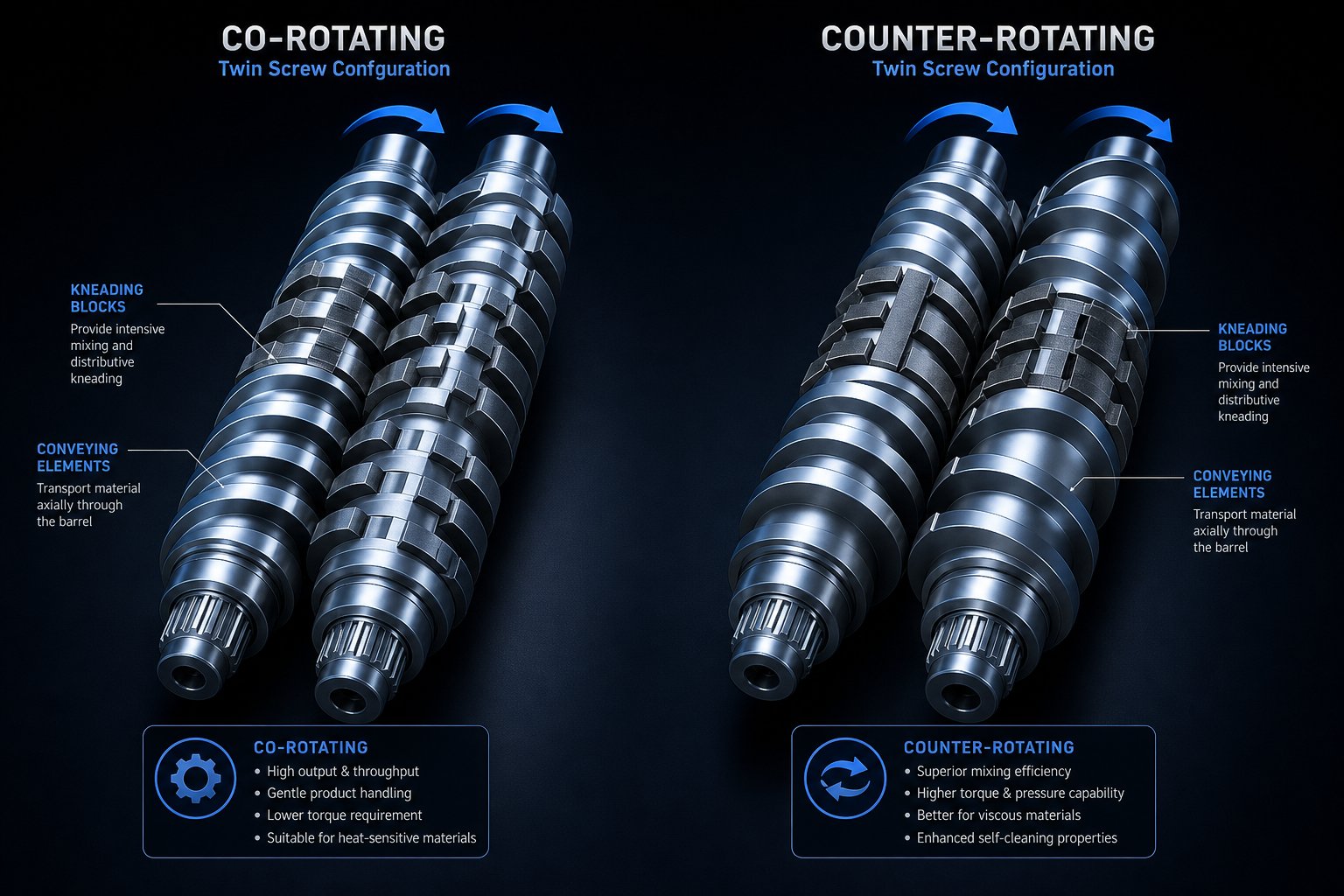
A co-rotating twin screw extruder spins both screws in the same direction. Material follows a figure-eight path as it transfers from one screw to the other, passing through the intermeshing zone repeatedly. Each pass subjects the melt to fresh shear and elongational forces, producing outstanding distributive and dispersive mixing. Co-rotating systems typically operate at high speeds (often 200–1,200 RPM), making them the workhorse of polymer compounding, reactive extrusion, and pharmaceutical hot-melt extrusion.
A counter-rotating design spins the screws in opposite directions. Material is squeezed between the screws in a calendering-like action, producing strong positive-displacement conveying at lower screw speeds (typically 10–80 RPM). The calender gap generates moderate shear, but the tight nip between counter-rotating flights builds pressure efficiently — a trait particularly valuable for profile and pipe extrusion of shear-sensitive materials like rigid PVC.
Understanding the distinction between co rotating and counter rotating twin screw extruder configurations is essential because choosing the wrong rotation direction for your material can either degrade heat-sensitive polymers or leave fillers poorly dispersed.
A conical twin screw extruder features screws that taper from a larger diameter at the feed end to a smaller diameter at the discharge end, providing high feeding capacity for bulky powders and strong pressure buildup toward the die. A parallel twin screw extruder maintains a constant screw diameter along its full length, offering greater L/D flexibility and easier modular screw element configuration for complex compounding tasks.
The table below synthesizes these subtypes into a practical classification framework, expanding on established engineering classification approaches to provide real-world application context.
| Configuration | Rotation Direction | Typical Speed Range | Self-Wiping Capability | Primary Applications |
|---|---|---|---|---|
| Intermeshing (fully) | Co-rotating | 200–1,200 RPM | Excellent — continuous self-wiping | Polymer compounding, masterbatch, reactive extrusion, pharmaceutical HME |
| Intermeshing (fully) | Counter-rotating | 10–80 RPM | Good — calender-nip wiping | PVC pipe and profile extrusion, rigid sheet |
| Intermeshing (partially) | Counter-rotating | 10–60 RPM | Moderate | Shear-sensitive formulations, specialty compounds |
| Non-intermeshing | Co-rotating or counter-rotating | 10–150 RPM | None | Soft PVC, thermoplastic elastomers, delicate blending |
Modular Screw Elements and Process Flexibility
Here is where twin screw extrusion gains its most powerful advantage over single screw systems: modularity. Rather than machining one continuous helical flight along the entire shaft, twin screw designs assemble individual screw elements onto a splined shaft, allowing engineers to customize the screw profile zone by zone.
Three element families form the building blocks of every screw configuration:
- Conveying elements — Deep-flighted helical segments that move material forward without applying significant shear. These fill the feed zone and any section where gentle transport is needed. As NC State Extension research explains, channel depth in conveying elements is deliberately deeper than in compression or metering zones to maximize volume throughput.
- Kneading blocks — Stacked elliptical discs offset at specific angles (commonly 30°, 45°, 60°, or 90°) that create intense shear and elongational flow. Wider discs promote dispersive mixing by breaking apart agglomerates, while narrower discs favor distributive mixing by spreading the dispersed phase more evenly. Forward-staggered kneading blocks convey material gently; neutral (90°) blocks impart maximum energy; reverse-staggered blocks push material backward, maximizing restriction and residence time.
- Toothed mixing elements — Gear-like segments that split and recombine flow streams, providing excellent distributive mixing without the high dispersive shear of kneading blocks. These are ideal for blending heat-sensitive additives or color concentrates.
By rearranging these elements on the shaft, process engineers can tailor an extruder for anything from aggressive filler dispersion to gentle blending — all on the same machine. A parallel twin screw extruder is particularly well-suited to this modular approach because its constant barrel diameter allows maximum flexibility in element selection and sequencing. Conical twin screw extruder designs offer modularity too, though the tapering geometry limits the number of interchangeable element positions.
This configurability also means two identical extruders can behave very differently depending on their screw profiles. It is a level of process customization that a single screw simply cannot replicate — but it also introduces complexity in maintenance and spare part management, a reality that carries significant cost-of-ownership implications worth examining closely.
Single Screw vs Twin Screw Extruder Head-to-Head Comparison
Knowing how each extruder works is one thing. Seeing the two designs measured against the same yardstick is something else entirely. The table below lines up single screw and twin screw extruders across fifteen processing parameters — covering everything from mixing quality and throughput to energy use and maintenance burden. Whether you are evaluating a double screw extruder for compounding or sizing a single screw line for pipe production, this comparison gives you a single reference point instead of scattered spec sheets.
15 Critical Parameters Compared
| Parameter | Single Screw Extruder | Twin Screw Extruder |
|---|---|---|
| Distributive Mixing | Moderate — limited to channel shearing; improved with add-on mixing sections or static mixers | Excellent — figure-eight material transfer and modular kneading elements produce thorough blending |
| Dispersive Mixing | Poor to moderate — cannot efficiently break apart tightly bonded agglomerates without specialty screws | Excellent — high-shear kneading blocks and elongational flow zones break agglomerates effectively |
| Throughput Capacity | High for simple melting and conveying; output is coupled to screw speed | High for compounding; output can be set independently of screw speed in starve-fed operation |
| Shear Rates | Moderate — governed mainly by screw speed and flight clearance | Adjustable from low to very high depending on screw element selection and speed |
| Residence Time Distribution (RTD) | Broad — significant velocity differences between barrel wall and screw root widen the spread | Narrow and controllable — intermeshing geometry and self-wiping action reduce stagnation |
| Self-Cleaning Capability | None — material can stagnate in dead zones, especially at flight roots | Excellent in co-rotating intermeshing designs; moderate in counter-rotating configurations |
| Material Versatility | Best suited for pre-compounded pellets and single-polymer systems | Handles powders, dry-blends, filled systems, reactive formulations, and recycled feedstocks |
| Relative Capital Cost | Lower — simpler mechanical design with fewer precision components | Higher — complex gearbox, modular screw elements, and tighter barrel tolerances increase price |
| Energy Efficiency | More efficient for straightforward melting and conveying at steady state | Higher motor input per kg, but can eliminate pre-compounding steps, lowering total system energy |
| Maintenance Complexity | Lower — one screw, fewer bearings, simpler inspections | Higher — modular elements require individual inspection; intermeshing zones experience complex wear |
| Scalability (Lab to Production) | Possible but challenging — shear rates and heat transfer shift non-linearly with diameter | Predictable in co-rotating designs — geometric similarity rules allow reliable scale-up |
| Venting / Devolatilization | Limited — typically one vent port; requires two-stage screw design for effective devolatilization | Excellent — multiple vent ports can be placed along the barrel; starve feeding keeps vents open |
| Feeding Flexibility | Flood-fed (gravity) — hopper must keep the feed throat full for stable output | Starve-fed (metered) — gravimetric feeders control throughput independently of screw speed |
| Typical L/D Ratio | 20:1 to 36:1, with 24:1 being most common | 32:1 to 56:1 for co-rotating; 16:1 to 28:1 for conical counter-rotating |
| Temperature Profile Control | Moderate — shear heating dominates and is difficult to decouple from screw speed | Precise — heat input from screws is lower relative to barrel heating, allowing independent thermal control |
| Pressure Generation | Strong — single deep-channel metering zone builds high, stable die pressure | Moderate — often requires a gear pump or discharge screw for applications needing very high die pressure |
Reading the Comparison Table for Your Application
A quick scan of the table might tempt you to conclude that twin-screw extruders win on most counts. Look more carefully, though, and you'll notice a pattern: every twin screw advantage comes with a cost, complexity, or energy trade-off. High dispersive mixing matters enormously when you're compounding glass-fiber-reinforced nylon — but it's wasted capability (and wasted budget) if you're running pre-colored HDPE pellets into pipe. Similarly, the strong pressure generation of a single screw is exactly what a profile die demands, while it's irrelevant in a starve-fed compounding line that uses a gear pump anyway.
The honest takeaway? Neither machine is universally superior. The "better" screw extruder is always defined by the intersection of your material, your process, and your economics. The parameters above are the vocabulary for that conversation — but the decision itself depends on how those parameters map onto a specific production scenario.
Key terms used in this comparison: L/D ratio is the screw length divided by its diameter, indicating how much processing length is available for melting, mixing, and pressure buildup. Residence time distribution (RTD) describes the statistical spread of how long individual material elements remain inside the extruder — a narrow RTD means uniform thermal history, which is critical for heat-sensitive polymers. Dispersive mixing refers to breaking apart agglomerates or droplets using high stress, while distributive mixing refers to spreading those already-reduced particles evenly throughout the matrix without necessarily applying additional stress.
These definitions matter because misunderstanding even one of them can lead to costly over-specification or, worse, choosing a machine that physically cannot deliver the mixing quality your formulation requires. The real question isn't which extruder scores higher on a spec sheet — it's which materials and industries actually exploit those differences in practice.
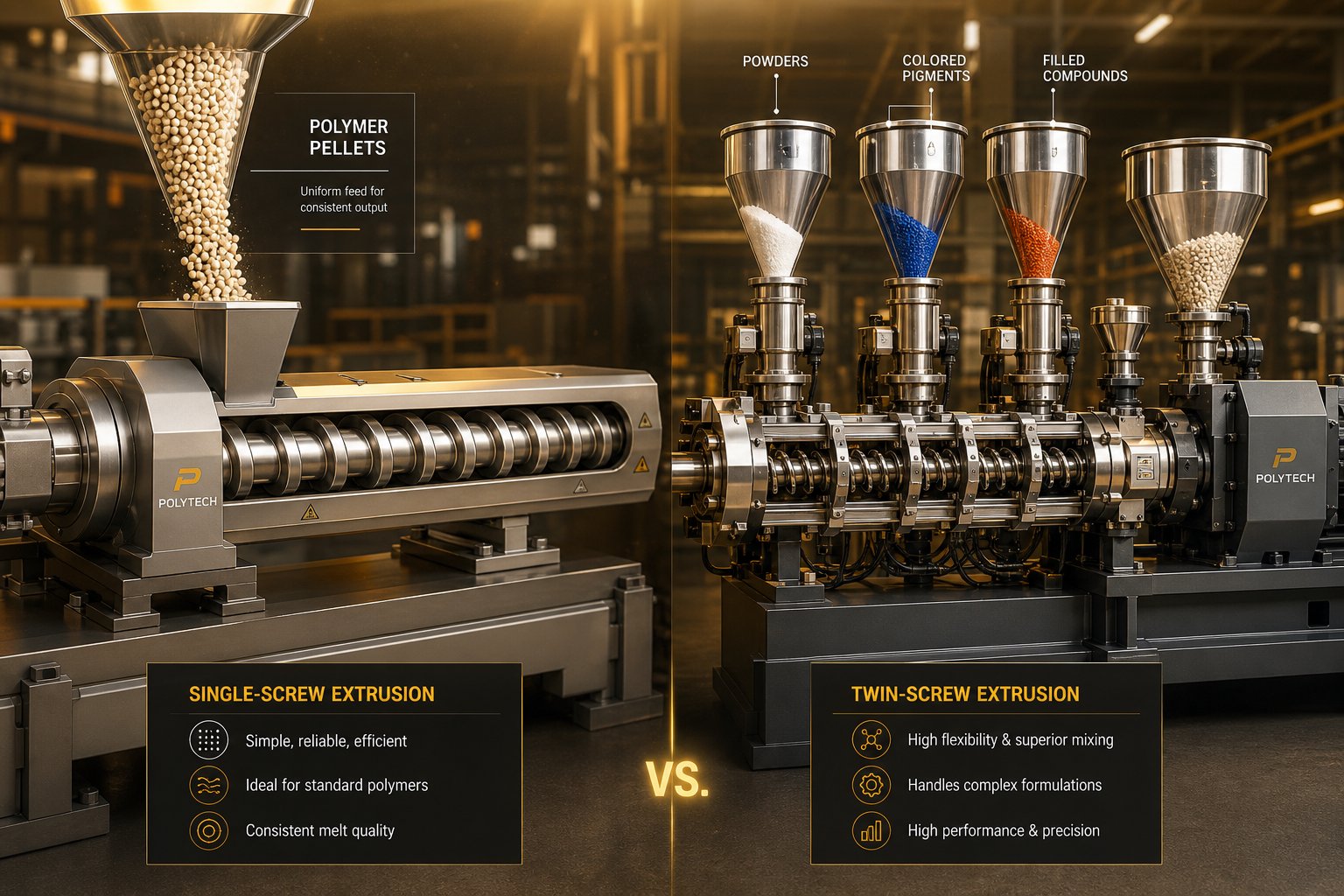
Material and Industry Performance Differences
Spec sheets compare machines. But the real test happens when polymer meets metal — when a specific resin, filler, or recycled flake enters the barrel and either processes cleanly or causes hours of headaches. The same extruder that runs PE film beautifully can choke on a glass-fiber-filled nylon compound. That's why understanding how different materials behave inside each extruder type is far more useful than memorizing parameter tables.
Commodity Polymers and Standard Extrusion
When you're running polyethylene (PE), polypropylene (PP), or polystyrene (PS) that arrives as pre-compounded pellets, a plastic single screw extruder is often the smartest investment. Why? Because these materials need only melting and stable pressure generation — exactly what the single screw's drag-flow mechanics deliver most efficiently.
- PE (HDPE, LDPE, LLDPE): Single screw preferred for pipe, blown film, and sheet extrusion. The polymer's relatively broad processing window and good flow characteristics match the single screw's steady-state pumping behavior. A twin screw adds mixing capability these applications simply don't require.
- PP: Single screw preferred for fiber spinning, cast film, and thermoformed sheet. PP's melt rheology responds well to the consistent shear environment of a metering zone. Twin screw systems enter the picture only when PP must be compounded with talc, calcium carbonate, or impact modifiers before being pelletized.
- PS and ABS (pre-compounded): Single screw preferred for profile and sheet extrusion. These amorphous polymers melt gradually across the compression zone and benefit from the strong, uniform die pressure a single screw generates.
The common thread is simple: if the material arrives ready to melt and shape — no fillers to disperse, no additives to incorporate, no moisture to vent — the single screw's lower cost and higher pumping efficiency make it the practical choice.
PVC and Shear-Sensitive Materials
Polyvinyl chloride breaks every rule that makes single screw extrusion straightforward. PVC is thermally unstable, shear-sensitive, and typically arrives as a dry-blend powder rather than pellets. Push it through excessive shear and it degrades, releasing hydrochloric acid that corrodes equipment and ruins the product. Yet it needs thorough mixing to incorporate the stabilizers, lubricants, and plasticizers that make it processable in the first place.
This is where counter-rotating conical twin screw extruders dominate. Their tapered screws provide three critical advantages for PVC processing:
- High feed-zone intake capacity: The large-diameter feed end accepts bulky, low-density dry-blend powder without bridging — a task that flood-fed single screw extruders struggle with because their constant-diameter channels aren't sized for low-bulk-density inputs.
- Gentle, controlled shear: Counter-rotating screws at low speeds (typically 10–40 RPM) generate just enough shear to fuse PVC particles into a homogeneous melt without pushing the material past its narrow thermal stability window.
- Strong pressure generation at the die: The tapered geometry naturally compresses material toward the smaller discharge end, building the high die pressure that PVC pipe and profile extrusion demand — without the need for aggressive metering-zone compression that could overheat the melt.
Other shear-sensitive materials — certain thermoplastic elastomers, crosslinkable compounds, and bio-based polymers with narrow processing windows — follow a similar logic. Whenever excessive shear triggers degradation, a counter-rotating or partially intermeshing twin screw plastic extruder provides the gentle conveying environment these formulations need.
Compounding, Filled Systems, and Recycled Plastics
Compounding is where the twin screw extruder truly earns its price premium. When the job involves blending polymers with fillers, reinforcements, colorants, or reactive additives, a co-rotating intermeshing design is almost always the right tool. The five-step compounding process — feeding, melting, mixing, venting, and metering — demands capabilities that single screw systems simply weren't designed to provide.
- Glass-fiber and mineral-filled engineering plastics (PA, PBT, PC): Co-rotating twin screw preferred. Kneading blocks break apart fiber bundles and disperse mineral particles uniformly, while downstream side-feeding ports introduce abrasive fillers after the polymer is already molten — protecting the feed zone from premature wear. A compounding extruder in this role typically operates at L/D ratios of 40:1 to 52:1 to provide enough barrel length for sequential feeding, mixing, and venting.
- Masterbatch and color concentrate production: Co-rotating twin screw preferred. Achieving uniform pigment dispersion at loadings of 20–70% demands the high dispersive and distributive mixing only an intermeshing twin screw design delivers. A single screw cannot break apart pigment agglomerates effectively, resulting in visible specks and inconsistent color.
- Polymer blends and alloys (PC/ABS, PA/PP, TPO): Co-rotating twin screw preferred. Blending immiscible polymers requires intense elongational flow to achieve the fine morphology that determines impact strength, surface finish, and long-term stability. The figure-eight flow pattern in co-rotating systems provides exactly this.
- Recycled and post-consumer plastics: Twin screw strongly preferred. Recycled feedstocks arrive with variable contamination, residual moisture, mixed polymer fractions, and inconsistent bulk density. A plastic twin screw extruder manages these challenges through starve-fed metering (handling bulk density variation), multiple venting zones (removing moisture and volatiles without a separate drying step), and self-wiping screws (preventing degraded material from accumulating in dead zones). As Torontech notes, twin screw extruders contribute directly to circular economy initiatives by converting post-consumer waste into usable pellets.
Even within compounding, though, nuance matters. A single screw can handle lightly filled concentrates (under 10% filler loading) if paired with a mixing-section screw design and static mixer. The distinction isn't binary — it's about the threshold where mixing demands exceed what a single channel can physically deliver.
Beyond Plastics: Food, Pharma, and Specialty Applications
The same mixing precision and residence time control that make twin screws ideal for polymer compounding also make them indispensable in industries far removed from plastics.
- Food processing: Twin screw extruders produce textured snacks, breakfast cereals, pet food, and plant-based meat analogs. Precise temperature profiling and ingredient sequencing — adding starches, proteins, fats, and flavors at different barrel positions — require the modular screw design and starve-fed flexibility that only twin screw systems offer.
- Pharmaceuticals: Hot-melt extrusion using co-rotating twin screws creates solid dispersions for controlled drug release. The narrow residence time distribution ensures that active pharmaceutical ingredients experience uniform thermal exposure, preventing degradation of sensitive compounds.
- Rubber and elastomers: Devolatilization and dewatering of synthetic rubber employ twin screw extruders with specialized venting zones, removing water and solvents in a continuous process that single screw designs cannot replicate efficiently.
The pattern across all these industries is consistent: when a process demands precise ingredient sequencing, controlled shear, effective devolatilization, or tight residence time management, twin screws are the preferred platform. When the process is primarily about melting a uniform feedstock and pushing it through a die at stable pressure, a single screw delivers equal or better results at lower cost.
Material choice, in other words, narrows the extruder decision considerably. But material behavior inside the barrel is only half the equation — how much energy each machine consumes to process that material, and how precisely engineers can control the process variables, shapes the total cost picture in ways that raw throughput numbers alone can't capture.
Energy Efficiency and Process Control Compared
Material compatibility tells you which extruder can run your formulation. Energy consumption and process control tell you how much that run actually costs — and how consistently you can hit spec. These two factors shape the total economics of an extrusion line far beyond what purchase price alone reveals, yet they remain the least discussed aspects of the single-vs-twin comparison.
Specific Energy Consumption Explained
The most honest way to compare energy use between extruder types is specific energy consumption (SEC), expressed in kilowatt-hours per kilogram of output (kWh/kg). SEC captures the total electrical energy — motor drive, barrel heating, cooling, and auxiliaries — divided by actual throughput. It strips away the noise of raw motor size and focuses on what matters: how much energy you spend to process each kilogram of product.
For straightforward melting and conveying of pre-compounded pellets, single screw extruders typically deliver SEC values in the range of 0.08–0.12 kWh/kg. Their simpler drag-flow mechanics and lower motor power relative to throughput make them inherently efficient when the job is just melting and pumping. Twin screw systems, by contrast, generally fall in the 0.12–0.25 kWh/kg range for the same reference. The dual-drive configuration, higher screw speeds, and intense shear in kneading zones all demand more electrical input per kilogram.
That gap, however, can be misleading if you look at the extruder in isolation. A compounding twin screw extruder often eliminates multiple downstream steps — pre-mixing, separate pelletizing passes, and post-blending — that a single screw process would require. When you account for the total system energy across the entire production workflow, the twin screw's higher per-kilogram input can actually reduce overall plant energy consumption by consolidating what would otherwise be a multi-step process into a single pass.
Residence Time, Temperature, and Pressure Control
Energy isn't the only process variable that behaves differently between the two designs. The twin screw extrusion process offers a level of parameter independence that single screws fundamentally cannot match.
Residence time distribution (RTD): Research on co-rotating twin screw extruders shows that throughput dominates residence time, while screw speed has a comparatively minor effect. A pharmaceutical extrusion study published in Pharmaceutics confirmed this pattern across multiple polymers — doubling screw speed shifted residence time only modestly, while halving throughput roughly doubled it. This independence lets engineers tune mixing intensity (via screw speed) without dramatically altering how long material stays in the barrel. In a single screw extruder, throughput and screw speed are tightly coupled; you can't meaningfully change one without changing the other.
Melt temperature: The same research found that screw speed exerts a much stronger influence on melt temperature than throughput does — higher RPM increases viscous dissipation, raising the melt temperature. Because twin screw systems operate starve-fed, engineers can adjust screw speed and feed rate independently, giving them two separate levers to control temperature and throughput. Single screw extruders, operating flood-fed, lack this decoupling. Shear heating dominates their thermal profile, making barrel-zone heaters more of a trim adjustment than a true control input.
Pressure generation: Single screw extruders build die pressure naturally through the metering zone — a genuine strength for profile and pipe dies that demand consistent backpressure. Twin screw compounding extruder systems generate moderate pressure at the screw tips, which is often sufficient for pelletizing dies but may require an auxiliary gear pump when high-pressure dies or filtration systems are downstream.
Scale-Up Behavior from Lab to Production
Imagine you've perfected a formulation on a laboratory twin screw extruder with a 26-mm screw diameter. Scaling that process to production involves real engineering risk — and here the two extruder types diverge sharply.
Co-rotating twin screw extruders scale using geometric similarity rules. If the lab and production machines share the same outer-to-inner diameter ratio and L/D ratio, throughput scales roughly with the cube of the diameter ratio when the process is power/volume-limited. A Dow case study in Plastics Technology demonstrated this approach across 26-mm, 40-mm, and 92-mm extruders producing a masterbatch. The key metric was specific mechanical energy (SME): as long as the scaled process matched the lab-scale SME of approximately 0.083 kWh/kg, both process stability and product quality were preserved — even when the 92-mm extruder achieved a throughput increase exceeding 12 times that of the 40-mm machine.
The same study revealed a critical caveat: the area-to-volume (A/V) ratio of a twin screw barrel decreases dramatically as diameter increases. Heat transfer through the barrel wall becomes less effective at larger scales, which can cause process instabilities if screw design and feeding configuration aren't adjusted. Initial scale-up attempts on the 92-mm extruder — using screw and temperature settings directly transferred from the smaller machines — produced unmelted pellets and an SME 67% lower than the target. Only after modifying the screw profile and feed arrangement did the process achieve the required energy input.
Single screw scale-up faces different challenges. Because melt quality depends heavily on the shear rate near the barrel wall — which changes non-linearly with diameter — a screw geometry that works perfectly at 60 mm doesn't automatically produce the same melt homogeneity at 150 mm. Compression ratios, flight depths, and even barrier-screw clearances may all need redesign. There is no single volumetric scaling equation that reliably predicts output quality the way geometric similarity does for co-rotating twin screws.
For companies developing new formulations, this scale-up predictability is a practical reason to invest in a benchtop twin screw extruder for early-stage R&D. Even a small-diameter system — 16 to 27 mm — can generate the SEC and RTD data that anchor a reliable scale-up pathway to full production, saving months of trial-and-error on larger equipment.
Energy and process control, then, reveal a deeper layer of the single-vs-twin comparison: it's not just about which machine mixes better, but about how precisely you can predict, control, and replicate your process as conditions change. That precision — or the lack of it — also shapes how people misunderstand each extruder type, fueling myths that lead to expensive purchasing mistakes.
Common Misconceptions About Single and Twin Screw Extruders
Persistent myths about extruder selection cost companies real money — either through over-specified equipment that never earns back its premium, or under-specified machines that choke on the very first production run. The four misconceptions below circulate widely in trade discussions, vendor presentations, and even training materials. Each one contains a kernel of truth wrapped in a generalization that breaks down the moment you apply it to a specific process.
Myth 1 — Twin Screw Is Always Superior
"If you want the best results, always go with a twin screw extruder machine — it outperforms single screw in every category."
This is the most expensive myth in the industry. Yes, twin screws deliver superior mixing, venting, and feedstock flexibility — but those advantages only matter when the application demands them. Consider pipe extrusion with pre-compounded HDPE pellets: the material needs melting and stable die pressure, nothing more. A single screw extruder handles this at lower capital cost, lower energy consumption, and simpler maintenance. The same logic applies to blown film, cast sheet, and profile extrusion of pre-colored resins. Specifying a double screw extruder machine for these jobs is like buying a commercial kitchen to reheat lunch — technically capable, but economically irrational. The "better" extruder is always the one matched to the task, not the one with the longer feature list.
Myth 2 — Single Screw Cannot Mix Well
"Single screw extruders are just pumps — they can't achieve meaningful mixing."
This was arguably true in the 1950s, but modern screw engineering has closed the gap considerably for many applications. Barrier screw designs separate melt from unmelted solids, completing melting more efficiently across the compression zone and freeing the downstream section for dedicated mixing duty. As extrusion consultant Jim Frankland explains, once material passes through a properly designed barrier section, it should be completely melted — making high-shear dispersive mixers unnecessary in most cases. Instead, distributive mixers such as Saxton-style multi-channel elements, pin mixers that create exponential melt divisions, and pineapple mixers that introduce chaotic flow angles can dramatically improve thermal homogeneity, color distribution, and additive blending. Static mixers installed between the screw tip and the die add yet another layer of redistributive capability. None of these solutions match a co-rotating twinscrew system for breaking apart tightly bonded filler agglomerates — but for color blending, thermal uniformity, and light additive incorporation, a well-designed single screw delivers results that surprise many engineers.
Myth 3 — All Twin Screw Extruders Are Alike
"We need a twin screw — just get us a quote on a double screw extruder and we'll be set."
This oversimplification ignores the fact that twin screws span a family of fundamentally different machines. A co-rotating intermeshing extruder running at 600 RPM for polymer compounding behaves nothing like a counter-rotating conical extruder running at 25 RPM for rigid PVC pipe. The first generates intense dispersive and distributive mixing through high-speed figure-eight material transfer. The second relies on gentle calendering action and positive displacement conveying to process a thermally fragile material without degradation. Treating these as interchangeable is a recipe for either destroying shear-sensitive polymers or failing to disperse fillers — depending on which direction the mismatch falls. Before requesting a quote, you need to specify not just "twin screw" but the rotation direction, intermeshing type, and speed range your process actually requires.
Myth 4 — Twin Screw Is Too Expensive for Small Operations
"Only large-scale production plants can justify the cost of a twinscrew extruder."
This belief made more sense two decades ago, when twin screw systems were available primarily in production-scale diameters. Today, laboratory and benchtop twin screw extruder machines with screw diameters as small as 6 to 16 mm are widely available, designed specifically for R&D, formulation screening, and small-batch production. These compact systems replicate the modular screw geometry, starve-fed operation, and mixing characteristics of their full-scale counterparts at a fraction of the footprint and investment. Small compounders, university research labs, and pharmaceutical developers routinely use them to optimize formulations before committing to production-scale equipment. The capital barrier to twin screw technology is far lower than many assume.
Each of these myths shares a common flaw: treating the extruder decision as a simple ranking rather than an engineering match. Recognizing what each design actually does — and where it falls short — is only half the picture, though. The long-term financial reality of owning and maintaining each machine type introduces another set of considerations that rarely appear in sales brochures but show up relentlessly on the plant floor.
Maintenance, Wear, and Total Cost of Ownership
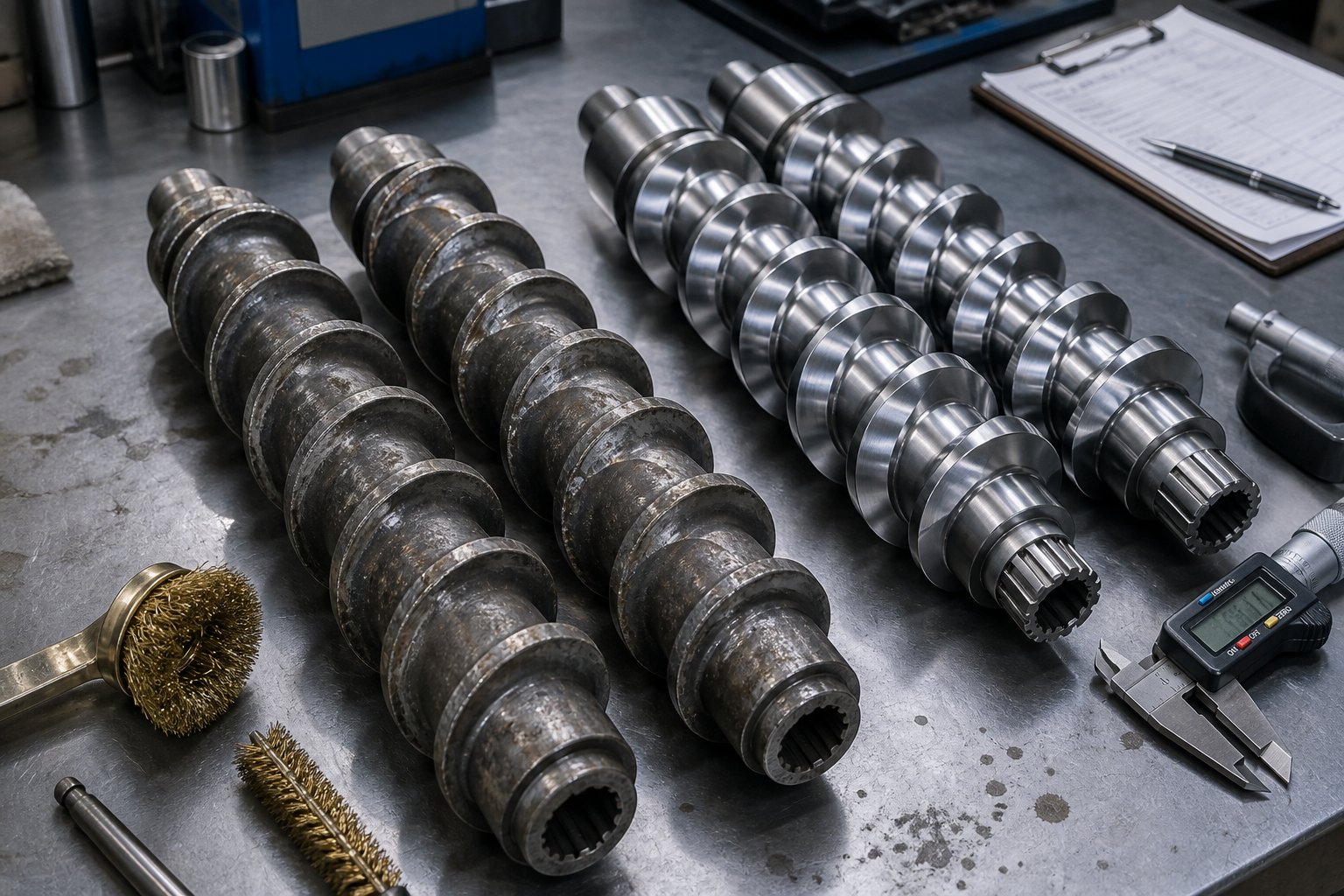
Sales brochures highlight throughput and mixing capability. They rarely mention what happens three years into ownership, when screw flights show visible wear lines, barrel clearances have doubled, and your process engineer is quietly compensating with higher speeds and adjusted temperatures just to hold spec. The long-term financial reality of any extruder lives in its maintenance profile — and this is where single screw and twin screw systems diverge in ways that matter as much as mixing quality or energy efficiency.
Wear Patterns in Single vs Twin Screw Systems
All screw extruders experience wear the moment rotation begins. As Plastics Technology explains, the clearances between screw flight outside diameter and barrel inner wall are minimal — typically 0.001 inch per side per inch of diameter — and any increase in those clearances reduces melting efficiency. But the location, pattern, and severity of that wear differ significantly between single and twin screw architectures.
In a single screw extruder, wear concentrates in predictable zones. The compression section takes the heaviest punishment because unmelted solids are forced against the barrel wall under increasing pressure. When the melting capacity of the screw falls short of the solids being delivered, a phenomenon called solids wedging occurs — the packed material pushes the screw off-center, driving the flight tips into the barrel wall on one side. This creates galling damage on both the flight lands and the barrel surface. Flight tip wear is the most common early indicator: the hardfaced alloy at the top of the flight gradually erodes, widening clearance and allowing molten polymer to leak backward over the flights instead of being pumped forward. Abrasive fillers — glass fiber, mineral reinforcements, flame retardants — accelerate this process dramatically, sometimes reducing useful screw life by 50% or more.
Twin screw systems face a more complex wear landscape. In addition to flight-tip abrasion, intermeshing co-rotating designs experience intense wear across kneading block surfaces, where high-shear elongational forces act on every polymer particle — along with any abrasive filler it carries. The intermeshing zone itself, where the two screws interact, sees material squeezed through tight clearances repeatedly, eroding both the lobal tips and the barrel bore simultaneously. Counter-rotating conical extruders process less abrasive formulations (PVC dry-blends, for example), so their wear tends to be gentler and more uniform, but the tapered twin screw barrel geometry makes wear measurement and replacement more involved than in parallel designs.
Three distinct wear mechanisms affect both architectures, though at different rates:
- Abrasive wear: Hard filler particles or contaminants act like sandpaper between screw and barrel surfaces — the dominant wear mode in compounding applications.
- Adhesive wear: Metal-to-metal contact between screw flights and barrel wall causes micro-welding and tearing at the surface. Misalignment and solids wedging are the primary triggers.
- Corrosive wear: Chemical attack from decomposing polymers — particularly PVC and fluoropolymers — gradually destroys iron-rich surfaces, making the weakened metal more vulnerable to mechanical wear.
The insidious part of all three mechanisms is how gradually they erode performance. Operators compensate with incremental speed increases, temperature adjustments, and backpressure tweaks. These changes go unnoticed until product quality or scrap rates cross an unacceptable threshold — a point industry veterans call "diminishing returns," where machine adjustments can no longer mask the underlying wear.
Cleaning, Purging, and Material Changeover
Wear isn't the only maintenance variable that separates these two designs. How quickly you can switch materials — and how thoroughly the barrel clears between runs — directly affects uptime, scrap rates, and product contamination risk.
Self-wiping co-rotating twin screws hold a genuine advantage here. Because each screw continuously scrapes residual polymer off the other, far less material stagnates in the barrel during a changeover. A dedicated purging compound pushed through a co-rotating system can clear the barrel in roughly 15–30 minutes for a standard color change. Purging specialists and machinery makers agree on one critical point: don't use production resin or regrind to purge — they lack the chemical agents and scrubbing action needed to clean tight kneading-block geometries. Commercial purging compounds are specifically formulated to drag stubborn colorants out of dead zones that bare PE or PP simply can't reach.
Single screw extruders, lacking self-wiping geometry, require longer purge cycles. Material can stagnate at the screw root and in the deeper feed-zone channels, meaning dark-to-light color transitions may consume significant resin and time before the output runs clean. Adding mixing sections or barrier elements improves melt quality, but these features also create additional crevices where degraded polymer can lodge and carbonize — eventually breaking free as black specks in a future run.
When purging compounds aren't enough, physically pulling the screws becomes necessary. Here, the twin screw's modularity works both for and against you. On one hand, individual kneading blocks and mixing elements can be removed, inspected, and cleaned separately. On the other hand, there are far more components to handle. Reassembling modular elements in the wrong order — or failing to align the spline phase angle between the two screws — can snap a shaft the moment the motor starts. Photographing every step before disassembly is standard practice among experienced operators for exactly this reason.
One tooling rule applies equally to both machine types: use only brass brushes and scrapers when cleaning screws manually. Extruder screws are typically nitrided to a surface hardness of HV 900–1,100, but that case is only 0.4–0.8 mm deep. A steel wire brush scratches through it, creating permanent micro-craters that trap and carbonize polymer on every subsequent run — a mistake that has turned routine maintenance into months of intermittent contamination for more than one compounder.
Sourcing Replacement Screw Barrels and Spare Parts
Eventually, even well-maintained screws and barrels reach the end of their useful life. How quickly you can source replacements determines whether that transition is a planned weekend changeover or a multi-week production shutdown.
Single screw spare parts are relatively straightforward. You're typically sourcing a single screw and a one-piece or segmented barrel — components that many single screw extruder manufacturers and aftermarket suppliers keep in stock or can fabricate to standard dimensions within a few weeks. The critical specifications are screw diameter, L/D ratio, compression ratio, flight hardfacing alloy, and barrel liner material. Compatible metallurgy matters: as Plastics Technology notes, softer screw alloys paired with the hardest barrel linings can cause galling, so specifying screw hardfacing that runs compatibly with the barrel liner is essential.
Twin screw spare part management is more involved. A modular co-rotating system might contain dozens of individual screw elements — conveying segments, kneading blocks at various stagger angles, toothed mixers, and spacer rings — each of which wears at different rates depending on its position in the screw profile and the abrasiveness of the processed material. The twin screw barrel is often segmented as well, with individual barrel sections featuring different bore treatments, side-feeding ports, or venting openings. Keeping a complete inventory of every possible element is impractical for most operations, so working with a reliable twin-screw extruder manufacturer or specialized aftermarket supplier who maintains broad element inventories becomes a strategic advantage.
Whether you run single or twin screw equipment, proactive spare part planning prevents the costliest scenario of all: running a worn screw and barrel past the point of diminishing returns simply because replacements aren't available. Engineers evaluating their options can compare single screw, parallel twin screw, conical twin screw, and injection molding screw barrel configurations — along with individual replacement elements — through suppliers like NANHAIYA's screw barrel product collection, which consolidates these categories in one place for faster specification and sourcing across different processing applications.
| Maintenance Factor | Single Screw Extruder | Twin Screw Extruder |
|---|---|---|
| Primary Wear Locations | Compression zone, screw flight tips, barrel wall at compression section | Kneading blocks, intermeshing zone lobal tips, barrel bore at high-shear positions |
| Wear Complexity | Predictable, concentrated in 1–2 zones | Distributed across multiple element types; varies by screw profile configuration |
| Purge Time (Color Change) | 30–60+ minutes; longer for dark-to-light transitions | 15–30 minutes with commercial purge; self-wiping action accelerates clearing |
| Physical Screw Pull Frequency | Every 3–12 months (application dependent) | Every 3–6 months; more frequent with abrasive compounds or frequent material changes |
| Spare Part Complexity | Low — single screw + one-piece barrel; few unique components | High — dozens of modular elements, segmented barrels, matched pairs for twin screw and barrel sets |
| Typical Replacement Components | Complete screw, barrel liner, thrust bearing, feed-throat liner | Individual kneading blocks, conveying elements, barrel segments, shaft seals, coupling components |
| Downtime Risk from Delayed Parts | Moderate — standard dimensions are widely available | High — specialized elements from twin screw extruder manufacturers may have longer lead times |
| Total Maintenance Cost Trend | Lower per-event cost; fewer events per year | Higher per-event cost; more frequent inspections; offset by faster changeovers and reduced scrap |
Total cost of ownership, then, isn't captured by any single line item. It's the cumulative effect of wear-driven efficiency loss, purging waste, spare part lead times, and unplanned downtime spread across years of operation. Understanding these patterns before you buy — not after your first emergency shutdown — is what separates a well-planned extruder investment from an ongoing maintenance headache. That clarity also feeds directly into the most practical question left to answer: given everything you now know about performance, energy, myths, and maintenance, how do you actually choose the right extruder for your specific application?
How to Choose the Right Extruder for Your Application
Performance data, energy profiles, maintenance realities — you've absorbed a lot of information. But when it comes time to sign a purchase order, the decision distills into a handful of practical questions that filter out the noise and point you toward the right machine. The framework below walks through those questions in a sequence that mirrors how experienced engineers actually evaluate extruder investments.
Five Questions to Guide Your Extruder Selection
Rather than comparing spec sheets line by line, start with your process and let the answers guide you toward the architecture that fits.
- What is your primary process — simple extrusion or compounding/reactive processing? If you're melting pre-compounded pellets and pushing them through a die to form pipe, film, sheet, or profiles, a single screw extruder is typically the most cost-effective choice. If you're blending polymers with fillers, dispersing pigments, reacting additives, or devolatilizing moisture, a twin-screw extruder is almost certainly required.
- What materials are you processing — pre-compounded pellets or raw/filled/recycled feedstocks? Pellets with consistent bulk density and no additives to incorporate favor single screw simplicity. Dry-blend powders (especially PVC), mineral-filled compounds, recycled flake, or multi-component formulations demand the mixing intensity and feeding flexibility only twin screws deliver.
- What throughput and scale do you need? Both architectures span a wide capacity range, but the path from lab development to production differs sharply. If you're scaling a new formulation, co-rotating twin screw systems offer predictable geometric scale-up. If you're adding capacity to a proven, single-material line, a larger single screw is often faster to commission and simpler to operate.
- What is your budget for capital equipment and ongoing maintenance? A twin-screw extruder machine carries a higher purchase price and more complex spare part requirements — but it can eliminate pre-compounding steps and reduce scrap rates that silently inflate single screw operating costs. Calculate total cost of ownership over five to ten years, not just the invoice price.
- Do you need frequent recipe or material changes? If your production schedule involves multiple changeovers per week, the self-wiping action and faster purge cycles of co-rotating twin screws save meaningful downtime. Operations running a single formulation 24/7 gain little from that capability and benefit more from the single screw's simpler operation.
These five questions won't produce a binary answer in every case. Some applications — lightly filled concentrates, for instance — sit in a gray zone where either machine could work. In those situations, the decision often tips on whichever factor you weight most heavily: capital cost, changeover speed, or long-term flexibility.
Quick-Reference Decision Matrix
The table below maps common application scenarios to a recommended extruder type, the key reason behind that recommendation, and the critical screw-barrel consideration that affects long-term performance.
| Application Scenario | Recommended Extruder Type | Key Reason | Critical Screw-Barrel Consideration |
|---|---|---|---|
| HDPE/PP pipe extrusion (pre-compounded) | Single screw | Strong die pressure, lower capital and energy cost for simple melting | Barrier screw with mixing section; nitrided barrel for long wear life |
| Masterbatch and color concentrate compounding | Co-rotating twin screw | Dispersive mixing breaks pigment agglomerates; distributive mixing ensures uniformity | High-wear kneading blocks in tool steel; bimetallic barrel liners for abrasion resistance |
| Rigid PVC pipe and profile extrusion | Counter-rotating conical twin screw | Gentle shear protects thermally sensitive PVC; large feed opening handles dry-blend powder | Corrosion-resistant barrel lining (HCl exposure); matched conical screw and barrel taper |
| Recycled plastic pelletizing | Co-rotating twin screw | Multiple vent ports remove moisture and volatiles; self-wiping prevents degraded buildup | Hardened screw elements for contaminated feedstock; segmented barrel for vent placement flexibility |
| Blown film (PE, PP — pre-compounded) | Single screw | Stable melt pressure and uniform output; lowest energy cost per kilogram | Optimized compression ratio for specific resin; grooved feed section for high-output designs |
| Glass-fiber-reinforced engineering plastics | Co-rotating twin screw | Downstream side feeding protects fibers; kneading intensity is adjustable via element selection | Abrasion-resistant barrel segments at side-feed and mixing positions; replaceable wear liners |
| Screw extruder granulator for compounding pellets | Co-rotating twin screw (with strand or underwater pelletizer) | Combines mixing and pelletizing in a single pass; starve-fed control sets precise throughput | Discharge screw or gear pump for stable die pressure; matched pelletizer capacity |
| Flexible PVC cable coating | Single screw | Pre-compounded pellets need only melting; high line speeds favor simple pumping design | Low compression ratio screw to avoid shear overheating; chrome-plated barrel for corrosion resistance |
Notice that the "Critical Screw-Barrel Consideration" column appears in every row. Regardless of which extruder twin screw or single screw architecture you choose, the screw and barrel are the components that determine melt quality, wear life, and maintenance cost. Specifying the right metallurgy, geometry, and surface treatment for these parts is just as important as selecting the machine itself.
Where to Start Your Evaluation
You have the framework. You know which extruder type suits your application. The next practical step is sourcing the screw barrel components that match your specific processing requirements — and this is where many buyers lose momentum, bouncing between multiple suppliers to compare single screw options against parallel twin screw and conical twin screw configurations.
A more efficient approach is starting with a supplier that consolidates these categories. Engineers comparing screw barrel options across single screw, parallel twin screw, and conical twin screw configurations for their specific application can use NANHAIYA's product collection as a practical starting point. It brings together screw barrels, individual replacement elements, and spare parts for different processing applications into a single reference, letting you match component specifications to the extruder type and material requirements you've identified through the decision framework above.
Whatever sourcing path you choose, anchor every specification decision to the five questions and the decision matrix. They exist to prevent the two most common purchasing mistakes: over-specifying a twin-screw extruder for a job a single screw handles better, or under-specifying a single screw for a process that genuinely demands twin screw mixing and venting capability.
The right extruder is defined by the application — not by any inherent superiority of one design over the other. Match the machine to your material, your process, and your economics, and both single screw and twin screw systems deliver excellent results within their respective domains.
Frequently Asked Questions About Single Screw and Twin Screw Extruders
1. What is the main difference between a single screw and twin screw extruder?
The core difference lies in conveying and mixing mechanics. A single screw extruder uses drag flow from one rotating screw to melt and pump material, excelling at steady-state extrusion of pre-compounded pellets. A twin screw extruder uses two intermeshing or non-intermeshing screws that create figure-eight material transfer, self-wiping action, and modular mixing zones. This makes twin screws superior for compounding, dispersing fillers, devolatilization, and processing challenging feedstocks like dry-blend powders or recycled plastics. However, the single screw remains more cost-effective and energy-efficient when only melting and stable die pressure are required.
2. Is a twin screw extruder always better than a single screw extruder?
No — this is one of the most costly myths in the industry. Twin screw extruders offer superior mixing, venting, and feedstock flexibility, but these advantages only justify the higher capital and maintenance costs when the application actually demands them. For pipe, blown film, cast sheet, or profile extrusion using pre-compounded pellets, a single screw extruder delivers equal or better output quality at lower energy consumption and simpler maintenance. The right extruder is always defined by matching the machine to your specific material, process requirements, and economics rather than defaulting to the more feature-rich option.
3. What is the difference between co-rotating and counter-rotating twin screw extruders?
Co-rotating twin screw extruders spin both screws in the same direction, typically at high speeds of 200-1,200 RPM. Material follows a figure-eight path through the intermeshing zone, producing excellent dispersive and distributive mixing — ideal for polymer compounding, masterbatch production, and reactive extrusion. Counter-rotating designs spin screws in opposite directions at lower speeds of 10-80 RPM, creating a gentle calendering action with strong positive-displacement conveying. This makes them the preferred choice for shear-sensitive materials like rigid PVC. Choosing the wrong rotation direction can either degrade heat-sensitive polymers or leave fillers poorly dispersed.
4. How do maintenance costs compare between single and twin screw extruders?
Single screw extruders have lower per-event maintenance costs and fewer inspections per year. Wear concentrates predictably in the compression zone and at flight tips, and spare parts are straightforward — one screw plus one barrel. Twin screw extruders require more frequent inspections because wear distributes across multiple modular elements like kneading blocks and intermeshing zones. However, twin screws offer faster purge cycles during material changeovers due to self-wiping action. Total cost of ownership depends on your application: high-changeover operations may actually save money with twin screws through reduced scrap, while single-material production lines benefit from the single screw's simpler upkeep. Suppliers such as NANHAIYA (nhyscrews.com/products) consolidate single screw, parallel twin screw, and conical twin screw barrel options to streamline spare part sourcing.
5. Which extruder type is best for processing recycled plastics?
Twin screw extruders are strongly preferred for recycled and post-consumer plastics. Recycled feedstocks arrive with variable contamination, residual moisture, mixed polymer fractions, and inconsistent bulk density — challenges that overwhelm single screw capabilities. Twin screws manage these through starve-fed metering that handles bulk density variation, multiple venting zones that remove moisture and volatiles without a separate drying step, and self-wiping screws that prevent degraded material from accumulating in dead zones. Co-rotating intermeshing designs at L/D ratios of 40:1 to 52:1 are most common for recycled pelletizing applications.
Written by
Nanhaiya Technical Team
Zhoushan Nanhaiya Plastic Machinery Co., Ltd.
The Nanhaiya technical team supports screw and barrel manufacturing projects through application review, technical communication, custom manufacturing coordination, and production and quality control.
Discuss Your Application
Related Articles
More insights on screw barrel technology and plastics processing.
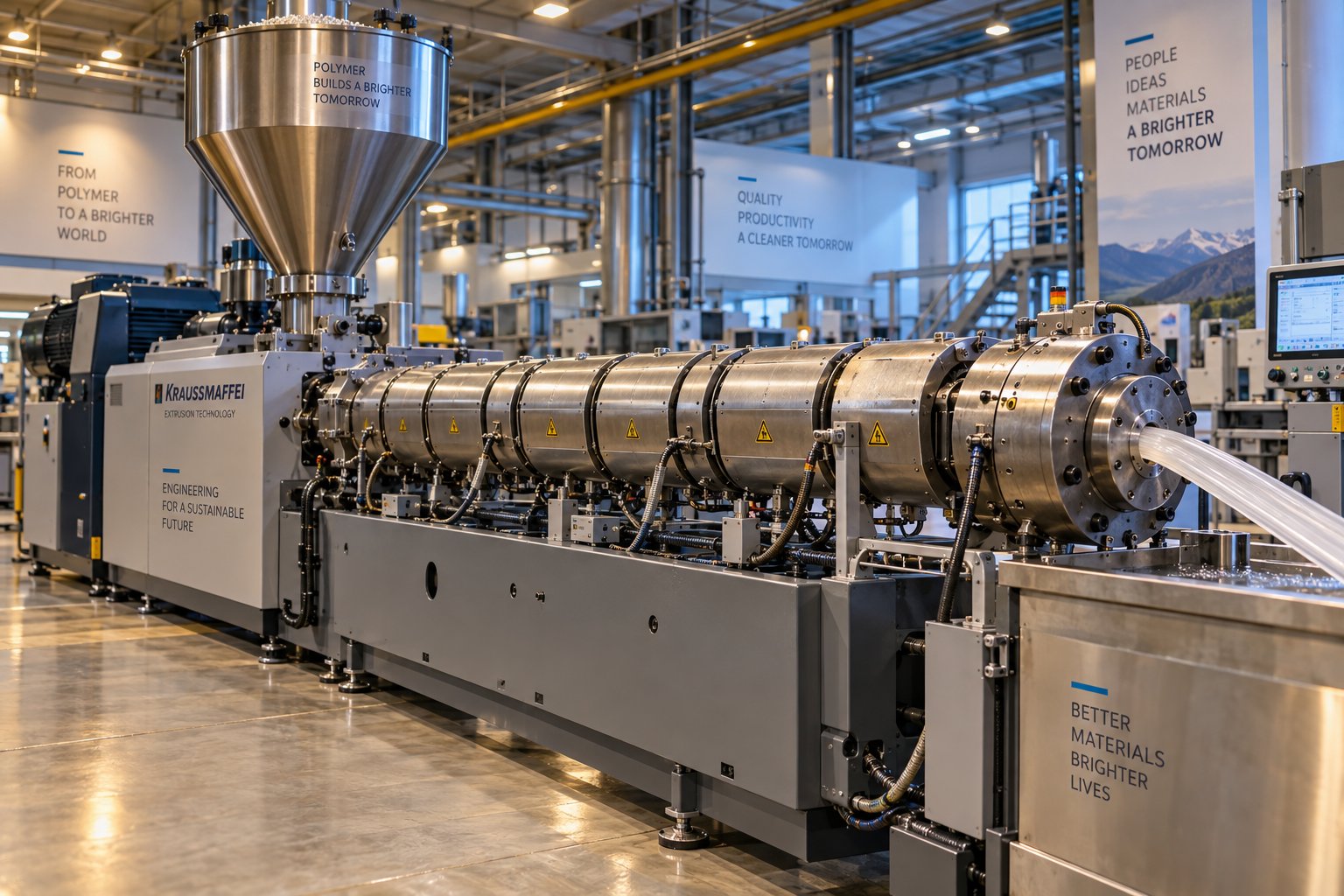
Extruder Machine Decoded: From Raw Pellet To Finished Product
Oct 6, 2026
Learn how an extruder machine works, compare single-screw vs. twin-screw types, and get expert guidance on specs, troubleshooting, and selection.
Read Article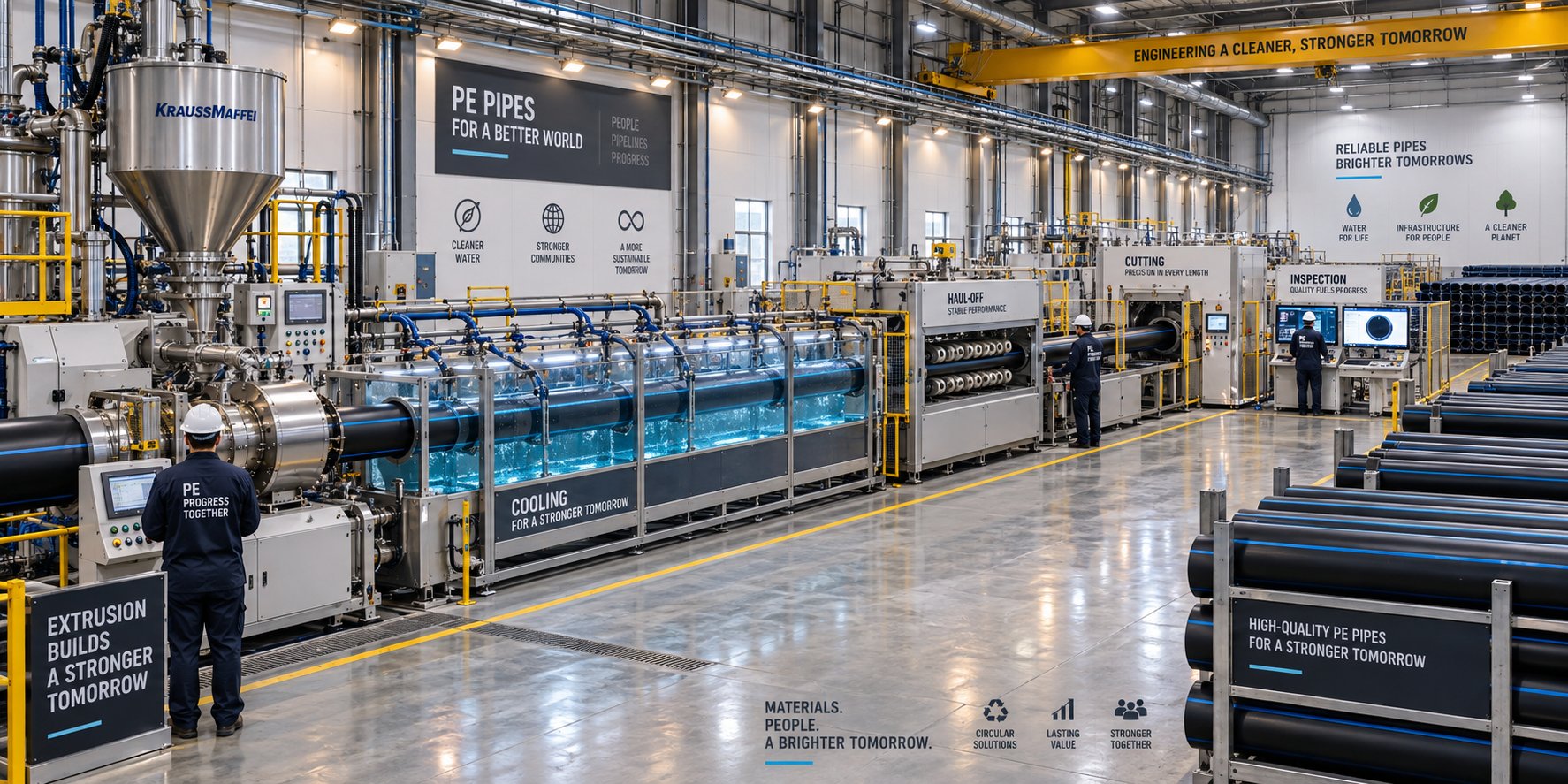
PE Pipe Making Machine Decoded: From Raw Resin to Flawless Pipe
Oct 4, 2026
Learn how a PE pipe making machine works, from resin to finished pipe. Covers components, material grades, automation, troubleshooting, and buyer selection tips.
Read Article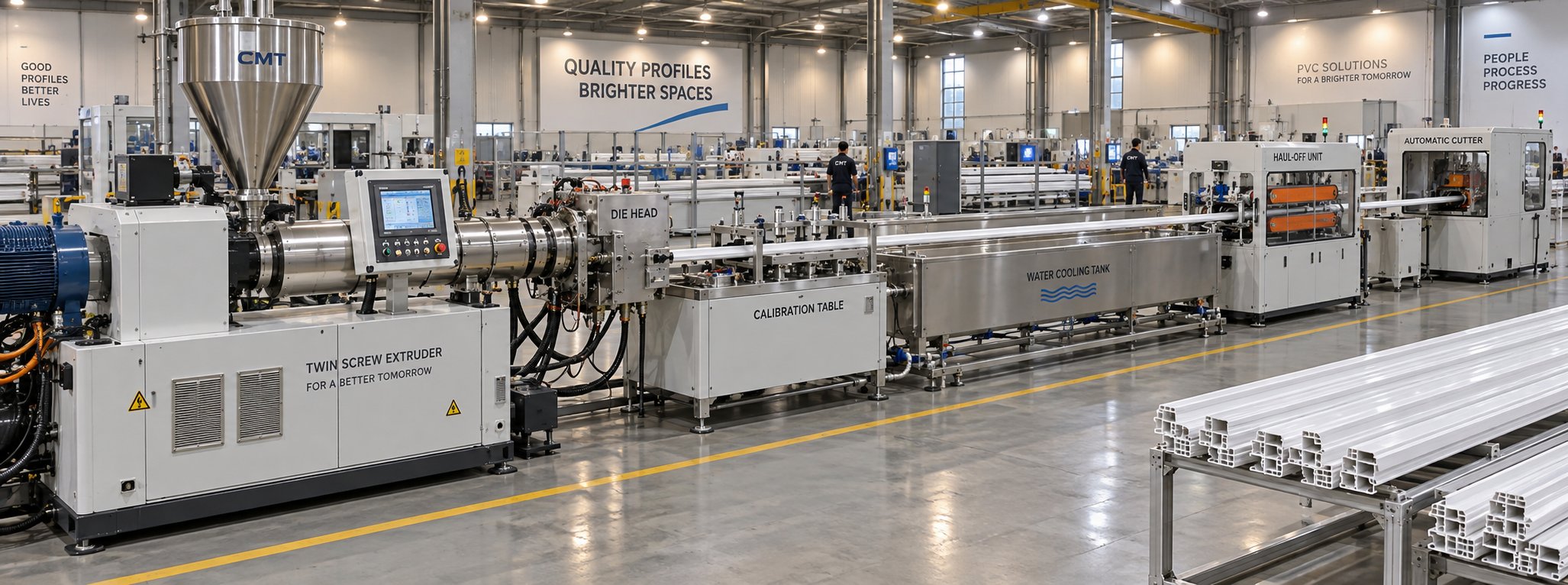
PVC Profile Making Machine Decoded: From Raw Resin To Profit
Oct 3, 2026
Learn how a PVC profile making machine works — extrusion process steps, key technical parameters, die design, calibration methods, maintenance, and total cost of ownership.
Read ArticleLooking for something else?
Search by material, symptom or product and jump straight to the relevant page.
These are navigation suggestions based on keyword matching — not a quotation, not a delivery commitment, and not a substitute for engineering review. Final specification is confirmed by our engineers against your drawings and processed material.
Need help with screw barrel selection?
Share your machine model, processed material and application. Our team can help with pricing and technical support.