

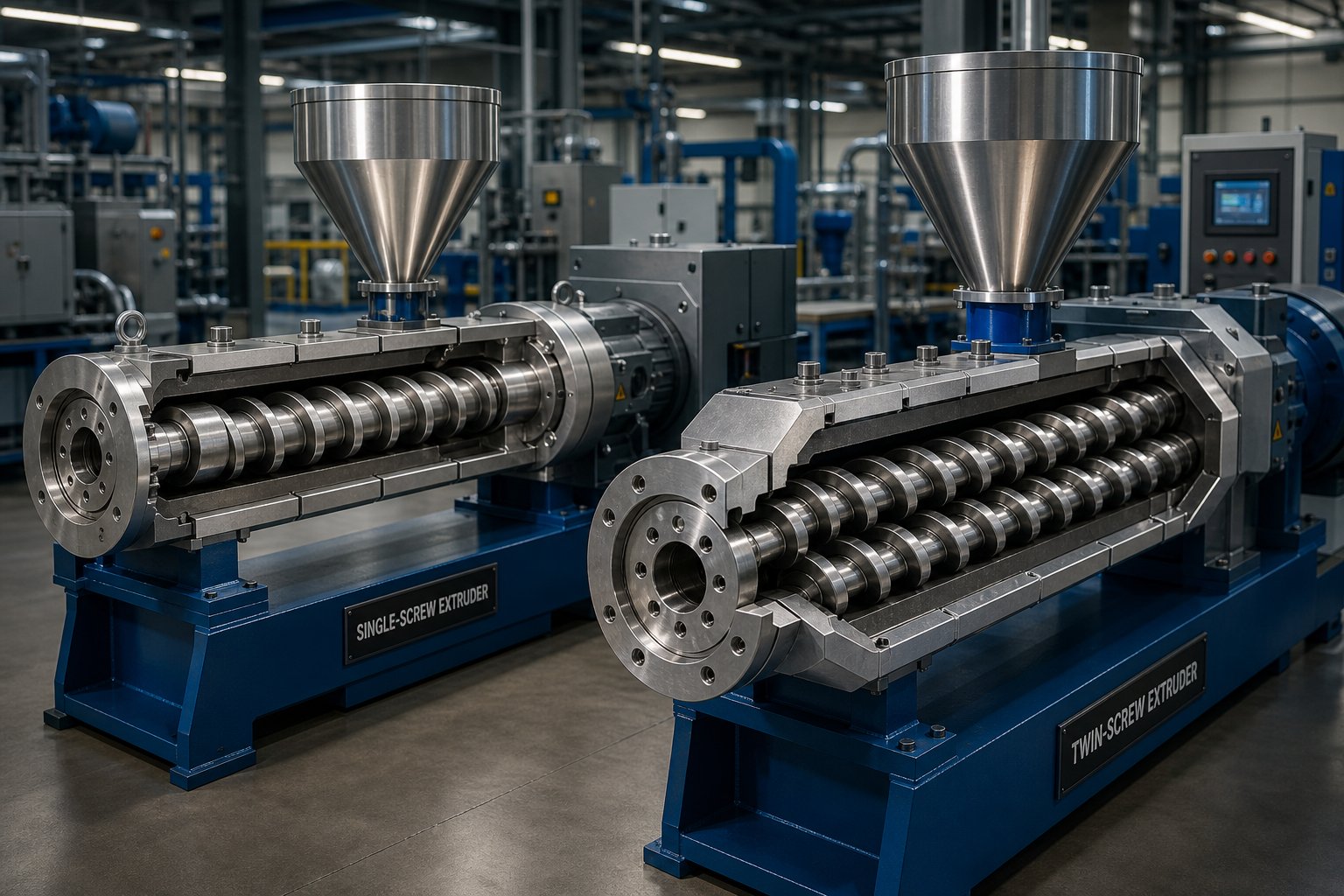
What Is a Screw Extruder and Why the Type You Choose Matters
Imagine you need to transform raw plastic pellets into a finished pipe, a sheet of film, or a precisely colored masterbatch. The machine at the heart of that transformation is a screw extruder, and the very first engineering decision you'll face is this: should it have one screw or two? Getting that choice wrong can mean poor product quality, wasted energy, and tens of thousands of dollars in unnecessary capital expense. Getting it right sets up every downstream process for success.
What Is a Screw Extruder
A screw extruder is a continuous processing machine used across plastics, food, pharmaceutical, and rubber industries. At its core, the concept is straightforward: one or more rotating screws sit inside a heated barrel, working together to melt, mix, and push material through a shaped opening called a die. The result is a continuous product with a uniform cross-section, whether that's a plastic tube, a thin film, or compounded pellets ready for the next manufacturing step.
A screw extruder uses a helical screw rotating inside a temperature-controlled barrel to convey, melt, mix, and pressurize thermoplastic material, then forces the molten polymer through a die to produce a continuous shape. The term covers an entire family of machines, from simple single screw designs to highly configurable twin screw systems, each engineered for different materials and processing demands.
You'll notice the phrase "screw extrusion" used broadly in industry literature, and that breadth is intentional. It encompasses single screw extruders that excel at steady melting and pressure building, twin screw extruders designed for intensive compounding and mixing, and even specialized multi-screw configurations for niche applications. What unites them is the fundamental mechanism: a rotating screw acts as both a conveyor and a pump, converting solid feedstock into a precisely controlled melt stream.
Why the Single vs Twin Screw Decision Matters
Here's where the stakes get real. A single screw extruder and a twin screw extruder are not just two versions of the same machine with a different number of screws. They differ in working principles, mixing capability, feeding mechanisms, pressure generation, material compatibility, energy consumption, and total cost of ownership. Selecting the wrong type doesn't just underperform; it can introduce defects, inflate operating costs, and lock your production line into limitations that no amount of process tuning can overcome.
Consider a few scenarios. A plant running pre-compounded polyethylene pellets into pipe probably needs the steady melt delivery and high pressure generation of a single screw extruder. A compounder blending recycled flake with mineral fillers and stabilizers almost certainly needs the intensive mixing and flexible feeding of a twin screw extruder. But the decision is rarely that obvious, and oversimplified advice like "twin screw is always better" leads to overspending, while "single screw is cheaper" ignores hidden process costs.
This article breaks down every difference between single and twin screw extruder designs that actually affects your production outcome. You'll find detailed comparisons across working principles, screw geometry, mixing performance, material suitability, industry applications, cost of ownership, and energy efficiency. The goal isn't to declare a winner. It's to give you the technical clarity to match the right screw extrusion architecture to your specific material, process, and budget.
The logical starting point is the machine most processors encounter first: the single screw extruder and the surprisingly sophisticated mechanics behind its three functional zones.
How a Single Screw Extruder Works and Where It Excels
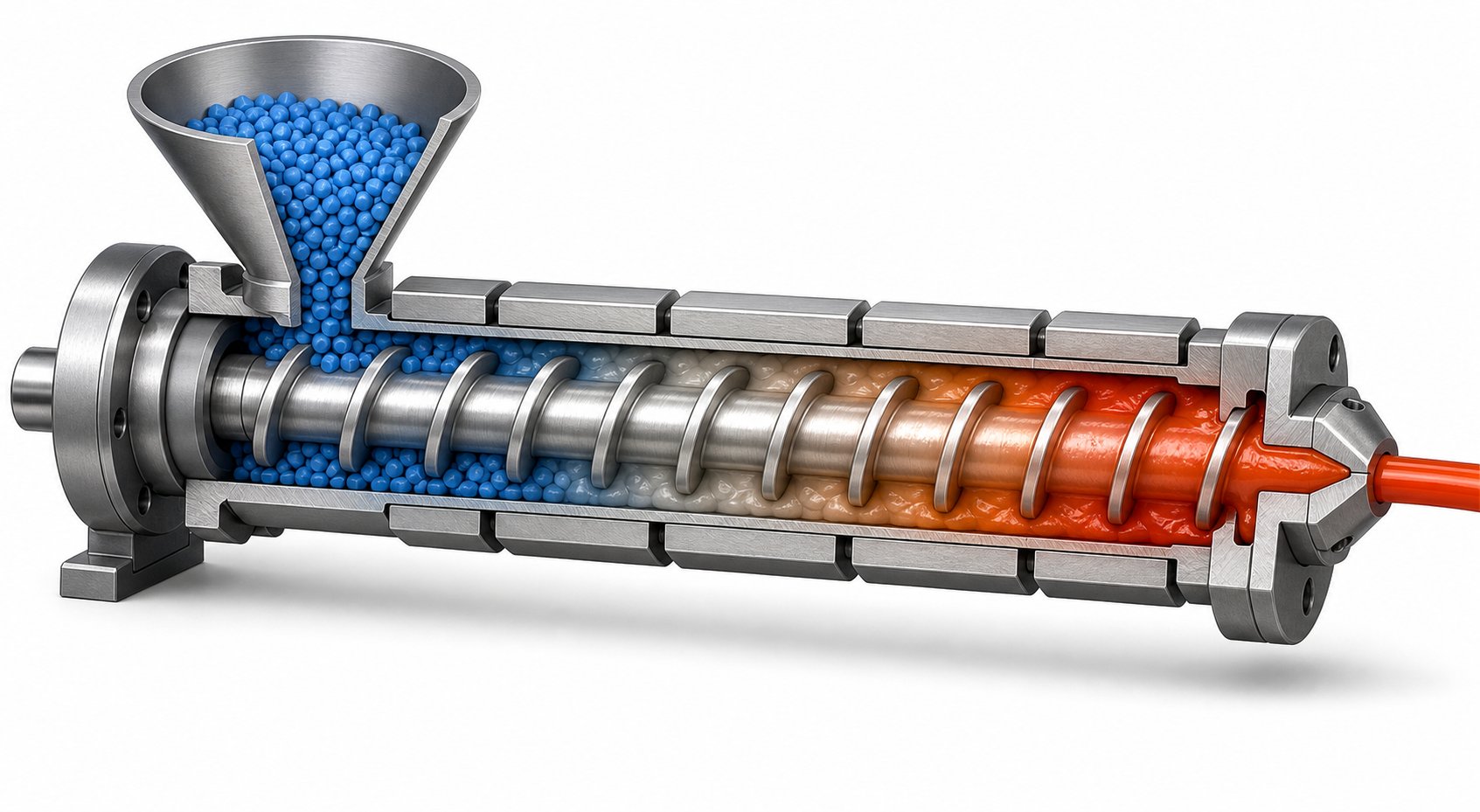
A single screw extruder machine looks deceptively simple: one helical screw rotating inside a cylindrical barrel. But what happens inside that barrel is anything but basic. The polymer undergoes a carefully orchestrated sequence of compaction, melting, and pressurization, and every millimeter of screw geometry influences whether the final product meets spec or ends up as scrap. Understanding this sequence is essential before comparing it with its twin screw counterpart.
Solids Conveying and Melting Mechanisms
Picture plastic pellets tumbling from a hopper into the feed throat of a single extruder screw. From that point forward, the material passes through three distinct functional zones, each with a specific job.
Feed zone: The screw channel is deepest here. Pellets are compacted into a solid bed and conveyed forward. No significant melting occurs yet. Instead, the goal is consistent solids conveying, and it depends almost entirely on friction between the pellets and the barrel wall. If the barrel-wall friction exceeds the friction at the screw root, the solid bed moves forward. If the screw surface gets too hot, pellets stick to the screw instead of sliding along it, and conveying breaks down. This is why many machines use water-cooled feed sections to keep the screw root temperature well below the resin's softening point.
Compression (transition) zone: Here, the channel depth decreases gradually, squeezing the solid bed against the barrel wall. A thin melt film forms at the heated barrel surface and is scraped off by the advancing flight, collecting in a melt pool on the pushing side of the screw channel. As the solid bed narrows, the melt pool grows until the solid bed eventually disappears. Shear heating, not barrel heaters, provides the majority of melting energy in this zone, making screw geometry a more powerful variable than temperature setpoints alone.
Metering zone: The channel depth is shallowest and uniform. By this point, the polymer should be fully molten and homogenized. The metering zone builds the stable pressure needed to push the melt through the die at a consistent rate. Any unmelted material reaching this zone shows up as gels, surface defects, or dimensional variation in the final product.
Single screw extrusion relies on flood feeding as its standard operating mode. The hopper gravity-feeds material into the screw channel, and the screw is always running full. This means throughput is directly tied to screw speed: spin the screw faster, and you push more material. You cannot independently adjust mixing intensity without also changing output, a fundamental constraint that shapes how these machines are applied in production.
Where Single Screw Extruders Excel
Competing articles frequently treat the single screw extruder as a lesser technology, something you settle for when you can't afford a twin screw. That framing is misleading. For a wide range of applications, a single screw extruder machine is not just adequate but genuinely superior. Here's why.
- Superior pressure generation: The metering zone of a well-designed single screw builds exceptionally stable discharge pressure, making it ideal for profile, pipe, and sheet dies that demand consistent melt delivery over long production runs.
- Lower shear for heat-sensitive polymers: Materials like PVC, HDPE, and certain fluoropolymers degrade when subjected to aggressive shear. The gentler, more predictable shear profile of a single screw protects these resins while still achieving complete melting.
- Simpler operation and training: Fewer moving parts, a single drive system, and straightforward process controls mean shorter operator learning curves and less room for setup errors.
- Reliable high-volume throughput: When the job is melting and pumping pre-compounded pellets, a single screw extruder scales efficiently to very high output rates with lower energy consumption per kilogram than a twin screw running the same material.
- Lower capital and maintenance costs: Purchase price, spare-parts inventory, and routine maintenance are all significantly reduced compared to twin screw systems of equivalent output capacity.
In short, for any process where the material arrives as a ready-to-use pellet and the primary task is melting and shaping rather than intensive mixing, a single screw plastic extruder is often the most efficient, most economical choice available.
Known Limitations and Common Processing Problems
Honesty about weaknesses matters more than sales pitches. Single screw extruders have real limitations, and ignoring them leads to frustrating production issues.
Output surging is the most widely reported problem. It shows up as cyclic oscillations in discharge pressure, causing weight variation and dimensional drift in the final product. The root cause is almost always unstable solids conveying: a feed casing that runs too hot, insufficient screw cooling, or a mismatch between barrel-wall friction and the resin's thermal behavior. As extrusion expert Mark Spalding of Dow has documented, even subtle temperature shifts in the feed zone can trigger severe surging cycles, and many plants misdiagnose the issue as a downstream problem rather than a solids-conveying failure.
Poor distributive mixing is another inherent limitation. A single flight screw generates limited cross-channel mixing, so blending colorants, additives, or fillers into a base resin produces uneven distribution. Modern barrier screws, Maddock-style mixing sections, and inline static mixers can partially compensate, but they cannot match the intensive distributive and dispersive mixing a twin screw delivers.
Limited feedstock flexibility rounds out the picture. Because single screw machines depend on barrel-wall friction to convey solids, they handle free-flowing pellets well but struggle with powders, flakes, sticky materials, or formulations requiring liquid injection. Reactive extrusion and devolatilization are also poorly suited to the single screw platform due to its limited venting capability and broad residence-time distribution.
These constraints don't make the single screw inferior as a category. They define its boundaries. And those boundaries are precisely what led to the development of twin screw systems, where two intermeshing screws and a modular barrel open up an entirely different set of processing possibilities.
How Twin Screw Extruders Work Including Co-Rotating and Counter-Rotating Types
Two screws instead of one. It sounds like a simple doubling, but a twin-screw extruder operates on fundamentally different principles than its single screw counterpart. The way material moves, melts, and mixes changes entirely, and so does the level of control you have over every stage of the process. Understanding that difference starts with what happens at the point where the two screws meet.
Intermeshing Screw Mechanics and Modular Design
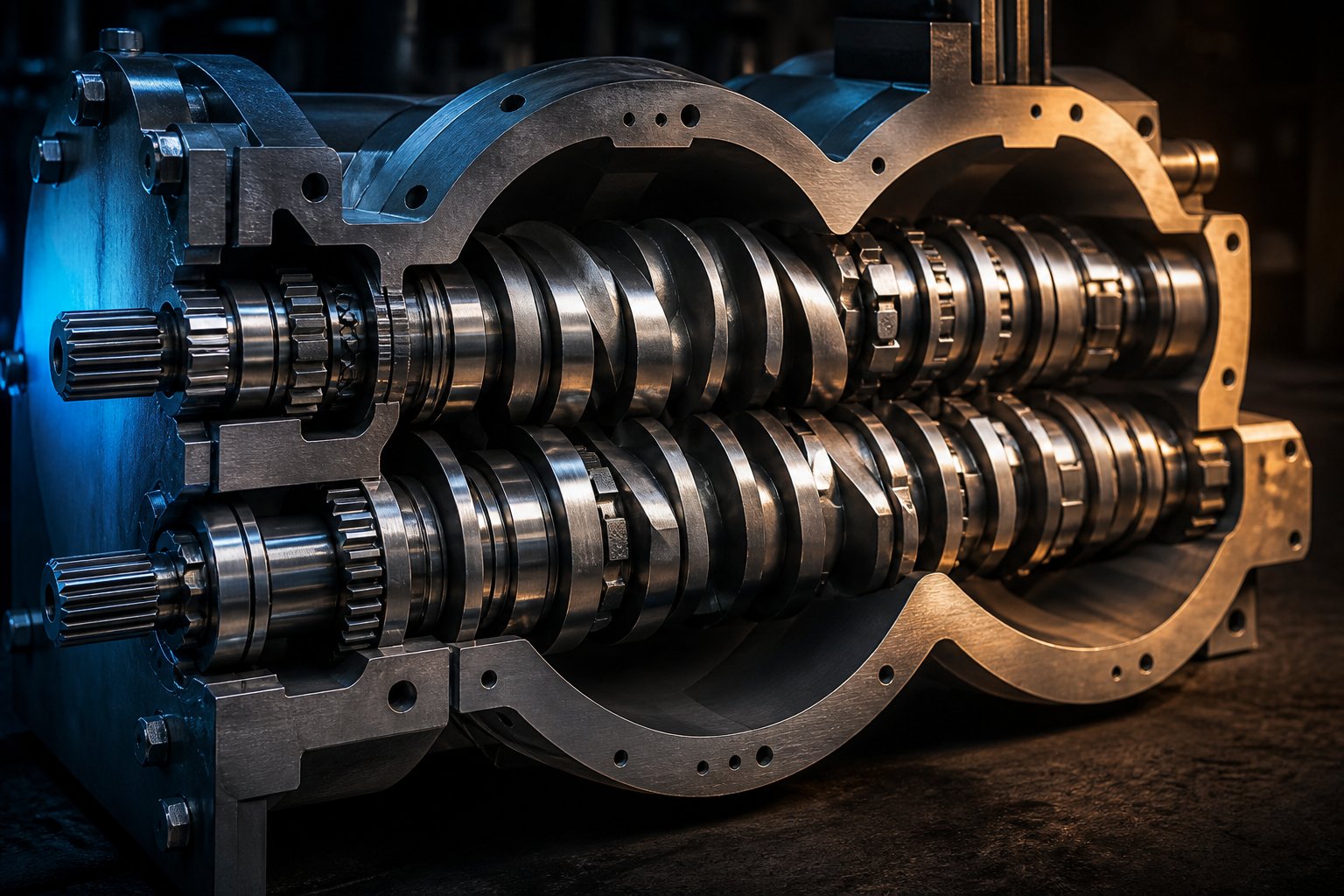
Imagine two helical screws positioned side by side inside a barrel shaped like a figure eight. The flights of one screw reach into the channel of the other, creating an intermeshing zone. This geometry produces positive displacement: material cannot simply ride along with the screw the way it does in a single screw channel. Instead, it gets forcibly transferred from one screw to the other at the intermeshing region, creating a continuous and controlled handoff that keeps the polymer moving forward.
This intermeshing action gives twin screw machines a critical capability called self-wiping. The flight of each screw sweeps the surface of its partner, preventing material from stagnating or adhering to metal surfaces. As Technovel's extrusion specialists explain, this self-wiping behavior plays a particularly important role in keeping the residence-time distribution narrow, especially during reactive extrusion and when processing thermally sensitive materials. Stagnant material means degradation, and degradation means defects. Self-wiping virtually eliminates that risk.
The other defining feature of twin screw extrusion is modular screw design. Unlike a single screw extruder, where the screw is typically a single monolithic piece, a twin screw uses individual elements assembled onto a splined shaft. These elements fall into several functional categories:
- Conveying elements: Deep-flighted sections that transport material forward without applying significant shear. NC State Extension research notes that deeper channels enable efficient conveyance with higher screw volume.
- Kneading blocks: Offset disc elements that generate intense shear and elongational flow for dispersive and distributive mixing. Wider kneading elements promote dispersive mixing (breaking agglomerates), while narrower ones favor distributive mixing (spreading components evenly).
- Reverse elements: Left-handed segments that push material backward, creating a dam effect that increases local fill and residence time for maximum mixing intensity.
- Toothed mixing elements: Specialized elements that deliver distributive mixing with minimal shear, useful for blending shear-sensitive additives.
You'll hear engineers describe screw profile design as "a blend of art and science," and that's not an exaggeration. By rearranging these elements along the shaft, a process engineer can tailor the twin screw to perform gentle conveying in one zone, aggressive kneading in the next, and vacuum devolatilization in a third, all within the same barrel. No other extruder type offers this level of zone-by-zone customization.
Co-Rotating vs Counter-Rotating Configurations
Here's where most explanations of the difference between single and twin screw extruder designs stop short. They mention that twin screws exist and move on. But within the twin screw category, two entirely distinct configurations serve very different processing needs, and choosing between them is just as consequential as choosing between single and twin in the first place.
In a co-rotating twin screw extruder, both screws turn in the same direction. The fully intermeshing geometry forces material through intense shear fields both between the screws and between each screw and the barrel wall. This produces excellent self-wiping, very few dead zones, and a narrow residence-time distribution. Co-rotating machines dominate compounding, reactive extrusion, and any process where high-speed, high-shear mixing is the goal. They handle tasks like breaking down filler agglomerates, controlling phase morphology in polymer alloys, and promoting mass transfer during chemical reactions.
A counter-rotating twin screw extruder takes the opposite approach, literally. The screws turn in opposite directions, drawing material inward at the intermeshing zone and compressing it forward. Material transport depends strongly on the screw rotation itself, enabling stable extrusion even at low RPMs with a high degree of fill. The shear intensity is significantly lower than in co-rotating designs. Instead of high-shear mixing, a calendering effect develops at the intermeshing region, where material undergoes repeated compressive and elongational deformation under gentle conditions. This makes counter-rotating machines the go-to choice for thermally unstable materials like rigid PVC, where the extrusion temperature must stay low to prevent decomposition.
| Parameter | Co-Rotating Twin Screw | Counter-Rotating Twin Screw |
|---|---|---|
| Rotation Direction | Both screws turn the same direction | Screws turn in opposite directions |
| Typical Speed Range | 200 - 1,200+ RPM | 10 - 80 RPM (often much lower) |
| Shear Intensity | High; intense shear fields between screws and barrel | Low; relies on compressive and elongational deformation |
| Primary Applications | Compounding, reactive extrusion, polymer alloys, nanocomposites | Rigid PVC pipes, sheets, profiles, calender feeding |
| Self-Wiping Ability | Excellent; fully intermeshing geometry with minimal dead zones | Limited; lower intermeshing engagement reduces wiping action |
The practical takeaway? When you hear someone recommend a "twin screw" without specifying co-rotating or counter-rotating, you're only getting half the answer. A co-rotating twin screw excels at blending carbon nanotubes into a polymer matrix; a counter-rotating twin screw excels at pushing rigid PVC through a profile die without burning it. They are different tools for different jobs.
Starve Feeding and Process Flexibility
One of the most underappreciated advantages of a twin-screw extruder is how material enters the machine. Unlike single screw systems that rely on flood feeding, where gravity fills the screw channel and throughput is locked to screw speed, twin screw machines use gravimetric starve feeding. A loss-in-weight feeder meters material into the barrel at a precisely controlled rate, independent of how fast the screws are turning.
Why does this matter? Because it decouples two variables that a single screw extruder forces you to link: output rate and mixing intensity. On a twin screw, you can increase screw speed to intensify mixing without increasing throughput, or you can raise feed rate while holding screw speed constant for gentler processing at higher volume. This independent control is what makes twin screw extrusion so adaptable to complex formulations.
Starve feeding also opens the door to downstream addition. Side stuffers can introduce glass fibers, mineral fillers, or recycled flake partway down the barrel, after the base polymer is already molten. Liquid injection ports add oils, plasticizers, or reactive chemicals at precisely the right processing stage. Vacuum venting ports remove moisture and volatiles. All of these capabilities stem from the partially filled barrel that starve feeding creates, and none of them are practical on a flood-fed single screw platform.
This combination of modular screws, configurable barrel zones, and decoupled process variables is what gives the twin screw its reputation for flexibility. But flexibility alone doesn't settle the decision. The real question is how these two extruder types compare when you set their specifications side by side, point by point.
Side-by-Side Technical Comparison of Single and Twin Screw Extruders
Specification sheets tell a story that paragraphs alone cannot. When you're evaluating a screw extruder for a specific production line, you need hard parameter comparisons, not generalizations. The table below consolidates every critical technical distinction between single and twin screw extruders into a single reference. Bookmark it, print it, share it with your engineering team. It's designed to settle debates quickly and ground purchasing conversations in fact rather than vendor opinion.
Technical Specifications Compared
Each parameter in this comparison reflects a real operational consequence. A difference in self-wiping ability, for instance, doesn't just affect cleaning convenience; it directly determines whether you'll see degraded material showing up as black specks in your product. Similarly, the gap between flood feeding and starve feeding isn't just a mechanical detail. It fundamentally shapes how much independent control you have over mixing intensity versus throughput.
| Parameter | Single Screw Extruder | Twin Screw Extruder (Co-Rotating) |
|---|---|---|
| Number of Screws | One helical screw in a cylindrical barrel | Two intermeshing screws in a figure-eight barrel bore |
| Screw Design | Monolithic (single piece); fixed geometry with feed, compression, and metering zones | Modular (interchangeable elements on a splined shaft); conveying, kneading, mixing, and reverse elements can be rearranged |
| Feeding Method | Flood fed (gravity hopper); throughput is screw-speed-dependent | Starve fed (gravimetric loss-in-weight feeders); throughput is feeder-controlled, independent of screw speed |
| Distributive Mixing | Low to moderate; limited cross-channel flow. Improved with barrier screws or static mixers but still constrained | Excellent; kneading blocks and toothed elements create repeated material splitting and recombination |
| Dispersive Mixing | Limited; cannot efficiently break agglomerates of fillers or pigments without specialized mixing sections | Excellent; high-shear kneading zones effectively break down agglomerates and reduce particle size |
| Self-Wiping Ability | None; material can stagnate in screw channels, leading to degradation and black specks | Excellent; intermeshing flight geometry continuously sweeps both screws, minimizing dead zones |
| Typical L/D Ratio Range | 24:1 to 36:1 | 32:1 to 52:1 (with some specialty machines reaching 60:1) |
| Shear Intensity | Low to moderate; controlled primarily by compression ratio and screw speed | Moderate to very high; adjustable through kneading block selection, stagger angle, and screw speed |
| Pressure Generation | High; the metering zone builds stable, consistent discharge pressure well suited for restrictive dies | Moderate; positive displacement aids conveying but pressure buildup is typically lower than single screw at comparable conditions |
| Residence-Time Distribution | Broad; material near the barrel wall moves faster than material at the screw root, creating significant variation | Narrow; positive displacement and self-wiping ensure most material experiences similar thermal and shear history |
| Process Flexibility | Limited; fixed screw geometry handles a narrow window of materials and formulations | Very high; modular screws, multiple feed ports, liquid injection, and vacuum venting allow extensive process customization |
| Typical Throughput Scaling | Scales efficiently to very high outputs for simple melting and pumping tasks | Best suited for compounding throughputs; very high volumes may require multiple lines |
| Capital Cost | Lower (baseline investment) | Higher (roughly 2-3x a comparable single screw system) |
| Energy Efficiency | Higher for simple melting and conveying (lower specific energy in kWh/kg) | Higher energy input per kilogram, but eliminates secondary processing steps for complex formulations |
A few patterns jump out immediately. If your primary task is generating stable melt pressure for a profile or pipe die using pre-compounded pellets, the single screw extruder wins on nearly every metric that matters: pressure generation, energy efficiency, capital cost, and throughput scaling. If your task involves blending multiple ingredients, controlling filler dispersion, or running reactive chemistry, twin screw extruders dominate mixing capability, process flexibility, and residence-time control.
Neither machine is universally superior. The right answer depends entirely on where your process sits along the complexity spectrum. And one of the clearest indicators of that complexity? How raw materials enter the machine.
Feeding Mechanism Differences in Detail
The way material gets into an extruder might seem like a minor mechanical detail, but it's actually one of the most consequential operational differences between these two platforms. It determines how much control you have over mixing, what physical forms of raw material you can process, and whether you can add ingredients at multiple points along the barrel.
Flood feeding is the standard in single screw extrusion. A hopper sits directly above the feed throat, and gravity keeps the screw channel completely full. The screw takes in as much material as it can handle at a given speed. Research published in Polymers describes the mechanism clearly: the bottom section of the hopper stays fully filled, and the throughput is a direct function of screw speed, screw geometry, and the friction between pellets and barrel wall. Want more output? Spin the screw faster. Want less? Slow it down. There's no independent dial for mixing intensity. This simplicity is a strength for steady-state production, but it becomes a constraint when formulation complexity increases.
Starve feeding works differently. A gravimetric loss-in-weight feeder meters material into the twin screw barrel at a precisely controlled mass flow rate. The screw channels are not fully filled in the early conveying zones, and the screw speed can be set independently of feed rate. As the same study by Nastaj and Wilczynski demonstrated, starve fed extrusion offers several advantages: pressure buildup along the screw is lower, there's less chance of agglomeration, and melting is faster because pellets are not compacted into a dense solid bed. Their optimization modeling even indicated that starve fed conditions achieved higher objective function values than flood feeding when balancing throughput against specific energy consumption.
Starve feeding also unlocks a set of capabilities that simply don't exist on a flood-fed platform:
- Side stuffers introduce solid ingredients, such as glass fibers, mineral fillers, or recycled flake, downstream after the base polymer is already molten. As compounding specialist Kenneth Russell explains, feeding fibers through the main feed throat would subject them to the high shear forces of the melting zone, essentially grinding them into powder and destroying the aspect ratio that provides reinforcement. A side feeder bypasses that damage entirely.
- Liquid injection ports deliver oils, plasticizers, peroxides, or reactive monomers directly into the melt stream at a controlled barrel position. The liquid pressure must exceed the local polymer pressure to prevent backflow, and the injection point is typically paired with medium-pitch conveying elements to keep local pressure low.
- Vacuum venting ports remove moisture, volatiles, and reaction byproducts through open barrel sections connected to a vacuum pump. This is critical for devolatilization processes and for recycling applications where incoming feedstock carries significant contamination.
- Multiple feed points allow staged addition of different ingredients at different barrel positions, giving the process engineer complete control over when each component enters the melt and how much shear history it accumulates.
These feeding and venting options explain why twin screw extruders handle a much wider range of physical feed forms than single screw machines. Here's a practical breakdown of what each platform manages well:
Feed Forms Suited to Single Screw Extruders
- Free-flowing pellets (virgin or pre-compounded)
- Uniform granules with consistent bulk density
- Preblended dry mixes where minor color or additive variation is acceptable
Feed Forms Suited to Double Screw Extruder Systems
- Pellets, powders, and granules of varying bulk density
- Flakes and regrind from recycled post-consumer or post-industrial waste
- Long fibers (glass, carbon, natural) fed via side stuffer to preserve aspect ratio
- Liquids (oils, plasticizers, reactive chemicals) injected at controlled barrel positions
- Sticky or irregular materials that would bridge or flood a single screw hopper
The contrast is stark. A single screw extruder is optimized for a narrow range of well-behaved inputs, and it processes them with remarkable efficiency. A double screw extruder accepts nearly anything you can meter into it, at the cost of greater mechanical complexity and higher capital investment. That tradeoff becomes even more nuanced when you map specific materials and industries to each platform, which is exactly where the real-world selection logic begins.
Which Extruder Type Fits Your Material and Industry Application
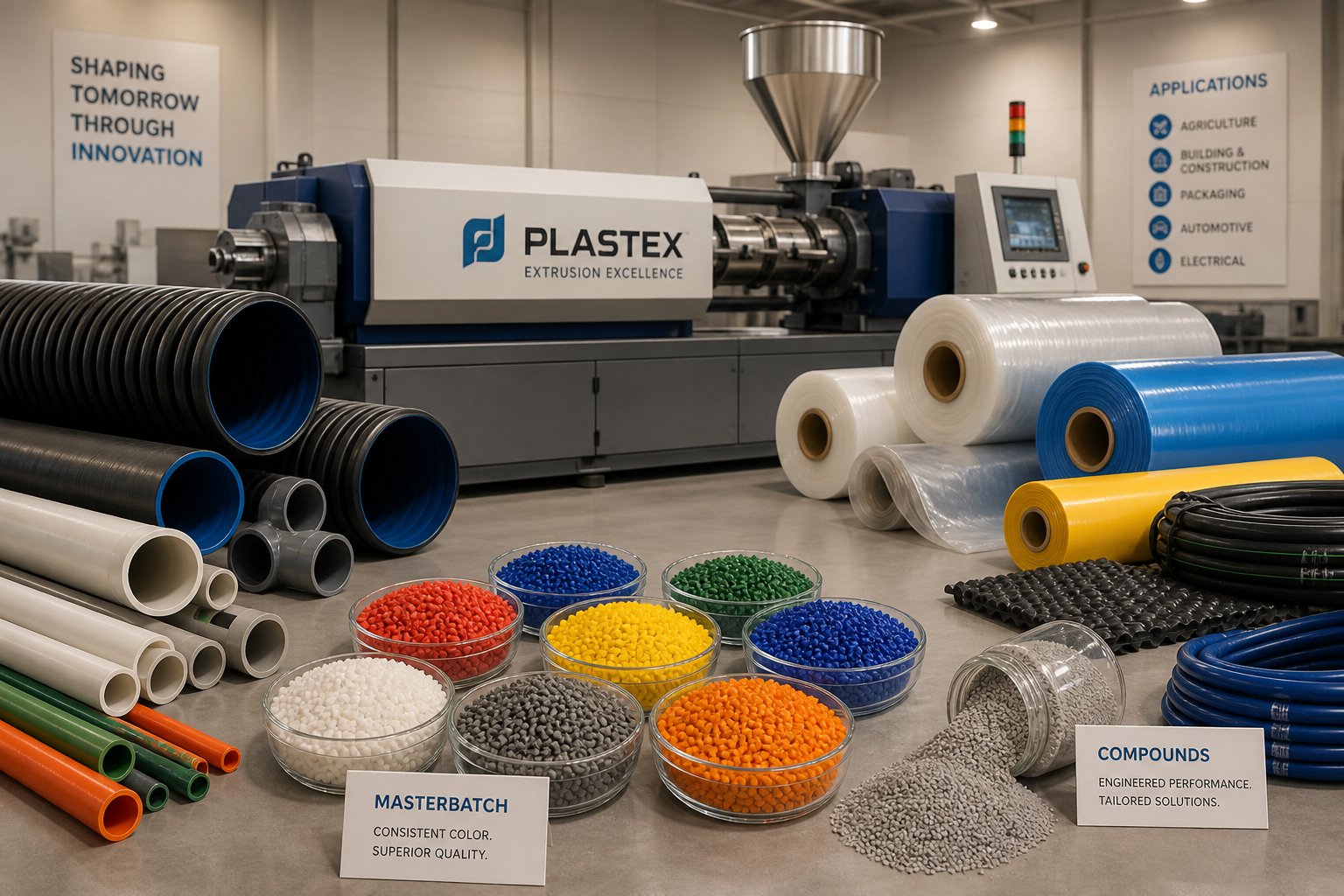
Specifications and feeding mechanisms paint the theoretical picture, but the real decision happens when you're standing in front of a specific polymer, a specific product, and a specific production target. Which extruder actually belongs on your floor? The answer shifts depending on the material you're processing, the industry you're serving, and the type of extrusion process your product demands. This section maps all three dimensions so you can match your exact situation to the right machine.
Polymer and Material Matching Guide
Different polymers behave differently under shear, heat, and pressure, and those behaviors dictate which extruder architecture delivers the best results. A single screw plastic extruder handles pre-compounded resins with predictable melt behavior beautifully, but hand it a multi-component formulation loaded with mineral fillers and you'll fight dispersion problems all day. A twin screw compounding extruder thrives on complexity, yet it's overkill and energy-wasteful when the job is simply melting clean pellets into pipe.
The table below maps the most common materials to their recommended extruder type, along with the technical reasoning behind each pairing.
| Material | Recommended Extruder Type | Reasoning |
|---|---|---|
| PVC (rigid profiles, pipes) | Single screw or counter-rotating twin screw | PVC is thermally sensitive and degrades under high shear. Single screw machines provide gentle, low-shear melting for profile extrusion. Counter-rotating twin screws excel at calender feeding for PVC sheet, using a low-speed calendering effect that avoids thermal decomposition. |
| HDPE (pipe, film) | Single screw | Pre-compounded HDPE pellets melt predictably. A single screw extruder generates the high, stable discharge pressure needed for pipe and blown film dies at lower specific energy than a twin screw running the same material. |
| LDPE / LLDPE (blown film, bags) | Single screw | Film extrusion demands consistent melt temperature and pressure uniformity across the die. A single screw delivers both efficiently for these well-behaved polyolefins. |
| PP (fibers, sheet, automotive parts) | Single screw for direct extrusion; twin screw for compounding with fillers | Neat PP processes cleanly on a single screw. Adding talc, glass fiber, or impact modifiers requires the dispersive mixing capability of a co-rotating twin screw plastic extruder. |
| Engineering plastics (PA, PC, PBT) | Co-rotating twin screw | These resins are typically compounded with glass fibers, flame retardants, and stabilizers. Twin screw machines provide the high shear needed for filler dispersion and the downstream side-feeding ports needed to preserve fiber length. |
| ABS | Single screw for sheet extrusion; twin screw for compounding | Ready-to-use ABS pellets extrude into sheet and profiles efficiently on a single screw. Blending ABS with PC or adding specialty additives requires twin screw mixing. |
| Thermoplastic elastomers (TPE, TPV) | Co-rotating twin screw | TPE production involves dynamic vulcanization or multi-phase blending, both of which demand the intensive dispersive and distributive mixing that only a twin screw provides. |
| Recycled mixed plastics | Co-rotating twin screw | Recycled feedstocks vary in composition, moisture, and contamination. Twin screw machines homogenize inconsistent input, devolatilize moisture and residual contaminants, and accommodate side feeding of stabilizers. |
| Biodegradable polymers (PLA, PHA) | Co-rotating twin screw | These materials are moisture-sensitive and often compounded with nucleating agents or chain extenders. The precise temperature control and vacuum venting of a twin screw protect against hydrolytic degradation. |
Notice the pattern: whenever the job is simply melting and shaping a single, pre-compounded resin, a single screw extruder is the efficient default. The moment you introduce multi-component formulations, fillers, reactive additives, or inconsistent feedstock quality, a twin screw compounding extruder becomes the technically justified choice.
Industry Application Breakdown
Materials tell part of the story. The industry you operate in tells the rest, because each sector has specific throughput expectations, quality standards, and regulatory requirements that favor one extruder type over the other. Here's how the landscape breaks down:
- Plastics compounding and masterbatch production: Co-rotating twin screw extruder. Compounding is the twin screw's home territory. Blending pigments, fillers, flame retardants, and stabilizers into a base resin at precise loadings requires the intensive mixing, modular screw design, and multi-point feeding that only a twin screw platform delivers. Masterbatch lines rely on the same capabilities to achieve the high pigment concentrations and tight color consistency that downstream converters demand.
- Pipe and profile extrusion: Single screw extruder for most thermoplastics; counter-rotating twin screw for rigid PVC. Pipe dies need rock-steady melt pressure over runs that can last days. A single screw excels here. For rigid PVC pipe and profiles specifically, counter-rotating twin screws dominate because they process the powder-based PVC dry blend directly while keeping shear-induced heat generation low enough to prevent degradation.
- Blown and cast film: Single screw extruder. Film extrusion prioritizes melt homogeneity and die pressure stability at high throughput. Pre-compounded polyolefins run efficiently through single screw systems. SpecialChem's extrusion guide describes typical blown film line configurations built around single screw extruders, with line speeds reaching 100 to 200 m/min for blown film and far higher for cast film.
- Plastics recycling: Co-rotating twin screw extruder. Post-consumer and post-industrial waste streams arrive as mixed, contaminated, and moisture-laden material. Twin screw machines handle this variability through starve feeding, vacuum devolatilization, melt filtration, and side feeding of compatibilizers or stabilizers to rescue otherwise unusable feedstock.
- Pharmaceutical hot-melt extrusion: Co-rotating twin screw extruder. Pharmaceutical applications use extrusion to create solid dispersions of active ingredients in polymer carriers. The precise residence-time control, self-wiping action, and ability to inject liquids at exact barrel positions make twin screw machines the industry standard for this application.
- Food processing: Co-rotating twin screw extruder. From snack puffs and breakfast cereals to plant-based meat alternatives, food extrusion requires controlled moisture addition, precise thermal management, and intensive mixing of multi-ingredient formulations. As Technovel notes, high-moisture soy meat production relies on twin screw extruders that adjust moisture content alongside die design and screw configuration to achieve the target fibrous texture.
- Wire and cable coating: Single screw extruder. Jacketing conductors with PE, PVC, or fluoropolymer insulation is a high-speed, continuous process that demands consistent melt delivery through a crosshead die. Single screw systems handle this cleanly at production speeds that can exceed several hundred meters per minute.
Process-to-Extruder Mapping
Beyond material and industry, certain extrusion processes carry their own inherent requirements that push strongly toward one extruder type. If you know what process your line must perform, you can often shortcut the selection entirely.
Reactive extrusion: Co-rotating twin screw. Reactive extrusion uses the extruder barrel as a continuous chemical reactor, carrying out grafting, crosslinking, polymerization, or chain extension while the material is conveyed and mixed. The narrow residence-time distribution of a twin screw ensures every molecule experiences similar reaction conditions, which is critical for consistent conversion. Technovel's technical overview emphasizes that the balance between shear and residence time is critical in reactive extrusion, and fully intermeshing co-rotating screws provide the energy transfer efficiency needed to promote reactions without degrading the polymer backbone.
Devolatilization: Co-rotating twin screw. Removing residual solvents, unreacted monomers, or moisture from the melt requires open barrel sections connected to vacuum systems. The partially filled barrel zones created by starve feeding make vacuum venting effective. Twin screw machines with multiple vent ports along the barrel can stage devolatilization in progressive steps, achieving volatile removal levels that a single screw simply cannot match.
Direct extrusion (melting and shaping pre-compounded resin): Single screw. When the raw material arrives as pellets with all additives already incorporated, the extruder's job is to melt, pressurize, and deliver a uniform melt to the die. A single screw performs this task with superior energy efficiency, simpler operation, and lower capital cost. Using a twin screw for straight melt-and-shape work wastes both money and energy.
Physical and chemical foaming: Both platforms serve foaming applications, but the roles differ. A twin screw extruder is preferred for the initial compounding step where chemical blowing agents must be dispersed uniformly into the polymer matrix. For the final foaming extrusion where the blowing agent expands into cells, a tandem system using a single screw as the secondary cooling extruder is common. The single screw provides the stable, low-shear melt conveyance needed to control cell nucleation and prevent premature blowing agent activation.
These process-to-extruder mappings reinforce a theme running through every comparison in this article: neither machine type is inherently better. Each dominates a clearly defined territory. The challenge isn't picking a favorite. It's honestly assessing where your specific process falls on the complexity and mixing-intensity spectrum, and then calculating whether the performance gap justifies the cost gap.
Total Cost of Ownership and Energy Efficiency Compared
Performance specs and material compatibility get the engineering team excited, but it's the financial analysis that ultimately signs the purchase order. And here's where conversations about the difference between single and twin screw extruder platforms tend to go sideways: most comparisons stop at the sticker price. The real picture emerges only when you account for energy consumption, spare-parts inventory, maintenance labor, and production downtime across a 10-year equipment lifespan. Let's break each one down with real operational data.
Purchase Price and Capital Investment
How wide is the price gap, exactly? A single screw extrusion machine carries a significantly lower capital cost than a twin screw system of comparable throughput capacity. Industry cost data puts entry-level single screw extruders in the $30,000 to $80,000 range for basic applications, with mid-range commercial models running $80,000 to $200,000 and large industrial systems reaching $200,000 to $500,000 or more. Twin screw extruder machines command substantially higher prices: production-scale co-rotating systems typically fall between $300,000 and $800,000, with high-performance compounding lines exceeding $1,500,000 for advanced configurations.
That means the price differential between a twin screw and a single screw of similar output capacity often ranges from two to five times. Counter-rotating conical twin screw extruders typically sit between these two tiers, offering a middle ground for processors who need twin screw capability for PVC or similar applications without the full cost of a co-rotating compounding line.
But the purchase price isn't the complete capital picture. A double screw extruder machine uses modular screw elements and segmented barrels, and you'll need a spare-parts inventory to keep the line running. A complete set of twin screw elements can cost anywhere from $20,000 to $100,000 depending on the configuration and metallurgy. A single screw, by contrast, is typically a one-piece monolithic design. Replacement is less frequent, and a spare screw plus barrel liner costs a fraction of what a full modular element set runs. If you're planning your capital budget, factor in not just the machine but also the elements sitting on the shelf waiting for the next screw pull.
Energy Consumption Profiles
Energy is the largest recurring operational expense for any extrusion line, and it's where the cost comparison gets counterintuitive. You might assume a more complex machine always burns more power. The reality is more nuanced, and the metric that matters isn't kilowatts per hour. It's specific energy consumption, measured in kWh per kilogram of output.
For straightforward melting and conveying tasks, single screw extruders typically achieve specific energy consumption rates of 0.25 to 0.45 kWh/kg, depending on the polymer and product. That's efficient, because the single screw is doing exactly what it was designed for: converting solid pellets into a pressurized melt stream with minimal mechanical complexity. A virgin LDPE film line, for example, benchmarks around 0.32 kWh/kg with the motor consuming roughly 65% of the total energy draw.
Twin screw machines, particularly co-rotating compounders, sit higher on the specific energy scale. Co-rotating twin screw systems typically land in the 0.30 to 0.55 kWh/kg range. Glass-filled PP compounding, a demanding application with high-shear kneading zones and multiple additive streams, can push toward 0.48 kWh/kg. Counter-rotating twin screws processing rigid PVC sit lower at roughly 0.28 to 0.35 kWh/kg, benefiting from lower melt temperatures and reduced screw speeds.
Here's the nuance that raw numbers miss: a twin screw extruder machine often eliminates an entire secondary processing step. Consider a manufacturer who runs virgin pellets through a single screw extruder but also operates a separate compounding line upstream to blend in fillers and stabilizers. The combined energy cost of two machines, two drives, two sets of heaters, and two cooling systems nearly always exceeds the energy draw of a single twin screw line that compounds and shapes in one pass. When you evaluate energy efficiency as total process kWh per kilogram of finished product rather than per kilogram of extruder throughput, the twin screw can deliver lower overall energy cost despite its higher per-machine specific energy consumption.
The cheapest extruder to run is the one that eliminates an entire upstream or downstream processing step from your production flow.
Maintenance, Wear, and Downtime
Maintenance cost is where long-term ownership economics diverge most sharply between the two platforms. The root cause is straightforward: more moving parts, more wear surfaces, and more complex disassembly translate directly into higher annual maintenance spend.
A single screw extruder benefits from mechanical simplicity. There's one screw, one barrel bore, one drive train. Industry maintenance benchmarks place annual routine servicing costs for industrial-scale single screw systems at roughly $3,000 to $15,000, covering oil changes, seal replacements, and standard inspections. Screw replacement intervals for hard chrome-plated screws typically fall in the 8,000 to 15,000 operating-hour range, with replacement costs of $3,000 to $15,000 per screw and $5,000 to $30,000 for barrel relining. In-house maintenance teams can often handle routine repairs without calling in external specialists.
Twin screw extruders demand more frequent and more specialized attention. Annual routine maintenance costs commonly range from $8,000 to $25,000, and major overhauls including bearing replacement and full screw inspection occur every 25,000 to 40,000 operating hours at costs of $40,000 to $150,000. The modular screw design, ironically, is both a maintenance advantage and an expense driver: you can replace individual worn kneading blocks or conveying elements without pulling the entire screw, but each element is a precision-machined component with a non-trivial price tag.
The wear patterns themselves differ in important ways:
- Abrasive filler acceleration: Glass fibers, mineral fillers, and recycite containing contaminants accelerate wear dramatically on twin screw kneading elements, where material undergoes repeated high-shear folding across tight clearances. A maintenance study notes that 60% of twin screw extruder failures trace back to improper maintenance of screw and barrel components, with abrasive compound processing being the primary driver. Single screw systems processing the same fillers wear more slowly because shear intensity is lower and filler-metal contact is less aggressive.
- Disassembly complexity: Pulling a single screw for inspection is a one-person, half-day job on most machines. Disassembling a twin screw involves removing individual barrel segments and sliding elements off splined shafts, a process that requires specialized tooling, careful sequencing to maintain element order, and typically two to three technicians.
- Element-by-element replacement: The modular twin screw design allows targeted replacement of only the worn sections. If three kneading blocks in the high-shear zone are worn past tolerance but the conveying elements are still in spec, you replace only those three blocks. A single screw, being monolithic, must be replaced or refurbished as a unit once wear in any zone exceeds tolerance, even if the rest of the screw is still serviceable.
- Barrel wear monitoring: Both platforms require periodic bore-diameter measurements to detect wear. On a twin screw, each barrel segment can be checked individually and replaced without disturbing adjacent segments. A single screw barrel typically requires full disassembly for accurate measurement along its entire length.
- Worn-barrel energy penalty: Field audit data shows that worn barrel liners on a twin screw compounding line can silently add approximately 0.09 kWh/kg to specific energy consumption, as increased clearance allows backflow that forces the motor to work harder. Most operators blame the raw material rather than the machine, letting the energy penalty compound for months before anyone measures the flight clearance.
Downtime rounds out the maintenance picture. Single screw extruders typically achieve availability rates of 92% to 96% with proper preventive maintenance. Twin screw machines land slightly lower at 88% to 94% due to the increased maintenance complexity. For a production line generating $500 per hour in saleable output and running 5,000 hours annually, each percentage point of availability represents roughly $25,000 in annual revenue. That gap alone can add up to $100,000 or more per year in lost production capacity if maintenance discipline slips.
The total cost of ownership picture, then, is far more complex than the sticker price suggests. Over a 10-year equipment life, operational and maintenance expenses typically exceed the original purchase price several times over for both platforms. A mid-range single screw system might accumulate $1.7 to $2.4 million in total ownership costs, while a comparable-throughput twin screw system can reach $2.0 to $2.9 million. But if that twin screw line eliminates a separate compounding step, reduces material waste by even 2%, or enables premium product pricing, the higher total cost often pays for itself and more.
Cost numbers, though, only tell you what a machine costs to own. They don't tell you when the cheaper machine is actually the more expensive choice, or when the premium machine is wasteful overkill. Those answers require confronting the myths and misconceptions that cloud extruder selection decisions across the industry.
Common Misconceptions About Single and Twin Screw Extruders Debunked
Every industry develops its own folklore, and plastics extrusion is no exception. Plant managers repeat rules of thumb they learned decades ago. Sales engineers push narratives that favor their product line. Internet forums recycle half-truths until they feel like settled fact. The result? Three persistent myths distort how processors evaluate the difference between single and twin screw extruder platforms, leading to purchasing decisions based on bias rather than engineering reality. Let's dismantle each one.
Twin Screw Is Always Better — False
This is the most expensive myth in the industry. It sounds reasonable on the surface: two screws deliver more mixing, more flexibility, and more process control than one. All true. But "more" isn't the same as "better" when the application doesn't require it.
Consider a blown film line running pre-compounded LLDPE pellets at 800 kg/hr. The raw material arrives with all pigments, stabilizers, and slip agents already incorporated by an upstream compounder. The extruder's only job is to melt those pellets, build stable die pressure, and deliver a homogeneous melt stream at consistent temperature. A plastic single screw extruder handles that job at lower capital cost, lower specific energy consumption, simpler operation, and higher availability than a twin screw doing identical work. Deploying twin-screw extruders on this line would mean spending two to five times the capital, consuming more energy per kilogram, and introducing mechanical complexity that adds maintenance burden without delivering any measurable product improvement.
The same logic applies across pipe extrusion, wire coating, and sheet lines running commodity polyolefins. When the formulation is already finished and the process demands melt delivery rather than melt modification, a single screw wins on every metric that matters to the bottom line. Reaching for a twin screw "just in case" is like buying a four-wheel-drive truck for a daily highway commute: capable, certainly, but wasteful for the actual task at hand.
Single Screw Extruders Cannot Mix — Misleading
This myth contains a grain of truth stretched far beyond its limits. A standard single-flight screw plastic extruder generates minimal cross-channel flow, meaning its distributive and dispersive mixing capability is genuinely limited compared to the kneading blocks and toothed elements of a twin screw. But "limited" is not the same as "nonexistent," and modern single screw technology has narrowed the gap significantly for many practical applications.
Barrier screws, for instance, separate the melt from the solid bed using a secondary flight, forcing molten polymer to flow across a clearance gap that acts as a shear-intensive mixing zone. As extrusion expert Allan Griff explains, barrier screws drain excess melt from the pellet channel into a dedicated melt channel, improving melting efficiency per revolution and simultaneously enhancing thermal homogeneity of the melt. Maddock mixing sections add another layer of capability: paired inlet and outlet flutes separated by a barrier ridge force the melt through a controlled clearance, straining out unmelt and shearing cooler material more aggressively than hotter material. The result is better thermal uniformity, not just physical mixing. Add mixing pins, wave screws, or an inline static mixer downstream of the screw tip, and a well-configured single screw system achieves adequate homogeneity for color blending, basic additive dispersion, and temperature uniformity across a surprisingly wide range of products.
The key word is "adequate." If your application requires breaking down 5-micron pigment agglomerates into sub-micron particles or dispersing carbon nanotubes uniformly through a polymer matrix, no single screw accessory will substitute for a co-rotating twin screw's high-shear kneading zones. But for achieving even color distribution in a masterbatch letdown, blending two compatible resins at a 90/10 ratio, or homogenizing temperature gradients in a thick-wall profile, modern single screw mixing technology delivers acceptable results at a fraction of the cost and complexity.
Twin Screw Always Costs More to Operate — Not Necessarily
On a pure kWh-per-kilogram basis, twin screw machines do consume more energy than single screw systems running the same polymer. And their maintenance costs are higher, their spare parts more expensive, and their downtime windows wider. Taken in isolation, these numbers seem to close the case. But isolation is exactly the wrong way to evaluate process economics.
Imagine a manufacturer producing glass-fiber-reinforced polypropylene parts. Without a twin screw, the production flow looks like this: purchase pre-compounded pellets from an outside compounder at a premium, store and handle those pellets, then melt and shape them on a single screw extruder. The outside compounder's margin, the logistics cost, and the inventory carrying expense all add up. With a twin screw compounding line in-house, the manufacturer buys virgin PP resin and glass fiber at commodity prices, compounds and shapes in a single integrated pass, and eliminates the middleman entirely. The per-kilogram material savings often dwarf the twin screw's higher energy and maintenance costs.
Scrap reduction tells a similar story. A technical review published by Plastics Technology emphasizes that twin screw extruders produce consistent and repeatable products due to their self-wiping geometry and narrow residence-time distribution, traits that translate directly into tighter quality tolerances and lower reject rates. If a twin screw line cuts scrap from 4% to 1.5% on a production run consuming 2,000 kg/hr of material worth $2/kg, the daily savings from reduced waste alone exceed $2,400. Annualized over 5,000 operating hours, that quality improvement recovers $600,000 — far more than the incremental energy and maintenance cost of the twin screw platform.
The right extruder depends on the complete process context — material sourcing, formulation complexity, quality requirements, and total per-kilogram cost — not any single specification viewed in isolation.
These three myths share a common flaw: they evaluate extruders as standalone machines rather than as components of a complete production system. A plastic single screw extruder isn't inferior; it's purpose-built for a specific class of tasks. Twin-screw extruders aren't universally superior; they justify their higher cost only when the process demands their unique capabilities. And operating cost doesn't live on a spec sheet; it lives in the total flow of material, energy, and quality through your entire production chain.
Stripping away these misconceptions clears the path for what most processors actually need: a structured, step-by-step method for matching the right extruder type to their specific material, process, and budget constraints.
A Step-by-Step Decision Framework for Choosing the Right Extruder
Myths debunked, specs compared, costs quantified. You have the data. What you still need is a method — a repeatable, logical process for turning all of that information into a confident equipment decision. Most processors skip this step entirely, relying on habit, vendor recommendations, or whatever machine the last plant manager happened to buy. That approach works until it doesn't, and when it doesn't, the consequences show up as chronic quality issues, inflated operating costs, or a machine sitting on the floor that can't handle a formulation change your biggest customer just requested.
The four-step framework below walks you through the selection systematically. Work through it in order, because each step narrows the field for the next.
Step 1 — Define Your Material and Formulation Complexity
Start here, every time. The single most predictive variable in the extruder selection decision is what goes into the hopper and how many components the recipe contains.
If you're processing a single-component, pre-compounded pellet — think virgin HDPE for pipe, pre-colored ABS for sheet, or stabilized PVC compound for profiles — the material arrives ready to melt. No blending, no filler dispersion, no reactive chemistry. A single screw extruder handles this class of feedstock with lower cost, lower complexity, and higher energy efficiency than any twin screw alternative.
The picture shifts the moment your formulation grows more complex. Multi-component recipes that combine a base resin with mineral fillers, glass fibers, pigment concentrates, flame retardants, or recycled content demand mixing that a single screw platform simply cannot deliver at the required consistency. A parallel twin screw extruder, with its modular kneading blocks and multiple feed points, becomes the technically justified choice. The same applies when raw material form varies — powders, flakes, sticky regrind, or liquid additives all favor twin screw feeding and conveying mechanics.
Ask yourself two concrete questions: Does the extruder need to combine ingredients, or just melt an already-finished compound? And does the feedstock arrive as uniform pellets, or as something less predictable? If both answers point toward simplicity, lean single screw. If either answer introduces complexity, move toward twin screw.
Step 2 — Determine Throughput and Scale Requirements
Volume requirements shape the decision differently than most people expect. Single screw extruders scale efficiently to very high throughputs for simple melting and pumping tasks. A 120mm single screw machine can push over 1,500 kg/hr of pre-compounded polyolefin through a pipe die, and scaling up further means selecting a larger screw diameter — a straightforward engineering exercise with well-understood cost curves. For dedicated, high-volume production of a single product, single screw economics are hard to beat.
Twin-screw extruder machines, by contrast, are typically sized for compounding throughputs rather than massive-volume direct extrusion. A production-scale 75mm co-rotating twin screw might deliver 500 to 1,200 kg/hr depending on formulation and screw configuration. If your plant needs 3,000 kg/hr of compounded material, you're looking at multiple parallel lines rather than a single oversized machine. That multiplies capital cost, floor space, and operator headcount.
Scale also matters at the other end of the spectrum. Lab-scale and pilot-scale twin screw extruders, some with screw diameters as small as 16mm to 27mm, are standard equipment for R&D departments developing new formulations. Single screw extruder manufacturers offer small-diameter machines as well, but pilot-scale formulation development almost always gravitates toward twin screw because the modular screw design lets engineers test different mixing configurations without ordering a new screw for every trial. If you're scaling from pilot to production, starting on a twin screw pilot line gives you screw-profile data that translates directly to production-scale twin screw equipment.
Step 3 — Evaluate Mixing and Quality Requirements
This step separates applications where either extruder type could technically work from applications where only one type can meet the quality spec. Ask yourself: what does the customer or regulatory standard actually require?
If your product spec allows modest color variation, occasional gel particles, or a residence-time distribution that varies by several seconds, a well-designed single screw system with barrier flights and a static mixer can meet the mark. Many pipe, profile, and sheet applications fall into this category. The quality bar is real, but a single screw clears it comfortably.
If your quality requirements include tight particle-size distribution of dispersed fillers, sub-micron pigment dispersion, narrow residence-time distribution for thermally sensitive materials, or batch-to-batch consistency measured in fractions of a percent, a twin screw is favored — and often non-negotiable. Pharmaceutical hot-melt extrusion, high-performance engineering compound production, and masterbatch manufacturing all fall into this territory. The self-wiping geometry, modular mixing zones, and decoupled throughput-versus-shear control of a twin screw deliver the process precision these applications demand.
Don't over-specify. If your product doesn't need twin screw-level mixing, paying for it anyway doesn't improve quality — it only inflates your cost per kilogram.
Step 4 — Calculate Total Budget Including Spare Parts
Capital cost is the number everyone looks at first, but it's the wrong number to look at alone. The real financial question is total cost of ownership over the machine's productive life — and that calculation must include spare parts, maintenance labor, energy, and planned downtime for screw pulls and barrel inspections.
For a single screw system, the spare-parts picture is relatively simple: keep a spare screw and barrel liner on hand, budget for periodic hard-chrome refurbishment, and plan for a screw pull every 8,000 to 15,000 operating hours. For a twin screw system, your spare-parts shelf needs to carry individual kneading blocks, conveying elements, barrel segments, and shaft seals — all precision-machined components with specific metallurgy matched to the compounds you're running. Sourcing these parts from a reliable, established supplier isn't just a purchasing preference; it's a direct lever on uptime and long-term TCO. Poorly manufactured replacement elements introduce clearance issues, accelerate wear on adjacent components, and can turn a routine maintenance window into a multi-day production outage.
Engineers and plant managers evaluating barrel and screw options can streamline this step by comparing specifications side by side across extruder types. NANHAIYA's screw barrel catalog is one practical resource that organizes single screw, parallel twin screw, and conical twin screw barrel configurations in a format designed for direct comparison, making it easier to match component specifications to your specific application and extruder platform.
The Framework at a Glance
Here's the complete decision sequence, condensed into a checklist you can bring to your next equipment planning meeting:
- Define material and formulation complexity. Pre-compounded pellets lean toward single screw. Multi-component formulations with fillers, reactive additives, or variable feedstock lean toward twin screw.
- Determine throughput and scale. High-volume, single-product lines favor single screw economics. Compounding-scale operations, frequent formulation changes, and pilot-to-production scaling favor twin screw flexibility.
- Evaluate mixing and quality requirements. Standard quality tolerances are achievable on single screw. Tight dispersion specs, narrow residence-time distribution, or regulatory-grade consistency require twin screw.
- Calculate total budget including spare parts and maintenance. Factor in not just the machine price but the full cost of screw elements, barrel segments, replacement frequency, and the reliability of your component supply chain.
Every step builds on the one before it. Material complexity defines the machine category. Throughput and scale size the machine. Quality requirements confirm the choice. And the total budget calculation determines whether the choice is financially sustainable over a decade of production.
What this framework doesn't address — and what most selection guides overlook entirely — is the component that sits at the center of every extruder's performance: the screw and barrel assembly itself. Choosing the right extruder type is only half the equation. Pairing it with precision-engineered screw barrels matched to your specific polymer and process is what turns a good machine selection into consistently excellent output.
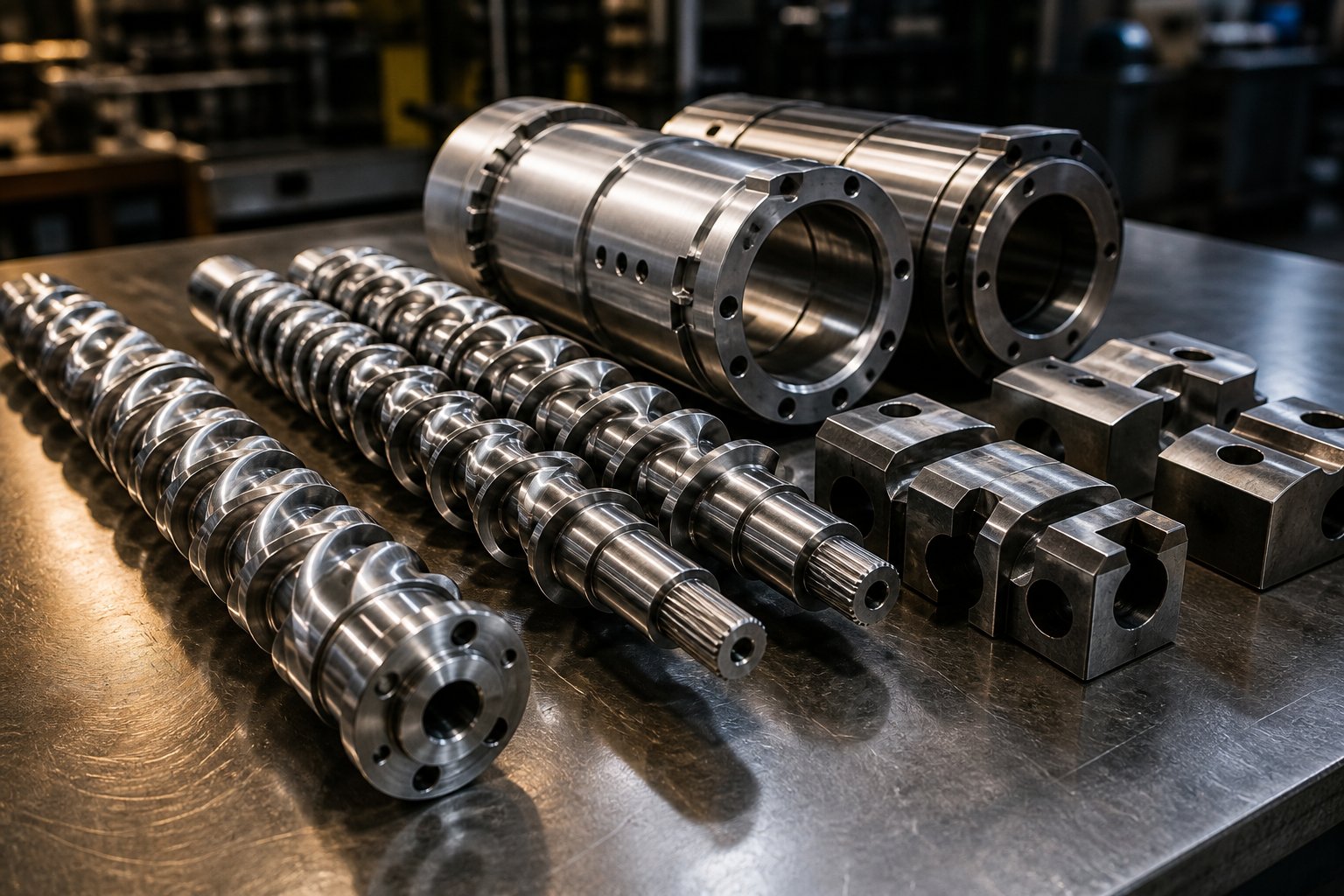
Optimizing Extruder Performance Through Screw and Barrel Selection
You've identified the right extruder type. You've sized it for throughput, validated the mixing requirements, and run the total cost of ownership numbers. But here's a reality that catches even experienced processors off guard: the machine itself is only the platform. The component that determines whether your extruder twin screw or single screw system actually delivers on its specifications is the screw and barrel assembly. A perfectly selected extruder running worn, poorly designed, or metallurgically mismatched screw barrels will underperform a lesser machine equipped with precision-engineered components. Every percentage point of output consistency, energy efficiency, and product quality traces back to what's rotating inside that barrel bore.
Why Screw and Barrel Quality Determines Real-World Performance
Think of the screw and barrel as the engine inside the chassis. The chassis matters, but the engine does the actual work. And just like an engine, performance degrades gradually — so gradually that most operators don't notice until quality complaints spike or energy bills drift upward without explanation.
Several interconnected factors determine how well a screw and barrel assembly performs over its service life:
Metallurgy and surface treatments are the first line of defense against wear. Screw extruders processing glass-fiber-filled compounds, mineral-loaded masterbatches, or recycled material containing contaminants face aggressive abrasive and corrosive conditions. The choice of base steel, hardening treatment, and surface coating directly controls how long flight clearances stay within tolerance. Nitrided tool steels work well for standard polymers, but abrasive compounds demand harder solutions — bimetallic barrel liners with tungsten carbide or boron alloy coatings, and screw flights with stellite or colmonoy hardfacing. As Santa Fe Machine Works notes, the processed material's viscosity, abrasiveness, and thermal conductivity all influence the wear rate, making material-specific metallurgy selection essential rather than optional.
L/D ratio optimization shapes the balance between melting, mixing, and pressure generation. A twin screw extruder plastic compounding line might run a 40:1 or 48:1 L/D ratio to provide enough barrel length for multiple kneading zones, side feeding, and vacuum venting. A single screw pipe extruder typically operates at 24:1 to 30:1, prioritizing efficient melting and stable metering-zone pressure. Specifying an L/D ratio that doesn't match the process leads to either incomplete melting or unnecessary residence time that degrades heat-sensitive resins.
Flight geometry is where screw design meets polymer science. Compression ratio, flight pitch, flight width, and channel depth must be tailored to the target polymer's melt behavior. A screw designed for LDPE film — with its broad melting range and low viscosity — will perform poorly on rigid PVC, which demands a very different compression profile and gentler shear history. Industry data from the Plastics Industry Association indicates that selecting the right screw barrel configuration can boost output by 15% to 30%, underscoring how much performance lives in the geometry rather than the machine frame.
Barrel liner materials must match the chemical and thermal profile of the processed compound. Corrosive polymers like fluoropolymers and certain flame-retardant formulations attack standard nitrided barrels from the inside out. Bimetallic liners with nickel-based alloys resist both corrosion and abrasion simultaneously, extending barrel life and protecting dimensional accuracy. Research suggests that the right barrel material can extend service life by up to 25% compared to a standard steel barrel in equivalent conditions.
Matching Screw Barrel Configurations to Your Extruder Type
What you should look for in a screw and barrel assembly differs significantly between single screw and twin screw platforms. Treating them as interchangeable leads to mismatched components and premature failures.
For single screw barrels, the screw is typically a monolithic one-piece design. Key selection criteria include compression ratio matched to the target resin, barrier flight designs that separate melt from solids for improved melting efficiency, and mixing sections (Maddock, pineapple, or static mixer) sized appropriately for the required homogeneity level. The barrel liner should be matched to the polymer's corrosion and abrasion profile, and the feed section should incorporate cooling channels to maintain the temperature differential that drives solids conveying.
For twin screw barrel sets, the focus shifts to modular element compatibility, segment alignment precision, and kneading-block selection. Each element must fit the splined shaft with tight tolerances — even minor dimensional deviations between elements from different suppliers can create dead zones where material stagnates and degrades. Kneading blocks must be specified by disc width, stagger angle, and number of lobes to achieve the target balance of dispersive versus distributive mixing. Barrel segments need precise bore alignment across the full barrel length; misalignment at segment joints accelerates localized wear and creates leak points.
Whether you're sourcing replacement components or specifying an upgrade, here's a checklist of specifications to verify before placing an order:
- Base metallurgy and hardening method — nitrided, through-hardened, or bimetallic, matched to the abrasiveness and corrosiveness of your processed material
- Surface treatment or coating — chrome plating, tungsten carbide overlay, or hardfacing alloy on flight lands and barrel bore
- Dimensional tolerances — flight outer diameter, barrel bore diameter, and flight-to-barrel clearance measured against OEM specifications
- L/D ratio and compression ratio — verified against the target polymer's melt behavior and the process type (direct extrusion, compounding, devolatilization)
- Modular element compatibility (twin screw) — spline profile, element outer diameter, and centerline distance confirmed to match the specific extruder make and model
- Barrel segment alignment and sealing surfaces — flatness and perpendicularity tolerances that prevent melt leaks at segment joints
- Cooling and heating channel configuration — adequate thermal management capacity for the target processing temperature range
Skipping even one of these verification steps can turn a routine barrel change into weeks of troubleshooting. Engineers and plant managers who want to compare these specifications across extruder types — single screw, parallel twin screw, conical twin screw, and injection molding configurations — can use NANHAIYA's screw barrel product catalog as a practical starting point. The catalog organizes options side by side for different plastic processing applications, which simplifies the matching process for teams moving from the decision framework in the previous section to actual component sourcing.
Putting It All Together
Every comparison in this article converges on the same conclusion: there is no universally superior extruder. The best machine for your production line depends on the intersection of material complexity, mixing requirements, throughput targets, and total economic context. A single screw extruder wins when the job is melting and shaping pre-compounded resin with maximum efficiency. A twin screw extruder wins when the job demands intensive mixing, multi-ingredient formulations, or process flexibility that a single screw cannot provide.
But choosing the right extruder type is only half the equation. The best results — the tightest tolerances, the lowest scrap rates, the longest intervals between maintenance shutdowns — come from pairing the right machine architecture with precision-engineered screw barrels whose metallurgy, geometry, and dimensional accuracy are matched to your specific polymer and process. Get both decisions right, and your extrusion line doesn't just run. It performs.
Frequently Asked Questions About Single and Twin Screw Extruders
1. What is the main difference between single and twin screw extruder designs?
The core difference lies in how each machine conveys and mixes material. A single screw extruder uses one helical screw inside a cylindrical barrel, relying on barrel-wall friction to drag pellets forward through feed, compression, and metering zones. A twin screw extruder uses two intermeshing screws inside a figure-eight barrel bore, creating positive displacement and self-wiping action. This fundamental mechanical difference means single screw machines excel at generating stable melt pressure for shaping pre-compounded resins, while twin screw machines excel at intensive mixing, multi-ingredient compounding, and handling diverse feedstock forms like powders, flakes, and liquids.
2. When should I choose a single screw extruder over a twin screw extruder?
A single screw extruder is the better choice when you are processing pre-compounded pellets that already contain all necessary additives and the primary task is melting, pressurizing, and shaping the material. Common applications include HDPE and PVC pipe extrusion, polyolefin blown and cast film lines, wire and cable coating, and sheet extrusion using ready-to-use ABS or polystyrene. These scenarios benefit from the single screw's superior pressure generation, lower capital cost, reduced energy consumption per kilogram, simpler operation, and higher equipment availability. Using a twin screw for these tasks adds unnecessary complexity and expense without measurable product improvement.
3. What is the cost difference between single and twin screw extruders?
The capital cost gap is significant. Entry-level single screw extruders start around $30,000 to $80,000, with mid-range models at $80,000 to $200,000 and large industrial systems reaching $500,000. Production-scale co-rotating twin screw systems typically range from $300,000 to $800,000, with advanced compounding lines exceeding $1,500,000. Beyond purchase price, twin screw machines require a larger spare-parts inventory of modular screw elements and barrel segments, with a full element set costing $20,000 to $100,000. However, total cost of ownership over a 10-year lifespan must also account for energy savings, scrap reduction, and elimination of secondary processing steps, which can offset the twin screw's higher upfront investment. Engineers comparing screw barrel components for either platform can review options at NANHAIYA's product catalog (https://www.nhyscrews.com/products) to benchmark replacement part costs.
4. What is the difference between co-rotating and counter-rotating twin screw extruders?
Co-rotating twin screw extruders have both screws turning in the same direction at speeds of 200 to 1,200+ RPM, producing high-shear mixing with excellent self-wiping and minimal dead zones. They dominate compounding, reactive extrusion, polymer alloys, and nanocomposite production. Counter-rotating twin screw extruders have screws turning in opposite directions at much lower speeds of 10 to 80 RPM, producing a gentle calendering effect with low shear intensity. They are primarily used for rigid PVC pipe, profile, and sheet extrusion where high temperatures would cause thermal decomposition. Choosing between them is just as consequential as choosing between single and twin screw platforms, yet this distinction is frequently overlooked in selection guides.
5. Can a single screw extruder handle mixing tasks effectively?
Yes, but within defined limits. A standard single-flight screw offers minimal cross-channel mixing, which is insufficient for demanding dispersion tasks. However, modern single screw technology significantly improves mixing capability through barrier screws that separate melt from solids, Maddock mixing sections that shear cooler material more aggressively, mixing pins, wave screws, and inline static mixers. These additions deliver adequate homogeneity for color blending in masterbatch letdowns, blending compatible resins at moderate ratios, and temperature uniformity in thick-wall profiles. For applications requiring sub-micron pigment dispersion, breaking filler agglomerates, or dispersing nanoparticles, a co-rotating twin screw extruder remains the only viable option due to its high-shear kneading zones and repeated material splitting and recombination.
Written by
Nanhaiya Technical Team
Zhoushan Nanhaiya Plastic Machinery Co., Ltd.
The Nanhaiya technical team supports screw and barrel manufacturing projects through application review, technical communication, custom manufacturing coordination, and production and quality control.
Discuss Your Application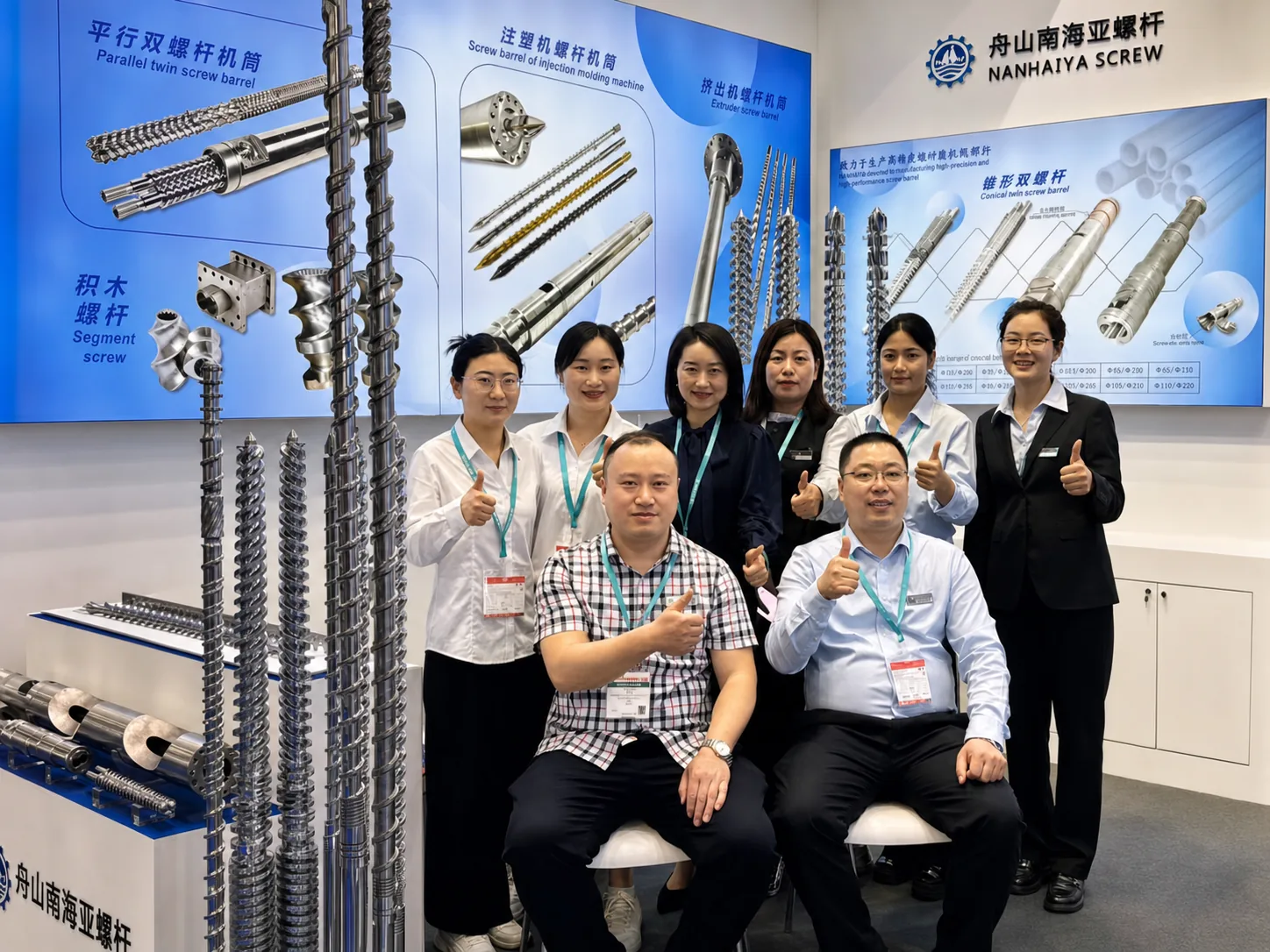
Related Articles
More insights on screw barrel technology and plastics processing.
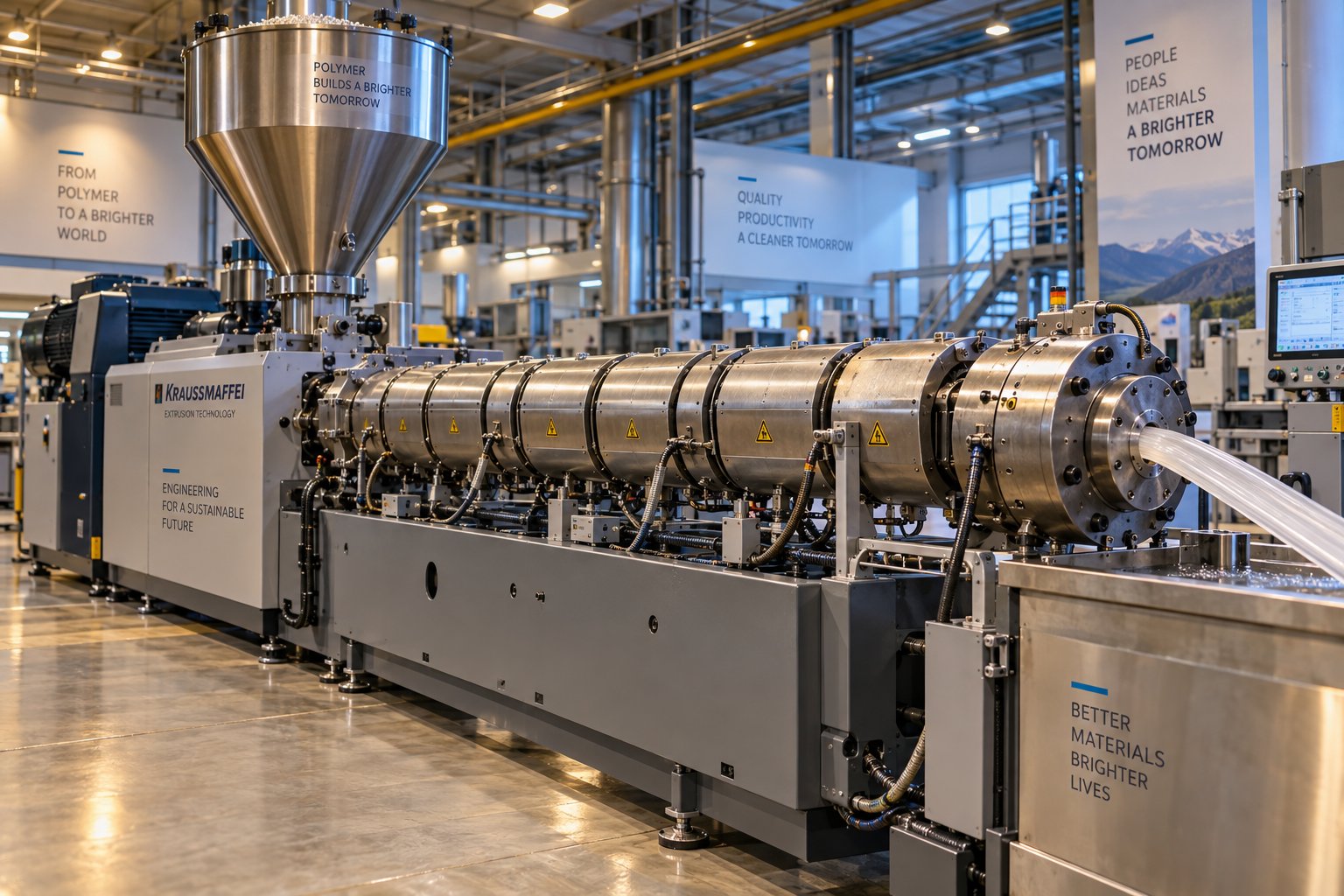
Extruder Machine Decoded: From Raw Pellet To Finished Product
Oct 6, 2026
Learn how an extruder machine works, compare single-screw vs. twin-screw types, and get expert guidance on specs, troubleshooting, and selection.
Read Article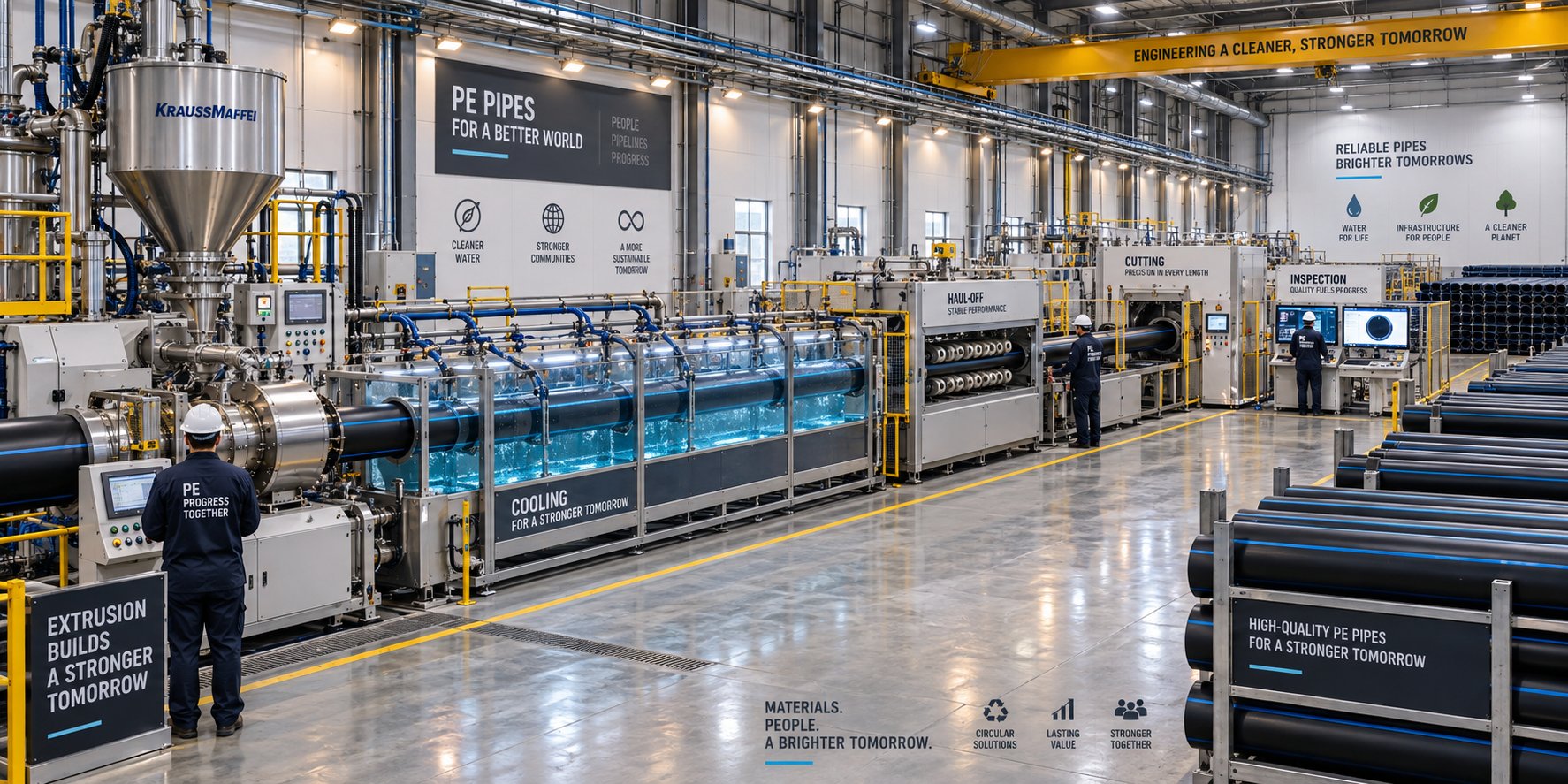
PE Pipe Making Machine Decoded: From Raw Resin to Flawless Pipe
Oct 4, 2026
Learn how a PE pipe making machine works, from resin to finished pipe. Covers components, material grades, automation, troubleshooting, and buyer selection tips.
Read Article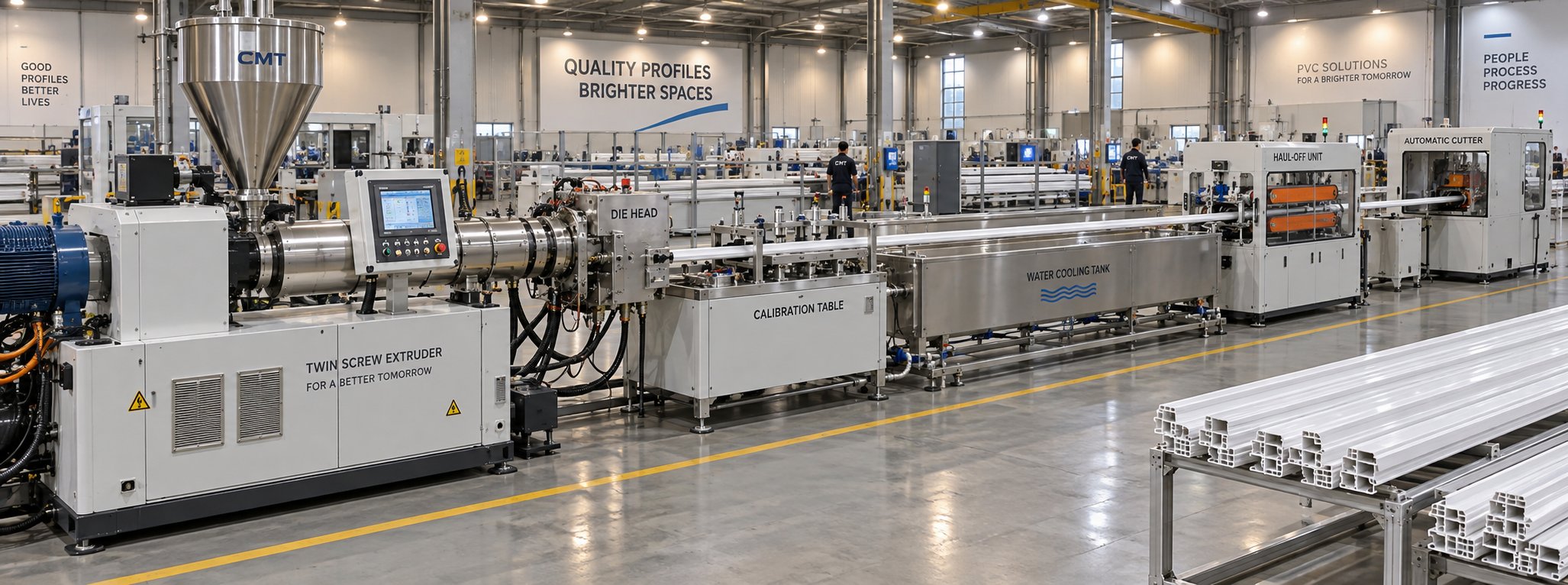
PVC Profile Making Machine Decoded: From Raw Resin To Profit
Oct 3, 2026
Learn how a PVC profile making machine works — extrusion process steps, key technical parameters, die design, calibration methods, maintenance, and total cost of ownership.
Read ArticleLooking for something else?
Search by material, symptom or product and jump straight to the relevant page.
These are navigation suggestions based on keyword matching — not a quotation, not a delivery commitment, and not a substitute for engineering review. Final specification is confirmed by our engineers against your drawings and processed material.
Need help with screw barrel selection?
Share your machine model, processed material and application. Our team can help with pricing and technical support.