

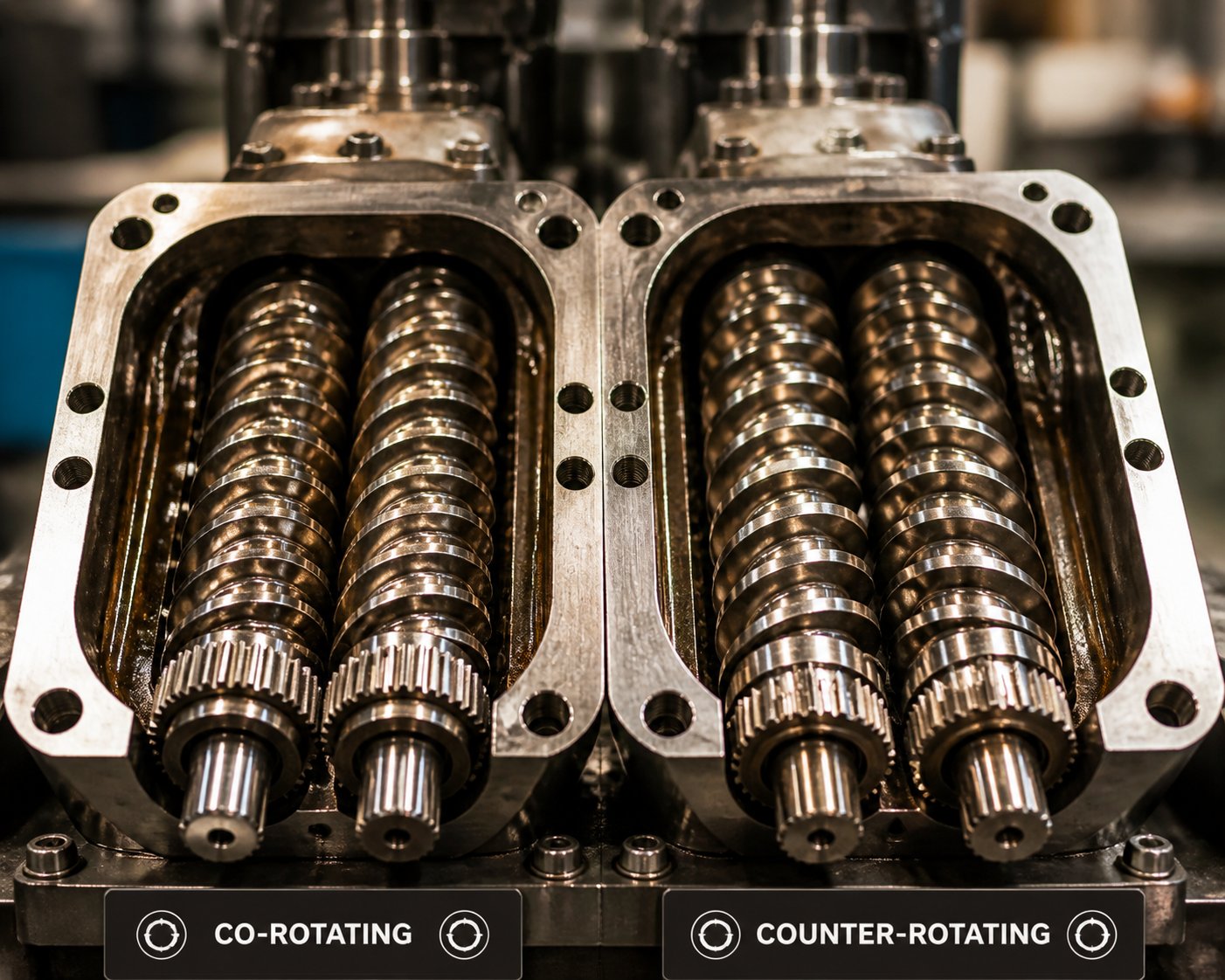
What Is a Twin Screw Extruder and Why Rotation Direction Matters
Imagine two helical screws spinning side by side inside a heated barrel, melting and mixing raw materials into a uniform product. That is the essence of a twin screw extruder - and the direction those screws rotate changes virtually everything about how the machine behaves.
A twin screw extruder is a processing machine that uses two intermeshing or non-intermeshing screws housed within a barrel to melt, mix, and convey polymers and other materials. Whether the screws rotate in the same direction (co-rotating) or in opposite directions (counter-rotating) fundamentally determines the machine's shear profile, mixing quality, material transport mechanism, and range of suitable applications.
The difference between co rotating and counter rotating twin screw extruder configurations is not a minor specification detail. It is the single most consequential design choice in twin screw extrusion, and choosing incorrectly can lead to degraded product quality, wasted energy, and costly downtime. This article breaks down all four subtypes, provides a full parameter comparison table, and offers a practical decision-making framework so you can match the right configuration to your process.
What Is a Twin Screw Extruder
At its core, every twin screw extruder shares the same foundational components: two parallel (or conical) screws, a segmented and independently heated barrel, a drive system consisting of a motor and gearbox, and a die that shapes the final output. Raw material - pellets, powder, or fibers - enters through a feed hopper, travels along the screws where it is melted by a combination of barrel heat and mechanical shear, and exits through the die as a finished or semi-finished product. Twin screw extruders outperform single-screw machines in mixing capability, process flexibility, and the ability to handle difficult-to-process materials like highly filled compounds or thermally sensitive polymers.
Why Rotation Direction Is the Defining Variable
Here is what makes the co rotating and counter rotating twin screw extruder distinction so critical: changing the rotation direction completely reshapes how material flows through the machine. Co-rotating screws create a figure-eight flow pattern with intense shear and self-wiping action. Counter-rotating screws form closed C-shaped chambers that push material forward through positive displacement with far less shear. These opposing flow mechanisms produce different residence time distributions, different pressure profiles, and entirely different mixing behaviors. In practical terms, a formulation that processes beautifully in one configuration can degrade or underperform in the other. Understanding exactly how each configuration works - starting with the co-rotating design - is the first step toward making the right equipment choice.
How Co-Rotating Twin Screw Extruders Work
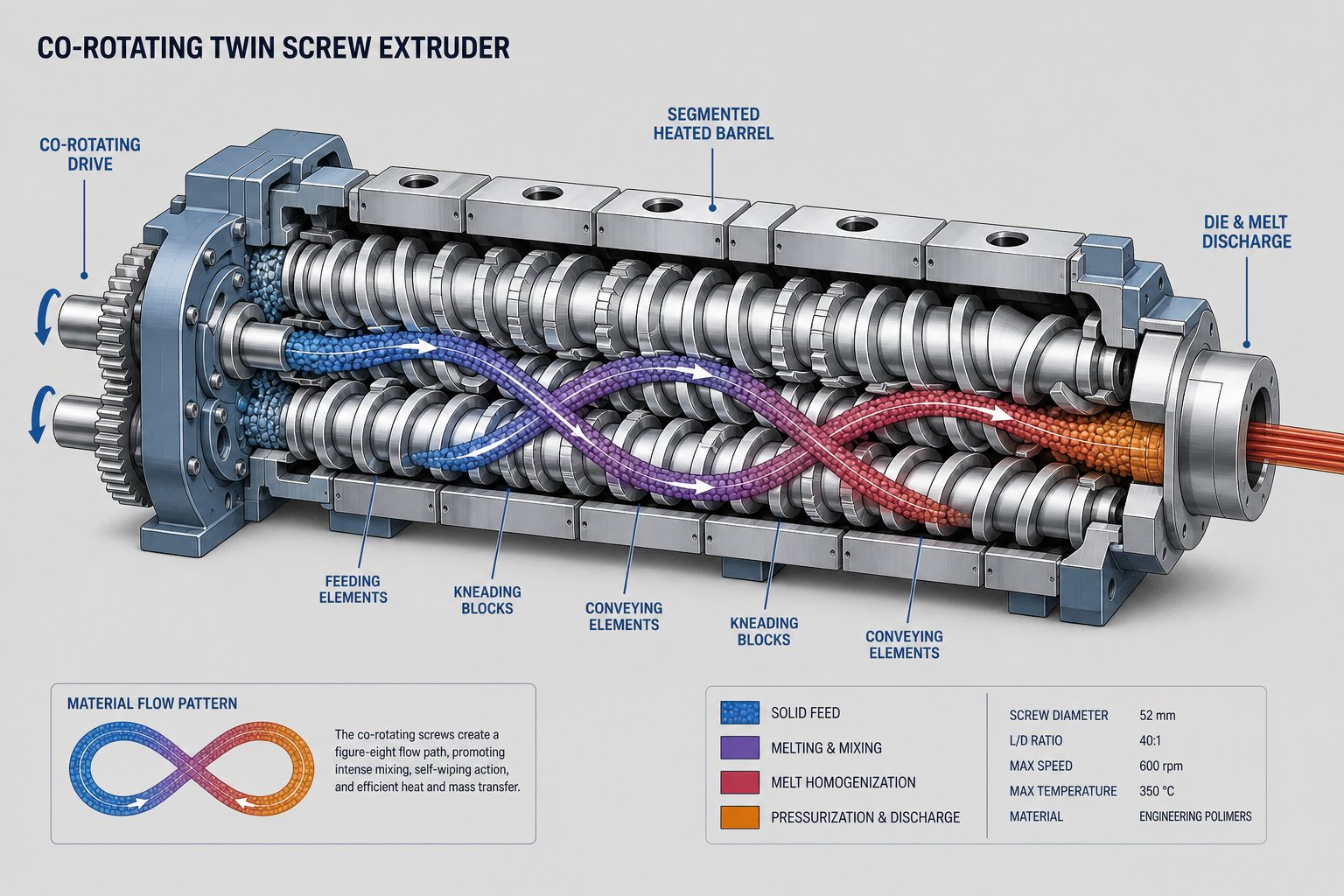
When both screws spin in the same direction, something remarkable happens to the polymer melt. Instead of being trapped in isolated pockets, material flows in a continuous figure-eight pattern - transferring from the channel of one screw to the channel of the other and back again. This constant material exchange is the defining characteristic of a co-rotating twin screw extruder, and it creates one of the most effective mixing environments available in continuous polymer processing.
Figure-Eight Flow and Self-Wiping Mechanism
Picture the infinity symbol (∞) laid on its side. That is essentially the path polymer melt follows as it moves through a co-rotation twin screw extruder. As material rides along one screw, it reaches the intermeshing zone where the flight of the opposing screw sweeps it across to the other channel. This hand-off repeats with every rotation, exposing the melt to constantly changing shear conditions and producing both distributive mixing (spreading additives uniformly) and dispersive mixing (breaking apart agglomerates).
The same intermeshing geometry delivers a powerful secondary benefit: self-wiping. Because both screws rotate in the same direction, the flight crest of one screw continuously scrapes the root of the other. This action prevents material from stagnating on metal surfaces - a critical advantage during color changes or when processing heat-sensitive formulations. Stagnant material degrades, creating black specks or contamination. The self-cleaning action virtually eliminates this risk, which is why Erdmenger-profile screw geometry has become the standard for co-rotating intermeshing designs.
High-Speed Operation and Modular Screw Design
Self-wiping opens the door to high-speed operation. Because material cannot accumulate and overheat, a twin screw co rotating extruder can safely run at far higher RPMs than its counter-rotating counterpart. Modern high-speed energy input (HSEI) machines operate at screw speeds exceeding 1,200 RPM, with some configurations reaching up to 1,800 RPM. Higher screw speed translates directly into greater specific energy input and higher throughput per unit of screw diameter - a 90 mm co-rotating extruder can often match or exceed the output of a significantly larger counter-rotating machine.
Equally important is the modular screw element system. Engineers assemble individual screw elements onto a splined shaft, choosing from conveying elements, kneading blocks, and specialized mixing or reverse elements. Kneading blocks alone can be configured at different stagger angles - 30, 45, 60, or 90 degrees - to fine-tune shear intensity. A 90-degree kneading block delivers maximum dispersive mixing for difficult pigments like carbon black, while a 30-degree block provides gentler distributive blending. This modularity allows a single co-rotating twin-screw extruder to be reconfigured for entirely different processes simply by rearranging the screw elements on the shaft.
Here is a summary of the key characteristics that define how a co-rotating twin screw extruder works:
- Self-wiping action - Flight-to-root contact prevents stagnation and material degradation
- High RPM capability - Speeds from 300 to 1,200+ RPM enable high throughput and intensive energy input
- Modular screw elements - Conveying, kneading, and mixing elements can be arranged in countless configurations
- Strong distributive and dispersive mixing - The figure-eight flow ensures thorough homogenization
- Broad residence time distribution (RTD) - Acceptable for compounding and reactive extrusion, though less ideal for extremely heat-sensitive polymers
These characteristics make the co-rotating design the dominant choice for compounding, masterbatch production, and reactive extrusion. Yet high shear and broad RTD are not advantages in every scenario - and that is precisely where the counter-rotating configuration reveals its own distinct strengths.
How Counter-Rotating Twin Screw Extruders Work
High shear and self-wiping are powerful tools - but they are not what every polymer needs. Rigid PVC, for example, has a thermal decomposition temperature dangerously close to its processing temperature. Subject it to the intense shear fields of a co-rotating machine, and you risk degrading the material before it ever reaches the die. This is where the counter rotating twin screw extruder earns its place - not as a lesser alternative, but as the technically superior solution for an entire class of shear-sensitive and heat-sensitive materials.
In a counter-rotating design, the two screws rotate in opposite directions, typically turning inward toward each other at the top of the barrel. This seemingly simple reversal transforms the entire material transport mechanism, replacing the open figure-eight flow with something far more controlled: a series of sealed, pressure-building chambers that push material forward with the precision of a gear pump.
C-Shaped Chamber and Positive Displacement Pumping
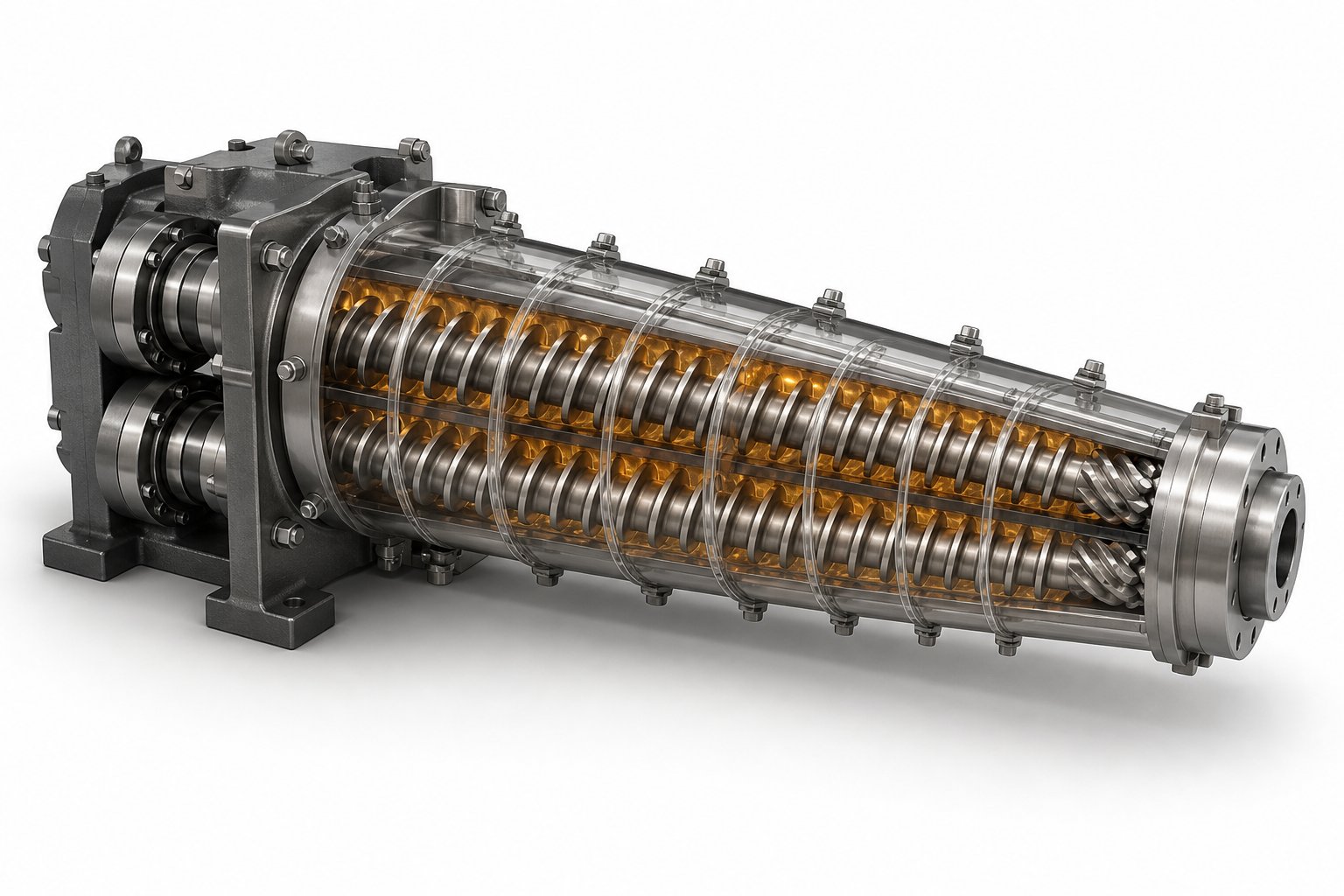
Imagine two gears meshing together inside a housing. Material entering from the feed side fills the spaces between teeth and is carried forward as the gears rotate, trapped with nowhere to go except toward the discharge end. A counter rotating twin screw extruder operates on essentially the same principle. As the screws rotate in opposite directions, material becomes enclosed in discrete C-shaped pockets - bounded by the screw flights on two sides and the extruder twin screw barrel wall on the third. Each pocket functions as a miniature sealed chamber, and as the screws turn, these chambers advance the material toward the die in a highly predictable fashion.
This positive displacement mechanism has two major practical consequences. First, the machine can generate stable, consistent pressure without relying heavily on the material's own viscosity or friction characteristics. Even low-melt-strength materials that would slip or surge in a single-screw machine convey reliably in a closely intermeshing twin screw extruder running in counter-rotation. Second, and equally important, every material particle follows roughly the same path through the machine. There are no fast lanes and no dead zones. This translates directly into a narrow residence time distribution (RTD) - the range of time that individual material particles spend inside the barrel is remarkably tight.
Why does narrow RTD matter so much? Think about rigid PVC again. Its decomposition temperature sits only about 10-20 degrees Celsius above its processing temperature. If some fraction of the melt lingers in the barrel even slightly longer than the rest, that fraction overheats and degrades - producing discoloration, black specks, or compromised mechanical properties. A narrow RTD ensures that virtually all material exits the extruder after the same controlled exposure to heat. You get consistent fusion, consistent color, and consistent quality from the first meter of pipe to the last.
The Calendering Effect and Low-Shear Processing
The intermeshing region of a counter-rotating machine creates another phenomenon that sets it apart: the calendering effect. As the two screws rotate toward each other, material is drawn into the narrowing gap between them - much like polymer sheet being fed between calender rolls in a film production line. In this nip region, the melt undergoes compressive and elongational deformation rather than the intense rotational shear typical of co-rotating designs.
This distinction matters enormously for processing behavior. Technovel's technical documentation describes how the calendering effect at the intermeshing zone provides dispersive mixing under relatively gentle conditions - breaking apart additive agglomerates and distributing stabilizers without generating excessive shear heat. For PVC formulations specifically, this gentle dispersion is not just adequate; it is actually preferable. Overly aggressive mixing can break polymer chains, reduce molecular weight, and destroy the very properties the formulation was designed to achieve. The counter-rotating approach delivers the moderate dispersion that these materials genuinely require.
Closely intermeshing counter-rotating designs do face one well-known constraint: speed. Because the screws rotate toward each other, the forces at the intermeshing zone increase sharply with RPM. Closely intermeshing configurations typically operate at approximately 60 RPM or below - a fraction of what co-rotating machines achieve. However, treating this as a weakness misses the point. For materials like rigid PVC, lower screw speed is not a limitation; it is a requirement. Lower RPM means less frictional heat, which means the extrusion temperature stays safely below the decomposition threshold. The machine's throughput is driven by its positive displacement pumping efficiency, not by screw speed alone.
Counter-rotating extruders also come in two distinct barrel geometries, each suited to different production scales and material requirements:
- Conical twin screw extruder - The screws taper from a larger diameter at the feed end to a smaller diameter at the discharge end. This geometry provides a large feed opening for bulk-density-limited powders like dry-blend PVC, while the tapering design naturally increases compression along the barrel length. Conical designs are compact, energy-efficient, and widely used for PVC pipe, profile, and sheet extrusion.
- Parallel twin screw extruder - The screws maintain a constant diameter along the full barrel length, offering greater L/D ratios and longer processing zones. Parallel counter-rotating designs are gaining adoption for larger-diameter pipe production and polyolefin processing where the additional barrel length provides better homogenization.
Both geometries rely on the same C-shaped chamber transport and calendering-based mixing, but the conical twin screw extruder has historically dominated PVC processing due to its ability to accept large volumes of low-bulk-density powder while maintaining a compact machine footprint. A 65/132 conical twin screw extruder with a 37 kW motor can match the output of a 75-80 mm single screw extruder running a 90+ kW motor, cutting energy consumption by more than 50 percent.
Here is a summary of the key characteristics that define how a counter-rotating twin screw extruder works:
- Positive displacement pumping - C-shaped chambers create gear-pump-like material transport with stable, predictable pressure buildup
- Narrow residence time distribution (RTD) - All material particles experience nearly identical thermal exposure, critical for heat-sensitive polymers
- Low shear processing - Reduced frictional heat generation keeps extrusion temperatures safely below degradation thresholds
- Calendering effect - Compressive and elongational deformation at the nip region provides gentle yet effective dispersive mixing
- Conical or parallel geometry options - Conical designs offer compactness and high powder intake; parallel designs provide longer processing zones for demanding applications
These strengths make the counter-rotating configuration genuinely irreplaceable for rigid PVC, wood-plastic composites, and other materials where thermal sensitivity and processing control outweigh the need for high-intensity mixing. The real question, then, is not which configuration is better in absolute terms - it is how the degree of intermeshing interacts with each rotation direction to create four distinct machine subtypes, each with its own processing niche.
All Four Twin Screw Extruder Subtypes Explained
Most discussions about the difference between co-rotating and counter-rotating twin screw extruders stop at two categories. In reality, there are four distinct subtypes - and each one creates a fundamentally different processing environment. The variable that splits each rotation direction into two branches is the degree of intermeshing: whether the screws physically engage with each other, or whether they rotate independently side by side with a gap between them.
Think of it this way. Rotation direction determines the type of material flow (figure-eight versus C-shaped chamber). Intermeshing degree determines the intensity of that flow. Together, these two variables produce four unique combinations - and understanding all four is essential for anyone involved in twin extruder screw design or equipment selection.
Co-Rotating Intermeshing vs Non-Intermeshing Configurations
The vast majority of co-rotating twin screw extruders sold worldwide fall into the intermeshing category. These are the high-speed energy input (HSEI) machines described by Plastics Today that dominate polymer compounding, reactive extrusion, and masterbatch production. Their tightly engaged screw flights create the self-wiping action and figure-eight material transfer covered earlier, enabling screw speeds exceeding 1,200 RPM and delivering intense distributive and dispersive mixing. The modular segmented screw elements - kneading blocks, conveying elements, mixing discs - can be rearranged on splined shafts to match virtually any process requirement. If you hear someone simply say "corotating twin screw extruder" without further qualification, they almost certainly mean this fully intermeshing variant.
Co-rotating non-intermeshing designs, by contrast, occupy a much narrower niche. Here, the two screws rotate in the same direction but do not physically engage - a gap separates the flight tips of one screw from the root of the other. What does removing the intermesh do? It eliminates the self-wiping mechanism, reduces shear intensity at the screw-to-screw interface, and shifts the mixing character from intensive dispersive blending toward gentler distributive action. Material exchange between the two screws still occurs through the gap region, but it is driven by drag flow and pressure differentials rather than by direct mechanical transfer.
You might wonder: why sacrifice self-wiping and mixing intensity on purpose? The answer lies in specific devolatilization and low-shear blending scenarios. Co-rotating non-intermeshing machines can maintain high free volume in the screw channels, increasing the surface area of the melt exposed to vacuum during venting operations. They are occasionally selected for processes where thorough mixing is less critical than high-throughput material conveyance with moderate homogenization. Still, this subtype is uncommon enough that most co-rotating twin-screw extruders in commercial production lines are fully or closely intermeshing.
Counter-Rotating Intermeshing vs Non-Intermeshing Configurations
The counter-rotating side of the classification tree splits along a more impactful dividing line, and it is here that a widely used industry framework becomes especially helpful. Industry experts distinguish between two families of twin screw extruders: HSEI (high-speed energy input) machines, which run at high RPM and prioritize mixing energy, and LSLF (low-speed late fusion) machines, which run at low RPM and prioritize gentle, controlled conveying. Counter-rotating intermeshing extruders are the textbook LSLF design, while counter-rotating non-intermeshing machines can serve either camp depending on their configuration.
Within the counter-rotating intermeshing category, you will encounter two further distinctions:
- Closely intermeshing - The screw flights mesh tightly, creating well-sealed C-shaped chambers with strong positive displacement pumping and extremely narrow RTD. This is the configuration used for rigid PVC pipe, profile, and sheet extrusion. The trade-off is a strict speed limitation - typically around 60 RPM - because the compressive forces at the tightly engaged intermeshing zone escalate rapidly with rotational speed.
- Loosely intermeshing - Larger clearances between the screw flights allow some material leakage between chambers, reducing positive pumping efficiency but enabling higher screw speeds and somewhat broader RTD. Loosely intermeshing counter-rotating twin screw extruders bridge the gap between the strict positive displacement of close intermeshing and the open flow of non-intermeshing designs. They find use in applications like PVC pelletizing and specialty compounding where moderate pressure buildup and controlled shear are both needed.
Counter-rotating non-intermeshing extruders are the rarest subtype in commercial production. With screws that neither engage nor wipe each other, these machines rely on friction-based conveying and barrel-wall drag to move material forward. Mixing intensity is the lowest of all four subtypes, and there is no self-wiping or positive displacement mechanism. Their primary niche is certain devolatilization applications where maximum free volume and minimal mechanical energy input are priorities - think of removing residual solvents or monomers from a polymer melt that cannot tolerate additional shear heating.
The table below brings all four subtypes together in a single reference framework. You will notice that the interaction between rotation direction and intermeshing degree produces distinct performance profiles across every key parameter:
| Subtype | Intermeshing Degree | Typical RPM Range | Mixing Intensity | Pumping Capability | Primary Applications |
|---|---|---|---|---|---|
| Co-rotating intermeshing | Fully/closely intermeshing | 300 - 1,200+ RPM | Very high (distributive and dispersive) | Moderate (drag-flow dependent) | Compounding, masterbatch, reactive extrusion, direct extrusion |
| Co-rotating non-intermeshing | No engagement (gap between screws) | 200 - 800 RPM | Low to moderate (distributive only) | Low (friction/drag-based) | Devolatilization, gentle blending, niche low-shear processes |
| Counter-rotating intermeshing | Closely or loosely intermeshing | 10 - 60 RPM (closely); up to 150 RPM (loosely) | Low to moderate (calendering effect) | Very high (positive displacement) | Rigid PVC pipe/profile, WPC, PVC sheet, pelletizing |
| Counter-rotating non-intermeshing | No engagement (gap between screws) | 50 - 300 RPM | Very low | Low (friction-based) | Specialty devolatilization, solvent removal |
What stands out immediately is how intermeshing amplifies the core strengths of each rotation direction. For co-rotating twin screw extruders, intermeshing unlocks maximum self-wiping and mixing energy. For counter-rotating machines, intermeshing creates the sealed chambers that enable true positive displacement. Remove the intermesh from either design, and you reduce both mixing intensity and conveying precision - which is why co-rotating intermeshing and counter-rotating intermeshing machines account for the overwhelming majority of installations worldwide, while their non-intermeshing counterparts remain specialty tools.
With all four subtypes mapped, the natural next step is lining up every measurable parameter - shear rate, torque capacity, energy profile, RTD shape - in a single side-by-side comparison that makes the practical differences impossible to miss.
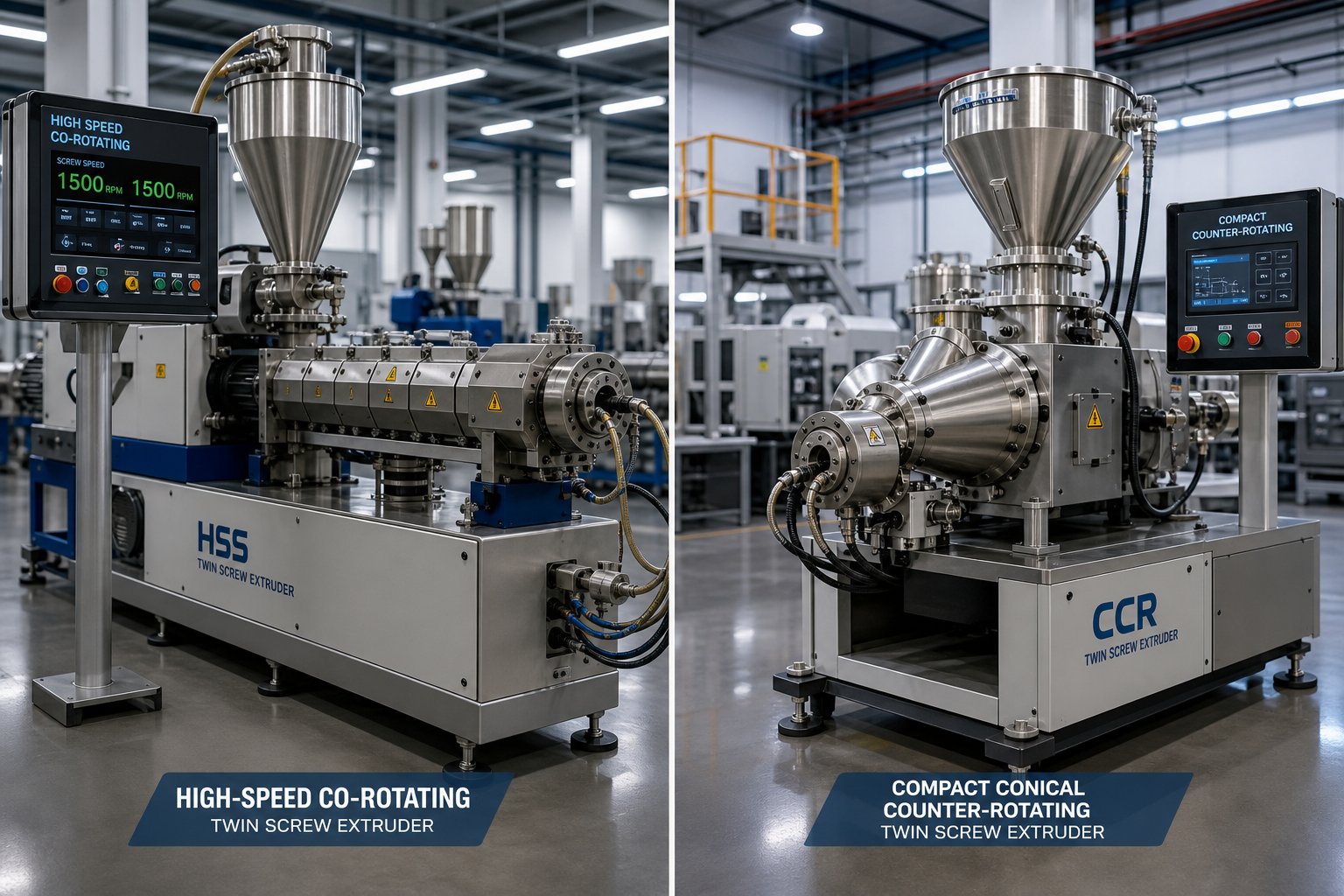
Side-by-Side Technical Comparison of Every Key Parameter
Having four subtypes mapped out is valuable - but when a process engineer or purchasing manager needs to make an actual equipment decision, what they really want is a single reference that puts every measurable parameter for a co-rotating and counter-rotating twin-screw extruder side by side. No ambiguity, no flipping between sections. Just a clear, scannable comparison that highlights exactly where these two configurations diverge.
That is exactly what the table below delivers. It consolidates screw geometry options, shear behavior, speed ranges, mixing characteristics, and application fit into one place - turning scattered technical details into a decision-ready resource for anyone evaluating a twin screw extruder machine purchase.
Complete Parameter Comparison Table
| Parameter | Co-Rotating (Intermeshing) | Counter-Rotating (Intermeshing) |
|---|---|---|
| Rotation Direction | Both screws rotate in the same direction | Screws rotate in opposite directions (typically inward at top) |
| Screw Geometry Options | Parallel only | Parallel or conical |
| Intermeshing Type | Fully intermeshing (self-wiping) | Closely or loosely intermeshing |
| Shear Rate | High - intense shear fields between screws and between screw and barrel | Low - compressive and elongational deformation dominates |
| Typical RPM Range | 300 - 1,200+ RPM | 10 - 60 RPM (closely intermeshing); up to 150 RPM (loosely) |
| Specific Torque Capacity | High - modern gearboxes deliver up to 18 Nm/cm3 | Moderate - limited by forces at the intermeshing zone |
| Throughput Capacity | High - driven by RPM and specific energy input | Moderate - driven by positive displacement volume per revolution |
| Mixing Type | Strong distributive and dispersive (figure-eight flow + kneading blocks) | Gentle dispersive via calendering effect; moderate distributive |
| Self-Wiping Capability | Yes - continuous flight-to-root contact prevents stagnation | Limited - screws do not wipe each other; some stagnation possible |
| Residence Time Distribution (RTD) | Broad - material particles experience varied thermal histories | Narrow - sealed C-chambers ensure uniform exposure time |
| Pressure Generation Method | Drag flow and viscous friction (pressure builds progressively) | Positive displacement (gear-pump-like sealed chamber transport) |
| Energy Consumption Profile | Higher specific energy per kg due to high RPM and shear | Lower specific energy per kg; reduced frictional heat generation |
| Primary Applications | Compounding, masterbatch, reactive extrusion, polymer alloys, nanocomposites | Rigid PVC pipe/profile/sheet, WPC, heat-sensitive formulations |
What These Differences Mean in Practice
Numbers and descriptors in a table only become useful when you understand their real-world consequences. Here is how the key contrasts play out on the production floor.
The RPM gap is the most visually obvious difference, yet its implications run deeper than simple speed. A co-rotating twin-screw extruder running at 800 RPM imparts enormous mechanical energy into the melt. That energy is exactly what you need to break apart carbon black agglomerates or drive a grafting reaction in reactive extrusion. But for rigid PVC - where the thermal decomposition temperature sits dangerously close to the processing window - that same energy input would generate enough shear heat to degrade the polymer before it reaches the die. The counter-rotating configuration's low RPM is not a compromise; it is the engineering solution.
Residence time distribution tells a similar story from a different angle. A broader RTD in co-rotating twin-screw extruders is perfectly acceptable - even beneficial - for compounding, where slightly varied thermal exposure helps complete additive dispersion. However, a broad RTD becomes genuinely problematic for heat-sensitive materials. Some particles linger longer, absorb more heat, and degrade while the rest of the batch processes normally. The narrow RTD of counter-rotating machines eliminates this variability, delivering the kind of thermal uniformity that PVC and WPC processors depend on for consistent product quality.
Self-wiping capability matters most during product transitions. If your production schedule involves frequent color or material changes, an extruder twin screw configuration with full self-wiping action minimizes purge time and material waste. Without self-wiping, residual material can cling to barrel walls and screw roots, requiring longer cleaning cycles and increasing the risk of cross-contamination between runs.
Pressure generation method shapes how each machine handles low-viscosity or low-melt-strength materials. Counter-rotating positive displacement pumping conveys material regardless of its rheological behavior, making it reliable for powdery PVC dry-blends that lack the melt strength needed for drag-flow-dependent transport. Co-rotating designs, on the other hand, rely on the material's own viscosity to build pressure - which works well for most thermoplastics but can cause surging with very low-viscosity formulations unless starve feeding and specialized screw profiles are employed.
The choice between co-rotating and counter-rotating configurations ultimately comes down to one question: does your process prioritize intensive mixing and throughput flexibility, or does it require gentle positive displacement with precise thermal control?
Every parameter in the comparison table traces back to that central trade-off. Yet parameters alone do not capture the full picture of ownership. The costs of buying, running, and maintaining these two machine types diverge just as sharply as their processing characteristics - and those financial realities often influence the final decision as much as any technical specification.
Cost, Maintenance, and Wear Comparison
A twin screw extruder price tag tells you what the machine costs to buy. It tells you almost nothing about what the machine costs to own. The real financial picture emerges only when you factor in energy consumption, wear rates, spare parts strategy, and maintenance downtime - and these ongoing costs diverge significantly between co-rotating and counter-rotating configurations. For anyone evaluating a twin screw extruder for sale, understanding these differences can prevent a purchasing decision that looks smart on day one but proves expensive over five years of production.
Capital and Operating Cost Differences
Co-rotating twin screw extruders generally carry higher upfront capital costs than their counter-rotating counterparts. Several factors drive this premium. The high-torque gearbox required to deliver specific torques up to 18 Nm/cm3 at speeds exceeding 1,000 RPM is a precision component with a price to match - industry data places gearbox replacement costs alone at roughly $1,800 to $3,800. The modular screw element system adds another layer of investment: while individual elements are relatively affordable (approximately $0.62 to $2.80 per piece depending on material grade), a complete set of conveying, kneading, and mixing elements for multiple process configurations adds up. The barrel itself, typically segmented and individually heated, contributes further to the initial outlay.
Counter-rotating extruders - especially conical designs - tend to be more economical at the point of purchase for equivalent output in their target applications. Conical twin screw extruders use a simpler, non-modular screw design and a less complex gearbox because they operate at far lower RPMs. A 65/132 conical machine running at 30-50 RPM simply does not need the same level of drivetrain engineering as a co-rotating compounder spinning at 800 RPM. For PVC pipe and profile manufacturers, this translates into meaningful capital savings without any sacrifice in processing capability.
Operating cost comparisons, however, flip the narrative in interesting ways. Co-rotating machines at high RPM consume significantly more specific energy per kilogram of processed material - all that shear and mechanical mixing requires power. Yet their higher throughput rates can reduce the cost per unit of finished product. Imagine a co-rotating extruder consuming 0.25 kWh/kg at 2,000 kg/h versus a counter-rotating machine consuming 0.15 kWh/kg at 500 kg/h. The co-rotating machine uses more total energy, but its per-kilogram cost may still be competitive because fixed overhead is spread across four times the output. For counter-rotating conical extruders processing PVC, the energy advantage is more clear-cut: lower RPM and reduced frictional heat generation mean lower electricity bills and reduced cooling requirements - a genuine operational savings that compounds over years of continuous production.
Wear Patterns and Maintenance Requirements
Here is where the ownership cost story gets especially interesting. Wear is inevitable in any extruder, but where it concentrates and how you address it differs dramatically between the two configurations.
In a co-rotating twin screw extruder, the self-wiping action that prevents material stagnation also distributes mechanical wear more evenly across screw elements. Abrasive wear studies show that the most affected zone is typically the last set of feed screws and the first set of kneading elements - the transition point where solid material begins melting and abrasive particles exert maximum force. As wear progresses, the effective melting point shifts downstream, reducing usable mixing length and eventually lowering achievable output. The good news? Modular screw design means you replace only the worn elements, not the entire screw. A single kneading block or conveying element can be swapped in minutes once the barrel is opened.
Counter-rotating machines face a different wear pattern. Because the screws do not self-wipe, abrasive wear tends to concentrate at the intermeshing zone and the calendering gap - the exact regions where screw-to-screw clearances are tightest and processing forces are highest. In closely intermeshing designs, even modest wear at the flight tips can compromise the seal integrity of those critical C-shaped chambers, reducing positive displacement efficiency and widening the RTD. The consequence is a more noticeable performance drop per millimeter of wear compared to co-rotating designs, where the impact of equivalent wear is spread across a broader processing zone.
Spare parts strategy amplifies this distinction. Consider the key maintenance factors for each configuration:
Co-rotating maintenance considerations:
- Individual element replacement - Worn kneading blocks or conveying elements slide off the splined shaft and are replaced individually, minimizing downtime and cost
- Element service life - Standard high-speed steel elements last roughly 4-8 months under normal conditions; bimetallic elements extend to 8-12 months
- Barrel inspection - Clamshell barrel designs on some co-rotating machines allow quick visual wear assessment without full disassembly
- Gearbox longevity - High-torque gearboxes typically last 5-8 years with proper lubrication, though internal bearings and gears may need attention around 15,000 operating hours
Counter-rotating maintenance considerations:
- Full screw replacement - Many counter-rotating designs (especially conical) use one-piece screws rather than modular elements, meaning wear at the intermeshing zone may require replacing the entire screw set
- Screw and barrel service life - Ordinary nitrided steel screws and barrels last approximately 6-12 months processing standard materials, dropping to 3-6 months with abrasive fillers; bimetallic upgrades can extend this to 12-24 months
- Concentrated wear zones - The intermeshing region and calendar gap require closer monitoring because wear here directly impacts pumping precision and RTD control
- Lower mechanical stress on gearbox - The slower operating speeds reduce bearing loads and gear stress, often extending gearbox service intervals compared to high-speed co-rotating systems
Barrel quality deserves special emphasis regardless of configuration. The barrel is the pressure vessel that contains the melt, transfers heat, and resists abrasive and corrosive attack from filled polymer compounds. A poorly manufactured barrel shortens screw element life, creates uneven temperature zones, and accelerates the cycle of wear and replacement. Bimetallic barrel liners - using centrifugally cast wear-resistant alloys - can double or triple service life compared to standard nitrided steel, especially when processing glass-fiber-reinforced or mineral-filled materials. Whether you are running a co-rotating compounder or a counter-rotating PVC line, investing in premium barrel construction pays for itself many times over in reduced maintenance frequency and more consistent product quality.
For manufacturers shopping for a used twin screw extruder for sale, these wear dynamics take on even greater importance. A used co-rotating machine with worn kneading blocks can be restored to near-original performance by replacing a handful of screw elements - a relatively modest investment. A used counter-rotating extruder with worn one-piece screws may require a full screw set replacement costing several thousand dollars before it runs properly. Always inspect the intermeshing zone clearances and barrel bore measurements before purchasing any used twin screw extruder, and factor the cost of replacement components into your total acquisition budget.
Financial realities shape equipment decisions - but so do assumptions. Some of the most common assumptions about twin screw extruder selection turn out to be flat-out wrong, and acting on them leads to costly mismatches between machine capability and process requirements.
Common Misconceptions About Twin Screw Extruder Selection
Misguided assumptions cost real money. A plant manager who insists on a co-rotating machine for every application, or a buyer who dismisses conical counter-rotating technology as outdated, is making decisions based on myths rather than engineering reality. These misconceptions circulate through trade shows, sales conversations, and even some technical literature - and they lead directly to equipment mismatches, unnecessary capital expenditure, and suboptimal product quality. Separating fact from fiction is essential before committing to any configuration.
Co-Rotating Is Not Always the Better Choice
The advantages of twin screw extruder technology are well documented - superior mixing, continuous processing, and the ability to handle complex formulations. Yet within the twin screw category, a persistent bias favors the co-rotating design as the universally superior option. This bias is understandable on the surface. Co-rotating machines dominate compounding lines worldwide, they run at impressive speeds, and their modular screw elements offer unmatched flexibility. But "dominant in compounding" is not the same thing as "best for everything."
Consider rigid PVC pipe production. The material's decomposition temperature hovers just 10-20 degrees Celsius above its processing window. A co-rotating extruder spinning at 600+ RPM generates intense shear heat that pushes the melt temperature dangerously close to - or past - that threshold. Technovel's extrusion specialists note explicitly that the high shear conditions of the co-rotating twin screw extruder "can work against the process" for materials like rigid PVC. The counter-rotating configuration does not just survive in this scenario; it genuinely outperforms. Its low-RPM positive displacement and narrow RTD deliver stable fusion at safe temperatures, producing consistent pipe quality that a co-rotating machine simply cannot match without compromising the polymer.
Wood-plastic composite (WPC) extrusion tells a similar story. Wood fibers degrade rapidly above 200 degrees Celsius, and the high shear of a co-rotating machine can both overheat the fibers and mechanically destroy their aspect ratio - reducing reinforcement effectiveness. Counter-rotating conical extruders handle these formulations with the thermal gentleness the fibers demand while still achieving adequate dispersion through the calendering effect.
Misconceptions About Mixing, Speed, and Interchangeability
Beyond the general co-rotating bias, several specific technical misunderstandings lead to poor equipment selection. Here are the most common myths - and the facts that correct them.
- Myth: Counter-rotating extruders cannot mix adequately.
Fact: Counter-rotating machines mix differently, not worse. The calendering effect at the intermeshing zone provides dispersive mixing through compressive and elongational deformation - a mechanism that is actually preferable for PVC formulations where moderate dispersion outperforms aggressive microscopic mixing. For processes that need gentle homogenization rather than high-intensity shear, counter-rotating mixing is not merely adequate; it is the technically correct approach. - Myth: Higher RPM always means better performance.
Fact: Speed is a tool, not a universal advantage. For shear-sensitive materials, higher RPM generates more frictional heat, broader residence time distribution, and greater risk of thermal degradation. A counter-rotating machine running at 40 RPM with positive displacement pumping can deliver more consistent product quality than a co-rotating machine at 800 RPM - because consistency for these materials depends on thermal control, not energy input. Evaluating performance solely by screw speed is like judging a surgeon by how fast they cut. - Myth: All twin screw extruders are interchangeable - just adjust the process settings.
Fact: Rotation direction creates fundamentally different processing environments that no amount of parameter adjustment can bridge. The figure-eight flow of a co-rotating machine and the C-shaped chamber transport of a counter-rotating machine impose entirely different shear profiles, pressure generation mechanisms, and residence time distributions on the melt. Swapping one for the other is not a matter of tweaking barrel temperatures or screw speed - it changes the physics of how material moves through the machine. The difference between single screw and twin screw extruder selection often gets more attention, yet the co-rotating versus counter-rotating distinction within the twin screw family is equally consequential. - Myth: Conical twin screw extruders are outdated technology.
Fact: Conical designs are a purpose-built counter-rotating subcategory with specific engineering advantages that parallel machines cannot replicate. The tapering geometry naturally creates compression along the barrel length, accepts large volumes of low-bulk-density powders (like PVC dry-blend) at the feed end, and delivers a compact machine footprint. Far from being obsolete, conical twin screw extruders remain the standard for PVC pipe and profile production lines installed worldwide - including new installations. Dismissing them as outdated ignores the engineering rationale that makes them the optimal tool for their intended applications. - Myth: A single screw extruder can replace a counter-rotating twin screw for simple extrusion tasks.
Fact: When comparing single screw vs twin screw extruder capabilities for applications like PVC processing, the twin screw's positive displacement pumping, superior temperature control, and ability to handle powder feedstocks give it clear advantages that a single screw machine cannot replicate - regardless of how simple the final product geometry appears. The difference between single and twin screw extruder designs is not just about mixing capability; it extends to feeding behavior, pressure stability, and thermal uniformity throughout the melt.
Each of these misconceptions stems from the same root error: generalizing from one application category to all applications. Co-rotating technology is genuinely excellent for what it does best - intensive compounding, reactive extrusion, and high-throughput production of filled and alloyed polymers. Counter-rotating technology is genuinely excellent for what it does best - gentle, thermally controlled extrusion of heat-sensitive materials with precise positive displacement. The right choice is always application-specific, never categorical.
That raises the practical question every processor eventually faces: given a specific material, a specific end product, and a specific production target, which configuration actually fits? Mapping real-world applications to the right extruder type - with clear technical reasoning behind each recommendation - turns these general principles into actionable decisions.
Which Extruder Type Fits Your Application
Every material tells you which extruder it needs - if you know how to listen. A rigid PVC dry-blend demands thermal restraint. A carbon-black-filled masterbatch demands shear intensity. A wood-plastic composite demands both gentle heat management and enough mechanical action to wet out natural fibers. Matching the right twin screw extruder configuration to each application of twin screw extruder technology is not a matter of preference; it is a matter of physics. Get it right and you produce consistent, high-quality output shift after shift. Get it wrong and you fight degradation, inconsistency, and scrap rates that eat into margins.
The sections below map specific processing scenarios to the configuration that serves them best - and explain the technical reasoning behind each recommendation.
PVC, WPC, and Profile Extrusion Applications
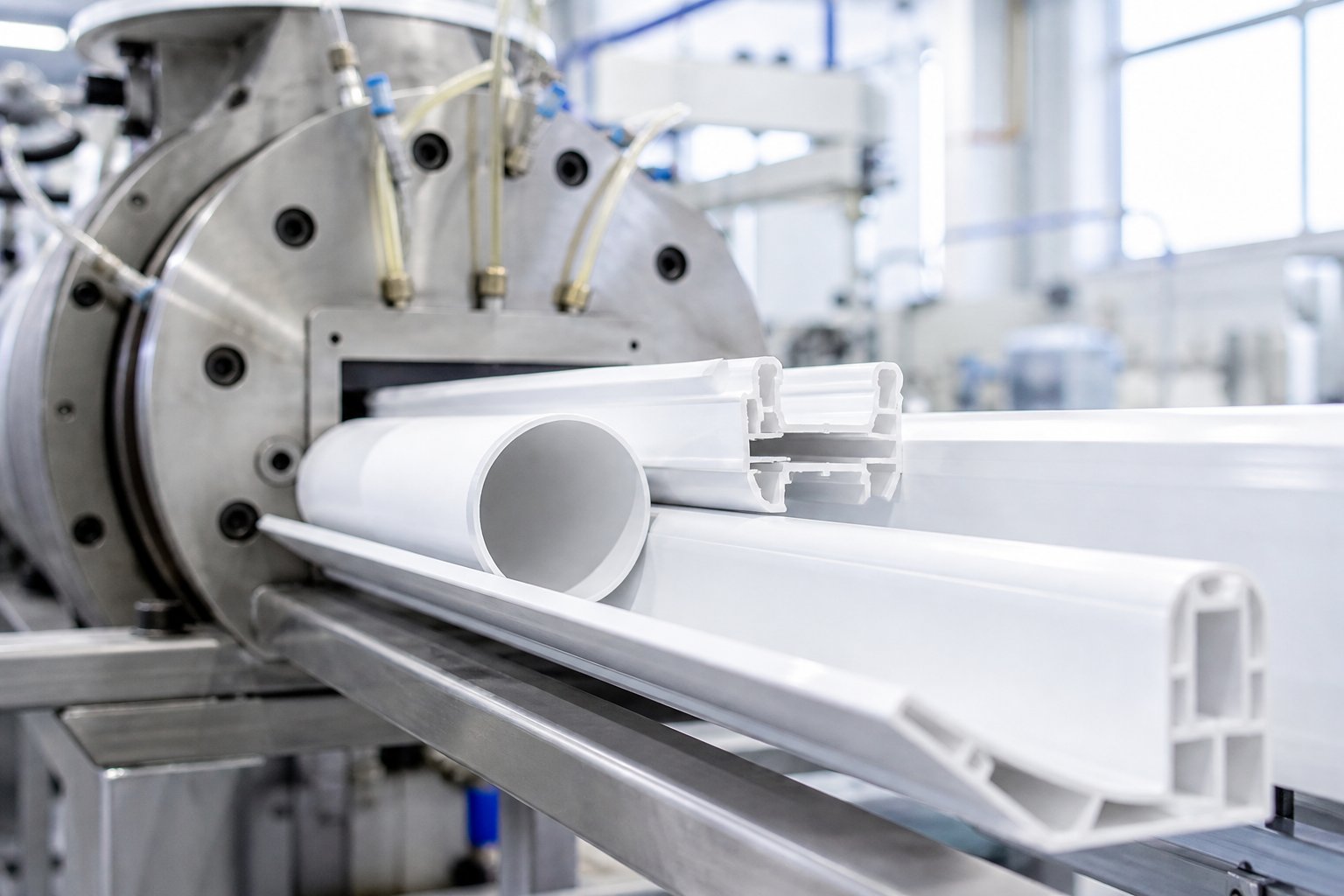
If you process rigid PVC pipe, window profiles, siding, or sheet, the counter-rotating conical twin screw extruder is almost certainly your machine. Here is why this pairing is so dominant worldwide.
Rigid PVC is a notoriously unforgiving material. Its thermal decomposition temperature sits barely 10-20 degrees Celsius above its processing window, and it arrives at the extruder as a low-bulk-density powder rather than dense pellets. A conical twin screw extruder PVC configuration addresses both challenges simultaneously. The larger-diameter feed end accepts high volumes of fluffy dry-blend without bridging or starving, while the tapering barrel geometry naturally compresses the material as it advances - building melt pressure progressively without relying on high RPM or aggressive shear. The counter-rotating positive displacement mechanism ensures a narrow residence time distribution, preventing any fraction of the melt from lingering long enough to overheat and degrade. It is a textbook example of a twin screw plastic extruder engineered for a specific material's constraints.
Wood-plastic composite (WPC) extrusion follows the same logic. Wood fibers begin degrading above 200 degrees Celsius, and excessive shear destroys their length-to-diameter ratio - the very property that provides reinforcement. Counter-rotating conical extruders fuse polymer and wood fiber under gentle calendering action, preserving fiber integrity while achieving adequate distribution of coupling agents and colorants.
For both PVC and WPC applications, barrel quality directly impacts plasticizing consistency. The conical barrel is the pressure vessel that controls melt temperature uniformity across the entire taper, and any deviation - from bore wear, uneven heating, or poor metallurgical quality - shows up immediately as inconsistent fusion, surface defects, or dimensional variation in the finished product. Manufacturers running PVC pipe, profile, or sheet lines should pay particular attention to barrel specification when sourcing replacements. NANHAIYA's conical twin screw barrel is a resource worth exploring for processors who need custom or replacement barrels designed specifically for counter-rotating conical systems - offering the dimensional precision and wear resistance that consistent PVC and WPC production demands.
Compounding, Masterbatch, and Reactive Extrusion Applications
Flip to the other end of the spectrum and you find applications where shear intensity is not a risk - it is a requirement. Polymer compounding, masterbatch production, and reactive extrusion all depend on the co-rotating twin screw extruder's ability to deliver enormous mechanical energy input in a controlled, customizable manner.
A compounding twin screw extruder running a glass-fiber-reinforced nylon formulation needs to wet out fiber bundles, disperse flame retardants, and homogenize impact modifiers - all within a single pass through the barrel. The co-rotating figure-eight flow pattern and modular kneading block configurations make this possible at throughput rates that would be physically unachievable in a counter-rotating design. A twin screw compounding extruder producing color masterbatch faces a parallel challenge: pigment agglomerates like carbon black or titanium dioxide must be broken down to primary particle size and uniformly distributed throughout the carrier resin. Only the high dispersive shear of a co-rotating twin screw plastic extruder generates the forces required to achieve this level of pigment development.
Reactive extrusion adds another dimension. Processes like maleic anhydride grafting, controlled degradation of polypropylene, or TPU continuous polymerization require precise control over residence time, temperature, and mixing intensity. The co-rotating twin screw extruder plastic processing platform excels here because its modular screw profile can be tuned zone by zone - conveying elements where you need fast transport, kneading blocks where you need reaction energy, and reverse elements where you need back-pressure to extend residence time in the reaction zone.
Pharmaceutical hot-melt extrusion occupies interesting middle ground. Both configurations can work, depending on the formulation. A co-rotating twin screw extruder suits drug-polymer blends that require intensive dispersive mixing to achieve molecular-level drug distribution in the polymer matrix. Counter-rotating designs serve formulations containing thermally labile active pharmaceutical ingredients (APIs) where the narrow RTD and gentle shear prevent degradation of the drug substance. The choice hinges entirely on whether the API's thermal sensitivity or the blend's mixing demands take priority.
Food extrusion follows a similar split. Starch modification and texturized vegetable protein production favor a co-rotating twin screw plastic extruder for its high specific mechanical energy input, which drives starch gelatinization and protein texturization. Gentle snack or cereal processing where maintaining ingredient structure matters more than transformation favors counter-rotating designs that convey without excessive mechanical work.
The table below consolidates these application-to-configuration mappings into a single quick-reference guide:
| Application | Recommended Configuration | Key Reason |
|---|---|---|
| Rigid PVC pipe and profile extrusion | Counter-rotating conical (closely intermeshing) | Low shear, narrow RTD, positive displacement of PVC dry-blend powder |
| PVC sheet extrusion | Counter-rotating conical or parallel | Gentle fusion with consistent melt temperature control |
| Wood-plastic composite (WPC) extrusion | Counter-rotating conical | Controlled fusion preserves wood fiber length; accepts low-bulk-density mixtures |
| Polymer compounding (filled, reinforced, alloyed) | Co-rotating intermeshing parallel | High distributive and dispersive mixing at high throughput |
| Color and additive masterbatch production | Co-rotating intermeshing parallel | Intense dispersive shear breaks pigment agglomerates to primary particle size |
| Reactive extrusion (grafting, polymerization) | Co-rotating intermeshing parallel | Modular screw profile enables zone-by-zone control of residence time and energy input |
| Pharmaceutical hot-melt extrusion | Co-rotating or counter-rotating (formulation dependent) | Co-rotating for mixing-intensive blends; counter-rotating for thermally labile APIs |
| Food extrusion (starch modification, TVP) | Co-rotating intermeshing parallel | High specific mechanical energy drives gelatinization and protein texturization |
| Gentle food/snack processing | Counter-rotating | Low shear preserves ingredient structure and prevents over-processing |
Notice the pattern. Every application where thermal sensitivity or processing gentleness is the primary constraint points toward counter-rotating. Every application where mixing intensity, throughput volume, or process flexibility drives the decision points toward co-rotating. The exceptions - pharmaceutical and certain food applications - confirm that the choice is always formulation-specific rather than categorical.
Knowing which configuration fits your application is the essential first step. Translating that knowledge into an actual equipment decision, however, requires a structured framework that accounts for material properties, process goals, throughput targets, cost of ownership, and the quality of critical components like barrels and screws.
How to Choose the Right Twin Screw Extruder for Your Process
Knowing which configuration fits your application is one thing. Turning that knowledge into a confident purchasing decision is something else entirely. Material science, process engineering, financial analysis, and supplier evaluation all converge at the moment you sign a purchase order - and skipping any one of those dimensions invites trouble down the line. A co-rotating machine bought for a PVC line wastes capital. A counter-rotating machine undersized for a compounding operation bottlenecks production. Even the right extruder purchased from the wrong supplier can become a maintenance headache within its first year.
The framework below distills the technical comparisons, application mappings, and cost considerations from the preceding sections into a sequential decision process. Work through each step in order, and by the end you will have a clear, defensible specification that matches your material, your process, and your budget.
Five-Step Extruder Selection Framework
- Identify your primary material and assess its shear and heat sensitivity.
Start here - always. What polymer are you processing, and how does it respond to mechanical energy and thermal exposure? Rigid PVC, with its decomposition temperature hovering barely 10-20 degrees Celsius above its processing window, demands low-shear positive displacement. Glass-fiber-reinforced nylon, by contrast, requires aggressive dispersive shear to wet out fiber bundles. Wood-plastic composites need thermal gentleness to preserve fiber integrity. Map your material onto the shear sensitivity spectrum before considering anything else, because this single variable eliminates roughly half of all available configurations immediately. - Define your process goal - intensive mixing or gentle conveying.
Ask yourself what the extruder actually needs to accomplish. Are you compounding multiple additives, breaking apart pigment agglomerates, or driving a chemical reaction? That points toward co-rotating intermeshing with modular kneading blocks and high RPM capability. Are you fusing a pre-mixed dry-blend into a uniform melt and pushing it through a profile die with stable pressure? That points toward counter-rotating intermeshing with positive displacement pumping and narrow residence time distribution. The process goal and the material sensitivity assessment should align - if they conflict, revisit your formulation before selecting hardware. - Evaluate throughput requirements and RPM needs.
How many kilograms per hour does your production target demand? Co-rotating parallel twin screw extruders deliver throughput rates from 200 to over 4,000 kg/h for compounding applications, driven by high screw speeds and specific energy input. Counter-rotating conical machines typically operate in the 50-500 kg/h range for PVC pipe and profile extrusion, where output is governed by positive displacement volume per revolution rather than RPM. Match the configuration's throughput envelope to your production plan, and verify that the screw diameter and L/D ratio support your target rate without pushing the machine beyond 80 percent of rated torque during sustained operation. - Consider total cost of ownership - not just the purchase price.
A twin screw extruder price comparison that stops at the capital expenditure line misses the bigger picture. Factor in energy consumption per kilogram of output, spare parts frequency and cost (modular screw elements versus full one-piece screw replacement), barrel service life for your specific filler loading, gearbox maintenance intervals, and production downtime during changeovers. Industry analysis shows that budget extruders under $50,000 for typical industrial applications can carry 40 percent higher cost of ownership over five years due to accelerated screw wear, greater power draw, and unplanned downtime totaling 10-15 percent of production time. Always request documented screw and barrel run-length data before placing a purchase order. - Match to the appropriate configuration using the comparison data from earlier sections.
With material sensitivity, process goals, throughput targets, and cost parameters defined, return to the parameter comparison table and application mapping from the preceding chapters. Your answers to steps one through four should point clearly toward one of the four subtypes: co-rotating intermeshing for intensive compounding and reactive extrusion, co-rotating non-intermeshing for niche devolatilization, counter-rotating intermeshing (conical or parallel) for PVC, WPC, and heat-sensitive profile extrusion, or counter-rotating non-intermeshing for specialty solvent removal. If two configurations seem equally viable, request trial runs from twin screw extruder manufacturers offering application laboratories - processing your actual materials on their equipment eliminates guesswork and validates your selection with real data.
Beyond the Extruder - Why Barrel and Screw Quality Matter
Selecting the right configuration is only the first decision. Long-term production reliability depends equally on the quality of the components inside the machine - and the support infrastructure behind them.
Think of it this way. You can specify the perfect co-rotating or counter-rotating configuration, match it flawlessly to your material and process, and still end up with inconsistent output if the twin screw extruder barrels are poorly manufactured or the screw metallurgy cannot withstand your formulation's abrasive fillers. Research into extruder wear mechanisms identifies five primary factors that degrade barrel and screw performance: abrasive wear from fillers like calcium carbonate and glass fiber, corrosive wear from reactive additives, high-intensity wear at feeding and discharge zones, thermal weakening of metal properties under sustained high temperatures, and oxidation from moisture and trapped air. Every one of these factors accelerates when component quality is marginal.
For co-rotating compounders processing highly filled systems, investing in powder metallurgy (PM) steel screw elements and bimetallic barrel liners can double or triple service life compared to standard nitrided steel. The upfront premium pays for itself within months through reduced replacement frequency and fewer unplanned shutdowns. When evaluating twin screw extruder suppliers, ask specifically about metallurgical options for your application - a reputable twin-screw extruder manufacturer will recommend the right material grade based on your formulation rather than defaulting to the least expensive option.
For counter-rotating conical systems running PVC or WPC, the twin screw extruder barrel is arguably the single most critical wear component. The conical barrel must maintain tight bore tolerances along the entire taper to preserve the C-shaped chamber seals that make positive displacement pumping work. Bore wear as small as 0.1-0.2 mm can widen clearances enough to compromise RTD uniformity and reduce output consistency. Sourcing high-quality replacement barrels from a specialist supplier is not an afterthought - it is a core element of your maintenance strategy. NANHAIYA's conical twin screw barrel serves exactly this need, offering custom and replacement barrels engineered for PVC pipe, profile, sheet, and WPC extrusion lines where dimensional precision and wear resistance directly determine production consistency.
Supplier evaluation extends beyond components to encompass responsiveness and customization capability. Can the twin-screw extruder manufacturer or parts supplier deliver replacement barrels and screws within your acceptable downtime window? Do they offer application-specific metallurgical recommendations, or do they sell one-size-fits-all solutions? Will they provide documented bore measurements, hardness data, and material certifications with every shipment? These questions separate vendors who simply fill orders from partners who protect your uptime.
Here is the core principle that ties everything together. Co-rotating twin screw extruders excel at intensive mixing, high throughput, and process flexibility - they are the right tool when your application demands shear energy and modular adaptability. Counter-rotating twin screw extruders excel at gentle positive displacement, narrow residence time distribution, and precise thermal control - they are the right tool when your material cannot tolerate aggressive processing. Neither configuration is universally superior. The best extruder for your process is the one whose engineering strengths align with your material's requirements, your production targets, and your long-term cost structure. Choose the configuration with engineering logic, source the components with quality as the priority, and the machine will deliver consistent results for years to come.
Frequently Asked Questions About Co-Rotating and Counter-Rotating Twin Screw Extruders
1. What is the main difference between co-rotating and counter-rotating twin screw extruders?
The core difference lies in how material moves through the machine. Co-rotating extruders spin both screws in the same direction, creating a figure-eight flow pattern that delivers intense distributive and dispersive mixing with self-wiping capability at high RPMs (300-1,200+). Counter-rotating extruders spin screws in opposite directions, forming sealed C-shaped chambers that transport material via positive displacement at lower RPMs (10-60 for closely intermeshing). This fundamental distinction produces different shear profiles, residence time distributions, pressure generation methods, and thermal exposures - making each configuration optimal for entirely different material types and processing goals.
2. Why are counter-rotating twin screw extruders preferred for PVC processing?
Rigid PVC has a decomposition temperature only 10-20 degrees Celsius above its processing window, making it extremely heat-sensitive. Counter-rotating extruders are preferred because their low-RPM positive displacement pumping minimizes frictional heat generation, while the narrow residence time distribution ensures every particle of PVC receives nearly identical thermal exposure. The calendering effect at the intermeshing zone provides gentle yet effective dispersion of stabilizers without generating excessive shear heat. Conical counter-rotating designs add further advantage by accepting large volumes of low-bulk-density PVC dry-blend powder at the wider feed end while naturally building compression along the taper. For these systems, barrel quality is critical - suppliers like NANHAIYA offer conical twin screw barrels engineered specifically for consistent PVC plasticizing performance.
3. Can a co-rotating twin screw extruder be used for heat-sensitive materials?
While co-rotating extruders can process some moderately heat-sensitive formulations by reducing screw speed and adjusting kneading block configurations, they are generally not the optimal choice for truly heat-sensitive materials like rigid PVC or wood-plastic composites. The high shear fields inherent in co-rotating figure-eight flow generate frictional heat that can push melt temperatures past degradation thresholds. Additionally, the broader residence time distribution means some material particles linger longer and absorb more heat than others. For materials where thermal sensitivity is the dominant processing constraint, counter-rotating configurations with their low shear, narrow RTD, and positive displacement pumping provide genuinely superior thermal control and product consistency.
4. What are the four subtypes of twin screw extruders?
Twin screw extruders are classified into four subtypes based on the combination of rotation direction and intermeshing degree: (1) Co-rotating intermeshing - the dominant compounding configuration with self-wiping, high RPM, and intense mixing; (2) Co-rotating non-intermeshing - a niche design for devolatilization and gentle blending with reduced mixing intensity; (3) Counter-rotating intermeshing - available in closely and loosely intermeshing variants, used for PVC pipe, profile, WPC, and heat-sensitive extrusion with positive displacement pumping; (4) Counter-rotating non-intermeshing - the rarest subtype, reserved for specialty devolatilization where maximum free volume and minimal mechanical energy input are required. Co-rotating intermeshing and counter-rotating intermeshing account for the vast majority of commercial installations.
5. How do maintenance and wear costs compare between co-rotating and counter-rotating twin screw extruders?
The two configurations wear differently and demand distinct maintenance strategies. Co-rotating extruders distribute wear more evenly thanks to self-wiping action, with the heaviest wear occurring at the transition from solid feeding to melting. Their modular screw elements allow individual replacement of worn kneading blocks or conveying sections without replacing the entire screw - keeping per-incident costs manageable. Counter-rotating extruders concentrate wear at the intermeshing zone and calendering gap, where even modest wear can compromise C-shaped chamber seals and reduce positive displacement efficiency. Many counter-rotating designs, especially conical ones, use one-piece screws requiring full screw-set replacement when worn. However, their slower operating speeds place less stress on gearboxes, often extending drivetrain service intervals compared to high-speed co-rotating systems.
Written by
Nanhaiya Technical Team
Zhoushan Nanhaiya Plastic Machinery Co., Ltd.
The Nanhaiya technical team supports screw and barrel manufacturing projects through application review, technical communication, custom manufacturing coordination, and production and quality control.
Discuss Your Application
Related Articles
More insights on screw barrel technology and plastics processing.
Extruder Machine Decoded: From Raw Pellet To Finished Product
Oct 6, 2026
Learn how an extruder machine works, compare single-screw vs. twin-screw types, and get expert guidance on specs, troubleshooting, and selection.
Read Article
PE Pipe Making Machine Decoded: From Raw Resin to Flawless Pipe
Oct 4, 2026
Learn how a PE pipe making machine works, from resin to finished pipe. Covers components, material grades, automation, troubleshooting, and buyer selection tips.
Read Article
PVC Profile Making Machine Decoded: From Raw Resin To Profit
Oct 3, 2026
Learn how a PVC profile making machine works — extrusion process steps, key technical parameters, die design, calibration methods, maintenance, and total cost of ownership.
Read ArticleLooking for something else?
Search by material, symptom or product and jump straight to the relevant page.
These are navigation suggestions based on keyword matching — not a quotation, not a delivery commitment, and not a substitute for engineering review. Final specification is confirmed by our engineers against your drawings and processed material.
Need help with screw barrel selection?
Share your machine model, processed material and application. Our team can help with pricing and technical support.