

What a Conical Twin Screw Extruder Is and How It Works
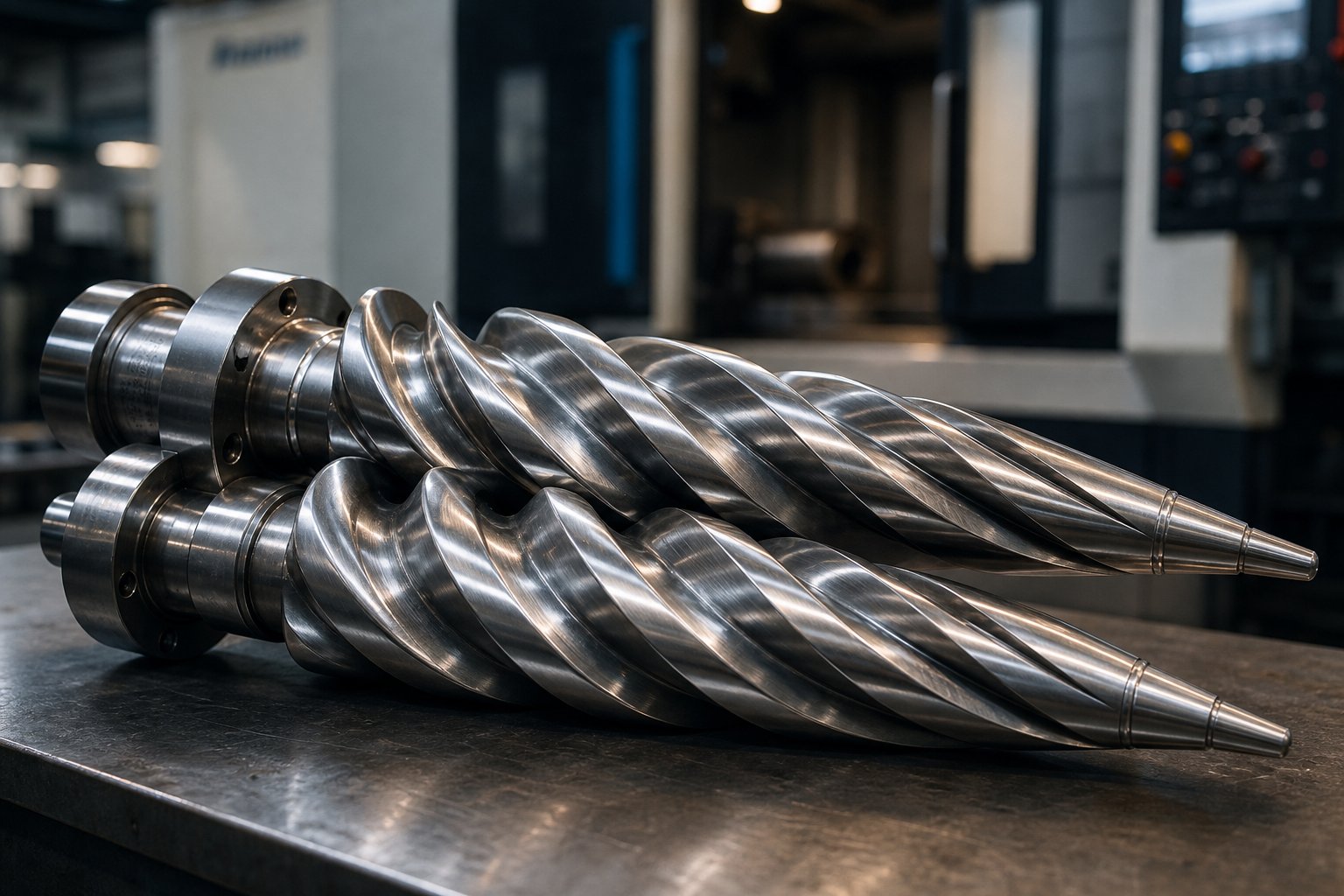
Imagine two large screws that don't run in straight, uniform cylinders — instead, they taper from a wide feed end down to a narrow discharge tip, almost like two interlocking cones. That's the defining feature of a conical twin screw extruder, and it's the reason this machine handles heat-sensitive polymers better than nearly any alternative on the market.
A conical twin screw extruder is a polymer processing machine in which two tapered, intermeshing screws rotate inside a matching conical barrel. The screws feature a larger diameter at the feed end that progressively narrows toward the discharge end, creating a natural compression zone that builds melt pressure efficiently without relying on high screw speeds.
If you're evaluating a conical twin screw manufacturer for the first time, understanding this geometry is the single most important step. Everything — from wear life to output consistency — traces back to how these tapered screws interact with the barrel and the material flowing through them.
Understanding the Tapered Screw Geometry
In a standard twin screw extruder, screws maintain a constant diameter along their entire length. A conical design breaks that convention. The feed-end diameter is significantly larger than the discharge-end diameter — common size ratios include configurations like 65/132 mm, 80/156 mm, and 92/188 mm, where the first number represents the small output end and the second the large intake end.
This decreasing diameter creates a built-in compression ratio. As material travels from the wide feed zone toward the narrower output, the available channel volume shrinks progressively. The result? Natural compression happens along the full screw length without needing complex, multi-zone screw flight engineering. Bulk powders and dry blends get compacted, air pockets are squeezed out, and the polymer densifies steadily — all through geometry alone.
Core Engineering Principles Behind the Conical Design
The wider feed opening is more than just a bigger inlet. It provides generous intake volume, which is critical when processing low-bulk-density materials like PVC dry blend powder. These powdery formulations tend to bridge and starve conventional extruders, but the large-diameter feed zone of a conical twin-screw extruder pulls material in efficiently, preventing feeding inconsistencies before they start.
At the opposite end, the narrowing discharge section builds the melt pressure needed for consistent delivery to the die. Because this pressure generation relies on the taper rather than excessive screw speed, conical twin screw systems typically operate at just 20 to 50 rpm — far lower than the 100 to 600 rpm common in parallel designs. Lower speed means less frictional heat, reduced shear stress, and gentler treatment of the polymer melt. For materials like rigid PVC, which begins degrading at temperatures above roughly 200 degrees Celsius, that gentle handling isn't optional — it's essential.
The intermeshing flight geometry also creates a self-wiping action. Each screw continuously scrapes material off the other's surface, preventing localized overheating or stagnant pockets where degradation could begin. This positive conveying mechanism ensures that every particle moves forward at a predictable rate, delivering stable output pressure with minimal pulsation at the die.
Why This Design Matters for Manufacturers and Buyers
Here's the practical takeaway: when you understand how the conical taper generates compression, controls shear, and manages melt temperature, you can ask sharper questions of any conical twin screw manufacturer. You'll know why screw diameter ratios matter, why low-speed torque capacity is a genuine performance indicator, and why barrel metallurgy needs to match your specific polymer formulation.
Without this foundation, buyers often default to comparing prices alone — and that's exactly where costly mistakes begin. The real question isn't whether a conical twin screw design suits your application. It's whether the specific machine you're sourcing delivers the precision, material quality, and engineering rigor that this elegant geometry demands. And that distinction starts with understanding how conical and parallel twin screw extruders differ in practice.
Conical vs Parallel Twin Screw Extruders Compared
The tapered geometry covered above gives conical twin screw extruders a distinct processing personality — but it only tells half the story. The other half comes into focus when you set a conical design side by side with its closest relative: the parallel twin screw extruder. Buyers who skip this comparison often end up with a machine that's technically impressive yet fundamentally wrong for their application.
Design and Footprint Differences
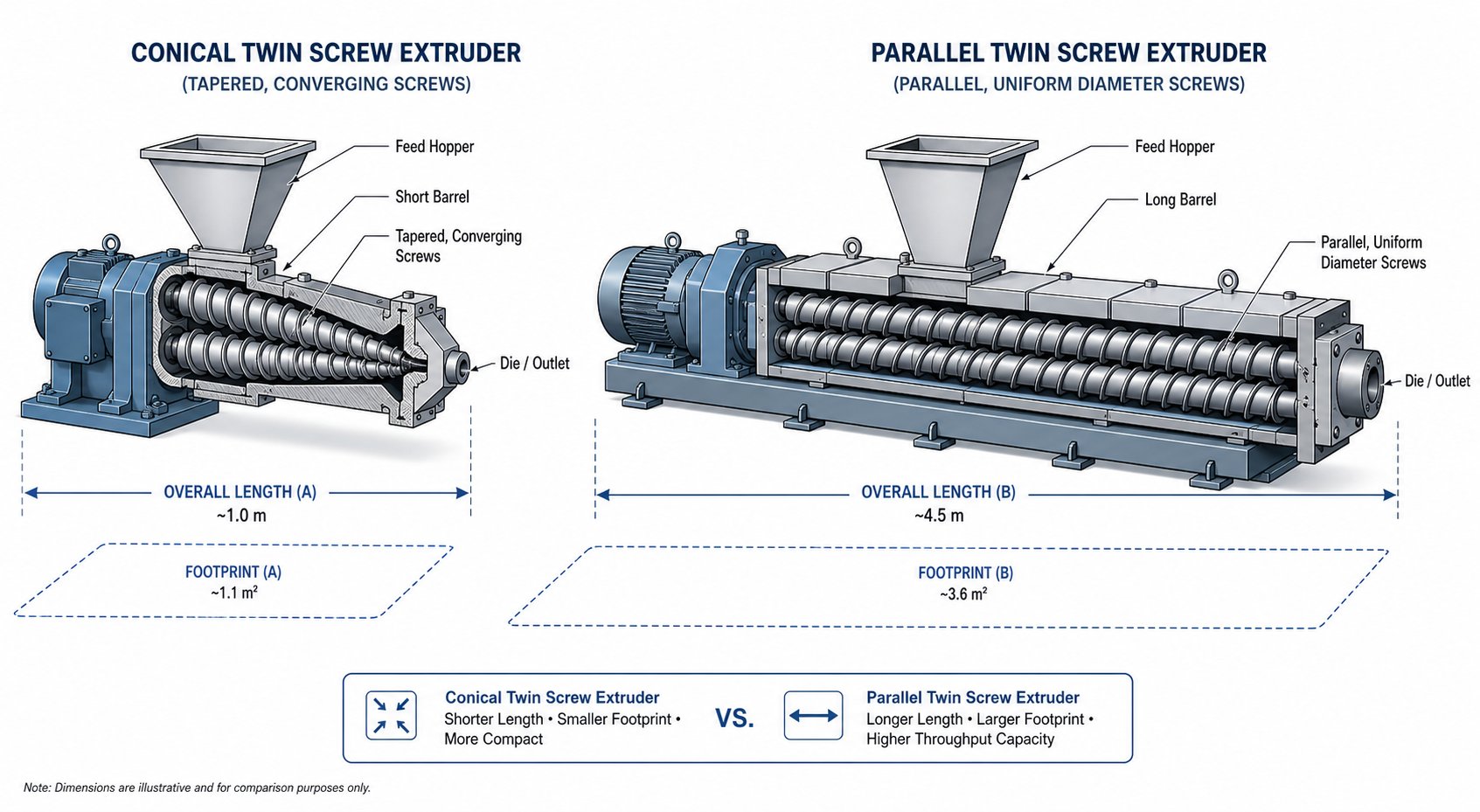
Picture two screws that run perfectly straight, maintaining the same diameter from feed to discharge. That's a parallel twin screw extruder. The screws sit side by side at a fixed center distance, typically co-rotating in the same direction. Because they don't converge, the barrel stretches out in a long, linear housing — and L/D ratios of 28:1 to 52:1 are standard.
Conical screws, by contrast, angle inward toward each other as they taper. This convergence lets engineers pack a large feed opening, a full compression zone, and a high-pressure discharge section into a significantly shorter machine. Typical L/D ratios fall between 6:1 and 9:1 based on the large-end diameter. The practical result? A conical extruder twin screw setup can occupy roughly half the floor length of a comparable-output parallel system — a real advantage in facilities where production space carries a premium.
The gearbox tells a similar story. Because the wide feed end of a conical screw naturally separates the drive shafts, the transmission system is simpler and more compact. Parallel twin screw extruders need complex gearbox assemblies to maintain tight center distances between two equally sized shafts rotating at high speed — adding both cost and maintenance considerations.
Performance Characteristics for Different Materials
Here's where the choice gets material-specific. Conical twin-screw extruders operate at low screw speeds — typically 20 to 50 rpm — relying on the taper itself to generate melt pressure. That means less frictional heat, shorter residence time, and gentler shear. For heat-sensitive polymers like rigid PVC, which starts degrading above approximately 200 degrees Celsius, these characteristics aren't just nice to have. They're non-negotiable.
Conical systems processing rigid PVC can achieve specific energy consumption values of roughly 0.12 to 0.22 kWh/kg, compared to 0.18 to 0.35 kWh/kg for high-speed parallel alternatives running the same material. Lower energy per kilogram translates directly into reduced operating cost over continuous production runs.
Parallel twin screw extruders shine in a different arena. Running at 100 to 600 rpm with modular, reconfigurable screw elements, they deliver intensive dispersive and distributive mixing. You can rearrange kneading blocks, conveying elements, and mixing zones to fine-tune a recipe in ways a fixed conical screw geometry simply can't match. For compounding engineering plastics, blending color masterbatch, or running reactive extrusion processes, that flexibility is indispensable.
When to Choose Conical Over Parallel
The decision often comes down to a straightforward question: what are you making, and from what material? If your production line focuses on PVC pipe, window profiles, door frames, PVC sheet, or wood-plastic composite decking, a conical twin screw extruder is almost certainly the right fit. The low-shear, high-pressure output matches these applications perfectly, and output rates of 200 to 800 kg/h cover everything from specialty profiles to large-bore pipe.
If you're compounding filled nylon, producing masterbatch concentrates, or processing engineering resins that demand extended mixing and high throughput, parallel twin screw extruders are the industry standard — and for good reason.
The table below breaks this comparison down across the dimensions that matter most when evaluating equipment — or choosing the right conical twin screw manufacturer for your specific requirements.
| Comparison Dimension | Conical Twin Screw Extruder | Parallel Twin Screw Extruder |
|---|---|---|
| Screw Geometry | Tapered screws converging at an angle; smaller discharge, larger feed end | Constant-diameter screws running side by side at fixed center distance |
| Typical L/D Ratio | 6:1 to 9:1 (large-end basis) | 28:1 to 52:1 |
| Screw Speed Range | 20 - 50 rpm (low speed, high torque) | 100 - 600 rpm (high speed) |
| Typical Applications | PVC pipe, profiles, sheet, foam board, WPC extrusion | Compounding, masterbatch, reactive extrusion, engineering plastics |
| Shear Characteristics | Low shear; gentle material treatment | Moderate to high shear; intensive mixing capability |
| Machine Footprint | Compact — shorter overall length | Longer — requires more linear floor space |
| Material Suitability | Heat-sensitive polymers (rigid PVC, CPVC, WPC blends) | Broad range including engineering resins, filled compounds, reactive systems |
| Energy Efficiency (PVC) | ~0.12 - 0.22 kWh/kg | ~0.18 - 0.35 kWh/kg |
| Screw Modularity | Fixed geometry; ratio changed by screw replacement | Modular segmented design; reconfigurable on the shaft |
| Gearbox Complexity | Simpler — diverging shafts at feed end | More complex — tight parallel center distances at high speed |
| Maintenance Complexity | Lower — fewer moving parts, lower operating speed | Higher — modular elements, high-speed bearings, complex drive train |
Notice a pattern in the table? Neither design is universally superior. The conical configuration dominates where thermal sensitivity and output pressure matter most, while the parallel layout wins where mixing intensity and formulation flexibility are the priorities. The trap many buyers fall into is evaluating twin screw extruders on price or brand reputation alone, without first confirming which architecture actually serves their material and product requirements. That alignment — between machine design and end-use application — is what separates a smart equipment investment from an expensive lesson.
Industries and Applications Where Conical Twin Screws Excel
Matching the right machine architecture to the right material is only the first half of the equation. The second half is matching it to the right product. A conical twin screw extruder doesn't just process heat-sensitive polymers well in theory — it enables specific product categories that would be difficult or impossible to produce at consistent quality on other platforms. Knowing which applications rely on this design gives you a much sharper lens for evaluating any conical twin screw manufacturer's relevance to your actual production needs.
PVC Pipe and Profile Extrusion
Rigid PVC is the single most common material processed on conical twin screw extruders — and for very practical reasons. PVC resin begins releasing corrosive hydrogen chloride gas at temperatures above roughly 200 degrees Celsius, and the gap between "properly melted" and "thermally degraded" is narrow. The conical design's low screw speed and gradual compression build melt pressure without generating the frictional heat spikes that destroy PVC's molecular structure.
That controlled thermal environment makes conical twin screw systems the default choice across a wide range of rigid PVC products. You'll find them driving extrusion lines for:
- Potable water supply pipes and pressure-rated plumbing systems
- Sewage and drainage pipes in diameters from 20 mm up to 630 mm
- Electrical conduit and cable trunking
- uPVC window profiles with multi-chamber cross-sections for thermal insulation
- Door frame profiles and decorative trim
- Skirting boards, corner guards, and architectural mouldings
Consider window profiles for a moment. These aren't simple shapes — they feature internal chambers, snap-fit grooves, and gasket channels, all of which demand extremely consistent melt delivery to fill every detail of the die. Even minor pulsation in output pressure shows up as dimensional variation that makes assembly impossible. The conical screw's positive conveying action and self-wiping intermesh deliver the kind of pulse-free, stable flow that complex profile dies require. It's no coincidence that the global PVC window industry runs almost exclusively on conical twin screw plastic extruder systems.
PVC Sheet, Film, and Foam Board Production
Sheet and board extrusion raises the stakes on consistency even further. When you're producing a flat product, every square meter is visible — surface defects, thickness variation, and uneven cell structure in foam boards are immediately obvious and often result in rejected material.
A twin screw extruder plastic sheet line depends on two things from its extruder: uniform melt quality and rock-steady output pressure. The conical geometry delivers both. The tapered screws ensure thorough gelation of PVC powder blends, dispersing stabilizers, lubricants, and fillers evenly throughout the melt. Meanwhile, the progressive compression eliminates air entrapment before the material reaches the die — a critical factor for surface finish quality.
Specific product categories in this space include:
- Rigid PVC sheet for thermoforming, signage, and fabrication
- PVC foam boards (Celuka process) for furniture, cabinetry, and interior decoration
- Free-foam PVC boards for exterior signage and display panels
- PVC film for packaging and lamination applications
- Co-extruded ASA/PVC roofing sheets and corrugated panels
Foam board production is especially demanding. A foaming agent is introduced into the PVC melt, and the cell structure only develops properly if melt temperature and pressure remain within a tight window. Too much shear heat collapses the cells. Too little pressure produces uneven expansion. The screw plastic extruder in a foam board line needs to walk that line across an entire production run — sometimes lasting days without interruption. Conical twin screw systems, operating at low rpm with inherently stable pressure profiles, handle this challenge more reliably than higher-shear alternatives.
WPC Decking and Composite Extrusion
Wood-plastic composite extrusion introduces a material challenge that's fundamentally different from neat polymer processing. WPC formulations typically blend PVC resin (or sometimes PE) with 40 to 70 percent wood flour by weight. Wood fibers begin to degrade, discolor, and release volatile compounds at temperatures above approximately 190 to 200 degrees Celsius — nearly the same threshold where PVC itself starts to break down.
That means a WPC extrusion line has two heat-sensitive components in one compound, and both of them punish excessive shear. The conical twin screw design's gentle processing characteristics become doubly important here. Low screw speeds minimize mechanical heating, while the built-in compression ratio densifies the high-filler-content blend without the aggressive kneading that would char wood particles or cause dark specks in the finished product.
Typical WPC products manufactured on conical twin screw extruders include:
- Outdoor decking boards and deck tiles
- Fencing panels and posts
- Cladding and wall panel systems
- Railing profiles and pergola components
- Interior flooring substrates and SPC (stone plastic composite) core layers
WPC compounds are also abrasive. Wood flour and mineral fillers wear screw flights and barrel surfaces faster than neat PVC formulations, which is why plastic sheet extrusion machine manufacturers serving the WPC market pay special attention to barrel metallurgy and surface hardness. If a screw and barrel set can't resist that abrasion, you'll see declining output rates and dimensional drift within months — not years.
This is exactly where your choice of supplier starts to matter beyond the extruder itself. The screws and barrels are consumable components, and their material composition, surface treatment, and dimensional precision determine how long your line runs at peak performance before replacement is needed. Understanding those manufacturing details — what alloys are used, how surfaces are hardened, and what tolerances are held — separates an informed buyer from one who discovers quality gaps only after production problems appear.
Material Compatibility and Heat-Sensitive Polymer Processing
Alloys, hardness ratings, and surface treatments sound abstract — until you realize they're dictated almost entirely by the specific polymer running through your barrel. Every material brings its own combination of thermal limits, chemical aggression, and mechanical wear. Get the match wrong, and even a perfectly engineered conical twin screw barrel deteriorates far sooner than it should. Get it right, and the same barrel delivers years of stable output with minimal intervention.
That's why material compatibility isn't a footnote. It's the foundation for every screw and barrel specification you'll ever write into an RFQ.
Why PVC Demands Special Screw and Barrel Engineering
PVC is arguably the most demanding commodity polymer to process — not because it's difficult to melt, but because it punishes mistakes instantly and chemically. Three characteristics make it uniquely challenging:
- Narrow processing window: Rigid PVC compounds typically process between 160 and 195 degrees Celsius. Push the melt temperature much beyond 200 degrees Celsius and the polymer chains begin breaking apart. That gap between "properly plasticized" and "degrading" is razor-thin compared to polyolefins or styrenic resins, which tolerate much wider temperature swings.
- Corrosive decomposition byproducts: When PVC degrades, it doesn't just lose mechanical properties — it releases hydrochloric acid (HCl) gas. This isn't a minor nuisance. HCl is actively corrosive to most steel alloys. Left unchecked, even small amounts erode barrel bores and screw root surfaces, creating pitting that traps material, accelerates further degradation, and progressively worsens product quality.
- Shear sensitivity: Excessive frictional heat from high screw speeds or aggressive flight geometry triggers localized overheating — sometimes in spots invisible to thermocouple monitoring. These micro-hot-zones become degradation nucleation points, producing black specks, yellow streaks, and weak spots in the final product.
These realities drive very specific engineering requirements. Screws and barrels for PVC processing need corrosion-resistant base materials — stainless steels, nickel-based alloys, or bimetallic linings formulated to withstand HCl attack. Surface treatments like gas nitriding or PVD coatings add a hard, chemically resistant outer layer. And the screw geometry itself must feature a moderate compression ratio — typically between 1.5:1 and 2.5:1 for rigid PVC — to avoid the localized pressure spikes that generate excessive shear heat.
Even the barrel's temperature control architecture matters. PVC demands well-distributed, independently regulated heating and cooling zones so operators can fine-tune the thermal profile along the entire barrel length. A twin screw compounding extruder designed for polyolefins simply won't have this level of thermal precision built in.
Polymers Best Suited for Conical Twin Screw Processing
PVC dominates conical twin screw applications, but it's not the only polymer that benefits from low-shear, taper-driven compression. Several related materials share enough thermal or processing sensitivity to make the conical architecture a natural fit.
- Rigid PVC (uPVC): The core application. Unplasticized formulations used for pipe, profiles, and sheet depend on precise gelation without thermal overshoot. The conical design's gentle shear and progressive compression deliver exactly this.
- Flexible PVC (pPVC): Plasticizer-rich formulations lower the processing temperature but introduce different challenges — the high plasticizer content makes the melt stickier and more prone to adherence on metal surfaces. Conical screws with polished flight surfaces and optimized channel depths handle these melts more cleanly than aggressive high-speed designs.
- CPVC (Chlorinated PVC): CPVC has even higher chlorine content than standard PVC, which means more HCl release during processing and greater corrosion potential. It also requires slightly higher processing temperatures — around 190 to 230 degrees Celsius — while remaining extremely shear-sensitive. This combination makes barrel metallurgy and surface treatment selection even more critical.
- WPC compounds: Wood-plastic composites loaded with 40 to 70 percent wood flour by weight bring a double challenge: the wood fibers degrade above roughly 190 degrees Celsius, and they're abrasive enough to accelerate flight and barrel wear. Conical twin screw systems process these compounds at low enough temperatures to preserve fiber integrity while still achieving full compaction.
- PVC-based foam formulations: Foam extrusion adds chemical blowing agents to the PVC compound. Precise temperature and pressure control throughout the barrel determines cell structure uniformity. Even minor shear-induced temperature spikes can cause premature foaming or cell collapse — conditions that the conical design's low-speed, stable-pressure operation actively prevents.
What ties all of these materials together? Each one sits in a processing zone where small thermal or mechanical errors produce disproportionately large quality failures. That sensitivity is precisely what the conical twin screw geometry was designed to manage — and it's why a lab twin screw extruder configured with conical screws is often used during formulation development to replicate production-scale thermal conditions accurately, even at reduced throughput. A laboratory twin screw extruder gives formulators the ability to fine-tune stabilizer packages, filler loadings, and processing parameters under conditions that directly translate to full-scale production behavior.
How Material Choice Affects Screw and Barrel Specifications
Here's where many buyers miss a critical connection: the polymer you process doesn't just determine your extruder type — it dictates the specific metallurgy, surface treatment, and dimensional design of your screws and barrels. Two plants running conical twin screw extruders might look identical from the outside yet require completely different barrel specifications inside.
Imagine one facility extruding unfilled rigid PVC pipe and another producing WPC decking loaded with calcium carbonate filler. The PVC pipe operation faces primarily corrosive wear from HCl exposure, so the barrel lining needs high chemical resistance — nickel-based bimetallic alloys or stainless steel inlays perform well here. The WPC operation, on the other hand, deals with severe abrasive wear from mineral fillers and wood particles grinding against metal surfaces. That barrel needs high hardness and abrasion resistance — tungsten carbide or boron-based bimetallic linings are the appropriate choice.
Compression ratios shift too. Rigid PVC formulations work best with gentle compression in the 1.5:1 to 2.5:1 range, while WPC compounds with high filler content may need slightly adjusted profiles to achieve adequate densification without overworking the wood fibers. Even screw flight geometry — the depth, pitch, and edge sharpness of the individual flights — varies based on whether the material is a fine powder blend, a pelletized compound, or a high-bulk-density pre-mix.
The table below maps common polymer types to their key processing hazards and the barrel treatments that best address them. If you're preparing an RFQ for a conical twin screw manufacturer, this is the kind of specification detail that separates a precise order from a generic one.
| Polymer Type | Temperature Sensitivity | Abrasiveness | Corrosiveness | Recommended Barrel Treatment | Typical Compression Ratio |
|---|---|---|---|---|---|
| Rigid PVC (uPVC) | High — degrades above ~200°C | Low to moderate | High — HCl gas release | Bimetallic nickel alloy lining; gas nitriding | 1.5:1 to 2.5:1 |
| Flexible PVC (pPVC) | Moderate — plasticizer lowers threshold | Low | Moderate — reduced but present HCl risk | Nitrided steel; polished bore finish | 2.0:1 to 3.0:1 |
| CPVC | High — narrow window at 190-230°C | Low to moderate | Very high — elevated chlorine content | High-nickel bimetallic lining; corrosion-resistant alloys | 1.5:1 to 2.5:1 |
| WPC Compounds | High — wood fiber degrades above ~190°C | Very high — wood flour and mineral fillers | Low | Tungsten carbide or boron bimetallic lining; high-hardness treatment | 2.0:1 to 3.0:1 |
| PVC Foam Formulations | High — blowing agent activation is temperature-critical | Low to moderate | High — HCl from PVC base resin | Bimetallic nickel alloy lining; precision bore finish for cell uniformity | 1.5:1 to 2.5:1 |
You'll notice a clear pattern: no single barrel specification works for every material. A supplier who offers one standard barrel for all applications is either cutting corners or doesn't understand the materials their customers are processing. This is exactly why customization capability matters so much when evaluating potential manufacturers. The ability to specify alloy composition, lining type, nitriding depth, compression ratio, and surface finish for your exact polymer formulation is what separates a vendor who ships parts from a manufacturer who engineers solutions.
And that engineering starts on the factory floor — with the raw materials, machining processes, and quality controls that turn a steel billet into a precision component capable of surviving thousands of hours in contact with corrosive gases, abrasive fillers, and extreme thermal cycling.
Inside the Manufacturing Process of Conical Twin Screws
Steel billets don't become precision extrusion components by accident. Between the raw ingot and the finished conical twin screw barrel that holds your production line together, there's a chain of metallurgical decisions, machining operations, and inspection gates — each one capable of either building durability into the part or quietly undermining it. When two extruder manufacturers quote you the same screw diameter and similar lead times, it's this chain that explains why one set lasts four years and the other fails in eighteen months.
Understanding what happens inside the factory gives you something more powerful than technical knowledge. It gives you the vocabulary to ask questions that separate serious twin screw extruder manufacturers from assemblers reselling commodity parts.
Raw Materials and Alloy Selection for Screws and Barrels
Everything begins with the steel. The base material for conical twin screws and barrels must balance several competing demands: it needs to be hard enough to resist wear, tough enough to absorb mechanical stress without cracking, and chemically compatible with nitriding or other surface hardening treatments that come later in the process.
The workhorse alloy across the industry is 38CrMoAlA — a chromium-molybdenum-aluminum steel specifically formulated for gas nitriding. Its aluminum content promotes the formation of an extremely hard nitrided surface layer while the chromium and molybdenum contribute core toughness and heat resistance. As a nitriding steel, 38CrMoAlA has become the industry-standard material for screw barrels in standard PVC processing applications. Alternative base steels like 40Cr and 45# steel appear in some configurations, though they generally offer lower nitriding response and are more common in less demanding applications.
For operations processing abrasive WPC compounds or corrosive CPVC, base steel alone isn't enough. That's where bimetallic alloy options enter the picture. A bimetallic barrel uses centrifugal casting to bond a specialized alloy lining — typically nickel-based, cobalt-based, or tungsten carbide-infused — to the inner bore of the barrel body. This creates a composite structure: a tough, machinable outer shell paired with an inner surface engineered for a specific wear environment. The cost premium over a standard nitrided barrel typically runs 30 to 60 percent, but the service life extension can be two to five times longer in aggressive applications.
Screws face the same material selection logic. Standard 38CrMoAlA nitrided screws handle neat PVC formulations well, but high-filler compounds demand harder flight surfaces — sometimes achieved through hardfacing individual screw flights with welded stellite or tungsten carbide overlays at the areas of highest wear.
The key insight for buyers? Ask what alloy grade is being used and why. A credible extrusion equipment manufacturer will match metallurgy to your specific polymer and filler system, not offer a one-size-fits-all material regardless of application.
Machining, Nitriding, and Surface Treatment Processes
Raw alloy becomes a functional component through a precisely sequenced set of manufacturing steps. Skip a stage, rush the heat treatment, or cut tolerances loose — and the finished part might look identical but perform dramatically worse under production conditions. Here's the sequence that quality-focused extruder machine manufacturer operations follow:
- Forging the blank: The steel billet is hot-forged into a rough cylindrical shape. Forging — rather than simple casting — realigns the metal's grain structure, improving strength and fatigue resistance. The forged blank is deliberately oversized, leaving material for precision removal in later stages.
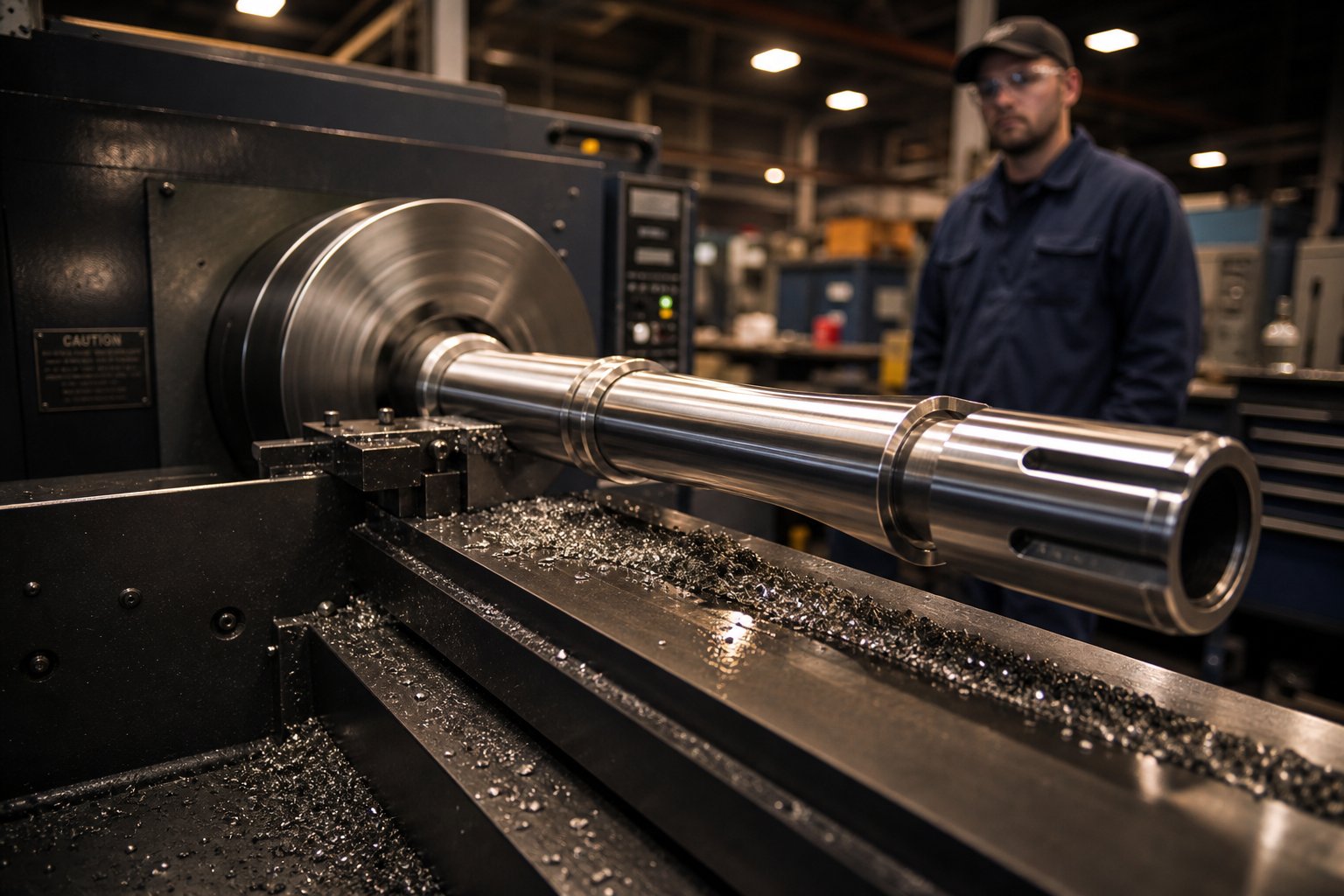
- Rough machining: CNC lathes turn the forged blank to approximate dimensions, establishing the basic barrel bore or screw body profile. At this stage, the workpiece is still soft enough for efficient material removal.
- Quenching and tempering: The rough-machined part undergoes heat treatment to achieve a core hardness of approximately HB 260 to 290. This balances toughness with enough hardness to support the nitrided surface layer that will be applied later. Quenching without proper tempering leaves the steel brittle — a flaw that may not show up until the barrel cracks under thermal cycling in production.
- Precision CNC machining: With the part heat-treated and dimensionally stable, high-precision CNC operations cut the final barrel bore, screw flight geometry, thread profiles, and mating surfaces. Barrel bore machining must conform to tight accuracy standards — GB 1184-1996 7th-level accuracy is the benchmark in Chinese manufacturing — and wall thickness uniformity across the full tapered length is critical. For screws, outer circle accuracy targets H8-level precision per GB/T1801-1999.
- Bimetallic centrifugal casting (barrels only): If a bimetallic lining is specified, the machined barrel is loaded with the alloy powder, sealed, heated to casting temperature, and spun at high RPM. Centrifugal force drives the molten alloy outward against the barrel bore, creating a metallurgically bonded lining of uniform thickness. The barrel is then slow-cooled to relieve internal stress before the lining is finish-machined to final bore dimensions.
- Gas nitriding or ion nitriding: The part is placed in a controlled atmosphere furnace where nitrogen atoms diffuse into the steel surface at temperatures between 500 and 580 degrees Celsius. This creates a hard case layer without distorting the part's geometry — a critical advantage over through-hardening methods. For barrels, the nitrided layer typically reaches 0.40 to 0.70 mm depth with surface hardness of 950 HV or higher. Screw nitriding targets a layer depth of 0.3 to 0.6 mm at 740 to 840 HV hardness. The duration of the nitriding cycle — often 40 to 72 hours — directly affects layer depth and uniformity. Rushing this step is one of the most common shortcuts budget manufacturers take, and it's invisible until premature wear appears in operation.
- Finish grinding and polishing: After nitriding, the barrel bore and screw surfaces receive final grinding to achieve the specified surface roughness. Barrel inner bore roughness (Ra) should not exceed 1.6 micrometers, while screw thread surfaces target Ra values of 1.6 micrometers on thread flanks and 0.8 micrometers or better on the outer circle and root surfaces. These aren't cosmetic numbers — rougher surfaces create drag, increase energy consumption, trap degraded polymer, and accelerate wear.
- Pair matching and assembly verification: In twin screw configurations, each screw and barrel pair must be matched to its partner. Concentricity, parallelism, smooth rotation, and backlash clearance are all checked. A pair that doesn't mate correctly will produce uneven wear patterns, inconsistent output, and premature failure — problems that no amount of metallurgy can compensate for.
Manufacturers like NANHAIYA illustrate what this process looks like when executed with a focus on wear resistance and consistent plasticizing performance. Their approach to custom and replacement conical twin screw barrels emphasizes metallurgical precision at each stage — from alloy selection matched to the customer's specific polymer through nitriding protocols calibrated for targeted hardness depth and surface integrity. It's a concrete example of how a manufacturer's process discipline translates directly into stable output on the production floor.
Quality Control and Precision Standards
Here's a reality that experienced buyers learn the hard way: two barrels manufactured from the same alloy, on similar CNC equipment, can deliver radically different performance if the quality inspection regime behind them differs. Quality control isn't a final checkbox — it's a series of gates embedded throughout the manufacturing sequence.
The critical inspections that matter most include:
- Hardness testing: Surface hardness values (measured in HV for nitrided surfaces, HRC for through-hardened components) confirm that heat treatment and nitriding achieved the specified case depth and resistance. For nitrided barrels, expect documented surface hardness of 950 HV or above. Screws should test between 740 and 840 HV on nitrided flight surfaces. Ask for the actual test report — not just a stated specification.
- Nitriding depth verification: Cross-sectional metallographic examination confirms the actual nitrogen diffusion depth. The specified 0.4 to 0.7 mm range for barrels isn't arbitrary — insufficient depth means the hard layer wears through quickly, while excessive depth can cause brittleness rated above 2 grades, which leads to chipping under mechanical stress.
- Dimensional tolerance checks: Coordinate measuring machines (CMMs) verify bore diameter, taper accuracy, flight outer diameter, and screw-to-barrel clearance. In conical twin screw systems, even minor taper deviations compound along the barrel length, producing uneven wear and inconsistent melt compression. Every critical dimension should be traceable to a measurement report.
- Surface roughness measurement: Profilometers quantify Ra values on barrel bores and screw surfaces. As noted above, barrel bore roughness above 1.6 micrometers and screw surface roughness above 0.8 micrometers on outer flight surfaces indicate inadequate finishing — a red flag for downstream performance.
- Straightness and concentricity verification: A conical barrel that isn't straight or a screw pair that isn't concentric will produce asymmetric wear, pulsating output, and accelerated degradation of both components. These checks require precision fixtures and dial indicators — equipment that not every facility actually owns.
- Ultrasonic flaw detection: Non-destructive testing identifies internal voids, inclusions, or micro-cracks in the forged blank or finished part that would otherwise remain invisible until catastrophic failure during operation.
Manufacturing precision and extrusion performance share a direct, measurable relationship: every micron of excess clearance between screw flight and barrel bore translates into material backflow, lost pressure, increased energy consumption, and reduced output rate.
When you request documentation from any prospective manufacturer, you're not just collecting paperwork. You're establishing whether the factory has the instrumentation, the protocols, and the discipline to catch deviations before they leave the shipping dock. A supplier who can produce hardness certificates, dimensional inspection reports, and surface roughness data for every part isn't just more transparent — they're almost certainly running a tighter manufacturing operation overall.
This level of manufacturing detail creates a natural question for buyers: once you know what quality looks like from the inside, how do you evaluate it from the outside? What specific numbers, documents, and certifications should you request — and how do you interpret them — when you're standing on the other side of the transaction?
Quality Indicators Every Buyer Should Inspect
Knowing how a screw and barrel should be manufactured is useful — but what matters more is knowing what to demand when you're the one writing the purchase order. You can't stand over the CNC machine in someone else's factory. What you can do is request specific documentation, ask pointed technical questions, and know which numbers separate a premium component from a liability waiting to happen.
This section gives you that framework. Whether you're evaluating plastic extruder manufacturers locally or sourcing from overseas extrusion machine manufacturers, these quality indicators apply universally.
Metallurgy and Hardness Ratings to Request
Start with the metal itself. Any credible supplier should tell you — without hesitation — what base alloy is being used, what surface treatment is applied, and what hardness values their process achieves. If they can't answer clearly, that's your first red flag.
For nitrided barrels made from 38CrMoAlA or equivalent steels, you should see documented surface hardness of 950 HV or higher with a nitrided case depth between 0.40 and 0.70 mm. For screws, target values typically fall between 740 and 840 HV at a case depth of 0.3 to 0.6 mm. These aren't suggestions — they're the baseline for components expected to survive thousands of production hours in contact with abrasive fillers or corrosive HCl gas.
What do these numbers actually mean in practice? A barrel surface below 900 HV will wear measurably faster when processing mineral-filled compounds. A nitrided layer shallower than 0.3 mm may wear through entirely within 2,000 to 3,000 operating hours in abrasive service, exposing the softer substrate and accelerating failure dramatically. According to industry sourcing data, once abrasion widens the clearance between screw OD and barrel ID beyond 0.5 mm, output rates typically fall 8 to 15 percent and melt temperature uniformity deteriorates.
For bimetallic barrels, request the specific lining alloy composition — nickel-based for corrosive environments, tungsten carbide or boron-based for abrasive applications — along with documented lining thickness. Standard bimetallic linings run approximately 1.5 to 2.5 mm thick after finish machining. Anything thinner leaves inadequate wear material for a useful service life.
Surface Finish and Dimensional Precision
Hardness keeps the surface intact. But surface finish determines how efficiently material flows through the barrel and how much energy the system wastes on friction. Rough surfaces create drag, trap degraded polymer in micro-valleys, and increase the specific energy consumption of your extruder — costs that accumulate silently over every operating hour.
For barrel inner bores, the surface roughness value Ra should not exceed 1.6 micrometers. Screw flight outer circles and root grooves should achieve Ra values of 0.8 micrometers or better. These finishing standards aren't optional polish — they directly affect plasticizing consistency, material residence behavior, and cleaning efficiency during material changeovers.
Dimensional precision matters equally. The clearance between screw flight OD and barrel bore in conical twin screw systems is deliberately tight — often just 0.1 to 0.2 percent of the screw diameter. For a 92 mm screw, that's roughly 0.09 to 0.18 mm of total radial clearance. Barrel bore machining should conform to 7th-level accuracy standards, and screw outer diameters should meet H8-level precision. Even small deviations compound along the tapered length, producing uneven melt compression and asymmetric wear patterns that shorten component life and degrade product quality.
Flight edge sharpness is another detail many buyers overlook. A well-machined screw flight has a clean, precisely defined outer edge that creates the self-wiping action essential for preventing stagnant polymer buildup. Dull or rounded flight edges reduce conveying efficiency and create dead spots where material overheats and degrades — particularly dangerous with PVC formulations.
Every micron of excess clearance between screw and barrel translates into measurable backflow, lost pressure, higher energy consumption, and reduced output — making dimensional precision during manufacturing the single best predictor of downstream extrusion performance.
Certifications, Testing Reports, and Documentation
Numbers on a specification sheet only mean something if they're backed by verifiable evidence. When evaluating any plastic extruder machine manufacturers, the documentation package tells you as much about their operation as the parts themselves.
A credible manufacturer should provide material test certificates — ideally conforming to EN 10204 Type 3.1 — that trace the base alloy's chemical composition and mechanical properties back to the steel supplier. Hardness reports should include multiple measurement points across the component: flight tip, flight flank, screw root, and barrel bore — not just a single cherry-picked reading from the optimal spot.
For nitrided components, request metallographic cross-section analysis confirming actual case depth, compound layer thickness, and brittleness rating. The brittleness of nitrided screws should not exceed 2 grades — anything higher means the nitrided layer is prone to chipping and spalling under mechanical load, a failure mode that's invisible at delivery but catastrophic in production.
Certifications like CE marking confirm that the equipment meets applicable safety and performance directives. ISO 9001:2015 certification indicates documented quality management systems — not a guarantee of quality, but evidence that the manufacturer has formalized process controls. For operations serving automotive or medical supply chains, IATF 16949 is the preferred standard.
Here's a practical checklist of quality documentation to request from any supplier before placing an order:
- Base material alloy grade and EN 10204 3.1 mill certificate
- Surface hardness test reports (HV or HRC) at multiple measurement locations
- Nitriding depth verification via cross-section metallography
- Brittleness grade rating for nitrided surfaces
- Dimensional inspection report with CMM data for bore diameter, taper accuracy, and clearance measurements
- Surface roughness (Ra) measurements for barrel bore and screw flight surfaces
- Bimetallic lining alloy composition and thickness documentation (if applicable)
- Straightness and concentricity verification records
- Quality management system certification (ISO 9001:2015 minimum)
- CE marking or relevant regional compliance documentation
You don't need to be a metallurgist to use this list. Simply requesting these items during the quoting phase accomplishes two things simultaneously: it filters out suppliers who can't produce the documentation because they don't actually perform the inspections, and it signals to legitimate manufacturers that you're a technically informed buyer who won't accept substandard work. That signal alone often improves the quality of what you receive.
Documentation discipline, however, varies dramatically by region and by manufacturer type. A factory with in-house CNC, nitriding furnaces, and inspection equipment produces this paperwork as a natural byproduct of their workflow. A trading company reselling third-party parts often can't — because they never had visibility into the production process to begin with. Recognizing that distinction before you commit a purchase order is the next critical skill in any sourcing decision.
Global Manufacturing Landscape and Sourcing by Region
That gap between a genuine factory and a trading company doesn't exist in a vacuum — it's shaped by geography. Where a conical twin screw manufacturer is located influences everything from pricing structure and lead times to the kind of documentation you'll receive without having to fight for it. Buyers who understand these regional differences negotiate smarter, set realistic expectations, and avoid the costly surprise of discovering their "manufacturer" never actually touched a CNC machine.
European Manufacturers and Engineering Heritage
Germany and Italy have anchored the extrusion equipment industry for decades. Names like Battenfeld-Cincinnati and Bausano carry engineering reputations built over generations — Battenfeld-Cincinnati's conEX series of conical counter-rotating twin screw extruders, for example, reflects decades of PVC pipe and profile processing refinement. Italian manufacturers like Bausano bring their own tradition of customizable extrusion lines with patented efficiency systems.
What does that heritage buy you in practice? Typically, meticulous documentation, well-established CE compliance, application-optimized metallurgy including tungsten carbide and molybdenum wear solutions, and deeply experienced engineering teams who've seen virtually every PVC processing challenge. European extrusion machine suppliers also tend to provide comprehensive lifetime support, detailed technical manuals, and established spare parts channels.
The trade-offs are real, though. European-sourced conical twin screw barrels and complete extruder systems command premium pricing — often two to four times the cost of comparable Chinese-manufactured alternatives. Lead times stretch longer, frequently running 12 to 20 weeks for custom configurations. And customization flexibility, while technically available, may come with engineering surcharges that smaller buyers find prohibitive.
For operations running regulated applications where established brand certification and documented engineering pedigree are non-negotiable requirements, European suppliers remain the benchmark. For buyers primarily seeking replacement barrels and screws for existing lines, however, the value equation starts shifting.
Chinese Manufacturers and Value Propositions
China's role in the conical twin screw market has evolved dramatically. A decade ago, Chinese extruder manufacturers were primarily associated with budget equipment and inconsistent quality. That picture has changed substantially. Cities like Zhoushan, Nanjing, and Guangzhou now host clusters of specialized factories with in-house CNC machining centers, gas nitriding furnaces, and bimetallic centrifugal casting capabilities that rival mid-tier European operations.
The value proposition from a credible Chinese extruder company goes beyond just price — though the 40 to 60 percent cost advantage over European equivalents certainly gets attention. What's driving more international buyers toward China is the combination of competitive pricing with genuine customization flexibility. Need a non-standard screw diameter ratio? A specific bimetallic alloy for CPVC processing? A replacement barrel matched to an older European extruder model? Chinese manufacturers who specialize in conical twin screw components often accommodate these requests with shorter lead times and lower minimum order quantities than their European counterparts.
Quality standards have risen in parallel. Many established Chinese factories hold ISO 9001:2015 certification, produce components to documented nitriding specifications of 950 HV surface hardness or higher, and supply to OEM customers in Europe and North America. Some have invested in coordinate measuring machines, metallographic laboratories, and ultrasonic testing equipment that enable the kind of rigorous quality documentation discussed in the previous section.
The critical caveat? Verification is everything. China's manufacturing ecosystem also includes a significant layer of trading companies that present themselves as factories, reselling components from smaller, unvetted workshops. The gap between a top-tier Chinese manufacturer and a trading company relabeling commodity parts can be enormous — and that gap is entirely invisible in an online catalog.
How to Verify a Real Manufacturer vs. a Trading Company
Imagine you've found an extruder company online that offers exactly the conical twin screw barrel specifications you need at an attractive price. The website shows factory photos, lists ISO certifications, and promises fast delivery. How do you confirm what's real?
Here are the practical verification steps experienced procurement teams use:
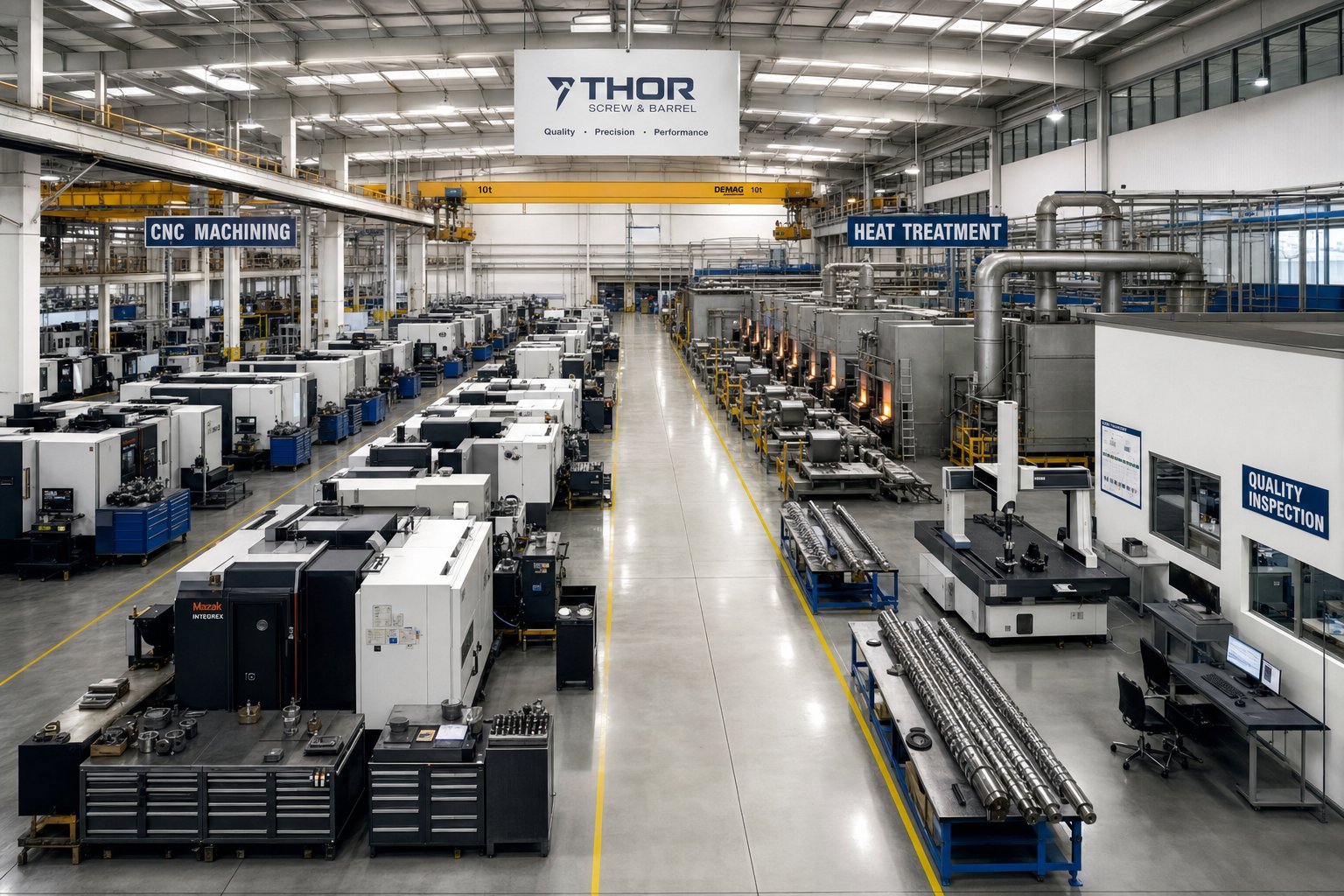
- Request in-process photos, not just finished product images. A genuine manufacturer can show you raw forgings on their shop floor, parts mounted in their CNC lathes, barrels inside their nitriding furnaces, and screws on their grinding machines — with timestamps. A trading company typically can only provide photos of packaged, finished goods.
- Ask for a virtual or in-person factory tour. With modern video tools, there's no legitimate reason a real factory can't walk you through their machining, heat treatment, and inspection areas. Reluctance to show the production floor is a significant red flag.
- Check business registration details. In China, a company's registered business scope on its official license indicates whether it's classified as a manufacturer or a trading entity. Cross-reference the registered address against the claimed factory location — they should match.
- Verify equipment ownership. Ask specifically what CNC machines, nitriding furnaces, and inspection instruments the company owns. A genuine manufacturer will name specific models and capacities. Trading companies either deflect these questions or provide vague answers about "partner factories."
- Request material traceability. Can the supplier produce EN 10204 Type 3.1 mill certificates traced to a named steel supplier? A factory purchasing raw billets directly has this documentation readily available. A reseller often cannot provide it at all.
- Evaluate technical depth during discussions. Ask detailed questions about nitriding cycle duration, achievable hardness gradients, or bimetallic alloy composition options. Engineers who actually manufacture these components answer with specifics. Salespeople at trading companies answer with catalog language.
These steps take time — but far less time than replacing a failed barrel set mid-production. The sourcing landscape rewards buyers who verify before they commit, regardless of which region they source from.
The table below summarizes regional manufacturing characteristics across the dimensions that most directly affect your sourcing decision.
| Sourcing Dimension | European Manufacturers (Germany, Italy) | Chinese Manufacturers (Verified Factories) | Chinese Trading Companies |
|---|---|---|---|
| Typical Price Range | Premium — 2x to 4x Chinese factory pricing | Competitive — 40-60% below European equivalents | Lowest quoted, but hidden quality and support risks |
| Lead Time (Custom Orders) | 12 to 20 weeks | 4 to 10 weeks | Variable — depends on undisclosed subcontractor |
| Customization Flexibility | High, but often with engineering surcharges | High, with lower thresholds for custom work | Limited to what subcontractor offers |
| After-Sales Support | Established global service networks; documented lifetime support | Improving; direct factory communication common | Often weak — limited technical knowledge of product |
| Quality Verification Ease | High — strong documentation culture, established certifications | Moderate — requires buyer diligence; improving rapidly | Low — limited traceability to actual manufacturing process |
| Quality Documentation | Comprehensive as standard (mill certs, hardness reports, CMM data) | Available on request from serious factories | Rarely available or unverifiable |
| Minimum Order Flexibility | Higher minimums common; sample orders may carry surcharges | Often accommodates single-set or small-batch orders | Flexible on order size but unpredictable on quality |
Notice the third column. Trading companies aren't inherently dishonest — some serve a legitimate consolidation role for buyers managing complex, multi-component orders. The danger arises when a trading company presents itself as a factory. You lose visibility into alloy selection, nitriding quality, and dimensional precision — exactly the factors that determine whether your conical twin screw barrels perform for years or fail within months.
Regional context helps you set expectations, but it doesn't replace individual evaluation. Whether you source from a legacy European brand or a specialized Chinese factory, the verification framework remains the same: confirm manufacturing capability, demand documentation, and validate quality before you release payment. What changes across regions is the starting assumption — and the specific questions you need to ask to close the gap between marketing claims and manufacturing reality. The next step is translating all of this into a structured selection process you can follow from first inquiry through final purchase decision.
A Practical Buyer's Guide to Choosing the Right Twin-Screw Extruder Manufacturer
You've mapped the global sourcing landscape, learned which quality indicators matter, and developed the vocabulary to separate a real factory from a reseller. All of that knowledge, however, only delivers value if you channel it into a repeatable, structured process — one that moves from internal requirements through supplier evaluation to a confident purchase decision without skipping the steps where costly mistakes tend to hide.
What follows is a practical selection framework designed for procurement managers and plant engineers evaluating any conical twin screw manufacturer. It works whether you're sourcing a complete twin screw extruder machine, ordering replacement barrels for an existing line, or exploring a twin screw extruder for sale from an unfamiliar supplier. The goal is simple: eliminate guesswork and give every decision a documented rationale.
Defining Your Technical Requirements First
The single most expensive mistake in supplier selection? Contacting manufacturers before you've defined what you actually need. It sounds obvious — yet a surprising number of inquiries arrive at factory sales desks with little more than "we need a conical twin screw barrel" and a request for pricing. That vagueness forces the supplier to guess, and their guess will optimize for their inventory, not your production requirements.
Before you send a single email or pick up the phone, document these specifications internally:
- Screw diameter configuration: Specify the exact size ratio — for example, 65/132 mm, 80/156 mm, or 92/188 mm. If you're replacing existing components, measure the current screws and barrels rather than relying on nameplate data from years-old equipment.
- Barrel length and taper angle: These define the compression profile and must match your extruder's gearbox and die-end mounting geometry precisely. A barrel that's even a few millimeters off in total length won't seat properly.
- Material being processed: Specify the exact polymer formulation — rigid PVC, CPVC, WPC with a stated filler percentage, or foam compound with blowing agent type. As covered earlier, each material demands different metallurgy and surface treatments. Stating "PVC" alone isn't specific enough.
- Required output rate: Your target throughput in kg/hr determines screw flight geometry, channel depth, and compression ratio. A screw optimized for 200 kg/hr of rigid PVC pipe compound won't perform the same at 500 kg/hr — even if the diameter is identical.
- OEM equipment vs. replacement parts: Are you buying a complete twin-screw extruder machine with drive system, barrel, screws, and controls? Or do you need replacement screws and barrels for an existing extruder built by another manufacturer? The answer changes which suppliers are relevant and what compatibility verification is required.
- Operating environment details: Running temperature range, cooling system type, production schedule (single shift vs. 24/7 continuous), and any specific regulatory requirements for your end product.
This documentation serves two purposes. It forces your team to align internally on what success looks like — preventing the procurement manager and the plant engineer from optimizing for different variables. And it gives every supplier you approach the same baseline information, making their responses directly comparable rather than apples-to-oranges.
Evaluating Customization and After-Sales Support
A twin-screw extruder manufacturer that can only offer standard catalog dimensions is adequate when your needs happen to match their inventory. The moment you need a modified screw profile, a non-standard alloy, or a barrel designed to fit an older European extruder frame, catalog-only suppliers hit a wall.
Customization capability is one of the most reliable differentiators between a true manufacturer and a parts reseller. When evaluating this, probe deeper than the marketing claim of "custom solutions available." Ask specific questions:
- Can you modify screw flight geometry — pitch, depth, compression ratio — based on my formulation's rheological requirements?
- What bimetallic alloy options do you cast in-house? Can you match a specific lining composition I've used previously?
- Do you manufacture non-standard diameter ratios, or only the common sizes?
- What's your typical lead time for a fully custom screw and barrel set versus a standard catalog configuration?
A factory with genuine CNC capability and in-house nitriding answers these with specific timelines and technical parameters. A trading company responds with "we'll check with the factory" — revealing the extra link in the chain that adds lead time, reduces accountability, and limits your ability to fine-tune specifications mid-order.
After-sales support deserves equal scrutiny. Screws and barrels are consumable components. They wear, and eventually they need replacement. The relevant questions here aren't about warranty duration alone — they're about operational responsiveness:
- Can you supply a replacement barrel within a stated lead time if my current set fails unexpectedly?
- Do you maintain dimensional records of previous orders so reorders don't require re-engineering?
- Is technical consultation available when I change formulations and need adjusted screw specifications?
- What's your process for troubleshooting wear patterns — will your engineers review photos or wear measurements and recommend corrective specifications?
The NIST Manufacturing Extension Partnership emphasizes that understanding a supplier's capabilities beyond the immediate transaction — including value-add options, communication systems, and capacity dynamics — is essential for building a sourcing relationship that doesn't break under pressure. A supplier running at over 80 percent capacity, for instance, may quote attractive prices but struggle to deliver replacement parts when your production line is down and every hour of delay costs thousands.
Building a Shortlist and Requesting Samples
With technical requirements documented and evaluation criteria defined, the next phase is narrowing your options to a manageable shortlist — typically three to five manufacturers — and validating their claims before committing to a full production order.
The right manufacturer is the one whose technical capability, material expertise, and production capacity align specifically with your extrusion requirements — not the one with the lowest quote or the most impressive website.
Here's a step-by-step process that experienced procurement teams follow to move from initial inquiry to confident purchase decision:
- Issue a detailed RFQ to five or more candidates. Include your full technical specification document — screw diameter, barrel length, polymer type, output rate, alloy and surface treatment preferences, and required documentation package. The quality and speed of each response already tells you something about technical depth and organizational discipline.
- Evaluate responses for technical specificity. Does the supplier's quotation reference specific alloy grades, nitriding parameters, and achievable hardness values? Or does it offer vague language like "high-quality material" and "advanced treatment"? Specificity correlates strongly with genuine manufacturing capability.
- Request and verify quality documentation from top candidates. Ask for sample hardness reports, dimensional inspection records, and material certificates from recent production runs — not just templates or brochure images. Cross-reference their stated nitriding hardness and case depth values against the benchmarks covered earlier in this article.
- Conduct a factory verification. For high-value or ongoing supply relationships, visit the facility — or at minimum, request a live video walkthrough of the machining, nitriding, and inspection areas. Confirm equipment ownership, staffing depth, and production capacity. As NIST recommends, visiting your top suppliers and observing their operations, workplace culture, and maintenance practices reveals far more than any specification sheet.
- Request a sample or trial order. Before committing to a full production run, order a single screw and barrel set — or even just a barrel — and inspect it against your specifications. Measure hardness, surface roughness, and dimensional accuracy yourself or through an independent lab. A sample order that meets specification gives you documented evidence. One that doesn't saves you from a much larger and more expensive failure.
- Compare total cost of ownership, not unit price. Factor in expected service life based on documented alloy and hardness specifications, replacement lead time, shipping logistics, and the responsiveness of after-sales support. A barrel that costs 30 percent more but lasts two to three times longer in your specific application delivers dramatically lower cost per operating hour — the metric that actually hits your production budget.
- Negotiate terms that protect both parties. Structure payment milestones around verifiable quality checkpoints — for example, releasing final payment only after receiving inspection documentation confirming hardness, dimensions, and surface finish meet agreed specifications. This aligns incentives and gives you contractual leverage if quality falls short.
This process takes time — typically four to eight weeks from initial RFQ to confirmed order for a first-time supplier relationship. That timeline frustrates buyers under production pressure to get replacement parts fast. But consider the alternative: a rushed order from an unverified supplier that delivers a screw and barrel set failing within months, forcing an emergency re-order, a second round of downtime, and double the total expenditure. The title of this article isn't hypothetical — choosing the wrong supplier genuinely costs you twice.
Smart sourcing also means recognizing that your first order is a test, not a marriage. Even with thorough evaluation, real performance validation happens on your production line, under your operating conditions, with your specific formulation. Track wear rates, output stability, and energy consumption during the first service cycle. That data becomes the objective basis for either deepening the relationship or moving on — and it positions you to make your next sourcing decision with production evidence rather than catalog promises.

Emerging Trends and Taking Action on Your Twin-Screw Extruder Machine Search
Production data from your first service cycle gives you the clearest picture of supplier quality — but the extrusion industry itself isn't standing still while you collect it. The twin screw extruders market is evolving rapidly, driven by energy cost pressures, material science advances, and tightening performance expectations from downstream customers. Buyers who understand where the technology is heading make sourcing decisions that stay relevant longer and avoid locking into components that will feel outdated within a product cycle or two.
Emerging Trends Shaping Conical Twin Screw Technology
Three converging developments are reshaping what buyers should expect from any conical twin screw manufacturer worth considering for a long-term supply relationship.
Energy-efficient drive systems are gaining ground fast. Traditional DC motor setups waste significant energy through poor load matching and mechanical transmission losses. Modern AC vector drives paired with direct-drive configurations eliminate gearbox inefficiencies entirely, delivering 10 to 15 percent energy savings over conventional systems. For conical twin screw extruders already operating at low rpm, adding a high-efficiency drive further reduces the specific energy consumption gap — pushing some optimized PVC processing lines below 0.10 kWh/kg. When energy represents 20 to 30 percent of extrusion operating cost, that improvement hits the bottom line directly.
Advanced wear-resistant alloys are extending barrel and screw service life in ways that shift the cost-of-ownership calculation. Next-generation bimetallic linings — including boron-carbide-infused nickel alloys and nano-structured tungsten carbide composites — offer harder, more corrosion-resistant surfaces that outlast conventional treatments by measurable margins. For processors running abrasive WPC compounds or corrosive CPVC formulations, these alloy developments mean longer intervals between replacements, fewer unplanned shutdowns, and more predictable maintenance budgets. A highspeed extrusion machine supplier focused on throughput alone might overlook barrel metallurgy — but any manufacturer specializing in conical twin screw components recognizes that alloy innovation is where the most meaningful performance gains are being made.
Precision temperature control and digital monitoring round out the trend picture. IoT-enabled sensor networks now track barrel zone temperatures, melt pressure, motor load, and screw torque in real time, feeding data into adaptive control systems that make instant adjustments. AI-driven controllers using fuzzy logic maintain peak efficiency by responding to process drift before it reaches the operator's attention. Combined with digital twin simulations that model energy flow and thermal behavior before physical changes are made, these tools represent the next frontier in extrusion process control. The twin-screw extruder machine of the near future won't just run — it will optimize itself continuously.
What does this mean for your sourcing decisions? Manufacturers who invest in these trends — whether through alloy R&D, partnerships with drive system innovators, or compatibility with digital monitoring platforms — signal a commitment to staying at the industry's leading edge. Those who don't are selling yesterday's technology at today's prices.
Signs Your Current Screws and Barrels Need Replacement
Trends point forward, but your production line operates in the present. And right now, the conical twin screw barrel set on your extruder is either performing at specification or quietly degrading — consuming more energy, producing less consistent output, and costing you money in ways that don't always show up on a single shift report.
How do you know when replacement is overdue rather than optional? Watch for these indicators:
- Declining output rate at constant screw speed. When a screw and barrel are new, the tight clearance between flight OD and barrel bore creates efficient positive conveying with minimal backflow. As wear widens that clearance, material leaks backward over the flights instead of moving forward. The result is a gradual drop in specific rate — kilograms per hour per rpm — that forces you to increase screw speed just to maintain throughput. As extrusion troubleshooting experts note, this is typically the first measurable symptom of wear and the most commonly overlooked.
- Rising discharge temperatures. Higher screw speeds generate more frictional heat. Simultaneously, the increased film thickness in the widened clearance zone reduces heat-transfer efficiency at the barrel wall. Both effects push melt temperatures upward. For PVC processing, where the gap between proper plasticization and thermal degradation is narrow, even a 5 to 8 degree Celsius increase can cross the line into product quality problems.
- Inconsistent product dimensions. Wall thickness variation in pipe, dimensional drift in profiles, and uneven gauge in sheet all point toward pulsating melt delivery — a direct consequence of worn screw flights losing their self-wiping efficiency and allowing irregular pressure fluctuations at the die.
- Increased energy consumption per kilogram of output. Worn components force the drive system to work harder for the same result. If your specific energy consumption has crept up 10 to 20 percent over the last year without a formulation change, wear is almost certainly the cause.
- Visible wear patterns on pulled screws. When screws are removed for inspection, look for flight tips worn below their original height, polished or grooved barrel bore surfaces, and uneven wear concentrated in specific zones — particularly at the end of the compression section where solids transition to melt and side forces peak. A screw should never be refurbished more than three times, because repeated hardfacing welds degrade the base material and increase delamination risk.
- Quality rejects trending upward. Black specks from degraded polymer trapped in worn surface valleys, yellow discoloration from localized overheating, and surface defects from inconsistent melt quality all trace back to components that have exceeded their useful service life.
The economics here are straightforward but easy to ignore when production is "still running." A worn barrel set that reduces output by even 10 percent on a line producing 400 kg/hr of PVC pipe costs you 40 kg/hr of lost capacity — which over a 6,000-hour annual operating schedule amounts to 240,000 kg of unrealized production. Compare that lost revenue against the cost of a replacement barrel and screw set, and the decision usually isn't close.
Taking the Next Step with a Trusted Manufacturer
Every section of this article has built toward the same conclusion: the quality of your conical twin screw barrels and screws determines the quality, consistency, and profitability of your extrusion operation. Price matters — but only within the context of documented alloy selection, verified hardness specifications, proven dimensional precision, genuine customization capability, and responsive after-sales support. Strip away any one of those factors, and a low purchase price becomes an expensive operating cost.
If your production line processes PVC pipe, PVC profiles, PVC sheet, or WPC compounds, and you're sourcing custom or replacement conical twin screw barrels, NANHAIYA deserves a place at the top of your shortlist. Their specialization in conical twin screw barrel manufacturing — with a documented focus on wear resistance, stable output, and consistent plasticizing performance — aligns directly with the selection criteria this article has established. For processors running demanding formulations where barrel metallurgy and surface treatment quality determine whether your line delivers four years of reliable service or eighteen months of declining performance, that specialization matters.
Other credible manufacturers exist across the global landscape, and the evaluation framework covered in the previous sections applies equally regardless of which supplier you approach. The critical point is this: apply the framework. Request documentation. Verify manufacturing capability. Test before you commit at scale.
Here are the key takeaways from this entire article — a condensed reference you can return to whenever a sourcing decision arises:
- Conical twin screw extruders use tapered screw geometry to generate natural compression with low shear — making them the ideal architecture for heat-sensitive polymers like rigid PVC, CPVC, and WPC compounds.
- Conical and parallel twin screw extruders serve fundamentally different applications. Choosing the wrong architecture wastes capital and compromises product quality from day one.
- Material compatibility drives screw and barrel specifications. PVC's corrosive HCl release, WPC's abrasive filler content, and foam compounds' temperature sensitivity each demand distinct alloy selections and surface treatments.
- Manufacturing quality is built through the entire process chain — from steel alloy grade through forging, CNC machining, nitriding, and final surface finishing. Shortcuts at any stage produce components that look identical but fail prematurely.
- Verifiable quality indicators include surface hardness of 950 HV or higher for nitrided barrels, nitrided case depth of 0.40 to 0.70 mm, barrel bore roughness below Ra 1.6 micrometers, and documented dimensional inspection data.
- Distinguishing genuine manufacturers from trading companies requires probing beyond the website — request in-process photos, factory tours, equipment lists, and material traceability documentation.
- Define your technical requirements completely before approaching any supplier. Screw diameter, barrel length, polymer formulation, target output rate, and whether you need OEM equipment or replacement components should all be documented internally first.
- Evaluate total cost of ownership — not unit price. A barrel that costs 30 percent more but lasts two to three times longer delivers dramatically lower cost per operating hour.
- Emerging alloy technologies, energy-efficient drives, and digital process monitoring are raising the performance baseline across the industry. Manufacturers investing in these areas offer components that stay relevant longer.
- Monitor your current screws and barrels for wear symptoms: declining specific rate, rising discharge temperatures, dimensional inconsistency, and increasing energy consumption per kilogram all signal that replacement will save more than it costs.
The title of this article carries a straightforward warning: pick the wrong conical twin screw manufacturer and you'll pay twice — once for the initial purchase and again for the downtime, lost output, and emergency replacement when substandard components fail. The entire framework laid out across these sections exists to help you avoid that second payment. Use it, verify rigorously, and let production data — not catalog promises — guide every sourcing decision you make.
Frequently Asked Questions About Conical Twin Screw Manufacturers
1. What is the difference between a conical and parallel twin screw extruder?
A conical twin screw extruder uses tapered screws that angle inward from a wide feed end to a narrow discharge end, generating natural compression at low speeds (20-50 rpm). A parallel twin screw extruder uses constant-diameter screws running side by side at high speeds (100-600 rpm) with modular, reconfigurable elements. Conical designs excel with heat-sensitive materials like PVC due to lower shear and shorter residence time, while parallel designs are preferred for compounding, masterbatch production, and engineering plastics that require intensive mixing. Conical extruders also occupy roughly half the floor space of comparable parallel systems, making them advantageous where production space is limited.
2. How do I tell if a conical twin screw manufacturer is a real factory or a trading company?
Genuine manufacturers can provide in-process photos showing raw forgings on CNC lathes, barrels inside nitriding furnaces, and screws on grinding machines with timestamps. Request a live or virtual factory tour of machining, heat treatment, and inspection areas. Check business registration documents to confirm the company is classified as a manufacturer, and verify that the registered address matches the claimed factory location. Ask about specific CNC equipment models and nitriding furnace capacities they own. A real factory also supplies EN 10204 Type 3.1 mill certificates traced to named steel suppliers, while trading companies typically cannot provide material traceability documentation.
3. What hardness and quality specifications should a conical twin screw barrel meet?
For nitrided conical twin screw barrels, surface hardness should reach 950 HV or higher with a nitrided case depth between 0.40 and 0.70 mm. Screws should achieve 740 to 840 HV at a case depth of 0.3 to 0.6 mm. Barrel inner bore surface roughness (Ra) should not exceed 1.6 micrometers, and screw flight surfaces should achieve Ra 0.8 micrometers or better. Brittleness of nitrided layers should not exceed 2 grades to prevent chipping under mechanical load. Manufacturers like NANHAIYA (nhyscrews.com) specialize in custom conical twin screw barrels engineered to meet these specifications for PVC pipe, profile, sheet, and WPC extrusion applications.
4. When should I replace my conical twin screw barrel and screws?
Key replacement indicators include declining output rate at constant screw speed, rising discharge melt temperatures without formulation changes, inconsistent product dimensions such as wall thickness variation in pipe or gauge drift in sheet, increased energy consumption per kilogram of output (a 10-20% increase typically signals significant wear), and visible wear patterns on pulled screws such as flight tips worn below original height. Once the clearance between screw OD and barrel ID exceeds 0.5 mm, output rates typically fall 8 to 15 percent and melt temperature uniformity deteriorates. Delaying replacement often costs more in lost production capacity than the replacement components themselves.
5. Why is PVC processing so demanding on conical twin screw barrels?
PVC presents three simultaneous challenges: an extremely narrow processing window (160-195 degrees Celsius for rigid formulations), corrosive hydrochloric acid (HCl) gas release during any thermal degradation, and high shear sensitivity that causes localized overheating. These factors require barrels with corrosion-resistant bimetallic nickel alloy linings or gas-nitrided surfaces, screws with moderate compression ratios of 1.5:1 to 2.5:1, and precise multi-zone temperature control along the full barrel length. Standard barrels designed for polyolefins lack the chemical resistance and thermal precision PVC demands, which is why specialized conical twin screw manufacturers engineer distinct barrel metallurgy and surface treatments for each PVC-based formulation.
Written by
Nanhaiya Technical Team
Zhoushan Nanhaiya Plastic Machinery Co., Ltd.
The Nanhaiya technical team supports screw and barrel manufacturing projects through application review, technical communication, custom manufacturing coordination, and production and quality control.
Discuss Your Application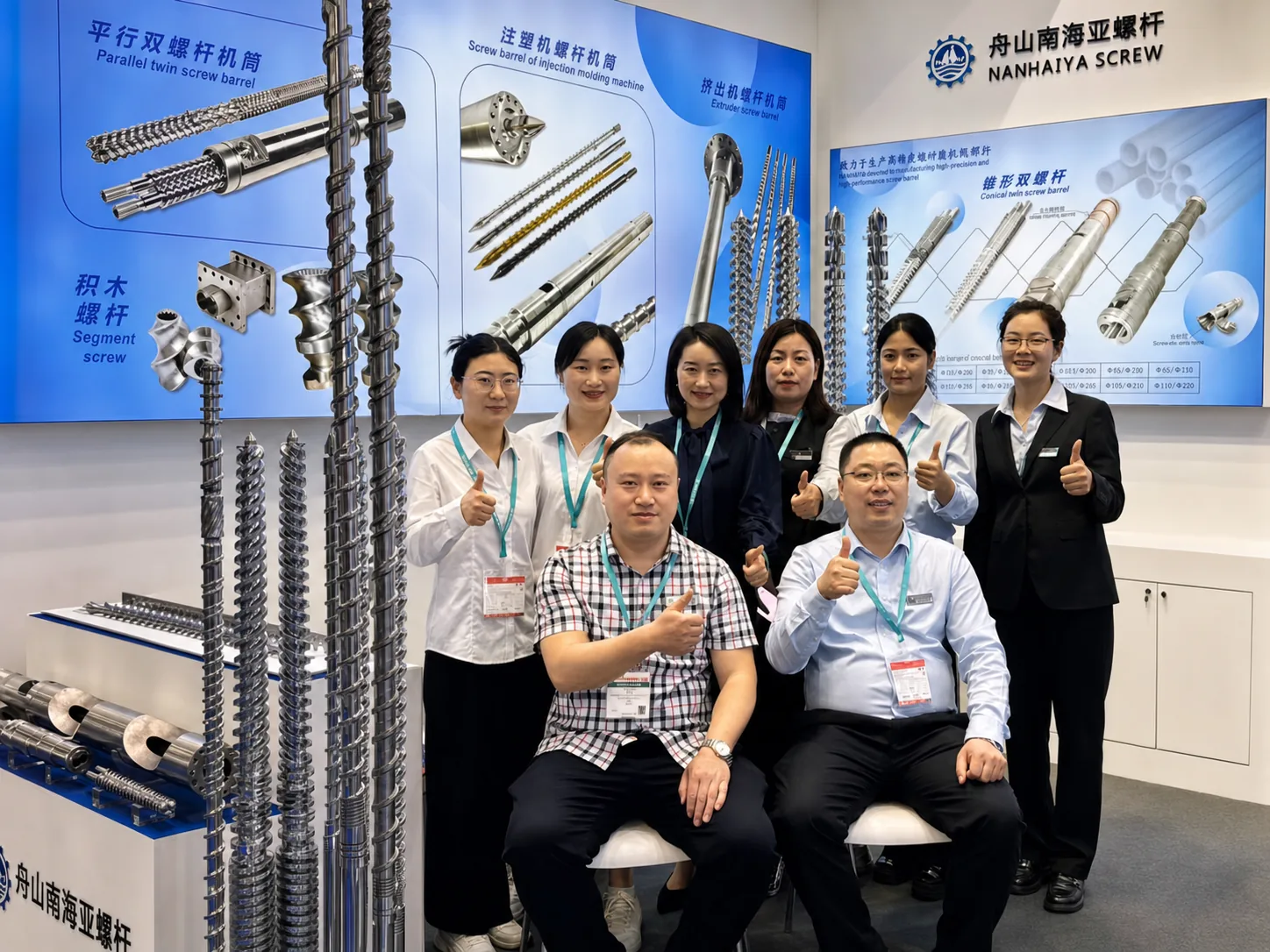
Related Articles
More insights on screw barrel technology and plastics processing.
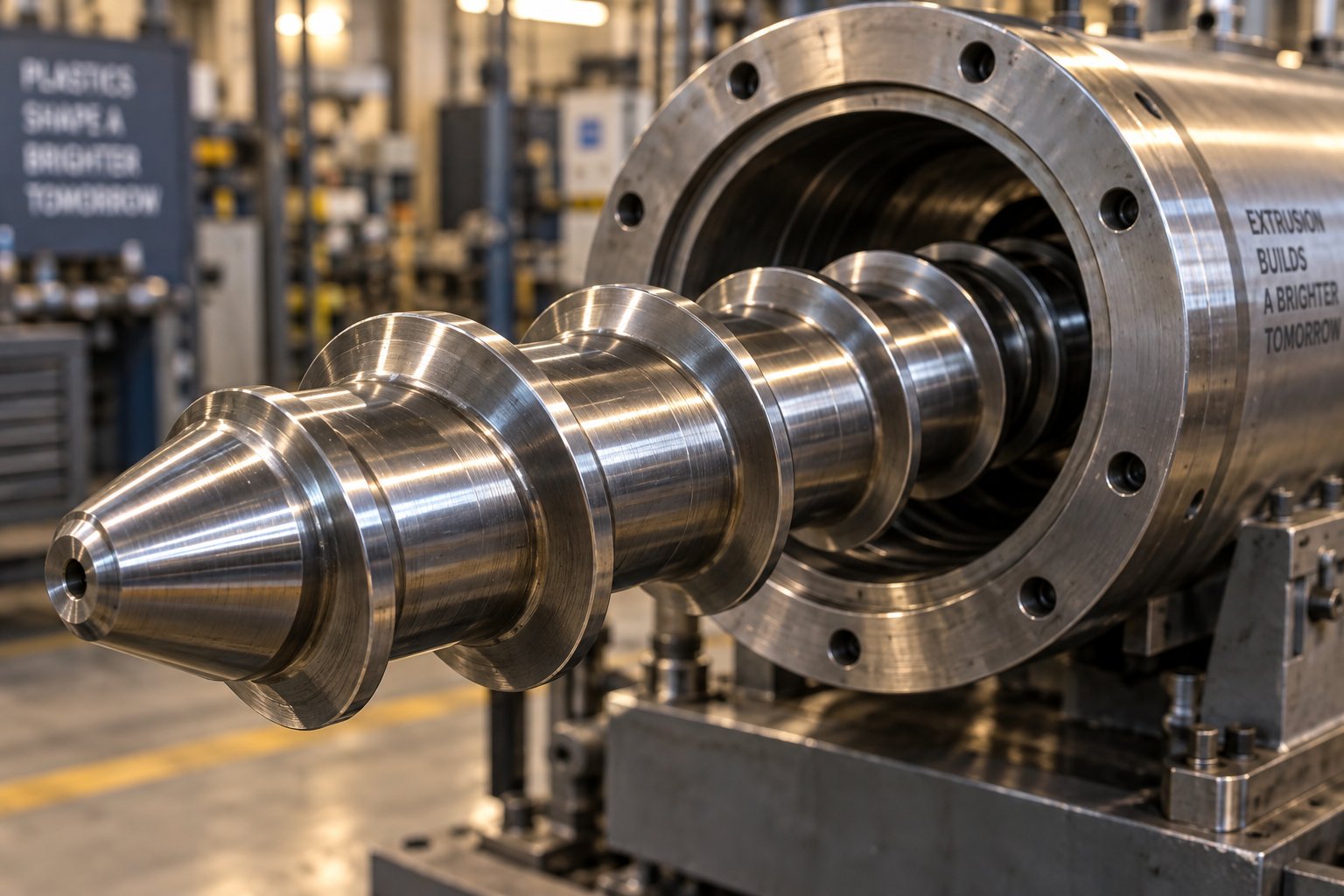
What Nobody Tells You About Screw Barrel For Plastic Machine Design
Oct 10, 2026
Learn how screw barrel for plastic machine design affects melt quality, throughput, and wear life. Covers geometry, resin matching, troubleshooting, and sourcing.
Read Article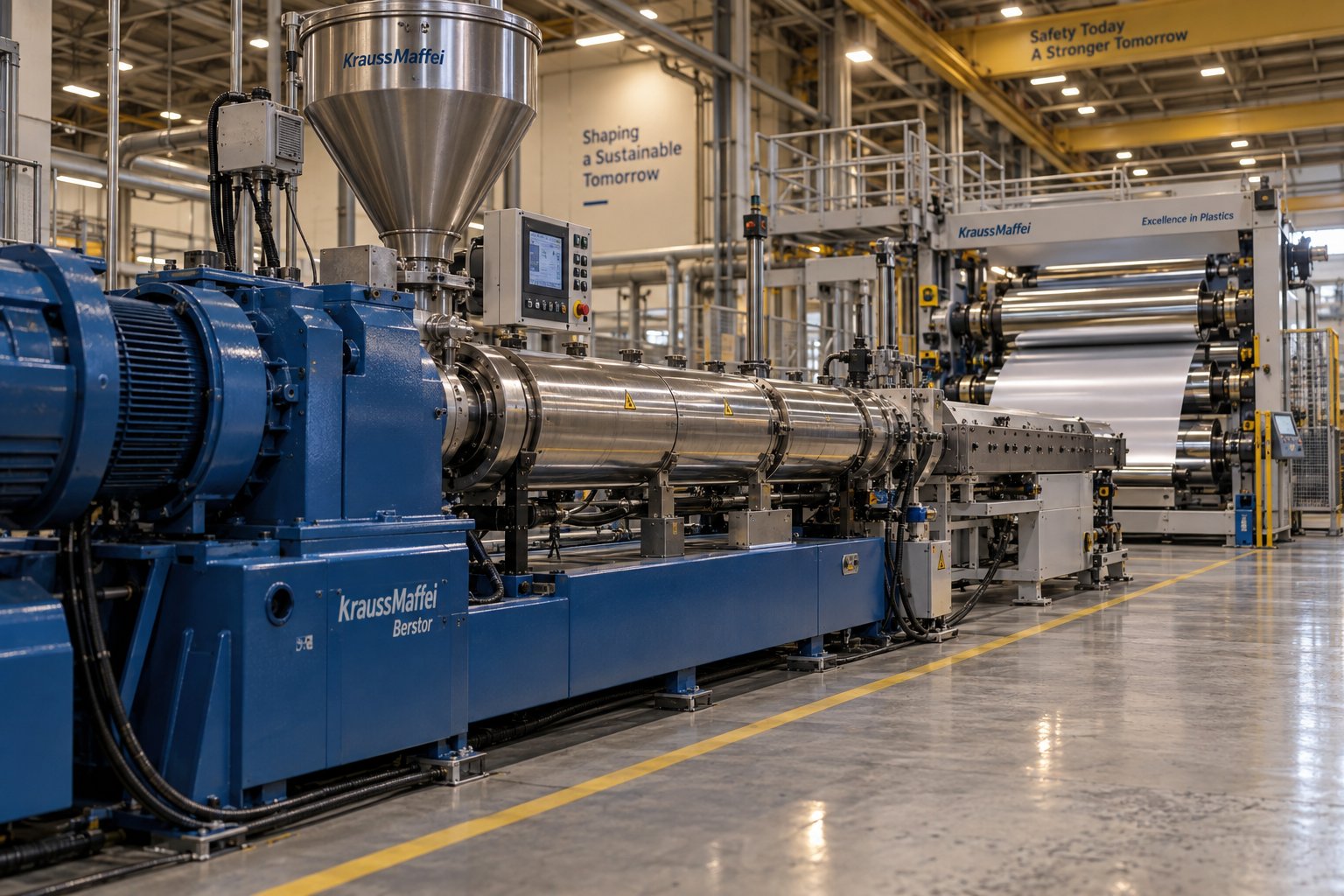
Single Screw Extruder for Sheet: Stop Guessing, Start Specifying
Oct 9, 2026
Learn how to specify a single screw extruder for sheet production. Covers screw geometry, resin-specific processing, troubleshooting, and maintenance best practices.
Read Article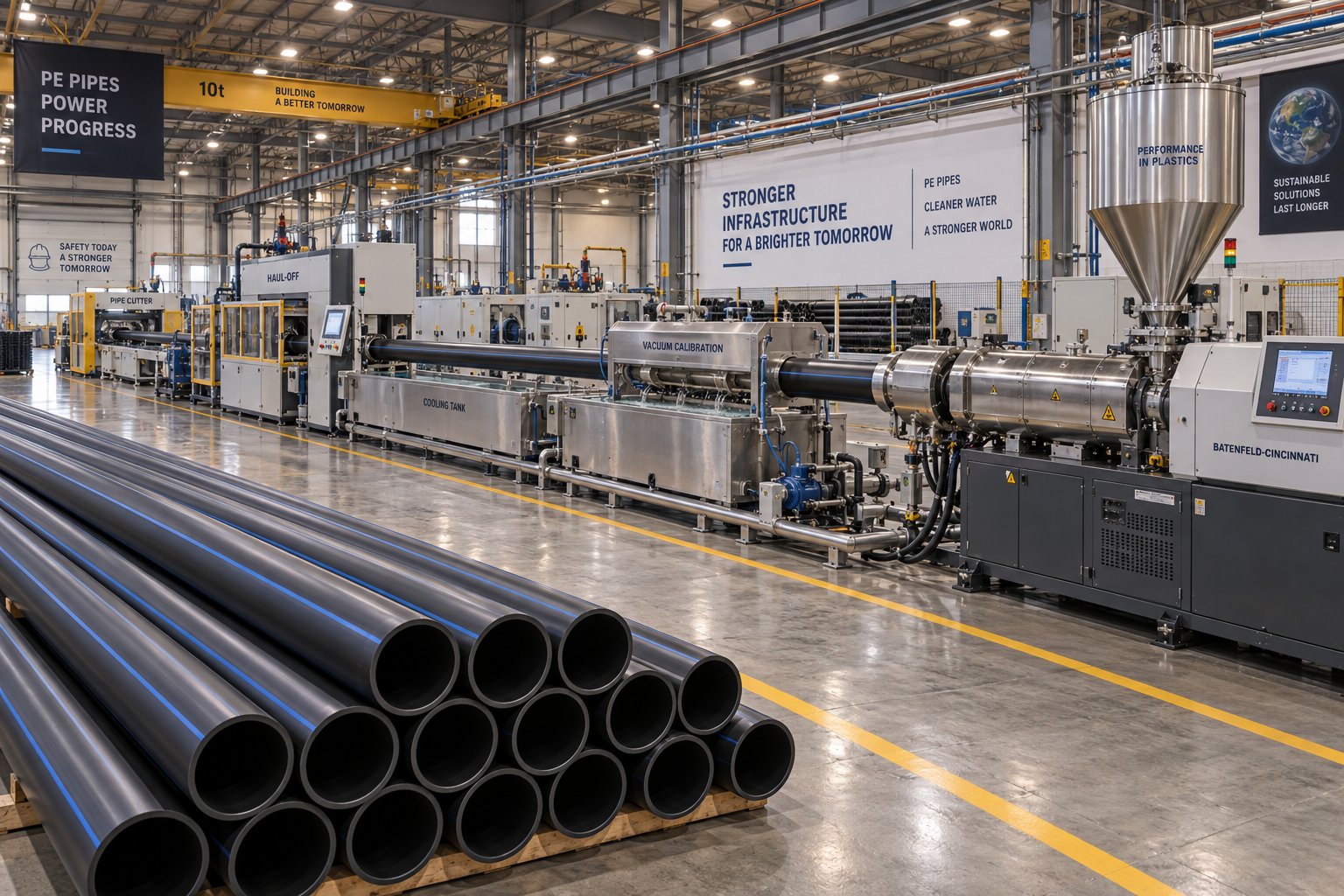
PE Pipe Extruder Machine: What Datasheets Won't Tell You
Oct 9, 2026
Learn how a PE pipe extruder machine works, key specs explained, material grade selection, maintenance tips, and buyer guidance beyond the datasheet.
Read ArticleLooking for something else?
Search by material, symptom or product and jump straight to the relevant page.
These are navigation suggestions based on keyword matching — not a quotation, not a delivery commitment, and not a substitute for engineering review. Final specification is confirmed by our engineers against your drawings and processed material.
Need help with screw barrel selection?
Share your machine model, processed material and application. Our team can help with pricing and technical support.