

锥形双螺杆挤出机的工作原理以及供应商选择的重要性
想象一下,你投入六位数资金购买了一台设备,却发现提供该设备的供应商在你需要更换桶身时无法交付。这种情况发生的频率远超大多数塑料加工商的预期,而其根源几乎总是同一个:供应商资质审核不严。
定义锥形双螺杆挤出机
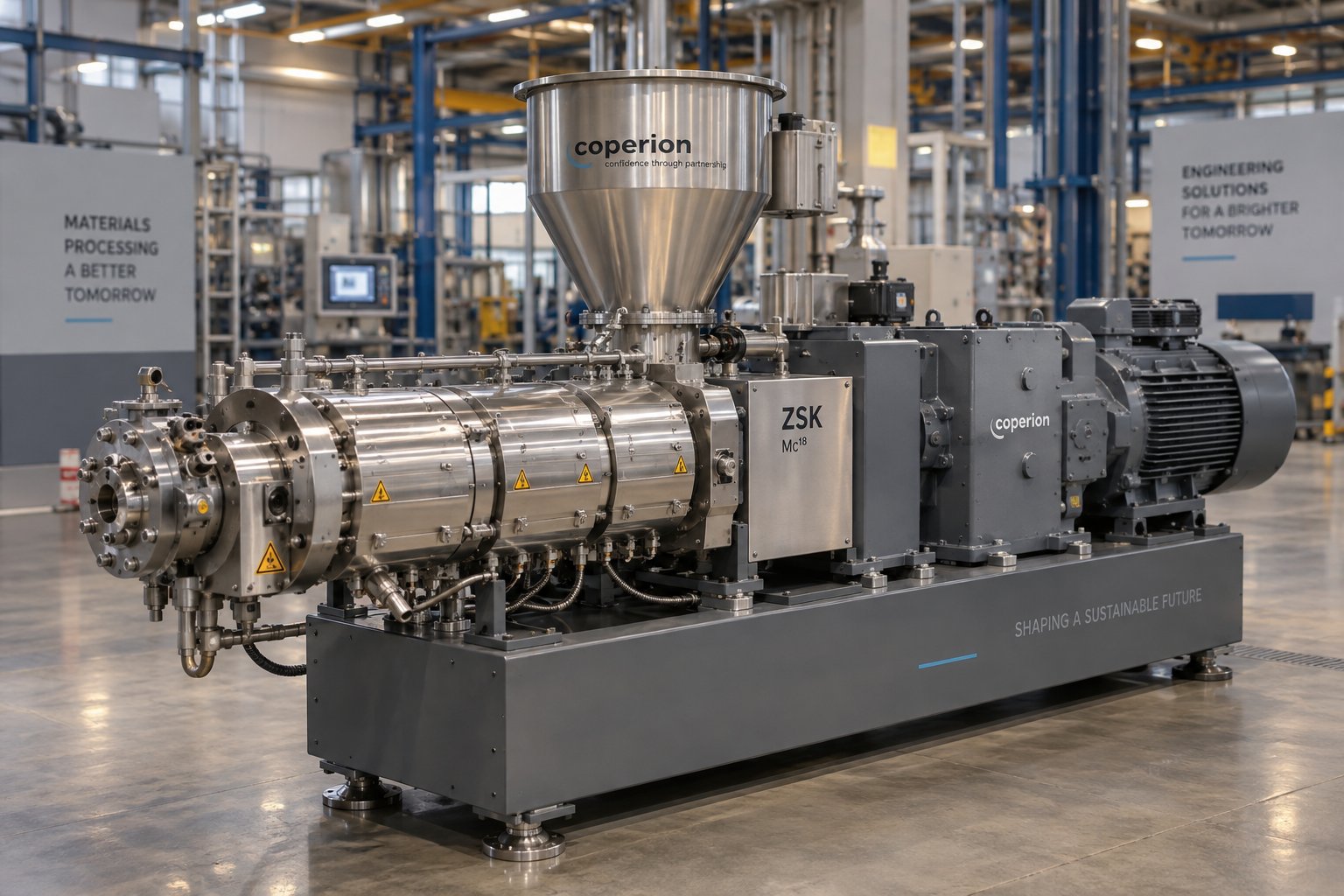
锥形双螺杆挤出机是一种聚合物加工设备,其核心是两个锥形反向旋转螺杆,螺杆在料筒的模头端逐渐收敛。较大的进料端直径能够高效地吸入物料,而逐渐变细的螺杆几何形状则在严格控制的剪切力和温度条件下对物料进行压缩和塑化。这种设计使得双螺杆挤出机特别适用于热敏性聚合物,例如硬质PVC,因为过大的剪切力会导致热降解。
与依靠摩擦阻力输送物料的单螺杆挤出机不同,锥形双螺杆挤出机采用正排量输送。此外,与平行双螺杆结构(两根螺杆在其全长范围内直径相同)不同,锥形结构能够在更紧凑的占地面积内提供更高的扭矩容量。这些区别至关重要,因为它们直接影响机器的生产能力、运行可靠性以及所需的配套设施。
为什么供应商的选择会直接影响生产
挤出机是每条PVC生产线的核心。其塑化均匀性决定产品质量,其正常运行时间决定产量,而其易损件系统——螺杆、料筒、加热器——则决定长期运营成本。在评估双螺杆挤出机制造商时,您实际上是在评估未来的生产合作伙伴,其工程技术实力、备件物流和技术支持将影响您未来多年的盈利能力。
合适的锥形双螺杆挤出机供应商不仅仅是卖机器——他们会成为长期的生产合作伙伴。
本文旨在为买家提供指导,而非产品目录。在接下来的章节中,您将找到所需的技术基础、评估框架和区域定价见解,从而区分真正值得信赖的供应商和那些发出警告的供应商——首先从每位明智的买家都应该了解的基本原则入手。
锥形双螺杆挤出技术的工作原理
Before you can spot a questionable supplier, you need to understand the machine itself well enough to ask the right questions. A twin-screw extruder built on conical geometry operates differently from every other extrusion platform — and those differences explain why the technology dominates rigid PVC processing worldwide.
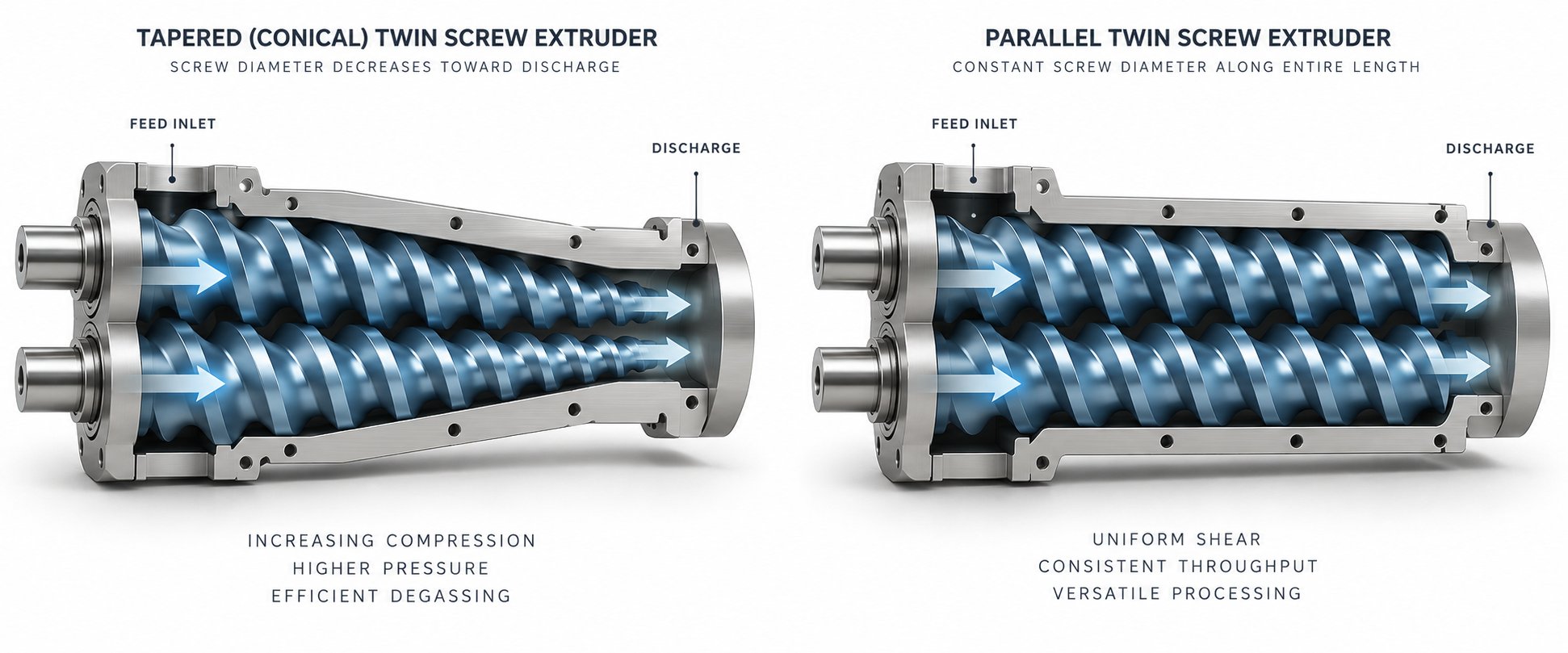
Picture two large, tapered screws sitting side by side inside a barrel that mirrors their shape. At the feed end, the screws have a wide diameter — typically 90 mm to 132 mm on common production models. As they extend toward the die, they taper down to a much smaller diameter, sometimes as narrow as 35 mm to 65 mm. This tapering profile is the key to everything the machine does well.
How Tapering Screw Geometry Creates Superior Compression
The decreasing screw diameter from feed end to discharge end creates a natural compression effect. As material travels forward, the available channel volume shrinks progressively. This forces the dry-blend PVC powder — which enters the extruder twin screw channel as a loose, air-filled bulk — to densify steadily along the barrel length.
Think of it like squeezing toothpaste through a narrowing tube. The decreasing channel depth pushes trapped air backward and out through the feed throat, while the material itself compacts into a denser mass. This progressive compression is critical for PVC dry-blend feeding because the powder has a low bulk density and contains significant interparticle air. Without gradual air expulsion, trapped volatiles would create voids, bubbles, or inconsistent melt quality downstream.
The compression ratio — the relationship between the channel volume at the feed end and the channel volume at the metering end — typically ranges from 2.5:1 to 4:1 in conical designs. Higher ratios produce more aggressive densification, which is useful for formulations with heavy filler loading. Lower ratios suit lighter compounds or applications where minimal shear history is preferred. This is one of those specification details worth discussing with any prospective supplier, because the screw geometry they offer reveals how well they understand your specific application.
Counter-Rotation and Its Role in Stable Plasticizing
Conical extruders overwhelmingly use counter-rotating screws — meaning one screw turns clockwise while the other turns counterclockwise. This isn't arbitrary. The rotation direction fundamentally changes how material moves through the barrel.
In a co-rotating twin screw extruder, material follows an infinity-shaped ("∞") flow path, transferring freely between the two screw channels. That promotes aggressive mixing and high shear — excellent for compounding, but risky for PVC, which degrades under excessive thermal and mechanical stress.
Counter-rotation, by contrast, creates a series of enclosed C-shaped chambers between the intermeshing screw flights. Material advances through these chambers in a positive-displacement fashion — pushed forward steadily rather than dragged by friction. The result is gentler shear, more predictable residence time, and a stable pressure profile along the barrel. For a double screw extruder processing heat-sensitive PVC, this gentle conveying behavior is not a luxury — it's a processing requirement.
Counter-rotating screws also offer a practical maintenance advantage. The opposing rotation at the intermeshing zone helps prevent material buildup in the screw channels, reducing the risk of localized overheating and degradation that can lead to black specks in finished products.
Every conical twin screw barrel can be divided into distinct functional zones, each performing a specific role in transforming raw powder into a homogeneous melt:
- Feed zone: The wide-diameter entry section where dry-blend powder is drawn in by the large screw flights, maximizing volumetric intake efficiency.
- Compression zone: The transitional region where decreasing channel depth compacts the material, expels trapped air, and initiates frictional and conductive heating.
- Metering and degassing zone: A controlled section where melt temperature and pressure stabilize, and any remaining volatiles or moisture are vented through barrel ports.
- Discharge zone: The narrowest section where the fully plasticized, homogeneous melt is pushed under consistent pressure toward the die for final shaping.
Each zone's dimensions — its length, channel depth, and flight pitch — directly influence melt quality, throughput, and energy consumption. These are not generic parameters; they vary by application, by formulation, and by the supplier's engineering capability. That variability is precisely why comparing the conical design against its parallel counterpart reveals so much about which machine suits your production line best.
Conical vs Parallel Twin Screw Extruders Compared
The zone-by-zone mechanics of conical extrusion explain why the technology works so well for PVC — but they also raise an obvious question. How does the conical configuration actually stack up against a parallel twin screw design in a head-to-head comparison? Buyers shopping for twin screw extruders encounter both options regularly, and supplier marketing materials rarely offer an honest, balanced breakdown. Here's one.
Design and Footprint Differences
The most visible difference is the screw geometry itself. In a conical design, two tapered screws converge toward the die, and the barrel mirrors this narrowing profile. A parallel design, by contrast, uses two screws with a constant diameter maintained along the full barrel length at a fixed center distance.
This geometric distinction creates a meaningful footprint advantage for conical machines. Because the tapering screws achieve compression through decreasing channel volume rather than extended barrel length, a conical extruder delivering equivalent PVC output typically occupies a shorter overall barrel length and a smaller floor footprint than its parallel counterpart. For processors working in space-constrained production halls, that difference matters.
There's a torque advantage, too. The larger root diameter at the feed end of the conical screw allows for a more robust screw core and bigger bearing surfaces. This translates into higher torque transmission capacity relative to the machine's overall size — a critical factor for pushing viscous PVC melt through restrictive downstream tooling like multi-cavity profile dies.
Parallel designs, however, offer something conical machines cannot easily match: modular screw configuration. Parallel screws are assembled from interchangeable elements — conveying flights, kneading blocks, mixing sections — that can be rearranged along a splined shaft. Conical screws are single-piece, application-specific designs. Once manufactured, their geometry is fixed. If you want to change the mixing intensity or compression profile, you need an entirely new screw set.
Performance Comparison for PVC and Heat-Sensitive Materials
Spec sheets can be misleading if you don't know what to weigh more heavily. The table below puts the most decision-relevant features side by side so you can see where each platform genuinely excels.
| Feature | Conical Twin Screw Extruder | Parallel Twin Screw Extruder |
|---|---|---|
| Screw Geometry | Tapered screws, decreasing diameter from feed to discharge | Constant-diameter screws along full barrel length |
| Rotation Direction | Counter-rotating (standard) | Co-rotating (standard); counter-rotating available |
| Shear Intensity | Low to moderate — gentle on heat-sensitive polymers | Moderate to high — suited for intensive compounding |
| Typical Applications | PVC pipe, profile, foam board, WPC, sheet extrusion | Compounding, masterbatch, engineering plastics, reactive extrusion |
| Machine Footprint | Compact — shorter barrel for equivalent output | Longer barrel; easier to extend length for higher throughput |
| Torque Transmission | High torque capacity from large feed-end root diameter | Torque depends on gearbox design; improved by modern FEM-optimized gearboxes |
| Suitability for PVC Dry-Blend | Excellent — progressive compression expels air efficiently | Workable but may require optimized screw configuration for gelation control |
| Energy Efficiency | Lower speed operation reduces energy per kg for PVC | Higher speed capability can increase energy draw; efficient for high-volume compounding |
| Screw Design Flexibility | Fixed single-piece design; application-specific | Modular elements allow reconfiguration for different materials |
| Processing Window | Narrower — optimized for specific PVC formulations | Wider — more forgiving across varied material types |
A few rows in that table deserve extra attention. The processing window difference is significant. Research from Rollepaal highlights that conical machines can present a relatively narrow processing window, particularly when targeting optimal gelation levels for demanding quality tests. Achieving sufficient gelation for certain tests might lead to over-fusion in the vent zone, potentially causing air inclusions. Parallel designs, by contrast, can offer a wider processing window and greater venting flexibility — advantages that become more relevant at larger output scales.
The screw speed contrast also tells an important story. A co rotating twin screw extruder in a parallel configuration can reach speeds up to 1,200 rpm, generating aggressive distributive and dispersive mixing. Conical extruders typically operate at much lower speeds — often below 40 rpm — relying on geometry rather than velocity to do the work. For PVC, slower speed means less frictional heat generation, which directly protects against thermal degradation.
When Parallel May Be the Better Choice
Honesty builds trust, so here's the straightforward assessment: parallel twin screw extruders are the superior platform for several important applications where conical machines simply cannot compete.
If your production involves compounding engineering plastics, producing color or additive masterbatch, blending high-filler formulations across multiple resin types, or running reactive extrusion processes, a parallel co-rotating extruder gives you the mixing intensity, throughput scalability, and material flexibility you need. The modular screw design means a single machine can be reconfigured for entirely different formulations — from PE-based calcium carbonate masterbatch to glass-fiber-reinforced nylon — just by rearranging screw elements and adjusting barrel sections. Some processors even explore triple screw extruder configurations for ultra-high-throughput compounding, though these remain niche.
Parallel platforms also scale up more gracefully. Increasing output on a conical extruder typically requires stepping up to a larger screw diameter, which means a completely different machine. On a parallel extruder, output can often be increased by extending the barrel length and adjusting screw pitch — a less capital-intensive path.
Yet for dedicated PVC pipe, profile, and board extrusion — the applications most readers evaluating a conical twin screw extruder supplier will prioritize — the conical counter-rotating design remains the industry standard. Its gentle shear, efficient air expulsion from dry-blend powder, compact footprint, and robust torque delivery align precisely with PVC's processing demands.
Understanding where each platform fits best gives you a sharper lens for the next critical step: matching your specific end-product requirements to the right machine configuration and, ultimately, the right supplier.
Application Breakdown by PVC End Product
Knowing that a conical twin screw extruder handles PVC well is one thing. Knowing exactly how your specific product — whether it's a pressure-rated water pipe or a lightweight foam advertising board — shapes the machine configuration you need is something else entirely. This distinction matters because the extruder requirements for a 400 mm drainage pipe and a six-cavity window profile are dramatically different, and a supplier who treats them the same is waving a red flag.
Let's walk through the major PVC product categories and the specific demands each one places on a twin screw plastic extruder, so you can approach suppliers with clear, application-driven specifications rather than vague requests.
PVC and CPVC Pipe Extrusion Requirements
Pipe extrusion is the single largest application segment for conical twin screw extruders, but not all pipe lines are created equal. PVC pressure pipe — used for potable water and industrial fluid transport — demands exceptionally stable melt pressure and consistent wall thickness. Even small fluctuations in output rate create dimensional variations that can cause a pipe to fail hydrostatic pressure testing. You'll want an extruder with precise temperature control across every heating zone, a robust drive system that holds screw speed steady under load, and a screw geometry optimized for high gelation levels without over-fusing the melt.
PVC drainage pipe is somewhat more forgiving on dimensional tolerances, but output volume becomes the priority. Higher throughput rates push the extruder's torque and cooling capacity harder, so motor power and gearbox rating deserve close scrutiny during supplier evaluation.
CPVC pipe adds another layer of complexity. The chlorinated resin processes at significantly higher temperatures than standard PVC — and it's far less forgiving of temperature swings. As processing guidance from JWELL notes, temperature fluctuation during CPVC extrusion should be controlled to approximately +/- 5 degrees Celsius, and the barrel and screw surfaces require corrosion-resistant treatments to withstand the aggressive HCl released during processing. If a supplier offers a "standard PVC" machine for CPVC work without discussing barrel lining upgrades, screw surface treatments, or enhanced temperature control stability, that's a clear warning sign.
PVC Profile and Window-Door Systems
Imagine feeding a homogeneous melt simultaneously into a die with four, five, or even six separate cavities, each producing a complex window profile with hollow chambers, wall thicknesses as thin as 1.2 mm, and tight co-planarity tolerances. That's the daily reality of profile extrusion — and it demands an extruder capable of delivering rock-steady melt quality with almost zero pressure variation.
Multi-cavity profile dies amplify every upstream inconsistency. A small temperature deviation or melt-pressure pulse that might go unnoticed in pipe production can cause visible warping, uneven wall distribution, or surface defects across multiple profile strands simultaneously. The extruder needs precise, zone-by-zone temperature control, a screw design that promotes thorough fusion without generating excessive shear heat, and a drive system that holds output constant during extended production runs.
Cable trunking and decorative profiles fall under the same umbrella, though their dimensional tolerances may differ. Trunking typically requires consistent snap-fit dimensions, while decorative profiles prioritize surface finish quality. In both cases, the extruder's plasticizing stability is what separates acceptable product from scrap.
Co extrusion machine setups are also common in the profile segment. Many window systems use a co extruder to apply a colored or UV-resistant cap layer over the main profile body. This adds another variable: the primary and secondary extruders must deliver synchronized, pulse-free output so the cap layer bonds uniformly without thickness variation.
PVC Foam Board and WPC Panel Production
Foam board and wood-plastic composite extrusion occupy a unique position because they introduce a chemical reaction — foaming agent decomposition — directly into the plasticizing process. The extruder doesn't just melt and push material; it must manage the precise temperature window where the blowing agent decomposes to generate gas cells without allowing premature expansion inside the barrel.
Detailed process analysis from JWELL Anhui underscores this challenge: screw geometry, temperature zoning, torque, and feed stability must create a homogeneous melt without degrading the PVC or releasing the blowing agent too early. Inconsistent melt temperature can produce boards with uneven cell structure — dense patches alongside large voids — resulting in poor surface quality, unreliable screw-holding capacity, and inconsistent board density.
WPC panels add wood flour into the mix, introducing moisture sensitivity and particle-size variability that further complicate plasticizing control. Enhanced mixing sections in the screw design help distribute the wood filler evenly throughout the PVC matrix, but the extruder also needs effective degassing to remove moisture-driven volatiles before the melt reaches the die.
These applications often demand specific screw designs with modified flight geometry, deeper mixing zones, and optimized compression profiles that differ substantially from standard pipe or profile screws. A supplier who offers only one "universal" screw configuration for all applications likely lacks the engineering depth these products require.
Matching Your Product to Extruder Requirements at a Glance
Before you contact any supplier, pin down exactly what you're producing and what that product demands from the extruder. Here's a scannable breakdown of the major application categories and their critical machine requirements:
- PVC pressure pipe: High gelation level, stable melt pressure, precise wall-thickness control, robust torque for restrictive die tooling.
- PVC drainage pipe: High throughput capacity, strong motor and gearbox rating, efficient cooling, consistent output rate.
- CPVC pipe: Elevated temperature capability, tight temperature control (+/- 5 degrees Celsius), corrosion-resistant barrel lining and screw surfaces, effective exhaust and venting.
- PVC window and door profiles: Ultra-stable melt delivery, multi-zone temperature precision, low-pulsation output for multi-cavity dies, co extrusion compatibility.
- Cable trunking: Consistent dimensional accuracy for snap-fit tolerances, stable plasticizing at moderate throughput.
- PVC rigid sheet: Uniform melt homogeneity across wide-die distribution, low shear to prevent surface defects, precise gauge control.
- PVC foam board: Controlled foaming agent decomposition, enhanced mixing screw sections, effective degassing, tight temperature uniformity.
- WPC profiles and decking: Moisture removal capability, filler-distribution mixing zones, abrasion-resistant barrel and screw surfaces for wood-flour processing.
- PVC edge banding: Fine dimensional precision, excellent surface finish, stable low-volume output control for thin-gauge products.
Each bullet point above translates into specific technical specifications on a supplier's quote sheet — screw diameter, L/D ratio, motor power, barrel lining type, number of heating zones, and more. Understanding what those numbers actually mean for your production performance is the difference between buying a machine that fits and buying one that frustrates. That's exactly where the conversation needs to go next.
Key Technical Specifications Every Buyer Should Evaluate
Supplier quotations arrive packed with numbers — screw diameters, motor ratings, torque figures, barrel treatments — and most buyers scan right past them. That's a costly habit. Every specification on a conical screw extruder data sheet connects directly to a production outcome: how much product you can run per hour, how consistent that product will be, and how often you'll be shutting down for maintenance. Reading these numbers with confidence turns you from a passive buyer into an informed negotiator.
Screw Diameter and L/D Ratio Decoded
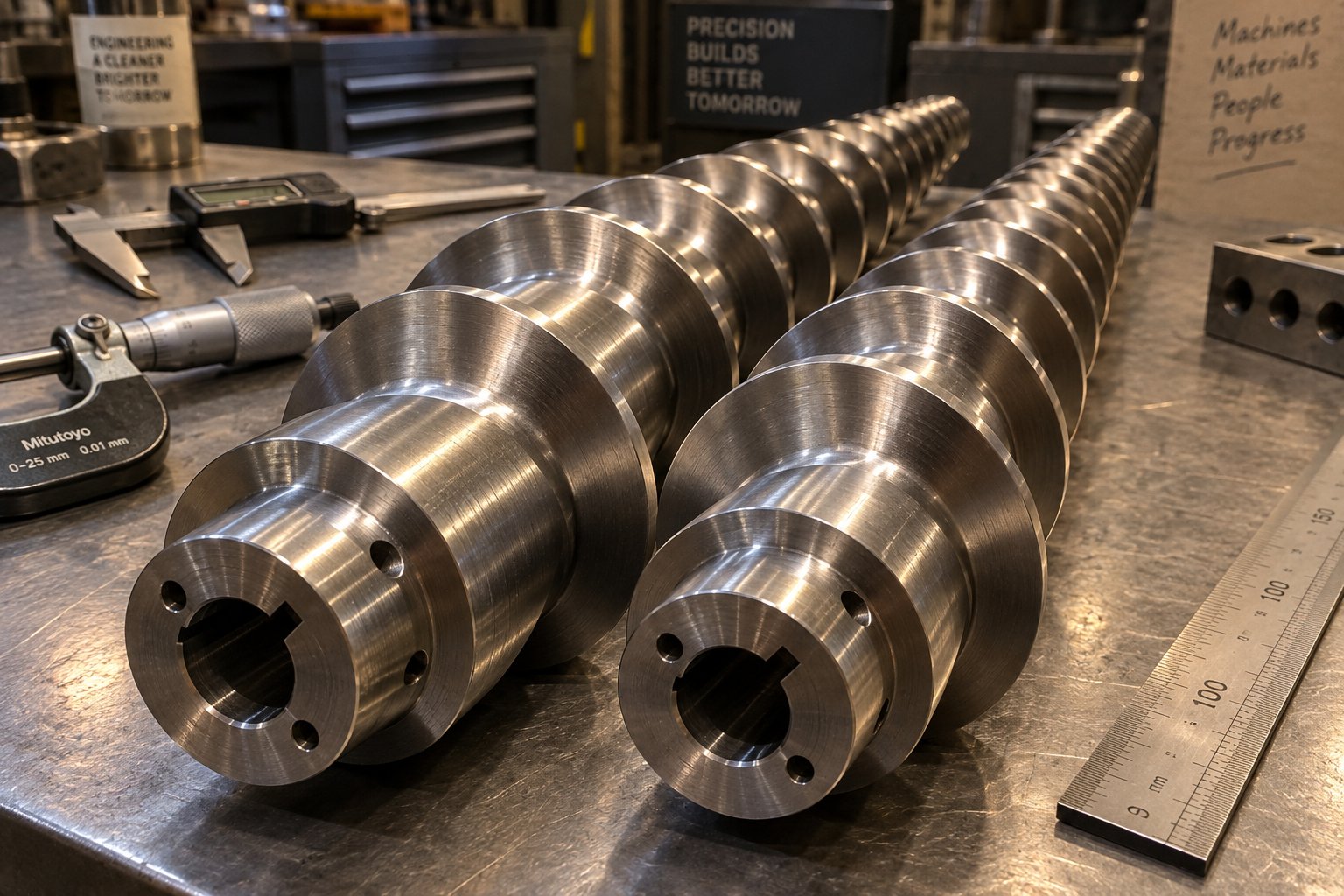
You'll notice that conical twin extruder models are named with two numbers separated by a slash — something like 65/132 or 80/156. These aren't arbitrary model codes. The first number represents the small-end screw diameter in millimeters (at the discharge end), and the second number represents the large-end screw diameter (at the feed end). So a 65/132 double screw extruder machine has screws that taper from 132 mm at the feed throat down to 65 mm at the die connection.
Why does this matter? The large-end diameter determines how much material the screws can pull in per revolution. Bigger feed diameters handle bulkier, lower-density PVC dry blends more efficiently. The small-end diameter, meanwhile, influences discharge pressure and torque transmission to the melt. Larger screw pairs — like the 80/158 and 92/188 configurations — deliver substantially higher throughput and are standard on large-bore pipe lines producing above 500 kg/h. Smaller pairs such as 45/90 or 50/105 target lower-output applications like narrow profiles or edge banding.
The L/D ratio describes the effective screw length relative to the screw diameter. In conical designs, this ratio is typically calculated on the large-end diameter basis and generally falls between 6:1 and 9:1 — far shorter than the 28:1 to 52:1 ratios common in parallel twin screw platforms. A shorter L/D ratio means shorter residence time inside the barrel, which reduces the risk of thermal degradation for heat-sensitive PVC. However, it also means less barrel length available for mixing and degassing. Suppliers who offer optimized screw flight designs within a given L/D range demonstrate engineering capability; those who simply list the ratio without context may not fully understand how it affects your specific formulation.
Output Capacity, Motor Power, and Torque Ratings
Three numbers on every spec sheet form a tightly linked triangle: motor power (kW), torque (Nm), and output capacity (kg/h). Here's how the relationship works in practice.
Motor power defines the total energy available to rotate the screws. But raw kilowatts alone don't tell the whole story. What actually moves the melt forward through a restrictive die is torque — the rotational force the gearbox delivers to the screw shafts. Because conical extruders operate at low screw speeds (typically 20 to 50 rpm), they rely on high torque rather than high speed to generate melt pressure. This low-speed, high-torque operating profile is what makes the conical platform so energy-efficient for PVC, with specific energy consumption values as low as 0.12 to 0.22 kWh/kg.
Torque is frequently the limiting factor in a twin extruder's real-world performance. If the gearbox torque rating is undersized relative to the screw geometry and die resistance, the motor draws excessive current under load. Over time, this leads to overheating, accelerated gear wear, and eventually premature gearbox failure — one of the most expensive repairs on any extrusion line. When comparing quotations, don't just look at motor power; ask for the specific torque rating at the screw shaft and verify it against the output claims for your intended application. A supplier who can clearly explain the torque-to-throughput relationship for your product is demonstrating genuine engineering competence.
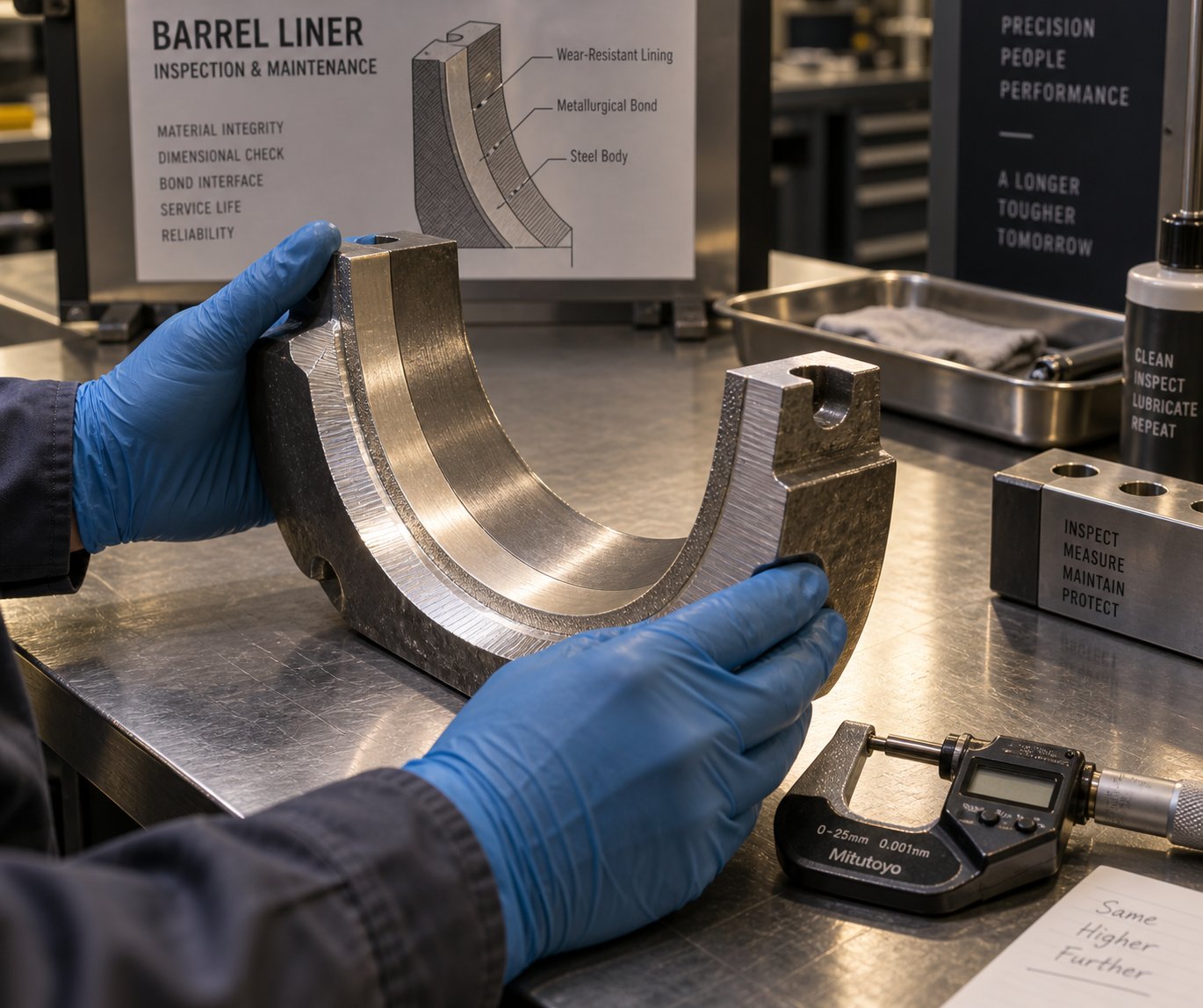
Barrel Material and Bimetallic Lining Options
The barrel is the wear surface your melt presses against millions of times per production hour. Its material and surface treatment directly determine how long it lasts, how much it costs to replace, and how well it resists the corrosive byproducts of PVC processing.
Two primary barrel construction approaches dominate the market: nitrided barrels and bimetallic-lined barrels.
A nitrided barrel starts with high-quality alloy steel — commonly 38CrMoAlA — and undergoes a gas nitriding process that diffuses nitrogen atoms into the surface. This creates a hardened layer with a surface hardness around HV 950 to 1,000 and a nitriding depth of 0.45 to 0.70 mm. Nitrided barrels offer good wear resistance at a cost-effective price point and perform reliably for standard rigid PVC processing where filler content is moderate.
A bimetallic barrel takes a different approach. It bonds a specialized wear-resistant alloy — tungsten carbide, nickel-based, or cobalt-based materials — to the inside bore of the barrel body. This creates an inner lining with hardness levels reaching 62 to 70 HRC, significantly exceeding what nitriding alone achieves. Bimetallic construction also provides superior corrosion resistance against the hydrochloric acid gases released during PVC melt processing.
When does the bimetallic upgrade become worth the higher upfront cost? Whenever your formulation includes abrasive fillers. Processing materials with calcium carbonate filler, titanium dioxide at high loadings, or recycled PVC content accelerates abrasive wear on barrel surfaces dramatically. The harder, thicker bimetallic liner resists this wear for longer, extending replacement intervals and reducing unplanned downtime. For WPC and heavily filled PVC compounds, bimetallic barrels are not a luxury — they're an economic necessity over the machine's lifecycle.
The table below consolidates every critical specification into a single reference, translating each parameter from data-sheet jargon into practical production impact.
| Specification | What It Means | Why It Matters for Production |
|---|---|---|
| Screw Diameter Pair (e.g., 65/132) | Small-end diameter / large-end diameter of the tapered screws, in millimeters | Determines maximum output capacity and material intake volume; larger pairs handle higher throughput and bulkier feed stocks |
| L/D Ratio | Effective screw length divided by the reference diameter; typically 6:1 to 9:1 for conical designs | Affects residence time, melt homogeneity, and degassing effectiveness; shorter ratios reduce thermal degradation risk for PVC |
| Output Capacity (kg/h) | Maximum achievable throughput under specified conditions | Must match your production targets; verify the output claim against your specific formulation, not just generic PVC |
| Motor Power (kW) | Total electrical power available to drive the screws through the gearbox | Higher power supports greater throughput but must be paired with adequate torque delivery; excess power without torque wastes energy |
| Torque Rating (Nm) | Rotational force delivered to the screw shafts at operating speed | Often the true performance limiter; undersized torque causes gearbox overload, overheating, and premature mechanical failure |
| Heating Zones (number) | Number of independently controlled temperature sections along the barrel | More zones allow finer temperature profiling, critical for multi-cavity profile dies and foam board where precise thermal control prevents defects |
| Barrel Lining Type | Surface treatment of the barrel bore — nitrided (HV 950-1,000) or bimetallic (62-70 HRC) | Determines wear life, corrosion resistance, and long-term replacement cost; bimetallic is essential for abrasive or filled formulations |
Each row in that table represents a question you should be asking every prospective supplier — and more importantly, every answer reveals how deeply that supplier understands the connection between machine specifications and your real-world production performance. Suppliers who explain these parameters in the context of your application are the ones worth shortlisting. Those who simply hand over a generic data sheet without discussion are telling you something about their engineering depth, even if they don't intend to.
Specifications, though, are only half the picture. A machine with perfect numbers on paper still needs a supplier behind it who can deliver reliable after-sales support, spare parts on demand, and the engineering flexibility to customize when your application requires it. Building a structured framework for evaluating those supplier-level qualities is the logical next step.
How to Build a Supplier Evaluation Framework
A spec sheet tells you what a machine can theoretically do. A supplier evaluation tells you whether you'll actually get that performance — and keep getting it five years down the road. Most buyers compare quotations by lining up prices, scanning a few headline specifications, and picking the lowest number that doesn't feel reckless. That approach misses the factors that truly determine whether a conical twin screw extruder investment pays off or turns into an expensive headache.
What you need instead is a structured, repeatable framework — a set of objective criteria you can apply to every prospective twin-screw extruder manufacturer on your shortlist, regardless of their region, brand reputation, or sales pitch. Think of it as a scoring system that separates genuine production partners from polished marketing operations. Here's how to build one.
Certifications, Standards, and Verification
Certifications are often treated as decorative badges on supplier websites — a row of logos at the bottom of a homepage that buyers glance at without questioning. That's a mistake. The right certifications signal that a manufacturer has submitted to independent scrutiny of their quality systems, design processes, and safety compliance. The wrong ones — or the absence of any — signal risk.
Start with ISO 9001. This quality management certification doesn't guarantee that an extruder manufacturer builds great machines, but it does confirm they follow documented processes for design, procurement, production, and inspection. An ISO 9001-certified supplier has a traceable system for handling nonconformances, managing supplier inputs, and maintaining calibration records. Without it, you're relying entirely on the manufacturer's self-reported quality claims.
CE marking carries different weight. For any machine entering the European market, CE compliance with directives like the Machinery Directive (2006/42/EC) and the Low Voltage Directive is a legal requirement, not a marketing choice. A CE-marked extruder has been assessed — either by the manufacturer or a notified body — against safety standards including EN ISO 12100 and EN 60204-1. If you're importing into Europe, the Middle East, or several African and South American markets that recognize CE, insist on seeing the Declaration of Conformity document, not just a sticker on the machine frame.
Region-specific certifications matter, too. Some markets require UL compliance for electrical components, GOST certification for CIS countries, or BIS certification for India. A supplier experienced in exporting to your region will already have these in place. One who hesitates when you ask is either unfamiliar with your market or cutting corners.
Here's the critical point: always request the actual documentation. Ask for the ISO certificate with its registration number and certifying body. Ask for the CE technical file or Declaration of Conformity. Verify the certificate hasn't expired. Any credible extruder manufacturer will provide these without hesitation. Resistance or vagueness is one of the clearest red flags you'll encounter.
After-Sales Support and Spare Parts Ecosystem
You've probably heard the truism that a machine purchase is just the beginning of the relationship. It sounds like a cliche until you're standing in front of a stopped extrusion line at 2 a.m., waiting for a replacement heating band or a barrel segment that's six weeks away by sea freight. At that point, after-sales support stops being an abstract evaluation criterion and becomes the single most important factor in your total production cost.
Responsive technical support takes several forms, and you should probe all of them during evaluation. Can you reach a qualified engineer by phone or video call within a defined timeframe — not just a sales representative who logs a ticket? Does the supplier offer remote diagnostics, where their technical team can connect to your machine's PLC and analyze data logs to troubleshoot issues without waiting for a site visit? According to industry service benchmarks, leading extruders manufacturers target initial response times under four hours and first-time fix rates above 90 percent — numbers you can and should ask prospective suppliers to substantiate.
Spare parts logistics deserve equally hard scrutiny. The critical wear components on a conical twin screw extruder — screws, barrels, heaters, thermocouples, gearbox bearings — all have finite service lives. When they need replacement, every day of lead time translates directly into lost production. Ask these specific questions:
- Does the supplier maintain a stock of standard wear parts, or is every replacement manufactured to order?
- What is the typical lead time for screws and barrels — the highest-value, longest-lead components?
- Does the supplier operate regional warehouses or partner with local distributors who hold inventory?
- Can the supplier provide a recommended "critical spares kit" that you keep on-site for emergency repairs?
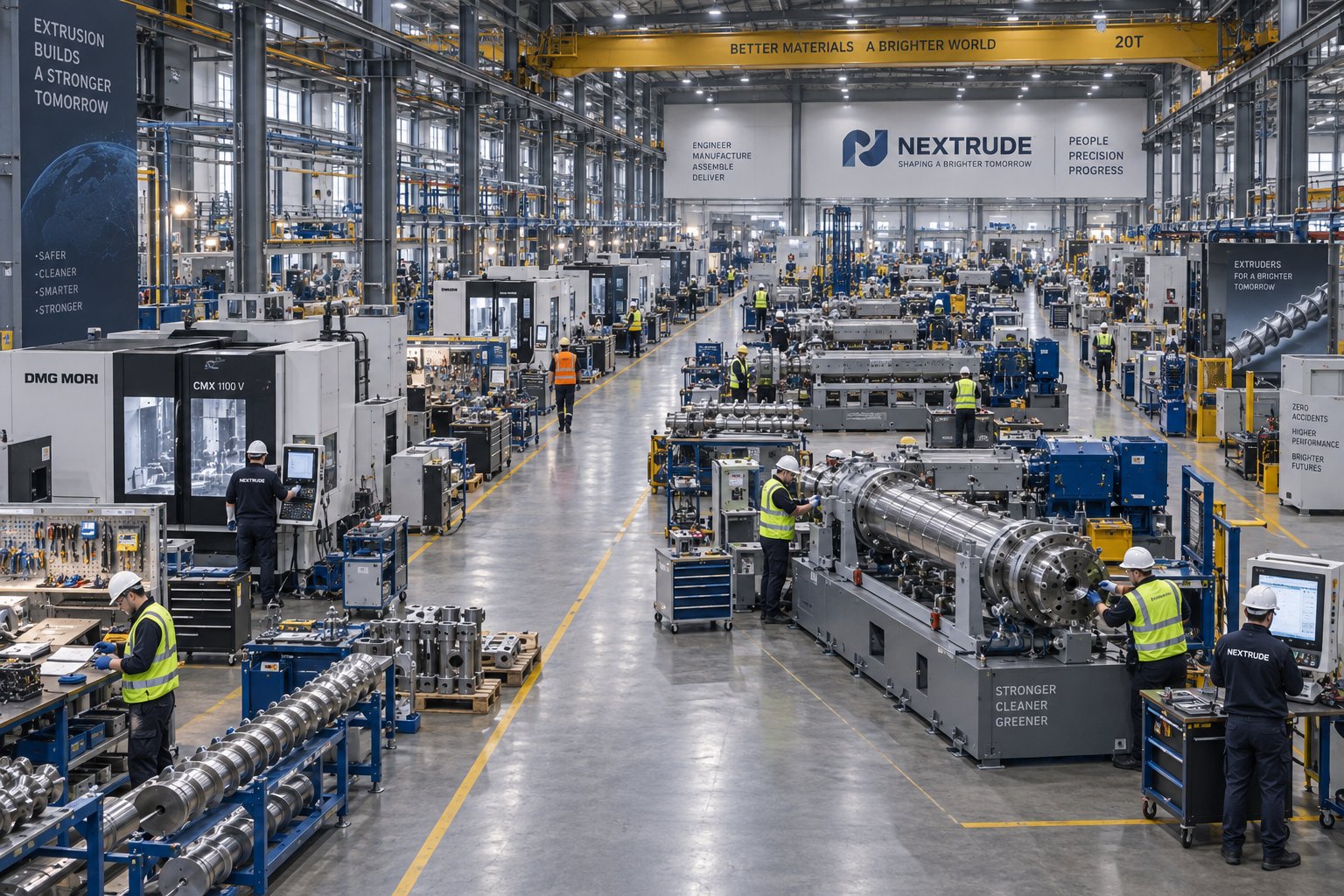
One capability separates top-tier suppliers from resellers and trading companies more reliably than almost any other: in-house screw and barrel manufacturing. A supplier who machines their own screws, casts or lines their own barrels, and performs their own heat treatment and finishing controls quality at the component level. They can respond faster to wear-part orders because they're not outsourcing to a third party. They can modify screw geometry or barrel lining specifications for your application without waiting on an external vendor's production schedule. And they can ensure dimensional consistency between the original equipment and the replacement components — a detail that matters enormously for maintaining plasticizing performance after a part swap.
A supplier who manufactures their own screws and barrels in-house controls quality at the component level — this directly impacts your maintenance costs and production uptime.
Suppliers who outsource these critical components aren't necessarily bad choices, but you need to understand that their spare-parts pricing, lead times, and quality consistency all depend on someone else's production capacity and priorities. That adds a layer of risk and cost to your long-term ownership equation.
Customization, Lead Times, and Warranty Terms
Here's where the distinction between a genuine manufacturer and a catalog reseller becomes unmistakable. Ask any prospective supplier whether they can modify the screw compression ratio for your specific PVC formulation. Ask whether they can upgrade the barrel lining from nitrided to bimetallic for a high-filler application. Ask whether they can add or reconfigure heating zones to accommodate a specialized downstream die. A real extruder manufacturer will discuss these requests in technical terms — citing specific alloy options, achievable hardness ranges, and the impact on plasticizing performance. A reseller will redirect the conversation back to standard models.
Customization capability matters because, as the application breakdown in earlier sections made clear, no two PVC extrusion operations are identical. A foam board producer processing a chemical blowing agent needs different screw flight geometry than a pipe producer running a heavy calcium carbonate-filled compound. A profile manufacturer feeding a co extruder alongside the primary machine needs synchronized output control that a stock configuration may not support. The ability to engineer these adaptations in-house — without adding months to the delivery timeline — is a hallmark of suppliers who genuinely understand the technology they sell.
Lead times reveal supply chain depth. A manufacturer with established raw material sourcing, in-house machining centers, and proven assembly workflows typically quotes machine delivery in 45 to 90 days. Significantly longer timelines may indicate capacity constraints, outsourced component production, or order-by-order material procurement — all factors that could repeat when you need service or parts later.
Warranty terms deserve line-by-line reading, not a quick skim. Most extruders manufacturers offer a standard 12-month warranty covering manufacturing defects. But the details vary sharply. Does the warranty cover the gearbox? Does it exclude wear parts like screws and barrels — and if so, what wear thresholds define "normal" versus "premature"? Does the supplier provide on-site commissioning support, or does the warranty clock start at shipment regardless of installation delays? Are overseas commissioning visits included in the machine price, or billed separately? These aren't trivial questions. They represent thousands of dollars of potential exposure on either side of the negotiation table.
Pulling all of these evaluation dimensions together, here's a ranked checklist you can apply systematically to every supplier on your shortlist:
- In-house screw and barrel manufacturing — Confirms component-level quality control and faster wear-part turnaround.
- Relevant certifications (ISO 9001, CE, region-specific) — Validated by requesting actual documentation, not accepting website badges.
- Application-specific engineering capability — Demonstrated through technical discussions about screw design, barrel treatment, and heating zone configuration for your product.
- Spare parts pricing and availability — Verified through quoted lead times, stocking policies, and regional warehousing or distribution partnerships.
- After-sales response time and technical support — Defined by measurable commitments: response time targets, remote diagnostic capability, field service engineer availability.
- Warranty scope and duration — Evaluated by reading the warranty document in detail, not relying on verbal assurances during sales conversations.
- Reference customers in your application segment — Confirmed by requesting contact details of existing clients producing similar products, and actually speaking with them.
That last point — reference customers — might be the most underused tool in procurement. Any confident supplier will connect you with existing users running the same application. If a supplier deflects that request with confidentiality excuses or generic testimonials, you've identified a red flag worth taking seriously.
This framework gives you a reliable method for separating strong candidates from weak ones. But supplier quality doesn't exist in a vacuum — it's heavily influenced by where a manufacturer is based, what engineering traditions they draw on, and what price tier their regional market supports. Those geographic factors shape everything from the automation level of the machines to the responsiveness of the service teams behind them.
Regional Supplier Landscape and Pricing Factors
Geography shapes machinery markets more profoundly than most buyers realize. The country where a conical twin screw extruder is designed, manufactured, and shipped from influences not just the price tag, but the engineering philosophy behind it, the automation technology embedded in it, and the support infrastructure available after it arrives on your factory floor. Understanding these regional dynamics gives you a sharper lens for interpreting quotations — because a $90,000 machine from one region and a $350,000 machine from another aren't simply different prices for the same product. They represent fundamentally different value propositions.
Chinese Suppliers and the Value Proposition
China dominates global PVC extrusion machinery production by volume, and it isn't particularly close. In 2024, Chinese extruder exports reached approximately USD 925 million, accounting for roughly 25 percent of global export value and a staggering 58 percent of total units shipped worldwide. Those numbers reflect a manufacturing ecosystem that has matured rapidly over the past two decades — driven by massive domestic PVC pipe and profile demand and fueled by concentrated industrial clusters with deep supply chains.
Three regions anchor China's conical twin screw extruder production. Zhangjiagang, in Jiangsu Province, has long been the country's most recognized hub for PVC extrusion line manufacturing, with dozens of companies producing complete pipe and profile systems. Qingdao, in Shandong Province, houses another significant cluster focused on both extrusion equipment and downstream tooling. And Guangdong Province contributes manufacturers serving Southeast Asian and African export markets with particular strength in cost-competitive configurations.
The pricing advantage is real — Chinese-manufactured conical twin screw extruders typically cost 40 to 60 percent less than comparable European models. But here's the critical nuance that trips up inexperienced buyers: the quality variance among Chinese extruder manufacturers is enormous. At one end, you'll find basic machines assembled with commodity-grade components, minimal quality documentation, and almost no post-sale engineering support. At the other end, export-grade manufacturers produce equipment meeting CE standards, use branded electrical components from Siemens or ABB, employ bimetallic barrel technology, and offer commissioning support and remote diagnostics. The gap between these two tiers is as wide as the gap between Chinese and European suppliers themselves.
How do you navigate that variance? Apply the evaluation framework from earlier sections rigorously. Prioritize suppliers with verifiable ISO 9001 certification, demonstrated export experience to your region, and — most importantly — reference customers you can actually contact. Companies that have survived years of fierce domestic competition and built sustained export businesses have done so by delivering machines that work reliably in the field, not just on the showroom floor.
European and North American Supplier Landscape
When plastics processors talk about the gold standard in extrusion engineering, the conversation inevitably turns to German and Austrian manufacturers. Brands historically associated with names like Cincinnati and Battenfeld — now operating as battenfeld-cincinnati under the Davis-Standard Corporation — set benchmarks for precision machining, automation integration, and long-term reliability that remain reference points for the entire twin screw extruders market. Their machines feature tightly toleranced screw and barrel manufacturing, advanced process control systems, and energy-optimized drive platforms designed for sustained, high-uptime operation.
The trade-off is price. European-manufactured conical twin screw extruders command premiums that can reach two to four times the cost of equivalent-output Chinese machines. For high-volume processors running 24/7 operations where every percentage point of uptime and energy efficiency translates into significant annual savings, that premium can justify itself over a five-to-ten-year ownership horizon. For smaller operations or cost-sensitive markets, the math often doesn't work.
The North American landscape reflects a different pattern. The domestic manufacturing base for conical twin screw extruders specifically is relatively thin compared to Europe or China. Processors in the U.S. and Canada typically source from a mix of European imports, Chinese imports vetted through established distribution partnerships, and a handful of domestic companies — some of which, like CPM Extrusion Group, focus more heavily on co-rotating compounding extruders than on conical PVC platforms. North American buyers often prioritize local service availability and parts logistics, which gives an edge to suppliers — regardless of origin — who maintain regional warehousing and field service capability within the continent.
Indian Suppliers and Emerging Markets
India's extrusion machinery industry has grown substantially, driven by massive domestic infrastructure investment in PVC piping for water supply, sanitation, and construction. Several Indian manufacturers now produce conical twin screw extruders for both domestic and export markets, particularly targeting price-sensitive regions in Africa, the Middle East, and Southeast Asia. Companies like Steer, while primarily known for co-rotating compounding extruders, reflect the broader trend of Indian manufacturers building international credibility through specialized engineering capabilities.
Indian-made machines generally occupy a price tier between Chinese and European equipment, offering a middle ground that appeals to buyers who want more robust engineering documentation and quality systems than entry-level Chinese options, without the capital commitment of a European line. Emerging hubs in Southeast Asia and Turkey are also beginning to contribute to the global supply picture, though their conical twin screw extruder output remains limited compared to China and India.
The table below consolidates these regional differences into a single comparative reference, giving you a quick-scan tool for aligning your budget and production requirements with the supplier geography most likely to meet them.
| Region | Typical Price Positioning | Engineering Standard | Automation Level | After-Sales Infrastructure | Lead Time |
|---|---|---|---|---|---|
| China (Zhangjiagang, Qingdao, Guangdong) | Low to mid-range; 40-60% below European equivalents | Wide variance — ranges from basic to CE/ISO-certified export grade | Basic to intermediate; top-tier suppliers offer PLC/HMI integration with branded components | Improving; leading exporters offer remote diagnostics and regional service partnerships | 30-60 days for standard models; 60-90 days for customized configurations |
| Germany / Austria | Premium; highest price tier in the market | Industry benchmark — precision machining, FEM-optimized gearboxes, stringent QC protocols | High; fully integrated process control, energy monitoring, and predictive maintenance features | Extensive global service networks with regional subsidiaries and trained field engineers | 90-180 days; longer for custom-engineered lines |
| India | Mid-range; positioned between Chinese and European pricing | Moderate to good; improving steadily with ISO adoption and export market feedback | Basic to intermediate; growing adoption of PLC-based control systems | Strong domestically; developing international service capability through distributor networks | 45-90 days |
| USA / North America | Mid to premium; domestic brands at higher tier, imported machines across the spectrum | High for domestic brands; import quality depends on sourcing standards | High; strong emphasis on process automation and data integration | Strong local infrastructure for domestic brands; import support varies by supplier partnership quality | 60-120 days for domestic; import timelines include shipping and customs clearance |
A few patterns emerge from that comparison worth highlighting. Price alone is a poor predictor of production success. A low-cost machine paired with reliable after-sales support and fast spare-parts delivery can outperform an expensive one backed by slow service and six-month barrel lead times. Conversely, a premium machine from a world-class manufacturer can deliver enough uptime improvement and energy savings to recoup its cost difference within a few years of continuous operation.
The real question isn't "which region is best?" — it's "which region best matches my production scale, application complexity, budget reality, and service expectations?" A processor running a single pipe line in a developing market has very different optimization priorities than a multi-line profile manufacturer supplying European window fabricators. Matching your specific situation to the right regional tier is a strategic decision, not a shopping exercise.
Regional pricing and engineering quality shape the upfront investment, but they represent only the starting point of a much larger financial picture. The true cost of owning and operating a conical twin screw extruder unfolds over years of production — through energy bills, wear-part replacements, maintenance labor, and the occasional unplanned shutdown. Calculating that full lifecycle cost is what separates experienced buyers from first-time purchasers.
Total Cost of Ownership and Maintenance Planning
When you see a twin screw extruder for sale listed at $85,000 from one supplier and $140,000 from another, the instinct is to treat the lower number as a better deal. Sometimes it is. More often, though, the purchase price is the smallest chapter in a much longer financial story. Energy consumption, wear-part replacements, planned maintenance labor, and unplanned downtime losses accumulate steadily over the machine's operational life — and these recurring costs can dwarf the original invoice within just a few years of continuous production.
Thinking in terms of total cost of ownership (TCO) rather than sticker price is what separates buyers who build profitable extrusion operations from those who spend their first two years chasing problems the purchase decision created.
Beyond Purchase Price — Calculating True Lifecycle Cost
Imagine two machines sitting side by side on your shortlist. Machine A costs $90,000. Machine B costs $130,000. On paper, Machine A saves you $40,000 upfront. But what if Machine A consumes 15 percent more energy per kilogram of output, needs screw and barrel replacement six months sooner, and comes from a supplier whose nearest spare-parts warehouse is a 10-week ocean shipment away? Over a five-year production horizon running two shifts per day, Machine A could easily cost more than Machine B — and deliver less reliable output along the way.
Four major cost drivers shape the TCO equation for any conical twin screw extruder:
- Energy consumption: The single largest ongoing operating expense. For PVC extrusion, specific energy consumption typically lands around 100 Wh/kg at the extruder plus 15 to 25 Wh/kg at the die, though poorly optimized machines or older drive systems can push these figures significantly higher. Over thousands of production hours annually, even a 10 percent difference in energy efficiency translates into meaningful savings.
- Wear parts replacement: Screws, barrels, heaters, thermocouples, and gearbox components all have finite service lives. Screws and barrels represent the highest-cost replacements, often running into thousands of dollars per set — and they need periodic replacement regardless of how well the machine is maintained.
- Planned maintenance labor: Routine inspections, lubrication, calibration, heating element checks, and alignment verification all require skilled labor hours. A machine designed for easy maintenance access reduces this cost; a poorly laid-out one increases it.
- Unplanned downtime losses: This is the hidden killer. Every hour your extruder sits idle costs you the margin on the product it should have been producing. A systematic review of maintenance strategies for PVC pipe extruders found that purely reactive (corrective) maintenance approaches carried the lowest upfront cost but the highest total lifecycle cost, precisely because unplanned breakdowns generated cascading production losses. Predictive maintenance — using condition monitoring to anticipate failures before they occur — proved the most cost-effective strategy overall.
When comparing twin screw extruder price quotations, request that each supplier provide estimated annual energy consumption at your target throughput, a recommended maintenance schedule with associated labor estimates, and a wear-parts price list. Any supplier who can't — or won't — provide this data is making it impossible for you to calculate TCO. That's a red flag, not an oversight.
Wear Part Replacement and the Barrel-Screw Equation
If there's one line item that dominates the recurring maintenance budget of a conical twin screw extruder, it's the screw and barrel set. These are the components in constant, aggressive contact with abrasive fillers, corrosive melt byproducts, and extreme thermal cycling — and their gradual wear directly degrades product quality long before a catastrophic failure forces a shutdown.
How quickly do they wear? That depends on three interacting factors.
Barrel lining quality sets the baseline. As discussed in earlier sections, nitrided barrels offer surface hardness around HV 950 to 1,000, suitable for standard rigid PVC with moderate filler content. Bimetallic linings push hardness to 62-70 HRC and add corrosion resistance against HCl gases. The harder and more corrosion-resistant the lining, the longer the barrel resists dimensional wear and maintains the tight clearance tolerances that keep plasticizing performance stable.
Screw surface treatment plays the complementary role. Screws can be nitrided, hard-chrome plated, or coated with specialized alloy overlays depending on the application severity. A screw wearing faster than its barrel — or vice versa — creates an uneven clearance gap that undermines melt consistency. Matching screw and barrel wear rates through appropriate surface treatments is a design decision that reflects the manufacturer's engineering depth.
Filler content in the processed material is the accelerator. Abrasive fillers like calcium carbonate and glass fiber wear down metal surfaces far faster than molten polymer alone. Recycled PVC content — increasingly common for sustainability reasons — often contains contaminants and inconsistent filler particle sizes that intensify abrasion unpredictably. If your formulation includes more than 20 to 30 parts of calcium carbonate per hundred parts of resin, barrel and screw replacement intervals shorten substantially, and bimetallic construction shifts from a premium upgrade to an economic necessity.
Beyond the wear factors themselves, the sourcing strategy for replacement barrels and screws has a major impact on both cost and downtime. Many processors default to ordering replacements through the original equipment manufacturer — a safe choice, but often the most expensive one, with lead times that can stretch to several months depending on the OEM's production queue and geographic distance.
An increasingly practical alternative is sourcing from specialized component manufacturers who focus specifically on screw and barrel production. NANHAIYA, for example, manufactures custom and replacement conical twin screw barrels engineered for PVC pipe, profile, foam board, and WPC applications. Their specialization in conical barrel geometry — with a focus on stable plasticizing performance across multiple PVC product types — means they can often deliver replacement components with shorter lead times and competitive pricing compared to OEM channels, while maintaining the dimensional accuracy and lining quality that plasticizing consistency demands. For processors running multiple extrusion lines or processing abrasive formulations that consume wear parts faster, establishing a relationship with a dedicated barrel supplier alongside the original equipment manufacturer creates a valuable secondary sourcing channel that reduces the risk of extended downtime when replacements are needed.
Whichever sourcing path you choose, keep a critical spare set on hand. Waiting until a barrel is visibly worn beyond tolerance before ordering its replacement virtually guarantees a period of compromised product quality or a full production stop. Proactive replacement planning — tracking wear measurements during scheduled maintenance intervals and ordering ahead of the failure curve — is one of the simplest, highest-ROI practices any extrusion operation can adopt.
Energy Efficiency as a Supplier Differentiator
Energy costs rarely dominate the conversation during initial supplier negotiations, yet they represent the largest cumulative operating expense over the machine's life. Two extruders with identical output ratings can differ meaningfully in how much electricity they consume per kilogram of PVC processed — and that difference compounds across thousands of production hours every year.
Where do those differences come from? Three areas matter most.
Drive system design is the primary lever. Modern servo-driven or high-efficiency AC motor systems paired with optimized gearbox transmissions convert electrical input into screw torque more efficiently than older, oversized constant-speed drives. Well-designed PVC extrusion systems use mechanical energy from the screws — controlled shear — to generate much of the heat needed for plasticizing, reducing reliance on external barrel heaters. This approach not only lowers total energy draw but also reduces the cooling load, since less excess heat needs to be removed from the melt before it reaches the die.
Screw geometry optimization influences how efficiently mechanical energy converts into melt preparation. A screw design that achieves thorough plasticizing and homogeneous melt at lower rotational speeds consumes less energy than one that requires higher speed and more aggressive shear to reach the same result. This is where the conical platform's inherent low-speed, high-torque operating profile becomes an energy advantage — PVC requires approximately three times less drive energy than polyolefins, and a well-matched conical screw design exploits this efficiently.
Cooling system architecture rounds out the picture. Air cooling of the barrel and closed internal screw cooling — as opposed to older fluid-based systems — reduce both energy consumption and maintenance demands. Suppliers who have adopted these modern cooling concepts demonstrate attention to operational cost, not just machine output.
When evaluating twin screw extruders for sale, request specific energy consumption data expressed in Wh/kg or kWh/kg at your target throughput and formulation. This single metric normalizes the comparison across different machine sizes, motor ratings, and supplier claims. A supplier who readily provides this number — and can explain how their screw design and drive system achieve it — is demonstrating the kind of engineering transparency that correlates with long-term production support. One who deflects with vague statements about "energy-saving motors" without quantifying the actual consumption is offering marketing, not data.
Ultimately, total cost of ownership is the lens through which every conical twin screw extruder supplier decision should be filtered. The initial purchase price opens the door, but energy efficiency, wear-part longevity, sourcing flexibility, and maintenance strategy determine whether you walk through it into a profitable operation — or into a cycle of escalating costs and declining performance. The final step is converting all of this knowledge into a structured procurement process that leads to a confident, defensible supplier decision.
Making a Confident Supplier Decision
You've built the technical foundation — screw geometry, compression mechanics, specification literacy, regional pricing dynamics, and total cost of ownership modeling. Every section of this guide has worked toward one practical outcome: giving you the tools to walk into a supplier negotiation knowing exactly what to ask, what to measure, and what to walk away from. The question now is how to sequence that knowledge into a procurement process that produces a defensible, high-confidence decision rather than an educated guess.
Matching Your Application to the Right Supplier Profile
Think of the supplier selection process as a funnel with four progressively finer filters. You start broad and narrow deliberately, letting each stage eliminate mismatches before you invest serious evaluation time.
The first filter is your end product. A processor running PVC foam board has fundamentally different extruder requirements than one producing CPVC pressure pipe — different screw geometry, different barrel lining needs, different temperature control precision, different degassing demands. Defining your application with specificity anchors every downstream decision and prevents you from being steered toward a machine that's close enough on paper but wrong in practice.
The second filter is throughput and specification tier. Your target output in kg/h determines the screw diameter pair you need. Your formulation's filler content dictates whether nitrided or bimetallic barrel construction makes economic sense over the machine's lifecycle. Your product's dimensional tolerances determine how many independently controlled heating zones the barrel requires. These aren't preferences — they're engineering constraints that narrow the field of suitable twin-screw extruders to a manageable shortlist.
The third filter is geography and budget. As the regional analysis made clear, a processor in sub-Saharan Africa scaling up a drainage pipe operation faces a completely different optimization problem than a European window profile manufacturer adding a sixth extrusion line. Budget reality, import logistics, regional service availability, and spare-parts lead times all favor certain supplier regions over others — and those preferences are legitimate, not compromises.
The fourth filter is the supplier evaluation framework itself: in-house manufacturing capability, certifications, engineering depth, spare-parts ecosystem, after-sales responsiveness, warranty terms, and verifiable reference customers. This is where red flags appear and green lights confirm what the earlier filters suggested.
Structured sequentially, the full procurement pathway looks like this:
- Define your application and output requirements — specify the end product, formulation, target throughput, and quality standards before contacting any supplier.
- Determine required screw diameter and specifications — match your throughput target to the appropriate screw diameter pair, motor power range, and barrel lining type.
- Research suppliers by region and specialization — identify manufacturers with demonstrated experience in your specific application segment and compatible with your budget tier.
- Request and compare detailed quotations — insist on itemized specifications including torque ratings, energy consumption data, barrel lining details, and wear-parts pricing.
- Verify references and certifications — request ISO certificates with registration numbers, CE Declarations of Conformity, and contact details for reference customers running similar products.
- Evaluate spare parts availability and after-sales terms — confirm lead times for screws and barrels, regional stocking arrangements, remote diagnostic capability, and field service engineer response times.
- Negotiate warranty and payment terms — read warranty documents line by line, clarify exclusions for wear parts, confirm commissioning support scope, and structure payment milestones tied to delivery and acceptance.
- Finalize supplier selection — make the decision based on the full weighted evaluation, not on price alone or a single impressive factory visit.
Each step in that sequence builds on the preceding one. Skipping steps — or reordering them by jumping straight to quotation requests before defining specifications — is one of the most common procurement mistakes in the twin screw extruders market. It invites apples-to-oranges comparisons, gives persuasive sales teams room to redirect your focus, and ultimately weakens your negotiating position.
Securing Long-Term Production Support
Here's a reality that experienced processors understand but first-time buyers often underestimate: the supplier relationship doesn't peak at the moment the machine starts running. It peaks — or fails — the first time you need a replacement barrel, a screw geometry modification for a new formulation, or troubleshooting support for a plasticizing issue that's generating scrap at 3 a.m. on a Friday. The purchase is a beginning, not an endpoint.
Reliable access to wear parts — particularly screws and barrels, the highest-value, most production-critical components on any conical twin screw extruder — is what sustains production quality over the machine's full operational life. Co extruders and single screw extruder manufacturers face the same fundamental reality: every extrusion platform depends on consumable components that degrade under normal operating conditions and must be replaced on a planned cycle.
Smart procurement planning includes building a diversified sourcing strategy for these critical components. Your original equipment manufacturer is the natural first source, but relying exclusively on a single channel exposes you to lead-time risk, pricing leverage imbalance, and potential supply disruptions. Establishing a relationship with a dedicated component manufacturer — one specializing in the exact barrel and screw geometries your machine requires — creates a secondary sourcing path that strengthens your position.
NANHAIYA, for instance, specializes in conical twin screw barrels engineered for PVC extrusion applications spanning pipe, profile, board, foam board, and WPC production. Their focus on conical barrel geometry and stable plasticizing performance across these application types positions them as a strategic component partner within the broader supplier ecosystem — not a replacement for the OEM relationship, but a complementary channel that can reduce lead times, provide competitive pricing on high-wear components, and deliver application-matched barrel specifications when your production demands it. For operations running multiple lines or processing abrasive formulations that accelerate wear cycles, this kind of secondary sourcing relationship isn't a luxury — it's a practical risk-mitigation strategy.
Beyond component sourcing, long-term production support means staying engaged with your supplier's engineering team as your business evolves. New product lines, formulation changes, throughput expansion targets, and sustainability-driven shifts toward recycled content all create situations where the extruder's original configuration may need adaptation. A supplier — or component partner — who can respond to those evolving needs with technical guidance and modified hardware keeps your production competitive rather than locked into yesterday's specifications.
The best conical twin screw extruder supplier relationship is built on technical competence, component quality, and consistent after-sales support — not just the lowest initial price.
That principle should guide every stage of your procurement journey. The red flags — vague certifications, deflected reference requests, missing energy data, universal screw configurations marketed for every application, and spare-parts lead times measured in months — are identifiable with the framework this article provides. The green lights — in-house manufacturing depth, application-specific engineering discussions, transparent TCO data, responsive technical support commitments, and verifiable customer references — are equally clear once you know what to look for.
Armed with that clarity, you're no longer a buyer hoping for the best outcome. You're an informed partner selecting the supplier whose technical capability, component ecosystem, and service commitment align with your production goals — today and for the years of operation ahead.
Frequently Asked Questions About Conical Twin Screw Extruder Suppliers
1. What is a conical twin screw extruder and how does it differ from a parallel twin screw extruder?
A conical twin screw extruder uses two tapered, counter-rotating screws that narrow from a large feed-end diameter toward the die. This geometry creates progressive compression that efficiently expels air from PVC dry-blend powder and plasticizes it under gentle shear. A parallel twin screw extruder, by contrast, maintains a constant screw diameter along the full barrel length and typically uses co-rotating screws suited for high-shear compounding tasks. The conical design offers a more compact footprint, higher torque capacity relative to its size, and a narrower but PVC-optimized processing window, while the parallel design provides modular screw reconfigurability and a wider range of material compatibility.
2. What should I look for when choosing a conical twin screw extruder supplier?
Prioritize suppliers who manufacture their own screws and barrels in-house, as this gives them direct control over component quality and faster wear-part turnaround. Verify ISO 9001 certification and CE compliance by requesting actual documentation rather than trusting website logos. Evaluate application-specific engineering capability by asking whether the supplier can customize screw geometry, barrel lining, and heating zones for your formulation. Check spare-parts lead times, after-sales response commitments, and warranty scope in detail. Finally, request reference customers producing similar PVC products and follow up with them directly to validate the supplier's claims.
3. How much does a conical twin screw extruder cost and what affects the price?
Pricing varies dramatically by region and specification tier. Chinese-manufactured machines typically cost 40 to 60 percent less than comparable European models, with standard configurations starting in the mid-five-figure range and larger, fully automated lines reaching well into six figures. German and Austrian machines command the highest premiums due to precision engineering and advanced automation. Key factors affecting price include screw diameter size, motor power and gearbox torque rating, barrel lining type (nitrided vs. bimetallic), automation level, and customization scope. However, the purchase price represents only part of the total cost of ownership — energy consumption, wear-part replacement frequency, and spare-parts sourcing costs often outweigh the initial price difference over a five-year production horizon.
4. How often do conical twin screw extruder barrels and screws need replacement?
Replacement intervals depend on three primary factors: barrel lining quality, screw surface treatment, and filler content in the processed material. Standard nitrided barrels processing moderate-filler PVC may last several thousand production hours before clearance tolerances degrade enough to affect melt consistency. Bimetallic-lined barrels with hardness ratings of 62 to 70 HRC extend service life significantly, especially when processing abrasive formulations containing calcium carbonate or recycled PVC. Tracking wear measurements during scheduled maintenance intervals and ordering replacement components proactively — from either the OEM or a specialized barrel manufacturer like NANHAIYA that produces custom conical twin screw barrels for PVC applications — prevents unplanned production stops and quality degradation.
5. Which PVC products can be manufactured using a conical twin screw extruder?
锥形双螺杆挤出机适用于多种硬质PVC产品,每种产品对机器的要求各不相同。主要应用包括PVC压力管和排水管、需要耐高温和耐腐蚀料筒的CPVC管材、需要超稳定熔体输送的多腔门窗型材、线槽、PVC硬质板材、需要控制发泡剂分解的PVC发泡板、需要增强混合和脱气以进行木粉加工的WPC型材和甲板,以及需要高精度尺寸的PVC封边条。每种产品类型都需要特定的螺杆几何形状、料筒内衬、温度区配置和输出控制——因此,针对特定应用的工程能力是选择供应商的关键标准。
Written by
Nanhaiya Technical Team
Zhoushan Nanhaiya Plastic Machinery Co., Ltd.
The Nanhaiya technical team supports screw and barrel manufacturing projects through application review, technical communication, custom manufacturing coordination, and production and quality control.
Discuss Your Application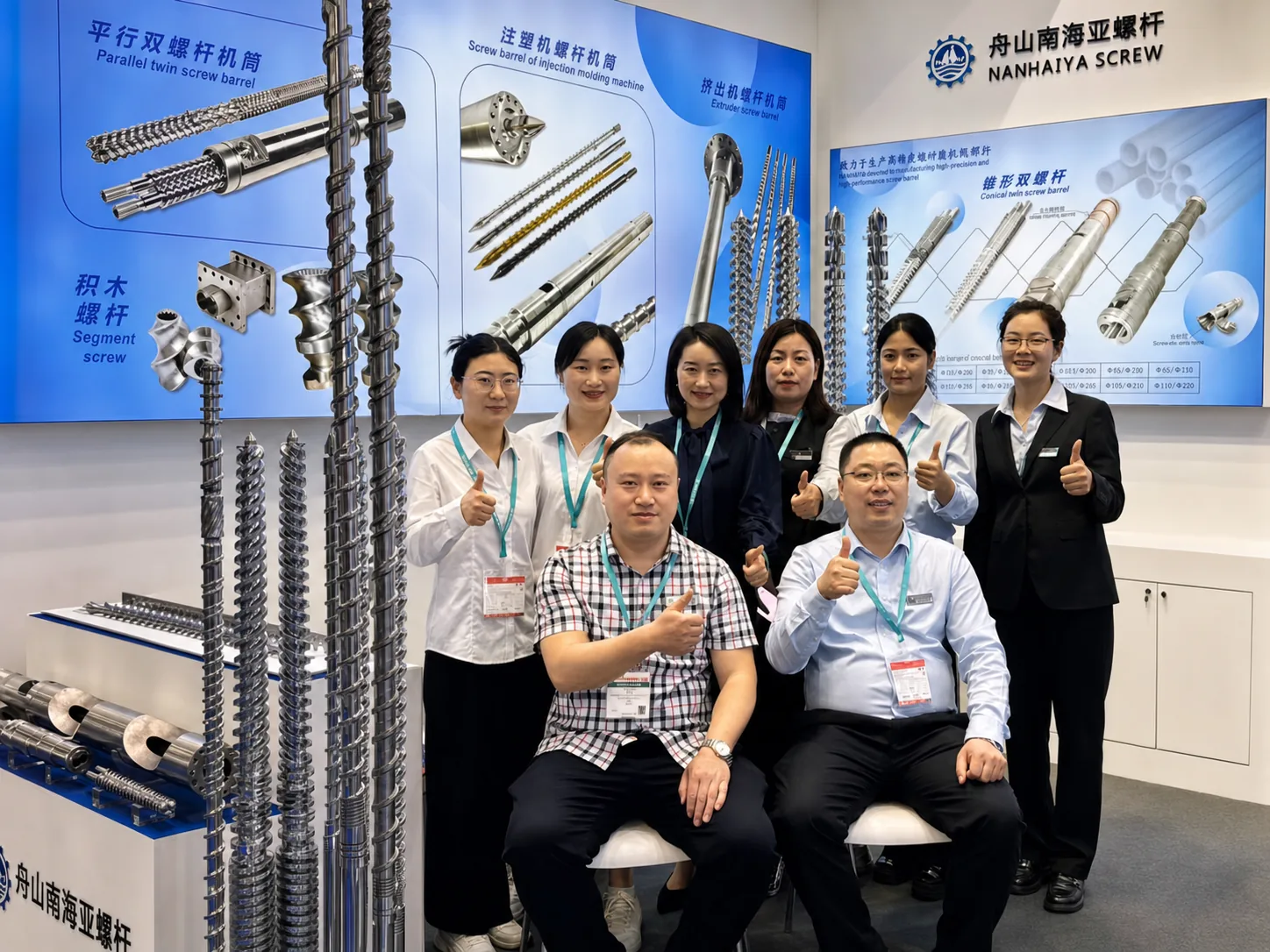
Related Articles
More insights on screw barrel technology and plastics processing.
What Your Single Screw Extruder Manufacturer Won't Tell You
Oct 10, 2026
Learn how to evaluate single screw extruder manufacturers with this buyer-focused guide covering specs, configurations, material matching, and a ready-to-use selection checklist.
Read Article
Plastic Extruder Screw Price Demystified: From Steel To Sticker
Oct 10, 2026
What drives plastic extruder screw price? This independent guide breaks down diameter, L/D ratio, metallurgy, order volume, and total cost of ownership factors.
Read Article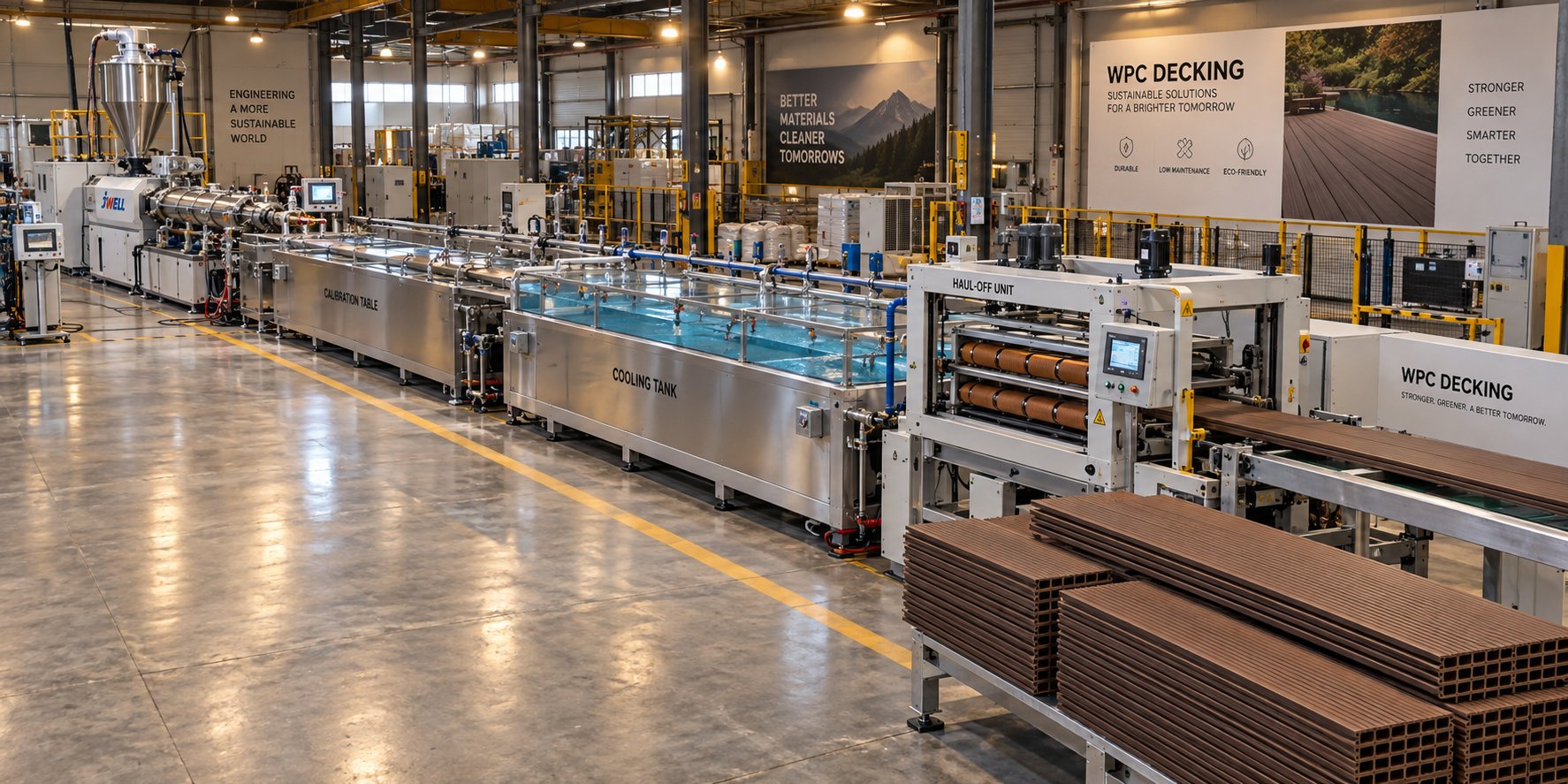
What No Supplier Tells You About WPC Decking Making Machines
Oct 6, 2026
Learn how a WPC decking making machine works, compare extruder types, formulations, and production methods, plus get a buyer checklist to evaluate any supplier.
Read ArticleLooking for something else?
Search by material, symptom or product and jump straight to the relevant page.
These are navigation suggestions based on keyword matching — not a quotation, not a delivery commitment, and not a substitute for engineering review. Final specification is confirmed by our engineers against your drawings and processed material.
Need help with screw barrel selection?
Share your machine model, processed material and application. Our team can help with pricing and technical support.