

What Is a Conical Twin Screw Extruder and Why PVC Demands It
Imagine trying to melt a material that starts to destroy itself at almost the exact temperature it needs to flow. That is the daily reality of processing PVC — and it is precisely why a conical twin screw extruder PVC system exists.
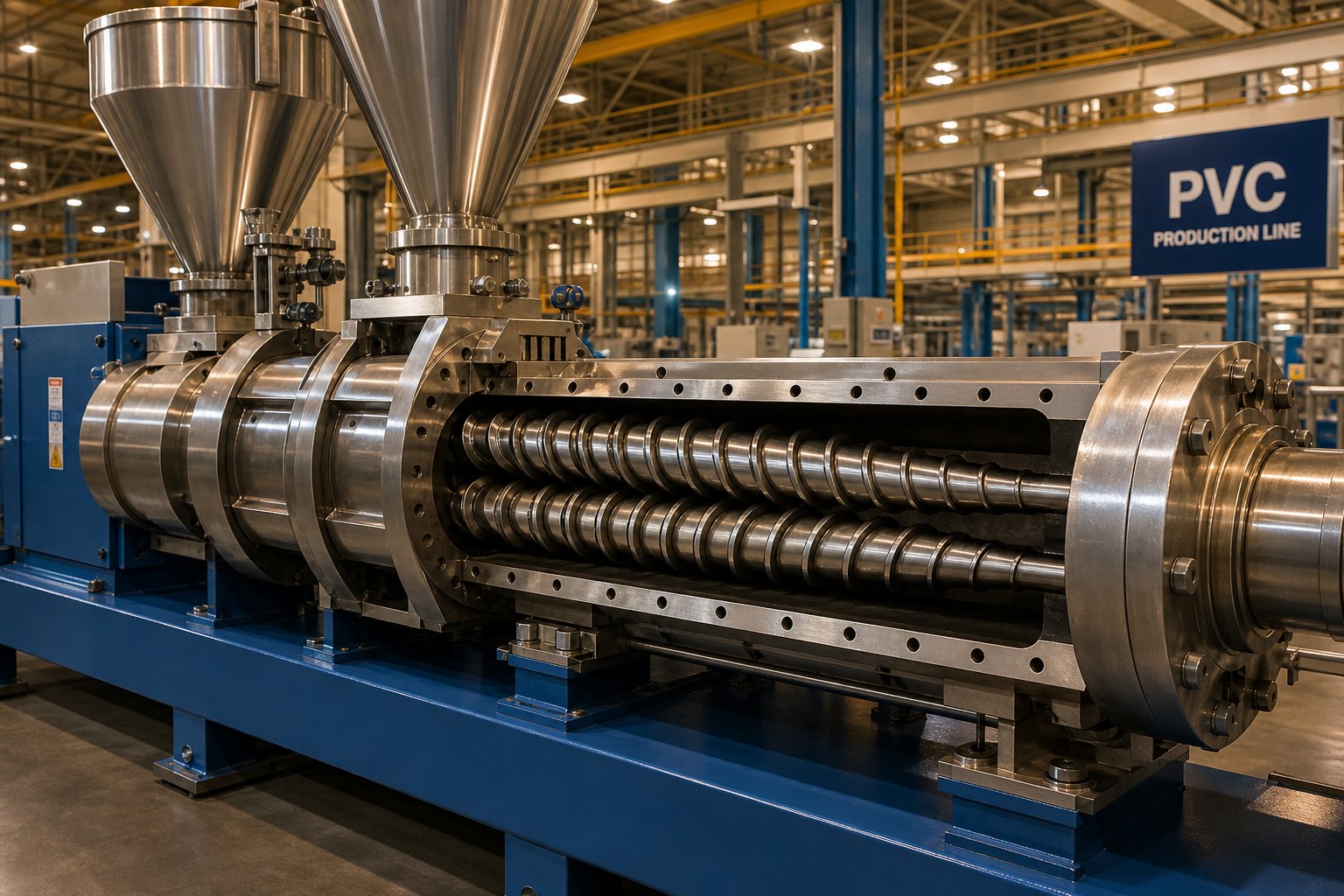
A conical twin screw extruder is a plastics processing machine that uses two tapered, counter-rotating screws inside a heated barrel to melt, mix, and convey PVC compounds. The screws have a larger diameter at the feed end and a smaller diameter at the discharge end, creating natural compression that delivers thorough plasticizing with carefully controlled shear and heat.
This tapered geometry sets it apart from both parallel twin screw extruders — where screws maintain a uniform diameter — and single screw machines, which rely on one rotating screw with more limited mixing capability. For PVC processing, those differences are not minor design preferences. They are fundamental to whether your product comes out intact or degraded.
Defining the Conical Twin Screw Extruder
The basic anatomy is straightforward. Two conical screws sit side by side in a figure-eight-shaped barrel, intermeshing as they rotate in opposite directions. The barrel is divided into independently controlled temperature zones, each equipped with heaters and cooling channels. A powerful drive system — typically a gearbox connected to an electric motor — delivers the torque needed to rotate the screws against the resistance of compacted PVC powder. At the far end, a die head shapes the homogeneous melt into the final product form, whether that is a pipe, profile, sheet, or panel.
You will notice that every component serves a single overriding purpose: moving PVC from raw powder to finished melt without pushing the material past its thermal limits.
Why PVC Is the Primary Application
PVC is unlike polyethylene or polypropylene. Its polymer chain contains chlorine atoms that make it inherently sensitive to heat. The processing temperature required for fusion sits dangerously close to the point where dehydrochlorination — the release of corrosive hydrogen chloride gas — begins. Even small excesses in temperature or shear can trigger discoloration, brittleness, and equipment corrosion.
This narrow thermal processing window is what makes a PVC conical twin screw extruder the industry standard rather than a niche choice. The tapered screw design generates high torque at the feed end for efficient powder intake while delivering lower shear at the metering end, keeping melt temperatures within safe bounds. The result is conical twin screw extruder PVC performance for stable powder extrusion that parallel and single screw systems struggle to match.
Throughout this article, you will see how that balance between sufficient plasticizing energy and thermal restraint shapes every aspect of machine design, parameter selection, and end-product quality — starting with exactly how material moves through each zone of the tapered screw geometry.
How the Tapered Screw Geometry Processes PVC Step by Step
Picture a funnel. Wide at the top, narrow at the bottom. Material poured into the wide end naturally compresses as it travels toward the exit. A conical twin screw extruder works on a remarkably similar principle — except the "funnel" is a pair of precisely engineered, intermeshing screws rotating inside a heated barrel, and the material being compressed is a loose, powdery PVC dry blend that must emerge as a dense, fully plasticized melt.
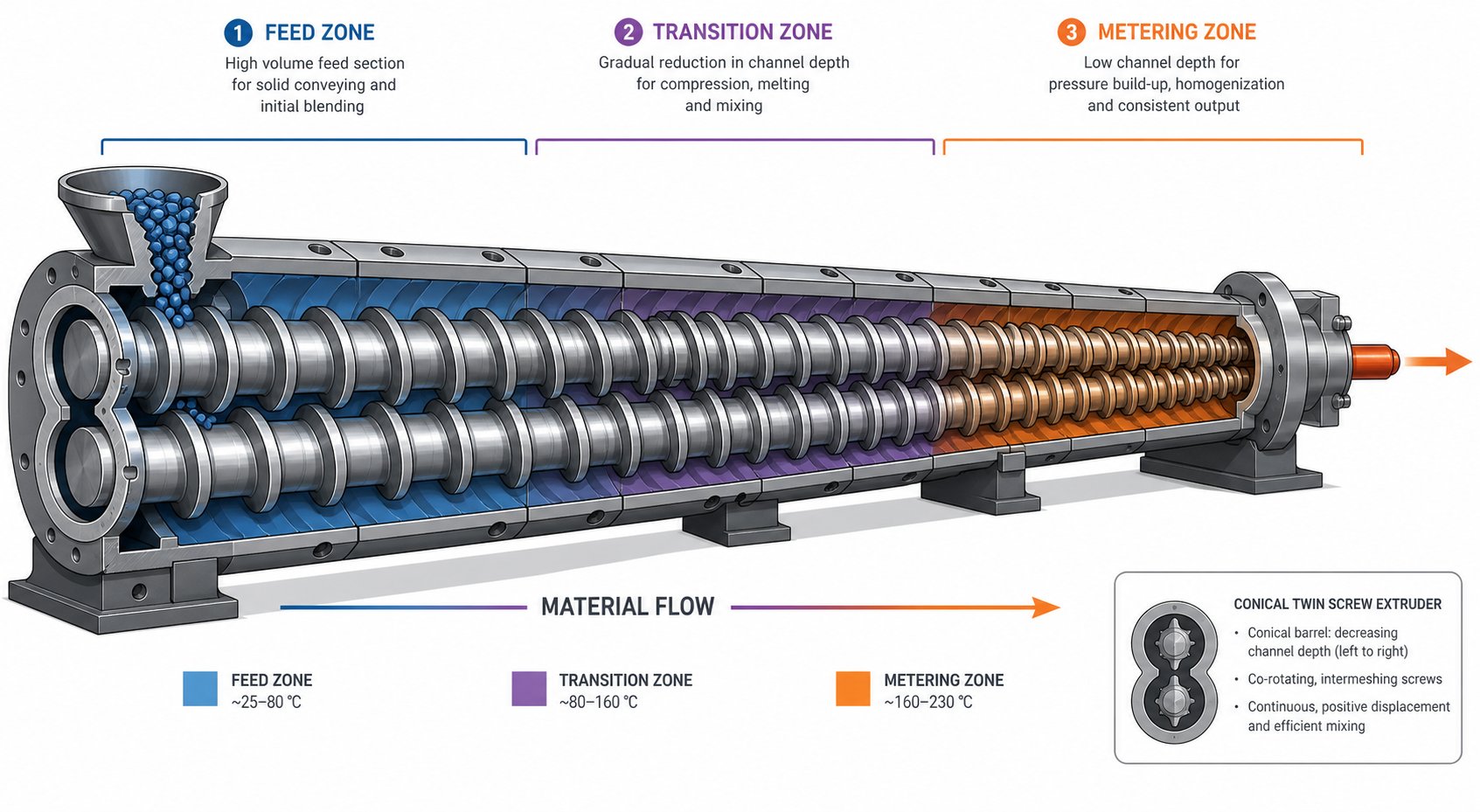
The entire journey from raw powder to extrudable melt happens across three distinct functional zones. Each zone plays a specific role, and the tapered geometry ties them together into a seamless, progressive process that no flat-profile screw can replicate as elegantly for heat-sensitive polymers.
Feed Zone and Material Intake Mechanics
Everything begins at the hopper, where PVC dry blend — a mixture of resin, stabilizers, lubricants, fillers, and processing aids — drops into the barrel's feed opening. Here is where the conical design offers its first major advantage: the screws are at their widest diameter in this zone, sometimes reaching roughly double the diameter found at the discharge end. A conical twin screw extruder PVC factory typically relies on this oversized feed geometry to handle one of PVC powder's most inconvenient traits — its low bulk density.
PVC dry blend does not flow like pelletized polyethylene. It is fluffy, prone to bridging, and resists being packed tightly. The large-diameter feed section provides a wide, open cross-sectional area that accepts this loose powder without choking or starving the screws. As the two counter-rotating screws intermesh, they act like a pair of interlocking gears, positively displacing the powder forward rather than relying on friction alone. This positive displacement characteristic is critical. It means feed consistency depends on screw geometry rather than the unpredictable friction coefficient between powder and barrel wall.
Gravimetric feeding upstream further stabilizes this intake. When bulk density drifts between compound batches — a common occurrence — volumetric feeders cannot compensate, leading to melt pressure fluctuations that show up as wall thickness variation in the finished product. Weight-based metering closes that gap before it reaches the screws.
Compression and Plasticizing Zone
As material advances past the feed section, something elegant happens without any mechanical intervention: the screw diameter shrinks. The channel volume between flights decreases progressively, and the powder that entered loosely packed is now squeezed into a shrinking space. This geometric compression generates pressure gradually, compacting the powder, expelling trapped air, and beginning the conversion from discrete particles to a cohesive mass.
Why does "gradual" matter so much? Because PVC cannot tolerate abrupt pressure spikes or sudden shear intensification. Its processing window — the gap between the temperature needed for fusion and the temperature at which degradation begins — is notoriously narrow. A compression ratio in the range of approximately 1.3 to 1.6, defined against the specific screw geometry, is commonly cited for rigid PVC screws to balance these competing demands. Too aggressive, and friction-generated heat pushes the compound past its safe limit. Too gentle, and the particle structure never breaks down completely.
Gelation happens here, and understanding it in practical terms matters. PVC resin arrives as porous grains — clusters of sub-micron primary particles held together by partial crystallinity. During compression and heating, those grain boundaries break down, particles begin to deform and pack against each other, and the material transitions from a loose collection of solids into a gelled, partially fused mass. This gelation stage typically occurs at material temperatures near 150 degrees Celsius, upstream of any vacuum vent port. Getting gelation to happen in the right location along the barrel is essential: too early, and trapped air has no escape path, resulting in voids; too late, and unfused particles get carried into the die.
The conical screw's linearly decreasing flight depth keeps shear forces relatively moderate throughout this transition. Unlike parallel systems where abrupt geometric changes can create localized hot spots, the tapered design distributes energy input smoothly. As one industry resource notes, the gentle variation in screw groove depth reduces the risk of thermal decomposition in heat-sensitive materials caused by friction-induced overheating. For any China conical twin screw extruder PVC factory producing rigid pipe or profile, this controlled plasticizing behavior is the core reason the technology dominates.
Metering Zone and Melt Delivery
By the time the material reaches the narrow discharge end, it should be fully fused — a homogeneous melt with no remaining particle boundaries, no trapped air, and a consistent temperature throughout its cross-section. The metering zone's job is not to plasticize further but to deliver that melt to the die at steady, predictable pressure.
The smaller screw diameter in this zone creates a deliberate reduction in shear rate. Since shear generates heat through viscous dissipation, lowering it at the final stage prevents last-minute temperature spikes that could push an already-fused PVC melt into degradation territory. This is the opposite of what happens in many parallel twin screw configurations, where uniform diameter means the metering section subjects material to the same shear intensity as the compression section. The result of the conical approach is lower die swell, reduced thermal stress, and a melt that behaves more predictably as it enters the die.
There is also a mechanical benefit worth noting. The axial force pushing back against the screws from die resistance is proportional to the cross-sectional area of the screw tip. A smaller tip means lower thrust loads on the bearings, extending equipment life and enabling the extruder to handle high-resistance dies — the kind needed for thick-walled PVC pipes and complex window profiles — without excessive mechanical strain.
Several key process parameters govern how well this three-zone journey performs:
- Screw speed (RPM): Controls throughput and shear rate; higher speeds increase output but also raise shear-generated heat
- Barrel temperature zones: Independently set across the feed, compression, and metering sections to create a deliberate thermal gradient
- Back pressure: Influenced by die resistance and screw geometry; directly affects melt density and fusion quality
- Feed rate: Must stay synchronized with screw speed to prevent starving or overfeeding, both of which destabilize melt pressure
The interplay between these variables is where operator skill meets engineering design. A well-built conical twin screw extruder provides the mechanical foundation — progressive compression, controlled shear, efficient melt delivery — but dialing in the right combination of speed, temperature, and feed rate for a specific PVC formulation is what separates a stable production run from a batch of degraded scrap. And as formulations vary between rigid and flexible PVC compounds, those parameter settings shift in ways that deserve their own detailed examination.
Why Conical Twin Screw Extruders Dominate PVC Manufacturing
Plenty of extruder designs can melt plastic. So why did one specific configuration — tapered, counter-rotating, intermeshing — rise to become the global default for PVC pipe and profile production? The answer is not marketing momentum or historical accident. It is a direct consequence of PVC's unusual polymer chemistry colliding with mechanical engineering constraints that only the conical geometry resolves cleanly.
The Engineering Rationale Behind Conical Dominance
PVC sits in a uniquely punishing category among thermoplastics. Its usable processing window spans roughly 160 to 190 degrees Celsius — and degradation via hydrogen chloride release accelerates sharply once temperatures exceed 180 degrees Celsius without adequate stabilization. That leaves engineers with an absurdly tight target: generate enough energy to fuse resin particles into a homogeneous melt, but never tip past the thermal ceiling where the polymer starts destroying itself and corroding the equipment around it.
The conical twin screw extruder solves this puzzle through four interlocking mechanical advantages that no other single configuration delivers simultaneously:
- High torque transmission at the feed end: The large-diameter gear end provides substantial root cross-section for the screw shafts. More metal at the drive side means higher permissible torque before risking shaft failure — critical when pushing dense, friction-heavy PVC powder forward against increasing barrel resistance.
- Low shear in the metering zone: The smaller screw diameter at the discharge end physically reduces peripheral speed, which directly lowers shear rate. Since shear is the primary source of viscous heat generation in the melt, this design keeps the fully plasticized PVC well below its degradation threshold right before it enters the die.
- Progressive compression without pressure spikes: The continuously tapering channel volume creates a smooth, linear compression profile. There are no abrupt geometric transitions — no sudden depth changes or barrier flights — that would cause localized pressure surges and the friction-generated hot spots PVC cannot tolerate.
- Efficient self-wiping action: The counter-rotating, intermeshing screw flights scrape material off each other's surfaces with every revolution. This prevents stagnant pockets where PVC could sit at elevated temperatures long enough to degrade. Consistent material residence time across the entire melt cross-section is the result — and it is non-negotiable for a polymer that punishes uneven thermal history with black specks and brittleness.
These advantages become even clearer when you stack the conical design against its alternatives side by side. The following comparison highlights where each extruder type excels — and where it falls short — across the parameters that matter most for PVC processing:
| Parameter | Conical Twin Screw | Parallel Twin Screw | Single Screw |
|---|---|---|---|
| Shear Generation | Low to moderate; decreases toward die end | Moderate to high; uniform along barrel length | Drag-flow dependent; limited dispersive shear |
| Torque Capacity | High — large gear-end diameter supports robust shafts | Moderate — constrained by fixed center distance between parallel shafts | Low to moderate — single shaft limits total torque |
| Suitability for PVC Powder | Excellent — large feed zone handles low bulk density; positive conveying | Good — but may require force-feeding for powder blends | Poor — powder bridging common; inconsistent intake |
| Typical Throughput Range | 150 – 800 kg/hr | 500 – 2,500 kg/hr | 80 – 500 kg/hr |
| Typical PVC Applications | Rigid pipe, window profile, foam board, WPC | High-volume sheet, compounding, recycled PVC pellets | Flexible PVC cable jacketing, garden hose |
Notice the throughput gap. Parallel twin screw extruders push significantly higher volumes, which is why they dominate large-scale compounding and sheet extrusion operations. But for the vast majority of rigid PVC pipe and profile lines producing under 800 kg/hr — which represents the bulk of global PVC extrusion capacity — the conical design hits a sweet spot that parallel machines overshoot with unnecessary shear, and single screws cannot reach due to mixing and conveying limitations.
How Industry Adopted Conical Technology for PVC
The engineering logic translated into rapid industrial adoption. As rigid PVC products — particularly pressure pipes, drainage systems, and window profiles — grew into massive global markets, every conical twin screw extruder PVC manufacturer recognized that this geometry answered the industry's most persistent production challenges. Consistent wall thickness in pipe extrusion demands rock-steady melt pressure. Smooth, defect-free surfaces on window profiles require homogeneous fusion without thermal degradation streaks. Both outcomes depend on the same thing: processing PVC thoroughly while keeping shear and temperature precisely controlled.
One often overlooked factor in machine selection is the K-value of the PVC resin itself. K-value reflects the average molecular weight of the polymer chain — higher K-values indicate longer chains, higher melt viscosity, and greater mechanical strength in the finished product, but also more processing resistance and higher sensitivity to shear-induced degradation. Pipe-grade resins and profile-grade resins sit at different points on this spectrum, and the conical extruder's ability to adjust compression behavior through screw geometry — without requiring entirely different screw designs the way parallel systems often do — makes it exceptionally versatile across common PVC grades.
This versatility is a key reason why a China conical twin screw extruder PVC manufacturer can serve pipe producers, profile fabricators, and panel makers from a relatively standardized machine platform. The core geometry stays the same; screw flight details, barrel zone lengths, and die configurations adapt to the specific product. That engineering efficiency, combined with the thermal gentleness PVC demands, cemented the conical twin screw as the default choice for rigid PVC worldwide.
Yet dominance in one broad category does not mean every PVC formulation behaves the same way inside the barrel. Rigid and flexible PVC compounds present fundamentally different challenges to the extruder — different viscosities, different friction profiles, and different thermal sensitivities — that require distinct parameter strategies even on the same machine.
Rigid PVC vs Flexible PVC Extrusion Parameter Differences
Rigid PVC and flexible PVC may share the same base polymer, but from an extruder's perspective, they behave like entirely different materials. The presence — or absence — of plasticizer changes everything: melt viscosity, internal friction, thermal behavior, and the exact barrel settings needed to produce a quality product. Understanding these differences is essential for any operator running a conical twin screw extruder, especially in facilities that switch between formulations on the same equipment.
Processing Rigid PVC Compounds
Rigid PVC, often called uPVC or unplasticized PVC, contains little to no plasticizer. What enters the barrel is essentially a dry blend of PVC resin, thermal stabilizers, lubricants, fillers like calcium carbonate, and impact modifiers — but no softening agent. That means the compound resists fusion. It does not flow easily, and it generates significant friction as powder particles compact against each other and the barrel wall.
This high internal friction is both a blessing and a curse. On one hand, frictional heat contributes a substantial portion of the energy needed for gelation, reducing dependence on external barrel heaters. On the other hand, it means temperature can spike unpredictably if screw speed climbs too high or lubricant balance drifts off target.
Barrel temperature profiles for rigid PVC on a PVC pipe conical twin screw extruder machine typically follow a deliberate gradient. The feed zone starts at a moderate temperature — often in the range of 150 to 165 degrees Celsius — warm enough to initiate particle softening but cool enough to maintain good powder conveying friction against the barrel. The compression zone rises slightly, often reaching 170 to 180 degrees Celsius, where the bulk of gelation occurs. Here is where it gets counterintuitive: the metering zone temperature is usually held steady or even reduced slightly to prevent the now-fused melt from overshooting into degradation territory.
Screw speed plays a direct role in this balancing act. Rigid PVC pipe and profile lines commonly operate at relatively low RPM — a deliberate choice. Higher screw speeds increase shear rate, which generates more viscous heat inside a compound that already runs hot from friction. The conical design's naturally declining diameter toward the discharge end helps here, since the smaller metering-zone screws impose lower peripheral velocity on the fully plasticized melt. This built-in shear reduction is one of the core reasons a conical twin screw extruder PVC manufacturer in China or anywhere else recommends the tapered configuration for uPVC products.
Achieving the right gelation level is the ultimate goal. Under-gelled PVC retains particle boundaries that act as stress concentrators — the finished pipe or profile looks fine but fails under pressure or impact. Over-gelled PVC has been pushed past its optimal fusion point, consuming thermal stabilizer reserves and leaving the product vulnerable to long-term degradation. The processing window between these extremes is narrow, and maintaining it demands tight coordination between barrel temperatures, screw speed, and the lubricant balance in the formulation itself.
Adjustments for Flexible PVC Formulations
Flexible PVC flips many of these processing dynamics. Plasticizer content — commonly DOTP, DINP, or similar phthalate-free alternatives — can range from roughly 20 to 50 parts per hundred resin depending on the target hardness. That plasticizer fundamentally alters how the compound behaves inside the extruder.
First, melt viscosity drops significantly. Where rigid PVC resists flow and demands high torque to push through the barrel, flexible compounds become fluid at lower temperatures and with less mechanical energy input. Research on flexible PVC extrusion has shown that energy demand increases with material hardness — softer, more heavily plasticized compounds require measurably less motor power than their rigid counterparts.
Second, internal friction decreases. Plasticizer acts as an internal lubricant between PVC particles, reducing the frictional heat generation that rigid formulations depend on. This means barrel heaters must contribute a larger share of the thermal energy required for fusion. Without that compensation, the compound can pass through the barrel under-processed — still carrying partially unfused regions despite appearing visually acceptable.
Third, flexible PVC is more sensitive to overheating in a different way. While rigid PVC degrades through dehydrochlorination, flexible compounds can also suffer plasticizer volatilization if temperatures run too high, creating bubbles, surface defects, and loss of the intended softness. Precise temperature control is essential across both formulation types — but the specific risks differ.
Screw speed typically runs higher for flexible PVC than for rigid, partly because the lower melt viscosity generates less shear heat per revolution, and partly because flexible products like cable jacketing and tubing often demand higher throughput relative to cross-sectional area. Feed rates also require recalibration. Flexible PVC pellets or powder blends may have different bulk densities than rigid dry blends, and the plasticizer content affects how readily the compound grips the screw flights during conveying.
The following comparison highlights the key parameter shifts between the two formulation families:
- Temperature profiles: Rigid PVC uses a rising-then-flat or slightly declining gradient, typically 150–185 degrees Celsius from feed to die. Flexible PVC operates at lower overall temperatures, often 140–165 degrees Celsius, with a more gradual and uniform gradient to avoid plasticizer volatilization.
- Screw RPM ranges: Rigid PVC runs at lower screw speeds to limit shear heat generation in the high-friction compound. Flexible PVC tolerates — and often benefits from — higher screw speeds due to reduced viscosity and lower friction.
- Feed rate considerations: Rigid PVC dry blends have low bulk density and require the conical extruder's wide feed zone for consistent intake. Flexible PVC compounds, especially pelletized grades, may feed more readily but can bridge differently due to plasticizer-induced tackiness.
- Cooling requirements: Rigid PVC extrudates, such as pipes and profiles, demand rapid vacuum-calibrated cooling to lock in dimensional accuracy. Flexible PVC products like hoses and cable sheathing typically cool more gradually — often through water baths or air rings — to preserve flexibility and avoid internal stress.
For manufacturers who process both rigid and flexible PVC — and many do — equipment versatility becomes a practical priority. A conical twin screw extruder PVC China operation serving diverse customers may need adjustable compression ratio capability, interchangeable screw elements, and control systems that store and recall distinct parameter recipes for each formulation type. The core machine geometry does not change, but the operating envelope shifts substantially between the two material families.
These formulation-driven parameter differences also cascade downstream. The die, calibration system, cooling setup, and haul-off equipment all need to match the specific PVC product being manufactured — a topic that becomes especially important when selecting the right extruder configuration for a particular end-use application.
Matching Conical Extruder Specifications to PVC End Products
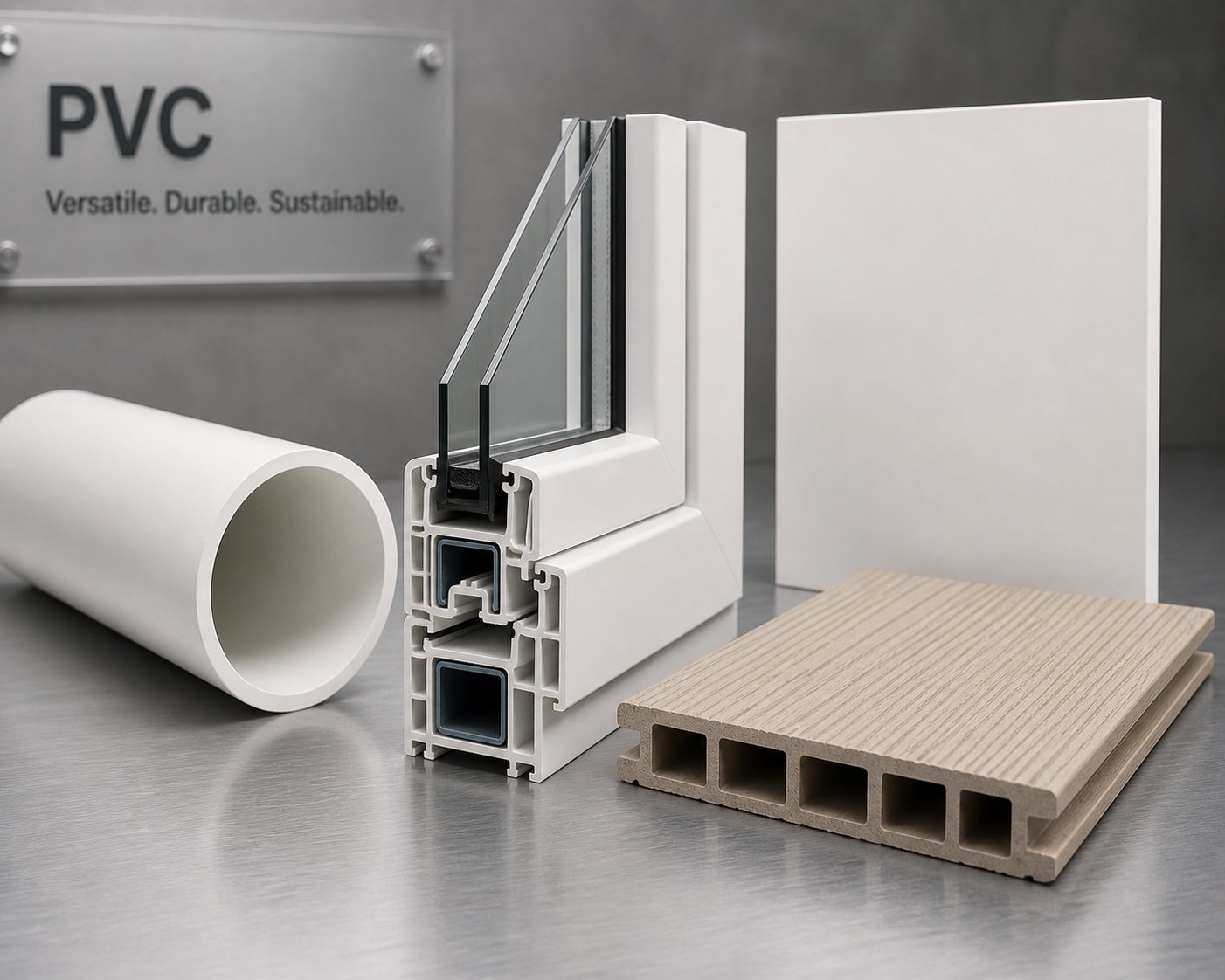
A conical twin screw extruder PVC system does not operate in isolation — it anchors a complete production line whose every component must align with the specific product rolling off the end. A machine perfectly tuned for 110 mm drainage pipe will underperform on wide-format foam board, and a setup optimized for window profiles will waste capacity on simple conduit. Choosing the right extruder configuration starts with the end product and works backward through screw geometry, output capacity, and die requirements.
PVC Pipe and Profile Extrusion Configurations
Pipe and profile manufacturing accounts for the vast majority of conical twin screw extruder installations worldwide. Yet these two product families stress the machine in different ways, and the specifications that serve one do not automatically satisfy the other.
PVC pressure pipes — used for potable water supply, irrigation, and industrial fluid transport — demand one thing above all else: steady melt pressure at the die. Wall thickness variation of even a fraction of a millimeter can compromise the pipe's pressure rating and fail certification testing. This means the extruder must deliver a pulsation-free melt stream at consistent volumetric flow. Larger diameter pipes, from roughly 200 mm up to 630 mm and beyond, typically require screw configurations in the 80/156 or 92/188 mm range to generate the throughput needed for economical production. According to industry technical data, output rates of 200 to 800 kg/hr are achievable depending on diameter selection, which covers the full spectrum from small-bore conduit lines to large pipe extrusion systems.
Drainage and sewage pipes are less demanding on pressure ratings but still require dimensional consistency across production runs that can stretch for kilometers. Mid-range screw sizes like 65/132 mm handle these applications efficiently, balancing output volume against energy consumption.
Window and door profiles present a fundamentally different challenge. Instead of a simple annular cross-section, profiles feature complex multi-chamber geometries with thin walls, hollow sections, and precise corner radii. The die alone can contain 20 or more flow channels, and any inconsistency in melt homogeneity — temperature variation, unfused particles, air entrapment — shows up immediately as surface defects or dimensional drift. Profile extrusion favors smaller to mid-range screw configurations, often in the 51/105 to 65/132 mm range, where the extruder operates at moderate throughput but delivers exceptionally uniform melt quality. Screw speed is kept deliberately low, and barrel temperature zones are tuned with tighter tolerances than pipe applications typically require.
The screw diameter ratio — expressed as the small-end diameter divided by the large-end diameter — directly governs the machine's compression behavior and torque capacity. A wider ratio creates more aggressive compression across the screw length, which suits low-bulk-density powders that need substantial compaction. A narrower ratio provides gentler compression suited to pre-compounded or denser feed materials. The L/D ratio, measured against the large-end diameter, determines how much barrel length is available for mixing, degassing, and thermal equalization. Rigid PVC pipe and profile extruders typically operate with conical L/D ratios in the range of 6:1 to 9:1, which provides sufficient residence time for thorough gelation without the extended thermal exposure that risks degradation.
PVC Sheet, Panel, and WPC Board Applications
Beyond pipes and profiles, the conical twin screw extruder serves a growing range of flat-product applications where different die configurations and sometimes higher-output machines come into play.
PVC rigid sheet extrusion — for thermoforming, signage, and construction panels — uses flat (T-type or coat-hanger) dies that distribute melt across a wide web. The challenge here is achieving uniform flow velocity across the full die width, which demands highly homogeneous melt with consistent viscosity. Larger screw configurations are often preferred because higher throughput reduces the time material spends in the wide die channels, limiting thermal exposure.
PVC foam board production adds another layer of complexity. A chemical foaming agent decomposes inside the melt, and the cell structure it creates depends on precise control of melt temperature, pressure drop at the die exit, and downstream cooling rate. As WPC foam board specialists note, the die geometry must be tuned for the foaming window — too fast a pressure drop ruptures cells, too slow a drop produces coarse or absent foam. Conical twin screw extruders handle this well because their low-shear metering zone delivers melt at a controllable, consistent pressure rather than pulsating flow.
Wood-plastic composite processing pushes the machine even further. WPC compounds blend PVC resin with 30 to 60 percent wood flour or rice hull fiber by weight. This creates a feed material that is simultaneously low in bulk density, abrasive, and hygroscopic. The conical extruder's oversized feed zone accommodates the bulky blend, while vacuum venting — essential for removing moisture that would otherwise cause surface defects — integrates naturally into the barrel design. Screws for WPC applications often feature hard-faced or bimetallic surface treatments to withstand the abrasive filler loading.
The following table maps common PVC end products against the extruder specifications best suited to each application. When evaluating a conical twin screw extruder PVC for sale, this framework helps match machine capability to production goals rather than relying on generic catalog figures.
| PVC End Product | Recommended Screw Size Range | Typical Output Rate (kg/hr) | Key Processing Considerations |
|---|---|---|---|
| Pressure Pipe (water supply, irrigation) | 65/132 – 92/188 mm | 250 – 800 | Steady melt pressure for uniform wall thickness; high-torque drive required for large diameters |
| Drainage / Sewage Pipe | 55/100 – 80/156 mm | 200 – 600 | Consistent dimensional accuracy over long runs; moderate throughput sufficient |
| Window and Door Profiles | 51/105 – 65/132 mm | 150 – 400 | Exceptional melt homogeneity for complex multi-chamber dies; tight temperature control |
| Rigid PVC Sheet | 65/132 – 80/156 mm | 300 – 600 | Uniform flow across wide T-die; consistent viscosity critical for thickness uniformity |
| PVC Roofing / Waterproofing Membrane | 65/132 – 80/156 mm | 250 – 500 | Flexible PVC formulation; lower barrel temperatures; controlled cooling for flatness |
| LVT / SPC Flooring | 65/132 – 92/188 mm | 300 – 700 | Highly filled compounds; wear-resistant screw metallurgy; calender stack downstream |
| PVC Foam Board / Panel | 65/132 – 80/156 mm | 200 – 500 | Chemical foaming agent control; precise die pressure drop; downstream calender for skin formation |
| WPC (Wood-Plastic Composite) | 65/132 – 92/188 mm | 200 – 600 | Vacuum venting for moisture removal; hard-faced screws; handles abrasive, low-density blends |
| PVC Granules / Pellets | 45/90 – 65/132 mm | 100 – 350 | Compounding and pelletizing; moderate output; flexible formulation handling |
Keep in mind that the extruder is just one station in a much longer production line. Each application listed above requires its own upstream mixing and compounding system — typically a high-speed hot/cold mixer for rigid PVC dry blends — and specific downstream equipment. Pipe lines need vacuum calibration tanks and spray cooling baths. Profile lines require precision calibration tables with individual cooling channels for each die cavity. Sheet and foam board lines depend on three-roll calender stacks where roll temperature control determines surface quality and core density. A factory price conical twin screw extruder PVC package that neglects these upstream and downstream requirements will underperform regardless of the extruder's own capability.
Matching extruder specifications to the end product is the engineering half of the equation. The commercial half — evaluating manufacturers, assessing total cost of ownership, and ensuring the selected machine integrates into a complete, balanced production line — carries equal weight in making a sound investment decision.
How to Select the Right Conical Twin Screw Extruder for Your PVC Application
Knowing which extruder specifications match your product is one thing. Turning that knowledge into a confident purchase decision — without overspending, under-specifying, or getting locked into equipment that cannot grow with your business — is something else entirely. Whether you are launching a new PVC pipe line or replacing aging profile extrusion equipment, a structured selection process prevents costly mismatches before they reach your factory floor.
Key Decision Criteria for Extruder Selection
Every specification on a conical twin screw extruder PVC datasheet traces back to a handful of practical variables. Get these right first, and the technical details fall into place naturally.
Target product type is the starting point. A pressure pipe line demands rock-steady melt delivery and high torque for thick-walled output. A window profile line needs exceptional melt homogeneity at moderate throughput. A foam board setup requires precise die pressure control. Each product steers you toward a different screw size range, die configuration, and downstream layout.
Required output volume — expressed in kg/hr — determines screw diameter more than any other single factor. Larger screws move more material per revolution, but they also cost more to purchase, maintain, and power. As a practical benchmark, a 65/132 mm conical twin screw typically handles 200 to 400 kg/hr for rigid PVC pipe, while an 80/156 mm machine pushes 350 to 600 kg/hr. Oversizing by 20 to 30 percent provides headroom for future growth without forcing the machine to run constantly at peak capacity, which accelerates wear.
PVC formulation type shapes screw geometry and barrel metallurgy requirements. Rigid dry-blend powder, flexible pelletized compound, foamed formulations with chemical blowing agents, and heavily filled WPC blends each impose different shear, compression, and venting demands. A machine optimized for rigid uPVC pipe may underperform on a 50-percent-wood-flour WPC compound without screw and venting modifications.
L/D ratio deserves careful attention. For conical twin screw extruders processing PVC, shorter L/D ratios limit thermal degradation risk by reducing residence time, while longer ratios provide more barrel length for mixing and degassing. The sweet spot for most rigid PVC applications sits between approximately 22:1 and 25:1 when measured against the large-end diameter — long enough for thorough gelation, short enough to keep heat-sensitive compounds safe.
Available floor space and budget round out the picture. Conical extruders have a more compact footprint than equivalent-output parallel machines, but the complete line — mixer, extruder, die, calibration, cooling, haul-off, cutter — still requires significant linear space. Budget should be evaluated against total cost of ownership, not just purchase price, since energy consumption, spare parts, and maintenance frequency vary substantially between machine tiers.
Pulling these variables together into a repeatable workflow keeps the selection process disciplined:
- Define the end product and output target. Specify the PVC product type, dimensional range, and required throughput in kg/hr. Add 20 to 30 percent headroom above current demand.
- Determine PVC formulation requirements. Identify whether the line will process rigid dry blend, flexible compound, foamed formulation, filled blend, or multiple types. This dictates screw design, venting needs, and barrel material.
- Evaluate screw geometry options. Match screw diameter ratio and L/D ratio to the formulation and throughput target. Request specific screw specifications in writing — not just model numbers.
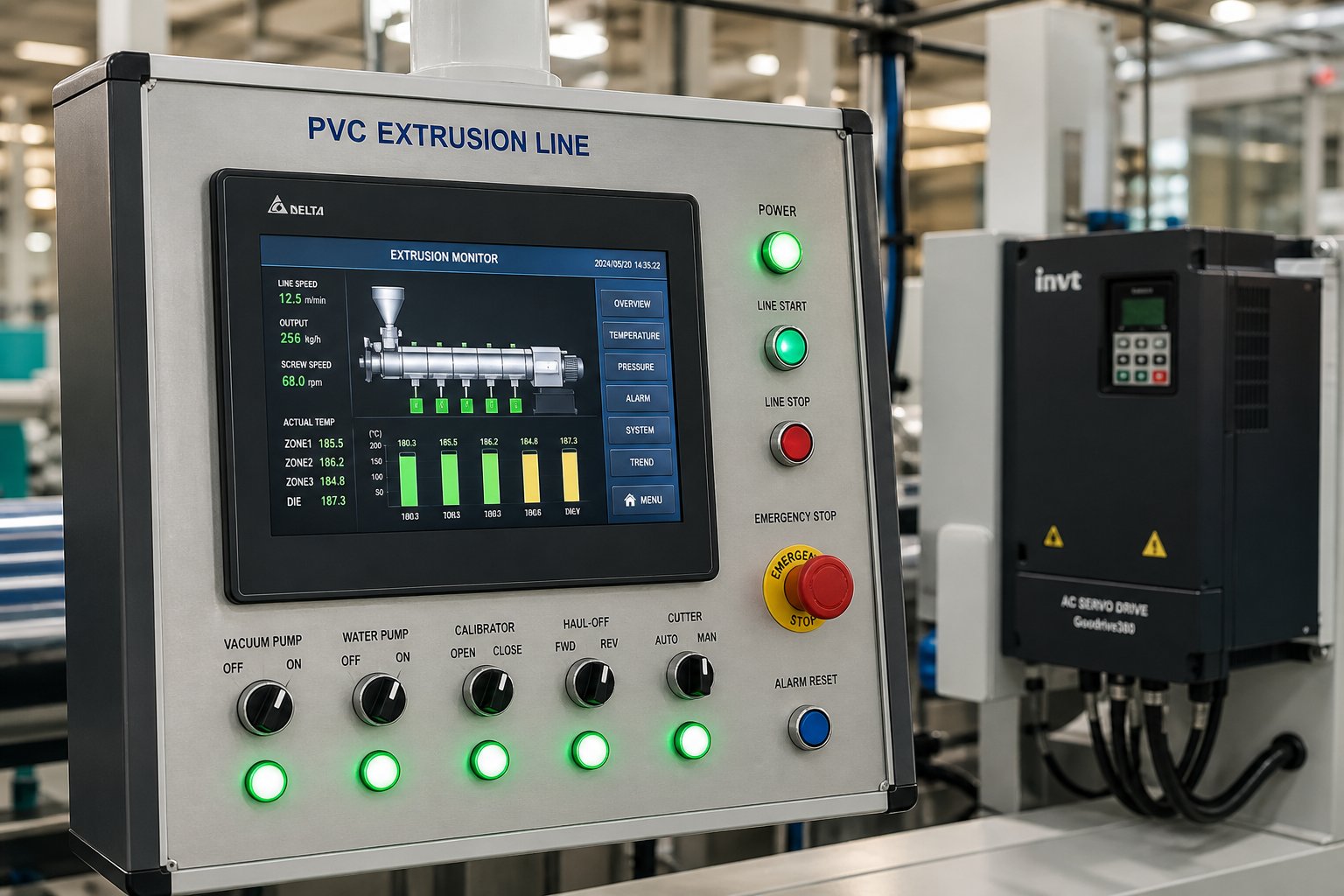
- Assess drive and control system capabilities. Confirm motor power class, gearbox torque rating, and control system features. Look for PLC-based controls with independent zone temperature management and recipe storage. Servo-driven or direct-drive systems offer energy advantages worth quantifying against your electricity costs.
- Consider total line integration. Verify that the extruder, die head, calibration equipment, cooling system, haul-off, and cutter are matched in capacity and control. Mixed-source lines can work, but integration responsibility must be clearly assigned.
Evaluating Manufacturers and Supply Options
Selecting a conical twin screw extruder PVC supplier involves more than comparing spec sheets. The machine is a 10-to-15-year investment, and the relationship with the manufacturer extends far beyond the initial delivery.
Engineering support separates serious manufacturers from assemblers. Can the supplier help optimize screw geometry for your specific PVC formulation? Will they provide process parameter recommendations based on actual trial run data? A manufacturer that offers application-specific guidance — rather than one-size-fits-all catalog specs — adds tangible value during startup and whenever you introduce new products.
Customization capability matters for any producer whose product mix may evolve. Ask whether the manufacturer can modify screw flight profiles, add vacuum venting ports, or adjust barrel zone configurations for different PVC formulations. Off-the-shelf machines work for standard applications, but the ability to tailor specifications becomes critical when your market demands specialized products.
After-sales service and spare parts availability are where purchase decisions either pay off or backfire. A worn screw or failed heater band can halt production entirely, and lead times for replacement components vary widely among suppliers. Before committing, ask specific questions: Where are spare parts warehoused? What is the typical delivery timeline for a replacement screw set? Does the manufacturer offer remote troubleshooting support? As industry sources note, the best suppliers maintain regional parts inventories and can ship critical spares within 48 to 72 hours — a benchmark worth verifying with reference customers.
The global supply landscape for conical twin screw extruders spans multiple manufacturing regions. European builders have long set the benchmark for precision, reliability, and process know-how, though they command premium pricing. A growing number of buyers now source from established manufacturing hubs in Asia, where competitive pricing meets improving quality standards. Finding a reliable china conical twin screw extruder PVC supplier requires the same due diligence applied to any major capital purchase: factory visits, reference customer checks, test run observation, and clear contractual terms covering warranty, performance guarantees, and service response commitments. Proper vetting transforms geographic price advantages into genuine value rather than a gamble.
Ultimately, the right conical twin screw extruder PVC supplier in china — or anywhere else — is the one whose machine specifications, engineering depth, and service infrastructure align with your production reality. A structured selection process ensures that alignment is verified before the purchase order is signed, not discovered afterward on the production floor. And once the machine is running, the next question every operator faces is equally practical: how much does it cost to keep running, and where can those costs be reduced?
Energy Efficiency and Operational Cost Control in PVC Extrusion
Electricity is the second-largest cost in PVC extrusion — trailing only raw materials. Industry estimates place energy at roughly 15 to 25 percent of total production cost, and with global energy prices remaining volatile, even modest efficiency gains translate into meaningful savings over a machine's 10-to-15-year operational life. The good news? The conical twin screw extruder carries inherent energy advantages baked into its geometry — advantages that many operators leave partially untapped simply because they have never mapped where their kilowatt-hours actually go.
Energy Consumption Factors in Conical Twin Screw Extrusion
Before you can reduce energy costs, you need to know where the energy is spent. Four primary consumers account for virtually all electricity drawn by a conical twin screw extruder PVC line:
The drive motor is the biggest single draw. It provides the torque to rotate the screws against the resistance of compacted, partially fused PVC compound. Motor power ratings on conical extruders typically range from around 15 kW on smaller machines up to 200 kW or more on large-output models. The conical geometry offers a structural efficiency advantage here that parallel designs cannot match: because the large-diameter gear end supports robust screw shafts with substantial root cross-sections, torque transmission from gearbox to screws is mechanically more efficient. Less energy is lost to shaft deflection and bearing friction under load. In practical terms, this means a conical extruder can achieve the same output as a comparable parallel machine while running at lower screw speeds — and since motor power consumption rises with speed, lower RPM means lower energy draw per kilogram of product.
Barrel heaters form the second major consumer. PVC requires carefully staged heat input across multiple independent temperature zones, and each zone uses electric band or cartridge heaters. However, PVC extrusion is somewhat unusual among thermoplastic processes: a significant fraction of the heat needed for gelation comes from frictional energy — viscous dissipation generated by the screws shearing and compressing the compound. In a well-tuned conical extruder processing rigid PVC, heaters in the compression and metering zones may only need to compensate for heat loss rather than actively raise the temperature. When operators fail to recognize this, they run heaters at unnecessarily high duty cycles, wasting electricity on thermal energy the screws are already providing.
Cooling systems — both barrel cooling channels and downstream product cooling — draw power that is easy to overlook. Barrel cooling activates when zone temperatures overshoot setpoints, and downstream vacuum tanks and spray baths run continuously during production. A poorly balanced system where heaters and cooling fans fight each other is surprisingly common, and it burns electricity on both sides of the equation simultaneously.
Auxiliary equipment rounds out the picture. Feeders, vacuum pumps, haul-off units, cutters, and material handling systems collectively account for 20 to 30 percent of total line energy consumption. These are often overlooked in energy audits focused solely on the extruder itself, but they represent a real and reducible cost.
The drive technology powering the motor deserves particular attention because it has evolved dramatically. Older conical extruders often used DC motors with belt or gear reduction drives — reliable but energy-inefficient, especially at partial loads. Modern machines increasingly feature AC motors paired with variable frequency drives (VFDs), which adjust motor speed electronically rather than mechanically. The efficiency improvement is substantial. As one case study from a pipe manufacturer documented, replacing DC motor systems with AC motor and drive packages reduced operational costs through more efficient energy use, lower current draw, and reduced maintenance. Servo-driven and direct-drive configurations push these gains even further by eliminating gearbox losses entirely in some designs, delivering motor torque directly to the screw shafts.
Reducing Operational Costs Without Sacrificing Output
Knowing where energy goes is the diagnostic step. The prescriptive step — actually cutting costs — requires targeted action across several fronts.
Optimize barrel temperature profiles. Many operators set barrel zones conservatively high "just in case" and never revisit those settings. Systematically lowering zone temperatures in 2-to-3-degree increments while monitoring melt quality and die pressure can reveal that the process runs perfectly well at lower heater setpoints. Since PVC generates substantial frictional heat during compression, the heaters often need to do less work than the default recipe assumes. Reducing heater load by even 10 to 15 kW saves hundreds of dollars monthly on a continuously running line.
Maintain proper screw-barrel clearances. As screws and barrels wear — a topic covered in detail in the next section — the gap between screw flight tips and barrel bore widens. Material leaks backward through that gap rather than advancing toward the die. The motor compensates by working harder to maintain throughput, consuming more energy for the same output. Tracking clearance measurements during scheduled shutdowns catches this creeping inefficiency before it becomes a significant cost driver.
Use frequency-controlled drives. If your conical extruder still runs on a fixed-speed motor, retrofitting a VFD is one of the highest-return investments available. Variable frequency drives allow the motor to run at exactly the speed needed for current production — not a fixed maximum speed throttled down mechanically. At partial loads, the energy savings can reach 15 to 25 percent compared to fixed-speed operation. Modern PLC-based control systems can also implement standby modes during changeovers or pauses, automatically reducing screw speed and barrel temperatures to minimal power consumption rather than idling at full operating parameters.
Insulate barrel zones. Traditional cast-iron band heaters radiate heat outward as well as inward, warming the factory air instead of the PVC compound. Ceramic-fiber insulation jackets or nano-insulation covers on heater bands reduce surface temperatures dramatically — from 60 to 80 degrees Celsius on exposed barrels down to near-ambient levels. The energy saved by keeping heat inside the barrel where it belongs typically pays for the insulation within months, and the cooler working environment is an added benefit for operators.
Pulling these strategies into a practical checklist gives operators and plant managers a reference they can act on immediately:
- Preventive maintenance schedules: Inspect screw-barrel clearances, gearbox oil condition, heater band continuity, and thermocouple accuracy at defined intervals — not just when problems appear.
- Optimal screw speed settings: Run at the lowest RPM that meets throughput targets. Every unnecessary revolution generates shear heat the cooling system must then remove, doubling the energy waste.
- Barrel zone insulation: Retrofit insulation jackets on any exposed heater zones. Prioritize the highest-temperature zones where heat loss is greatest.
- Specific energy consumption monitoring: Track kWh per kilogram of finished product as a routine KPI. This single metric — total line power draw divided by output weight — captures the net effect of every efficiency improvement and flags degradation trends before they become costly. A well-optimized conical twin screw extruder PVC line processing rigid pipe typically operates in the range of 0.15 to 0.25 kWh/kg; values drifting above that range signal mechanical wear, process inefficiency, or both.
Emerging drive technologies — including IE4-class synchronous reluctance motors and fully integrated servo-drive packages — continue to push the efficiency envelope. For PVC processors evaluating a cheap conical twin screw extruder PVC option, the purchase price comparison only tells half the story. A low price conical twin screw extruder PVC machine running an outdated DC drive system at 0.30 kWh/kg will cost substantially more to operate over a decade than a slightly more expensive machine equipped with a modern AC drive running at 0.18 kWh/kg. Total cost of ownership — not sticker price — is the metric that separates a bargain from a money pit.
Energy efficiency and operational cost control depend on the machine running at its design specifications. The moment screw flights wear down, barrel bores widen, or nitrided surfaces degrade, every efficiency gain discussed here starts eroding — silently, steadily, and expensively. That makes screw and barrel condition the single most important variable in sustaining both product quality and cost performance over time.
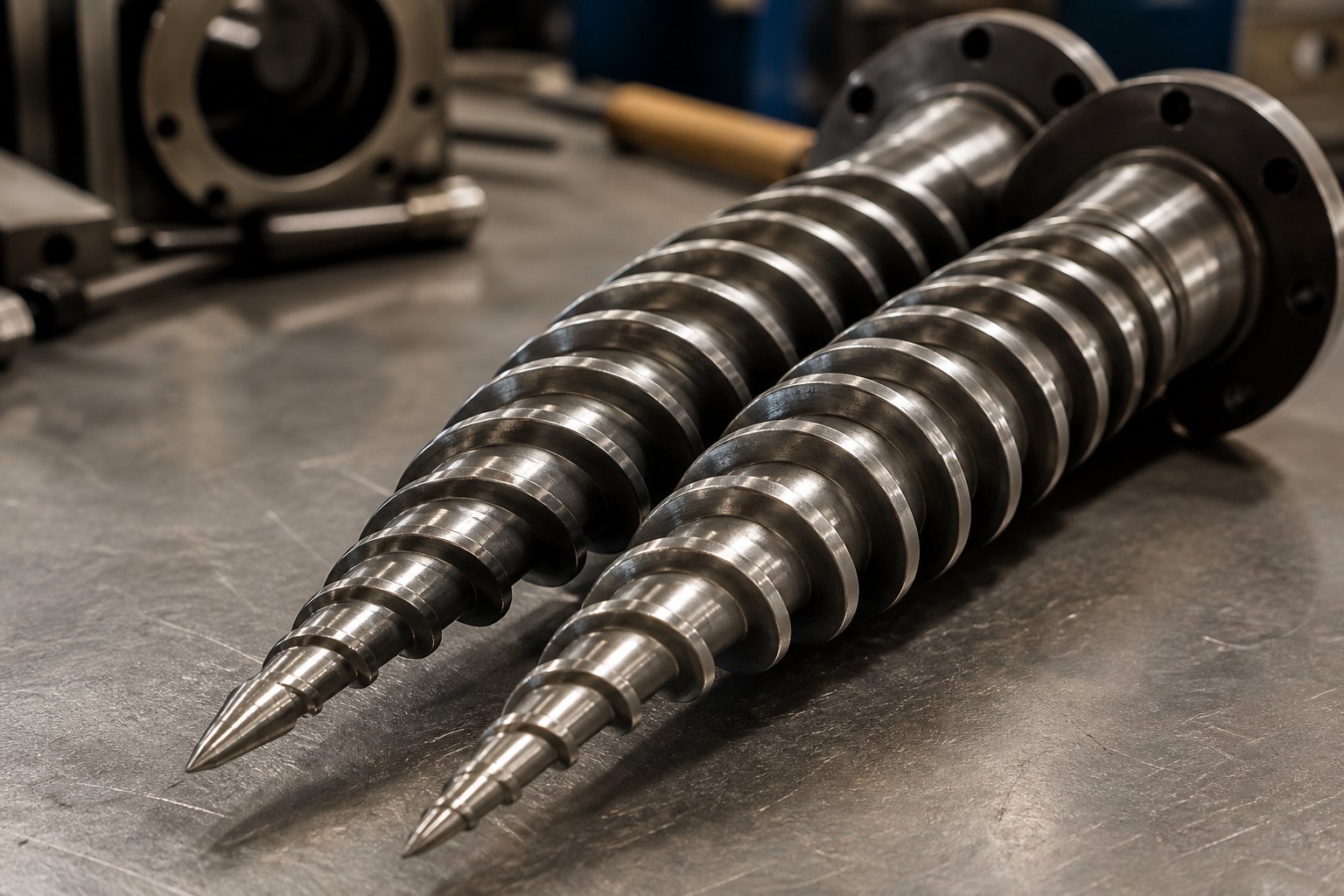
Maintenance and Screw Barrel Replacement for PVC Extruders
A conical twin screw extruder running PVC faces a uniquely punishing combination of forces that no amount of energy optimization or parameter tuning can prevent indefinitely. PVC compounds attack screws and barrels on two fronts simultaneously — and recognizing when that attack has progressed from normal wear into production-threatening damage is the difference between a planned maintenance stop and a catastrophic quality failure.
Wear Patterns and Warning Signs in PVC Processing
Every polymer wears extruder components to some degree. PVC does it faster and more aggressively than almost any other thermoplastic, for reasons rooted in its chemistry and formulation.
The first mechanism is chemical. As PVC approaches its processing temperature, it begins releasing hydrochloric acid (HCl) — a corrosive byproduct of thermal degradation that attacks steel directly, etching surfaces and initiating pitting corrosion on both barrel bores and screw flight surfaces. Even well-stabilized formulations generate trace HCl, and over thousands of operating hours, that trace exposure accumulates into measurable surface damage.
The second mechanism is mechanical. Rigid PVC formulations rarely arrive at the extruder pure. Calcium carbonate, titanium dioxide, and other mineral fillers are standard additives for cost reduction, opacity, and UV resistance. These particles are harder than the steel they contact, and they grind against flight tips and barrel walls with every screw revolution. The combination — chemical corrosion weakening the surface while abrasive fillers scrape it away — creates a dual attack that no single base steel resists well on its own.
What does this look like in practice? The symptoms tend to appear gradually, which is why many operators miss them until quality complaints arrive from downstream customers. Watch for these warning signs:
Declining output at constant screw speed. This is often the earliest measurable indicator. As screw flight outer diameters shrink or barrel bore diameters grow, the clearance between them widens. Material leaks backward through that gap instead of advancing toward the die. The motor still draws power, the screws still turn, but less compound reaches the die per revolution. According to extrusion troubleshooting data published by Plastics Technology, even moderate wear that increases flight clearance can force operators to raise screw speed to maintain rate — which in turn accelerates further wear and drives up discharge temperatures, compounding the problem.
Inconsistent melt quality. Worn screws lose their ability to generate the precise compression profile the conical geometry was designed to deliver. The progressive pressure build that drives thorough gelation becomes uneven, leaving partially fused PVC particles in the melt stream. These show up as surface roughness, reduced impact strength, or visible grain structure in finished pipe and profile cross-sections — defects that cannot be corrected downstream.
Increased energy consumption. A widening screw-barrel clearance forces the drive motor to work harder for the same throughput. If you are tracking specific energy consumption in kWh/kg — as recommended in the previous section — a gradual upward drift at constant production parameters is a reliable early warning that wear has crossed from cosmetic to functional.
Visible surface degradation on extruded products. Black specks, brown streaks, and yellowing that cannot be traced to formulation changes or temperature errors often point to material hanging up in pitted or roughened barrel surfaces. Corroded metal creates stagnation points where PVC sits long enough to degrade, then releases intermittently into the melt stream. By the time these defects appear regularly, the barrel bore is likely well past its serviceable tolerance.
Catching wear before it reaches these visible stages requires scheduled physical inspection. During planned shutdowns, the following measurements should be taken and recorded against baseline values:
- Screw flight outer diameter: Measured at multiple points along each screw using a micrometer. Flight tip wear reduces the effective diameter, directly increasing clearance. As a general industry guideline, replacement should be considered when the flight clearance reaches approximately two to four times the clearance when new — depending on how critical the application's quality requirements are.
- Barrel bore diameter: Measured using a bore gauge at several axial positions and rotational angles. Oval wear patterns indicate alignment issues or uneven screw loading in addition to normal abrasion.
- Nitrided surface condition: Visual inspection for pitting, flaking, or discoloration of the nitrided layer. Once the nitrided case is breached, the softer base steel underneath wears exponentially faster. For iron-based bimetallic liners, the typical finished liner thickness is approximately 0.060 inches — once that liner is worn through, barrel replacement becomes urgent.
- Screw-barrel clearance measurements: The difference between barrel bore diameter and screw flight OD, measured at corresponding positions. This is the single most telling number. Tracking it over time — plotted against operating hours — reveals the wear rate and predicts when intervention will be needed, turning reactive maintenance into a planned event.
Screw and Barrel Material Recommendations and Replacement
The metallurgy of your screws and barrels determines how long they withstand PVC's dual chemical-and-mechanical assault. Choosing the right material combination at purchase — or replacement — is not an academic exercise. It is a direct investment in uptime, product consistency, and total cost of ownership.
Nitrided steel remains the baseline for most conical twin screw PVC applications. The workhorse screw material is 38CrMoAlA, a chromium-molybdenum-aluminum alloy whose aluminum content enables formation of an exceptionally hard nitrided surface layer — roughly 850 to 1,100 HV — while maintaining a tough, ductile core. Barrel bodies are typically machined from 42CrMo (4140 equivalent) forged alloy steel, with the bore nitrided to provide initial wear resistance. For standard rigid PVC formulations with moderate filler loading, a nitrided screw paired with a nitrided barrel provides reasonable service life at the lowest upfront cost.
The limitation is corrosion resistance. Nitriding alone offers only moderate protection against concentrated HCl attack. Adding hard chrome plating over the nitrided screw surface dramatically improves chemical resistance and provides a low-friction finish that helps heat-sensitive PVC melt slide without sticking. This combination — nitrided base plus chrome overlay — is what many conical twin screw extruder PVC wholesaler operations recommend as the default for general-purpose PVC processing.
Bimetallic linings step in when standard nitriding and chrome cannot keep pace with the compound's aggressiveness. A bimetallic barrel uses centrifugal casting to bond a wear-and-corrosion-resistant alloy — typically a nickel-based or tungsten-carbide-loaded composition — to the inside of the barrel bore. The structural steel body provides mechanical strength, while the inner alloy handles the HCl and filler contact. Industry data suggests that bimetallic barrels can deliver three to seven times the abrasion resistance of standard nitrided barrels, depending on alloy grade and operating conditions. For CPVC, heavily filled rigid PVC, and recycled PVC blends carrying contaminants, bimetallic construction is not optional — it is the minimum viable specification.
Tungsten carbide overlay on screw flight lands addresses the extreme abrasion end of the spectrum. When calcium carbonate loading exceeds 15 to 20 parts per hundred resin, or when processing mineral-heavy WPC blends, the mechanical grinding on flight tips outpaces even chromed surfaces. Carbide hardfacing extends flight life dramatically in these applications. The important caveat, as PVC screw specialists note, is that carbide protects against abrasion but does not solve corrosion on the screw root and channel surfaces — so it works best as a complement to chrome or nickel-alloy protection, not a replacement.
The following table summarizes material options against PVC application severity to guide replacement decisions:
| PVC Application Severity | Recommended Screw Treatment | Recommended Barrel Treatment | Expected Service Life Advantage |
|---|---|---|---|
| Standard rigid PVC (low filler) | Nitrided 38CrMoAlA + hard chrome | Nitrided bore | Baseline |
| Moderate filler loading (CaCO3 10-20 phr) | Nitrided + chrome; carbide on flights | Nitrided or bimetallic bore | 1.5 to 2.5x baseline |
| Heavy filler / WPC / recycled PVC | Carbide-faced flights + chrome on root | Bimetallic (Ni-based or WC-loaded liner) | 3 to 5x baseline |
| CPVC or highly corrosive compounds | Nitrided + nickel-alloy overlay | Bimetallic (corrosion-grade Ni liner) | 3 to 7x baseline |
Timely replacement of worn conical twin screw barrels is not just a quality issue — it is an economics issue. A barrel bore is more expensive and more disruptive to replace than a screw, and waiting until the bore is visibly damaged means the part has likely been costing you output, energy, and product quality for months before anyone opened the barrel for inspection. The smarter approach is to establish clearance thresholds that trigger proactive replacement, then source components from a supplier capable of delivering custom-specification parts without extended lead times.
For manufacturers running PVC pipe, profile, sheet, or WPC extrusion lines, NANHAIYA's Conical Twin Screw Barrel offers a practical sourcing option for custom or replacement barrels engineered to match specific machine dimensions and PVC processing demands. Their product range covers the screw diameter ratios and metallurgy combinations — including bimetallic options — that PVC applications require, with custom specification support for processors who need components tailored to their compound severity rather than off-the-shelf generics. For any china conical twin screw extruder PVC wholesaler or end-user looking to maintain plasticizing consistency without extended downtime, having a reliable replacement barrel source on hand before the current set reaches end-of-life is one of the most practical insurance policies available.
A spare screw set should also be kept in storage. Industry best practice recommends that when a worn screw is pulled, the spare is installed immediately, and the worn screw is either refurbished or replaced offline — minimizing production interruption to the duration of a changeover rather than the duration of a procurement cycle. However, screws should generally not be refurbished more than two to three times, because repeated welding of hard-facing material onto the base metal can compromise the metallurgical bond and lead to delamination under operating loads.
Maintaining screw and barrel condition is ultimately about preserving the mechanical precision that makes the conical twin screw design superior for PVC in the first place. Once that precision degrades — once clearances widen, surfaces pit, and compression profiles drift — every advantage discussed in earlier sections erodes with it. The same principle applies to newer developments in screw metallurgy, smart process controls, and recycled PVC handling, where equipment condition determines whether emerging technologies deliver on their promises or fall short of expectations.
Emerging Trends Shaping Conical Twin Screw PVC Extrusion
PVC extrusion is not standing still. Regulatory pressure, raw material economics, and digital transformation are reshaping how conical twin screw extruders are built, operated, and maintained — and manufacturers who ignore these shifts risk falling behind competitors who embrace them. The core tapered geometry that makes the conical design ideal for PVC has not changed, but nearly everything surrounding it is evolving rapidly.
Processing Recycled PVC and Sustainable Extrusion
Recycled PVC is no longer a niche feedstock tolerated in low-grade applications. It is becoming a strategic raw material. The European PVC industry alone has committed to recycling 900,000 tonnes of PVC annually through programs like Recovinyl, and similar circular-economy mandates are expanding across Asia, North America, and the Middle East. For conical twin screw extruder operators, this means learning to process feedstock that behaves nothing like virgin dry blend.
Imagine opening a bag of regrind from a post-consumer PVC window profile. What is inside? Fragments of varying particle size. Residual stabilizer that may be partially consumed. Trace contamination — adhesive residue, gasket material, perhaps bits of steel reinforcement that escaped the sorting line. The PVC resin itself carries a thermal history — it has already been melted once, meaning some of its heat stabilizer capacity is already spent. The degradation clock does not reset when PVC is recycled; it picks up where it left off.
These variables create real processing challenges. Melt viscosity swings from batch to batch because molecular weight distribution shifts with degradation history. Contamination introduces localized hot spots and potential blockages at screen packs or die land areas. Variable particle geometry — flakes, chunks, fine powder — makes consistent feeding difficult even with the conical extruder's generous feed zone.
How are producers adapting? Several practical modifications make recycled PVC viable on existing conical twin screw equipment:
- Screw geometry adjustments: Slightly lower compression ratios accommodate the higher bulk density and different friction behavior of regrind compared to fluffy virgin powder. Some manufacturers offer interchangeable screw tip sections that allow compression tuning without replacing the full screw set.
- Barrel temperature recalibration: Recycled PVC with partially depleted stabilizer requires a narrower and often lower temperature window to avoid triggering the degradation that its reduced stabilizer reserves can no longer suppress. Feed zone temperatures may be reduced by 5 to 10 degrees Celsius compared to virgin compound settings.
- Enhanced venting: Vacuum degassing ports become essential rather than optional. Recycled feedstock carries more moisture, more trapped air, and more volatile contaminants than virgin dry blend. Without adequate venting, these volatiles create porosity, surface blisters, and even corrosive vapor concentrations inside the barrel.
- Melt filtration integration: Screen changers positioned between the extruder discharge and the die catch particulate contaminants — metal fragments, rubber particles, undispersed pigment agglomerates — before they reach the die. Continuous or hydraulic screen changers allow filter changes without stopping the line, which is critical when contamination levels vary unpredictably.
The economic incentive is compelling. Virgin PVC resin prices fluctuate with ethylene and chlorine markets, and recycled PVC typically trades at a meaningful discount — sometimes 20 to 40 percent below virgin depending on grade and region. For manufacturers willing to invest in the process adjustments and quality controls that recycled feedstock demands, a conical twin screw extruder PVC wholesale operation processing blended virgin-and-recycled compounds can achieve significant raw material savings while meeting tightening sustainability requirements.
Advanced Screw Metallurgy and Smart Controls
Processing recycled and heavily filled PVC compounds accelerates the wear mechanisms discussed in the previous chapter — which is exactly why screw and barrel metallurgy is advancing in parallel with feedstock trends. The logic is straightforward: if the material going into the machine is getting more aggressive, the metal surfaces it contacts must keep pace.
New alloy formulations for bimetallic barrel liners are pushing corrosion and abrasion resistance beyond what was achievable even five years ago. Nickel-boron-silicon alloys with engineered carbide particle distributions offer improved resistance to both the chemical attack of HCl and the mechanical grinding of mineral fillers — without sacrificing the thermal conductivity needed for precise barrel temperature control. For processors evaluating their equipment upgrade path, manufacturers like NANHAIYA now offer custom-engineered conical twin screw barrels designed for consistent plasticizing performance across PVC pipe, profile, sheet, and WPC applications, with metallurgy options matched to specific compound severity levels. This kind of application-specific barrel engineering — rather than generic one-grade-fits-all offerings — reflects where the replacement parts market is heading.
On the controls side, the transformation is even more dramatic. Traditional PLC-based temperature controllers that react to thermocouple readings with simple PID loops are giving way to integrated systems that monitor, correlate, and adjust multiple process variables simultaneously. Real-time melt pressure sensors positioned at the die inlet detect pressure fluctuations that signal early-stage wear, feeding inconsistency, or formulation drift — often before the operator notices any change in the extrudate. IoT-connected sensors stream this data to cloud platforms where machine learning algorithms identify patterns invisible to human operators: subtle correlations between ambient temperature shifts and barrel zone energy draw, or between raw material lot changes and specific energy consumption trends.
The practical payoff? Predictive maintenance that schedules screw and barrel inspections based on actual measured wear indicators rather than arbitrary calendar intervals. Process optimization that continuously nudges screw speed, barrel temperatures, and feed rates toward the lowest specific energy consumption achievable for the current compound — automatically, without requiring an experienced operator to babysit every parameter. As the broader plastics industry embraces Industry 4.0 principles, conical twin screw PVC extrusion lines are integrating these capabilities into both new installations and retrofit packages for existing machines.
The key trends reshaping conical twin screw PVC extrusion can be summarized as a convergence of material, mechanical, and digital innovation:
- Energy-saving drive systems: IE4-class motors, servo drives, and direct-drive configurations are reducing specific energy consumption below 0.15 kWh/kg on optimized lines — a benchmark that was aspirational just a few years ago.
- Improved wear-resistant barrel materials: Advanced bimetallic alloys and surface treatments extend barrel service life by factors of three to seven compared to standard nitrided steel, even under aggressive recycled and filled PVC compounds.
- Recycled PVC processing capability: Modified screw geometries, enhanced venting, and inline melt filtration are making post-consumer and post-industrial PVC regrind a routine feedstock rather than a processing headache.
- Industry 4.0 integration: IoT sensors, cloud-based analytics, and automated parameter optimization are transforming conical extruder operation from experience-dependent art into data-driven precision manufacturing.
- Evolving environmental regulations: Tightening emissions standards for HCl and volatile organic compounds during PVC processing are driving demand for better-sealed barrel systems, improved ventilation engineering, and compounds formulated with lower degradation potential.
None of these trends operate in isolation. Recycled PVC demands better barrel metallurgy. Better metallurgy justifies higher equipment investment. Higher investment demands better process control to maximize return. And smarter controls generate the data needed to optimize recycled feedstock processing. The cycle reinforces itself — and the manufacturers who recognize this interconnection earliest will hold a durable competitive advantage in a PVC market that is simultaneously growing in volume and tightening in regulatory and sustainability expectations.
Frequently Asked Questions About Conical Twin Screw Extruder PVC
1. What is the difference between a conical twin screw extruder and a parallel twin screw extruder for PVC?
The main difference lies in screw geometry and how it affects PVC processing. A conical twin screw extruder uses two tapered screws that are wider at the feed end and narrower at the discharge end. This taper naturally reduces shear as material approaches the die, keeping heat-sensitive PVC safely below its degradation temperature. Parallel twin screw extruders maintain a uniform screw diameter, which subjects the melt to consistent shear throughout the barrel length. While parallel machines excel at high-volume compounding above 800 kg/hr, conical designs deliver superior torque transmission, gentler compression profiles, and more precise thermal control — making them the preferred choice for rigid PVC pipe, profile, and foam board production where output requirements fall within the 150 to 800 kg/hr range.
2. Why is a conical twin screw extruder preferred for PVC over a single screw extruder?
PVC dry blend is a fluffy, low-bulk-density powder that single screw extruders struggle to convey consistently. Single screws rely on friction between the powder and barrel wall to push material forward, which leads to inconsistent feeding, bridging, and uneven melt quality. Conical twin screw extruders solve this with two counter-rotating, intermeshing screws that positively displace powder forward like interlocking gears. The large-diameter feed section accommodates bulky PVC powder efficiently, while the progressive compression along the tapered screws delivers thorough gelation without the shear spikes that cause thermal degradation. Single screw machines remain useful for flexible PVC pellet processing, such as cable jacketing, but for rigid PVC powder extrusion they cannot match the conveying reliability or mixing performance of the conical twin screw design.
3. How do you select the right screw size for a conical twin screw extruder PVC line?
Screw size selection starts with your target output in kg/hr and the specific PVC product you plan to manufacture. For PVC drainage pipe at moderate throughput, screw sizes in the 55/100 to 65/132 mm range typically suffice. Large-diameter pressure pipes may require 80/156 or 92/188 mm screws to achieve 400 to 800 kg/hr. Window and door profiles favor 51/105 to 65/132 mm configurations where melt homogeneity matters more than raw volume. A practical rule is to oversize by 20 to 30 percent above your current throughput target, which provides headroom for growth without forcing the machine to run at peak capacity continuously. Beyond diameter, the L/D ratio and compression ratio must match your PVC formulation type — rigid dry blend, flexible compound, foamed, or filled WPC — so always request detailed screw specifications rather than relying on model numbers alone.
4. What maintenance is critical for conical twin screw extruders processing PVC?
PVC attacks screw and barrel surfaces through both chemical corrosion from hydrochloric acid release and mechanical abrasion from mineral fillers like calcium carbonate. The most critical maintenance task is tracking screw-barrel clearance over time. As flight tips wear down and barrel bores widen, output drops at constant screw speed, energy consumption rises, and melt quality deteriorates. Schedule regular inspections during planned shutdowns to measure screw flight diameter, barrel bore diameter, and nitrided surface condition. Replacement should be considered when clearance reaches roughly two to four times the original specification. Keeping a spare screw set in storage allows immediate swap-outs that limit downtime to a changeover duration. Suppliers like NANHAIYA offer custom replacement conical twin screw barrels with bimetallic and nitrided options engineered for PVC severity levels, which can significantly extend service intervals.
5. Can a conical twin screw extruder process recycled PVC material?
Yes, conical twin screw extruders can process recycled PVC, but modifications are necessary. Recycled PVC carries a thermal history — its stabilizer reserves are partially depleted, molecular weight distribution may have shifted, and contamination from labels, adhesives, or mixed plastics is common. To handle regrind successfully, operators typically lower barrel temperatures by 5 to 10 degrees Celsius compared to virgin settings, reduce compression ratios to accommodate different bulk density, and add vacuum degassing ports to remove moisture and volatile contaminants. Inline melt filtration through continuous screen changers catches particulate contamination before it reaches the die. These adjustments, combined with wear-resistant bimetallic barrel linings to handle the more abrasive recycled feedstock, make recycled PVC a viable and economically attractive raw material on existing conical twin screw equipment.
Written by
Nanhaiya Technical Team
Zhoushan Nanhaiya Plastic Machinery Co., Ltd.
The Nanhaiya technical team supports screw and barrel manufacturing projects through application review, technical communication, custom manufacturing coordination, and production and quality control.
Discuss Your Application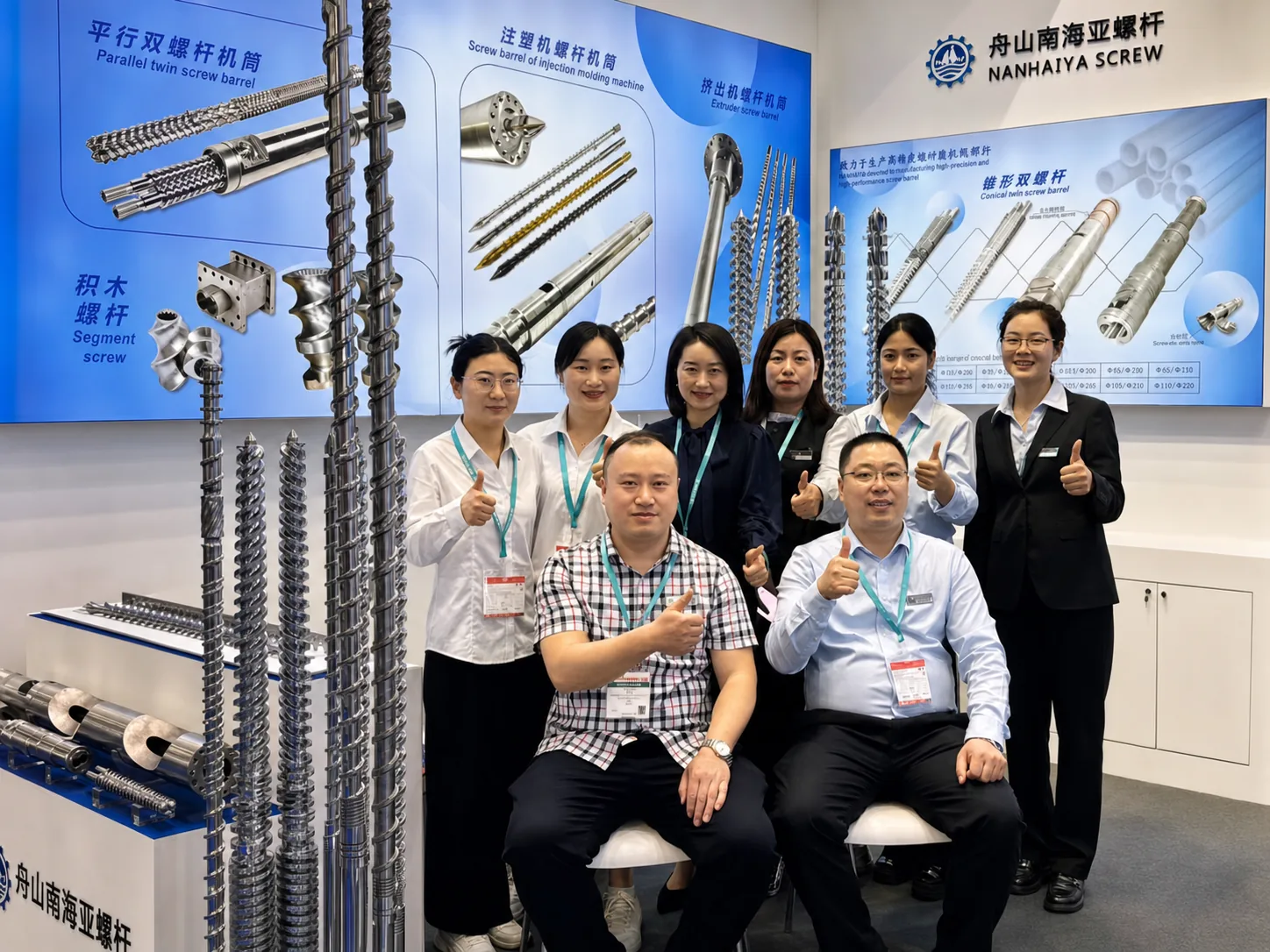
Related Articles
More insights on screw barrel technology and plastics processing.
Extruder Machine Decoded: From Raw Pellet To Finished Product
Oct 6, 2026
Learn how an extruder machine works, compare single-screw vs. twin-screw types, and get expert guidance on specs, troubleshooting, and selection.
Read Article
PE Pipe Making Machine Decoded: From Raw Resin to Flawless Pipe
Oct 4, 2026
Learn how a PE pipe making machine works, from resin to finished pipe. Covers components, material grades, automation, troubleshooting, and buyer selection tips.
Read Article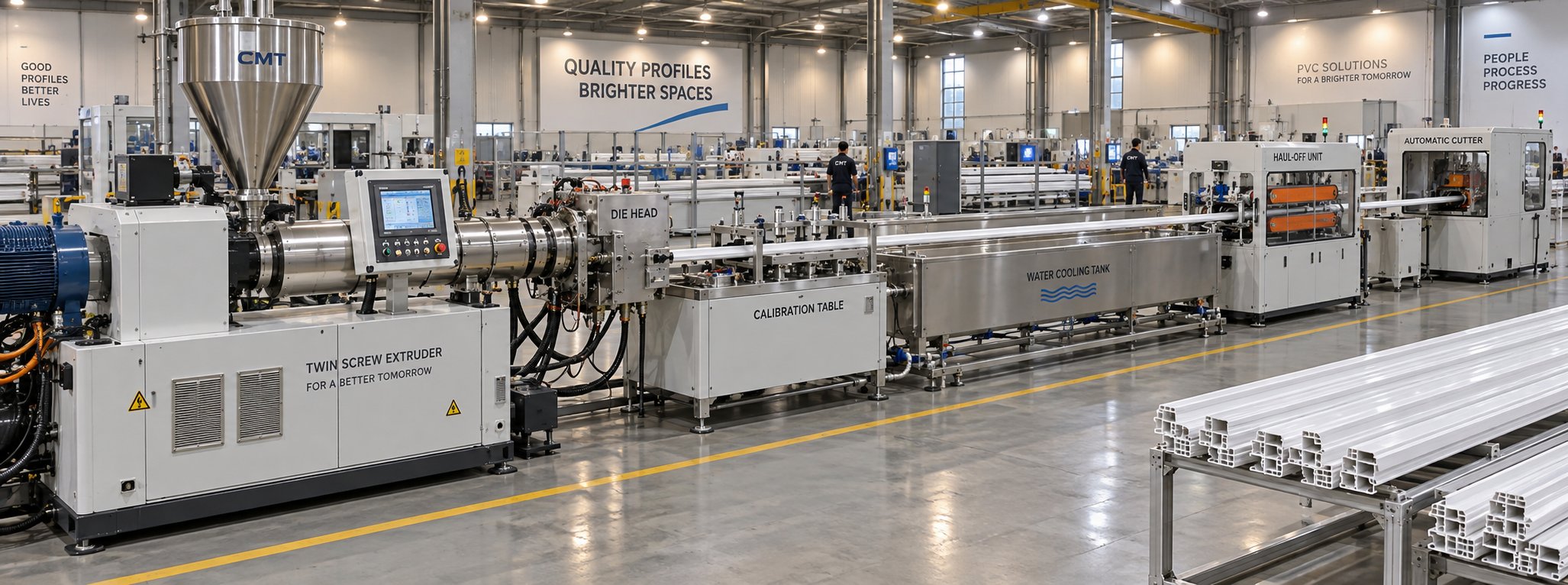
PVC Profile Making Machine Decoded: From Raw Resin To Profit
Oct 3, 2026
Learn how a PVC profile making machine works — extrusion process steps, key technical parameters, die design, calibration methods, maintenance, and total cost of ownership.
Read ArticleLooking for something else?
Search by material, symptom or product and jump straight to the relevant page.
These are navigation suggestions based on keyword matching — not a quotation, not a delivery commitment, and not a substitute for engineering review. Final specification is confirmed by our engineers against your drawings and processed material.
Need help with screw barrel selection?
Share your machine model, processed material and application. Our team can help with pricing and technical support.