

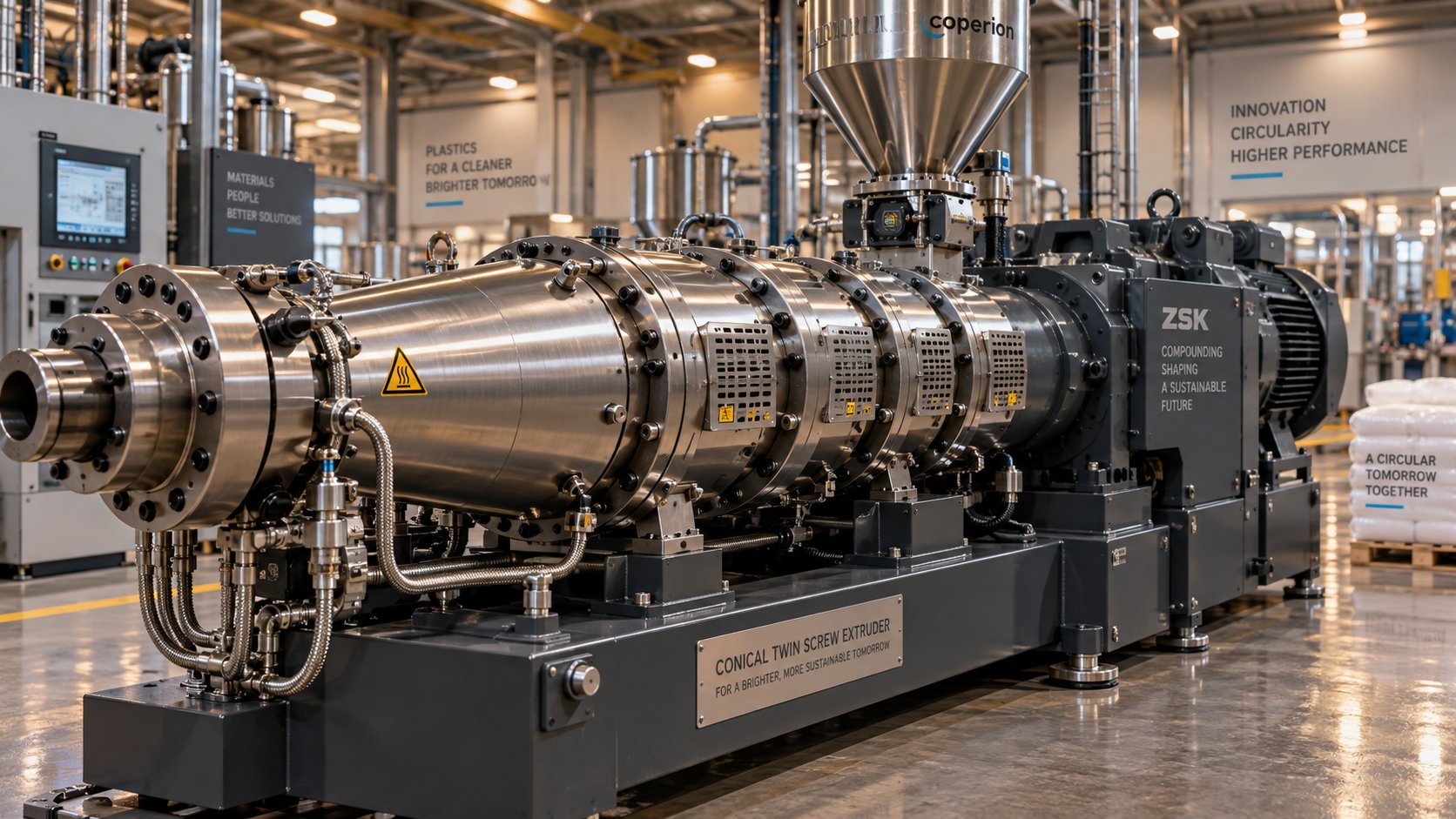
What Is a Conical Twin Screw Extruder and Why Does the Manufacturer Matter
Imagine investing six figures in a piece of equipment only to discover, two years later, that the screws wear prematurely, replacement barrels take months to arrive, and your output consistency has quietly eroded. That scenario plays out more often than most buyers expect — and it almost always traces back to one overlooked decision: which manufacturer built the machine.
A conical twin screw extruder is a thermoplastic processing machine that uses two tapered, counter-rotating screws housed inside a conical barrel to melt, mix, and convey polymer materials — most commonly PVC compounds — through a die at stable pressure and temperature.
If you have encountered parallel twin screw or single screw extruders before, you will notice a key structural difference right away. A single screw extruder relies on one rotating screw and depends heavily on friction-driven conveying. A parallel twin screw extruder uses two uniform-diameter screws — typically co-rotating — designed for high-throughput compounding across a wide range of polymers. The conical twin screw extruder, by contrast, features screws that taper from a large feed-end diameter down to a smaller discharge-end diameter, creating a natural compression effect as material travels forward.
Defining the Conical Twin Screw Extruder
The tapered screw geometry is more than a design quirk — it is the defining engineering principle behind the machine. As raw material enters the wider feed zone and moves toward the narrower discharge end, the gradually shrinking screw channel volume builds pressure and compacts the melt without requiring aggressive screw element configurations. The two screws intermesh and rotate in opposite directions, producing a positive conveying action with controlled, gentle shear. This counter-rotating mechanism is fundamentally different from the co-rotating parallel designs used in compounding, where screws spin in the same direction to maximize dispersive and distributive mixing.
That distinction matters because the conical design's primary function is stable plasticizing — delivering a homogeneous, thermally uniform melt to the die without overheating the material. For heat-sensitive polymers like PVC, which degrade within a narrow processing temperature window, this gentle approach is not optional. It is essential.
Why Manufacturer Selection Matters
Here is where many buyers miscalculate. A conical twin screw extruder is not a commodity product you can swap between suppliers without consequence. The machine involves tight engineering tolerances across three critical systems: screw geometry, barrel metallurgy, and gearbox design. Small deviations in taper angle or screw flight dimensions directly affect compression behavior and melt quality. Barrel liner composition determines how quickly wear degrades output — especially when processing abrasive fillers like calcium carbonate. And the gearbox, often the single most expensive component, must sustain high thrust loads and precise torque transmission over years of continuous operation.
What this means in practical terms is straightforward: the twin-screw extruder manufacturer you select directly determines machine reliability, output consistency, energy efficiency, and spare parts availability across a service life that typically spans 10 to 20 years. A poor choice compounds costs quietly — through unplanned downtime, inconsistent product dimensions, higher energy bills, and delayed replacement parts.
The sections ahead break down exactly what separates dependable twin screw extruder manufacturers from the rest — starting with the internal mechanics that every buyer should understand before requesting a single quote.
How Conical Twin Screw Extruders Work From Feed to Die
Requesting quotes without understanding the internal mechanics of what you are buying is like hiring an architect without knowing the difference between load-bearing and partition walls. You might get lucky — or you might lock yourself into a machine whose operating principles do not match your production demands. A clear grasp of how a conical screw extruder actually processes material gives you the vocabulary and judgment to evaluate any manufacturer's claims with confidence.
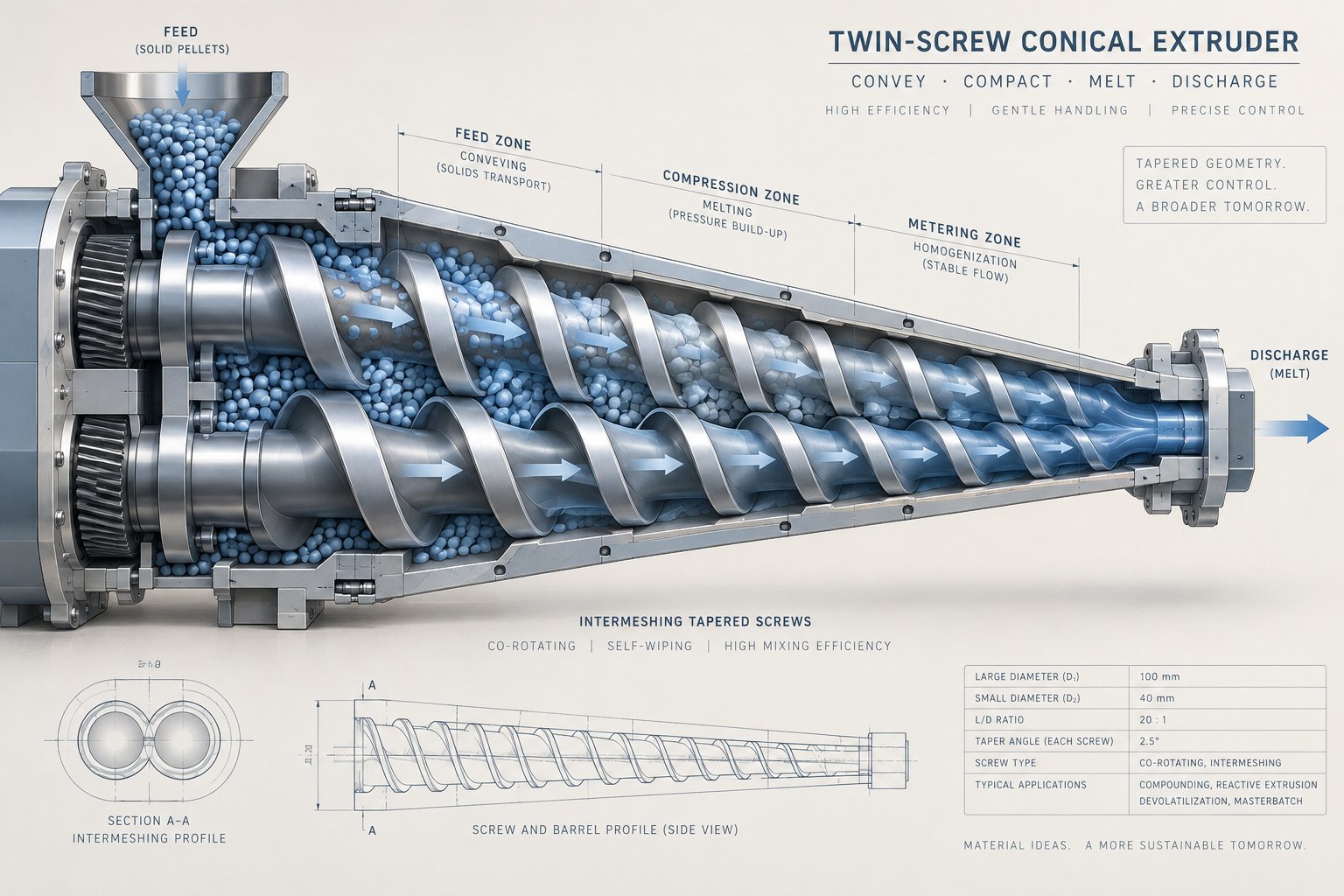
The core principle is deceptively simple. Two tapered screws sit side by side inside a conical barrel, rotating in opposite directions. Raw material — typically PVC dry blend in powder form — enters at the wide end, gets compressed, heated, and plasticized as it travels toward the narrow end, and exits as a homogeneous melt forced through a die. Every stage of that journey, however, involves deliberate engineering trade-offs that separate a well-built extruder twin screw system from one that underperforms within its first year.
Screw Geometry and the Counter-Rotating Mechanism
Picture two ice cream cones placed side by side, tips pointing the same direction, with spiral flights carved along their surfaces. That is roughly the geometry of a conical twin-screw extruder's screw pair. The screws intermesh — meaning the flight of one screw fits into the channel of the other — and they rotate in opposite directions. This counter-rotating, fully intermeshing arrangement creates what engineers call a positive displacement pump. Material trapped between the screw flights and the barrel wall gets pushed forward in discrete pockets, rather than relying on frictional drag the way a single screw design does.
Why does this matter? Positive displacement means the conveying action is largely independent of frictional properties between the polymer and the barrel surface. As PVC processing research has noted, fully intermeshing counter-rotating twin screw extruders function as positive displacement pumps independent of frictional criterion — making them inherently suited for thermally sensitive polymers like PVC and C-PVC.
The taper angle itself plays a critical role. As material advances from the large-diameter feed end toward the smaller-diameter discharge end, the channel volume decreases progressively. This geometric reduction creates a natural compression ratio without requiring complex screw element configurations. You do not need specialized kneading blocks or mixing elements to build pressure — the converging geometry does much of that work inherently. The result is a simpler, more predictable compression profile compared to parallel co-rotating designs, where compression depends entirely on modular screw element sequencing.
There is also a subtle but important mechanical advantage. The larger root diameter at the feed end allows the screws to transmit higher torque where it is needed most — at the point where cold, unplasticized powder resists conveying. This contrasts with parallel screws, which maintain a uniform and generally smaller root diameter along their full length, limiting torque capacity relative to overall machine size.
From Feed Zone to Die Output
A conical twin-screw extruder divides its processing length into three functional zones, each performing a distinct role in transforming raw powder into a pressurized, homogeneous melt:
- Feed zone (large-diameter end): Powder or pellet material drops from a hopper into the wide opening between the two screws. The large screw diameter here provides generous channel volume, enabling the extruder to accept high volumes of low-bulk-density dry blend. The intermeshing flights grip the material and begin positive conveying forward. At this stage, the material is still essentially cold and unplasticized.
- Transition (compression) zone: As the material advances toward the narrower section, the shrinking channel volume physically compacts the powder. Friction between particles, between material and barrel, and between material and screw surfaces generates mechanical heat. Simultaneously, external barrel heating zones — typically controlled independently via electric band heaters — add thermal energy. The combination of frictional shear and conducted heat begins melting the polymer. This is where the fusion process gains momentum, and the intermeshing surface area between the conical screws is at its largest, contributing higher but controlled energy input through shear.
- Metering zone (small-diameter end): By this point, the material is fully or nearly fully plasticized. The narrow screw diameter in this zone serves two purposes. First, it reduces shear rate — the smaller diameter means lower circumferential speed at the screw tips, which minimizes unwanted heat generation in an already-molten material. Second, it builds the final pressure needed to push the melt through the die at consistent flow. The intermeshing surface here is smaller than in the compression zone, further reducing shear energy input and avoiding thermal degradation.
Temperature control through each zone is managed by multiple independent barrel heating and cooling zones. Operators set target temperatures for each zone, and the control system modulates heater output — and in some machines, cooling fans or oil channels — to maintain precise thermal profiles. This zone-by-zone temperature management is essential because the fusion point and degradation threshold of PVC sit uncomfortably close together. A well-designed barrel and temperature control system keeps the melt within that narrow window across the entire processing length.
The melt exits the metering zone and enters a breaker plate or screen pack before reaching the die. At this stage, pressure stability and melt temperature uniformity across the flow channel are the measurable indicators of how well the extruder is performing. Any inconsistencies here show up directly as dimensional variation, surface defects, or weak spots in the final product.
Why Counter-Rotation Suits PVC Processing
PVC is not a forgiving polymer. Its thermal degradation window can be as narrow as 10-15 degrees Celsius above its fusion temperature, and degradation releases hydrochloric acid — which corrodes equipment and ruins product. This is the fundamental engineering rationale behind why counter-rotating conical designs dominate PVC extrusion worldwide.
In a co-rotating parallel extruder, the screws spin in the same direction, and material in the intermeshing region is subjected to high elongational shear as it transfers between screws in an "infinity"-shaped flow path. That aggressive mixing action generates significant frictional heat — excellent for compounding engineering plastics, but dangerous for PVC. Counter-rotating conical screws, by contrast, create C-shaped closed chambers between the flights and barrel. Material moves forward in these chambers with far less internal shear, producing lower frictional heat buildup.
The tapered geometry compounds this advantage. As technical analysis of conical extrusion explains, the smaller diameter at the metering section further reduces shear rate, meaning lower temperature rise, lower degradation risk, and lower die swell. The plasticizing rate in conical extruders is primarily controlled by adjusting screw and barrel temperatures rather than by manipulating shear intensity. This thermal-dominant plasticizing approach results in significantly lower amperage draw and higher power economy at higher screw speeds — a direct operational cost benefit that compounds over thousands of production hours.
This also explains why conical twin screw extruders handle C-PVC (chlorinated PVC) effectively. C-PVC has an even narrower processing window than standard PVC, and the low-shear, temperature-controlled plasticizing approach of the conical design accommodates that sensitivity without requiring radical formulation changes.
Understanding these internal mechanics reveals something important for any buyer evaluating manufacturers: the quality of the screw geometry, the precision of barrel temperature control, and the accuracy of the intermeshing clearances — the so-called "milling gap" — are not marketing details. They are the engineering variables that determine whether your extruder produces consistent, degradation-free output or slowly destroys product quality as clearances wear and thermal control drifts. That reality sets up a critical question most buyers face early in their search: should they invest in a conical or parallel architecture in the first place?
Conical vs Parallel Twin Screw Extruder Comparison
The architecture question is unavoidable. Whether you are specifying a new extrusion line or replacing aging equipment, you will eventually face a fundamental fork in the road: conical or parallel twin screw extruders? Both designs use two intermeshing screws inside a heated barrel. Both melt, mix, and convey thermoplastics. But they solve different engineering problems, and choosing the wrong one locks you into years of suboptimal performance. The table below maps the core differences across every criterion that matters for production-level decision-making.
| Criteria | Conical Twin Screw Extruder | Parallel Twin Screw Extruder |
|---|---|---|
| Screw Geometry | Tapered screws — large feed-end diameter narrows to a smaller discharge-end diameter | Uniform-diameter screws maintained at constant center distance along full length |
| Typical Rotation Direction | Counter-rotating (opposite directions) | Co-rotating (same direction) in most compounding configurations |
| Shear Characteristics | Lower shear — C-shaped closed chambers limit elongational shear and frictional heat | Higher shear — material transfers between screws in an "infinity" flow path, generating intensive dispersive mixing |
| Compression Mechanism | Natural compression via converging screw geometry — no complex element configurations required | Compression achieved through modular screw element sequencing (kneading blocks, mixing elements) |
| Machine Footprint | Compact — converging barrel design shortens overall length | Longer — uniform diameter requires greater barrel length for equivalent L/D ratios |
| Torque Transmission | Higher torque at feed end due to larger root diameter; more gearbox space available from converging shaft layout | Limited by uniform, smaller root diameter; modern FEM-optimized gearboxes compensate effectively |
| Output Capacity Range | Typically lower — suited for small to medium throughput (roughly 50-800+ kg/hr depending on screw size) | Higher throughput potential — scalable to thousands of kg/hr with larger screw diameters |
| Screw Design Freedom | More limited — taper constrains element placement and zone length adjustments | Greater flexibility — modular barrel and screw elements allow reconfiguration for different formulations |
| Processing Window | Can be narrower, especially when balancing gelation quality and venting requirements | Wider — more zone length available for pressure generation, mixing, and venting |
| Typical Applications | Rigid PVC pipe, PVC profiles, PVC sheet, foam board, WPC decking | Engineering plastics compounding, masterbatch production, reactive extrusion, high-filler formulations |
| Material Suitability | Heat-sensitive polymers — PVC, C-PVC, and similar thermally narrow materials | Broad polymer range — polyolefins, engineering resins, filled systems, biodegradable polymers |
Geometric and Mechanical Differences
The visual difference is immediately obvious. Conical screws taper like elongated cones — a large-diameter feed end gradually narrows toward a smaller-diameter discharge end. Parallel screws, by contrast, maintain a constant diameter from intake to output. That geometric distinction drives nearly every performance difference between the two architectures.
Consider torque transmission first. The conical layout positions a larger root diameter at the feed end, right where cold, unplasticized powder resists being conveyed forward. That bigger cross-section lets the screw absorb and transmit significantly higher torque without exceeding material stress limits. Additionally, the converging shaft arrangement creates more physical space between the screw shafts at the drive end, giving gearbox designers room to fit larger bearings and gears. As Rollepaal's engineering analysis notes, conical designs historically made gearbox construction easier precisely because of this additional space.
Parallel designs compensate with a different strategy. Modern finite element method (FEM)-optimized gearboxes have closed much of the historical reliability gap, and parallel screws offer something conical designs cannot easily match: modularity. Because the diameter is uniform, manufacturers can extend barrel length to increase output, reconfigure screw element sequences for different formulations, and add extra venting or side-feeding ports without redesigning the entire screw. Conical screws, constrained by their taper, have less room for zone-length adjustments. Extending output on a conical machine often requires increasing the screw diameter itself — a far more expensive proposition than stretching pitches on a parallel system.
The compression mechanism further separates the two architectures. A double screw extruder with conical geometry achieves compression inherently — the shrinking channel volume between feed and discharge does the work automatically. Parallel co-rotating designs need deliberate screw element programming. Kneading blocks, reverse-pitch elements, and mixing zones must be sequenced along the barrel to create compression, distribute fillers, and build die pressure. That modularity is powerful for complex compounding tasks, but it adds engineering complexity and cost.
Performance Trade-Offs for Different Applications
Here is the practical question every buyer faces: which trade-offs align with your production goals?
Conical twin screw extruders dominate in applications where gentle, low-shear processing is non-negotiable. Rigid PVC pipe, window and door profiles, PVC sheet, and foam board production all require a melt that reaches adequate gelation without crossing the thermal degradation threshold. The conical design's lower shear heat generation and natural compression handle that balance reliably. However, that same gentle processing approach limits throughput capacity compared to large parallel machines.
The processing window trade-off deserves particular attention. Technical analysis from Rollepaal highlights that conical machines can present a relatively narrow processing window — achieving sufficient melt gelation for demanding quality tests (like the DMC test) while simultaneously venting air effectively creates a tight balancing act. Over-fusing in the vent zone risks air inclusions, while under-fusing risks borderline mechanical properties in the finished product. Parallel designs, with their longer available screw length for mixing and pressure generation, can offer a wider processing window and better venting flexibility.
A co rotating twin screw extruder shines in a fundamentally different arena: high-volume compounding, reactive extrusion, and multi-material processing. The intensive "infinity"-shaped mixing pattern between co-rotating screws delivers superior dispersive and distributive mixing — essential for uniformly incorporating high filler loadings, blending incompatible polymers, or driving chemical reactions during extrusion. Throughput can scale to tens of thousands of kilograms per hour in the largest machines. The trade-off is higher shear heat generation, greater mechanical complexity, and a higher capital cost.
When to Choose Conical Over Parallel
Rather than treating this as an abstract engineering debate, frame it around your specific production reality. Here are clear decision criteria:
Choose conical twin screw extruders when:
- Your primary material is PVC or C-PVC, and thermal sensitivity dictates low-shear processing
- Your product mix centers on pipe, profiles, sheet, or foam board — applications where melt stability and pressure consistency matter more than extreme throughput
- Floor space is limited, and you need a compact machine footprint
- Capital budget is constrained — conical machines typically carry a lower price point than comparable parallel systems
- Your operation prioritizes straightforward screw design and maintenance over modular reconfigurability
Choose parallel twin screw extruders when:
- You process a wide range of polymers beyond PVC — engineering plastics, polyolefins, biodegradable resins
- High-volume compounding or masterbatch production drives your throughput requirements
- Your formulations demand aggressive dispersive mixing — high filler loadings, nano-additives, or reactive processing
- You need modular screw and barrel configurations that can be reconfigured for different products without replacing the entire screw set
- Venting requirements are complex, or your process benefits from side-feeding capabilities
For many PVC-focused manufacturers, the conical architecture remains the clear technical and economic choice. But choosing the right architecture is only half the equation. The real production outcomes — whether you actually achieve the stable plasticizing, dimensional accuracy, and service life those designs promise — depend entirely on how well the machine is configured for your specific end product. That brings up a question most buyers underestimate: how do you match extruder specifications to the exact product you intend to produce?
Applications and Materials Suited to Conical Twin Screw Extrusion
Selecting a conical architecture is a starting point, not a destination. The same twin screw extruder machine that reliably produces 110 mm drainage pipe may struggle with a complex multi-cavity window profile — not because the design is wrong, but because the configuration does not match the product. Understanding which extruder specifications align with which end products is the gap that separates a productive investment from an expensive lesson.
Below is a structured look at the primary application segments where conical twin screw extruders deliver their strongest value, along with the configuration details that matter for each.
PVC Pipe and Profile Extrusion
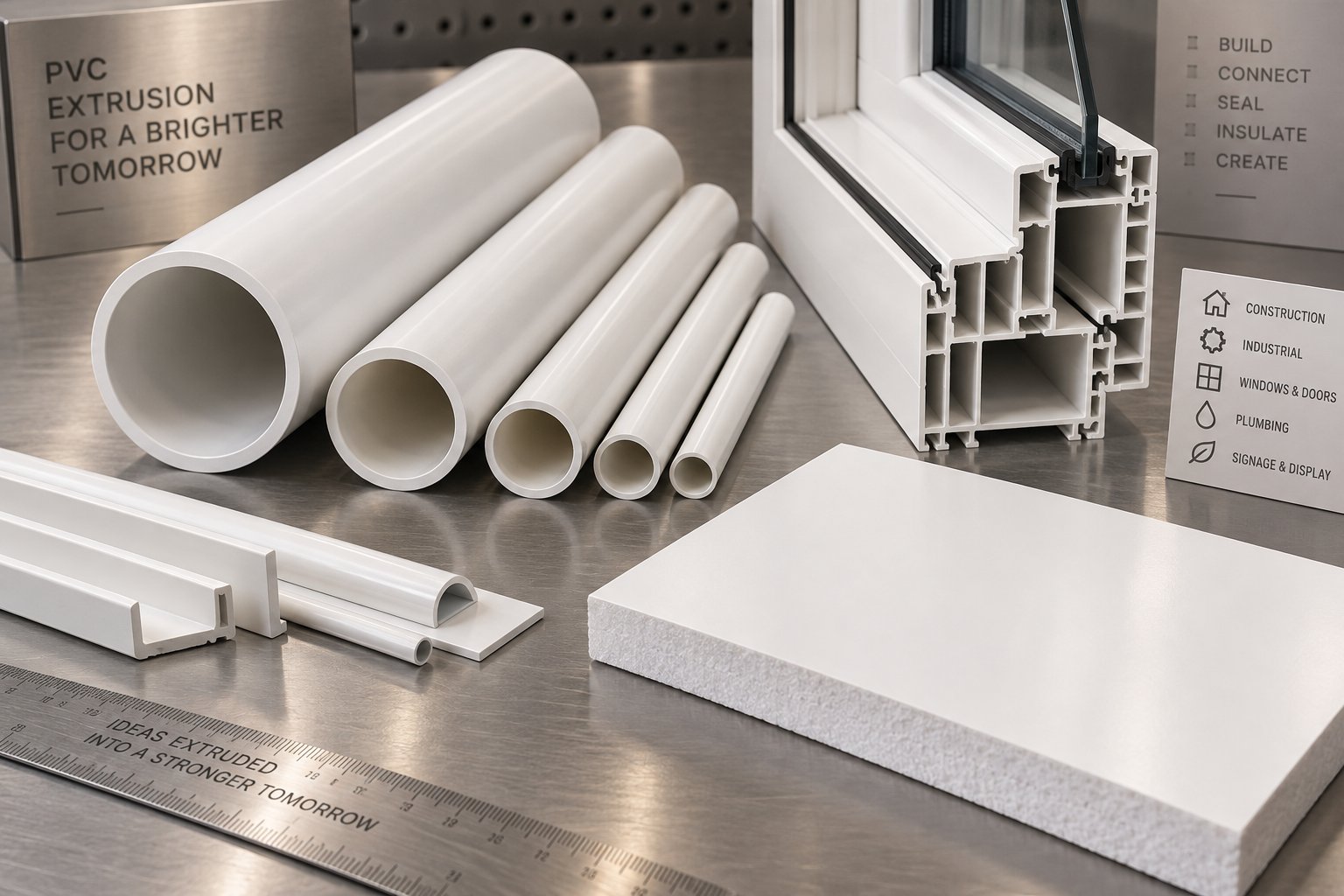
Rigid PVC pipes — water supply, drainage, electrical conduit, and telecommunications ducting — represent the single largest application segment for conical twin screw plastic extruder systems worldwide. The relationship between screw diameter and pipe output is direct. Smaller screw sizes like 51/105 and 55/110 typically handle pipes in the 16-110 mm diameter range at outputs suitable for small to mid-scale operations. Mid-range models such as 65/132 cover the workhorse 63-250 mm pipe range that dominates municipal water and drainage projects. Larger configurations — 80/156 and 92/188 — push into 200-630 mm large-diameter pipes with wall thicknesses heavy enough for pressurized systems.
Window and door profiles are arguably more demanding. A single profile die may contain multiple chambers, lips, and co-extruded layers. Imagine extruding a hollow, multi-chambered window frame cross-section where every wall thickness must remain uniform across a complex shape. That requires exceptional melt homogeneity and pressure stability at the die — any melt temperature variation or pressure fluctuation shows up as dimensional drift, warped edges, or weak weld lines between chambers. Manufacturers building extrusion lines for profile applications must demonstrate tight temperature control and die-pressure consistency during factory acceptance testing, not just headline output numbers.
Board, Foam Board, and WPC Production
Board applications push a double screw extruder machine into territory where formulation complexity and process sensitivity intensify significantly. The primary products include:
- Rigid PVC sheet: Used for thermoforming, chemical tank liners, and signage. Requires uniform thickness and minimal internal stress to avoid warping during secondary processing.
- PVC foam board: Lightweight panels for advertising, cabinetry, and interior decoration. Foam extrusion demands precise temperature control and back-pressure management to achieve uniform cell structure. As industry process guides emphasize, high density or poor foaming can result from insufficient blowing action, low melt temperature, or poor melt strength — variables the extruder must control tightly.
- Celuka (skinning) board: A foam board variant where cooled calibrator surfaces create a dense, smooth skin over a cellular core. The extruder must deliver a melt with sufficient melt strength and thermal uniformity to support this dual-density structure.
- Wood-plastic composite (WPC) decking and profiles: WPC formulations incorporate wood flour or other lignocellulosic fillers, which introduce abrasive wear on screw flights and barrel bores. Moisture control in the wood filler is critical — excess moisture causes bubbles, voids, and surface streaks, while over-drying creates handling issues. The screws and barrels must withstand abrasive filler contact without rapid wear, making metallurgy a key specification rather than an afterthought.
Across all these board and WPC applications, the barrel and screw pair functions as the process heart. Wear, corrosion from PVC decomposition byproducts, and abrasion from fillers gradually erode performance if these components are not manufactured to exacting standards. NANHAIYA serves PVC pipe, PVC profile, PVC board, foam board, and WPC extrusion manufacturers with custom and replacement conical twin screw barrels designed for stable plasticizing across these demanding applications — an important resource when original equipment barrels reach the end of their service life or when a specific formulation requires upgraded wear resistance.
Matching Extruder Configuration to End Product
Here is a detail most first-time buyers overlook: your extruder does not operate in isolation. It is the first link in a chain of downstream equipment that collectively determines product quality. A PVC pipe extrusion line, for example, includes a die head, vacuum calibration tank, spray cooling tank, haul-off unit, planetary cutter, and stacker — each synchronized to the extruder's output rate and melt characteristics. A foam board line adds calibration plates, multi-stage cooling, edge trimming, and cross-cutting stations.
Why does this matter when evaluating manufacturers? Because an extruder that delivers excellent melt quality at 200 kg/hr means nothing if the downstream haul-off cannot maintain consistent pulling speed, or if the calibration table was designed for a different thickness range. The best conical twin screw extruder manufacturers understand complete extrusion line integration. They ask about your downstream equipment before quoting — confirming die compatibility, calibration sizing, cooling capacity, and haul-off speed synchronization.
When a manufacturer skips those questions and jumps straight to a price quote, treat that as a red flag. A twin screw plastic extruder is only as productive as the weakest link in its production line, and the manufacturer's willingness to discuss that full picture reveals how deeply they understand real-world production — not just machine sales.
Matching machine to product is half the equation. The other half involves understanding the technical specifications that make one manufacturer's offering genuinely different from another's — starting with the screw diameter designations and performance metrics that many buyers accept at face value without knowing what they actually mean.
Critical Technical Specifications Every Buyer Should Understand
Here is something that costs buyers real money: accepting a manufacturer's spec sheet at face value without understanding what the numbers actually describe. Every twin extruder listing you encounter will feature a string of figures — screw diameters, motor power, L/D ratio, output capacity. Those numbers look objective. They feel comparable. But without knowing how they relate to each other and to your production reality, you are essentially comparing prices on machines you cannot meaningfully differentiate. That is how buyers end up chasing the lowest twin screw extruder price while overlooking the specifications that actually determine production economics over a decade of operation.
Screw Diameter Ranges and L/D Ratios
If you have browsed any twin screw extruder for sale listing, you have probably seen designations like 51/105, 55/110, 65/132, 80/156, or 92/188. Those paired numbers are not arbitrary model codes. They describe the two defining dimensions of the conical screw pair: the small-end diameter and the large-end diameter, both in millimeters. A 65/132 machine, for example, has screws that taper from 132 mm at the feed end down to 65 mm at the discharge end.
Why do these numbers matter? They directly dictate the machine's throughput capacity and the range of products it can handle. Smaller screw pairs like 51/105 and 55/110 suit lower-output operations — small-diameter pipes, thin profiles, or startup production lines where capital efficiency matters more than volume. The 65/132 designation represents the industry's workhorse, covering mid-range pipe diameters and a broad selection of profile geometries at output rates that satisfy most medium-scale operations. Larger machines — 80/156 and 92/188 — handle high-output pipe production, thick-walled pressure pipe, and large-format board extrusion where throughput in the hundreds of kilograms per hour is essential.
The L/D ratio adds another layer. In a conical context, L/D is calculated using the large-end diameter as the reference. A typical conical twin screw extruder operates with an L/D ratio somewhere between 22:1 and 28:1. What does that tell you? A higher L/D ratio means the material spends more time inside the barrel — longer residence time translates to more thorough melting, better mixing, and greater homogeneity. But it also means more heat exposure, higher energy input, and a physically longer machine. For heat-sensitive PVC, the sweet spot balances sufficient plasticizing time against the risk of thermal degradation. When comparing machines from different manufacturers, verify that they calculate L/D the same way — some reference the small-end diameter, which inflates the ratio and makes direct comparison misleading.
Motor Power, Torque, and Output Capacity
Motor power scales predictably with screw diameter and target throughput. A 55/110 machine might run on a 22-37 kW motor, while a 92/188 unit could demand 110-160 kW or more. But raw kilowatt ratings tell you less than you might assume. Two machines with identical motor power can deliver very different output rates depending on gearbox efficiency, screw design, and how effectively the drive system converts electrical energy into mechanical work at the screw shafts.
The gearbox torque rating deserves particular scrutiny. Torque — not motor power — is what actually rotates the screws against the resistance of cold, unplasticized powder in the feed zone. A gearbox with insufficient thrust bearing capacity or poorly hardened gear teeth will limit your practical screw speed range, which directly caps your output. Manufacturers sometimes quote peak output capacity achieved during short demonstration runs, but sustained production conditions tell the real story. Ask for output data measured over continuous eight-hour shifts, not optimistic peak figures from a thirty-minute trial.
Screw speed range also matters more than many buyers realize. A wider speed range — say 5 to 40 RPM versus 10 to 30 RPM — gives you greater flexibility to optimize output for different formulations and product geometries. Some PVC dry blends plasticize best at lower speeds with higher barrel temperatures, while others benefit from faster screw rotation and reduced external heat. A machine that locks you into a narrow speed band limits your ability to fine-tune the process as formulation or product demands change.
Key Performance Indicators to Request From Manufacturers
This is where most buyer conversations go wrong. Manufacturers lead with headline output numbers — "400 kg/hr capacity" — and buyers accept that figure as the primary comparison metric. Output capacity matters, of course. But it reveals almost nothing about the quality of that output or the cost of producing it. The KPIs below expose genuine machine quality differences that headline numbers conceal:
- Specific energy consumption (kWh/kg): This is the single most revealing efficiency metric. It measures how many kilowatt-hours the extruder consumes per kilogram of processed material. Industry data indicates twin screw extruders typically consume between 0.2 and 1.0 kWh per kilogram, depending on the application and material type. A machine that produces 400 kg/hr at 0.35 kWh/kg costs dramatically less to operate over five years than one producing the same output at 0.55 kWh/kg. Request this figure measured under your target formulation and output conditions — not under ideal laboratory settings.
- Melt temperature uniformity across the die width: A well-engineered extruder delivers melt to the die at a consistent temperature from edge to edge. Temperature variation across the die width — even as little as 3-5 degrees Celsius — causes uneven flow distribution, leading to thickness variation in sheet, wall-thickness inconsistency in pipe, or warped profiles. Ask manufacturers to provide melt thermocouple data or infrared thermal mapping from production runs.
- Output stability percentage over extended runs: This measures how much the output rate fluctuates during continuous operation. A machine rated at 300 kg/hr that swings between 270 and 330 kg/hr during an eight-hour run creates significant downstream problems — haul-off speed mismatches, inconsistent wall thickness, and material waste. Target output stability within plus or minus 2% as a benchmark for well-built machines.
- Pressure consistency at the die head: Melt pressure fluctuations at the die translate directly into product dimensional variation. Consistent die pressure indicates uniform screw conveying, stable plasticizing, and proper gearbox and drive performance. Pressure variation beyond plus or minus 5 bar during steady-state operation often signals screw or barrel wear, poor temperature control, or inconsistent feed rate.
These four indicators function as a quality X-ray. Any manufacturer confident in their engineering will provide this data willingly. Reluctance to share specific energy figures or pressure stability data during the quoting process is itself a data point — and not a reassuring one.
Specifications tell you what a machine can do on paper. But the same numbers printed on a spec sheet can represent vastly different real-world performance depending on where and how the machine was built. That reality brings up a dimension of the buying decision most technical evaluations skip entirely: the geography of manufacturing and how it shapes everything from pricing tiers to after-sales support infrastructure.
Global Manufacturing Landscape for Conical Twin Screw Extruders
A spec sheet does not tell you where the machine was built — or why that matters. Two extruders with nearly identical technical parameters can arrive at dramatically different price points, lead times, and long-term support experiences depending on the region of origin. Yet most buyers evaluate machines in a geographic vacuum, comparing numbers without accounting for the sourcing ecosystem behind them. Understanding the twin screw extruders market on a regional level transforms what feels like an apples-to-apples comparison into the reality it actually is: a strategic sourcing decision shaped by trade infrastructure, engineering culture, and supply chain logistics.
The table below maps the major manufacturing regions across the criteria that matter most when you are buying capital equipment intended to run for a decade or longer.
| Criteria | China | India | Europe (Germany, Italy, Austria) |
|---|---|---|---|
| Price Range Positioning | Low to mid-high — broad spectrum depending on manufacturer tier | Low to mid — competitive on entry-level and mid-range segments | Premium — typically 2-4x Chinese mid-range pricing |
| Typical Quality Tier | Entry-level through premium; top-tier Chinese machines approach European specifications | Entry-level to mid-range; growing quality improvements in recent years | Premium to ultra-premium; benchmark-setting engineering and finish quality |
| Lead Time | 30-90 days for standard configurations; expedited options often available | 45-120 days depending on customization level | 3-6 months or longer for custom-engineered machines |
| After-Sales Infrastructure | Variable — ranges from minimal to well-established global service networks among top manufacturers | Strong domestically and in South Asia; limited global presence | Extensive global service networks with regional subsidiaries and trained service engineers |
| Common Certifications | CE marking, ISO 9001; top-tier manufacturers also hold SGS, BV, and TUV certifications | ISO 9001, BIS standards; CE marking for export-oriented manufacturers | CE, ISO 9001, full EU machinery directive compliance, often with Industry 4.0 integration certifications |
| Export Experience | Highly developed — established logistics to Africa, Southeast Asia, Middle East, South America, and increasingly to Europe and North America | Growing — primary export corridors to South Asia, Africa, and the Middle East | Mature — global distribution networks with decades of cross-border support experience |
China as the Dominant Manufacturing Hub
If you survey the global landscape of extruders manufacturers producing conical twin screw systems, one geographic reality stands out: China dominates in sheer production volume, manufacturer density, and export reach. Industry analysis indicates that Nanjing alone concentrates more than 90% of China's twin screw extruder manufacturing enterprises, with additional clusters in Jiangsu province's surrounding cities, Zhejiang province, and Guangdong province. The domestic market exceeded 15 billion yuan in 2023, with projections reaching 25 billion yuan by 2030 — and overseas market share has already climbed to approximately 15%.
What makes this relevant to you as a buyer? The density of chinese extruder manufacturers creates a competitive ecosystem that drives rapid innovation cycles, aggressive pricing, and short lead times. But it also creates a challenge: distinguishing genuine manufacturers from trading companies that source machines from smaller, unknown factories and resell them under their own branding.
The quality spectrum within China is wider than most international buyers realize. At the entry level, you will find functional machines with basic controls and standard metallurgy — suitable for low-volume or cost-sensitive operations but limited in longevity under demanding conditions. At the top tier, Chinese manufacturers produce machines with bimetallic barrel liners, hardened alloy screws, PLC-driven control systems, and build quality that competes directly with European specifications — often at 40-60% of the European price point. The key is knowing how to identify which tier you are actually buying, a skill that depends on factory visits, reference verification, and the technical evaluation criteria covered elsewhere in this article.
India, Europe, and Other Regional Players
India's extrusion equipment sector has expanded significantly, driven by domestic infrastructure spending and a growing PVC pipe market. Indian manufacturers offer strong value for buyers within the subcontinent and neighboring South Asian markets, where geographic proximity simplifies logistics and after-sales support. For international buyers sourcing from India, the primary considerations are verifying export-grade build quality, confirming CE compliance if the machine will operate in a regulated market, and assessing whether the manufacturer's service network extends to your region.
European manufacturers — concentrated in Germany, Italy, and Austria — occupy a different position entirely. These are the premium-segment players, and their pricing reflects it. What justifies the premium? Typically, it is a combination of tighter machining tolerances, advanced automation integration, proprietary gearbox designs, sophisticated control systems with Industry 4.0 connectivity, and decades-deep service networks with regional subsidiaries staffed by trained engineers. For large-scale producers running multi-line facilities where uptime is worth tens of thousands of dollars per hour, the reliability premium can pay for itself within a few years. For smaller operations or markets where labor-intensive maintenance is acceptable, the cost gap may be difficult to justify.
How Geography Affects Your Total Sourcing Equation
The unit price on a manufacturer's quote is just one line in a much longer equation. Imagine you are comparing a Chinese-built 65/132 conical extruder priced at $45,000 against a European equivalent at $130,000. The sticker difference is dramatic. But several variables either widen or narrow that gap once you factor in the full sourcing picture:
- Shipping and logistics: Ocean freight for a multi-ton extruder from China to South America might add $3,000-8,000 depending on port, container type, and current freight rates. European shipping to the same destination could be comparable or slightly higher. Inland transport from port to factory adds further cost in either case.
- Import duties and tariffs: Trade policy analysis from Stout highlights that tariffs on specialized extrusion equipment can meaningfully alter capital expenditure planning. Duties vary by destination country and origin — some nations impose 5-15% tariffs on Chinese machinery while offering preferential rates for imports from trade agreement partners. Verify the Harmonized System (HS) code for your specific machine configuration and check applicable duty rates before comparing landed costs.
- Spare parts logistics: A barrel or screw replacement shipped from Nanjing to Lagos may take 4-6 weeks door-to-door. The same part from a European manufacturer with a regional warehouse might arrive in days. That time difference translates directly into production downtime cost — a variable that accumulates over the machine's full service life.
- Time zone alignment for technical support: When your extruder throws a fault code at 2:00 PM in your factory, is it business hours at your manufacturer's engineering office? A 6-hour time zone gap is manageable. A 12-hour gap means your urgent email sits until the next morning — and your line stays down.
- Warranty enforcement across borders: A two-year warranty from a domestic supplier carries real weight — you can visit their office, escalate issues face to face, and enforce terms under local commercial law. The same warranty from a manufacturer 8,000 miles away requires more trust, more documentation, and realistic expectations about resolution speed.
None of these factors automatically disqualify any region. Chinese manufacturers with established export departments and stocked spare parts warehouses in key markets can match or exceed the total sourcing value of higher-priced competitors. European builders with premium pricing may deliver lower total cost of ownership through superior uptime and energy efficiency. The point is this: geography is not just a line on a map. It is a cost variable, a risk variable, and a relationship variable that shapes your ownership experience long after the purchase order is signed.
Regional origin tells you where the machine was built and what supply chain supports it. What it does not reveal is the engineering quality inside the machine itself — the metallurgy, the gearbox construction, the control system architecture. Those internal differences define the quality tiers that separate a ten-year workhorse from a five-year headache, and they deserve their own careful examination.
Quality Tiers That Separate Premium From Entry-Level Machines
Two conical twin screw extruders can share the same screw diameter designation, the same motor power rating, and nearly identical spec sheets — and still deliver wildly different production experiences over five years. One runs with minimal intervention, holding tight tolerances through thousands of operating hours. The other demands frequent barrel replacements, suffers gearbox failures, and drifts out of specification in ways that quietly inflate scrap rates. The difference is not in the headline numbers. It lives in the engineering details that most spec sheets gloss over: metallurgy, gearbox construction, and control system architecture.
Understanding these quality tiers is not academic. It is the practical skill that lets you read between the lines of any extruder manufacturer's claims and ask the questions that reveal what you are actually buying.
Metallurgy and Wear Resistance
If there is a single component where quality tiers diverge most dramatically, it is the barrel and screw pair. Think of these as the engine block and pistons of your extruder — everything depends on their integrity, and their degradation is inevitable. The question is how fast.
Entry-level twin-screw extruders typically use standard nitrided steel for both screws and barrel bores. Nitriding — a surface-hardening process that diffuses nitrogen into the steel — creates a hard outer layer that resists wear under normal conditions. For straightforward PVC dry-blend processing without aggressive fillers, nitrided steel performs adequately. But "adequately" has a shelf life. The nitrided layer is thin, typically 0.3-0.7 mm, and once it wears through, the softer base metal underneath erodes rapidly. You will notice output declining, melt quality deteriorating, and energy consumption climbing — all symptoms of widening clearance between screw flights and barrel bore.
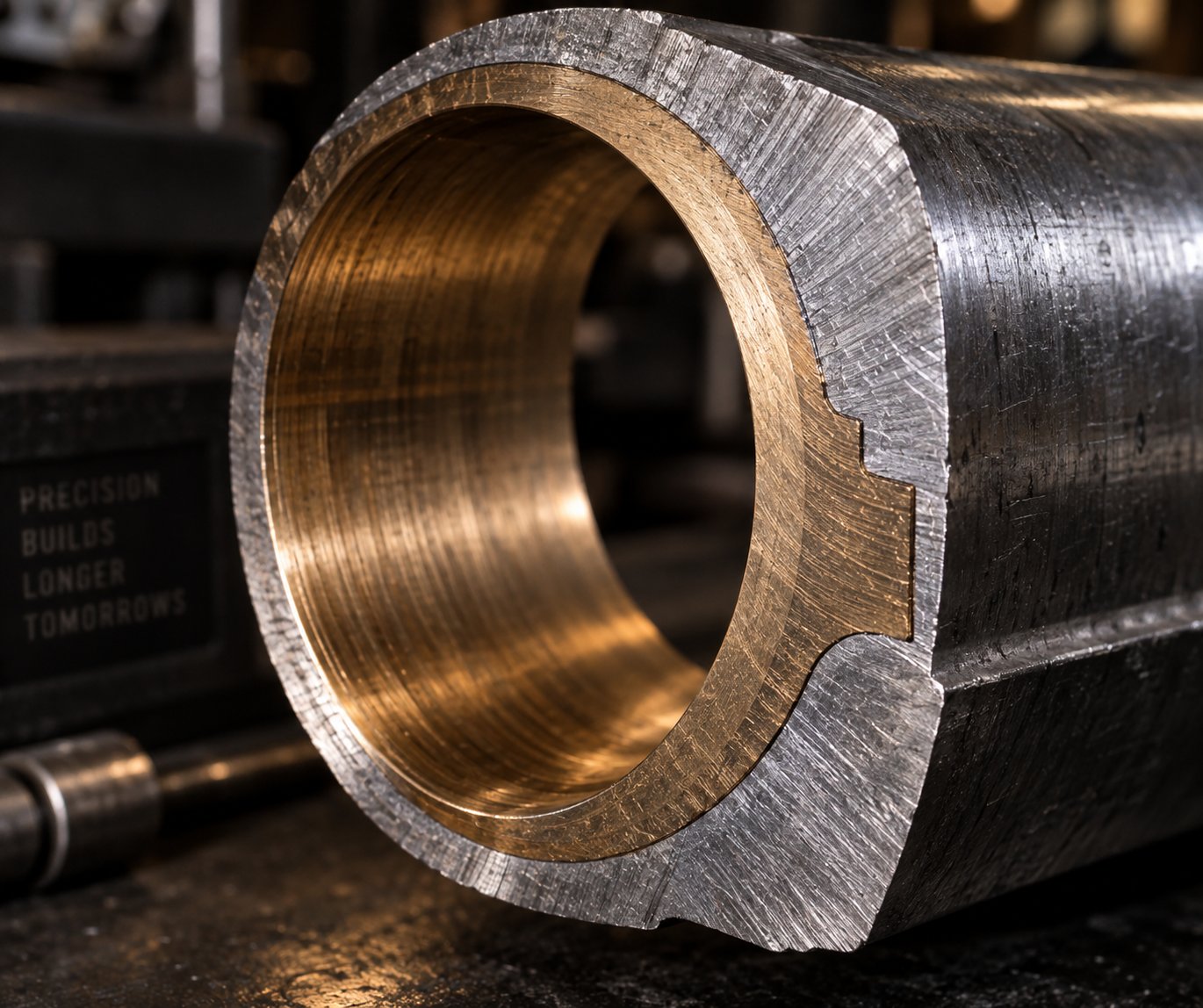
Mid-range machines step up to bimetallic barrel liners. These barrels feature a centrifugally cast inner liner made from a different alloy than the barrel body — typically a nickel-rich boron alloy base incorporating molybdenum, boride, and carbide compounds. As barrel longevity research details, these nickel-boron alloy liners offer excellent acid resistance — a critical advantage given that PVC processing releases hydrochloric acid as a decomposition byproduct. The corrosive attack from HCl is relentless during normal operation, and standard nitrided steel simply cannot withstand it over extended production cycles the way a bimetallic liner can.
Premium configurations go further. Screw surfaces receive hardened overlay coatings — alloys like Colmonoy 56 or Colmonoy 83 — applied through weld overlay or thermal spray processes. These coatings provide a dual defense: wear resistance against abrasive particles and corrosion resistance against acidic decomposition gases. For applications involving calcium carbonate fillers at 20-40% loading, or wood-fiber fillers in WPC processing, this level of metallurgy is not a luxury. It is what separates a screw that lasts 8,000 operating hours from one that needs replacement at 3,000.
The metallurgy hierarchy looks like this in practical terms:
| Quality Tier | Barrel Construction | Screw Surface Treatment | Best Suited For | Typical Service Life (hours) |
|---|---|---|---|---|
| Entry-Level | Standard nitrided steel bore | Through-hardened or gas-nitrided | Unfilled or lightly filled PVC at moderate output | 3,000 - 6,000 |
| Mid-Range | Bimetallic centrifugal-cast liner (Ni-B alloy) | Nitrided with localized hard-facing on high-wear zones | Standard PVC with CaCO3 fillers up to 20% | 8,000 - 15,000 |
| Premium | Bimetallic liner with tungsten carbide or boron-carbide compounds | Full Colmonoy 56/83 overlay or tungsten alloy coating | High-filler PVC, WPC, abrasive compounds, C-PVC | 15,000 - 25,000+ |
Notice the service life spread. A premium barrel and screw set can outlast an entry-level pair by a factor of four to five. When you calculate the cost of replacement parts, the production downtime during changeouts, and the gradual quality degradation as clearances open up, the upfront savings on entry-level metallurgy evaporate quickly — often within the first two years of high-utilization operation.
Gearbox Design and Drive Systems
Ask experienced operators what fails most expensively on a conical twin screw extruder, and the gearbox will come up repeatedly. It is often the single most expensive component in the machine — and one of the hardest for buyers to evaluate from a spec sheet alone.
The gearbox in a conical extruder performs a demanding job: it takes high-speed motor rotation, reduces it to the low-RPM, high-torque output the screws need, and absorbs the substantial axial thrust forces generated as material is compressed and pushed toward the die. Every quality shortcut in gearbox construction eventually manifests as noise, vibration, overheating, or catastrophic failure.
Here is where the tiers diverge:
- Entry-level gearboxes typically use cast-iron housings and standard-grade gear teeth with basic surface hardening. Bearings are adequate for rated loads but carry limited safety margins. These units function reliably within their rated capacity but offer less tolerance for overload conditions — running above rated speed, processing higher-viscosity formulations, or sustaining extended production campaigns without cooldown periods.
- Mid-range gearboxes step up to fabricated steel housings that are stiffer and more dimensionally stable under thermal load. Gear teeth undergo carburizing or case-hardening processes that create a hard, wear-resistant surface over a tough core — significantly extending gear life under high-torque conditions. Bearing specifications improve, with oversized thrust bearings that provide meaningful safety margins above rated axial loads.
- Premium gearboxes feature precision-ground, case-hardened gears with tight tooth-profile tolerances that minimize noise and vibration. Thrust bearing assemblies are designed for extreme axial loads with redundant lubrication systems. Housing designs incorporate forced oil cooling to maintain stable operating temperatures during continuous high-output runs. Some premium-tier manufacturers now offer direct-drive systems that eliminate the gearbox entirely — coupling high-torque, low-speed servo motors directly to the screw shafts. This approach removes gearbox efficiency losses (typically 3-5% of input power), eliminates gear and bearing wear as maintenance concerns, and delivers more precise speed control.
The practical implication? A gearbox failure on a production line does not just cost the price of a replacement unit. It costs weeks of downtime while the gearbox is sourced, shipped, and installed — plus all the revenue those lost production hours represent. Buyers evaluating twin-screw extruders from competing manufacturers should request gearbox specifications explicitly: housing material, gear hardening method, bearing type and rated load, thrust bearing capacity, and lubrication system design. If a manufacturer cannot or will not provide these details, that silence tells you something about the tier you are evaluating.
Control Systems and Automation Sophistication
The gap between entry-level and premium control systems is arguably the most visible quality differentiator — and the one that most directly affects daily production consistency and operator experience.
At the entry level, you will find relay-based or simple contactor-driven control panels. Temperature control uses basic ON/OFF thermocouples. Screw speed adjustment may rely on a manual potentiometer. There is no data logging, no recipe storage, and no remote access. The machine runs, and the operator manages it through experience and manual adjustments. For a single-product operation with experienced staff, this can work. But it depends entirely on human consistency — a variable that fluctuates with shift changes, fatigue, and training levels.
Mid-range machines integrate PLC (Programmable Logic Controller) systems with HMI (Human-Machine Interface) touchscreens. This is where the operational experience transforms. Operators interact with a visual dashboard displaying real-time temperatures, screw speed, motor load, and die pressure. Recipe management becomes possible — you store optimized parameter sets for each product and recall them instantly during changeovers, eliminating the trial-and-error warmup that wastes material and time. Basic alarm logging and trend displays help identify process drift before it becomes a quality problem.
Premium control architectures push into territory that Industry 4.0 integration frameworks describe as connected, data-driven production. These systems add SCADA (Supervisory Control and Data Acquisition) platforms, IoT gateways for remote monitoring, predictive maintenance algorithms that analyze motor load trends and bearing vibration signatures, and closed-loop automatic control that adjusts barrel temperatures and screw speed in real time without operator intervention. Data logging captures every process variable at high resolution, supporting traceability, quality audits, and continuous improvement programs. Remote diagnostics allow the manufacturer's engineers to troubleshoot issues from thousands of miles away — a capability that directly reduces downtime for international buyers operating far from the factory.
The business impact is measurable. Automated process control reduces output variability. Recipe management cuts changeover time — sometimes from hours to minutes. Data logging supports compliance with quality management systems. And predictive maintenance, as extrusion automation analysis emphasizes, shifts maintenance from reactive (high downtime risk) or preventive (moderate risk) to predictive (lower risk), identifying equipment degradation before failure occurs rather than responding after the fact.
Regardless of which automation tier you target, verify two baseline certifications from any extruder manufacturer you consider seriously: ISO 9001 for quality management systems and CE marking for compliance with EU safety, health, and environmental protection standards. These are not guarantees of premium quality, but their absence from a manufacturer's documentation is a reliable indicator that basic quality infrastructure may be missing. Single screw extruder manufacturers, parallel twin screw builders, and conical system producers alike should meet these minimum thresholds — they represent the floor, not the ceiling.
Quality tiers define what a machine is made of. But knowing what to look for inside the machine is only useful if you have a structured method for comparing manufacturers against each other — one that accounts for your specific operation's scale, priorities, and growth trajectory.
A Structured Framework for Evaluating Twin Screw Extruder Manufacturers
You know what to look for inside the machine. You understand metallurgy tiers, gearbox construction, and control system architecture. But when three manufacturers land in your inbox with proposals that all look credible on paper, how do you systematically rank them against each other — and against what your specific operation actually needs? Most buyers default to comparing price and headline output. That approach misses the criteria that determine whether a machine becomes a production asset or a maintenance burden. What you need is an evaluation matrix weighted to your buyer profile.
Evaluation Framework by Buyer Profile
A startup launching its first PVC extrusion line faces a fundamentally different decision calculus than a large-scale producer optimizing a multi-line facility. The startup needs turnkey support, operator training, and a competitive entry price — because capital is constrained and in-house expertise is still developing. A mid-scale upgrader replacing aging equipment prioritizes compatibility with existing downstream systems, proven reliability track records, and fast spare parts delivery — because their revenue depends on minimizing transition downtime. A large industrial producer evaluating twin screw extruders for sale across multiple facilities cares most about customization capability, output optimization for specific formulations, and the depth of a long-term technical partnership.
The table below maps eight critical evaluation criteria against these three buyer profiles, scoring each criterion's relative importance on a scale from 1 (lower priority) to 5 (critical priority). Use it as a starting template and adjust weightings based on your own operational realities.
| Evaluation Criteria | Startup (First Line) | Mid-Scale Upgrader | Large Industrial Producer |
|---|---|---|---|
| Technical Capability (screw/barrel design, process engineering depth) | 3 | 4 | 5 |
| Production Capacity and Lead Time | 3 | 4 | 5 |
| Quality Certifications (ISO 9001, CE, third-party audits) | 4 | 4 | 5 |
| Geographic Support and Time Zone Alignment | 3 | 4 | 4 |
| After-Sales Service (training, commissioning, troubleshooting) | 5 | 4 | 4 |
| Customization Options (screw geometry, barrel metallurgy, control systems) | 2 | 3 | 5 |
| Spare Parts Availability and Delivery Speed | 3 | 5 | 5 |
| Vertical Integration (in-house screw, barrel, and gearbox manufacturing) | 2 | 4 | 5 |
Notice the pattern. After-sales service tops the priority list for startups because their internal team lacks the experience to troubleshoot independently. Spare parts availability becomes critical for mid-scale upgraders because they cannot afford extended downtime on established production lines. And vertical integration — a criterion many buyers overlook entirely — rises to maximum importance for large producers who understand that long-term parts supply reliability depends on whether the manufacturer controls its own component production.
This matrix is not decorative. Print it, adjust the weightings for your situation, and score every manufacturer you evaluate against it. When you total the weighted scores, the ranking often looks very different from the ranking based on quoted price alone.
Why Vertical Integration in Screw and Barrel Manufacturing Matters
Imagine this scenario: your barrel bore has worn past tolerance after four years of processing CaCO3-filled PVC pipe compound. You contact the original equipment manufacturer for a replacement conical twin screw barrel. They tell you the barrels were sourced from a third-party supplier — one that has since changed ownership, relocated production, or discontinued your barrel specification. Lead time? Uncertain. Exact metallurgy match? Not guaranteed. Your line sits idle while the supply chain sorts itself out.
This is not hypothetical. It happens routinely to buyers who purchase from manufacturers that outsource critical wear components. Vertically integrated manufacturers — those who machine their own screws and cast or line their own barrels in-house — offer three tangible advantages that compound over the machine's service life:
- Quality control continuity: When the same facility that built your original barrel also manufactures the replacement, the metallurgy, dimensional tolerances, and heat treatment processes remain consistent. You are not gambling on a substitute supplier's interpretation of the original specification.
- Faster replacement lead times: In-house production eliminates the coordination delays between a machine OEM and an external parts supplier. A vertically integrated manufacturer can often ship replacement screws or barrels within weeks rather than months — a difference that directly translates into recovered production hours.
- Customization for specific formulations: If your formulation changes — say you increase calcium carbonate loading from 15% to 30%, or you introduce wood-fiber filler for a WPC line — a vertically integrated manufacturer can engineer a barrel liner or screw coating upgrade matched to the new wear profile. An outsourced supply chain rarely offers that flexibility without extended engineering review and minimum order quantities.
When browsing twin screw extruders for sale, ask each manufacturer directly: do you produce your screw and barrel pairs in-house, or do you source them externally? The answer reveals a structural vulnerability — or a structural strength — that will affect your operation for years after the purchase invoice is paid. Companies like CPM Century Extrusion and other established global players have built reputations partly on this kind of vertical control over critical components, and the principle applies equally whether you are sourcing a complete co extrusion machine or a standalone conical line.
Certifications, References, and Red Flags
Verification is where good intentions meet reality. Every manufacturer claims quality. Not every manufacturer can prove it under scrutiny. Here is a practical checklist for separating genuine capability from polished marketing:
Certifications worth verifying independently:
- ISO 9001: Request the actual certificate — not a logo on a website. Check the issuing body's accreditation status and confirm the certificate scope covers manufacturing, not just trading or assembly. Reputable certificates come from accredited bodies like TUV, SGS, or BSI. An expired or scope-mismatched certificate is functionally worthless.
- CE marking: For any machine entering the European Economic Area, CE compliance is a legal requirement under the Machinery Directive 2006/42/EC. Request the Declaration of Conformity (DoC) document — it must name specific directives, reference harmonized standards, and identify an authorized representative. A CE sticker without a corresponding DoC is a red flag, not a certification.
- Third-party test reports: Independent inspection reports from organizations like SGS or Bureau Veritas carry more weight than self-declared compliance documents. Ask whether the manufacturer has completed any third-party factory audits and whether you can review the findings.
Customer references that actually tell you something:
Generic reference lists are easy to fabricate. Useful references are specific. Ask for contact details of customers who run the same screw diameter you are considering, process similar formulations, and have operated the machine for at least two years. Then actually call them. Ask about spare parts delivery speed, how the manufacturer handled warranty claims, and whether output performance matched the figures quoted during the sales process. Two honest conversations with existing customers reveal more about a manufacturer's real capability than any factory brochure.
Red flags that warrant caution:
- Manufacturer vs. trading company ambiguity: Some entities presenting themselves as manufacturers are actually trading companies that source machines from smaller factories and resell under their own brand. Ask for factory location photos, in-process manufacturing images, and — if possible — arrange a factory visit or live video walkthrough. A genuine manufacturer will welcome the scrutiny.
- Reluctance to share technical documentation: If a manufacturer hesitates to provide gearbox specifications, barrel metallurgy details, specific energy consumption data, or test run results, that reluctance is itself a data point. Confident manufacturers provide documentation readily because it substantiates their quality claims.
- Vague or generic responses during inquiry: Pay attention to communication quality during the quotation process. Does the manufacturer ask detailed questions about your application, formulation, and downstream equipment? Or do they jump straight to a price quote without understanding your requirements? The inquiry process mirrors the after-sales support experience you can expect once the machine is installed.
- Mismatched serial numbers or generic documentation: As machinery procurement specialists note, serial numbers on the machine nameplate must match those on the Declaration of Conformity and test reports. Discrepancies suggest documentation may be generic rather than specific to your unit.
Treat the evaluation process as a stress test of the manufacturer's organization — not just their machine. How they respond to detailed technical questions, how quickly they produce documentation, and how transparently they address your concerns during the sales process is the most reliable preview of how they will behave when you need warranty support, replacement parts, or process troubleshooting three years down the road.
A rigorous evaluation framework tells you which manufacturer to trust with your capital investment. But the purchase itself is only the beginning of the financial equation. The costs that accumulate after installation — energy consumption, wear part replacement cycles, maintenance labor, and unplanned downtime — often dwarf the original machine price within just a few years of operation.
Total Cost of Ownership and Twin Screw Extruder Maintenance Cost Realities
A purchase order is not the finish line — it is the starting line. The machine arrives, gets commissioned, runs its first product, and from that moment forward, a second financial clock starts ticking. Energy bills accumulate shift by shift. Screw flights lose fractions of a millimeter month by month. Barrel bores widen imperceptibly under the abrasive assault of calcium carbonate particles and the corrosive bite of hydrochloric acid released during PVC processing. These incremental costs are invisible on any purchase invoice, yet over a five-year production cycle, they frequently exceed the original machine price by a factor of two or three. Understanding twin screw extruder maintenance cost patterns and total cost of ownership is what separates buyers who make profitable investments from those who simply bought equipment.
Maintenance, Wear Patterns, and Replacement Planning
Every conical twin screw extruder wears. That is not a defect — it is physics. Two intermeshing screws rotating inside a tight-clearance barrel while processing abrasive, corrosive polymer compounds will degrade over time. The question is not whether wear happens, but how quickly, where it concentrates, and how proactively you manage it.
Three primary wear mechanisms dominate in conical twin screw systems:
- Barrel bore wear from abrasive fillers: Calcium carbonate, titanium dioxide, wood fiber, and glass-fiber fillers act like sandpaper against the barrel's inner surface. The wear concentrates most heavily in the transition and compression zones, where partially plasticized material creates the highest friction against the barrel wall. As Plastics Technology notes, abrasive components in the resin cause high wear rates especially where channels have high levels of solids — and common abrasive fillers like calcium carbonate and silica are among the leading culprits.
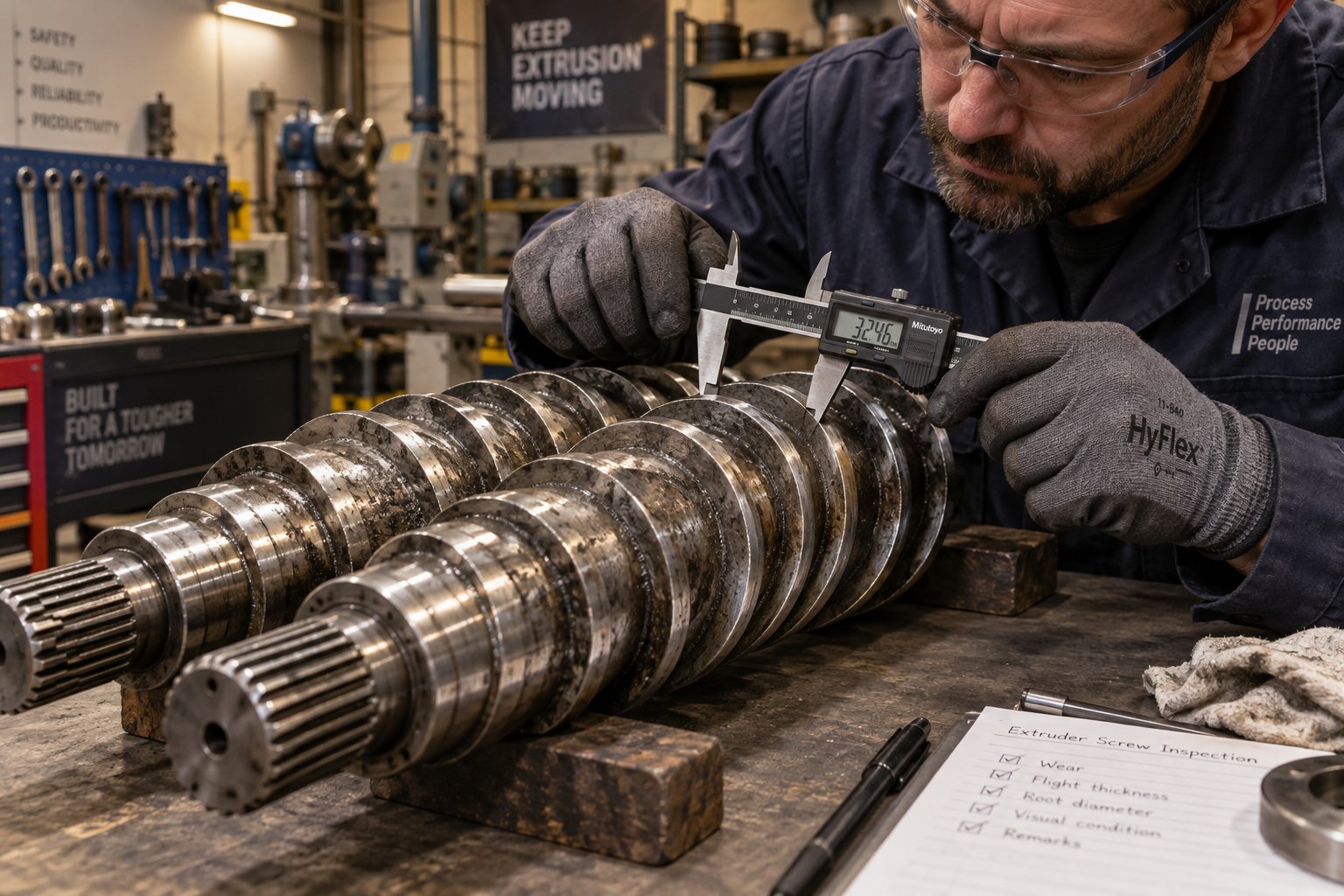
- Screw flight erosion: The outermost edges of the screw flights — the flight tips — bear the brunt of wear because they operate closest to the barrel wall with the thinnest material film between them. As these flight tips erode, the clearance between screw and barrel increases. That widening gap allows more material to leak backward over the flights rather than being conveyed forward, reducing output efficiency and increasing discharge temperature. Research from extrusion wear analysis demonstrates that even modest wear — increasing flight clearance from 0.005 inches to 0.016 inches on a 100 mm screw — can force a 13% rate reduction to maintain acceptable discharge temperatures.
- Corrosion from PVC decomposition byproducts: PVC releases hydrochloric acid (HCl) gas when it thermally degrades, even in small amounts during normal processing. This acidic environment attacks barrel and screw surfaces from the inside, creating pitting and surface roughening that accelerates abrasive wear. The corrosion effect is continuous and cumulative — a machine processing PVC for 6,000 hours per year faces relentless chemical attack that standard nitrided steel simply cannot resist over the long term.
Proactive inspection is the difference between a planned barrel swap and an emergency shutdown. Experienced operators monitor several leading indicators: rising specific energy consumption (kWh/kg) at constant output, increasing discharge temperature at constant screw speed, visible changes in melt quality or product dimensions, and higher motor amperage draw indicating the screws are working harder to maintain throughput. When these indicators trend upward consistently, it is time to measure barrel bore diameter and screw flight dimensions directly.
When should you replace rather than rebuild? Industry practice from extrusion specialists offers a practical guideline: replacement becomes more economical than rebuilding when the flight clearance reaches approximately four times the original new clearance. Additionally, a screw should never be refurbished more than three times — each re-application of hard facing degrades the base metal, increasing the risk of delamination between the hard facing and the substrate. A barrel with a bimetallic liner typically lasts about three times the service life of a screw, so coordinating replacement schedules between the two components avoids the costly situation of installing a new screw into a worn barrel, which accelerates wear on both.
One critical practice that many operations neglect: keeping a spare screw set in storage. When the current screws reach end of life, a ready spare can be installed during a planned maintenance window — hours of downtime instead of weeks spent waiting for a replacement to be manufactured and shipped. The worn screws then get evaluated for refurbishment or replacement while the line continues producing revenue.
Calculating Total Cost of Ownership Beyond Purchase Price
The initial machine price — whether it is $45,000 for a Chinese-built 65/132 or $150,000 for a European equivalent — represents only a fraction of what you will actually spend over the machine's productive life. Industry TCO analysis suggests that the purchase price accounts for just 30-50% of the total five-year cost of ownership. The rest accumulates through operating expenses that many buyers underestimate or ignore entirely during the purchasing decision.
Here are the TCO components that deserve explicit calculation before you sign any purchase order:
- Energy consumption patterns: Specific energy (kWh/kg) varies significantly between manufacturers and quality tiers. A machine consuming 0.55 kWh/kg versus one at 0.35 kWh/kg — running 4,000 hours annually at 300 kg/hr — costs roughly $24,000 more per year in electricity at $0.10/kWh. Over five years, that is $120,000 in excess energy cost. A co extruder or co extruders arrangement running multiple material streams amplifies this differential further.
- Wear part replacement frequency and cost: Entry-level barrel and screw sets may need replacement every 3,000-6,000 operating hours. Premium bimetallic components can last 15,000-25,000 hours. At $5,000-15,000 per screw and barrel set (depending on size and metallurgy), the replacement cadence alone can create a $20,000-50,000 cost difference over five years between quality tiers.
- Training requirements: A machine with sophisticated PLC controls and recipe management reduces operator error but requires initial training investment. A basic machine with manual controls demands less upfront training but creates ongoing quality variability costs — higher scrap rates, slower changeovers, and inconsistent product dimensions that may not surface as a line item but erode margins continuously.
- Installation and commissioning costs: Some manufacturers include on-site commissioning, operator training, and initial production run supervision in their pricing. Others quote the bare machine and charge separately for every service day — sometimes $500-1,000 per day plus travel expenses. Clarify this before comparing quotes.
- Shipping and import duties: Ocean freight, inland transport, customs clearance fees, and applicable tariffs can add 10-20% to the machine's FOB price depending on origin and destination. These costs are fixed and non-recoverable — they belong in your TCO calculation, not as a surprise after the deal closes.
- Ongoing technical support quality: What happens when your machine throws an unfamiliar fault code at 3:00 AM during a critical production run? Manufacturers with responsive technical support — phone, video call, or remote PLC access — resolve issues in hours. Those without leave you troubleshooting alone, potentially for days. Each hour of unplanned downtime carries a calculable cost in lost production and delayed orders.
The math is sobering. Comparative TCO data illustrates that a lower-priced machine at $60,000 can accumulate $490,000 in total five-year costs — driven by higher energy consumption, frequent screw replacements, gearbox repairs, and 10% production downtime — while a higher-quality $150,000 machine totals $270,000 over the same period with routine maintenance only and just 1% downtime. The "expensive" machine saves $220,000. The "cheap" machine costs 45% more to own.
Print this reality on your wall before your next purchasing meeting. The question is never "what does this machine cost?" The question is "what will this machine cost me over the next five years of continuous operation?"
Building a Long-Term Supply Partnership
Here is the strategic insight that the most experienced PVC extrusion operators understand but rarely articulate explicitly: your relationship with a reliable wear parts supplier is as valuable as your relationship with the original equipment manufacturer — sometimes more so.
Think about it practically. Your extruder OEM built the machine. But over a 15-year service life, you will likely replace the screw and barrel set three to five times. Each replacement cycle involves sourcing components that must match your barrel bore dimensions, screw taper geometry, metallurgy specifications, and mounting interfaces precisely. If the OEM has long lead times, discontinued your barrel specification, or simply does not prioritize aftermarket parts — a common situation with manufacturers focused on new machine sales — your production stability depends on having an alternative supply partner who specializes in exactly these components.
This is where dedicated barrel and screw suppliers create strategic value that extends well beyond a single transaction. NANHAIYA, for example, serves PVC pipe, PVC profile, PVC board, foam board, and WPC extrusion manufacturers with custom and replacement conical twin screw barrels engineered for stable plasticizing and extended service life. Rather than treating wear part replacement as a reactive emergency, manufacturers who establish a standing relationship with a dedicated supplier like NANHAIYA gain several compounding advantages:
- Faster replacement turnaround: A specialist supplier with your barrel specifications already on file can begin production immediately upon order — eliminating the engineering review and specification confirmation steps that slow first-time orders.
- Metallurgy matched to your specific application: If you process CaCO3-filled PVC pipe compound, your barrel liner needs different wear characteristics than one processing unfilled PVC profile or abrasive WPC formulations. A dedicated supplier engineers each barrel to the actual wear environment rather than offering a one-size-fits-all solution.
- Reduced downtime risk through planned inventory: As spare parts strategy analysis emphasizes, the stocking decision for critical components should weigh criticality, failure probability, and lead time. For high-criticality, long-lead-time parts like conical twin screw barrels, maintaining a relationship with a responsive supplier — or stocking a spare set — transforms what would be weeks of emergency downtime into a planned maintenance event lasting hours.
- Cost predictability over the machine's life: Knowing your barrel replacement cost, lead time, and supplier reliability years in advance lets you budget maintenance expenses accurately rather than absorbing unpredictable cost spikes when wear forces an urgent order.
The best time to identify and qualify a wear parts supplier is before you need one — ideally during the initial machine purchase phase, when you can evaluate barrel specifications, compare metallurgy options, and establish a supply relationship without the pressure of a production line sitting idle. NANHAIYA's conical twin screw barrel catalog is a practical starting point for manufacturers seeking production support through precision-manufactured replacement barrels tailored to their specific extrusion applications.
Ultimately, every insight in this article — from understanding screw geometry and comparing architectures to evaluating manufacturers and calculating total cost of ownership — converges on a single principle: the conical twin screw extruder manufacturer you choose shapes your production economics for a decade or longer. The machine itself is important. But the ecosystem surrounding it — the parts suppliers, the technical support infrastructure, the maintenance planning, and the quality of the engineering decisions embedded in every component — determines whether that investment compounds value or compounds cost. Buy with that full picture in mind, and you will join the minority of buyers who get this decision right the first time.
Frequently Asked Questions About Conical Twin Screw Extruder Manufacturers
1. What is the difference between a conical and parallel twin screw extruder?
A conical twin screw extruder uses two tapered, counter-rotating screws that narrow from the feed end to the discharge end, creating natural compression suited for heat-sensitive materials like PVC. A parallel twin screw extruder uses uniform-diameter screws, typically co-rotating, delivering higher shear and throughput for compounding and engineering plastics. Conical designs offer a compact footprint, lower capital cost, and gentler processing, while parallel designs provide modular screw configurations and superior dispersive mixing for multi-material formulations. Your choice depends on whether your primary application demands low-shear PVC processing or high-volume compounding flexibility.
2. How do I choose the right conical twin screw extruder manufacturer?
Start by matching the manufacturer to your buyer profile. Startups should prioritize after-sales service, operator training, and turnkey commissioning support. Mid-scale upgraders need proven compatibility with existing downstream equipment and fast spare parts delivery. Large producers benefit from manufacturers offering deep customization, vertical integration in screw and barrel production, and long-term technical partnerships. Verify ISO 9001 and CE certifications independently, request customer references running similar applications for at least two years, and confirm whether the company is a genuine manufacturer or a trading company. NANHAIYA, for example, supports PVC extrusion manufacturers with custom and replacement conical twin screw barrels engineered for stable plasticizing, illustrating the value of a dedicated wear-parts partner.
3. What are common screw diameter sizes for conical twin screw extruders?
Common designations include 51/105, 55/110, 65/132, 80/156, and 92/188, where the first number is the small-end (discharge) diameter and the second is the large-end (feed) diameter in millimeters. Smaller sizes like 51/105 and 55/110 suit low-volume pipe and profile production. The 65/132 is the industry workhorse for mid-range pipe diameters and most profile geometries. Larger models such as 80/156 and 92/188 handle high-output, large-diameter pipe and thick board extrusion. L/D ratios typically range from 22:1 to 28:1, calculated using the large-end diameter, and directly affect residence time and mixing quality.
4. How much does a conical twin screw extruder cost over its lifetime?
The purchase price typically represents only 30-50% of the total five-year cost of ownership. Ongoing costs include energy consumption, wear part replacements, training, installation, shipping, import duties, and technical support. A lower-priced machine at $60,000 can accumulate over $490,000 in total five-year costs due to higher energy use, frequent screw and barrel replacements, and 10% downtime. A higher-quality $150,000 machine may total around $270,000 over the same period with routine maintenance and just 1% downtime. Evaluating specific energy consumption in kWh/kg, barrel metallurgy tier, and gearbox quality before purchasing prevents hidden costs from eroding profitability.
5. How often should conical twin screw extruder barrels and screws be replaced?
Replacement intervals depend heavily on metallurgy and the materials being processed. Entry-level nitrided steel components may last 3,000-6,000 operating hours, mid-range bimetallic barrels reach 8,000-15,000 hours, and premium tungsten carbide or boron-carbide lined barrels can exceed 15,000-25,000 hours. Key wear indicators include rising specific energy consumption, increasing discharge temperature at constant screw speed, and dimensional drift in finished products. Industry best practice recommends replacing screws when flight clearance reaches four times the original specification and limiting screw refurbishment to three cycles maximum. Partnering with a specialist supplier like NANHAIYA for replacement conical twin screw barrels ensures metallurgy-matched components and faster turnaround than relying solely on the original equipment manufacturer.
Written by
Nanhaiya Technical Team
Zhoushan Nanhaiya Plastic Machinery Co., Ltd.
The Nanhaiya technical team supports screw and barrel manufacturing projects through application review, technical communication, custom manufacturing coordination, and production and quality control.
Discuss Your Application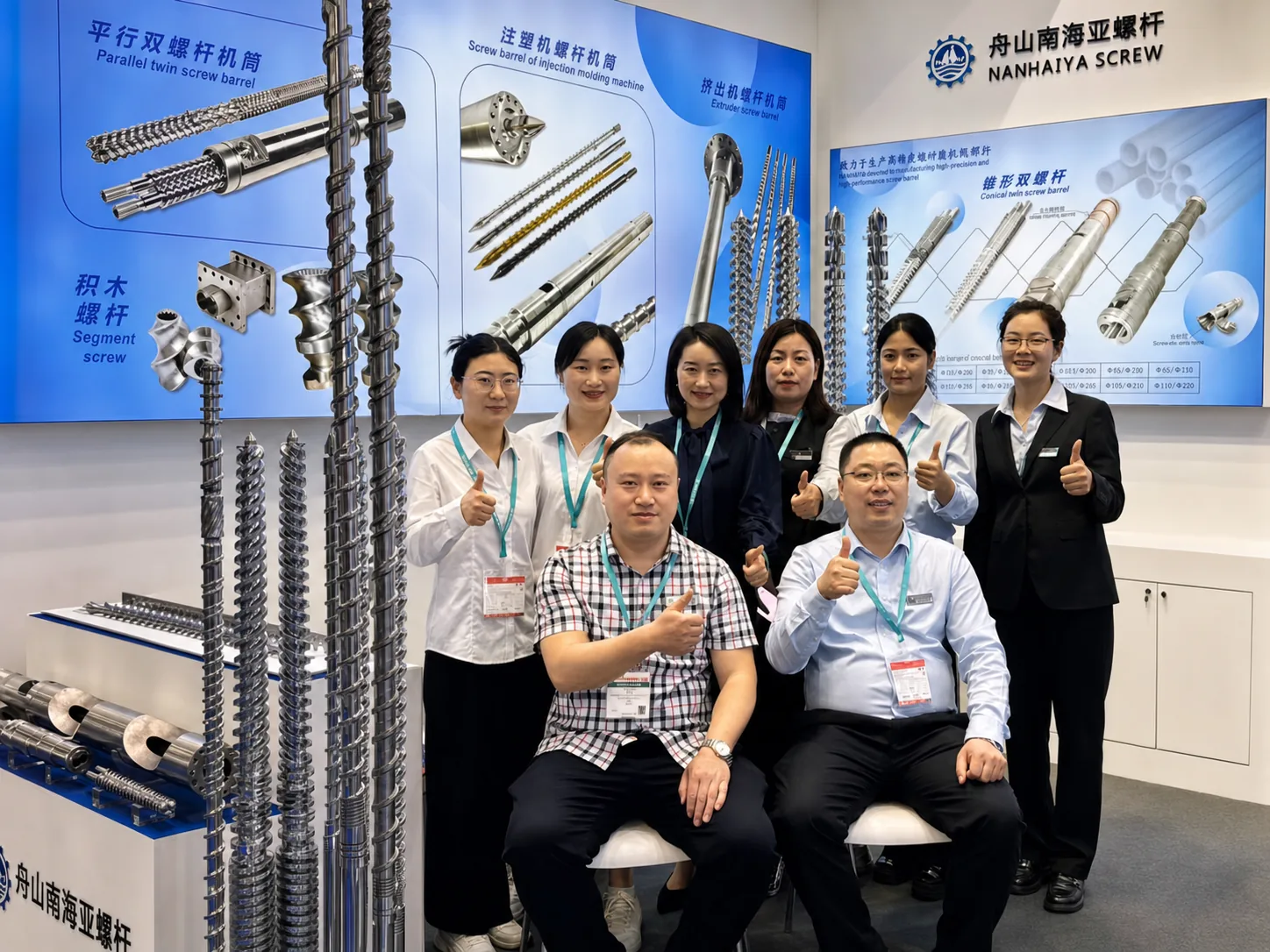
Related Articles
More insights on screw barrel technology and plastics processing.
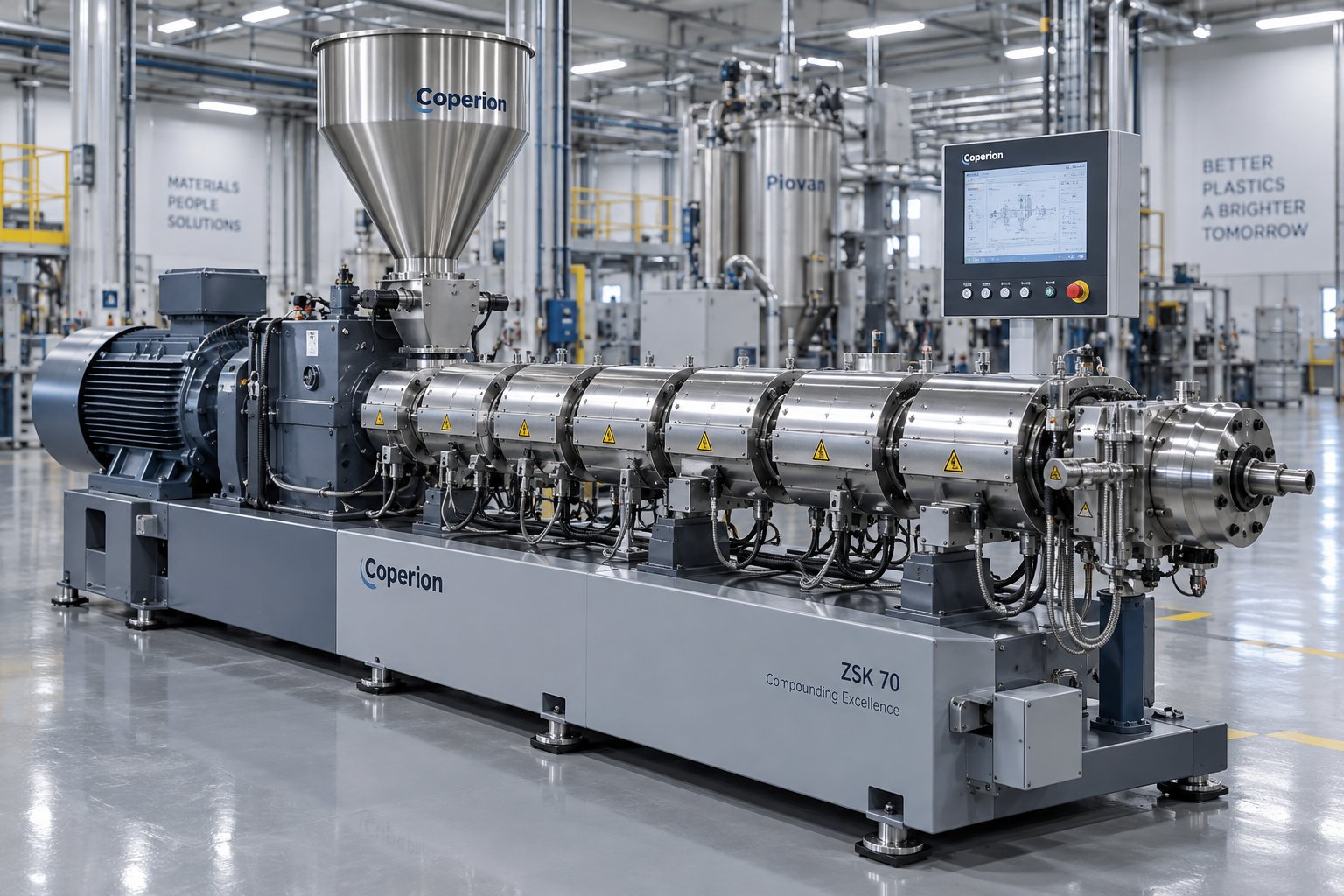
What Your Single Screw Extruder Manufacturer Won't Tell You
Oct 10, 2026
Learn how to evaluate single screw extruder manufacturers with this buyer-focused guide covering specs, configurations, material matching, and a ready-to-use selection checklist.
Read Article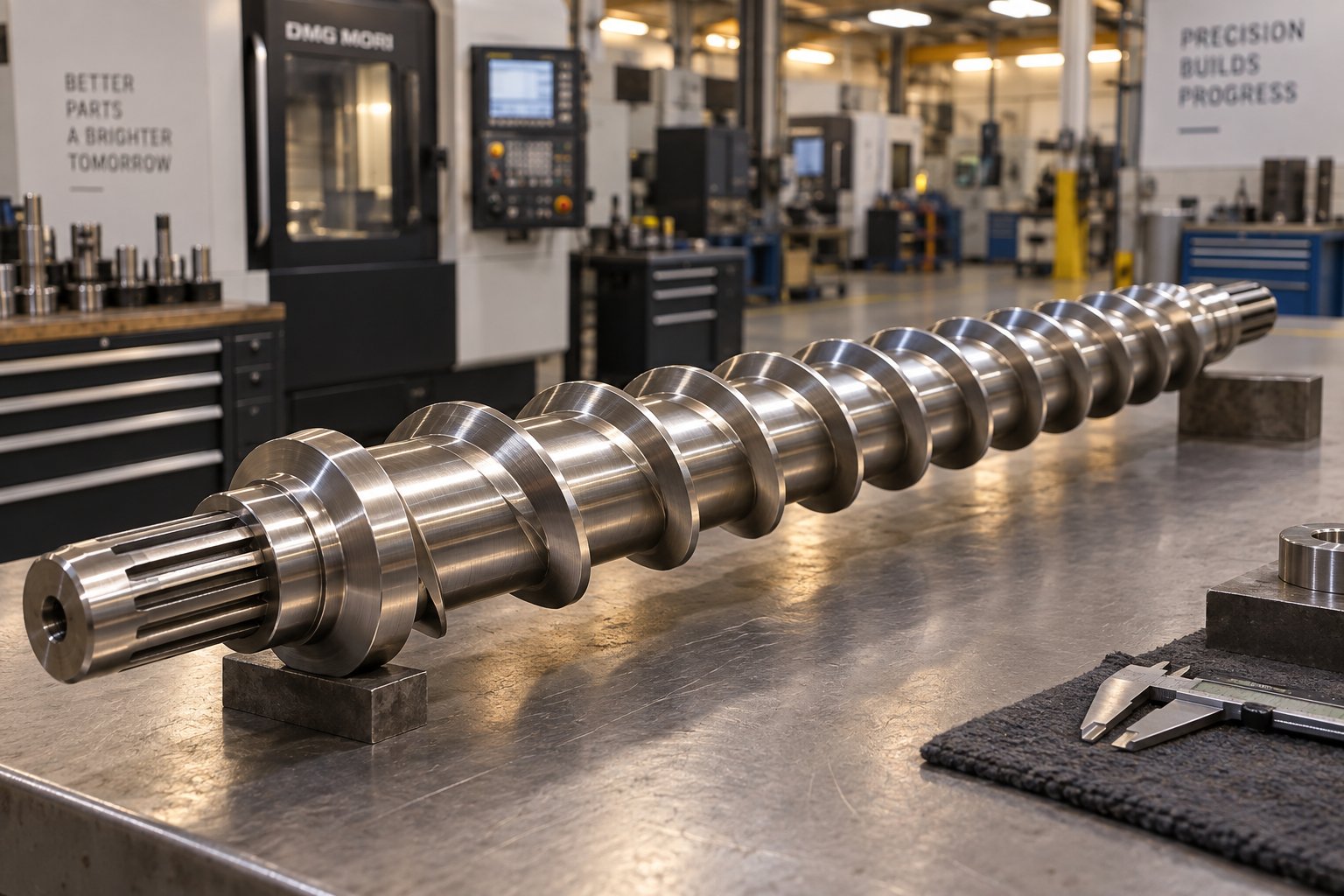
Plastic Extruder Screw Price Demystified: From Steel To Sticker
Oct 10, 2026
What drives plastic extruder screw price? This independent guide breaks down diameter, L/D ratio, metallurgy, order volume, and total cost of ownership factors.
Read Article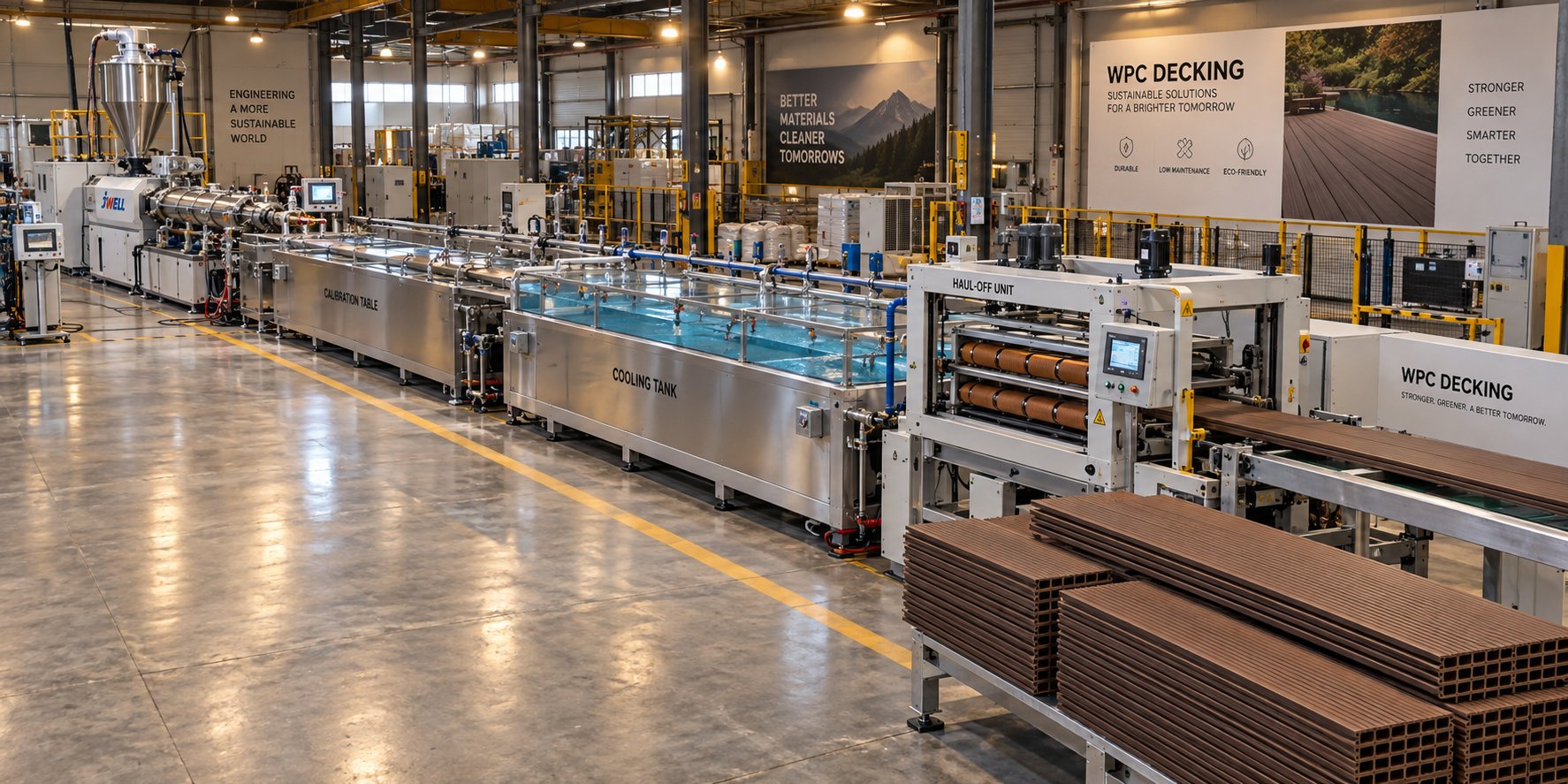
What No Supplier Tells You About WPC Decking Making Machines
Oct 6, 2026
Learn how a WPC decking making machine works, compare extruder types, formulations, and production methods, plus get a buyer checklist to evaluate any supplier.
Read ArticleLooking for something else?
Search by material, symptom or product and jump straight to the relevant page.
These are navigation suggestions based on keyword matching — not a quotation, not a delivery commitment, and not a substitute for engineering review. Final specification is confirmed by our engineers against your drawings and processed material.
Need help with screw barrel selection?
Share your machine model, processed material and application. Our team can help with pricing and technical support.