

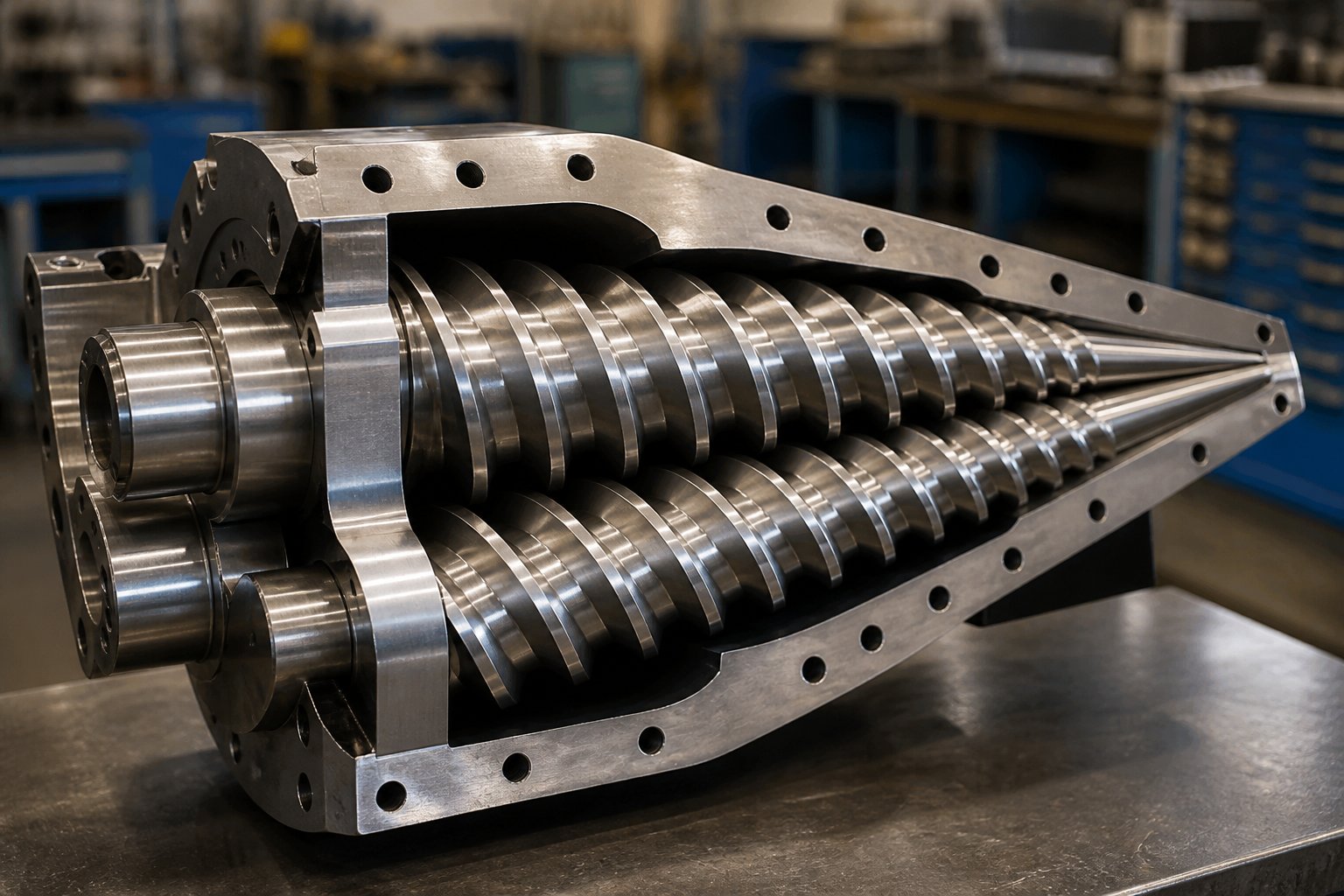
What Is a Conical Twin Screw Barrel and Why Does It Exist
A conical twin screw barrel is a tapered extrusion component in which two counter-rotating screws sit inside a gradually narrowing barrel bore. Raw material enters through a wide feed end, and as it travels toward the smaller discharge end, the shrinking channel volume generates progressive compression. This built-in geometric squeeze melts, mixes, and pressurizes polymer without relying entirely on complex screw-flight engineering. Think of it as a funnel with moving parts — except every millimeter of that taper is doing real thermomechanical work.
Why does this matter? A single-screw extruder pushes material forward with one rotating element, limiting its mixing power and making it less effective with difficult-to-process polymers like rigid PVC. A twin screw setup doubles the active surfaces, and when those screws are tapered, you gain a compression advantage that a constant-diameter design simply cannot replicate through geometry alone.
What Defines a Conical Twin Screw Barrel
At its core, every conical twin screw and barrel assembly shares the same anatomy. Two tapered screws — each with a larger root diameter at the feed section and a progressively smaller diameter toward the tip — nestle inside a matched barrel housing. That housing can be a split design for easier maintenance access or a single-piece construction for maximum rigidity.
Three additional features complete the picture:
- Feed throat: an opening at the wide end where dry-blend powder or pellets enter the barrel bore.
- Barrel bore: a precision-machined, tapered dual-bore cavity that mirrors the screw taper angle.
- Discharge flange: the narrow exit end where molten polymer is pushed toward a die head or downstream tooling.
Unlike a parallel twin screw system — where both screws share a constant diameter and often rotate in the same direction — conical twin screw barrels use counter-rotating screws that mesh inward. This inward rotation creates a calendering nip between flights, pulling material downward and forward with a positive conveying action that improves feed consistency.
Why Conical Geometry Matters in Extrusion
You might wonder: why taper the screws at all? The answer involves three distinct engineering advantages.
First, the larger screw root diameter at the feed zone provides a bigger cross-section for the drive shaft. That translates directly into higher torque transmission right where material resistance is greatest — at initial intake. Second, the decreasing free volume along the barrel length creates a natural compression ratio. Material densifies simply by moving forward, which means air expulsion and pressure buildup happen smoothly rather than through abrupt geometric transitions. Third, the tapered layout yields a remarkably compact machine footprint compared to parallel designs with equivalent output, because the wide feed section and narrow discharge can be packed into a shorter overall length.
The taper itself functions as a compression mechanism, reducing reliance on complex flight geometries.
This gentle, geometry-driven compression is exactly why conical twin screw barrels became the industry-standard choice for heat-sensitive polymers like PVC. Excessive shear destroys PVC before it fully plasticizes, so the gradual squeeze of a conical bore keeps frictional heat manageable while still achieving thorough melting.
Of course, understanding why the geometry works is only half the picture. The real question is what happens to your raw material once it enters that tapered bore — how each zone transforms loose powder into a homogeneous, pressurized melt ready for shaping.
How a Conical Twin Screw Barrel Actually Works
Drop a handful of dry PVC powder into a hopper, and a few seconds later a smooth, pressurized melt exits the discharge flange. What happens in between is a precisely orchestrated sequence of conveying, compressing, heating, and homogenizing — all governed by the interaction between two tapered screws and their matched barrel bore. Understanding the conical twin screw barrel working principle at each stage helps you optimize screw speed, temperature settings, and output quality rather than relying on trial and error.
Counter-Rotating Screw Mechanics
Inside every twin conical screw and barrel assembly, the two screws rotate inward — meaning each screw turns toward the other at the top of the nip point. Imagine two rollers in a calendering mill pulling a sheet of rubber downward between them. The same principle applies here: material caught between the intermeshing flights is dragged forward and downward with a strong positive displacement action. This is fundamentally different from a co-rotating parallel system, where material can circulate in figure-eight patterns. Counter-rotation in a conical design creates distinct, sealed pockets of material between flights, delivering consistent forward conveyance with minimal backflow.
That positive displacement matters because PVC dry blends are notoriously poor at flowing. The inward-rotating flights essentially grab the powder, eliminating the slip and bridging problems that plague single-screw extruders processing the same formulation. As the screws mesh, they also generate controlled frictional heat — not through brute screw speed (conical systems typically run at just 20 to 50 rpm), but through the repeated shearing action at flight tips and the calendering nip itself.
The tapered barrel bore divides this work into three functional zones, each with a distinct thermomechanical role:
- Feed zone: Located at the wide end of the barrel, this section has the deepest screw channels and the largest free volume. Its job is simple — accept incoming material from the hopper and begin moving it forward. The generous channel depth accommodates low-bulk-density powders without starving the screw.
- Compression zone: As the screws taper, channel depth decreases and material is forced into a progressively smaller space. Air trapped between powder particles is squeezed backward and expelled through the feed throat. Simultaneously, frictional heat and conducted heat from barrel heaters begin softening the polymer.
- Metering zone: Near the narrow discharge end, channel depth reaches its shallowest point. By this stage, the material is fully molten. The metering zone's role is to deliver a uniform, pressurized melt stream to the die head at a consistent volumetric flow rate.
The beauty of the conical geometry is how it transitions material through these three zones without abrupt pressure spikes. In a parallel twin screw system, compression must be engineered entirely through changing flight depths or element configurations. In conical twin screws and barrel assemblies, the taper itself provides a smooth, continuous compression gradient — the barrel literally narrows around the material, steadily increasing pressure from feed to discharge.
Compression Ratio and Melt Pressure Development
Compression ratio in a conical system describes the relationship between the free volume per unit length at the feed end and the free volume per unit length at the discharge end. A higher ratio means the material undergoes more volumetric reduction as it travels down the barrel, generating greater compressive work. Typical values range from roughly 2:1 to 4:1, selected based on the bulk density of the feed material and its thermal sensitivity.
Here is where how conical twin screw barrel works becomes especially elegant. Because the taper angle is fixed by the barrel geometry, the compression ratio is largely built into the hardware. Screw speed and back pressure from the die then fine-tune how that geometric compression translates into actual melt quality. Run the screws too fast, and excessive frictional heat can degrade PVC before it fully gels. Run them too slowly, and incomplete plasticization produces a melt riddled with unmelted particles and poor mechanical properties.
The entire plasticization journey follows a clear sequence from powder to pressurized melt:
- Material intake and initial conveying — Dry blend powder or pellets fall from the hopper into the deep-channel feed zone. Counter-rotating flights grip the material and push it forward with positive displacement.
- Densification and air expulsion — As the channel narrows in the compression zone, powder particles are packed tightly together. Trapped air is driven backward toward the feed throat and vented out of the system.
- Frictional and conductive heating — Shearing at flight tips and barrel-wall contact transfers heat into the compacted material. Barrel-mounted heaters supplement this frictional energy, raising the polymer to its softening temperature.
- Full plasticization and homogenization — The material transitions from a partially softened mass to a fully molten, continuous phase. Intermeshing flight geometry folds and re-folds the melt, distributing temperature and any additives evenly throughout the polymer matrix.
- Metered output through the discharge — The shallow metering zone delivers the homogenized melt at a stable pressure and flow rate to the die head, where it is shaped into the final product — whether pipe, profile, sheet, or foam board.
Each of these stages depends on the one before it. Skip proper densification, and air pockets survive into the melt. Rush the heating phase, and you get cold spots surrounded by overheated material that has already started degrading. The conical twin screw barrel working principle succeeds precisely because the tapered geometry paces each transition naturally, giving the polymer exactly the time and compression it needs at every point along the bore.
Melt pressure at the discharge typically settles between 15 and 30 MPa for rigid PVC applications, though the exact value depends on die resistance, screw speed, and formulation viscosity. Monitoring this pressure in real time provides one of the clearest indicators of process health — a slow drift upward may signal a partially blocked screen pack, while a sudden drop could point to worn screw flights that can no longer maintain the seal between material pockets.
This interplay between geometry, speed, and thermal input raises a natural question: if the taper handles compression so effectively, what distinguishes a conical configuration from its parallel twin screw counterpart in practice — and where does each design genuinely excel?
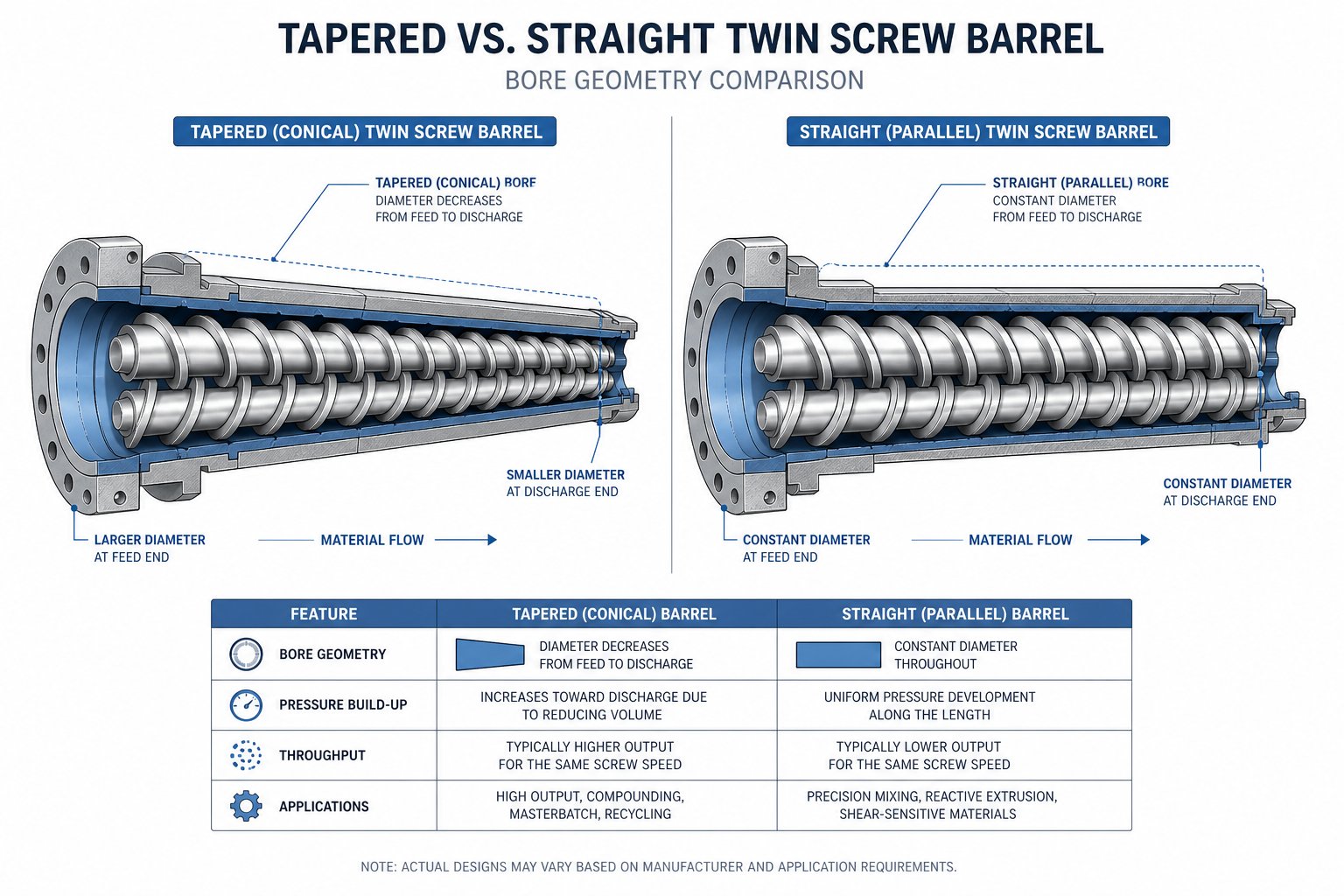
Conical vs Parallel Twin Screw Barrels Compared
Geometry, speed, and thermal input shape melt quality in every conical system — but the same processing goals can also be met with a parallel twin screw barrel. So which configuration actually wins? The honest answer is neither, universally. Each design carries genuine engineering trade-offs, and a credible conical twin screw barrel comparison demands acknowledging where the conical layout falls short alongside where it excels.
Geometric and Mechanical Differences
The most visible distinction is the bore itself. A conical extruder twin screw barrel tapers from a large feed-end diameter to a smaller discharge diameter, while a parallel barrel maintains a constant bore diameter from end to end. That single geometric difference cascades into almost every performance characteristic.
Consider torque distribution. The conical screw's wider root at the feed section provides a larger shaft cross-section, enabling robust torque transmission at low speeds — typically 20 to 50 rpm. Parallel screws, sharing a constant and usually smaller diameter, compensate by running at much higher speeds (often 100 to 600 rpm), relying on complex high-speed gearboxes to deliver the required energy input.
L/D ratio tells another part of the story. Conical designs generally operate at lower L/D ratios — around 22:1 to 28:1 — compared to parallel configurations that commonly reach 30:1 to 40:1 or higher. What does that mean in practice? A shorter effective barrel length gives the polymer less residence time and less total thermal exposure. For heat-sensitive materials like rigid PVC, that's a clear advantage: less time at elevated temperatures means less risk of degradation. For compounding applications that need extended mixing or reactive dwell time, however, the shorter conical barrel becomes a limitation.
Footprint differences are equally practical. Because the wide feed end and narrow discharge of a conical barrel pack into a compact envelope, the extruder conical twin screw barrel system occupies significantly less floor space than a parallel unit with comparable output — a meaningful benefit in crowded production halls.
Performance Trade-Offs for Different Applications
The table below lays out a side-by-side conical vs parallel twin screw barrel comparison across the dimensions that matter most during equipment selection:
| Performance Dimension | Conical Twin Screw Barrel | Parallel Twin Screw Barrel |
|---|---|---|
| Torque Capacity at Feed | High — large root diameter enables strong low-speed torque | Moderate — requires complex high-speed gearbox |
| Typical L/D Ratio | 22:1 to 28:1 | 30:1 to 40:1+ |
| Maximum Output Rate | Moderate — suited to lines up to ~800 kg/h depending on screw size | High — scalable to very high throughputs for compounding lines |
| Machine Footprint | Compact — tapered geometry shortens overall length | Larger — constant-diameter screws require greater barrel length |
| Scalability for High-Volume Production | Limited — output ceiling constrained by taper geometry | Strong — modular screw elements and large L/D support scale-up |
| Shear Sensitivity Handling | Excellent — low rpm and gentle geometric compression minimize shear damage | Moderate — higher screw speeds generate more frictional heat |
| Screw Design Flexibility | Fixed taper; compression ratio set by screw selection | Modular segments allow on-the-fly reconfiguration |
| Typical Polymer Applications | PVC pipe, PVC profiles, WPC, foam board | Compounding, masterbatch, reactive extrusion, engineering plastics |
A few entries in that table deserve extra honesty. The conical barrel's lower throughput ceiling and limited scalability are real constraints. If your production line demands multi-ton-per-hour compounding rates or frequent screw-element changes for different formulations, a parallel system is almost certainly the better fit. Conical designs are not infinitely scalable the way modular parallel systems can be, and manufacturers who suggest otherwise are glossing over physics.
Where conical twin screw barrels genuinely dominate is shear-sensitive processing. PVC — especially rigid PVC for pipes and window profiles — degrades rapidly when subjected to excessive shear heat. The conical barrel's low-speed, high-torque operation and built-in geometric compression keep frictional temperatures in check while still achieving thorough plasticization. Wood-plastic composite (WPC) extrusion follows a similar logic: the abrasive wood-flour blends benefit from gentle handling and the large feed zone's ability to ingest low-bulk-density material without bridging.
Specific energy consumption reinforces this point. Conical twin screw extruders processing rigid PVC typically achieve values around 0.12 to 0.22 kWh/kg, reflecting the efficiency of converting motor torque into melt pressure through taper geometry rather than high screw speed.
So the real takeaway isn't which design is "better" — it's which design matches your material, your output target, and your quality requirements. For PVC and WPC processors who value consistent plasticization and thermal safety over raw throughput, the conical configuration remains the industry-standard choice. For high-volume compounders chasing maximum mixing intensity and formulation flexibility, parallel barrels earn their place.
Whichever configuration you choose, though, the barrel and screw materials that sit behind the geometry ultimately determine how long that performance lasts — and that's a topic most equipment discussions skim over far too quickly.
Material Science Behind Barrel and Screw Construction
Geometry gives a conical twin screw barrel its processing character — but the metals and coatings lining that bore determine whether it delivers years of stable output or wears out in under a year. Two barrels with identical taper angles and screw diameters can have wildly different service lives depending on the conical twin screw barrel material choices made during manufacturing. Understanding these choices lets you specify the right protection level for your application instead of over-spending on premium alloys you don't need or under-specifying and paying the price in downtime.
Base Materials and Alloy Compositions
Every conical twin barrel screw assembly starts with a substrate steel — the structural backbone that provides mechanical strength, dimensional stability, and fatigue resistance under continuous thermal cycling. Two grades dominate the industry:
- 38CrMoAlA — A chromium-molybdenum-aluminum alloy steel widely used across Chinese and Asian barrel manufacturing. It responds exceptionally well to gas nitriding, forming a hard surface case while the core retains toughness at roughly 280–320 HB. Think of it as the workhorse: affordable, well-understood, and perfectly adequate for standard PVC processing without aggressive fillers.
- 42CrMo — A higher-toughness steel with better impact resistance, often selected for larger-diameter barrels where mechanical loads on the housing are more severe. It lacks the aluminum content that makes 38CrMoAlA ideal for nitriding, so it's more commonly used as the outer shell in bimetallic constructions rather than as a stand-alone nitrided barrel.
For processors running clean, unfilled or lightly filled PVC, a nitrided 38CrMoAlA barrel can deliver several years of reliable service. The nitriding process diffuses nitrogen into the bore surface at 500–550°C, creating a hardened case approximately 0.4–0.6 mm deep with surface hardness in the range of 950–1,100 HV (roughly 65–70 HRC equivalent). That's impressively hard — harder, in fact, than many bimetallic liners at the surface level.
The catch? Depth. Once abrasive wear chews through that thin hardened layer, the soft core beneath is exposed and wear accelerates dramatically. There is no second line of defense. For standard PVC dry blends with minimal filler content, this isn't a problem. But introduce 20% or more calcium carbonate, titanium dioxide, or wood flour, and that 0.5 mm case can be breached within 12 to 18 months of continuous operation.
That limitation is exactly why bimetallic conical twin screw barrel technology exists. Instead of hardening the surface of a single steel, bimetallic barrels use a centrifugally cast alloy liner — typically 1.5 to 3.0 mm thick — metallurgically bonded to the inside of the barrel bore. The centrifugal casting process, performed at approximately 1,100°C with the barrel shell rotating at controlled speed, produces a uniform, pore-free wear layer that extends five to six times deeper than a nitrided case.
Two alloy families cover the vast majority of conical barrel applications:
- Iron-based (Fe-Cr-B) liners — These contain chromium and boron carbides dispersed in an iron matrix, delivering 58–62 HRC surface hardness. They provide cost-effective abrasion resistance for standard PVC formulations with moderate CaCO₃ loading. If your biggest concern is filler-driven wear rather than chemical attack, Fe-based liners offer a solid balance between protection and price.
- Nickel-based (Ni-Cr-B-W) liners — With a nickel matrix reinforced by chromium, boron, and tungsten carbides, these liners reach 60–65 HRC while adding superior corrosion resistance. PVC processing generates trace hydrochloric acid during thermal decomposition, and CPVC or halogenated flame-retardant formulations amplify that chemical aggression considerably. In these environments, the nickel matrix resists both the chemical attack and the mechanical abrasion simultaneously — something an iron-based alloy or a nitrided surface simply cannot match over the long term.
The trade-off is straightforward: Fe-based liners cost less and handle abrasion well, while Ni-based liners cost more but protect against the combined corrosive-plus-abrasive wear modes common in aggressive PVC and specialty formulations. Choosing between them comes down to your specific compound chemistry and filler loading.
Surface Treatments and Hardness Benchmarks
Hardness numbers appear on every barrel spec sheet, but they mean little without context. A surface measuring 65 HRC sounds impressive regardless of the treatment — yet the depth of that hardness and the mechanism providing it vary enormously, and those differences directly dictate practical wear life.
Gas nitriding, the most basic protection, produces the thinnest hardened zone. The diffused nitrogen case is extremely hard at the very surface (950–1,100 HV) but drops off steeply within fractions of a millimeter. For extreme-wear situations — high glass-fiber loading, mineral-reinforced engineering plastics, or heavily filled WPC — even bimetallic liners may benefit from an additional tungsten carbide overlay. WC-rich liners or HVOF (High Velocity Oxygen Fuel) tungsten carbide coatings push surface hardness into the 65–75 HRC range and provide the hardest commercially available bore surface for extruder barrels.
You can think of barrel protection as a hierarchy, where each tier adds cost but extends service life under increasingly demanding conditions:
- Standard nitrided (38CrMoAlA) — Surface hardness of 950–1,100 HV; effective wear depth of 0.4–0.6 mm. Best for clean polymers and lightly filled PVC. Lowest cost tier.
- Bimetallic Fe-based liner — Surface hardness of 58–62 HRC; wear-resistant layer 1.5–3.0 mm deep. Suited for moderate abrasion from CaCO₃, talc, and similar mineral fillers.
- Bimetallic Ni-based liner — Surface hardness of 60–65 HRC; same depth range with added corrosion resistance. Essential for PVC, CPVC, and halogenated compound processing.
- Tungsten carbide overlay (WC-rich or HVOF) — Surface hardness of 65–75 HRC. Reserved for the most severe abrasive environments: high glass-fiber content, heavy mineral reinforcement, or aggressive WPC formulations.
When evaluating any conical twin screw barrel material specification, always ask for the hardness profile — not just the peak surface number but how hardness varies from the bore surface through to the substrate. A reputable manufacturer will provide a metallurgical report showing this gradient, along with liner bonding integrity verification. That document is arguably the single most important quality control record for any bimetallic barrel.
Bore surface finish also matters more than many buyers realize. A honed bore roughness of Ra ≤ 0.4 µm reduces adhesive wear and improves melt film quality at the barrel wall, directly influencing plasticization consistency and final product surface appearance.
Selecting the right metallurgy protects the barrel bore — but it doesn't control the thermal environment that surrounds it. How heating and cooling zones are arranged along the tapered barrel body, and how precisely they maintain temperature, plays an equally critical role in both product quality and barrel longevity.
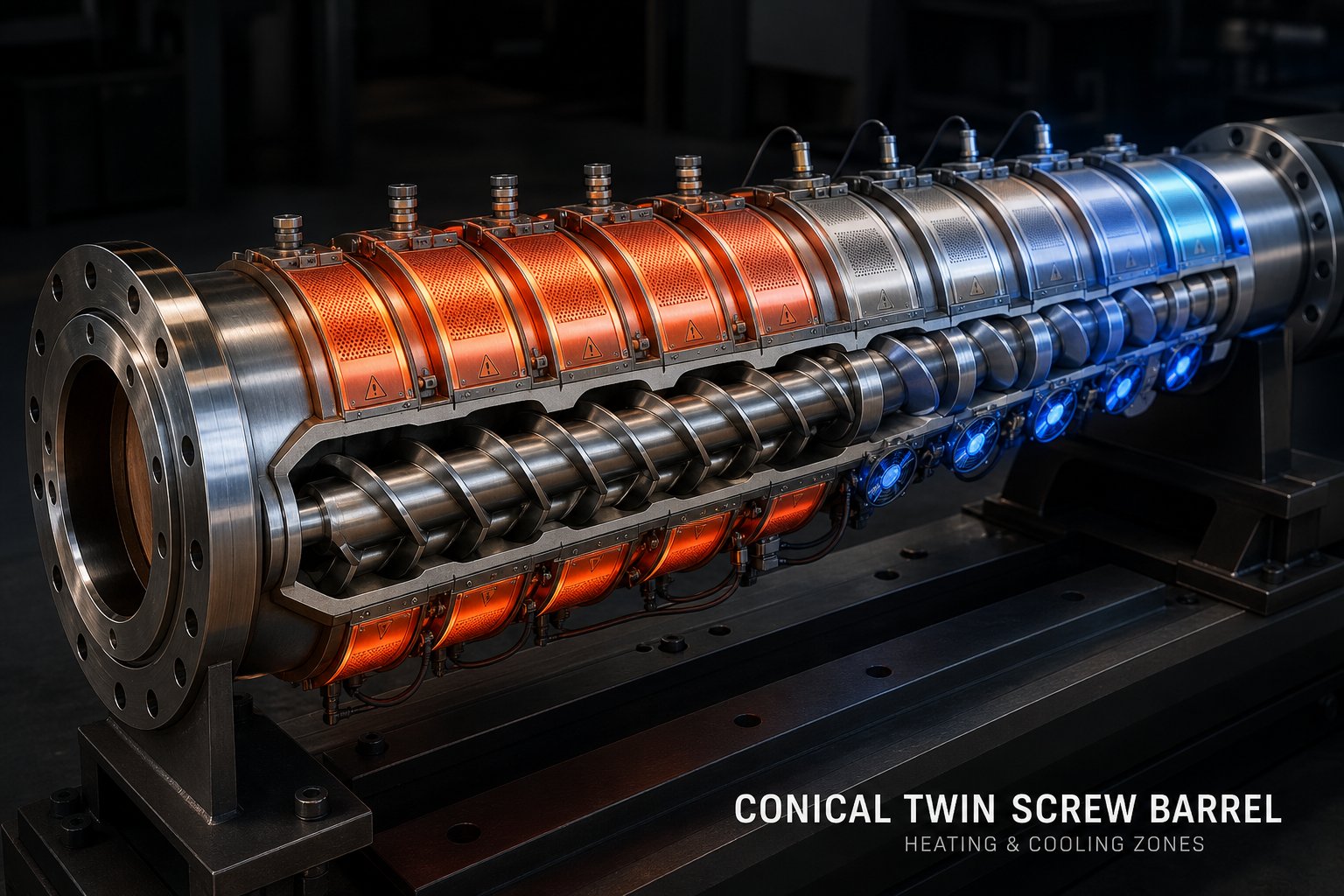
Heating, Cooling, and Temperature Zone Design
Imagine investing in a premium bimetallic liner only to watch product quality deteriorate because a single heating zone runs 12°C too hot. Metallurgy protects the bore surface — but conical twin screw barrel temperature control determines whether the polymer flowing through that bore gels properly or degrades before it ever reaches the die. The tapered geometry that makes conical systems so effective at compression also introduces unique thermal management challenges that flat-bore extruders never face.
Heating Zone Layout in Conical Barrels
A typical conical twin screw barrel features three to five independently controlled conical twin screw barrel heating zones arranged sequentially from the wide feed end to the narrow discharge flange. Each zone wraps around its section of the tapered body using cast aluminum heaters, ceramic band heaters, or — in newer installations — mica-insulated band heaters. The critical word here is "independently." Each zone receives its own thermocouple, its own temperature controller, and its own power supply circuit. That independence allows operators to build a deliberate temperature profile along the barrel's length rather than applying one uniform setpoint.
For rigid PVC processing, a representative temperature profile progresses roughly as follows:
| Zone | Location on Barrel | Typical Temperature Range | Primary Function |
|---|---|---|---|
| Zone 1 | Feed section (widest diameter) | 150–165°C | Preheat powder; avoid premature melting or bridging |
| Zone 2 | Early compression | 160–170°C | Begin softening; supplement frictional heat |
| Zone 3 | Mid-compression | 165–175°C | Drive gelation through combined conductive and shear heating |
| Zone 4 | Late compression / metering | 170–185°C | Complete plasticization; homogenize melt temperature |
| Adapter / Die | Discharge end (narrowest diameter) | 175–190°C | Maintain melt fluidity for die entry; control surface finish |
These ranges, drawn from established PVC processing guidelines, shift based on formulation, filler content, and output rate — but the upward progression from feed to die remains consistent across most rigid PVC applications.
Here's where conical geometry creates a thermal nuance that parallel barrels don't share. The feed zone — with its larger diameter and thicker barrel wall — carries significantly more thermal mass than the narrow discharge zone. That means Zone 1 responds more slowly to temperature changes. You'll notice that adjusting the feed-section setpoint by 5°C might take several minutes to stabilize, while the same adjustment at the metering end reaches equilibrium almost immediately. Operators who don't account for this asymmetric thermal response risk overshooting at the discharge end while waiting for the feed zone to catch up.
The decreasing cross-section also affects heat flux distribution. A ceramic band heater wrapped around the smaller-diameter metering zone covers less barrel surface area but heats a thinner wall, delivering energy into the melt more efficiently per watt than the same heater type at the feed section. Practical consequence? Feed-zone heaters often need higher wattage ratings to compensate for the greater thermal mass, while discharge-zone heaters must be carefully sized to avoid overheating a section that's already receiving substantial frictional energy from the fully molten polymer.
Cooling Systems and Thermal Balance
Heating alone doesn't maintain a stable temperature profile. Counter-rotating screws generate considerable frictional heat — especially in the compression zone where material densification and shear are highest. Without active cooling, this self-generated heat pushes barrel temperatures above setpoints, creating localized hot spots that can degrade PVC well before the melt exits the barrel.
Two cooling approaches dominate conical twin screw barrel designs:
- Forced-air cooling: Small blower fans mounted above each barrel zone direct ambient air across the barrel surface. This is the simpler and more common system, adequate for most standard PVC processing. Air cooling responds more slowly than liquid systems but is mechanically simple, inexpensive to maintain, and avoids any risk of coolant leaks contaminating the process.
- Liquid-cooled channels: Machined into the barrel housing or incorporated through jacketed barrel sections, these circulate oil or water for faster, more aggressive heat removal. Liquid cooling is favored in high-output lines or when processing materials that generate extreme frictional heat — heavy WPC formulations with high wood-flour loading, for example, or CPVC compounds that demand very tight thermal control.
In practice, heating and cooling systems work together in a continuous balancing act. The temperature controller for each zone constantly cycles between energizing the heater band and activating the cooling fan (or valve) to hold the barrel wall within a narrow window — often plus or minus 2°C of the setpoint. During steady-state operation, the compression zone frequently runs with heaters off and fans on, relying entirely on frictional energy from the screws while using forced air to bleed off excess heat. The feed zone, by contrast, typically requires net heat input because the incoming cold powder absorbs energy faster than friction can supply it.
Why does this matter so much for PVC specifically? Because PVC doesn't behave like polyethylene or polypropylene. It doesn't have a clean, forgiving melt transition. Instead, PVC must reach a state called "gelation" — where primary particles fuse into a continuous melt network — without exceeding the temperature at which thermal decomposition releases hydrochloric acid. That decomposition threshold sits uncomfortably close to the gelation range.
In PVC extrusion, the margin between proper gelation and thermal degradation can be as narrow as 10-15°C — precise zone control is not optional.
This razor-thin processing window explains why conical twin screw barrel temperature control receives so much engineering attention. A 10°C overshoot in one zone doesn't just produce an off-spec product — it can release corrosive HCl gas that attacks the barrel bore, accelerates wear on bimetallic liners, and poses safety risks for operators. Cooling systems are not optional accessories; they are essential safety and quality infrastructure.
Process Monitoring and Quality Control Integration
Holding a stable temperature profile means nothing if you can't verify it in real time. Modern conical twin screw systems integrate multiple sensor types to give operators — and increasingly, automated control systems — a comprehensive picture of process health:
- Thermocouples at each zone: Embedded in the barrel wall, these provide the feedback loop for individual zone controllers. J-type and K-type thermocouples are standard, with calibration checks recommended at regular intervals to prevent drift-related temperature errors.
- Melt pressure sensors: Positioned near the discharge flange, these transducers track the pressure of the fully plasticized melt. A steady pressure reading confirms stable output; a rising trend may indicate a clogging screen pack, while a falling trend could flag worn screw flights or inconsistent feeding.
- Melt temperature probes: Distinct from barrel-wall thermocouples, these protrude into the melt stream itself, capturing the actual polymer temperature rather than the barrel surface temperature. The difference between the two readings reveals how effectively heat is penetrating into the bulk material — a critical diagnostic for identifying under-gelation issues before they show up as visible defects in the finished product.
Emerging process analytical technology (PAT) takes this further. Some advanced extrusion lines now incorporate in-line near-infrared (NIR) spectroscopy or ultrasonic sensors that assess gelation level, filler dispersion, or moisture content continuously, providing real-time quality feedback rather than relying on periodic offline testing. While these tools remain more common in pharmaceutical and food extrusion, their adoption in PVC and WPC processing is accelerating as processors seek tighter quality assurance and reduced scrap rates.
The integration of precise thermal management with real-time monitoring transforms a conical twin screw barrel from a static hardware component into an actively controlled processing platform. Yet even the best temperature control means little if the barrel isn't matched to the right application — and the range of materials and products these systems handle extends well beyond the basic PVC pipe that most discussions fixate on.
Applications Across PVC, WPC, and Other Thermoplastics
Precise thermal control unlocks consistent melt quality — but that melt can be shaped into a surprisingly wide range of finished products. Many discussions treat the conical twin screw barrel as a single-purpose PVC pipe component. The reality is far broader. The same tapered barrel platform, paired with different screw geometries and die configurations, serves industries from construction and signage to outdoor decking and furniture manufacturing.
PVC Pipe and Profile Extrusion
Rigid PVC pipe remains the highest-volume application for a conical twin screw barrel for pipe production. Water supply, drainage, sewage, and electrical conduit lines all rely on extruded PVC tubes with consistent wall thickness and dimensional accuracy. The conical system's low-shear, counter-rotating action keeps frictional heat in check — exactly what rigid PVC demands, given its narrow processing window between proper gelation and thermal decomposition.
UPVC (unplasticized PVC) dominates cold-water supply and drainage applications, while CPVC — chlorinated PVC with a higher heat-deflection temperature — handles hot-water distribution and industrial chemical piping. CPVC processing pushes barrel temperatures higher and releases more hydrochloric acid during extrusion, making a Ni-based bimetallic liner essential rather than optional.
Beyond pipes, a conical twin screw barrel for PVC processing drives complex multi-cavity profile dies for window frames, door panels, siding, and cable trunking. These profiles often feature internal chambers for thermal insulation and structural reinforcement — geometries that demand an exceptionally homogeneous melt with zero unmelted particles or air inclusions. The conical barrel's gradual compression and thorough plasticization make it the industry-standard choice for these applications, precisely because profile dies are far less forgiving of melt inconsistencies than simple pipe dies.
WPC, Foam Board, and Specialty Applications
Wood-plastic composite (WPC) extrusion places an entirely different set of demands on the barrel. WPC formulations — commonly 50 to 70% wood flour blended with PVC or polyolefin — are highly abrasive, moisture-laden, and heat-sensitive. Wood fiber degrades above approximately 190°C, so a conical twin screw barrel for WPC extrusion must operate with gentle shear and tight thermal control. The large feed-end diameter helps here: it accepts the low-bulk-density wood-flour blends that would bridge or starve a smaller feed opening. Counter-rotating screws convey this difficult material positively, without generating the excess shear heat that would scorch the cellulose fibers.
PVC foam board production adds yet another variable — a chemical or physical foaming agent that must expand uniformly within the melt to create a lightweight cellular core with a smooth, dense skin. Uneven temperature zones or inconsistent plasticization produce irregular cell structures, surface defects, and density variations that ruin the board for signage, furniture, or construction cladding. Conical barrels suit this process because their geometry-driven compression builds pressure gradually, giving the foaming agent controlled conditions to nucleate and expand.
Flexible PVC sheet and film — used in packaging, medical tubing, and industrial laminates — rounds out the application spectrum. Plasticized PVC compounds process at lower viscosities than rigid PVC, requiring different screw flight depths and compression ratios but still benefiting from the conical system's gentle thermal management.
The table below maps these applications to the barrel specifications that matter most:
| Application | Material Processed | Typical Screw Diameter Range | Recommended Barrel Liner | Critical Processing Considerations |
|---|---|---|---|---|
| Rigid PVC pipe (water/drainage) | UPVC dry blend, moderate CaCO₃ | 55/110 to 92/188 | Fe-based bimetallic or nitrided | Consistent wall thickness; stable melt pressure |
| CPVC pipe (hot water/chemical) | CPVC compound | 55/110 to 80/156 | Ni-based bimetallic (corrosion resistance essential) | Higher processing temps; aggressive HCl release |
| Window/door profiles | Rigid PVC with impact modifiers, TiO₂ | 55/110 to 80/156 | Fe-based or Ni-based bimetallic | Homogeneous melt for multi-cavity dies; surface finish |
| WPC decking and cladding | PVC or PE/PP + 50-70% wood flour | 65/132 to 92/188 | Fe-based bimetallic or tungsten carbide overlay | Max. melt temp below 190°C; abrasion resistance; venting for moisture |
| PVC foam board | Rigid PVC + foaming agent | 55/110 to 80/156 | Fe-based bimetallic | Uniform cell structure; precise pressure and temperature control |
| Flexible PVC sheet/film | Plasticized PVC compound | 51/105 to 65/132 | Nitrided or Fe-based bimetallic | Lower viscosity melt; adjusted compression ratio |
Conical Twin Screw Barrel for Pipe and Beyond
What makes this range of applications possible from a single platform? The answer lies in screw geometry customization rather than barrel redesign. The barrel bore — its taper angle, diameter range, and liner material — stays constant for a given machine size. Processors adapt the system to different products by swapping screw sets with modified flight depths, pitch progressions, and compression ratios tailored to each material's bulk density, thermal sensitivity, and viscosity behavior.
A screw set optimized for rigid PVC pipe, for instance, features moderate compression and relatively shallow metering flights for high-pressure output. A WPC screw set for the same barrel might use deeper feed flights to accommodate the bulkier wood-flour blend and a gentler compression profile to avoid overheating the cellulose. The barrel itself doesn't change — it simply receives a different pair of screws and a revised temperature profile.
This versatility is precisely why conical twin screw barrels persist as the dominant platform for PVC and WPC processing despite the rise of parallel systems in other sectors. They don't try to do everything — high-speed compounding and reactive extrusion belong to parallel configurations — but within their sweet spot of shear-sensitive, thermally demanding materials, they offer a depth of application flexibility that few processors fully exploit.
Matching the right barrel specification to each application, however, requires answering a set of practical questions that go beyond material type alone — questions about screw diameter, output targets, extruder compatibility, and whether a standard replacement or a custom-engineered solution is the better path forward.
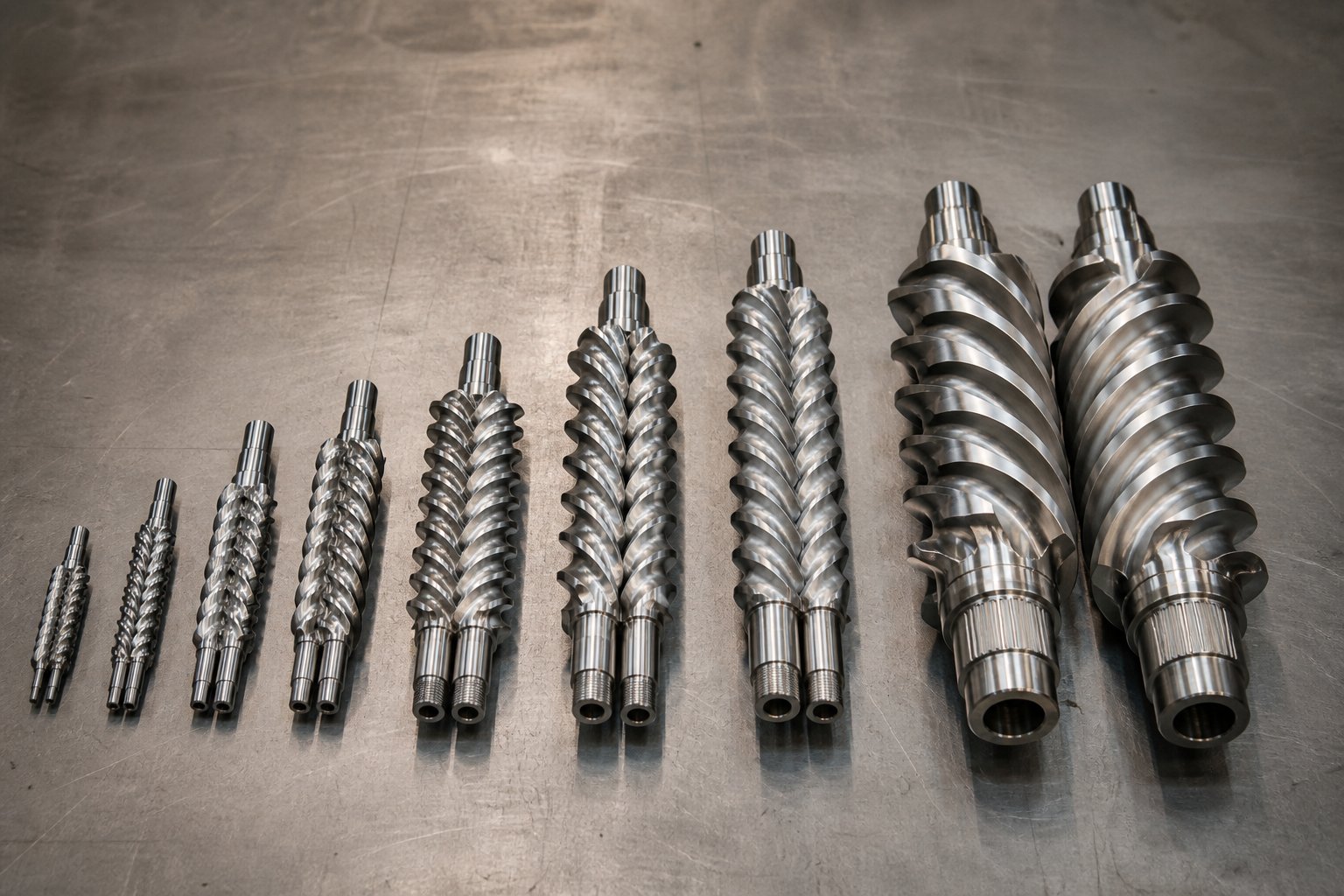
How to Choose the Right Conical Twin Screw Barrel
Picking the wrong barrel specification doesn't just cost you money — it costs you months of subpar output, premature wear, and formulation headaches that no amount of process tweaking will fix. Whether you're sourcing a direct replacement or upgrading to a higher-performance build, every decision starts with matching conical twin screw barrel specifications to your actual processing requirements — not to generic catalog descriptions.
Matching Barrel Specifications to Processing Requirements
The first number you'll encounter on any spec sheet is the screw diameter designation. These paired figures — like 51/105, 55/110, 65/132, 80/156, or 92/188 — describe the small-end and large-end diameters of each conical screw in millimeters. Think of them as a conical twin screw barrel size chart shorthand: the first number tells you the discharge-end diameter, and the second tells you the feed-end diameter. Larger designations handle higher throughputs, but they also require more powerful drive systems and generate greater mechanical loads on the barrel housing.
Here's a practical reference for matching screw size to typical output targets:
| Screw Designation (mm) | Typical Application Scale | Approximate Output Range (Rigid PVC) |
|---|---|---|
| 51/105 | Small-diameter pipes, lab/pilot lines | 60–120 kg/h |
| 55/110 | Small to mid-range profiles, pipes | 80–180 kg/h |
| 65/132 | Mid-range pipes, profiles, foam board | 150–300 kg/h |
| 80/156 | Large-diameter pipes, heavy profiles | 250–500 kg/h |
| 92/188 | High-output pipe and panel lines | 400–800 kg/h |
Beyond diameter, three additional specification decisions shape performance:
- L/D ratio: Most conical systems fall between 22:1 and 28:1. A longer L/D extends residence time, which benefits formulations requiring more thorough plasticization — but also increases thermal exposure for heat-sensitive PVC. Shorter ratios suit clean, low-filler compounds.
- Compression ratio: PVC dry blends with high CaCO₃ or wood-flour loading have lower bulk densities, demanding a higher compression ratio (closer to 3.5:1 or 4:1) to fully densify and plasticize the material. Unfilled or lightly filled compounds perform well at lower ratios around 2.5:1 to 3:1.
- Flight geometry: High-filler formulations may need deeper feed flights to ingest bulky powder without bridging, along with wider flight lands in the compression zone to distribute pressure evenly. These details are often overlooked when buyers focus exclusively on diameter and liner material.
Screw geometry adjustments for filled compounds aren't trivial. As SpecialChem's extrusion guide explains, fillers alter the coefficient of friction and specific gravity of the compound, which means a screw designed for unfilled resin may cause temperature overrides and accelerated wear when processing the same polymer with 30% or 40% mineral loading. The feed section may need to be lengthened, and the volumetric compression ratio recalculated to account for the non-compressible filler volume.
Custom vs Standard Replacement Barrels
When an existing barrel wears beyond tolerance, you face a straightforward fork: order a standard replacement that matches OEM dimensions, or invest in a custom-engineered conical twin screw and barrel set designed around your current — not original — processing reality.
A standard replacement makes sense when:
- Your extruder is a widely used model (Cincinnati, Battenfeld, Krauss Maffei, or common Chinese-manufactured equivalents).
- Your formulation and output targets haven't changed since the original barrel was specified.
- Wear was uniform and predictable, suggesting the original specification was appropriate.
Custom engineering becomes the smarter path when:
- You've switched to a higher-filler formulation since the machine was installed.
- Output requirements have increased, and you need optimized flight geometry to push throughput closer to the machine's mechanical limits.
- The extruder is a non-standard or older European/Taiwanese brand where OEM parts are discontinued or prohibitively expensive.
- Wear patterns from the old barrel reveal design weaknesses — accelerated erosion at the compression zone, for instance — that a geometry revision could correct.
Before contacting any supplier — whether you're browsing a wholesale conical twin screw and barrel catalog, searching conical twin screw and barrel alibaba listings, or reaching out to a specialized manufacturer directly — answer these five questions first:
- What material and formulation will be processed (polymer type, filler type, filler loading percentage)?
- What is the target output rate in kg/h?
- What is the extruder make, model, and year of manufacture?
- What specific wear issues prompted the replacement (declining output, poor melt quality, torque spikes)?
- What barrel liner and screw surface treatment levels are needed based on your formulation's abrasiveness and corrosivity?
Any manufacturer worth working with will ask you these same questions before quoting — and if they don't, that's a red flag. A barrel is not a commodity bolt; it's a precision-engineered component where dimensional tolerances, metallurgical specifications, and geometric compatibility all determine whether it performs or simply fits.
For PVC and WPC processors specifically, manufacturers like NANHAIYA focus on both custom-engineered and standard replacement conical twin screw barrels, with particular emphasis on wear resistance and plasticizing consistency for PVC pipe, profile, sheet, and WPC extrusion lines. Their specialization in these material families means screw geometry optimization is part of the conversation — not an afterthought bolted onto a generic product listing.
Regardless of which supplier you choose, the selection process itself should follow the same discipline: define your formulation, quantify your output needs, document your wear history, and specify your protection level before price enters the discussion. Getting those fundamentals right upfront prevents the far more expensive mistake of installing a barrel that wears out in half the expected service life — or worse, one that never quite produces the melt quality your downstream tooling demands.
Of course, even a perfectly specified barrel eventually wears. Knowing what wear looks like, where it concentrates, and when it crosses the line from acceptable to production-threatening is what separates reactive maintenance from proactive barrel management.
Maintenance, Troubleshooting, and Conical Twin Screw Barrel Wear Management
A perfectly specified barrel doesn't stay perfect forever. Every hour of operation — every kilogram of filled PVC or abrasive WPC pushed through the bore — removes microscopic layers of metal from the barrel surface and screw flights. The question isn't whether wear happens. It's whether you catch it early enough to plan a controlled replacement or whether it catches you first, showing up as rejected product, missed output targets, and an emergency shutdown nobody budgeted for.
Conical twin screw barrel maintenance is fundamentally about pattern recognition. The tapered geometry that makes these systems so effective at compression also creates wear patterns that differ meaningfully from parallel configurations. Understanding where wear concentrates, what symptoms it produces, and when to act gives you a practical edge over simply waiting until things go wrong.
Common Wear Patterns in Conical Barrels
Wear in a conical system doesn't distribute evenly across the bore. The tapered geometry, combined with the counter-rotating screw mechanics, concentrates degradation in predictable zones — and knowing those zones lets you target your inspection efforts precisely.
- Accelerated wear at the compression zone transition: This is the highest-stress region of any conical twin screw barrel. Material transitions from a loosely packed powder to a partially molten, highly viscous mass right here. The compressive forces peak, frictional heat generation spikes, and any abrasive fillers like CaCO₃ or TiO₂ are at their most destructive because they haven't yet been encapsulated by molten polymer. You'll often find bore diameter enlargement of 0.1 to 0.3 mm concentrated in this zone well before the feed or metering sections show measurable wear.
- Uneven wear between the two barrel bores: Although the twin bores look symmetrical on a drawing, material flow inside them rarely is. Slight differences in screw-to-barrel clearance, feed distribution from the hopper, or thermal gradients between the two bores can create asymmetric flow that loads one bore more heavily than the other. Over thousands of operating hours, one bore may wear measurably faster — sometimes 20 to 30% more than its twin. This asymmetry is easy to miss if you only measure one bore during inspections.
- Feed throat erosion from abrasive fillers: The feed opening takes a beating in heavily filled formulations. Hard mineral particles like calcium carbonate, titanium dioxide, and especially glass fibers impact the feed throat at high velocity as they drop from the hopper into the screw flights. Unlike bore wear, which progresses gradually, feed throat erosion can be severe and localized, creating channeling that disrupts uniform material intake and leads to inconsistent feeding.
- Screw flight tip wear and clearance growth: The flight tips are the first line of contact between the screw and the barrel wall. As extrusion experts note, hard facing on flight tips is typically about 0.060 inches (1.5 mm) thick. Once abrasion wears through this protective layer, the softer base metal beneath erodes rapidly, and clearance between the flight and bore expands. The resulting material leakage over the flights reduces compression efficiency and allows partially unmelted material to bypass the plasticization process.
These wear patterns are interconnected. Enlarged bore clearance in the compression zone reduces the seal between material pockets, forcing operators to increase screw speed to maintain throughput. Higher speed generates more frictional heat, which accelerates chemical corrosion in PVC systems by increasing HCl release. That corrosion, in turn, attacks the barrel liner, further widening clearance. It's a self-reinforcing cycle — and the only way to break it is early detection.
Troubleshooting Reduced Performance
When a conical twin screw barrel begins losing its edge, the symptoms rarely arrive as a single dramatic failure. Instead, you'll notice a gradual drift: output slipping a few percent per month, melt quality subtly declining, energy consumption creeping upward. The troubleshooting table below maps the most common production-floor symptoms to their probable causes and corrective actions:
| Problem | Probable Cause | Corrective Action |
|---|---|---|
| Declining output rate at constant screw speed | Enlarged barrel bore or worn screw flights increasing clearance; material leaks backward over flights instead of conveying forward | Measure bore diameter and screw flight OD at compression zone; compare against manufacturer tolerances; replace screw or barrel if clearance exceeds specification |
| Poor melt homogeneity (streaks, color inconsistency) | Uneven wear between twin bores creating asymmetric flow; worn compression zone failing to generate sufficient shear for complete mixing | Inspect both bores independently; check for thermocouple drift causing uneven heating; consider re-profiling screw flights or replacing the barrel set |
| Visible unmelted particles in extrudate | Excessive flight clearance allowing material to bypass the compression and metering zones without full plasticization | Reduce screw speed temporarily to increase residence time; verify barrel zone temperatures match formulation requirements; schedule bore and screw measurement |
| Barrel overheating alarms (especially compression zone) | Worn bore surface increasing friction; failed cooling fan or blocked cooling channel; thermocouple malfunction reading artificially low | Verify cooling system operation; calibrate thermocouples; inspect bore for scoring or localized erosion that could increase frictional heat generation |
| Unusual screw torque readings (spikes or sustained increase) | Material buildup or bridging in feed section; worn flight tips causing metal-to-metal contact; contaminated feedstock containing foreign objects | Purge the system and inspect for blockages; check screw alignment; measure flight-to-bore clearance for metal contact evidence; review raw material quality control |
| Increasing energy consumption per kilogram of output | Worn screw and barrel requiring higher speeds to compensate for lost conveying efficiency; cooling systems working harder to counteract excess frictional heat | Calculate specific energy (kWh/kg) trend over time; compare current values to baseline when barrel was new; use the trend rate to forecast optimal replacement timing |
A useful diagnostic principle from twin-screw compounding troubleshooting applies directly here: distinguish between chronic and transient problems. If output has been declining steadily over months, you're likely looking at progressive wear — a "disease" that won't be fixed by adjusting process settings. If performance dropped suddenly after a raw material lot change, that's a temporary "illness" requiring a different investigation path entirely. The time scale of the problem points you toward the root cause.
Inspection Methods and Replacement Timing
Catching wear before it reaches the production-threatening stage requires systematic measurement — not just a visual glance at the screw tips when they happen to be pulled for cleaning. Here's what a proper conical twin screw barrel maintenance inspection covers:
Bore diameter measurement: An internal micrometer or bore gauge is inserted at multiple points along each barrel bore — feed zone, compression zone transition, mid-compression, and metering zone. Because the bore is tapered, you're comparing each measurement against the manufacturer's specification for that exact axial position, not against a single nominal diameter. Record both bores independently to catch the asymmetric wear pattern described earlier. Industry practice flags any bore enlargement beyond 0.3 to 0.5 mm beyond nominal as the threshold where performance degradation becomes significant.
Screw flight diameter checks: Measure the outside diameter of screw flights at the same axial positions where bore measurements are taken. The gap between flight OD and bore ID is your actual running clearance. For a new conical twin screw barrel, this clearance typically follows the rule of nominal diameter divided by 1000 per side — for example, roughly 0.05 mm per side on a 55 mm discharge-end diameter. When that clearance reaches three to four times the original value, specific output rate drops measurably and discharge temperatures begin climbing.
Visual bore inspection: Beyond dimensional checks, look inside the bore for scoring (deep longitudinal scratches from contamination), pitting (chemical corrosion from HCl attack), and uneven discoloration (indicating hot spots or degraded polymer adhesion). These surface conditions tell you why wear is occurring — abrasive, corrosive, or adhesive mechanisms — which directly informs whether you need a different liner alloy in the replacement barrel.
Refurbishment vs. full replacement: When measurements show wear approaching tolerance limits, the next question is whether the existing barrel can be salvaged. Re-nitriding is possible only if the original nitrided case hasn't been fully worn through — and only on barrels where the bore geometry remains within re-machinable limits. Bimetallic barrels can sometimes be re-bored and re-lined if the outer shell retains sufficient wall thickness and structural integrity. However, a critical rule applies: a screw should never be refurbished more than three times, because repeated welding of hard facing onto the base metal deteriorates the substrate and increases the risk of delamination during operation. The same principle extends to barrel re-lining — each cycle weakens the bond interface.
When bore diameter wear exceeds the manufacturer-specified tolerance — typically measured at the compression zone — output stability and product quality degrade rapidly, making timely replacement essential.
A practical approach many conical twin screw barrels factory customers adopt is maintaining a spare screw set in storage. When inspection reveals that clearance has crossed the threshold, the worn set is pulled and the spare installed without extended downtime. The worn set is then evaluated offline for refurbishment viability. This rotation strategy keeps production running while giving you time for a deliberate repair-or-replace decision rather than a panicked emergency order.
Tracking wear rates over time also transforms maintenance from reactive to predictive. If you measure bore diameter every 2,000 to 3,000 operating hours and plot the data, you'll see a characteristic curve: slow initial wear while the hardened surface or bimetallic liner is intact, followed by an accelerating slope once the protective layer is breached. That inflection point — where wear rate suddenly steepens — is your signal to order replacement components. Waiting until the curve goes steep means you've already been running with compromised output for weeks or months.
Disciplined inspection and data-driven replacement timing protect your investment in barrel metallurgy and screw engineering. But the quality of the replacement barrel itself matters just as much as knowing when to install it — and that brings the focus to how you evaluate the manufacturers and suppliers behind those components.
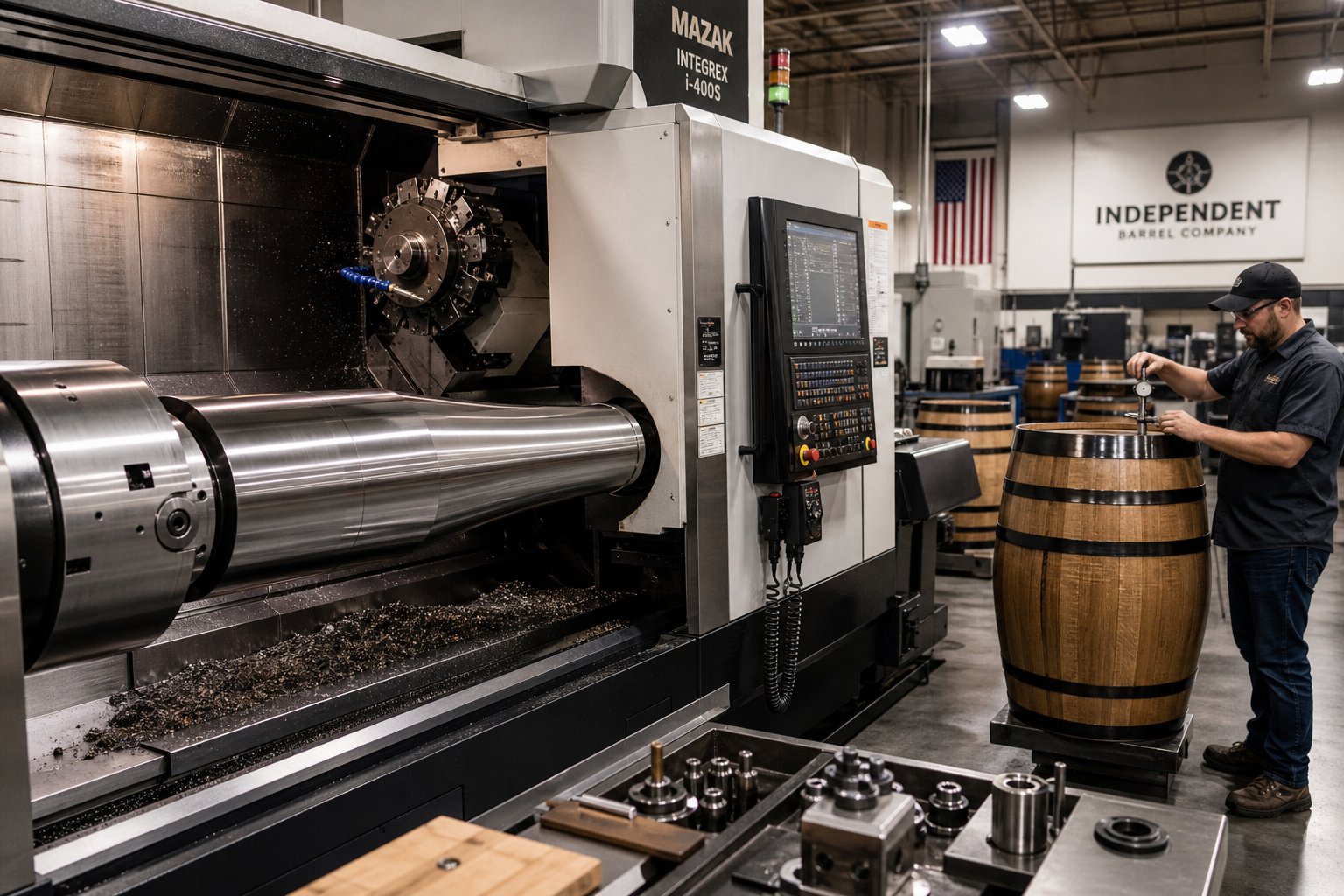
Finding a Reliable Twin Conical Screw Barrel Manufacturer
Knowing when to replace a worn barrel is half the equation. The other half — and arguably the trickier part — is knowing who should build the replacement. A barrel that measures perfectly on a spec sheet can still underperform in your extruder if the metallurgy is inconsistent, the bore finish is rough, or the liner bonding was rushed during casting. The supplier behind the component shapes its field life just as much as the alloy composition printed on the certificate.
So how do you separate a capable manufacturer from one that simply brokers someone else's castings? The answer lies in asking the right questions before a purchase order is ever written.
What to Evaluate in a Barrel Manufacturer
Not every supplier who lists conical twin screw barrels in their catalog actually manufactures them. Some are traders. Others machine externally sourced castings without controlling the metallurgy. A handful control the entire process chain in-house. The difference shows up in field life variability — and the only way to distinguish between them is systematic evaluation.
Use this checklist when assessing any prospective twin conical screw barrel manufacturer:
- Metallurgical capabilities: Does the supplier perform in-house gas nitriding and bimetallic centrifugal casting, or do they outsource these critical steps? In-house nitriding ensures control over case depth (that 0.4-0.7 mm range discussed earlier), while in-house centrifugal casting governs liner uniformity, bond integrity, and alloy chemistry consistency. Suppliers who cast, machine, heat-treat, and grind under one roof eliminate the process control gaps that arise whenever production crosses facility boundaries.
- Dimensional inspection and QC processes: Ask for documentation — not promises. A credible manufacturer provides hardness test reports at multiple bore positions, bore diameter measurements at each functional zone, surface roughness verification (Ra values), and for bimetallic barrels, metallographic cross-sections confirming liner thickness and bond quality. EN 10204 3.1 material certificates for base steel and liner alloy should be standard, not a special request.
- Range of screw diameters and extruder brand compatibility: Can the manufacturer produce barrels across the full common size spectrum — 51/105 through 92/188 and beyond? More importantly, can they match bore geometry, flange dimensions, and connection details for your specific extruder brand, whether it's a Chinese-built machine, a European model from Cincinnati or Battenfeld, or a Taiwanese design? Compatibility with non-standard or discontinued models is where experienced manufacturers separate from catalog-only vendors.
- Lead time for custom orders: Standard replacement barrels might ship in two to four weeks. Custom-engineered barrels — with modified liner alloys, adjusted taper angles, or non-standard flange configurations — typically require six to ten weeks depending on complexity. Ask for realistic lead times and whether the supplier maintains raw material inventory for common base steels and liner alloys, or whether they procure materials per order.
- Technical support for screw geometry optimization: The best suppliers don't just build what you specify — they help you specify correctly. As experienced manufacturers emphasize, a supplier who asks about your formulation details, filler percentage, and working conditions is focused on long-term performance rather than short-term pricing. This kind of application engineering support — recommending compression ratio adjustments, flight geometry changes, or liner upgrades based on your actual wear history — is a meaningful differentiator.
If a supplier can't address every item on that list with specific, documented answers, you're taking on risk that will eventually surface as inconsistent wear life, unexpected early failure, or dimensional incompatibility that delays installation.
Sourcing Strategies for Custom and Replacement Barrels
China dominates the global supply base for conical twin screw barrels. The concentration of raw material suppliers, nitriding furnaces, centrifugal casting foundries, and CNC machining capacity in regions like Zhejiang and Jiangsu provinces makes Chinese manufacturers the default source for both OEM equipment builders and aftermarket replacement buyers worldwide. That dominance brings real advantages — competitive pricing, broad size coverage, and deep manufacturing experience with PVC and WPC applications — but it also demands a disciplined approach to quality verification.
Here's what that discipline looks like in practice:
Request material certificates upfront, not after delivery. A China conical twin screw barrel supplier should provide EN 10204 3.1 certificates for the base steel (38CrMoAlA, 42CrMo, or equivalent) and for the liner alloy composition. If the supplier hesitates or offers generic certificates not tied to your specific order, treat that as a warning sign. Every alloy used in the assembly — base material, liner casting, and any hardfacing powder — should have traceable documentation.
Start with a trial order. Even when certificates and factory tours look promising, a single trial barrel tells you more about real manufacturing quality than any sales presentation. Install it, run it under your actual production conditions, and measure bore diameter at the compression zone after 1,000 to 2,000 operating hours. Compare that wear rate against your baseline data from the OEM barrel. This investment in validation — typically the cost of one barrel — can prevent a costly commitment to a supplier whose products underperform under your specific formulation and operating parameters.
Verify dimensional compatibility before production begins. When sourcing replacement barrels for European or Taiwanese extruder brands from China conical twin screw barrels factories, dimensional mismatches are the most common sourcing failure. Flange bolt patterns, barrel mounting geometries, and feed-throat positions vary across brands and even across model years from the same manufacturer. Provide the supplier with detailed drawings or, when drawings aren't available, physical measurements of the existing barrel. Professional suppliers can reverse-engineer dimensions from a sample barrel or machine model information — but they need accurate starting data to do so reliably.
Clarify what's included in the quoted price. Some China conical twin screw and barrel quotations cover only the raw machined barrel; others include nitriding or bimetallic lining, bore honing, dimensional inspection reports, and packaging for international shipping. Ensure the quotation explicitly states the liner alloy type, nitriding depth specification, bore surface finish target, and what QC documentation ships with the finished product. Ambiguity in the quote translates directly into ambiguity in the product you receive.
Evaluate communication responsiveness as a proxy for technical capability. A supplier who responds to technical questions within 24 hours, asks clarifying questions about your formulation and extruder model, and proactively flags potential compatibility issues is almost always a more reliable manufacturing partner than one who simply confirms your order and quotes a price. The depth of pre-sale technical dialogue correlates strongly with the quality of the finished barrel — because the same engineering attention that drives good communication also drives careful manufacturing.
Among China-based manufacturers specializing in conical twin screw barrels, NANHAIYA focuses specifically on PVC pipe, PVC profile, PVC sheet, and WPC extrusion applications — areas where wear resistance and plasticizing consistency are the dominant performance criteria. Their emphasis on both custom-engineered and standard replacement barrels positions them as a representative example of the specialized suppliers that the Chinese market has produced for this product category. For processors who have moved beyond commodity nitrided barrels and need bimetallic solutions tailored to specific filler loadings and extruder brands, this type of application-focused manufacturer merits evaluation alongside broader-catalog competitors.
Regardless of which supplier you ultimately select, the evaluation framework remains the same: verify metallurgical capability, demand traceable documentation, validate with a trial order, and prioritize technical dialogue over price alone. A china conical twin barrel screw that costs 15% less but lasts 40% fewer operating hours is the most expensive barrel you'll ever buy — you'll just pay the difference in downtime, scrap, and emergency replacement orders instead of on the original invoice.
Frequently Asked Questions About Conical Twin Screw Barrels
1. What is the difference between a conical and parallel twin screw barrel?
A conical twin screw barrel tapers from a wide feed end to a narrow discharge end, generating compression through geometry at low screw speeds (20-50 rpm). A parallel twin screw barrel maintains a constant bore diameter and relies on higher screw speeds (100-600+ rpm) and modular screw elements for compression and mixing. Conical designs excel in shear-sensitive PVC and WPC processing with compact footprints and L/D ratios of 22:1 to 28:1, while parallel systems suit high-throughput compounding with L/D ratios of 30:1 to 40:1+. The best choice depends on your material sensitivity, output targets, and formulation flexibility needs.
2. How long does a conical twin screw barrel last before replacement?
Service life varies significantly based on barrel liner type, processed material, and filler content. A standard nitrided barrel processing clean PVC may last several years, while the same barrel running heavily filled compounds with 20%+ calcium carbonate could wear through its 0.4-0.6 mm hardened case in 12-18 months. Bimetallic barrels with Fe-based or Ni-based liners (1.5-3.0 mm wear depth) substantially extend service life. Monitoring bore diameter at the compression zone every 2,000-3,000 operating hours and tracking the wear rate trend helps predict optimal replacement timing before output quality deteriorates.
3. What materials are conical twin screw barrels made from?
The base steel is typically 38CrMoAlA (ideal for gas nitriding, achieving 950-1,100 HV surface hardness) or 42CrMo (higher toughness for larger barrels). For enhanced protection, bimetallic liners are centrifugally cast inside the bore: Fe-based (Fe-Cr-B) liners at 58-62 HRC handle moderate abrasion cost-effectively, while Ni-based (Ni-Cr-B-W) liners at 60-65 HRC add corrosion resistance essential for PVC and CPVC processing. Tungsten carbide overlays (65-75 HRC) represent the highest protection tier for extreme-wear applications like heavily filled WPC. Manufacturers such as NANHAIYA offer these material tiers tailored to specific PVC and WPC formulations.
4. What screw diameter sizes are available for conical twin screw barrels?
Common conical twin screw barrel designations include 51/105, 55/110, 65/132, 80/156, and 92/188, where the first number is the discharge-end diameter and the second is the feed-end diameter in millimeters. Output ranges scale accordingly: a 51/105 produces roughly 60-120 kg/h of rigid PVC, while a 92/188 can reach 400-800 kg/h. Selecting the right size requires matching your target throughput, extruder drive capacity, and material bulk density. Larger sizes accommodate higher filler loadings and bulkier feed materials like wood-flour blends used in WPC extrusion.
5. How do you maintain a conical twin screw barrel to prevent premature wear?
Effective maintenance centers on systematic bore measurement using internal micrometers at multiple axial positions every 2,000-3,000 hours, inspecting both bores independently to catch asymmetric wear. Focus measurements at the compression zone transition where wear concentrates most heavily. Track bore enlargement over time and plan replacement when clearance exceeds 0.3-0.5 mm beyond nominal or reaches three to four times the original flight-to-bore gap. Maintain proper temperature zone control to minimize corrosive HCl release in PVC processing, verify cooling system function regularly, and keep a spare screw set ready for quick changeover during scheduled inspections.
Written by
Nanhaiya Technical Team
Zhoushan Nanhaiya Plastic Machinery Co., Ltd.
The Nanhaiya technical team supports screw and barrel manufacturing projects through application review, technical communication, custom manufacturing coordination, and production and quality control.
Discuss Your Application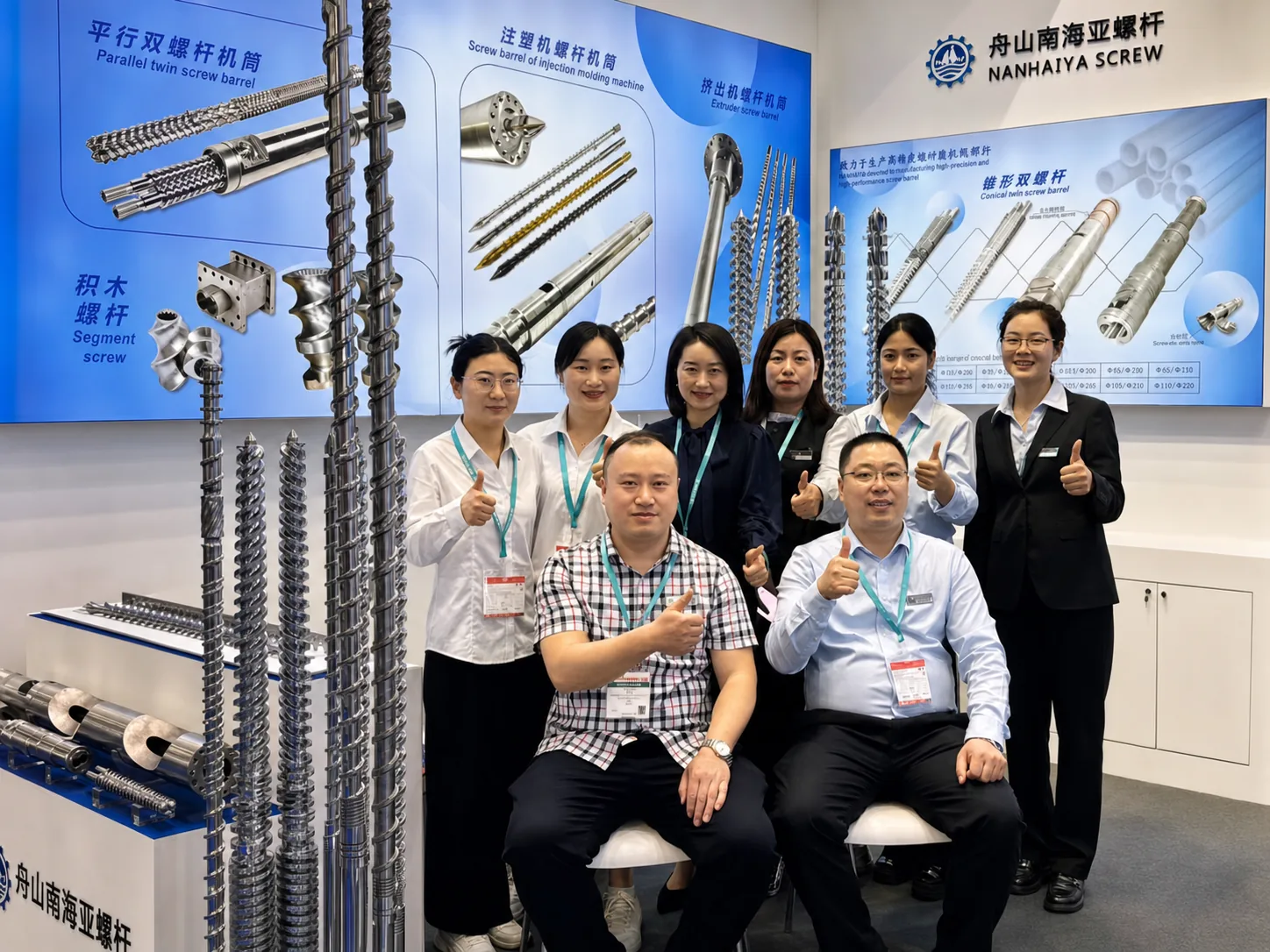
Related Articles
More insights on screw barrel technology and plastics processing.
What Nobody Tells You About Screw Barrel For Plastic Machine Design
Oct 10, 2026
Learn how screw barrel for plastic machine design affects melt quality, throughput, and wear life. Covers geometry, resin matching, troubleshooting, and sourcing.
Read Article
Single Screw Extruder for Sheet: Stop Guessing, Start Specifying
Oct 9, 2026
Learn how to specify a single screw extruder for sheet production. Covers screw geometry, resin-specific processing, troubleshooting, and maintenance best practices.
Read Article
PE Pipe Extruder Machine: What Datasheets Won't Tell You
Oct 9, 2026
Learn how a PE pipe extruder machine works, key specs explained, material grade selection, maintenance tips, and buyer guidance beyond the datasheet.
Read ArticleLooking for something else?
Search by material, symptom or product and jump straight to the relevant page.
These are navigation suggestions based on keyword matching — not a quotation, not a delivery commitment, and not a substitute for engineering review. Final specification is confirmed by our engineers against your drawings and processed material.
Need help with screw barrel selection?
Share your machine model, processed material and application. Our team can help with pricing and technical support.