

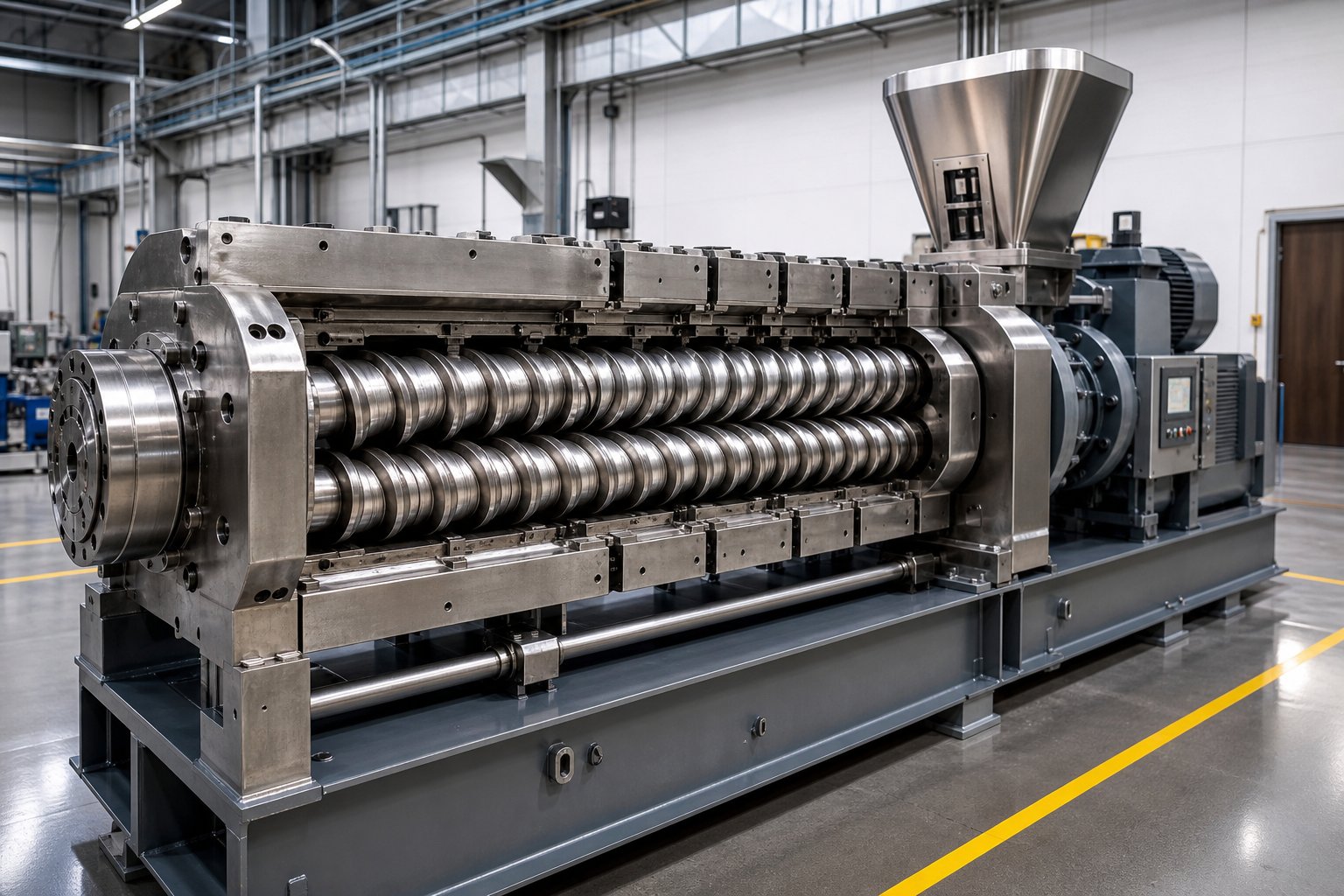
What Is a Twin Screw Extruder and Why China Leads the Market
Imagine two oversized drill bits rotating side by side inside a heated steel tube. Raw plastic pellets go in one end, and a continuous stream of precisely mixed, molten material comes out the other. That, in simple terms, is what a twin screw extruder does - and if you're sourcing one, there's a good chance your search has already led you to China.
What Is a Twin Screw Extruder
A twin screw extruder is a machine built around two intermeshing screws that rotate inside a heated barrel. As raw materials - usually polymer pellets, powders, or granules - enter through a feed hopper, the screws convey them forward while generating intense shear forces and frictional heat. This combination melts the material, blends in any additives or fillers, and pushes the homogeneous melt through a shaped die at the discharge end.
What makes this design powerful is its versatility. The intermeshing screw geometry creates a self-wiping action that prevents material from sticking to barrel walls, ensuring consistent output quality. Multiple temperature zones along the barrel give operators precise control over the thermal profile, which is critical when processing heat-sensitive polymers. Modular screw elements - conveying flights, kneading blocks, and mixing sections - can be rearranged to match specific materials and product requirements.
For procurement professionals who aren't engineers, the key takeaway is straightforward: twin screw extruders handle a broader range of materials, deliver superior mixing performance, and offer more processing flexibility than single screw alternatives. That's why they dominate applications like polymer compounding, masterbatch production, and plastics recycling - sectors where material uniformity isn't optional.
Why China Dominates Twin Screw Extruder Production
The global twin screw extruders market reached USD 3.1 billion in 2025 and is forecast to grow at a 5.3% CAGR through 2035. China leads that growth curve at a projected 7.1% CAGR - the fastest rate of any major market. The Chinese domestic twin screw extruder industry, valued at approximately 15 billion yuan, is on track to reach 25 billion yuan, fueled by recycling mandates, surging demand for engineering plastics, and rapid expansion of masterbatch production capacity.
Roughly 90% of Chinese twin screw extruder manufacturers are concentrated in the Nanjing region, creating one of the densest industrial clusters for extrusion equipment anywhere in the world.
This concentration isn't accidental. Decades of knowledge transfer from academic research institutions, a deep local supply chain for specialty steels and precision-machined components, and a growing pool of experienced engineers have turned Nanjing into a self-reinforcing ecosystem. The result: a china extruder manufacturer twin screw buyers encounter today may offer equipment that is structurally competitive with European brands - at a fraction of the cost.
Yet here's what most search results won't tell you. Nearly every article ranking for "twin screw extruder china" or "best twin screw extruder from china" is written by a manufacturer promoting its own product line. This article takes a different approach. It's an independent, buyer-education resource designed to help you understand the technology, navigate the supplier landscape, and recognize warning signs before they become costly mistakes.
Understanding the machine itself is only half the equation, though. The real complexity lies in the design differences between extruder types - and knowing which configuration actually fits your application.
How Twin Screw Extruders Work and Why Design Differences Matter
Every china twin screw extruder listing you'll encounter boils down to a single, fundamental design choice: which direction do the screws spin? That decision shapes everything from shear intensity to the types of polymers the machine can handle. Before requesting china twin screw extruder design quotes from any supplier, you need a clear picture of what separates the two primary configurations - and what each one actually excels at.
Co-Rotating vs Counter-Rotating Mechanisms
In a co-rotating twin screw extruder, both screws turn in the same direction. This creates a fully intermeshing geometry where material is forcibly handed off from one screw flight to the next at the intermeshing zone. The result is intense shear, excellent self-wiping action, and very few dead zones inside the barrel. You'll notice that this self-wiping behavior keeps the residence time distribution narrow - a critical advantage for reactive extrusion and thermally sensitive compounds where stagnation leads to degradation.
A china co rotating twin screw extruder dominates applications like polymer compounding, masterbatch production, and polymer alloying precisely because of this mixing intensity. Shear fields develop both between the screws and between the screws and barrel wall, while kneading blocks introduce elongational flow that breaks down filler agglomerates and controls phase morphology.
Counter-rotating designs flip the script. Here, the screws turn in opposite directions, drawing material into the intermeshing region through compression rather than shear transfer. A calendering effect appears at the nip point, dispersing additives under gentle conditions with significantly lower shear stress. A china counter rotating twin screw extruder operates at high fill levels and low screw speeds, keeping melt temperatures down - exactly what thermally unstable materials like rigid PVC demand.
Think of it this way: co-rotating machines prioritize mixing energy, while counter-rotating machines prioritize gentle, positive conveying. Choosing the wrong one isn't a minor inconvenience - it can mean degraded polymer, inconsistent output, or a machine that simply can't process your formulation.
| Parameter | Co-Rotating | Counter-Rotating |
|---|---|---|
| Rotation Direction | Both screws same direction | Screws in opposite directions |
| Shear Level | High | Low to moderate |
| Mixing Intensity | Strong dispersive and distributive mixing | Gentle compressive and elongational mixing |
| Self-Wiping | Yes - narrow residence time distribution | Limited - higher fill operation |
| Typical Throughput Range | 30 - 4,000+ kg/h | 50 - 1,500 kg/h |
| Primary Applications | Compounding, masterbatch, reactive extrusion, polymer alloys | PVC pipes, profiles, sheets, foam board |
When evaluating a china intermeshing twin screw extruder - whether co-rotating or counter-rotating - the rotation type alone doesn't tell the full story. The real performance signature comes from what's mounted on those shafts.
Screw Geometry and Mixing Principles
Twin screw extruders use a modular screw design, meaning individual elements slide onto a splined shaft and can be rearranged like building blocks. This modularity is what gives the machine its extraordinary flexibility, and it's also where many specification conversations go wrong during sourcing.
Three element families make up a typical screw profile:
- Conveying elements feature deep flights designed to transport material forward efficiently without applying significant shear. They dominate the feed zone and any section where the goal is simply to move material downstream.
- Kneading blocks are the workhorses of mixing. Wider kneading discs stacked at staggering angles generate dispersive mixing that breaks apart agglomerates through intense shear stress, while narrower discs promote distributive mixing that spreads the dispersed phase evenly. Forward-staggered kneading blocks are less aggressive; neutral (90-degree) blocks increase residence time and energy input; reverse-staggered blocks push material backward, creating maximum restriction and shear.
- Toothed mixing elements provide distributive mixing with minimal shear, making them useful for blending heat-sensitive additives without generating excessive melt temperature.
Imagine you're watching a china twin screw extruder animation in slow motion. You'd see raw pellets grabbed by conveying elements in the feed zone, softened and compressed as the channel depth decreases, then intensely kneaded by staggered disc blocks in the mixing zone. Reverse elements momentarily push material backward, forcing it to spend more time in high-shear regions. Finally, metering elements build the pressure needed to push melt through the die.
The arrangement, sequence, and proportion of these elements determine whether a given screw profile delivers aggressive filler dispersion or gentle homogenization. As NC State University researchers emphasize, configuring a screw profile is a blend of art and science - no single configuration optimizes flow for all materials, because every polymer responds differently to heat, shear rate, and extruder geometry.
Equally important is the L/D ratio - the ratio of the screw's working length to its diameter. A higher L/D ratio means the material travels a longer path through the barrel, giving more residence time for mixing, melting, and devolatilization. Most compounding applications require L/D ratios between 28:1 and 40:1, with some high-performance configurations stretching to 48:1 or even 52:1 for complex formulations demanding multiple mixing stages and vacuum venting ports. Shorter ratios suit simpler formulations or materials with tight thermal processing windows, where minimizing heat exposure is more valuable than maximizing mixing intensity.
Here's a practical way to think about it: every additional barrel segment in the L/D ratio gives you room for another functional zone - an extra kneading section, a side feeder port, or a devolatilization vent. But it also adds cost, floor space, and energy consumption. The right ratio isn't the longest one available; it's the shortest one that still accomplishes everything your formulation requires.
These screw-level details matter because they directly influence which physical machine architecture - conical or parallel - best fits a given application. And that distinction carries significant implications for both equipment cost and long-term processing flexibility.
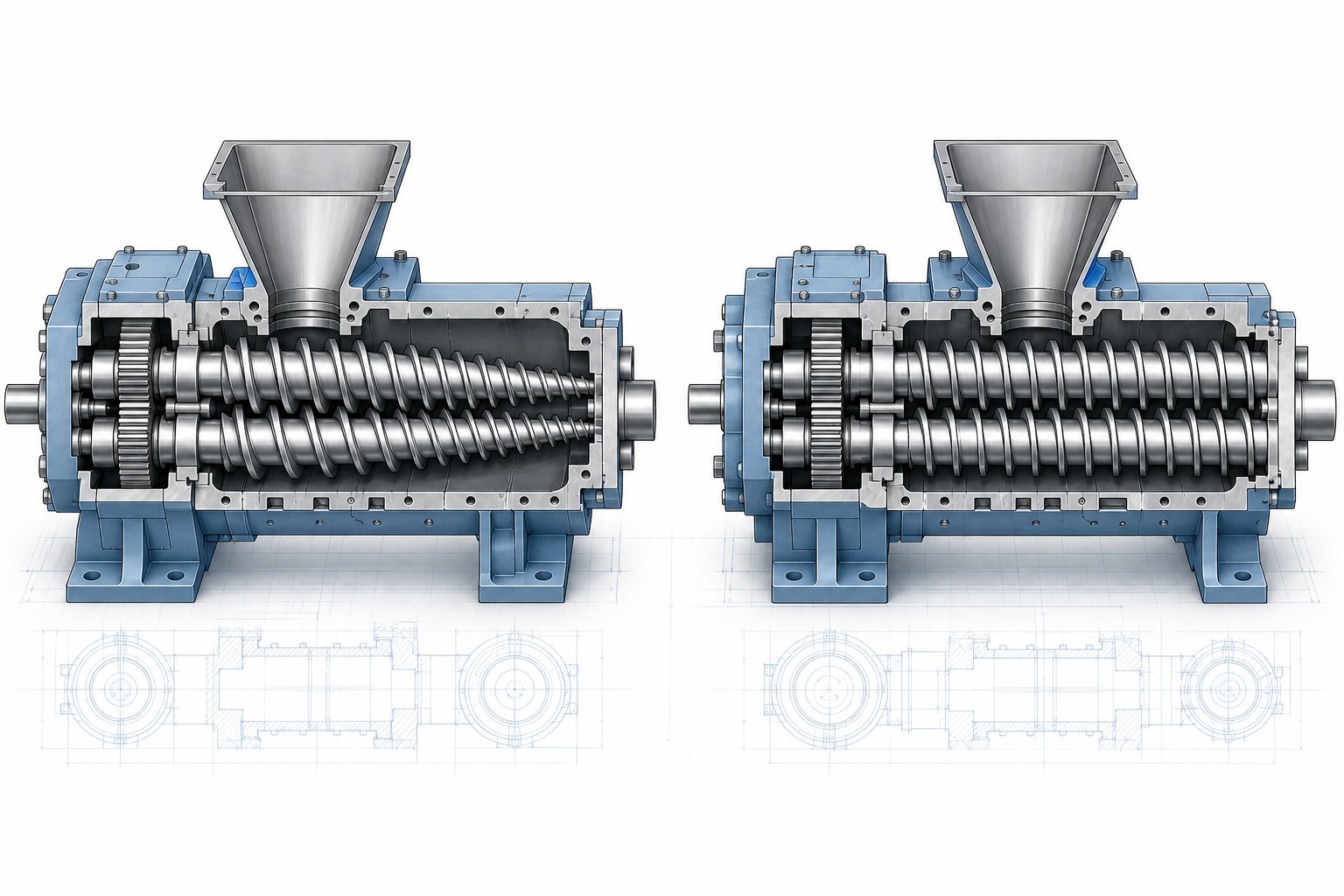
Conical vs Parallel Twin Screw Extruders from China
Screw geometry and rotation direction define how material behaves inside the barrel - but the physical shape of the screws themselves determines which machine architecture you're actually buying. Chinese manufacturers produce two fundamentally different twin screw extruder platforms, and confusing them during procurement is one of the fastest ways to end up with equipment that can't run your formulation. Let's break down each design so the distinction is unmistakable.
Conical Twin Screw Extruder Design and Applications
Picture two large funnels laid on their sides, rotating in opposite directions. That's essentially the geometry of a china conical twin screw extruder. The screws taper from a larger diameter at the feed end to a smaller diameter at the discharge end, creating a natural compression ratio built right into the hardware. As material moves forward along these tapered flights, the decreasing channel volume squeezes it progressively, generating high discharge pressure without relying on aggressive shear.
This tapered geometry serves a very specific purpose. The large feed-end diameter provides generous root area for mounting robust bearings and transmitting high torque, while the smaller discharge end concentrates pressure at the die. Because the screws converge toward the output, the center distance between them decreases along the barrel length - a design feature that enhances the calendering and compressive action characteristic of counter-rotating operation.
And counter-rotating is the default here. Nearly every conical twin screw extruder china suppliers offer runs with screws turning in opposite directions. That combination of tapering geometry and counter-rotation delivers gentle, low-shear processing with precise temperature control - exactly what thermally sensitive PVC compounds require. Rigid PVC begins degrading at temperatures uncomfortably close to its processing window, so the ability to build pressure without excessive frictional heating is non-negotiable.
You'll encounter a china conic twin screw extruder machine listed with designations like 55/110, 65/132, or 80/156. These numbers represent the small-end and large-end screw diameters in millimeters. A 65/132 model, for example, has screws tapering from 132 mm at the feed to 65 mm at the die end. Larger designations like 80/156 or 92/188 handle higher throughput for industrial-scale PVC pipe and profile lines. Typical applications include:
- PVC window profiles and door frames
- PVC pipes and fittings
- PVC sheet and foam board
- WPC (wood-plastic composite) decking and panels
- PVC cable trunking and edge banding
If your production centers on PVC or similarly heat-sensitive formulations, the conical architecture is almost certainly the right starting point. Its simplicity also translates to lower initial cost and straightforward maintenance compared to modular parallel systems.
Parallel Twin Screw Extruder Design and Applications
Parallel designs take a completely different approach. Here, both screws maintain a uniform diameter from feed to discharge - no taper, no built-in compression ratio. This constant geometry means pressure generation depends entirely on screw element configuration rather than hardware shape, which gives operators far more control over the processing profile.
A china parallel twin screw extruder is available in both co-rotating and counter-rotating configurations, but the co-rotating variant dominates the market for one reason: modularity. The barrel splits into individual segments bolted together in series, and the screw elements slide onto splined shafts in any sequence. Need an extra kneading zone? Add more kneading blocks. Require a side feeder port for downstream filler addition? Insert a barrel section with an open port. This building-block flexibility is what makes parallel co-rotating extruders the universal platform for compounding operations worldwide.
Co-rotating parallel machines from Chinese manufacturers handle an enormous application range:
- Engineering plastics compounding (glass fiber reinforced nylon, PC/ABS alloys)
- Color masterbatch production with high pigment loading
- Filler masterbatch (calcium carbonate, talc, barium sulfate concentrates)
- Reactive extrusion and polymer grafting
- Biodegradable polymer compounding (PLA, PBAT blends)
- Plastics recycling and regranulation
Counter-rotating parallel extruders occupy a smaller niche - primarily PVC compounding and calender feeding - where gentle processing is needed but higher throughput than conical designs is required. They sacrifice some of the modularity advantages but retain the uniform-diameter geometry that simplifies screw and barrel manufacturing.
For buyers evaluating a china taper twin screw extruder against a parallel alternative, the deciding factors almost always come down to material type and processing flexibility. The table below puts the key differences side by side.
| Characteristic | Conical Twin Screw Extruder | Parallel Twin Screw Extruder |
|---|---|---|
| Screw Geometry | Tapered - large feed end to small discharge end | Uniform diameter throughout entire length |
| Rotation Type | Counter-rotating (standard) | Co-rotating (dominant) or counter-rotating |
| Pressure Generation | High - built into tapered compression geometry | Moderate - controlled by screw element selection |
| Shear Characteristics | Low shear, gentle processing | Low to high shear, adjustable via screw profile |
| Modularity | Limited - fixed screw and barrel design | High - interchangeable barrel segments and screw elements |
| Best-Fit Applications | PVC profiles, pipes, sheets, foam board, WPC | Compounding, masterbatch, engineering plastics, recycling |
Here's a practical rule of thumb: if your operation processes primarily PVC-based products with stable formulations, conical extruders deliver proven performance at lower capital cost. If you compound multiple polymer families, switch formulations frequently, or need to optimize screw profiles for new materials, parallel co-rotating machines justify their higher investment through sheer versatility.
Choosing between these two architectures is a technical decision - but the supplier landscape behind each one is a business decision that carries its own risks. Understanding where these machines are actually made, and by whom, adds a layer of due diligence most buyers overlook entirely.
Why Nanjing Is the Global Hub for Twin Screw Extruder Manufacturing
You've seen the technical differences between conical and parallel machines - but here's a question most procurement teams never think to ask: why does one city produce the vast majority of the world's twin screw extruders? The answer reveals a lot about why Chinese pricing is so competitive, and more importantly, why not every supplier in that city delivers the same quality.
The Nanjing Manufacturing Cluster Explained
Nanjing didn't become the epicenter of global twin screw extruder production by accident. The story starts with Nanjing University of Technology (now Nanjing Tech University), one of China's leading research institutions for polymer processing and extrusion science. For decades, its faculty and graduates have fed directly into local equipment manufacturers, creating a pipeline of engineers who understand screw geometry, metallurgy, and process optimization at a foundational level. That academic nucleus attracted the first wave of extrusion equipment companies to the region in the 1980s and 1990s - and the cluster effect took over from there.
When dozens of extruder manufacturers operate within a 50-kilometer radius, the supporting ecosystem grows dense. Specialty steel suppliers, precision CNC machining shops, heat treatment facilities, gearbox manufacturers, and electrical control system integrators all established operations nearby. A china co rotating twin screw extruder factory in Nanjing can source nitrided barrel liners, hardened screw elements, and high-torque gearboxes from vendors located less than an hour away - eliminating the long-distance logistics costs that manufacturers in other regions face.
This proximity creates a self-reinforcing cycle. Concentrated demand for metallurgical components drives local suppliers to invest in better equipment and tighter tolerances. Skilled machinists and assembly technicians move between companies, carrying practical know-how that raises the baseline capability across the cluster. Knowledge transfer happens informally - through supplier networks, industry conferences hosted locally, and the simple reality that engineers at competing firms often trained under the same professors.
The practical outcome for international buyers? A china compounding twin screw extruder factory operating inside this cluster benefits from supply chain efficiencies that structurally reduce production costs without necessarily sacrificing material quality. It's the same economic logic that makes Shenzhen dominant in electronics manufacturing or northern Italy dominant in packaging machinery - geographic concentration drives specialization, and specialization drives both quality improvement and cost reduction simultaneously.
Tiered Landscape of Chinese Manufacturers
Here's where buyer education becomes critical. The Nanjing cluster - and the broader Chinese market - is not a monolith. Treating every supplier as interchangeable is one of the most expensive mistakes an international buyer can make. The market segments into distinct tiers, each with very different capabilities, price points, and risk profiles.
Tier 1: Branded manufacturers with proprietary R&D
- Operate dedicated research and development departments with screw design simulation software and material testing laboratories
- Hold significant patent portfolios covering screw element geometry, gearbox design, or process control innovations
- Maintain documented export track records spanning multiple continents, often with references from industries like automotive compounding, biodegradable plastics, and engineering polymers
- Offer application engineering support - meaning they help you configure screw profiles, barrel zones, and feeding systems for your specific formulation, not just sell you a machine
- Provide structured after-sales programs including commissioning support, operator training, and spare parts inventory commitments
- Price range reflects genuine engineering investment and typically represents the mid-market between European premium brands and budget assemblers
Tier 2: Established regional manufacturers
- Produce reliable equipment for well-understood applications (standard compounding, common masterbatch formulations, PVC processing)
- May license or adapt designs rather than developing proprietary technology from scratch
- Serve primarily domestic customers with growing but limited export experience
- Offer competitive pricing with adequate - but not exceptional - technical support infrastructure
- Quality consistency can vary between production runs, making pre-shipment inspection particularly important
Tier 3: Smaller assemblers and trading companies
- Source components - barrels, screw elements, gearboxes, motors, control panels - from multiple third-party suppliers and assemble them under their own brand
- Offer the lowest price points but may lack engineering depth to troubleshoot complex processing challenges
- Limited or no in-house machining capability, meaning quality depends entirely on their component suppliers
- After-sales support is often reactive rather than structured, with spare parts availability that can be unpredictable
- Some operate primarily as trading intermediaries, adding a margin without adding technical value
There's another distinction that catches many first-time buyers off guard: the difference between OEM/white-label extruders and branded Chinese manufacturers. A significant number of twin screw extruders sold under European or North American brand names are actually manufactured in Nanjing by china parallel twin screw extruder manufacturers who produce to the foreign brand's specifications. The purchasing company adds its logo, documentation, and service layer - then sells the machine at a substantial markup. There's nothing inherently wrong with this model, but it does mean that the "European" machine on your shortlist and the branded Chinese alternative on your other shortlist might share more DNA than their price tags suggest.
Meanwhile, a growing number of china twin screw extruder exporters are building international reputations under their own names. These companies invest in multilingual technical teams, attend major trade shows like Chinaplas and K Fair, and develop direct relationships with end users. For buyers willing to do their due diligence, this category often represents the strongest value proposition - you get tier-1 engineering capability at pricing that reflects Chinese manufacturing economics rather than a European brand premium layered on top.
Understanding which tier a potential supplier actually occupies - regardless of what their website claims - requires verification methods that go well beyond browsing a product catalog. And even before you evaluate suppliers, you need to know exactly which specifications your application demands, because the wrong machine configuration will underperform no matter how reputable the manufacturer behind it.

Key Applications and Which Specifications Matter Most
A machine's spec sheet means nothing until you match it against the demands of a real production scenario. The reason so many buyers struggle when evaluating a china plastic twin screw extruder is that supplier brochures list dozens of parameters without clarifying which ones actually determine success or failure for a given application. That gap disappears once you understand what each major use case requires from the hardware.
Compounding and Masterbatch Production
Compounding is where twin screw extruders earn their reputation - and where specification mismatches create the most expensive problems. The core challenge is straightforward: you're blending a base polymer with fillers, reinforcements, pigments, or functional additives, and the result needs to be perfectly homogeneous at a molecular or particle level. That demands three things from the machine: high torque density, strong mixing energy, and precise feeding control.
Torque density matters because heavily filled compounds - think 60% calcium carbonate in polyethylene or 40% glass fiber in nylon - resist movement through the barrel. If the gearbox can't deliver enough rotational force at processing speed, the motor bogs down, throughput drops, and you're left with inconsistently mixed output. A china high torque series twin screw extruder designed for compounding typically delivers torque densities in the range of 11.3 to 18 Nm/cm3, classified under torque grade designations that correspond to the gearbox's structural capacity.
Mixing energy comes from the screw profile - specifically, the arrangement of kneading blocks that generate both dispersive mixing (breaking apart filler agglomerates) and distributive mixing (spreading the dispersed phase uniformly throughout the melt). Co-rotating parallel twin screw extruders dominate this segment because their modular screw design allows engineers to fine-tune the balance between shear intensity and residence time for each specific formulation.
For polymer compounding, L/D ratios of 40:1 to 48:1 are standard, providing enough barrel length to accommodate a feeding zone, multiple mixing stages, vacuum devolatilization, and a pressure-building metering section. Some complex formulations - polymer alloys requiring reactive compatibilization, for example - push into 52:1 territory to gain additional mixing zones or side-feeder injection points.
Masterbatch production layers additional demands on top of standard compounding requirements. Color masterbatch, for instance, involves loading 40-70% pigment into a carrier resin and dispersing it to a fineness that eliminates visible specks or color streaks in the final product. Filler masterbatch concentrates push loading levels even higher. Additive masterbatch requires uniform distribution of flame retardants, UV stabilizers, or antioxidants at precise concentrations. In every case, the quality benchmark is dispersion - and dispersion quality depends directly on screw profile design and the torque available to drive material through high-shear kneading zones.
Any reputable china compounding twin screw extruder manufacturer will ask detailed questions about your formulation before recommending a machine size. If a supplier jumps straight to quoting a model number without understanding your filler type, loading percentage, target throughput, and downstream pelletizing method, that's an early signal worth paying attention to.
- Screw type: Co-rotating parallel with modular elements
- L/D ratio: 40:1 to 48:1 (up to 52:1 for complex formulations)
- Torque class: High torque density (11.3-18 Nm/cm3), typically Grade D or higher
- Throughput range: 150-4,000 kg/h depending on screw diameter (35 mm to 135 mm+)
- Feeding system: Gravimetric feeders with accuracy of +/-0.5% for consistent additive dosing
PVC Processing and Profile Extrusion
PVC plays by different rules. Its usable processing window is narrow - roughly 165-185 degrees Celsius - and exceeding the upper boundary triggers rapid degradation that releases hydrochloric acid, discolors the product, and corrodes equipment. This thermal sensitivity fundamentally shapes every specification decision.
Where compounding thrives on high shear and aggressive mixing, PVC processing demands the opposite: gentle conveying, low frictional heat generation, and precise zone-by-zone temperature control. That's why a china pvc twin screw extruder is almost always a conical counter-rotating design or, for higher-throughput applications, a parallel counter-rotating machine.
Conical extruders generate the high die pressure PVC profile and pipe tooling requires through their tapered screw geometry rather than through shear - a critical distinction. The material experiences compression without the aggressive kneading that would push melt temperature past the degradation threshold. For standard rigid PVC profiles like window frames and door systems, conical models in the 65/132 or 80/156 size range handle the majority of production requirements globally.
Parallel counter-rotating extruders enter the picture when formulations involve high filler loadings. PVC compounds with calcium carbonate content exceeding 100 parts per hundred resin (phr) benefit from the longer L/D ratio of parallel screws, which provides more residence time for thorough plastification and better coating of filler particles. The parallel geometry also offers greater wear resistance against abrasive calcium carbonate thanks to larger screw root cross-sections.
Choosing the wrong machine type here isn't just suboptimal - it's potentially destructive. Specifying a high-shear co-rotating extruder for rigid PVC profiles, as industry sources consistently warn, is one of the most common and costly specification errors buyers make.
- Screw type: Conical counter-rotating (standard) or parallel counter-rotating (high-filler formulations)
- L/D ratio: Tapered geometry for conical; 22:1 to 30:1 for parallel counter-rotating
- Torque class: Moderate - pressure generated mechanically through geometry rather than torque-driven shear
- Throughput range: 50-500 kg/h for conical; up to 800+ kg/h for parallel counter-rotating
- Temperature control: Multiple independent zones with +/-2 degrees Celsius accuracy; liquid-cooled barrel segments essential
Recycling and Specialty Applications
Plastics recycling is the fastest-growing application segment for twin screw extruders - and the one creating the most new demand for equipment from Chinese suppliers. Government-mandated recycling targets across the EU, North America, and Southeast Asia are pushing processors to invest in lines capable of handling post-consumer and post-industrial waste streams that earlier generations of equipment simply couldn't manage.
The challenge with recycled feedstock is variability. Post-consumer plastics arrive contaminated with moisture, paper labels, residual food, and mixed polymer fractions. A china plastic extruder machine twin screw designed for recycling needs robust devolatilization capability - typically two or more vacuum venting zones along the barrel - to extract moisture and volatile contaminants from the melt. Without effective degassing, the resulting pellets contain voids and surface defects that make them unsuitable for demanding downstream applications.
Co-rotating parallel extruders with L/D ratios of 44:1 to 52:1 are the standard platform for recycling because the extended barrel length accommodates the necessary functional zones: initial conveying and melting, a first atmospheric vent, intensive mixing to homogenize inconsistent feed, a second vacuum vent for deep devolatilization, and a final metering section to build die pressure. Side feeders can introduce virgin resin or additives downstream to upgrade the recycled melt's properties.
Biodegradable polymer compounding represents another rapidly expanding niche. Materials like PLA, PBAT, and starch-based blends require careful thermal management and specific screw profiles to avoid hydrolytic degradation during processing. Finding a china manufacturer twin screw extruder for biodegradable plastic compounds increasingly matters as global demand for compostable packaging accelerates. The technical requirements overlap significantly with standard compounding - co-rotating parallel design, moderate-to-high L/D ratios, precise temperature control - but the screw profile must minimize residence time in high-temperature zones where these moisture-sensitive polymers break down most quickly.
Reactive extrusion adds yet another layer of complexity. Here, the extruder functions as a continuous chemical reactor - grafting maleic anhydride onto polyolefins, crosslinking silane-modified polyethylene, or producing thermoplastic vulcanizates through dynamic vulcanization. These processes demand exceptional control over residence time distribution, temperature uniformity, and mixing intensity, typically pushing equipment requirements toward the highest torque grades and longest L/D ratios available.
PET sheet production is another specialty application worth noting. A china plastic twin screw pet sheet extruder must manage PET's sensitivity to moisture-induced degradation through pre-drying systems and vacuum venting while maintaining the melt viscosity needed for uniform sheet formation. The twin screw platform's superior mixing and devolatilization capabilities give it advantages over single-screw alternatives for recycled PET processing in particular.
- Screw type: Co-rotating parallel with extended barrel configurations
- L/D ratio: 44:1 to 52:1 for recycling; 36:1 to 44:1 for biodegradable compounding
- Torque class: High - contaminated and variable feedstocks create unpredictable resistance
- Throughput range: 300-3,000 kg/h for recycling lines; 100-1,000 kg/h for specialty compounding
- Critical features: Multiple vacuum venting ports, side feeder capability, melt filtration compatibility, and corrosion-resistant barrel linings for acidic or abrasive recycled materials
Matching the right specifications to each application is a technical exercise - but knowing what to expect on the invoice, and what costs hide behind it, is an entirely different discipline. The financial picture of sourcing from China extends well beyond the quoted machine price, and the gaps between sticker price and total cost of ownership trip up even experienced procurement teams.
True Cost of Buying a Twin Screw Extruder from China
The quoted price on a china twin screw extruder is the number everyone fixates on - and it's the number that tells you the least about what you'll actually spend. International buyers routinely cite a 40-60% cost advantage over comparable European machinery. That figure is real, but understanding why it exists matters just as much as understanding what additional costs sit behind it. Without both halves of that picture, your procurement decision is built on incomplete math.
Purchase Price Advantages and Their Structural Causes
When you see a china co rotating twin screw extruder for sale at half the price of a German equivalent, the instinct is to question quality. Sometimes that instinct is right. But much of the pricing gap has nothing to do with corners being cut - it reflects structural economic advantages that are difficult to replicate outside China's manufacturing ecosystem.
Four factors drive the bulk of the difference:
- Labor cost differentials: Engineering and skilled machinist wages in Nanjing remain significantly lower than in Germany, Italy, or Japan - even as Chinese wages have risen over the past decade. This impacts every stage from design through final assembly.
- Fully domestic supply chains: Specialty steels, nitrided barrel liners, hardened screw elements, precision gearboxes, and servo drive systems are all sourced from domestic suppliers located within the Nanjing cluster. No import duties, minimal shipping distances, and purchasing power concentrated through volume demand keep component costs structurally lower.
- Government incentives for equipment manufacturers: Tax benefits, subsidized industrial land, and preferential financing for high-tech manufacturing enterprises reduce fixed overhead. While recent policy shifts are curtailing direct subsidy wars between localities, the underlying infrastructure advantages - reliable power, logistics connectivity, pilot-friendly industrial zones - continue to lower operating costs.
- Industrial cluster efficiencies: Component suppliers sitting minutes rather than weeks away cut inventory carrying costs and reduce working capital tied up in safety stock. Tight physical clustering lowers the coordination costs of managing dozens of suppliers, and fast feedback loops between manufacturers catch defects earlier - reducing rework and warranty costs across a product's life. These savings compound the longer a manufacturer operates within the ecosystem.
There's a subtlety here that most pricing discussions miss entirely. Not all machines at a given price point are equivalent, and the specification most directly responsible for price variation within Chinese offerings is torque grade classification.
Chinese twin screw extruder gearboxes are commonly categorized into torque tiers - often referenced as B-type (standard), D-type (high torque), and G-type (ultra-high torque). Each tier reflects the specific torque capacity of the gearbox, measured in Nm/cm3. A B-type gearbox delivering roughly 8.8-10 Nm/cm3 handles conventional compounding. A D-type at 11-13.5 Nm/cm3 processes high-filler formulations and glass fiber reinforcement. A G-type exceeding 15 Nm/cm3 tackles reactive extrusion and ultra-high-viscosity materials.
Why does this matter for cost? Because a china twin screw extruder cost factory quote for a D-type gearbox machine will run 20-35% higher than a B-type model with identical screw diameter. Jumping to G-type can push the premium past 50%. If a supplier quotes you a suspiciously low price on a "high torque" extruder, the first question to ask is which torque grade the gearbox actually delivers - and whether independent test data backs up the claim. The gearbox is the single most expensive component in the machine, and it's the easiest specification to quietly downgrade.
Total Cost of Ownership Beyond the Invoice
Imagine you've negotiated what feels like an excellent china twin screw extruder cost quotes scenario - the machine price is competitive, the specs look right, and the supplier is responsive. Then the purchase order turns into a logistics project, and costs you never budgeted for start accumulating.
This is where international procurement gets real. The machine price typically represents 60-75% of your total landed cost, depending on destination. The remaining 25-40% hides in shipping, duties, installation, and the ongoing operational expenses that stretch across the machine's 15-20 year service life.
Whether you're evaluating a china conical twin screw extruder for sale for a PVC line, a china compounding twin screw extruder for sale for engineering plastics, or a china pvc twin screw extruder for sale for profile extrusion, the cost categories beyond the invoice are remarkably consistent. Here's what to budget for:
| Cost Category | Typical Range or Consideration | Risk Mitigation Strategy |
|---|---|---|
| International Shipping | $3,000-$15,000+ depending on machine size and destination; most twin screw extruders require flat rack or open-top containers for larger models | Request FOB and CIF quotes separately to compare; confirm Incoterms clearly in the contract; select port of loading closest to the manufacturer's facility |
| Import Duties | EU: 1.7-3.7% (machinery HS codes); US: 0-3.5% base rate plus any applicable Section 301 tariffs; Southeast Asia: varies by FTA status, often 0-5% | Verify the correct HS code with your customs broker before shipment; check for applicable trade agreement preferential rates; budget for worst-case tariff scenarios |
| Port Handling and Customs Clearance | $500-$3,000 including terminal handling charges, customs brokerage fees, and port storage fees if clearance is delayed | Engage a customs broker experienced with industrial machinery imports; pre-clear documentation to minimize port storage charges |
| Installation and Commissioning | $2,000-$10,000 if the manufacturer sends engineers on-site (travel, accommodation, per diem); some buyers handle installation internally with remote video support | Confirm in the purchase contract whether on-site commissioning is included or quoted separately; request a detailed installation manual and utility requirements list before the machine ships |
| Spare Parts Inventory | 5-10% of machine price for initial recommended spare parts package (wear items: screw elements, barrel liners, coupling components, heater bands) | Negotiate a spare parts package at time of purchase when pricing leverage is highest; confirm spare parts lead times and whether the manufacturer maintains overseas inventory |
| Long-Term Maintenance | Annual maintenance costs typically run 2-5% of machine value; major overhauls (gearbox, barrel replacement) at 5-8 year intervals | Request a maintenance schedule and projected replacement intervals during pre-purchase evaluation; confirm whether the manufacturer offers long-term service contracts |
| Voltage and Electrical Adaptation | $500-$5,000 depending on destination power standards; Chinese machines typically ship with 380V/50Hz configuration | Specify your facility's voltage, frequency, and electrical code requirements in the purchase order; confirm control panel certifications (CE, UL) match your market |
| Training | $1,000-$5,000 for operator and maintenance training, either at the factory before shipment or on-site during commissioning | Include training scope and duration in the contract; request training materials in your operators' working language |
A few of these line items deserve special attention. Shipping logistics catch first-time importers off guard because twin screw extruders - particularly parallel co-rotating machines with L/D ratios above 40:1 - are long and heavy. A 75mm machine with gearbox, motor, and control cabinet might weigh 8-12 metric tons and stretch beyond standard container dimensions. Flat rack containers or breakbulk shipping become necessary, and costs scale accordingly. Confirming whether your supplier quotes FOB (Free on Board) or CIF (Cost, Insurance, and Freight) pricing determines who bears the shipping risk and at what point ownership transfers.
Import duties present another variable. Base tariff rates on industrial machinery from China tend to be modest in most markets, but supplementary tariffs - particularly US Section 301 duties on Chinese-origin goods - can add 7.5-25% on top of the base rate, significantly narrowing the cost advantage. Buyers in markets with active free trade agreements with China may face lower or zero duty rates, making the landed cost calculation highly destination-dependent.
Perhaps the most underestimated cost dimension is spare parts lead time. When a screw element wears out or a heater band fails, production stops until the replacement arrives. If your supplier maintains no regional warehouse and every replacement component ships from Nanjing with a 6-8 week lead time, those weeks of downtime carry a cost that dwarfs the price difference between suppliers. Asking about spare parts logistics during the quoting phase - not after the machine is installed - separates experienced buyers from first-timers.
When browsing a china parallel twin screw extruder for sale, the sticker price opens the conversation. Total cost of ownership finishes it. And the only way to evaluate TCO accurately is to verify that the supplier's claims - about torque grades, certifications, service commitments, and engineering capability - actually hold up under scrutiny. That verification process is where most sourcing efforts either succeed or quietly fall apart.
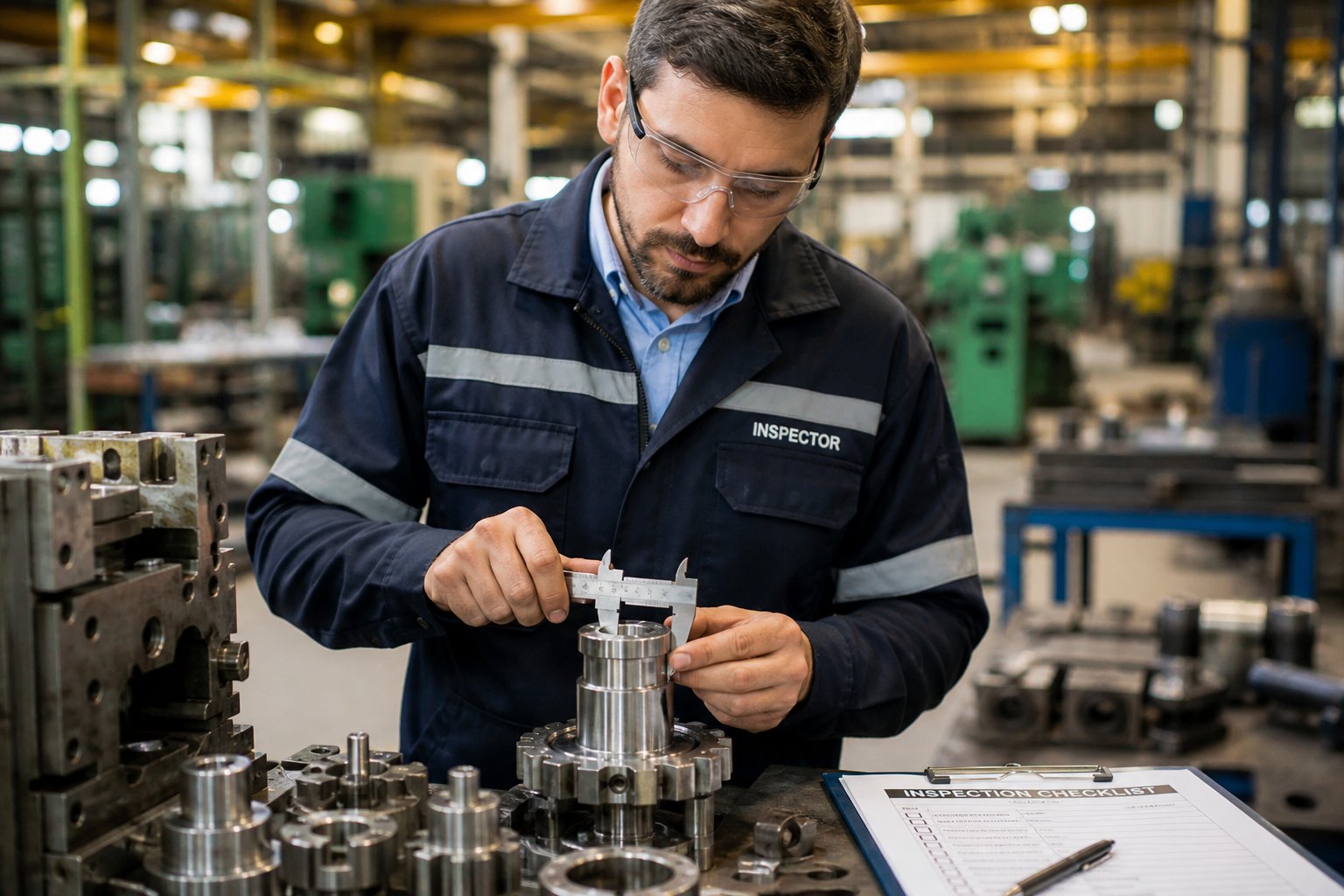
How to Verify Quality and Certifications When Sourcing from China
Every supplier's website features the same reassuring row of certification logos - CE, ISO 9001, sometimes UL or SGS badges. They look official. They feel trustworthy. And in a surprising number of cases, they don't hold up under even basic scrutiny. The challenge isn't that quality certifications don't matter - they absolutely do. The challenge is that verifying whether those certifications are genuine, current, and actually applicable to the equipment you're buying requires steps that most manufacturer-authored content conveniently skips over.
This gap exists for an obvious reason: every competing article on the SERP is written by a manufacturer promoting its own products. No supplier is going to publish a guide explaining how to catch falsified certifications - including, potentially, their own. That's exactly why this section exists.
How to Verify Quality Certifications from Chinese Suppliers
Three certifications dominate the conversation when international buyers evaluate a china twin screw extruder, and each one serves a different purpose. Confusing them - or accepting them at face value - is where procurement teams get into trouble.
CE marking indicates that a product meets European Union health, safety, and environmental requirements. For machinery sold into the EU market, CE marking is a legal requirement, not a quality bonus. The critical distinction most buyers miss is between self-declared conformity and third-party certified compliance. Under EU machinery directives, manufacturers of standard-risk equipment can self-declare CE conformity by preparing a Declaration of Conformity and maintaining a technical file. Higher-risk machinery categories require assessment by a Notified Body - an independent organization authorized by an EU member state. A CE mark without Notified Body involvement on applicable high-risk equipment is legally insufficient for EU market access.
ISO 9001 certifies that a manufacturer operates a quality management system meeting international standards. It evaluates the factory's processes - documentation, production consistency, corrective action procedures, and continuous improvement practices. What it does not do is certify any individual machine. An ISO 9001 certificate means the company follows organized, auditable workflows. It does not guarantee that a specific china lab twin screw extruder or a 135mm production-scale machine will perform to your specifications. Think of it as a credential for the kitchen, not a taste test of the meal.
UL certification addresses electrical safety standards primarily relevant to North American markets. UL-listed electrical components (motors, control panels, wiring) confirm compliance with safety standards that many US and Canadian facilities require. Some buyers also encounter CSA or ETL marks, which serve similar purposes under different testing organizations.
Sounds straightforward? Here's where it gets complicated. Falsified certifications are not uncommon among Chinese machinery suppliers. A certificate might display a legitimate-looking format and logo but reference an expired date, a different product category, or an issuing body that doesn't actually exist. Some suppliers present certificates belonging to their component suppliers - a motor manufacturer's UL listing, for example - as if they apply to the entire extruder assembly.
To cut through the noise, follow these verification steps:
- Check certificate numbers against the issuing body's public database. For CE Notified Body certificates, search the EU's NANDO database to confirm the Notified Body is legitimate and authorized for the relevant machinery directive. For ISO 9001, verify the certificate on the accreditation body's registry - certificates issued by IAF-accredited bodies can be cross-referenced through national accreditation websites.
- Confirm scope and expiration. An ISO 9001 certificate is only valid within its stated scope. A manufacturer certified for "production of plastic pipe extrusion equipment" may not be covered for compounding extruders under the same certificate. Expiration dates matter equally - ISO certifications require annual surveillance audits and full recertification every three years. An expired certificate signals that the manufacturer's quality system hasn't been independently reviewed under current standards.
- Request the full Declaration of Conformity, not just the CE logo. The Declaration of Conformity is a legal document that must identify the specific product, list applicable EU directives and harmonized standards, and be signed by an authorized representative. If a china pvc twin screw extruder manufacturer can only show you a logo on their website but cannot produce this document on request, the CE mark is unverified.
- Distinguish self-declaration from third-party testing. Ask directly: was the CE conformity assessment performed by an independent Notified Body, or was it self-declared by the manufacturer? Both are legally valid for different risk categories, but knowing which path was taken tells you how much independent scrutiny the equipment actually received.
- Request third-party test reports. For UL or CE compliance, ask for the actual test reports from the testing laboratory - not just the summary certificate. These reports contain specific test parameters, pass/fail criteria, and the tested product model. If the tested model differs from the one you're purchasing, the certification may not transfer.
Assessing Manufacturing Capability Beyond the Brochure
Certifications tell you whether a manufacturer's systems meet documented standards. They tell you almost nothing about whether a specific machine will perform reliably in your facility for the next fifteen years. That distinction is why due diligence has to extend well beyond paperwork.
Imagine two suppliers. Both hold valid ISO 9001 certifications. Both display CE marks. Their brochures feature similar specifications and polished factory photos. Yet one operates advanced CNC machining centers with tolerances within 0.02mm, employs a dedicated R&D team, and maintains component traceability from raw steel billet to finished screw element. The other assembles purchased components in a rented facility with minimal in-house machining capability. The certifications won't distinguish between them. Your verification process must.
Whether you're evaluating a china conical twin screw extruder pvc factory for a profile line, a china parallel twin-screw extruder factory for compounding, or a china laboratory twin screw extruder supplier for R&D trials, the due diligence steps are fundamentally the same. Use this checklist as your working framework:
- Request a factory audit - or commission one independently. A structured factory audit conducted by a recognized third-party firm like SGS, TUV, or Bureau Veritas evaluates production equipment, quality control processes, workforce capability, and documentation systems across 400+ checkpoints. These audits typically cost $200-$400 per auditor-day and take two to five days on-site. If the supplier resists or delays an independent audit, treat that as a data point, not an excuse. Suppliers confident in their capabilities welcome external verification.
- Ask for reference customers in your region and your industry. A supplier claiming extensive export experience should be able to provide contact details for customers running similar applications in your geographic market. When you reach those references, ask specific questions: How did the machine perform against quoted specifications? How responsive was after-sales support when problems arose? How long did spare parts take to arrive? A china conical twin screw extruder pvc supplier serving the European window profile market should have verifiable European references - not just domestic installations.
- Evaluate genuine R&D capability versus assembly-only operations. Ask to see the engineering department - not the sales office. Genuine R&D capability shows up as screw profile simulation software, material testing equipment (melt flow indexers, torque rheometers), documented patent filings, and engineers who can discuss your specific formulation challenges in technical detail. Assembly-only operations source barrels, screw elements, gearboxes, and control panels from external suppliers and bolt them together. Both business models exist; the distinction matters because it determines whether the supplier can troubleshoot processing problems or only replace components.
- Check export track records through trade data platforms. Services like ImportGenius, Panjiva, or customs data aggregators allow you to search actual shipping records tied to a manufacturer's name. These records reveal how many containers a supplier has shipped, to which countries, and how frequently. A manufacturer claiming "equipment operating in 70+ countries" should have a verifiable trade history that supports that claim. Discrepancies between stated experience and actual export data are a significant red flag.
- Review technical documentation quality. Request operation manuals, electrical schematics, and maintenance guides before purchase. The quality of these documents reveals more about a manufacturer's engineering culture than any sales presentation. Detailed, well-translated technical documentation with clear diagrams and part numbers indicates systematic engineering practices. Poorly formatted, machine-translated manuals with vague references suggest a company that invests in sales rather than engineering depth.
- Verify component sourcing transparency. Ask the manufacturer to identify the brands and origins of key components: gearbox manufacturer, motor brand, PLC and HMI supplier, bearing manufacturer, and barrel liner material specification. Reputable suppliers provide this information readily because their component choices are a competitive advantage. Reluctance to disclose component sources often indicates that lower-cost alternatives are being substituted without disclosure.
- Assess after-sales infrastructure before you need it. Determine whether the manufacturer maintains regional service engineers, spare parts warehouses outside China, or partnerships with local service providers in your market. A china twin screw extruder that arrives with excellent specifications but zero accessible support infrastructure when a gearbox seal fails at 2 AM on a production night creates a very different ownership experience than one backed by a structured service network.
A realistic assessment of Chinese twin screw extruders recognizes that the quality spectrum is wide. Some manufacturers produce equipment with machining precision, metallurgical quality, and control system sophistication that genuinely rivals European alternatives - at significantly lower price points. Others produce machines that look similar in photographs but fall short in the dimensional tolerances, material grades, and engineering support that determine long-term reliability. Blanket claims of parity are as misleading as blanket dismissals of Chinese quality. The only honest answer is: it depends on the specific manufacturer, and verification is the only way to find out.
This verification discipline protects you from the most common sourcing failures. But even thorough due diligence operates on information the supplier provides. The next layer of protection comes from knowing what honest suppliers won't volunteer and dishonest ones actively conceal - the red flags and contractual pitfalls that separate a successful purchase from an expensive lesson.
Red Flags and Common Pitfalls When Buying from China
Verification checklists and certification databases protect you from suppliers who can't withstand scrutiny. But what about the ones who pass the initial screening and still burn you? The most dangerous sourcing failures don't come from obviously fraudulent operators - they come from suppliers who seem professional enough during the sales phase and unravel slowly after your deposit clears. No manufacturer-authored article will publish what follows, because every warning sign on this list describes behavior that exists within their own competitive landscape.
Warning Signs of Unreliable Manufacturers
When you're comparing china co rotating twin screw extruder quotes or evaluating china parallel twin screw extruder quotes from multiple suppliers, certain patterns should trigger immediate caution. None of these red flags is automatically disqualifying on its own - context matters - but encountering two or more together should fundamentally change how you approach that supplier relationship.
- Cannot provide references from your target industry. A supplier quoting on a compounding extruder for glass-fiber-reinforced nylon should be able to connect you with at least one customer running a similar application. Vague references - "we have many customers in Europe" without names, contact details, or verifiable installations - are not references. They're marketing claims. If you're sourcing a china lab twin screw extruder quotes package for R&D trials, the supplier should demonstrate experience with laboratory-scale machines specifically, not just point to their production-line catalog.
- Pricing that undercuts the market by more than 30% without clear justification. Chinese manufacturers already operate at a significant structural cost advantage. When a quote comes in dramatically below even the Chinese market average, something is being left out - a lower torque grade gearbox, inferior barrel metallurgy, no-name electrical components, or a machine that exists only as a configuration on a spreadsheet rather than a proven production model. Extreme undercutting is often compensated later through reduced quality, surprise surcharges, or in worst cases, non-delivery.
- Reluctance to allow factory visits or provide live video tours. A real manufacturer with actual production capacity has no reason to avoid showing you the shop floor. Suppliers who continually dodge video calls, refuse on-site visits, or only share carefully edited marketing videos may not own the factory they're presenting - or may be hiding conditions that wouldn't survive scrutiny. In an era of instant video communication, there is no legitimate excuse for refusing a live walkthrough.
- Vague or inconsistent technical specifications. Ask for the gearbox torque rating in Nm/cm3, the barrel liner material grade, or the screw element hardness specification. If the answers shift between conversations, arrive weeks late, or get deflected with "we can customize anything you need," you're likely dealing with a trading company or assembler who doesn't control the engineering. Genuine manufacturers answer technical questions with precision because their engineers designed the equipment.
- No after-sales service infrastructure or spare parts commitment. Ask a simple question: if a screw element wears out eight months after commissioning, where does the replacement ship from and how long does it take? Suppliers who hesitate, defer, or promise "we'll handle it when the time comes" are telling you they have no service system in place. The best time to evaluate after-sales capability is before you've paid for the machine - not when your production line is down.
- Pressure to wire full payment upfront without escrow or LC options. Any supplier demanding 100% payment before production - especially on a first order and without trade assurance - is removing every point of leverage you have if something goes wrong. Professional manufacturers understand that structured payment terms protect both parties. Resistance to standard payment structures signals either financial instability or intent to avoid accountability.
One additional red flag deserves standalone attention because it's uniquely common in the extruder market. When comparing a china single screw extruder vs twin screw extruder, buyers sometimes encounter suppliers who aggressively push a twin screw configuration for applications where a single screw would perform equally well - simply because the twin screw carries a higher price tag. A trustworthy supplier recommends the machine that fits your process, even when that recommendation means a smaller order value.
Similarly, be cautious with suppliers who claim their equipment is "equivalent to" premium Western brands like china brabender twin screw extruder or china clextral twin screw extruder models. Brabender and Clextral are established names with decades of documented application engineering behind their machines. A Chinese supplier claiming equivalence should be able to substantiate that claim with independent test data, side-by-side performance comparisons, or verifiable customer testimonials - not just a brochure assertion.
Common Pitfalls in Contract and Communication
Red flags help you avoid the wrong suppliers. Contract pitfalls can undermine deals with the right ones. Even well-intentioned manufacturers can become problematic partners when purchase agreements leave critical terms ambiguous - and ambiguity in cross-border machinery contracts tends to resolve itself in favor of whoever wrote the vague language.
Warranty scope that evaporates at the border. A 12-month warranty sounds reassuring until you read the fine print. Does it cover parts only, or parts and labor? Does it require you to ship failed components back to China for inspection before a replacement is authorized? Who pays freight on warranty claims? What constitutes "normal wear" versus a warranty-eligible defect? Disputes over warranty clause interpretation in cross-border machinery transactions routinely escalate into costly disagreements precisely because these details were never pinned down in the purchase agreement. Get the answers in writing, in the contract itself - not in a sales email that has no legal standing.
Language version discrepancies. When your contract exists in both English and Chinese, which version controls? This is not a theoretical concern. In documented disputes, manufacturers have successfully argued that the Chinese-language version of a contract was the controlling document - even when the buyer negotiated entirely in English. If the Chinese text uses a term equivalent to "may" where the English version says "shall," the obligation can vanish entirely. Specify the governing language in the contract, and have the controlling version reviewed by someone who reads it fluently.
Technical specifications buried in attachments nobody reviews. The purchase order should include a detailed technical specification sheet as a contractual annex - screw diameter, L/D ratio, torque grade with rated Nm/cm3, motor power, barrel material specification, control system brand and model, and a complete list of included accessories. When you're finalizing china twin screw compounding extruder quotes, every parameter discussed during the sales process must appear in the signed document. Verbal assurances about "upgraded components" or "latest generation controls" mean nothing if the contract references a generic model number without elaboration.
Intellectual property exposure. If your extruder will process proprietary formulations and you share those formulations with the supplier for screw profile optimization, understand that Chinese IP protections exist but enforcement remains challenging. Share only what's necessary for machine configuration, require an NDA before disclosing formulation details, and retain the ability to modify screw profiles independently after delivery. Your formulation knowledge is a competitive asset - treat it accordingly.
Payment terms that protect both parties. The industry-standard structure for a first order is 30% deposit via T/T (telegraphic transfer) with the 70% balance paid against Bill of Lading or upon passing pre-shipment inspection. This gives the manufacturer working capital to begin production while preserving your leverage until the machine is built and verified. For orders exceeding $100,000, a Letter of Credit (LC) at sight offers stronger protection - the manufacturer only gets paid when compliant shipping documents are presented to the issuing bank, and the bank verifies conformity before releasing funds. Escrow services provide a third option, particularly useful when neither party has established trust.
A deal without secure payment terms is not a deal - it is a gamble. Structure your payment milestones so that final payment is never released before independent verification confirms the machine meets contracted specifications.
The gap between sales promises and post-delivery reality. This is perhaps the most frustrating pitfall because it's nearly invisible during the buying process. The sales team that responded to your emails within hours, arranged factory tours, and provided detailed china lab twin screw extruder quotes with full technical breakdowns may hand you off to an entirely different support structure after shipment. Commissioning engineers might arrive weeks late. Technical questions routed through a general support inbox might take days instead of hours. Spare parts inquiries might reveal that the responsive sales contact has no authority or capability to expedite logistics.
The countermeasure is contractual. Include specific after-sales commitments in the purchase agreement: response time guarantees for technical support inquiries, commissioning engineer arrival deadlines tied to your installation schedule, spare parts delivery timelines with penalties for delays beyond agreed windows, and a named technical contact - not just a department email - who carries responsibility for your account post-delivery.
Every one of these pitfalls is avoidable. None requires extraordinary sophistication - just the discipline to document expectations in enforceable language before money changes hands. The suppliers worth partnering with will respect that discipline, because it protects them too.
Contract terms and supplier vetting address the purchase itself. But the relationship between buyer and manufacturer doesn't end at commissioning - it extends across years of operation, and the components that wear out fastest are the ones that determine whether that long-term relationship delivers value or frustration.
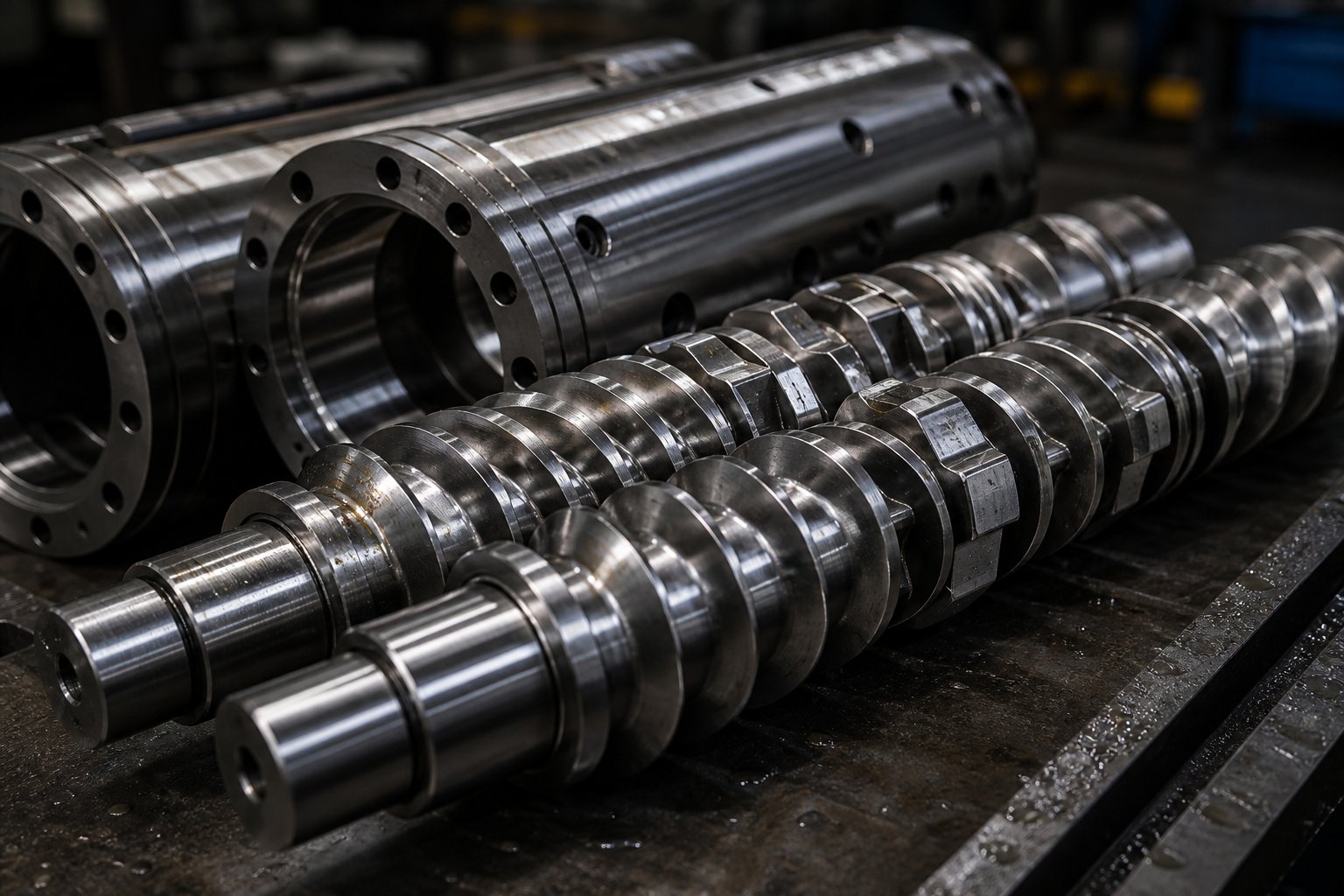
Screw Barrels and Replacement Parts That Keep Extruders Running
Your extruder is commissioned, your production line is humming, and the sales team that courted you has moved on to their next prospect. Six months pass. Twelve months. Then a routine inspection reveals flight clearance on your screw elements has widened past tolerance, melt temperature uniformity starts drifting, and output drops by 8% before anyone connects the dots. Welcome to the phase of ownership that no brochure covers and no sales engineer volunteers to discuss during the quoting process - the ongoing replacement of wear parts that quietly govern your machine's real operating economics.
Why Screw and Barrel Quality Determines Long-Term Performance
Screw elements and barrels are the highest-wear components in any twin screw extruder. They're also the components that most directly control everything your production team cares about: output consistency, melt quality, energy consumption, and uptime. According to industry sourcing data, screws and barrels together represent under 5% of a typical extruder's capital cost - yet they govern 60% to 75% of its lifetime operating economics through wear-driven downtime, replacement frequency, and the energy penalty that comes from running degraded components.
Think of it this way: every hour your extruder runs, hard filler particles act as microscopic cutting tools against flight surfaces and barrel bores. The clearance between screw outer diameter and barrel inner diameter - typically set at 0.1% to 0.2% of screw diameter - widens progressively. Once that clearance crosses a critical threshold, polymer leaks backward across flight tips instead of moving forward. Output falls. Melt temperature becomes less uniform. Pressure variability increases. And the compounding quality your customers rely on degrades in ways that may not show up until downstream quality checks catch the problem.
This is why metallurgy isn't just an engineering footnote - it's a procurement decision that directly determines how often you shut down for replacement and how much each shutdown costs.
Three metallurgical tiers cover the vast majority of china twin screw extruder barrels and screw elements in service globally:
- Nitrided steel (baseline): The standard surface treatment for general-purpose applications. Nitrogen diffusion creates a hardened case of 950-1,100 HV to a depth of 0.3-0.7 mm. Nitrided 4140 steel handles unfilled commodity polymers adequately but wears rapidly - sometimes within 2,000-3,000 hours - when processing abrasive fillers like glass fiber or mineral concentrates. As ENTEK's metallurgy engineers note, the industry has shifted dramatically away from nitrided tool steels over the past decade, with the share dropping from roughly 70% to approximately 10% of production in advanced applications.
- Bimetallic construction (mid-tier to premium): A tough core alloy - typically 4340 or 4140 heat-treated for torsional strength - overlaid with a wear-resistant material on the working surfaces. For barrels, centrifugally cast liners with high chromium and tungsten carbide content deliver bore hardness of 60-72 HRC. For screws, Stellite overlay via plasma transferred arc (PTA) welding or HVOF thermal spray of tungsten carbide-cobalt powders protects flight tips and flanks. Documented case studies show bimetallic screws delivering 4x to 8x the service life of nitrided alternatives in abrasive compounding - a service life extension that, despite 2.5x to 4x higher upfront cost, consistently reduces 36-month total cost of ownership by 50% or more.
- Tungsten carbide coatings and powder metallurgy grades (extreme wear): For the most demanding applications - 40-60% mineral-filled compounds, glass fiber reinforced engineering plastics, or recycled streams contaminated with abrasive particulates - HVOF WC-Co coatings reaching 1,100-1,400 HV or CPM 10V powder metallurgy tool steels represent the highest tier. These materials command 4x to 9x the cost of baseline nitrided components, but in severely abrasive service, they routinely exceed 20,000 hours of operation where nitrided steel lasts 3,000-4,000 hours.
Corrosion adds another dimension entirely. If your production involves PVC, halogenated flame retardants, or fluoropolymers, hydrogen chloride or hydrogen fluoride gas attacks screw and barrel surfaces from the inside. Standard nitrided steel corrodes at rates of 0.08-0.15 mm per 1,000 operating hours in rigid PVC service, while nickel-based bimetallic constructions reduce that rate to 0.01-0.03 mm - an order-of-magnitude difference that determines whether you're replacing barrels annually or every five years.
Beyond material selection, geometry precision matters just as much. A china twin screw extruder element manufacturer producing conveying elements, kneading blocks, and mixing elements must hold tight dimensional tolerances to maintain the designed processing profile over time. Conveying elements need consistent flight depth and pitch to deliver predictable throughput. Kneading blocks require precise stagger angles - forward, neutral, or reverse - to generate the intended shear and residence time distribution. Reverse elements must create the exact restriction calculated in the original screw profile design. When replacement elements deviate from these geometries, the carefully optimized processing profile the machine was commissioned with degrades, even if the metallurgy is correct.
Sourcing Factory-Direct Replacement Components
Here's where the buyer-supplier relationship evolves from a one-time transaction into an ongoing operational dependency - and where strategic thinking separates experienced procurement teams from reactive ones.
Most buyers default to ordering replacement china twin screw extruder elements from their original equipment manufacturer. That's a reasonable starting point, but it comes with limitations. OEM lead times on wear parts often stretch to 8-12 weeks because extruder manufacturers prioritize new machine production over spare parts orders. OEM pricing includes engineering overhead, brand markup, and logistics margins that don't reflect the actual manufacturing cost of the component. And if your OEM is a European or Japanese brand, every replacement component ships internationally with duties and freight costs baked in - even when the component itself was originally manufactured in China.
This is why identifying reliable component suppliers independent of your OEM is a strategic advantage, not just a cost-cutting tactic. Factory-direct china twin screw extruder barrel factory operations and specialized screw element manufacturers can offer faster lead times, lower unit costs, and compatibility across multiple extruder brands - because they focus exclusively on wear parts rather than treating them as an afterthought within a complete machine business.
Suppliers like NANHAIYA specialize in factory-direct screw and barrel solutions for twin screw extrusion, compounding, and pelletizing applications. Their product range covers the replacement components that plastic extrusion plants and procurement teams most frequently need - screw elements, barrel segments, shafts, and liners compatible with major extruder platforms. By sourcing directly from a dedicated china twin screw extruder barrel manufacturer rather than routing through OEM channels, buyers can reduce per-component costs significantly while often cutting lead times in half.
The economics are compelling, but cost savings mean nothing if the replacement components don't perform. A screw element that's $200 cheaper but wears out in half the time isn't a savings - it's a hidden cost multiplier. That's why evaluating any china twin extruder screw barrel supplier requires the same rigor you'd apply to the original machine purchase. Here are the criteria that separate reliable component suppliers from commodity vendors:
- Material certifications: Demand EN 10204 3.1 mill certificates for every alloy used - base steel, hardfacing powder, and barrel liner casting material. These certificates should specify chemical composition, mechanical properties, and heat treatment conditions. A supplier who cannot produce material traceability documents for the specific components you're purchasing lacks the process control to guarantee consistent field performance.
- Dimensional tolerances: Request documented inspection records showing flight outer diameter, bore diameter, spline fit, and element length tolerances. For twin screw elements, flight OD tolerance directly determines barrel clearance - the parameter that governs output efficiency and melt quality. Tolerances should be verified by calibrated instruments, ideally with CMM (coordinate measuring machine) data rather than manual caliper readings.
- Surface finish specifications: Screw element flight surfaces and barrel bores require controlled surface roughness to balance polymer flow characteristics and wear resistance. Typically, barrel bore finish should fall within Ra 0.4-0.8 micrometers, and screw flight surfaces within Ra 0.2-0.6 micrometers depending on application. Ask for surface roughness data as part of the quality documentation package.
- Hardness testing documentation: Hardness values should be tested and reported at multiple locations per component - flight tip, flight flank, screw root for elements; bore surface at multiple axial positions for barrels. A single hardness reading on a data sheet tells you almost nothing about uniformity. Multi-point hardness maps reveal whether heat treatment and overlay application achieved consistent results across the entire working surface.
- Compatibility verification processes: The supplier should have a documented method for confirming dimensional compatibility with your specific extruder make and model. This goes beyond matching a diameter - spline geometry, element length, locking mechanisms, and barrel flange bolt patterns must all align precisely. Reputable component suppliers maintain dimensional databases for major extruder brands and request your machine model, serial number, or sample component drawings before manufacturing.
- Metallographic cross-section analysis (for bimetallic and coated components): For hardfaced screw elements and bimetallic barrel liners, metallography verifies overlay thickness, bond quality, carbide distribution, and absence of porosity or micro-cracking. For HVOF coatings specifically, porosity above 2% indicates inadequate deposition parameters and should be grounds for rejection.
One practical approach that experienced procurement teams use: order a small trial batch of the most frequently replaced china twin screw extruder elements - typically two or three kneading blocks and a set of conveying elements - and run them alongside OEM components in the same extruder. Measure wear rates, dimensional stability, and processing performance at defined intervals. This head-to-head comparison generates the only data that truly matters: how the factory-direct components perform in your actual process, with your actual materials, at your actual operating conditions.
Building a reliable supply chain for replacement screws and barrels isn't glamorous procurement work. Nobody celebrates a perfectly timed barrel liner swap the way they celebrate a new machine installation. But the math is unforgiving: over a 15-year machine life, you'll spend more on replacement wear parts than you spent on the original china twin screw extruder barrel and screw assembly that came with the machine. The suppliers you choose for those replacements - and the verification discipline you apply to their products - determine whether your extruder delivers consistent, cost-effective production year after year, or slowly bleeds margin through preventable downtime and quality drift.
Frequently Asked Questions About Sourcing Twin Screw Extruders from China
1. How much cheaper is a twin screw extruder from China compared to European brands?
Chinese twin screw extruders typically cost 40-60% less than comparable European machines. This gap stems from structural advantages - lower labor costs, fully domestic supply chains for specialty steels and gearboxes, industrial cluster efficiencies in the Nanjing region, and government incentives for equipment manufacturers. However, the purchase price only represents 60-75% of your total landed cost. Shipping, import duties (which can include US Section 301 tariffs of 7.5-25%), installation, commissioning, spare parts inventory, and long-term maintenance add 25-40% more. Buyers should also verify the torque grade classification of the gearbox, as a lower-tier B-type unit can be quoted at a misleadingly low price versus the D-type or G-type gearbox your application actually requires.
2. What is the difference between a conical and parallel twin screw extruder?
Conical twin screw extruders use tapered screws that narrow from the feed end to the discharge end, generating high pressure through built-in compression geometry with low shear. They are almost exclusively counter-rotating and are the standard choice for PVC profiles, pipes, sheets, and foam board. Parallel twin screw extruders maintain a uniform screw diameter throughout and are available in co-rotating or counter-rotating configurations. Co-rotating parallel machines dominate polymer compounding, masterbatch production, engineering plastics, and recycling because their modular barrel and screw element design allows full customization of the processing profile. The practical rule: if you process primarily PVC, conical extruders offer proven performance at lower capital cost. If you compound multiple polymer families or switch formulations frequently, parallel co-rotating machines justify their higher investment through processing versatility.
3. Why are most Chinese twin screw extruder manufacturers located in Nanjing?
Roughly 90% of Chinese twin screw extruder manufacturers are concentrated in the Nanjing region due to a self-reinforcing industrial cluster that developed over decades. The catalyst was Nanjing University of Technology (now Nanjing Tech University), a leading polymer processing research institution whose graduates fed directly into local equipment companies. This academic nucleus attracted specialty steel suppliers, CNC machining shops, heat treatment facilities, gearbox manufacturers, and control system integrators to the area. The resulting ecosystem allows a factory to source nitrided barrel liners, hardened screw elements, and high-torque gearboxes from vendors less than an hour away, drastically reducing logistics costs and enabling rapid iteration on design improvements.
4. How can I verify if a Chinese twin screw extruder manufacturer's certifications are genuine?
Start by checking certificate numbers against the issuing body's public database. For CE Notified Body certificates, search the EU's NANDO database to confirm the body is authorized for the relevant machinery directive. For ISO 9001, verify the certificate through the national accreditation body's registry. Always confirm scope and expiration - an ISO certificate for pipe extrusion equipment may not cover compounding extruders, and certificates require annual surveillance audits. Request the full Declaration of Conformity for CE marking, not just a logo. Ask whether CE conformity was self-declared or assessed by an independent Notified Body. For UL certification, request actual test reports specifying the tested model. Falsified or misapplied certifications are not uncommon, so independent verification through third-party audits from firms like SGS or TUV adds an essential layer of assurance.
5. How often do twin screw extruder screws and barrels need replacement, and where should I source them?
Replacement frequency depends heavily on the materials being processed and the metallurgy of the wear components. Nitrided steel elements processing abrasive fillers like glass fiber may wear out within 2,000-3,000 hours, while bimetallic constructions with tungsten carbide overlays can exceed 20,000 hours in the same application. Over a 15-year machine life, total spend on replacement wear parts typically exceeds the cost of the original screw and barrel assembly. For sourcing, buyers benefit from identifying factory-direct component suppliers like NANHAIYA (https://www.nhyscrews.com/products) independent of the OEM. Dedicated screw and barrel manufacturers often deliver faster lead times - sometimes half the OEM's 8-12 week timeline - at lower per-component costs, with compatibility across multiple extruder brands. Always verify material certifications, dimensional tolerances, and hardness testing documentation before committing to a new supplier.
Written by
Nanhaiya Technical Team
Zhoushan Nanhaiya Plastic Machinery Co., Ltd.
The Nanhaiya technical team supports screw and barrel manufacturing projects through application review, technical communication, custom manufacturing coordination, and production and quality control.
Discuss Your Application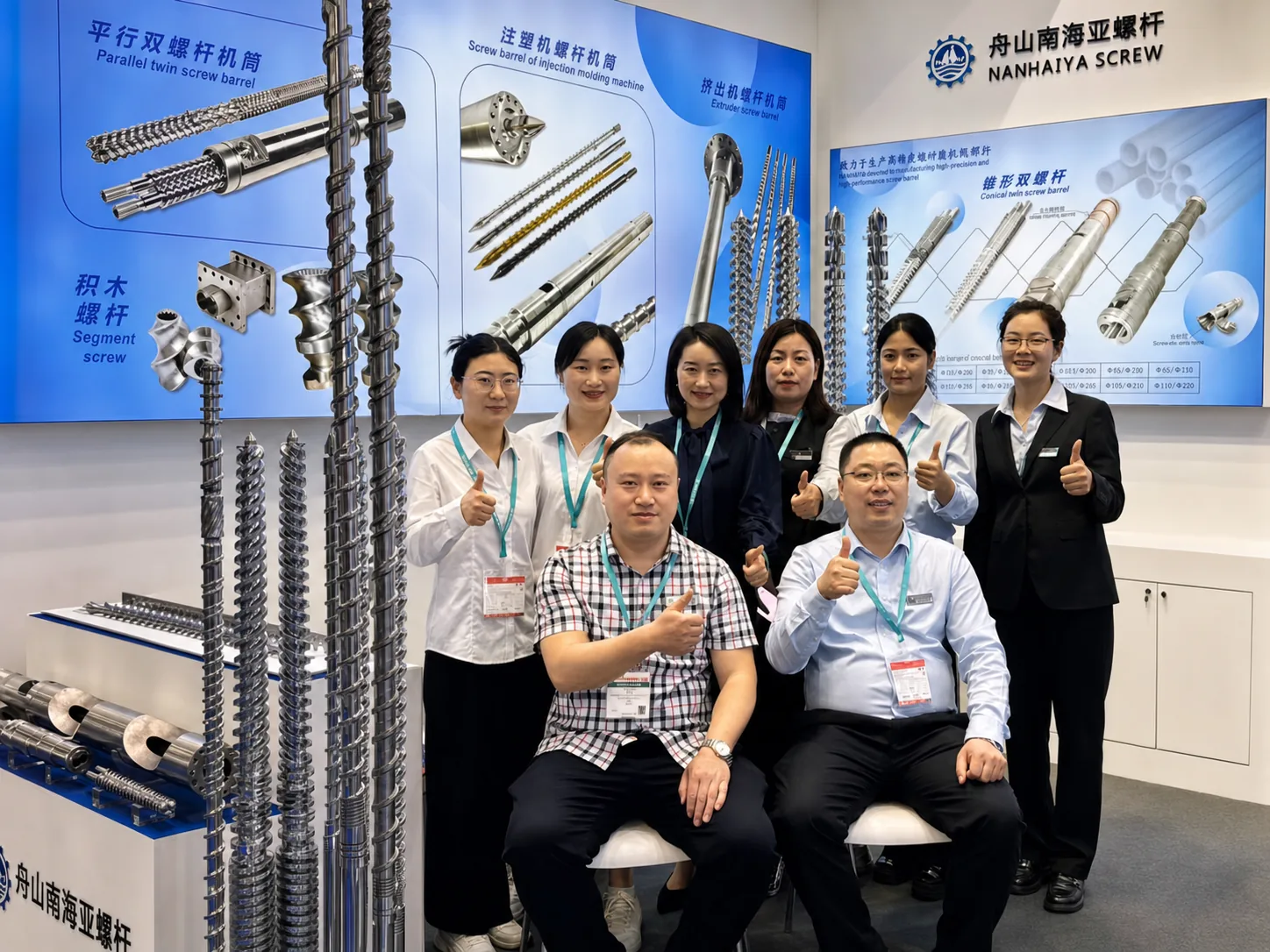
Related Articles
More insights on screw barrel technology and plastics processing.
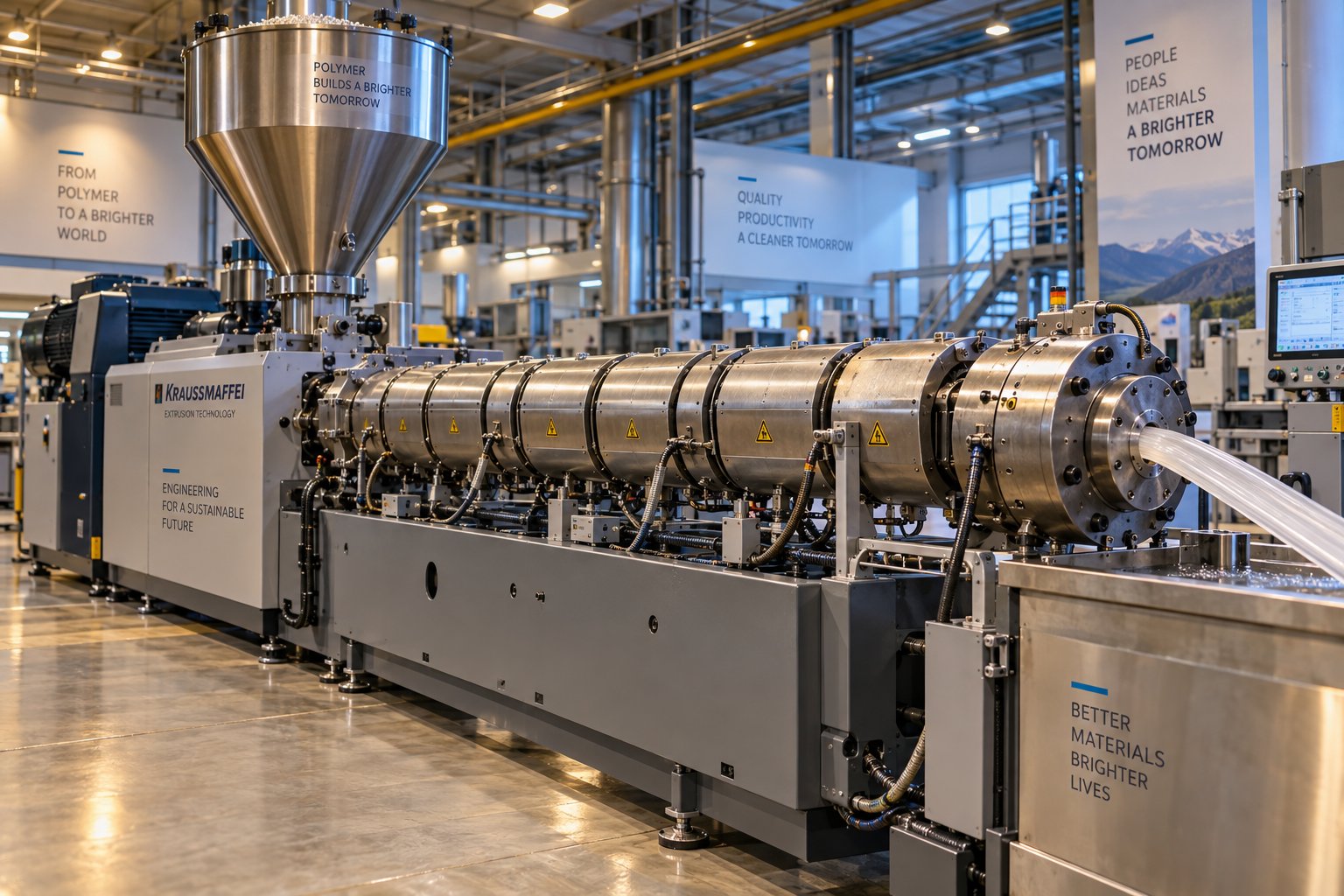
Extruder Machine Decoded: From Raw Pellet To Finished Product
Oct 6, 2026
Learn how an extruder machine works, compare single-screw vs. twin-screw types, and get expert guidance on specs, troubleshooting, and selection.
Read Article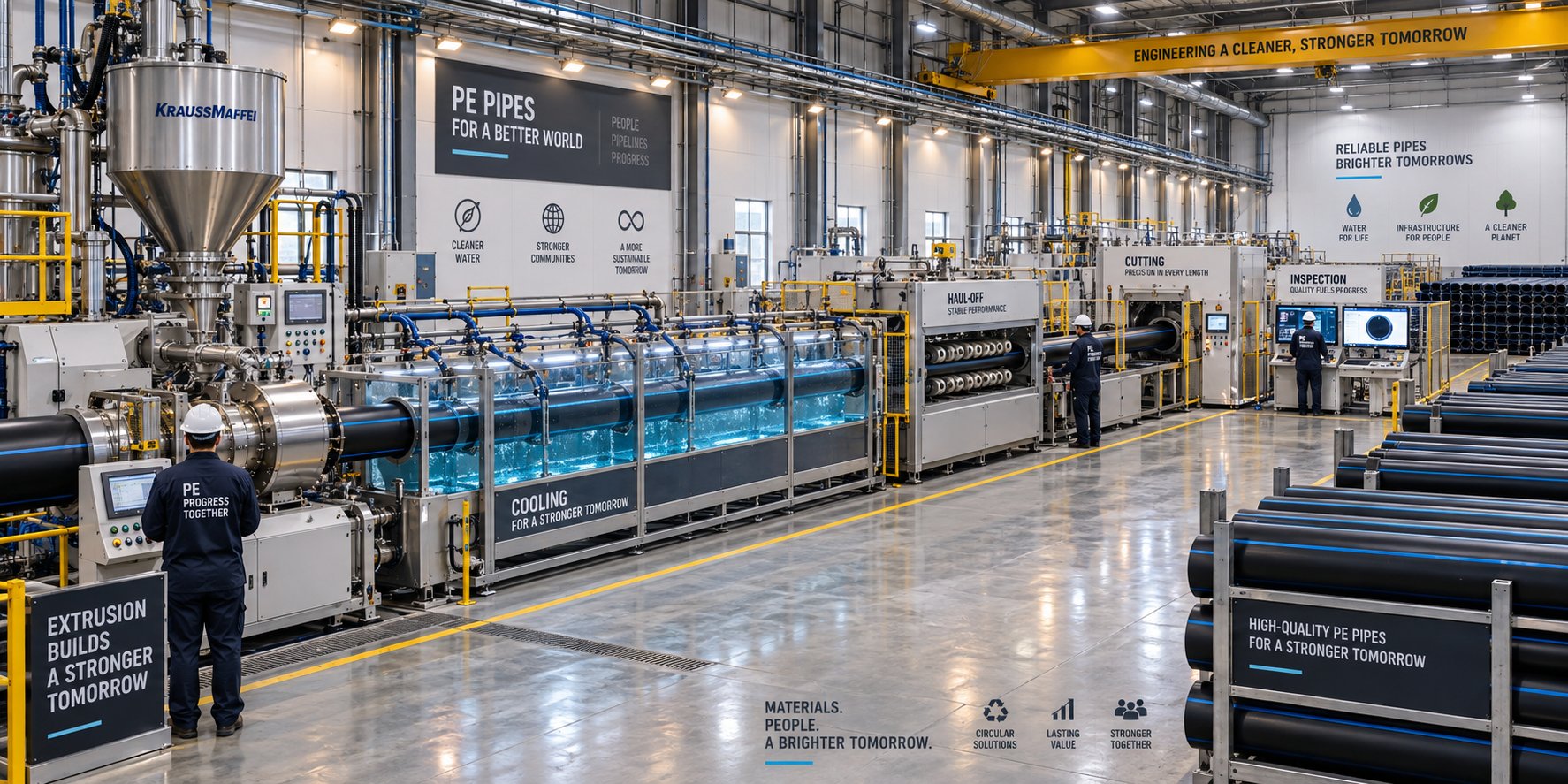
PE Pipe Making Machine Decoded: From Raw Resin to Flawless Pipe
Oct 4, 2026
Learn how a PE pipe making machine works, from resin to finished pipe. Covers components, material grades, automation, troubleshooting, and buyer selection tips.
Read Article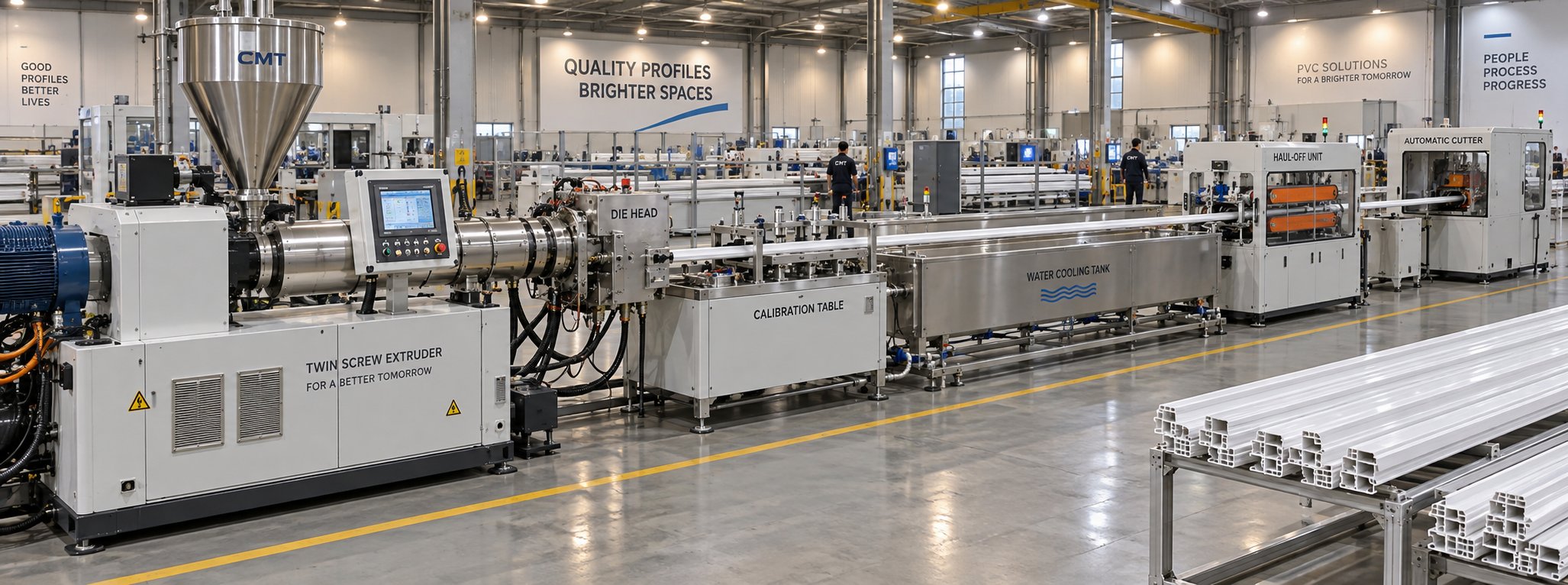
PVC Profile Making Machine Decoded: From Raw Resin To Profit
Oct 3, 2026
Learn how a PVC profile making machine works — extrusion process steps, key technical parameters, die design, calibration methods, maintenance, and total cost of ownership.
Read ArticleLooking for something else?
Search by material, symptom or product and jump straight to the relevant page.
These are navigation suggestions based on keyword matching — not a quotation, not a delivery commitment, and not a substitute for engineering review. Final specification is confirmed by our engineers against your drawings and processed material.
Need help with screw barrel selection?
Share your machine model, processed material and application. Our team can help with pricing and technical support.