

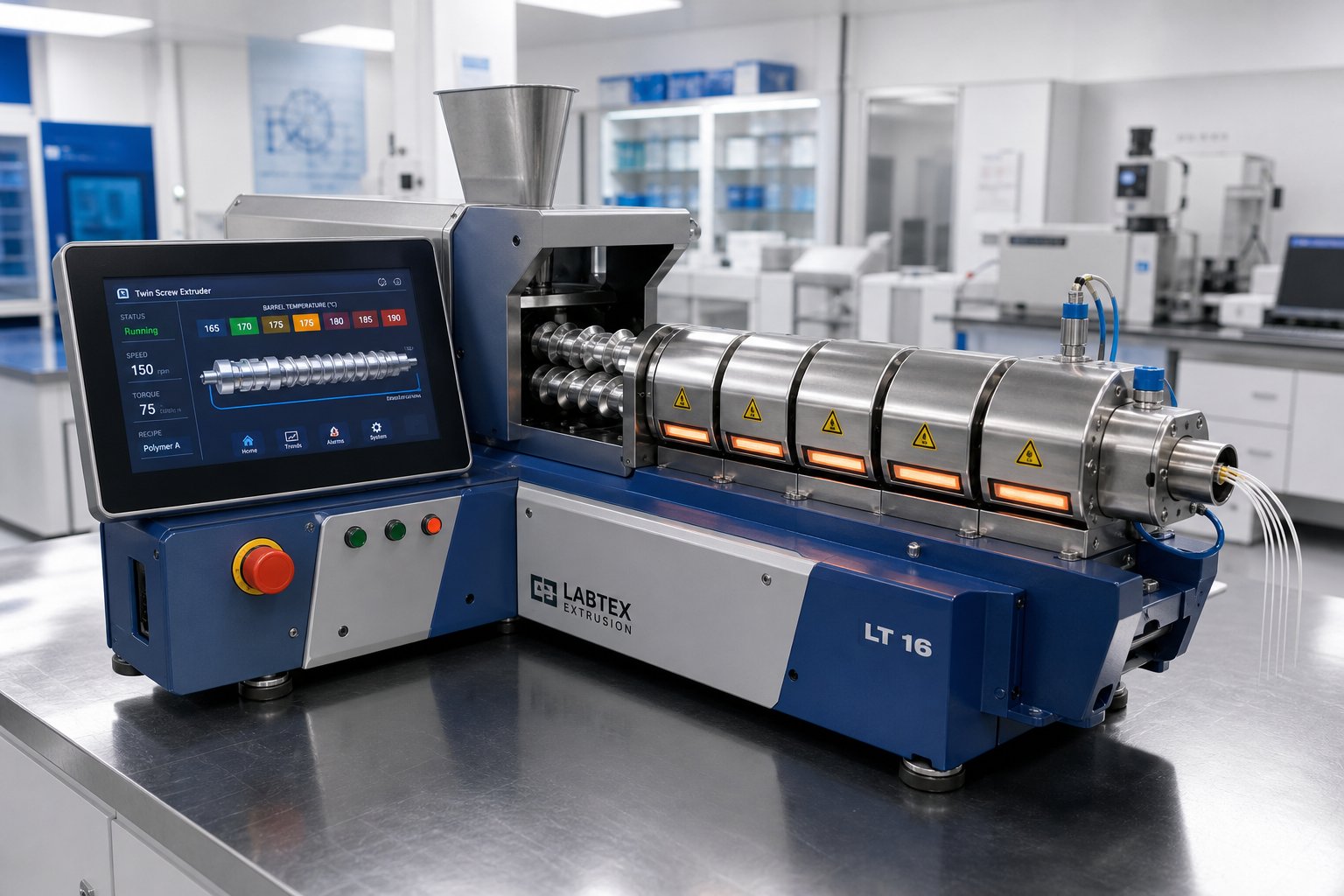
What Is a Lab Twin Screw Extruder and Why Source from China
Imagine you're developing a brand-new polymer blend or testing an experimental pharmaceutical compound. You have only a few hundred grams of costly raw material, and you need precise, repeatable processing data before committing to full-scale production. This is exactly where a lab twin screw extruder earns its place in the workflow.
A China lab twin screw extruder is a compact, small-footprint extrusion system engineered specifically for R&D, formulation screening, and small-batch trial production. Unlike its industrial counterparts that fill entire factory floors, a lab-scale machine sits comfortably on a bench top or occupies minimal workshop space. It processes materials at throughputs typically under 10-20 kg/hr, uses screw diameters commonly ranging from 16mm to 35mm, and — here's the critical advantage — delivers meaningful experimental results from very small sample sizes, sometimes as little as 500 grams per run.
For research teams working with expensive experimental polymers, rare additives, or pharmaceutical-grade compounds, that low material requirement translates directly into significant cost savings per trial.
Defining the Lab Twin Screw Extruder
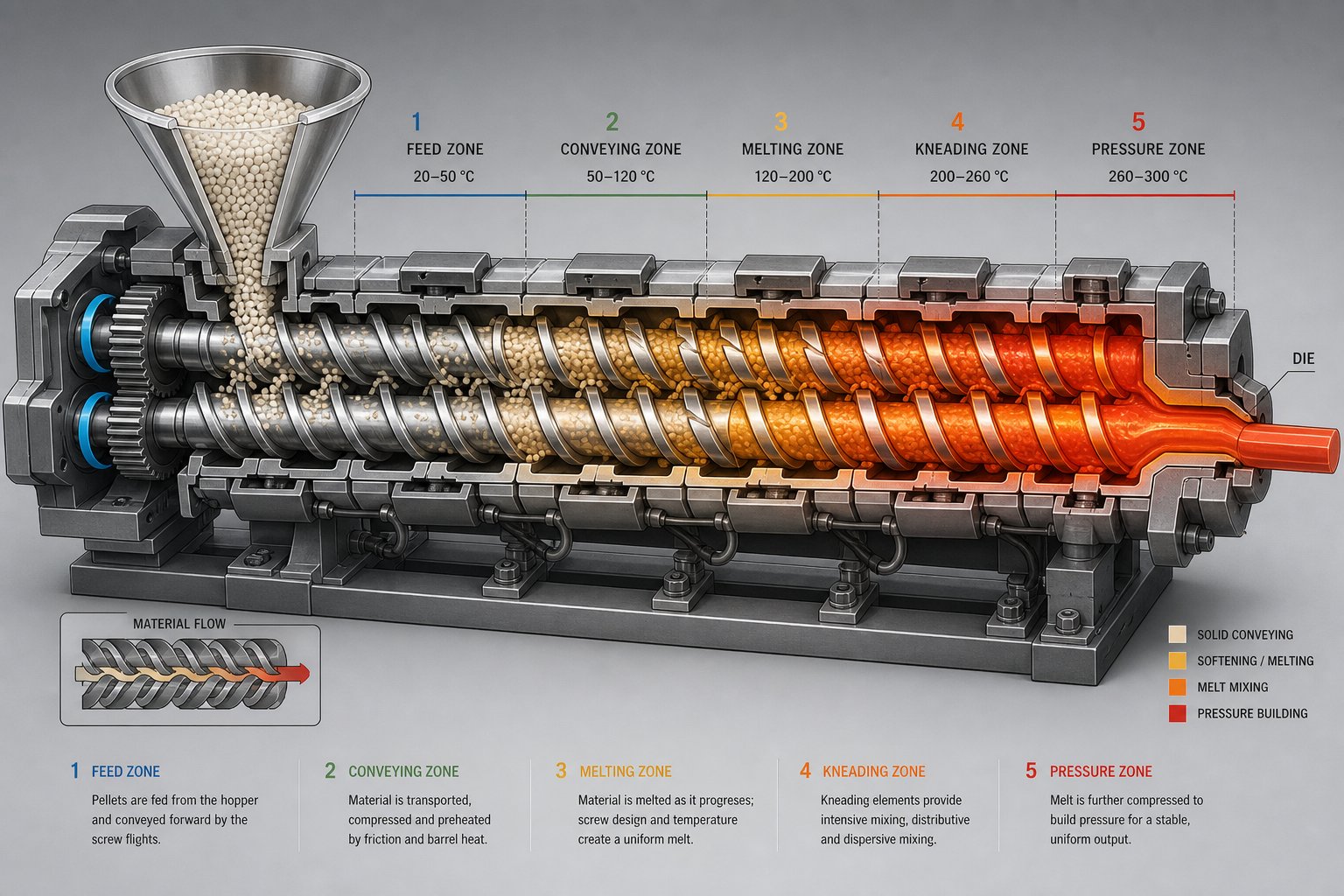
At its core, every lab twin screw extruder operates on a straightforward mechanical principle: two precisely intermeshing screws rotate inside a heated, segmented barrel. As raw materials enter the feeding zone, the rotating screws convey them forward through progressively hotter barrel sections. Along the way, the material melts, undergoes intensive mixing and kneading, gets degassed through vacuum ports, and is finally pushed through a die to form strands, films, or pellets.
What separates a true lab-scale machine from a production extruder goes beyond just smaller dimensions. Lab extruders are purpose-built for flexibility and rapid iteration. They feature modular screw elements that researchers can rearrange to fine-tune mixing intensity, quick-open barrel designs for fast cleaning between material changeovers, and PLC-based control systems capable of temperature accuracy within ±1°C. These design choices reflect a single priority: generating reliable, scalable data from the smallest possible material quantities.
You'll typically find these machines in university polymer science departments, corporate R&D centers developing new material formulations, and pilot-line facilities validating processes before industrial scale-up.
Why China Has Become a Global Sourcing Destination
A decade ago, buyers seeking lab-scale twin screw extruders looked almost exclusively to European and Japanese legacy brands. That landscape has shifted dramatically. Chinese manufacturers have built a mature industrial ecosystem — concentrated heavily in cities like Nanjing — that combines advanced CNC metal-machining capabilities, deep metallurgical expertise, and lower labor costs to produce increasingly sophisticated lab extrusion equipment at competitive price points.
China's twin-screw extruder industry has grown into a sector with a market size exceeding 15 billion yuan, with the Nanjing region alone hosting over 90% of the country's manufacturing enterprises in this space. That concentration creates a powerful supply chain effect: specialized component suppliers, experienced engineering talent, and a competitive environment that drives continuous improvement in machine quality and feature sets.
Growing R&D investment across Chinese manufacturers has also closed the technology gap considerably. Modern lab scale twin screw extruders from China now offer features that were once exclusive to premium European equipment — multi-zone independent temperature control, high-torque gearboxes, advanced data acquisition systems, and modular barrel-screw architectures that rival established Western designs.
Lab twin screw extruders manufactured in China now serve universities, corporate R&D centers, and pilot-line operators on every continent — offering a compelling combination of engineering capability and cost efficiency that has redefined global sourcing decisions for research-grade extrusion equipment.
The competitive pricing isn't simply about cutting corners. Chinese factories leverage smart manufacturing optimization — automated assembly, lean production workflows, and economies of scale — to deliver cost savings of 40-60% compared to equivalent European options while maintaining rigorous quality standards. For procurement teams evaluating a lab twin screw extruder in China, this means the conversation has evolved from "Can Chinese equipment meet our standards?" to "Which Chinese manufacturer offers the best fit for our specific research needs?"
That question of fit depends heavily on understanding the technical fundamentals of how these machines actually work — and where the engineering details truly matter.
How Lab Twin Screw Extrusion Works
Picture two helical screws sitting side by side inside a precisely engineered metal barrel. Raw material drops in at one end, and a finished extrudate — a strand, film, or shaped profile — emerges at the other. Between those two points, a carefully orchestrated sequence of physical transformations takes place. Understanding this sequence is essential for anyone evaluating a lab twin screw extruder from China or any other source, because the mechanical principles directly determine what the machine can — and cannot — do for your research.
Co-Rotating vs Counter-Rotating Screw Configurations
The first design decision that defines a lab twin screw extruder's character is the direction the screws turn. This single variable shapes everything from mixing intensity to material residence time.
In a co-rotating configuration, both screws turn in the same direction. This is the dominant setup for lab compounding work, and for good reason. Co-rotating screws create a fully intermeshing geometry where material is forcibly handed off between screw flights at the intermeshing zone. The result is a powerful self-wiping action that virtually eliminates dead zones inside the barrel. For researchers, this matters enormously — stagnant material pockets lead to thermal degradation, inconsistent residence times, and unreliable experimental data.
Co-rotating designs also generate intense shear fields both between the two screws and between each screw and the barrel wall. Combined with kneading block elements that introduce elongational flow, this produces thorough distributive and dispersive mixing. You'll find this configuration handling everything from polymer blending and nanocomposite dispersion to reactive extrusion experiments where precise energy input control is critical.
A counter-rotating configuration, by contrast, features screws turning in opposite directions. Material gets drawn into the intermeshing region and compressed forward, creating a calendering effect. Shear stress and the resulting shear-induced heat generation stay considerably lower than in co-rotating machines. This gentler processing environment suits materials with poor thermal stability — rigid PVC being the classic example, where even modest overheating triggers decomposition.
For most lab environments focused on polymer compounding, masterbatch development, or pharmaceutical extrusion research, co-rotating machines dominate. Counter-rotating lab extruders fill a narrower niche: PVC profiling studies, calender-feeding trials, and applications where minimal shear history is a strict requirement. When evaluating a China lab twin screw plastic extruder, confirming the rotation type upfront avoids costly mismatches between machine capability and research objectives.
The Extrusion Process Step by Step
Regardless of rotation direction, every lab twin screw extruder processes material through a defined sequence of functional zones. Think of it as a journey the material takes from solid feedstock to shaped output, with each stage performing a specific transformation.
- Solid Feeding: Raw material — pellets, powder, or granules — enters the barrel through a hopper or a controlled gravimetric feeder. Consistent feed rate is essential for stable processing, especially at the low throughputs typical of lab machines.
- Conveying: Forward-pitch screw elements grab the solid material and push it downstream. At this stage, the material is still largely unmelted, and the screws act primarily as a transport mechanism.
- Melting and Plasticization: As the material advances, it encounters increasing barrel temperatures and growing shear forces from the intermeshing screws. The combination of conducted heat from the barrel walls and frictional heat from screw action gradually transforms solid feedstock into a viscous melt.
- Intensive Mixing and Kneading: This is where the real compounding happens. Specialized kneading block elements create complex deformation patterns — stretching, folding, and shearing the melt to disperse additives, break down filler agglomerates, or promote chemical reactions in reactive extrusion scenarios.
- Melt Conveying and Degassing: After intensive mixing, forward-conveying elements transport the homogenized melt further along the barrel. Venting or vacuum ports in this zone allow volatile components, moisture, and trapped air to escape — a step that directly impacts final product quality.
- Pressure Building: As the melt approaches the barrel exit, screw geometry shifts to build the pressure needed to force material through the die. Insufficient pressure results in inconsistent output; excessive pressure wastes energy and can overheat sensitive materials.
- Die Extrusion: The pressurized melt exits through a shaped die — producing strands for pelletizing, flat films, tubes, or custom profiles depending on the research objective.
Each of these stages maps to physical zones along the barrel, and lab machines typically provide 4 to 8 independently controlled temperature zones to manage the thermal profile across them. This level of zoned control lets researchers fine-tune the exact temperature at each process stage — critical when you're running experiments where a deviation of even 2-3°C can alter crystallization behavior, reaction kinetics, or dispersion quality.
What Makes Lab-Scale Operation Unique
A China lab twin screw food extruder or polymer compounder shares the same fundamental process stages as a full-production machine. So what actually makes lab-scale operation different?
It comes down to three practical demands that production machines simply don't face.
Rapid changeovers between materials. In a production environment, an extruder might run the same formulation for days or weeks. In a lab, researchers may test five or ten different formulations in a single day. This means the extruder barrel and screws must be designed for fast disassembly, thorough cleaning, and quick reassembly — ideally without specialized tools. Split-barrel designs and modular screw-on-shaft architectures make this possible, reducing changeover times from hours to minutes.
Meaningful data from tiny sample sizes. Many experimental materials — novel biopolymers, pharmaceutical-grade active ingredients, custom nanofillers — are available only in very limited quantities. Lab extruders must produce reliable, repeatable processing data from batches as small as 200 to 500 grams. This requires precise low-throughput control, accurate micro-feeding systems, and minimal dead volume inside the barrel so that expensive material isn't wasted in startup purges.
Configuration flexibility for iterative experimentation. Production extruders are optimized for one process and run that way indefinitely. Lab extruders need to be reconfigurable — researchers swap screw element sequences, adjust barrel zone lengths, and experiment with different die geometries to understand how processing parameters influence material properties. The machine's value lies not just in making product, but in generating process knowledge.
These three requirements — fast changeovers, small-batch capability, and configuration flexibility — are what separate a genuine lab twin screw extruder from a merely downsized production unit. They're also the features that matter most when comparing machines from different manufacturers, regardless of origin.
Of course, recognizing these differences raises a practical question: where exactly does "lab scale" end and "pilot scale" or "production scale" begin? The boundaries aren't as obvious as they might seem, and getting this classification wrong during procurement can result in equipment that fundamentally doesn't match your research workflow.
Lab Scale vs Pilot Scale vs Production Twin Screw Extruders
The line between "lab," "pilot," and "production" gets blurred surprisingly often in equipment listings — especially when browsing catalogs from any lab twin screw extruder factory in China. Manufacturers sometimes stretch the definition of "lab scale" to cover machines that really belong in a different category. Getting this classification wrong doesn't just waste budget; it saddles your research team with equipment that either can't handle small enough batches or lacks the flexibility rapid experimentation demands.
Here's how these three classes actually break down.
Screw Diameter and Throughput Ranges by Scale
Screw diameter is the single most reliable indicator of an extruder's scale class, because it directly governs both throughput capacity and minimum feasible batch size.
A small lab twin screw extruder from China typically features screw diameters between 12mm and 35mm. At the smallest end — micro-lab units with 12-16mm screws — throughput drops below 5 kg/hr, making them ideal for experiments using only a few hundred grams of material. Standard lab models with 20-35mm screws push throughput up to roughly 20 kg/hr while still maintaining the fine process control researchers need. Data from established Chinese manufacturers shows that a 16mm lab model delivers 0.5-5 kg/hr, while a 26mm variant reaches 10-50 kg/hr.
Pilot-scale machines occupy the 35-50mm range, producing 20-100 kg/hr. They bridge the gap between discovery and commercialization — large enough to generate representative production samples, yet still manageable for process optimization work. Production-scale extruders exceed 50mm in diameter and handle throughputs from several hundred to thousands of kilograms per hour for continuous manufacturing operations.
When to Choose Lab Scale Over Pilot or Production
Choosing the right scale class comes down to matching the machine to your actual workflow, not buying the most impressive spec sheet. Consider the decision this way:
If you're screening new formulations, running proof-of-concept trials, or conducting academic research where raw material availability is measured in grams rather than kilograms, lab scale is the clear choice. A bench top twin screw extruder from a China manufacturer built for genuine R&D use lets you iterate through dozens of formulations per week with minimal material waste.
Pilot scale makes sense when you've already identified promising formulations and need to validate that your process parameters translate to higher throughput. Customer sample generation, pre-commercialization testing, and regulatory submission batches all fit this category.
Production scale is for continuous, steady-state manufacturing — a fundamentally different operating mode where flexibility takes a back seat to uptime and output consistency.
The following table lays out the comparison when evaluating lab scale vs pilot scale twin screw extruder options from China and elsewhere:
| Parameter | Lab Scale | Pilot Scale | Production Scale |
|---|---|---|---|
| Screw Diameter Range | 12-35 mm | 35-50 mm | 50-135+ mm |
| Typical L/D Ratio | 32:1 to 52:1 | 36:1 to 48:1 | 36:1 to 56:1 |
| Throughput Capacity | 0.5-20 kg/hr | 20-100 kg/hr | 100-4,000+ kg/hr |
| Motor Power | 2-10 kW | 15-55 kW | 55-500+ kW |
| Number of Barrel Zones | 4-8 | 8-12 | 8-16+ |
| Typical Use Case | Formulation screening, R&D, academic research, small-batch testing | Scale-up validation, process optimization, customer sample production | Continuous manufacturing, high-volume compounding |
| Approx. Price Range (Chinese Manufacturers) | $15,000-$40,000 | $45,000-$120,000 | $80,000-$500,000+ |
The Miniaturized Production Extruder Trap
Here's where procurement teams frequently stumble. Some machines marketed as "lab extruders" are actually scaled-down production units — smaller screws bolted into a simplified frame, but lacking the features that make a true lab machine valuable for R&D.
What's missing? Genuine modular screw architecture that allows rapid element rearrangement. Quick-open or split-barrel designs for fast cleaning between material trials. Precise low-throughput control that remains stable when you're running only a few hundred grams. Advanced data acquisition beyond basic temperature readouts.
A miniaturized production extruder can melt and extrude material just fine. But it won't let you reconfigure the screw profile in fifteen minutes, and it won't produce repeatable results from a 300-gram experimental batch. You'll notice this gap immediately during the first week of actual lab work — and by then, the purchase order is signed.
The telltale signs? Fixed or limited screw configurations, barrel designs that require hours of labor to disassemble, no torque or pressure data logging, and throughput specs listed only at maximum capacity with no mention of stable minimum output. If a supplier can't clearly explain how their machine performs at 10-20% of its rated throughput, that's a strong indicator you're looking at a downsized production unit rather than purpose-built lab equipment.
Avoiding this trap requires looking beyond headline specs and into the engineering details that define day-to-day research capability — which is exactly where the next set of technical specifications becomes critical to evaluate.
Key Technical Specifications to Evaluate Before Buying
Spec sheets from any lab twin screw extruder manufacturer in China will list dozens of numbers — screw diameter, L/D ratio, torque rating, temperature range, RPM limits. Most buyers glance at these figures, compare columns across two or three suppliers, and pick the one with the biggest numbers or the lowest price. That approach misses the point entirely.
Each specification tells a story about what the machine can actually do in your lab. A torque figure reveals whether the extruder will stall when you feed it a glass-fiber-loaded polyamide. A temperature control tolerance determines whether your pharmaceutical hot melt extrusion data is publishable or useless. Understanding what each number means for your specific research outcomes is what separates a smart purchase from an expensive regret.
Screw Diameter and L/D Ratio
These two parameters form the foundation of every other spec on the sheet. Get them wrong, and no amount of advanced controls or premium gearbox engineering can compensate.
Screw diameter directly controls two things: maximum throughput capacity and — just as importantly for lab work — minimum feasible batch size. A 16mm screw diameter extruder can deliver stable output from as little as 200-500 grams of material. Jump up to a 35mm diameter, and you'll need substantially more feedstock to achieve steady-state conditions. For researchers working with rare or expensive experimental compounds, this difference determines whether an experiment is economically viable.
Production capacity scales roughly with the square of the screw diameter, so even small increases in diameter translate into significant throughput jumps. A 20mm machine and a 30mm machine aren't just "a little different" — they occupy fundamentally different output ranges.
L/D ratio — the length of the screw divided by its diameter — governs how much processing the material undergoes during its trip through the barrel. Lab twin screw extruder specifications from China typically show L/D ratios between 32:1 and 52:1, with some specialized models stretching to 60:1 or beyond.
Why does this matter? A higher L/D ratio means more barrel length relative to screw diameter, which translates into longer residence time, more available zones for mixing and reaction, and greater flexibility to handle complex compounding tasks. If your research involves reactive extrusion — where chemical reactions must complete inside the barrel — or multi-stage additive incorporation requiring separate feeding, mixing, and degassing zones, you'll want an L/D of at least 40:1. Simple melt blending or basic masterbatch work can often be accomplished at 32:1.
Think of L/D ratio as your processing real estate. More length gives you more room to arrange screw elements for different functions. Less length forces compromises — combining zones that ideally would be separate, or accepting incomplete mixing because there simply isn't enough barrel to work with.
Torque Rating and Gearbox Quality
If screw diameter and L/D ratio define what the extruder can process in theory, torque capacity determines what it can actually handle in practice. The gearbox is arguably the most critical component for long-term reliability, yet it's the specification buyers most often misjudge.
Here's the physics: as the screws rotate inside the barrel, they must overcome the viscous resistance of the polymer melt trapped between screw flights and barrel wall. This melt film resistance — not mechanical friction — creates most of the torque load. Higher-viscosity materials, heavily filled compounds, and high-molecular-weight polymers all increase this resistance substantially. Run a 60% glass-fiber-reinforced nylon through an undersized gearbox, and you'll hit the torque limit long before you reach your target throughput.
The most useful comparison metric is torque density, measured in Nm/cm3. This figure relates the gearbox's torque capacity to the screw cross-sectional area it drives. Modern high-performance twin screw extruders achieve torque densities up to 18 Nm/cm3, while standard machines typically operate in the 5-10 Nm/cm3 range. For lab machines processing challenging materials — highly filled compounds, high-viscosity engineering polymers, or reactive systems with rapidly changing rheology — targeting a torque density above 10 Nm/cm3 provides meaningful headroom.
Some Chinese manufacturers offer multiple torque grades for the same screw diameter platform, letting buyers match the gearbox investment to their application intensity. A university running unfilled polyethylene blends doesn't need the same torque class as a corporate R&D lab developing mineral-filled engineering compounds.
One critical detail when comparing quotes: verify whether the stated torque rating represents continuous duty capacity or peak/intermittent rating. A machine rated at 50 Nm peak but only 35 Nm continuous will spend its life running near maximum real capacity if you size your process to that headline number. A reliable operating guideline is to plan for 80% of the continuous torque rating — that margin covers cold-start transients, which can exceed steady-state torque by 20-40%, and process variations without risking premature gearbox wear.
Temperature Control and Barrel Zone Configuration
Temperature precision sounds like a minor detail until you're running an experiment where a 3°C overshoot in the kneading zone triggers polymer degradation, alters crystallization kinetics, or pushes a reactive extrusion past its intended conversion target.
Lab twin screw extruders from Chinese suppliers typically feature 4 to 8 independently controlled heating and cooling zones along the barrel length. Each zone uses electric cartridge heaters or band heaters for heating and either air cooling or liquid (water/oil) cooling to remove excess heat. The number of zones directly correlates with the L/D ratio — a 40:1 machine naturally accommodates more zones than a 32:1 unit.
For research applications, the key questions are:
- Maximum temperature capability: Standard lab machines reach 350°C, sufficient for most commodity and engineering polymers. Processing high-temperature polymers like PEEK, PPS, or liquid crystal polymers demands barrel zones rated to 400°C or higher.
- Control accuracy: Research-grade extruders should maintain temperature within ±1°C of the setpoint under steady-state conditions. Less precise systems — common on budget machines with basic PID controllers — introduce unacceptable variability into experimental data.
- Heating and cooling response speed: Fast thermal response is essential during startup, shutdown, and when transitioning between temperature profiles for different materials. Slow-responding zones extend changeover times and waste material during stabilization.
- Independent zone control: Each zone must be genuinely independent, not linked or slaved to adjacent zones. This allows researchers to create sharp temperature gradients — for example, a cool feeding zone transitioning to a hot melting zone and back down to a cooler die — that replicate specific processing conditions needed for their research.
The cooling system design deserves particular attention. Electrically heated zones are straightforward, but effective cooling is harder to engineer. Air-cooled barrels respond slowly and struggle to pull heat fast enough during high-shear processing of viscous materials. Liquid-cooled zones offer faster response and tighter control but add plumbing complexity and cost. For pharmaceutical or food research where temperature sensitivity is paramount, liquid cooling is strongly preferred.
RPM Range and Drive System
Screw speed controls shear rate, residence time, and energy input — three variables that profoundly influence mixing quality, material degradation, and experimental reproducibility. Lab extruders commonly offer screw speeds from 0 to 600 RPM, with some high-performance models reaching 800-1,200 RPM for specialized applications like nano-filler dispersion where extreme shear forces improve particle deagglomeration.
But maximum RPM alone tells only half the story. What matters equally is minimum stable speed and speed control precision. Many research scenarios — processing shear-sensitive biopolymers, pharmaceutical compounds, or running very low throughput trials — require the extruder to operate reliably at 20-50 RPM. A machine that delivers smooth, consistent torque at 500 RPM but exhibits speed fluctuations or jerky behavior below 100 RPM is essentially unusable for a significant portion of lab work.
Variable-frequency drives (VFDs) are the preferred drive system for research flexibility. A VFD allows stepless speed adjustment across the full RPM range, provides smooth acceleration and deceleration curves, and typically includes built-in overload protection that safeguards the gearbox. When evaluating a lab twin screw extruder supplier in China, confirm whether the VFD is from a reputable manufacturer — the drive electronics directly affect speed stability, torque response, and long-term reliability.
The drive motor's power rating ties back to torque and screw speed through a simple relationship: power equals torque multiplied by rotational speed. A machine with a higher-power motor can sustain higher torque at higher speeds simultaneously. For lab-scale machines, motor power typically ranges from 2 to 10 kW — adequate for the throughputs and screw diameters involved, provided the gearbox efficiently transmits that power to the screws.
Specification Checklist: What Each Parameter Means for Your Research
The following table consolidates the critical lab twin screw extruder specifications into a single reference. Use it as a checklist when reviewing datasheets from Chinese manufacturers — and more importantly, as a guide for understanding how each parameter connects to real research outcomes.
| Specification Parameter | Typical Lab-Scale Values | Why It Matters for Research |
|---|---|---|
| Screw Diameter | 16-35 mm | Determines throughput range and minimum batch size; smaller diameters preserve expensive experimental materials |
| L/D Ratio | 32:1 to 52:1 | Governs available processing length for mixing, reaction, and degassing zones; higher ratios suit complex compounding tasks |
| Torque Density | 5-18 Nm/cm3 | Defines the machine's ability to process high-viscosity, highly filled, or reactive compounds without stalling |
| Torque Rating (Continuous) | 10-80 Nm per shaft | Must exceed steady-state process demands with a 20% safety margin; verify continuous vs. peak rating |
| Number of Barrel Zones | 4-8 independently controlled | More zones enable finer thermal profiling and sharper temperature gradients for sensitive experiments |
| Max Barrel Temperature | 350-400°C | Must exceed the processing temperature of your highest-temperature material with sufficient headroom |
| Temperature Control Accuracy | ±1°C (research grade) | Critical for repeatable data; poor accuracy introduces uncontrolled variables into experimental results |
| Screw Speed Range | 0-600+ RPM (stepless via VFD) | Wide range accommodates both high-shear dispersion and gentle low-speed processing of sensitive materials |
| Motor Power | 2-10 kW | Must support target torque at target speed simultaneously; underpowered motors force compromises |
| Screw Configuration | Modular elements on splined shafts | Enables rapid screw profile changes for different materials and mixing requirements without new screws |
| Barrel Design | Segmented, split, or clamshell options | Split or clamshell barrels dramatically reduce cleaning and inspection time between material changeovers |
| Control System | PLC with HMI touchscreen, data logging | Data acquisition capability turns each run into documented, repeatable research; essential for publication-quality work |
| Feeding System | Volumetric or gravimetric feeder | Gravimetric feeders provide mass-based accuracy critical for precise formulation control at low feed rates |
A spec sheet only tells you what a machine is built to do. What it won't tell you is how well the machine performs across the wide range of materials and processing conditions your lab will actually encounter. That performance depends heavily on the application — and different industries push lab extruders in very different directions, demanding unique combinations of these specifications.
Applications Across Industries from Polymers to Pharmaceuticals
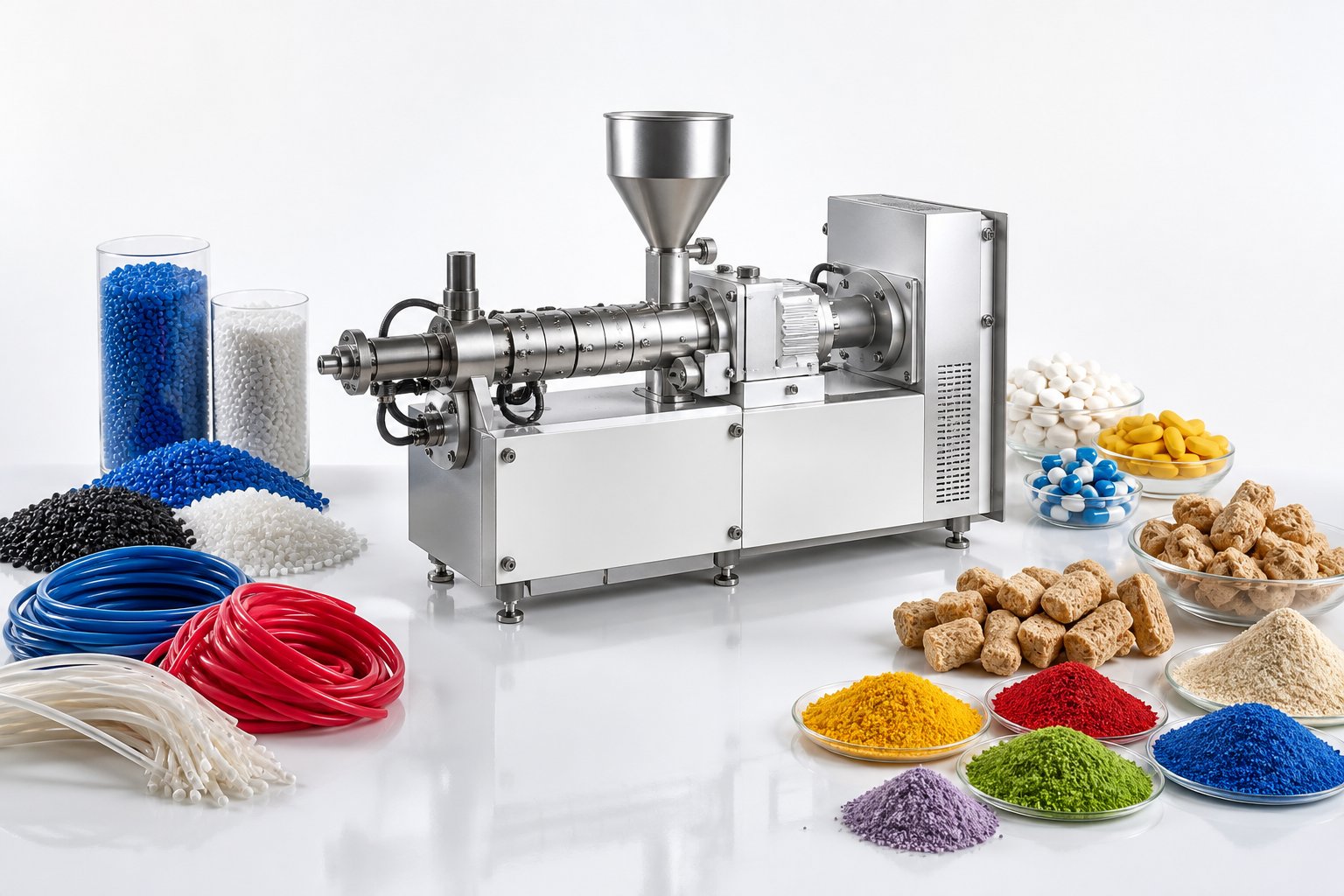
A lab twin screw extruder sitting idle is just an expensive piece of metal. Its real value emerges the moment it starts processing actual materials for actual research objectives — and those objectives vary wildly depending on the industry. A polymer scientist developing a new recycled-content compound has fundamentally different demands than a pharmaceutical formulator trying to improve drug bioavailability, even though both might be running the same 20mm co-rotating machine from the same Chinese manufacturer.
Understanding how different industries use these machines reveals which specifications matter most for your specific work — and helps you avoid buying a general-purpose extruder when your application demands specialized capabilities.
Polymer Compounding and Materials Science Research
This is the bread and butter of lab twin screw extrusion. Materials science researchers and polymer engineers use compact extruders to develop new formulations before committing thousands of kilograms of raw material to a production run.
Imagine you're working on a polyamide compound reinforced with 30% glass fiber for automotive under-hood components. Before ordering a full production trial on a 75mm extruder, you need answers: Does the fiber disperse uniformly at this loading level? What screw configuration minimizes fiber breakage while achieving adequate wetting? How does adjusting the barrel temperature profile affect the compound's impact strength? A lab extruder lets you run through dozens of variations using just a few kilograms of material per trial.
The material families routinely processed on lab twin screw extruders span the full polymer spectrum. Commodity resins like PE and PP get blended with mineral fillers, colorants, and stabilizers for masterbatch development. Engineering polymers — PA (nylon with glass fiber reinforcement), PC/ABS blends for electronics housings, and POM for precision mechanical parts — undergo compounding trials where precise filler dispersion and thermal management are critical. Thermoplastic elastomers (TPE and TPU) present unique challenges because their soft, sticky melt behavior demands carefully optimized screw configurations to avoid excessive shear degradation.
Biodegradable polymer research has driven substantial demand for lab extruders in recent years. Materials like PLA, PBAT, and starch-based blends behave differently from conventional thermoplastics — they're often moisture-sensitive, shear-sensitive, and require lower processing temperatures. Researchers developing compostable packaging or agricultural films rely on lab-scale trials to establish processing windows before scaling up.
Nanocomposite development adds another layer of complexity. Dispersing nanoclays, carbon nanotubes, or graphene nanoplatelets into a polymer matrix requires intense distributive and dispersive mixing at precisely controlled shear levels. Too little mixing leaves agglomerates that create weak points; too much degrades the nanoparticles or the polymer matrix. Lab extruders with modular screw configurations let researchers iterate through mixing element arrangements — adjusting kneading block widths, stagger angles, and positions — until the dispersion quality meets specification.
Pharmaceutical Hot Melt Extrusion
Perhaps the fastest-growing application segment for lab twin screw extruders is pharmaceutical R&D. Hot melt extrusion (HME) has evolved from a niche technique into a mainstream manufacturing platform for advanced drug delivery systems, and lab-scale machines are where every new formulation begins its journey.
The core challenge HME addresses is drug solubility. A significant percentage of new drug candidates are poorly water-soluble, which limits their bioavailability — the amount of active ingredient that actually reaches the bloodstream after oral administration. Twin screw extrusion solves this by intimately dispersing the active pharmaceutical ingredient (API) into a polymeric carrier at elevated temperatures, creating what's known as an amorphous solid dispersion. In this amorphous state, the drug dissolves far more readily than its crystalline form.
The list of commercially marketed drugs manufactured through twin screw melt extrusion continues to grow. Products treating conditions from HIV to diabetes to fungal infections have been successfully produced using this technology, validating its reliability for pharmaceutical manufacturing.
For R&D teams, lab extruders serve as the essential screening tool. With new API candidates available in quantities measured in grams during early development, a 16mm or 20mm extruder that can produce meaningful data from 200-500 gram batches is invaluable. Researchers systematically vary polymer type, drug loading, processing temperature, screw speed, and screw configuration to identify the formulation and process window that yields a stable amorphous dispersion.
Pharmaceutical applications impose specific equipment requirements that go beyond standard polymer compounding setups:
- GMP-compatible materials of construction: All product-contact surfaces — screw elements, barrel liners, die components — must be manufactured from stainless steel grades that meet regulatory requirements and resist corrosion from reactive formulation ingredients.
- Precise, validated temperature control: Pharmaceutical processes often operate within narrow temperature windows where even a 2-3°C deviation can shift the API from amorphous to crystalline form, destroying the intended bioavailability enhancement.
- Clean-in-place or easy-disassemble capability: Cross-contamination between API compounds is unacceptable. The extruder must allow thorough cleaning with documented procedures between formulation trials.
- Comprehensive data logging: Every process parameter — temperature, screw speed, torque, feed rate, melt pressure — must be recorded and traceable for regulatory compliance and scientific reproducibility.
Chinese manufacturers targeting this segment increasingly offer pharmaceutical-grade configurations with appropriate stainless steel barrel liners, FDA-compliant seals, and PLC systems capable of 21 CFR Part 11-compliant data management. Buyers evaluating these options should request detailed material certifications for every product-contact component — not just a general "stainless steel" designation.
Food Processing and Specialty Chemical Applications
Twin screw extrusion has been a cornerstone of food processing for decades, and the lab-scale version plays a crucial role in product development. When a food scientist wants to prototype a new high-protein snack, develop a plant-based meat analog with realistic texture, or test an encapsulation system for flavor or nutrient delivery, a lab extruder is the starting point.
Food extrusion research relies on the extruder's ability to simultaneously cook, texturize, and shape ingredients under controlled conditions. Plant-based protein texturization — creating fibrous, meat-like structures from soy, pea, or wheat protein — has become a particularly active research area. The twin screw extruder's combination of high shear, precise thermal control, and moisture management makes it uniquely suited for developing these products. Researchers adjust screw configuration, barrel temperature profile, moisture content, and die geometry to achieve target texture, density, and mouthfeel characteristics.
A China lab twin screw food extruder used for these applications faces a distinct set of demands: food-grade stainless steel contact surfaces, the ability to handle high-moisture formulations (up to 60-70% water content in some texturization processes), and easy cleaning protocols that prevent allergen cross-contamination between trials.
Beyond food, specialty chemical applications represent a diverse and growing use case for lab-scale twin screw extrusion:
- Adhesive compounding: Developing hot melt adhesive formulations by blending base polymers with tackifiers, waxes, and stabilizers. Lab extruders allow rapid screening of component ratios and mixing conditions.
- Color masterbatch testing: Creating concentrated pigment dispersions in carrier resins. The quality of pigment dispersion directly affects final product appearance, and lab trials identify optimal processing conditions before production commitment.
- Encapsulation studies: Embedding active ingredients — fragrances, pesticides, pharmaceutical actives, or nutritional supplements — within protective polymer or wax matrices for controlled release applications.
- Reactive compounding: Conducting polymer modification reactions (grafting, crosslinking, chain extension) inside the extruder barrel, using precise temperature and residence time control to manage reaction kinetics.
Powder Coating Formulation Development
One application that deserves specific attention — because it's often overlooked in general lab extruder discussions — is powder coating R&D. The powder coating industry relies heavily on twin screw extrusion as the primary dispersion and homogenization step in manufacturing, and lab-scale extruders serve as the essential tool for developing new resin-pigment-additive formulations.
In powder coating production, raw materials — thermosetting resins (epoxy, polyester, hybrid systems), pigments, fillers, flow agents, and curing agents — are premixed and then fed through a twin screw extruder that melts the resin, disperses the pigments and additives uniformly throughout the matrix, and produces a homogeneous extrudate. This extrudate is then cooled, broken into chips, and ground into a fine powder for electrostatic application.
A china powder coating lab scale twin screw extruder lets formulators test new color matches, evaluate alternative raw materials, adjust gloss and texture properties, and optimize curing agent levels — all from batches as small as 500 grams to a few kilograms. Given that powder coating formulations can involve 8-12 or more individual components, the ability to screen dozens of variations quickly and inexpensively is a significant competitive advantage.
The specific demands of powder coating extrusion shape equipment selection. Processing temperatures are relatively low — typically 80-130°C, well below the curing activation temperature — which means the extruder must deliver excellent mixing performance without relying on high melt temperatures. Screw configurations emphasizing distributive mixing (narrow kneading blocks at moderate stagger angles) tend to outperform high-shear dispersive designs for this application. Barrel and screw surfaces must also resist abrasion from mineral fillers like barium sulfate and calcium carbonate that are standard components in many powder coating formulations.
For R&D teams sourcing a powder coating lab scale twin screw extruder from China, verifying that the machine's minimum stable throughput matches the small batch sizes typical of coating trials is essential. A machine optimized for 5-10 kg/hr polymer compounding may not deliver consistent results at the 1-2 kg/hr feed rates that coating formulators often require.
Primary Application Areas at a Glance
The following list summarizes the major application domains and what researchers in each field typically aim to achieve:
- Polymer compounding and blending: Developing new material formulations by melt-mixing polymers with fillers, reinforcements, and functional additives to achieve target mechanical, thermal, or barrier properties.
- Masterbatch and color concentrate development: Creating highly loaded pigment or additive concentrates in carrier resins, optimizing dispersion quality and let-down ratio performance.
- Nanocomposite research: Dispersing nanoscale fillers (nanoclays, carbon nanotubes, graphene) into polymer matrices to enhance mechanical, electrical, or barrier properties at low loading levels.
- Biodegradable and bio-based polymer development: Establishing processing windows for PLA, PHA, PBAT, starch blends, and other sustainable materials with inherently narrow thermal stability ranges.
- Pharmaceutical hot melt extrusion: Generating amorphous solid dispersions to improve bioavailability of poorly soluble drug candidates, and developing controlled-release formulations.
- Food extrusion R&D: Prototyping snack products, texturizing plant-based proteins, and developing encapsulated ingredients for flavor, nutrient, or bioactive delivery.
- Powder coating formulation: Screening new resin-pigment-additive systems and optimizing dispersion quality, gloss, texture, and curing behavior before production-scale trials.
- Adhesive and sealant compounding: Developing hot melt adhesive formulations and testing component compatibility, open time, bond strength, and thermal resistance.
- Recycled-content compound development: Evaluating how post-consumer or post-industrial recycled resins perform when compounded with virgin material, compatibilizers, and property-restoring additives.
- 3D printing filament production: Compounding and extruding specialty filament materials (filled PLA, carbon-fiber-reinforced nylon, flexible TPU) for additive manufacturing research.
Each of these application domains pushes certain extruder specifications harder than others — pharma demands temperature precision and GMP compliance, nanocomposites require extreme mixing flexibility, and powder coatings need consistent low-throughput performance. The common thread across all of them is the need for a machine whose screw and barrel configuration can be adapted to match the specific processing challenge at hand. That configurability — the ability to rearrange screw elements to tailor mixing intensity, residence time, and shear profile — is what transforms a lab extruder from a simple processing tool into a genuine research instrument.
Screw Configuration and Modular Design for R&D Flexibility
Configurability is the word that keeps surfacing — and for good reason. A lab twin screw extruder's true power doesn't live in its motor, gearbox, or control panel. It lives in the screw elements mounted on those two rotating shafts. Swap a few elements, and the same machine that gently blends a shear-sensitive biopolymer in the morning can aggressively disperse carbon nanotubes into an engineering resin by afternoon.
But how does this modularity actually work? And what are the specific element types that researchers mix and match to shape processing behavior? This is where most equipment discussions stay vague. Let's fix that.
Understanding Screw Element Types and Their Functions
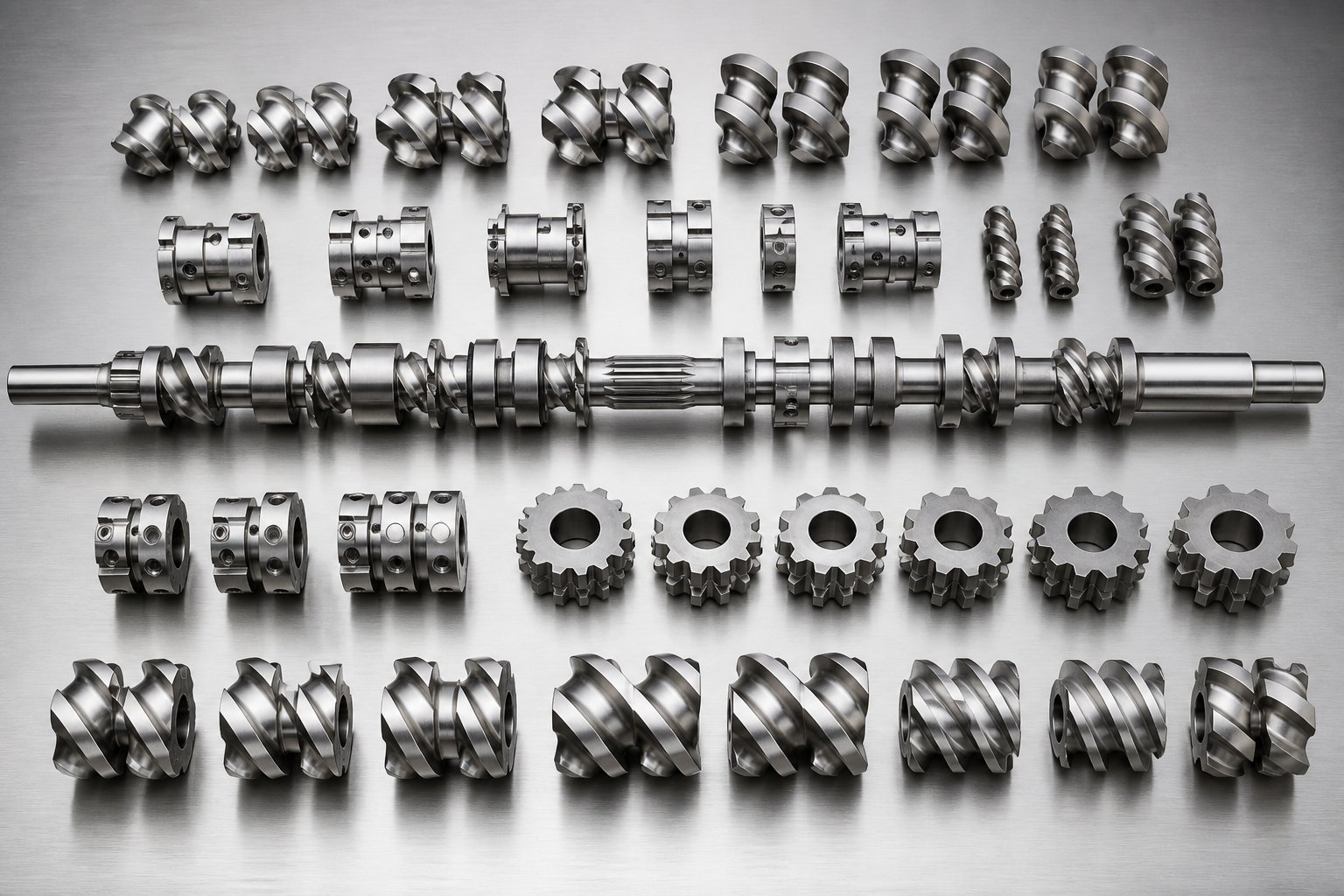
Every modular twin screw extruder uses the same fundamental principle: individual screw elements slide onto a splined shaft, locked in position by their internal spline geometry. Changing the sequence, type, and orientation of these elements completely reshapes what happens to the material as it travels through the barrel. Think of it like assembling a playlist — each element contributes a different effect, and the order you arrange them in determines the overall experience.
The screw elements used in lab twin screw extruders fall into several distinct categories, each performing a specific function in the processing sequence. The geometry of these elements follows what's known as the Erdmenger self-wiping profile, a design principle that ensures the screws continuously clean each other's surfaces during rotation — preventing material stagnation and thermal degradation inside the barrel.
- Forward conveying elements: These are the workhorses of material transport. Their deep helical flights grab solid or molten material and push it downstream toward the die. Varying the pitch (the distance between successive flights) adjusts conveying speed — a larger pitch moves material faster but builds less pressure, while a tighter pitch slows transport and increases compression. In nomenclature terms, you'll see designations like SE-30/30 R, where the numbers indicate pitch and length, and "R" denotes right-handed (forward) rotation.
- Reverse conveying elements (re-conveying elements): These look similar to forward elements but feature left-handed flights (designated "L") that push material backward against the main flow direction. Why would you want that? Placing a short reverse element in the screw profile creates a local dam — material backs up, filling the barrel completely in that zone and dramatically increasing residence time and mixing intensity. Reverse elements are essential for creating seal zones before vacuum venting ports and for building the backpressure needed for thorough kneading.
- Kneading blocks: This is where the real mixing happens. Kneading blocks consist of a series of lobed discs stacked at specific angular offsets (stagger angles) to each other. The width of those discs and the angle between them determine whether the block performs primarily distributive mixing (spreading components evenly throughout the melt) or dispersive mixing (breaking apart agglomerates through intense shear forces). Wider discs at 90-degree stagger angles deliver aggressive dispersive action — ideal for deagglomerating pigment clusters or mineral filler clumps. Narrower discs at 30- or 45-degree forward stagger angles provide gentler distributive mixing suited for blending miscible polymers without excessive energy input.
- Toothed mixing elements (TME/ZME): These specialized elements feature rows of teeth rather than continuous flights. Material flows through the gaps between teeth, experiencing repeated splitting and recombination — a highly effective distributive mixing mechanism that generates minimal shear heat compared to kneading blocks. Toothed elements excel at incorporating low-viscosity additives, liquid colorants, or heat-sensitive components where excessive temperature rise must be avoided.
- Distributive mixing elements: Various proprietary designs exist in this category, but the common principle involves creating numerous flow-splitting channels that divide the melt stream into thin layers, rearrange them, and recombine. The result is thorough homogenization without the high energy input of dispersive kneading. These elements prove particularly valuable for pharmaceutical hot melt extrusion, where API degradation from excessive shear is a constant concern.
The interplay between these element types is where screw design becomes both a science and a craft. A typical lab extruder screw profile might begin with large-pitch forward conveying elements in the feeding zone, transition to tighter-pitch conveyors as material enters the melting section, shift into a series of kneading blocks for intensive mixing, return to forward conveying for melt transport past a degassing vent, and finish with compression elements to build die pressure. Every element choice — its type, width, stagger angle, and position along the shaft — influences the final product.
How Configuration Flexibility Accelerates R&D
Here's where lab-scale machines earn their premium over simplified small extruders. A lab twin screw extruder designed with true modular architecture lets a researcher pull the screws, rearrange elements, and reassemble in fifteen to thirty minutes. On a production extruder, that same change might require a full shift of downtime.
Why does speed matter so much? Consider a typical formulation development day. You're screening five different kneading block arrangements to find the configuration that disperses a 15% talc loading into polypropylene without degrading the polymer's impact properties. Each configuration change requires pulling the screws, swapping two or three kneading elements, reinstalling, and running a new trial. If each changeover takes three hours, you complete one configuration per day. If it takes twenty minutes, you test all five before lunch.
That acceleration compounds over weeks and months of active R&D. Faster iteration means more data points, quicker identification of optimal processing conditions, and shorter time-to-market for new formulations. This is precisely why the modular screw design of a lab extruder isn't just a convenience feature — it's a fundamental research productivity multiplier.
A critical but often overlooked factor in this equation is the breadth of the element library available from your extruder supplier. Imagine having a beautifully modular machine but only four or five element types to work with. Your configuration options shrink dramatically. The best lab twin screw extruder screw elements from China suppliers come in comprehensive libraries: multiple conveying pitches, kneading blocks in narrow, medium, and wide disc widths at various stagger angles (30°, 45°, 60°, 90°), reverse elements in several lengths, and specialty mixing elements for specific applications. Before purchasing, request the complete element catalog — not just what ships standard with the machine, but everything available for order. A thin catalog signals a supplier focused on basic equipment sales rather than long-term R&D partnership.
Custom Screw Design for Specialized Materials
Standard element libraries handle the majority of common compounding tasks effectively. But what happens when your research pushes into unconventional territory?
Highly abrasive mineral-filled compounds — 60% calcium carbonate in polyethylene, or ceramic-particle-loaded feedstocks for metal injection molding — chew through standard tool steel elements at an accelerated rate. Shear-sensitive biopolymers like PHA or thermoplastic starch degrade if processed with aggressive kneading blocks designed for engineering resins. Reactive extrusion chemistries, where monomers polymerize inside the barrel, demand screw geometries that provide the exact residence time and mixing intensity the reaction kinetics require — too little mixing and conversion stalls, too much and side reactions produce undesirable byproducts.
In each of these scenarios, off-the-shelf screw configurations hit their limits. Researchers find themselves stuck between element combinations that are "almost right" — close enough to produce samples, but not optimized enough to generate the data quality or product properties their work demands.
This is where working with a specialized screw and barrel design partner becomes a genuine competitive advantage for R&D programs. Rather than accepting compromises imposed by a generic element set, researchers can collaborate with engineers who understand both the metallurgy and the processing science involved. The right partner evaluates your specific material system, recommends element geometries tailored to your shear, mixing, and wear requirements, and manufactures custom elements that integrate seamlessly with your existing lab extruder platform.
For R&D labs, universities, and pilot-line operators working with experimental materials that fall outside mainstream polymer compounding, NANHAIYA's Custom Screw Design Services offer exactly this type of application-specific engineering support. Their team designs screw and barrel configurations matched to specialized materials, compact lab equipment geometries, and the unique processing demands of experimental extrusion workflows — whether that means wear-resistant elements for abrasive fillers, low-shear profiles for degradation-prone biopolymers, or precision-geometry kneading blocks for reactive systems requiring controlled residence time distribution.
The ability to move beyond catalog selections and into purpose-built screw solutions can mean the difference between "workable" lab results and genuinely optimized processing data that translates reliably to pilot and production scale.
Of course, screw elements and modular design represent just one dimension of the total investment equation. Understanding what drives pricing — and where hidden costs lurk beneath an attractive headline quote — is equally essential for making a procurement decision you won't regret twelve months down the line.
Pricing Factors and How to Compare China Lab Twin Screw Extruder Quotes
You've identified the right screw diameter, confirmed the L/D ratio suits your compounding tasks, and verified that the modular element library covers your research needs. The next question is inevitable: what will this actually cost? And more importantly, how do you make sense of the quotes landing in your inbox?
Pricing transparency is surprisingly rare in the lab extruder market. Most suppliers present a single lump-sum figure with little explanation of what's included, what's optional, and what will cost extra six months after installation. Chinese manufacturers are no exception — some provide detailed, itemized proposals, while others deliver a headline number that looks attractively low until the add-ons start stacking up. Knowing what drives the price and where the real costs hide puts you in a far stronger negotiating position.
Primary Factors That Influence Pricing
No two china lab twin screw extruder quotes are identical, because no two configurations are identical. The final price is shaped by a combination of hardware choices, each adding cost in proportion to the engineering complexity involved.
Screw diameter is the most visible cost driver. A 16mm micro-lab unit requires smaller barrel sections, a lighter gearbox, and a lower-power motor than a 35mm machine. The price difference between these two ends of the lab-scale spectrum can easily be twofold or more — not because the larger machine is "better," but because every mechanical component scales up with diameter.
Torque class and gearbox quality represent the second major cost layer. As discussed in earlier sections, the gearbox is the component most directly tied to long-term reliability. A standard-torque gearbox adequate for unfilled polymer blends costs significantly less than a high-torque unit built to handle glass-fiber-reinforced engineering compounds. Industry pricing data indicates that lab-scale twin screw extruders from quality Chinese manufacturers typically start around $20,000 for basic configurations and can reach $40,000 or more for fully equipped research-grade systems — a range that reflects gearbox tier as much as anything else.
Number of barrel zones adds incremental cost per zone, since each independently controlled segment requires its own heater assembly, temperature sensor, cooling circuit, and PLC channel. A four-zone machine is inherently cheaper than an eight-zone unit, but the additional zones buy you the thermal profiling precision that serious R&D demands.
Automation level creates one of the widest pricing gaps within the same screw diameter platform. A manually controlled machine with basic analog temperature readouts sits at the low end. Step up to PLC-controlled operation with an HMI touchscreen, real-time data logging, recipe storage, and alarm management, and you've added meaningful cost — but also the data acquisition capability that transforms each extrusion run into documented, reproducible research.
Materials of construction matter more than most buyers initially realize. Standard nitrided tool steel screws and barrels work well for general polymer compounding. Wear-resistant bimetallic barrel liners become necessary for abrasive mineral-filled compounds. Corrosion-resistant stainless steel construction is mandatory for pharmaceutical and food applications. Each upgrade in metallurgy carries a price premium, but choosing the wrong material class leads to premature wear and far higher replacement costs down the road.
Included accessories can swing the total dramatically. Some quotes include a volumetric feeder, strand die, water bath, and pelletizer as a complete downstream package. Others price the bare extruder only, with every accessory itemized separately. A powder coating lab scale twin screw extruder price from China, for instance, may or may not include the specific cooling belt and flaking roller setup that coating formulators require.
What to Expect in Quotes from Chinese Manufacturers
When requesting china lab twin screw extruder quotes, the quality of the proposal you receive tells you almost as much about the supplier as the price itself. Here's how to extract maximum clarity from the quoting process.
Insist on itemized pricing. A single-line quote that reads "Lab extruder system — $28,000" is useless for comparison purposes. Ask for each component broken out separately: extruder main unit, gearbox, motor, control system, barrel segments, screw element sets, feeder, die heads, downstream equipment, and spare parts kit. This line-item breakdown lets you compare apples to apples across suppliers and immediately reveals where one manufacturer is bundling items another charges separately.
Clarify what's included versus optional. Common items that might or might not be part of the base price include: the initial set of screw elements, spare heating elements, a basic spare parts kit, installation supervision, operator training, and software licenses for data logging systems. If the quote doesn't explicitly state inclusion or exclusion of these items, assume nothing.
Ask about spare parts pricing upfront. A low machine price loses its appeal quickly if replacement screw elements cost three times what a competitor charges. Request a separate spare parts price list covering the items you'll eventually need: kneading blocks, conveying elements, barrel liners, heater bands, thermocouples, and sealing gaskets. This information feeds directly into your total cost of ownership calculation.
Confirm warranty terms and after-sales support scope. Standard warranty periods from Chinese lab extruder manufacturers typically range from one to two years, but the scope varies enormously. Does the warranty cover the gearbox? The electrical components? What constitutes "normal wear" excluded from coverage? Is remote troubleshooting included, or billed hourly? These details matter far more than the warranty duration printed on the cover page.
Factor in landed cost. The FOB (Free on Board) factory price on a quote is not what the machine costs you. International shipping for a lab extruder — typically crated at 500-2,000 kg depending on configuration — adds meaningful freight charges. Customs duties, import fees, and brokerage charges stack on top. For buyers importing into the United States, combined duty rates on Chinese industrial machinery can add a substantial percentage to the equipment value, and installation support (if the manufacturer sends a technician) involves travel expenses and daily rates. A responsible budget estimate includes all of these components, not just the factory gate price.
Budget Planning and Total Cost of Ownership
Here's the uncomfortable truth about lab extruder procurement: the purchase price typically represents only 60-70% of what the machine will actually cost you over its useful life. The remaining 30-40% arrives in smaller, less visible installments — spare parts orders, energy bills, maintenance labor, and the occasional costly surprise.
Industry analysis of twin screw extruder economics consistently shows that initial investment costs account for 60-70% of total cost of ownership, with operating costs, maintenance, and downtime making up the balance. While these figures come from larger production-scale equipment studies, the proportional relationship holds for lab machines — and in some ways, lab extruders face amplified per-unit costs because their smaller components wear at similar rates but process far less material over their lifetimes.
Cheaper upfront pricing sometimes correlates directly with higher long-term maintenance costs. A budget gearbox that saves $3,000 at purchase but requires rebuild or replacement after two years of moderate use doesn't save money — it shifts it. Similarly, economy-grade screw elements made from lower-quality steel wear faster when processing abrasive compounds, driving up replacement frequency and per-trial costs.
To build a realistic budget, account for every cost component that will arise over the machine's expected service life:
- Equipment purchase price (FOB or delivered, depending on Incoterm agreed with supplier)
- International freight and shipping insurance for the main equipment crate and any separately shipped accessories
- Import duties, customs brokerage fees, and applicable tariffs based on your country's current rates for industrial machinery from China
- Installation and commissioning costs including site preparation, utility connections, and manufacturer technician travel if required
- Operator training — whether provided on-site by the manufacturer, conducted remotely, or handled through third-party courses
- Spare screw elements — budget for at least one complete replacement set of your most-used conveying and kneading elements within the first two years
- Barrel liner replacement — liners for highly abrasive applications may need replacement every 2-4 years depending on material processed
- Wear parts and consumables — heater bands, thermocouples, sealing gaskets, die inserts, and cutter blades for pelletizers
- Energy consumption — lab extruders draw modest power (2-10 kW), but continuous R&D operation accumulates meaningful energy costs over years
- Preventive maintenance labor — regular gearbox oil changes, lubrication, alignment checks, and calibration of temperature controllers and load cells
- Software updates and control system maintenance — PLC firmware updates, HMI software licenses, and data management system upkeep
- Unplanned repair contingency — a prudent budget includes a reserve for unexpected component failures, typically estimated at 3-5% of equipment cost per year
When comparing powder coating lab scale twin screw extruder prices from China — or quotes for any other application-specific configuration — run these numbers side by side for each supplier, not just the headline equipment cost. A machine priced 20% lower than a competitor but requiring wear parts at twice the frequency and offering no included training can easily cost more over a five-year horizon.
The most reliable approach? Request a total cost of ownership estimate from each supplier, covering the first three to five years. Manufacturers confident in their build quality will engage with this conversation openly. Those who deflect or refuse to discuss long-term costs are telling you something important about what they expect their equipment to demand after the warranty expires.
Pricing, though, is only one dimension of the procurement puzzle. Even a well-priced, well-built lab extruder can become a frustrating investment if the buying process itself falls into common traps — mistakes that experienced procurement teams have learned the hard way and that first-time buyers rarely see coming.
Common Mistakes When Buying a Lab Twin Screw Extruder from China
Every procurement mistake in this space follows a pattern: it looks harmless on paper, invisible at the quoting stage, and only reveals itself months later — usually during a critical research deadline. The frustrating part? Nearly all of them are avoidable. You just need to know where to look before signing the purchase order.
Whether you're a university procurement officer placing your first equipment order from an overseas wholesaler or a corporate R&D manager expanding your lab's extrusion capability, these are the pitfalls that trip up buyers most frequently — ranked by the severity of their long-term impact on your research program.
-
Overlooking Screw and Barrel Metallurgy
This is the single most consequential oversight in lab extruder procurement, yet it rarely appears on a buyer's initial checklist. Here's why it matters so much: lab extruders process dozens of different materials — often including abrasive mineral fillers, corrosive reactive additives, and glass-fiber-reinforced compounds — with frequent changeovers that expose screw and barrel surfaces to repeated thermal cycling and mechanical stress.
That operating profile accelerates wear far faster than a production machine running a single compound continuously. Fillers like calcium carbonate and glass fiber are particularly abrasive, wearing down metal surfaces much faster than molten polymers alone. And the problem compounds in specific high-wear zones — the feeding zone where solid particles grind against barrel walls, the filler incorporation zone where sharp fiber fragments shear during rotation, and the discharge zone where gravity-induced screw deflection causes edge scraping against the barrel interior.
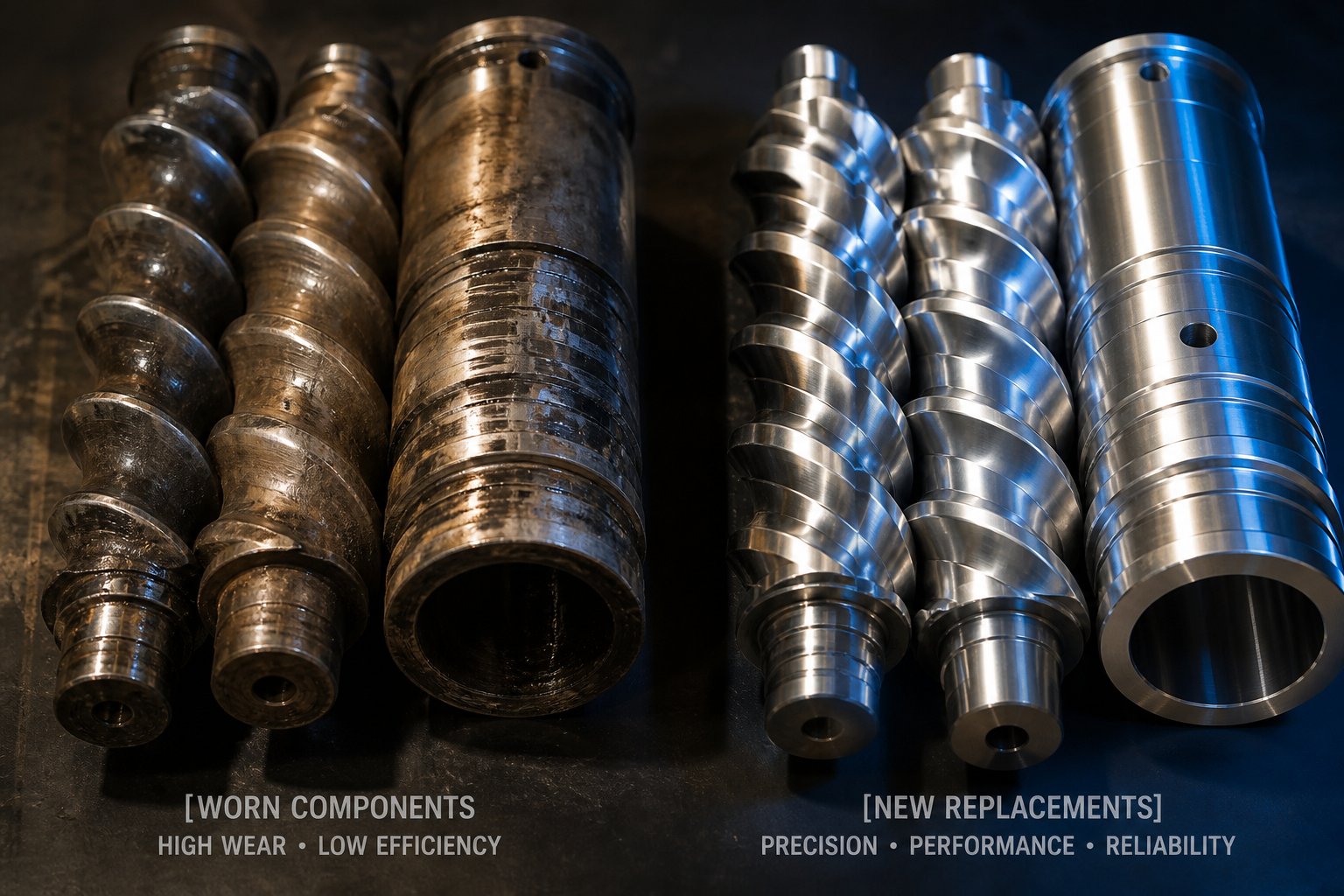
The trap? Many buyers accept vague metallurgy descriptions like "high-quality alloy steel" or "wear-resistant material" without digging deeper. These labels tell you almost nothing about actual performance. Instead, request specific information:
- Base metal grade: What exact steel designation (e.g., 38CrMoAlA, W6Mo5Cr4V2, or specific powder metallurgy grades) is used for screw elements and barrel liners?
- Surface treatment: Are barrels nitrided? What nitriding depth and surface hardness (measured in HV or HRC) does the treatment achieve?
- Bimetallic options: For abrasive applications, does the manufacturer offer bimetallic barrel liners with centrifugally cast wear-resistant alloy layers?
- Powder metallurgy steel availability: PM steel offers superior wear and corrosion resistance through its finer, more uniform grain structure and minimal segregation of alloying elements like nickel, chromium, and molybdenum. It's the premium choice for labs processing highly filled or chemically aggressive compounds.
A lab twin screw extruder wholesaler in China who cannot provide specific hardness ratings, steel grade certifications, or clear documentation of surface treatment processes is selling components whose lifespan you cannot predict — and unpredictable wear translates directly into unpredictable research costs.
-
Ignoring Certification and Compliance Requirements
Sounds like a bureaucratic afterthought? It isn't. Certification and compliance issues have delayed installations, blocked equipment imports, and — in worst cases — rendered purchased machines unusable in their intended facility.
CE marking is mandatory for machinery entering the European Economic Area and is increasingly expected (even if not legally required) by institutions and companies worldwide as baseline evidence of safety compliance. A CE mark on a lab extruder indicates that the equipment complies with applicable EU directives — primarily the Machinery Directive and potentially the Low Voltage Directive for electrical safety. This compliance must be backed by testing according to harmonised standards and supported by proper technical documentation, including test reports, a Declaration of Conformity, and traceable design records. A CE sticker without this documentation behind it is essentially meaningless.
When buying a lab twin screw extruder from China, don't simply ask "Is this CE certified?" Ask to see the Declaration of Conformity, the list of harmonised standards tested against, and the test reports. Legitimate manufacturers will provide these without hesitation. Those who can't produce supporting documentation either haven't completed proper compliance assessment or have applied the marking without validation — both scenarios that create liability risk for the buyer.
ISO certification — typically ISO 9001 for quality management systems — is a separate matter. It certifies that the manufacturer's production processes follow documented quality procedures, not that any individual machine meets specific performance standards. It's a useful indicator of organizational discipline, but it doesn't replace product-level testing or certification.
For pharmaceutical or food research applications, additional requirements apply. Product-contact surfaces may need to meet specific FDA or EU food-contact material regulations. Stainless steel grades must be documented and traceable. Control systems intended for GMP environments may need to support 21 CFR Part 11 compliance for electronic records. Ignoring these requirements during purchasing means discovering them during facility audits — at which point your expensive new extruder might sit idle until modifications are made.
-
Underestimating After-Sales Support Needs
Imagine this scenario: three months after installation, a heater band fails on your fourth barrel zone during a critical pharmaceutical formulation trial. You email the manufacturer. Two days pass before you get a response asking for photos. Another day to confirm the replacement part number. A week for international shipping. Your research timeline just slipped by two weeks — for a component worth less than a hundred dollars.
After-sales support is the dimension of buying lab twin screw extruder wholesale in China that buyers consistently underweight during supplier evaluation, only to overweight after the first technical issue arises. The challenge is structural: you're purchasing complex mechanical equipment from a manufacturer located thousands of miles away, often across significant time zone differences, with potential language barriers layered on top.
Before purchasing, evaluate these support dimensions with the same rigor you apply to technical specifications:
- Response time: Send a detailed technical question during the quoting process and measure how quickly and thoroughly the supplier responds. This is the best preview you'll get of post-sale responsiveness.
- English-language documentation quality: Request the operating manual, maintenance guide, and electrical schematics before ordering. If these documents are poorly translated, incomplete, or unavailable in English, troubleshooting without manufacturer support will be significantly harder.
- Remote troubleshooting capability: Does the supplier offer video call support? Can their engineers walk your team through diagnostics and repairs remotely? Some Chinese manufacturers have invested heavily in remote support infrastructure; others rely entirely on email exchanges that stretch problems across days or weeks.
- Spare parts stocking and lead times: Determine whether commonly needed parts — heater bands, thermocouples, sealing elements, kneading blocks — are stocked and available for immediate shipment, or manufactured to order with lead times measured in weeks.
- Local service partnerships: A few forward-thinking Chinese extruder manufacturers have established service partnerships or stocking arrangements with distributors in major markets. This dramatically reduces response time for parts and technical support.
The suppliers who invest in robust after-sales infrastructure are making a statement about the long-term relationships they intend to build. Those who don't are optimized for transaction volume, not customer success — and lab equipment is a relationship purchase, not a transactional one.
-
Confusing Throughput Claims with Practical Output
Every spec sheet lists a maximum throughput figure. And nearly every buyer makes the same error: treating that number as the machine's normal operating capacity.
Maximum throughput specifications are typically measured under ideal conditions — processing a well-behaved, easy-flowing polymer like LDPE at optimal barrel temperatures with a simple strand die offering minimal resistance. Your actual research materials will behave nothing like this. High-viscosity engineering polymers generate more torque load, reducing achievable throughput. Heavily filled compounds increase barrel pressure and screw wear, forcing slower speeds. Reactive systems require specific residence times that limit how fast material can move through the barrel. Shear-sensitive biopolymers demand low RPM operation that inherently restricts output.
The practical throughput for challenging experimental compounds often falls to 30-60% of the rated maximum. A machine advertised at 10 kg/hr might realistically deliver 3-6 kg/hr with your glass-fiber-reinforced polyamide, and even less with a highly filled reactive compound.
The more important question — and the one most buyers forget to ask — is about minimum stable throughput. Lab work frequently requires running at very low feed rates, sometimes under 1 kg/hr, to conserve expensive experimental materials. If the extruder's control system can't maintain stable screw speed, consistent barrel temperatures, and reliable feeder operation at these low rates, your data will be scattered and unreproducible. Ask the manufacturer explicitly: what is the lowest throughput at which this machine produces stable, repeatable output? If they can't answer that question with confidence, the machine likely wasn't designed with genuine lab-scale R&D in mind.
The quality of a lab twin screw extruder purchase isn't determined by the specifications printed on the datasheet — it's determined by the questions the buyer asks before signing the order and the verification steps taken to confirm the answers.
Each of these mistakes stems from the same root cause: evaluating equipment based on surface-level information rather than the operational details that define daily research experience. Avoiding them requires a structured supplier evaluation process — one that goes beyond comparing spec sheets and price columns to assess the full spectrum of what a manufacturer actually delivers, from hardware quality through technical partnership capability.
How to Choose the Best Lab Twin Screw Extruder Manufacturer in China
Structured supplier evaluation separates procurement outcomes that accelerate research programs from those that quietly drain budgets for years. The specifications, pricing factors, and buyer traps covered throughout this guide all feed into a single practical challenge: translating that knowledge into a repeatable process for identifying, vetting, and selecting the right manufacturing partner.
Notice the word "partner" — not "vendor." A lab twin screw extruder is not a commodity purchase like office furniture or consumable supplies. It's a piece of capital research infrastructure that your team will rely on daily, reconfigure repeatedly, and eventually need to expand or repair. The supplier standing behind that machine shapes your experience far beyond the delivery date.
Building a Supplier Evaluation Checklist
Gut instinct and a competitive price might work for low-stakes purchases, but lab twin screw extruder vendor selection in China demands a systematic approach. Procurement frameworks used by successful industrial purchasing teams consistently evaluate suppliers across multiple dimensions — not just technical capability and cost, but also quality systems, communication quality, and long-term support infrastructure.
Here's a practical checklist covering the evaluation areas that matter most for lab extruder procurement:
Manufacturing capability verification. Can the supplier demonstrate that they actually manufacture the equipment rather than reselling machines assembled by a third party? Request factory photos, machining center details, and — if feasible — arrange a virtual or in-person factory tour. Verify that they have the CNC machining, heat treatment, and assembly capabilities in-house to control quality at every stage. A powder coating lab scale twin screw extruder supplier in China who owns their barrel boring, screw grinding, and nitriding processes offers far more quality traceability than one outsourcing critical steps to unknown subcontractors.
Quality management systems. ISO 9001 certification is a baseline indicator of documented production processes, but dig deeper. Ask how incoming raw materials are inspected, how dimensional tolerances on screw elements are verified, and what final testing protocols the assembled machine undergoes before shipment. Suppliers with genuine quality discipline will welcome these questions — those without it will deflect.
Technical consultation depth. Send a detailed technical inquiry describing your application, materials, and processing objectives before requesting a quote. Does the supplier respond with generic product recommendations, or do they ask clarifying questions about your barrel temperature requirements, filler types, batch sizes, and screw configuration needs? The depth of the pre-sale technical conversation previews the quality of post-sale engineering support you'll receive.
Customization capacity. Lab R&D rarely fits neatly into a standard catalog configuration. Can the manufacturer modify barrel zone counts, offer alternative gearbox torque classes, supply pharmaceutical-grade stainless steel construction, or design application-specific screw elements? Customization capability distinguishes a full-service lab twin screw extruder manufacturer in China from a catalog reseller with a fixed product line.
Reference customers. Ask for contact information of two or three existing customers — ideally in your industry or application area. Speaking directly with current users about machine reliability, support responsiveness, and any issues encountered provides insight that no sales presentation can match. Suppliers confident in their equipment and service will provide references readily.
Communication quality. Evaluate not just what the supplier says, but how they communicate. Are emails answered within 24-48 hours? Is the English-language correspondence clear and technically precise? Do they proactively share relevant technical documentation, or must every piece of information be explicitly requested? Time zone differences between China and Western markets are unavoidable — strong communication discipline bridges that gap effectively.
Why Custom Screw Design Support Matters for R&D Buyers
Imagine you've installed your new lab extruder, run the first few standard compounding trials successfully, and now you're pushing into the experimental work that justified the purchase. You're trying to disperse a novel bio-based filler into a moisture-sensitive polyester matrix, and the standard kneading block arrangements produce either insufficient dispersion or excessive thermal degradation. You've tried every element combination in your library. None of them quite work.
This scenario plays out regularly in R&D labs — and it's the moment that reveals whether you bought equipment from a hardware supplier or entered a relationship with a genuine processing partner. Simple equipment resellers have nothing to offer at this stage. They shipped the machine, they shipped the standard element set, and their involvement ends there.
A partner with screw design engineering capability steps in with solutions. They analyze your material system, evaluate the shear sensitivity and dispersion requirements, and design custom screw element geometries — perhaps a modified kneading block with narrower discs and shallower stagger angles, or a specialized distributive mixing element that achieves homogenization at lower energy input. As NC State Extension research on screw profile design emphasizes, configuring a screw for extrusion is a blend of art and science, and no universal profile optimizes flow for all materials. Every unique material demands tailored screw geometry considerations.
This capability is exactly what distinguishes the best lab twin screw extruder manufacturer in China from the rest of the field. NANHAIYA's Custom Screw Design Services represent this type of specialized partnership — their engineering team works directly with R&D labs, university research programs, and pilot-line operators to design application-specific screw and barrel configurations for specialized materials, compact lab equipment platforms, and experimental extrusion workflows. Whether the challenge involves wear-resistant geometries for abrasive mineral-filled compounds, low-shear profiles for degradation-prone biopolymers, or precision mixing elements for reactive extrusion chemistries, having a design partner who understands both the metallurgy and the processing science transforms a procurement relationship into an ongoing R&D advantage.
When evaluating powder coating lab scale twin screw extruder suppliers in China — or suppliers serving any other specialized application — ask explicitly: "If our standard screw configuration doesn't solve a processing challenge, can you design custom elements for our specific materials?" The answer to that question reveals more about the supplier's long-term value than any specification on their datasheet.
Final Decision Framework
Pulling all of these evaluation criteria into a structured scoring system prevents the common trap of letting a single impressive attribute — usually price — overshadow weaknesses in areas that matter just as much over the equipment's lifespan. The following supplier evaluation scorecard template adapts weighted scoring methodologies used in industrial procurement specifically for lab extruder purchasing decisions. Score each supplier on a 1-5 scale for every criterion, multiply by the suggested weight, and compare total weighted scores to identify the strongest overall partner.
| Evaluation Criteria | Weight | What to Assess | Example Supplier Entry | Score (1-5) | Weighted Score |
|---|---|---|---|---|---|
| Customization and Screw Design Capability | 25% | Ability to design custom screw elements, modify barrel configurations, and engineer application-specific solutions beyond catalog offerings | NANHAIYA — Custom screw design services for lab, pilot, and experimental extrusion | 5 | 1.25 |
| Technical Capability and Manufacturing Quality | 20% | In-house CNC machining, heat treatment, assembly quality, dimensional tolerances on screw elements and barrel bores | Verify via factory tour, machining certifications, and sample component inspection | — | — |
| Quality Certifications and Compliance | 15% | ISO 9001, CE marking with supporting documentation, material certifications for product-contact surfaces, GMP capability if applicable | Request Declaration of Conformity, harmonised standard test reports, steel grade certificates | — | — |
| After-Sales Support and Responsiveness | 15% | Response time to technical inquiries, English documentation quality, remote troubleshooting capability, spare parts stocking and lead times | Test during quoting phase; measure response speed and technical depth | — | — |
| Pricing Transparency and Total Cost of Ownership | 15% | Itemized quotes, clear inclusion/exclusion of accessories, spare parts pricing, warranty scope, willingness to discuss 3-5 year TCO | Compare landed cost plus 3-year spare parts and maintenance estimates across suppliers | — | — |
| Lead Time and Delivery Reliability | 10% | Quoted production lead time, shipping timeline, track record of on-time delivery, packaging quality for international freight | Confirm with reference customers; typical lab extruder lead times range 6-12 weeks from Chinese manufacturers | — | — |
A few scoring guidelines to keep this exercise meaningful:
- Score 5 (Excellent): Supplier demonstrates clear leadership in this area with documented evidence, reference customer validation, and proactive engagement.
- Score 4 (Good): Supplier meets all requirements solidly with minor gaps that don't create significant risk.
- Score 3 (Adequate): Supplier meets basic requirements but lacks depth, customization ability, or proactive support in this dimension.
- Score 2 (Below expectations): Noticeable gaps that would require the buyer to compensate through additional effort, expense, or third-party support.
- Score 1 (Unacceptable): Supplier cannot meaningfully address this criterion — a potential disqualifier depending on its weight in your evaluation.
Notice that customization and screw design capability carries the heaviest weight in this framework — 25%. That's intentional. For R&D equipment, the ability to iterate and adapt the machine to evolving research challenges determines its long-term value more than any other single factor. A lab extruder you can't reconfigure for next year's project becomes an expensive shelf ornament.
Run every serious candidate through this scorecard. Compare the weighted totals, but also examine the individual category scores. A supplier with a strong total score but a "2" in after-sales support might still create operational headaches that the overall number masks. Conversely, a slightly lower total score from a supplier offering exceptional customization and technical partnership could deliver far more value over a five-year research horizon.
The right supplier for your lab twin screw extruder isn't the one with the lowest quote or the longest spec sheet — it's the one whose technical capability, customization depth, and support infrastructure make them a long-term R&D partner capable of evolving alongside your research program.
Lab-scale twin screw extrusion is ultimately a tool for discovery — and discovery rarely follows a straight path. The materials change, the research questions evolve, and the processing challenges grow more complex as your work advances. Choosing a supplier equipped to grow with you — through custom screw designs, responsive technical support, and genuine engineering partnership — is the single decision that determines whether your extruder investment compounds in value or depreciates from day one.
Frequently Asked Questions About China Lab Twin Screw Extruders
1. What screw diameter should I choose for a lab twin screw extruder from China?
Your ideal screw diameter depends on batch size and throughput needs. For early-stage research using expensive or limited experimental materials (200-500 grams per run), a 16-20mm micro-lab extruder is the best fit, delivering 0.5-5 kg/hr. If you need slightly higher output for pilot-adjacent work or larger formulation trials, a 25-35mm model handles up to 20 kg/hr while still qualifying as true lab scale. Smaller diameters conserve costly raw materials, while larger diameters offer higher throughput but require more feedstock to reach steady-state conditions. Always confirm the minimum stable throughput — not just the maximum — to ensure the machine performs reliably at the low feed rates lab work often demands.
2. How much does a lab twin screw extruder from China cost?
Pricing from Chinese manufacturers typically ranges from $15,000 to $40,000 or more depending on configuration. Key cost drivers include screw diameter, gearbox torque class, number of independently controlled barrel zones, automation level (manual vs. PLC with data logging), materials of construction (standard tool steel vs. pharmaceutical-grade stainless steel), and included accessories like feeders, die heads, and pelletizers. However, the purchase price represents only about 60-70% of total cost of ownership. Factor in international freight, customs duties, spare screw elements, barrel liner replacements, energy consumption, and training to build a realistic budget. Always request itemized quotes and a spare parts price list from each supplier before comparing.
3. What is the difference between co-rotating and counter-rotating lab twin screw extruders?
Co-rotating extruders have both screws turning in the same direction, producing intense self-wiping action and superior dispersive and distributive mixing. This configuration dominates lab compounding for polymer blending, nanocomposite dispersion, reactive extrusion, and pharmaceutical hot melt extrusion. Counter-rotating extruders turn the screws in opposite directions, generating lower shear and gentler processing — suited for thermally sensitive materials like rigid PVC. For most R&D labs working across multiple polymer systems, co-rotating is the more versatile choice. Counter-rotating fills a niche role when minimal shear history is strictly required.
4. Can a lab twin screw extruder from China be used for pharmaceutical hot melt extrusion?
Yes, many Chinese manufacturers now offer pharmaceutical-grade lab extruder configurations. However, pharma applications impose specific requirements beyond standard polymer compounding setups. You need GMP-compatible stainless steel product-contact surfaces with traceable material certifications, temperature control accuracy within ±1°C, clean-in-place or easy-disassemble capability to prevent cross-contamination, and comprehensive data logging systems capable of supporting 21 CFR Part 11 compliance. When evaluating suppliers, request detailed material certificates for every product-contact component and verify the control system's data integrity features — not just a general claim of pharmaceutical suitability.
5. Why is custom screw design important when buying a lab twin screw extruder?
Standard screw element libraries handle common compounding tasks, but R&D work often pushes into unconventional territory — highly abrasive mineral-filled compounds, shear-sensitive biopolymers, or reactive extrusion chemistries where off-the-shelf configurations fall short. Custom screw design allows engineers to tailor element geometries for your specific material system, optimizing dispersion quality, residence time, and shear without the compromises imposed by generic elements. Partners like NANHAIYA offer custom screw design services (https://www.nhyscrews.com/services/custom-screw-design) specifically for R&D labs, universities, and pilot-line operators needing application-specific screw and barrel solutions for experimental extrusion workflows.
Written by
Nanhaiya Technical Team
Zhoushan Nanhaiya Plastic Machinery Co., Ltd.
The Nanhaiya technical team supports screw and barrel manufacturing projects through application review, technical communication, custom manufacturing coordination, and production and quality control.
Discuss Your Application
Related Articles
More insights on screw barrel technology and plastics processing.
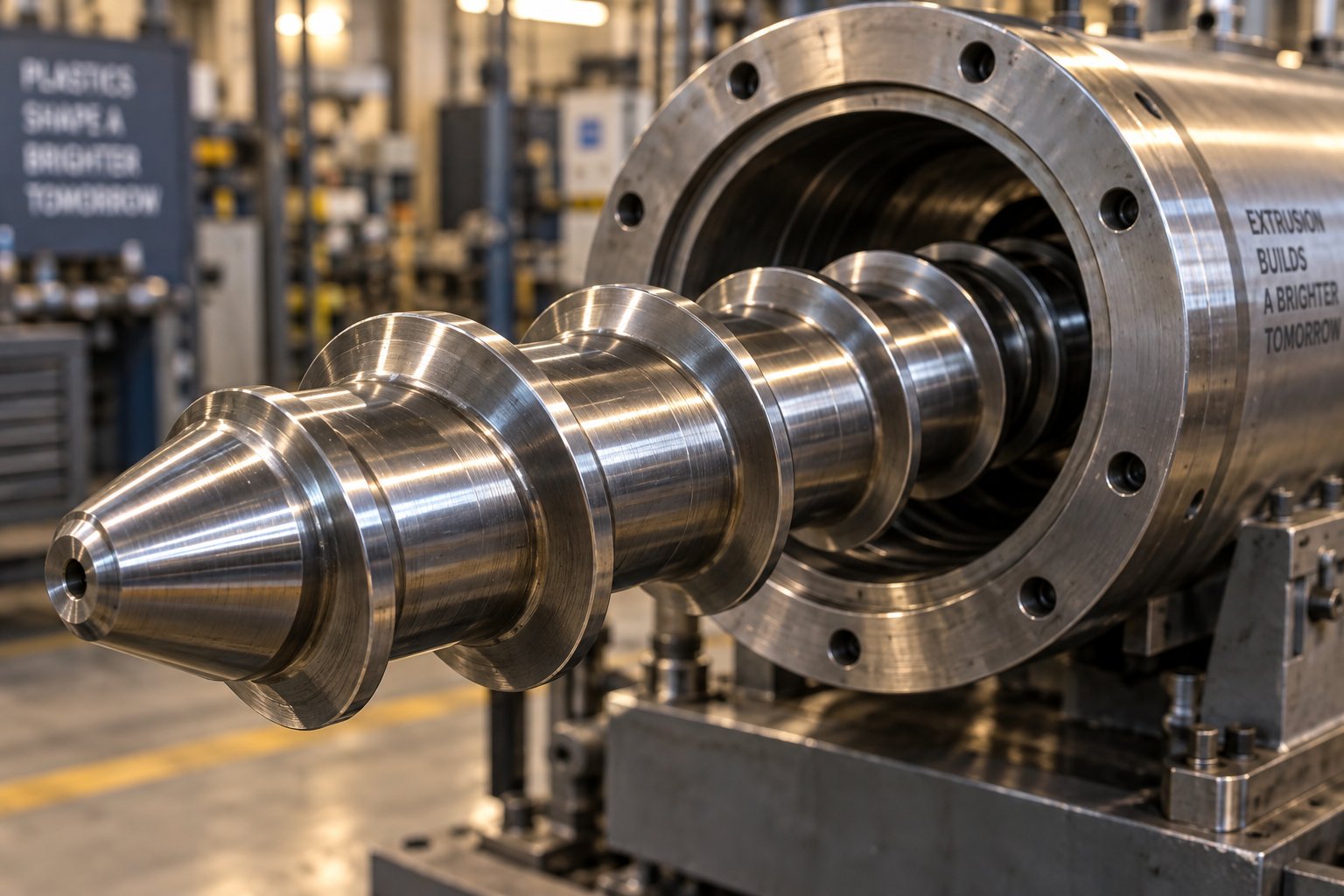
What Nobody Tells You About Screw Barrel For Plastic Machine Design
Oct 10, 2026
Learn how screw barrel for plastic machine design affects melt quality, throughput, and wear life. Covers geometry, resin matching, troubleshooting, and sourcing.
Read Article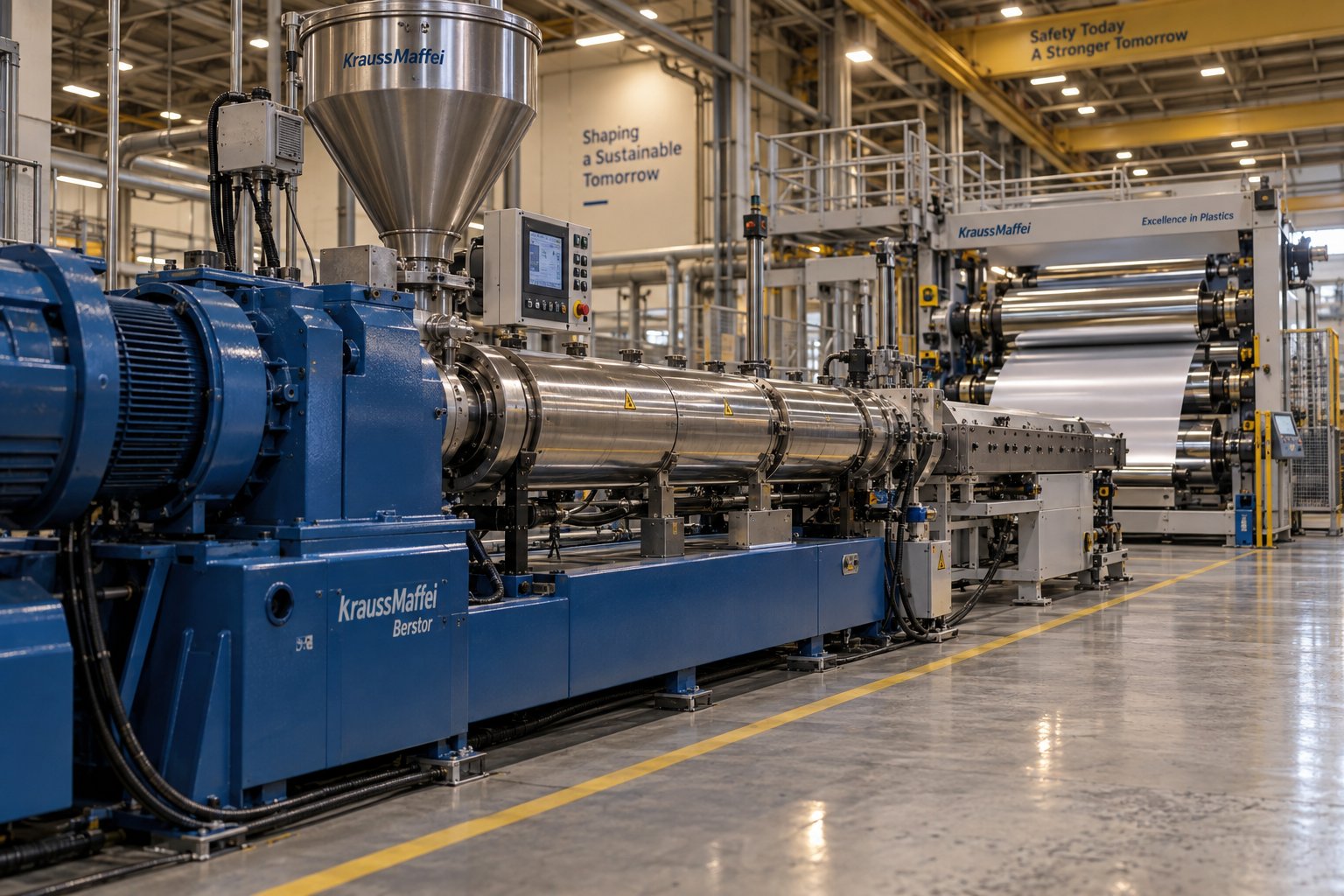
Single Screw Extruder for Sheet: Stop Guessing, Start Specifying
Oct 9, 2026
Learn how to specify a single screw extruder for sheet production. Covers screw geometry, resin-specific processing, troubleshooting, and maintenance best practices.
Read Article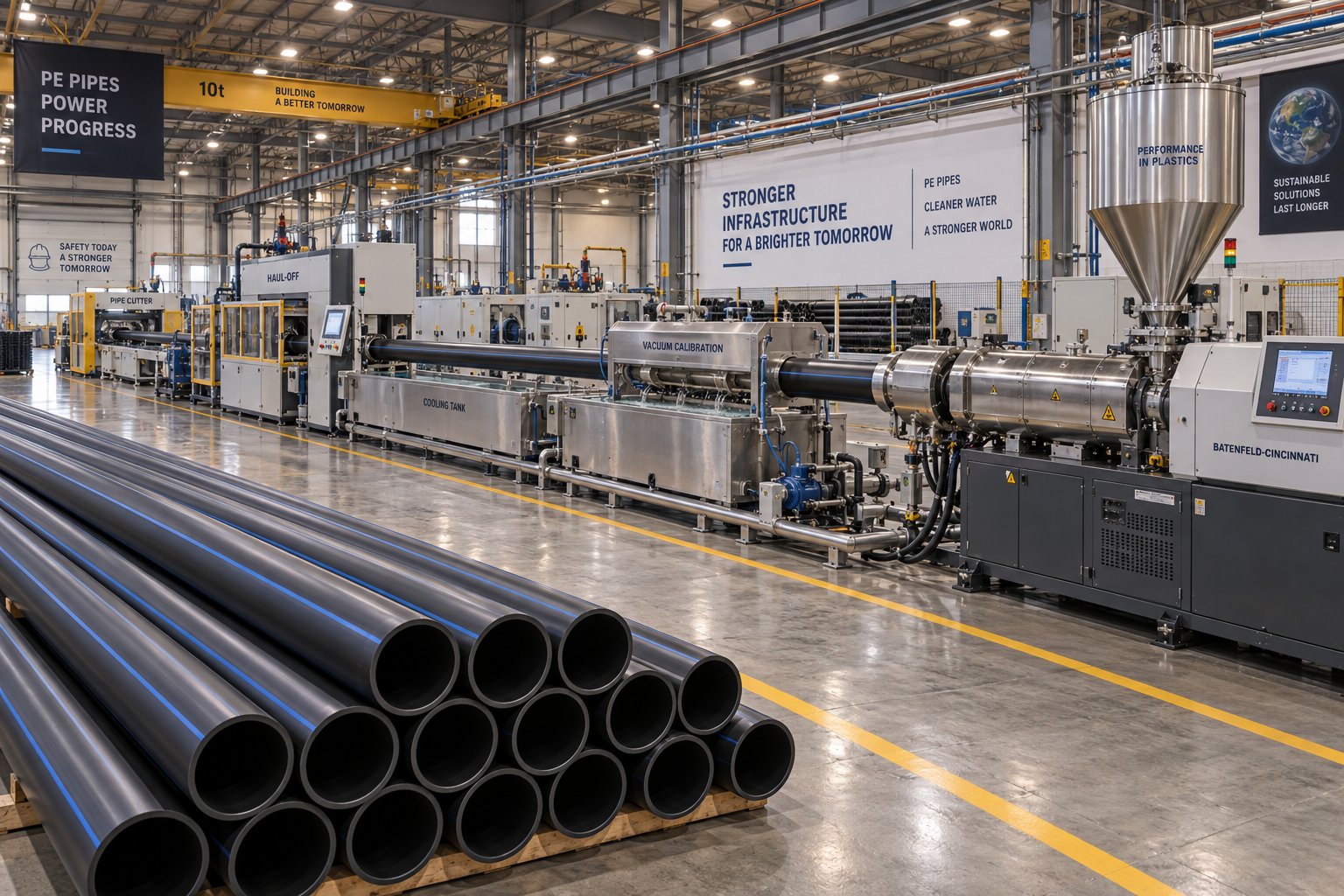
PE Pipe Extruder Machine: What Datasheets Won't Tell You
Oct 9, 2026
Learn how a PE pipe extruder machine works, key specs explained, material grade selection, maintenance tips, and buyer guidance beyond the datasheet.
Read ArticleLooking for something else?
Search by material, symptom or product and jump straight to the relevant page.
These are navigation suggestions based on keyword matching — not a quotation, not a delivery commitment, and not a substitute for engineering review. Final specification is confirmed by our engineers against your drawings and processed material.
Need help with screw barrel selection?
Share your machine model, processed material and application. Our team can help with pricing and technical support.