

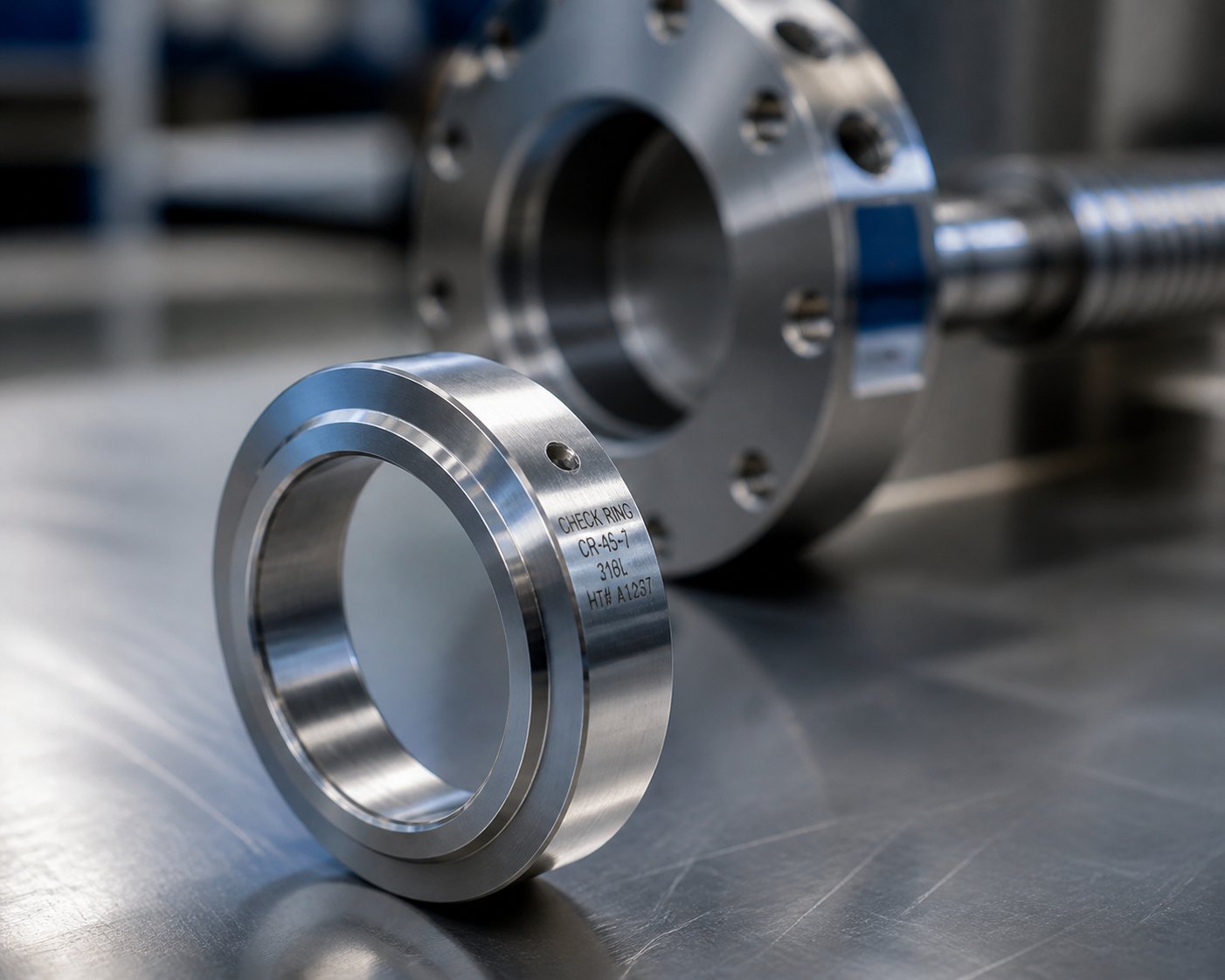
What Is a Check Ring and Why It Matters
Imagine you're troubleshooting shot-to-shot variation on a production line. Parts are coming out light, cushion readings are all over the place, and cycle times keep creeping up. Before you start adjusting process parameters, there's one component you should inspect first — the check ring.
A check ring is a precision-machined, cylindrical component that sits at the front of the screw assembly inside an injection molding barrel. Its sole job? Preventing molten plastic from flowing backward during injection. It's a deceptively simple part, but its impact on part quality, production consistency, and overall machine performance is enormous. As SpiraMelt Technologies puts it, the non-return valve — another name for this assembly — is "a vital component to the entire injection molding process" because "valve closure controls the accuracy of the final molded part."
Check Ring Definition in Industrial Manufacturing
A check ring is a one-way flow-control component that works alongside a screw tip and a rear seat to form a non-return valve assembly. Positioned at the front end of the reciprocating screw inside a heated barrel, it slides open during plasticization to let molten resin pass forward, then seals shut during injection to block backflow. This sealing action ensures a consistent, repeatable shot size on every cycle — making it one of the most mission-critical wear parts in any injection molding operation.
The terms "non-return valve" and "check ring" are used interchangeably throughout the injection molding community, and both refer to the same functional assembly. Whether you're running commodity polyolefins or engineering-grade glass-filled nylon, this component directly governs how accurately your machine delivers material into the mold.
That brings up a critical question: what exactly happens inside the barrel during each phase of the injection cycle, and how does this small ring control the entire process?
How a Check Ring Works in Injection Molding
Picture a syringe. You pull the plunger back to draw fluid in, then push it forward to force fluid out — and absolutely nothing leaks backward past the plunger seal. That's essentially what a check ring does inside an injection molding barrel, except the fluid is molten plastic under extreme pressure and the stakes are measured in thousands of dollars of scrap per shift.
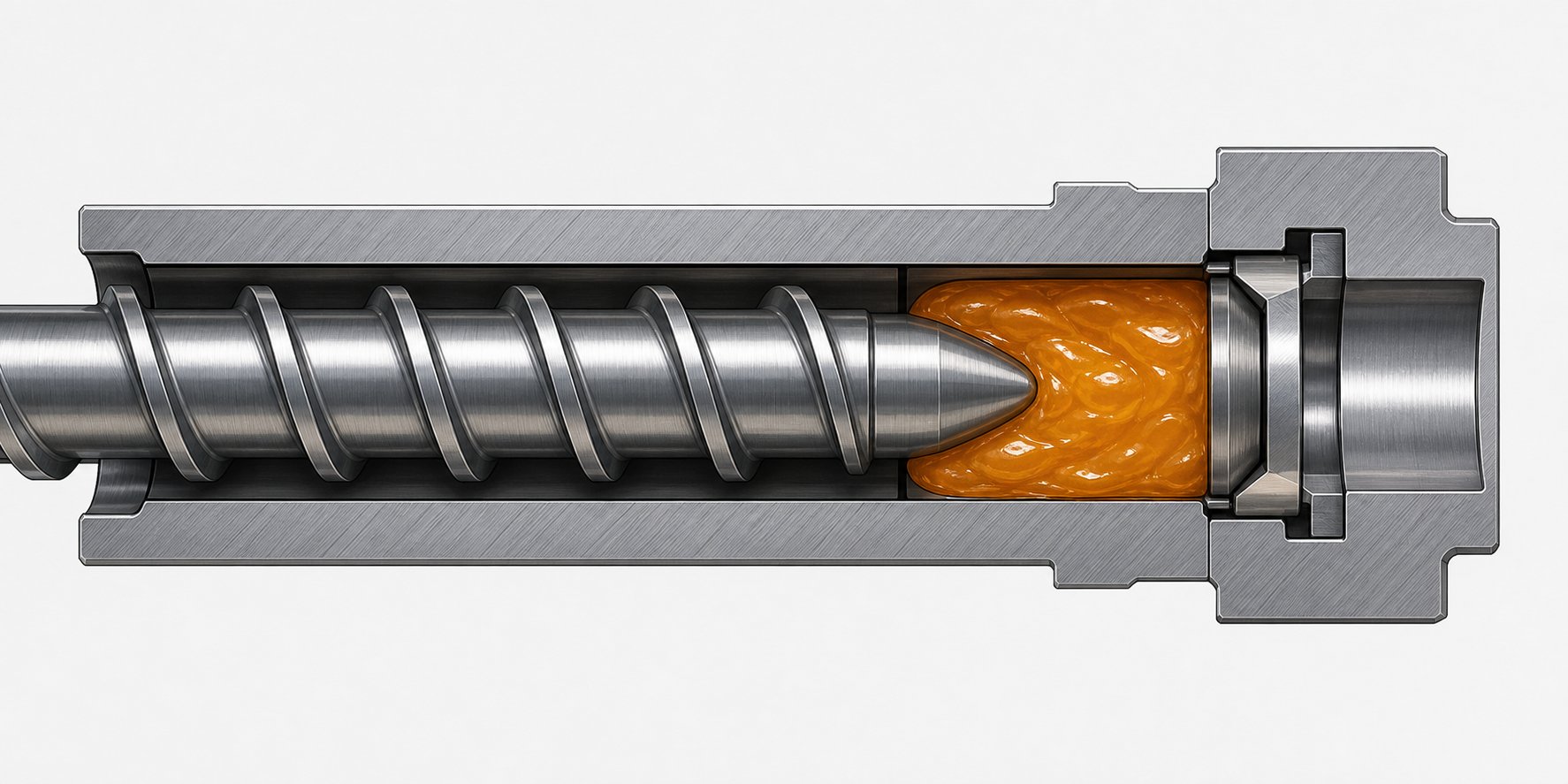
The check ring injection molding function centers on one principle: directional flow control. This ring sits at the very front of a reciprocating screw, sandwiched between a screw tip ahead of it and a rear seat behind it. Together, these three components form a non-return valve assembly. The ring itself is free to slide forward and backward along the screw tip body, and that simple sliding motion is what governs whether molten resin can pass through or gets blocked.
The Injection Cycle and Check Ring Movement
Understanding how a check ring works requires walking through the injection cycle phase by phase. During each stage, the ring shifts position — and those shifts determine whether material flows forward toward the mold or stays locked in place.
- Plasticization (screw recovery): The screw rotates inside the heated barrel, conveying plastic pellets forward. Friction and barrel heaters melt the resin as it moves along the screw flights. The check ring slides to its open position, pushed backward by the forward flow of melt. Molten material passes freely through the gap between the ring and the screw tip, accumulating in front of the screw.
- Shot size buildup: As molten plastic collects ahead of the screw, it generates pressure that pushes the screw rearward. The machine's back pressure setting — typically 500 to 750 psi plastic pressure for unfilled resins — controls how much resistance the screw encounters during this retreat. Throughout this phase, the ring remains open, allowing continuous material flow.
- Injection: The screw stops rotating and drives forward like a ram. This sudden forward motion pushes the check ring rearward against the rear seat, snapping it into the closed position. The ring-to-seat contact creates a seal that blocks molten plastic from leaking back over the screw flights.
- Pack and hold: The screw maintains forward pressure to compensate for material shrinkage as the part cools inside the mold. The ring stays sealed against the rear seat throughout this stage. Pressures acting on the non-return valve assembly during injection and packing can reach 20,000 to 45,000 psi — especially when filling thin-walled parts.
- Cooling and screw recovery restart: While the part cools in the mold, the screw begins rotating again for the next shot. The ring slides open once more, and the cycle repeats.
Two seals must form every single cycle for this system to work properly. The first is between the ring and the rear seat — a metal-to-metal contact that depends on precise mating surfaces. The second is between the ring's outer diameter and the barrel wall, maintained by an extremely tight clearance, often just hundredths of a millimeter.
Why Backflow Prevention Is Critical
So what happens when those seals don't hold? Molten resin leaks backward along the screw flights during injection instead of being driven into the mold cavity. Even a small amount of backflow throws off the entire process.
The consequences show up fast:
- Short shots and incomplete fill — the mold doesn't receive enough material to fully form the part.
- Inconsistent part weight — every shot delivers a slightly different volume of resin, making quality control nearly impossible.
- Cushion variation — the screw's final position at the end of pack and hold shifts unpredictably from cycle to cycle.
- Poor surface finish — uneven filling leads to flow marks, sink marks, and other cosmetic defects.
- Process instability — technicians end up chasing symptoms by adjusting temperatures, pressures, and timings, which masks the root cause and often introduces new problems.
At its core, a check ring is a non-return valve in injection molding — nothing more, nothing less. It has no electronics, no sensors, and no moving parts beyond its own sliding motion. That simplicity is deceptive, though, because its failure directly undermines every downstream quality metric. As injection molding expert John Bozzelli puts it, how well the check ring functions to prevent backflow determines the consistency of shot size and cushion.
From a troubleshooting standpoint, this makes the non-return valve one of the first components to inspect whenever shot-to-shot variation appears. Before adjusting barrel temperatures, tweaking hold pressures, or blaming the resin lot, pull the screw and examine the ring and seat surfaces. Scoring, uneven wear, or visible gaps between mating surfaces will confirm whether check ring backflow prevention has been compromised.
The real question for most maintenance teams isn't if this component will wear — it's recognizing which design variation they're working with and whether it's the right fit for their specific resin and process conditions.
Common Types of Check Rings and Non-Return Valves
Not every non-return valve assembly looks the same — or performs the same way. The types of check rings used in injection molding vary significantly in sealing mechanism, complexity, and suitability for different resins. Knowing which design sits at the front of your screw is the first step toward making smarter maintenance and sourcing decisions.
Think of it this way: you wouldn't put a general-purpose tire on a race car. The same logic applies here. Each design brings trade-offs in flow restriction, seal quality, durability, and cost — and matching the right one to your process conditions can mean the difference between consistent cycles and chronic quality headaches.
Sliding Ring Check Valves
The sliding ring check valve is the most widely used design in the industry, and for good reason. It's simple, versatile, and effective across a broad range of resins and applications.
This assembly typically consists of three or four components: a retainer (screw tip), the ring itself, and a rear seat. In a four-piece configuration, the front seat is manufactured as a separate piece from the retainer, allowing the use of a harder, more wear-resistant material for the seat surface. That's a meaningful upgrade — a four-piece design generally lasts longer and offers more flexibility in material selection compared to a three-piece version, where the front seat is machined directly into the retainer body.
During screw recovery, the ring slides forward freely on the retainer, opening a flow path for molten resin to pass through and accumulate ahead of the screw. When injection begins, the ring reverses direction and seats against the rear seat to form a seal. One key characteristic of this design is that the ring does not rotate with the screw during plasticization — it only moves axially, sliding back and forth. That distinction matters because it significantly reduces the friction and wear that the ring imparts on the barrel's internal surface.
Sliding ring designs are well suited for most general-purpose processing, including commodity resins like polyethylene and polypropylene, as well as many engineering thermoplastics. Their straightforward construction makes them easy to inspect, replace, and source, which is why they remain the default starting point for most applications.
Ball Check and Poppet-Style Non-Return Valves
When you're processing heat-sensitive or low-viscosity materials, a ball check non-return valve in injection molding may be the better choice. Instead of a sliding ring, these designs use a ball, poppet, or similar floating element housed inside the tip body. During recovery, the ball or poppet lifts off its seat to allow melt flow. During injection, it drops back or is pushed into a sealing position, plugging the flow channel.
The simplified internal geometry of ball check assemblies is their main advantage. Because there are fewer internal edges and transitions where material can hang up, these valves tend to perform better with highly sensitive materials like polycarbonate and acrylic that are prone to degradation if exposed to excessive residence time or sharp flow path changes. Poppet-style variants — sometimes marketed as quick shut-off (QSO) valves — take this a step further by offering exceptionally fast and positive sealing, making them popular for small shot sizes and thin-wall applications where even minor backflow causes defects.
There's a trade-off to be aware of, though. In both ball check and poppet configurations, the sealing outer diameter typically rotates with the screw during plasticization. That continuous rotation increases the potential for premature barrel internal diameter wear — a concern that makes these designs less suitable for long production runs on abrasive materials.
Locking and Positive Shut-Off Designs
Some applications demand absolute zero backflow — no exceptions. Liquid silicone rubber (LSR) molding, precision medical components, and micro-molding operations fall into this category. For these scenarios, mechanical locking check rings and positive shut-off nozzles provide the tightest possible seal.
A locking-ring design — sometimes called a castle tip — works similarly to a sliding ring but with one critical difference: the ring keys into the retainer and rotates with the screw rather than floating independently. This keyed engagement can improve seal consistency in certain setups. However, injection molding expert John Bozzelli has raised concerns about this design, noting that the rotating ring can cause significant barrel scoring — sometimes after as few as 2,000 hours of operation.
Positive shut-off nozzles take a different approach entirely. Instead of relying on the screw-tip assembly to prevent backflow, they use a mechanically actuated valve at the nozzle itself to physically close the flow path during injection. This provides the most definitive seal available but adds mechanical complexity and maintenance requirements to the machine.
The table below provides a side-by-side comparison to help you quickly match a design to your processing needs:
| Design Type | Sealing Mechanism | Best Suited Resin Types | Relative Cost | Maintenance Complexity |
|---|---|---|---|---|
| Sliding Ring (3-piece or 4-piece) | Ring slides against rear seat; does not rotate with screw | General-purpose resins, commodity and engineering thermoplastics | Low to Moderate | Low — easy to inspect and replace |
| Ball Check | Ball or sphere seats into flow channel opening | Heat-sensitive resins (PC, PMMA), low-viscosity materials | Moderate | Moderate — internal components require careful inspection |
| Poppet / Quick Shut-Off (QSO) | Poppet element plugs flow hole for rapid sealing | Small shot sizes, thin-wall parts, low-viscosity resins | Moderate to High | Moderate — fast-wear sealing surfaces need regular checks |
| Locking Ring (Castle Tip) | Keyed ring rotates with screw and locks into seat | Applications requiring consistent seal with standard resins | Moderate | Moderate to High — potential for barrel ID wear |
| Positive Shut-Off Nozzle | Mechanically actuated valve at nozzle closes flow path | LSR, micro-molding, precision medical parts | High | High — additional mechanical actuation components |
Each of these designs exists because no single valve geometry handles every resin, shot size, and quality requirement equally well. The sliding ring remains the most versatile and widely recommended starting point — but knowing when to move beyond it can solve persistent process problems that no amount of parameter adjustment will fix.
Of course, identifying the right type is only half the equation. These components share their names — and sometimes their appearance — with entirely different parts used in other industries, which creates real confusion when sourcing replacements or troubleshooting unfamiliar equipment.
Check Ring vs. Similar Components Explained
You've probably noticed how many ring-shaped metal parts float around in industrial catalogs — check valves, retaining rings, snap rings, O-rings, seal rings. They all sound vaguely related, and some even look alike at first glance. But confusing one for another can send you down the wrong troubleshooting path, lead to incorrect part orders, or waste valuable time during a machine teardown.
The terminology overlap is real, and it catches people off guard more often than you might expect. A purchasing agent sourcing a "check ring" for the first time may stumble into retaining ring catalogs. A junior technician hearing "check valve" might wonder if it's the same thing as the ring sitting at the front of the screw. Let's clear up each distinction so you know exactly what you're dealing with — and exactly what to ask for when it's time to order parts.
Check Ring vs. Check Valve
This is the most common source of confusion, and it's understandable — both components exist to prevent backflow. The check ring vs check valve difference, however, comes down to context, scale, and application.
A check ring is a specific type of non-return valve designed exclusively for the interior of an injection molding barrel. It slides along a screw tip body, seating against a rear seat to block molten resin from leaking backward during the injection phase. Its operating environment involves extreme temperatures (often 400°F to 700°F), pressures reaching tens of thousands of psi, and direct contact with abrasive or corrosive polymer melts. It's a compact, precision-machined metal component — typically just a few inches in diameter — with no springs, no external actuators, and no elastomeric seals.
A check valve, by contrast, is a far broader category. You'll find check valves in plumbing systems preventing water from flowing back into municipal supply lines, in hydraulic circuits protecting pumps from reverse pressure surges, and in chemical process piping controlling fluid direction across large-diameter lines. These valves use swing gates, spring-loaded discs, lift mechanisms, or ball-and-seat assemblies to accomplish backflow prevention. They range from thumbnail-sized brass fittings to massive flanged assemblies spanning several feet.
So while a non-return valve in injection molding and a check valve in a plumbing system serve the same fundamental purpose — allowing flow in one direction and blocking it in the other — they are engineered for entirely different worlds. Asking a plumbing supplier for a "check ring" will get you a blank stare, and searching a valve catalog for an injection molding non-return valve will bury you in irrelevant results.
Check Ring vs. Retaining Ring and Snap Ring
Here's where appearances become genuinely misleading. A check ring, a retaining ring, and a snap ring are all circular metal components used inside machinery. They're roughly the same general shape. They even occupy similar spaces in industrial parts bins. But functionally, they couldn't be more different.
Retaining rings — also known as snap rings or circlips — are metal fasteners installed into a groove on a shaft or inside a housing bore to hold an assembly in place. They don't control flow. They don't interact with molten material. They simply keep parts from sliding off shafts or out of bores. As engineering resource Design World explains, these devices "keep parts in place using a compact, lightweight design that requires fewer machining operations than other fastening techniques."
Retaining rings come in three main styles: tapered-section rings that make continuous contact within their groove, constant-section rings with a uniform width around their circumference, and spiral rings coiled from flat wire for 360-degree contact. Engineers select them based on rotational speed, load requirements, and installation frequency — criteria that have absolutely nothing to do with flow control or polymer processing.
A check ring, by contrast, is a flow-control component. It doesn't fasten anything. It doesn't sit in a groove. It slides freely along a screw tip and its entire purpose is to regulate the directional movement of molten plastic. The confusion between these components typically arises during parts ordering — especially when someone unfamiliar with injection molding equipment is tasked with sourcing replacements based on a vague description like "the ring on the front of the screw."
Check Ring vs. O-Ring and Seal Ring
O-rings and seal rings are sealing components, so at least there's a functional connection to the concept of preventing leakage. But the mechanism is completely different.
An O-ring creates a seal through elastomeric compression — it's a flexible rubber or polymer ring that deforms when squeezed between two surfaces, filling gaps and blocking fluid passage. Seal rings operate on the same principle, whether they're providing static sealing between flanged connections or dynamic sealing around a reciprocating shaft. Both rely on the material's elasticity and its ability to conform to surface irregularities under compression.
A check ring, on the other hand, creates directional flow control through rigid, metal-to-metal sliding contact. It doesn't compress. It doesn't deform. It physically moves from an open position to a closed position, and its sealing effectiveness depends on precise machining tolerances and surface finish — not material flexibility. While an O-ring might tolerate slight dimensional variation because the rubber compensates, a check ring demands precision within hundredths of a millimeter to function correctly.
The summary below lays out the core distinctions at a glance:
- Check Ring — Primary function: Directional flow control (non-return valve). Typical material: Tool steel, high-alloy steel, or corrosion-resistant alloy. Application context: Injection molding screw assemblies; prevents backflow of molten plastic during injection.
- Check Valve — Primary function: Backflow prevention in piping and fluid systems. Typical material: Brass, stainless steel, cast iron, or PVC. Application context: Plumbing, hydraulics, process piping, HVAC systems.
- Retaining Ring / Snap Ring — Primary function: Axial retention of components on shafts or in bores. Typical material: Carbon steel, stainless steel, or beryllium copper. Application context: Automotive, industrial machinery, consumer products — anywhere parts need to be held in position.
- O-Ring / Seal Ring — Primary function: Static or dynamic sealing through elastomeric compression. Typical material: Nitrile, EPDM, Viton, silicone, or PTFE. Application context: Hydraulic cylinders, pipe joints, valve stems, pump housings — anywhere a fluid-tight seal is needed.
Getting these distinctions right matters most when you're diagnosing problems under pressure. A technician who confuses a worn check ring with a failed O-ring might replace the wrong component entirely. A buyer who orders retaining rings when the screw assembly needs a new non-return valve ring will lose days waiting for the correct part to arrive. Clarity on terminology isn't just academic — it's practical, and it saves real time and money on the shop floor.
That clarity becomes even more important when things go wrong. Knowing what a check ring is only helps if you can also recognize what it looks like when it's failing — and what those failure symptoms mean for your production line.
Signs Your Check Ring Needs Replacement
Your machine doesn't send you a notification when its non-return valve starts to fail. There's no warning light, no alarm code, and no convenient pop-up message on the controller screen. Instead, the symptoms show up in your parts — quietly at first, then loud enough to shut down production if you're not paying attention.
The tricky part? Many check ring wear symptoms in injection molding mimic other process issues. Shot-to-shot variation could be a material problem. Short shots could be a temperature problem. Cushion instability could be a hydraulic problem. Experienced technicians learn to rule out the simple explanations first, but the non-return valve assembly should always be near the top of the diagnostic checklist — especially on machines with high cycle counts or a history of running abrasive materials.
Symptoms of a Worn or Failing Check Ring
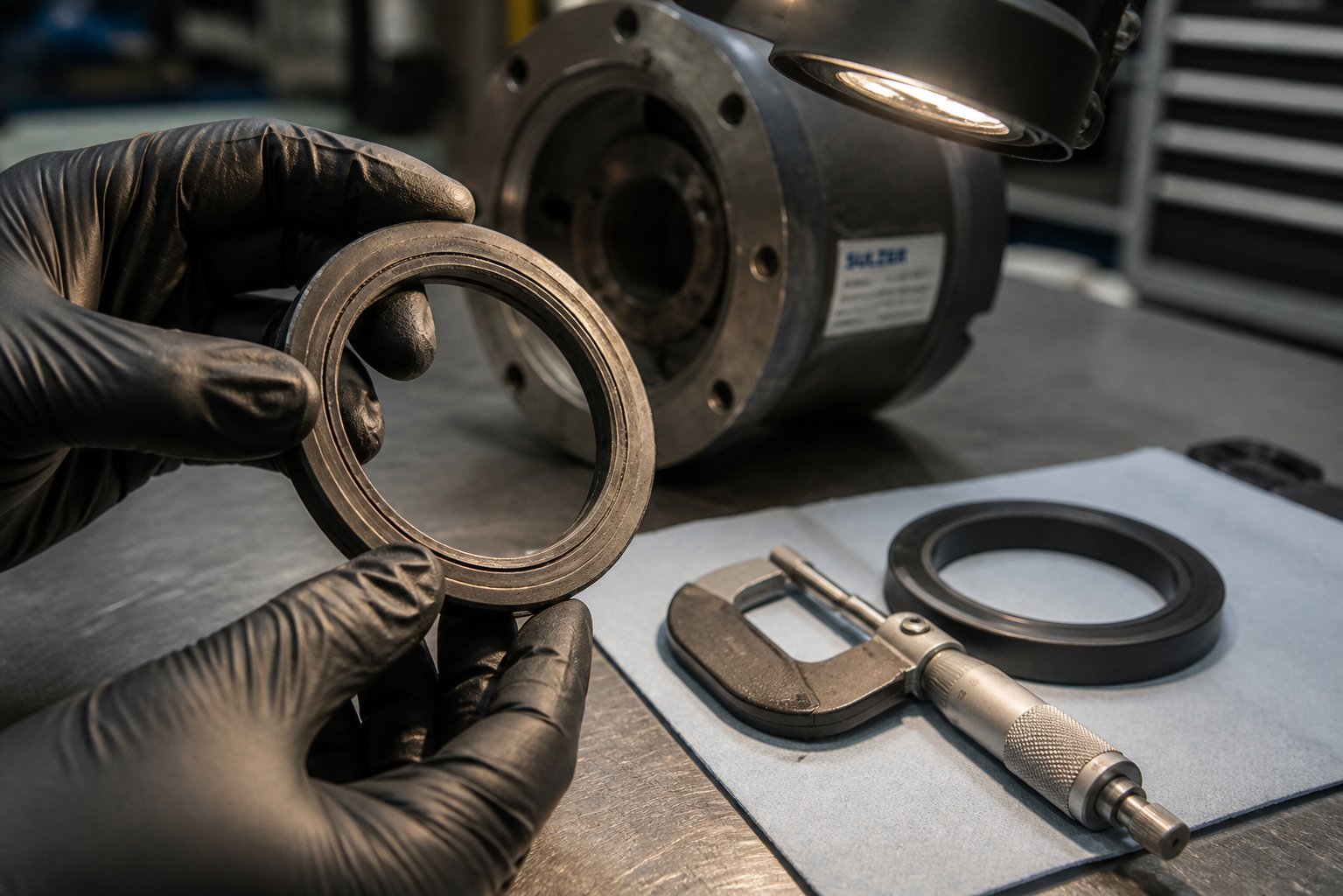
When the sealing surfaces on this component degrade, molten resin escapes backward over the screw flights during injection instead of being driven into the mold. That leakage may start small — barely noticeable in the numbers — but it compounds over time. Here are the warning signs that point directly to a compromised non-return valve:
- Inconsistent shot size or part weight — This is usually the earliest and most telling indicator. If your parts fluctuate in weight from cycle to cycle without any change in process settings, the ring likely isn't sealing consistently. Each time the screw drives forward, a different amount of melt leaks backward, delivering an unpredictable volume of resin to the mold cavity.
- Increased cushion variation — Cushion is the small amount of melt remaining in front of the screw at the end of the pack-and-hold phase. A healthy assembly produces a stable, repeatable cushion position. When the seal degrades, melt slips past the ring during injection, causing the screw to bottom out or fluctuate unpredictably. If your cushion readings swing more than a few thousandths of an inch from shot to shot, the non-return valve deserves immediate inspection.
- Short shots or incomplete fill — A worn check ring and short shots go hand in hand. When backflow robs the mold of material, cavities don't fill completely — especially in thin-walled sections or at the end of flow paths. You might compensate temporarily by increasing shot size or injection pressure, but that only masks the root cause and can introduce flash or other defects elsewhere in the part.
- Degraded surface quality — Flow marks, sink marks, and inconsistent gloss often trace back to uneven cavity filling. If the non-return valve allows variable amounts of leakage from cycle to cycle, the fill pattern inside the mold shifts unpredictably, producing cosmetic defects that no amount of parameter tweaking will eliminate.
- Longer cycle times due to compensation adjustments — When operators notice quality drifting, the instinct is to add hold time, increase pack pressure, or slow the injection speed to improve fill consistency. Each of those adjustments adds seconds to the cycle. Over thousands of shots, those extra seconds translate into significant lost production capacity — all because a worn ring is forcing the process to work harder to deliver the same result.
- Material drooling from the nozzle — If you see resin oozing from the nozzle tip between shots or during mold open, the ring may be allowing melt to migrate forward past the screw tip during recovery. While nozzle drool can also result from decompression settings or nozzle temperature issues, a leaking non-return valve is a common contributor — especially on machines that previously ran clean.
A dynamic check ring test — a diagnostic procedure that evaluates sealing reliability under actual injection conditions — can confirm whether the valve is performing within acceptable limits. This test measures how well the assembly holds pressure during injection, and inconsistent results point directly to a seal that's lost its integrity. If your facility doesn't already include this test in its standard machine qualification routine, it's worth adding.
What Causes Check Ring Wear
Every check ring has a finite service life. It's a metal component in constant contact with high-temperature, high-pressure polymer melt, and the physics of that environment guarantee eventual degradation. The question isn't whether it will wear — it's how fast and how severely. Several factors accelerate the process:
Abrasive fillers are the single biggest wear driver. Glass fiber, mineral fillers, and carbon fiber act like liquid sandpaper against the ring's sealing surfaces and the barrel wall. Research into screw and barrel wear consistently shows that filler particle size, shape, and concentration directly influence wear intensity — larger particles with sharper edges cause the most damage. If your shop runs glass-filled nylon, glass-filled polypropylene, or similar reinforced compounds, expect to replace the non-return valve assembly far more frequently than shops running unfilled materials.
Corrosive resins attack from a different angle. PVC generates hydrochloric acid at elevated processing temperatures, which leads to extreme corrosive wear on equipment. Fluoropolymers and certain flame-retardant compounds release similarly aggressive byproducts. Corrosion doesn't just thin the ring — it pits and roughens the sealing surfaces, destroying the precise metal-to-metal contact needed for an effective seal.
High injection pressures compound the problem. Every time the screw rams forward, the ring slams against the rear seat under enormous force. Pressures in the non-return valve assembly can reach 20,000 to 45,000 psi during injection and packing. Over hundreds of thousands of cycles, that repeated impact fatigues and deforms the contact surfaces — even on hardened steel components.
Excessive cycle counts are simply the reality of production. A machine running 24/7 at a 15-second cycle accumulates nearly 5,800 cycles per day — over 2.1 million cycles per year. Each cycle involves one full open-close sequence of the ring. No material is immune to that kind of repetitive mechanical stress indefinitely.
Improper material selection for the ring itself often shortens service life dramatically. Running a standard tool steel ring on a glass-filled engineering resin is a recipe for premature failure. The ring's hardness, corrosion resistance, and surface treatment must match the demands of the specific resin being processed. Mismatches — whether from cost-cutting or simply not knowing — lead to accelerated wear and more frequent unplanned downtime.
Proactive check ring inspection during scheduled shutdowns prevents costly unplanned downtime and scrap. Treat this component as a planned maintenance item with a defined replacement interval — not as something you address only after quality collapses.
The principle is straightforward: knowing when to replace a check ring is far less expensive than discovering the hard way that you should have replaced it three weeks ago. A robust preventive maintenance program — one rooted in baseline data and wear-monitoring procedures — transforms this component from a crisis trigger into a routine line item on your maintenance calendar.
Recognizing the symptoms and understanding the wear mechanisms puts you in a strong position to act. The next challenge is more specific: once you know a replacement is needed, how do you ensure the new ring is the right size, the right material, and the right fit for your particular machine and resin?
How to Choose the Right Check Ring for Your Machine
Spotting the wear is the easy part. Ordering the correct replacement? That's where things get tricky — and where mistakes can cost you days of downtime waiting for the right component to arrive.
A check ring isn't a universal part. It's a precision-machined component engineered to fit one specific screw assembly inside one specific barrel bore. Swap in a ring that's a few tenths of a millimeter too large and it binds inside the barrel. Go slightly undersized and it won't seal against the rear seat, defeating the entire purpose of the non-return valve. Getting the dimensions, material grade, and specification method right the first time saves money, prevents rework, and keeps your machine running on schedule.
Matching Check Ring Dimensions to Your Barrel and Screw
Every check ring is defined by a handful of critical dimensions that must align precisely with the screw diameter, barrel bore, and screw tip geometry it mates with. You can't approximate these numbers — you need exact measurements.
Here are the dimensions that matter most when determining how to choose check ring size:
- Outer diameter (OD) — This must create an extremely tight clearance against the barrel bore's inner wall. Too tight and the ring won't slide freely during recovery. Too loose and molten resin leaks around the outside of the ring during injection. Typical clearances between the ring OD and barrel ID fall within hundredths of a millimeter — tight enough that even minor barrel bore wear changes the relationship.
- Inner diameter (ID) — The ring slides along the screw tip body, so the ID must match the tip's outer profile precisely. An undersized ID creates friction, binding, or uneven wear. An oversized ID allows the ring to wobble, producing inconsistent sealing and accelerated degradation of both the ring and the tip.
- Length — The axial length of the ring determines how far it travels between its open and closed positions. This dimension is dictated by the screw tip assembly geometry and affects both flow area during recovery and sealing contact area during injection.
- Seat angle — The mating angle between the ring's rear face and the rear seat must match exactly. A mismatched seat angle creates only partial line contact instead of full-surface sealing, which leads to immediate backflow and rapid wear on both components.
Imagine trying to seal a valve where the plug only touches the seat on one edge. That's exactly what happens when the seat angle is off by even a degree or two. The localized contact point concentrates wear in a narrow band, and the ring's useful life drops dramatically.
One detail that often gets overlooked: the barrel bore itself may have worn since the original screw assembly was installed. If you're replacing a check ring on a machine with high cycle counts, measure the actual barrel ID at the screw tip's operating position — don't rely on the original specification alone. As wear tolerance data shows, diametrical clearance between the screw and barrel increases over time, and this directly affects how well a new ring will perform. You may need to account for barrel wear when specifying the replacement ring's OD.
Material Selection Based on Processing Conditions
Getting the dimensions right only solves half the problem. A perfectly sized ring made from the wrong material will wear out in a fraction of the expected service life — or fail catastrophically under aggressive processing conditions.
Your check ring material selection guide should start with one question: what resin are you running? The answer determines the hardness, corrosion resistance, and surface treatment your ring needs to survive.
Tool steel (4140, H-13, or equivalent) is the baseline choice for general-purpose processing. Nitrided tool steel offers a hardened surface layer that resists wear from unfilled commodity resins like polyethylene, polypropylene, and ABS. It's cost-effective, widely available, and performs well in applications without heavy abrasive or corrosive demands.
High-alloy steels and bimetallic construction step up the protection for glass-filled and mineral-filled compounds. These materials incorporate wear-resistant alloy layers — often applied through centrifugal casting or thermal spray processes — that handle the grinding action of reinforcing fibers far better than standard nitrided surfaces. If your facility processes glass fiber, calcium carbonate, or mineral fillers, bimetallic or high-alloy check rings are worth the investment. The upfront cost is higher, but the extended replacement interval and reduced downtime more than offset it.
Corrosion-resistant alloys are essential for chemically aggressive resins. PVC, fluoropolymers, and certain flame-retardant compounds generate acidic byproducts at processing temperatures that attack standard steel surfaces from within. Nickel-based alloys, cobalt-chromium alloys, and specialized stainless grades resist this chemical assault and maintain their sealing surfaces far longer than tool steel alternatives.
The table below provides a quick-reference comparison for matching materials to processing conditions:
| Material Type | Hardness Range (HRC) | Best For | Limitations |
|---|---|---|---|
| Nitrided Tool Steel (4140/H-13) | 48 - 55 | Unfilled commodity resins (PE, PP, ABS, PS) | Limited abrasion resistance; poor corrosion resistance against acidic polymers |
| High-Alloy Tool Steel (D-2, CPM series) | 58 - 62 | Moderate glass-filled resins (up to 30% GF) | Higher cost; may still corrode under PVC or fluoropolymer conditions |
| Bimetallic (Alloy-Lined) | 55 - 70 | Heavily glass-filled and mineral-filled compounds | Longer lead time; higher cost; not all suppliers offer this for small components |
| Corrosion-Resistant Alloy (Inconel, Hastelloy, or equivalent) | 35 - 50 | PVC, fluoropolymers, flame-retardant resins | Lower hardness means less abrasion resistance; significantly higher material cost |
| Solid Carbide / Tungsten Carbide | 70+ | Extremely abrasive formulations (50%+ glass fiber) | Brittle; expensive; requires careful handling during installation |
A common mistake is choosing based on cost alone. Running a standard nitrided ring on a 40% glass-filled nylon application might save fifty dollars on the part — but it could cost thousands in unplanned downtime, scrap, and emergency replacement labor when the ring wears through in a fraction of the normal interval. Match the material to the resin, not to the budget line.
Using Drawings, Samples, or Measurements for Custom Specifications
Here's a reality that surprises many buyers encountering this component for the first time: most check rings are not off-the-shelf parts. They are manufactured to match specific OEM screw assemblies, and dimensions vary between machine brands, screw designs, and even model years of the same machine. You can't just order "a 50mm check ring" and expect it to fit.
Maintenance teams typically source replacements through one of three workflows, and understanding which path to follow saves significant time:
- Engineering drawings — The most precise method. If you have the original OEM drawing for the screw tip assembly, a qualified manufacturer can produce an exact match. Always verify that the drawing reflects the current barrel bore condition, not just the original specification.
- Worn samples — Sending the worn ring and mating components to a manufacturer allows them to reverse-engineer the geometry, accounting for wear patterns and original design intent. This is the most common approach when drawings are unavailable — which happens more often than you'd think, especially on older machines.
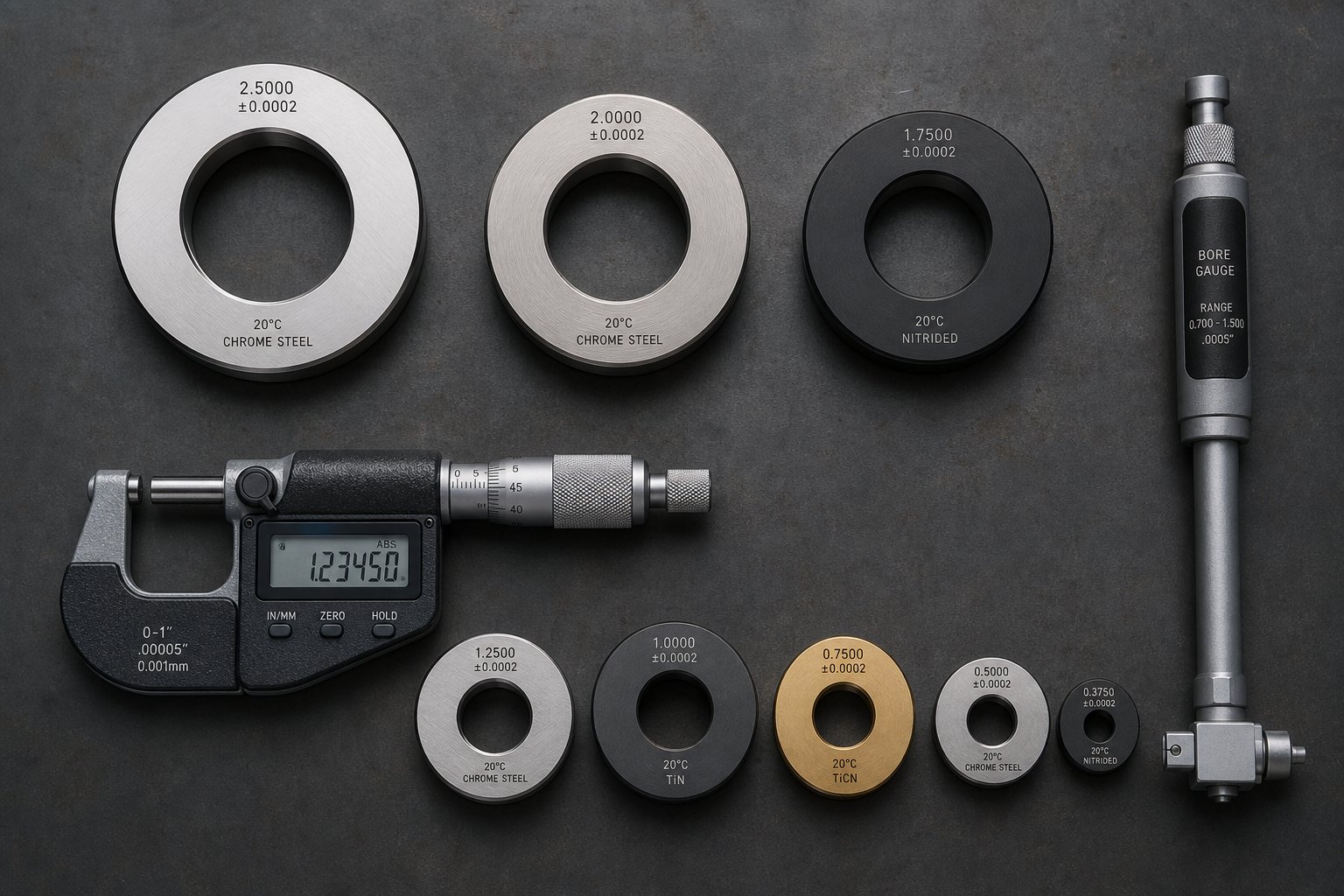
- Measured dimensions — When you can't send the part and don't have a drawing, providing accurate measurements of the ring, screw tip, rear seat, and barrel bore gives a manufacturer enough data to produce a replacement. Use calibrated micrometers and bore gauges, take readings at multiple points, and note the seat angle carefully.
Suppliers like NANHAIYA manufacture check rings and other extruder spare parts to custom specifications using any of these methods — drawings, samples, photos, or measured dimensions. This kind of flexibility is particularly valuable for maintenance teams managing diverse machine fleets where no two screw assemblies are identical. Rather than navigating multiple vendors for each machine brand, having a single manufacturing partner that can work from whatever documentation you have on hand streamlines the entire replacement process.
Regardless of which sourcing path you follow, always verify the finished component against your barrel and screw assembly before putting it into production. Check the OD against the barrel bore, confirm free sliding motion on the screw tip, and inspect the seat angle contact with marking compound if possible. A five-minute fit check at the bench prevents a far more expensive discovery during startup.
With the right ring selected, sized, and in hand, the next step is getting it installed correctly — because even a perfectly specified component won't perform if it's assembled improperly or put into service without verifying the condition of the mating parts it depends on.
How to Install a Check Ring and Maintain It for Maximum Service Life
A brand-new, perfectly specified check ring sitting on the workbench is worth nothing if it goes into the machine incorrectly. Improper installation — wrong orientation, contaminated threads, a damaged rear seat nobody bothered to inspect — can turn a straightforward replacement into a repeat failure within days. And once the ring is running, neglecting routine inspection guarantees you'll be back at this same workbench sooner than anyone planned.
The procedures below are written for the technician standing next to the machine with tools in hand. They're practical, sequential, and built around avoiding the mistakes that cause the most rework. Whether you're pulling a screw for the first time or you've done it a hundred times, a disciplined approach to check ring installation in injection molding protects both the component and your production schedule.
Check Ring Installation Steps
Every installation starts long before the new ring touches the screw tip. Preparation and inspection of the mating components matter just as much as the ring itself. Skip a step here and you risk compromising the seal before the first shot.
- Safely purge and shut down the machine. Run a heat-stable, unfilled purging compound through the barrel to flush residual resin. As Services for Plastics emphasizes, never attempt to rotate or retract a screw without resin in the barrel — doing so risks metal-to-metal contact damage. Reduce barrel temperatures to a safe handling range and follow your facility's lockout/tagout procedures.
- Retract the screw and remove it from the barrel. Back the screw out carefully, supporting its weight to prevent bending or scoring the barrel bore. On larger machines, this requires an overhead crane or screw-pulling fixture. Lay the screw on a clean, padded surface — V-blocks or wooden cradles work well to prevent rolling and surface damage.
- Disassemble the existing screw tip assembly. Unthread the screw tip from the front of the screw. If the tip resists removal, apply penetrating lubricant and use the proper wrench or socket — never hammer directly on the tip body. Remove the worn check ring and rear seat, noting their orientation and arrangement. Take photos before disassembly if you haven't done this on the specific machine before.
- Inspect the rear seat and screw tip for wear or damage. This is the step most often rushed — and it's arguably the most important. A new ring installed against a scored or grooved rear seat will never seal properly. Examine the seat's mating surface under good lighting: look for circumferential scoring, pitting, galling, or any dimensional deviation from the original seat angle. Run a fingernail across the sealing face — if you can feel ridges or grooves, the seat needs replacement or re-machining. Inspect the screw tip body for wear on the surfaces where the ring slides; scoring here causes the ring to hang up instead of sliding freely between its open and closed positions.
- Clean all threaded areas and apply anti-seize compound. Contaminated or galled threads are a leading cause of difficult disassembly on the next replacement. Industry best practice calls for applying anti-seize compound on all threaded areas during assembly — this simple step enables easy removal in the future and prevents thread seizure caused by the extreme thermal cycling these components endure.
- Install the new check ring in the correct orientation. This sounds obvious, but orientation errors happen more frequently than anyone admits. The ring's sealing face must mate flush with the rear seat when the screw drives forward. Reversing the ring means it can never seal, regardless of how new or precisely machined it is. If the ring has any chamfer, taper, or asymmetrical feature, verify which face contacts the seat by referencing the manufacturer's diagram or comparing it to the worn ring you removed.
- Reassemble and torque the screw tip to specification. Thread the screw tip back onto the screw and tighten to the manufacturer's recommended torque value. Do not over-torque — as emphasized in screw tip assembly guidelines, excessive torque can distort the seat geometry or damage threads. Confirm that the register of the screw matches perfectly with the seat before final tightening.
- Verify free sliding movement before reinsertion into the barrel. With the tip assembly fully torqued, manually slide the ring back and forth on the tip body. It should move freely with no binding, catching, or excessive play. If the ring sticks or feels tight at any point in its travel, disassemble and investigate — a binding ring won't open properly during recovery, restricting flow and causing erratic plasticization.
Once the screw is reinstalled in the barrel, bring the barrel up to processing temperature gradually and run several purge cycles before beginning production. These initial shots flush any contamination introduced during assembly and let you verify that the new ring is cycling properly by observing cushion stability and shot consistency.
Inspection and Preventive Maintenance Schedule
Waiting until quality falls apart to inspect the non-return valve assembly is the most expensive check ring maintenance schedule possible. Integrating inspection into your regular preventive maintenance intervals catches degradation early — before it reaches the point where parts start going bad.
Industry maintenance frameworks recommend a monthly inspection of the check ring and non-return valve wear as part of the plasticizing unit PM cycle, with a full screw pull and detailed inspection annually or every 4,000 to 6,000 operating hours — whichever comes first. Machines running 24/7 hit that hour threshold in roughly five to six months of calendar time, so wall-clock schedules alone aren't reliable on high-utilization equipment.
During a visual check ring inspection procedure, focus on these specific indicators:
- Scoring on the sealing surfaces — Any circumferential scratches or grooves on the ring's seat face or the mating rear seat indicate material has been passing through the seal. Light scoring may still allow acceptable performance, but deep or progressive grooves signal imminent failure.
- Uneven wear patterns — A ring that wears more heavily on one side than the other often points to barrel bore misalignment, screw deflection, or a concentricity issue with the tip body. Address the root cause along with replacing the ring, or the new one will develop the same pattern.
- Dimensional changes — Measure the ring's outer diameter with a calibrated micrometer and compare it to the original specification. Diametral wear beyond factory tolerances means the ring can no longer maintain the barrel-wall clearance needed for an effective seal. Similarly, measure the inner diameter to confirm it hasn't opened up to the point where the ring wobbles on the tip.
- Material buildup or contamination — Carbon deposits, degraded polymer, or filler accumulation on the ring's sliding surfaces or seat faces can physically prevent the ring from closing fully. Thorough cleaning during inspection often reveals surface damage hidden underneath.
One practical tip that pays for itself many times over: keep spare check rings, rear seats, and screw tips in inventory for your critical machines. A non-return valve assembly costs a fraction of what an eight-hour unplanned production stoppage costs. Industry data puts the hourly cost of unplanned downtime on a mid-size press in the thousands of dollars — against that figure, stocking a few spare wear components is one of the easiest financial decisions a plant manager can make.
Extending Check Ring Service Life
Replacement intervals aren't fixed by fate. How you run the machine, what you run through it, and how well you maintain the surrounding components all influence how long the ring lasts. These practical steps for extending check ring service life won't eliminate wear entirely — nothing will — but they can meaningfully stretch the interval between replacements:
- Match the material grade to the resin. This point bears repeating because it's the single most impactful variable. Running a nitrided tool steel ring on heavily glass-filled compounds is asking for premature failure. Invest in bimetallic or high-alloy rings for abrasive applications and corrosion-resistant alloys for chemically aggressive resins. The higher upfront cost is recovered in longer service intervals and fewer production interruptions.
- Avoid processing abrasive materials through components designed for general-purpose use. If your production schedule includes both unfilled commodities and 40% glass-filled engineering resins, don't assume one ring handles both. Dedicated screw assemblies for abrasive applications protect your investment and prevent cross-application wear damage.
- Maintain proper barrel and screw alignment. Misalignment causes the ring to bear unevenly against the barrel wall, accelerating localized wear on both components. Machine leveling checks and platen parallelism measurements should be part of your quarterly or annual PM routine.
- Follow manufacturer-recommended processing parameters. Excessive injection pressures, unnecessarily high screw speeds, and cold-start cycling all increase mechanical stress on the non-return valve assembly. Operating within the machine builder's recommended ranges reduces the cumulative impact of each cycle on the ring's sealing surfaces.
- Avoid dry cycling or cold starts without resin. Running the screw without material creates direct metal-to-metal contact between the ring, barrel, and seat — a scenario that can cause measurable damage in minutes. Always purge with a heat-stable compound before shutdown and ensure resin is present before startup.
A well-maintained check ring assembly directly contributes to consistent part quality and reduced scrap rates. Treating this component as a scheduled wear item — inspected regularly, replaced proactively, and matched precisely to your processing conditions — is one of the highest-return maintenance investments on the shop floor.
Next Steps for Sourcing and Replacing Your Check Ring
You've diagnosed the symptoms, identified the wear pattern, and confirmed that the non-return valve assembly needs attention. The screw is coming out on the next scheduled shutdown — or maybe sooner, if quality has already started to slip. What matters now is having the right replacement component ready before that window opens, not scrambling to source one after the machine is already down.
Everything covered in this guide leads to a single practical objective: keeping your injection molding process stable, your parts consistent, and your downtime planned rather than reactive. Here's a concise recap of the essentials, followed by clear guidance on where to buy replacement check rings and how to streamline your sourcing workflow.
Key Takeaways for Industrial Check Ring Users
Whether you're a process engineer refining cycle parameters, a maintenance technician pulling screws, or a plant buyer building a preferred supplier list, these are the points worth carrying forward:
- What it does and why it matters — A check ring is a precision non-return valve that prevents molten resin from flowing backward during injection. Its sealing performance directly controls shot size consistency, cushion stability, and part quality across every cycle.
- How to spot failure early — Inconsistent part weight, increasing cushion variation, short shots, degraded surface finish, and nozzle drool are the primary warning signs. A dynamic check ring test confirms whether the seal has degraded beyond acceptable limits.
- Choosing the right type — Sliding ring designs cover most general-purpose applications. Ball check and poppet-style valves suit heat-sensitive or low-viscosity resins. Locking rings and positive shut-off nozzles serve zero-backflow applications like LSR and micro-molding.
- Matching the material to the resin — Nitrided tool steel handles unfilled commodity resins. High-alloy or bimetallic construction is necessary for glass-filled and mineral-filled compounds. Corrosion-resistant alloys protect against PVC, fluoropolymers, and flame-retardant formulations.
- Getting the dimensions right — Outer diameter, inner diameter, length, and seat angle must match the specific screw tip assembly and barrel bore. Tolerances within hundredths of a millimeter determine whether the ring seals or leaks.
- Installing and maintaining properly — Inspect the rear seat and screw tip before installing a new ring. Apply anti-seize to threads. Verify free sliding motion before reinserting the screw. Integrate non-return valve inspection into your regular PM schedule — monthly checks at minimum, with a full screw pull annually or every 4,000 to 6,000 operating hours.
Sourcing Reliable Replacement Check Rings and Screw Assembly Components
Here's a reality that experienced maintenance teams already know: finding a check ring supplier for injection molding that can deliver precision components to your exact specifications — not close-enough catalog approximations — is harder than it sounds. Most of these parts are custom manufactured to match specific OEM screw assemblies, and dimensions vary across machine brands, screw designs, and model years.
That means your sourcing workflow needs a supplier capable of working from whatever documentation you have available. Sometimes that's a complete engineering drawing. More often, it's a worn sample, a set of measured dimensions, or a handful of photos taken during a screw pull. The supplier's ability to accept all of these inputs — and still deliver a dimensionally accurate part — separates reliable custom check ring manufacturers from vendors who can only fill standard catalog orders.
NANHAIYA is one practical option worth evaluating for this exact scenario. Their extruder spare parts program is built around the sourcing workflows discussed throughout this guide — manufacturing check rings, screw tips, injection nozzles, heater bands, thermocouples, die heads, pelletizing blades, screen packs, filter adapters, and gearbox components based on drawings, samples, photos, or measured dimensions. For maintenance teams managing diverse machine fleets where every screw assembly is slightly different, that flexibility eliminates the back-and-forth of trying to match catalog listings to non-standard configurations.
When evaluating any supplier for sourcing injection molding spare parts, ask these questions before placing an order:
- Can they manufacture from a worn sample or measured dimensions — not just OEM drawings?
- Do they offer the material grades needed for your specific resin applications?
- What are their lead times for custom-specified components?
- Can they supply the complete screw tip assembly — ring, seat, and tip — as a matched set?
- Do they have experience with your machine brand and screw diameter range?
Building a relationship with a capable supplier before you need an emergency replacement is one of the smartest moves a plant buyer can make. Stock critical spares for your highest-utilization machines. Keep dimensional records of every screw assembly in your fleet. And treat the non-return valve as what it is — a planned maintenance item with a predictable service life, not a crisis that catches you off guard.
Treating check rings as planned maintenance items rather than emergency replacements saves money, reduces scrap, and keeps production running smoothly. The cost of a spare sitting on the shelf is always less than the cost of a production line sitting idle.
Bookmark NANHAIYA's extruder spare parts page as a starting point for your next replacement cycle — and make sure your maintenance calendar, not your reject bin, is what tells you it's time to order.
Frequently Asked Questions About Check Rings
1. What is a check ring in injection molding?
A check ring is a precision-machined cylindrical component positioned at the front of the reciprocating screw inside an injection molding barrel. It works together with a screw tip and rear seat to form a non-return valve assembly. During plasticization, it slides open so molten resin can flow forward past the screw tip. During injection, it slides closed against the rear seat to block backflow, ensuring each shot delivers a consistent volume of material into the mold. Without a properly functioning check ring, shot size varies unpredictably, leading to defective parts and wasted resin.
2. How do I know if my check ring is worn and needs replacement?
The most common indicators of a failing check ring include inconsistent part weight from cycle to cycle, increasing cushion variation, short shots or incomplete cavity fill, degraded surface finish on molded parts, and material drooling from the nozzle between shots. A dynamic check ring test — which evaluates how well the assembly holds pressure under actual injection conditions — can confirm whether the seal has degraded. If you notice any combination of these symptoms and process parameter adjustments do not resolve them, pulling the screw to inspect the non-return valve assembly should be your next step.
3. What is the difference between a check ring and a check valve?
Both components prevent backflow, but they operate in entirely different contexts. A check ring is a compact, precision-machined metal ring that slides along a screw tip inside an injection molding barrel, sealing against a rear seat to block molten plastic from flowing backward during injection. A check valve is a much broader category of flow-control device found in plumbing, hydraulics, and process piping systems. Check valves use swing gates, spring-loaded discs, or ball-and-seat mechanisms and range from small brass fittings to large flanged industrial assemblies. Asking a plumbing supplier for a check ring — or searching a valve catalog for an injection molding non-return valve — will not yield the correct part.
4. How often should a check ring be inspected or replaced?
Industry best practices recommend a monthly visual inspection of the check ring and non-return valve assembly as part of the plasticizing unit preventive maintenance cycle. A full screw pull with detailed inspection should occur annually or every 4,000 to 6,000 operating hours — whichever comes first. Machines processing abrasive glass-filled or mineral-filled resins may require more frequent inspections because filler particles accelerate wear on sealing surfaces. Keeping spare check rings, rear seats, and screw tips in inventory for critical machines minimizes downtime when replacement is needed. Suppliers like NANHAIYA manufacture these components to custom specifications from drawings, samples, or measured dimensions via their extruder spare parts program at https://www.nhyscrews.com/products/extruder-spare-parts.
5. What material should a check ring be made from?
The ideal material depends on the resin being processed. Nitrided tool steel (such as 4140 or H-13) is suitable for unfilled commodity resins like polyethylene and polypropylene. High-alloy steels or bimetallic construction are recommended for glass-filled and mineral-filled compounds because standard tool steel wears rapidly under abrasive conditions. Corrosion-resistant alloys — including nickel-based and cobalt-chromium grades — are necessary for chemically aggressive materials like PVC and fluoropolymers, which generate acidic byproducts at processing temperatures. Choosing based on cost alone often leads to premature failure and unplanned downtime that far exceeds the savings on the component itself.
Written by
Nanhaiya Technical Team
Zhoushan Nanhaiya Plastic Machinery Co., Ltd.
The Nanhaiya technical team supports screw and barrel manufacturing projects through application review, technical communication, custom manufacturing coordination, and production and quality control.
Discuss Your Application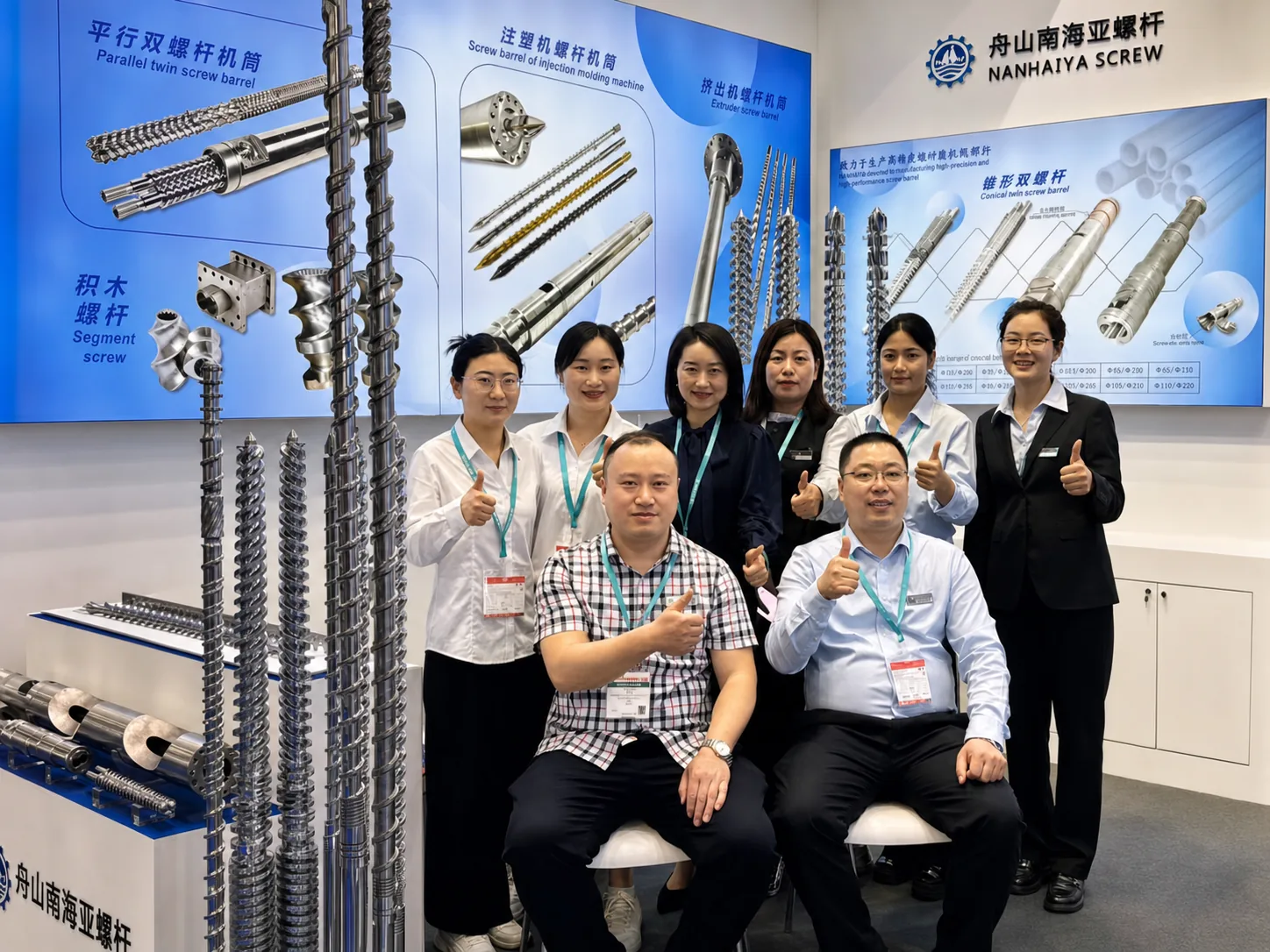
Related Articles
More insights on screw barrel technology and plastics processing.
What Nobody Tells You About Screw Barrel For Plastic Machine Design
Oct 10, 2026
Learn how screw barrel for plastic machine design affects melt quality, throughput, and wear life. Covers geometry, resin matching, troubleshooting, and sourcing.
Read Article
Single Screw Extruder for Sheet: Stop Guessing, Start Specifying
Oct 9, 2026
Learn how to specify a single screw extruder for sheet production. Covers screw geometry, resin-specific processing, troubleshooting, and maintenance best practices.
Read Article
PE Pipe Extruder Machine: What Datasheets Won't Tell You
Oct 9, 2026
Learn how a PE pipe extruder machine works, key specs explained, material grade selection, maintenance tips, and buyer guidance beyond the datasheet.
Read ArticleLooking for something else?
Search by material, symptom or product and jump straight to the relevant page.
These are navigation suggestions based on keyword matching — not a quotation, not a delivery commitment, and not a substitute for engineering review. Final specification is confirmed by our engineers against your drawings and processed material.
Need help with screw barrel selection?
Share your machine model, processed material and application. Our team can help with pricing and technical support.