

What a Twin Screw Extruder Does and Why Buyers Need One
You're about to make a six-figure capital equipment decision, and every manufacturer wants to sell you their machine. Before you request a single quote, you need to understand exactly what you're buying, why it matters, and what sellers rarely volunteer. This guide exists for one reason: to put you, the buyer, in the strongest possible position.
What Is a Twin Screw Extruder
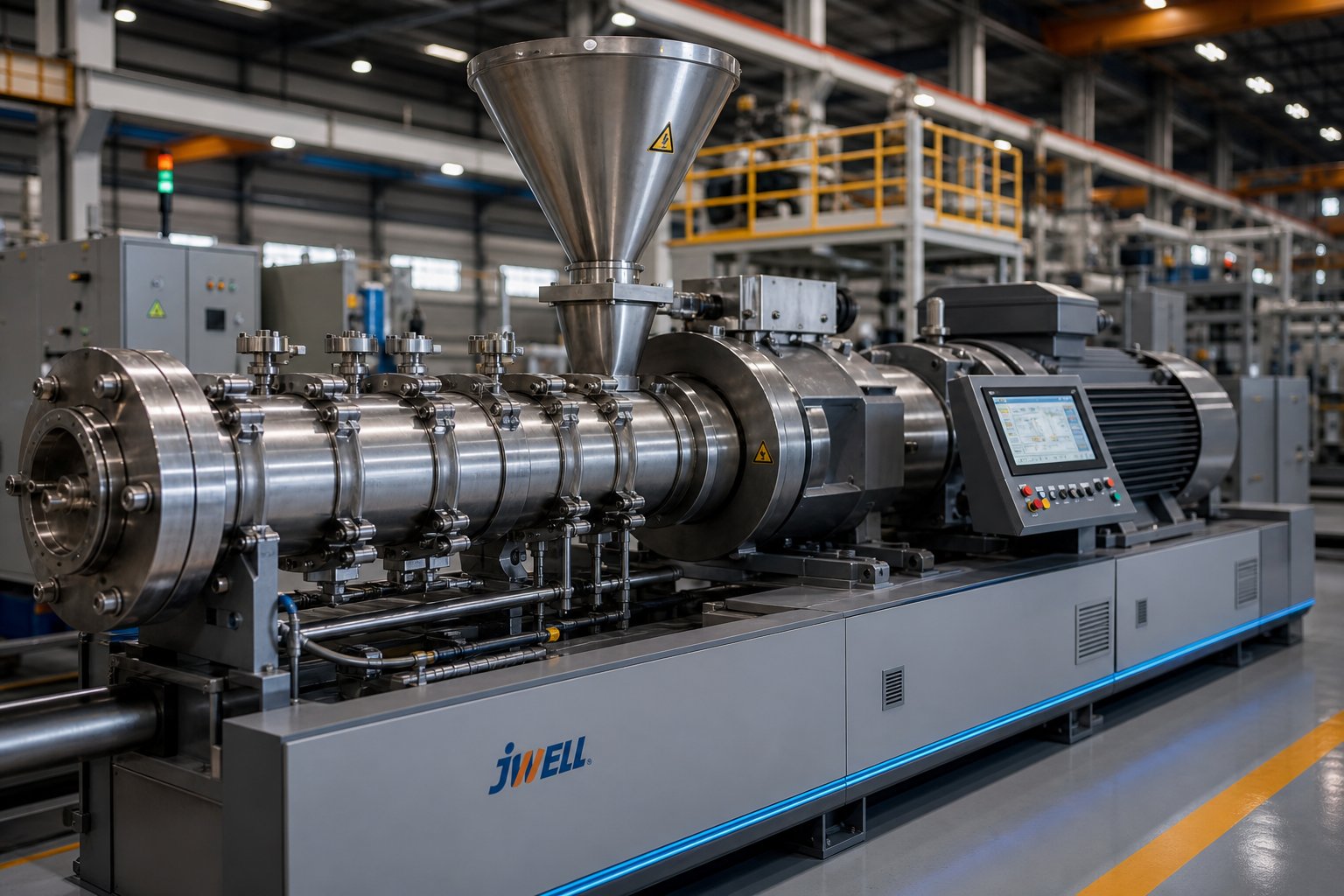
A twin screw extruder is a processing machine that uses two intermeshing screws rotating inside a heated barrel to melt, mix, and convey polymers or other materials into a uniform output. Sometimes referred to as a double screw extruder, it continuously blends raw ingredients, additives, and fillers into homogeneous compounds that can then be shaped, pelletized, or fed into downstream equipment.
What separates twin screw extruders from their single-screw counterparts? Three critical advantages. First, superior mixing capability — the intermeshing screw design generates high shear forces that break down agglomerates and disperse additives far more effectively than a single rotating screw ever can. As extrusion expert Jim Frankland explains, a twin can transfer the entire channel of polymer from one screw to the other multiple times, enabling full-channel mixing that single screws simply cannot replicate. Second, a self-wiping action prevents material buildup on barrel walls, ensuring consistent processing and easier material changeovers. Third, a modular screw design lets operators rearrange conveying elements, kneading blocks, and mixing sections to tailor the machine's behavior to virtually any formulation.
Why This Machine Is Critical for Modern Processing
Imagine a single piece of equipment flexible enough to compound engineering plastics one week, produce color masterbatch the next, and run a reactive extrusion trial the week after — all by reconfiguring screw elements and adjusting process parameters. That's exactly why the twin-screw extruder has become the industry workhorse across a remarkable range of sectors.
In polymer compounding, it blends resins with fillers, stabilizers, and reinforcements to create custom compounds. In masterbatch production, it disperses high concentrations of pigments or additives into carrier resins. For reactive extrusion, it serves as a continuous chemical reactor — grafting, cross-linking, or modifying polymers in-line. Devolatilization processes rely on its venting zones to strip moisture, solvents, and volatile compounds from sensitive materials. Beyond plastics, twin screw extruders are central to pharmaceutical hot-melt extrusion, where they enhance drug solubility and create controlled-release formulations, and to food processing, where they texturize proteins and produce snacks, cereals, and pet food at industrial scale.
This breadth of application is precisely what makes the purchasing decision so consequential.
The decision to buy a twin screw extruder is one of the highest-impact capital equipment choices a processing plant makes — it defines your production capability, product quality ceiling, and operating costs for a decade or more.
Yet most available information online comes from manufacturers with machines to sell, not from independent sources focused on the buyer's interest. This guide changes that. In the sections ahead, you'll find a structured walkthrough of co-rotating versus counter-rotating configurations, the exact specifications you need to evaluate, an honest comparison of new versus used equipment, a manufacturer landscape overview, application-matching frameworks, red flags that signal a bad deal, and a step-by-step purchasing process — all written from the buyer's side of the table.
The first decision that shapes everything else? Choosing the right screw rotation configuration for your process.
Co-Rotating vs Counter-Rotating Configurations Explained
Screw rotation direction isn't a minor technical detail — it fundamentally shapes how material flows, how intensely it mixes, and which applications the machine can handle. Yet many buyers gloss over this choice, defaulting to whatever a sales engineer recommends. Understanding the difference between a co rotating twin screw extruder and a counter-rotating design puts you in control of the most foundational decision in the entire purchasing process.
Co-Rotating Twin Screw Extruders and Their Strengths
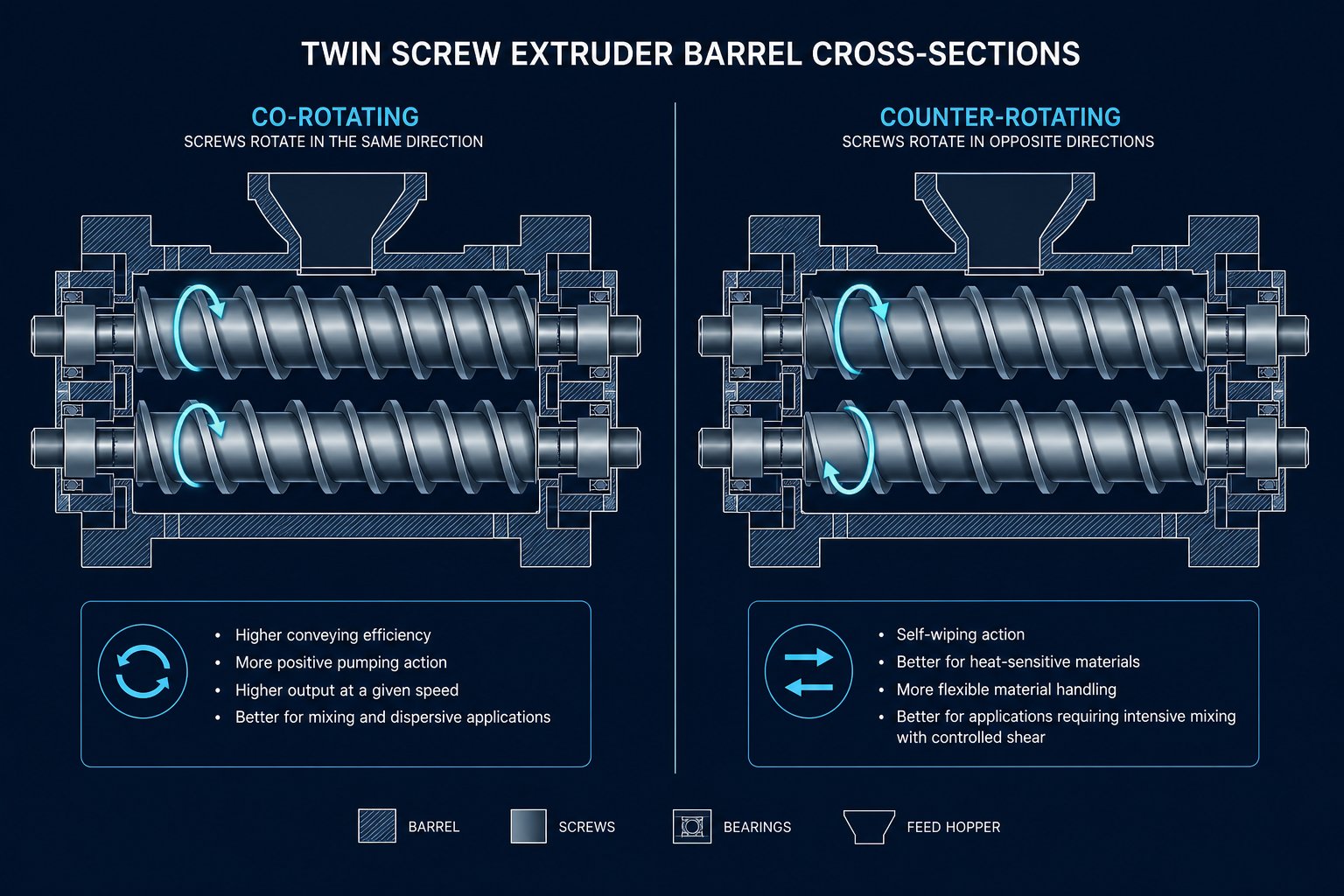
In a co-rotating configuration, both screws turn in the same direction inside a fully intermeshing barrel geometry. Picture material being forcibly handed from one screw flight to the next at the intermeshing zone — this constant transfer creates intense shear fields and a complex deformation history that few other machines can match.
What does that mean in practical terms? Three standout strengths define the co rotating twin screw extruder:
- High-shear mixing: Intense shear develops both between the screws and between each screw and the barrel wall. Add kneading blocks into the modular design, and you introduce elongational flow components that break down filler agglomerates and achieve microscopic-level dispersion.
- Self-wiping action: The fully intermeshing geometry leaves very few dead zones inside the barrel. Material doesn't stagnate or adhere to surfaces, which keeps the residence time distribution narrow — a critical factor during reactive extrusion or when processing thermally sensitive formulations.
- Modular flexibility: Screw elements can be freely combined and rearranged, allowing operators to control exactly where and how much energy the material receives along the barrel length.
These characteristics make co-rotating machines the dominant choice for polymer compounding with inorganic or nanoscale fillers, color masterbatch production, polymer alloy and blend development, devolatilization, and reactive extrusion involving polymerization or compatibilization. If your process demands thorough distributive and dispersive blending at high throughput, this is typically where you land.
Counter-Rotating and Conical Configurations Explained
Flip one screw's rotation, and the machine's personality changes dramatically. In a counter-rotating twin screw extruder, the two screws turn in opposite directions. At the intermeshing region, material is drawn inward by the screws and advances forward under compression — a fundamentally different conveying mechanism that relies on positive displacement rather than high-shear transfer.
The mixing behavior shifts as well. Instead of the aggressive shear fields found in co-rotating designs, counter-rotating machines rely primarily on compressive and elongational deformation. A calendering effect appears at the intermeshing zone, where material undergoes repeated compression and stretching under relatively gentle conditions. Shear heating stays low, and the extrusion temperature can be held well below levels that would degrade thermally sensitive compounds.
Rigid PVC is the textbook example. It has a low thermal decomposition temperature and poor melt flow — a combination that punishes high-shear processing. The counter-rotating design handles it reliably at high fill levels and low screw speeds, which is why this configuration dominates PVC pipe, sheet, and profile extrusion worldwide.
A specialized variant worth understanding is the conical twin screw extruder. Instead of parallel screws with uniform diameter, conical designs taper from a larger diameter at the feed end to a smaller one at the discharge end. This geometry creates a natural compression zone that enhances melting and improves pressure generation, all within a compact machine footprint. Conical twin screw extruders deliver high torque transmission in a smaller package, making them well-suited for medium-capacity PVC extrusion lines where space and cost efficiency matter.
How to Choose the Right Configuration for Your Process
Sellers sometimes push whichever configuration they manufacture or stock. Your decision, however, should be driven entirely by what your process actually demands. The following comparison lays out the key differences side by side:
| Dimension | Co-Rotating | Counter-Rotating |
|---|---|---|
| Mixing Intensity | High — excellent distributive and dispersive blending | Moderate — gentle calendering-based dispersion |
| Shear Level | High shear stress between screws and barrel | Low shear stress; minimal shear-induced heating |
| Throughput Range | Wide range; scales efficiently to high volumes | Moderate; optimized at high fill and low screw speed |
| Typical Applications | Compounding, masterbatch, reactive extrusion, devolatilization | PVC pipe and profile extrusion, heat-sensitive materials |
| Material Suitability | Engineering polymers, filled systems, polymer alloys, nanocomposites | Rigid PVC, thermally unstable compounds |
| Barrel Wear Rate | Higher due to intense shear and abrasive fillers | Lower; gentler processing reduces wear on barrel surfaces |
| Self-Wiping Capability | Strong — minimal dead zones, narrow residence time distribution | Limited — positive displacement conveying with less self-cleaning |
Notice that neither configuration is universally superior. A buyer compounding glass-fiber-reinforced nylon needs a completely different machine than a buyer extruding rigid PVC window profiles. The co rotating and counter rotating twin screw extruder designs each solve distinct processing challenges, and choosing the wrong one leads to chronic quality issues, excessive wear, or throughput limitations that no amount of process tuning can fix.
The decision rule is straightforward: choose co-rotating for compounding and mixing-intensive processes where high shear and modular flexibility matter most; choose counter-rotating for gentle conveying, profile extrusion, and heat-sensitive materials where low shear and positive displacement are essential.
Getting the configuration right eliminates an entire category of downstream problems. But configuration alone doesn't guarantee the right machine — the specific technical specifications within that configuration determine whether your extruder actually meets production targets or falls short. That's where most buyers make their costliest mistakes.
Critical Specifications Every Buyer Must Evaluate
A spec sheet from a twin screw extruder machine manufacturer can run several pages, packed with numbers that blur together if you don't know which ones actually matter. Here's the problem: sellers highlight the figures that make their equipment look competitive and quietly downplay the ones that don't. Knowing which specifications drive real-world performance — and which ones expose hidden weaknesses — is the single best defense against an expensive mismatch between your process requirements and the machine sitting on your floor.
Three specification categories separate a productive investment from a regrettable one: screw geometry, torque and power, and gearbox integrity. Let's break each one down.
Screw Diameter and L/D Ratio Selection
Think of screw diameter as the engine displacement of your extruder — it sets the baseline for how much material the machine can physically move per revolution. A 26 mm lab machine and a 133 mm production workhorse operate on the same principles, but they live in completely different throughput universes. Larger diameters process more material per turn, though the relationship isn't linear. The torque requirement follows a cube law: doubling screw diameter roughly octuples the torque demand, which cascades into gearbox sizing, motor power, and ultimately, the twin screw extruder price.
Diameter alone, however, tells only half the story. The length-to-diameter ratio — universally called the L/D ratio — determines how much processing real estate your material gets between feed throat and die face. A longer barrel means more zones for melting, mixing, venting, and pressure building. A shorter one means less residence time and less heat exposure.
How do you pick the right L/D? Match it to your process complexity:
- Short L/D ratios (20:1 to 28:1): Best for applications needing intensive mixing with minimal residence time — color masterbatch, thermally sensitive materials, and simple blending operations where prolonged heat exposure degrades the product.
- Medium L/D ratios (28:1 to 36:1): The workhorse range for general polymer compounding, fiber reinforcement, and engineering plastics. A 32:1 to 36:1 ratio handles the vast majority of standard compounding applications, balancing mixing intensity against thermal exposure.
- Long L/D ratios (36:1 to 48:1+): Required when the process demands extended residence time — reactive extrusion, devolatilization, high-filler-loading compounds, or multi-stage processes that combine feeding, mixing, venting, and pressure generation along a single barrel. Some specialty applications push beyond 48:1 to 60:1.
Here's the nuance sellers sometimes skip: a longer L/D ratio isn't automatically better. Running a simple masterbatch formulation through a 48:1 barrel wastes energy, increases thermal degradation risk, and adds unnecessary capital cost to a double screw extruder machine that didn't need those extra barrel sections. Conversely, trying to devolatilize a moisture-sensitive polymer in a 28:1 barrel leaves you with insufficient venting zones and a product that fails quality specs.
Torque Density and Motor Power Requirements
If screw diameter is the engine displacement, torque density is the horsepower-per-liter rating. Measured in Nm/cm3, torque density expresses how much rotational force the machine can deliver relative to the cross-sectional area of its screws. This single number separates entry-level machines from heavy-duty compounding lines more decisively than almost any other specification.
Why does it matter so much? Because the polymer melt film between screw flights and barrel wall resists every rotation. Filled compounds — glass fiber in nylon, mineral fillers in polypropylene, carbon black in polyethylene — dramatically increase that viscous resistance. Underestimate the torque your formulation demands, and the extruder hits its torque limit well before reaching your throughput target. You end up running slower, producing less, and watching your cost-per-kilogram climb.
Modern high-performance twin screw extruders deliver torque densities around 18 Nm/cm3 — a 30% increase over previous-generation machines. Standard machines typically operate in the 5 to 10 Nm/cm3 range. That gap isn't trivial: higher torque density can enable up to a 100% increase in throughput for materials that previously ran at the torque ceiling.
Motor power connects directly to torque and speed. The relationship is straightforward — torque equals 9,550 multiplied by motor power in kW, divided by maximum screw RPM. A 200 kW motor geared for 600 RPM delivers the same shaft torque as a 400 kW motor geared for 1,200 RPM. The difference? That larger motor lets you access higher screw speeds if your process benefits from them. If it doesn't, you've paid for capability you'll never use. As industry experts at Plastics Today note, if the process doesn't benefit from higher screw speeds, the higher kW/RPM configuration probably should not be specified.
The takeaway for buyers: always ask for the continuous-duty torque rating, not the peak or intermittent figure. A machine rated at 12,000 Nm peak but only 8,000 Nm continuous will spend its operational life straining at the edge of its real capacity if you sized the process to that peak number. A reliable operating guideline is to target 80% of continuous torque and 80% of maximum speed — that margin absorbs cold-start transients, material variations, and process fluctuations without risking the drivetrain.
Gearbox Condition and Throughput Capacity Assessment
The gearbox is the most mechanically complex — and often the most expensive — component to repair or replace. It sits between the motor and the screws, performing three simultaneous jobs: reducing speed, multiplying torque, and absorbing the axial thrust load that the screws generate against the die. Get any one of those wrong, and production stops.
For buyers evaluating a new twin screw extruder machine, gearbox selection is primarily about matching the torque class and cooling capacity to your process requirements. For anyone considering used equipment, gearbox condition becomes the single most important inspection priority. Excessive bearing noise, measurable shaft play, discolored oil samples, or incomplete service records are warning signs that the gearbox may be approaching end-of-life — and a gearbox rebuild or replacement can rival the cost of the used machine itself.
Throughput capacity claims deserve equal scrutiny. Manufacturers publish maximum throughput ratings, but those numbers are typically achieved under ideal laboratory conditions with a specific material at a specific screw speed and configuration. Your actual throughput depends on your formulation's melt viscosity, filler loading, moisture content, and the specific screw design you run. Always request throughput data for materials similar to yours, and if possible, insist on a trial run with your actual formulation before committing to purchase.
Before you engage any supplier, walk through this structured pre-purchase specification checklist to ensure nothing critical gets overlooked:
- Screw diameter — Matched to your target throughput volume and product type
- L/D ratio — Aligned with process complexity (compounding, devolatilization, reactive extrusion)
- Torque density (Nm/cm3) — Verified against the most demanding formulation you plan to run, using continuous-duty ratings
- Motor power (kW) — Sized to deliver required torque at your target screw speed, with headroom for future formulations
- Maximum throughput (kg/hr) — Validated against real-world data for comparable materials, not just catalog figures
- Maximum screw speed (RPM) — Evaluated relative to whether your process actually benefits from high-speed operation
- Barrel heating and cooling zones — Sufficient number and capacity for independent temperature control along the full process length
- Gearbox type and condition — For new equipment, confirm torque class and cooling capacity; for used equipment, require inspection records, oil analysis, and bearing condition assessment
You'll notice a pattern in how extruder machine price scales across these specifications. Larger screw diameters, higher torque densities, longer L/D ratios, and more barrel zones all push the investment upward. But the relationship isn't simply "more expensive equals better." A meticulously specified mid-range machine that matches your actual process requirements will outperform — and outlast — an over-specified premium unit running below its design envelope, or a bargain machine constantly pushed beyond its limits.
The real cost question isn't what appears on the purchase order. It's the total cost of ownership across the machine's productive life — and that calculation changes dramatically depending on whether you're buying new or used.
New vs Used Twin Screw Extruders: A Decision Framework
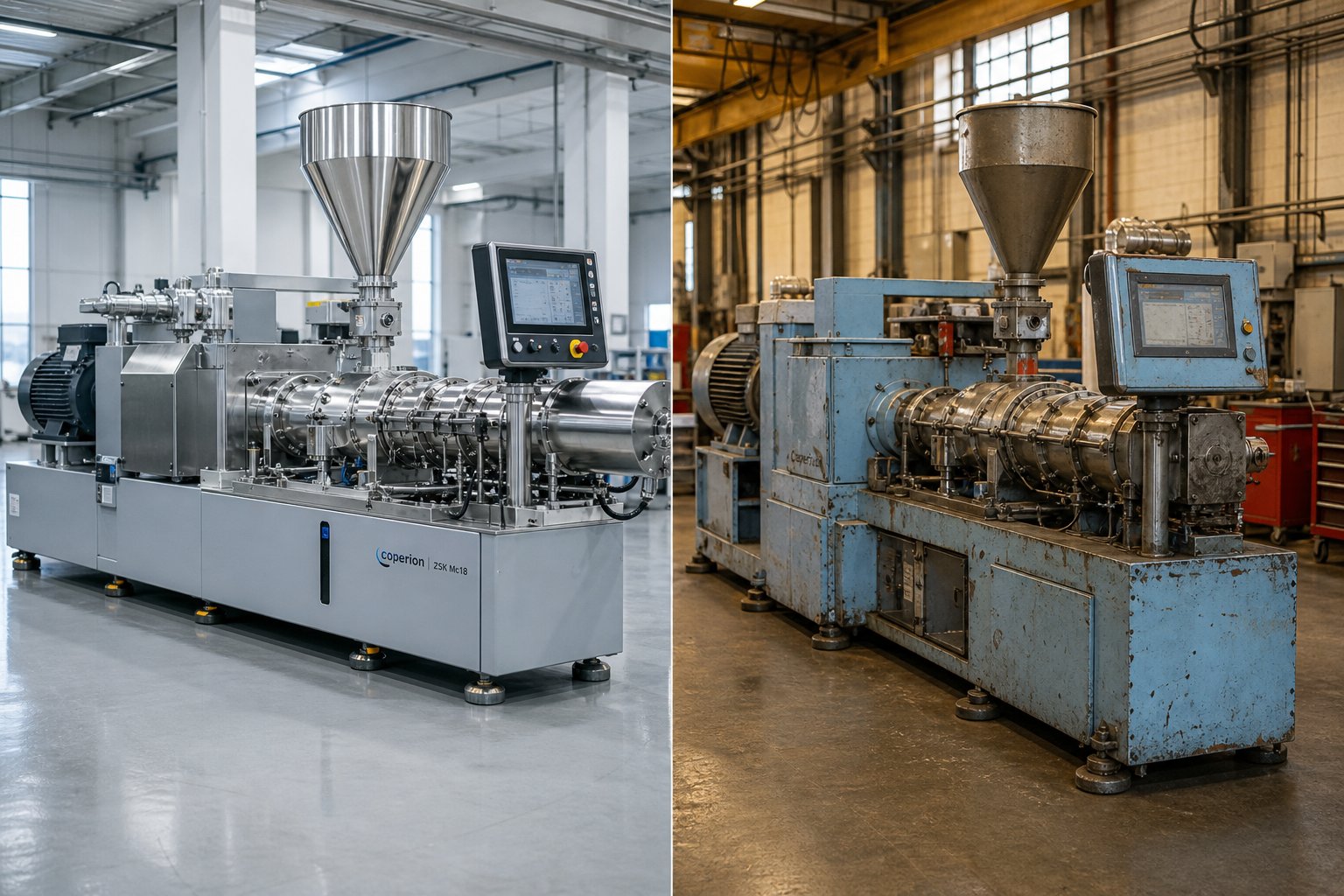
Total cost of ownership doesn't start and stop at the invoice amount — and this is exactly where many buyers get burned. Whether you're browsing OEM configurators or scanning listings for a used twin screw extruder for sale, the financial picture extends years beyond the initial transaction. Making the right call between new and pre-owned equipment requires an honest look at what each path actually delivers — and what it quietly costs you down the road.
Advantages of Buying a New Twin Screw Extruder
A new machine arrives with zero unknowns. You get full warranty protection covering critical components like the gearbox, barrel, and drive system. More importantly, you get complete customization — the ability to specify screw configuration, barrel metallurgy, number of heating and cooling zones, vent port placement, and the exact control system architecture your operators need. That level of tailoring simply isn't available on the secondary market.
Modern machines also bring measurable energy efficiency gains. Newer drive systems, optimized barrel insulation, and advanced process controls reduce per-kilogram energy costs — savings that compound over a decade of operation. As Bausano's equipment planning guidance emphasizes, investing in digital technologies and energy-efficient designs is a key driver of long-term productivity growth.
The trade-off? Lead times for new equipment can stretch from several months to over a year depending on the manufacturer and configuration complexity. And depreciation hits hardest in the first two to three years — a reality that matters if resale value factors into your financial planning.
When Buying a Used Twin Screw Extruder Makes Sense
Not every operation needs a factory-fresh machine. Imagine you're launching a new compounding line with a constrained capital budget, or you need a proven platform fast because a customer contract starts in 90 days. In these scenarios, a used twin screw extruder becomes the rational choice — not a compromise.
Used extruders often include proven models with established track records and well-documented operating histories. Some of the most sought-after machines on the secondary market are discontinued OEM lines that processors already know and trust. Delivery can happen in weeks rather than months, and the initial depreciation has already been absorbed by the previous owner.
The critical caveat? Thorough inspection is non-negotiable. Gearbox condition, barrel bore measurements, screw element wear patterns, control system obsolescence, and complete maintenance records must all be verified independently. Skipping this step — or accepting a seller's assurance in place of an independent assessment — is how a bargain becomes the most expensive machine you've ever owned.
Total Cost of Ownership Comparison
Price tags lie. A machine listed at 40% below new-equipment cost can end up costing more within three years once you factor in unplanned repairs, energy inefficiency, and production downtime. Total cost of ownership analysis demands that you look beyond the purchase order and account for every dollar the machine will consume — or save — across its productive life in your facility.
| Decision Factor | New Equipment | Used Equipment |
|---|---|---|
| Upfront Cost | Higher initial capital outlay | Significantly lower purchase price |
| Warranty Coverage | Full OEM warranty on all major components | Limited or no warranty; as-is sales common |
| Customization Options | Fully configurable to exact process requirements | Fixed configuration; modifications possible but costly |
| Lead Time | Months to over a year depending on complexity | Weeks; often available for immediate shipment |
| Depreciation Curve | Steepest in years one through three | Flatter; bulk of depreciation already absorbed |
| Spare Parts Availability | Current-generation parts readily available from OEM | May require third-party sourcing for older models |
| Energy Efficiency | Latest drive and insulation technology; lower operating cost | Older designs may consume 15-25% more energy per kg |
| Risk Level | Low; known condition, factory acceptance testing | Moderate to high; depends on inspection thoroughness |
Notice how advantages shift depending on your planning horizon. A startup with tight capital and a short payback window may rationally choose used extruders for sale that can be operational within weeks. An established compounder investing in a 15-year production asset will likely recover the premium of new equipment many times over through lower energy bills, reduced downtime, and full warranty protection.
The cheapest purchase price rarely equals the lowest total cost of ownership — buyers must factor in installation, commissioning, spare parts, downtime risk, and energy consumption over the machine's entire lifecycle before deciding between new and used.
Whether the machine rolling onto your production floor is brand new or pre-owned, one variable shapes the long-term experience more than any spec on the purchase order: who manufactured it. The OEM behind the equipment determines your spare parts ecosystem, technical support access, and upgrade path for years to come.
Major Twin Screw Extruder Manufacturers Compared
Every OEM brochure reads the same way: high torque, modular design, global support, world-class engineering. Strip away the marketing language, though, and you'll find that twin screw extruder manufacturers differ sharply in application focus, service infrastructure, and spare parts ecosystems. Those differences — not glossy spec sheets — determine whether your machine runs profitably for a decade or becomes a maintenance headache within three years.
Here's a vendor-neutral look at the major players, organized around what actually matters to a buyer signing a purchase order.
Leading Twin Screw Extruder Manufacturers by Specialty
The global market for twin screw extruders is dominated by a handful of OEMs, each with distinct engineering DNA and application strengths. Understanding where each manufacturer excels helps you shortlist the right partners rather than defaulting to whichever brand your sales contact happens to represent.
Coperion — originally Werner & Pfleiderer before a series of acquisitions — sets the global benchmark with its ZSK Mc18 series. The werner pfleiderer extruder lineage stretches back over 60 years, and current ZSK models deliver an industry-leading specific torque of 18 Nm/cm3. You'll find Coperion extruders anchoring engineering plastics lines, polyolefin compounding operations, and GMP-certified pharmaceutical continuous manufacturing installations worldwide. The trade-off is price and lead time — these are premium machines with premium timelines.
KraussMaffei Berstorff — one of Germany's oldest machinery manufacturers, founded in 1838 — builds the ZE BluePower series around an unusually high outer-to-inner diameter ratio (Da/Di = 1.65), which delivers up to 16 Nm/cm3 of torque density while preserving high free volume for low-bulk-density fillers. Berstorff machines are strong in compounding, recycling, and the newer ZE-PC series targets petrochemical-scale polymerization. Digital process control through their Pioneer ProcessControl (ppC) platform gives operators real-time monitoring and optimization capability.
Leistritz — with over a century in screw technology — occupies a distinctive niche. The ZSE iMAXX series reaches up to 15 Nm/cm3 specific torque, but Leistritz's real differentiator is depth in specialty applications: pharmaceutical hot-melt extrusion, thermoplastic elastomers, and R&D-to-production scale-up. If you need deep customization rather than catalog standardization, Leistritz deserves a close look.
JSW (Japan Steel Works) has delivered over 2,300 twin screw extruders under its TEX brand since 1950. The flagship TEX-aIII achieves a specific torque of 18.2 Nm/cm3 — among the highest globally — with screw diameters ranging from 26.5 mm up to a massive 443 mm for large-scale devolatilization. JSW's proprietary TEX-FAN simulation software lets buyers run virtual extrusion trials before commissioning, reducing startup risk considerably.
ENTEK, based in Lebanon, Oregon, builds twin screw extruders entirely in the United States. The HT72 matches European torque density at 18 Nm/cm3, while the QC3 line is purpose-built for compounders running small lots with frequent changeovers. For North American buyers who prioritize domestic manufacturing, fast spare-parts delivery, and screw remanufacturing services, ENTEK fills a gap that European and Japanese OEMs struggle to match on response time.
Some manufacturers organize their product lines by application rather than by machine size — a framework worth borrowing regardless of which brand you evaluate. B&P Littleford, for example, segments its offerings into compounding, specialty processing, and continuous processing categories. That kind of application-first segmentation forces you to start with your process requirement and work backward to the machine, rather than browsing a catalog of screw diameters and hoping one fits.
How to Compare Manufacturers Beyond Brand Reputation
Brand prestige is easy to assess and dangerously easy to overweight. A Coperion extruder carries undeniable engineering credibility — but if the nearest service engineer is a 14-hour flight from your plant and screw element lead times stretch to eight weeks, that prestige won't keep your line running during an unplanned shutdown. The same logic applies to every OEM on the list.
The following table maps the major twin screw extruder manufacturers across the dimensions that actually drive long-term ownership experience:
| Manufacturer | Primary Application Focus | Geographic Presence | Screw Element Availability | Typical Size Range | Known Strengths |
|---|---|---|---|---|---|
| Coperion | Engineering plastics, polyolefin compounding, pharma | Global — strong in Europe, N. America, Asia | Extensive OEM catalog; long lead times on custom elements | 18 - 380 mm | Highest torque density (18 Nm/cm3), 60+ year platform history |
| KraussMaffei Berstorff | Compounding, recycling, petrochemical | Global — strong in Europe, growing in Asia | Broad OEM supply; digital process integration | 28 - 186 mm | High free volume, energy efficiency, digital controls (ppC) |
| Leistritz | Specialty polymers, pharma HME, R&D | Strong in Europe and N. America | Good OEM availability; custom configurations a core strength | 18 - 180 mm | Deep customization, pharma GMP expertise, pilot-to-production scaling |
| JSW | High-torque compounding, devolatilization, polymer alloys | Global — strongest in Japan, strong in Europe and N. America | Proprietary elements; strong regional warehousing in Japan | 26.5 - 443 mm | Highest specific torque (18.2 Nm/cm3), virtual trial software, ultra-large scale |
| ENTEK | US-built compounding, custom small-lot production | Primarily North America | Fast domestic delivery; screw remanufacturing services | 27 - 133 mm | US-built, 24/7 production capability, rapid spare-parts turnaround |
Numbers and geography only tell part of the story. The after-sales infrastructure behind each brand is what determines your actual experience once the machine is commissioned and production pressure kicks in. When evaluating any manufacturer — whether you're considering a well-known werner pfleiderer extruder successor like Coperion or a regionally strong OEM — run through these criteria before you commit:
- Technical support responsiveness: Can you reach a process engineer within hours during an emergency, or are you waiting days for a callback? Ask for documented response-time commitments, not vague assurances.
- Spare screw element lead times: A worn kneading block can halt production. If the OEM's standard lead time for replacement elements is six to eight weeks, you need to know that before you buy — not after a production stoppage.
- Local service engineers: Remote diagnostics help, but some problems require hands on the machine. Confirm whether the manufacturer has field engineers within a 24-48 hour travel radius of your facility.
- Training programs: Comprehensive operator and maintenance training — ideally both at the factory and on-site — reduces human-error downtime and extends equipment life.
- Retrofit and upgrade paths: Your process requirements will evolve. Can the manufacturer retrofit higher-torque gearboxes, upgrade control systems, or add barrel sections to the machine you're buying today?
Availability of replacement screw elements and barrels — from the OEM or from compatible third-party suppliers — should be a major factor in brand selection. A machine with a proprietary, single-source parts ecosystem locks you into one supplier's pricing and delivery timeline for the entire life of the equipment.
Selecting the right manufacturer gives you a foundation. But the machine itself is only as valuable as its fit with your specific production goals — and that alignment depends less on brand prestige than on how precisely the extruder matches the application it's meant to run.
Matching the Right Twin Screw Extruder to Your Application
Most equipment guides start with machine specs and expect you to figure out whether they fit your process. That approach is backwards. You don't walk into a dealership asking for a 6.2-liter V8 — you walk in knowing you need to tow 10,000 pounds. The same logic applies here. Your application defines the extruder, not the other way around.
Three broad application categories cover the majority of buyers evaluating a twin screw extruder purchase: compounding and masterbatch production, laboratory and R&D-scale work, and reactive or specialty processing. Each one demands a distinct machine profile — and confusing one for another is how production lines underperform from day one.
Compounding and Masterbatch Production Requirements
Compounding is the bread and butter of twin screw extrusion, and a twin screw compounding extruder faces some of the most demanding performance requirements in the industry. The job sounds simple — blend a polymer with fillers, reinforcements, stabilizers, or pigments and produce uniform pellets. In practice, achieving that uniformity at commercial throughput rates requires precise orchestration of several machine capabilities simultaneously.
What does a compounding operation actually demand from the equipment?
- High dispersive and distributive mixing: Fillers like calcium carbonate, glass fiber, or carbon black need to be broken down from agglomerates into individual particles (dispersive mixing) and then spread evenly throughout the polymer matrix (distributive mixing). As Technovel's technical resources explain, the fully intermeshing co-rotating design applies strong shear to achieve both forms of mixing, even in high-viscosity systems or composite materials with heavy filler loading.
- Accurate side feeding: Abrasive fillers and fragile reinforcements like glass fibers cannot be dumped into the main feed throat. They need to enter downstream through calibrated side feeders, arriving after the polymer is already molten so that fiber length is preserved and filler dispersion is maximized.
- Precise temperature control: Each barrel section must be independently heated and cooled. Engineering polymers like nylon or polycarbonate have narrow processing windows — a few degrees too high triggers degradation, a few too low leaves unmelted granules in the compound. Independent zone control across 8 to 12 barrel sections is standard for production-scale compounding.
- High throughput with consistent quality: Commercial compounding lines run continuously for days or weeks. The machine must sustain target output rates without torque-limiting, overheating, or producing out-of-spec material.
These demands map cleanly to a co-rotating twin screw extruder with an L/D ratio in the 32:1 to 44:1 range. Screw configurations typically combine forward-conveying elements at the feed zone, kneading blocks of varying stagger angles in the mixing zone, and high-pitch conveying elements at the metering section. For heavily filled compounds — think 40% or higher mineral loading — machines with torque densities above 13 Nm/cm3 prevent the drivetrain from becoming the throughput bottleneck.
Masterbatch production shares the same platform but shifts the emphasis. Color masterbatch demands exceptional pigment dispersion at high concentrations, often 30-60% pigment in a carrier resin. The screw design leans heavier on kneading blocks and mixing elements, and shorter L/D ratios (28:1 to 36:1) help reduce heat history that can shift color values. If you're producing additive masterbatch — UV stabilizers, flame retardants, or slip agents — temperature sensitivity and additive reactivity drive the screw and barrel configuration choices more than raw throughput.
Laboratory and Benchtop Scale Extrusion Needs
Not every buyer needs a production-floor machine. A growing segment of the market involves R&D teams, university labs, and formulation development groups looking for a laboratory twin screw extruder that can test screw configurations, validate new materials, and generate sample quantities before committing hundreds of thousands of dollars to a full-scale line.
A lab scale twin screw extruder typically features screw diameters between 6 mm and 27 mm, with throughput capacities ranging from grams per hour up to roughly 50 kg/hr. These machines are physically compact — designed to fit in research laboratories where floor space is limited — but they're engineered to replicate the processing conditions of their larger industrial counterparts. As noted by ExtruderX, a well-designed lab twin screw extruder can accurately simulate industrial production parameters, providing reliable data support for large-scale manufacturing decisions.
What makes a benchtop twin screw extruder valuable goes beyond small batch size. Consider these capabilities:
- Screw configuration testing: Trying different kneading block arrangements on a 15 mm lab machine costs a fraction of what it would cost in lost production time on a 75 mm line. You validate the mixing profile at small scale and then scale up with confidence.
- Formulation screening: New polymer blends, filler ratios, or additive packages can be evaluated quickly. Some lab models support output below 1 kg/hr, meaning you can test a new formulation with minimal raw material investment.
- Temperature control precision: High-end lab extruders achieve temperature control accuracy within ±0.5°C — tighter than many production machines — which is critical for processing temperature-sensitive biomaterials or pharmaceutical compounds.
- Quick changeover: Detachable screws and barrel sections allow researchers to clean and switch materials rapidly, preventing cross-contamination between experiments.
The key selection criteria differ from production equipment. For a lab scale twin screw extruder, prioritize L/D ratio flexibility (models offering 16:1 to 40:1 cover the widest experimental range), data acquisition capability for recording temperature, pressure, and torque in real time, and ease of disassembly for cleaning. After-sales support matters here too — the ability to order custom screw elements and get them quickly determines how productive your R&D program actually is.
One important caveat: a benchtop twin screw extruder can predict trends in mixing performance and material behavior, but scale-up is never a simple linear multiplication. Technovel's engineering guidance emphasizes that twin screw extruder scale-up sits between the square law (based on heat transfer) and the cube law (based on throughput), and the actual process falls somewhere in between. Lab results guide the direction — they don't guarantee the destination.
Reactive Extrusion and Specialty Processing
Reactive extrusion turns the twin screw extruder into a continuous chemical reactor. Instead of just mixing and conveying, the machine facilitates chemical reactions — polymer grafting, cross-linking, compatibilization, or even controlled degradation — while simultaneously transporting material from feed to die. It's one of the most technically demanding applications, and it requires an extruder configured very differently from a standard compounding line.
Why is the twin screw extruder suited for this? Residence time control. By adjusting screw speed, element configuration, and throughput rate, operators can precisely control how long reactants spend in each processing zone. Kneading blocks create high-shear mixing regions where reactants are forced into intimate contact, while conveying sections provide lower-shear transport zones where reactions can propagate. Longer L/D ratios — typically 40:1 to 52:1 — provide the barrel length needed for multi-stage reaction sequences.
Devolatilization represents another specialty application with unique hardware demands. Removing residual monomers, solvents, or moisture from a polymer melt requires dedicated vent ports connected to vacuum systems. These vents must be positioned along the barrel where the melt is partially starved — meaning the screw channel isn't fully filled — so that volatile components can escape to the surface and be evacuated. A machine configured for devolatilization might include two or three atmospheric vents plus one or two vacuum vents, which requires both sufficient barrel length and carefully designed screw elements that create the right fill conditions at each vent location.
Food and pharmaceutical processing add regulatory complexity on top of technical requirements. Pharmaceutical hot-melt extrusion, used to improve drug solubility and create controlled-release dosage forms, demands GMP-compliant equipment with fully documented material traceability, cleanability validation, and FDA-compatible barrel and screw metallurgy. Food-grade extrusion — producing textured proteins, snack pellets, or breakfast cereals — requires machines rated for high moisture content and equipped with specialized die heads that shape the final product texture.
Here's a practical mapping of common applications to their key extruder requirements:
- Polymer compounding (filled systems): Co-rotating, L/D 32:1–44:1, high torque density, multiple side feeders, 8–12 independent temperature zones
- Color and additive masterbatch: Co-rotating, L/D 28:1–36:1, intensive kneading block configuration, precise melt temperature control, high dispersive mixing
- Reactive extrusion (grafting, compatibilization): Co-rotating, L/D 40:1–52:1, long residence time, liquid injection ports, precise temperature profiling across extended barrel
- Devolatilization: Co-rotating, L/D 40:1–48:1, multiple vent ports (atmospheric and vacuum), starve-fed screw design, high screw speed capability
- Laboratory R&D and formulation testing: Co-rotating, screw diameter 6–27 mm, L/D 16:1–40:1, high-precision temperature control (±0.5°C), data acquisition, quick-change screw and barrel
- PVC pipe and profile extrusion: Counter-rotating (parallel or conical), L/D 20:1–28:1, low shear, positive displacement conveying, high pressure generation at die
- Food and pharma processing: Co-rotating, L/D 25:1–40:1, GMP/FDA-compliant materials, specialized die heads, moisture-rated barrel seals, full traceability documentation
You'll notice a pattern: every application drives toward a specific combination of configuration type, barrel length, and accessory requirements. The twin screw extruder that runs 40% glass-fiber-reinforced nylon brilliantly may be entirely wrong for pharmaceutical hot-melt extrusion — not because of any quality deficiency, but because the process demands are fundamentally different.
Getting the application-to-machine match right eliminates entire categories of downstream problems. But even a perfectly specified machine can become a liability if you miss the warning signs during the buying process itself — and some of those red flags are ones that sellers actively hope you'll overlook.
Red Flags and Common Mistakes When Buying a Twin Screw Extruder
Here's the uncomfortable truth about the equipment market: sellers profit when you buy, not when you buy right. That misalignment means certain risks, shortcuts, and deal-breaking flaws rarely surface during the sales process — unless you know exactly where to look. Whether you're evaluating a brand-new production line or scanning listings for a used extruder for sale, the mistakes covered in this section have collectively cost buyers millions in lost production, emergency repairs, and equipment that never ran the intended process reliably.
Knowing these pitfalls before you engage a single supplier shifts the power dynamic entirely in your favor.
Common Mistakes That Cost Buyers Thousands
Some purchasing errors are obvious in hindsight but nearly invisible during the excitement of a capital equipment acquisition. These are the ones that show up most frequently — and most painfully:
- Underestimating torque density requirements for the target material. This is the single most common sizing error. Buyers spec a machine based on throughput goals without accounting for the viscous resistance their most demanding formulation generates. The result? The extruder hits its torque ceiling at 60% of target output, and no amount of screw optimization fixes a drivetrain that's fundamentally undersized.
- Selecting the wrong screw configuration for the application. A co-rotating machine purchased for PVC profile extrusion or a counter-rotating unit pressed into service for high-shear compounding — either mismatch leads to chronic quality issues, excessive wear, or both. As covered earlier, configuration must follow application, not habit or availability.
- Ignoring spare parts availability and lead times from the OEM. A machine is only as reliable as the speed at which worn components can be replaced. Buyers who don't verify screw element and barrel lead times before purchase discover, during their first unplanned stoppage, that replacements take six to ten weeks — and every day of downtime erodes profitability.
- Choosing based on price alone without evaluating total cost of ownership. The lowest quote often hides the highest long-term cost. Inferior barrel metallurgy wears faster. Underpowered drives consume more energy per kilogram. Outdated controls require costly retrofits within a few years. A rigorous total-cost analysis across the machine's expected service life consistently outperforms a lowest-bid purchasing strategy.
- Skipping independent inspection for used machines. Accepting a seller's verbal assurance that a used twin screw extruder is "in good working condition" without independent verification is a gamble with terrible odds. Barrel bore measurements, gearbox oil analysis, screw element inspection, and control system assessment should all be performed by a qualified third party — not by the party trying to close the sale.
Red Flags in Used Equipment Purchases
The secondary market for used extrusion equipment offers legitimate value — but it also harbors machines that previous owners discarded for reasons that don't appear in the listing. When evaluating used extruder equipment, treat the following warning signs as deal-breakers until proven otherwise:
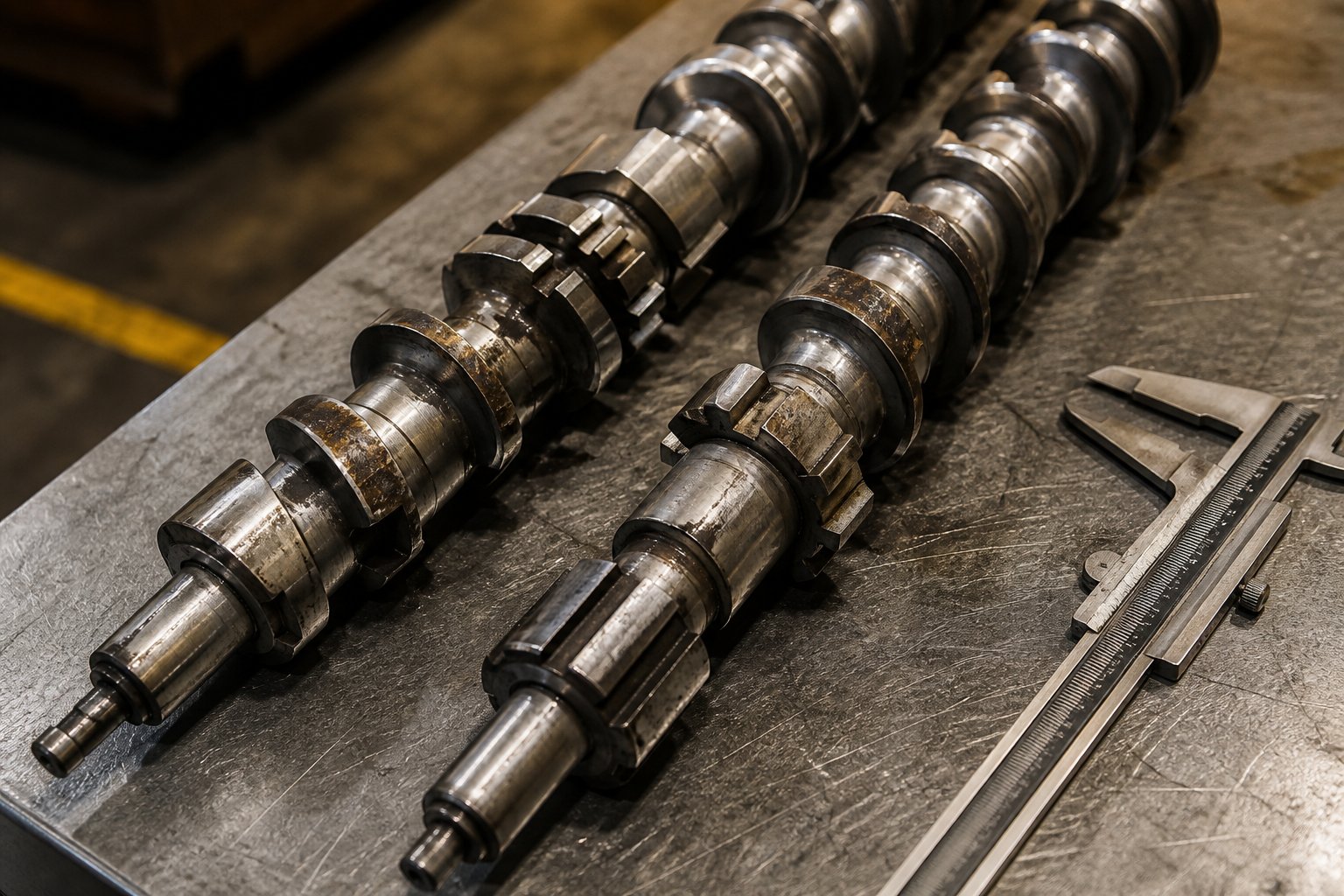
- Excessive barrel wear beyond tolerance: Barrel bore measurements should fall within the manufacturer's published wear limits. If a seller can't provide recent bore measurements — or won't allow you to take your own — walk away. Worn barrels reduce mixing efficiency, increase melt temperature variability, and can't be fixed without expensive relining or replacement.
- Gearbox noise or shaft play: Any grinding, whining, or clicking during operation signals bearing deterioration. Measurable radial or axial play in the output shafts indicates wear that will only accelerate under load. A gearbox rebuild can easily exceed 30-40% of the machine's used purchase price.
- Missing or non-original screw elements: If the screw configuration has been assembled from mixed-origin elements — some OEM, some aftermarket, some from a different machine model — you inherit an unknown mixing profile and potential metallurgical mismatches. Verify that all elements are compatible and within wear specifications.
- Incomplete maintenance records: A well-maintained machine has a documented history of oil changes, barrel inspections, heater replacements, and gearbox servicing. Absent records suggest deferred maintenance — and deferred maintenance means hidden damage.
- Outdated control systems with no upgrade path: PLCs and HMIs from two or three generations back may still function, but replacement parts are scarce and qualified technicians scarcer. If the controls can't be cost-effectively upgraded to current platforms, factor that modernization cost into your purchase decision.
- Sellers unwilling to allow independent inspection or trial runs: This is the clearest red flag of all. Any reputable seller of used extrusion equipment welcomes buyer-side inspection because it builds confidence in the transaction. Resistance to inspection almost always means something won't survive scrutiny.
Red Flags When Dealing with New Equipment Suppliers
Used equipment isn't the only territory where buyers need their guard up. New machine suppliers can present their own set of warning signs — subtler, perhaps, but equally costly if ignored:
- Vague delivery timelines: "Approximately 6-8 months" with no milestone schedule and no penalty for delays should raise immediate concern. Reputable manufacturers provide detailed production timelines with defined checkpoints for design approval, fabrication, assembly, and testing.
- No factory acceptance test offered: A factory acceptance test (FAT) is standard practice for capital equipment of this magnitude. It verifies that the machine meets all agreed-upon specifications — including dimensional checks, electrical loop testing, safety interlock validation, and ideally a material trial — before it leaves the manufacturer's floor. A supplier that skips or discourages FAT is asking you to accept all risk upon delivery.
- Unclear warranty terms on wear parts: Screws, barrels, and heating elements are consumable by nature, but warranty coverage should still be clearly defined. How many operating hours or months are covered? What constitutes "normal wear" versus a defect? If the supplier can't articulate these boundaries in writing, expect disputes when a claim arises.
- Lack of local technical support: A machine built on another continent without regional service infrastructure means every technical issue requires international coordination. Ask specifically: where is the nearest field service engineer, and what is the contractual response time for critical failures?
- Inability to provide reference installations in similar applications: Every established manufacturer should be able to connect you with existing customers running comparable processes. If a supplier can't — or won't — provide references, you're being asked to be their proving ground rather than their customer.
The most expensive twin screw extruder mistake is not overpaying — it is buying a machine that cannot reliably run the intended process. Price recovery takes time; process mismatch costs production every single day the machine is running.
Recognizing these red flags protects you from the worst outcomes. But avoiding bad decisions is only half the equation — the other half is executing a structured purchasing process that consistently leads to good ones. That journey has distinct phases, each with its own set of best practices that separate experienced equipment buyers from first-timers learning expensive lessons.
The Complete Purchasing Process Step by Step
Spotting red flags keeps you out of trouble. But a structured buying process is what consistently delivers the right machine, at the right terms, installed and running on schedule. Most buyers — even experienced ones — skip steps, shortcut evaluations, or leave critical negotiations until it's too late to gain leverage. The result is a transaction shaped more by the seller's process than the buyer's interests.
Whether you're responding to a twin screw extruder for sale listing or initiating a custom build with an OEM, the journey from initial need to validated production follows the same sequence. Here's how to execute each phase so nothing falls through the cracks.
Needs Assessment and RFQ Preparation
This is where most purchasing failures actually originate — not at the negotiation table, but months earlier, when requirements were loosely defined or never documented at all. Engaging suppliers before you've nailed down your own process parameters hands them control of the conversation. They'll fill the gaps in your specification with whatever configuration they happen to stock or manufacture most efficiently.
Start by documenting everything your process demands in writing, before contacting a single vendor:
- Material specifications: Base polymer type, filler or reinforcement identity and loading percentage, additive packages, moisture sensitivity, and thermal degradation limits. A supplier can't recommend the right barrel metallurgy or screw configuration without knowing exactly what's running through the machine.
- Throughput targets: Define your required output in kilograms per hour — both your current production need and your projected volume 3-5 years out. Sizing for today's demand alone means you'll outgrow the machine before it's paid off.
- Product quality specifications: Dispersion standards, pellet geometry, color tolerance, mechanical property targets, or regulatory compliance requirements (FDA, EU food contact, GMP). These specs drive screw element selection, temperature zone count, and downstream equipment choices.
- Facility constraints: Available floor space, ceiling height, electrical supply capacity, cooling water availability, and compressed air infrastructure. A machine that exceeds your utility capacity requires expensive plant upgrades that rarely appear in the initial quote.
With these parameters documented, you're ready to create a formal Request for Quotation. A well-structured RFQ levels the playing field — every supplier responds to the same requirements, making proposals genuinely comparable rather than each one answering a slightly different question. Issue your RFQ to at least three qualified suppliers, including both OEM manufacturers and reputable dealers if you're considering twin screw extruders for sale on the secondary market.
One detail experienced buyers never skip: specify in the RFQ exactly what must be included in the quoted scope. Controls, feeders, pelletizing systems, installation supervision, and operator training are frequently excluded from base prices, creating apparent cost differences between proposals that vanish once you add the missing line items back in.
Evaluation and Negotiation Best Practices
Proposals arrive, and the temptation is to jump straight to the bottom line. Resist it. The lowest number on paper often conceals the highest total cost in practice — a lesson covered earlier but worth reinforcing here, where the rubber meets the road.
Evaluate each proposal across these dimensions before price even enters the discussion:
- Scope completeness: Does the quote include the control system, gravimetric feeders, pelletizer, cooling bath, and all necessary ancillary equipment? Or are those listed as optional extras? Normalize every proposal to an identical scope before comparing prices.
- Warranty terms: What components are covered, for how long, and under what conditions? Pay close attention to exclusions — wear parts like screw elements and barrel liners may carry shorter warranty periods or be excluded entirely. Get the boundaries in writing.
- Trial runs and reference sites: Request the opportunity to run your actual material on an equivalent machine at the supplier's facility or at a reference customer's site. A supplier confident in their equipment welcomes this. One that deflects or makes excuses is telling you something. Reference site visits let you speak directly with operators who run the machine daily — the most unfiltered feedback you'll ever get.
- Spare parts pricing: Lock in pricing for critical wear components — kneading blocks, conveying elements, barrel sections, heating bands — at the time of purchase. Suppliers are far more accommodating on spare parts pricing when they're trying to close a capital equipment deal than they are eighteen months later when you're calling with an urgent production need.
- Delivery milestones and penalties: For new equipment, negotiate a delivery schedule with defined milestone payments tied to verified progress — design approval, fabrication completion, assembly, testing. Include contractual remedies for delays that exceed agreed timelines.
When evaluating extrusion equipment for sale on the used market, the negotiation dynamics shift. Insist on a physical inspection period before finalizing payment, and if possible, structure the transaction through an escrow arrangement that protects both parties. Used equipment dealers who pressure you to close quickly without allowing adequate inspection time are prioritizing their cash flow over your risk management.
Inspection, Commissioning, and After-Sales Support
You've selected a supplier and agreed on terms. The machine is being built or prepared for shipment. This is precisely the moment many buyers relax — and precisely when the most expensive oversights occur.
For new equipment, the Factory Acceptance Test (FAT) is your last cost-effective opportunity to identify and resolve problems before the machine ships. Industry commissioning research consistently shows that fixing a defect identified during a FAT costs roughly ten times less than fixing the same defect after site installation — and ten times less again than discovering it during production. A comprehensive FAT should verify:
- Dimensional accuracy of all connection points against site layout drawings
- Functional testing of all control modes, safety interlocks, and alarm setpoints — each interlock tested by inducing the actual fault condition, not just by checking PLC logic
- Temperature control performance across all barrel zones, including ramp rates and steady-state accuracy
- Drive system operation across the full speed range with documented motor current and vibration readings
- Complete documentation handover: P&ID drawings, electrical schematics, material certificates, and maintenance manuals
For used machines, an independent inspection replaces the FAT. Engage a qualified third-party technician — not the seller's maintenance team — to measure barrel bore dimensions, assess gearbox condition through oil analysis and bearing noise evaluation, verify screw element wear against OEM tolerances, and test all control and safety systems. Any seller of a used extruder for sale who objects to independent inspection has effectively answered your most important question.
Once the machine arrives at your facility, Site Acceptance Testing (SAT) validates what the factory test could not: how the equipment performs integrated with your actual plant systems, utilities, and environmental conditions. The SAT should include a continuous operational run at production load — typically 72 to 168 hours — during which all key parameters are monitored against the FAT baseline. Any deviation greater than 10% from baseline values warrants investigation before you sign off on acceptance.
Operator training deserves more emphasis than it typically receives. A machine handed over to untrained operators generates failures that look like equipment defects but are actually operating errors — failures that void warranty coverage and create unnecessary maintenance costs. Ensure that all shift operators complete manufacturer-specified training before the machine enters production service, and document that training formally.
Perhaps the most underappreciated phase of the entire process is after-sales support planning. The availability of replacement screw elements, barrel liners, heating elements, and gearbox components should factor into your final vendor decision as heavily as the machine's technical specifications. Establish your spare parts supply chain before the first production run, not after the first breakdown. This means identifying both OEM parts channels and reliable third-party suppliers. Factory-direct sources like NANHAIYA's screw and barrel product line give buyers an alternative pipeline for replacement screw and barrel components — a practical consideration whether you're commissioning a new machine or inheriting a used one with uncertain parts availability. The broader principle applies regardless of which suppliers you choose: diversify your sourcing early, so a single supplier's backlog or pricing decision never holds your production hostage.
Here's the complete purchasing workflow, distilled into a sequential checklist you can follow from first conversation to stable production:
- Define process requirements: Document material specs, throughput targets, quality standards, and facility constraints in writing
- Shortlist suppliers: Identify 3-5 qualified OEMs, dealers, or sources of twin screw extruders for sale based on application fit, geographic support, and reputation
- Issue RFQs: Send standardized Requests for Quotation specifying identical scope requirements to all shortlisted suppliers
- Evaluate proposals: Compare on scope completeness, warranty terms, spare parts pricing, delivery schedule, and total cost of ownership — not just purchase price
- Negotiate terms: Lock in spare parts pricing, clarify warranty boundaries, define milestone payments, and establish delivery penalties
- Conduct inspection or FAT: Perform factory acceptance testing for new equipment or independent third-party inspection for used machines
- Arrange logistics: Coordinate shipping, customs documentation, site preparation, utility connections, and foundation work
- Install and commission: Execute mechanical installation, electrical connections, alignment verification, and SAT with continuous run at production load
- Validate performance: Confirm throughput, product quality, energy consumption, and cycle time against contractual specifications during the first 30 days
- Establish spare parts pipeline: Stock critical wear components, finalize relationships with OEM and third-party parts suppliers, and set up preventive maintenance schedules from day one
Each step feeds the next. Skip one — particularly the needs assessment, inspection, or spare parts planning — and you introduce risk that compounds throughout the machine's operational life. Execute them all, and you've built a purchasing process that consistently outperforms the reactive, price-driven approach most buyers default to.
That final step — establishing a spare parts pipeline — isn't just a post-purchase administrative task. It's the beginning of the operational strategy that determines whether your twin screw extruder runs profitably for three years or for fifteen. The ongoing economics of screw and barrel sourcing deserve their own focused discussion.
Sourcing Screw Barrels and Spare Parts for Long-Term Success
You've selected the right configuration, matched the machine to your application, negotiated solid terms, and commissioned the equipment on schedule. Production is running. So the hard part is over, right? Not even close. The capital purchase was a one-time event — but the ongoing cost of keeping your twin screw plastic extruder performing at specification is a continuous financial commitment that most buyers dramatically underestimate.
Screw elements and barrels are consumable components. They wear. They corrode. They erode. And the speed at which they degrade — along with the cost, quality, and lead time of their replacements — quietly governs your production uptime, product consistency, and true plastic extrusion machine cost over the equipment's lifetime. Ignore this reality during the purchasing phase, and you'll discover it during your first emergency shutdown, when a worn kneading block forces a production stop and the only replacement is eight weeks away.
Why Screw and Barrel Supply Strategy Matters
Inside every operating screw extruder, four wear mechanisms are working simultaneously against your hardware. Abrasive wear — the most common in filled compound processing — erodes flight tips and barrel bores as hard filler particles like glass fiber, calcium carbonate, or mineral reinforcements act as micro-cutting tools against metal surfaces. Adhesive wear occurs when screws contact the barrel wall during cold starts or material transitions, flattening flight outer diameters and scoring barrel surfaces. Corrosive wear attacks from within, driven by acidic degradation products like hydrogen chloride in PVC processing. And erosive wear, particularly destructive in high-speed twin screw compounders running at 400 to 1,200 RPM, hammers flight surfaces through high-velocity particle impact.
The practical consequence? As industry sourcing data confirms, screw and barrel assemblies represent under 5% of a typical extruder's capital cost — yet they govern 60% to 75% of its lifetime operating economics through wear-driven downtime, energy consumption, melt quality, and replacement frequency. A 60 mm twin screw element set that lasts 4,500 hours instead of 18,000 hours doesn't save money. It accelerates a replacement cycle by a factor of four, multiplying downtime events, labor costs, and production losses.
Material selection for replacement parts isn't a one-size-fits-all decision either. Different processing conditions demand different metallurgies:
- Nitrided steel (4140/4340): The baseline for unfilled commodity polymers. Surface hardness reaches 55-62 HRC, but the hardened case is shallow — typically 0.3 to 0.7 mm. Once abrasive wear removes this layer, the softer substrate is exposed and wear accelerates dramatically. Suitable only for non-abrasive, non-corrosive applications.
- Bimetallic construction: A tough core alloy overlaid with wear-resistant material on working surfaces. Approximately 54% of newly installed screw extruders now use bimetallic barrel construction, reflecting the industry's shift toward longer-service-life components. Documented comparisons show 4x to 8x service life improvements over monolithic nitrided screws in abrasive compounding.
- Tungsten carbide (WC-Co) coatings: HVOF thermal spray deposits achieve coating hardness of 1,100-1,400 HV — approximately 70+ HRC equivalent. Ideal for severely abrasive applications but brittle under substrate deflection, making them better suited for shorter screw sections than full-length assemblies.
- Stellite and nickel-based overlays: The standard for corrosive environments like PVC, halogenated flame retardants, and fluoropolymer processing. Stellite-overlaid flights exhibit corrosive wear rates 8x to 12x lower than nitrided steel in chlorinated polymer service.
Choosing the wrong replacement metallurgy is almost as costly as choosing the wrong machine. A buyer who specifies commodity nitrided elements for a 40% glass-filled nylon compound will replace those elements every few months — while a properly specified bimetallic assembly running the same formulation could last years. The extruder machine price you paid at purchase becomes irrelevant if your ongoing consumables costs spiral out of control.
Building a Reliable Spare Parts Pipeline
Imagine this scenario: your primary compounding line goes down at 2 AM on a Tuesday because a worn kneading block finally exceeds tolerance. You call the OEM. The replacement element ships in six to eight weeks. Your line sits idle — or limps along producing off-spec material — while a $300 part holds a $2 million production line hostage. According to industrial spare parts research, 23% of unplanned downtime events across manufacturing are directly attributable to unavailable spare parts, and emergency procurement costs run 3x to 5x higher than planned purchases.
That scenario is entirely preventable — but only if you build your spare parts strategy before the first production run, not after the first breakdown. The approach has three pillars.
First, identify your critical wear components. Not every part on your twin screw extruder wears at the same rate. High-shear zones — where kneading blocks break down filler agglomerates — experience the most aggressive abrasive and erosive wear. Feed zone barrel sections see accelerated adhesive wear during startups. Vent zone elements face corrosive attack from volatile degradation products. Map your screw configuration and identify which elements sit in the harshest processing conditions. Those are the parts you stock first.
Second, establish relationships with both OEM and compatible third-party suppliers. Relying exclusively on OEM parts channels creates a single point of failure in your supply chain. OEM lead times can stretch to weeks or months, especially for less common element geometries or older machine models. Diversifying your supplier base — by qualifying factory-direct manufacturers who produce compatible replacement components — gives you pricing leverage, delivery alternatives, and protection against any single supplier's production backlog. Sources like NANHAIYA's screw and barrel product line provide plastic extrusion plants and procurement teams with factory-direct access to replacement screw and barrel solutions compatible with major extruder platforms. Whether you're running a new co-rotating compounder or maintaining an older machine acquired on the secondary market, having qualified alternative suppliers in your pipeline turns an eight-week emergency into a planned maintenance event.
Third, balance inventory investment against downtime risk. You don't need a warehouse full of every conceivable spare part. But you do need the components whose absence would halt production. A practical rule: stock one complete set of the elements in your highest-wear screw zones, plus critical barrel components. The carrying cost of those parts on a shelf is a fraction of a single day's lost production.
Here's a checklist of essential spare parts every twin screw extruder operator should have on hand:
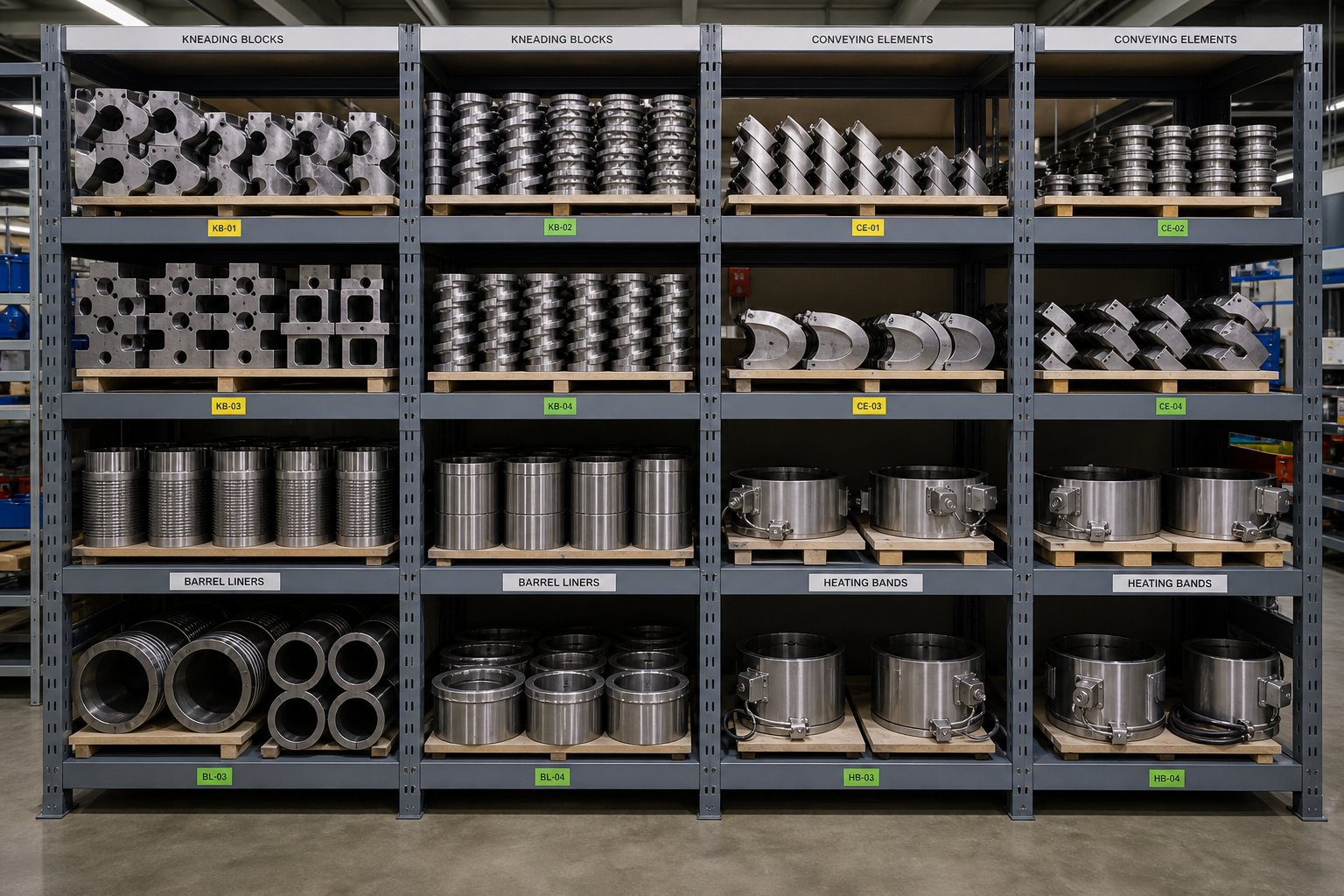
- Kneading blocks: The highest-wear elements in most compounding configurations — stock replacements for every kneading section in your screw design
- Conveying elements: Forward and reverse conveying elements for feed, transition, and metering zones
- Mixing elements: Distributive mixing elements (TME, ZME, or equivalent) specific to your screw program
- Barrel liners: Replacement liners for the highest-wear barrel sections, matched to your process chemistry (iron-based for abrasive service, nickel-based for corrosive service)
- Barrel heating elements: Band heaters or cartridge heaters for each barrel zone — electrical failures are unpredictable and immediate
- Coupling components: Shaft couplings, spline adapters, and associated hardware that connect screw shafts to the gearbox output
Inspection frequency matters just as much as inventory depth. As a baseline, industry maintenance guidelines recommend checking inside the extruder barrel monthly so that wear can be assessed in early stages and replacement parts ordered before additional damage occurs. The general replacement threshold for screw elements is approximately 5% reduction from starting diameter over three-quarters of the element's length, and for barrel liners, approximately 5% increase in bore diameter over a length of one screw diameter. Catching wear at these thresholds — rather than waiting for output drops or quality failures to signal the problem — prevents cascading damage where a worn element accelerates wear on adjacent components.
One final consideration that separates sophisticated equipment operators from reactive ones: track your actual replacement data. Log every screw element change, barrel liner swap, and heating element failure with the operating hours at replacement, the material being processed, and the throughput rate. Over 12 to 24 months, this data reveals your true wear patterns — information that lets you optimize both your spare parts inventory and your alloy specifications for future replacements. You may discover that a specific kneading block position wears three times faster than the rest of the screw, justifying a targeted upgrade to a higher-grade metallurgy at that single location rather than across the entire configuration.
A smart twin screw extruder purchase considers not just the machine, but the entire ecosystem of support, spare parts, and technical service that keeps it running profitably for years. The buyer who plans for ongoing screw and barrel sourcing from day one will consistently outperform the buyer who treats spare parts as an afterthought.
Frequently Asked Questions About Buying a Twin Screw Extruder
1. What is the difference between a co-rotating and counter-rotating twin screw extruder?
A co-rotating twin screw extruder has both screws turning in the same direction, producing high-shear mixing, self-wiping barrel cleaning, and modular flexibility — ideal for polymer compounding, masterbatch, and reactive extrusion. A counter-rotating design turns the screws in opposite directions, offering gentle positive-displacement conveying with low shear, making it the preferred choice for heat-sensitive materials like rigid PVC and profile extrusion. Conical counter-rotating variants add natural compression and a compact footprint for medium-capacity PVC lines. Your specific application — not a default assumption — should determine which configuration you select.
2. How do I choose the right L/D ratio for a twin screw extruder?
L/D ratio selection depends on your process complexity. Short ratios (20:1 to 28:1) suit thermally sensitive materials and simple blending where minimal residence time is needed. Medium ratios (28:1 to 36:1) handle the majority of standard compounding and fiber reinforcement applications. Long ratios (36:1 to 48:1 or beyond) are required for reactive extrusion, devolatilization, and multi-stage processes demanding extended residence time. Longer is not automatically better — running a simple masterbatch through a 48:1 barrel wastes energy and increases thermal degradation risk. Match the ratio to the actual demands of your formulation and process stages.
3. Is it better to buy a new or used twin screw extruder?
Neither option is universally superior — the right choice depends on your capital budget, timeline, and risk tolerance. New equipment offers full warranty coverage, complete customization, latest energy-efficient drives, and known maintenance history, but comes with longer lead times and steeper upfront costs. Used extruders provide faster delivery and significantly lower purchase prices, though they carry risks around barrel wear, gearbox condition, outdated controls, and limited warranty. Always evaluate total cost of ownership — including installation, commissioning, energy consumption, spare parts, and potential downtime — rather than comparing invoice prices alone. Independent inspection is non-negotiable for any used machine purchase.
4. What spare parts should I stock for a twin screw extruder?
At a minimum, keep replacement kneading blocks for every high-shear zone in your screw design, forward and reverse conveying elements, distributive mixing elements, barrel liners for the highest-wear sections, barrel heating elements for each zone, and coupling components connecting screw shafts to the gearbox. These components wear at different rates depending on your formulation's abrasiveness, corrosiveness, and processing speed. Establish relationships with both the OEM and compatible third-party suppliers — such as factory-direct sources like NANHAIYA (nhyscrews.com/products) — so that a single supplier's backlog never halts your production. Stock critical items before your first production run, not after your first breakdown.
5. Why is torque density important when buying a twin screw extruder?
Torque density, measured in Nm/cm3, indicates how much rotational force the machine delivers relative to screw cross-sectional area. It is the single most decisive specification separating entry-level machines from heavy-duty compounding lines. Underestimating torque requirements — the most common buyer sizing error — means the extruder hits its torque ceiling well below your throughput target, forcing slower speeds and lower output. High-performance machines now reach 18 Nm/cm3, potentially doubling throughput for torque-limited formulations compared to standard 5-10 Nm/cm3 units. Always evaluate continuous-duty torque ratings rather than peak or intermittent figures, and target 80% of rated continuous torque for reliable daily operation.
Written by
Nanhaiya Technical Team
Zhoushan Nanhaiya Plastic Machinery Co., Ltd.
The Nanhaiya technical team supports screw and barrel manufacturing projects through application review, technical communication, custom manufacturing coordination, and production and quality control.
Discuss Your Application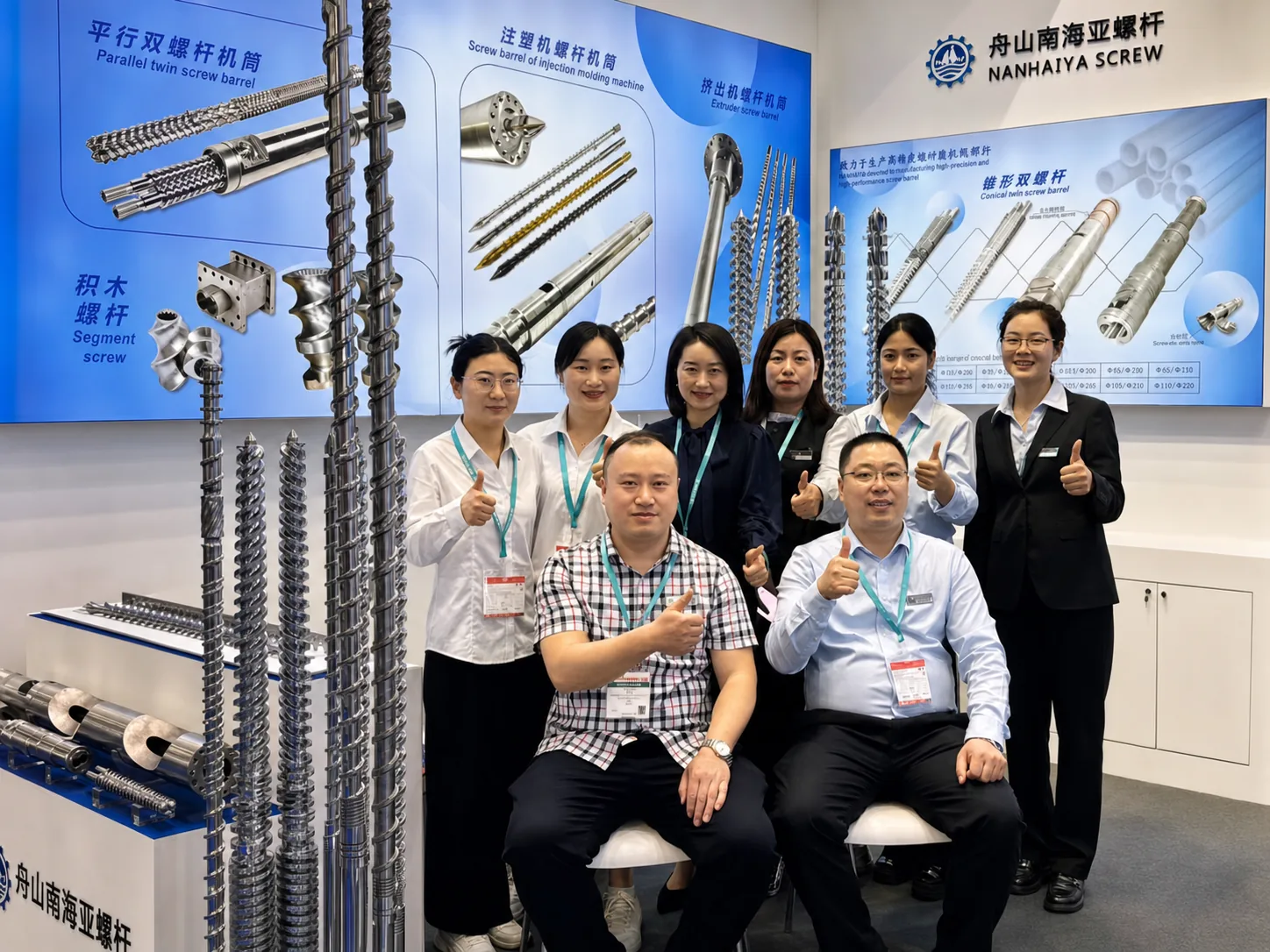
Related Articles
More insights on screw barrel technology and plastics processing.
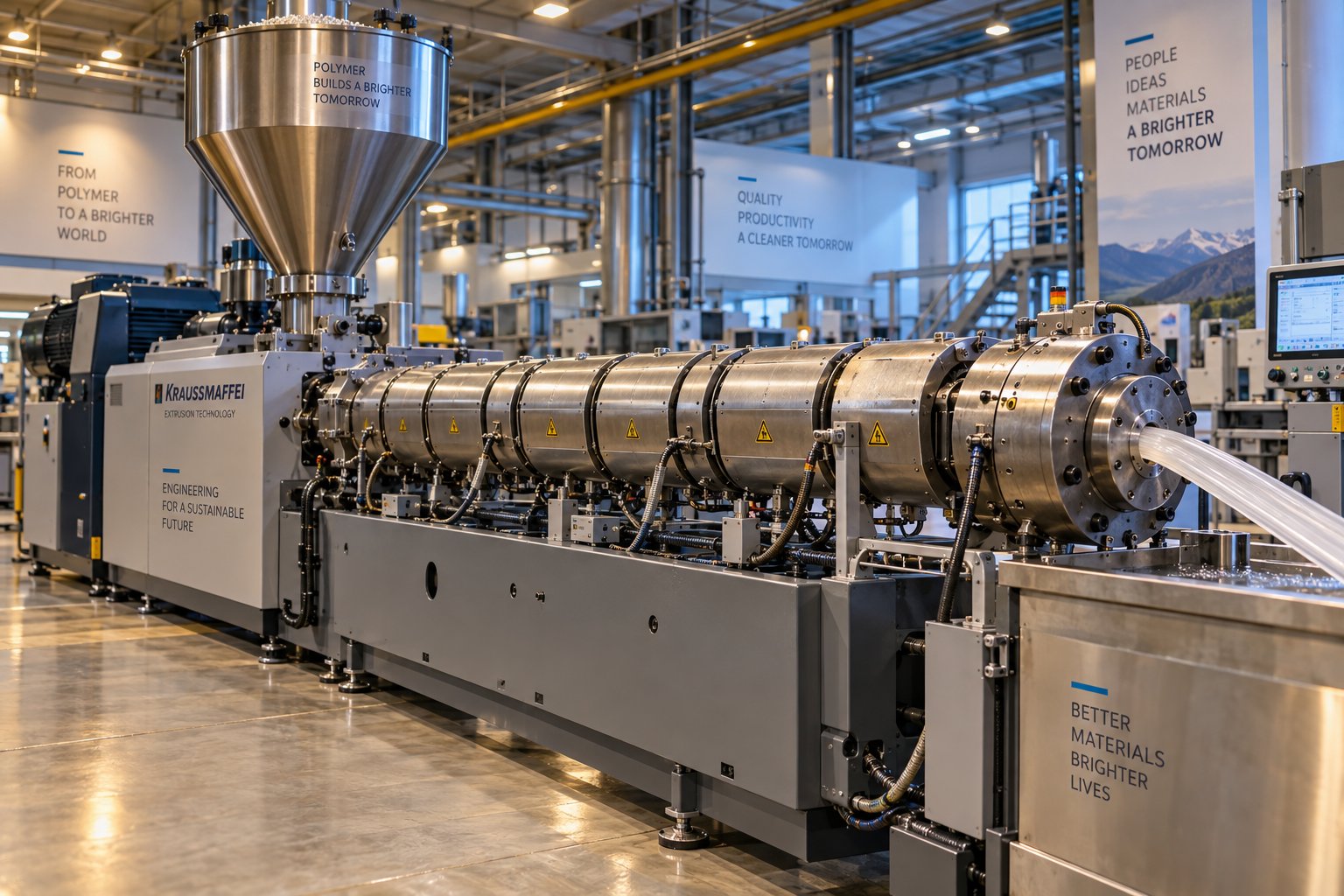
Extruder Machine Decoded: From Raw Pellet To Finished Product
Oct 6, 2026
Learn how an extruder machine works, compare single-screw vs. twin-screw types, and get expert guidance on specs, troubleshooting, and selection.
Read Article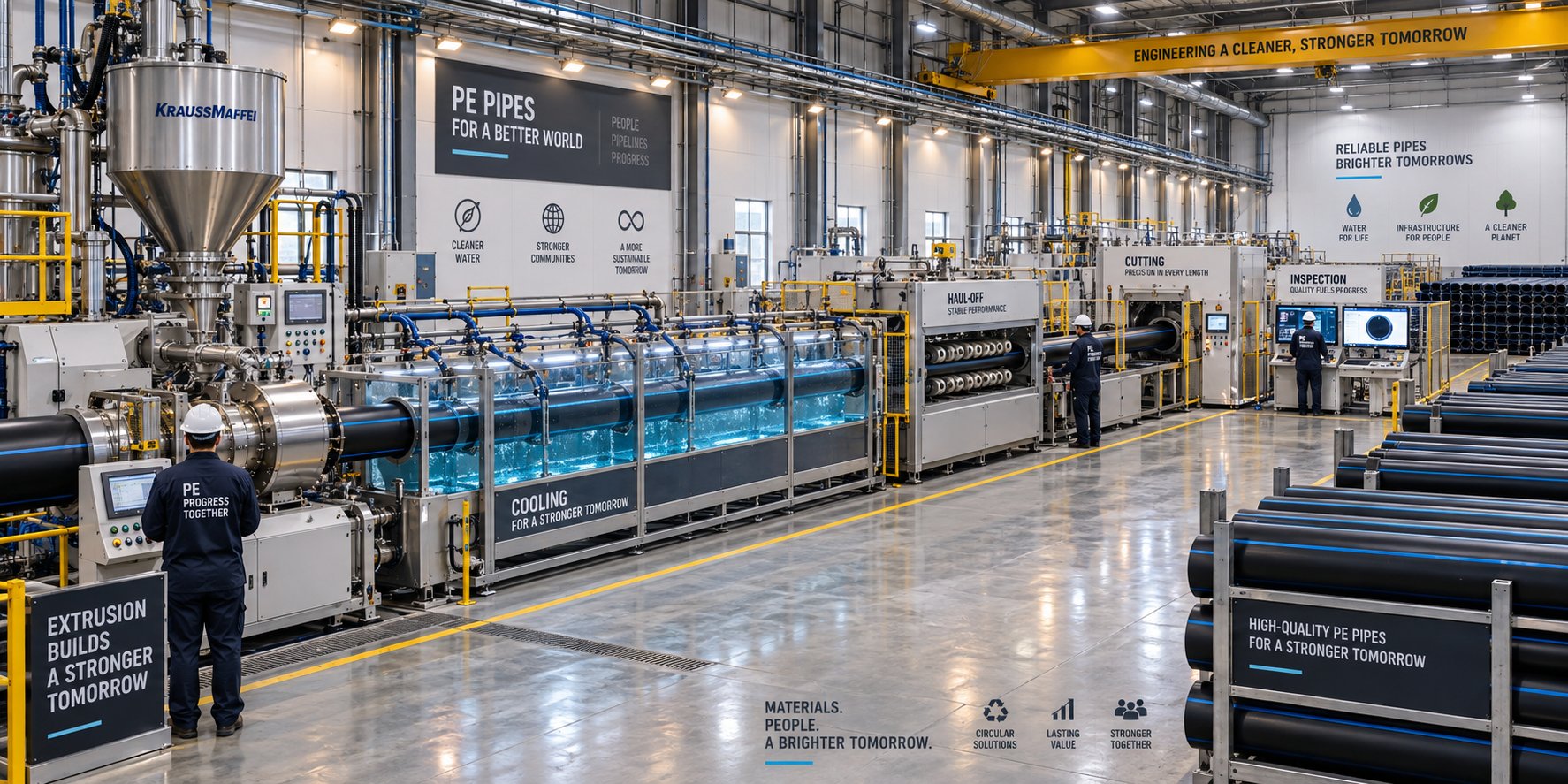
PE Pipe Making Machine Decoded: From Raw Resin to Flawless Pipe
Oct 4, 2026
Learn how a PE pipe making machine works, from resin to finished pipe. Covers components, material grades, automation, troubleshooting, and buyer selection tips.
Read Article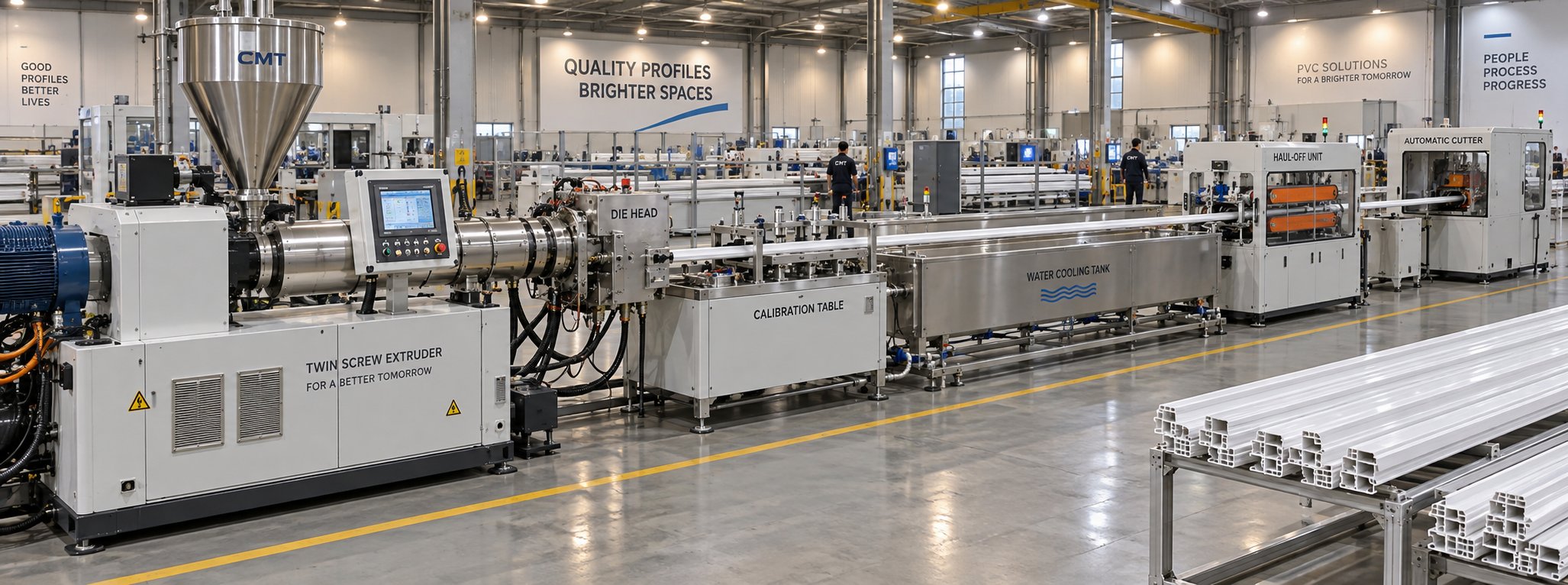
PVC Profile Making Machine Decoded: From Raw Resin To Profit
Oct 3, 2026
Learn how a PVC profile making machine works — extrusion process steps, key technical parameters, die design, calibration methods, maintenance, and total cost of ownership.
Read ArticleLooking for something else?
Search by material, symptom or product and jump straight to the relevant page.
These are navigation suggestions based on keyword matching — not a quotation, not a delivery commitment, and not a substitute for engineering review. Final specification is confirmed by our engineers against your drawings and processed material.
Need help with screw barrel selection?
Share your machine model, processed material and application. Our team can help with pricing and technical support.