

Table of Contents
Surface Treatment Options for Screw Barrels
The surface treatment of a screw barrel determines its wear resistance, corrosion resistance, and ultimately its service life. Two dominant technologies compete in the market: nitriding (gas or ion) and bimetallic centrifugal casting. Understanding their differences helps manufacturers make cost-effective decisions.
Nitrided Screw Barrels (38CrMoAlA)
Nitriding creates a hard surface layer (900-1100 HV) on 38CrMoAlA alloy steel through nitrogen diffusion at 500-550°C. The hardened layer typically reaches 0.4-0.7mm depth.
Advantages
- Lower initial cost (40-60% less than bimetallic)
- Suitable for non-abrasive materials (PE, PP, PS, ABS)
- Good dimensional stability during treatment
- Easier to re-nitride after wear
Limitations
- Thin hardened layer wears through faster with abrasive fillers
- Limited corrosion resistance against chlorine-based materials
- Typical service life: 1-3 years depending on material processed
Bimetallic Screw Barrels
Bimetallic barrels feature a centrifugally cast alloy lining (typically iron-boron or nickel-based alloys) with hardness reaching 58-65 HRC. The lining thickness is 2-5mm.
Advantages
- Superior wear resistance for glass fiber, calcium carbonate, and mineral fillers
- Excellent corrosion resistance for PVC and fluoropolymers
- Service life 3-5x longer than nitrided barrels in abrasive conditions
- Maintains consistent bore diameter over time
Limitations
- Higher upfront investment
- Cannot be re-lined economically after wear-through
- Longer lead time for manufacturing
Cost-Benefit Analysis
For operations processing unfilled polyolefins at moderate volumes, nitrided barrels offer the best value. However, any operation involving glass fiber content above 15%, mineral fillers, or corrosive PVC compounds should invest in bimetallic barrels. The 3-5x longer service life typically delivers a lower total cost of ownership despite the higher purchase price.
Nanhaiya Solutions
Nanhaiya manufactures both nitrided and bimetallic screw barrels, and also offers alloy spray welding as a middle-ground option. Our technical team provides material analysis and lifecycle cost projections to help you choose the most economical solution for your specific application.
Written by
Nanhaiya Technical Team
Over a decade of expertise in screw and barrel engineering for the plastic processing industry. Our technical team brings hands-on manufacturing knowledge from Zhoushan, China — the global hub of screw manufacturing.
Related Articles
More insights on screw barrel technology and plastics processing.
How To Vet a Screw Barrel Supplier Before You Waste a Single PO
Jul 24, 2026
Learn how to vet a screw barrel supplier with this buyer's guide covering design parameters, materials, manufacturing quality, pricing, and red flags to avoid.
Read Article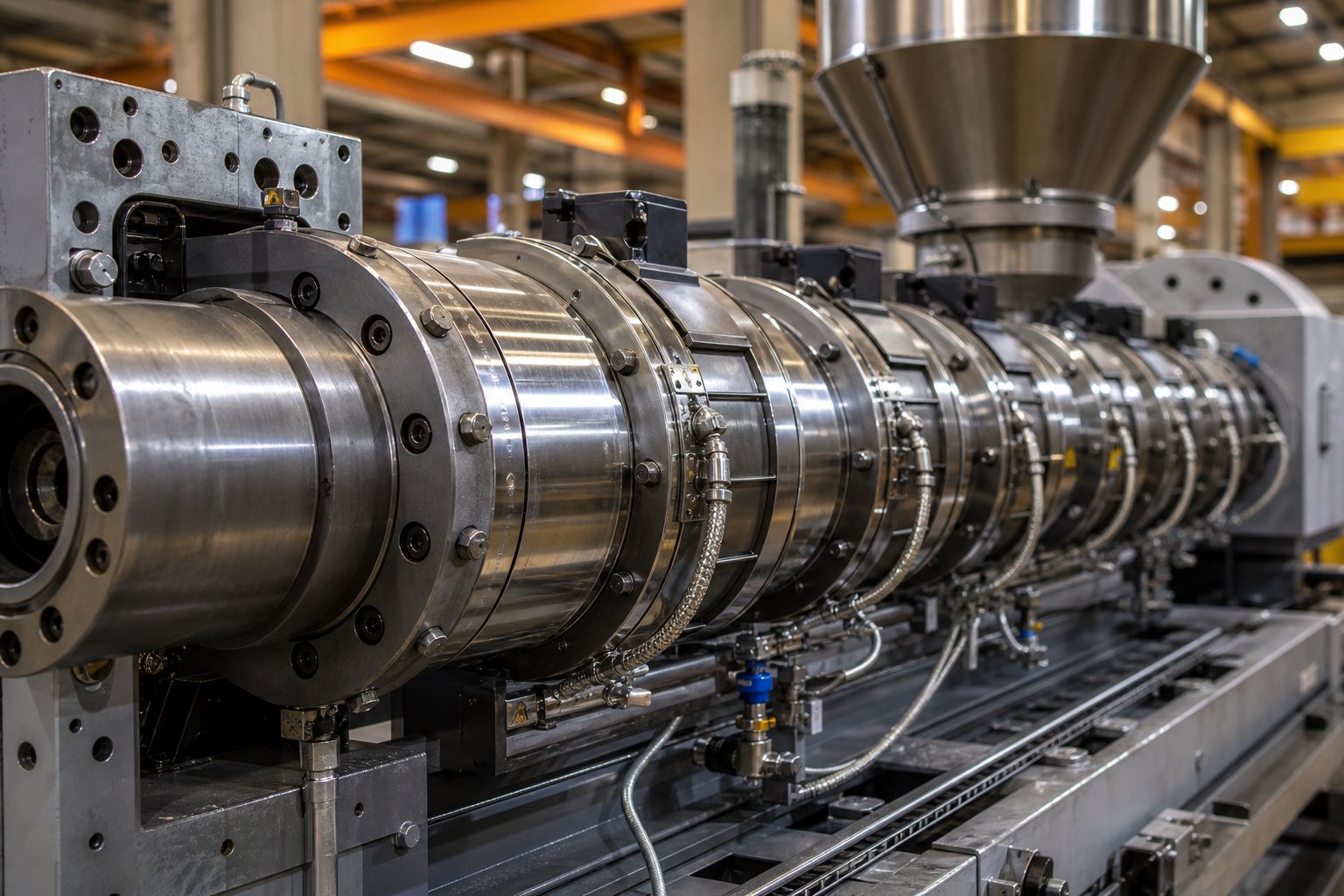
Inside The Twin Screw Extruder Barrel: What Engineers Miss
Jul 21, 2026
Learn how twin screw extruder barrel bore geometry, liner metallurgy, wear diagnostics, and port configurations drive process performance, uptime, and cost.
Read Article
Nanhaiya Exhibits at CHINAPLAS 2026 — New Planetary Screw Series
Jun 10, 2026
Nanhaiya showcased the latest planetary screw series and alloy spray welding technology at CHINAPLAS 2026, introducing screw barrel and alloy spray welding capabilities to international visitors.
Read ArticleNeed help with screw barrel selection?
Share your machine model, processed material and application. Our team can help with pricing and technical support.