

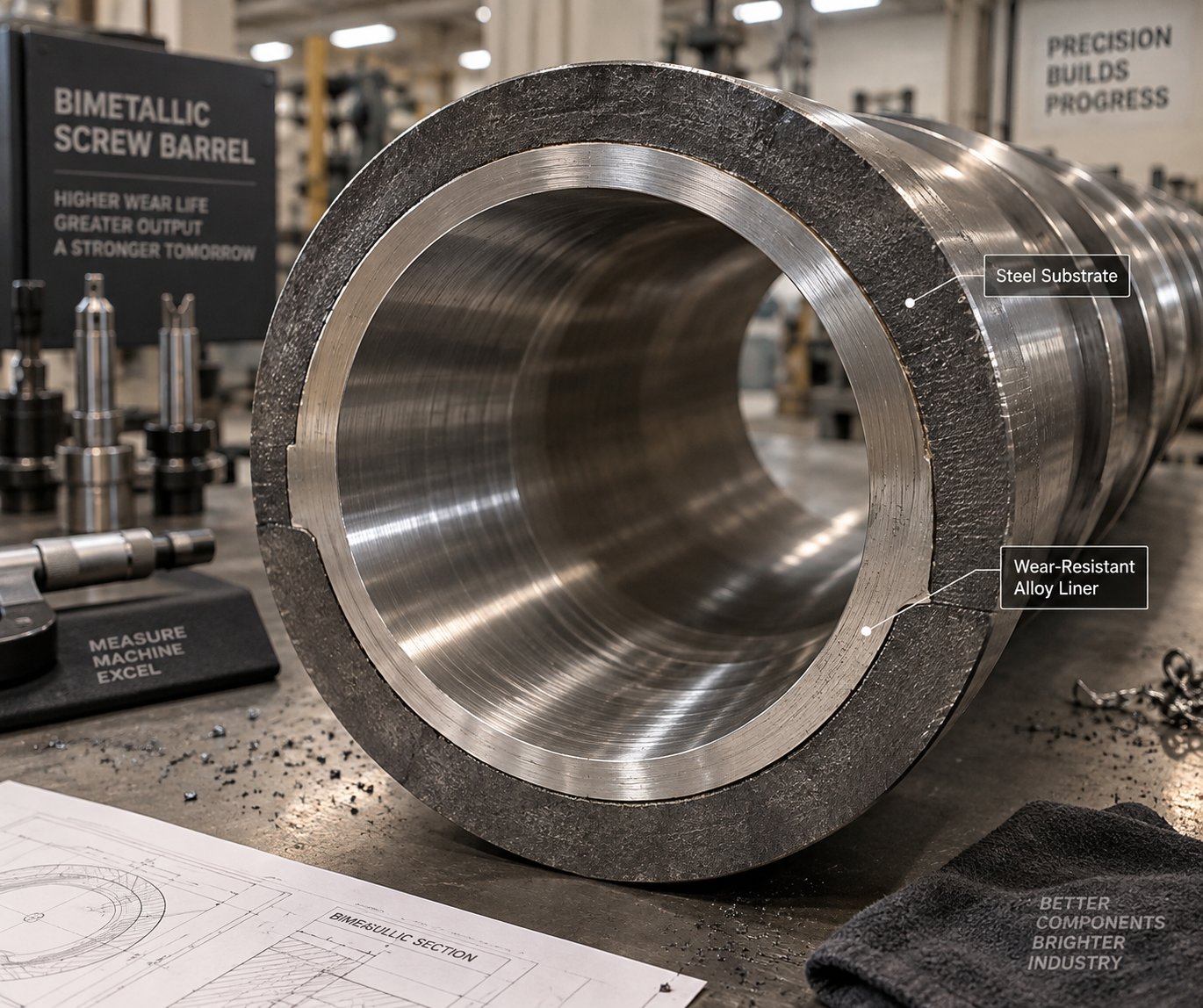
什么是双金属螺杆筒?它为何如此重要?
想象一下,一条生产线24小时不间断运转,加工玻璃纤维增强尼龙,却发现不到一年,螺杆筒内壁就磨损严重,超出了公差范围。螺杆叶片也变得圆滑。产量下降,熔体质量受损,你面临着计划外的停机,每小时损失数千美元。这种情况在全球各地的塑料加工厂屡见不鲜——而这正是双金属螺杆筒技术旨在解决的问题。
然而,大多数买家从未从双金属螺旋枪管制造商那里获得完整的信息。纸面上的规格参数看起来很漂亮,但真正决定投资是否划算的细节往往被掩盖。本指南将揭示这些细节。
双金属螺杆筒的定义
双金属螺杆筒体是一种双层结构部件,由耐磨合金衬里和钢基体通过冶金结合而成。与涂层或电镀不同,该合金层(筒体厚度通常为 2.0 至 3.0 毫米,螺杆螺纹槽厚度通常为 1.0 至 1.5 毫米)通过离心铸造或 PTA 焊接工艺熔合为部件的永久组成部分。
这里的关键词是“冶金结合”。这并非一种会剥落或脱落的表面处理工艺。“双”这个前缀表示“二”——两种不同的金属在同一个部件中发挥着两种不同的作用。基体钢提供结构强度、抗疲劳性和尺寸稳定性。位于基体之上的合金衬里则提供聚合物化合物所需的耐磨性和耐腐蚀性。
这种区别比大多数供应商所承认的要重要得多。镀铬枪管只是在表面沉积一层薄薄的镀层——在热循环作用下可能会发生分层。氮化枪管是将氮扩散到现有钢材中,而不是添加新材料,因此形成的硬化层厚度仅为0.4至0.7毫米。相比之下,双金属枪管则添加了数毫米厚的真正合金,这些合金在分子层面与基材融合。
为什么标准枪管会不足
普通的未经处理的钢桶通常都能正常工作——直到出现问题为止。如果您使用的是干净、未填充的聚乙烯或聚丙烯,那么传统的钢桶可以多年无故障运行。但一旦您在物料中添加了磨蚀性填料、腐蚀性添加剂或回收原料,问题就出现了。
三种磨损会加速标准枪管的损坏:
- Abrasive wear — glass fibers, mineral fillers, and contaminants in regrind act like sandpaper against the barrel wall and screw flights. As industry experts note, some of the most aggressive fillers can reduce screw and barrel useful life by 50% or more.
- Corrosive wear — polymers like PVC release hydrogen chloride during processing, which chemically attacks steel surfaces with high iron content. Fluoropolymers are equally aggressive.
- Adhesive wear — when metal-to-metal contact occurs between the screw flight lands and barrel bore, microscopic welding and fracturing take place, scoring both surfaces.
As these wear mechanisms enlarge the clearance between screw and barrel, melting efficiency drops. Operators compensate by increasing screw speed, adjusting temperatures, or raising backpressure — incremental changes that consume more energy and erode part quality until, eventually, the line reaches a point of diminishing returns and the barrel must be replaced.
The Role of Substrate Steel in Performance
Here's something your supplier probably won't volunteer: the alloy liner is only half the equation. The base steel underneath it plays a critical role in how long the barrel lasts and how well that liner stays bonded.
Two of the most common substrate grades are AISI 4140 and AISI 4340. Both are chromium-molybdenum alloy steels, but they serve different duty levels:
- AISI 4140 — a cost-effective workhorse offering good fatigue strength and hardenability, with tensile strength in the 850 to 1000 MPa range. It's widely used for general-purpose barrel substrates.
- AISI 4340 — the premium choice, containing 1.65 to 2.00% nickel for superior toughness, impact resistance, and fatigue life, with tensile strength reaching 1000 to 1200+ MPa. It earns its place under barrels subjected to high pressures, heavy cycling, or extreme operating temperatures.
Other substrate grades commonly seen in the industry include 38CrMoAlA (the standard nitriding steel across Asia), 34CrAlNi7 for deeper nitride cases, and 42CrMo — essentially the international equivalent of 4140. The substrate must bond cleanly with the liner alloy during casting, resist fatigue over millions of pressure cycles, and maintain dimensional stability under sustained heat. A cheap substrate compromises all three, regardless of how impressive the liner alloy sounds on the spec sheet.
Understanding this two-layer relationship is fundamental to making a smart purchasing decision. But the alloy liner itself comes in several distinct families — each with dramatically different strengths, hardness profiles, and ideal applications.
Bimetallic Alloy Types and How They Compare
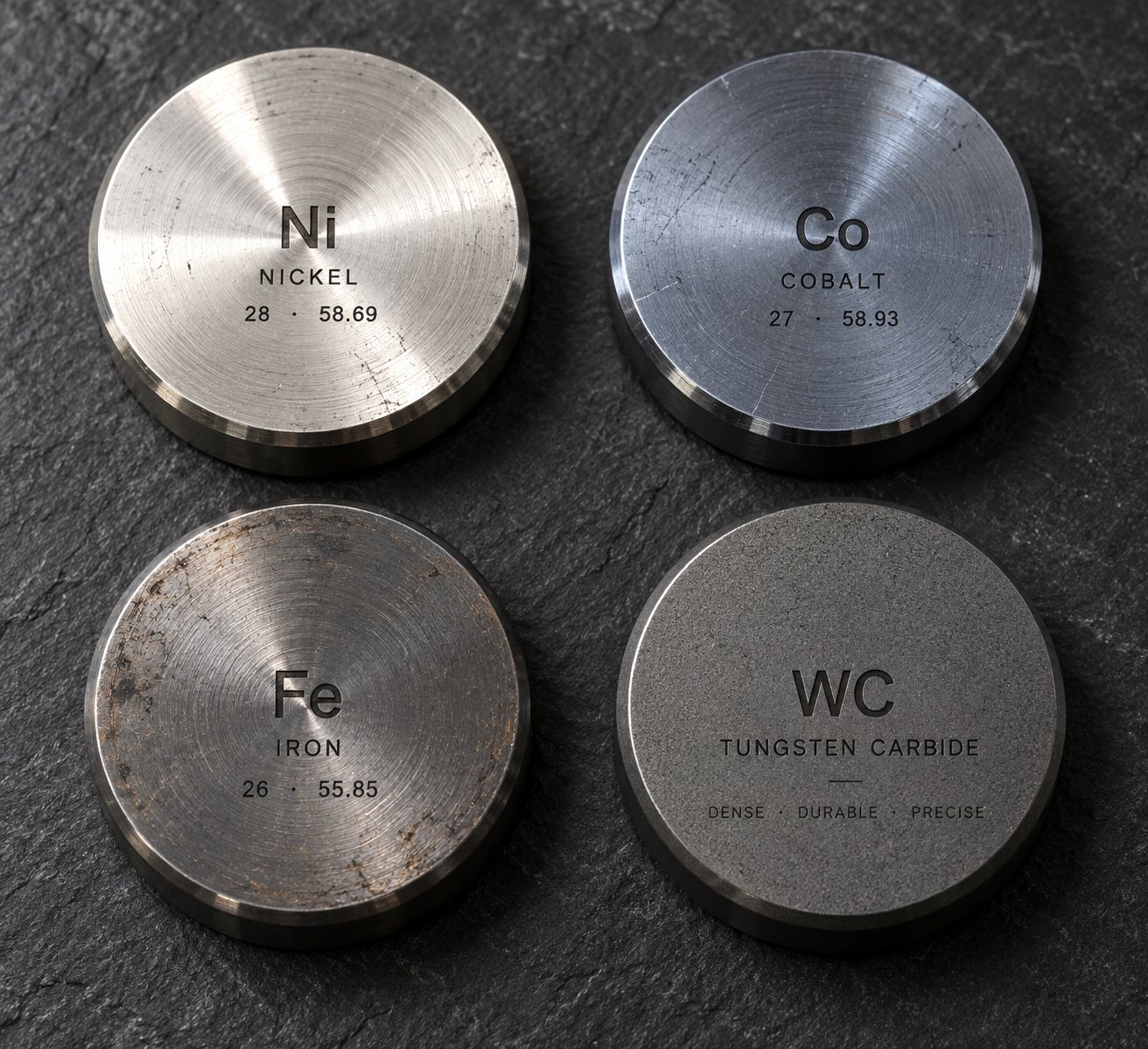
Not all bimetallic screw barrel material is created equal. The alloy liner fused inside your barrel belongs to one of four primary families, and each one is engineered for a fundamentally different threat profile. Picking the wrong family doesn't just reduce service life — it can mean replacing a barrel in months instead of years. Yet most suppliers quote a single hardness number and call it a day.
Here's what those alloy families actually look like side by side:
| Alloy Family | Key Properties | Typical Hardness Range | Corrosion Resistance | Abrasion Resistance | Best-Fit Applications |
|---|---|---|---|---|---|
| Nickel-Based (Colmonoy, Inconel) | Excellent chemical resistance, good toughness | 35-60 HRC | ★★★★★ | ★★★☆☆ | PVC, fluoropolymers, corrosive resins |
| Cobalt-Based (Stellite) | Retains hardness at elevated temperatures | 40-55 HRC | ★★★★☆ | ★★★★☆ | High-temp engineering polymers (PEEK, PPS) |
| Iron-Based (Fe-B, Fe-Cr-B) | Cost-effective, strong abrasion resistance | 58-65 HRC | ★★☆☆☆ | ★★★★☆ | Mineral-filled polyolefins, CaCO3 compounds |
| Tungsten Carbide Composites (WC) | Extreme hardness, superior particle erosion resistance | 60-70 HRC (matrix: 1200-1400 HV via HVOF) | ★★☆☆☆ | ★★★★★ | High glass-fiber content, heavily filled compounds |
Nickel-Based and Cobalt-Based Alloy Liners
Nickel-based alloys — think Colmonoy 5, Colmonoy 6, or Inconel 625 — dominate wherever chemical attack is the primary threat. The nickel matrix resists hydrogen chloride off-gassing from PVC, shrugs off fluoropolymer degradation byproducts, and provides enough ductility to absorb thermal cycling without cracking. Hardness ranges from around 35 HRC for lower-grade compositions up to 60 HRC for boron-silicon-enriched variants like Colmonoy 88. That spread lets engineers match the liner precisely to whether they need toughness, corrosion resistance, or a balance of both.
Cobalt-based alloys — the Stellite family — take a different approach. Stellite-6, the most widely referenced grade, delivers roughly 40-45 HRC in its as-deposited state and maintains that hardness even at sustained temperatures above 400°C. That thermal stability makes cobalt-based liners the go-to choice for processing high-temperature engineering polymers. Where nickel alloys excel against chemical attack, cobalt alloys excel against combined thermal and mechanical stress. The tradeoff? Cobalt-based liners carry a higher raw material cost, and they aren't the best pick for severely corrosive environments like sour-gas-producing PVC.
Iron-Based Alloys and Tungsten Carbide Composites
For processors running mineral-filled polyolefins or calcium-carbonate compounds on a budget, iron-based alloys hit a practical sweet spot. Iron-boron and iron-chromium-boron compositions achieve 58-65 HRC — harder than most nickel or cobalt liners — at a significantly lower material cost. They handle abrasive wear well. The catch is corrosion resistance: iron-rich matrices corrode faster in acidic or chloride-laden environments, so they're a poor match for PVC or chemically aggressive feedstocks.
When abrasion is extreme — imagine 40% glass-fiber loading or recycled compounds full of metallic contaminants — tungsten carbide composites step in. Research published in Wear found that WC-based overlays can outperform plain carbon steel by a factor of 21 in erosion-corrosion resistance. The carbide particles embedded in a nickel or cobalt binder matrix create a surface that simply outlasts everything else when hard particles are scouring the barrel bore. These composites represent the top tier in bimetallic screw and barrel technology for heavily filled compounds, though they carry the highest cost premium and can be more brittle under impact loads.
Understanding Hardness Values in Real-World Context
Hardness numbers dominate every plastic machine bimetallic screw barrel spec sheet, yet they're often presented without context. So what do they actually mean for your operation?
HRC (Rockwell C) measures resistance to indentation on a finished surface — higher numbers mean more resistance to localized deformation. HV (Vickers Hardness) does the same with a diamond pyramid under precise load, and it's more useful for very hard materials where the Rockwell scale compresses. For rough conversion, 60 HRC corresponds to approximately 700 HV, while 70 HRC approaches 1100 HV.
Here's the practical takeaway: a liner at 58 HRC will resist scratch-type abrasion from calcium carbonate particles effectively, but it may not survive the gouging impact of large glass fibers the way a 65-70 HRC tungsten carbide composite would. Conversely, pushing hardness too high sacrifices toughness. A 70 HRC surface is extremely hard, but it can also be brittle — if your barrel experiences mechanical shock or misalignment, a hard-but-brittle liner is more likely to crack than a 45 HRC nickel alloy that flexes under stress.
The smartest approach isn't chasing the highest number. It's matching the hardness profile to the specific wear mechanism your resin and filler combination produces. That decision becomes much clearer when you understand how bimetallic barrels stack up against their main alternatives — nitrided and chrome-plated barrels — which is exactly where the comparison gets interesting.
Bimetallic vs Nitrided vs Chrome-Plated Barrels
You've seen the alloy families and their hardness numbers. But here's the question most buyers actually ask first: do I really need a bimetallic single screw barrel, or would a nitrided or chrome-plated one do the job? The answer depends entirely on what you're processing, how long you need the barrel to last, and what you're willing to spend — not just upfront, but over the barrel's full service life.
This comparison lays out the differences in plain terms.
| Performance Factor | Standard Barrel | Nitrided Barrel | Chrome-Plated Barrel | Bimetallic Barrel |
|---|---|---|---|---|
| Wear Resistance | Low | Moderate | Moderate to Good | High to Excellent |
| Corrosion Resistance | Low | Moderate | Good | Good to Excellent (alloy-dependent) |
| Typical Lifespan Improvement vs Standard | 1x (baseline) | 2-3x | 2-4x | 4-8x |
| Cost Premium Over Standard | Baseline | 15-30% | 30-50% | 60-150% |
| Temperature Tolerance | Limited by base steel | Good (up to ~500°C surface) | Moderate (chrome softens above ~425°C) | Excellent (alloy-dependent, up to 600°C+) |
| Treatment Thickness | N/A | 0.4-0.7 mm diffusion case | 0.05-0.25 mm deposited layer | 2.0-3.0 mm fused alloy liner |
| Best-Fit Applications | Unfilled commodity resins, low-volume runs | General-purpose molding, moderately filled compounds | Corrosion-sensitive resins with low abrasion | Abrasive fillers, corrosive resins, high-volume production |
Standard and Nitrided Barrels Explained
A standard barrel is simply machined from a single grade of alloy steel — typically 38CrMoAlA or 42CrMo — with no additional surface treatment. It's the baseline. For clean, unfilled commodity resins like LDPE or general-purpose polystyrene, it works. Costs stay low and lead times are short. The moment you introduce glass fiber, mineral filler, or a chemically aggressive polymer, though, that untreated bore becomes the weakest link in the system.
Nitriding improves on this by diffusing nitrogen atoms into the steel surface, creating a hardened case that can reach HV 950 or above (roughly HRC 55-58). It also enhances fatigue resistance and provides moderate corrosion protection. The process is relatively inexpensive and well-proven — nitrided barrels remain the most common surface-hardening option worldwide.
The limitation? That hardened case is thin — typically only 0.4 to 0.7 mm deep. Once abrasive fillers wear through it, you're back to base steel, and wear accelerates rapidly. Think of it as a hard shell around a soft core. For a bimetallic normal screw barrel, by contrast, the wear-resistant material extends 2 to 3 mm deep, providing a dramatically larger safety margin before the substrate is ever exposed.
Chrome-Plated vs Bimetallic Barrel Performance
Chrome plating occupies an interesting middle ground. The deposited chrome layer offers good corrosion resistance and reasonable hardness — enough to extend barrel life meaningfully in mildly corrosive applications. It's also a proven technology that's been used across multiple industries for decades.
The problems emerge under real-world plastics processing conditions. First, thickness: hard chrome plating typically deposits only 0.05 to 0.25 mm of material. That's a fraction of what even nitriding achieves, and an order of magnitude thinner than a bimetallic liner. Second, adhesion under thermal cycling: chrome plate bonds to the substrate mechanically rather than metallurgically. Repeated heating and cooling cycles — standard in any injection molding or extrusion operation — can create differential expansion stresses that cause the chrome layer to crack and peel away from the substrate. Once delamination starts, it accelerates — loose chrome flakes contaminate your melt stream and expose the base steel underneath to direct attack.
Research comparing chrome plating to thermal spray alternatives shows that advanced coatings like HVOF tungsten carbide deliver "excellent" wear performance where chrome plate rates only "good." A single bimetallic screw barrel takes this further by placing the wear-resistant alloy as a thick, permanently fused structural layer rather than a surface deposit — eliminating the delamination risk entirely.
That said, chrome plating still makes sense in specific scenarios: low-abrasion resins that produce mild corrosive byproducts, shorter production runs where upfront cost matters more than extended life, or applications where barrel temperatures remain consistently moderate and don't subject the plating to extreme thermal swings.
Choosing the Right Treatment for Your Application
There's no single correct answer here — each treatment earns its place depending on the processing environment. Consider these decision criteria:
- Resin type: Unfilled commodity plastics rarely justify bimetallic cost. Filled engineering resins almost always do.
- Filler content: Above 15-20% glass fiber or mineral filler, nitrided barrels struggle to deliver acceptable service life. Bimetallic liners become the practical minimum.
- Corrosive environment: PVC, fluoropolymers, and flame-retardant additives demand alloy liners with proven chemical resistance — nitriding alone won't hold up against sustained HCl attack.
- Production volume: High-volume, continuous operations benefit most from bimetallic longevity because downtime costs dwarf the barrel price premium. Low-volume or job-shop operations running mild resins may find nitrided barrels perfectly adequate.
- Budget perspective: A bimetallic barrel costs 60-150% more upfront than a standard one. But if it lasts four to eight times longer, the cost-per-processing-hour drops significantly. The cheapest barrel per unit rarely turns out to be the cheapest barrel per year.
Being honest about these tradeoffs is what separates a genuinely informed purchase from an oversold one. A reputable supplier will tell you when nitriding is sufficient for your application rather than pushing a premium product you don't need. That level of transparency also signals something about how the barrel itself is made — a topic that reveals even more about quality differences between manufacturers.
How Bimetallic Screw Barrels Are Manufactured
Knowing which alloy and barrel treatment to specify is one thing. Understanding how that barrel actually gets made is something else entirely — and it's the part most suppliers skip over. Yet the manufacturing method directly determines liner uniformity, bond integrity, and ultimately how many processing hours you'll get before wear becomes a problem. Whether you're sourcing from a bimetallic screw barrel factory in Europe or evaluating a china bimetallic screw barrel supplier, the production process behind the product matters just as much as the alloy spec printed on the certificate.
Four primary methods dominate bimetallic barrel production: centrifugal casting, hot isostatic pressing (HIP), alloy spray welding, and plasma transfer arc (PTA) welding. Each serves a different purpose, and each carries distinct advantages depending on whether you're producing a new barrel or restoring a worn one.
Centrifugal Casting Step by Step
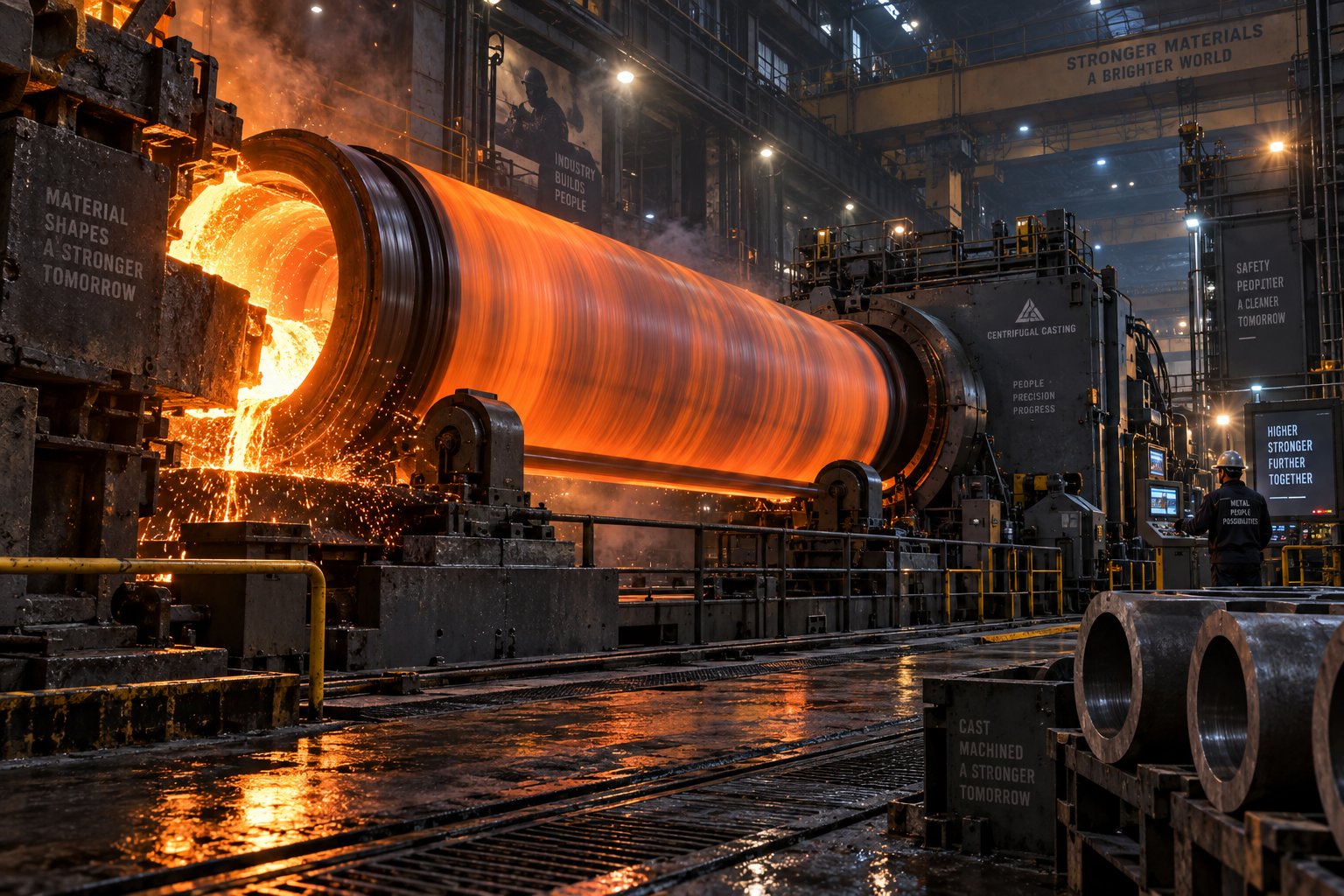
Centrifugal casting is the industry workhorse — the method responsible for the vast majority of bimetallic barrels produced worldwide. The concept is straightforward: pour molten alloy into a spinning barrel shell and let centrifugal force distribute it evenly across the inner wall. In practice, every step in the sequence demands tight control to produce a defect-free liner with strong metallurgical adhesion.
Here's how a reputable single bimetallic screw barrel factory executes the process:
- Base barrel preparation: The barrel substrate — typically AISI 4140, 4340, or equivalent alloy steel — is rough-machined to the required outer geometry and wall thickness. The inner bore is cleaned and prepared to ensure proper bonding conditions.
- Preheating: The prepared barrel is heated to a controlled temperature, typically several hundred degrees Celsius. This preheating step reduces thermal shock when molten alloy contacts the inner surface and promotes a stronger metallurgical bond between liner and substrate.
- Alloy loading: A measured charge of the selected alloy — nickel-based, iron-based, cobalt-based, or tungsten carbide composite — is introduced into the barrel cavity. The alloy composition has been pre-selected based on the end user's resin and filler profile.
- High-speed rotation and melting: The barrel is placed in a centrifugal casting machine and spun at precisely controlled speed. The alloy melts (or has been pre-melted before loading, depending on the specific process variant), and centrifugal force drives the molten material outward, distributing it uniformly along the bore wall. As Tan Star Industries notes, precise control of temperature, rotational speed, and cooling rate is essential to achieving uniform thickness and strong metallurgical adhesion.
- Controlled cooling: The barrel cools at a managed rate to minimize residual stress and prevent cracking at the alloy-substrate interface. Too fast and the liner may develop micro-cracks; too slow and grain structure coarsens, reducing hardness.
- Heat treatment: Post-cast heat treatment enhances the hardness and bonding strength between the alloy layer and the base material, ensuring uniform structural stability under high operating temperatures.
- CNC machining and finishing: The barrel undergoes precision boring, honing, and grinding to achieve final bore dimensions, surface finish, and tolerance specifications. Feed zones, vent ports, and custom fittings are machined at this stage based on application requirements.
- Quality inspection: Dimensional verification, hardness testing (Rockwell and Vickers), ultrasonic flaw detection, and metallographic analysis confirm liner integrity, thickness consistency, and bond quality before the barrel is approved for shipment.
Compared with surface coating or plating methods, centrifugal casting produces a significantly more reliable composite structure. The alloy liner isn't sitting on top of the substrate — it's fused into it, creating a dense, defect-free layer capable of withstanding severe abrasion and chemical attack during production.
Hot isostatic pressing (HIP) represents a more specialized alternative. HIP uses a combination of high temperature and uniform gas pressure to bond alloy powder to the barrel substrate. The result is an extremely dense liner with virtually no porosity. It's a premium process, often reserved for critical applications where even minor voids in the liner would be unacceptable — think aerospace-grade components or barrels processing ultra-high-performance polymers. The cost reflects that precision, making HIP far less common in standard plastics processing applications.
Spray Welding and PTA Welding Methods
Not every bimetallic barrel begins life inside a centrifugal casting machine. Two alternative deposition methods — alloy spray welding and plasma transfer arc (PTA) welding — play critical roles in both new production and worn component restoration.
Alloy spray welding uses a thermal spray process to deposit wear-resistant alloy material onto a component surface. The alloy — delivered as powder or wire — is melted in a high-temperature flame or arc and propelled onto the barrel bore or screw flight surface, where it solidifies into a protective layer. This technique is particularly valuable for two reasons: it can apply liners to new barrels where centrifugal casting isn't practical due to geometry or size constraints, and it excels at restoring worn barrels and screws to serviceable condition without full replacement.
For extrusion and injection molding operators dealing with progressive screw wear or barrel bore degradation, alloy spray welding offers a practical middle path between tolerating declining performance and purchasing an entirely new component. Providers like NANHAIYA's alloy spray welding service support operators facing screw wear, barrel wear, and corrosion challenges by applying wear-resistant surface treatments that restore critical dimensions and extend service life — an increasingly relevant option as lifecycle cost management tightens across the industry.
PTA welding — plasma transfer arc welding — takes a different approach. A high-energy plasma arc melts alloy powder and a thin layer of the base material simultaneously, creating a true metallurgical bond as the deposit solidifies. Because PTA fuses the alloy directly into the substrate rather than depositing it on top, the resulting layer offers excellent durability under demanding operating conditions. PTA welding is most commonly applied to screw flights — the surfaces that experience the highest contact pressure and abrasion — using nickel-chromium, cobalt-based, or nickel-chromium-tungsten alloy systems depending on the wear profile.
The distinction between these methods matters when evaluating suppliers. A china single bimetallic screw barrel producer offering only centrifugal casting may not be equipped to handle screw flight hardening or barrel refurbishment. A manufacturer with spray welding and PTA capabilities, on the other hand, can address both new production and aftermarket restoration — giving buyers more flexibility across the full component lifecycle.
How L/D Ratio and Screw Geometry Influence Liner Selection
Manufacturing method and alloy choice don't exist in isolation. The barrel's physical specifications — particularly its length-to-diameter ratio (L/D) and the screw geometry it houses — directly influence which liner composition and production process make the most sense.
Longer barrels (L/D ratios of 30:1 to 40:1, common in modern extrusion lines) present greater challenges for centrifugal casting uniformity. The molten alloy must distribute evenly across a longer bore, and any temperature gradient along the barrel length can cause thickness variation. Reputable manufacturers address this with multi-zone heating during the casting cycle and post-cast ultrasonic testing to verify uniformity across the full length. With capabilities extending to barrels up to 7,500 mm in length, leading factories have refined their processes to handle even the most demanding dimensional requirements.
Screw geometry adds another layer. Aggressive mixing elements, barrier flights, and high-compression-ratio designs create localized pressure peaks and accelerated wear zones inside the barrel. When the screw design concentrates mechanical stress in specific regions, the liner alloy in those zones needs to be harder or more wear-resistant than a simple conveying barrel would require. In these cases, a factory might use a tungsten carbide composite liner for the metering and mixing zones while specifying a nickel-based alloy in the feed section where corrosion from moisture-laden feedstock is the dominant concern.
This interplay between barrel geometry, screw design, and liner selection is precisely why the best bimetallic screw barrel factories don't just take an order and cast — they ask detailed questions about your machine configuration, resin type, and production profile before recommending a specification. That conversation reveals whether you're working with a genuine technical partner or simply a commodity supplier. And it leads directly to a question most buyers overlook: which alloy matches which resin?
Which Bimetallic Alloy Fits Your Resin Type
Every resin attacks a barrel differently. PVC eats through standard steel with chemical aggression. Glass-fiber-filled nylon grinds it away mechanically. Recycled post-consumer compounds do both at once — plus throw in random metallic contaminants for good measure. Yet most bimetallic screw barrel manufacturer spec sheets list a single "universal" alloy recommendation, as though one liner composition could handle all of these threats equally well.
It can't. And getting this match wrong is one of the fastest paths to premature barrel failure. The table below maps six major resin categories to their recommended alloy families, dominant wear threats, and practical configuration notes that engineers and procurement teams can reference directly.
| Resin / Material Type | Recommended Alloy Family | Key Threat | Configuration Notes |
|---|---|---|---|
| PVC (rigid and flexible) | Nickel-based (Colmonoy, Inconel) | Corrosion (HCl off-gassing) | Avoid iron-rich liners; use low-iron nickel matrix for maximum acid resistance. Bimetallic PVC extrusion screw barrel configurations should pair nickel liners with corrosion-resistant screw coatings. |
| Glass-fiber-filled resins (PA, PBT, PP-GF) | Tungsten carbide composites or high-hardness iron-based | Extreme abrasion | Above 30% glass content, tungsten carbide is strongly preferred. Screw flight lands need PTA-welded hardface overlays to match barrel liner longevity. |
| Wood-plastic composites (WPC) | Iron-based (Fe-Cr-B) or nickel-based | Abrasion + moisture corrosion | Wood fibers are moderately abrasive; moisture creates mild corrosive conditions. Iron-based liners work for lower moisture content; nickel-based may be needed for high-humidity feedstocks. |
| Calcium-carbonate-filled compounds | Iron-based (Fe-B, Fe-Cr-B) | Abrasion | CaCO3 is a cost-effective filler but highly abrasive at loadings above 20%. Iron-based liners offer the best cost-to-performance ratio here. |
| Recycled plastics (post-consumer, post-industrial) | Nickel-based or tungsten carbide composites | Both (contaminants + variable abrasion) | Feedstock inconsistency demands tough, forgiving liners. Nickel-based alloys handle chemical variability; add WC for heavily contaminated streams with metallic or mineral debris. |
| Engineering polymers (PEEK, PPS, PEI) | Cobalt-based (Stellite) or nickel-based | High temperature + chemical attack | Processing temperatures above 350-400°C demand alloys that retain hardness at elevated temperatures. Cobalt-based liners maintain stability where nickel alloys may soften. |
Processing Corrosive Resins Like PVC
PVC is one of the most widely processed polymers globally, and one of the most destructive to barrel internals. When PVC degrades during processing — even slightly — it releases hydrogen chloride (HCl) gas. That gas reacts with moisture in the system to form hydrochloric acid, which attacks iron-rich surfaces aggressively from the inside out.
Standard nitrided barrels and iron-based bimetallic liners are particularly vulnerable because their high iron content provides a ready target for acid corrosion. You'll notice pitting, surface roughening, and progressive bore enlargement — often within months of commissioning if the wrong alloy was specified. As Juyuan Machinery explains, a nickel-alloy liner or chromium-nickel overlay combats corrosive wear and helps maintain smooth internal surfaces in these environments.
For a bimetallic PVC extrusion screw barrel configuration, the best practice is a nickel-based alloy liner — such as Colmonoy 5 or Inconel 625 — where the nickel matrix creates a chemical barrier that resists HCl attack. The screw itself matters equally: pairing a nickel-lined barrel with an untreated or basic-nitrided screw means the screw becomes the weak link. Experienced suppliers typically recommend corrosion-resistant hard-facing on the screw flights to match the barrel's protective capability.
Flexible PVC compounds containing plasticizers and stabilizers introduce additional chemical complexity, but the fundamental alloy recommendation stays the same: keep the iron content low and the nickel content high. The liner's corrosion resistance, not its hardness number, determines how many processing hours you'll get before dimensional degradation affects output quality.
Handling Glass-Fiber-Filled and Mineral-Filled Compounds
Glass fibers are abrasion in engineered form. Each individual fiber — typically 10 to 15 micrometers in diameter — is harder than the steel substrate underneath your liner. At 30% or 40% loading, millions of these fibers are continuously scraping, cutting, and gouging the barrel bore with every revolution of the screw. Industry data suggests that aggressive fillers can slash screw and barrel life by more than 50% without adequate protection.
This is where tungsten carbide composites earn their premium. With hardness values reaching 60-70 HRC and embedded WC particles that resist gouging far better than any homogeneous alloy, these liners are the practical standard for high-glass-content resins. The tradeoff — higher cost and somewhat reduced toughness — is easily justified when you're comparing it against replacing an iron-based or nickel-based liner every few months.
Mineral fillers like talc, mica, and wollastonite present a slightly different challenge. They're abrasive, but less aggressively so than glass fibers. For these compounds, iron-based alloys (Fe-Cr-B at 58-65 HRC) often provide sufficient wear resistance at a meaningfully lower price point. The decision essentially hinges on filler hardness and loading percentage. Below 20% mineral filler, a good iron-based liner handles the job comfortably. Above 30%, or whenever glass fiber enters the formulation, upgrading to tungsten carbide becomes the cost-effective move over the barrel's full service life.
For a customized bimetallic rubber screw and barrel setup processing heavily filled elastomeric compounds, the same principles apply — match the liner's abrasion resistance to the filler's aggressiveness, and don't forget that screw flight hardfacing must keep pace with the barrel liner's capability.
Recycled Plastics and Engineering Polymer Considerations
Recycled plastics create a uniquely unpredictable wear environment. One batch might contain trace metals from label adhesives or closures. The next might carry elevated moisture levels, degraded stabilizers, or inconsistent filler concentrations. Recycled materials introduce contaminants and inconsistent particle sizes that accelerate localized wear patterns — patterns that can differ from week to week as feedstock quality fluctuates.
This variability demands a forgiving liner — one with enough toughness to absorb unexpected impacts and enough chemical breadth to resist whatever degradation byproducts the feedstock produces. Nickel-based alloys deliver that balance for most recycled streams. When the recycled material contains significant glass or mineral residues — common in post-industrial engineering plastic regrind — supplementing with tungsten carbide in the metering and mixing zones provides an extra margin of safety.
Engineering polymers like PEEK and PPS present the opposite challenge: extreme consistency at extreme conditions. PEEK's melting point sits around 343°C, which means barrel temperatures during processing can reach 380-420°C. At those temperatures, many nickel-based alloys begin losing hardness. Cobalt-based liners — the Stellite family — retain their mechanical properties well above 400°C, making them the preferred choice for these high-performance resins.
PPS adds a corrosion dimension. During processing, PPS can release sulfur-containing compounds that attack metal surfaces. The combination of sustained high temperature and chemical attack narrows the alloy selection significantly — cobalt-based or high-grade nickel-chromium compositions that can handle both thermal and chemical stress simultaneously.
The practical takeaway? No single bimetallic extrusion barrel screw configuration works for every application. A processor running PVC on Monday and glass-filled PA66 on Friday needs either two different barrels or a carefully chosen compromise alloy — and that compromise always sacrifices something. The more precisely you match alloy to resin, the more processing hours you extract per dollar invested. Getting that match right, however, depends on more than alloy knowledge alone. It requires working with a supplier whose quality systems, testing capabilities, and technical transparency can back up their recommendations with verifiable data.
How to Evaluate a Bimetallic Screw Barrel Manufacturer
Matching the right alloy to the right resin is critical — but even the perfect alloy specification is only as good as the factory that produces it. A nickel-based liner rated at HRC 58 on paper means nothing if the actual casting has undetected voids, inconsistent thickness, or a weak metallurgical bond hiding beneath a polished bore surface. The uncomfortable truth is that two bimetallic screw barrel manufacturers quoting the exact same alloy specification can deliver wildly different products. What separates them isn't the alloy name — it's their quality systems, testing rigor, and willingness to prove what they've made.
Yet finding actionable guidance on how to evaluate these suppliers is surprisingly difficult. Most buyers default to price comparisons and delivery timelines without ever verifying the metallurgical integrity of the barrel they're purchasing. This section changes that.
Quality Certifications and Testing Standards to Demand
Start with the baseline: ISO 9001 certification. In the context of bimetallic barrel production, ISO 9001 means the manufacturer has documented, auditable processes governing everything from incoming raw material inspection to final shipment verification. It doesn't guarantee a perfect barrel — but it does guarantee that the factory follows a repeatable system rather than relying on ad hoc judgment calls. If a supplier can't show a current ISO 9001 certificate, that's a serious concern regardless of how competitive their pricing looks.
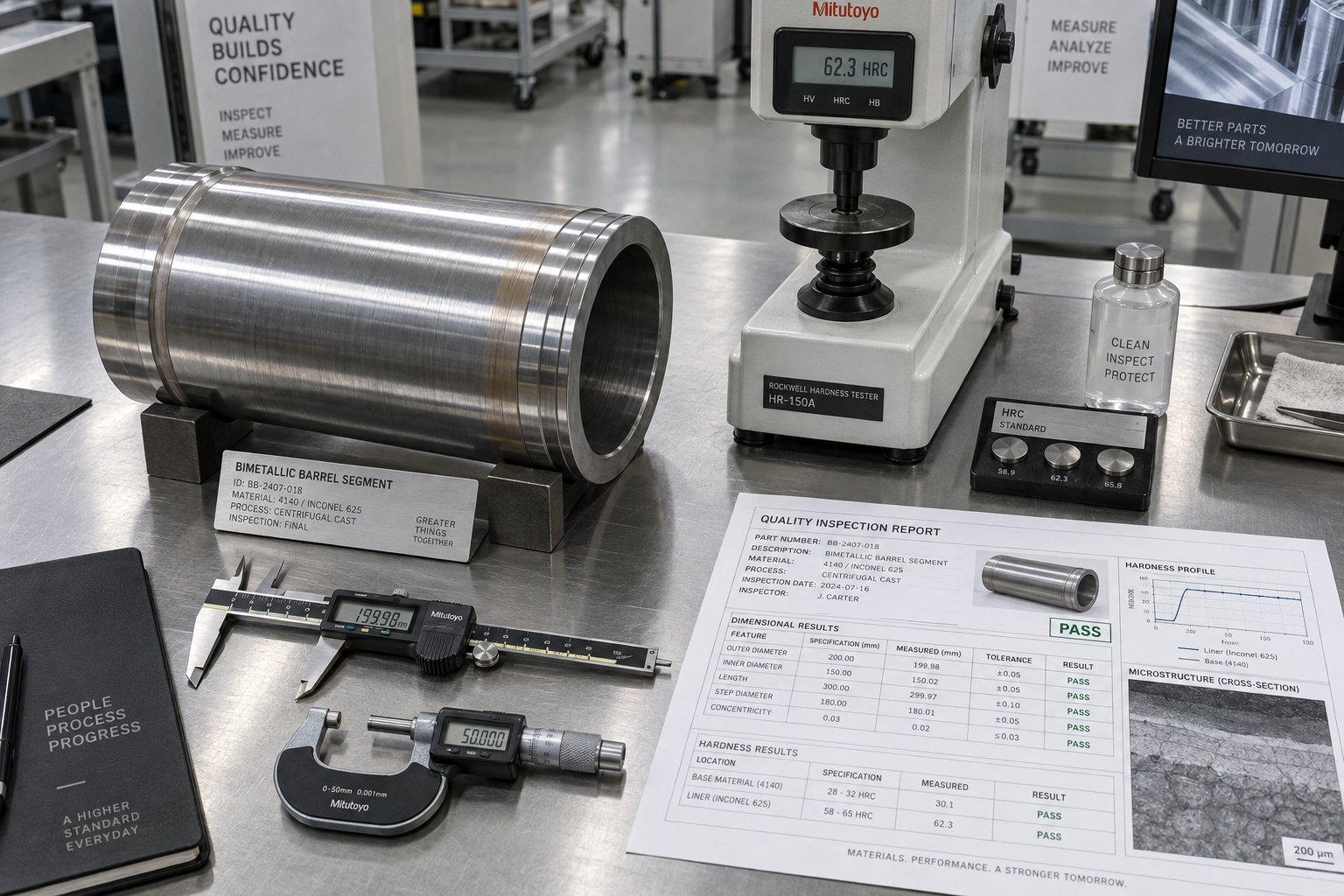
Beyond ISO 9001, the tests that actually verify liner quality involve specific metallurgical and dimensional inspections. Here's what reputable bimetallic screw barrel manufacturers perform as part of their standard quality control process:
| Inspection Method | What It Verifies | Why It Matters |
|---|---|---|
| Metallographic Analysis | Alloy microstructure, bond interface quality, porosity | Reveals whether the metallurgical bond between liner and substrate is continuous and defect-free |
| Rockwell Hardness Testing (HRC) | Surface hardness of the alloy liner | Confirms the liner meets the specified hardness range for the chosen alloy family |
| Vickers Hardness Testing (HV) | Micro-hardness across the liner cross-section | Detects hardness gradients or soft spots that Rockwell testing alone may miss |
| Ultrasonic Testing (UT) | Bond integrity and liner thickness uniformity | Identifies delamination, voids, or thickness variation along the barrel length without destructive testing |
| Dimensional Tolerance Verification | Bore diameter, straightness, roundness, taper | Ensures the barrel meets machine specifications and maintains proper screw-to-barrel clearance |
| Surface Finish Measurement (Ra) | Internal bore surface roughness | A rough bore accelerates wear and increases friction; typical targets fall below Ra 0.4 micrometers |
Any supplier unwilling to provide test reports covering at least hardness, ultrasonic bond integrity, and dimensional verification is asking you to take their quality on faith. For a component that directly determines your production uptime and product consistency, faith isn't a procurement strategy.
Questions to Ask Any Bimetallic Barrel Supplier
Before placing an order — especially with a new supplier or a bimetallic screw barrel importer you haven't worked with previously — run through this checklist. The answers reveal far more about manufacturing capability than any sales brochure.
- What specific alloy composition do you use for the liner? Vague answers like "nickel alloy" or "wear-resistant material" are insufficient. You need the alloy family, grade designation, and ideally the nominal chemical composition.
- What substrate steel grade is used for the barrel body? Confirm whether they use recognized grades like AISI 4140, 4340, or 38CrMoAlA — and whether heat treatment specifications are documented.
- What is the nominal liner thickness, and how do you verify uniformity? Reputable factories perform ultrasonic measurement at multiple points along the barrel length. Ask for the measurement protocol.
- Can you provide metallographic cross-section images of the liner-substrate bond? This is the single most revealing quality indicator. A clean, continuous bond interface with minimal porosity signals controlled casting; a ragged or porous interface signals problems.
- What hardness testing do you perform, and will you supply certificates with each shipment? Both Rockwell and Vickers testing should be standard. Ask whether testing is performed at multiple locations along the barrel.
- Do you have reference customers processing similar resins to ours? A manufacturer experienced with your specific application — whether PVC, glass-filled PA, or recycled compounds — understands the alloy-resin matching challenge firsthand.
- What is your typical lead time, and how do you handle urgent replacement orders? Production disruptions don't wait for standard lead times. Knowing whether a supplier can expedite critical components matters before you need it.
- Do you offer aftermarket support such as refurbishment, re-lining, or alloy spray welding? Suppliers who support the full lifecycle — not just the initial sale — tend to build barrels designed for longer service and easier restoration.
Think of these questions as a filter. A supplier who answers all eight with specifics and documentation is operating at a professional level. One who deflects or generalizes is telling you something important about their process control — or lack of it.
Red Flags That Signal a Low-Quality Manufacturer
Some warning signs should prompt immediate caution, regardless of how attractive the quoted price appears:
- No metallurgical test reports provided — if a supplier won't share hardness certificates, metallographic images, or ultrasonic inspection data, they either don't perform these tests or don't want you seeing the results. Neither option is acceptable.
- Vague alloy composition claims — terms like "high-quality bimetallic alloy" or "premium wear-resistant lining" without specifying the actual alloy grade or chemical composition suggest the manufacturer either doesn't control the alloy selection or is using lower-cost substitutes.
- No reference customers or case studies — an established factory should be able to point to customers in your industry segment or resin category. Complete absence of references raises questions about track record and application experience.
- Unusually low pricing without clear explanation — bimetallic barrel production has real material and process costs. A quote significantly below market norms typically reflects thinner liners, cheaper alloy substitutes, reduced heat treatment, or skipped quality inspections. As one industry sourcing guide puts it, successful procurement comes from accurate matching — not price chasing.
- No ISO 9001 or equivalent quality system certification — while certification alone doesn't guarantee quality, its absence in a sector this technical strongly suggests undocumented processes.
- Resistance to sample orders or trial quantities — reliable manufacturers are typically willing to supply one or two units for validation before committing buyers to large orders. A supplier who insists on high minimum quantities from the start may be prioritizing volume over quality assurance.
Geographic sourcing adds another dimension to this evaluation. Bimetallic screw barrel manufacturers in India — including clusters in manufacturing hubs like Ahmedabad — often offer competitive pricing and growing technical capability, particularly for standard alloy specifications and moderate production volumes. Bimetallic screw barrel manufacturers in China represent the widest range of the spectrum: from world-class factories with automated centrifugal casting lines, PTA welding cells, and rigorous ISO-certified quality systems, to lower-tier operations where process control varies batch to batch. European manufacturers — primarily in Germany, Italy, and Austria — generally command higher prices but deliver tighter tolerances, premium alloy sourcing, and extensive documentation as standard practice.
The key takeaway isn't that one region is universally better than another. It's that every region has a quality spectrum, and the evaluation framework above applies equally whether you're sourcing a bimetallic screw barrel in India, China, or Western Europe. Certifications, test data, and transparent answers to direct questions separate trustworthy suppliers from risky ones — regardless of geography.
Even with the right supplier selected, however, barrels don't last forever. Understanding how they fail — and recognizing the early warning signs before catastrophic damage occurs — can mean the difference between a scheduled maintenance stop and an emergency shutdown that derails your production calendar.
Failure Modes and Troubleshooting for Bimetallic Barrels
A bimetallic screw barrel is engineered to outlast standard and nitrided alternatives by a significant margin. But "outlast" doesn't mean "indestructible." Every barrel will eventually fail — the question is whether that failure arrives predictably after years of productive service or shows up prematurely as an emergency that shuts down your line mid-shift. Knowing the difference, and catching the warning signs early, protects both your production schedule and your investment.
Four distinct failure modes account for the vast majority of bimetallic barrel problems. Each one tells a different story about what went wrong — and more importantly, what you can fix before ordering a replacement.
Liner Delamination Causes and Prevention
Delamination — the separation of the alloy liner from the steel substrate — is the most serious failure mode unique to bimetallic construction. When the metallurgical bond between the two layers breaks down, the liner can crack, lift, or fragment inside the bore. Loose alloy fragments contaminate your melt stream, score the screw flights, and can damage downstream tooling. In extreme cases, delamination creates localized hot spots where the exposed substrate corrodes rapidly, compounding the damage.
What causes this bond to fail? Three primary culprits:
- Poor centrifugal casting quality during manufacturing — if the rotational speed, melt temperature, or cooling rate was improperly controlled, the bond interface may contain voids, porosity, or inclusions that act as stress concentrators. These defects can remain hidden for months before propagating under service loads. This is precisely why ultrasonic bond-integrity testing at the factory — discussed in the supplier evaluation section earlier — is non-negotiable.
- Thermal shock from rapid temperature changes — the alloy liner and the steel substrate expand at different rates when heated. Gradual, controlled heat-up allows both layers to accommodate this difference. Rapid heating — such as starting the screw before barrel temperatures have stabilized — creates differential expansion stress at the interface. Repeated thermal cycling under aggressive startup and shutdown procedures weakens the bond over time, eventually initiating cracks along the interface that propagate into full delamination.
- Exceeding the alloy's rated temperature limits — every liner alloy has a service temperature ceiling. Push a nickel-based liner beyond its designed operating range, and the bond zone can undergo structural changes — diffusion, phase transformation, or localized softening — that compromise adhesion. Running a barrel consistently at or above its temperature limit is a slow-motion recipe for delamination.
Early detection is possible. Watch for these symptoms:
- Sudden, unexplained changes in melt quality or color streaking that don't respond to process adjustments
- Metallic particles or flakes appearing in extruded or molded parts
- Localized temperature irregularities along the barrel length
- Unusual noises — grinding or knocking — during screw rotation
Prevention starts with sourcing from a manufacturer whose quality system includes metallographic inspection of the bond interface and ultrasonic testing along the barrel's full length. On the operational side, preheat your barrel gradually — a 30- to 60-minute warm-up cycle is standard practice — and never initiate screw rotation until all zones have reached stable processing temperature.
Premature Wear Patterns and What They Indicate
Even a well-bonded bimetallic liner can wear out faster than expected. The pattern of that wear, however, tells you whether the problem is the barrel itself, the machine alignment, or the operating conditions.
Uniform wear across the full bore length is normal. It happens gradually over thousands of operating hours as abrasive fillers progressively remove material from the liner surface. This is the failure mode you're paying the bimetallic premium to delay — and when it arrives predictably after a long service life, it simply means the barrel has done its job.
Uneven or localized wear is the red flag. Here's what different patterns typically indicate:
- One-sided wear (heavier on the bottom or one lateral side): This almost always points to screw-to-barrel misalignment. The screw is riding against one wall of the bore, concentrating contact pressure on a narrow strip. Corrective action involves checking machine alignment, inspecting thrust bearings, and verifying that the barrel is mounted straight. Replacing the barrel without fixing the alignment will simply reproduce the same pattern on the new component.
- Accelerated wear in the metering or mixing zone only: High-shear screw elements, barrier flights, or mixing sections create localized pressure peaks and elevated filler contact intensity. If wear is concentrated here while the feed section remains relatively clean, the liner alloy may not be hard enough for the filler being processed. Consider upgrading to a tungsten carbide composite liner in the high-wear zone for your next barrel specification.
- Rapid wear in the feed section: Abrasive contaminants in recycled feedstock or improperly dried hygroscopic resins can accelerate wear at the entry point, where solid pellets and hard particles exert the most mechanical force. Improving material preparation and feed-stock cleanliness often resolves this without changing the barrel specification.
- Excessive screw-to-barrel clearance with processing instability: When the gap between screw flight lands and the barrel bore exceeds acceptable tolerances, molten plastic flows backward across the flights rather than conveying forward. You'll notice longer recovery times, shot-to-shot inconsistency, and increasing difficulty maintaining a stable process window. Measure both the screw and barrel dimensions — replacing only one component without checking the other can leave the underlying clearance problem unresolved.
A bimetallic screw barrel for injection mold factory operations faces particularly demanding wear scenarios. Short cycles, high injection pressures, and frequent material changes all accelerate wear — especially in the check-ring area and transition zone. Tracking bore diameter at regular intervals using internal micrometers or bore gauges provides objective data that distinguishes normal service wear from abnormal degradation patterns requiring corrective action.
Avoiding Costly Alloy Mismatch Errors
The third and most preventable failure mode isn't a manufacturing defect or a machine problem — it's a specification error. Choosing the wrong alloy for the resin being processed leads to corrosion breakthrough, where the chemical environment inside the barrel attacks the liner material itself.
Imagine installing an iron-based bimetallic liner — cost-effective, impressively hard at 60+ HRC — and then running PVC through it. The iron-rich matrix reacts with hydrogen chloride off-gassing, pitting the liner surface within weeks. Or picture specifying a nickel-based liner for a 40% glass-fiber-filled nylon compound. The nickel alloy resists corrosion beautifully, but its moderate hardness can't withstand the relentless mechanical abrasion from millions of glass fibers. In both cases, the barrel fails not because it was poorly made, but because it was poorly specified.
Symptoms of alloy mismatch include:
- Corrosion breakthrough: Pitting, surface roughening, or bore enlargement appearing much earlier than the liner's expected service life — especially concentrated in high-temperature zones where chemical reactions accelerate.
- Rapid, unexplained wear despite correct alignment and clearance: If the barrel is straight, the screw is in good condition, and alignment is verified, yet wear progresses far faster than projected, the alloy's abrasion resistance likely doesn't match the filler's hardness profile.
- Surface scoring or gouging in specific barrel zones: Large, hard contaminants in recycled feedstock can gouge a liner that lacks sufficient toughness, even if its hardness number looks adequate on paper.
The earlier resin-to-alloy matching guidance in this article exists precisely to prevent these errors. A china bimetallic single screw barrel with the correct alloy for your application will dramatically outperform a premium-priced barrel with the wrong one. The alloy must be selected based on the actual wear mechanism — abrasion, corrosion, or both — not simply on hardness or price.
Cracking represents a fourth, less common but equally destructive failure mode. Excessive internal pressure from process spikes, material fatigue from millions of injection cycles, or barrel operation beyond its rated pressure capacity can initiate cracks that propagate through both the liner and the substrate. Bimetallic rubber screw and barrel components processing high-viscosity elastomeric compounds face elevated cracking risk due to the sustained high pressures these materials generate during plasticization. Prevention comes down to respecting pressure ratings, maintaining proper machine calibration, and never operating a barrel that shows signs of external deformation or bulging.
Each of these failure modes carries a cost — and that cost isn't limited to the replacement barrel itself. Unplanned downtime, scrapped product, emergency freight charges, and the labor hours spent diagnosing problems all add up. Which raises a practical question that too few buyers consider at the purchasing stage: when a barrel does reach end of life, is replacement always the right call — or does refurbishment sometimes deliver a better return?
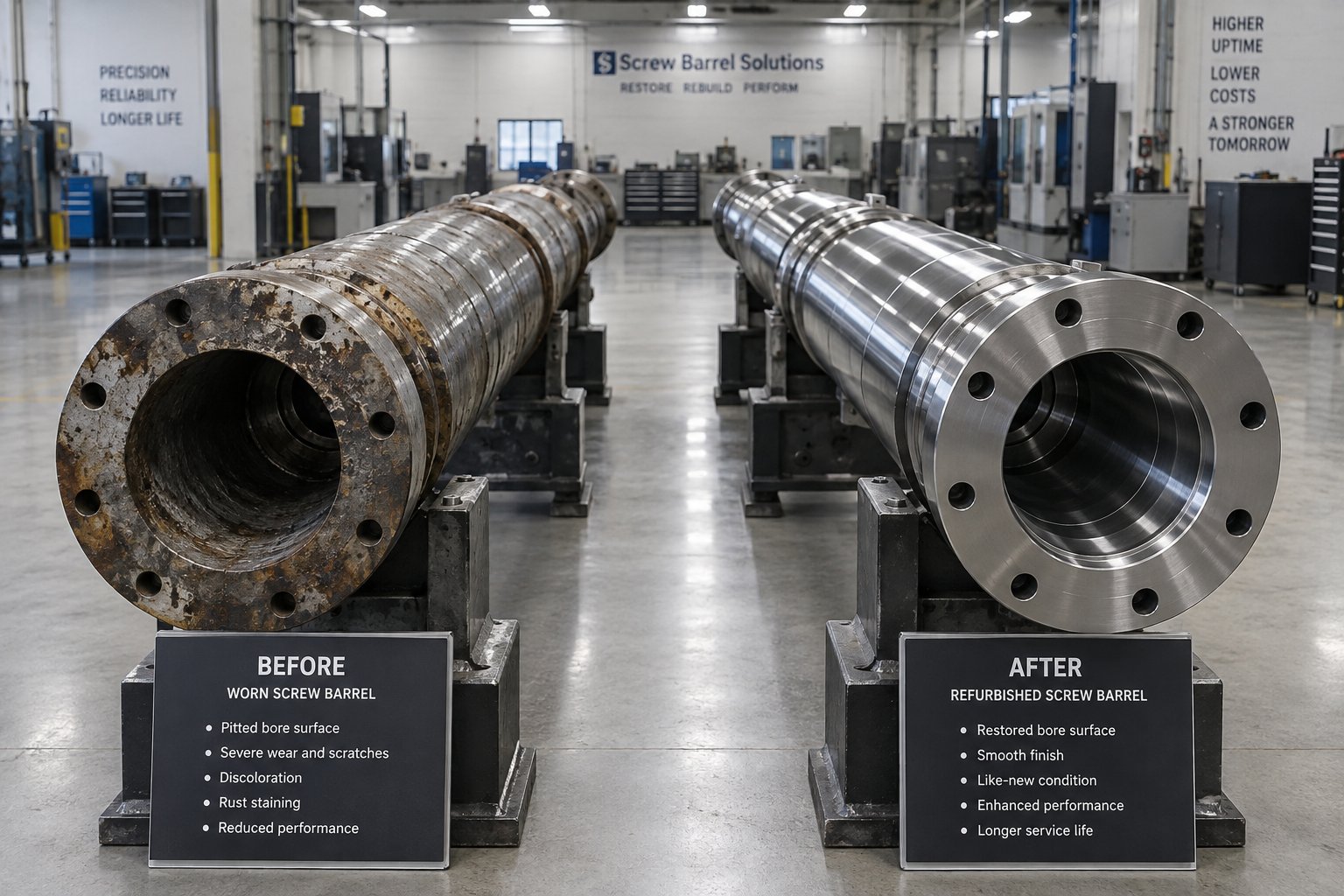
Refurbishment vs Replacement: The Economics Your Bimetallic Screw Barrel Manufacturer Rarely Discusses
A worn barrel sits on your shop floor. The bore diameter has grown past tolerance, output quality is slipping, and you're facing a decision that most procurement teams treat as binary: buy a new bimetallic screw barrel for sale from your usual supplier and wait for delivery, or keep running a degraded component and accept the losses. But there's a third option that rarely makes it into the conversation — refurbishment. Re-lining a worn barrel through alloy spray welding or centrifugal re-casting can restore it to serviceable condition at a fraction of the replacement cost, yet surprisingly few buyers even know it's available.
Why the silence? Partly because selling a new barrel generates more revenue than refurbishing an old one. Partly because not every manufacturer has the technical capability to offer restoration services. Whatever the reason, the economics deserve a clear-eyed comparison — because the right choice depends on the barrel's condition, your production timeline, and how you calculate cost.
| Dimension | Refurbishment (Re-lining) | Full Replacement |
|---|---|---|
| Typical Cost Relative to New Barrel | 30-60% of new barrel price | 100% (baseline) |
| Turnaround Time | 1-3 weeks (depending on method and barrel size) | 4-12 weeks (manufacturing lead time plus shipping) |
| Expected Service Life After Treatment | 60-85% of original barrel life (method-dependent) | 100% of rated service life |
| Best Candidates | Moderate bore wear (within re-lining allowance), structurally sound substrate, no cracking or external deformation | Severe wear beyond re-lining limits, substrate fatigue, delamination damage, or cracked barrel body |
| Limitations | Cannot restore barrels with compromised substrates, deep corrosion pitting into base steel, or dimensional distortion; liner thickness may be slightly reduced vs. original | Higher upfront cost, longer lead time, requires accurate re-specification if application or resin has changed |
When Refurbishment Makes Economic Sense
Not every worn barrel qualifies for refurbishment — but many do, and the savings can be substantial. The key variable is substrate integrity. If the base steel body remains straight, dimensionally stable, and free of cracks or deep corrosion penetration, the worn alloy liner can be removed and a fresh layer applied. The barrel essentially gets a second life at roughly 30-60% of the cost of buying new.
Imagine you're running a production line with a bimetallic twin screw barrel that originally cost $25,000. After three years of processing glass-fiber-filled compounds, bore measurements confirm the liner has worn past tolerance. A full replacement means another $25,000 plus an 8-week lead time — during which you either shut the line down or limp along with degraded output. Refurbishment, by contrast, can restore the bore in one to three weeks at $8,000-$15,000. You're back to full production faster and at lower cost.
The wear threshold matters. Refurbishment works best when the liner has worn moderately but the substrate underneath hasn't been exposed to direct chemical or abrasive attack for extended periods. Once corrosive resins breach the liner and start pitting the base steel, the substrate's bonding surface is compromised — and a new liner applied to damaged steel won't adhere as reliably as one bonded to clean, intact material.
A practical rule of thumb: if your bore diameter has enlarged by more than the original liner thickness — meaning the wear has consumed the entire alloy layer and begun eroding base metal — replacement is generally the safer path. If the liner still retains 20-40% of its original thickness and the substrate shows no signs of corrosion or fatigue cracking, refurbishment delivers strong return on investment.
The True Cost of Bimetallic Barrel Ownership
Here's where most purchasing decisions go wrong: comparing barrels on unit price rather than cost-per-processing-hour. A $12,000 barrel that lasts 8,000 hours costs $1.50 per hour of operation. A $20,000 barrel from a different supplier that lasts 18,000 hours costs $1.11 per hour. The "expensive" barrel is actually 26% cheaper to own.
This calculation becomes even more revealing when you factor in downtime. Industry cost analysis suggests that for production lines generating $500 per hour in output value, each percentage point of equipment availability represents roughly $21,000 in annual revenue at 5,000 operating hours. A barrel failure that takes your line down for two weeks doesn't just cost you the replacement barrel — it costs you $84,000 or more in lost production capacity.
Framing barrel economics this way changes the refurbishment-versus-replacement decision fundamentally. Consider two scenarios:
- Scenario A: You buy a new bimetallic twin screw barrel extruder barrel for $25,000 with an 8-week lead time. Total cost including estimated downtime at $500/hour for two weeks of partial production loss: $25,000 + approximately $40,000 in reduced throughput = $65,000 effective cost.
- Scenario B: You refurbish the existing barrel for $12,000 with a 2-week turnaround, using a spare barrel to bridge the gap or scheduling the work during a planned shutdown. Total cost: $12,000 with minimal production impact. The refurbished barrel delivers 60-85% of original service life — still thousands of productive hours.
Scenario B doesn't always win. If the barrel's substrate is compromised, if the alloy specification needs to change because you've switched resins, or if the barrel has already been refurbished once and a second re-lining would leave insufficient liner thickness, replacement is the correct call. But when conditions favor refurbishment, ignoring it means leaving tens of thousands of dollars on the table.
The smartest operators maintain a lifecycle cost spreadsheet for every critical barrel, tracking cumulative processing hours, bore measurements at regular intervals, and cost-per-hour performance. This data transforms barrel management from reactive crisis response into planned, optimized maintenance — and it tells you exactly when refurbishment makes sense versus when it's time to buy new.
Alloy Spray Welding as a Restoration Option
Among refurbishment methods, alloy spray welding has emerged as one of the most versatile and accessible techniques for restoring worn barrels and screws. The process deposits wear-resistant alloy material — typically nickel-based, cobalt-based, or tungsten carbide composite powders — onto worn surfaces using a high-temperature thermal spray. Unlike traditional welding, spray welding applies minimal heat to the base material, preserving the substrate's metallurgical properties while building up the worn surface to its original dimensions or better.
The process follows a logical sequence: the worn surface is turned down to remove damaged material and create a uniform bonding profile, grit-blasted for adhesion, coated with the selected alloy through controlled spray deposition, and then finish-machined to final tolerances. The result is a protective layer that restores both dimensional accuracy and wear resistance — often improving on the original surface properties if a harder alloy is selected during the restoration.
What makes alloy spray welding particularly valuable for plastics processors is its applicability to both barrels and screws. Screw flight lands, which experience the most intense abrasive contact, can be rebuilt with hardfacing alloys that match or exceed the barrel liner's wear resistance. This means you can restore an entire screw-and-barrel set to working condition rather than replacing individual components piecemeal — an approach that maintains optimal clearance and extends the service life of both parts simultaneously.
For extrusion and injection molding operators dealing with progressive screw wear, barrel bore degradation, or corrosion damage, providers like NANHAIYA's alloy spray welding service offer targeted restoration through wear-resistant surface treatments. Their service supports operators facing the full range of wear challenges — from abrasion-driven bore enlargement to corrosion-induced surface degradation — providing a practical alternative to full component replacement when barrel and screw substrates remain structurally sound.
Centrifugal re-casting represents another refurbishment pathway, essentially repeating the original barrel manufacturing process with a fresh alloy charge spun into the cleaned-out bore. This method produces a thicker, more uniformly bonded liner than spray welding and delivers service life closer to a brand-new barrel. The tradeoff is longer turnaround time, higher cost, and limited availability — not every facility has centrifugal casting equipment capable of handling refurbishment work.
The choice between spray welding and re-casting depends on how much material needs to be restored, the barrel's geometry, and the urgency of the repair. Spray welding is faster and more flexible, especially for localized wear repair or screw restoration. Re-casting delivers a more robust result when the entire liner needs replacement. Both methods, however, share a common prerequisite: the substrate must be in good condition. No refurbishment technique can rescue a barrel whose base steel has been structurally compromised.
Understanding these restoration options — and factoring them into your purchasing strategy from the beginning — fundamentally changes how you evaluate suppliers. A bimetallic screw barrel manufacturer that offers aftermarket refurbishment services is signaling confidence in their product's design for longevity. They're also giving you a cost-management tool that extends the value of every barrel you buy. Conversely, a supplier with no restoration capability is implicitly telling you that every worn barrel is a new sale — an incentive structure worth recognizing as you finalize your sourcing decisions.
Common Sourcing Mistakes Every Buyer Should Avoid
Refurbishment economics, alloy-resin matching, failure mode recognition — you now have the technical foundation to make a genuinely informed purchasing decision. Yet even well-informed buyers stumble at the sourcing stage. The mistakes are rarely dramatic. They're quiet oversights — a skipped question, an unchecked assumption, a price comparison that ignores everything behind the number — that surface months later as premature wear, unexpected downtime, or a barrel that simply doesn't perform the way the spec sheet promised.
These are the sourcing errors that show up most frequently, ranked roughly by the severity of their consequences:
- Choosing based solely on price without evaluating alloy composition or test documentation. The most common and most costly mistake. A low quote feels like a win — until the barrel fails at half the expected service life. As Plastics Technology emphasizes, a barrel purchased based only on price can ultimately cost more than higher-priced alternatives when you factor in premature wear, contaminated output, and production downtime.
- Not specifying the exact alloy required for the target resin. Ordering a "bimetallic barrel" without defining the alloy family is like ordering "steel" without specifying the grade. The supplier fills in the blank — often with whatever alloy they have in stock or whatever costs them the least to produce.
- Ignoring substrate steel grade and its impact on liner adhesion. Buyers fixate on the liner alloy and overlook the base metal entirely. A cheap substrate compromises bond integrity, fatigue resistance, and dimensional stability under pressure cycling — problems that no liner, however premium, can compensate for.
- Failing to request metallurgical test reports. Hardness certificates, metallographic cross-section images, and ultrasonic bond-integrity results should accompany every shipment. Without them, you're accepting quality claims on trust alone. Mill test reports — documenting chemical composition, mechanical properties, and heat treatment data — provide the traceability that connects a delivered barrel to its actual production conditions.
- Overlooking lead times and logistical planning. A bimetallic barrel isn't a shelf-stock commodity. Manufacturing lead times of 4 to 12 weeks are normal, and ocean shipping from a china bimetallic twin screw barrel supplier adds further time plus the risk of vibration-induced stress relief and saltwater corrosion during transit. Failing to plan for these timelines turns a routine barrel change into an emergency procurement scramble — at premium cost.
- Not considering the full lifecycle cost including potential refurbishment. The purchase price is one data point. The cost-per-processing-hour — factoring in service life, downtime impact, refurbishment potential, and replacement frequency — is the number that actually determines your barrel economics.
The Price Trap and How to Avoid It
Why do experienced procurement professionals still fall into price-driven purchasing? Because bimetallic screw barrel HS code classifications (typically under 8477.90 for plastics machinery parts) make barrels look interchangeable on paper. Two line items with the same tariff code, the same nominal dimensions, and similar-sounding alloy descriptions appear to be the same product. They rarely are.
The differences hide in places that a purchase order can't capture: liner porosity invisible without metallographic inspection, hardness values that vary along the barrel length because casting parameters drifted during production, bond-interface quality that only ultrasonic testing reveals, and substrate steel that was substituted for a cheaper grade without disclosure. A top sale bimetallic screw and barrel listing at an attractively low price may reflect genuine manufacturing efficiency — or it may reflect corners cut in alloy quality, heat treatment duration, or post-cast inspection.
The practical defense is straightforward: never compare barrels on unit price alone. Request the alloy composition certificate, hardness test results at multiple measurement points, and ultrasonic bond-integrity data. Then calculate the cost-per-hour based on the supplier's documented performance data or — better yet — your own historical records with that supplier's barrels. A barrel costing 30% more upfront but lasting twice as long is 35% cheaper to own. That math doesn't change regardless of where the barrel ships from.
Specification Errors That Lead to Premature Failure
Even when you've found a trustworthy supplier, specification oversights can undermine the entire investment. Two errors appear disproportionately often:
Alloy mismatch for the resin being processed. This was covered in depth earlier, but it bears repeating here because it's the single most preventable cause of premature barrel failure. An iron-based liner running PVC will corrode. A nickel-based liner processing 40% glass-filled nylon will abrade faster than expected. The alloy must be selected based on the dominant wear mechanism — abrasion, corrosion, or both — not on hardness number or price.
Substrate steel left unspecified. Many purchase orders define the liner alloy precisely but say nothing about the barrel body material. This gives the manufacturer discretion to use whatever base steel they choose — and in cost-competitive markets, that discretion tends to favor the cheapest option that meets minimum dimensional requirements. Specify the substrate grade explicitly (AISI 4140, 4340, or equivalent), and confirm the heat treatment protocol. The substrate carries every mechanical load the barrel experiences; it's not a detail you can afford to leave undefined.
A third, subtler error involves dimensional specifications. Barrel bore diameter, straightness tolerance, surface finish (Ra value), and liner thickness should all appear on your purchase specification with defined acceptance criteria. As industry sources note, even a seemingly minuscule deviation in straightness can adversely affect performance, accelerate wear to both screw and barrel, and generate metal particles that contaminate your end product. Specifying these parameters upfront — rather than assuming the supplier's defaults match your requirements — prevents problems that are very difficult to fix after delivery.
Building a Reliable Supplier Relationship
The most resilient barrel sourcing strategy isn't finding the lowest price or even the best single barrel — it's building a relationship with a manufacturer whose capabilities, transparency, and service scope align with your long-term operational needs.
What does that look like in practice? A supplier who provides transparent documentation — alloy certificates, hardness reports, dimensional inspection data — with every shipment, not just when you ask for it. A technical team that helps you match alloy specifications to your resin portfolio rather than defaulting to a one-size-fits-all recommendation. Aftermarket services like alloy spray welding for barrel and screw restoration, which give you cost-management flexibility when components wear and extend the return on every barrel purchased.
Reliable suppliers also communicate proactively about lead times, raw material availability, and any production changes that could affect consistency. They accept trial orders so you can validate quality before committing to volume. And they welcome your questions — including the tough ones about alloy sourcing, process control, and inspection methodology — because their answers reflect genuine capability rather than marketing language.
Geography matters, but less than many buyers assume. Whether you're evaluating a china bimetallic twin screw barrel manufacturer, a supplier in India, or a European producer, the evaluation framework is identical: certifications, test data, reference customers, and honest answers to direct questions. The best supplier for your operation is the one whose quality systems, technical depth, and commercial terms consistently deliver barrels that perform as specified — shipment after shipment, year after year.
The true cost of a bimetallic screw barrel is never the invoice price — it is the cost per hour of reliable production, determined by alloy-resin compatibility, manufacturing quality, substrate integrity, and the supplier's commitment to transparency at every stage from specification through service life.
Frequently Asked Questions About Bimetallic Screw Barrels
1. What is a bimetallic screw barrel and how does it differ from a nitrided barrel?
A bimetallic screw barrel features a 2-3 mm thick wear-resistant alloy liner metallurgically fused to a steel substrate through centrifugal casting or PTA welding. Unlike nitrided barrels, which only harden the existing steel surface to a depth of 0.4-0.7 mm, bimetallic barrels add an entirely separate alloy layer permanently bonded at the molecular level. This gives bimetallic barrels 4-8x the service life of standard barrels, compared to just 2-3x for nitrided versions, making them the preferred choice for abrasive or corrosive resin processing.
2. Which bimetallic alloy liner is best for processing PVC?
Nickel-based alloy liners such as Colmonoy 5 or Inconel 625 are strongly recommended for PVC processing. PVC releases hydrogen chloride gas during thermal processing, which forms hydrochloric acid and rapidly corrodes iron-rich surfaces. Nickel-based liners create an effective chemical barrier against HCl attack. Iron-based liners should be avoided entirely for PVC, regardless of their hardness ratings, because their high iron content makes them highly susceptible to acid-driven corrosion and pitting.
3. How do I evaluate the quality of a bimetallic screw barrel manufacturer?
Start by confirming ISO 9001 certification, then request specific metallurgical documentation: hardness test certificates (Rockwell and Vickers), metallographic cross-section images of the liner-substrate bond, ultrasonic bond-integrity test results, and dimensional tolerance verification reports. Ask the supplier to name the exact alloy grade and substrate steel used. Reputable manufacturers will provide reference customers in your resin category and welcome trial orders. Red flags include vague alloy claims, missing test reports, no reference customers, and pricing significantly below market norms without explanation.
4. Can a worn bimetallic barrel be refurbished instead of replaced?
Yes, if the steel substrate remains structurally sound, straight, and free of deep corrosion or cracking. Refurbishment methods like alloy spray welding can restore worn bores and screw flights at 30-60% of new barrel cost with turnaround times of 1-3 weeks. Services such as NANHAIYA's alloy spray welding (nhyscrews.com/services/alloy-spray-welding) support extrusion and injection molding operators by applying wear-resistant surface treatments that restore critical dimensions. Refurbishment is not viable when the substrate has been compromised by corrosion breakthrough or mechanical fatigue.
5. What causes bimetallic barrel liner delamination and how can it be prevented?
衬里分层——即合金层与基材的分离——主要由三个因素造成:制造过程中离心铸造质量差(结合界面处存在空隙或气孔)、启动和停止过程中温度快速变化引起的热冲击,以及运行温度超过合金的额定温度极限。预防措施包括:选择进行超声波结合完整性测试的制造商,遵循螺杆旋转前30-60分钟的逐步料筒预热程序,并且始终避免超过衬里合金的额定温度上限。早期症状包括模制零件中出现金属屑以及熔体质量发生不明原因的变化。
Written by
Nanhaiya Technical Team
Zhoushan Nanhaiya Plastic Machinery Co., Ltd.
The Nanhaiya technical team supports screw and barrel manufacturing projects through application review, technical communication, custom manufacturing coordination, and production and quality control.
Discuss Your Application
Related Articles
More insights on screw barrel technology and plastics processing.
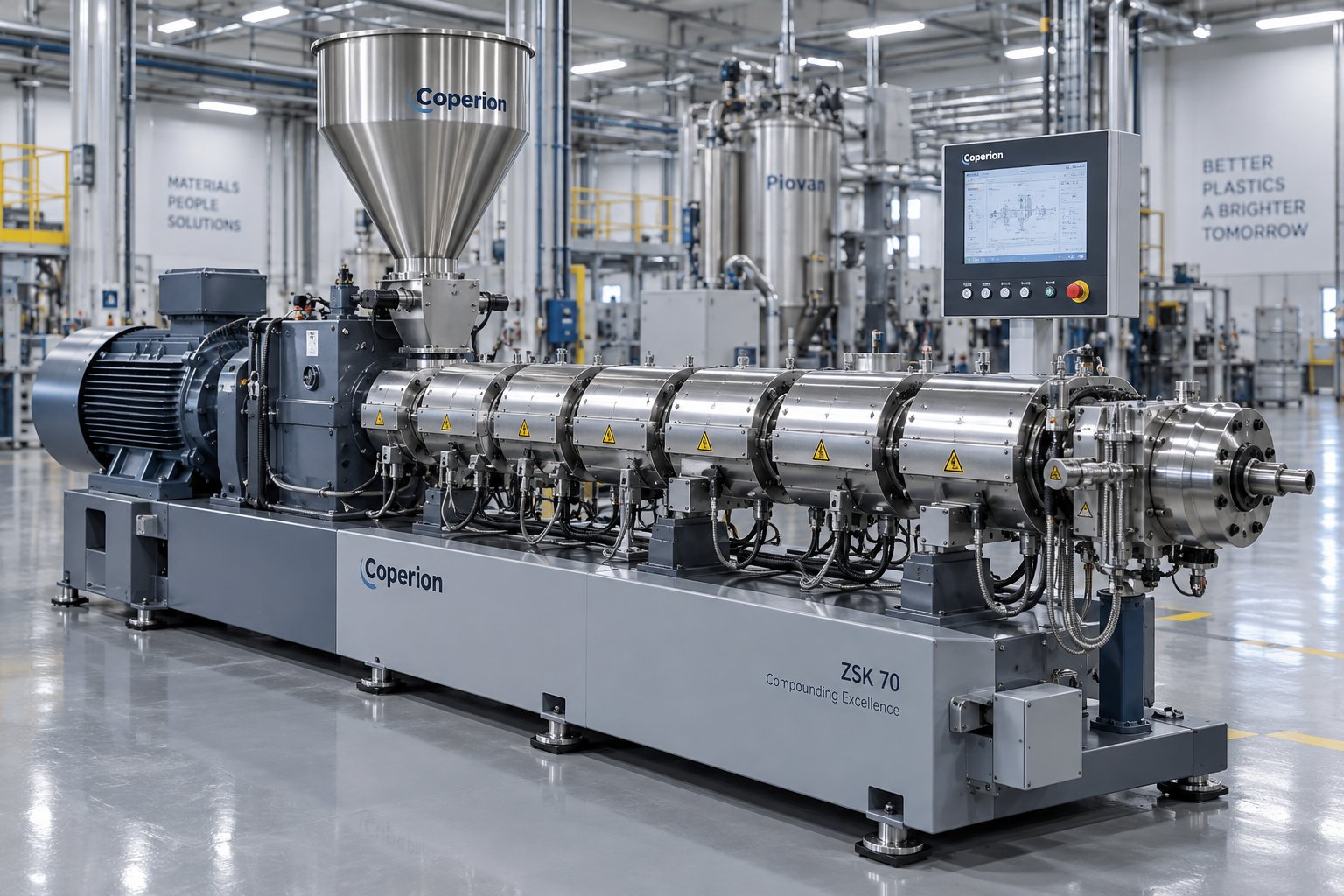
What Your Single Screw Extruder Manufacturer Won't Tell You
Oct 10, 2026
Learn how to evaluate single screw extruder manufacturers with this buyer-focused guide covering specs, configurations, material matching, and a ready-to-use selection checklist.
Read Article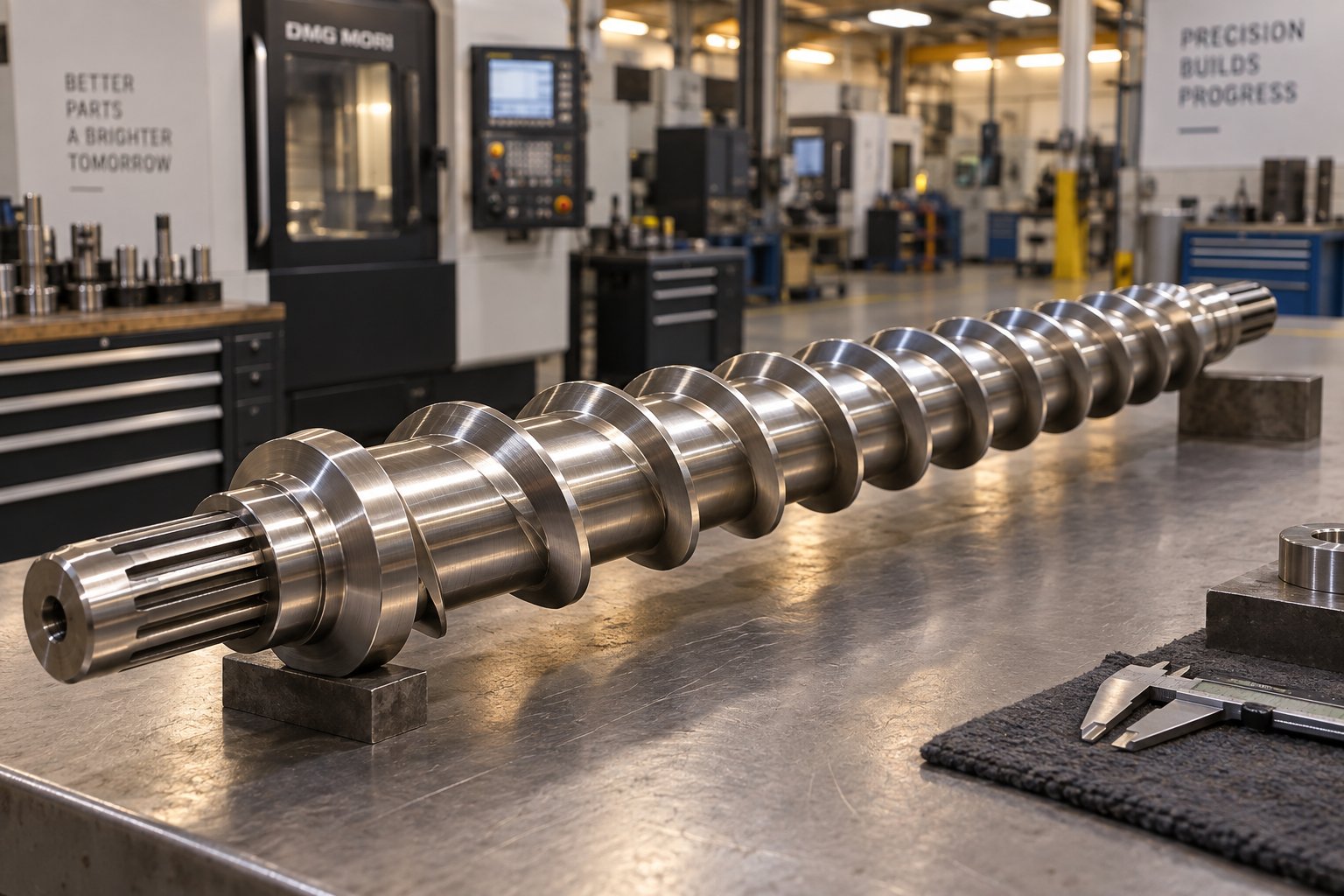
Plastic Extruder Screw Price Demystified: From Steel To Sticker
Oct 10, 2026
What drives plastic extruder screw price? This independent guide breaks down diameter, L/D ratio, metallurgy, order volume, and total cost of ownership factors.
Read Article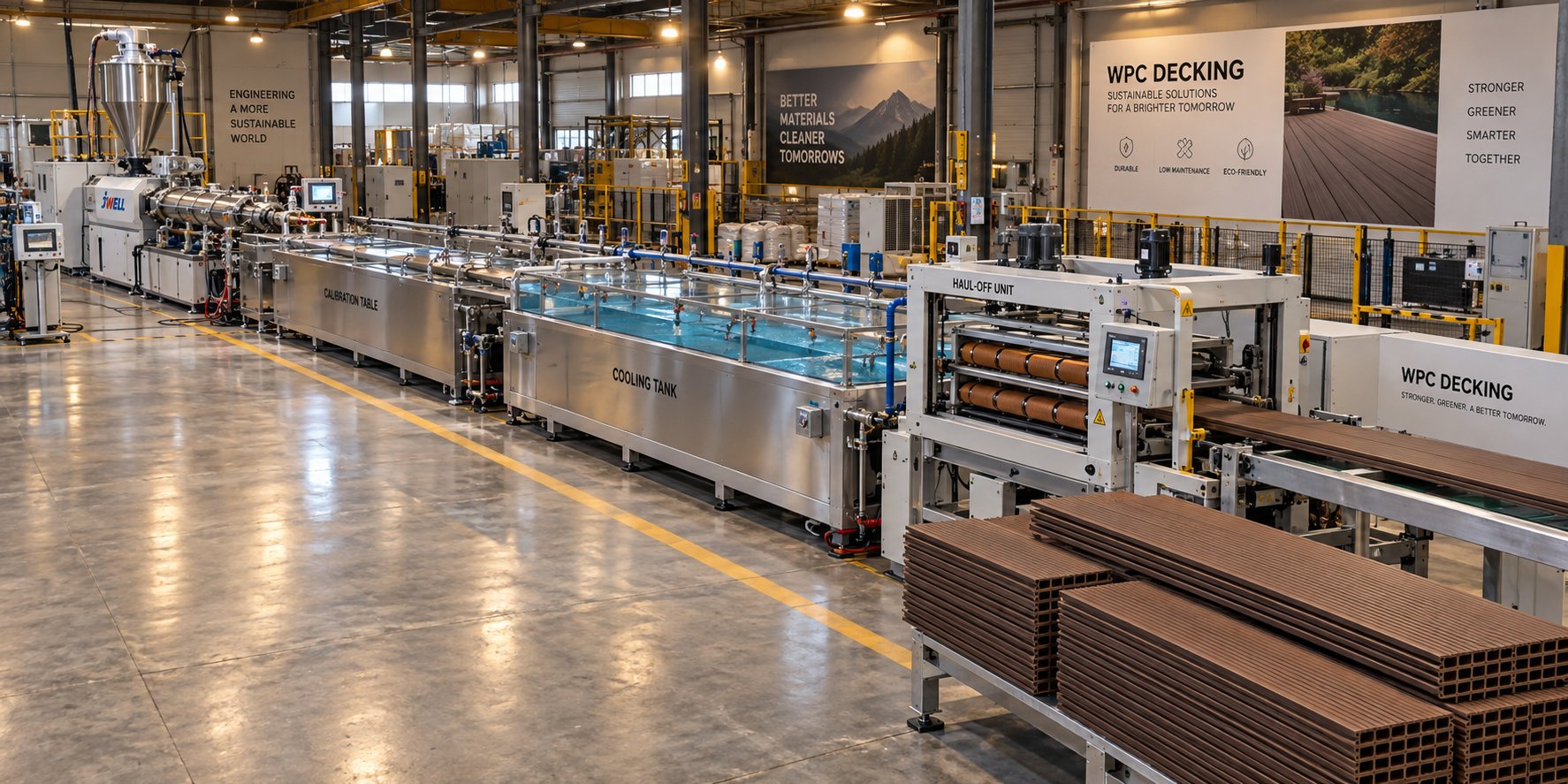
What No Supplier Tells You About WPC Decking Making Machines
Oct 6, 2026
Learn how a WPC decking making machine works, compare extruder types, formulations, and production methods, plus get a buyer checklist to evaluate any supplier.
Read ArticleLooking for something else?
Search by material, symptom or product and jump straight to the relevant page.
These are navigation suggestions based on keyword matching — not a quotation, not a delivery commitment, and not a substitute for engineering review. Final specification is confirmed by our engineers against your drawings and processed material.
Need help with screw barrel selection?
Share your machine model, processed material and application. Our team can help with pricing and technical support.