

What Is a Bimetallic Screw Barrel and Why Does It Matter
Imagine you need a single component that is both structurally tough enough to handle enormous mechanical stress and hard enough to resist constant surface erosion. Sounds like a contradiction? That is exactly the engineering problem a bimetallic screw barrel is designed to solve — and understanding how it works can save you thousands of dollars in avoidable wear, downtime, and premature replacements.
Defining the Bimetallic Screw Barrel
The term gets tossed around loosely in supplier catalogs, so let's pin it down clearly.
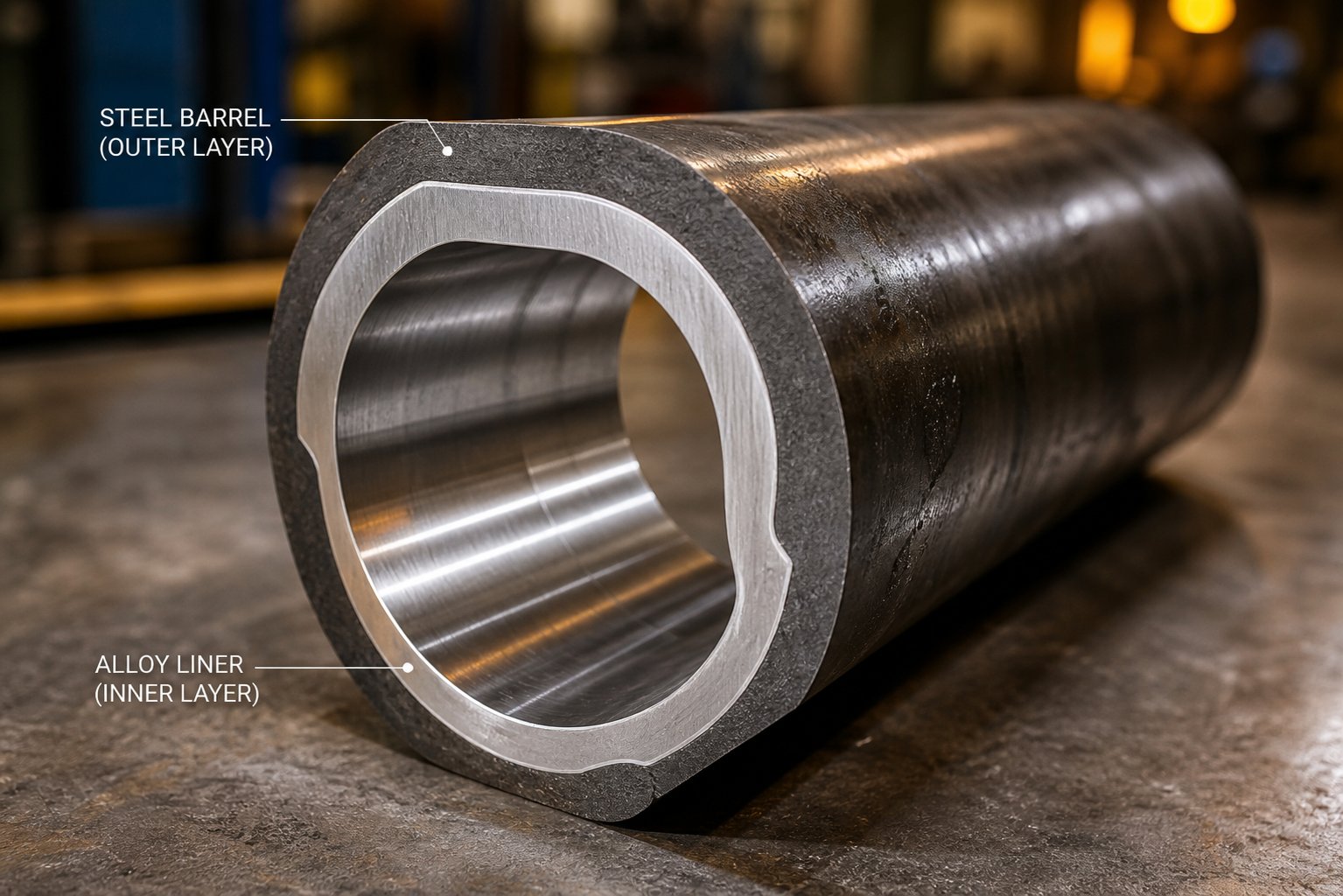
A bimetallic screw barrel is a plastics processing component that combines a carbon or alloy steel base — providing structural strength, fatigue resistance, and dimensional stability — with a separate wear-resistant and/or corrosion-resistant alloy layer metallurgically bonded to its working surfaces. The two materials remain in distinct layers, fused together rather than mixed, creating a component optimized for both durability and surface protection.
The prefix "bi" simply means two. Two metals, two distinct jobs. The steel base handles the mechanical load. The alloy surface layer fights the abrasion and chemical attack that polymers and their additives inflict during processing.
This distinction matters more than it might seem at first glance. A chrome-plated barrel is not bimetallic — plating is a thin surface deposit that can flake under thermal cycling. A nitrided barrel is not bimetallic either — nitriding diffuses nitrogen into existing steel rather than adding a new material. A true bimetallic component carries several millimeters of real alloy that becomes an integral part of the piece itself.
It is also important to recognize that the term covers two different components built through two different processes. A bimetallic barrel receives its alloy through centrifugal casting, which deposits a dense liner — typically 2.0 to 3.0 mm thick — along the entire bore. A bimetallic screw, on the other hand, gets its protection through PTA (plasma transferred arc) welding, which deposits a 1.0 to 1.5 mm hardfacing layer onto the flight lands — the precise surfaces where the screw contacts the barrel wall and where wear concentrates. When people refer to a bimetallic screw and barrel set, they are describing a matched pair where both components carry specialized alloy protection, each applied by its own manufacturing method.
Why the Dual-Material Approach Exists
Here is the core engineering dilemma: no single alloy can do everything a screw or barrel demands. Materials that excel at resisting abrasion tend to be brittle. Materials tough enough to absorb mechanical shock and thermal cycling lack the surface hardness to survive contact with glass-fiber-filled compounds or chemically aggressive resins like PVC.
A barrel machined entirely from a hard alloy like tungsten carbide would shatter under the internal pressures and thermal stresses of an extruder. Conversely, a plain carbon steel barrel running 30% glass-filled nylon would have its bore eroded in a matter of months. Neither extreme works on its own.
Bimetallic construction sidesteps this tradeoff entirely. The tough steel core absorbs stress, resists fatigue, and holds dimensional tolerances. The bonded alloy layer — engineered specifically for the polymer being processed — takes the punishment at the surface. Each material does the job it was designed for, and neither is forced to compromise.
That dual-material logic is what makes these components worth evaluating seriously. But the real question is not whether the technology works — it is whether your specific application actually needs it. The answer depends on metallurgy, alloy selection, and the particular polymers running through your machine.
The Metallurgical Science Behind Bimetallic Screw Barrel Material
The dual-material concept sounds straightforward — put a hard layer on a tough base. But the reason a bimetallic extrusion barrel screw actually survives the punishing interior of an extruder or injection molding machine comes down to what happens at the boundary between those two materials. That boundary is not a simple joint. It is a carefully engineered metallurgical bond zone, and understanding it explains why these components last as long as they do.
How the Alloy Bond Zone Forms
Picture two metals pressed together and heated to extreme temperatures. At those temperatures, atoms from the steel substrate and atoms from the alloy liner do not just sit next to each other — they migrate across the interface and intermix. This atomic-level diffusion creates a gradient transition zone rather than a sharp, abrupt line between materials.
During centrifugal casting, the barrel is heated as the lining material melts, then rotated at high RPMs while cooling. The combination of heat, pressure, and centrifugal force drives this interdiffusion, fusing the alloy liner to the steel base in an inseparable bond. The resulting transition zone might only be fractions of a millimeter thick, but it is what prevents the liner from cracking, peeling, or delaminating under operational stress.
Why does this gradient matter so much? Consider what a plastic machine bimetallic screw barrel endures during a single production run: rapid thermal cycling as heater zones fluctuate, internal pressures that can exceed 20,000 psi, and constant mechanical vibration. A mechanical joint — bolted, press-fitted, or adhesively bonded — would eventually fail under these conditions. Thermal expansion differences alone would create gaps and stress concentrations at a sharp interface. The diffusion-bonded gradient absorbs those stresses gradually, distributing them across a smooth transition instead of concentrating them at a single plane.
Why Monolithic Alloys Cannot Compete
If the alloy liner is what provides wear resistance, why not simply make the entire barrel from that alloy? The answer is both practical and economic.
A barrel machined entirely from a tungsten carbide matrix would be extraordinarily brittle. One thermal shock event — a heater malfunction, an unexpected cold start — could crack it catastrophically. As metallurgy experts note, excessively hard alloys can crack or chip under shock loads because maximum hardness often comes at the expense of toughness. On the opposite end, a plain carbon steel barrel offers excellent toughness and is inexpensive, but it simply cannot withstand the abrasive erosion from glass-fiber-filled compounds or the chemical attack from corrosive resins like PVC and fluoropolymers.
Bimetallic construction occupies the engineering sweet spot between these extremes. You'll notice that each material handles the job it was specifically designed to perform — the steel base absorbs stress while the alloy surface resists degradation.
| Property | Monolithic Carbon Steel | Monolithic Hard Alloy | Bimetallic Construction |
|---|---|---|---|
| Structural Toughness | Excellent | Poor — brittle under shock loads | Excellent (steel core) |
| Wear Resistance | Poor — erodes rapidly with filled polymers | Excellent | Excellent (alloy liner) |
| Corrosion Resistance | Minimal | Varies by alloy | High (when matched to resin type) |
| Thermal Shock Tolerance | High | Low — risk of catastrophic cracking | High (steel absorbs thermal stress) |
| Material Cost | Low | Prohibitively expensive at full volume | Moderate premium over steel |
| Practical Viability | Only for unfilled, non-corrosive resins | Impractical for full-size barrels | Industry standard for demanding applications |
The table makes the tradeoff clear. Neither extreme delivers a viable solution for processors running abrasive or chemically aggressive materials. Bimetallic construction is not a luxury upgrade — for these applications, it is the only approach that balances all the competing demands simultaneously.
Of course, knowing that a dual-material approach works raises the next logical question: which alloy should go on the inside? The answer depends entirely on whether your primary enemy is abrasion, corrosion, or some combination of both — and the alloy families available for that inner layer differ dramatically in how they handle each threat.
Bimetallic Alloy Types and How to Choose the Right One
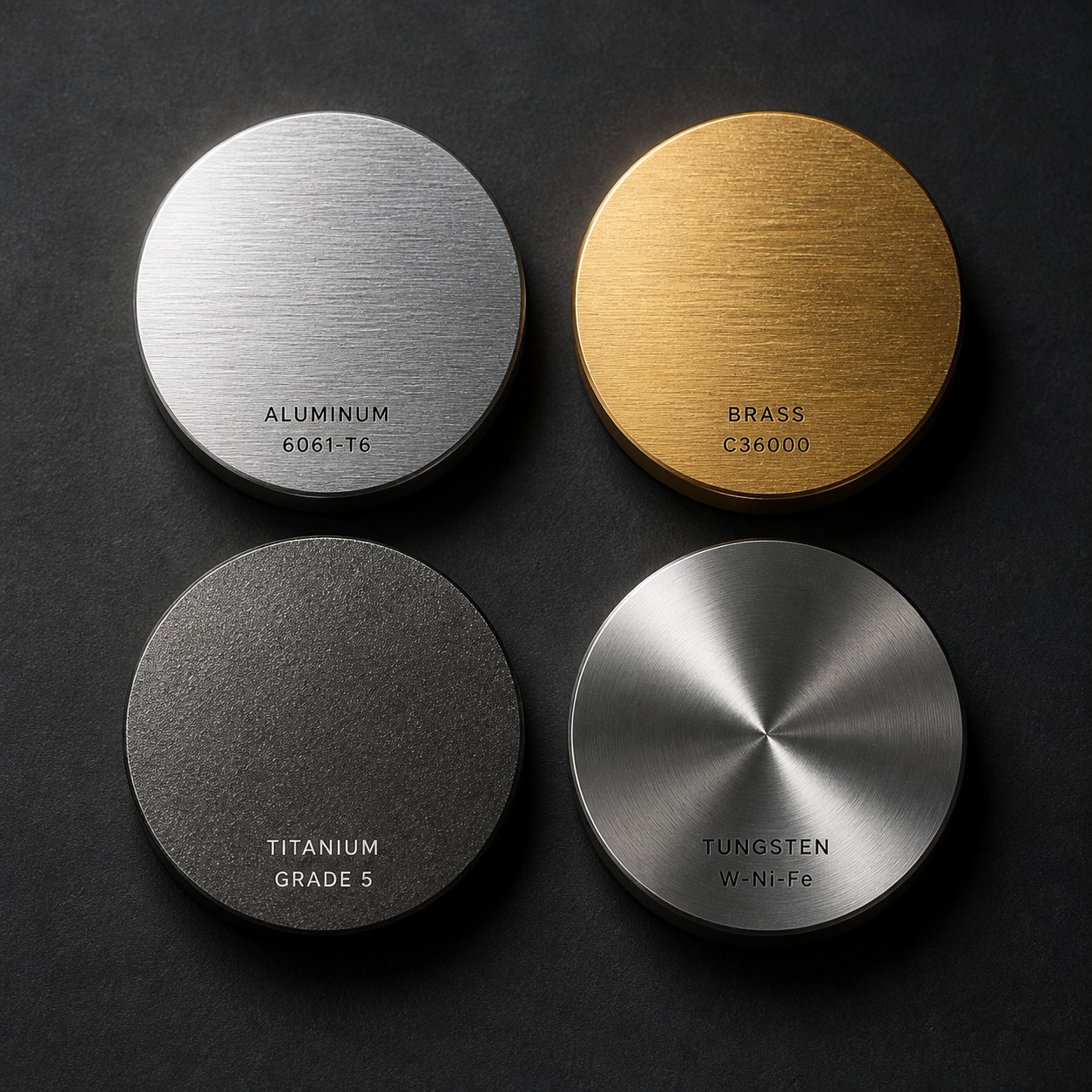
Your primary threat — abrasion, corrosion, or both — determines which alloy belongs on the working surface of your bimetallic screw barrel. Four major alloy families dominate the market, and each is engineered to handle a specific type of punishment. Choosing the wrong one is not just inefficient; it can shorten component life to a fraction of what the right alloy would deliver.
Nickel-Based Alloys for Corrosion and Moderate Wear
When you process PVC, CPVC, fluoropolymers, or any resin that generates acidic byproducts at elevated temperatures, corrosion is the primary enemy — not abrasion. Hydrogen chloride gas released during PVC processing can reach 50 to 200 ppm concentration inside the barrel, creating conditions aggressive enough to corrode standard nitrided steel at measurable rates within 500 operating hours.
Nickel-based alloys — often referenced as Ni-60 type designations or trade names like Xaloy 800-series equivalents in supplier datasheets — address this directly. Their nickel-rich matrix combined with high chromium content forms a passive oxide layer that resists chemical attack from HCl and other decomposition products. For a bimetallic PVC extrusion screw barrel, a nickel-based alloy liner is the industry-standard specification because corrosive wear rates drop dramatically — roughly 0.01 to 0.03 mm per 1,000 hours compared to 0.08 to 0.15 mm per 1,000 hours for nitrided 4140 steel in the same PVC service.
The tradeoff? Nickel-based alloys provide moderate abrasion resistance, not extreme abrasion resistance. They work well for unfilled or lightly filled corrosive resins, but if you are running 40% glass-filled PVC, you'll need a different strategy — one that addresses both attack vectors simultaneously.
Cobalt-Based and Iron-Based Alloys for Abrasive Applications
Cobalt-based alloys, most commonly recognized under the Stellite family (Stellite 6 and Stellite 12), occupy a unique position: they resist both abrasion and corrosion at the same time. Stellite 6 deposits at approximately 36 to 45 HRC, while Stellite 12 reaches 45 to 52 HRC. But hardness numbers alone do not explain their real advantage.
What makes cobalt-based alloys exceptional is their ability to retain hardness at elevated temperatures. Stellite 6 maintains 35 to 40 HRC at 600 degrees Celsius — a temperature range where conventional tool steels have already softened below 30 HRC and lost their protective value. Independent testing has shown that Stellite-overlaid screws exhibit corrosive wear rates 8 to 12 times lower than nitrided 4140 in chlorinated polymer environments. This makes them the benchmark for bimetallic rubber screw and barrel components exposed to chemically aggressive compounds, halogenated flame retardants, and high-temperature processing.
Iron-based boron alloys offer a more budget-friendly alternative for processors who face abrasion without significant corrosion. High-chromium white iron compositions — typically 15% to 30% chromium with 2% to 3.5% carbon — produce a microstructure packed with M7C3 chromium carbides in a martensitic matrix, delivering hardness values of 58 to 68 HRC. These alloys are commonly centrifugally cast as barrel bore liners and represent excellent value for general abrasive service. Their material costs sit substantially below Stellite or CPM tool steels, and the deposition processes are well-established. The limitation is moderate corrosion resistance — fine for filled polyolefins, but inadequate for PVC or fluoropolymer processing.
Tungsten Carbide Alloys for Extreme Abrasion
When your compound is loaded with 30% or more glass fiber, ceramic microspheres, or mineral fillers, you are dealing with particles that act as micro-cutting tools inside the barrel. Standard alloys erode too quickly. This is where tungsten carbide (WC) dispersed in a metallic matrix delivers its premium performance.
Tungsten carbide alloys achieve hardness values of 1,100 to 1,400 HV — roughly equivalent to 70+ HRC — far exceeding any monolithic alloy option. When applied as an HVOF thermal spray coating on screw flight tips or embedded in centrifugally cast barrel liners, WC provides the most aggressive abrasion resistance commercially available. In standardized ASTM G65 dry-sand abrasion testing, WC-Co coatings show volume loss of just 1 to 5 mm cubed, compared to 15 to 35 mm cubed for D2 tool steel under equivalent conditions.
There is a critical caveat, though. Conventional WC-Co formulations have a vulnerability: the cobalt binder phase dissolves in acidic environments generated by PVC and halogenated compounds. For applications combining extreme abrasion with corrosive resins, corrosion-resistant variants like WC-CrC-Ni replace the cobalt binder with a nickel-chromium matrix, reducing corrosion current density 5 to 8 times while maintaining hardness above 1,000 HV. This distinction matters enormously when specifying a customized bimetallic rubber screw and barrel for demanding compound formulations.
Comparing the Four Alloy Families
The table below puts all four families side by side across the criteria that actually drive your selection decision. Use it as a starting point, then verify specific hardness values and alloy designations against your supplier's certified datasheets before finalizing a specification.
| Alloy Family | Primary Resistance | Typical Hardness | Ideal Polymer Applications | Relative Cost |
|---|---|---|---|---|
| Nickel-Based (Ni-60 type) | Corrosion | 50 - 62 HRC | PVC, CPVC, fluoropolymers, halogenated resins | Moderate-High |
| Cobalt-Based (Stellite 6 / 12) | Corrosion + Abrasion + Hot Hardness | 36 - 52 HRC (retains hardness above 600°C) | PVC with fillers, flame retardant compounds, rubber compounds | High |
| Iron-Based (High-Cr White Iron) | Abrasion (cost-effective) | 58 - 68 HRC | Filled polyolefins, mineral-filled compounds, general abrasive service | Low-Moderate |
| Tungsten Carbide (WC-Co / WC-CrC-Ni) | Extreme Abrasion | 1,100 - 1,400 HV (70+ HRC equivalent) | High glass-fiber loading, ceramic fillers, mineral-filled engineering plastics | High-Premium |
Notice the pattern: as you move from iron-based alloys toward tungsten carbide, abrasion resistance climbs dramatically — but so does cost. The sweet spot for your operation depends on exactly how abrasive and how corrosive your specific compound is. A processor running unfilled rigid PVC needs a completely different alloy than one compounding 50% glass-filled nylon, even though both are running bimetallic components.
Selecting the right alloy family is half the equation. The other half is how that alloy gets applied to the base metal — and that manufacturing process varies significantly depending on whether you are building a barrel or a screw.
How Bimetallic Screw Barrels Are Manufactured
The alloy you choose only matters if it ends up properly bonded to the base metal. A perfectly selected tungsten carbide liner that delaminates after three months of service is worse than useless — it is an expensive lesson in why manufacturing method matters just as much as material selection. Every bimetallic screw barrel factory uses specific processes tailored to the geometry of the component being produced, and the differences between those processes directly affect performance, longevity, and repairability.
Centrifugal Casting for Bimetallic Barrels
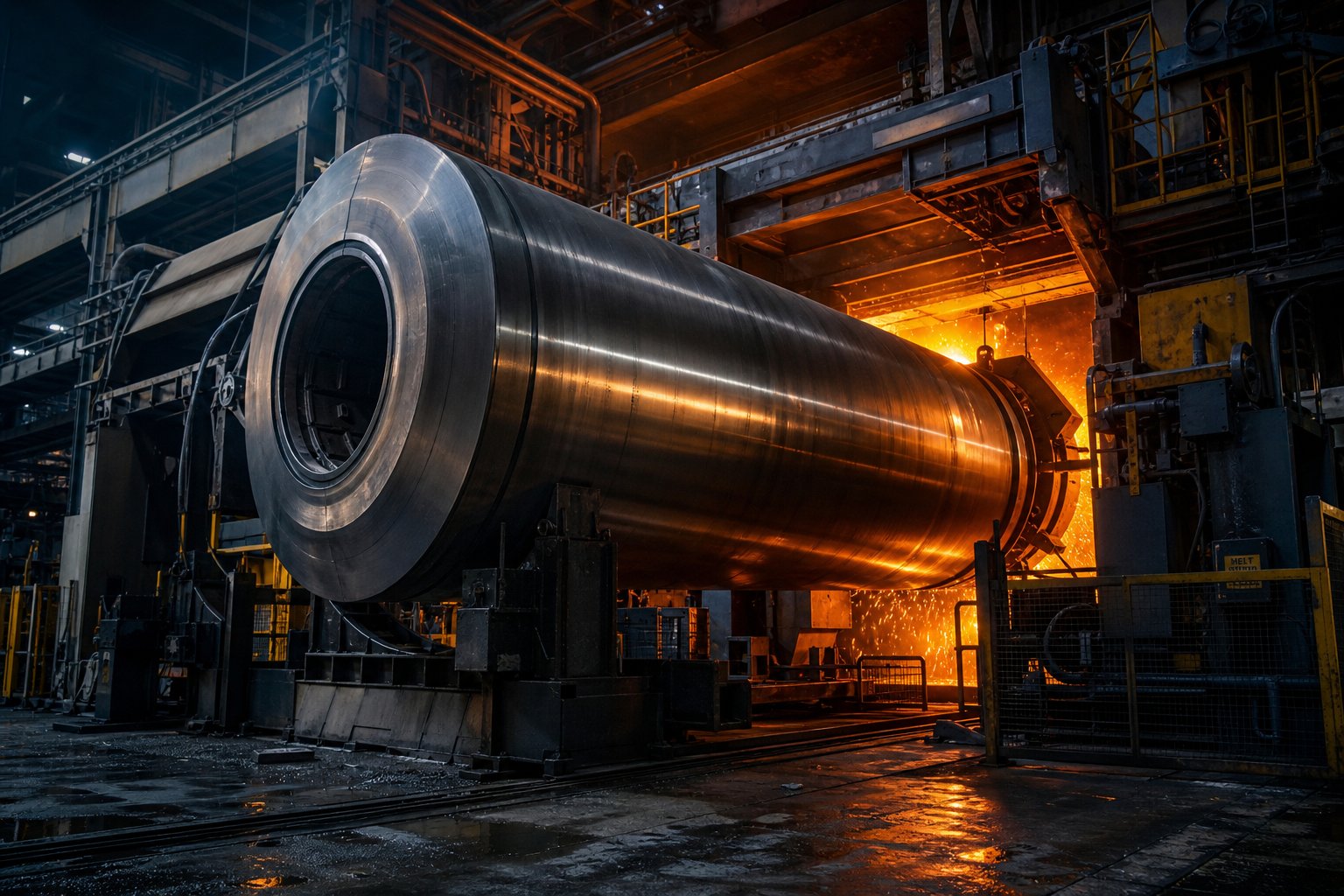
The barrel's cylindrical bore lends itself perfectly to centrifugal casting — the dominant manufacturing method for bimetallic barrel liners worldwide, and the reason China bimetallic screw barrel production has scaled so effectively over the past two decades. Here is how the process works, step by step:
- Bore preparation. The barrel tube is pre-bored to a diameter slightly larger than the final bore specification, leaving room for the alloy liner and finish machining.
- Alloy loading. A precisely measured charge of alloy powder — matched to the application requirements discussed in the previous section — is loaded into the bore.
- Sealing. Both ends of the barrel are sealed to contain the molten alloy during rotation.
- Furnace heating. The sealed barrel enters a furnace where temperatures climb high enough to melt the alloy powder completely. Conventional gas-fired furnaces are standard, though induction furnaces are also used for faster, more consistent heating and the ability to handle very large barrels.
- High-speed rotation. While the alloy is molten, the barrel spins at high RPM. Centrifugal force drives the liquid alloy outward against the bore wall, distributing it uniformly across the entire length. This force also pushes impurities and gas inclusions inward, away from the working surface, producing a dense, void-free liner.
- Controlled cooling. The barrel cools gradually while still spinning, allowing the metallurgical diffusion bond to form between the alloy and the steel substrate. Rapid or uneven cooling risks introducing residual stresses that can cause straightness deviations or liner cracking.
- Final machining. Once cooled, the bore is honed to its final diameter and surface finish. The outer surface is machined for heater band contact, thermocouple holes, and mounting flanges.
The result is a liner that is metallurgically fused to the steel — not mechanically attached, not plated, not sprayed on. As industry experts note, the ideal liner thickness is approximately 1.6 mm (0.063 in.), beyond which returns diminish. The composition, uniform thickness, and absence of porosity in this liner are critical determinants of working life, and they depend entirely on the reliability and repeatability of the centrifugal casting process.
One detail worth emphasizing: the quality of the backing material also matters. During the high-temperature furnace cycle, the steel base anneals. A well-controlled process accounts for this, but a poorly managed casting cycle can weaken the barrel's pressure-carrying capacity — a serious concern in injection molding where pressures at the end of the injection stroke routinely reach 20,000 psi.
Hard-Facing Methods for Bimetallic Screws
Screws present a completely different manufacturing challenge. You cannot spin a screw inside a furnace and expect molten alloy to coat its complex flight geometry evenly. The helical shape, varying root diameters, and flight land surfaces demand targeted deposition methods that apply alloy precisely where wear concentrates — the outermost edges of the flights that contact the barrel bore.
Three primary hard-facing methods are used in China bimetallic single screw barrel production and globally:
- Plasma Transfer Arc (PTA) Welding. PTA uses a plasma arc to melt alloy powder and fuse it directly onto the screw flight surface. The arc generates enough heat to create a true metallurgical bond between the deposited alloy and the base steel, with minimal dilution of the overlay chemistry. Typical deposit thickness runs 1.0 to 2.0 mm per pass. PTA is widely regarded as the benchmark for new screw manufacturing because it produces a dense, well-bonded layer with predictable hardness and chemistry. It is also effective for rebuilding worn screws.
- Spray Welding (Thermal Spray + Fuse). In this two-step process, alloy powder is first thermally sprayed onto the flight surfaces, then the coated screw passes through a furnace or is heated by torch to fuse the sprayed layer into a metallurgical bond. The fusing step is critical — without it, the coating remains mechanically bonded and vulnerable to spalling. Spray welding is commonly used for alloy spray overlays on screw flights and offers good coverage at moderate cost, though bond quality can be more variable than PTA depending on operator skill and furnace control.
- Laser Cladding. A focused laser beam melts alloy powder directly onto the screw surface, producing an extremely precise, low-dilution deposit with a very narrow heat-affected zone. This precision minimizes distortion of the screw geometry — a significant advantage for tight-tolerance components. However, deposition rates are slower than PTA, and equipment costs are higher, which currently limits laser cladding to specialized or high-value applications rather than high-volume screw production.
Comparing Manufacturing Methods
Each method has clear strengths and limitations. The table below puts them side by side across the parameters that matter most when you are specifying a new component or evaluating a repair option.
| Parameter | Centrifugal Casting | PTA Welding | Spray Welding | Laser Cladding |
|---|---|---|---|---|
| Component Type | Barrels only | Screws (flights) | Screws (flights) | Screws (flights and localized areas) |
| Alloy Bond Quality | Excellent — full metallurgical fusion with diffusion zone | Excellent — true metallurgical bond, low dilution | Good — requires proper fusing; variable with operator skill | Excellent — very low dilution, precise bond |
| Typical Alloy Thickness | 1.5 - 3.0 mm (ideal ~1.6 mm) | 1.0 - 2.0 mm per pass | 0.5 - 1.5 mm | 0.3 - 1.5 mm |
| Heat-Affected Zone | Broad — entire barrel is furnace-heated | Moderate — localized but significant | Moderate to broad during fusing step | Narrow — minimal thermal distortion |
| Deposition Rate | High — entire bore lined in one cycle | Moderate | Moderate to high | Low — slower per unit area |
| Suitability for Repair | Limited — re-lining a worn barrel is rarely practical | Excellent — commonly used for screw rebuilding | Good — widely used for alloy overlay restoration | Excellent for precision repair of localized wear |
| Relative Equipment Cost | High (furnace, rotation equipment) | Moderate | Low to moderate | High (laser systems) |
A few patterns stand out. Centrifugal casting is the only viable method for barrel liners, while screws rely on overlay processes — predominantly PTA and spray welding for production-scale work. Laser cladding occupies a niche for precision repairs and high-value components where minimal distortion is essential.
Notice the "Suitability for Repair" row. This is often overlooked during initial purchasing decisions, but it has enormous implications for long-term cost of ownership. A screw that can be rebuilt with PTA or spray welding when its flights wear down delivers a dramatically different lifecycle cost than one that must be discarded and replaced entirely. The manufacturing method you start with shapes not just the component's initial performance, but also your options when wear inevitably occurs.
That raises a practical question every processor faces: does your application actually require these specialized manufacturing processes, or would a simpler, less expensive solution work just as well?
When You Need a Bimetallic Single Screw Barrel and When You Do Not
Not every extrusion or injection molding line demands bimetallic protection — and specifying it unnecessarily is one of the most common procurement mistakes in plastics processing. Over-specifying costs you money upfront with no operational payback. Under-specifying costs you far more in premature wear, unplanned downtime, and scrapped output. Getting the boundary right between these two mistakes is where the real value lies.
Applications That Demand Bimetallic Protection
Certain polymer compounds actively destroy standard barrel surfaces. The damage mechanism varies — some materials physically grind the metal away, while others eat into it chemically — but the outcome is the same: accelerated clearance growth, output loss, and frequent replacements. If your operation falls into any of the following categories, a bimetallic screw barrel is not optional — it is the baseline responsible specification.
- Glass-fiber-reinforced compounds (PA, PBT, PP-GF at 20%+ loading). Glass fibers act as continuous micro-cutting tools inside the barrel bore. They are harder than nitrided steel, and they score the bore surface relentlessly. Field data shows nitrided barrels processing 30%+ glass fiber can reach functional failure in as little as 6 to 12 months, while WC-rich bimetallic liners extend service to 24 to 48 months under equivalent conditions.
- Mineral-filled engineering plastics (CaCO3, talc, wollastonite, BaSO4). These fillers generate abrasive wear that steadily enlarges bore diameter. At filler loadings above 20% by weight, the wear rate exceeds what a 0.5 mm nitrided case can sustain for commercially acceptable service intervals.
- PVC and halogenated resins. Processing PVC releases hydrogen chloride gas, which chemically attacks any exposed iron-matrix surface. A bimetallic single screw barrel with a nickel-based liner resists this corrosive attack at rates roughly 3 to 5 times lower than nitrided steel in the same PVC service.
- Recycled plastics with contaminants. Post-consumer regrind streams are inherently unpredictable. Paper fibers, metal flakes, label adhesives, sand, and residual fillers from mixed-resin bales all create abrasive and sometimes corrosive wear patterns that standard barrels cannot handle reliably.
- High-volume production where downtime costs are significant. Even if your resin is only moderately abrasive, running 6,000+ hours per year compresses the replacement timeline. A single bimetallic screw barrel that lasts five years versus a nitrided unit replaced every 18 months eliminates multiple production-interrupting changeovers.
The pattern across all five scenarios is the same: something in the melt stream — hard particles, corrosive gases, or sheer volume — overwhelms the thin hardened case of a standard nitrided barrel before the investment can deliver acceptable returns.
When Standard or Nitrided Barrels Are Sufficient
Here is where honest engineering saves you money. If you are running unfilled commodity polymers — HDPE, LLDPE, PP, or general-purpose PS — through a single-screw extruder at moderate throughput, a properly manufactured gas-nitrided barrel paired with a standard or lightly hardfaced screw will likely deliver years of reliable service.
Consider a real-world example: an HDPE pressure pipe manufacturer running virgin PE100 resin on a 90 mm single-screw extruder measured just 0.18 mm of bore wear after five full years of production — well within tolerance. An upgrade to bimetallic would have added substantial capital cost with no measurable performance benefit over the projected line life.
A bimetallic normal screw barrel is also unnecessary in several other situations:
- Low-filler masterbatch production where pigment loading is below 15% and the pigment chemistry is non-corrosive.
- Short-run or prototype operations where annual operating hours stay under 2,000 and the barrel will wear out from obsolescence before it wears out from abrasion.
- Clean PET bottle or sheet extrusion using virgin resin with minimal TiO2 — nitrided barrels perform well here, and some processors add an iron-based bimetallic liner only at very high output rates.
The decision threshold comes down to two questions. First, is your filler content above 20% by weight? Second, is the line running more than 6,000 hours per year? If the answer to both is no, the cost premium of bimetallic construction rarely pays back within the component's useful life.
Reading Bimetallic Specifications in Supplier Datasheets
Once you have determined that your application does require bimetallic protection, you need to evaluate supplier quotes independently rather than relying solely on sales claims. Supplier datasheets contain specific metrics — and knowing what they mean helps you compare offerings on equal terms.
| Specification | What It Means | What to Look For |
|---|---|---|
| Bore Diameter Tolerance | The allowable deviation from nominal bore size after final honing | Tighter tolerance (e.g., +/- 0.01 mm) means better initial clearance control with the screw |
| Alloy Liner Thickness | Depth of the centrifugally cast wear-resistant layer | Typical range is 1.5 to 3.0 mm; thinner liners reduce usable wear life before the soft backing is exposed |
| Bore Straightness | Maximum deviation from a perfectly straight line along the barrel's full length | Industry standard is 0.015 mm per meter or better; poor straightness accelerates localized screw-to-barrel contact wear |
| L/D Ratio | Barrel length divided by bore diameter — defines the processing length available for melting, mixing, and pressure building | Must match your machine's original specification exactly; mismatched L/D changes residence time and melt quality |
| Hardness Rating (HRC or HV) | Measured hardness of the alloy liner surface | Request a hardness profile from surface through to substrate, not just a single surface reading — this confirms bonding integrity and consistent alloy quality |
| Bore Surface Roughness (Ra) | Average roughness of the honed bore surface | Ra of 0.4 micrometers or better ensures proper melt film formation and reduces adhesive wear during break-in |
One critical document to request — and the single most telling quality indicator — is the metallurgical report showing the hardness profile from liner surface through to substrate, along with bonding-integrity verification. A supplier willing to provide this demonstrates confidence in their centrifugal casting process. A supplier that cannot or will not provide it is telling you something equally useful.
Armed with a clear understanding of whether your process demands bimetallic protection and how to evaluate the components you are being quoted, the remaining challenge is knowing what to do when wear eventually appears — and recognizing the warning signs before they escalate into costly failures.
Bimetallic Failure Modes and Wear Troubleshooting
Every bimetallic screw barrel wears eventually — that is not a defect, it is physics. The real problem is not that wear occurs, but that most plants misdiagnose it. A maintenance team that blames erratic output on the drive motor or the material supplier, when the actual culprit is progressive bore enlargement, loses weeks of production chasing the wrong fix. Understanding how wear presents — and what each pattern tells you about process conditions — is the fastest path to smarter maintenance decisions.
Common Bimetallic Wear Patterns and What They Indicate
Wear inside a barrel or on a screw is never random. It follows patterns dictated by the polymer, the fillers, and the operating conditions. Three dominant mechanisms account for the vast majority of bimetallic component degradation:
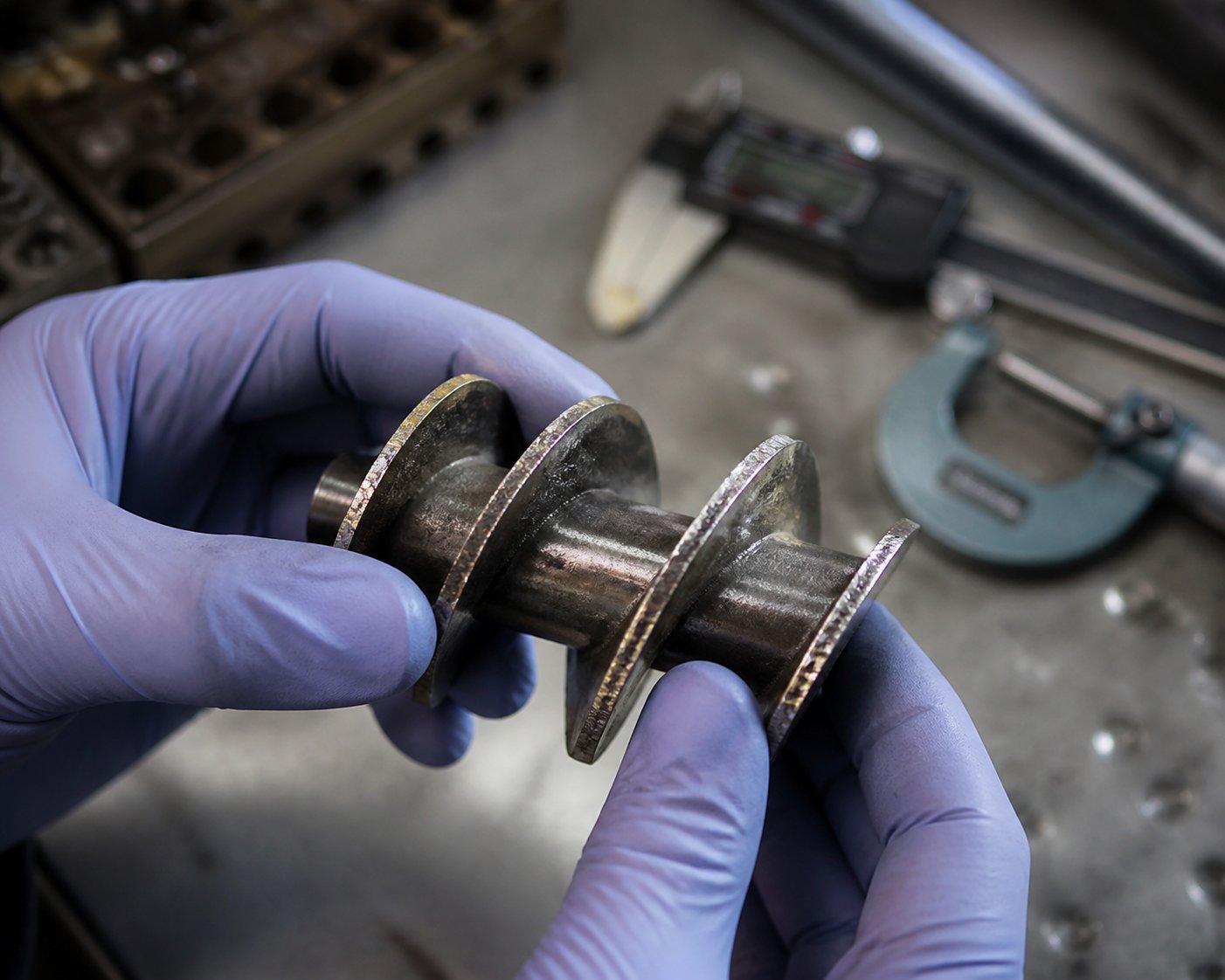
- Adhesive wear (metal-to-metal contact). This occurs when screw flight tips physically contact the barrel bore. Contrary to common belief, uniform high internal pressure alone does not deflect the screw — a pressure differential is needed. The real causes are mechanical: barrel misalignment, a bent screw, gearbox damage, or an inadequate foundation. You'll recognize adhesive wear by bright, polished streaks on the flight tips and corresponding scoring inside the barrel bore, often concentrated on one side. If you see this pattern, do not simply buy a bimetallic twin screw barrel or single screw replacement — investigate the mechanical root cause first, or the new component will wear identically.
- Abrasive wear from filled polymers. Glass fibers, calcium carbonate, talc, silica, and regrind contaminants act as micro-cutting tools that score the alloy liner progressively. Wear concentrates in high-pressure zones — particularly the compression section and the last few turns of the metering section — because increased pressure and temperature amplify friction rates. The forwarding side of the flight typically shows more severe root wear than the trailing side. Larger filler particles with sharper corners intensify the damage compared to smaller, rounder ones.
- Corrosive wear from chemical attack. PVC, fluoropolymers, flame-retardant compounds, and moisture-sensitive resins release acidic decomposition byproducts — hydrogen chloride, hydrogen fluoride, or hydrobromic acid — at processing temperatures. These gases attack the liner surface chemically, producing pitting and surface cracking that can progress rapidly. A critical insight from field failure analysis: a barrel can appear dimensionally acceptable yet still fail because corrosion pitting compromises surface integrity without significantly enlarging the bore diameter. Dimensional checks alone will miss this failure mode.
In many real-world applications, these mechanisms overlap. A processor running glass-filled PVC faces simultaneous abrasive and corrosive attack — and the combination accelerates damage faster than either mechanism would alone.
Bimetallic Liner Delamination and Its Causes
The most alarming failure mode is delamination — where the alloy liner physically separates from the base steel. Unlike gradual wear, delamination can progress rapidly and cause catastrophic downstream problems.
Three primary triggers drive delamination:
- Thermal shock. A sudden, severe temperature change — such as starting an extruder cold without proper heat soak, or a heater band failure followed by rapid reheating — creates differential thermal expansion between the liner and the base steel. The bond zone, strong as it is, cannot absorb an instantaneous expansion mismatch across its full length.
- Manufacturing defects in the bond zone. Incomplete metallurgical fusion during centrifugal casting — caused by inadequate furnace temperature, insufficient rotation speed, or contaminated alloy powder — leaves weak spots where the liner never fully bonded. These defects can remain dormant for months or years before propagating under operational stress.
- Operating outside the designed temperature range. Every alloy liner has a service temperature ceiling. Running a nickel-based liner above its rated range softens the binder phase and degrades the bond zone. Similarly, cobalt-based alloys lose their structural advantage if consistently operated below their optimal range and then subjected to sudden thermal spikes.
Warning signs of delamination include a sudden, unexplained drop in output rate, visible degradation in melt quality (streaks, unmelted particles, or inconsistent color), and barrel temperature readings that spike or fluctuate erratically in a single zone. If you notice any of these symptoms appearing together, pull the screw and inspect the bore immediately — continued operation risks liner fragments breaking free and jamming between the screw and barrel wall.
Diagnostic Steps for Worn Components
Whether you are evaluating a bimetallic screw barrel for sale as a replacement candidate or assessing whether your existing components can be restored, a structured diagnostic sequence prevents guesswork and missed damage. Follow these steps in order:
- Visual inspection of screw flights. Pull the screw and examine the flight tips, root surfaces, and mixing elements. Look for polished streaks (adhesive wear), scored grooves (abrasive wear), pitting or discoloration (corrosive wear), and chipped or missing hardfacing. As screw rebuilding specialists note, severe root wear on the forwarding side of flights can undermine the hardfacing substrate, causing brittle chunks to chip away and contaminate the extrudate.
- Bore diameter measurement. Use a bore gauge at multiple points along the barrel length, measuring at least two orientations (0 degrees and 90 degrees) at each position. Compare readings to the original bore specification. A common guideline treats flight clearance at four times the original tolerance as a replacement threshold — but this rule of thumb must be weighed against the viscosity of the resin you process. Higher-viscosity materials tolerate more clearance before output loss becomes significant.
- Corrosion pitting inspection. Run a finger or a calibrated surface profilometer along the bore. Corrosion damage feels rough even when dimensional measurements still fall within tolerance. Pitting creates material hang-up points that degrade resin, producing black specks and burning.
- Output consistency evaluation. Before pulling any components, record baseline data: specific rate (output divided by screw speed), shot-to-shot weight variation for injection molding, or extrusion rate stability at constant RPM. A reduction in specific rate is the earliest quantifiable indicator of wear-related performance loss.
- Melt temperature uniformity assessment. Measure discharge melt temperature at multiple points across the melt stream. Worn clearances increase shear heating unevenly, producing temperature gradients that degrade part quality — particularly with shear-sensitive resins like PVC and polycarbonate.
Here is the critical takeaway many maintenance teams overlook: a worn bimetallic component does not automatically require full replacement. Screw flights can often be restored through hardfacing processes like PTA welding or alloy spray welding, returning them to original tolerances at a fraction of the cost. Reputable screw manufacturers have rebuilt individual screws six to eight times using high-quality welding practices and careful metallurgical management. The key is catching wear early enough that the base material remains structurally sound — once root erosion undermines the flight substrate or the barrel wall thins below safe limits, restoration is no longer viable.
Knowing how to diagnose wear is essential, but it only delivers value if you can translate those findings into a sound financial decision. The real question maintenance engineers and procurement managers face is not just "is it worn?" but "does repairing it, replacing it, or upgrading it deliver the best return on our investment?"
Lifespan Expectations and Return on Investment for Bimetallic Screw Barrels
A bimetallic screw barrel costs more upfront than a nitrided alternative — typically about 25% more at the point of purchase. That number is easy to see on a purchase order, which is exactly why so many procurement decisions stop there. But component price is the smallest line item in the true cost equation. Unplanned downtime, scrap, energy waste, and emergency labor dwarf the price gap between barrel technologies — and ignoring those costs is the most expensive mistake a plastics processor can make.
Lifespan Comparison Between Standard and Bimetallic Components
How much longer does a bimetallic barrel actually last? The honest answer depends on several variables, but the general magnitude is consistent across independent data. When processing abrasive compounds — glass-fiber-reinforced nylons, mineral-filled polyolefins, recycled streams with contaminants — bimetallic barrels and screws typically outlast nitrided equivalents by 2 to 3 times, with wear rates reduced by over 60%.
Imagine two identical 90 mm single-screw extruders running 30% glass-filled PA66 side by side. The nitrided barrel on Line A hits its wear limit at roughly 8,000 operating hours. The china bimetallic single screw barrel on Line B, fitted with a tungsten carbide liner, runs 18,000 to 24,000 hours before reaching the same clearance threshold. That is the difference between replacing barrels every 12 to 14 months and replacing them every three to four years on a three-shift operation.
However, the multiplier is not fixed. Several factors shift it significantly:
- Filler type and particle geometry. Sharp, angular glass fibers wear surfaces faster than rounded calcium carbonate particles at the same loading percentage.
- Filler percentage. Jumping from 20% to 40% glass fiber does not double the wear rate — it can triple or quadruple it, because particle-to-surface contact frequency increases nonlinearly.
- Processing temperature. Higher melt temperatures soften certain liner alloys and accelerate corrosive degradation, narrowing the lifespan advantage.
- Screw speed. Higher RPM increases shear heating and the velocity of abrasive particles across the liner surface, compressing service intervals.
- Alloy selection. A nickel-based liner running highly abrasive but non-corrosive compounds will underperform a tungsten carbide liner in the same application. Matching the alloy to the dominant wear mechanism — as covered in the alloy selection chapter — is what unlocks the full lifespan potential.
For low-abrasion commodity resins, the gap narrows dramatically. A nitrided barrel running unfilled HDPE may last five or six years, while a bimetallic equivalent in the same service might deliver seven or eight — a marginal improvement that rarely justifies the price premium. The ROI case for bimetallic construction is strongest precisely where wear rates are highest, because that is where the lifespan multiplier translates into the largest dollar savings.
Calculating the True Cost of Screw Barrel Wear
Here is where most cost analyses go wrong: they compare the purchase price of Component A against Component B and stop. The barrel or screw itself is often the cheapest part of a wear event. The expensive part is everything that surrounds it.
Think about what actually happens when a barrel wears beyond tolerance. Production stops. A maintenance crew pulls the screw, measures the bore, confirms the diagnosis, orders a replacement, waits for delivery, installs the new component, and restarts the line. That sequence can consume days — sometimes weeks if the replacement is not in stock. Meanwhile, every hour of downtime carries a cost that dwarfs the component price.
A complete cost analysis should account for all of the following factors beyond the component purchase price:
- Unplanned downtime. Lost production hours multiplied by your hourly contribution margin. For a high-output extrusion line, this figure can reach thousands of dollars per hour.
- Scrap from dimensional inconsistency. As clearance grows, shot weight variation increases in injection molding, and wall thickness uniformity degrades in extrusion. Parts that fall outside specification become scrap — or worse, escape to customers and generate warranty claims.
- Energy waste from worn clearances. A worn screw-to-barrel interface allows polymer to leak backward over the flights, forcing the drive motor to work harder. Operators compensate by increasing RPM to maintain output, which drives up energy consumption and further raises melt temperature — creating a vicious cycle of escalating power cost and degrading melt quality.
- Emergency labor costs. Unscheduled changeovers pull skilled technicians from other tasks, often at overtime rates. Planned replacements during scheduled shutdowns cost a fraction of emergency interventions.
- Expedited shipping for replacement components. When a single bimetallic screw barrel factory has a standard lead time of six to eight weeks, emergency orders carry premium freight charges that can add 15% to 30% to the component cost.
- Quality requalification time. After installing new components, many operations require validation runs to confirm dimensional and cosmetic part quality before resuming full production — adding more lost hours.
- Downstream equipment damage. In extreme cases, liner fragments from delamination or chipped hardfacing can damage dies, screen packs, or mold cavities, multiplying repair costs far beyond the barrel or screw itself.
When you stack all these factors together, the total cost of ownership over three years can be roughly 50% lower for bimetallic components compared to nitrided alternatives in abrasive-compound service — even though the initial purchase price is higher. The math flips because each replacement cycle you eliminate removes an entire bundle of associated costs, not just the price of one barrel.
Repair and Resurfacing as an ROI Multiplier
There is a third option that most cost analyses overlook entirely: instead of replacing a worn component, restore it.
Worn bimetallic screws — even those with significant flight tip erosion — can often be rebuilt through alloy spray welding or PTA re-facing. The process deposits fresh wear-resistant alloy onto the eroded flight surfaces, and the screw is then ground back to original OD tolerances. As industry rebuilding specialists have documented, a single screw can be rebuilt six to eight times when high-quality welding practices and proper metallurgical management are followed. Each rebuild costs a fraction of a new component — and delivers comparable performance if the base material remains structurally sound.
The economics are compelling. If a new screw costs $X and a rebuild costs 40% to 60% of that, extending one screw through three or four rebuild cycles effectively cuts your per-year screw cost by more than half. Multiply that across every extruder and injection unit in a multi-line plant, and the savings become substantial.
For operations looking to implement this approach, service partners that specialize in screw and barrel restoration make the process practical. NANHAIYA's alloy spray welding service, for example, supports extrusion and injection molding operators by restoring worn flight surfaces rather than requiring full screw replacement — a particularly relevant option for processors dealing with abrasive materials where flight tip wear is the primary failure mode. Having a reliable restoration partner effectively transforms your maintenance strategy from reactive replacement to planned lifecycle extension.
A few conditions must be met for rebuilding to make sense. The screw's root diameter should still be within acceptable limits — severe root erosion means the flight substrate can no longer support a new hardfacing overlay. The screw body must be straight, without cracks or heat damage. And the barrel bore must still be within tolerance; there is no point restoring a screw to original OD if the barrel it runs inside has already worn 0.5 mm beyond specification.
This is where the diagnostic sequence from the previous chapter feeds directly into financial decision-making. A structured wear assessment — measuring flight OD, root diameter, bore diameter, and surface condition — gives you the data to choose confidently between repair and replacement, rather than defaulting to the most expensive option out of uncertainty.
The real leverage in screw barrel economics is not buying the cheapest component or even buying the longest-lasting one. It is building a lifecycle strategy that combines the right initial specification, proactive wear monitoring, and timely restoration — so that every dollar spent on components delivers the maximum possible production hours. That strategy, however, requires a clear decision framework tying all these factors together, tailored to your specific operation and the people making the call.
Making the Right Bimetallic Screw Barrel Decision for Your Operation
Every piece of information covered so far — alloy families, manufacturing methods, wear patterns, lifespan data, and cost dynamics — converges on a single practical moment: someone in your organization has to make a call. An engineer needs to write a material specification. A procurement manager needs to evaluate competing quotes. A maintenance technician needs to decide whether a worn screw gets rebuilt or scrapped. Each of those decisions carries real financial consequences, and each benefits from a structured approach rather than gut instinct or habit.
Decision Framework for New Bimetallic Component Selection
Whether you are a bimetallic screw barrel importer sourcing components from overseas or specifying directly with a domestic manufacturer, the selection process follows the same logical sequence. Skip a step, and you risk either over-specifying (wasting capital) or under-specifying (inviting premature failure).
- Identify the polymer and filler type. Start with exactly what runs through the barrel. Is it unfilled commodity resin? Glass-fiber-reinforced engineering plastic? PVC with 30% calcium carbonate? Recycled post-consumer material with unpredictable contaminants? The resin-filler combination determines the dominant wear threat — and every subsequent choice flows from this answer.
- Determine the dominant wear mechanism. Refer back to the three primary mechanisms: abrasive wear from hard fillers and fibers, corrosive wear from acidic decomposition byproducts, or a combination of both. Glass-filled nylon is almost purely abrasive. PVC compounds impose corrosive and abrasive attack simultaneously. Unfilled HDPE generates neither at significant rates. If you are uncertain, pull your current screw and inspect it — the wear patterns described in the troubleshooting chapter will tell you which mechanism dominates.
- Select the appropriate alloy family. Match the dominant wear mechanism to the alloy comparison table from earlier in this article. Corrosion-dominant applications point to nickel-based alloys. Abrasion-dominant applications call for iron-based or tungsten carbide liners. Combined attack scenarios — filled PVC, halogenated flame retardants — demand nickel-chromium-boron-tungsten alloys or corrosion-resistant WC-CrC-Ni formulations.
- Verify specifications against supplier datasheets. Request documented alloy composition, liner thickness, bore diameter tolerance, straightness, surface roughness, and — critically — a metallurgical hardness profile from the liner surface through the bond zone to the substrate. Any reputable bimetallic screw barrel manufacturer will provide this documentation without hesitation. Treat reluctance to share inspection data as a disqualifying signal.
- Evaluate total cost of ownership, not unit price. Factor in expected service life for your specific compound, the number of replacement cycles over a five-year horizon, downtime cost per changeover, scrap implications of progressive wear, and whether the component design supports future repair or resurfacing. A barrel that costs 2.5 times more but lasts four times longer is not expensive — it is the cheaper option by a wide margin.
This five-step sequence works for any bimetallic screw barrel specification — single screw, parallel twin, conical twin, injection or extrusion. The variables change, but the logic does not.
Repair Versus Replacement Decision Guide
Not every worn component belongs in the scrap bin. Equally, not every worn component is a candidate for restoration. The wrong choice in either direction costs money — scrapping a rebuildable screw wastes its remaining structural value, while attempting to repair a component that has exceeded its serviceable limits wastes labor and still leaves you with a substandard part.
The table below lays out the key scenarios and the smarter path for each. Evaluate repair and resurfacing first — it is the lower-cost option when conditions allow it.
| Scenario | Recommended Action | Rationale |
|---|---|---|
| Localized flight tip wear; root diameter within tolerance | Repair / Resurface | PTA welding or alloy spray welding restores flight OD to original spec at 40-60% of new component cost |
| Screw flight erosion on one or two zones; body straight and crack-free | Repair / Resurface | Targeted hardfacing on worn zones extends service life without replacing structurally sound material |
| Barrel bore within alloy liner thickness (wear has not reached base steel) | Repair / Resurface | Re-machining within the remaining liner restores clearance tolerances; re-honing to next oversize may be viable |
| Experienced service partner available for welding and precision grinding | Repair / Resurface | Quality of the rebuild depends entirely on the service provider's metallurgical capability and equipment precision |
| Bore diameter worn beyond alloy liner into base steel | Full Replacement | Once the soft substrate is exposed, no surface treatment restores the barrel's wear resistance — the liner is gone |
| Liner delamination detected (separation of alloy from base steel) | Full Replacement | Delamination compromises structural integrity; continued operation risks liner fragments contaminating the melt stream |
| Structural damage — cracked barrel wall, bent screw body, heat-check cracking | Full Replacement | No surface treatment corrects base-material failure; the component is no longer safe for high-pressure service |
| Severe root diameter erosion undermining flight base | Full Replacement | Hardfacing deposited onto an eroded root will not hold — the substrate cannot support the overlay |
The pattern is clear. If the base material — whether barrel wall or screw body — remains structurally intact, repair almost always delivers better economics than replacement. A screw rebuilt through quality PTA or spray welding processes can match or exceed the performance of a new component, and as experienced refurbishment specialists emphasize, the key is professional evaluation before committing to either path. Skipping that assessment step is how processors end up either discarding salvageable components or wasting money rebuilding ones that should have been replaced.
Selecting a Reliable Supplier or Service Partner
Your component specification is only as good as the manufacturer who executes it. Whether you are sourcing from a bimetallic screw barrel manufacturer in Ahmedabad, evaluating a bimetallic screw barrel in India, or working with a factory in China, the evaluation criteria remain the same. Geography matters less than capability, transparency, and accountability.
Here is what to look for:
- Documented alloy specifications. The supplier should provide certified material composition for both the base steel and the alloy liner or hardfacing. Reliable manufacturers issue material certificates, hardness reports, and dimensional inspection records as standard practice — not as optional extras you have to fight for.
- Manufacturing process transparency. Ask about the centrifugal casting parameters for barrels (furnace type, rotation speed control, cooling protocol) and the hardfacing method for screws (PTA, spray welding, or laser cladding). A supplier that can walk you through their process understands what they are making. One that deflects technical questions probably does not.
- Dimensional inspection reports. Every barrel should ship with bore diameter measurements at multiple points along its length, straightness verification, and surface roughness data. Every screw should include flight OD, root diameter, and runout measurements. These are not premium add-ons — they are baseline quality documentation.
- Support for both new components and repair services. The best supplier relationships are not transactional; they extend across the full lifecycle of your equipment. A partner who can supply new bimetallic components and also restore worn ones through professional hardfacing gives you flexibility that a new-parts-only supplier cannot. NANHAIYA's alloy spray welding service is one example of this lifecycle approach — supporting both surface treatment for worn screws and barrels and component life extension, which is particularly valuable for operators processing abrasive or corrosive materials where flight wear is an ongoing operational reality.
- Customization capability. Your extruder is not generic, and your replacement components should not be either. Confirm that the supplier can manufacture to your specific machine drawings, including non-standard L/D ratios, custom flight geometries, and application-specific alloy selections rather than offering only a limited catalog of standard sizes.
One final point that experienced procurement managers already know but newer buyers often miss: always request references from customers running similar materials on similar equipment. A supplier's performance with unfilled polyolefins tells you nothing about their capability with 40% glass-filled PA66. The metallurgy, the casting parameters, and the quality control demands are fundamentally different — and so are the consequences of getting them wrong.
The bimetallic screw barrel decision is ultimately not about choosing a product. It is about matching a material strategy to your specific process conditions, evaluating total lifecycle cost rather than purchase price, and partnering with suppliers who support you from initial specification through years of operation and eventual component restoration. Get those three elements right, and the technology pays for itself many times over.
Frequently Asked Questions About Bimetallic Screw Barrels
1. What is the difference between a bimetallic barrel and a nitrided barrel?
A nitrided barrel uses a gas diffusion process to harden the surface of existing steel, typically producing a hardened case of about 0.5 mm. A bimetallic barrel, by contrast, features a completely separate wear-resistant alloy layer — usually 1.5 to 3.0 mm thick — that is metallurgically fused to the steel base through centrifugal casting. This thicker, dedicated alloy liner delivers significantly greater abrasion and corrosion resistance, making bimetallic barrels the preferred choice for processing glass-fiber-filled compounds, PVC, recycled plastics, and other demanding materials where nitrided surfaces would erode too quickly.
2. How long does a bimetallic screw barrel last compared to a standard barrel?
In abrasive-compound service such as glass-fiber-reinforced nylons or mineral-filled polyolefins, bimetallic barrels typically outlast nitrided equivalents by 2 to 3 times, with wear rates reduced by over 60%. Actual lifespan varies based on filler type, filler percentage, processing temperature, screw speed, and alloy selection. For unfilled commodity resins like HDPE or PP, the lifespan gap narrows considerably, and the cost premium of bimetallic construction may not be justified.
3. Can a worn bimetallic screw be repaired instead of replaced?
Yes, worn bimetallic screws can often be restored through alloy spray welding or PTA (plasma transfer arc) re-facing, which deposits fresh wear-resistant alloy onto eroded flight surfaces before grinding back to original tolerances. A single screw can be rebuilt multiple times as long as the base material remains structurally sound. Services like NANHAIYA's alloy spray welding (https://www.nhyscrew.com/services/alloy-spray-welding) support extrusion and injection molding operators by restoring worn components at 40-60% of new component cost, making repair a highly cost-effective lifecycle strategy.
4. Which bimetallic alloy is best for processing PVC?
Nickel-based alloys — commonly referenced as Ni-60 type designations — are the industry standard for PVC processing. PVC releases hydrogen chloride gas during extrusion, which aggressively corrodes iron-matrix surfaces. Nickel-based liners form a passive oxide layer that resists this chemical attack, reducing corrosive wear rates to roughly 0.01 to 0.03 mm per 1,000 hours compared to 0.08 to 0.15 mm for nitrided steel. For PVC compounds that also contain abrasive fillers, cobalt-based alloys like Stellite or corrosion-resistant tungsten carbide variants (WC-CrC-Ni) offer combined abrasion and corrosion protection.
5. How do I know when my bimetallic screw barrel needs replacement or repair?
Key indicators include declining specific output rate at constant screw speed, increasing shot-to-shot weight variation in injection molding, visible screw flight erosion or bore scoring, and melt temperature inconsistencies across the discharge stream. A structured diagnostic approach involves pulling the screw for visual inspection, measuring bore diameter at multiple points, checking for corrosion pitting, and evaluating output consistency. If wear is localized to flight tips and the base material is structurally intact, repair through hardfacing is usually the smarter economic choice. Full replacement is necessary when bore diameter has worn through the alloy liner into base steel, liner delamination is detected, or structural damage like cracks or bending is present.
Written by
Nanhaiya Technical Team
Zhoushan Nanhaiya Plastic Machinery Co., Ltd.
The Nanhaiya technical team supports screw and barrel manufacturing projects through application review, technical communication, custom manufacturing coordination, and production and quality control.
Discuss Your Application
Related Articles
More insights on screw barrel technology and plastics processing.
What Nobody Tells You About Screw Barrel For Plastic Machine Design
Oct 10, 2026
Learn how screw barrel for plastic machine design affects melt quality, throughput, and wear life. Covers geometry, resin matching, troubleshooting, and sourcing.
Read Article
Single Screw Extruder for Sheet: Stop Guessing, Start Specifying
Oct 9, 2026
Learn how to specify a single screw extruder for sheet production. Covers screw geometry, resin-specific processing, troubleshooting, and maintenance best practices.
Read Article
PE Pipe Extruder Machine: What Datasheets Won't Tell You
Oct 9, 2026
Learn how a PE pipe extruder machine works, key specs explained, material grade selection, maintenance tips, and buyer guidance beyond the datasheet.
Read ArticleLooking for something else?
Search by material, symptom or product and jump straight to the relevant page.
These are navigation suggestions based on keyword matching — not a quotation, not a delivery commitment, and not a substitute for engineering review. Final specification is confirmed by our engineers against your drawings and processed material.
Need help with screw barrel selection?
Share your machine model, processed material and application. Our team can help with pricing and technical support.