

What Is a Bimetallic Screw and Why Does It Matter
Imagine running a production line at full capacity, only to pull a screw from your extruder and find its flight lands ground down to a fraction of their original height. If you're processing glass-filled nylon or recycled feedstock loaded with contaminants, this scenario probably sounds familiar. Standard nitrided screws simply cannot keep pace with the aggressive materials modern plastics processors are expected to handle. That gap between what conventional screws can endure and what today's resins demand is exactly where bimetallic screw technology steps in.
What Makes a Screw Bimetallic
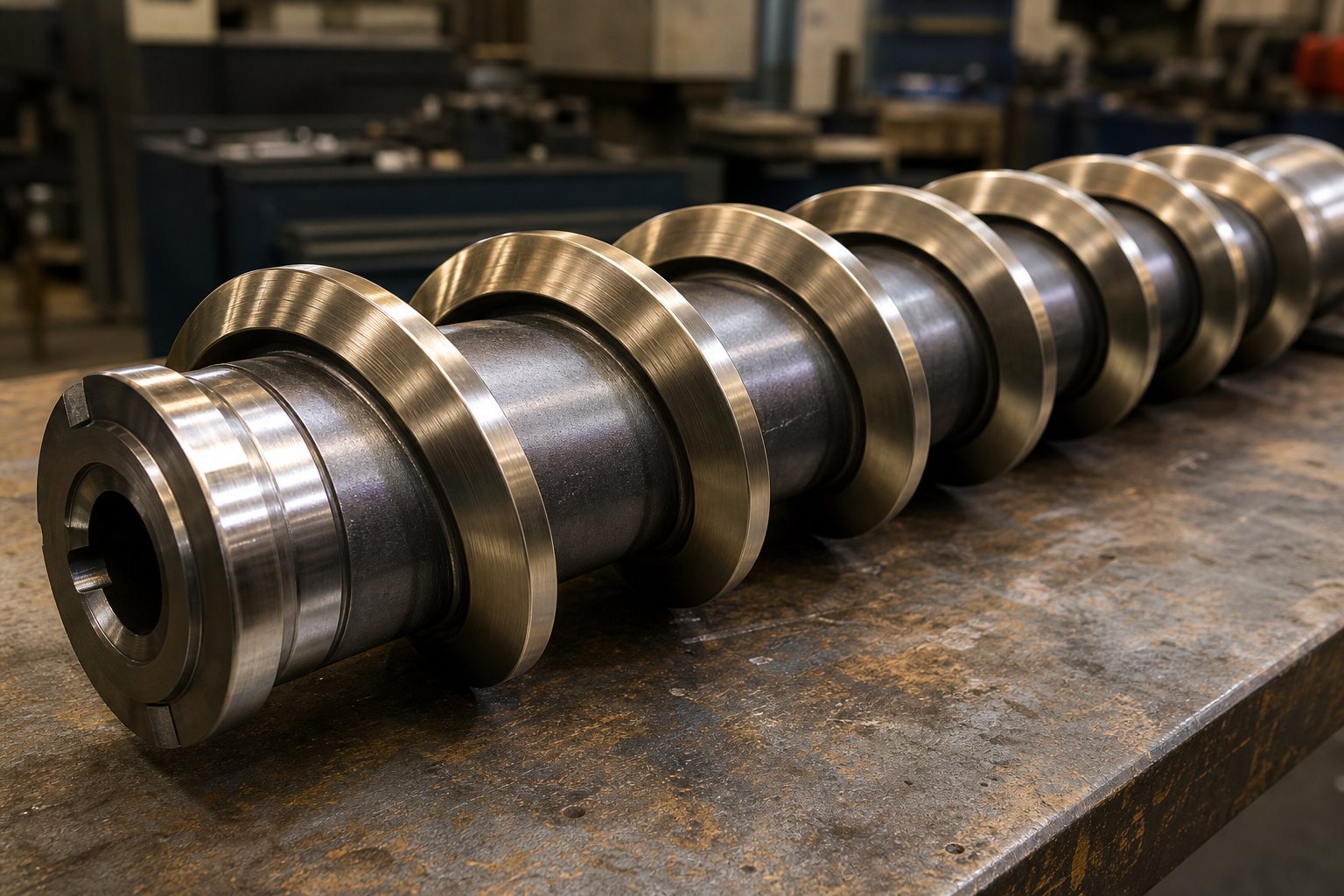
At its core, the bimetallic screw definition and construction is straightforward: two distinct materials, each chosen for a specific engineering purpose, fused into a single component. A high-strength steel substrate—commonly 4140 or 38CrMoAlA—provides the structural backbone, delivering the toughness and ductility needed to absorb torsional loads and mechanical stress. Over the critical wear surfaces, such as the flight lands and root, a layer of wear- and corrosion-resistant alloy is applied. This alloy layer typically consists of nickel-based, cobalt-based, or tungsten carbide composite materials, depending on the application.
A bimetallic screw is an extrusion or injection molding screw whose flight surfaces are lined with a hard, wear-resistant alloy that is metallurgically bonded to a tough steel core—combining structural strength with exceptional surface durability in a single component.
The key distinction here lies in the metallurgical bond. Unlike coated screws, where a surface layer is mechanically deposited and can chip or delaminate under stress, the alloy in a bimetallic screw is fused to the steel through a diffusion bond at the alloy-steel interface. During manufacturing, atoms from the alloy and the base steel intermigrate across the boundary, creating a gradient transition zone rather than a sharp dividing line. This diffusion bond ensures the alloy layer cannot peel away during operation—even under extreme pressure, temperature, and rotational forces inside a plasticating barrel.
Why the Plastics Industry Relies on Bimetallic Technology
The plastics processing landscape has shifted dramatically. Operators today face a convergence of pressures that standard screws were never engineered to handle. Recycled feedstock—now mandated or incentivized across many markets—introduces unpredictable contaminants like sand, metal fragments, paper residue, and inconsistent additive packages. Glass-fiber-reinforced polymers and mineral-filled compounds, which deliver superior mechanical properties in finished parts, act like liquid sandpaper on screw flight surfaces. Chemically aggressive resins such as PVC, fluoropolymers, and flame-retardant compounds release acids and corrosive byproducts that attack unprotected steel at processing temperatures.
A conventional nitrided screw offers a thin hardened case—typically less than 0.5 mm deep—that wears through rapidly under these conditions. Once that shallow case is breached, the soft base steel beneath erodes at an accelerated rate, leading to loss of output consistency, increased energy consumption, and costly unplanned downtime. Bimetallic construction addresses this vulnerability with alloy layers that are significantly thicker, chemically tailored to resist specific attack mechanisms, and bonded so deeply to the substrate that they maintain protective performance over a service life two to three times longer than their nitrided counterparts.
Yet not every application demands this level of protection—and not every alloy suits every resin. The real engineering challenge is not whether to go bimetallic, but which alloy to choose, which manufacturing method delivers the best bond, and when the investment actually pays for itself. Those are the questions the following sections answer in detail.
How Bimetallic Screws Are Manufactured
The metallurgical bond that separates a bimetallic screw from a simple coated one doesn't happen by accident—it's the direct result of how the alloy layer is applied. Different manufacturing methods produce different bond qualities, layer thicknesses, and cost profiles. Understanding these processes helps you evaluate whether a component was built to last or simply built to look the part on a spec sheet.
Centrifugal Casting for Bimetallic Barrels and Screws
Centrifugal casting is the workhorse method behind most bimetallic barrels, and it's occasionally adapted for screw flight surfaces in specialized configurations. Picture a barrel or cylindrical mold spinning at high speed while molten alloy is poured inside. The rotational force drives the liquid metal outward against the bore wall, distributing it in a uniform layer as it solidifies. Because the alloy is fully molten during application, it fuses intimately with the pre-heated base steel, forming a strong metallurgical bond across the entire interface.
The process allows manufacturers to control lining thickness by adjusting the volume of molten alloy and the rotation speed. After casting, heat treatment relieves internal stresses and further enhances the hardness and toughness of the lining material. For barrels, centrifugal casting remains the dominant technique because the cylindrical geometry is inherently suited to rotation. Applying it to complex screw flight geometry is more challenging, which is why alternative deposition methods have gained ground for screw-specific applications.
Plasma Transfer Arc and Thermal Spray Welding Methods
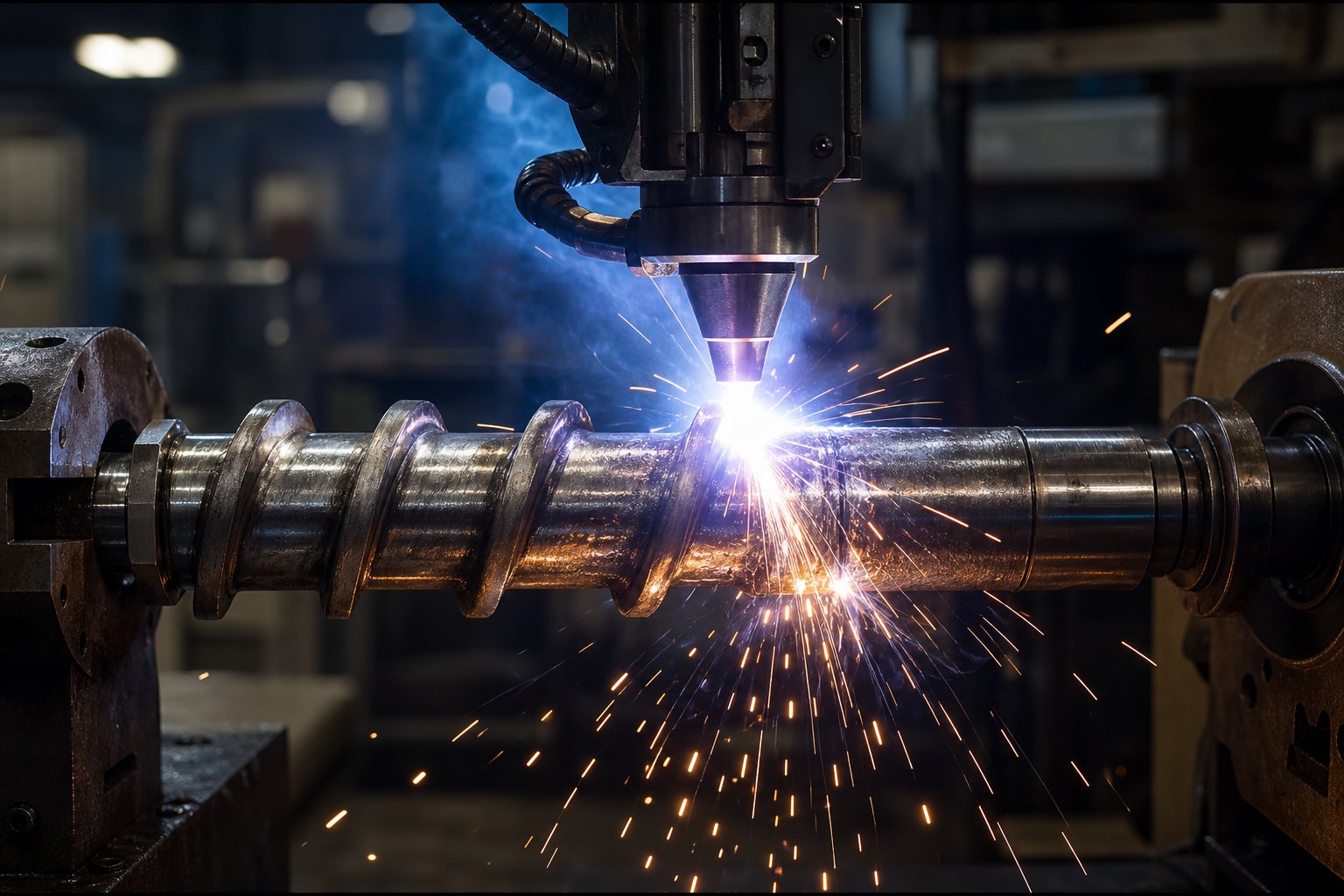
When the goal is depositing alloy directly onto screw flight lands—irregular surfaces that don't lend themselves to rotation—plasma transfer arc (PTA) welding is the go-to precision method. PTA uses a plasma arc to melt alloy powder and simultaneously fuse it into the base steel surface, producing a dense, porosity-free metallurgical bond in a single pass. The result is a thick, tightly adhered alloy layer with hardness values that can reach HRC 50 to 65, depending on the alloy family selected. PTA's controlled heat input also minimizes distortion, making it well suited for new manufacture of flight-hardfaced screws.
Thermal spray methods—including high-velocity oxygen fuel (HVOF) spraying and alloy spray welding—take a fundamentally different approach. Instead of melting alloy into the substrate, these techniques propel powder particles at high velocity onto the surface, where they flatten, interlock, and build up a protective layer. The bond in standard thermal spray is primarily mechanical rather than metallurgical, with typical coating thicknesses of 0.05 to 0.5 mm. That said, alloy spray welding variants apply enough heat to achieve a partial metallurgical bond, bridging the gap between pure thermal spray and full hardfacing. Thermal spray is especially valued for its versatility in repair and surface rebuilding scenarios—restoring worn flight dimensions on existing screws without the lead time or cost of complete replacement.
Hot Isostatic Pressing and Emerging Techniques
For specialized applications where even trace porosity is unacceptable, hot isostatic pressing (HIP) offers an alternative path. HIP simultaneously applies high temperature (800–1,350 °C) and uniform gas pressure (100–200 MPa) to consolidate alloy powder into a fully dense layer. The result is a coating with virtually zero internal voids—critical in environments where micro-porosity could become initiation points for corrosion or fatigue cracking. HIP's drawbacks are practical: high equipment costs, slow processing speeds, and limited batch sizes make it a niche solution rather than a mainstream production method for screws and barrels. Still, as demand grows for longer-life components in corrosive chemical and pharmaceutical processing, HIP is gaining traction as a premium manufacturing option.
| Criteria | Centrifugal Casting | PTA Welding | Thermal Spray (incl. HVOF) | Hot Isostatic Pressing |
|---|---|---|---|---|
| Bond Type | Metallurgical | Metallurgical | Mechanical (partial metallurgical in spray welding variants) | Diffusion / Metallurgical |
| Typical Application | Barrels (primary); screws (limited) | Screw flight lands and surfaces | Screw repair and surface rebuilding | Specialty components requiring zero porosity |
| Layer Thickness Range | 1–3 mm | 1–10 mm | 0.05–0.5 mm (up to ~1 mm with spray welding) | Application-dependent; fully dense consolidation |
| Suitability for New Manufacture | Excellent for barrels | Excellent for screws | Moderate—better suited for repair | Viable but cost-prohibitive at scale |
| Suitability for Repair | Not practical | Possible but less common | Excellent—fast turnaround, field-adaptable | Not practical |
| Relative Cost | Moderate | Moderate to High | Low to Moderate | High |
Each method occupies a distinct niche. Centrifugal casting dominates bimetallic barrel production. PTA welding leads in plasma transfer arc welding screw flights for new builds. Thermal spray welding for screw repair fills the gap when fast turnaround matters more than maximum bond strength. And HIP serves the high-stakes edge cases where absolute material density is non-negotiable. The manufacturing method, however, is only half the equation—the alloy deposited by that method determines whether the finished component resists abrasion, corrosion, or both.
Bimetallic Alloy Types and Their Key Properties
So the manufacturing method shapes the bond—but the alloy itself determines what that bond actually protects against. This is where most bimetallic screw alloy types discussions go silent. Suppliers list vague terms like "wear-resistant lining" without specifying which alloy family is being applied or why it matters for your particular resin. In reality, the difference between choosing the right alloy and the wrong one can mean the difference between 15,000 hours of reliable service and a screw pulled out after 3,000 hours with its flights ground flat. Three major alloy families dominate the landscape, each engineered around a different threat profile.
Nickel-Based Alloys for Corrosion and Moderate Abrasion
The nickel-boron-silicon (Ni-Cr-B-Si) family is the backbone of bimetallic screw hardfacing for corrosion-intensive applications. These alloys build their protective performance on a nickel-rich matrix fortified with chromium, boron, and silicon—elements that together form hard boride and carbide phases while maintaining strong chemical inertness against acidic degradation products.
Two grades stand out as industry reference points. Colmonoy 56 is the workhorse: a general-purpose nickel-based alloy delivering approximately 50 to 55 HRC with excellent corrosion resistance and moderate abrasion protection. It handles the dual threat processors face when running PVC, flame-retardant compounds, or other chemically aggressive resins that simultaneously introduce some filler abrasion. Colmonoy 83 takes a different approach—embedding tungsten carbide particles into the nickel matrix, pushing effective hardness above 60 HRC and dramatically increasing resistance to abrasive fillers. The Colmonoy 56 vs Colmonoy 83 screw alloy decision often comes down to a single question: is your primary enemy chemical attack, or is abrasion from glass fibers and mineral fillers the dominant failure driver?
The nickel base also gives these alloys a natural advantage in environments where corrosion compounds the damage. Nickel resists hydrochloric acid attack far better than cobalt or iron matrices, which is why a nickel-based alloy screw with high chromium content remains the default recommendation for halogenated polymer processing.
Cobalt-Based and Tungsten Carbide Alloys for Extreme Wear
When impact toughness or high-temperature hardness retention matters more than maximum surface hardness, cobalt-based alloys—most notably the Stellite family—earn their place. Stellite 6 (Co-Cr-W-C) delivers approximately 35 to 45 HRC and is valued for its ability to absorb mechanical shock without cracking, a characteristic that makes it suitable for screws subjected to startup impacts or surge conditions. Stellite 12, with its higher tungsten content, reaches 45 to 50 HRC and bridges the gap between toughness and wear resistance.
Here's the critical trade-off: cobalt-based alloys are more ductile but less hard than their nickel counterparts. As industry testing confirms, nickel-based coatings handle abrasive wear better due to their higher hardness, while cobalt-based coatings handle impact wear better due to their ductility. Stellite also famously retains hardness at temperatures exceeding 700 degrees Celsius—far above the softening point of conventional tool steels—making it a strong candidate for high-temperature engineering resin processing.
For the most extreme abrasive environments—think heavily glass-filled nylon at 40% or higher loading, or wood-plastic composite formulations saturated with mineral contaminants—tungsten carbide composite alloys represent the top tier. A tungsten carbide alloy screw for glass-filled resin achieves coating hardness values of 1,100 to 1,400 HV (roughly 70+ HRC equivalent) through HVOF thermal spray, with carbide particles far harder than even the most advanced nickel or cobalt matrices. The trade-off is brittleness: these ultra-hard layers can crack under mechanical shock or substrate deflection, limiting their use to rigid screw geometries where bending stress is minimal.
Iron-Boron Alloys as a Cost-Effective Option
Not every application justifies the cost of nickel- or cobalt-based alloys. Iron-boron alloy systems fill the entry-level tier of bimetallic construction, offering solid abrasion resistance at a significantly lower price point. These alloys rely on iron-rich matrices with boron and chromium additions to form hard carbide and boride phases—similar in principle to their nickel-based cousins but using less expensive base elements.
Iron-boron linings typically achieve hardness in the range of 58 to 65 HRC, comparable to or even exceeding some nickel-based grades in pure hardness numbers. However, their corrosion resistance is notably lower than nickel- or cobalt-based families. This makes them well suited for mildly abrasive applications—moderately filled polyolefins, lightly loaded mineral compounds, or general-purpose commodity resin processing where chemical attack is not a primary concern. For processors running standard filled polypropylene or HDPE compounds, iron-boron linings deliver meaningful life extension over nitrided screws without the premium price tag of specialty alloys.
| Alloy Family | Primary Resistance | Hardness Range | Typical Applications | Relative Cost |
|---|---|---|---|---|
| Nickel-Based (Ni-Cr-B-Si) e.g., Colmonoy 56 | Corrosion + moderate abrasion | 50–55 HRC | PVC, flame-retardant compounds, moderately filled resins | Medium-High |
| Nickel + Tungsten Carbide e.g., Colmonoy 83 | Severe abrasion + corrosion | 60+ HRC (matrix; WC particles far harder) | High glass-fiber nylon, heavily mineral-filled compounds, WPC | High |
| Cobalt-Based (Co-Cr-W-C) e.g., Stellite 6, Stellite 12 | Impact toughness + high-temp hardness | 35–50 HRC | Impact-prone applications, high-temperature processing, corrosive-abrasive service | High |
| Tungsten Carbide Composite (HVOF WC-Co / WC-CrC-Ni) | Extreme abrasion | 1,100–1,400 HV (~70+ HRC equiv.) | Maximum abrasion resistance for heavily filled resins | Very High |
| Iron-Boron (Fe-B-Cr) | Moderate abrasion | 58–65 HRC | Mildly abrasive commodity resins, filled polyolefins, budget-conscious applications | Low-Medium |
One important caveat applies across every family: as-deposited hardness varies with the application method, layer thickness, and degree of dilution with the base steel. Treat published hardness ranges as guidance rather than guarantees, and always ask your supplier for achieved hardness data on the actual finished component. Knowing which alloy family suits your resin is the starting point—but translating that knowledge into a reliable selection requires understanding exactly which wear mechanism is destroying your current screw.
Mapping Wear Mechanisms to the Right Alloy Family
Knowing which alloy families exist is one thing. Knowing which one to pick for your specific process is something else entirely. The missing link? Identifying the dominant screw wear mechanism—abrasive vs corrosive—that's actually destroying your flight surfaces. Get this step wrong, and even the most expensive alloy will underperform. Get it right, and your bimetallic alloy selection by wear type becomes a straightforward engineering decision rather than a guessing game.
Abrasive Wear from Fillers and Reinforcements
Picture glass fibers, calcium carbonate particles, talc, and ceramic microspheres tumbling through your screw channel at high velocity under intense pressure. Each particle acts like a microscopic cutting tool, progressively carving away metal from flight lands, roots, and mixing elements. This abrasive mechanism accounts for roughly 60% to 70% of total wear in filled polymer extrusion.
Glass fiber abrasion screw flight wear is particularly aggressive because glass ranks 5.5 to 6.5 on the Mohs hardness scale—harder than most steel surfaces. Mineral fillers like calcium carbonate are softer individually, but at loading levels above 40% to 50%, their sheer volume compensates for lower individual particle hardness. Recycled feedstock compounds the problem by introducing unpredictable contaminants—metal fines, sand, grit, and remnants from previous product life cycles—that accelerate erosion far beyond what virgin resin formulations produce.
The alloy defense against abrasive attack is straightforward: maximize surface hardness. Tungsten carbide composite coatings (WC-Co or WC-CrC-Ni) deliver the highest abrasion resistance available, with hardness values exceeding 1,100 HV. For applications where some mechanical toughness is also needed, cobalt-based Stellite alloys and nickel-tungsten carbide composites like Colmonoy 83 offer a balance between hardness and impact resistance.
Corrosive Wear from Chemical Attack
Corrosion is subtler than abrasion—and often more destructive because it goes unnoticed until significant material loss has already occurred. When PVC degrades during processing, it releases hydrochloric acid (HCl) gas. Flame-retardant additives, especially halogenated types, produce similarly corrosive byproducts. Fluoropolymers like PVDF and PTFE generate hydrofluoric acid (HF)—one of the most chemically aggressive substances a screw surface can encounter.
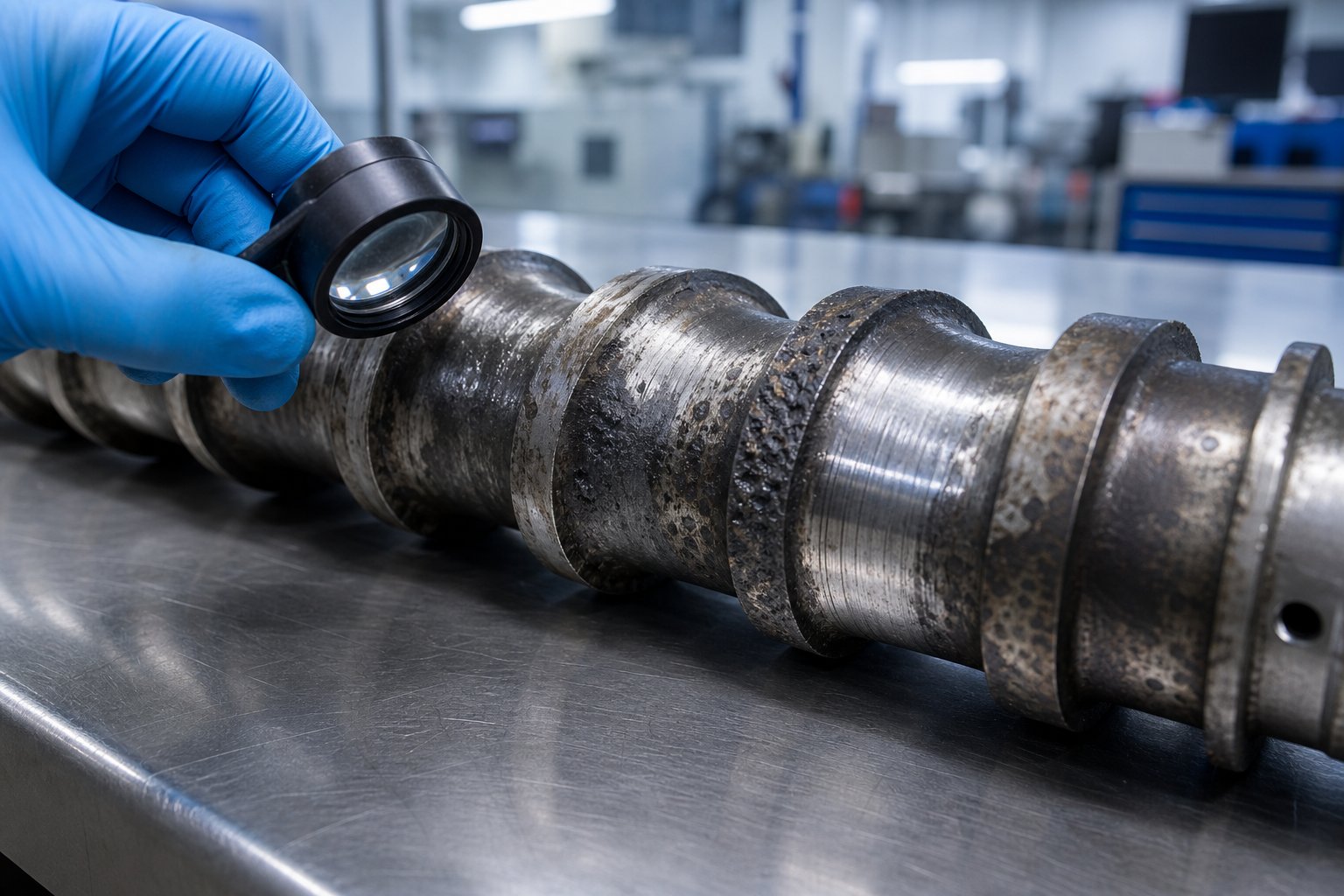
These acids don't grind the metal away—they dissolve it. Pitting, roughening, and etching appear on screw surfaces as the chemical attack undermines the protective oxide layer that most steels depend on. Corrosive wear rates for nitrided 4140 steel in rigid PVC service run 0.08 to 0.15 mm per 1,000 operating hours, compared to just 0.01 to 0.03 mm for high-nickel, high-chromium bimetallic constructions. That's a five- to eight-fold improvement simply by matching alloy chemistry to the chemical environment.
A reliable PVC corrosion screw alloy recommendation centers on nickel-based alloys with high chromium and molybdenum content. Stellite 6 and Stellite 12 PTA overlays also perform well in chlorinated environments, while Hastelloy C-276 remains the premium choice for the most aggressive fluoropolymer applications where HF concentrations are highest.
Adhesive Wear and Combined Mechanisms
Adhesive wear—sometimes called galling—occurs when the screw flight physically contacts the barrel bore. Under normal operation, the polymer melt forms a thin lubricating film between these two metal surfaces. During cold startups, material transitions, or surge events where feed consistency drops, that protective film breaks down. Metal asperities on the screw and barrel weld together momentarily, then tear apart, ripping material from both surfaces.
In real-world plastics processing, you'll rarely face just one wear mechanism in isolation. A glass-filled PVC compound, for example, delivers simultaneous abrasive wear from the filler and corrosive wear from HCl evolution. Recycled streams might combine abrasion from contaminants, corrosion from mixed additives, and adhesive wear from inconsistent melt viscosity. Understanding which mechanism dominates is the critical first step—but planning for the secondary mechanisms prevents premature failure that a single-focus alloy selection would miss.
- Abrasive wear (glass fibers, mineral fillers, recycled contaminants) → Tungsten carbide composites (WC-Co, WC-CrC-Ni) or nickel-tungsten carbide alloys (Colmonoy 83) for maximum hardness
- Corrosive wear (PVC/HCl, fluoropolymers/HF, halogenated flame retardants) → Nickel-based alloys (Colmonoy 56, Inconel) or cobalt-based alloys (Stellite 6/12) with high chromium content
- Extreme corrosion (fluoropolymer processing, mixed acid environments) → Hastelloy C-276 overlay for unmatched chemical resistance
- Adhesive wear (metal-to-metal contact during startups or surges) → Maintain a 2 to 4 HRC hardness differential between screw and barrel; favor tougher, more ductile alloys like Stellite 6 over brittle ultra-hard coatings
- Combined abrasion + corrosion (filled PVC, recycled feedstock, WPC) → Nickel-tungsten carbide composites or WC-CrC-Ni (nickel-chromium binder replaces cobalt to resist HCl dissolution)
The pattern is clear: hardness alone doesn't solve every problem, and corrosion resistance alone won't help if abrasion is grinding through your flights. The most reliable approach matches the alloy's primary strength to the dominant wear driver in your specific application—then verifies that it can also handle the secondary mechanisms at play. That principle raises the next logical question: does your application actually require a bimetallic solution, or could a simpler screw construction do the job?
Bimetallic vs. Nitrided vs. Through-Hardened Screws
Matching an alloy to the right wear mechanism is only half the decision. The other half is determining whether you need a bimetallic screw at all. For plenty of applications, a well-made nitrided or through-hardened screw performs just fine—and costs significantly less. The trouble is, most processors lack a clear framework for drawing that line. They either overspend on bimetallic construction they don't need or underspend on nitrided screws that fail within months. Here's the side-by-side breakdown that eliminates guesswork.
Nitrided Screws and Their Performance Envelope
Gas nitriding remains the most widely used surface-hardening process for extrusion and injection molding screws. It works by exposing a pre-hardened steel screw—typically 38CrMoAlA—to an ammonia gas atmosphere at elevated temperature. Nitrogen atoms diffuse into the steel surface and react with aluminum, chromium, and molybdenum to form extremely hard nitride compounds. The result is a surface case reaching HV 900 to 1,020 (roughly HRC 57 to 65), while the core retains its original toughness at around 28 to 32 HRC.
Sounds impressive—and for the right applications, it genuinely is. Nitrided screws handle commodity resins like PE, PP, PS, and standard ABS with ease. They offer excellent dimensional stability, low upfront cost, and a proven track record that explains why they account for approximately 80% of the screw market. For processors running stable, low-abrasion formulations on a predictable production schedule, nitriding delivers more than adequate protection at a fraction of the price of bimetallic alternatives.
The catch? That hardened case is typically only 0.5 to 0.8 mm thick. Once abrasive fillers or corrosive byproducts eat through it, the softer base material beneath erodes at an accelerated rate—what engineers sometimes call the "cliff effect." You'll notice this as a sudden, dramatic increase in wear rate after a period of seemingly stable performance. In glass-filled polymers, heavily loaded mineral compounds, or halogenated resin processing, that thin nitrided layer can wear through in a fraction of the time operators expect. And because the hardened layer is integral to the base steel rather than a separate applied material, localized repair is generally impossible. Once a nitrided screw reaches its wear limit, it goes to scrap.
Through-Hardened Screws for Impact and Structural Loads
Through hardening takes an entirely different approach. Instead of creating a hard surface case on a softer core, the process heats the entire screw—made from medium or high carbon tool steels like D2, H13, or CPM powder metallurgy grades—followed by rapid quenching and tempering. The result is uniform hardness throughout the entire cross-section, from flight tip to root.
This uniformity is both the method's greatest strength and its inherent limitation. Traditional tool steels like D2 and H13 reach HRC 58 to 62 through standard heat treatment. Modern CPM grades push further: CPM 9V has become the industry standard for high-performance screws processing 30% or higher glass-fiber content, and CPM 10V offers the highest wear resistance in the powder metallurgy family—though with reduced toughness and a higher risk of fracture under sudden impact loads.
Through-hardened screws excel in environments where hard fillers scour not just the flight lands but also the screw root—areas that bimetallic overlays don't always cover. Because the entire component is uniformly hard, there's no "cliff effect" where wear suddenly accelerates after breaching a surface layer. However, through-hardened tool steels lack the specialized surface chemistry that nickel-based or cobalt-based alloys provide. Against corrosive resins like PVC or fluoropolymers, a through-hardened D2 or H13 screw offers minimal chemical protection. And the cost premium is substantial—typically 3 to 4 times the price of a nitrided screw—with longer lead times and limited repairability.
When Bimetallic Construction Becomes Essential
Bimetallic construction occupies the strategic middle ground. It delivers a thick, chemically tailored alloy layer—1.5 to 2.5 mm, more than three times the depth of a nitrided case—metallurgically bonded to a tough steel substrate that absorbs torsional loads. Unlike through-hardened tool steel, the alloy composition can be precisely selected to match the dominant wear mechanism: nickel-based for corrosion, tungsten carbide composite for extreme abrasion, or a balanced formulation for mixed-wear environments.
The bimetallic vs nitrided screw comparison comes down to a simple question: is your resin actively destroying the screw surface through abrasion, corrosion, or both? If yes, the nitrided case will wear through too quickly, and the total cost of repeated replacements—plus the downtime and quality losses associated with each changeout—will dwarf the initial savings. If no, you're paying a premium for protection you don't need.
Through-hardened tool steel makes sense in a narrower window: extremely high glass-fiber loading (30% or more) where the screw root—not just the flight lands—faces severe erosion. For most other abrasive or corrosive applications, bimetallic construction delivers comparable flight surface protection at a lower price point than CPM tool steels, with the added advantage that some configurations can be repaired through re-welding or alloy spray welding when the wear layer eventually reaches its limit.
| Criteria | Nitrided (38CrMoAlA) | Through-Hardened (Tool Steel / CPM) | Bimetallic |
|---|---|---|---|
| Surface Hardness | HV 900–1,020 (HRC 57–65) | HRC 58–62 (CPM grades up to HRC 64) | HRC 50–65+ (alloy-dependent; WC composites exceed HRC 70 equiv.) |
| Case / Layer Depth | 0.5–0.8 mm | Uniform throughout entire cross-section | 1.5–2.5 mm |
| Corrosion Resistance | Low to moderate | Low (unless stainless CPM grade like S90V) | High—alloy chemistry can be tailored to specific corrosive environments |
| Abrasion Resistance | Moderate; degrades rapidly once case wears through | High and consistent; no "cliff effect" | High to very high; sustained by thick alloy layer |
| Cost Relative to Nitrided | 1x (baseline) | 3–4x | 1.5–2.5x |
| Expected Service Life vs. Nitrided | 1x (baseline) | 4–5x in high-abrasion applications | 2–3x in abrasive/corrosive applications |
| Repairability | Generally not repairable; must scrap | Limited; difficult to re-harden locally | Repairable via re-welding or alloy spray welding |
| Best Suited For | Commodity resins (PE, PP, PS, ABS) with low filler content | Extremely high glass-fiber loading (30%+ GF nylon, PBT) | Abrasive, corrosive, or mixed-wear applications (PVC, WPC, SPC, recycled feedstock, filled engineering resins) |
The service life multipliers in this table reflect industry-reported ranges rather than laboratory-controlled benchmarks. Actual results vary with resin formulation, filler type, screw geometry, and operating parameters. A bimetallic screw service life vs nitrided improvement of 2 to 3 times is well documented across PVC, WPC, SPC, and recycled material processing. Through-hardened CPM screws can extend that to 4 to 5 times in the most demanding glass-fiber-intensive applications—but at a proportionally higher initial investment.
A bimetallic screw is not always the right answer. For low-abrasion commodity resins, nitrided screws deliver reliable performance at the lowest cost. But when processing abrasive or corrosive materials, choosing a cheaper alternative leads to more frequent replacements, more unplanned downtime, and a higher total cost of ownership—often exceeding what the bimetallic option would have cost in the first place.
This comparison clarifies which construction method fits which operating reality. But even within the bimetallic category, the right alloy choice depends heavily on the specific resin you're processing—and that's a mapping exercise that demands its own detailed treatment.
Choosing a Bimetallic Screw by Resin Type
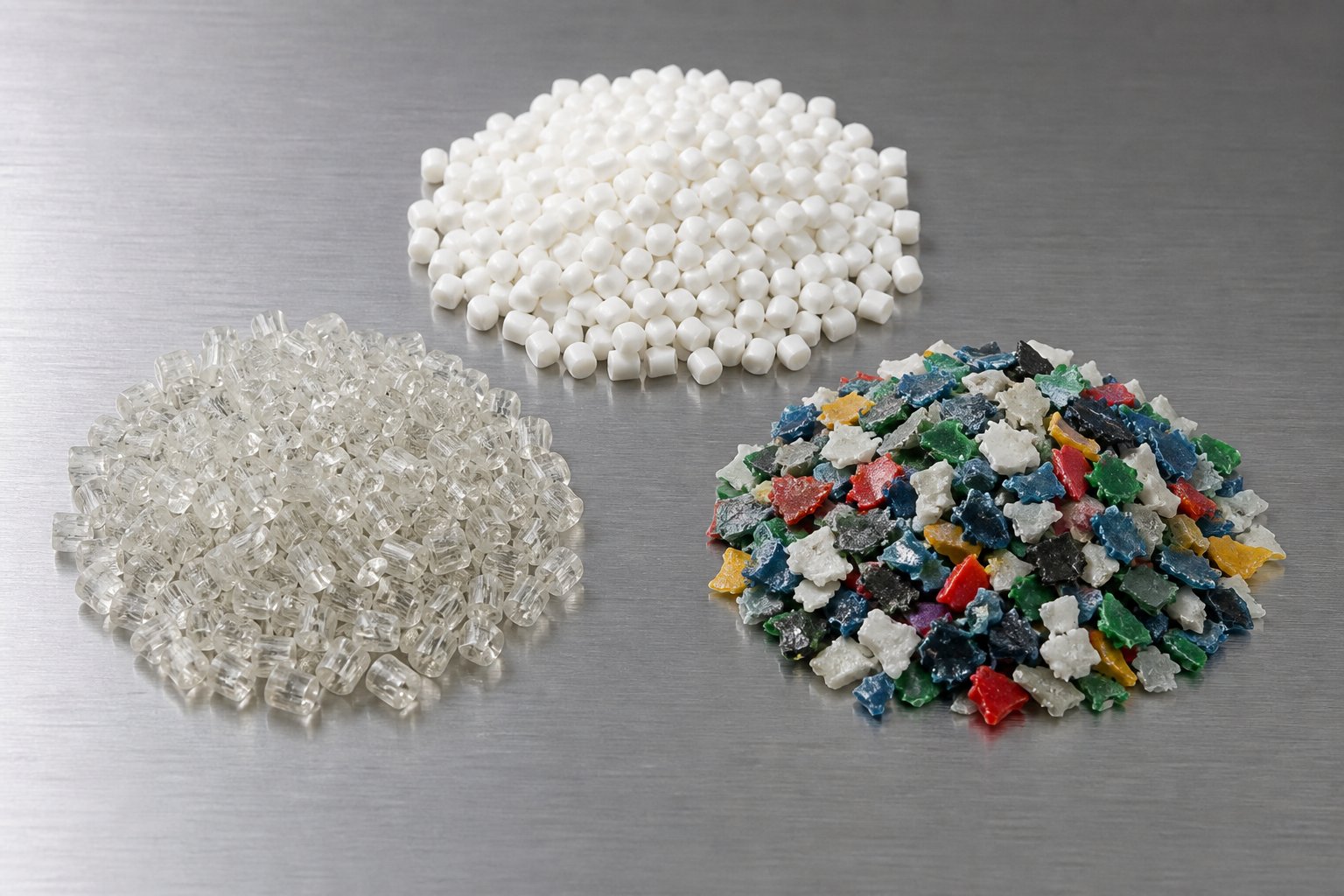
You've identified your dominant wear mechanism and confirmed that bimetallic construction is justified. The next question is intensely practical: which alloy do you specify for the exact resins running through your barrel? A bimetallic screw for glass-filled nylon faces a completely different threat profile than one processing rigid PVC or post-consumer recycled flake. Treating them the same is one of the fastest ways to waste a premium investment. Here's a resin-by-resin breakdown that turns alloy selection from art into engineering.
Selection for Glass-Filled and Mineral-Filled Polymers
Glass-fiber-reinforced nylon (PA6 and PA66), glass-filled polycarbonate, and mineral-loaded polypropylene rank among the most abrasive materials a screw will ever encounter. At 30% glass-fiber loading, individual fibers with a Mohs hardness of 5.5 to 6.5 act as microscopic cutting tools, carving material from flight lands with every screw rotation. Increase the loading to 40% or 50%, and the erosion rate escalates dramatically—especially in the transition and metering zones where melt pressure compresses fibers against the flight surfaces.
Tungsten carbide composite alloys are the clear first choice here. WC-Co and WC-CrC-Ni coatings applied via PTA or HVOF deliver surface hardness exceeding 1,100 HV, far above what glass fibers can effectively erode. For moderate glass-fiber content (15% to 30%), nickel-tungsten carbide alloys like Colmonoy 83 offer an effective balance of abrasion resistance and cost. Flight geometry also matters in these applications: wider flight lands distribute contact pressure across a larger surface area, reducing localized erosion and extending the interval between inspections.
Selection for PVC, Fluoropolymers, and Flame-Retardant Compounds
Corrosion—not abrasion—is the primary threat when processing halogenated resins. PVC releases hydrochloric acid during thermal degradation. Fluoropolymers like PTFE and PVDF generate hydrofluoric acid, which is aggressive enough to attack even hardened tool steels. Flame-retardant compounds containing brominated or chlorinated additives produce similarly corrosive byproducts at processing temperatures.
Choosing the best screw alloy for PVC processing means prioritizing chemical inertness over raw hardness. Nickel-based alloys with high chromium and molybdenum content—Colmonoy 56 being the industry standard—resist HCl attack far more effectively than cobalt or iron matrices. For fluoropolymer processing, DuPont specifically recommends nickel-based alloys such as Hastelloy, Inconel, and Monel for all melt-contact surfaces, explicitly warning against chrome-plated alternatives. Here's where an uninformed selection gets expensive: a tungsten carbide composite screw might offer impressive hardness numbers, but its cobalt binder dissolves under sustained HCl exposure, undermining the very layer that's supposed to provide protection. Hardness without chemical compatibility is a false economy.
Selection for Recycled and Off-Spec Feedstock
Recycled plastics processing is where alloy selection becomes genuinely complicated. Post-consumer streams don't arrive with predictable compositions—they carry metal fragments, sand, paper fiber, residual adhesives, mixed colorants, and inconsistent stabilizer packages. One batch might be mildly abrasive; the next might contain enough contaminants to mimic a heavily filled compound. Adding to the challenge, moisture and degraded additives in recycled material can generate corrosive byproducts that attack the screw surface simultaneously.
A bimetallic screw for recycled plastics needs to resist both abrasion and corrosion at the same time, which eliminates single-purpose alloys from consideration. Nickel-tungsten carbide composites (like Colmonoy 83) and WC-CrC-Ni systems—where a nickel-chromium binder replaces the cobalt binder used in standard tungsten carbide coatings—handle this dual threat effectively. The nickel-chromium matrix resists chemical attack while the embedded carbide particles provide the hardness needed to survive abrasive contaminants. For processors running high-calcium PVC, WPC, SPC, and recycled formulations, bimetallic liners on both the screw and barrel are recommended to maintain consistent clearance and plasticizing stability over extended service intervals.
| Resin Category | Dominant Wear Mechanism | Recommended Alloy Family | Key Selection Rationale |
|---|---|---|---|
| Glass-filled nylon (PA6/PA66), glass-filled PC | Severe abrasion | Tungsten carbide composite (WC-Co); Colmonoy 83 | Maximum surface hardness to resist glass-fiber erosion |
| Mineral-filled PP, talc-filled compounds | Moderate abrasion | Colmonoy 83; iron-boron (budget option) | Mineral fillers are softer than glass but high loading increases cumulative erosion |
| Rigid PVC, CPVC | Corrosion (HCl) + mild abrasion | Nickel-based (Colmonoy 56); Hastelloy overlay | Nickel matrix resists HCl; chromium content provides passive oxide protection |
| Fluoropolymers (PTFE, PVDF, FEP) | Extreme corrosion (HF) | Hastelloy C-276; Inconel | HF attacks most alloys; only high-nickel, high-molybdenum compositions survive |
| Flame-retardant compounds (halogenated) | Corrosion + moderate abrasion | Colmonoy 56; Stellite 6/12 | Halogenated additives release corrosive gases; fillers add secondary abrasion |
| Post-consumer recycled plastics | Mixed abrasion + corrosion | WC-CrC-Ni; Colmonoy 83 | Unpredictable contaminants demand dual abrasion-corrosion resistance |
| Wood-plastic composite (WPC), SPC | Abrasion + moisture corrosion | WC-CrC-Ni; nickel-tungsten carbide bimetallic | Wood fiber and mineral fillers erode surfaces; moisture drives corrosion |
| Commodity resins (PE, PP, PS, ABS—unfilled) | Minimal | Nitrided steel (bimetallic not required) | No significant abrasion or corrosion; nitriding is cost-effective and sufficient |
This screw selection by resin type guide is a starting point, not a final specification. Filler loading, processing temperature, screw speed, and barrel condition all influence real-world wear rates. A 15% glass-filled nylon might perform acceptably on a nitrided screw at conservative throughput rates, while the same compound at 40% loading on a high-speed line demands the hardest tungsten carbide composite available. The practical takeaway: let the resin and its filler package dictate the alloy, not the other way around.
Of course, no alloy is a universal solution—and there are situations where specifying bimetallic construction doesn't make financial or engineering sense at all. Recognizing those situations before committing budget is just as important as choosing the right alloy when the investment is justified.
When a Bimetallic Screw Is Not the Right Choice
Every section so far has built the case for bimetallic construction in demanding applications. Here's the honest counterpoint: specifying a bimetallic screw when the application doesn't warrant it wastes money, complicates procurement, and delivers zero meaningful performance gain. Understanding bimetallic screw disadvantages and limitations is just as critical as knowing when the technology shines—because the goal isn't always the hardest alloy, it's the most cost-effective solution for the actual wear environment.
Cost Considerations and Break-Even Analysis
A bimetallic screw typically costs 1.5 to 2.5 times more than a comparable nitrided one. That premium is easy to justify when you're burning through nitrided screws every few months processing glass-filled nylon or corrosive PVC. It's much harder to justify when you're running unfilled HDPE, general-purpose polystyrene, or standard ABS—resins that generate minimal abrasion and no meaningful chemical attack.
The bimetallic screw cost vs nitrided screw equation is ultimately about break-even timing. If a nitrided screw lasts 8,000 hours in your application and a bimetallic alternative would last 10,000 hours, that modest life extension rarely recoups the upfront premium—especially after factoring in the cost of capital tied up in a more expensive spare. Processors should evaluate their actual wear rate, measured in millimeters of flight diameter loss per 1,000 operating hours, before committing to bimetallic construction. If wear data shows that your current nitrided screws are lasting through their expected service cycle without quality deterioration, the upgrade isn't solving a real problem.
Short production runs complicate the math further. A facility that processes a given resin for only a few hundred hours per year before switching to a different compound may never accumulate enough operating time to benefit from the extended wear life that bimetallic alloys deliver.
Design Constraints and Material Brittleness
High hardness and brittleness are two sides of the same metallurgical coin. The very alloy compositions that resist abrasion so effectively—tungsten carbide composites, high-boron nickel alloys—are inherently less ductile than base steel. In practical terms, this means they can crack under mechanical shock: a jammed screw, an overtorqued drive, or an improperly cleared cold start where solidified resin creates extreme localized pressure on the flights.
Bimetallic alloy layer cracking from thermal shock is another real-world risk that's often overlooked during specification. Rapid heating or cooling cycles—imagine pushing a cold screw into a barrel already at processing temperature, or shutting down without a proper soak period—create steep thermal gradients between the alloy layer and the steel substrate. Because these two materials have different coefficients of thermal expansion, the interface experiences shear stress. If that stress exceeds the bond strength, cracks can initiate and propagate along the alloy-substrate boundary. Research on nickel-based superalloys confirms that thermal stress concentrations—particularly at material interfaces—are a primary driver of crack formation, with residual stresses accumulating along the build direction and concentrating where temperature gradients are steepest.
This doesn't mean bimetallic screws are fragile—it means they require disciplined operating procedures. Gradual warm-up cycles, controlled shutdown sequences, and careful screw removal practices are essential. For facilities that lack the process discipline or operator training to follow these protocols consistently, bimetallic construction may introduce a failure mode that wouldn't exist with a tougher, more forgiving nitrided screw.
Availability and Lead Time Realities
When a screw fails unexpectedly, downtime costs can dwarf the price of the replacement itself. Standard nitrided screws are widely stocked and can often ship within days. Bimetallic screws, by contrast, require alloy application, heat treatment, precision grinding, and quality verification—a process that typically adds weeks to the delivery timeline. Some specialized alloy configurations, particularly those involving tungsten carbide PTA hardfacing or HIP-processed layers, may extend lead times even further.
For operations that cannot tolerate extended downtime, maintaining a spare bimetallic screw in inventory is the obvious solution—but that ties up significant capital in a component that may sit on a shelf for months or years. Processors who run multiple extruder sizes or screw geometries face an even steeper inventory burden. In emergency replacement scenarios, a nitrided screw that arrives in three days and lasts six months may be a more practical choice than a bimetallic screw that arrives in six weeks and lasts three years.
To summarize, here are the scenarios where specifying bimetallic is likely unnecessary or even counterproductive:
- Low-abrasion commodity resins — Unfilled PE, PP, PS, and standard ABS generate minimal flight wear; nitrided screws deliver adequate service life at significantly lower cost.
- Short or intermittent production runs — If annual operating hours on a given resin are low, the extended wear life of bimetallic alloys may never be realized before the screw is repurposed or retired.
- Applications where current screw life is already adequate — If your nitrided screw consistently reaches its planned replacement interval without quality issues, upgrading to bimetallic adds cost without adding value.
- Facilities lacking disciplined startup and shutdown procedures — High-hardness alloy layers are less tolerant of thermal shock and mechanical abuse; improper operation can cause cracking that a tougher nitrided or through-hardened screw would survive.
- Emergency replacement situations — When lead time matters more than ultimate longevity, a readily available nitrided screw gets production back online faster than waiting for a custom bimetallic build.
- Cases where surface treatment or repair is more cost-effective — Worn screws that still have sound base geometry may benefit more from alloy spray welding or thermal spray restoration than from full replacement with a new bimetallic component.
This last point deserves particular attention. The assumption that a worn screw must always be replaced with a brand-new component is deeply ingrained—but it's not always correct. Surface restoration techniques can return flight dimensions to original or even enhanced specifications, buying significant additional service life at a fraction of the cost and lead time of a new build. That repair-versus-replace calculation is exactly where the next section picks up.
Extending Screw and Barrel Life Through Maintenance and Repair
Specifying the right alloy and construction method is a strong starting point—but even the best bimetallic screw will eventually wear. What separates high-performing operations from the rest isn't just the quality of components they buy. It's how they monitor, maintain, and restore those components before wear turns into a production crisis. A proactive maintenance strategy can double or triple the useful life of your screw and barrel assembly, cutting total cost of ownership in ways that no alloy upgrade alone can match.
Proactive Wear Monitoring and Inspection Protocols
You can't manage what you don't measure. Screw flight wear monitoring and inspection should be a scheduled, documented activity—not something that happens only after output drops or part quality deteriorates. The goal is straightforward: track how quickly your screw flight outer diameter is decreasing and how quickly your barrel bore is increasing, then use those data points to predict when intervention is needed.
The measurement process starts with a clean screw. As Davis-Standard's maintenance guidelines emphasize, all solidified residue and buildup must be removed from the screw surface before taking measurements—and only with brass tools and copper gauze, never steel wire brushes or aggressive abrasives that could damage the surface and skew your readings. Once the screw is clean and cooled to room temperature, use an OD bar micrometer to measure the outer diameter of the flights at multiple points along the screw length, referencing each location with a tape measure so you can map wear distribution over time.
What you're building with repeated measurements is a wear curve—a plot of flight diameter loss against operating hours for each screw position. Early readings establish a baseline. Subsequent inspections at six-month intervals for abrasive resins, or annually for unfilled materials, reveal the rate of progression. Industry best practices from Reiloy USA recommend establishing these wear trends before setting fixed replacement schedules, because actual wear rates vary dramatically with resin type, filler content, processing speed, and alloy composition. A structured preventive maintenance program also tracks secondary indicators—overall cycle times, scrap rates, energy consumption, and unplanned downtime—that often correlate with component wear and provide early warning signals even between physical inspections.
The payoff is predictability. Instead of reacting to a sudden quality collapse or catastrophic screw failure, you'll know weeks or months in advance when a screw is approaching its service limit. That lead time is exactly what you need to schedule a repair or source a replacement without disrupting production.
Surface Treatment and Alloy Spray Welding for Life Extension
Here's where conventional thinking costs processors real money. The default assumption in many shops is that a worn screw equals a new screw order. But if the base steel substrate is still structurally sound—no cracks, no excessive root wear, no shaft deflection—the component is a strong candidate for surface restoration rather than full replacement.
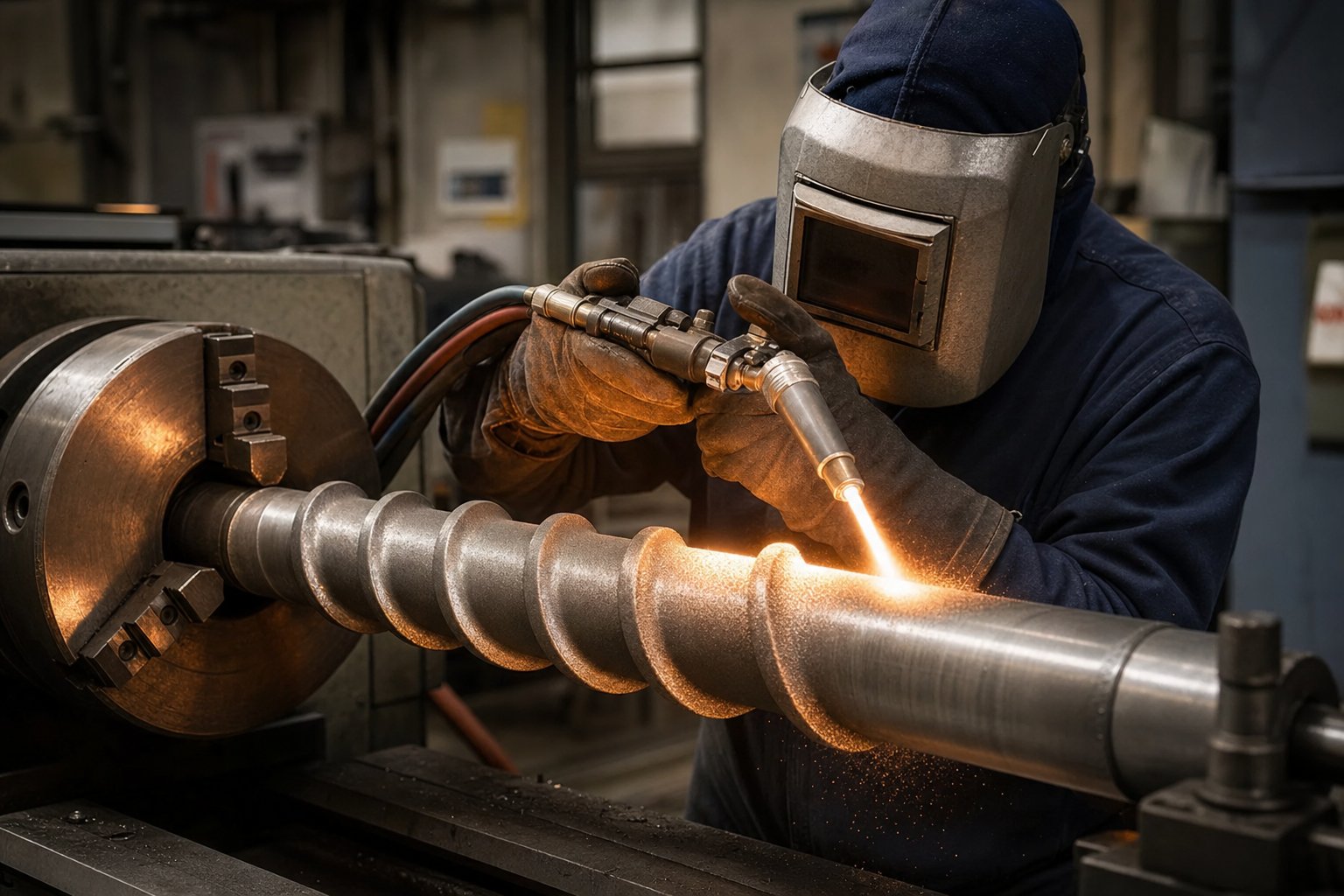
Alloy spray welding is one of the most effective methods for extending bimetallic screw life. The process works by depositing wear-resistant alloy material onto eroded flight surfaces, rebuilding them to original dimensions or even enhancing them with a harder alloy than the original specification. As industrial repair specialists explain, the technique applies molten or semi-molten alloy particles onto a prepared surface, where they flatten and solidify into a dense protective coating. Unlike traditional welding, spray welding applies minimal heat to the base material—reducing distortion and preserving the substrate's mechanical properties. After buildup, the restored flights are precision-ground to final dimensions, delivering performance that meets or exceeds the original component specification.
The practical advantages are compelling. A surface restoration typically costs a fraction of a new bimetallic screw and can be completed in significantly less time—critical when lead times for new builds stretch into weeks. For operations that process abrasive or corrosive materials and experience predictable, localized flight wear, periodic alloy spray welding can turn a single screw body into a platform that delivers multiple service lives through successive rebuilds.
This repair-first approach is especially relevant for extrusion and injection molding operators dealing with screw wear, barrel wear, corrosion, and slippage—situations where the underlying component geometry is still viable but the surface has degraded past acceptable tolerances. NANHAIYA's alloy spray welding service is built specifically for these scenarios, providing surface treatment and repair-oriented support as an alternative to defaulting to full replacement. For processors who need to get a worn screw back into service quickly while preserving their capital budget, this type of targeted restoration fills a gap that new component procurement alone cannot address.
Operational Best Practices to Reduce Wear Rate
Even the best alloy and the most diligent inspection program can't overcome operational habits that accelerate wear unnecessarily. Many of the most damaging wear events happen not during normal steady-state processing, but during startups, shutdowns, transitions, and maintenance activities where temperature gradients, mechanical stresses, and material flow disruptions are at their worst. Adopting disciplined screw and barrel maintenance best practices reduces your baseline wear rate and stretches the interval between inspections, repairs, and replacements.
- Follow a gradual warm-up sequence. Never start the screw turning until all barrel zones have reached their target processing temperature and have soaked for a minimum of 15 to 20 minutes. Cold startups create extreme localized stress on flight surfaces and can crack high-hardness bimetallic alloy layers through thermal shock.
- Purge corrosive and filled resins before shutdown. Reiloy USA recommends always removing corrosive and filled resins before idling equipment. Left in contact with metal surfaces at elevated temperatures, PVC residue continues releasing HCl, and glass fibers embedded in solidified melt create abrasive contact points during the next startup. Use a quality commercial purging compound matched to your resin and temperature range.
- Use heat-stable purging compounds for extended shutdowns. A thermally stable purging compound seals the barrel and prevents oxidation during idle periods. This eliminates carbon buildup and black specks on restart, reducing the need for extended purge cycles that waste material and wear the screw.
- Monitor and maintain proper barrel-screw clearance. As both the screw diameter decreases and the barrel bore increases over time, the growing clearance reduces pumping efficiency and increases material backflow. Track these dimensions together—not in isolation—and plan repair or replacement when combined clearance exceeds your process tolerance.
- Control screw RPM to the minimum needed for target output. Higher rotational speeds increase the velocity of abrasive particles against flight surfaces and generate more frictional heat. Running at the lowest RPM that meets throughput and melt quality requirements meaningfully slows wear progression.
- Remove screws carefully during maintenance. Use proper pulling equipment and support the screw along its length to prevent bending. Dragging a screw across the barrel bore without adequate support scores both surfaces unnecessarily—damage that is entirely preventable with correct handling technique.
- Document every inspection and maintenance event. Record flight diameter measurements, barrel bore readings, operating hours since last inspection, resin types processed, and any process anomalies. This data feeds your wear curves and transforms maintenance from a reactive cost into a predictive tool that optimizes component life.
None of these steps are exotic or expensive. They're process discipline—the kind of operational rigor that compounds over thousands of hours into measurably longer component life and fewer emergency shutdowns. Combined with proactive wear monitoring and timely surface restoration, they form a complete strategy for how to extend bimetallic screw life well beyond what the alloy alone would deliver. The final piece of the puzzle is pulling these elements—alloy selection, wear mechanism mapping, repair-versus-replace analysis, and maintenance protocol—into a single decision framework that any engineer or maintenance manager can follow from start to finish.
Building Your Bimetallic Screw Selection Framework
Alloy families, wear mechanisms, manufacturing methods, resin mappings, maintenance protocols—there's a lot of ground to cover when specifying or managing bimetallic screws. The risk isn't a lack of information at this point. It's the opposite: too many variables without a clear sequence for working through them. What engineers and maintenance managers need is a repeatable decision process—one that moves from diagnosis to action without skipping the steps that prevent expensive mistakes.
The Five-Step Bimetallic Screw Decision Process
Whether you're specifying a new component, evaluating a worn one, or building a long-term maintenance strategy, this bimetallic screw selection guide for engineers distills the entire analysis into five sequential steps. Each one builds on the previous, so skipping ahead usually means revisiting earlier decisions later—at greater cost.
- Identify your dominant wear mechanism based on resin and filler type. Start with the material, not the screw. Is the primary threat abrasion from glass fibers, mineral fillers, or recycled contaminants? Corrosion from HCl, HF, or halogenated flame-retardant byproducts? Or a combination of both? Reviewing your screw's current wear pattern—flight land erosion versus pitting versus root thinning—tells you which mechanism is doing the most damage. If you're unsure, pull a worn screw, clean it with brass tools, and examine the surfaces under magnification. Abrasive wear leaves scoring and polished grooves; corrosive wear shows pitting, roughening, and etched surfaces. This single observation drives every subsequent choice.
- Determine whether bimetallic construction is justified—or if nitrided or through-hardened alternatives suffice. Not every application warrants the cost premium. If you're processing unfilled commodity resins like PE, PP, or PS, and your current nitrided screws consistently reach their planned replacement interval without quality deterioration, bimetallic construction adds expense without adding value. Reserve it for abrasive, corrosive, or mixed-wear environments where the thin nitrided case (0.4 to 0.7 mm) wears through too quickly to deliver acceptable service life. For extremely high glass-fiber loading above 30%, evaluate through-hardened CPM tool steels as an alternative that provides uniform hardness throughout the entire cross-section.
- Select the appropriate alloy family matched to your wear profile. With the dominant wear mechanism identified and bimetallic construction confirmed, the alloy choice becomes a direct mapping exercise. Severe abrasion points to tungsten carbide composites or Colmonoy 83. Corrosion-dominated environments—PVC, fluoropolymers, halogenated compounds—call for nickel-based alloys like Colmonoy 56 or Hastelloy overlays. Mixed abrasion-corrosion scenarios, especially in recycled plastics, demand WC-CrC-Ni systems where the nickel-chromium binder resists chemical attack while embedded carbides handle the abrasive component. Always confirm alloy compatibility with your barrel lining material—mismatched alloys between screw and barrel can accelerate adhesive wear and galling, undermining the protection both components are designed to provide.
- Evaluate whether the existing screw can be restored through surface treatment or alloy spray welding before ordering a new component. This is the step most operations skip—and it's often the one that saves the most money. If the base steel substrate is structurally sound, with no cracking, shaft deflection, or excessive root erosion, surface restoration can rebuild worn flight dimensions to original or even enhanced specifications at a fraction of the cost and lead time of a new build. NANHAIYA's alloy spray welding service addresses exactly this scenario—providing targeted surface treatment for extrusion and injection molding operators dealing with screw wear, barrel wear, corrosion, or slippage, without the expense and extended downtime of full bimetallic screw replacement. The screw replacement vs repair decision framework is straightforward: if the component's geometry and substrate integrity support restoration, repair first. If the base steel is compromised or the required alloy upgrade demands a full new build, replace.
- Establish a wear monitoring protocol to optimize replacement and repair timing. Measuring flight diameter and barrel bore at regular intervals—every six months for abrasive resins, annually for unfilled materials—builds the wear curves that transform maintenance from reactive to predictive. Track flight OD loss per 1,000 operating hours, correlate it with process parameters like screw RPM and throughput rate, and set intervention thresholds that trigger repair or replacement before quality loss becomes visible in your finished product. Glycon Corp.'s research shows that identifying the "point of diminishing returns"—where incremental machine adjustments can no longer compensate for component wear—allows maintenance teams to schedule interventions proactively, eliminating unplanned downtime entirely.
Repair-First vs. Replace-First Thinking
The plastics processing industry has a deeply ingrained reflex: when a screw wears out, order a new one. That reflex made sense decades ago, when surface restoration technologies were limited and alloy spray welding was imprecise. It makes far less sense today.
Modern alloy spray welding techniques deposit wear-resistant material onto eroded flight surfaces with minimal heat input to the substrate, preserving the base steel's mechanical properties while rebuilding protective layers that meet or exceed original specifications. The economics are compelling—a structured repair-versus-replace analysis considers not just the sticker price of a new component, but the total cost including downtime during lead time, capital tied up in spare inventory, and the opportunity cost of money spent on replacement when restoration would have delivered equivalent performance.
For many applications, the math favors repair decisively. A screw with localized flight wear in the metering zone—the most common wear pattern in filled-resin processing—can be restored in days rather than the weeks required to manufacture a new bimetallic component. The base steel, which represents the majority of the screw's material and manufacturing cost, is preserved and reused. And because spray welding can apply the same alloy families used in new construction—nickel-based, cobalt-based, or tungsten carbide composites—the restored surface delivers the same chemical and mechanical protection as a freshly manufactured part.
This doesn't mean replacement is never the right call. When the base steel is cracked, bent, or eroded beyond safe dimensional tolerances, restoration isn't viable. When a process change demands a fundamentally different screw geometry or alloy upgrade that can't be achieved through surface buildup alone, a new build is the correct path. The key shift is in the default assumption: evaluate repair first, and replace only when the engineering case demands it.
The most cost-effective bimetallic screw strategy is not choosing the hardest alloy or the most expensive construction—it is combining smart initial specification with proactive wear monitoring and timely surface restoration to minimize total cost of ownership across the full component lifecycle.
Imagine approaching your next screw specification or replacement decision with this framework in hand. You know which wear mechanism is dominant. You know whether bimetallic construction is justified. You know which alloy family matches your resin. You've evaluated whether the existing component can be restored—potentially through a service like NANHAIYA's alloy spray welding—before committing capital to a new build. And you have a monitoring protocol in place to catch the next wear event before it becomes a production crisis. That's not just how to choose a bimetallic screw alloy. It's how to build a total cost of ownership strategy that keeps your operation running efficiently, predictably, and without the expensive surprises that come from treating every worn screw as a disposal event.
Frequently Asked Questions About Bimetallic Screws
1. What is a bimetallic screw and how does it differ from a coated screw?
A bimetallic screw features a wear-resistant alloy layer—such as nickel-based, cobalt-based, or tungsten carbide composite material—metallurgically bonded to a tough steel core through atomic diffusion at the interface. This creates a gradient transition zone rather than a sharp boundary. Coated screws, by contrast, rely on mechanical adhesion that can chip or delaminate under the extreme pressures and temperatures inside a plasticating barrel. The metallurgical bond in bimetallic construction ensures the protective layer remains intact throughout the screw's service life, even under severe abrasive or corrosive conditions.
2. How long does a bimetallic screw last compared to a nitrided screw?
In abrasive or corrosive applications—such as processing glass-filled nylon, PVC, or recycled plastics—bimetallic screws typically last 2 to 3 times longer than nitrided screws. Nitrided screws have a hardened case only 0.5 to 0.8 mm deep, which wears through quickly when exposed to aggressive fillers or corrosive byproducts. Once breached, the softer base steel erodes rapidly. Bimetallic alloy layers are 1.5 to 2.5 mm thick and chemically tailored to resist specific attack mechanisms, sustaining protection far longer. However, for unfilled commodity resins like PE or PP, nitrided screws perform adequately and the bimetallic premium may not be justified.
3. Which bimetallic alloy should I choose for PVC processing?
PVC releases hydrochloric acid (HCl) during thermal degradation, making corrosion resistance the top priority. Nickel-based alloys with high chromium content—particularly Colmonoy 56—are the industry standard for PVC screw hardfacing because the nickel matrix resists HCl attack far better than cobalt or iron alternatives. For more aggressive fluoropolymer processing where hydrofluoric acid is present, Hastelloy C-276 or Inconel overlays are recommended. Avoid tungsten carbide composites with cobalt binders in these environments, as HCl dissolves the cobalt matrix and undermines the protective layer despite its high hardness.
4. Can a worn bimetallic screw be repaired instead of replaced?
Yes, if the base steel substrate remains structurally sound—free of cracks, shaft deflection, or excessive root erosion—alloy spray welding can rebuild worn flight surfaces to original or enhanced specifications. This process deposits wear-resistant alloy onto eroded areas with minimal heat input, preserving the substrate's mechanical properties. Restoration typically costs a fraction of a new bimetallic screw and can be completed in days rather than the weeks a new build requires. Services like NANHAIYA's alloy spray welding (https://www.nhyscrew.com/services/alloy-spray-welding) are designed specifically for extrusion and injection molding operators who need to address screw wear, barrel wear, or corrosion without full replacement.
5. What causes bimetallic screw alloy layers to crack?
The most common cause is thermal shock from improper startup or shutdown procedures. Rapid temperature changes create steep thermal gradients between the alloy layer and the steel substrate, which have different coefficients of thermal expansion. The resulting shear stress at the interface can initiate and propagate cracks along the alloy-substrate boundary. Mechanical shock—from jammed screws, overtorqued drives, or cold starts with solidified resin—also poses a risk, especially with ultra-hard alloys like tungsten carbide composites. Preventing these failures requires gradual warm-up sequences, controlled shutdowns, proper purging before idle periods, and careful screw removal techniques during maintenance.
Written by
Nanhaiya Technical Team
Zhoushan Nanhaiya Plastic Machinery Co., Ltd.
The Nanhaiya technical team supports screw and barrel manufacturing projects through application review, technical communication, custom manufacturing coordination, and production and quality control.
Discuss Your Application
Related Articles
More insights on screw barrel technology and plastics processing.
What Nobody Tells You About Screw Barrel For Plastic Machine Design
Oct 10, 2026
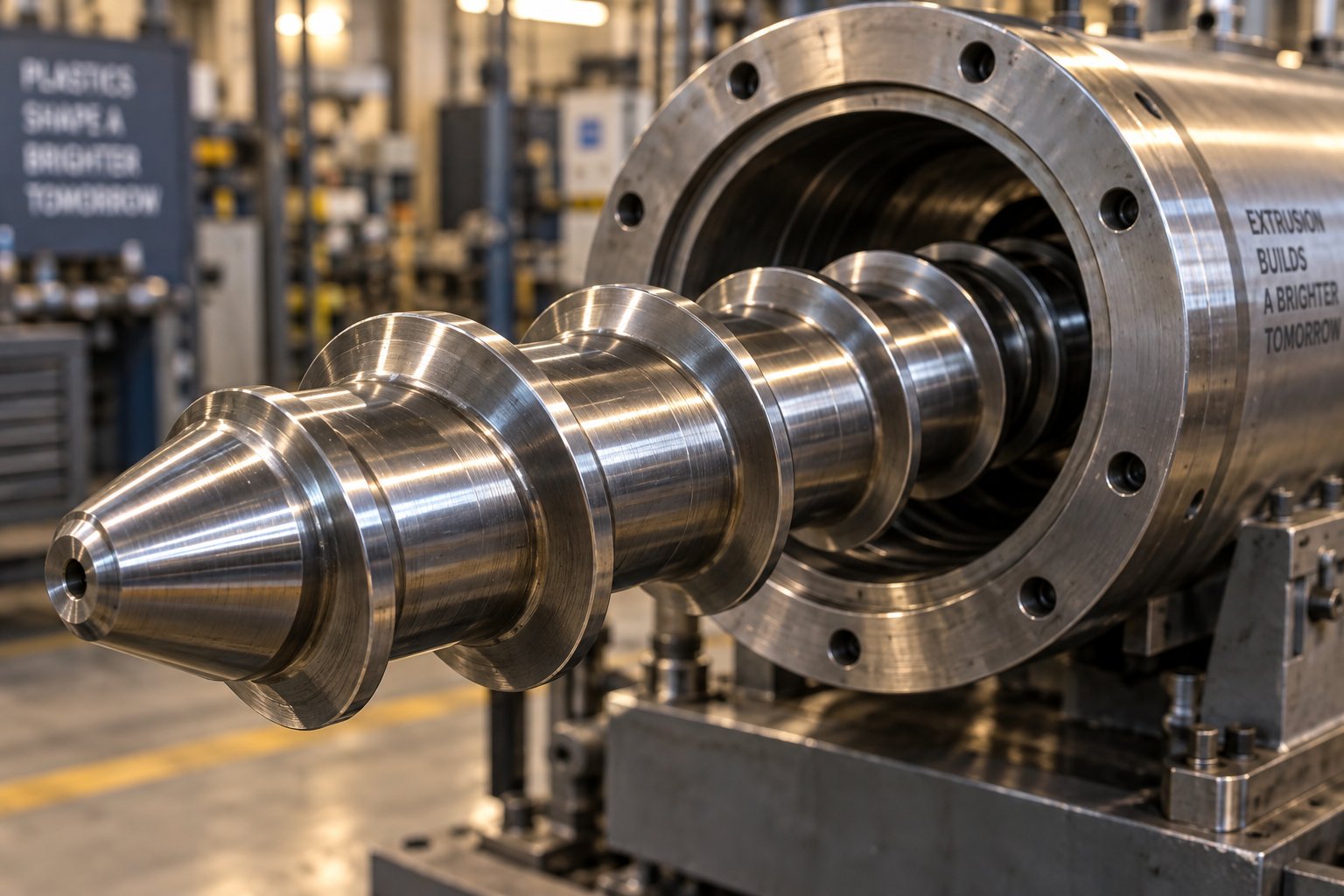
Learn how screw barrel for plastic machine design affects melt quality, throughput, and wear life. Covers geometry, resin matching, troubleshooting, and sourcing.
Read Article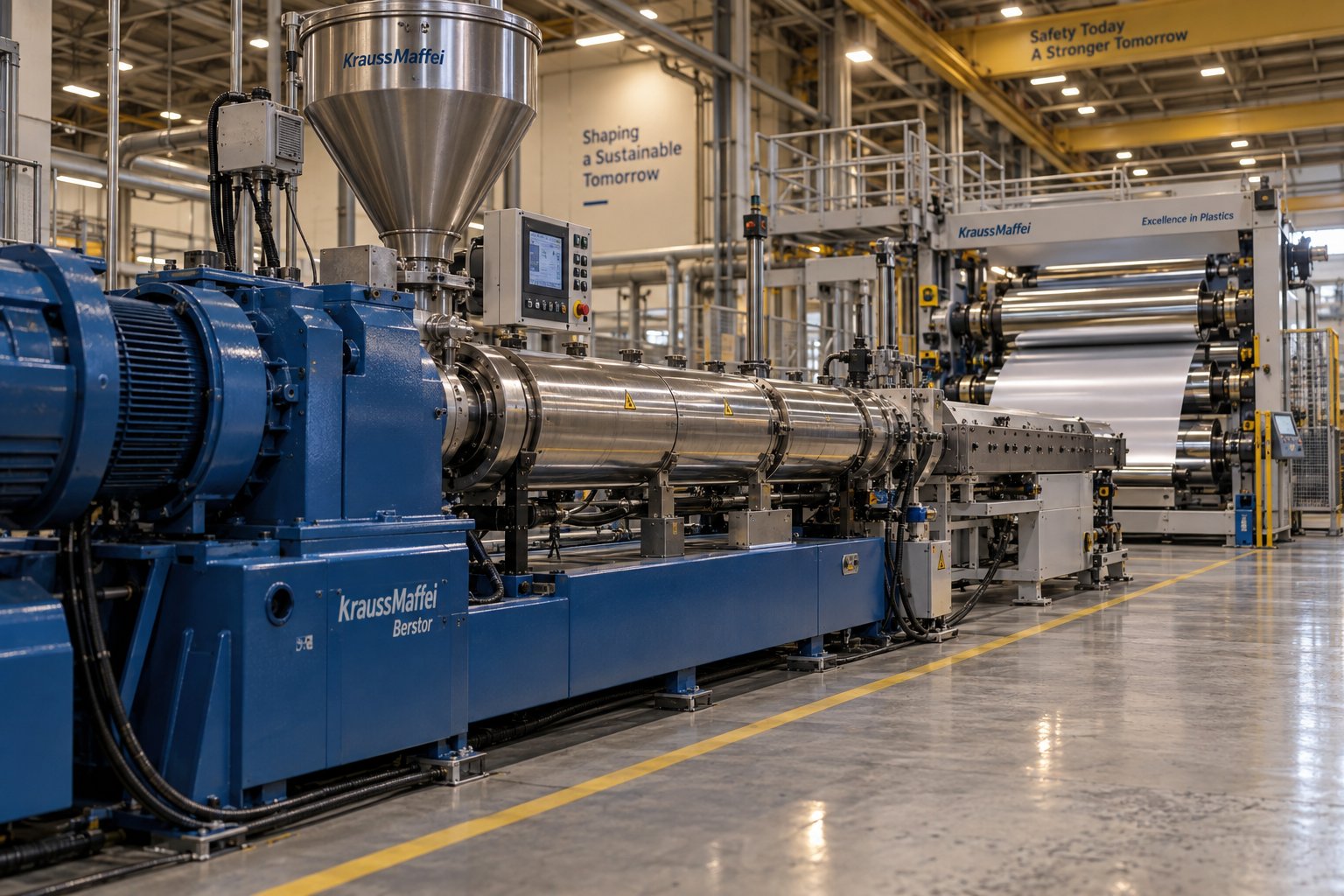
Single Screw Extruder for Sheet: Stop Guessing, Start Specifying
Oct 9, 2026
Learn how to specify a single screw extruder for sheet production. Covers screw geometry, resin-specific processing, troubleshooting, and maintenance best practices.
Read Article
PE Pipe Extruder Machine: What Datasheets Won't Tell You
Oct 9, 2026
Learn how a PE pipe extruder machine works, key specs explained, material grade selection, maintenance tips, and buyer guidance beyond the datasheet.
Read ArticleLooking for something else?
Search by material, symptom or product and jump straight to the relevant page.
These are navigation suggestions based on keyword matching — not a quotation, not a delivery commitment, and not a substitute for engineering review. Final specification is confirmed by our engineers against your drawings and processed material.
Need help with screw barrel selection?
Share your machine model, processed material and application. Our team can help with pricing and technical support.