

What Is a Benchtop Twin Screw Extruder and Who Needs One
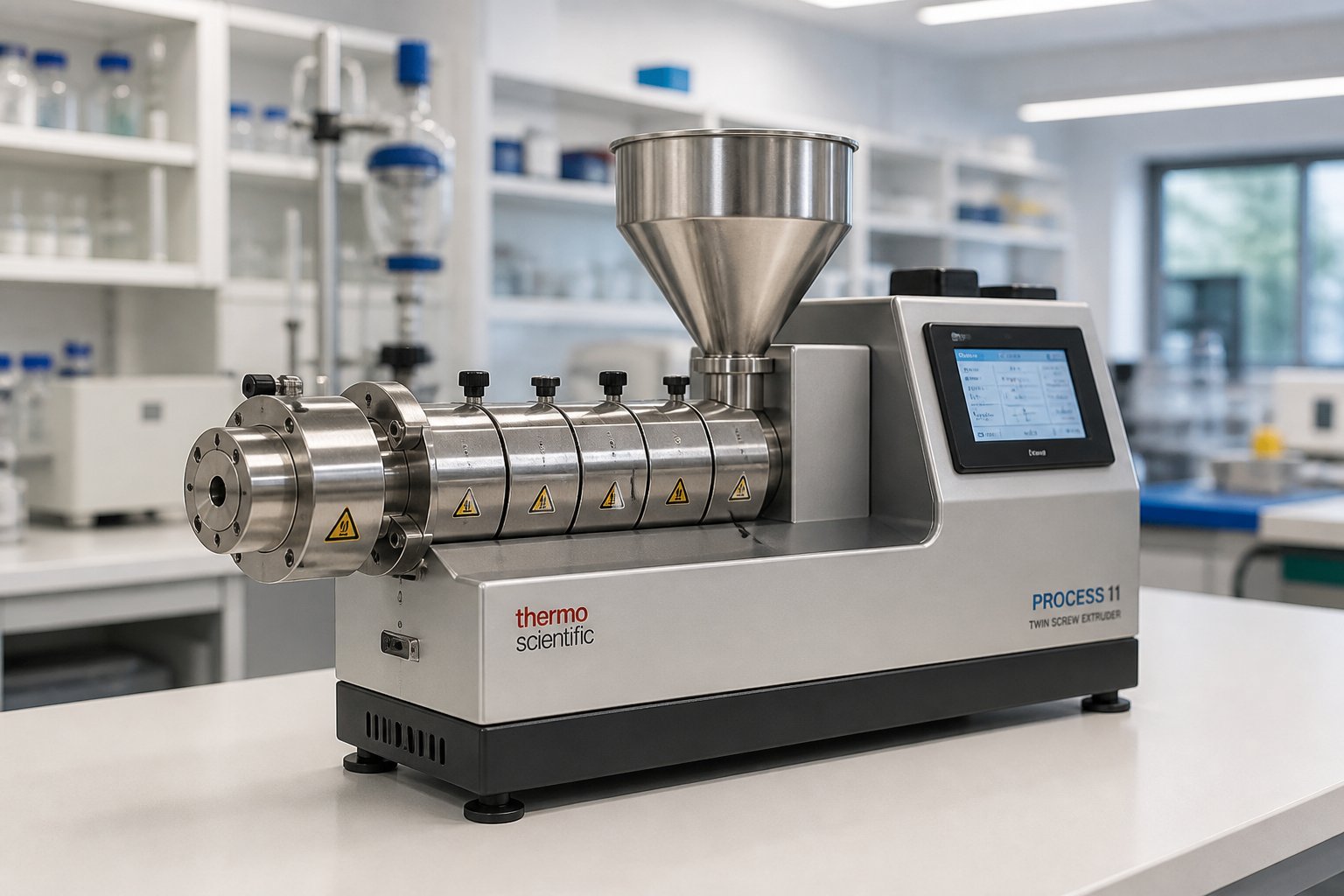
If you have ever asked yourself "what is an extruder machine," picture a device that melts, mixes, and shapes raw materials by forcing them through a heated barrel with rotating screws. Scale that concept down to fit on a laboratory workbench, equip it with two co-rotating screws instead of one, and you have the machine at the center of this guide.
A benchtop twin screw extruder is a compact, small-footprint twin screw extrusion system engineered for R&D laboratories, university research groups, and small-batch processing. It replicates the mixing, conveying, and shaping capabilities of full-scale production extruders while requiring only grams to a few kilograms of raw material per run.
That distinction matters more than it might seem. Industrial twin screw extruders occupy entire factory floors, consume hundreds of kilograms of material per hour, and demand dedicated infrastructure. Single-screw machines, while simpler and less expensive, lack the intense distributive and dispersive mixing that a twin-screw design delivers. The benchtop twin screw extruder sits at the intersection of both gaps — offering advanced mixing performance in a footprint small enough for a shared lab.
Defining the Benchtop Twin Screw Extruder
Several core characteristics set this class of laboratory extruder apart. First, the compact frame — typically under a meter in length — allows placement directly on a standard lab bench without specialized foundations. Second, throughput is intentionally low, often ranging from a few hundred grams to roughly 5 kg per hour, so researchers can iterate on formulations without burning through expensive raw materials. Third, modular screw and barrel configurations let users swap individual screw elements and barrel segments to tailor the machine for different materials and processing objectives. Finally, precise digital process control — temperature accuracy within +/-1 degree Celsius, real-time torque monitoring, and adjustable screw speed — ensures that experimental results are repeatable and meaningful for scale-up decisions.
Who Uses Benchtop Extruders and Why
The user base is broader than you might expect. Polymer scientists rely on these machines for compounding trials, blending novel resins with fillers and additives at minimal material cost. Food technologists use them to prototype texturized proteins and extruded snack formulations. Pharmaceutical formulators turn to twin-screw extruder platforms for hot-melt extrusion studies, developing amorphous solid dispersions where every gram of active ingredient can cost a small fortune. Materials engineers in university labs run nanocomposite and biodegradable polymer experiments that would be impractical — and prohibitively wasteful — on production-scale equipment.
The common thread across all these groups is the same: they need a twin-screw extruder that delivers industrially relevant processing data from the smallest feasible batch size. Understanding what this machine is and who it serves lays the groundwork for every specification, geometry choice, and cost decision explored throughout the rest of this article — starting with what actually happens to material once it enters the barrel.
How Benchtop Twin Screw Extrusion Works Step by Step
Knowing what a benchtop twin screw extruder is and who benefits from it raises a natural follow-up question: what actually happens to the material between the moment it drops into the hopper and the instant it exits the die? The answer involves a carefully orchestrated sequence of physical transformations — and understanding each stage is the difference between running a successful experiment and generating data you cannot trust.
The Intermeshing Co-Rotating Mechanism
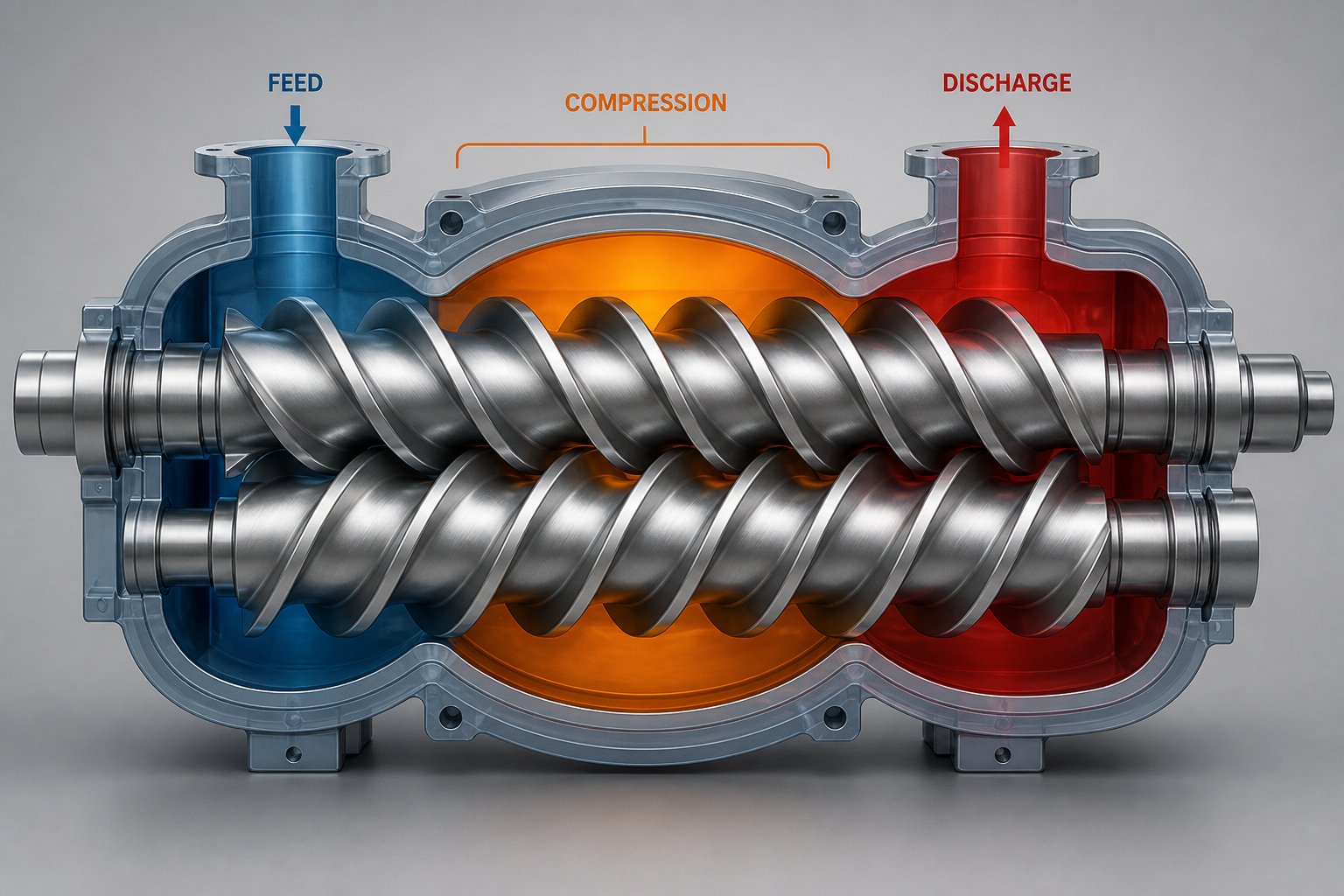
Imagine two screws placed side by side inside a figure-eight-shaped barrel, both turning in the same direction. That is the core of a co rotating twin screw extruder. The flights of one screw mesh tightly into the channels of the other, creating a self-wiping action that continuously scrapes material off the barrel walls and screw surfaces. This intermeshing geometry is what makes a double screw extruder fundamentally different from a single-screw machine. Rather than relying on friction drag alone to push material forward, the interlocking flight pattern generates positive conveying — material physically cannot sit still.
The self-wiping effect also prevents stagnant zones where polymer could overheat and degrade. As Technovel's technical resources note, the fully intermeshing co-rotating configuration has become the mainstream choice precisely because it delivers excellent self-cleaning capability alongside stable, high-quality compounding. For benchtop R&D work, where you may switch between dozens of formulations in a single week, that self-cleaning property is not just convenient — it is essential for preventing cross-contamination.
The intermeshing design also creates two distinct types of mixing that single-screw machines struggle to replicate:
- Distributive mixing — Splitting, reorienting, and recombining material streams so that every component is spread uniformly throughout the melt. Think of it as shuffling a deck of cards until every suit is evenly distributed.
- Dispersive mixing — Applying enough stress to break down agglomerates, droplets, or filler clusters into their smallest achievable size. This requires high shear and elongational forces concentrated at the intermeshing region between the two screws.
Together, these two mixing mechanisms give the extruder twin screw configuration its reputation for handling everything from simple color concentrates to highly filled nanocomposites.
The Material Journey: Functional Zones From Inlet to Die
As material travels along the barrel of a screw extruder, it passes through a series of functional zones. Each zone is defined not by a fixed barrel position, but by the screw elements installed at that location and the processing conditions they create. Here is what happens in each stage:
- Solids conveying zone — Raw material, whether pellets, powder, or granules, drops from the hopper onto the screws. The flight geometry grabs the solid feedstock and moves it forward. Temperature here is kept low enough to prevent premature melting that could block the feed throat.
- Melting and plasticating zone — Barrel heaters and mechanical shear work together to transition the material from solid to molten state. The combination of conducted heat from the barrel wall and viscous dissipation from the screw action ensures efficient melting, even at the small barrel volumes typical of benchtop machines.
- Mixing and kneading zone — Specialized kneading block elements replace standard conveying flights. These staggered disc elements force the melt through narrow gaps and constantly reorient the flow direction, delivering the intense distributive and dispersive mixing described above. The number, width, and stagger angle of these kneading blocks can be reconfigured to match each formulation's requirements.
- Pressure building and pumping zone — After mixing is complete, conveying elements re-establish forward flow and build sufficient pressure to push the melt through the die. The die shapes the material into its final form — whether that is a strand for pelletizing, a film, or a profile for downstream analysis.
This modular zone architecture is one of the defining strengths of twin screw extrusion. You are not locked into a fixed processing sequence. By rearranging screw elements along the shaft, you can add a second kneading section, insert a venting zone to remove volatiles, or extend the melting region — all without purchasing a new machine.
How Benchtop Scale Changes the Extrusion Dynamic
The fundamental principles of twin screw extrusion remain identical whether the screw diameter is 12 mm or 120 mm. Material still melts, mixes, and gets pumped through a die. However, the physics of small geometry introduces practical differences that you need to account for before drawing scale-up conclusions from benchtop trials.
Heat transfer behaves differently. A smaller barrel has a much higher surface-area-to-volume ratio. That means the barrel heaters exert a stronger relative influence on melt temperature compared to a production-scale extruder, where viscous shear heating dominates. In practice, you will notice that benchtop machines can sometimes achieve melt temperatures with less mechanical energy input, making it tempting to underestimate how much work the screws will need to do at larger scale.
Residence time distribution shifts. With a smaller barrel volume and lower throughput, individual material particles spend proportionally more time inside the extruder. This can be an advantage for reactive processes that benefit from extended dwell time, but it also means heat-sensitive materials face a higher degradation risk than they would in a faster, larger-volume production machine.
Shear rate profiles require careful interpretation. While the screw speed range on a benchtop unit may look similar to a production machine on paper, the smaller screw diameter changes the actual shear rates experienced by the melt. Maintaining equivalent specific energy input — rather than simply matching RPM settings — is critical when translating an extruder twin screw process from bench to plant floor.
None of these differences invalidate benchtop data. They simply mean that a well-run benchtop trial records actual melt temperatures, torque values, and die pressures alongside machine setpoints, giving researchers the real process fingerprint they need for confident scale-up. That level of process awareness also depends heavily on knowing which machine geometry fits your application — a topic that leads directly into the distinction between parallel and conical twin screw designs.
Parallel vs. Conical Twin Screw Geometry Explained
Every benchtop twin screw extruder datasheet lists a screw geometry — parallel or conical — yet rarely explains why that distinction should influence your purchasing decision. Vendors mention it like a checkbox item, leaving researchers to wonder whether it actually matters for their work. It does, and the reasons go well beyond simple shape differences.
Parallel Twin Screw Design and Its Advantages
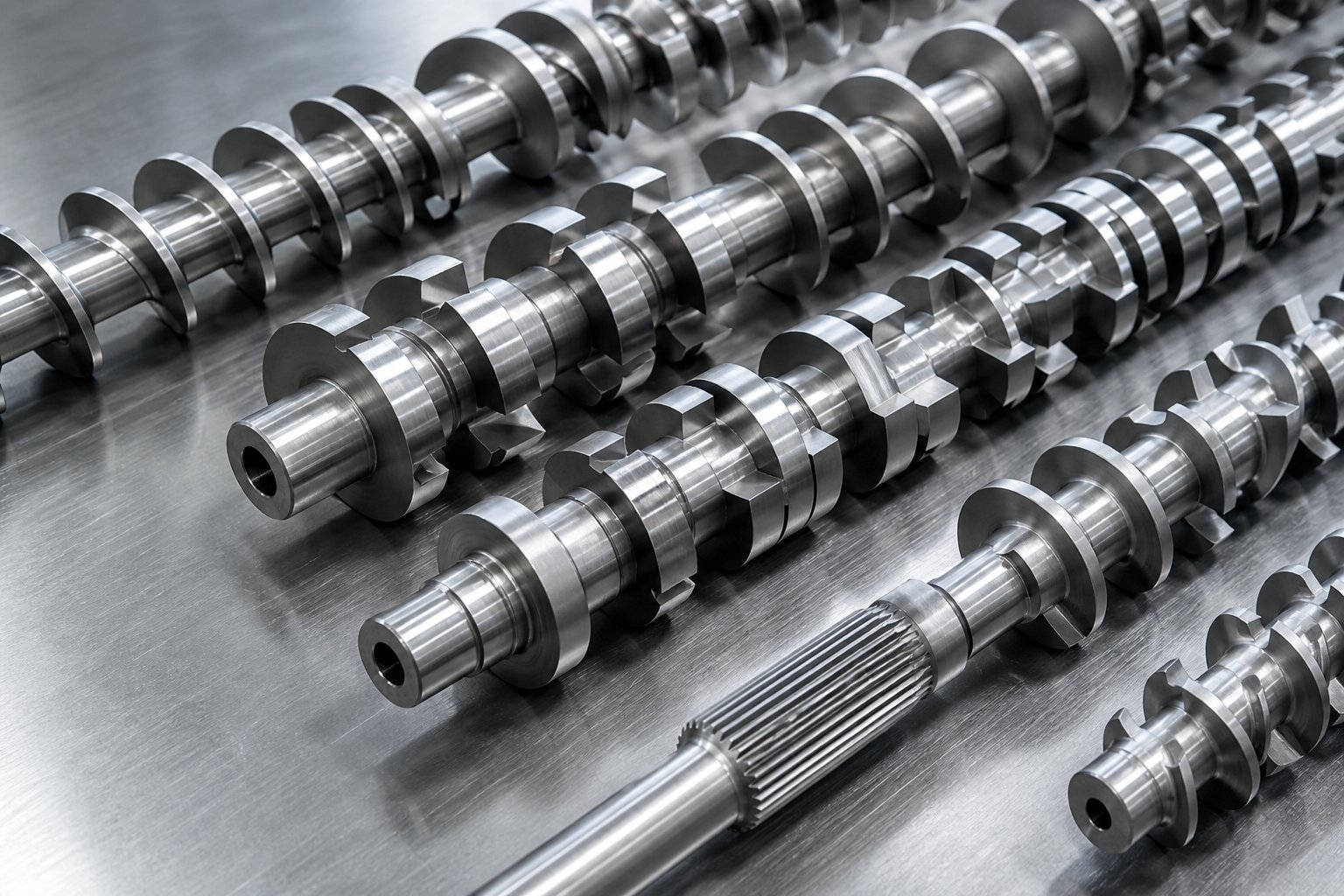
A parallel twin screw extruder uses two screws that maintain a constant, equal diameter along their entire length. Picture two identical cylinders sitting side by side inside a straight, figure-eight barrel bore. Because the diameter never changes, you can build the screw profile from interchangeable modular elements — conveying flights, kneading blocks, mixing elements, and distributive mixing sections — arranging them in any order along a common splined shaft.
That modularity is the single biggest reason parallel geometry dominates benchtop R&D applications. When you are screening a new polymer blend on Monday, testing a filled masterbatch on Wednesday, and running a pharmaceutical hot-melt extrusion trial on Friday, the ability to reconfigure the twin screw and barrel setup in under an hour is not a luxury — it is a workflow requirement. Swapping a few kneading blocks for conveying elements, or adding a venting barrel segment, lets you match the screw profile to each formulation without purchasing dedicated hardware.
Parallel designs also deliver broader processing flexibility. As Rollepaal's technical comparison highlights, parallel extruders offer a wider processing window and greater screw design freedom compared to conical alternatives. The consistent barrel bore simplifies cleaning as well — you can push elements off the shaft in sequence and inspect every surface, reducing cross-contamination risk between material changes.
Conical Twin Screw Design and Where It Fits
A conical twin screw extruder takes a fundamentally different approach. Its two screws taper from a larger diameter at the feed end to a smaller diameter at the discharge end. Imagine two elongated cones, rotating together inside a barrel that narrows correspondingly. This geometry naturally compresses material as it travels forward, generating high compression ratios without relying solely on screw element design.
That built-in compression makes conical machines particularly well suited for processing rigid PVC and other materials that demand aggressive pressure buildup before the die. The tapered shape also creates more space between the screw shafts at the feed end, historically making gearbox design simpler for counter-rotating configurations. Some laboratory-scale micro-compounders, like those from Xplore, use conical geometries with recirculation channels to simulate different L/D ratios — an elegant workaround for the limited screw length inherent in tapered designs.
However, conical geometry introduces trade-offs that matter at benchtop scale. Screw length available for mixing and pressure generation is inherently limited because the taper constrains how many functional zones you can fit. The twin screw barrel in a conical system is not segmented in the same modular fashion, so reconfiguring the processing profile is far more restricted. And when you need to extend output or add processing length, a conical design requires increasing the large-end diameter — a far more disruptive change than simply adding barrel sections to a parallel machine.
Side-by-Side Comparison
The following table breaks down the practical differences across the criteria that matter most when evaluating geometry for a benchtop twin screw extruder:
| Criterion | Parallel Twin Screw | Conical Twin Screw |
|---|---|---|
| Modularity | Fully modular — individual screw elements and barrel segments are interchangeable | Limited — tapered screws are typically one-piece or semi-modular |
| Compression Ratio | Controlled by screw element selection; adjustable per application | Inherently high due to taper geometry; less adjustable |
| Typical Applications | Polymer compounding, pharmaceutical HME, food extrusion, nanocomposites, multi-material R&D | Rigid PVC processing, high-compression shaping, shear-sensitive material conveying |
| Barrel/Screw Interchangeability | High — standard elements fit any position along the barrel | Low — elements are position-specific due to changing diameter |
| Processing Window | Wider — more flexibility in temperature, speed, and screw configuration | Narrower — taper constrains available processing length |
| Suitability for Benchtop R&D | Excellent — frequent screw changes, fast cleaning, broad material range | Niche — best when high compression or recirculation features are required |
You will notice that parallel geometry wins on nearly every criterion relevant to multi-material research environments. The conical design is not inferior — it is simply purpose-built for a narrower set of processing challenges where inherent compression matters more than reconfigurability.
For most R&D teams purchasing a benchtop twin screw extruder intended for formulation screening across multiple materials, the parallel configuration is the default choice. Its modular twin screw and barrel architecture lets you adapt the machine to the experiment rather than the other way around. The conical option earns its place in labs with a dedicated focus on PVC or where a micro-compounder's recirculation capability adds value for ultra-small batch work.
Geometry, of course, is only one layer of the specification puzzle. The screw diameter, L/D ratio, torque rating, and barrel zone count printed on the same datasheet each carry their own set of practical implications — numbers that look straightforward on paper but behave very differently in the lab.
Key Specifications That Define Extruder Performance
Datasheets for any twin screw extruder machine list the same handful of numbers: screw diameter, L/D ratio, maximum torque, top screw speed, throughput range, and barrel zone count. They look simple enough in a comparison spreadsheet. The problem is that none of these values mean much in isolation — and vendors rarely explain how they interact to shape your actual R&D experience. Let's decode each one.
Screw Diameter and L/D Ratio
Screw diameter is the single number that most directly determines what your benchtop twin screw extruder can and cannot do. At benchtop scale, diameters commonly fall between 10 mm and 27 mm. A smaller diameter — say 11 or 12 mm — means you can run experiments with as little as 20 to 50 grams of material per batch. That is a game-changer when you are working with expensive active pharmaceutical ingredients or rare experimental polymers. A larger benchtop diameter around 20 to 27 mm increases throughput and makes the machine behave more like a pilot-scale extruder system, but it also raises your minimum viable batch size significantly.
The length-to-diameter ratio, or L/D, tells you how much processing length you have to work with relative to screw diameter. As industry references note, twin screw extruders commonly range from 10:1 to 40:1, with general-purpose machines typically falling between 20:1 and 30:1. Benchtop R&D machines tend to cluster in the 20:1 to 40:1 range, and the choice matters more than most buyers realize.
Here is the practical trade-off. A shorter L/D — around 20:1 to 25:1 — suits straightforward blending tasks where you need basic melting and mixing without extended residence time. A longer L/D of 32:1 to 40:1 opens the door to complex screw configurations with dedicated zones for melting, intensive kneading, devolatilization, and pressure buildup. The added length gives you room to insert venting barrel sections, additional kneading blocks, or downstream feed ports. The downside? Material spends more time inside the barrel, which increases degradation risk for heat-sensitive formulations. Choosing the right L/D ratio depends on the specific requirements of the material being processed — the type of polymer, desired viscosity, shear sensitivity, and whether devolatilization is part of your workflow.
Torque, Speed, and Throughput Capacity
If screw diameter and L/D define the geometry of your twin-screw extruder machine, torque defines its muscle. Torque represents the rotational force available to process your material — and it becomes the limiting factor the moment you attempt to compound highly filled formulations, process high-viscosity melts, or run aggressive kneading configurations. When torque demand exceeds the machine's capacity, safety systems intervene to prevent gearbox or shaft damage, effectively capping your processing intensity.
Screw speed, typically quoted as maximum RPM, controls shear rate and mixing intensity. Faster rotation means higher shear and more vigorous mixing, but it also generates more viscous dissipation heat — which can push melt temperatures beyond your target window. Most benchtop screw extruders offer speed ranges from roughly 10 to 800 or even 1,200 RPM. That range sounds wide, but in practice you will find that many formulations process well within a narrower operating band. The real value of a high top speed is flexibility: it lets you explore shear-sensitive materials at low RPM and high-energy compounding tasks at elevated speeds on the same machine.
Throughput capacity at benchtop scale typically ranges from about 0.1 kg/h at the low end to 10 to 15 kg/h for larger benchtop-class machines. For screening experiments, the minimum achievable throughput often matters more than the maximum. You want to know: how small a batch can I run and still get reliable, steady-state data? If your extruder system requires 2 kg of material to reach equilibrium, and your experimental polymer costs $500 per kilogram, that specification has just become your most expensive line item.
The following table provides general specification ranges for benchtop-class twin screw extruder machines. These are representative values — not tied to any single manufacturer — intended to help you benchmark what to expect when evaluating options.
| Specification | Typical Benchtop Range | What It Means for R&D |
|---|---|---|
| Screw Diameter | 10 – 27 mm | Determines minimum batch size and throughput ceiling |
| L/D Ratio | 20:1 – 40:1 | Controls available processing length for melting, mixing, venting |
| Max Torque (per shaft) | 4 – 40 N·m | Limits processing of high-viscosity and highly filled materials |
| Max Screw Speed | 200 – 1,200 RPM | Governs shear rate range and mixing energy input |
| Throughput Capacity | 0.1 – 15 kg/h | Defines feasible batch sizes for screening vs. small production runs |
Barrel Zone Configuration
The last specification that often gets overlooked is the number of individually heated and cooled barrel zones. Each zone is a separately controlled thermal segment along the barrel extruder length, with its own heater and — in better-equipped machines — its own cooling channel. More zones mean finer control over the temperature profile from feed throat to die.
Why does that matter? Imagine you are developing a reactive extrusion process where the first third of the barrel needs to stay cool enough to prevent premature reaction, the middle section must hit a precise activation temperature, and the final section needs to cool the melt before it exits the die. A machine with only three barrel zones forces you to compromise. A machine with six to eight zones lets you sculpt the temperature profile with far greater precision, matching the thermal demands of each functional screw section independently.
Benchtop machines commonly offer between 4 and 10 barrel zones depending on L/D ratio and overall design philosophy. As a rough rule of thumb, you will find approximately one independently controlled zone for every 4 to 5 L/D of processing length. Machines at the higher end of the zone count also tend to offer more ports for side feeding, liquid injection, or vacuum venting — features that multiply your experimental flexibility without requiring additional barrel extruder hardware.
Taken together, these specifications paint a far more complete picture than any single number on a datasheet. Screw diameter sets your batch size floor, L/D ratio determines processing versatility, torque defines material limits, speed controls mixing intensity, and barrel zone count shapes thermal precision. The challenge for most buyers is not understanding any one spec — it is recognizing how they interact to define the machine's true capability envelope. And that capability question becomes even more pressing when you need to choose between machines that vendors label as "benchtop," "lab-scale," or "pilot-scale" — terms that sound distinct but overlap more than anyone in the industry likes to admit.
Benchtop vs. Lab-Scale vs. Pilot-Scale Twin Screw Extruders
Search for a laboratory twin screw extruder and you will quickly run into a terminology problem. One vendor calls a 16 mm machine "benchtop." Another uses the same word for a 26 mm unit that weighs 200 kg and needs its own floor stand. A third labels an almost identical machine "lab-scale" or even "pilot-scale." The industry has no universal standard for these terms, and the inconsistency creates real confusion when you are trying to match equipment to your research objectives and budget. Let's draw some practical boundaries.
Defining Each Scale Category
Benchtop extruders — as the name implies — are designed to sit on a standard laboratory bench. Screw diameters typically fall below 20 mm, often in the 10 to 16 mm range. These are the smallest fully functional twin screw machines available, capable of processing batch sizes as low as tens of grams. Their compact footprint, often under a meter in total length, means a shared university lab can accommodate one without sacrificing valuable workspace. Throughput maxes out around 2 to 5 kg/h, though many researchers operate them well below 1 kg/h during formulation screening. The primary purpose is material exploration: quick iterations on composition, rapid comparison of additive packages, and early feasibility checks that consume minimal raw material.
Lab scale extruders occupy the next tier. Screw diameters generally range from about 16 to 27 mm, and these machines often require a dedicated heavy-duty bench or their own stand. A lab scale twin screw extruder delivers throughput up to roughly 10 to 15 kg/h — enough to produce sample quantities for downstream testing such as injection molding, film casting, or mechanical property evaluation. As Haisi Extrusion notes, standard laboratory extruders in the 16 to 35 mm range are widely used for both material development and process validation, bridging the gap between pure screening and realistic production simulation. You will notice some overlap with the benchtop category — a 16 mm machine could legitimately carry either label — which is exactly why vendor terminology alone is an unreliable guide.
Pilot-scale extruders step up again in both size and purpose. Screw diameters typically start around 27 mm and extend to 50 mm or beyond. These are floor-standing systems, sometimes requiring dedicated utilities for cooling water and high-amperage electrical supply. Throughput reaches tens to over a hundred kilograms per hour, making them suitable for trial production runs, customer sample manufacturing, and generating the kind of volume needed for statistically meaningful quality testing. The goal at pilot scale shifts from "does this formulation work?" to "can this process run reliably at conditions that translate to full production?"
Where do the boundaries blur? Almost everywhere. A 25 mm laboratory scale extruder from one manufacturer may overlap in capability with a 27 mm pilot-scale machine from another. The distinction often comes down to ancillary features — whether the system includes production-grade pelletizing, automated feeding, or process data logging sophisticated enough for regulatory submissions. Recognize that these labels describe a spectrum, not hard categories.
Choosing the Right Scale for Your Objectives
The decision logic is more straightforward than the terminology suggests. Ask yourself two questions: How much material can I afford to consume per experiment? And what do I need to do with the output?
If you are in early-stage formulation development — screening dozens of compositions, testing novel additives, or evaluating materials that cost hundreds of dollars per kilogram — the smallest feasible batch size wins. A benchtop extruder that runs meaningful trials on 50 to 200 grams of material keeps your material budget under control while still generating actionable processing data like melt temperature, torque response, and visual strand quality.
When your research objective shifts toward process development and scale-up validation, you need more material throughput, longer steady-state run times, and output volumes large enough for comprehensive downstream testing. That is where a lab scale extruder or a small pilot-scale system earns its place. The data from these machines carries more weight in scale-up discussions because the screw diameter is closer to production geometry, making shear rate and residence time translation more direct.
Budget-constrained teams — especially university labs and startup R&D groups — sometimes try to cover both stages with a single mid-range machine. That can work if you choose a laboratory twin screw extruder in the 20 to 25 mm range with modular barrel sections and a wide speed range. You sacrifice the ultra-small batch capability of a true benchtop unit, but you gain the ability to produce enough material for pilot-level characterization without a second machine.
The following table consolidates these distinctions into a single reference. Bookmark it — you will likely revisit it when comparing quotes from vendors who use these terms differently.
| Criterion | Benchtop | Lab-Scale | Pilot-Scale |
|---|---|---|---|
| Typical Screw Diameter | 10 – 20 mm | 16 – 27 mm | 27 – 50+ mm |
| Throughput Range | 0.1 – 5 kg/h | 1 – 15 kg/h | 10 – 150+ kg/h |
| Footprint | Fits on a standard lab bench | Requires dedicated bench or stand | Floor-standing; may need dedicated utilities |
| Minimum Batch Size | Tens of grams | Hundreds of grams to ~1 kg | Several kilograms |
| Primary Use Case | Formulation screening, material feasibility, teaching | Process development, parameter optimization, sample production | Scale-up validation, trial production, regulatory sample generation |
| Relative Cost Tier | $ (lowest entry point) | $$ (mid-range) | $$$ (significant capital investment) |
Keep in mind that these ranges reflect general industry patterns rather than rigid rules. Laboratory extruders from different manufacturers may straddle category boundaries, and your specific application requirements — not the vendor's marketing label — should drive the final selection. A 16 mm machine called "lab-scale" in one catalog delivers the same physics as a 16 mm "benchtop" unit in another. Focus on the specifications discussed in the previous section, match them to your batch size needs and research goals, and let the label follow the data.
Scale selection also shapes a more practical question that researchers often underestimate until the purchase order is signed: what will this machine actually cost to buy, operate, and maintain over its useful life?
Top R&D Applications for Benchtop Twin Screw Extruders Across Industries
Scale categories and specification numbers only matter if the machine can actually solve the problems your lab faces every day. The real test of any benchtop twin screw extruder is not what its datasheet promises — it is what researchers accomplish with it across wildly different materials, industries, and research objectives. The range of applications might surprise you, especially if you associate twin screw extrusion primarily with plastics manufacturing.
Polymer Compounding and Masterbatch Development
Polymer compounding remains the heartland application for any compounding twin screw extruder, and the benchtop format makes it dramatically more accessible. Imagine you are developing a new glass-fiber-reinforced nylon formulation. On a production-scale machine, a single screening run might consume 20 to 50 kg of resin, fiber, and additives. On a benchtop unit, you can evaluate the same formulation with a few hundred grams — then run five more variations before lunch.
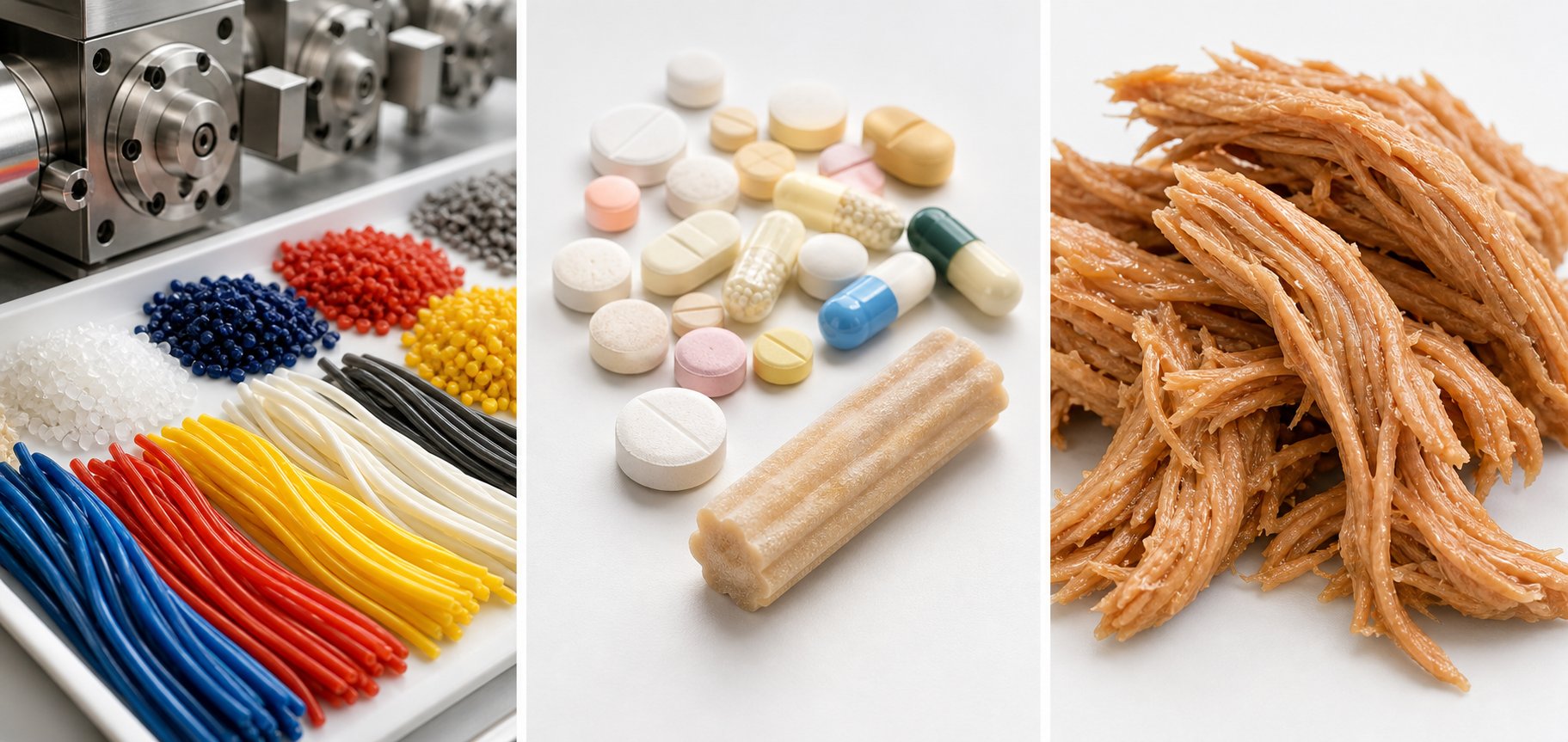
R&D teams routinely use these machines for formulation screening of filled compounds, color masterbatches, and additive concentrates. A twin screw compounding extruder at benchtop scale lets you iterate on filler loading levels, compare coupling agent chemistries, or dial in pigment dispersion quality without the material waste and downtime that larger equipment demands. When you are evaluating a new carbon black grade or testing whether a bio-based plasticizer performs as well as its petroleum-derived predecessor, the ability to run 10 formulations in a day on 200-gram batches fundamentally changes how quickly you reach answers.
Nanocomposite compounding has become an especially active area. Dispersing nanoclays, carbon nanotubes, or graphene nanoplatelets into a polymer matrix requires precise control over shear intensity and residence time — exactly the kind of fine-tuning a twin screw extruder plastic compounding setup enables at small scale. Researchers working on next-generation barrier films, conductive composites, and flame-retardant systems depend on benchtop trials to establish dispersion quality benchmarks before committing to expensive pilot runs. A plastic twin screw extruder at this scale lets you screen dozens of nanofiller surface treatments and loading levels with minimal material investment, generating transmission electron microscopy samples and mechanical test specimens from each variation.
Pharmaceutical Hot-Melt Extrusion
Pharmaceutical R&D has embraced twin screw extrusion with remarkable speed, and the benchtop format is a major reason why. The core application is amorphous solid dispersion (ASD) development — a technique that disperses a poorly soluble drug compound into a polymeric carrier to dramatically improve its bioavailability. Hot-melt extrusion achieves this without solvents, making it cleaner and more scalable than spray-drying alternatives.
Here is where the benchtop advantage becomes financially compelling. Active pharmaceutical ingredients at early development stages can cost thousands of dollars per gram. A study published in AAPS PharmSciTech demonstrated that researchers successfully developed and scaled an ASD formulation from a 9 mm mini-extruder — processing batch sizes as small as 5 to 20 grams — all the way to clinical-scale manufacturing using less than 500 grams of total API. The entire development cycle from mini-scale to clinical batch took just seven months. Without the benchtop platform, the same polymer-drug screening work would have consumed orders of magnitude more compound and time.
Pharmaceutical formulators also value the precise temperature control and real-time torque monitoring these machines provide. Formation of a stable ASD requires hitting exact processing temperatures — often within a narrow window where the drug dissolves into the molten polymer without degrading. Benchtop machines deliver the thermal precision and process data logging that regulatory filings demand, right from the earliest feasibility experiments.
Food, Feed, and Specialty Applications
Twin screw extrusion is a workhorse technology in food processing, and benchtop units bring that capability into the food science laboratory. Texturized vegetable protein development is a prime example — plant-based meat alternatives rely on extrusion to transform soy, pea, or wheat protein concentrates into fibrous, meat-like structures. Prototyping these textures at benchtop scale lets food scientists rapidly adjust moisture levels, barrel temperature profiles, and screw configurations to dial in the sensory properties consumers expect, all with kilograms rather than hundreds of kilograms of raw material.
Snack food prototyping follows a similar logic. Expanded cereal and starch-based snacks depend heavily on the specific mechanical energy delivered by the screw profile, and benchtop trials allow researchers to screen ingredient ratios, moisture levels, and die geometries before tying up a production line for test runs.
Beyond food and pharmaceuticals, benchtop machines serve a surprisingly broad set of specialty applications. Here is a snapshot of the diversity:
- Polymer compounding — Filled compounds, blends, color masterbatches, and additive concentrates for screening filler types, loadings, and coupling agents
- Nanocomposite development — Dispersion of nanoclays, carbon nanotubes, and graphene into polymer matrices for barrier, conductive, and structural applications
- Pharmaceutical ASD formulation — Amorphous solid dispersions of poorly soluble drugs in polymeric carriers to improve bioavailability
- Controlled-release drug delivery — Matrix-based tablets, implants, and pellets with tailored release profiles
- Texturized plant proteins — Meat-alternative prototyping with controlled fiber formation and sensory property optimization
- Expanded snack and cereal development — Starch-based product prototyping with adjustable expansion ratios and texture
- Biodegradable and bio-based polymer research — PLA, PHA, starch blends, and other compostable material formulations for packaging and agricultural films
- 3D printing filament production — Custom filament extrusion from novel polymer blends, composites, and recycled feedstocks
- Reactive extrusion — In-situ polymerization, grafting, and crosslinking reactions performed within the extruder barrel
- Recycled material evaluation — Assessing processability and property retention of post-consumer or post-industrial recycled polymer streams
What ties all of these applications together is a shared set of practical advantages. Low material requirements mean expensive or scarce feedstocks are not wasted on preliminary trials. Fast changeover — enabled by the modular screw design discussed earlier — means a single machine can serve multiple research programs in the same week. And the accessible, bench-friendly format means researchers who are not trained extrusion engineers can still generate meaningful processing data, lowering the barrier to cross-disciplinary exploration.
A polymer extruder at benchtop scale is no longer a specialized tool locked inside a plastics lab. It has become a shared platform that food scientists, pharmacists, materials engineers, and sustainability researchers all reach for when they need to transform raw ingredients into something functional — and need to do it with the smallest possible material footprint. That cross-disciplinary versatility, however, only delivers value when the process parameters developed on a benchtop machine can be translated reliably to larger equipment. Getting that translation right is where most R&D teams face their steepest learning curve.
Optimizing Process Parameters and Scaling Up Your Benchtop Twin Screw Extruder
You have the right machine, the right geometry, and a formulation you are eager to test. You load your material, pick a temperature profile that seems reasonable, set the screw speed somewhere in the middle of the range, and hit start. The strand coming out of the die looks... fine. But is "fine" good enough to base a production-scale decision on? Almost never. The gap between running an extruder and systematically developing a robust process window is where most R&D teams lose weeks of effort — and where the real value of a benchtop platform either materializes or evaporates.
Building a Process Window at Benchtop Scale
A process window is the defined space of operating conditions — temperature profile, screw speed, and feed rate — within which your material produces acceptable results. Too hot and the polymer degrades. Too fast and you overwhelm the mixing zones. Too slow and residence time creeps up, causing discoloration or molecular weight loss. The goal is to map those boundaries deliberately rather than stumbling into them.
Start with the three primary variables you can control independently on any compounding extruder:
- Barrel temperature profile — Set each zone individually, working from a conservative starting point based on the material's recommended processing range. Gradually adjust zones to create the thermal gradient your formulation needs: cooler at the feed throat to prevent bridging, ramping up through the melting section, and potentially stepping back down near the die to manage melt viscosity.
- Screw speed (RPM) — This controls shear rate and mixing intensity. Begin at a moderate speed and test upward and downward to find the range where mixing quality is adequate without driving melt temperature beyond your target.
- Feed rate — Throughput directly affects how long material stays inside the barrel. As AZoM's overview of twin screw compounding parameters demonstrates, higher throughput reduces both average residence time and the width of the residence time distribution. Lower feed rates extend residence time, which can improve mixing but raises degradation risk for heat-sensitive materials.
With three variables and potentially dozens of possible combinations, running every permutation is impractical — even with the small batch sizes a benchtop machine allows. This is where design-of-experiment (DOE) methodology earns its keep. A structured DOE approach — whether a full factorial, fractional factorial, or response surface design — lets you efficiently explore the multi-variable parameter space with a manageable number of runs. Instead of testing 50 random combinations, a well-designed DOE might require only 15 to 20 targeted experiments to identify not just the optimal settings but the sensitivity of your results to each variable.
Here is where many researchers make a costly mistake: they record only the machine setpoints. Setpoints are what you tell the machine to do. What actually happens inside the barrel is often different. A barrel zone set to 180 degrees Celsius does not guarantee the melt reaches 180 degrees — viscous shear heating from the screws can push actual melt temperature 10 to 30 degrees higher, especially at elevated screw speeds. The data that matters for scale-up is the measured reality: actual melt temperature at the die, real-time torque readings, die pressure, and specific energy input (calculated from torque, speed, and throughput).
Record actual measured values — melt temperature, torque, and die pressure — not just machine setpoints. Setpoints describe your intention; measured values describe your process.
Specific energy input, typically expressed in kJ/kg, deserves special attention. It captures the total mechanical energy the screws deliver to each kilogram of material processed and serves as the single most transferable metric between different twin screw extruders. Two machines running at completely different RPMs and throughputs can produce equivalent compounding results if they deliver the same specific energy to the same material. In scale-up trials documented by Thermo Fisher Scientific, matching specific energy between an 11 mm lab compounder (559 kJ/kg) and a 16 mm unit (566 kJ/kg) produced comparable residence times and product quality — even though the feed rate had to be adjusted away from the theoretical scale-up prediction to achieve that match.
Scale-Up Translation and Screw Configuration Strategy
Successful benchtop trials create excitement. The formulation works, the strand looks clean, mechanical properties hit the target. The natural next question — how do we replicate this on an industrial extruder? — is where many teams discover that their benchtop data, while encouraging, does not translate as directly as they hoped.
The fundamental challenge is that you cannot simply scale up by matching RPM and temperature setpoints. A 12 mm benchtop machine and a 60 mm industrial extruder machine operate with profoundly different physics. The surface-area-to-volume ratio drops dramatically at larger diameters, which means barrel heating and cooling have less influence relative to shear heating from the screws. Residence time distributions shift because the larger free volume changes how material moves through partially filled and fully filled zones. Even the Leistritz Twin Screw Report emphasizes that volume scales by a factor of three while surface area only scales by a factor of two — a geometric reality that limits how effectively barrel temperature control can compensate for shear-induced heating at larger diameters.
Instead of matching settings, focus on matching process outcomes. Three parameters deserve the most attention during translation from benchtop to pilot or production scale:
- Specific energy input (kJ/kg) — Maintain the same energy per unit mass by adjusting the ratio of screw speed to feed rate. This is the most reliable bridge between scales.
- Residence time — Use the Schuler rule as a starting estimate for throughput at the larger scale, but verify by measuring actual residence time. As the Thermo Fisher scale-up study showed, theoretical throughput predictions often need adjustment — their 16 mm compounder required a feed rate reduction from the predicted 3 kg/h to 2.5 kg/h to match the smaller machine's residence time.
- Melt temperature at the die — This is the integrated outcome of all thermal inputs. If your benchtop process produces a 195 degree Celsius melt, the larger machine needs to hit the same value, even if achieving it requires different barrel zone setpoints.
Screw element configuration is often the most critical — and most underestimated — variable in the entire scale-up chain. The type, quantity, and stagger angle of mixing elements directly control dispersive and distributive mixing outcomes. A kneading block with a 60-degree stagger angle at 12 mm diameter behaves differently than the same angular geometry at 40 mm, because the absolute gap clearances, channel depths, and extensional flow fields all scale nonlinearly. As OneCPM's detailed analysis of screw design explains, narrower kneading discs increase dispersive mixing intensity while wider discs favor gentler distributive action — and the optimal balance shifts when you change screw diameter.
Getting screw configuration right at each scale is not something you solve with a single formula. It requires understanding how your specific material responds to changes in shear, compression, and dwell time across different geometries. For research teams working with specialized materials or non-standard formulations — highly filled compounds, reactive extrusion systems, or novel biopolymers — this optimization process can consume months of trial and error when attempted with off-the-shelf screw elements alone.
This is precisely where partnering with screw design specialists adds measurable value. Services like NANHAIYA's custom screw design program provide engineered screw and barrel configurations tailored to specific material behaviors and processing goals. Rather than iterating blindly through standard element combinations, their engineers analyze your material's rheology, thermal sensitivity, and target mixing requirements to recommend configurations optimized from the start. For university labs and small-batch teams that lack in-house extrusion engineering expertise, this kind of external support can compress a six-month optimization cycle into weeks — freeing researchers to focus on formulation science rather than screw element trial-and-error.
Whether you handle screw design internally or work with external specialists, the underlying principle remains the same: extrusion processing machines at any scale are only as good as the process knowledge behind them. A benchtop twin screw extruder generates that knowledge efficiently, but only if you capture the right data, respect the physics of scale, and treat screw configuration as a design problem rather than a guessing game. The investment in systematic parameter development at small scale pays its largest dividends when the process reaches production — and the cost implications of that journey are worth examining in detail.
Benchtop Twin Screw Extruder Cost: Price Range, TCO, and ROI
Systematic process development on a benchtop twin screw extruder can save months of scale-up guesswork — but it requires a machine on your bench in the first place. And here is where conversations in most labs get uncomfortable. Vendor websites rarely publish pricing. Datasheets list every technical specification down to the thermocouple type, yet the single number most budget holders care about — twin screw extruder price — is conspicuously absent. Let's fill that gap with realistic expectations so you can plan an equipment budget that accounts for the full financial picture, not just the purchase order.
Price Range and What Drives Cost Variation
The honest answer to "how much does a benchtop twin screw extruder cost?" is: it depends — significantly. Pricing varies based on a cluster of interrelated factors, and understanding which ones drive the biggest cost deltas helps you avoid overspending on features you do not need while ensuring you do not underspec the machine and pay for it later in lost capability.
The most influential cost drivers include:
- Screw diameter — A 12 mm micro-compounder sits at a fundamentally different price point than a 27 mm benchtop system. Larger diameter means larger gearbox, heavier barrel, beefier drive motor, and more material in every component.
- Number of barrel zones — Each independently heated and cooled zone adds heaters, thermocouples, cooling channels, and control circuitry. A 4-zone machine costs measurably less than an 8-zone configuration with the same screw diameter.
- Drive torque and motor power — High-torque gearboxes engineered for processing viscous or highly filled materials require precision machining and premium metallurgy, pushing the extruder machine price upward.
- Control system sophistication — Basic PID temperature controllers versus fully integrated touchscreen HMIs with data logging, recipe storage, and remote monitoring represent a wide cost spectrum. Advanced systems with real-time data acquisition and test control software — the kind pharmaceutical labs need for regulatory documentation — command a premium.
- Included accessories — A bare extruder is just the starting point. Gravimetric feeders, strand die heads, pelletizers, water baths, and haul-off units each add to the invoice. Some vendors bundle essential accessories into package pricing; others list every component separately.
In general terms, industry pricing data places entry-level lab-scale twin screw extruders in the range of $20,000 to $50,000 USD for basic configurations with lower throughput and simpler controls. Mid-range models with advanced features, higher torque, and more barrel zones typically fall between $50,000 and $100,000. Fully instrumented research-grade machines — the kind equipped with precision gravimetric feeding, comprehensive data acquisition, and pharmaceutical-grade control systems — can reach $100,000 to $200,000 or more. These ranges shift depending on the source region: manufacturers in China often offer competitive pricing that can bring entry-level systems to the $15,000 to $40,000 range and mid-tier machines to $40,000 to $80,000.
Keep in mind that these figures represent the extruder unit itself. A complete benchtop extrusion line — including feeding, cooling, pelletizing, and downstream handling — can add 30% to 60% on top of the base machine cost. Budgeting only for the extruder and discovering you need $15,000 in ancillary equipment six weeks after the purchase order ships is a frustratingly common scenario.
Total Cost of Ownership Beyond Purchase Price
The sticker price is only the beginning of the financial commitment. Total cost of ownership (TCO) over the machine's useful life includes a set of recurring expenses that many first-time buyers overlook — and that can collectively rival the original purchase cost over five to seven years. TCO analysis across the industry suggests that the initial purchase may represent only 30% to 50% of the total five-year expenditure, especially when accounting for wear parts, energy, and downtime.
Here are the cost components that budget holders should plan for beyond day one:
- Replacement screw elements — Kneading blocks and conveying elements wear over time, particularly when processing abrasive fillers like glass fiber, calcium carbonate, or mineral reinforcements. A full set of replacement elements for a benchtop machine can cost several thousand dollars.
- Barrel liner wear — Barrel bores erode gradually under abrasive and corrosive conditions. Bimetallic barrel liners last longer but cost more upfront. Eventually, barrel segments need refurbishment or replacement.
- Spare heaters and thermocouples — These are consumable items. Heater bands fail, thermocouples drift, and having spares on hand avoids days of downtime waiting for replacements.
- Gearbox maintenance — Oil changes, seal inspections, and periodic bearing assessments keep the drivetrain running smoothly. Neglecting gearbox maintenance on a high-torque machine is an expensive gamble.
- Calibration and software updates — Temperature controllers, pressure transducers, and torque sensors require periodic calibration to maintain data integrity. Some control systems also carry annual software license fees.
- Maintenance labor — Whether handled in-house or contracted to the manufacturer, someone needs to perform preventive maintenance, troubleshoot issues, and manage spare parts inventory.
- Energy consumption — While benchtop machines draw far less power than industrial lines, heaters running at 200+ degrees Celsius across multiple zones for hours per day still contribute a measurable utility cost over years of operation.
Factoring these items into your procurement proposal from the start avoids the unpleasant mid-project conversation where your lab manager asks why the "fully funded" extrusion program needs an emergency purchase order for wear parts.
ROI Considerations for R&D Teams
Cost is only half the equation. The return side — what a benchtop twin screw extruder saves and enables — is where the investment case becomes compelling, especially when compared to the alternatives.
Material savings alone can justify the purchase. Consider a pharmaceutical formulation screening program that needs to evaluate 30 drug-polymer combinations. On a pilot-scale extruder requiring 2 kg per run, you would consume 60 kg of material — potentially hundreds of thousands of dollars in active ingredient costs at early development-stage pricing. A benchtop machine running 50-gram batches drops that total to 1.5 kg. The material cost difference in a single screening campaign can approach or exceed the price of the machine itself.
Faster iteration compresses time-to-market. Small batch sizes and quick changeovers mean you can run five or ten formulation variants in a single day, rather than one per day on a larger system. As Bausano's application overview notes, laboratory extruders enable fast testing cycles ideal for rapid iterations and comparing multiple formulations. That acceleration compounds across a development program spanning months, potentially bringing a product to market weeks or even months ahead of schedule.
De-risking before scale commitment protects capital. Every formulation validated at benchtop scale is one less surprise during expensive pilot and production trials. The data you collect — melt temperature behavior, torque response, strand quality, and thermal stability — gives your engineering team and your management the confidence to commit production resources to a formulation that has already proven itself. The cost of discovering a fundamental processability problem on a $300,000 pilot line is orders of magnitude higher than finding it on a benchtop system.
For labs where even the entry-level price tier stretches the budget, the used and refurbished market offers a viable path. A used twin screw extruder from a reputable source — whether a university lab upgrading to a larger system or a company decommissioning redundant R&D equipment — can deliver 70% to 80% of the capability at 40% to 60% of new-unit pricing. You will find used extruders and refurbished systems listed through specialized equipment dealers, auction platforms, and even directly from manufacturers who accept trade-ins. When browsing used extruder equipment, prioritize machines with documented maintenance histories, verified barrel and screw wear measurements, and available spare parts support from the original manufacturer. A well-maintained five-year-old machine with a known service record is a far better investment than a bargain-priced unit with no provenance and worn-out barrel bores.
The secondary market for laboratory-class machines is smaller than the industrial segment, but it is growing. You will occasionally find a twin screw extruder for sale through university surplus programs or pharmaceutical companies that have moved formulations past the benchtop stage. Checking multiple channels — dedicated platforms listing extruders for sale alongside broader scientific equipment marketplaces — increases your chances of finding a machine that matches your specifications at a price your grant budget can absorb.
Whether you buy new or used, the financial case for a benchtop twin screw extruder ultimately rests on one question: will the material savings, time compression, and risk reduction it delivers over its lifetime exceed what you paid for it? For most active R&D programs running more than a handful of formulation studies per year, the answer is a clear yes — often within the first 12 to 18 months of operation. The bigger risk, ironically, is not the capital outlay. It is buying the right machine and then failing to operate and maintain it properly — a topic that deserves its own detailed attention.
Maintenance, Safety, and Choosing the Right Twin-Screw Extruder Configuration
A well-chosen benchtop extruder sitting idle because of a seized gearbox or a contaminated barrel is not an R&D asset — it is an expensive paperweight. And a machine running without proper safety protocols is something far worse. The operational knowledge covered here rarely appears in vendor brochures, yet it determines whether your investment delivers years of productive research or months of frustrating downtime. Let's walk through the practical routines, hazard awareness, and selection criteria that separate labs running smoothly from labs learning expensive lessons.
Cleaning Procedures and Maintenance Best Practices
Every material change on a lab twin screw extruder demands thorough cleaning — especially in multi-formulation environments where cross-contamination can invalidate an entire experimental series. The good news is that the modular screw design found on most twin-screw extruders makes this process significantly faster and more reliable than cleaning a single-screw machine, where the screw is typically one monolithic piece that cannot be easily disassembled.
Barrel purging is your first line of defense. Before disassembly, run a compatible purging compound or a clean base resin through the machine at moderate screw speed to flush residual material from the barrel, screw channels, and die. For sticky or thermally sensitive materials, select a purging compound rated for the temperature range you were processing at — using a general-purpose purge on a 280-degree-Celsius engineering polymer run will not clear the barrel effectively.
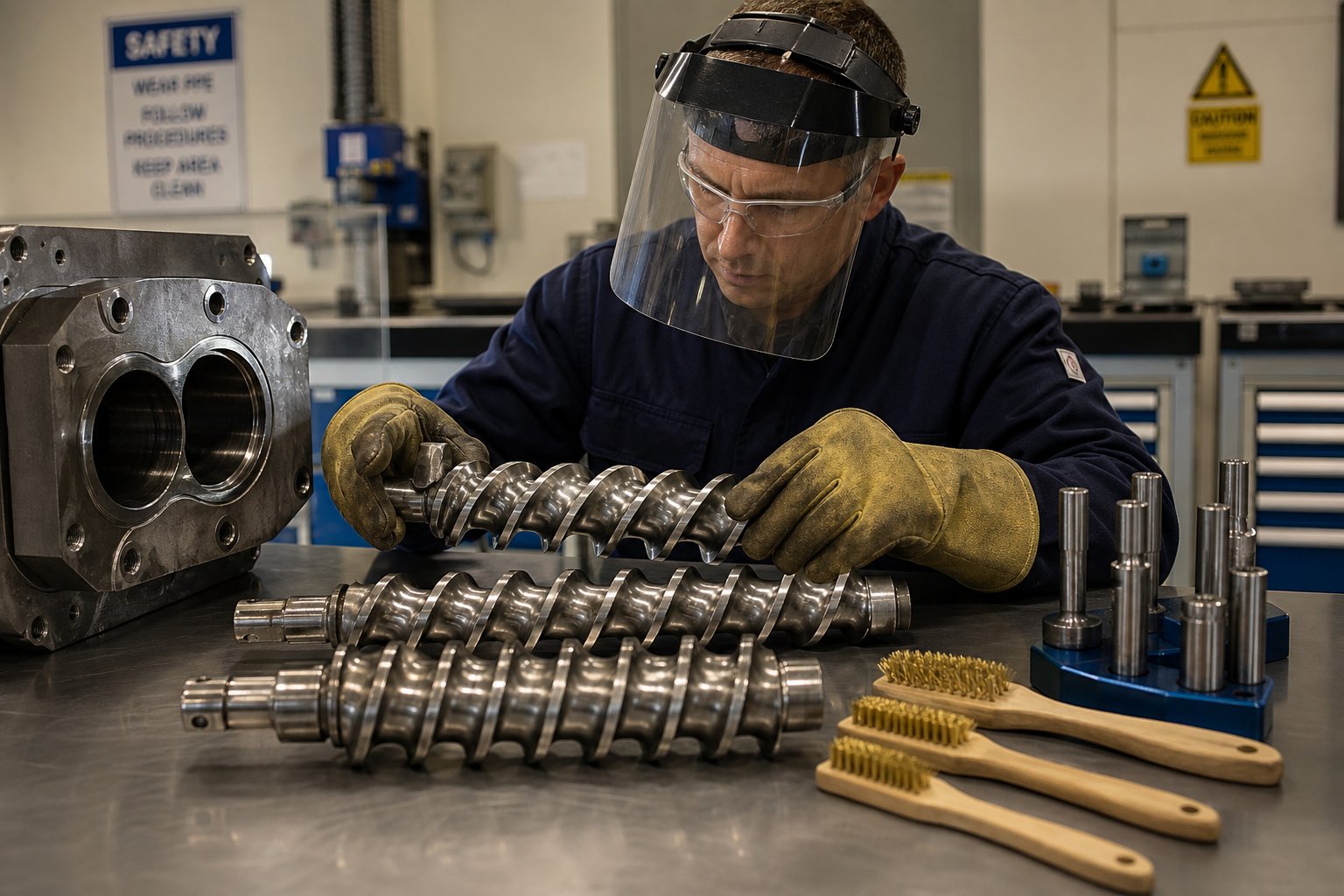
Screw element disassembly and cleaning follow the purge. Slide each element off the splined shaft in sequence, noting the order and orientation for reassembly. Clean elements individually using brass brushes, ultrasonic baths, or non-abrasive solvents — never steel scrapers that can damage flight surfaces and tight-tolerance mixing elements. Inspect each piece for wear marks, pitting, or buildup that resists cleaning. As Wanplas's maintenance guide notes, roughly 60% of twin screw extruder failures trace back to improper maintenance of screw and barrel components, making this inspection step far more than a formality.
Preventive maintenance schedules should cover three areas that benchtop users commonly neglect:
- Gearbox oil — Check oil level weekly; change oil per the manufacturer's interval, typically every 2,000 to 4,000 operating hours. Discolored or metallic-flecked oil signals bearing wear.
- Heater bands and thermocouples — Inspect heater connections monthly for corrosion or looseness. Test thermocouple accuracy quarterly against a calibrated reference. A drifted thermocouple means your recorded melt temperatures — and every scale-up conclusion based on them — are wrong.
- Barrel bore measurement — Use pin gauges or bore micrometers at least annually to check for wear. A worn barrel increases clearance between screw flights and barrel wall, degrading mixing efficiency and allowing material leakage between zones.
Proactive maintenance reduces operating costs by 20% to 30% compared to reactive approaches, according to industry data. For a benchtop machine that might serve a lab for a decade or more, that margin compounds into substantial savings — and, more importantly, avoids the mid-project breakdowns that derail research timelines.
Safety Considerations Specific to Benchtop Equipment
The compact size of a benchtop extruder creates a deceptive sense of familiarity. It sits on a bench, looks approachable, and lacks the imposing scale of factory-floor machinery. That perception is dangerous. The physics inside the barrel are every bit as aggressive as a production machine — high torque, extreme temperatures, and pressurized molten material — all concentrated within arm's reach of the operator.
Nip-point hazards are amplified at benchtop scale. The rotating screws generate substantial torque relative to their size, and the short distance between the feed opening and the screw flights means fingers or loose clothing can be drawn in before you have time to react. Updated OSHA data links over 4,000 workplace injuries per year in the plastics sector to extruder operations, with mechanical entanglement incidents occurring most frequently during non-routine tasks like clearing jams or adjusting settings.
Thermal exposure is the other constant risk. Barrel zone temperatures commonly exceed 200 degrees Celsius, and many polymer processing applications push zones above 250 or even 300 degrees Celsius. On a benchtop machine, those surfaces sit centimeters from the operator's hands during feeding, sample collection, and die adjustments. Molten polymer exiting the die is particularly hazardous because — unlike touching a hot metal surface — molten plastic adheres to skin and continues transferring heat, causing deeper burns than momentary contact with a solid surface.
Fume management deserves more attention than it typically receives in university and small-company labs. Overheated polymers release degradation products that range from irritating (aldehydes from polyethylene) to seriously toxic (hydrogen chloride from PVC, hydrogen cyanide from ABS). A benchtop machine without proper ventilation or an enclosure connected to local exhaust exposes everyone in the room — not just the operator — to these compounds.
Use the following checklist as a baseline safety protocol for anyone operating twin-screw extruders at benchtop scale:
- Verify all safety guards and interlocks are in place and functional before every startup
- Wear heat-resistant gloves rated for 250+ degrees Celsius during any task within reach of barrel, die, or extrudate
- Use a face shield when opening the die, clearing vent ports, or purging at startup
- Never reach into the feed throat or attempt to clear a blockage with hands or improvised tools while screws are rotating
- Follow lockout/tagout (LOTO) procedures before any maintenance, disassembly, or screw element change — disconnect electrical power and verify zero energy state
- Operate under local exhaust ventilation or within a fume enclosure; do not rely on general room ventilation
- Allow a minimum of 2 to 4 hours of cooldown after shutdown before handling barrel or die components without thermal PPE
- Keep a burn-specific first aid station — sterile water, non-adhesive dressings, burn gel — within 10 seconds of walking distance from the machine
- Ensure every operator has received hands-on training specific to the benchtop model in use, not just general extrusion safety awareness
- Post emergency shutdown procedures at the machine and confirm every operator can execute them without referring to a manual
Safety is not a topic that gets less important because the machine is smaller. If anything, the accessibility and lab-bench familiarity of a benchtop extruder demand more disciplined protocols, not fewer, because the informal lab environment lacks the safety infrastructure — dedicated safety officers, engineered walkways, automated lockout systems — that production floors provide.
Selecting the Right Machine and Screw Configuration
With maintenance practices and safety protocols established, the final piece is ensuring you select the right machine in the first place. Browsing listings for an extruder machine for sale — whether new from twin screw extruder manufacturers or refurbished from the secondary market — can feel overwhelming when every vendor claims their system is ideal for R&D. A structured evaluation process cuts through the noise.
Follow this step-by-step checklist to match machine specifications to your actual research requirements:
- Define your target batch sizes. Calculate the minimum amount of material you need to process per experiment. If your typical formulation screening uses 50 to 200 grams per run, a screw diameter in the 10 to 16 mm range keeps material consumption in check. If you also need to produce kilogram-scale samples for downstream testing, a 20 to 27 mm machine provides that flexibility.
- Verify the L/D ratio supports your required processing zones. Map out the functional zones your process needs — feeding, melting, mixing, venting, pressure buildup — and confirm the machine's L/D ratio provides enough barrel length to accommodate them. Complex processes requiring devolatilization or multiple kneading sections typically need an L/D of 32:1 or higher.
- Confirm torque capacity for your target material viscosities. High-viscosity polymers, heavily filled compounds, and reactive systems demand more torque than neat thermoplastics. Request torque specifications per shaft and compare them against the processing requirements of your most demanding formulation — not your easiest one.
- Evaluate barrel zone count and thermal control precision. Count the number of independently heated and cooled zones. More zones mean finer temperature profile control, which matters for reactive extrusion, pharmaceutical HME, and any process with narrow thermal windows.
- Assess screw element availability and modularity. Check whether the twin-screw extruder manufacturer offers a full library of conveying, kneading, mixing, and specialty elements for your screw diameter. Limited element selection constrains your ability to optimize screw profiles for different materials.
- Check vendor support infrastructure. Evaluate spare parts lead times, technical support responsiveness, and availability of application engineering assistance. A machine from a responsive manufacturer with readily available wear parts will spend far more time running experiments and far less time waiting for components.
- Request references or trial processing. Ask twin screw extruder manufacturers for customer references in your application area, or arrange a trial run with your actual materials on their demonstration equipment before committing to a purchase.
- Factor in total system cost. Price the complete extrusion line — feeders, die heads, downstream equipment, spare element kits, and installation — not just the extruder unit. A seemingly affordable base machine can become the most expensive option once you add all the ancillaries needed for a functional setup.
For teams working with challenging materials — highly filled compounds, reactive extrusion chemistries, novel biopolymers, or shear-sensitive pharmaceutical dispersions — standard off-the-shelf screw elements may not deliver optimal results. The screw profile is the single most influential variable in determining mixing quality, residence time, and melt temperature, yet many labs default to generic configurations simply because they lack the extrusion engineering expertise to design something better.
This is where custom screw and barrel design services deliver outsized value. NANHAIYA's custom screw design program works directly with R&D teams to engineer screw profiles matched to specific material behaviors and processing objectives. Rather than spending months iterating through standard element combinations — swapping kneading blocks, adjusting stagger angles, and rerunning experiments — their specialists analyze your material's rheological and thermal characteristics to recommend a configuration optimized from the first run. For university labs, startup R&D groups, and small-batch processing teams that lack dedicated extrusion engineers on staff, this kind of support transforms the screw design challenge from a bottleneck into a solved problem.
Whether you are evaluating your first benchtop extruder or upgrading an aging system, the selection process rewards preparation. Define your requirements before you start comparing quotes. Match specifications to your most demanding application, not your average one. And treat the screw configuration as a design investment — not an afterthought — because no amount of process parameter optimization can compensate for a screw profile that is fundamentally mismatched to your material. The labs that get these decisions right do not just buy a machine. They build a platform that accelerates every formulation project it touches for years to come.
Frequently Asked Questions About Benchtop Twin Screw Extruders
1. What is the typical price range for a benchtop twin screw extruder?
Entry-level benchtop twin screw extruders generally start between $15,000 and $50,000 USD, while mid-range models with higher torque, more barrel zones, and advanced control systems fall in the $50,000 to $100,000 range. Fully instrumented research-grade machines with pharmaceutical-level data acquisition can reach $100,000 to $200,000 or more. Keep in mind that ancillary equipment such as feeders, pelletizers, and cooling baths can add 30% to 60% on top of the base unit cost, so budgeting for the complete extrusion line is essential.
2. What is the difference between a benchtop, lab-scale, and pilot-scale twin screw extruder?
The categories primarily differ by screw diameter, throughput, and footprint. Benchtop units typically feature screw diameters under 20 mm, process as little as tens of grams per batch, and fit on a standard lab bench. Lab-scale extruders use 16 to 27 mm screws, require a dedicated stand, and handle up to about 15 kg/h. Pilot-scale machines start around 27 mm diameter, are floor-standing, and produce enough throughput for trial production runs. These categories overlap significantly, and vendors apply the labels inconsistently, so matching specifications to your batch size needs matters more than the marketing label.
3. Should I choose a parallel or conical twin screw extruder for R&D work?
For most multi-material R&D environments, a parallel twin screw extruder is the preferred choice. Its fully modular screw and barrel design allows rapid reconfiguration between experiments, supports a wider processing window, and simplifies cleaning between material changes. Conical extruders excel in niche applications requiring inherently high compression ratios, such as rigid PVC processing, but their limited modularity and narrower processing flexibility make them less versatile for general formulation screening. If your lab processes diverse materials across multiple projects, the parallel geometry offers far greater adaptability.
4. How do you scale up results from a benchtop twin screw extruder to production?
Successful scale-up focuses on matching process outcomes rather than copying machine setpoints. The three most transferable parameters are specific energy input (kJ/kg), residence time, and actual melt temperature at the die. Simply replicating RPM and barrel temperature settings from a small machine onto a larger one will not produce equivalent results because the surface-area-to-volume ratio and shear dynamics change with screw diameter. Screw element configuration is also critical, as mixing element behavior shifts nonlinearly with scale. Working with custom screw design specialists like NANHAIYA (nhyscrews.com) can accelerate this translation by engineering screw profiles tailored to your specific material and target scale.
5. What maintenance does a benchtop twin screw extruder require?
Routine maintenance includes barrel purging between material changes, individual screw element disassembly and cleaning with non-abrasive tools, and regular inspection for wear. Gearbox oil should be checked weekly and changed every 2,000 to 4,000 operating hours. Thermocouple accuracy should be verified quarterly against a calibrated reference, and barrel bore diameter should be measured at least annually using pin gauges to detect wear. Industry data suggests that roughly 60% of twin screw extruder failures trace back to improper screw and barrel maintenance, so establishing a preventive schedule from day one protects both equipment longevity and data reliability.
Written by
Nanhaiya Technical Team
Zhoushan Nanhaiya Plastic Machinery Co., Ltd.
The Nanhaiya technical team supports screw and barrel manufacturing projects through application review, technical communication, custom manufacturing coordination, and production and quality control.
Discuss Your Application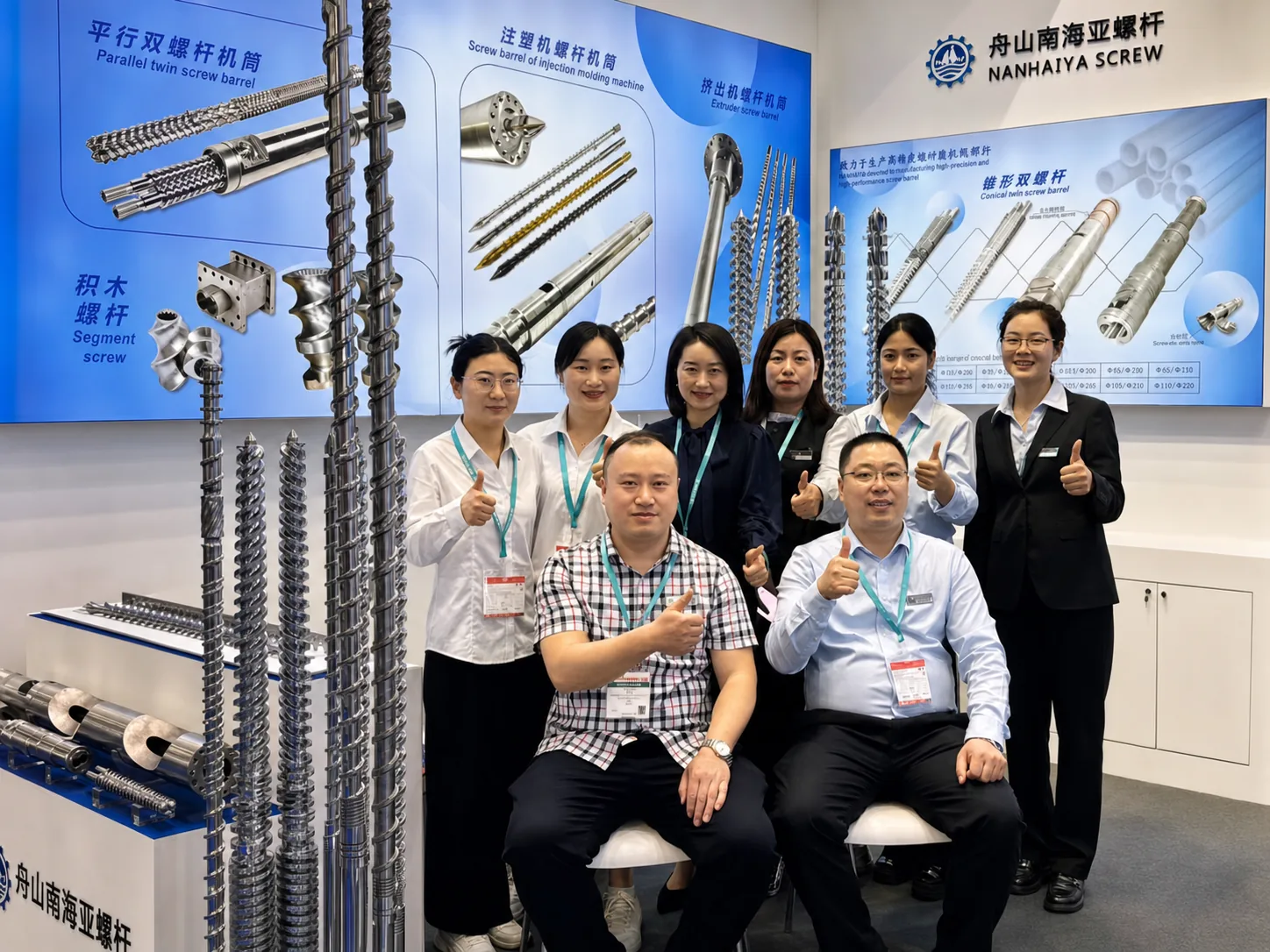
Related Articles
More insights on screw barrel technology and plastics processing.
What Nobody Tells You About Screw Barrel For Plastic Machine Design
Oct 10, 2026
Learn how screw barrel for plastic machine design affects melt quality, throughput, and wear life. Covers geometry, resin matching, troubleshooting, and sourcing.
Read Article
Single Screw Extruder for Sheet: Stop Guessing, Start Specifying
Oct 9, 2026
Learn how to specify a single screw extruder for sheet production. Covers screw geometry, resin-specific processing, troubleshooting, and maintenance best practices.
Read Article
PE Pipe Extruder Machine: What Datasheets Won't Tell You
Oct 9, 2026
Learn how a PE pipe extruder machine works, key specs explained, material grade selection, maintenance tips, and buyer guidance beyond the datasheet.
Read ArticleLooking for something else?
Search by material, symptom or product and jump straight to the relevant page.
These are navigation suggestions based on keyword matching — not a quotation, not a delivery commitment, and not a substitute for engineering review. Final specification is confirmed by our engineers against your drawings and processed material.
Need help with screw barrel selection?
Share your machine model, processed material and application. Our team can help with pricing and technical support.