

What Is a Twin Screw Extruder and Why It Matters
If you've ever asked yourself, "what's an extruder, and why do so many production lines depend on one?" the answer starts with a simple concept: a machine that pushes material through a shaped opening to create a continuous product. A screw extruder does this by rotating one or more helical screws inside a heated barrel, melting and conveying raw material forward. The twin screw version, however, takes that principle and elevates it dramatically.
Defining the Twin Screw Extruder
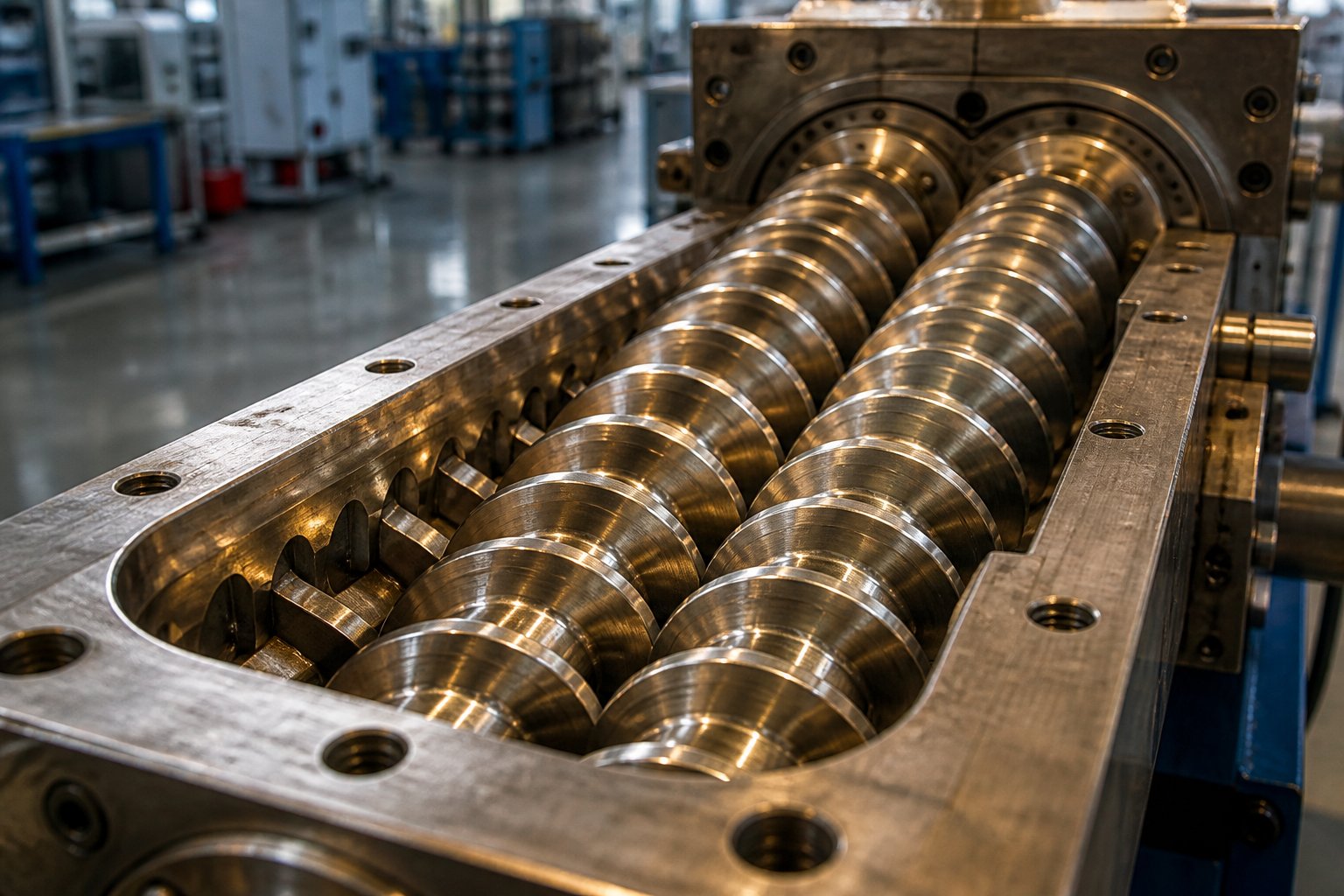
A twin screw extruder is a processing machine that uses two intermeshing, parallel screws rotating inside a closely fitted barrel to convey, melt, mix, and shape materials with far greater control than single screw designs can achieve.
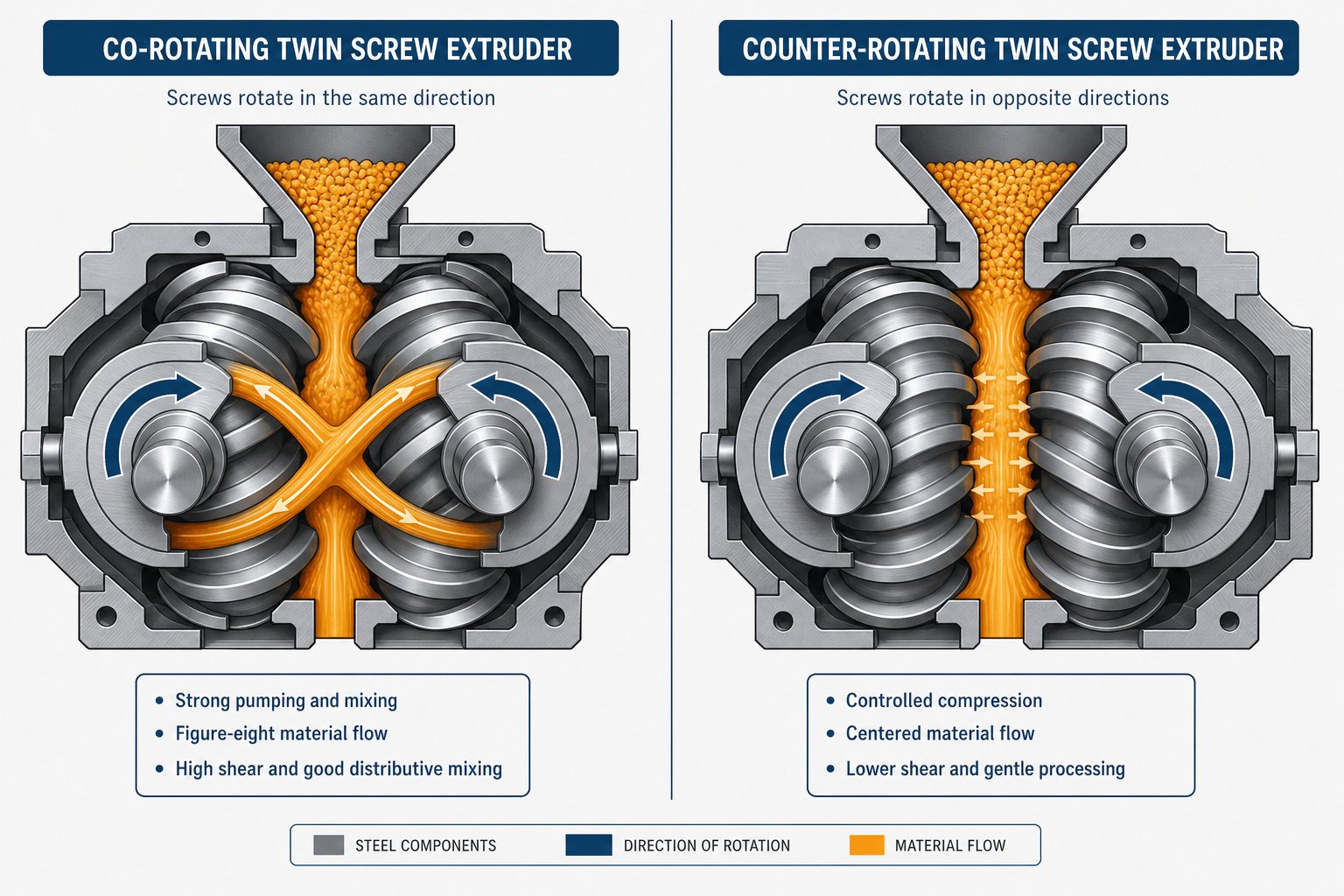
Twin screw extruders come in two primary configurations. Co-rotating designs feature screws that turn in the same direction, generating high shear and intensive mixing ideal for compounding and reactive extrusion. Counter-rotating designs spin the screws in opposite directions, producing gentler processing forces better suited for heat-sensitive materials like PVC. Both variants share the defining trait of intermeshing screw geometry, which creates a self-wiping action that prevents material stagnation inside the barrel.
This technology has become the backbone of modern polymer compounding, plastics recycling, food processing, and pharmaceutical manufacturing. Wherever a process demands precise mixing, consistent melt quality, or the ability to incorporate multiple additives into a base material, you'll find a twin-screw extruder at the heart of the operation.
Why Understanding These Advantages Matters
Most spec sheets list the advantages of twin screw extruders as bullet points: better mixing, higher throughput, more flexibility. What they rarely explain is why these benefits exist mechanically, or how specific design parameters create them. That gap matters when you're evaluating a significant equipment investment.
Imagine choosing between two machines that both claim "superior mixing." Without understanding the engineering principles behind that claim, you're making a decision based on marketing language rather than processing reality. This article bridges that gap. You'll learn how twin screw geometry, modular elements, and key design ratios translate directly into measurable processing advantages, and where honest trade-offs exist that spec sheets tend to leave out.
Engineering Principles Behind Twin Screw Performance
Claiming "better mixing" is easy. Explaining exactly how two rotating screws achieve it is where most discussions fall short. The advantages of a twin screw extruder aren't accidental — they emerge from specific mechanical interactions between screw geometry, element design, and processing parameters. Understanding these principles turns vague marketing claims into verifiable engineering facts.
Intermeshing Geometry and Self-Wiping Action
Picture two helical screws closely fitted together inside a barrel. As the twin screws rotate, each flight of one screw sweeps through the channel of the other. This intermeshing creates a series of isolated C-shaped chambers between the screw flights and the barrel wall. Material trapped inside these chambers moves forward in a controlled, positive displacement manner rather than relying purely on frictional drag.
Why does this matter? Positive displacement conveying means every particle of material follows a predictable path with a narrow residence time distribution. You get uniform heat exposure, consistent shear history, and minimal risk of some material sitting stagnant while other material races through. The result is a more homogeneous melt with significantly less thermal degradation.
The same intermeshing action also produces the self-wiping effect. Each screw continuously scrapes material off its partner's surface and off the barrel wall. This prevents dead zones where degraded or discolored material could accumulate and contaminate the product stream. In practical terms, self-wiping geometry translates directly into faster color changeovers, reduced purge material waste, and more consistent product quality from batch to batch.
Modular Screw Elements and Process Flexibility
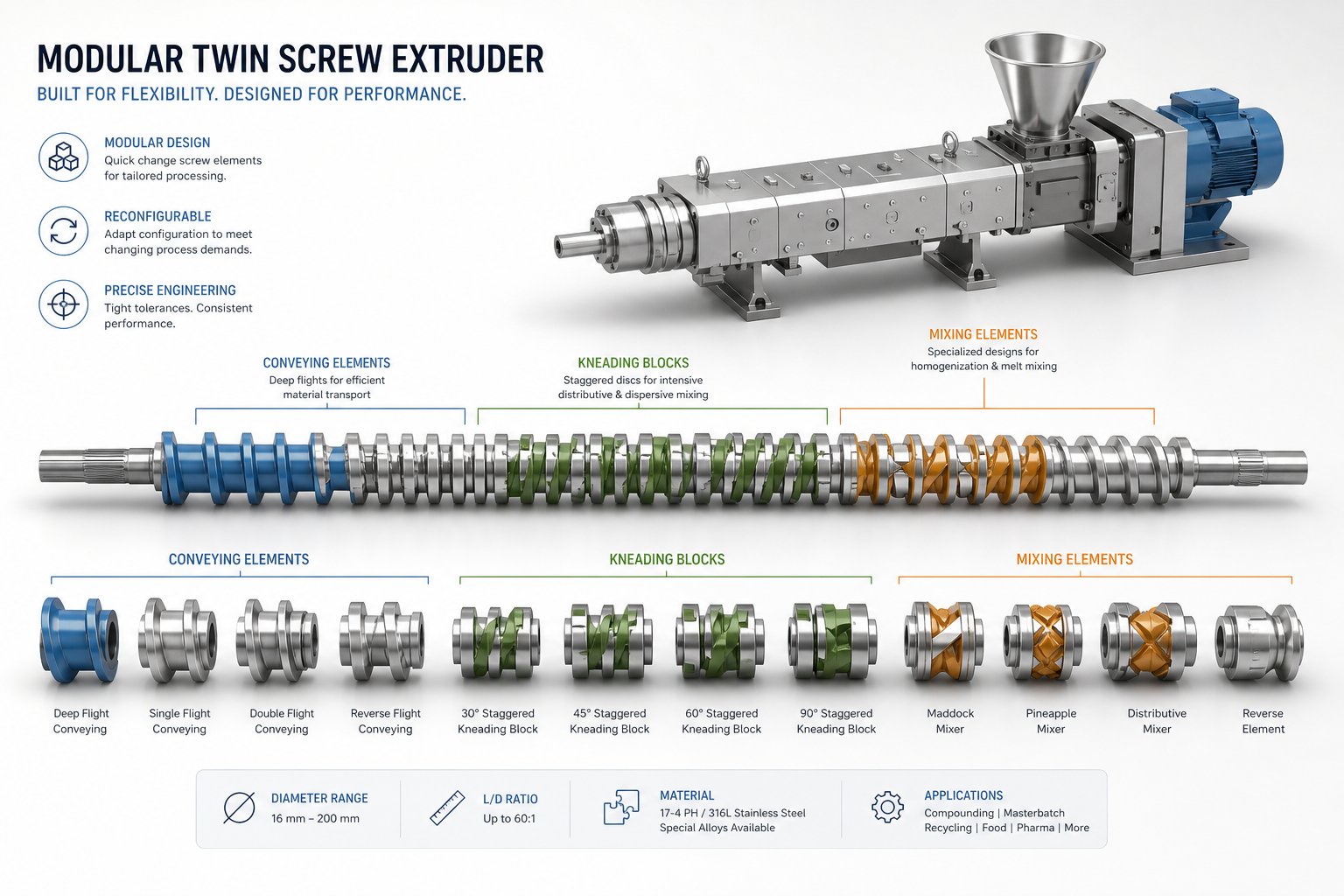
Here's where twin screw extrusion truly separates itself from other processing methods. Rather than using a single, fixed-geometry screw, modern screw extruders use a modular design: individual elements slide onto a keyed shaft and can be rearranged like building blocks. Each element type performs a distinct function in the twin screw extrusion process.
- Conveying elements: Feature deep flights that efficiently transport material forward with minimal shear input, ideal for feeding and discharge zones.
- Kneading blocks: Consist of staggered disc-shaped lobes that apply intensive shear and elongational forces. Wider discs promote dispersive mixing (breaking apart agglomerates), while narrower discs favor distributive mixing (spreading components evenly).
- Toothed mixing elements: Provide strong distributive mixing with minimal dispersive shear, useful for blending heat-sensitive additives without damaging them.
- Reverse (re-conveying) elements: Push material backward against the main flow, creating localized pressure buildup and extended residence time in specific barrel zones for thorough processing or devolatilization.
Engineers can rearrange these elements along the screw shaft to create a custom screw profile matched precisely to the material and process at hand. A compounding application that needs aggressive filler dispersion might use multiple wide kneading blocks, while a reactive extrusion process could prioritize longer conveying sections with strategically placed reverse elements to control reaction time. This modularity is one reason a single twin-screw extruder can serve applications as different as glass-fiber reinforcement, color masterbatch production, and polymer devolatilization — simply by reconfiguring the screw profile.
How L/D Ratio and Speed Influence Performance
Two design parameters shape almost every processing outcome in screw extrusion: the length-to-diameter (L/D) ratio and screw speed.
The L/D ratio determines how much barrel length is available for conveying, melting, mixing, and venting. Twin screw extruders typically operate with L/D ratios ranging from 20:1 to 48:1. Shorter ratios (20:1 to 28:1) suit applications requiring intense mixing over brief residence times, such as color masterbatch. Longer ratios (36:1 to 48:1) provide the extended processing length needed for devolatilization, reactive extrusion, or heavily filled compounds that demand thorough wetting and dispersion. Choosing incorrectly in either direction carries consequences — too short and mixing may be inadequate, too long and thermally sensitive materials risk degradation from excessive heat exposure.
Screw speed, meanwhile, directly controls shear rate and throughput. Higher speeds increase mixing intensity and output, but also raise melt temperature through viscous dissipation. Lower speeds reduce shear and heat generation, protecting sensitive formulations at the cost of reduced capacity. The interplay between L/D ratio and screw speed gives process engineers two powerful levers for fine-tuning the twin screw extrusion process without changing hardware.
Together, these engineering principles — intermeshing geometry, modular elements, and adjustable design parameters — explain why twin screw advantages exist, not just that they exist. They also reveal something equally important: the same design flexibility that creates these advantages means that configuration choices matter enormously. Two identically sized machines can deliver vastly different results depending on how their screws are built and how they're run.
Co-Rotating vs Counter-Rotating Configurations Compared
That design flexibility raises a practical question: which configuration delivers the right balance of shear, mixing, and material protection for your specific application? The answer depends largely on whether the screws spin in the same direction or in opposite directions — and on how the screw geometry is shaped along its length. Understanding the differences between a co rotating twin screw extruder and its counter-rotating counterpart is essential for matching machine capabilities to processing demands.
Co-Rotating Twin Screw Extruders and Their Strengths
In a co rotating twin screw extruder, both screws turn in the same direction with a fully intermeshing geometry. Material is forcibly handed off from one screw flight to the next at the intermeshing zone, creating a spiral flow path (often described as a figure-eight or "infinity" pattern) that exposes every particle to intensive shear and elongational forces.
This flow pattern produces several distinct strengths. The intense shear fields that develop both between the screws and between each screw and the barrel wall deliver exceptional dispersive mixing — breaking apart filler agglomerates, distributing pigments uniformly, and promoting mass transfer in reactive extrusion. The self-wiping action virtually eliminates dead zones, keeping the residence time distribution narrow and preventing thermal degradation.
You'll find co-rotating designs dominating applications like polymer compounding with inorganic and organic fillers, masterbatch production, polymer alloy development, nanocomposite processing, and reactive extrusion involving in-line polymerization or compatibilization. Their modular screw elements make them exceptionally adaptable — the same machine can handle glass-fiber reinforcement one week and color concentrate production the next.
Counter-Rotating Configurations for Sensitive Processing
A counter-rotating twin screw extruder flips the rotation direction: the two screws spin in opposite directions. At the intermeshing region, material is drawn inward by the screws and advances forward while being compressed, creating distinct C-shaped enclosed chambers that function almost like a positive displacement pump.
The key difference? Mixing relies on compressive and elongational deformation rather than the aggressive shear stress characteristic of co-rotating designs. A calendering effect appears at the intermeshing region, dispersing additives under relatively gentle conditions. This keeps shear-induced heat generation low — a critical advantage when processing materials like rigid PVC, which has a low thermal decomposition temperature and poor melt flow.
Counter-rotating extruders operate effectively at high fill levels and comparatively low rotational speeds. This combination allows extrusion temperatures to remain low enough for stable forming of PVC pipes, sheets, and profile extrusion products. They are also well suited for other heat-sensitive formulations where excessive mechanical energy input would compromise product integrity.
It's also worth distinguishing between intermeshing and non-intermeshing configurations within these categories. Non-intermeshing twin screw extruders run the screws parallel with a gap between them, reducing shear forces significantly. They lack the self-wiping action of intermeshing designs but excel at processing thermally sensitive or low-viscosity materials like soft PVC and thermoplastic elastomers where gentle handling outweighs intensive mixing needs.
Conical vs Parallel Design Trade-Offs
Beyond rotation direction, screw geometry introduces another layer of choice. A parallel twin screw extruder features screws with a consistent diameter along their entire length. This design provides a longer processing zone, uniform shear distribution, and greater flexibility in screw element configuration — making it the standard for high-output compounding and continuous production processes.
A conical twin screw extruder, by contrast, uses a tapered profile — larger diameter at the feed end tapering to a smaller diameter at the discharge. This geometry creates a natural compression zone as material moves forward, enhancing melting and improving pressure buildup without relying on high screw speeds. Conical designs deliver high torque transmission in a compact footprint, making them well suited for medium-capacity extrusion lines where floor space is limited and gentle plasticization is a priority.
When evaluating co rotating and counter rotating twin screw extruder options alongside these geometric variations, the decision matrix grows considerably. The table below consolidates the critical differentiators:
| Feature | Co-Rotating (Parallel) | Counter-Rotating (Parallel) | Conical Twin Screw Extruder |
|---|---|---|---|
| Rotation Direction | Same direction | Opposite directions | Typically counter-rotating |
| Mixing Intensity | Very high (dispersive + distributive) | Moderate (compressive + elongational) | Moderate to gentle |
| Shear Level | High | Low to moderate | Low |
| Self-Wiping Capability | Excellent | Good (intermeshing) / None (non-intermeshing) | Good |
| Ideal Applications | Compounding, masterbatch, reactive extrusion, nanocomposites | PVC pipe and profile, heat-sensitive materials | PVC processing, medium-capacity lines |
| Throughput Capacity | High (scalable with screw speed) | Moderate (fill-dependent) | Low to moderate |
| Screw Speed Range | Wide (low to very high RPM) | Low to moderate RPM | Low RPM |
| Footprint | Larger (longer barrel) | Moderate | Compact |
Imagine you're processing a rigid PVC dry blend for pipe production. A counter-rotating or conical design keeps temperatures low and material intact. Shift that same production goal to a highly filled engineering plastic compound, and a co-rotating parallel twin screw extruder becomes the clear choice for achieving the dispersion quality and throughput you need. Neither configuration is universally superior — each unlocks different advantages depending on what your material and your process actually require.
Twin Screw vs Single Screw Extruder Side-by-Side Breakdown
Choosing between twin screw configurations is one layer of the decision. The more fundamental question many manufacturers face is whether they need a twin screw system at all — or whether a single screw extruder machine can handle the job. This comparison deserves more than a vague claim that one is "better" than the other. The mechanical reasons behind each difference are what actually help you make a sound investment decision.
Mixing and Compounding Performance
The single biggest gap between these two platforms comes down to how each one moves and mixes material. A single screw extruder relies on drag flow — frictional contact between the polymer, the screw flight, and the barrel wall pushes material forward. Mixing occurs mainly through shear generated in the thin melt film between the screw flight tip and the barrel. This mechanism produces some distributive blending, but dispersive mixing — the kind needed to break apart pigment agglomerates, disperse nanofillers, or create fine polymer blends — is inherently limited.
Twin screw systems, by contrast, generate both dispersive and distributive mixing simultaneously. The intermeshing zone forces material through tight gaps between screw flights, creating intense shear and extensional flow that fractures agglomerates. At the same time, the figure-eight flow path continuously splits, stretches, and recombines the melt stream, distributing every additive uniformly throughout the matrix. As detailed in CPM's analysis of screw design and mixing, process engineers can further tune these effects by selecting specific kneading block geometries — adjusting disc width, stagger angle, and block length to dial in the exact ratio of dispersive to distributive mixing a formulation requires.
For a single screw plastic extruder, achieving anything close to this mixing quality typically demands add-on mixing sections or static mixers downstream — workarounds that increase complexity without fully closing the performance gap.
Throughput and Process Flexibility
In single screw extrusion, throughput and screw speed are directly coupled. You increase output by spinning the screw faster, but faster rotation also changes shear rate, melt temperature, and residence time — all at once. This coupling limits how much you can adjust one variable without disrupting others.
Twin screw extruders decouple these parameters. Because the intermeshing geometry provides positive displacement conveying, throughput can be chosen independently of screw speed. Starve feeding — metering material into the extruder at a controlled rate below maximum capacity — allows engineers to set screw speed for optimal mixing intensity while a separate gravimetric feeder governs output volume. Side feeders can introduce glass fibers, fillers, or secondary polymers downstream, and liquid injection ports add plasticizers or reactive agents at precise barrel locations.
A single extruder screw setup simply doesn't offer this level of independent process control. Feeding is flood-fed, meaning the hopper gravity-fills the screw channel, and output is dictated primarily by screw geometry and speed. Process adjustments become trade-offs rather than independent optimizations.
The comparison table below maps these differences across the performance categories that matter most in real production environments:
| Performance Category | Twin Screw Extruder | Single Screw Extruder | Advantage |
|---|---|---|---|
| Dispersive Mixing | Excellent — intermeshing shear and extensional flow break agglomerates effectively | Limited — relies on drag flow with narrow shear zones | Twin Screw |
| Distributive Mixing | Excellent — figure-eight flow path splits and recombines melt repeatedly | Moderate — improved with add-on mixing sections | Twin Screw |
| Material Flexibility | High — handles powders, pellets, fibers, liquids, and blends via modular screw design | Moderate — best suited for uniform pellet feedstocks | Twin Screw |
| Feeding Capability | Starve feeding, side feeding, and liquid injection at multiple barrel positions | Primarily flood-fed from a single hopper | Twin Screw |
| Venting and Devolatilization | Strong — multiple vent ports with melt seals enable deep degassing | Limited — fewer vent options, less effective surface renewal | Twin Screw |
| Process Control Precision | Throughput independent of screw speed; narrow residence time distribution | Throughput coupled to screw speed; broader residence time spread | Twin Screw |
| Changeover Time | Fast — self-wiping action clears residual material quickly | Slower — requires extended purging to clear barrel dead zones | Twin Screw |
| Energy Efficiency (per unit output) | Higher specific energy input per kg; efficient for complex processing tasks | Lower specific energy for straightforward melting and conveying | Application-Dependent |
| Initial Capital Cost | Higher — complex gearbox, dual screws, modular barrel design | Lower — simpler mechanical construction | Single Screw |
| Maintenance Complexity | Higher — dual screw sets, segmented barrels, precision gearbox | Lower — fewer wear components, simpler drivetrain | Single Screw |
Where Single Screw Extruders Still Excel
Editorial honesty demands acknowledging what a single screw extruder does well. For straightforward applications — producing single-resin pipe, blown film, sheet extrusion, or profile extrusion from consistent, pre-compounded pellets — a single screw machine delivers reliable output at a significantly lower purchase price. The simpler mechanical design means fewer components to maintain, lower spare parts costs, and a shorter learning curve for operators.
Energy consumption per kilogram of processed material can also favor single screw extrusion when the task involves nothing more than melting and conveying a homogeneous polymer. As ACERETECH's comparison notes, under the same production capacity with clean feedstock, single screw systems are often more energy-efficient because their simpler structure generates frictional heat efficiently without a complex transmission system.
The takeaway? If your process doesn't require intensive mixing, multi-component feeding, or deep devolatilization, a single extruder screw system may genuinely be the smarter investment. The advantages of twin screw extruders are transformative — but only when your application actually demands them. Overspending on capability you won't use doesn't improve your bottom line.
That raises a natural follow-up: among the many advantages twin screw technology does offer, which ones deliver the greatest real-world impact? Ranking them by processing value rather than listing them alphabetically paints a much clearer picture.
Top Advantages of Twin Screw Extruders Ranked by Real-World Impact
Most discussions of twin screw extruder advantages present them as an unordered list, treating every benefit as equally important. They're not. Some advantages fundamentally reshape what a production line can achieve, while others deliver incremental improvements. Ranking them by actual processing impact helps you focus on what truly drives value when evaluating an extruder twin screw system.
- Superior mixing and compounding capability — The single most impactful benefit. Intermeshing screw geometry creates simultaneous dispersive and distributive mixing that no other continuous processing method matches at equivalent throughput.
- Process flexibility through modular screw design — Reconfigurable screw profiles enable one machine to serve dozens of applications without capital reinvestment.
- Enhanced feeding versatility — Starve feeding, side feeding, and liquid injection allow independent control of throughput and multi-stage material introduction.
- Superior venting and devolatilization — Multiple vent ports with engineered melt seals remove moisture, residual monomers, and volatile contaminants during processing.
- Precise residence time control — Positive displacement conveying creates a narrow residence time distribution, ensuring uniform thermal and shear history for every particle.
- Self-wiping action and reduced degradation — Continuous scraping between intermeshing flights eliminates dead zones and prevents material stagnation.
- High throughput with consistent quality — Efficient conveying mechanics support high output rates without sacrificing melt homogeneity.
- Energy efficiency per unit of processed material — Targeted mechanical energy input reduces wasted heat generation compared to batch processing alternatives.
Superior Mixing as the Defining Advantage
Every other benefit on that list matters, but this one stands alone. Why? Because the core reason manufacturers choose a twin screw extruder machine over simpler alternatives is almost always mixing quality. The intermeshing zone forces material through narrow clearances where intense shear fractures agglomerates, while the figure-eight flow path continuously splits and recombines the melt stream to spread every component uniformly.
Consider what this means in practice. A double screw extruder can disperse carbon black into a polymer matrix at loadings that would produce visible specks and weak spots on a single screw system. It can blend two immiscible polymers into a stable alloy with domain sizes measured in microns. It can distribute nanoscale additives so uniformly that mechanical property improvements appear across the entire cross-section of a finished part — not just near the surface. As Technovel's technical overview emphasizes, even highly viscous resins and composite systems with high filler content reach uniform melting and mixing by controlling the intermeshing shear and residence behavior together.
This mixing capability is also what makes twin-screw extruders viable as the processing heart of a screw extruder granulator line, where thorough blending and homogenization must be completed before the melt reaches the pelletizing die. Without reliable dispersive and distributive mixing upstream, pellet quality downstream falls apart.
Modular Design and Process Versatility
Ranking second might surprise some engineers, but the reasoning is straightforward. Modular screw design doesn't just improve one processing outcome — it multiplies the number of outcomes a single machine can deliver. Swap kneading blocks for conveying elements, reposition reverse segments, add or remove mixing zones, and the same twin screw extruder machine transforms from a color masterbatch compounder into a reactive extrusion platform or a devolatilization system.
This versatility directly reduces capital expenditure. Instead of purchasing separate dedicated machines for each product family, a facility can invest in one well-specified extruder twin screw system with a library of screw element sets. Modular element selection, guided by both experimental data and simulation, makes it possible to design screw profiles that match each material's properties and processing targets precisely. The freedom to reconfigure also accelerates product development cycles — prototype formulations can move from lab evaluation to pilot runs on the same equipment simply by adjusting the screw layout.
Feeding, Venting, and Residence Time Control
The remaining advantages in the hierarchy share a common thread: they all stem from the positive displacement conveying mechanism and the partially filled operating mode that twin screw systems are inherently designed to use.
Starve feeding — deliberately metering material below the screw's maximum conveying capacity — decouples throughput from screw speed. This means you can increase RPM for better mixing intensity without automatically raising output, or hold screw speed constant while adjusting feed rate. Side feeders introduce fillers, fibers, or secondary polymers at the optimal barrel position, after the base polymer is already molten and ready to receive them. Liquid injection ports add plasticizers, reactive agents, or processing aids at precisely controlled locations. No other continuous processing platform offers this degree of independent feed control.
Venting and devolatilization follow naturally from the same design. Because the screw channel can run partially filled in designated zones, a large free surface area of exposed melt forms beneath each vent port. Moisture, trapped air, residual solvents, and reaction byproducts escape efficiently — especially under vacuum. As research into starve feeding in screw extruders confirms, these degassing sections explicitly require partially filled conditions, and twin-screw extruders are engineered to maintain them reliably while keeping melt seals intact upstream and downstream.
Residence time control ties these capabilities together. The narrow residence time distribution produced by positive displacement conveying ensures that every particle spends roughly the same amount of time under heat and shear. For thermally sensitive polymers, reactive formulations, or screw extruder granulator applications where melt uniformity directly determines pellet quality, this consistency is non-negotiable. Broad residence time distributions — typical in flood-fed single screw systems — mean some material is over-processed while other material is under-mixed, a compromise that shows up as inconsistent product properties.
Taken together, these ranked advantages explain why twin-screw extruders dominate high-performance processing. Yet advantages on paper only translate to value on the production floor when the machine meets the specific demands of an actual application. That connection between capability and application is where the real engineering decisions begin.
Industry Applications Where Twin Screw Advantages Shine
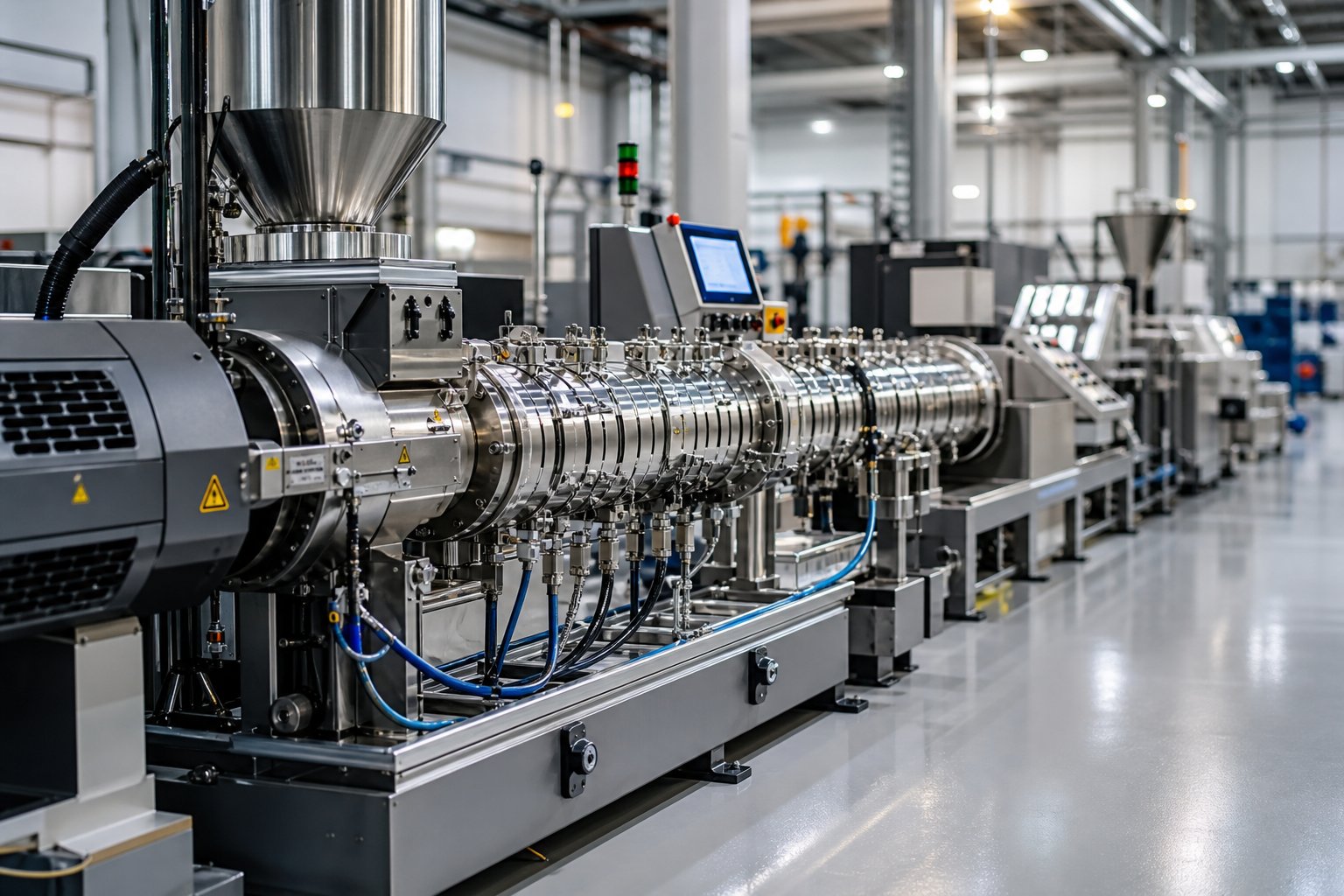
Ranked advantages tell you what a twin screw extruder can do in theory. Seeing those advantages solve real problems across distinct industries tells you what they actually deliver in practice. The same core capabilities — intensive mixing, modular reconfiguration, multi-stage feeding, and precise devolatilization — manifest differently depending on the material, the quality standard, and the end product. Here's how those capabilities translate across the sectors that rely on them most.
Compounding and Masterbatch Production
Polymer compounding is where the twin screw compounding extruder earns its reputation. Engineering plastics demand the incorporation of inorganic fillers like talc, calcium carbonate, and glass fibers at loadings that can exceed 50% by weight — all while maintaining uniform dispersion and preserving base polymer properties. A compounding extruder built around co-rotating twin screw geometry handles this effortlessly because its intermeshing shear zones break apart filler agglomerates while the figure-eight flow path distributes them evenly throughout the melt.
- Filler and fiber incorporation: Side feeders introduce glass fibers or mineral fillers downstream after the polymer is fully molten, minimizing fiber breakage and ensuring thorough wetting.
- Color masterbatch dispersion: Kneading block configurations fracture pigment clusters to sub-micron levels, producing consistent color strength and eliminating specks — a task that would require multiple passes on less capable equipment.
- Reactive extrusion: Controlled residence time and precise temperature zoning enable in-line grafting, compatibilization, and chain extension reactions during a single pass through the barrel.
- Nanocomposite processing: Co-rotating designs deliver the shear intensity required to exfoliate nanoclays and distribute carbon nanotubes at concentrations where even minor agglomeration degrades mechanical performance.
This versatility is precisely why a compounding twin screw extruder often replaces multiple single-purpose machines in a production facility. One platform, reconfigured with different screw element sets, can produce glass-fiber-reinforced polyamide on Monday and a flame-retardant polypropylene compound on Wednesday.
Plastics Recycling and Post-Consumer Waste Processing
Recycling is the application where the advantages of twin screw technology are perhaps most dramatically felt. Post-consumer plastic waste is messy — inconsistent in composition, contaminated with residual inks and adhesives, and loaded with moisture and volatile organic compounds. A twin screw plastic extruder handles all of this simultaneously.
- Contamination tolerance: Co-rotating twin screws accept shredded flakes, films of varying bulk density, and mixed-grade feedstocks without the feeding problems that plague single screw systems.
- Multi-stage devolatilization: As AIMPLAS compounding leader Luis Roca notes, co-rotating extruders can incorporate up to four devolatilization zones — compared to one or none in single screw alternatives — dramatically reducing odors from volatile organic compounds and fogging compounds in the finished pellet.
- Property restoration: Modular screw and barrel design enables simultaneous addition of stabilizers, compatibilizers, and reinforcing fillers that compensate for degradation from the original product life cycle, supporting the upcycling concept where recycled output rivals virgin material performance.
- Rheology adjustment: Controlled degradation within the twin screw barrel can adjust melt flow rates in polypropylene and polyamide, while high-viscosity polymers like HDPE can be processed to flow rates suitable for downstream reprocessing.
This capability is transforming how the recycling industry operates. As regulations and brand owner commitments push demand for higher-quality recycled content, facilities that once relied on basic single screw pelletizing lines are migrating toward co-rotating twin screw systems to meet automotive, electronics, and consumer goods specifications that recycled material couldn't previously satisfy.
Pipe, Profile, Food, and Specialty Applications
Beyond compounding and recycling, a twin screw extruder plastic processing line adapts to verticals with fundamentally different material challenges.
Pipe and profile extrusion showcases the counter-rotating side of the technology. PVC dry blend — a powder-form compound that's notoriously heat-sensitive — requires gentle plasticization at low shear and low temperature. Counter-rotating twin screws provide the positive displacement transport needed to move this material forward without generating the frictional heat that triggers degradation. The result is consistent wall thickness, smooth surface finish, and dimensional stability in rigid PVC pipes, window profiles, and siding.
- Low-shear melting: Compressive intermeshing action plasticizes PVC without exceeding its narrow thermal processing window.
- Stable pressure generation: Positive pumping action maintains uniform die pressure, reducing wall thickness variation.
- Compact footprint: Conical counter-rotating designs deliver adequate throughput while occupying less floor space than parallel alternatives.
Food and feed processing leverages an entirely different set of twin screw strengths. Cooking extrusion — used to produce snack foods, breakfast cereals, textured vegetable proteins, and pet food — relies on the twin screw's ability to simultaneously convey, mix, cook, and texturize ingredients under precise temperature and pressure conditions.
- Ingredient mixing: Multiple feed ports introduce starches, proteins, fats, flavors, and colorants at optimal barrel positions.
- Texturization: Kneading and mixing elements apply controlled mechanical energy that transforms raw starch and protein matrices into expanded, textured structures.
- Continuous cooking: Barrel temperature zones and residence time control replace batch cooking processes with continuous, reproducible thermal treatment.
Pharmaceutical hot-melt extrusion (HME) represents the most precision-demanding application. Twin screw extruders produce solid dispersions and controlled-release formulations by intimately blending active pharmaceutical ingredients (APIs) with thermoplastic polymers. The narrow residence time distribution ensures uniform drug distribution, while precise temperature control prevents thermal degradation of sensitive compounds. Regulatory compliance further benefits from the computerized process monitoring inherent to modern twin screw platforms — every temperature zone, torque reading, and screw speed is logged for batch traceability.
Across every one of these verticals, a common pattern emerges: the advantages aren't generic. Each industry activates a specific subset of twin screw capabilities that directly addresses its most pressing processing challenge. That specificity, however, introduces an important caveat — every advantage discussed so far carries real-world trade-offs that honest evaluation demands you understand before committing capital.
Honest Limitations and Trade-Offs Worth Knowing
No piece of equipment is all upside. If the advantages of twin screw extruders were free of cost and complexity, every production line on the planet would already use one. They don't — and the reasons are worth understanding clearly before you sign a purchase order.
Capital and Operational Cost Considerations
The most immediate trade-off is price. Twin screw extruders carry substantially higher upfront costs than comparable single screw systems. Industry cost analyses show that the price differential between twin and single screw systems often ranges from two to five times for comparable production capacities. A mid-range single screw extrusion machine might run $150,000 to $250,000 installed, while a twin screw system delivering similar throughput can reach $350,000 to $550,000 or higher depending on configuration and control system sophistication.
Operational expenses follow the same pattern. Annual maintenance costs for twin screw extruders typically range from $8,000 to $25,000 for routine service, compared with $3,000 to $15,000 for a plastic single screw extruder of comparable size. Complete screw element sets for twin screw systems can cost $20,000 to $100,000 — significantly more than single screw replacement, which typically runs $3,000 to $15,000.
These aren't trivial differences, especially for operations with tight capital budgets or applications that don't demand advanced mixing.
Complexity, Maintenance, and Operator Skill Requirements
Beyond the dollar figures, twin screw systems introduce practical complexities that ripple through daily operations:
- Mechanical complexity: Dual screw sets, segmented barrels, high-precision gearboxes, and modular element configurations mean more components that can wear, misalign, or require replacement. Screw element wear monitoring becomes essential, since worn elements degrade mixing consistency and increase energy consumption.
- Higher operator skill requirements: Programming and optimizing a twin screw profile demands deeper understanding of material science and processing dynamics. Temperature, screw speed, feed rate, and element configuration all interact — a mistake in one parameter cascades into product quality issues. A screw plastic extruder based on single screw technology, by contrast, involves fewer interdependent variables and a shorter training curve.
- Spare parts cost and lead time: Modular barrel segments, specialized kneading blocks, and application-specific metallurgies mean maintaining a larger inventory of replacement components or accepting longer lead times for critical parts.
- More frequent cleaning: Although self-wiping action reduces material stagnation, twin screw extruders processing diverse formulations still require more thorough cleaning between product changes — sometimes involving partial disassembly that a simpler machine wouldn't need.
- Sensitivity to operating errors: Incorrect screw element sequencing, improper torque settings, or feeding rate miscalculations can damage screw elements or barrels far more quickly than comparable mistakes on a single screw platform.
When a Twin Screw Extruder May Not Be the Right Choice
Here's the honest question behind every spec sheet comparison: are these advantages worth the higher cost? The answer depends entirely on what your production line actually needs to do.
A twin screw system may not be the right choice when:
- Your process involves straightforward melting and conveying of pre-compounded pellets — pipe, blown film, or sheet extrusion from virgin resin.
- Your formulations don't require intensive dispersive mixing, devolatilization, or multi-stage additive incorporation.
- Production volumes and product margins can't absorb the higher capital and maintenance investment.
- Your team lacks the trained process engineers needed to optimize and maintain a more complex system.
For these scenarios, a well-specified single screw extrusion machine genuinely delivers better value. It's not a compromise — it's a fit.
Where the calculation shifts is in total cost of ownership. When a twin screw extruder reduces scrap rates by even a few percentage points, cuts changeover time between product runs, and enables processing of higher-margin materials that simpler equipment can't handle, the higher upfront investment often pays back within a few production cycles. Detailed cost modeling suggests that for operations monetizing enhanced product quality at even a modest premium, twin screw investment frequently proves economically justified over a full equipment lifecycle.
The key takeaway? Don't buy capability you won't use — but don't underestimate the cost of capability you need but don't have. That balance hinges on one often-overlooked factor: the screw and barrel components themselves, and whether they're properly specified for your exact application.
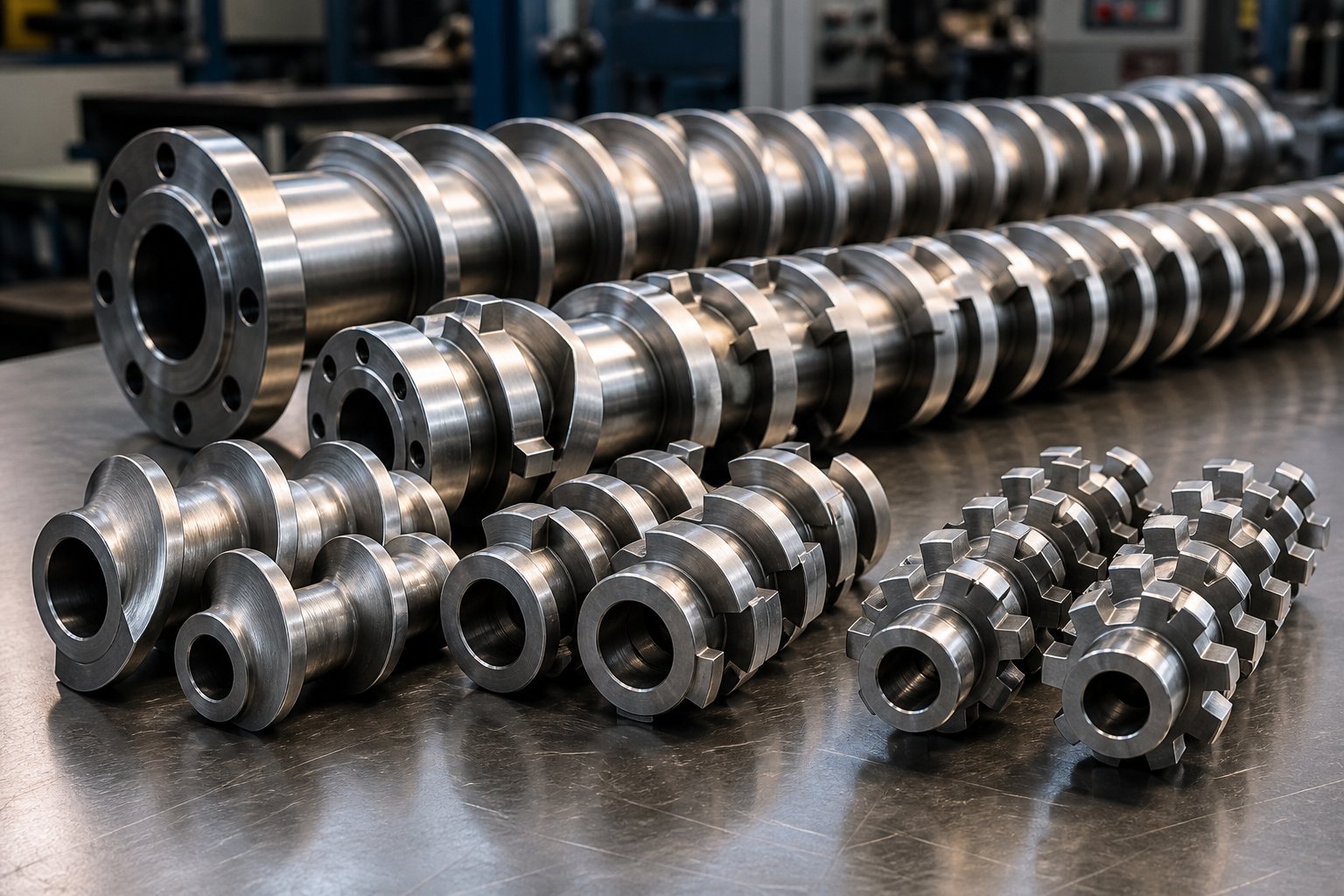
Optimizing Twin Screw Barrel and Screw Selection for Maximum Advantage
Every advantage discussed so far — superior mixing, modular flexibility, precise devolatilization, consistent residence time control — shares a single dependency. None of them materialize in production unless the twin screw and barrel combination is correctly specified for the actual material, throughput target, and processing conditions at hand. Think of it this way: a twin-screw extruder machine is a platform, but the screw elements and barrel liners are the tools that do the work. Choose the wrong tools, and even the most expensive platform underperforms.
Why Screw and Barrel Selection Determines Real-World Performance
Imagine investing in a high-end double screw extruder machine, configuring it with a carefully designed screw profile, and then watching mixing quality deteriorate within months. What happened? In most cases, the problem isn't the machine design — it's component specification. The screw element metallurgy didn't match the abrasiveness of the filler system, the barrel liner hardness couldn't withstand the processing temperatures, or the element geometry was optimized for a different polymer family entirely.
The consequences of worn or improperly specified twin screw barrel components compound rapidly. As Plastics Technology's troubleshooting analysis details, increasing flight clearance from wear directly reduces conveying efficiency and forces operators to raise screw speed to maintain output. Higher screw speeds generate more frictional heat, raising discharge temperatures and narrowing the processing window. Eventually, output must be cut — sometimes by 13% or more — to keep product quality within specification. That's a direct hit to profitability caused not by the extruder's inherent design, but by the condition of its wearing components.
The same principle applies to the barrel side. A twin screw barrel lined with an iron-based bimetallic alloy may last three times the service life of its screw elements under normal conditions. But process highly abrasive compounds — glass fiber at 40% loading, calcium carbonate, or flame retardant packages containing hard particulates — and even premium barrel liners erode faster than expected if the metallurgy wasn't selected for that specific wear environment. According to screw element material guides from KY Extruder, options range from basic nitrided steel for general compounding to powder metallurgy HIP alloys and nickel-based corrosion-resistant alloys for the most demanding formulations. Choosing correctly at the outset prevents the costly cycle of premature replacement and unplanned downtime.
Screw element geometry matters equally. Kneading block stagger angles, disc widths, and the ratio of outer diameter to inner diameter (Do/Di) all influence mixing intensity, free volume, and torque capacity. A plastic twin screw extruder running a highly filled mineral compound needs a different kneading block configuration than one processing a low-viscosity reactive formulation. Getting this wrong doesn't just reduce performance — it can actively damage the material, producing degraded polymer, broken fibers, or inconsistent additive dispersion that shows up as rejected product at the end of the line.
Matching Screw Barrel Specifications to Your Application
Different processing lines impose fundamentally different demands on the twin screw and barrel system. A pipe extrusion line running PVC dry blend needs gentle, low-shear screw elements with corrosion-resistant barrel liners to handle chlorine-based degradation products. A recycling line processing post-consumer HDPE flakes with paper and adhesive contamination demands aggressive devolatilization sections, high free-volume conveying elements, and abrasion-resistant metallurgies. A pelletizing line compounding 50% glass-fiber-reinforced polyamide requires maximum wear resistance in the kneading and mixing zones where fiber-polymer interaction is most intense.
The critical factors that determine whether your screw and barrel configuration actually delivers the performance your twin-screw extruder machine was designed to provide include:
- Metallurgy and base material: Match the screw element steel grade to your formulation's abrasiveness and corrosiveness. Nitrided steel handles standard polymers cost-effectively; tool steel and high-speed steel suit moderate wear conditions; PM-HIP alloys and nickel-based alloys are essential for high glass fiber, mineral filler, and corrosive systems.
- Screw element configuration: Select conveying element lead, kneading block stagger angle, and disc width based on your specific mixing intensity and residence time requirements — not generic recommendations.
- Barrel liner wear resistance: Ensure barrel liner hardness and alloy composition align with the processing environment. A bimetallic liner rated for unfilled polyolefins won't survive long in a heavily filled engineering plastics application.
- Surface hardening treatment: Consider gas nitriding for general use, or HVOF thermal spray coatings for screw elements exposed to highly abrasive compounds like carbon black, CaCO3, or glass fiber systems.
- Application-specific matching: Work with suppliers who understand the distinct demands of pipe, profile, sheet, pelletizing, and recycling lines rather than offering one-size-fits-all solutions.
That last point deserves emphasis. A supplier who simply sells you screw elements based on diameter and thread pitch, without understanding your formulation and processing targets, is leaving performance — and money — on the table. Manufacturers like NANHAIYA address this gap by connecting extrusion manufacturers, recycling plants, and technical teams with application-matched screw and barrel solutions across pipe, profile, sheet, pelletizing, and recycling production lines. That kind of application-specific support matters because the difference between a correctly specified twin screw barrel and a generic replacement can be the difference between a double screw extruder machine that delivers its rated advantages and one that chronically underperforms.
You'll notice a pattern here: every screw and barrel selection decision circles back to a single question — does this component match the actual demands of my process? Getting that answer right is what separates production lines that realize the full advantages of twin screw technology from those that spend years troubleshooting problems that better component specification would have prevented entirely. And that same question — matching capability to need — becomes the central framework for choosing the right twin screw extruder in the first place.
Choosing the Right Twin Screw Extruder for Your Application
Matching capability to need — that principle guided every screw and barrel decision in the previous section, and it applies with equal force when selecting the extruder itself. Yet most buyers approach this decision armed with spec sheets and price quotes rather than a structured evaluation framework. The result? Equipment that's either overspecified for the task (wasting capital) or underspecified for the material (wasting product). A step-by-step process cuts through both traps.
A Practical Decision Framework for Your Application
Rather than comparing machines head-to-head on paper, start by mapping your process requirements and letting those requirements point you toward the right configuration. Here's how that evaluation unfolds in practice:
- Define your material and formulation requirements. Identify the base polymer, its form (pellet, powder, flake, or dry blend), and every additive the process must incorporate — fillers, fibers, stabilizers, colorants, impact modifiers, or reactive agents. A PVC dry blend with heat stabilizers and calcium carbonate points toward counter-rotating geometry. A polyamide compounded with 40% glass fiber demands co-rotating design with aggressive mixing zones and wear-resistant metallurgy.
- Quantify your mixing intensity needs. Ask a simple question: does the extruder need to create the compound, or just melt and convey an already-compounded material? If your process requires dispersive mixing to break apart filler agglomerates, distributive mixing to uniformly spread multiple additives, or reactive processing to drive in-line chemical reactions, twin screw is almost certainly justified. If the material arrives as a uniform pellet ready for shaping, revisit whether a single screw system genuinely meets the need at lower cost.
- Assess production flexibility requirements. Will the machine run a single product continuously, or must it handle multiple formulations with frequent changeovers? Operations producing diverse product families — color concentrates, filled engineering compounds, and recycled blends on the same line — benefit enormously from modular screw design and the self-wiping action that accelerates transitions. A dedicated single-product line may not need that flexibility.
- Set throughput targets with growth margin. Calculate your required output in kilograms per hour based on current demand, then add 20-30% headroom for projected growth. This figure, combined with your material's processing characteristics, determines the screw diameter and L/D ratio you need. A laboratory twin screw extruder with a 20mm screw diameter suits R&D and pilot trials at outputs of a few kilograms per hour, while production-scale machines with 50-150mm diameters handle hundreds to thousands of kilograms per hour. A benchtop twin screw extruder can validate formulations before committing to full-scale equipment — a smart risk-reduction strategy.
- Evaluate total cost of ownership, not just purchase price. Factor in energy consumption, maintenance cycles, screw and barrel replacement intervals, scrap rates, changeover losses, and the revenue potential of materials you can process with twin screw capability but cannot process without it. The twin screw extruders market continues expanding precisely because buyers increasingly evaluate this full picture rather than fixating on initial capital alone.
- Select the right configuration. Use the material-to-machine logic established throughout this article. Co-rotating parallel designs for compounding, masterbatch, reactive extrusion, and recycling applications demanding high shear and modular flexibility. Counter-rotating parallel or conical designs for PVC processing, pipe and profile extrusion, and heat-sensitive formulations requiring gentle, positive-displacement transport.
This sequence keeps the decision anchored in processing reality rather than marketing claims. Every step narrows the field based on what your material and your production goals actually demand.
Evaluating Manufacturers and Technical Partners
Selecting the right machine configuration is half the equation. The other half is choosing twin screw extruder manufacturers and component suppliers who can support that configuration through installation, optimization, and the full equipment lifecycle. Here's what separates strong technical partners from simple equipment vendors:
- Application-specific expertise: Can the manufacturer or supplier demonstrate experience with your material type and production vertical? A vendor who understands the difference between specifying screw elements for recycled LDPE film and specifying them for glass-fiber-reinforced PBT will save you months of trial-and-error optimization.
- Screw element availability and customization: Does the supplier offer a full library of conveying, kneading, mixing, and reverse elements — along with guidance on how to configure them? Modular design only delivers value if you can actually access and reconfigure the modules. The best twin-screw extruder manufacturer partners maintain element inventories and provide configuration recommendations tailored to specific formulations.
- Barrel and metallurgy options: Look for suppliers who offer multiple barrel liner materials and screw element metallurgies matched to different wear environments. Processing abrasive fillers, corrosive additives, or high-temperature engineering polymers each demands a different metallurgical solution.
- Multi-application support: Production facilities rarely run a single product indefinitely. Your supplier should understand the demands of pipe, profile, sheet, pelletizing, and recycling lines — not just one niche. NANHAIYA, for example, supports extrusion manufacturers and recycling plants across all of these application categories with application-matched screw and barrel solutions, illustrating the kind of breadth that keeps a partnership valuable as your product mix evolves.
- After-sales technical support: Screw and barrel wear is inevitable. What matters is how quickly your supplier can diagnose wear patterns, recommend replacements, and deliver correctly specified components. Long lead times on critical wear parts translate directly into lost production hours.
It's also worth noting that the landscape of single screw extruder manufacturers and twin screw specialists is broad — and not every company excels at both. When your application clearly calls for twin screw capability, prioritize partners whose core competency aligns with that technology rather than generalists who treat it as a secondary offering.
A twin screw extruder justifies its investment when your process demands intensive mixing, multi-component feeding, devolatilization, or frequent product changeovers — and when the total cost of ownership, including reduced scrap, faster transitions, and access to higher-value materials, outweighs the higher capital and maintenance commitment.
That single statement captures the decision logic running through this entire article. The advantages of twin screw extruders are real, well-documented, and mechanically grounded. They're also conditional — they deliver maximum value only when the application genuinely requires them and when the equipment is properly specified, from machine configuration down to individual screw elements and barrel liners. Approach the decision with that clarity, partner with suppliers who share it, and you'll invest in capability that pays back on the production floor — not just on the spec sheet.
Frequently Asked Questions About Twin Screw Extruder Advantages
1. What is the main advantage of a twin screw extruder over a single screw extruder?
The primary advantage is superior mixing and compounding capability. Twin screw extruders use intermeshing screw geometry that generates both dispersive mixing (breaking apart agglomerates) and distributive mixing (spreading components evenly) simultaneously. Single screw systems rely mainly on drag flow, which limits mixing to narrow shear zones near the barrel wall. This mechanical difference means twin screw extruders can uniformly incorporate fillers, fibers, pigments, and reactive additives into polymer matrices at a level single screw designs simply cannot match in a single pass.
2. What is the difference between co-rotating and counter-rotating twin screw extruders?
Co-rotating twin screw extruders spin both screws in the same direction, generating high shear and intensive dispersive mixing. They excel in compounding, masterbatch production, reactive extrusion, and recycling applications. Counter-rotating extruders spin screws in opposite directions, producing gentler compressive and elongational mixing with lower heat generation. This makes them ideal for heat-sensitive materials like PVC, pipe extrusion, and profile production. Your material properties and processing requirements determine which configuration delivers the right balance of shear intensity and thermal protection.
3. Are twin screw extruders worth the higher cost compared to single screw systems?
Twin screw extruders justify their higher capital and maintenance costs when your process demands intensive mixing, multi-component feeding, devolatilization, or frequent product changeovers. The total cost of ownership calculation should factor in reduced scrap rates, faster color and material transitions, and the ability to process higher-value formulations that simpler equipment cannot handle. However, for straightforward melting and conveying of pre-compounded pellets — such as single-resin pipe or blown film — a single screw extruder often delivers better economic value with simpler operation.
4. What industries benefit most from twin screw extruder technology?
Polymer compounding leads the list, where twin screw extruders incorporate fillers, fibers, and additives into engineering plastics. Plastics recycling benefits from multi-stage devolatilization and contamination handling. PVC pipe and profile extrusion uses counter-rotating designs for gentle, low-shear processing. Food and feed manufacturing leverages twin screw cooking extrusion for texturization and continuous ingredient mixing. Pharmaceutical hot-melt extrusion relies on precise residence time control and narrow thermal distribution for drug delivery formulations. Each industry activates a specific subset of twin screw capabilities matched to its most pressing processing challenge.
5. How does screw and barrel selection affect twin screw extruder performance?
Screw and barrel specification is the single most critical factor in realizing twin screw advantages on the production floor. Incorrect metallurgy accelerates wear, increasing flight clearances that reduce conveying efficiency and force higher screw speeds — raising melt temperatures and narrowing the processing window. Mismatched kneading block geometry degrades mixing quality, while underspecified barrel liners erode prematurely under abrasive fillers. Working with application-focused suppliers like NANHAIYA, who match screw and barrel configurations to specific processing demands across pipe, profile, sheet, pelletizing, and recycling lines, prevents the costly cycle of premature replacement and underperformance.
Written by
Nanhaiya Technical Team
Zhoushan Nanhaiya Plastic Machinery Co., Ltd.
The Nanhaiya technical team supports screw and barrel manufacturing projects through application review, technical communication, custom manufacturing coordination, and production and quality control.
Discuss Your Application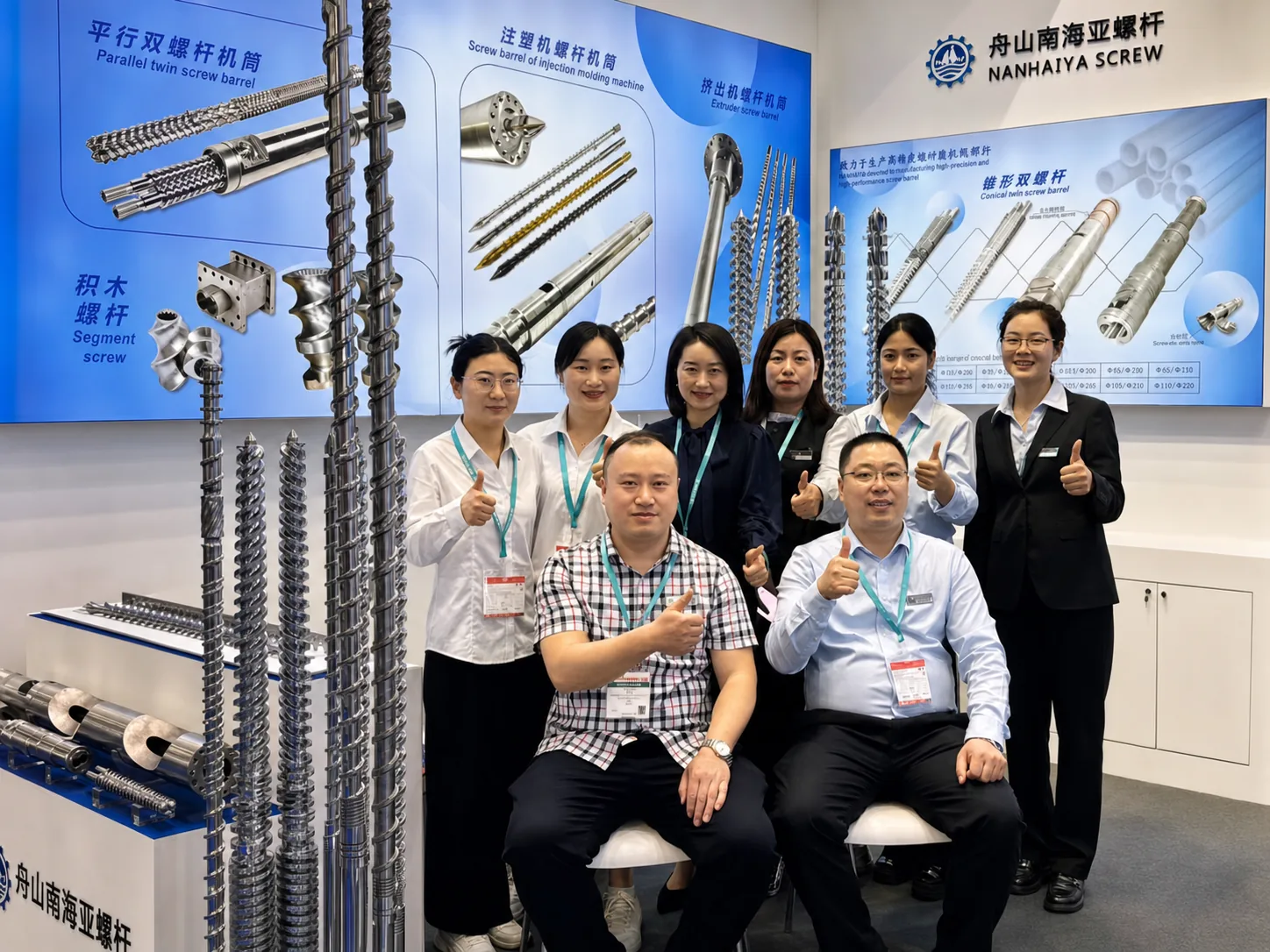
Related Articles
More insights on screw barrel technology and plastics processing.
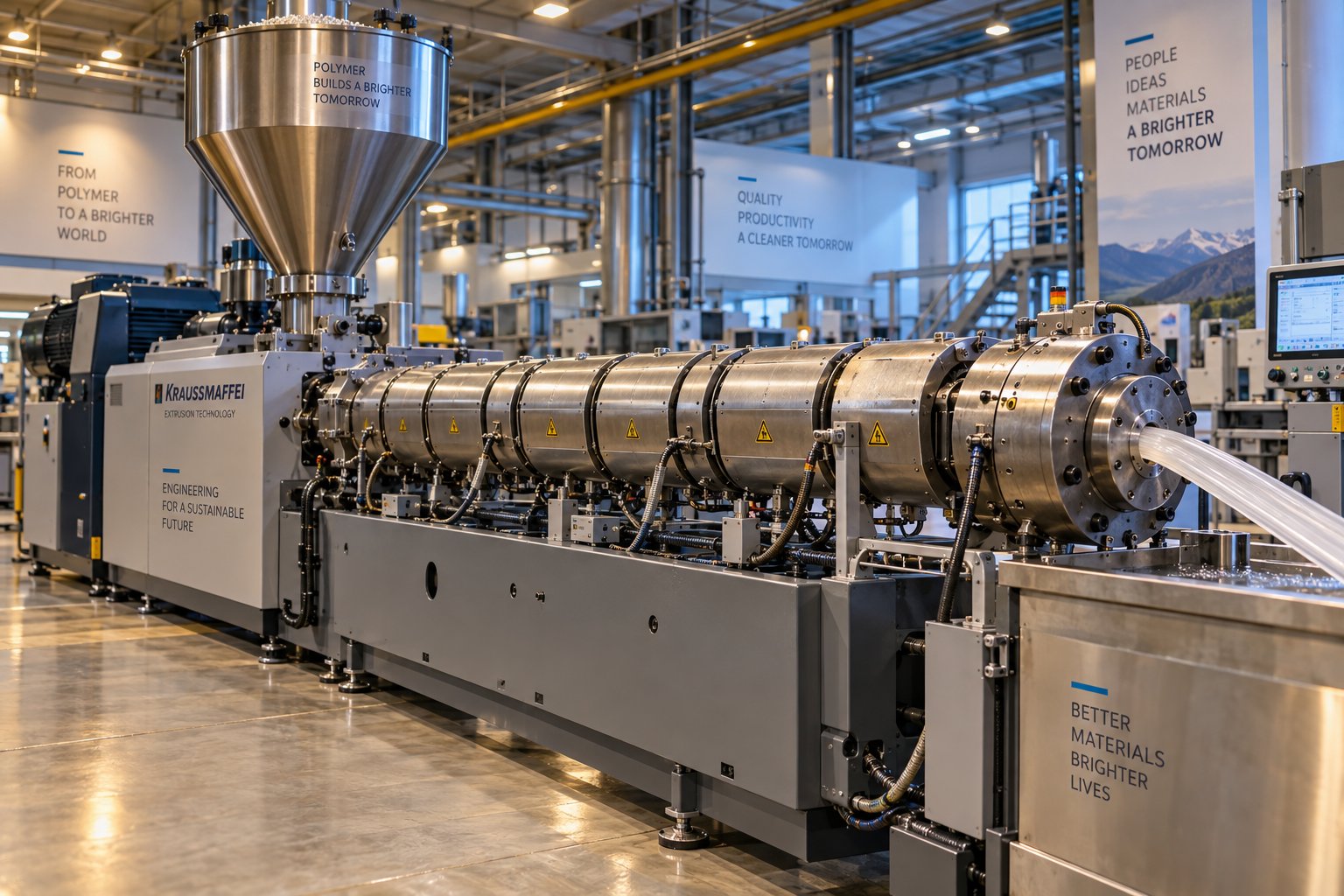
Extruder Machine Decoded: From Raw Pellet To Finished Product
Oct 6, 2026
Learn how an extruder machine works, compare single-screw vs. twin-screw types, and get expert guidance on specs, troubleshooting, and selection.
Read Article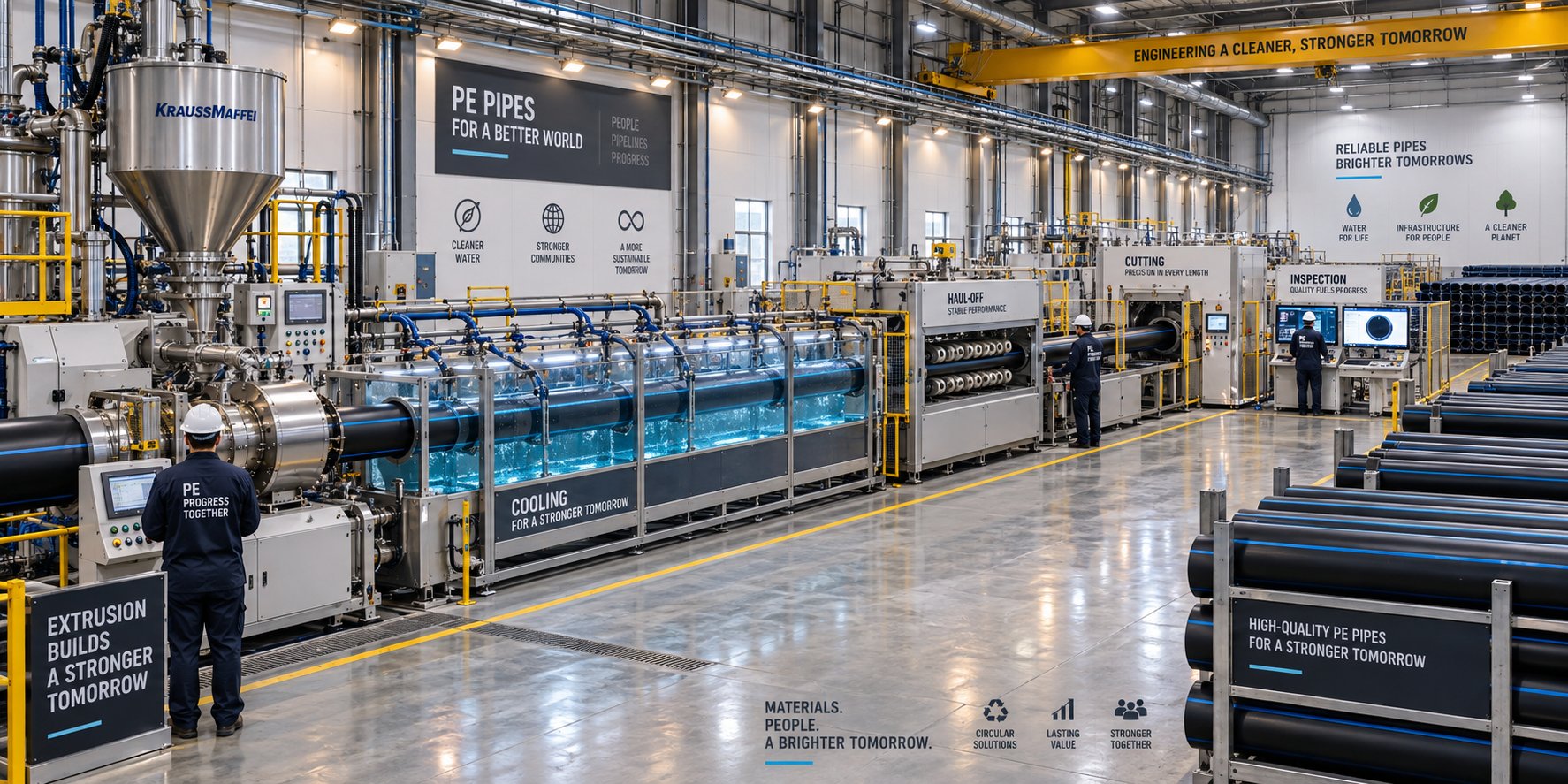
PE Pipe Making Machine Decoded: From Raw Resin to Flawless Pipe
Oct 4, 2026
Learn how a PE pipe making machine works, from resin to finished pipe. Covers components, material grades, automation, troubleshooting, and buyer selection tips.
Read Article
PVC Profile Making Machine Decoded: From Raw Resin To Profit
Oct 3, 2026
Learn how a PVC profile making machine works — extrusion process steps, key technical parameters, die design, calibration methods, maintenance, and total cost of ownership.
Read ArticleLooking for something else?
Search by material, symptom or product and jump straight to the relevant page.
These are navigation suggestions based on keyword matching — not a quotation, not a delivery commitment, and not a substitute for engineering review. Final specification is confirmed by our engineers against your drawings and processed material.
Need help with screw barrel selection?
Share your machine model, processed material and application. Our team can help with pricing and technical support.